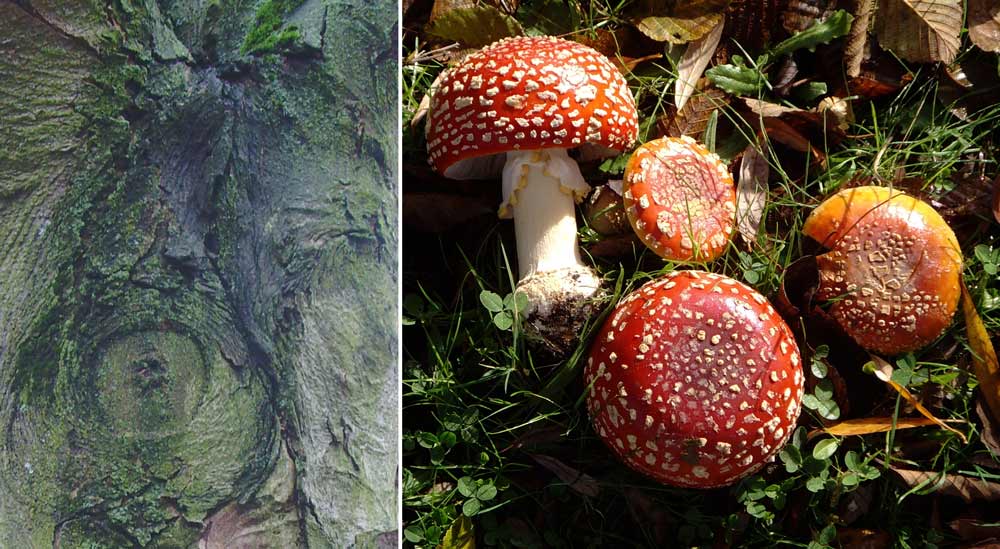
Happily we return now with more landscapes by our friend the distinguished morphologist John Sundsten.This time he mixes Green Lake scenes with an example or two from his midbrain research as an Emeritus Assoc. Prof in the Department of Biological Structure at the University of Washington (We write it out for those reading this in Wisconsin.)As he explains in his brief and poetic introduction, John frequently walks the circle around Green Lake here in Seattle.Although he is older than I, he is Finnish and so both in fine shape and generally better looking than the rest of us over seventy.Ask any Italian and they will tell you that the Finno-Ugrics are generally the handsomest people on the globe, and the Fins return those sentiments with a strong attraction to Italians.At the bottom of this montage of John’s photographs, we have included one of his cross-sections of the midbrain, for which John offers a helpful analogy, that Jean has illustrated this lovely fall Sunday afternoon from the 45th Street I-5 Overpass.
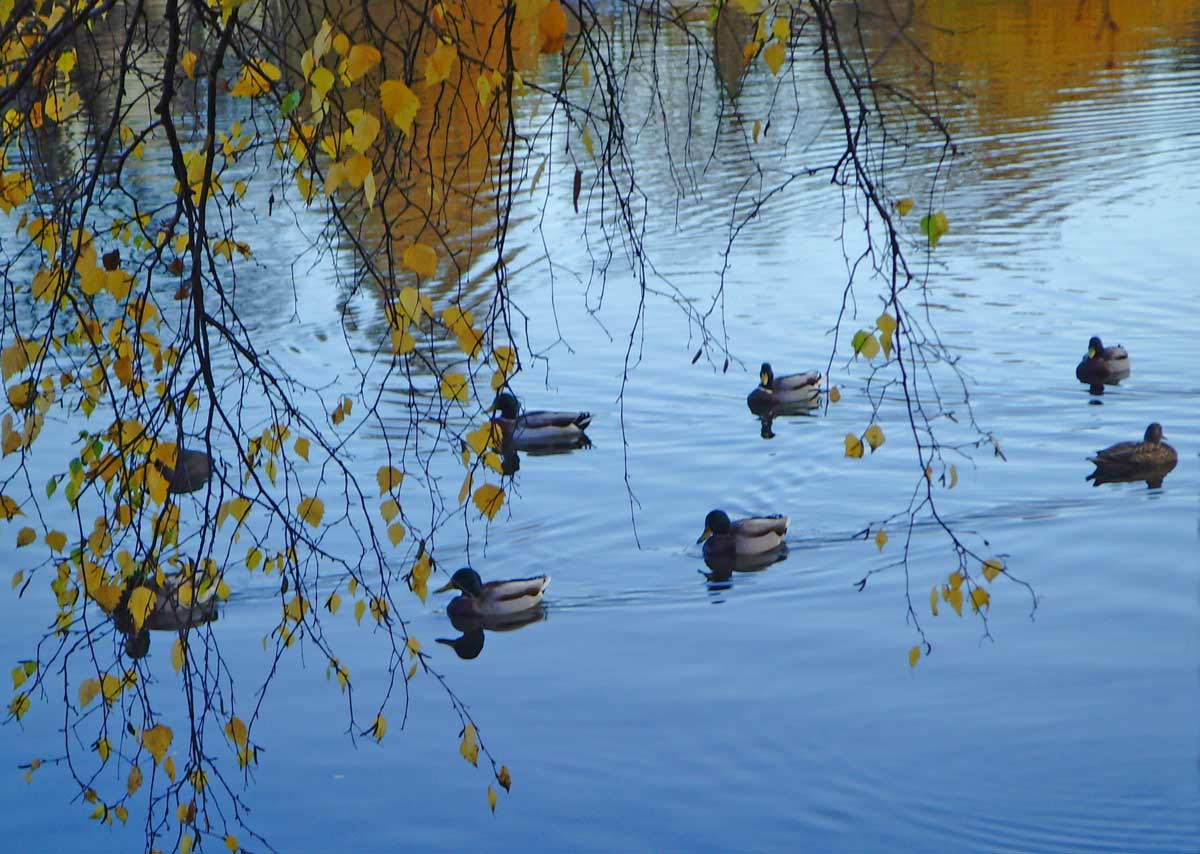
Two examples of inspiring Green Lake morphologyWhen John Sundsten sees ducks in a row or two rows he also sees patterns of synapses and sub-arachnoid spaces filled with gray and white matter in great splendor.
Here follows John’s introduction, followed by more examples from his Green Lake walks and concluded with a slice of his research.
These views around Green Lake were made in the last couple of months or so (August-November). In my more or less daily walks around Green Lake there are always new things appearing to me, whether clusters or mounds of landscaped trees, or loner trees angled in strange ways, or unusual unnamed trees, or treetops against an endless sky, or tree branches arching into space, or tree bark crackling or peeling or canyoned, or stones left as solid reminders, or changing foliage moving in slow time, or long views of the other side mirrored in the water, or lazy-sometimes-busy birds eating or claiming rights, or lakeside details of ferns and other growing things crowding each other. And every day it is different in color and tone, with unknown expectations like the initial wonder in a love affair.
[Remember – CLICK to enlarge.]
The above is a transverse cross section (imagine one of a stack of poker chips) through a part of the human brain called the midbrain. The neuron cell bodies are stained a cresyl violet color. Unstained (more or less) zones are where the nerve fibers (axons) are packed together. The polygons encircle various neuron components found at this level. The midbrain does many things but perhaps most important is that it is essential for the maintenance of consciousness. One of the other things it does is to regulate movement (along with many other structures). Note the very dense accumulation of stained neurons at the bottom of the figure. Some of these form the Substantia Nigra, which cells project to basal ganglia in the forebrain. When no longer functioning properly (a loss of a neurotransmitter, dopamine), Parkinson’s disease results. Most of the non-staining regions are axons packed together, traveling through to other destinations. Imagine you are on the overpass at 45th and I-5, and you are looking through this section of the brain. The nerve tracts are like the freeway traffic; a lot of it is going to Everett (the forebrain) and a lot is going to Tacoma (the pons, medulla and spinal cord).
Below and by way of analogy only is 1-5 looking south from the 45th Street overpass on Sunday Nov. 15, 2009. (by Jean Sherrard)
Postcard photographer M. L. Oakes has captioned his subject “Edgewater looking N.E.” and yet many, perhaps most, of those now living in these blocks will, I’d bet, have no inkling that they live in Edgewater. Some will put themselves in Fremont, others in Wallingford. Only a few will prefer Freeford or Wallingmont. In spite of this confusion, we thank Oakes, for it is rare indeed to find a historic glimpse into any part of old and now largely forgotten Edgewater, especially this extended part of it north of 40th Street.
Woodland Park Avenue is in the foreground, and you can make out the Green Lake trolley tracks running to either side of the darker strip of weeds allowed to grow in the middle of the avenue. Near the scene’s center, 41st Street climbs into Wallingford east from Stone Way, which can also be glimpsed center-left, and a portion of the intervening, and appropriately named, Midvale Avenue is evident center-right. Not more than ten years before Oakes recorded this subject a trout stream flowed through this vale south to Lake Union.
The Edgewood neighborhood was first platted at the north shore of Lake Union in June 1889, soon after Seattle’s “great fire.” Perhaps the partners in this platting, north shore farmer William Ashworth and one time Seattle Mayor Corliss P. Stone, figured that fire-frightened citizens combined with the flood of immigrants, would bring home builders to the north shore of Lake Union. Whatever, they were right. It helped that since 1887 one could easily get here on the Seattle Lake Shore and Eastern Railroad’s commuter service. Also the electric trolleys that first reached Fremont in 1890 over a Westlake trestle continued north to Green Lake, here along Woodland Park Ave.
The home on the right is not among the many homes In Oakes’ view that survive a century later, but the large box, far left, did make it. It was built in 1906, 39 feet wide, and by the mid-1930s another symmetrical 24 feet was added at the rear. Within then were five apartments, one of them with five rooms.
WEB EXTRAS
Jean turned his camera to the southeast and took a couple more shots through a veritable mare’s nest of wires, combined below into a panorama.
The rest of the view
In our next blog post (see below), Paul offers a detailed examination of photographer Oakes’ somewhat narrower southeasterly view.
And near the end of a long and fruitful day, Paul pauses to admire a spectacular tomato bruschetta at his beloved Ivar’s.
Oakes' view to the southeast. Courtesy John Cooper
Postcard “artist” Oakes turned his camera to the southeast and took a second look across the “lowlands” of upper Edgewater. Here, again, Woodland Park Avenue clearly crosses the bottom of his frame, and the trolley tracks heading for Green Lake are there to see. On the left men are working in the vacant lot at the southeast corner of Woodland Park Ave and 40th Street. Beyond them are two homes facing Midvale Avenue and left and to the east of those homes is a patch of the graded scar of Stone Way, an avenue that was relatively slow to be developed through this lowland. These two-plus blocks between Woodland Park Avenue and the hill east of Stone Way once shared their vale with a small creek. Beyond the graded land is another large vacant lot or lots, the future home but now past home of Safeway at the southeast corner of Stone Way and 40th Avenue. Cows are grazing there where now yawns a flooded construction pit. For the other Oakes Edgewater scene above, Jean shares a contemporary pan that repeats both of Oakes’ shots. Below are a roughly patched or merged sequence of snapshots taken this afternoon (11/7/09) of the old Safeway Block from near the northeast corner of 39th Street and Stone Way. It seems that the developers here may have resumed digging their pit. And below that patched pan is a ca. 1904 map of much of Seattle north of Lake Union.
Circa 1904 map of Seattle north of Lake Union.
The big north end neighborhood we now know as Wallingford is not recognized in his circa 1904 map. Instead its streets are “divided” between Edgewater and Latona, both neighborhoods that are now remembered only by citizens with the wit to study recent history. A red arrow has been drawn in the the still undeveloped acres to either side of Stone Way the line of which is indicated by a row of hand-fashioned red dots. An isolated dot – the arrow points towards it – near the corner of Whitman Avenue and 40th Street indicates the prospect from which Oakes took his two Edgewater views a few years after this map was published. The neighborhood of Brooklyn, far right, is long since known as the University District. Ross, on the far left, is remembered with a playground on Third Ave. Northwest at 43rd Street, the home formerly of Ross School.
The business center of Edgewater at 36th Street and Woodland Park Avenue ca. 1910.The same corner block in 1950, but without the hardward store.Both the corner structure and the large box behind it have survived and with some of the same second floor window forms (fenestration). This view was photographed earlier this afternoon of Nov. 7, 2009. The "North End" from the west slope of Capitol Hill looking northwest across Lake Union, ca. 1895.
This is but one of several views that look north over Lake Union to the developing north end of Seattle in the 1890s. “East Fremont” merging with Edgewater is the centerpiece on the far shore, and to the right of it is the scattering of structures associated with “Independent Edgewater”. Note that the “lowland” along Stone Way is still hardly marked by structures. The actual first plat (below) of Edgewater was for streets and lots to the east of the then future Stone Way. On the far right is a portion of the future “Wallingford Peninsuala” or Gas Works Park. The forest on the horizon is (about) north of 45th Street.
The original 1899 plat map for Edgewater. (Courtesy Washington State Archive on the Bellevue Community College Campus)
ANOTHER WEB EXTRA – LINCOLN HIGH SCHOOL.
(This feature first appears in a slightly different version in the Seattle Times issue of Pacific Northwest Magazine for April 10, 2005.)
Lincoln High School, ca. 1914.A repeat for the above ca. 1914 photograph. Like the original feature it also dates from 2005.
This little sketch of Lincoln High School history began by consulting Nile Thompson and Carolyn Marr’s “Building for Learning, Seattle Public School Histories, 1862-2000.”Within we learn that although Lincoln High closed its doors to Wallingford teens in 1981 the now more than century–old story of the school on Interlake Avenue is not over.
First in 1997 it was the students of Ballard who used a renovated Lincoln campus while a new Ballard High was built for them.Next followed the kids form Latona for their two-year stint during the renovation of their campus and following them the students of Bryant Elementary School were bussed to Lincoln while their building was renovated. Roosevelt High followed as that campus was also rebuilt.In a way, the Roosevelt students’ visit was a return of what that school took from Lincoln when it opened in 1922, capturing about half of the older school’s territory with it.Garfield was next in 2006 and in two 2006 “now” photos printed below a temporary sign for the Garfield High holds the corner.Garfield would stay for two years.Now since September of this year (2009) the students of the nearby Hamilton International Middle School are meeting at Lincoln and will use it through the school year as their Hamilton home is renovated.
Early in 1906, an anxious Seattle School board committee scouted the Wallingford site when there were still some scattered stump fields remaining from the original clear-cutting of the late 1880s and early 1890s.The 30-room “Little Red Brick Schoolhouse” was built with speed, and in the following September enrolled 900 students – many of them from Queen Anne.Two years later Queen Anne got its own high school, which it has also since lost.In spite of the Queen Anne drain Lincoln kept growing.
The view accompanying this little history that looks southeast through the intersection of North Allen Place and Interlake Avenue North dates probably from 1914, the year its new north wing was added.In 1930, a south wing followed, and in 1959 an east-side addition.That year Lincoln was the largest high school in Seattle with an enrollment of 2,800. But soon enrollments began a steady decline and 21 years later the home of the fighting Lynxes, would close for a rest until, as noted near the top, it would reopen again and again.
The "Little Red School House" from a postcard of the time, ca. 1909.We come around from the two Oakes Edgewater views described at the top with another Oakes, this one of the new - in 1907 - Lincoln High School. The view looks northeast from 43rd Street and Interlake Avenue.An exposed Lok cafe on the left, and a hidden Lincoln High behind the trees still in full green on Sept. 5, 2006. Same corner of Interlake Avenue and 43rd Street, only eleven days later. The trees are turning but the temporary Garfield High School sign is still in place on the right. The crowded halls of Lincoln about the time - in the late 1950s - it was the largest high school in Seattle.