
Our Daily Sykes #98 – "Winter Color in Wyoming"



Merci chers amis de Seattle !!!!


Here’s some help from Robert Cross of Camas, WA. Robert was alerted to our confusion by a mutual friend, Angela Roark. Thanks Angela. Cross has used Google Earth better than we did, perhaps because he was willing to cross the Columbia River with it. We didn’t. Here’s his description of what he discovered.
“OK. I checked it out on Google Earth, and pinpointed it exactly, by going down to birdseye level/angle, matching up the view of the mountain, and then flying backwards until the landmarks in the foreground were in view. This photo was def…(tharr be more)initely taken from the hills above Lyle, WA, looking across to Rowena and then down towards the mountain from the NE. I would say that it’s either Alder Springs Rd/Oliver Point Rd or a little further up on the hill at Oda Knight Rd. Looks too far from the river to be Riverview Rd. Is that good enough?”
It surely is good enough Robert, and thanks much.


(click to enlarge)
THE HORRORS OF TRAVEL
(Harpers Weekly Sept. 23, 1865)
“All aboard” a train
Riding into another train
Or over a cliff because someone
Or something broke a rail!
Whether intentionally or innocently
It is equally horrible for you and the conductor.
That’s it, that’s all, your life is over!
So long, so short
Now no difference.
Think of playing an accordion so blithe
Aboard a side-wheeler, enjoying the cruise.
The steamer blows up – in two.
You, the squeezebox, the purser go three ways.
There is no help – no big sand pail
No caustic for a ship breaking up
Or glue for its passengers and crew.
In spite of all the jolly talk
About comfort and progress,
Or gainful commerce taught
About investments in transshipments,
“Where Rail Meets Sail”
Was once also a horrific thought,
Immigrants jostled in schooners in a storm,
Tourists steaming aboard a Blue Funnel
Travelers riding west on a Mountain Goat
Most expected that those machines were well wrought
With handiwork fit tight and crews well taught
But still climbing up the riders’ throats
Were the old horrors of travel.
Boarding a train or schooner
You don’t have to any longer.
But there are modern ways
To find perdition sooner.
Take your own motorcar
Or ride a motorbike
Into a slippery night.


It is sometimes difficult for an associate editor to decide on what page to put a story. Instead, we give this wrecked Oakland three chances for broader meaning. It is clearly a WRECK, but it is also an Unintended Effect, and not knowing on whose lawn we have found it, this embarrassment is also somehow confidential, although exposed. Ron Edge contributed this scene, but Ron, for now, is not able to place it, except to note that it comes from a collection of Seattle-based negatives, which are big glass ones. Perhaps some reader can figure the location and make it all less confidential. It seems to me most likely that it is somewhere on the first ridge east of downtown, which is First Hill and Capitol Hill. It is also Ron who calls this unintended wreck an Oakland. He explains that because the original is from a large glass negative he could read the name in a detail of the wheel.


With WRECK we add another numbered feature to this blog, and we do it for several reasons. First, people like them. Next, WRECK will remind all of us to be careful. Really we give this advice especially to those we love, and not to everyone. We will be honest about this. If everyone were careful there would be fewer auto wrecks to choose from for these object lessons in safety. And if everyone were very careful, there would be no driving at all, and so no wrecks and also no feature. We would need to return to runaway horses. So we are prepared to encourage those we neither know nor love to go ahead and keep on driving. In spite of how hard it is to face our own meanness in this, we know that our position on this will make no difference. People need to get places fast. And with WRECK we need wrecks for those who like to look at them, which is just about everybody. Like the Romans watching gladiators, driving is a blood sport, although it does not seem fair to have passengers involved, even ones we neither know nor care for. (Consequently, we will avoid showing bodies.) WRECK will be this blog’s embrace of journalist sensation, when we can find them. In this line, please share your wrecks with us, and we will show them in all their mangled spectacle and twisted art. Yes, we might have included practically any wreck as another example of an “Unintended Effect” – the name for another of our newer features – but we chose to give WRECK its own place. Be sure sure to CLICK TWICE not just once to see the spectacle in great detail.


It was Ron Edge, a friend and collector and guide for our sometimes feature here of “Edge Clippings,” who gently pulled this week’s subject from a short stack of historical prints and asked, “Do you know where this is?” I did and my heart leaped because of it. The sheds were easily referenced to two other surviving glimpses into parts of the Belltown Ravine. (See below for one of them.) Ron’s third view is the most recent and the most direct.
The ravine was unique for there were only two breaks in the embankment or bluff that once rose abruptly from the beach to varying heights for the mile between Columbia and Broad Streets. A small ravine near Seneca Street was used for a tribal graveyard. This much larger ravine between Bell and Blanchard Streets cut nearly three blocks into the northwest slope of Denny Hill before reaching grade near Bell, between First and Second Avenues.
The sheds, some of them built for squatting, were removed when the Great Northern cut into the bank to dig its tunnel beneath the business district. The ravine was filled by fits between the 1880s and 1920s and then forgotten. I found its topography on a map when asked to figure out the source of human bones that were found in what I soon determined to be landfill brought from another place. Since the lost ravine had no name, I took the “explorer’s right” and named it the “Belltown Ravine” for the neighborhood it penetrates.
It was another old friend, the yachtsman, wit and author Scott Rohrer who’s heart also leapt when first shown this photograph. But Scott’s stir was more for the 32’ sloop Evelyn May here held steady in her cradle at the mouth to the ravine. Scott identifies Seattle Yacht Club Commodore C.D. Stimson as the one who ordered the Evelyn May and naval architect Leigh Coolidge as the sloop’s designer. In an essay he wrote on this subject for the Binnacle, fittingly the Yacht club’s periodical, Scott notes, “We have no record of her builder who may have made his home in this little pocket and worked for a larger yard.” And the maritime historian adds, “She won a number of races, some in heavy weather.”


Here begins another category of interest, which we have named “Unintended Effects.” In this case it is three double-exposures, and all came from Victorian era photo albums assembled in the Northwest. Two have their own captions. (Click Twice to Enlarge)
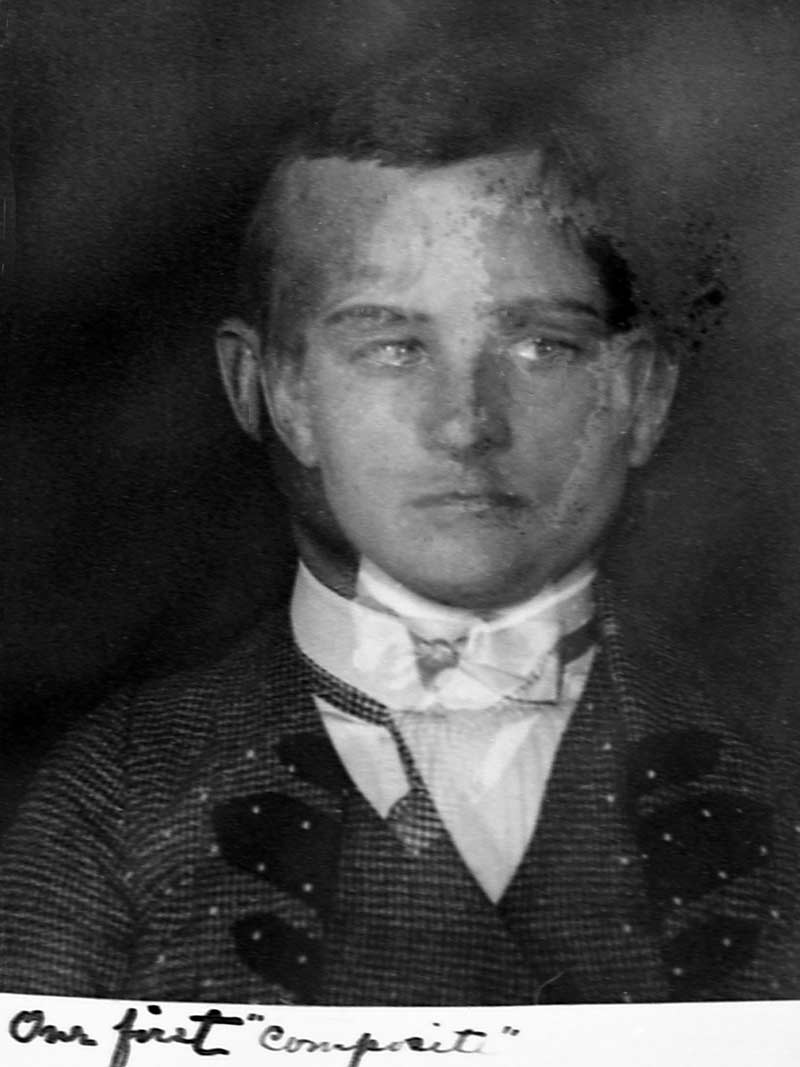


AN ANTIQUES ROAD SHOW 85 YEARS AGO
(click TWICE to enlarge)

1925 REAL ESTATE BOOMING HEADING FOR BUBBLING
(CLICK twice to Enlarge)


In the gaggle of vessels hugging the sides of the Pike Street pier it is the 1200-ton wooden steamship Santa Ana that shows a full profile. She may be backing out of the slip between the Pike Street and Schwabacher’s piers. However, there is a chop on Elliot bay and the black smoke from her stack may be pushed east by a breeze off of Elliott Bay. Perhaps the Santa Ana is coming home from Alaska to her Northwestern Steamship Company (the name is written on the pier) terminus.
The Pike Pier is a triumph of preservation for us, as are the other “Gold Rush Piers” that still line up behind the photographer of this scene – and so behind Jean too. Both the “now and then” were snapped from the water end of Pier 57, the old Milwaukee Railroad pier. All of the old piers follow the angle into the bay prescribed for them in 1897, although all were built in the early 20th Century. The wealth got from warehousing and wharf rates during the gold rush of the late 1890s allowed the dock owners to build these conforming and bigger piers after the greatest excitement of the rush settled down – although some gold fever continued with the rush to Nome during their construction.
The Pike Pier was planned in 1903 and completed a year later by Ainsworth and Dunn. They also rented space to both the steamship line and the Mt. Vernon farmer Willis Wilbur Robinson, whose name is writ large along all sides of the Pike Pier. Robinson stuffed Skagit River sternwheelers with hay for delivery to the Pike Pier, until railroads did the hauling cheaper. About 1911 Robinson’s block letters were replaced by ones for a steamship agent named Dodwell.
Ainsworth and Dunn sold fish primarily. They started the move of fish merchants to the north end of the central waterfront in the mid 1890s. Before their lead most fish commerce was handled south of Yesler’s Wharf. In 1916 Dodwell was replaced by Pacific Net and Twine Company, and from then until after World War Two, Pike Pier was home for fishermen and the professionals who serve and represent them.
[CLICK TO ENLARGE]


You may find some clues in this mysterious party portrait – or you may not – but when all is described the mystery abides. Who are these people once so confident in their pleasure and now passed or worried perhaps and withdrawn in the past? I may recognize the back of one head – that in the middle background with a hand on its shoulder. However, not wishing to influence your speculations I will not name mine.

Horace Sykes loved orchids especially and there are nearly as many slides of flowers in his collection as there are landscapes.


Scenes from Seattle – or near it – so confidential we don’t know what they are. Some, we imagine, are erased forever. Others you may know, but we do not.


Berangere sends us a special post from Paris:
Every year, on the first Sunday of July is celebrated “the Félibrée” or an Occitanian Fête, in a different town of Périgord. Montignac has been chosen four times since 1913.
The Félibrée is a célebration of Occitan language, tradition, earth and Perigordian customs.
For several months all the population of Montignac has been dedicated to the decoration of the town, making flowers and sewing traditional clothes. It is organized by the “Bornat du Périgord” which means apiary or school of Perigordian félibrée , which is an association of every person with occitan knowledge.
The Félibrée lasts two days and follows a very precise ritual; it is not so touristic, but mostly of interest to the inhabitants of Périgord.
Chaque année, au premier dimanche de juillet est célébrée la Félibré, ou fête de l’Occitanie, dans une ville du Périgord à chaque fois différente. Montignac a donc accueilli pour la 4ème fois les félibres depuis 1913.
La félibrée est une fête de la langue d’Oc et des félibres, de la tradition occitane, de la terre et des coutumes périgourdines, héritée des troubadours qui jadis chantaient en langue d’Oc dans les cours d’Europe.
Depuis plusiurs mois, toute la population se consacre à la réalisation des décors dans la ville, des fleurs, des costumes traditionnels.
Mais cette fête est organisée par une association “le Bournat du Périgord” signifiant la rûche, qui est une école félibréenne du Périgord, cette association réunit toutes les personnes détentrices d’un savoir occitant.
La fête dure deux journées et obeit à un rituel très précis, elle n’est pas très touristique mais intéresse principalement les Périgourdins…


After the different folkloric groups cross the city:
Après la traversée de la ville par les différents groupes folkloriques:


(click to enlarge photos)


Frank Shaw recorded his look up the old Pike Street Hill Climb less than two months before Seattle Mayor Wes Uhlman grabbed a shovel to break ground here for the grand stairway that Jean Sherrard shows us with his “now.” So it is not so long ago that Uhlman shoveled (Jan. 17, 1977) and Shaw snapped (Nov. 22, 1976). Shaw almost always dated his negatives, and the roving photographer returned many times to this scene to track with his Hasselblad how this public work advanced.
The oldest built hill climb here was a trestle, down and up, which coal cars were winched between the Pike Street Coal Wharf and a narrow-gauged railroad that was run to the south end of Lake Union.
There the cars took on coal from scows that were alternately hauled and floated there from mines on the east side of Lake Washington. It was a difficult route, but it paid very well. In 1878 the entire operation was smartly replaced by a new railroad that ran around the south end of Lake Washington and thereby directly between the coal fields of Newcastle and a new coal wharf at the foot of King Street.
Panoramic photographs from the 1890s of Denny Hill show what appear to be steps near the top of this incline. Otherwise, buildings obscure the view. In 1911-13 a steep pedestrian trestle was built over the dangerous Railroad Avenue, and the trestle continued on high above these steps to connect the Pike Street Pier directly with the then 6-year-old Pike Place Public Market. The trestle was lost to the Alaskan Way Viaduct in the early 1950s, but not the steps below it.
Shaw’s photograph may make some readers downright nostalgic for the old public market and its rough surrounds.
Looking into the Market from the north on a recent evening:

Anything to add, Paul?
Yes Jean – a few more variations on Pike Street Hill Climb aka Hillclimb.


In searching for this site I skimmed the surface of the Snake River from the mouth at the Columbia through the roughly 130 miles upstream to it’s Clearwater contributions at Lewiston/Clarkston on the Idaho-Washington border. About 20 miles down stream from Clarkston I found the site, or believed I had.
In the slack Lower Granite Lake, behind the dam of the same name, the orchard seen here far right has been submerged, and many others that once thrived along the banks of the Snake. (Horace Sykes took his photo ca. 1950 when the river was still running free, and the fish were not confused.) Ladders that were included with the four dams built in this stretch of the Snake between 1948, when the site was chosen for the first one, Ice Harbor ten miles above the Columbia, and 1975 when the last three – Lower Monumental, Little Goose, Lower Granite – were dedicated.
With the opening of the locks, Lewiston and Clarkston became ocean seaports. In the first full three-year period after this “Inland Passage” was completed, barge traffic increased through Lower Granite from 559,000 to 1,422,000 tons – by now a nearly ancient statistic, and one for which I have no recent update. Most of this was wheat that the railroads had formerly hauled, some of it to Puget Sound ports, although the commerce of southeast Washington was almost always more tied to Portland than to Seattle/Tacoma.
The Canyon drop here is on an average about 2000 feet from the wheat fields of the Palouse above to the lake/river. Garfield Country is south of the river and Whitman County to the north.
When I returned to Google Earth to hunt a name for the contributing gully on the right I became confused and could not find my way. Perhaps some reader would like to try and find this place again, starting with my suggestion (only) that it is about 20 miles down stream from Clarkston, and about 12 miles south of Pullman.
The road along the north bank of the river is called the Wawawai River Road. Wawhy we can imagine. (Click to Enlarge.)


And once again, here’s the photo taken in the video (click to enlarge):

[Click to Enlarge] When first I looked upon this Sykes slide I thought that it was most likely somewhere above Lake Chelan, and now after using – again – Googlecopter, it is confirmed.
That Horace Sykes also drove his Chevrolet up the Shady Pass Road from the Entiat River valley means that he reached the lake from behind. Or did he? It is also possible to reach these heights from the other end of Shady Pass Road at the 25 Mile Creek on Lake Chelan, this means that it is roughly 2/5th of the way up the lake from Chelan to Stehekin. I doubt that it standard to ferry anybody’s Chevy up the lake to 25 Miles Creek, so I conclude – as introduced – that it is more likely that Horace got to this prospect from the south – from the Entiat side. I name the prospect Grouse Mountain because there’s a blue dot photo there that is captioned so. The highest point on Shady Pass Road is a few miles northwest of this prospect and it is considerably higher. This elevation is about 4,500 feet. The Pass and its campground around 6,600 feet. Lake Chelan is 1,102 feet above Puget Sound.
If I have figured correctly the mountain seen far up the lake is Goods Mountain, the highest point in the North Cascades National Park, “the fourth highest non-volcanic peak in Washington, and the twelfth highest summit overall.” Quoting there from Wikipedia.
Mt. Goods has this added mystery. In spite of it height, Goods cannot be seen from any highway. It rests in a sublime boudoir surrounded by attendant (or at least watchful) peaks that reach heights nearly its own. Together they are not a massif – like the Wallowas in northeast Oregon – because this range continues on to all sides far beyond park boundaries .


Independent of our wives, Jean and I were busy Americans yesterday – Independence Day – between Noon and 6pm. First we visited the “This Place Matter’s” demonstration in front of Alki’s closed and ribboned Homestead Restaurant. (Ribbons and not bunting. They were yellow and not red-white-&-blue.) The sun came out for the moment of Jean’s recording and then retreated as we scampered off to Gasworks Park and the Celebrity Chef Fourth of July Salvation there. We arrived in the rain.
Below are an unattributed mix of snapshots (without fireworks) we took when we were not eating from the potluck at the Alki Lob Cabin Museum or the buffet table in the sponsors and noble seniors gated corral, which was fenced at the extreme most pointed and southern part of the Walllingford Peninsula, the best place to sit in the rain for five hours waiting for the show. We didn’t so sit, but the trio in the top-most photograph did – or told us they would. We left much too early to catch the show but none too early to get dry. (I, at least, am getting old and easily dampened in my enthusiasm.)


(click – and click again – to enlarge photo)
I rode with Jean to his high – second floor balcony – assignment, and can witness to the skill he showed in moving the crowd into a shape most fitting. The event itself involved a sequence of about eight speakers – preservationists and/or politicians. Clay Eals was the Master of Ceremonies and he wore his big blue Australian (I think) hat. (You can find Clay about four persons over from the far right end of the “This Place Matters” sign. He is in a white T-shirt.) The sun came out just before Jean started to work. Every speaker Clay introduced was told that they should keep their remarks to 30 seconds, which means, I think, two minutes, but never more than that. Our recent mayor, West Seattle’s Greg Nickels was there and with a fine beard too. He kept his remarks to two minutes, which was in the spirit of 30 seconds. Greg is in red just up and left from the left end of the “This Place Matters” sign. The message was also a chanting motif of the event, with each speaker repeating the line while leading the crowd in a chorus of “THIS PLACE MATTERS.” At one moment in this chanting I looked too longingly towards the closed chicken dinner house, the Homestead, and imagined – or heard – in an interval of “This Place Matters” one sounding of “Chicken Platters” while remembering the many poultry feasts we enjoyed during the founding and funding of The Log House Museum. Someone counted 196 faces in that chorus. Someone else added three Waldos. So it was a crowd of two hundred then.
(click to enlarge photos)


Long ago when first I studied this look northwest across First Hill I was startled by its revelations of the hill’s topography. The hill does not, or did not, as we imagine steadily climb from the waterfront to the east. For instance, here Cherry Street between Fifth and Sixth avenues — the white picket fence that runs across the scene’s center marks the north side of that block — keeps a fairly flat grade and then, where it intersects with Sixth Avenue, defies all our modern expectations and dips to the east.
James Street, on the left, climbs First Hill between Fifth and Sixth on an exposed-timber trestle. To the lower (north) side of that bridge there was about a four-block pause between James and Columbia, Fifth and Seventh, in the steady climbing we expect of First Hill. Now in these blocks the flat Seattle Freeway repeats this feature ironically.
There are enough clues here to pull an approximate date for this unsigned cityscape, which looks northwest from near Seventh Avenue and Jefferson Street. It is most likely sometime during the winter of 1887-88. The best clue is the Gothic spire atop the Methodist Episcopal Church (until recently First United Methodist) far left of center. There is still construction scaffolding on the sanctuary, which was completed at the corner of Marion and Third Avenue in 1889. On the far right horizon is the Central School (it burned down in 1888) and to this side of it the McNaught big home, recently featured in this column, at its original grade on the corner of Marion and Sixth.
This panorama is strewed with other pioneer landmarks, including the Western House at the southeast corner of Sixth and James. It is the large L-shaped box below the scene’s center.
Anything to add, Paul? – And don’t forget that we’ve got an appointment this afternoon in West Seattle. At 1:30, we’ll be taking a photo of a crowd in front of the Homestead Restaurant, as mentioned in last week’s column.
Paul replies: I’ll begin by adding my voice to your voice, Jean. Yes I’ll be at Alki Point to be photographed by you, because, you know I riding over there with you. And I do have something to add as well to the above story. This is easy. May the reader go back to May 1 of this year (nine pages back) and find the now-then feature about the McNaught mansion at 6th and Marion. It includes other images that relate to this week’s point about the odd topographic ways of First Hill in its ascension from 5th to 8th through a section holding (or whatever) Jefferson through Marion Streets. One of the pictures supporting that story is the same one that was used for the primary photograph this week. So the reader gets two captions for one.
On the side and also in closing, I will say I am most startled by finding that “back then” when the flowers of May were asked to wait a while longer by the showers of April, we had only reached Our Daily Sykes #18, and here we are into the seventies. Horace would be proud of us Jean.

A scene taken in the same direction and from nearly the same prospect as Sykes appears as a volunteered “blue-dot” photograph in Google Earth. It includes what I imagine is an ironic caption. “The east moraine before the houses go in.” I doubt that this slope has since been dappled with houses, although the uses of Lake Wallowa have been sometimes exploitive. This is Nez Perce land and by treaty it remained theirs until gold was discovered nearby and the lake and land around it was taken back by the feds for settlement – and the rest – in 1877.
The Nez Perce war with U.S. Regulars that followed was one of the last battles between “manifest destiny” and Native Americans, and led to the 1000 mile near escape of Chief Joseph and the tribe for Canada – but not quite to it. It was the occasion of the Chief’s famous “From where the sun now stands, I will fight no more, forever” speech. Now, in a mix of admiration and white guilt, Mt. Chief Joseph rises to the west of the lake as part of the massif known as the Wallowa Mountains, and the town of Joseph sits near the north end of the lake, in the direction Horace points his 35mm slide camera here.
To his left but out of frame, the south end of the lake is well stocked for tourists with lodges, cabins, marinas, and prepared food. Both Hells and Imnaha canyons (and several more) are off to the east, and not so far away. The several canyons that drain the Wallowas to the north are to the west and northwest of Wallowa Lake where one will also find the town of Minam.

Since Horace Sykes did not caption his subject, I needed some help. With good effect I asked coastwise historian Gene Woodwick, and she helped track these jetties down.
Since Sykes lived in Washington I thought first of the Washington coast, but what ports are there along our coast with jetties that resemble these? None. Gene suggested I move to Oregon, which is where Sykes came from when he moved to Seattle in the late 1920s to take up a new job as an adjuster with Northern Life Insurance. With Gene’s advice I started near the south end of the Oregon coast at Gold Beach, where the jetties are about 900 feet apart. But they did not match. Next I backtracked south to Chetco River – about 250 ft. wide at the mouth – but without success. Then I Googlecoptered up the entire Oregon coast and found six more pairs of jetties – and so eight in all. They appear in this order, south to north: Chetco, Gold Beach, Coos Bay (1700 feet), Glenada/Florence (750 feet), Yaquina Bay / Agate Beach / Newport (1100 feet), Tillamook Bay (1200 feet), Nedonna Beach (650 feet), and Rockaway Beach (600 feet). All those widths are approximate measures using Google’s yardstick.
It was not difficult to match the Yaquina Bay jetties, as looking west from the north end of the Newport Bay Bridge’s great arch, as the correct choice. We cannot tell, however, if Horace Sykes shot from a moving car or stopped for a moment on the bridge. You may note the lone boat heading into port.