THEN: Part of the roofline of Cascade School - the school that named the neighborhood - rises above a tight ensemble of workers homes in 1937-8. (Courtesy Washington State Archive, Bellevue Community College branch)NOW: The school was damaged by the 1949 earthquake and removed. These homes were razed in the early 1980s and replaced first by a play area for day care. Since 1996 the corner has shined with one of the city’s many community gardens or P-Patches. Jean Sherrard’s winter repeat may be complemented with the Cascade P-Patch’s own blog at http://cascade-ppatch.blogspot.com/ (Now photo by Jean Sherrard)
For a moment, only, this historical photographer paused on Minor Avenue about 40 feet north of Thomas Street and aiming east snapped this official record of lot 5 in the tenth block of the Fairview Homestead Association’s addition to Seattle. The addition was filed in the mid-1880s but the photograph was taken in 1937 as part of the depression-time Works Progress Administrations picture-inventory of every taxable structure in King County.
The tax assessment here was not very high for these are four nearly identical 900-plus square foot homes squeeze onto one lot, the second lot north of Thomas. The tax card indicates that they were built in 1900. (Perhaps, but they do not show up in the ordinarily trustworthy 1912 Baist Real Estate map.) The intentions of the original pioneer developers were to help working families stop paying rents and start investing in their own homes. Innovative installment payments made the lots affordable and many of the homes were built by those who lived in them, although probably not this quartet.
If we may trust the 1891 Birdseye view of Seattle – and it is splendid to study – Minor Avenue was then part of a shallow ravine or very near it, which gathered run-off in this Lake Union watershed. And since 1996, as part of the Cascade Neighborhood’s public garden that spreads 50 lovingly tended p-patches across this 7000 sq. ft. corner, rain water for the garden is collected into big barrels from the roof of the nearby Cascade Peoples’ Center.
I am a very small part of the footprint of this corner, having lived from 1978 to 1980 in the house immediately to the rear of principal home shown. My desk sat inside the longer window there and looked out on a coiling blackberry patch where now are many kinds of berries, and veggies, and flowers tended with the meditative pleasures of gardening. JoJo Tran, one of the gardeners here, plants for his table and many others. He reflects, “If you love nature, the environment, the colors of the plants, it you can see the beauty of the garden, you feel the beginning of love.”
WEB EXTRAS
Jean writes: Visiting this sacred corner of Paul’s personal history on a sodden day at the end of December was a mini-revelation. Here, Paul lived with his dear friend Bill Burden (whose wise and scintillating blog can be found here and through the button ‘Will’s Convivium’ at upper right) and I snapped him looking bemusedly from the spot he identified as having once contained Bill’s room.
Paul sits where Bill's room once stood
Paul brought along a photo he’d taken from his own bedroom window of the church across the road. We include it again, below.
Paul holds up a photo taken from his window
Here’s a repeat I did of the photo in Paul’s hand above:
Repeat of Paul's original photo
Anything to add, Paul? Or to correct?
BLOG EXTRAS we call them Jean. And yes I have a few – a slew even – of other pictures that catch this corner or nearby. I will given captions for them, but little ones I hope. I have also written a few now-thens (other ones) about landmarks within a block of this corner but I’ll not include them here. I mention that only to inspire longing in the reader or readers if we have more than one, which is to say more than you.
I’ll begin with two of the south side of 306&1/2 Minor, where Bill and I lived in the late 1970s. My desk – with its Selectric typewriter – sat at the larger of the windows on that wall. I looked out across the vacant ans sunken blackberry snarled corner lot to Thomas Street, and to the left of Thomas still stands Immanuel Lutheran Church. After the views of the window, I’ll place one that looks from it to the church on a night of snow, then others photographed in the late 90s and early 2ooos of the p-patch development. I will date them as best as I can. I believe a highlight of what follows will be my snapshot of Bill trucking down the Minor Avenue sidewalk.
306&1/2 Minor North looking north from Tomas, ca. 1938. A tax photo.306&1/2 Minor in 1958 with "War Brick", a popular asbestos covering sold by door-to-door salesman in the 1940s.Looking from my bedroom window to Immanuel Lutheran Church on a snowing night of the 1977-78 winter.1997 building of the Cascade P-PatchApril 2001. The lot has been raised to street grade. When I lived there it was a pit deep enough for a basement but not necessarily built for one. Next, I'll put in a 1891 birdseye that shows a ravine here or very near here that ran south towards Lake Union.Cascade neighborhood detail from the 1891 Birdseye View of Seattle. Depot St., since renamed Denny Way, runs along the bottom border. Lake Union at the top. Eastlake is far right with the trolley tracks. Rollin, now Westlake, is on the far left. Near the center a ravine runs north-south from Thomas Street towards Lake Union. The big house hanging there above the east (right) right side of the ravine is near the northeast corner of Minor and Thomas, the P-Patch corner.August 2002Jan. 30, 2005Immanuel Lutheran at southwest corner of Thomas and Pontius, early 20th Century.2001 pan of the corner from Minor Ave. sidewalk looking southeast with Cascade Playfield on the left and the corner of Minor and Thomas, far right.306&1/2 interior with the door to my bedroom behind me. I am looking northwest to Bill's desk. Bill's bedroom was off-camera to the left, and the kitchen to the right. Bill did the cooking, and fine cooking it was. Jan and Jack Arkills, old friends visiting from Spokane are on the left. Paula Calderon Kerby is on the right writing a letter it seems. Paula and Bill head for faux stairway to Cascade Playground on Minor Avenue. Our home was to the right. 1977 snow.Unable to reach the Cascade Playfield by its Ceta Mural stairway (ca 1975 Seattle Arts Commission granted creation) Bill Burden continues to truck north on Minor Avenue towards Harrison Street.Stairway off Minor Avenue to Cascade Playfield twenty-two years later & still in good enough repair. Same wall along the east side of Minor Ave. between Thomas and Harrison Streets during its depression-time 1930s construction for the Cascade Playfield (to service, in part, the children of Cascade School, which was directly to the east - right - across Pontinus Avenue.)Looking north from the Roosevelt Hotel over the Cascade Neighborhood to Lake Union in 1959. Still no hint of the freeway. Immanuel Lutheran (painted brown) can be seen but with difficlty - about one-fourth of the width of the slide to the left of its right border. The landscape on the distant north shore of Lake Union (in Wallingford) is a half century younger here than now, and its relative lack of verdure shows. The houses - their roofs - still dominate the 1959 scene. Freeway construction looking south from near Republican. Photo by Frank Shaw, 5/30/62. Only now do I notice that at the bottom left-of-center is part of the stonework on the old Republican Street Hill climb that for pedestrians once extended from Eastlake up to Melrose and so through the steepest part of the climb from the Cascade neighborhood to the attractions of Capitol Hill. Also by Frank Shaw - Freeway construction sometime later. Another Frank Shaw of the I-5 "Seattle Freeway" construction. This one looks north from near Olive and over the Denny Way temporary timber trestle (I believe). It dates from 1963. Cascade neighborhood and beyond it the I-5 freeway construction effectively cutting off the Cascade neighborhood from Capitol Hill. Photo taken by Robert Bradley in 1967 - as seen from the Space Needle. The green lawn of the Cascade Playfield can be easily found right-of-center. Thomas Street rises from the photograph's bottom border about one-third of the way across it from the right side.
That is all for now Jean. Is it too much? When I find one of Cascade School I’ll attach it.
FOUND the school Jean. Twice – back and front. And another looked at Bill on site in 2006 at the bottom.
Cascade School looking northeast from Thomas and PontiusThe source of the Neighborhood's name, Cascade School backside looking west. A south wing on the left has been added.This new one was taken by Berangere - of this blog - in 2006 when both were visiting: the one from Paris and the other from California. Here is Bill smelling and perhaps preparing to buss a sunflower in the Cascade P-Patch and not far from where his bedroom was comforted him at night.
We are delighted to recommend for your enjoyment, Shadow and Light Theatre, a groundbreaking new theatre company presenting two one-act plays by Harold Pinter. Paul and I will be attending next week – the production runs through Feb. 7th at ACT’s Bullitt Theatre – and we urge anyone interested in ‘da real magilla’ to join us for a provocative and haunting theatrical experience.
Directed by Victor Pappas and featuring Frank Corrado and Suzanne Bouchard, this production offers theatregoers an opportunity not only to encounter masterpieces of the theatre (A Kind of Alaska, staged at ACT in 1985; and Ashes to Ashes, receiving its Seattle premiere), but to do so in the company of some extraordinary artists.
Blue Angels, Blue Flower, Blue Grass, Blue Leaf, Blue Hair, Blue Madonna, Blue Moon, Blue Jays, Blue Boy (paint-by-numbers), Blues Stage, Blue Mountains, Blue Bottles
Below are several winter colors photographed this day, the 25th of January, 2010, on a short walk of five blocks here in Wallingford. I have named none of them, for the reason, I confess, that I know the names of very few of them. Perhaps you will help with a comment. But how can we indicate them? If I can number them below I will. [Carolyn Honke has sent a few names this way from the Azores, where she lives, and we wil include them.]
[Click to Enlarge]
No. 1 (vinca major L.)No.2No. 3 (Origanum vulgare L, majoram)No. 4 (camelia)No. 5 (dandilion)No. 6 (salix, willow)No. 7No. 8No. 9No. 10No. 11 (crocus)No. 12 (crocus)No. 13 (crocus)No. 14No. 15 (snowdrops)No. 16 (forsythia)No. 17 (ericace)The southeast corner of First Ave. N.E. and 44th Street where the recording began.
THEN: Seattle Architect Paul Henderson Ryan designed the Liberty Theatre around the first of many subsequent Wurlitzer organs used for accompanying silent films in theatres “across the land”. The Spanish-clad actor-dancers posed on the stage apron are most likely involved in a promotion for a film – perhaps Don Q, Son of Zorro (1925) or Douglas Fairbanks’ The Gaucho (1929) that also played at the Liberty. (Courtesy Lawton Gowey)NOW: The curving glass curtain on the west façade of the new Fifteen Twenty-On Second Ave. building can be seen to “repeat” somewhat the symmetry of the Liberty’s proscenium arch. (photo by Jean Sherrard)
In the now 55 years since the Liberty Theatre was razed for the big snuggery of parked cars across First Avenue from the Public Market, a few oil-stained stalls have taken the places of the Liberty’s 1600 seats. “The only theatre built around an organ!” Is how popular organist Eddie Clifford described the Liberty in 1954, which was forty years after it opened as one of the first big theatres built in Seattle for movies rather than some mix of film and variety.
The organ sat front-center – as you see it here – and from its seat some of the best players of its silent film glory days accompanied the films. Half-hidden behind the grills to the sides and above the grand and gilded proscenium arch that framed the movie screen were the pipes and special machines the made the romantic Wurlitzer sounds, and effects like cooing doves, marimbas (you could see the hammers through the grill), canary trills, the sound of surf, and much more. The tallest pipe – 32 feet – was removed for repairs when its dangerous vibrations cracked the plaster.
In 1929, only the 15th year of its joyful noisemaking, the Wurlitzer was quieted as the talkies took over and the screen was widened. Still depression-time attendance was good as management bucked Hollywood’s price policy with its own “New Declaration of Independence” that announced a reduction in ticket prices. The theatre prospered. In 1937 some press agent figured that “if all the money the Liberty has made was laid end to end it would stretch from here to a point twenty-seven miles southwest of Honolulu” – thereby floating a vision of great prosperity with one of a tropical vacation.
While planning to widen the screen for Cinemascope in 1955, management changed its mind and razed the Liberty instead complaining that there were “not enough good films” but plenty of cars needing to be parked. It did not think to revive the Wurlitzer for a new era of silent films – something that is happening now in other venues. The organ was first saved – 15 truckloads – by the music department at Pacific Lutheran University. Now it is at home at Spokane’s First Nazarene church, where it has its own activist chapter of the American Theatre Organ Society. One of the highlights of the American Theatre Organ Society 2010 convention this summer in Seattle will be a cross-state bus excursion to Spokane and the Liberty’s born again Wurlitzer.
WEB EXTRAS
Jean contributes a somewhat wider view:
Liberty's lot
Anything to add, Paul? You might at least compliment me on my double entendre in the caption.
YES JEAN WE HAVE SOME EXTRAS (& continue to click once and sometimes twice to enlarge)
But first our well wishes for you and your puns, may they be as supportive of you as a mother, for one good pun is as good as a mother.
We have more – four more photographs of the Liberty. First another close look at your organ, followed by a wide angle of another production and unidentified too! (something for our reading experts to ponder), followed by another mystery, ushers or performers, we do not know which, posing with an unexplained sign on the sidewalk in front of the Liberty Theatre, and finally a night shot with a happy crowd (we know) gathered to see what that blessedly egalitarian encyclopedia that is written and checked by enthusiasts identifies as “the second talkie photographed entirely in Technicolor.” The blessed media is, of course, Wikipedia, and the film “Gold Diggers of Broadway”.
The Liberty Theatre stage with a scene of passion not identified and its famous organ too.The Liberty's showy stage from the back of the theatre for another unidentified production. We may remind readers who visited last week's insertion on the Swedish Baptist Church that like it the Liberty Theatre was designed by architect Henderson Ryan.We don't know, but it is on the First Avenue sidewalk in front of the Liberty Theatre looking north. When was the last time you made it to a movie that was so appointed?
A happy crowd gathered in front of the Liberty Theatre for Gold Diggers of Broadway sometime after its Aug. 30, 1929 release. This, of course, is only weeks before the great economic crash-panic that began that fall and lingered to the Second World War. So the film’s enduring hits “Tiptoe Through the Tulips” and “Painting the Clouds with Sunshine” were not composed as diversions or compensation for the Great Depression, but would soon serve so.
Gold Diggers was a hit – “one of the ten best films of 1929” as rated then by Film Daily. Wikipedia concludes “Contemporary reviews, the soundtrack and the surviving footage suggest that the film was a fast-moving comedy, which was enhanced by Technicolor and a set of lively and popular songs. It encapsulates the spirit of the flapper era, giving us a glimpse of a world about to be changed by the Great Depression.” To conclude and to repeat the historical point that was noted in the introduction to these four “extras”, Gold Diggers of Broadway was the second talkie photographed entirely in Technicolor.
Feb. 1, 1937 clipping from unidentified Seattle paper – Times, P-I, or Star.
Flip side of the same clipping – 2/1/37
This found fragment may be a reminder that February has typically been our cruelest month, and it is yet a week away, and looked to now from the warm days that have some camellias opening their red blooms early. A reading of the preserved part of the story above reveals that Olympia had 19 inches, Lake Union had a sheet of ice on it although nothing one could walk upon, Portland was stuck in every way, the farmers in the vicinity of Spokane continued to be isolated from supplies and markets, that Seattle’s birds needed some food thrown their way in such a way that it is not buried by the snow, and that – showing at the bottom of the left column – something has happened to 53-year-old W.M. Littleton. But what? Perhaps some reader will get to the U.W. Library or the Seattle Public Library and search through microfilm for the Feb. 1 1937 issues for The Seattle Star, the Seattle Post-Intelligencer and The Seattle Times and share with us Littleton’s predicament or fate. It might be wise to start with The Seattle Times, then still an afternoon paper.
(We will insert this into our History of Seattle Snows, Part 6.)
Nine years ago, perhaps, after leaving the library at its temporary quarters on Pike, I took this photograph of the Paramount and its old sign warmed by a late-afternoon winter sunset. This old sign may be compared to Jean's recent record of the new sign that replaced it, which is included just below as part of the Swedish Baptist feature.
THEN: The Ballard Public Library in 1903-4, and here the Swedish Baptist Church at 9th and Pine, 1904-5, were architect Henderson Ryan’s first large contracts after the 20 year old southerner first reached Seattle in 1898. Later he would also design both the Liberty and Neptune Theatres, the latter still projecting films in the University District. (Photo courtesy Lawton Gowey)NOW: High rises continue to advance on the parking lot that took the place of the Swedish Baptist Church in the early 1970s. (Photo by Jean Sherrard)
When Seattle became a boisterous “boom town,” especially following its “great fire” of 1889, the immigrant Euro-American communities that fed the growth rarely created neighborhoods of size that were clearly theirs. However, they could organize churches and did.
The Swedish Baptists are an example. Organized as a mission in 1881 for a Seattle of about five thousand, it was “instituted” in 1889 for a community of over 30,000. A stately if typical frame sanctuary with soaring steeple was built on then still affordable land at Olive Way near 5th Avenue. Fifteen years more and the ballooning opportunities of land values moved the congregation five blocks east into this spectacularly towered church of pressed brick and stone at the northwest corner of 9th Avenue and Pine Street.
At its dedication on July 16, 1905, addresses were given in both Swedish and English. Thirty years later, Dr. Emil Friburg, by then its pastor for 24 years, announced to his congregation that Sunday evening services, which for 55 years had been given in Swedish, would from then on be delivered in English only. The immigrant’s children, of course, were not so disappointed. Raised in Seattle and its public schools – more than in the church – their principal language was English.
In 1970 the congregation sold its corner to the Vance Corporation, which given the then slumping economy probably got a deal. It has, I believe, been a parking lot ever since. Many of the church’s members and assets joined with Seattle First Baptist on the northern “ledge” of First Hill.
WEB EXTRAS
At the opposite corner stands the Paramount Theatre, newly signed. Its beautifully wrought fire escapes remain unchanged.
The Paramount TheatreFireoglyphs
Anything to add, Paul?
Yes Jean, here’s something we might call . . . CAN YOU FIND THE SWEDISH BAPTISTS? Remember Jean to click to enlarge. It will help you find the Baptists.
Here we look west towards a Capitol Hill horizon from the nearly new New Washington Hotel, still standing at the northeast corner of Second and Stewart although long since renamed the Josephinum. The Swedish Baptist Church at its new location, the northwest corner of 9th Avenue and Pine Street, appears here left-of-center. It can be best identified by the shine of its tower arches. They are small from this distance but still sparkle. Beginning in this scene at 5th Avenue, Pine Street cuts across the scene from its bottom-right corner. Some of Olive Way appears on the left.
The likely date for this is 1911 (but possibly 1910), for the rear unadorned facade of the Seattle Electric Company’s new administration building appears far left at the southwest corner of 7th Ave and Olive Way. See how the fresh sidewalk on Olive Way shines at the base of the new headquarters. The same company’s old trolley car barn is to this side of 6th Avenue. The new – since 1906 – cut of Westlake is twice evident: in both the bottom-right and bottom-left corners. Broadway High School at Broadway and Pine just touches the horizon, left-of-center. Also up there, but not reaching the horizon, is the wide west facade of Summit School, right-of-center, at 1415 Summit Avenue. It is still in use as Northwest School.
Below is the “base.” It is a detail from a neighbor’s bush that was planted as a screen between the sidewalk and the small house, which is one of the few in Wallingford that has gone vacant because of the burst bubble.
The bubbles – on the leaves – where photographed on an afternoon in the first week of January 2010. Above is a detail from the same plant – or long young hedge – which was chosen because of its “scar.” I use it as a detail in the montage that follows in order to break the regularity of it all. (I see now that I appear hugging my camera in the biggest bubble.) When I learn the more sophisticated powers of “Photoshop Layers” there will be more and less regular opportunities for introducing asymmetry into these montages.
Over the past three years I have done scores of these. Much more than snowflakes they are all very different. And they are all in process – often waiting for irregular and pleasantly confusing layers. In four years of walking the neighborhood almost everyday I have “collected” a large library of subjects that were “captured” for these purposes. Most of the bases are natural and photographed as found, like this one, but a few others I have prepared by arranging sticks and flowers and such with an eye to how they will multiply. But this multiplication is so transforming that really anything will bring forth modest and always, I think, stimulating revelations. As you will note below the more you multiply through successive flip-flops these designs the more they head march towards texture. With one more generation below we have a fabric suitable for a men’s sports coat (at 16,276) and with two more (as yet not rendered) perhaps a formal suit for wearing in tolerant society (65,104). All of them from rain-splattered leaves on an unidentified bush.
Below the scar are the multiplications. The first is a quartet. From there we flip and flop and jump to 4, 16, 64, 256, 1,024, 4096 and 16,384. All have been layered with an asymmetrical piece copied and itself multiplied or flipped (or perhaps flopped) from the detailed “scar” at the top. No. 256, especially, may be imagined as a quilt or a ceiling. Some of this shares the pleasure of making quilts and even knitting – although it is much quicker. Perhaps 65,104 will follow in a moment more idle than this. If it is brought up it will seem to be nearly pure texture in which the parts cannot be seen clearly and are imagined to be in a chaotic distribution rather than arranged. I think. “All will be revealed.”
BASE
4
16
64
256
1024
4096 / This 4096 montage may serve as an hour glass for me – a “Time Remaining” calendar that encourages me to not waste time. Now 71 I could treat the above as a check-off list for time left – if I live as long as my two oldest brothers Ted and Norm and my father Theodore. All three lived to within months of 80. If I count everyone of the gray “hour glasses” in the montage above as representing three days, then I may there both purview and preview the sum I have remaining for abiding here in this often enough happy veil of tears, but only if I am as fortunate as the others and do not stumble into some misery that I would rather escape than abide.
4719 Thackeray Place NE. The 1938 WPA tax photo. (Courtesy Washington State Archive, Bellevue Community College Branch)
Here’s a happy story now increasingly told throughout Seattle. The names and places vary but the story is the same, and restoration is always in the title.
In this instance Claudia Levi purchased the Wallingford home seen in the second photograph (below), with a mind to restoring it. She looked no further than the 1937-8 tax photo, printed on top, to determine what her home almost certainly looked like in 1909 when it was built. Some of the original details were hidden under a cedar cladding that had been added in an effort to “modernize.” Other parts had gone missing, but after three summers of work Claudia Levi had her new old home.
What the house looked like in 1997 soon after Claudia purchased it. (photo by Claudia Levi.)
Certainly it helped that as a member of the Business Faculty at Edmonds Community College, Ms Levi had economic savvy. And in compliment to her restoration project she also taught a class in using salvage material to rebuild houses.
Claudia Levi’s 1937 evidence (top) comes from the Washington State Archive’s WPA survey of taxable structures from the late 1930s. There is a good chance that Pacific readers living in good old homes that have been altered will find their home “as built” in that collection. Contact archivist Greg Lange at 425 564 3942, and have your home’s tax number or legal description (addition, block, lot) ready. Prepare to restore.
A restored 4729 Thackeray Place during the summer of 2009 with a front porch crowded by friends celebrating its centennial. (This photo and the others not marked recorded by Paul.)From left to right: * On the left riser: Dick Barnes behind the balloons (see the bottom), Candy Barnes, and Claudia Levi * On the steps clockwise starting left top: Meg Pasquini, Gina McManus, Andy Williams, Brian McManus, Mazie McManus, Charlie McMansu and Gisela Levi * On the right riser from top to bottom: Jane Shapira, Cynthia Williams, Shaun Darragh, Chris Way, and Sam Miller
Now the owner-restorer, Claudia Levi, (second from the right, below) adds her own testimony to the joy and work of restoration.
I bought 4719 Thackeray Place NE in 1996. Well, it was really ugly! All of the beautiful exterior trim and detail was removed or boarded over and it endured so for about 50 years, from the 1940s to 2000 when I had it restored to its original facade.
This was a beautiful house when it was built in 1909 and it was pretty much as built still in 1937. After 1940 it lost a lot of its original charm in order to “modernize” for a “cleaner” look. The family that had the house from 1940 to 1992, was the longest consistent resident in the home, and they made a lot of the changes to the house.
One can see in the 1996 photo that the top half of the house was boarded over with dark cedar boards, and all of the original street-side windows were modernized. They put a big picture window downstairs and made the upstairs window smaller to accommodate a big bed under the window. The two oval windows on the sides of the second floor were simply boarded over. Well just about everything was boarded over. I am sure this was done for a heat savings. It was considered “progress.” All of the beautiful trim on the inside was also removed. To restore its original charm the entire home needed work.
As part of the “young-over-zealous homeowner movement” of the 90’s and early 00’s, I brought the house back to its original charm removing its cedar mask. Through multiple visits to ReStore (1440 NW 52nd St Seattle 206-297-9119) and Second Use Building Materials (7953 Second Ave. S. Seattle 206-763-6929) the house regained its original exterior look, similar to 1909. This included replacing both large windows, a new stucco job on the second floor exterior, and a four-color paint job. There was an extensive interior restoration completed as well during this time. The house will surely live another century to outlive me – and well you too!
Happy Birthday, 4719 Thackeray Place! Wishing you another 100 years and more!
In the back yard, left to right: Meg Pasquini, Jane Shapira, Claudia Levi and Gisela LeviA page from Claudia Levi's restoration journal - with timeline and Claudia's forefinger.Concluding with nearby neighbor and raconteur Dick Barnes out from behind the balloon.
Early this afternoon I came upon this still life with oranges seen through a neighbor's window, and not being too revealing, except for the fruit and the bottles (or parts of them), I recorded it. The glass reflected greenery is across the street and behind me.
THEN: Carolyn Marr, Museum of History and Industry librarian and Anders Wilse expert, answers the joking caption on Councilman Reinhard’s pant leg with another example. “Wilse had a wry sense of humor. In one photo he took during the Great Northern Railroad construction project, a group of 4 men sit around a table playing cards with revolvers and glasses of liquid. He wrote on the photo ‘A Merry Christmas.’” (Courtesy Seattle Municipal Archive)NOW: Author-editor and friend Clay Eals accompanied Jean Sherrard to the new Queen Anne Standpipe to take Reinhard’s place. Clay is drinking Cedar River water drawn from his own tap. Above him is 2 million more gallons of it. (photo by Jean Sherrard)
For more than thirty years I have included this Anders Beer Wilse image in slide shows. It always amuses. Typically, I explain to those in attendance “Here are two members of the Seattle City Council ‘testing Cedar River Water’.” They answer with incredulous variations of “Oh really!”
“Testing Cedar River Water” is written clearly across the pants of the one tipping the bottle. Who is he, where is he and when? I did not know. But now with a little help from friends and fellow heritage travelers I do and it can be told.
Anders Wilse was hired in 1899 by Seattle Public Works to photograph work-in-progress on the Cedar River gravity system. Anne Frantilla, Seattle’s Deputy City Archivist, notes that the Norwegian photographer’s negative number “80.x” is also written on a pant leg. Deducting from other numbered Wilse negatives and also from news clippings of the city council’s long tour itinerary for this Tuesday, we may conclude that our two “inspectors” are joyfully lifting their arms on top of Queen Anne hill beside its then new standpipe. It is early in the afternoon of May 1, 1900.
Using group photos and newspaper election-time mug shots Jodee Fenton and Carol Lo of the Public Library’s “Seattle Room” have identified these two transplanted Oregonians as the newly elected Scott Benjamin on the left and the third term councilman William V. Rinehard tipping the bottle – but a bottle of what?
Fred Cruger and John Cooper, two antiquarian beverage experts, think they know, and independently. That is a long-necked, foil-capped bottle of a malt-extracted low alcohol drink that Rinehard is sampling. It was promoted as healthful, and new mothers were advised to use it to enrich – or fortify – their breast milk. Consequently, it was most likely not pure Cedar River water, which was still months from reaching Seattle, that councilman Rinehard was chugging.
(Please Click once and then CLICK AGAIN to enlarge.)
The most likely near-beer toast to Cedar River Water shown and described above is one joyful moment in the history of Seattle’s efforts to have clean water beyond fetching it with a bucket from streams and/or the springs that once flowed from First Hill and have since been redirected into the city’s sewerage system. The limiting date here – ca 1996 – is “confessed” because what follows, with a few small exceptions, is copied from the Building Washington, A History of Public Works that Genny McCoy and I wrote and published in the 1990s. We worked on it for about eight years, and were rewarded with The Governor’s Writers Award for 1999. (Imgaine, the governor hugged us before about 100 admiring book lovers.) Of course, much has happened with Seattle’s waterworks since 1996 (or so) but you will not find that below. Ron Edge – of Edge Clippings – has been speculating or murmuring that perhaps we should make a PDR file out of the entire book. If so we could then try some updates for the subjects – like this one. (One can also check historylink.org and see how they have developed this story.) Some of the photos included here were scanned from the book, others from negatives. It should be obvious which are which. We will begin with Seattle’s first two photographs, which are also waterworks related. This is explained in their captions copies here directly from the book.
HISTORY of the SEATTLE WATER DEPARTMENT to ca.1996.
Seattle’s first Euro-American settlers picked Alki Point for its proximity to salt water, not fresh. From the Point they could see in all directions and there was also a security in being easily seen -especially by other Midwesterners searching for homesteads. But the spit was dry. Within a half year, most of Seattle’s original pioneers fled across Elliott Bay to a hill sprouting with springs. The generous hydraulics of their second choice came from the aquifer that flowed below glacial hills and was replenished by the region’s reliable rain. This easy water helped convince Henry Yesler to set up Puget Sound’s first steam sawmill on Elliott Bay in 1853. (See Waterways Chapter – but for that you will need the book “Building Washington” for now.)
John Leary, a sometime partner of Yesler, was one of a group of local movers who first attempted in 1881 to build and organize an integrated distribution system. The Spring Hill Water Company diverted spring water into a dozen or so wooden tanks along the ridge between First and Beacon hills and laid some sizable water mains beneath the business district’s principle streets. However, the most auspicious moment for the future of community water that year was the September 25 arrival of Reginald H. Thomson. At daybreak the young teacher stepped from the steamer Dakota onto Yesler’s Wharf and was greeted by Yesler himself. Besides his baggage, Thomson carried ashore a predisposition to public service and a fervent belief in the importance of fresh water. “Clean water and sufficient water is the life blood of a city,” he liked to say. “My father drilled that into me.”
In the year Thomson came to Seattle his cousin and host, city engineer F. H. Whitworth, advised the city council that the Cedar River was the best potential source for an abundant supply of pure community water. However, in 1881 the council’s interest in building a water utility was as remote as the recommended river, which flowed from Cedar Lake some thirty-five miles southeast of the city. The council chose to rely on the bubbling wells of Spring Hill instead. With the boom in Seattle’s population throughout the 1880s (and well beyond them) the company’s wells were not enough so it built a pumping plant on the west shore of Lake Washington (now the site of Colman Park), and began pumping lake water to its new Beacon Hill reservoirs in 1886. Still the company could not keep up with the city’s requirements. When its delivery was much less than heroic on June 6, 1889, the day thirty-plus blocks of the business district burned to the ground city leaders responded.
The bust of R.H. Thomson looks down at the Headworks, which is the dam, for the city’s gravity system. It is still being constructed here. The date is Nov. 14, 1899 and A. Wilse was the photographer, as he was for many of the subjects included below. His negative number for this is “48x”.
For the price of $352,265.67 the city purchased Spring Hill’s system and the responsibility of supplying its 12,000 customers. The remainder of Seattle’s 42,000 citizens (in 1890) were serviced either from their own wells or by smaller water companies which the city utility eventually subsumed. Shortly after the fire destroyed most of downtown in 1889, Seattle Mayor Robert Moran hired Chicago waterworks engineer Benezette Williams to devise a plan for increasing the city’s water supply. Williams warned against relying on merely adding more pumps at Lake Washington. The lake was already showing signs of pollution. The new municipal utility installed another pump at Lake Washington anyway. R. H. Thomson became city engineer, on June 1, 1892. He forbade expansion of the Lake Washington plant and put his formidable will to the task of bringing Cedar River water to the city.
Interrupting the Black River for construction of a trench to carry the pipeline from the Cedar River below the Black River. Date is Oct. 13, 1999. Seventeen years later the Black River was eliminated with the lowering of its source, Lake Washington. by A. Wilse
During the summers of 1893 and 1894 Thomson and an assistant made several trips on the night train to Maple Valley. There they unrolled their beds in the woods and rose with the light to tramp along the line of Benezette Williams’s proposed gravity line. Persuaded that Williams’s plan for an open V-shaped flume was “very bad engineering” as well as unsafe and unsanitary, they rough-sketched a route for a buried pipeline. However, Thomson’s plans were soon buried below the hard times of the Panic of 1893. Two years later relief came from an unexpected source. Funding problems were resolved after the state Supreme Court approved the city of Spokane’ s proposal to rebuild its water system with revenue bonds redeemed solely through water utility receipts and not from the city general fund. Using the Spokane model, Thomson and his assistant, George Cotterill, wrote an ordinance for a Cedar River system to be paid for by revenue bonds. The new bonds, however, required voter approval. A contemporary characterized the election that followed as “waged with a fury scarcely equaled in any other campaign that the city has experienced. ”
Support for Thomson’s plan came from a combination of Progressives and Populists. The opposition was led by eastern capitalist Edward Ammidown. Allied with several prominent Seattle businessmen Ammidown incorporated the Seattle Power Company and proposed to build a Cedar River system that would then sell its water to the city. The well-funded privatizing forces hired bands and speakers and hurled accusations of socialism at the public utility advocates. Federal judge J.J. McGilvra, a Lincoln appointee and respected Seattle civic leader, published a letter in the Post-Intelligencer supporting Ammidown’ s plan and urging a nay vote on city ownership. This apparent setback set the stage for Thomson’s strategy. Pioneer Seattle historian Clarence Bagley noted Thomson’s “masterful fighting” qualities, and the engineer’s assistants said he hunted “with a rifle, not a shotgun.”
Laying the water main on Broadway Avenue – somewhere. This photograph is a puzzler yet to be unraveled. This line is described as connecting the low reservoir on Capitol Hill with the standpipe on Queen Anne Hill. The pipeline between them ran on Harrison Street, which is but three blocks north of the north border of the reservoir on Denny Way. Perhaps this is, then, part of that three blocks on Broadway although for 1899 it seems, to me, not as developed as I would expect. And yet there is very little in the way of photographic evidence from that early. A clue: judging from the shadows this recording of Broadway was taken looking south in the morning. Those two large homes on the right surely would have survived for a few years more before being sacrificed for commercial structures on a commercial trolley-served street. Another point: many of the earliest commercial structures were simply storefronts added to the fronts of home, facing the sidewalk, single story boxes where once there was a yard and/or front porch – of sorts.
Thomson set his sights on McGilvra. After several meetings with the city engineer, the judge ten days before the election wrote a second letter to the P-I, calling for approval of the bond issue. McGilvra then paid for the bands and speakers supporting public water. The combination of populism and respectability won the day with 2,656 votes for the measure to 1,665 against. As Thomson’s assistant George Cotterill later noted, “What we accomplished here in 1895 …within a few years every state did the same. Hundreds of millions of utility bonds were issued, interest rates were lowered, and utility bond investment was among the safest and most desirable.”
When Thomson and Cotterill emerged from the Cedar River watershed with their completed surveys in 1897, the city was alive with the stimulating effects of the Klondike Gold Rush. The following year the city acquired Landsburg for the site of its supply intake. (Shown above with Thomson’s portrait.) The timber-crib dam there was constructed on concrete piers set at an elevation of 536.4 feet, a head high enough to carry water by gravity twenty-eight miles to the city reservoirs at Volunteer and Lincoln (Broadway Playfield, Carl Anderson Park) parks on Capitol Hill. From the headworks the water was delivered a few hundred feet downstream through a 54-inch pipe to a settling basin where the flow passed through screens, initially operated manually, to remove coarser materials like sticks and leaves. Over twenty-two miles of the pipeline were constructed of wood staves bound with threaded steel bands of the latest design.
Testing the pressure on the main built along (and eventually under) Harrison Street (shown here) between the lower of two reservoirs on Capitol Hill and the standpipe on Queen Anne Hill. This view is dated Sept. 8, 1899. Negative 26x by Wilse.
On the first of May 1900 the Seattle City Council made an all-day inspection tour of the system’s facilities. The paused in Volunteer park for lunch on tables, inspected the work underway there on the high reservoir, and then proceeded to Queen Anne Hill for a look at the standpipe there. As we know from the top, two of them also at least pretended to test the Cedar River water while visiting the standpipe. They then went on to Kinnear Park to study its rustic mushroom and rest on the grass.
May 1, 1900. City Council pauses at Volunteer Park. R.H. Thomson is far left. Wilse neg. 74x.
Wilse’s Neg x73 shows City Council in Volunteer Park moments earlier.
Standing in a sturdy (or studied) line within the Volunteer Park reservoir’s construction zone, the members have spread themselves out for distinction. And R.H. Thomson has again put himself at the end, far left. Wilse, again on May 1, 1900.
The base of the Queen Anne Standpipe on Sept. 13, 1899. by Wilse.
Construction on the Queen Anne Standpipe as of Jan. 26, 1900. by Wilse
Queen Anne Standpipe on Feb. 22, 1900. by Wilse. Neg. 61x.
The Standpipe on May 1, 1900 inspected by the Council and by Wilse.
Once more our two happy council members “testing” the water. For names and more speculations see the now-then feature at the top.
The Council in the rustic fields of Kinnear Park and within the influence of its “mushroom.”
City Council on the lawn at Kinnear Park taking a well-earned break from the rigors of inspecting, May 1, 1900. by Wilse.
On Christmas Eve, 1900, the system tested so satisfactorily that on ]anuary, 10, 1901, the waters of the Cedar River were let loose into the Volunteer Park reservoir. After a decade of riotous development, during which Seattle’s population grew from 80,000 in 1900 to nearly 240,000 in 1910, a second pipeline, which paralleled the first, was added in 1909. With the two mains the Cedar system capacity increased to 67,269,000 gallons a day. Two additional city reservoirs with a 110 million-gallon combined capacity were also built atop Beacon Hill.
Another testing of the main – but where Wilse does not indicate? The date is Jan. 12, 1900.
In 1928 the Seattle utility began diverting Cedar River water to the 500-acre Lake Youngs (formerly called Swan Lake and named for Water Superintendent L. B. Youngs), seven miles west of Landsburg, for settling and storage. The following July Seattleites complained about the taste when the heavy summer draw lowered the lake level and raised its temperature. Eventually, a pipeline was added, which allowed the utility to bypass the lake when the river waters were cool and clear and did not need settling. From Lake Youngs, water was sent through the system control works where it was screened and chlorinated before being delivered to its users.
In 1923 the city completed a third Cedar River pipeline that ran parallel to the first two. A fourth line was dedicated in 1954. Its path was entirely separated from the first three lines, in part as a precaution against any disasters that might sever the triad of pipes that ran through Renton and up and along the ridge of Beacon Hill to the city reservoirs. The fourth Cedar River line, or the Bow Lake Pipeline as it was originally called, entered the city from the southwest after running west from the control works to near Bow Lake in the neighborhood of Sea-Tac Airport.
Getting water to Alki Point and the rest of West Seattle was still a problem sixty years after most of the first settlers left. West Seattle was annexed in 1907, following proclamations that the two communities were “plainly designated by nature to form one community.” However, the Duwamish River, which at the time was being developed into the Duwamish Waterway, inhibited the transport of Cedar River water to the annexed neighborhoods. The swing bridge over the Duwamish, built for wagons and trolleys in 1910, also carried the city’s main water lines to West Seattle. The effects on West Seattle plumbing were easily calculated. Whenever the bridge swung open for a boat or barge, the taps of West Seattle went dry. This intermittent service continued until the bridge was scrapped in 1918 and the mains submerged beneath the river’s traffic. The underwater solution was improved in 1924 when an 8-foot, concrete-lined tunnel was dug beneath the river and a steel main with walls three inches thick was laid within it. The desire for Cedar River water also figured prominently in Ballard’s annexation in 1907. In the “Shingle Capital of the World,” the campaign for “pure and sufficient water” was helped considerably when a dead horse was found floating in the Ballard reservoir on the eve of the election.
More water had to be crossed in the city’s extension of service to neighborhoods on the north shore of Lake Union. A pipeline from the Volunteer Park reservoir was run across the old Latona Bridge, which spanned the lake’s narrow neck to Portage Bay in line with the future 1-5 Ship Canal Bridge. Beginning in 1911 an extension of Cedar River Pipeline #2 was carried parallel to the Latona bridge on its own timber-pile span until 1916, when nearly 2,000 feet of 42-inch steel pipe were laid through a concrete tunnel built beneath the lake at the same passage.
The 1911 wash out of the Cedar River pipeline, on top, and the flooding of Renton from the combination of heavy rain and the break in the main. The bottom view looks west on Third Street from Burnett Avenue. Renton High School is on the right.
In 1906 the City of Seattle made a widely unpopular decision to allow the Milwaukee Railroad to run its electric line to Snoqualmie Pass twelve miles through the lower Cedar River watershed. Five years later on the Sunday morning of November 19, 1911, the church bells of Renton called not for worship but for escape, sending its citizens scurrying for the hills. A warm Chinook wind released a downpour which swelled the river and undermined the bridge that carried the two Cedar River pipelines just downstream from the Landsburg intake. The railroad construction along the river was determined partly responsible for making the pipeline’s own supports vulnerable. The collapsing bridge broke open both pipes, adding their volume to the already overflowing river and flooding the valley.
Summit Ave. looking north towards Republican Street intersection - now.
A water famine in Seattle followed. Citizens were encouraged to fill their bathtubs with lake and rainwater and the health commissioner’s precaution “BOIL YOUR WATER” blazoned across the front pages of the dailies. Since the limited supply in the city reservoirs was released only to the business district, entire families from more affluent neighborhoods fled their homes for downtown hotels. Schools closed for want of steam heat, and on Wednesday 2,000 bundles of Seattle’s dirty laundry were shipped to Tacoma. By week’s end water department crews had restored the pipelines.
In 1936 city officials applied for the water rights to build two reservoirs on the Tolt River. But it was almost twenty years later that the utility actually prepared to tap the river. In 1955, 650,000 people were being served by the Seattle Water Department. Water Superintendent Roy Morse-calculated that the Cedar River would be pushed to its capacity by 1970, and by 1980 about 900,000 people would be using the system. A second major source besides the Cedar would have to be used. Once the city council was convinced, it went ahead with development of the Tolt. In 1963 the river’s waters began flowing through the 25-mile Tolt River pipeline. As it turned out, Morse’s predictions were about right. In 1989 the Tolt and Cedar rivers together served over one million residents in an area whose size had grown to nearly 450 square miles. As parts of an integrated system, the two sources, plus a small amount pumped from the Highline Well Fields, could deliver up to 350 million gallons a day in 1990.
The Tolt line and beyond it the dam and behind it the reservoir. Following this short history Jean has inserted our “then and now” from Washington Then and Now, which shows the Tolt reservoir when it was being cleared for filling, and Jean’s repeat of it from 2005 (or was it 2006?).
Seattle’s water system includes Bellevue, Kirkland, and Redmond, together with a number of other cities and water districts. Each community acts as a separate purveyor purchasing water from Seattle, the wholesaler, and reselling it within its service area. Although Seattle aggressively pursued water customers to the north, the city had to be wooed for nearly thirty years to supply the Eastside. In 1937 Eastside residents petitioned the city council to allow them to connect into either the Tolt River or Cedar River lines. The construction ofa pipeline from the Cedar would have involved no insurmountable engineering obstacles. (The’Tolt waters were still a quarter century from being tapped.) But the Seattle City Council didn’t think there was enough population to support the service, and not even the prospect of $900,000 in federal employment grants persuaded them to build the connection.
Eastside residents themselves were ambivalent about requesting the gravity system to supplant their wells. In a 1939 election a new water district, which included Bellevue, voted 891 in favor and 899 against requesting Cedar River water. Seattle’s relaxed water department superintendent, W. Chester Morse, remarked, “Take as much time as you want. Every month’s delay saves this department over $15,000 dollars. We certainly are in no hurry.” Ultimately, the utility would change its mind as postwar growth brought increased water needs to the Eastside. Three years after he succeeded his father as superintendent in 1949, Roy Morse advised the city to speed its development of the Tolt River, in part to supply the Bellevue area. In 1963 that community came on line with the Seattle system’s new Tolt pipeline. Eventually, the Tolt Eastside supply line was connected with a new Eastside line laid from the Cedar River at the pump station in Bellevue’s Lake Hills district. In 1998 construction began at a 25-acre site overlooking the South Fork of the Tolt River on a filtration plant capable of filtering 120 million gallons of water a day when it opens in late 2000.
With the considerable population growth that occurred in King County by the 1980s, Seattle water department officials quickened their search for new sources of supply and their investigations into conservation methods. In 1985-86 the water department tapped its Highline Well Fields for a ready daily supply of 10 million gallons. Typically this new source was used only during the dry summer season when the average daily demand of 170 million gallons could rapidly inflate up to 300 million gallons. Restraining the public’s wasteful over-watering of residential lawns became the key to the utility’s development of a conservation program.
During the drought of 1987, the utility was forced to innovate when the level of Chester Morse Lake (Cedar Lake) dropped below the elevation of 1,532 feet – the minimum level for moving lake water by gravity. Department officials outfitted a barge with a pumping plant capable of moving nearly 120 million gallons a day from the lake into the lower-elevation pool behind City Light’s masonry dam from which it flowed into the system. The experience resulted in plans for installing a permanent on-shore version of the barge-mounted pumps. The Cedar Watershed is capable of supplying a volume considerably greater than that which it now delivers through the four Cedar pipelines. However, fish using the stream to spawn could be adversely affected, and new transmission lines would be needed if a permanent deep-water pump at Chester Morse Lake were to be useful year round. Two other possibilities for increasing supply are to add a filtration plant to the Tolt River system, making it usable during periods when heavy runoff makes the water turbid, and building a second intake on the river’s north fork.
However, even during the more severe drought of 1992, department spokesmen admitted that any such expansions were at least ten years away. In the meantime, Seattle and other Puget Sound area water departments and districts hurried work on their conservation plans as they implemented drastic conservation measures, such as a total ban on lawn watering. The reuse of treated waste water and the distribution of low flow shower heads were just two of the measures Seattle officials promoted as a way to save the 47 million gallons a day the department needed to conserve through the end of the decade.
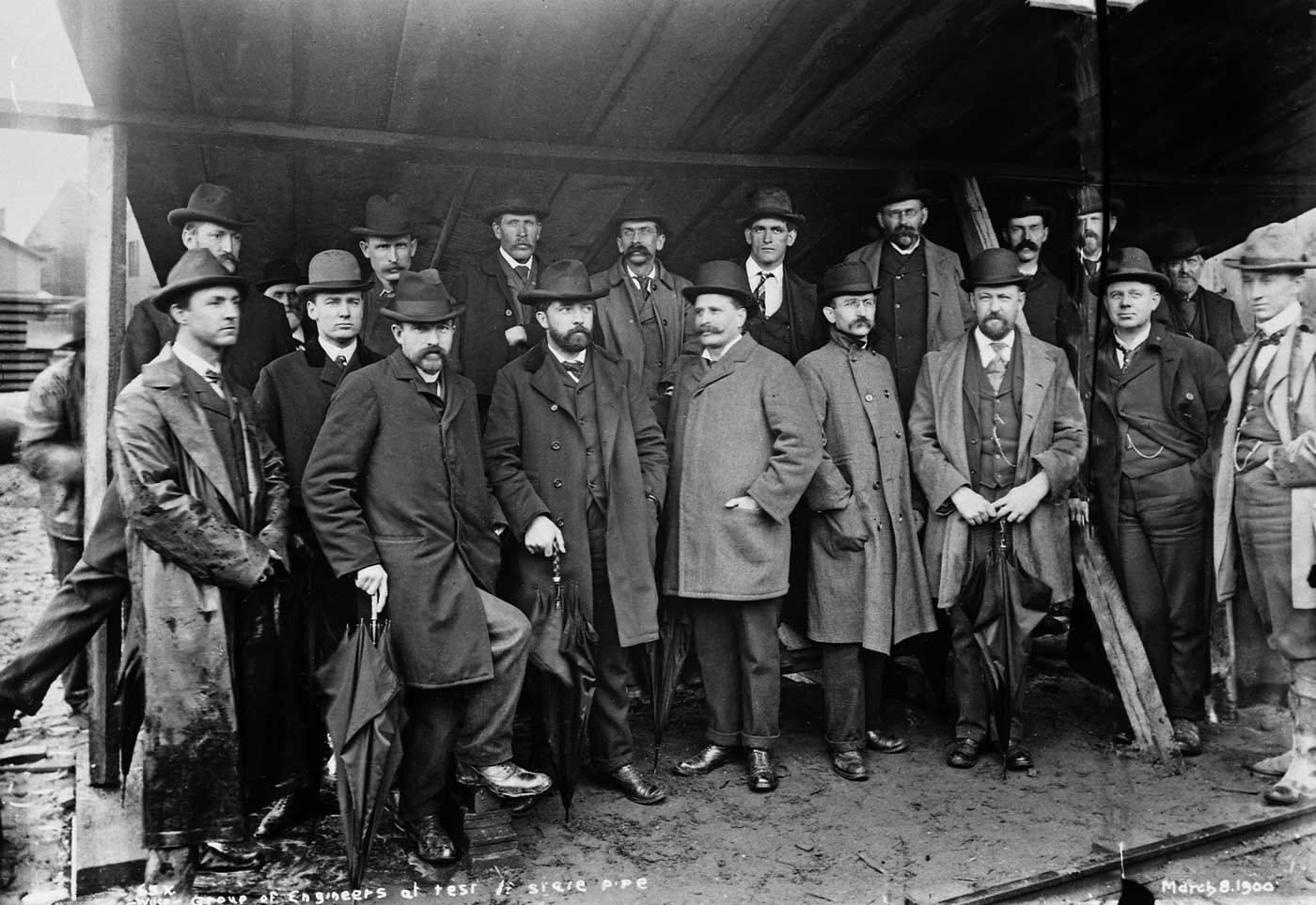
Less than two months before the City Council’s May 1, 1900 inspection, an unidentified group of Seattle-based (we assume) engineers were invited to inspect the project as well. Yes R.H. Thomson is among them, and can you find him? The date is March 8, 1900.
The following photo and its repeat directly below are one of the many comparisons Jean and I make in our book “Washington Then and Now.” It is described in greater detail on its own webpage and also appears in the “store” we have buttoned on this blog
THEN: The Tolt River pre-dam, mid-50s NOW: The Tolt in 2006
Just after brunching at Queen Anne’s Five Spot Cafe with sound design supremo Jim Wilson (with whom I worked on 16 Stories of Chekhov a couple of decades ago), I visited Doris Chase’s 15-foot tall steel “Changing Form” – which Paul hazards is the most photographed sculpture in Seattle – except for, perhaps, the Fremont Troll. This narrow strip called Kerry Park provides some of the best views in town.
And even on this wet New Year’s Day, a half dozen cameras were snapping away. A couple of young women stood out for sheer exuberance: a jumper and her delighted photographer, glimpsed through the sculpture against the gray Sound and sky.
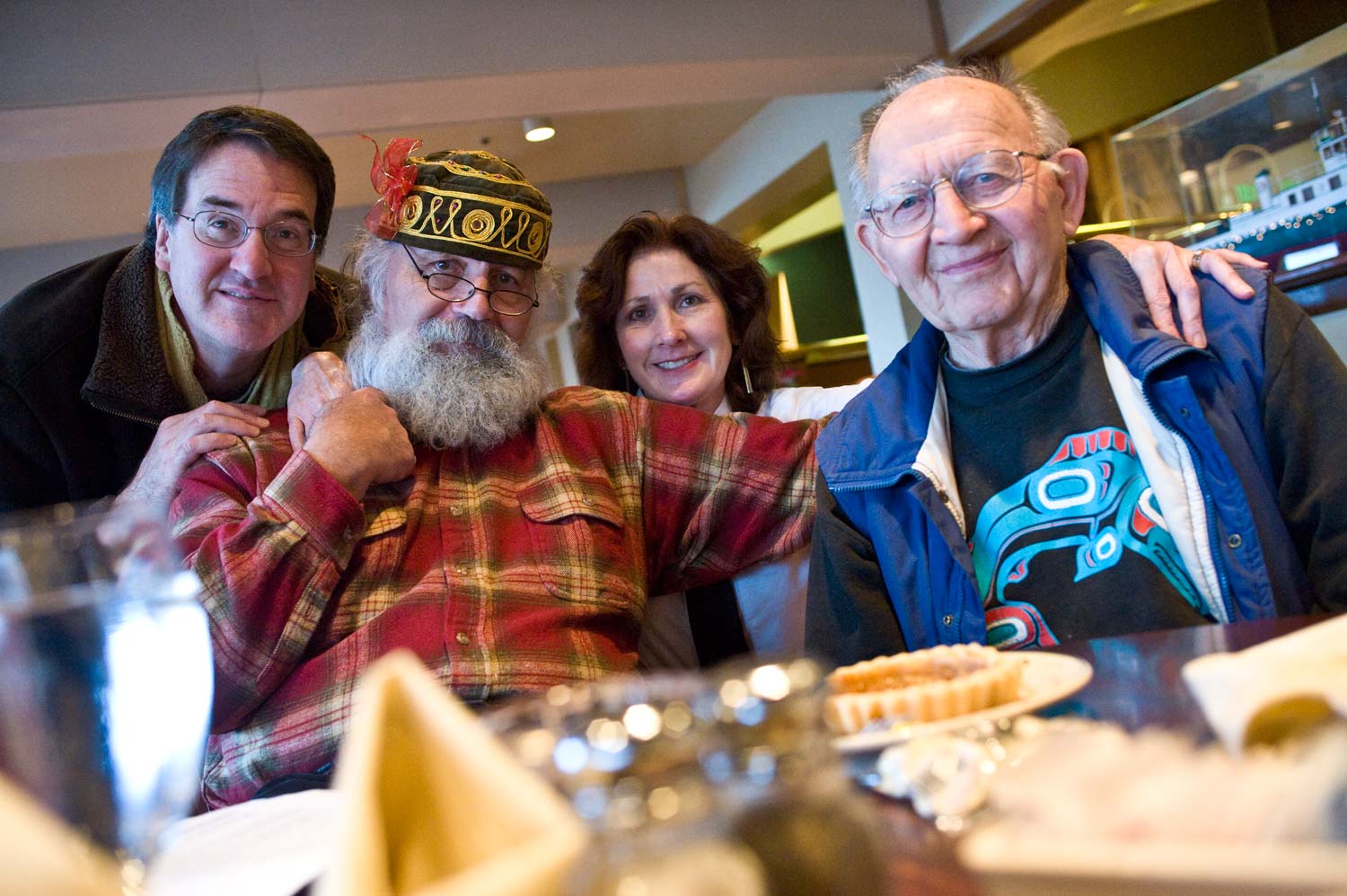
RICH BERNER of this blog is 89 today, Dec. 31, 2009 and Jean and I treated him to lunch at Ivar’s Acres of Clams – “Where Clams and Culture Meet” – on Pier 54 “At the Foot of Madison Street.” Jean is on the left, I’m wearing the ribbon in my hat, and Lisa, an Ivar’s mainstay, in posing with us too. All that puts Rich on the far right. (I think that is Lisa’s hand on Rich’s left shoulder – not mine.)
(Click these cards once or sometimes twice to ENLARGE.)
Earlier on the 31st – because Paris runs 9 hours earlier than we in Seattle – Berangere took this look across the Blvd Haussmann to the rear facade of the Paris Opera House.
This lavishly cute – bunnies!!! – and sentimental card is about a century old, as are most of those that follow.
Now open your door to a few resolutions that follow. Some of these read like they were composed by Horatio Alger when he was a clerk for the Better Business Bureau in Peoria, Illinois.
Sunset if its the 31st and Sunrise if the 1st.
New Years Resolutions as Prescriptions
More Horatio Alger as a developed marketing sensibility.
So true and so hard!
Flowers this First Morning
Must we always be productive?
An Unfinished Churchyard Story. May you treat these four cards as parts of an incomplete story – finish it and share it as a “comment.”
We wave again from the garden gate. Happy 89th Rich. Happy New Years Everyone.