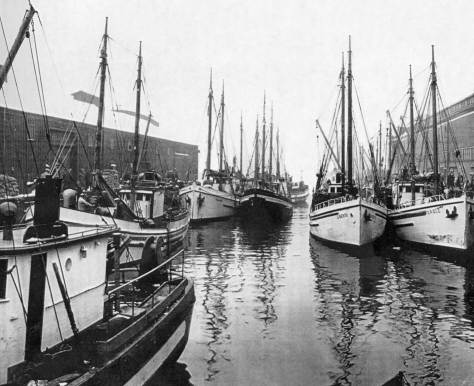
(click to enlarge photos)


We may thank Jean Sherrard, the weekly provider of our “nows,” for finding and deciphering the name of the long ship posing here, the sizable four-masted Ecclefechan. The name is attached to the bow on the far right, where it quarter-hides behind the ship’s anchor and its shadows. (To repeat his sleuthing you will need an enlarged print

and a magnifying glass.) The Ecclefechan was named for a Scottish village about eight miles northwest of the border between Scotland and England and as close to the Irish Sea. The town modestly thrived for two-hundred-plus years as a stop for stagecoaches on the six-day, 400-mile-ride between Glasgow and London. (It now takes four hours and a few minutes by train.)

On February 5, 1881, when plans for the Ecclefechan were underway in a Port Glasgow shipyard, Thomas Carlyle, the favorite son of Ecclefechan, died. As “the first man of English letters,” Carlyle had been offered a burial at Westminster Abby, but he declined in favor of a gravesite beside his parents in the churchyard of the town where he was born in 1795. One description of the ship notes that a sculpted figurehead of Carlyle was fitted on its bow. It seems possible, or perhaps likely, that Thomas G. Guthrie, the ship’s first owner, was an admirer of the author.
The Ecclefechan was short-lived. On February 23, 1900, filled with 15,000 bales of Indian jute, the classified barque ran upon Skateraw Rocks about fifty miles short of Dundee, its port-of-call on the east coast of Scotland. Although the ship broke in half, its cargo was saved.


Our “then,” but not our “now,” looks south from the Schwabacher Wharf at the foot of Union Street. It was the only pier on Seattle’s central waterfront to survive the Great Fire of 1889, and so was the gateway for the shipped materials needed to rebuild the some thirty city blocks flattened by the fire. The photo was recorded sometime after the fire and before the November storm of 1892, when “high and violent winds” collapsed the next dock south of the Schwabacher, Baker’s Dock at the foot of University Street. Here it is still standing on the far side of the 290-foot-long and dark green Ecclefechan, resting at what since 1974 has been the south side of Waterfront Park.


After its 1892 collapse, Baker’s Dock (it is written on photographer George H. Braas’s negative, lower-right) was rebuilt, longer and stronger, as the Arlington Dock. (Compare the pre-and-post storm piers in the two “then” photos at the top.) About a dozen years later it was replaced by the Chicago, Milwaukee and St. Paul Railway pier, which survives and now supports a Ferris wheel. Five years after Braas used it for his prospect, the Schwabacher Wharf hosted the sensational arrival of the S.S. Portland, the “ton of gold” steamer

that in 1897 incited the hysteria surrounding the Yukon Gold Rush. Seventy years later the old wharf was torn down by its owner, the Port of Seattle, in preparation, in turned out, for the open water of Seattle’s Waterfront Park and Jean’s many-splendored view.


WEB EXTRAS
Anything to add, me lads? Yes Jean, Ron has committed himself to a generous embrace of past features, and all are off the waterfront, or near it.