(click to enlarge photos)


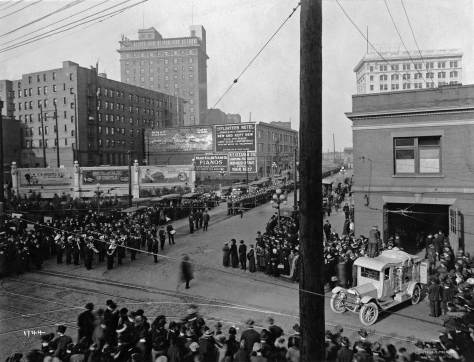
Here is yet another billboard negative from the Foster and Kleiser collection that Jean and I have visited a few times for this Sunday feature. The anonymous photographer chose a prospect that exposed the company’s two billboards on the roof of the Virginian Tavern, the tenant of the modest brick building at the southwest corner of Virginia Street and Third Avenue. This time Jean’s ‘repeat’ shows us that in this block not much has changed in the intervening eighty years. To gain some perspective on this booming town, the negative date, December 11, 1936, roughly splits the years between when the first settler-farmers landed near Alki Point in 1851 and now.


What were they thinking, the pedestrians and motorists here on Third Avenue? Surely of the kings of England: both of them. This is the day, a Friday, when it was at last fulfilled at 1:52 pm that the Duke of York took – or was given – the throne of his older brother Edward VIII who abdicated it for love. The Seattle Times, of course, trumpeted news about the switch, including a front page photograph of the new king’s daughter, the ten-year old Elizabeth who, an unnamed friend of the royals assured, as an “astute sharp-witted little girl” was figuring it out.

The neighborhood was then variously called the Uptown Retail Center, Belltown, and the Denny Regrade. Only the first two names survive. It is likely that many of these motorists on Third Avenue between Virginia and Stewart Streets remembered the regrade itself, and knew that they were driving under what only thirty years earlier was the south summit of Denny Hill.


Just left of center, the six-story White Garage, the tallest of the five buildings on the east side of Third Avenue, fails to reach the elevation of the historic summit. It is also short of reaching the elevation of what before the regrading was the basement of the majestic Denny Hotel, a.k.a. Washington Hotel, that sat atop the hill and advertised itself as “the scenic hotel of the West.” Both the south summit and the hotel were razed between 1906 and 1908.


Given that the featured photo at the top was photographed in the midst of the Great Depression, Third Avenue seems surprisingly rife with motorcars. A review of some historical vehicular statistics may explain the motorized zest. Four blocks away at Second Avenue and Pike Street, and only thirty-two years earlier, the city’s street department counted 3,959 vehicles visiting the intersection, of which only fourteen were automobiles. One year earlier there were no motorcars – everything moved by horse or by pedal. By 1916 many Seattle cyclists had turned into motorists, and Seattle had some 16,000 cars. By 1921, with the doughboys returned from World War I, there were about 48,000 cars in Seattle. By 1929 there were 129,000 cars on the city’s streets.
Of the two billboards above the Virginian Tavern, the one on the left advertises next year’s model 1937 Buick for $1,099. Figured for inflation, the price seems surprisingly affordable. In today’s showroom, the sticker would convert to about $18.400. It seems that despite the ongoing depression, if one had a good middle class job, it was possible to own the mobility and prestige of a brand new Buick.
WEB EXTRAS
Anything to add, fellahs? Ron Edge has put forward this week’s neighborhood links below – neither less nor more than nineteen of them, except that each is also bound to be packed with other links and so on and on. I have not lifted so much. It is, Jean, now nearly 5 am Sunday morning and I’m surrendering to my heart’s beating pleading for sleep. However, should I survive the night I will return tomorrow (Sunday) afternoon to finish up this feature. Now I lay me down to sleep . . . and the rest that passes all understanding.