

(click to enlarge photos)


A few weeks ago Jean and I were invited to the Washington Athletic Club (WAC) to give an illustrated lecture on how we go about delivering these weekly “repeats.” It is Jean’s and my tenth anniversary – about. With both text and pictures, I began this weekly feature in the winter of 1982. Jean rescued me in 2005 when he started helping with the “nows.” By then we were old friends. Now he does all the repeats. I both thank and need him.

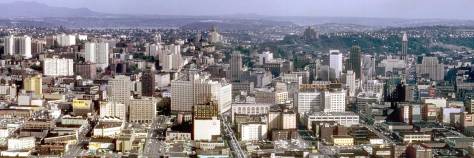
The day before our WAC lecture, Jean took the opportunity of visiting the club’s roof, thereby extending his practice of illustrating Seattle from its high-rises. This time Robert Laurent, our gracious host and the Club’s Senior Event Manager, accompanied him. This Sunday’s “then” is one of the three historical photos that Jean carried with him. (The other two – or three – are included here below this introduction.) None of them was named, dated or credited, although I suspect another old friend, Lawton Gowey did the recording. Lawton also explored the city on its sidewalks and from its roofs, and he (since deceased) and I shared at least three abiding interests: London history, the music of Johann Sebastian Bach and historical ephemera of Seattle, which we regularly exchanged.


Like any high-rise panorama, this one is both stacked and stocked with stories, of which we can only touch a very few. First, far right in the “then,” the twin towers of St. James Cathedral (1907) transcend the First Hill horizon. In the “now,” one of the two towers peeks through the slot of First Hill that is revealed between the Park Place Building (1972) and One Union Square (1981). Left-of-center, its neighbor, the Two Union Square (1987-88) reaches fifty-six stories and is the third highest building in Seattle. Together, One and Two hide most of the horizon revealed in the “then.”

On the left, Eagles Auditorium (1924-5), home of ACT Theatre since 1993, fills the southwest corner of Seventh Avenue and Union Street, and to the east its terra cotta skin approaches the green glass of the Washington State Convention and Trade Center (1985-88). From internal evidence the historical pan barely predates the Seattle Freeway section of Interstate-5. Consequently, there is no Freeway Park, which in Jean’s “now” is knit with both the Park and the Center and the autumnal-toned landscape seen between the two Union Squares. Instead, the “then” gives us a spread of the parking lots and small hotels that once sat on a few of the thousands of parcels of Seattle properties cleared for the freeway.


For a reader’s game of hide and seek, we will name a few more of the built landmarks that appear in either the “then” or “now” panoramas or in both: the Exeter, Normandie, Cambridge, Van Siclen, Fourth Church of Christ, Scientist, now Town Hall since 1999, Horizon House, both Virginia Mason and Swedish Hospitals, the side-by-side Marlborough and Panorama, Nettleton, and – giving these away – the new blue and salmon colored Meridian Tower, which rises behind the spreading Electra apartments on the left. The concrete Electra was built in 1949 as one of Seattle’s largest mid-century moderns and converted to condominiums in the 1990s.
WEB EXTRAS
Here’s a few more shots from the WAC rooftop:


And the WAC from below:

Anything to add, boys? Yes sir. First a now-then clip on WAC that we managed in 1999. That we will follow with a harsh of features Ron Edge has flavored for the neighborhood. We may conclude by reaching beyond these horizons with some pans we think classic, including at the bottom Seattle’s first, the Sammis 1865 pan of the pioneer town.



=====


=====

=====

=====

=====

=====

=====

=====

=====

=====


=====


=====

=====

=====

=====

=====
![Another by the California photographer McDonald taken during his brief stay in Seattle in the early 1890s. [Courtesy, Museum of History and Industry.]](https://i0.wp.com/pauldorpat.com/wp-content/uploads/2016/11/clip-cascade-cap-hill-fm-d-hill-ca91-web.jpg?ssl=1)
A PANORAMA SAMPLER


=====


===


