

(click to enlarge photos)


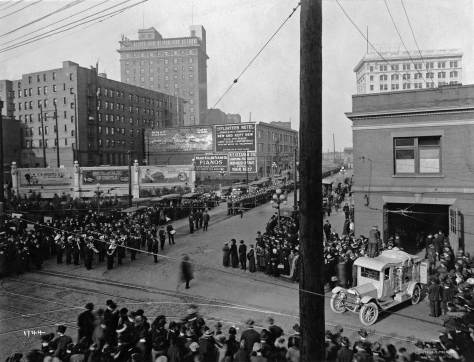
The pedestrians ‘posing’ here seem selected for their silhouettes and artful stepping. The view looks northwest from the southeast corner of Seneca Street and Third Avenue. If I have correctly figured the snuggled clues, this was recorded in 1910 or perhaps 1911. Why the Webster and Stevens Studio photographer snapped this street scene, I don’t know. But the brickwork itself is impressive enough to warrant a portrait. The new pavement came with the 1906-07 Third Avenue Regrade, which lowered Third Avenue a full story here at Seneca. Because of the city’s manic growth, the regrading was easily boosted by Seattle’s Public Works Department.

The Post-Intelligencer for June 24, 1906, explained it. “The Third and Fourth Avenue regrades are the outgrowth of the wonderful expansion of Seattle’s retail business. With First and Second Avenue congested the retail trade must spread, and it was the judgment of property owners along those streets that the leveling of them with the accompanying reduction for the approaching grades for First and Second would make them desirable for business purposes.” We may say the same for the purposes of spiritual economics.


Before the regrade, Third Avenue had developed into a “Church Row,” with sanctuaries tended by Methodists, Catholics, Presbyterians, Lutherans, and biggest of them all, the Congregationalists. The landmark tower of Plymouth Congregational Church (1891) is seen in part in the featured photo at the top. far-right at the northeast corner of Third Avenue and University Street. Although less than twenty years old, it is waiting to be razed for an even larger secular sanctuary, the terra-cotta clad Pantages Theatre. [The next-to-last of the Edge Links, no. 17 – although we have not numbered them, as such – included here below the main feature, concentrates on the Pantages.] With the gaining commercial status of Third Avenue, Lutherans, Methodists, Catholics and Presbyterians sold their sacred footprints and moved away to cheaper corners, most of them nearby.


The ascending skyline here is the most obvious concretion of the city’s growth. Hotel Savoy, midblock on the east side of Second Avenue, was built in 1905-06 to a height of eight floors but then soon pushed higher to the dozen seen here. The seven-floor Eilers Music House, on the right at the northwest corner of Third and University, was first named the D.S. Johnston Bldg. for its founder, a piano salesman extraordinaire. For its summer opening in 1907 Johnston stocked the building with what he promised “is the largest shipment of high-grade pianos ever made west of Chicago. We unhesitatingly predict that this … will mean the greatest sale of pianos ever witnessed in the United States.” The full-page ad below includes an etching of Johnston’s “Magnificent New” building at the northwest corner of University and Third, the building showing left-of-center in the featured photo at the top. The caption reads “The magnificent new D.S.Johnston Co. Building, at Third Avenue and University Street, will not only be the largest but also the finest music emporium in the West – arranged and equipped with every modern facility for the up-to-date and economical retailing of high-grade Pianos and Musical Instruments.”

The big frame house left-of-center, with the address 1203 Third Avenue, William H. Reeves family probably in the early 1880s. Here it is enterprisingly fronted with brick storefronts, an enriching practice that was typical of many other big homes in Seattle’s developing business strips during the booming growth years of the Yukon Gold Rush and after. At the time of the photo, the Reeves are


no longer living at the corner. This cosmopolitan retail row includes a French dry cleaners, a shop selling post cards, and at the corner, the Beautiful Orient Store where an ad in The Times (below) advises “all the latest styles of silk and crepe Kimonos” can be had and on sale. As witness to neighborhood’s cosmopolitan touches, in the featured photo at the top, a sign at the corner points down Seneca Street to the San Francisco Kosher Restaurant.

WEB EXTRAS
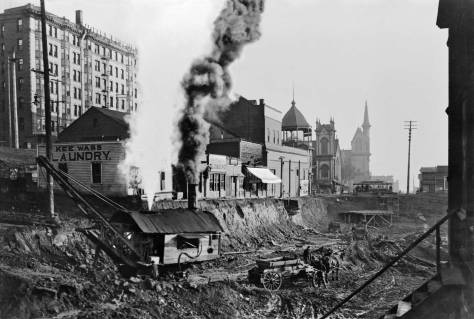
Anything to add, boys? Surely Jean, Ron starts his Edge Links with a look north of Third Avenue with the “biggest brick church in town” filling the northeast corner of University Street and Third Avenue, and so one block north of Seneca. We will prelude Ron’s contribution with three other photos that show the Plymouth Congregational sanctuary in times before, during and after the Third Avenue Regrade of 1906-7.
THE THIRD AVENUE REGRADE, BEFORE – DURING – AFTER: Looking north from near the corner of Third and Spring


==========================
follows, EIGHTEEN EDGE LINKS, all for unfolding with a click!






![THEN: Looking north-northeast from a low knoll at the southwest corner of Seneca Street and Seventh Avenue, circa 1916. By 1925, a commercial automobile garage filled the vacant lot in the foreground. [Courtesy, Ron Edge]](https://i0.wp.com/pauldorpat.com/wp-content/uploads/2014/11/seneca-7th-mr-then.jpg?resize=474%2C353&ssl=1)


