

(click to enlarge photos)


Lawton Gowey, once the Director of Finance for the Seattle Water Department, recorded this week’s “then” subject. This old friend, now three decades deceased (1921-1983), was a public worker who studied and extensively photographed the built city. He carried a 35mm camera loaded with Kodachrome transparency (slide) film. Gowey’s subject is a relatively recent one, dated July 4, 1957. It is still easy to place. For this Independence Day Parade portrait, Lawton took his photographer’s crouch on the east side of Fourth Avenue, standing just off the curb and a little less than a half-block south of Pike Street.


Most of the structures, but not the businesses, in Gowey’s photo survive, including the Seaboard Building (1906-9) at the northeast corner of Fourth and Pike, to the right of the light standard. Behind the same standard, but two blocks north on Fourth, the Mayflower Hotel stands at its southeast corner with Olive way. Nearby, the Great Northern Railroad’s long popular symbol of a mountain goat looks from its monumental neon circle up the center of Fourth Avenue. Its rooftop perch was at the northeast corner with Stewart Street. Surely, many PacificNW readers remember it.


The block-sized Bon Marche, opened in 1929 and remodeled in 1955 as the “largest department store west of Chicago,” holds the center of the subject. To this side of The Bon, the two three-story-tall gaudy signs for Gasco (1932) and the Colonial Theatre (1913) rise side-by-side above the busy sidewalk where street photographers vended to pedestrians their candid portraits. Many


of these unwitting but generally willing subjects were on their way either to or from Manning’s Coffee at 1533 Fourth Avenue. Manning’s, a small chain, were the “Acknowledged Quality Coffee Stores of the Pacific Coast,” and so perhaps, the too-often forgotten fountainhead of Seattle’s rich coffee reputation.


Left of center at the northwest corner of Fourth and Pike stands the seven-story Bigelow Building. It was named for the pioneer couple Harry and Emma Bigelow, who after purchasing the water-logged corner from Arthur and Mary Denny in the 1870s left it to its croaking. It was soon named “Harry’s Frog Pond.” They replaced the wetland with their big home in 1883. The Bigelow Building in the “then” was built in 1923 and replaced in the 1980s by the grander Century Square retail and office complex.

When the Joshua Green Building, far-left in the featured photo at the top, opened in 1913, the men’s clothier Lundquist – Lilly occupied the second floor, a higher level but with a lower rent. The partners promised to share the savings with their customers. (See their sign.) Lundquist and Lilly hoped that their clientele would be impressed by “The big saving we make in side-stepping the tremendous operative expense which all street-level clothiers are up against . . . Our furniture and fixtures are very plain; you pay only for clothes. That’s why we give you a $25.00 suit for $15.00.”

The July 4, 1957 parade of mostly marching military units that celebrated the nation’s 181st anniversary of America’s assertion of independence from King George III was a modest display. By police estimates the parade attracted a crowd of about 25,000. This was pint-sized parading when compared, for instance, to the 150,000 who lined Fourth Avenue to greet President Harry Truman during his 1948 visit to Seattle.


WEB EXTRAS
Hi guys. Before inviting your contributions, I’ll post a few faces from the 2017 march as clickable thumbnails. YOUR parade shots are embraceable Jean. Give us more if you have them. By those that find them they will be often returned to – I expect.


Anything to add, gentles? We will search about for a few more parades, and similar sensations. Ron has put up – I’m counting – 23 Edge links to former features, and the last of those is a return to the 1883 celebrations connected with the completion of the transcontinental Northern Pacific Railroad. And the last part of the 23rd feature shows off the song writing and playing skills of the local band Pineola. We often return to Pineola and listen too. Enjoy.




=====
BELOW: A FEW OLDER FEATURES and then tomorrow after a few hours slumber some more Seattle parades.

=====

=====

=====

=====

=====

=====

=====

=====

=====

====


MORE ELEPHANTS on PARADE

=====

=====

=====


=====
=====

=====

SANTA CLAUS PARADES
The SANTA CLAUS PARADE tradition began in 1949. The first parade was held on November 12 and it brought out what The Seattle Times – one of its sponsors – reported that afternoon “The biggest parade crowd in Seattle’s history turned out this afternoon despite rainy weather to view the gigantic Santa Clause parade.” Seattle Police Chief George D. Eastman estimates the crowd surpassed the Seattle record then of 150,000, which greeted President Truman in 1948. (See the Truman Parade press photo above, the last illustration here before Jean’s question about “Web Extras.” )


The Santa Claus parades ran at least through the 1940s. We will include at the bottom of our Santa parade photos a colored record of the parade by Frank Shaw from Nov. 19, 1960. The rest are press shots from The Seattle Times. The Santa parades typically featured the region’s best high school marching bands and the parade’s stars, giants balloons representing classic cartoon characters and monsters – the shapes most likely to thrill the kids, many of whom were also dressed in costumes. (We imagine, only, that the balloons were recycled from one of the east coast department store parades, like Macy’s in New York City.)
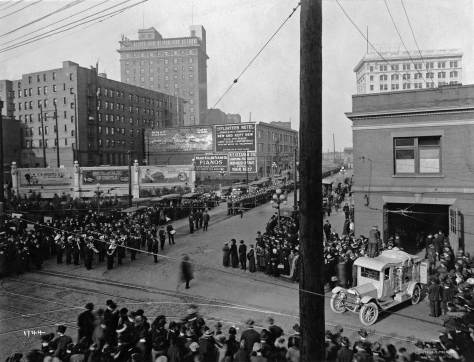
(pause) Please compare the below photo from an AYP-related parade down Fifth Avenue in 1909, with the above photo. They were recorded from nearly the same prospect.


The mid-November PARADE was popular enough to sell out downtown lodgings for the night before. The Times reported that “one hotel on the parade route reportedly turned down at least 300 requests for reservations.” In 1949 the Santa Claus parade route went south of Second Avenue from Virginia Street to Yesler Way and returned north on Third Avenue with a reviewing stand at Third and Virginia. In 1950 the route changed to Third (going south) and Fifth Avenues. Two years more and the directions were switched, south on Fifth and north on Third. The 1956 parade features a dozen bands and forty balloons or “Novelty Units.” This year the route was again first heading south on Third Avenue from Virginia Street and then returning from Yesler Way by way of Fifth Avenue.


=====
POTLATCH PARADES – A Few Examples from the first Golden Potlatch Parade in 1911, followed by a Dad’s Day promotion from the 1913 Potlatch Parade.


=====
MILITARY-INDUSTRIAL PREPAREDNESS PARADES


=====
FAT TUESDAY PARADE: During the 1970s it seemed like every February includes a few unseasonably warm days. Once of these natural lapses was used to stage a Fat Tuesday parade from the Pike Place Market to the drinking reservoirs of Pioneer Square. The size of the downhill entourage was huge. Here are two shots featuring the Friends of the Rag. Both were snapped by Frank Shaw.


WALLINGFORD KIDDIE PARADE from the early 1950s and its DISTINGUISHED QUINTET of Hoary Parade Marshalls from 2008, I believe.


=====
POSTSCRIPT
