

(click to enlarge photos)


The Onarga, the mid-sized flats filling the center of this modest row of rentals, was most likely named for the small town founded in 1854 about 90 miles south of Chicago, Illinois. That was three years after Seattle’s founder-pioneers first settled both on Alki Point and in the Duwamish River Valley. (Some of them came from Illinois, if not Onarga.)

The street number 1108 for this apartment house on Seventh Avenue is tacked to the front door beneath a sign that reads “Housekeeping Rooms for Rent.” If I have figured the evidence correctly, these apartments were first opened to renters in late 1903 or 1904; newspaper listings for the Onarga began in 1904. I am especially fond of a classified ad placed in The Times on September 18, 1904, which reads “$200 CASH and eight monthly

payments $25 each buys the furniture of a six-room well furnished flat. Large, light rooms, pantry closets, porcelain bath, coal and gas ranges, sideboard, golden oak furniture, French bevel plate dressers, folding and iron beds, Brussels carpets, Bigelow Axminster art squares. Rent $30. 1108 7th Avenue, first door.” One would then – if I have read this correctly – have found these offered items in an apartment on the first floor. The Times classified was listed under “FOR SALE FURNITURE – 109.” To my reading the ad’s creators seem to be selling the flat’s furnishings while also offering for rent the large apartment itself.


One of this flat’s best qualities is not noted in the 1904 Times classified. The Onarga apartments, like its neighbors, were “within walking distance” of practically every urban need and/or opportunity. They are “close in.” By 1904, after more than two decades of the Queen City’s booming growth, the western slope of First Hill was increasingly filling up with rentals at the expanse of single-family homes. There was a mix of brick and frame construction among these apartment houses, and, of course, the former were ordinarily larger and classier. As the map detail shows direclty above, in this block bordered by Seventh and Eighth Avenues and Spring and Seneca Streets, it was all frame, while in

neighboring blocks many of the addresses were grander, some of them high-rises. Two examples of these are on show in our featured 1938 tax photo, and both are still standing. To the left of the parking strip tree is a sample of the Exeter House Seneca Street façade, with its Tudor Gothic style. And to the right is the well-ornamented Gothic crown of the high-rise Virginia Mason Hospital, which nearly fills the photo’s upper-right corner. [WARNING!!! WRONG!!!. An alert early reader of the Time’s saturday delivery for this week’s PacificNW, made a kind (not unkind) correction. This is not the hospital but rather the Lowell Apartments at and near the northeast corner of 8th Avenue and Spring Street, and so just south up 8th Avenue and across 8th from Town Hall. This is embarrassing for me, and rates

in the top ten of the many mistakes I have made since I started this feature now 35 years ago on a wet sunday in January, 1982. Had my many flubs been then preluded before me I might have run to the Main Branch of the Seattle Public Library for penance and so correction. The portrait of the Lowell Apts above come’s from SPL’S prolific Werner Lenggenhager Collection. Lenggenhager has it captioned that the Lowell Apartments were built in 1928 and designed by Harry E. Hudson. I did not find this in Shaping Seattle Architecture, where Hudson is not noted. I’ll surely ask Diana James, author of Shared Walls, our history of Seattle’s apartment houses, about Hudson. At this hour – 3am – she is almost certainly not awake. The Virginia Mason is behind the Lowell, a short ways up Spring Street from ‘our block’. It is also somewhat above the Lowell, but not high enough to alert me, and that’s working on an excuse. Asking now for forgiveness, I’ll share a preferred excuse for this mistake once I think it up, and/or learn of a good escape thru Diana.)

The first heavy poured construction came to the featured block with the dedication of the Fourth Church of Christ Scientist. Prior its construction in 1923, the northeast corner of the block was undeveloped. Since 1999 the church building has splendidly served (in my opinion) as one of Seattle’s greatest non-profits: its Town Hall, a kind secular church with little dogma. And here in the partnership that authors “Seattle Now and Then” you have a close-to-home example of that somewhat spiritual zest: Jean Sherrard, this feature’s photographer-repeater of well-wrought “nows.” For a dozen years now, Jean has been producing, hosting and performing in Town Hall’s Christmas edition of Act Theatre’s series, “Short Stories Live.” After a few years he began calling it “A Rogue’s Christmas.” Every year now someone from Central Casting call’s Jean and asks him to prepare another season’s greetings for Town Hall. Now that the Hall is getting it elaborate restoration, I do not know where the Rogue will show his tricks.
Continuing: here in anticipation of the webmaster Jean’s question, “Anything to add, buys?” here a few somethings.
First, A kind of spiritual sampler of Seattle in 1916 includes an example from the Onarga Apartments. It is sublimely marked in yellow with a blue border. Please note that this printed list does not include any of the “regular” churches in town. They have their own section in the paper, which in 1916 could still feature printed sermons by the more celebrity preachers in town like Mark Matthews whose First Presbyterian Church was directly south across Spring Street from “our block.”

Second, the story of the precocious Walter Fogh who lived in the Onarga Apartments in 1922. The Times clipping is dated November 25, 1922.

Third, using a neighborhood detail from a business map dated 1925 we find the Onarga Apartments among the four structures identified on “our block.” The others are the Morningside Apartments next door on 8th Avenue to the east of the “4th C S Church,” which is also named., and the Toraine Apartments facing Seneca Street west across the alley from the C. Scientist. The Toraine will appear in four of the remaining illustrations that follow before Jean’s query about “anything.”

Fourth


WEB EXTRAS
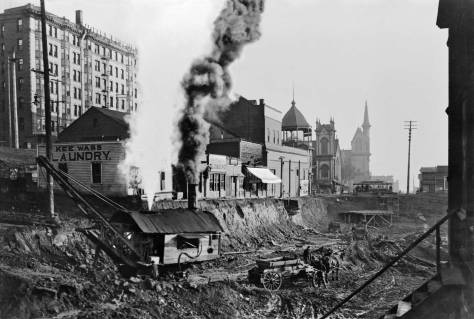
Anything to add, guys? Yes Jean and starting with the first of the featured Edge Links below, the one looking northeast across the intersection of 7th Avenue and Seneca Street. While our featured tax photo at the top concentrates on the Onarga near the center of the east side of 7th Avenue between Seneca and Spring, the first feature below reveals, far-right, the north end of this same east side of 7th. It also shows the northwest corner of the Toraine Apartments facing Seneca Street from its south side and from this prospect above the corner grocery store, right-of-center. So please open the link and read the rest.
![THEN: Looking north-northeast from a low knoll at the southwest corner of Seneca Street and Seventh Avenue, circa 1916. By 1925, a commercial automobile garage filled the vacant lot in the foreground. [Courtesy, Ron Edge]](https://i0.wp.com/pauldorpat.com/wp-content/uploads/2014/11/seneca-7th-mr-then.jpg?resize=474%2C353&ssl=1)




======

=====

=====

=====

=====

=====

=====

=====


==========