

(click to enlarge photos)


I’m pulled into this clutter of storefront commerce and small hotels that extend through about half of the west side of 8th Avenue between Pine and Olive Streets. Photographed in 1938, the year of my nativity, it offers attractions that I remember from my youth first in Grand Forks, North Dakota and then – beginning in 1946 – in Spokane. Following Locksmith Snyder’s many keys and services, far left, are the 35 cent haircuts available from the Eighth Avenue Barber at 1619 8th Avenue, and Jackson C. Clifford’s Red Front Cigar Store, at 1621. After that comes the modest front door to the Olive Court Apartments. There Mrs. Sigrid Fales is in charge, equipped with a telephone. Most likely, Sigrid was originally from Northern Europe, and as Scandinavian as her nearby neighbors directly across 8th Avenue, the Viking Tavern and Krono Coffee Shop, both at 1622 Eighth Ave. And next door to Sigrid is her grandest neighbor, The Swedish Club.


“The Club,” as its many members called it, was the best evidence that downtown Seattle had its own “Snooze Junction” or corner, a variation on Ballard. From the beginning the Swedish Club was an institutional reminder of the left homeland. It was a profound and shared nostalgia that ran through its many banquets for fondly remembered traditional gatherings, and its choral concerts, dances, and opportunities for mixing and courting. Also in a less secular line, neighborhood’s Gethsemane Lutheran, Swedish Baptist, First Covenant, Reformer Presbyterian, and others churches, were all Scandinavian sourced congregations.


The club was first organized on August 12, 1892 by recently arrived Swedes. They were young and living in Belltown’s Stockholm Hotel. It was a name chosen to attract them. In spite of the economic crash or panic of 1893 and following, the club flourished, largely because there were so many migrating Swedes. (Migrating Norwegian’s and Danes had their own clubs.) Using the often generous contributions from members of the burgeoning Swedish community, the Club built its home here on 8th Avenue on its own terms. Andrew Chilberg, the Seattle-based vice consul for both Sweden and Norway was a charter member and the Club’s first president. He was also founder of the Scandinavian-American Bank: Seattle’s Scandinavian godfather. Chilberg bought the property for the Club’s construction and half-century of use. N.D. Nelson the partner in Frederick and Nelson Department Store, also helped with the club’s financing and first construction, as did Otto Roselead, the contractor for both the Swedish Club and the Swedish Hospital. The dark brick façade with its ornamental banding and spiral scrolls or volutes, both seen in the feature photo, were soon added to the original frame structure when the neighborhood was regraded.


The diverse flips in needs and interests that have understandably followed through the club’s now century and a quarter of service are typical for cultural institutions that have their origins in other hemisphere’s. It has been long since members were more likely to join classes to learn Swedish than English. Now sponsored group flights to the homeland are fast and for many affordable. (Thanks to Club president Christine Leander for lots of help with this.)

WEB EXTRAS
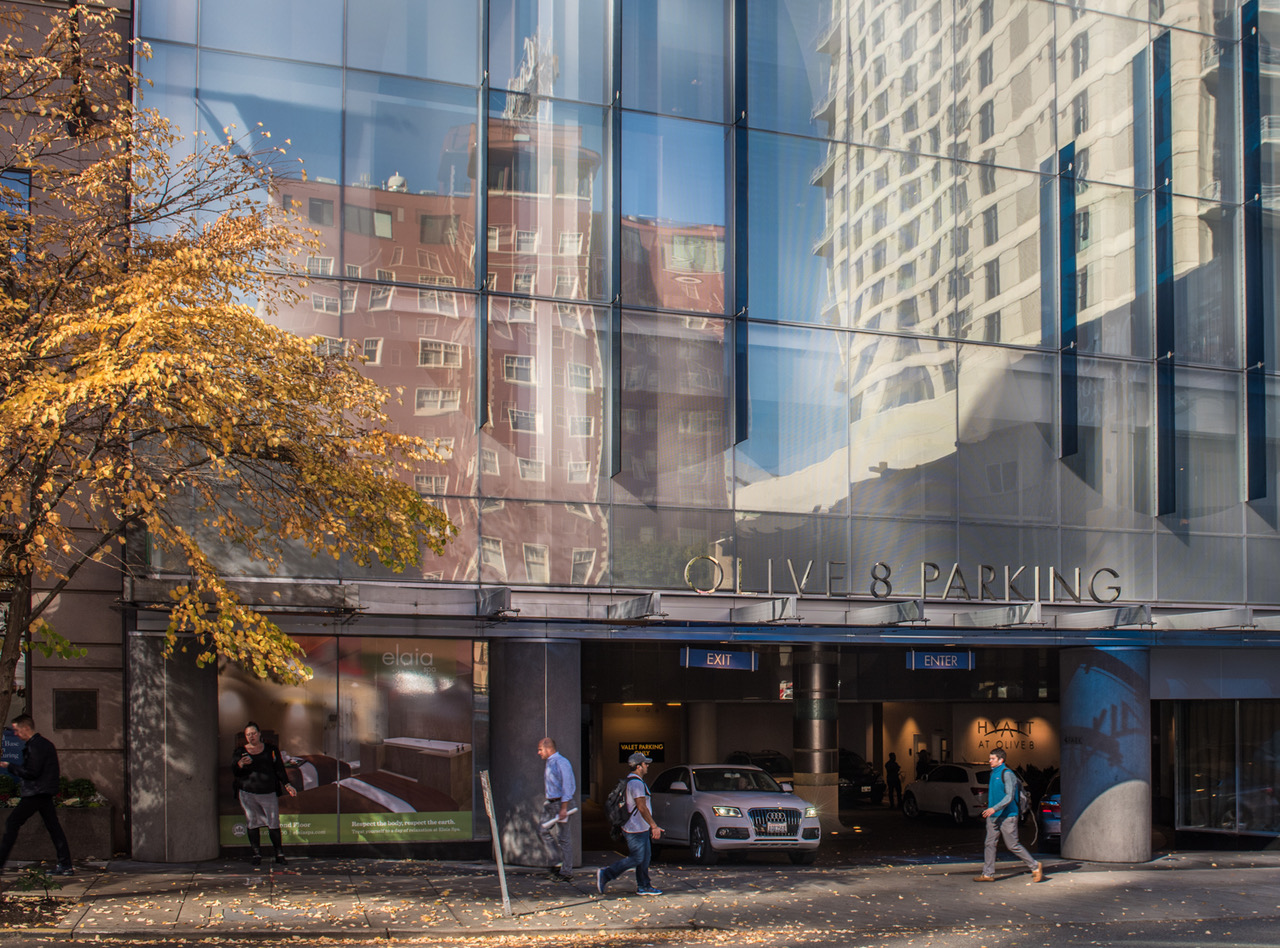
In the Hyatt’s glass curtains, from a slightly less oblique angle, we find a reflection of the lovely Camlin Hotel, recently featured in this column:
Anything to add, fellahs? Lots of past but not lost features Jean – all but two are from the neighborhood or near it but one of the two is named Anderson. Let us hope that our readers CLICK TO ENLARGE.


=====

=====

=====

=====

=====

=====

=====

=====

=====

=====

=====

=====

=====

=====

=====

=====

=====

======

=====

=====

=====

=====

=====

=====
