

(click to enlarge photos)
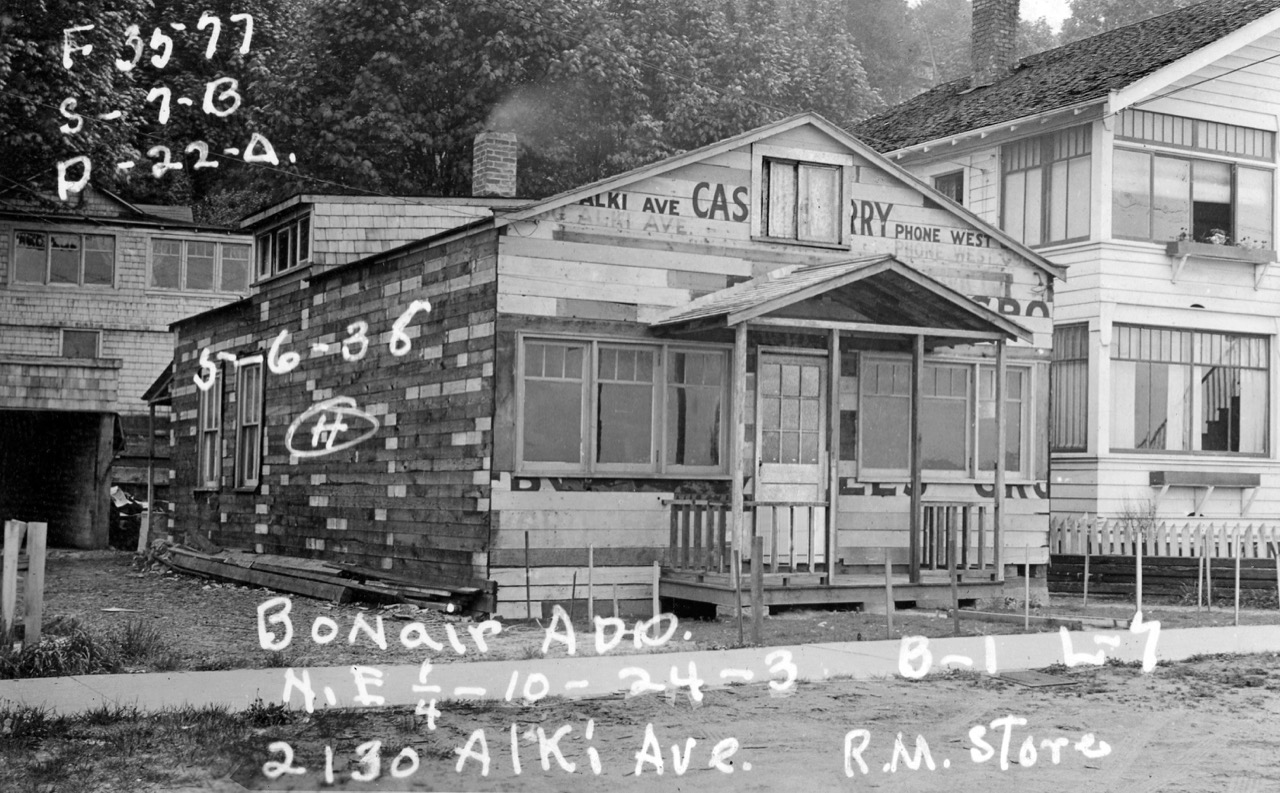

Here is the “Pink House” beach landmark for which Alki Beach locals – especially those near the sand – feel protective. In our “then” photo the Pink House is only nearly pink. Our “then” is another “tax photo” from the Depression-era’s WPA (Works Progress Administration) photographic inventory of every taxable structure in King County. Many properties were exposed as tax-dodgers by the preliminary 1936 aerial survey of King County.

This dappled construction site could not escape attention in 1938, the date inscribed on the tax photo. (The scribble, center-left, reads like May 6 “1936”, however, from other evidences, it is certainly 1938.) The cottage is getting its conversion from a beachside Cash and Carry store into a wind-shakened residence. In 1927 it was called “The People’s Grocery.” Somewhat mysteriously “GRO,” the first three letters of “grocery,” have been cut in half and separated for the home’s new six window exposure to the northwest on Alki Beach. The sign’s shipboard remnants have been, it seems, salvaged by the carpenters for the new façade. Clay Eals, West Seattle neighborhood activist wonders if the shuffled letters survive under the home’s namesake pink paint? (Its pop name was vox populi – inevitable.)


Who painted it pink? Most likely Susan B. Griffin, a lead gardener at the University of Washington arboretum who lived in The Pink House at 2130 Alki Avenue for nearly 40 years. Her niece Katy Griffin remembers that the master gardener “kept a beautifully maintained home and garden. It has been painted pink ever since I can remember. . . It was decorated with carefully chosen antiques, with beautiful glassware on the window sills that trembled every time the metro bus would go by. My aunt delighted in entertaining, and hosted many gatherings.” Griffen was also an exceptional landlord for her other properties in the Alki area and “treated her tenants like family…She kept a vegetable garden for all of her neighbors to plant and harvest.” It was an inspiration for the community’s P-Patch Program.


The Pink House’s tax card (far above) dates its construction in 1909. According to West Seattle’s committed community of historians this waterfront bungalow was built for Granville and Henrietta Haller’s family, pioneers who in 1883 completed Seattle’s first and largest mansion, Castlemount, on First Hill’s summit near James Street and Broadway. In ironic hindsight, the footprints for both Castlemount and what became the Pink house were chosen in part for their proximity to the sporting life (fishing and hunting) of Seattle’s pioneer “Indian-fighter” Granville and Henrietta Haller’s family.

Thanks to West Seattle researchers Greg Lange, Clay Eals and Matt Vaughan for their help in following the history of the Pink House. Vaughan the long-time proprietor of West Seattle’s Easy Street Records was also the Pink House owner for a dozen years until 2010.
WEB EXTRAS
Anything to add, fellas? For you and your’s we shall try.






=====

=====

=====

=====


=====

=====

=====

======

=====

=====

=====

=====

=====