

(click to enlarge photos)


(Published in The Seattle Times online on Aug. 19, 2021
and in PacificNW Magazine of the print Times on Aug. 22, 2021)
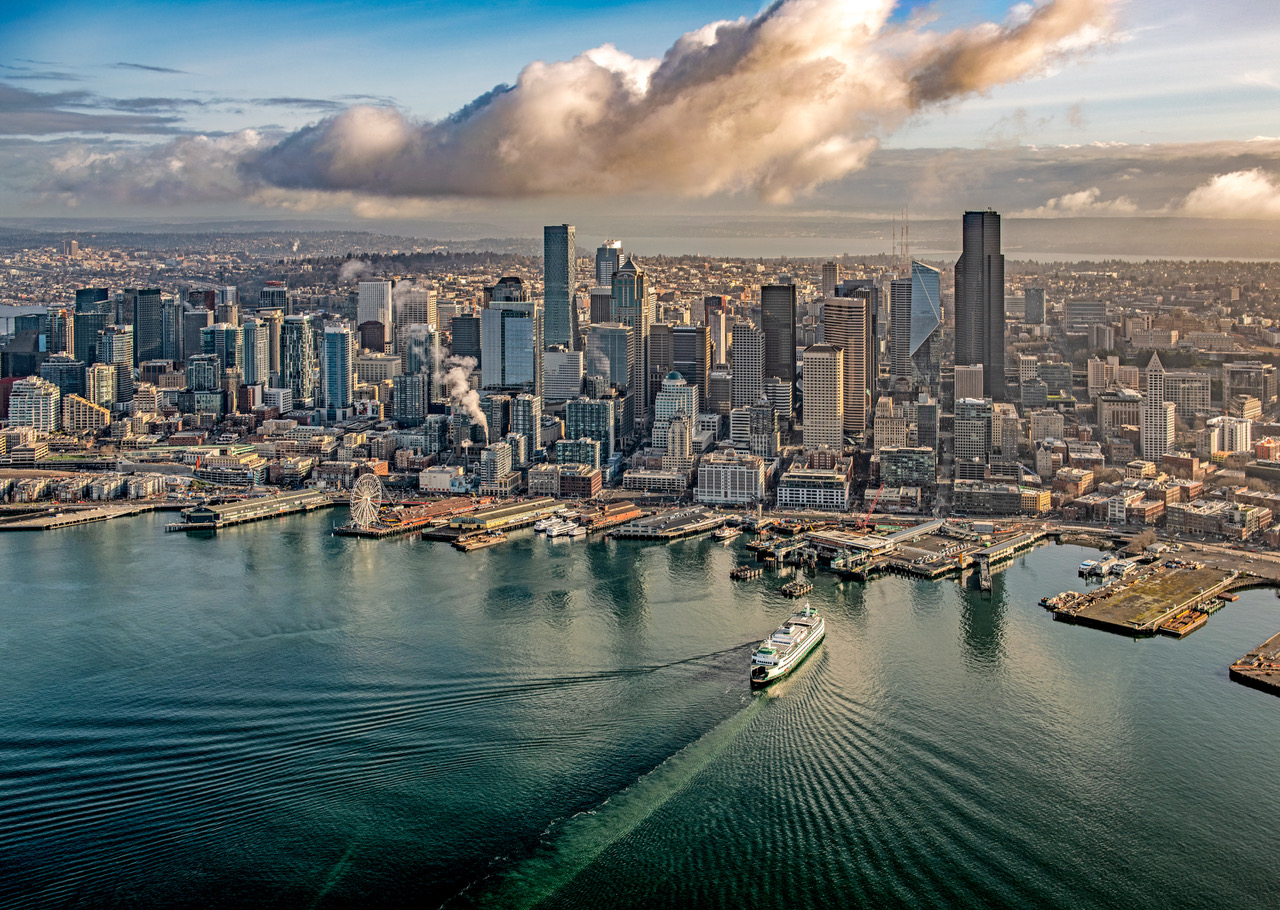
An aerial depiction of Seattle’s too-busy bay feels right for its time
By Jean Sherrard
The camera never lies, so goes the maxim. Yet photographers have stretched the truth on occasion, long before Photoshop made fakery a breeze.
Last Feb. 27, Clay Eals and I chartered a helicopter, the left door removed for photography. This week’s “Now” photo, from 800 feet above the waterfront, illustrates the potential for spectacle and perspective.
Seeing this elevated view, photo historian Ron Edge responded by sending me our serendipitous first “Then” photo — a shot I’d never seen. “Pretty close!” Ron marveled.
It was a prevalent postcard of a vibrant Elliott Bay, taken Sept. 15, 1936, by pilot/aerial photographer Charles F. Laidlaw, who apparently captured a miracle of near-misses. In it, various crisscrossing vessels provide visual bon-bons for today’s maritime historians.
Most recognizable at lower left is the beloved, streamlined ferry Kalakala, placed into service in 1935 and departing Colman Dock on the Bremerton run that she would make for 30 years. Above left, the night steamer Iroquois arrives from Victoria via Port Angeles. Puffing from Pier 3 (now Pier 54) is the sturdy oceangoing tug Goliah, built in 1882 and later converted from steam to diesel. Barreling south is the Coast Guard cutter Tallapoosa, fresh from fleet duties with the Bering Sea Patrol. At lower right, the Army Corps of Engineers dredger Michie heads due west.
Whew! Such a spectacular view of Seattle’s busy port.
Trouble is, it’s mostly fiction. Skillfully inserted, complete with brushed-in wakes and waves, none of these vessels (identified by veteran ship historians Michael Mjelke and Paul Marlow) were present in Laidlaw’s original photo, our second “Then.”
One explanation for the empty bay lies in the widening ripples of the Great Depression. Imports and exports had plummeted since the 1929 crash, threatening maritime commerce with ruin.
By the mid-1930s, widespread labor unrest sporadically shuttered ports along the West Coast. Under sympathetic President Franklin Roosevelt, unions flourished. William Randolph Hearst’s Seattle Post-Intelligencer even paused publication for the first time since its 1863 founding due to striking writers and editors.
What’s more, Puget Sound’s Mosquito Fleet, dozens of lively craft ferrying passengers and cargo bowed to grander but fewer vessels. “Suddenly, in the mid-(19)30s, people found that their Fleet was gone,” wrote marine historian Gordon Newell. “(Seeing) the quiet reaches of the Sound, they began to feel that something fine and exciting was missing.”
In that context, Laidlaw’s marine manipulations feel right for the time, a quiescent harbor being no subject for a popular postcard. With no end in sight to the Depression, maybe Seattle was ready for a boost, even one fabricated with a photographer’s fib.
WEB EXTRAS
In place of Jean Sherrard‘s usual 360-degree video of the “Now” prospect, below we have aerial video of downtown by Clay Eals.

