

(click to enlarge photos)


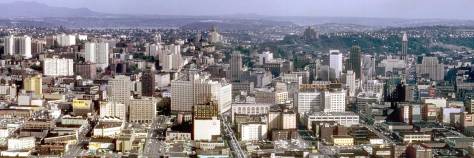
For reasons that may in part have had something to do with nostalgia for farm life and open mid-western pastures, the young city builders David and Louisa Denny protected from development most of the swale, or naturally cleared wetland, on their pioneer claim. Much of that clearing is included in this look south from the still lightly developed southern slope of Queen Anne Hill, in the foreground, to the extensive scatter of structures on Denny Hill, crowned by its landmark Denny Hotel, at the middle distance. The far horizon extends from West Seattle, on the right, along the ridge of Beacon Hill to First Hill, the ‘Profanity Hill’ part of it, where the brandishing tower of the King County Court House makes a perpetual promotion for law and order.


This week’s ‘then’ is one of a dozen or more panoramas that the photographer A. J. McDonald took of Seattle from a few of its hills during his, it seems, brief stay in the early mid-1890s. (We will attached a few more below.) This is one of the more softly focused of the photographer’s recordings, but it is still outstanding. No doubt, McDonald is standing with his tri-pod on or near Ward Street and sighting south on Second Ave. N. It is about 1895, the year the Seattle Dept. of Public Works regularized and thereby restrained the often imaginative collection of Seattle’s street names.

Previously, Second Ave. N. was Poplar Avenue, and Ward was Villard Street. The last was named for the journalist-capitalist who brought the Northern Pacific Railroad to Seattle in the early 1880s and then promptly lost it.
Running left-right (east-west) above the center of the pan is Harrison Street, which now passes through the fanciful clutter of the irregularly-shaped Seattle Center. Nob Hill Avenue, which was Ash Avenue until 1895, reaches Harrison directly above the center of McDonald’s panorama. Directly below that intersection is the swale, still holding on to its green, but now transformed into part of the artificial grass end zone of the Seattle Memorial Stadium. [There is a good now-then comparison of the swale among the Edge Links that follow this brief exposition.]

The list of historical uses of this clearing begins with the Duwamish Tribe’s both ritual and practical potlatch celebrations, and their catching in nets the low-flying waterfowl passing between Elliott Bay and the then restful tulles at the south end of Lake Union. With the Dennys in the early 1850s came their extensive gardens, which helped feed both their family and Seattle’s produce needs. In the late 1890s the swale was fitted with an army corral filled with horses and mules for help with the Spanish-American War. Soon after McDonald’s visit, the swale repeatedly hosted other horses, with carnivals and traveling circuses. Part of it was also developed into a fenced field with bleachers for professional baseball. In 1927-28 the swale was appointed with the concrete core for Seattle’s arts and entertainment culture: the Civic Auditorium, Arena, and Civic Field.

In 1958, or thirty years later, the Seattle City Council allotted $7,550 for the clearing away of eighteen “dilapidated buildings” from the by then probable site of the Century 21 Exposition, Seattle World’s Fair. It is likely the McDonald’s panorama includes some of the condemned structures in the neighborhood beyond Harrison Street, on the far side of the swale.

WEB EXTRAS
Anything to add, kids? Sure Randall. Ron has topped his past clips from the neighborhood with another by McDonald panaorama, one that looks northwest from Terry Avenue and Union Street towards Lake Union with the northeast corner of Queen Anne Hill on the far right. But first we will “trump” Ron by showing a merge he composed of two other McDonald pans that were, like the featured photo, taken from a prospect on or very near Ward Street and looking east over Fifth Avenue. That double pan follows now. Please double click it.



======
The SARAH B. YESLER HOME (for working girls), AKA the NEW WAYSIDE EMERGENCY HOSPITAL, AKA the CLINTON APARTMENTS, AKA the CLARION APARTMENT HOUSE, all of them at the northwest corner of Republican Street and Second Avenue North, and found in the shadows on the far right of the featured photo at the top, and also below.


=====
ANOTHER MCDONALD PAN – This from DENNY HILL to CAPITOL HILL with the Cascade Neighborhood in between.


=====
THE BAGLEY MANSION, Northeast Corner of Aloha and Second Ave. N.

![From The Seattle Times for December 27, 1925. [CLICK-CLICK to ENLARGE]](https://i0.wp.com/pauldorpat.com/wp-content/uploads/2016/07/st-12-27-25-bagley-60th-anniv-web.jpg?ssl=1)


Ward (Villiard) Street pan featured at the top. That pan just missed including a corner of the Bagley mansion at the northeast corner of Second Ave and Aloha Street, bottom-right. Here, Mercer School is found just above and beyond it. Again the horizon is held by Capitol Hill. (Courtesy, Museum of History and Industry.)