Seattle Now & Then: Cornish School Construction, 1921
jrsherrard
(click to enlarge photos)
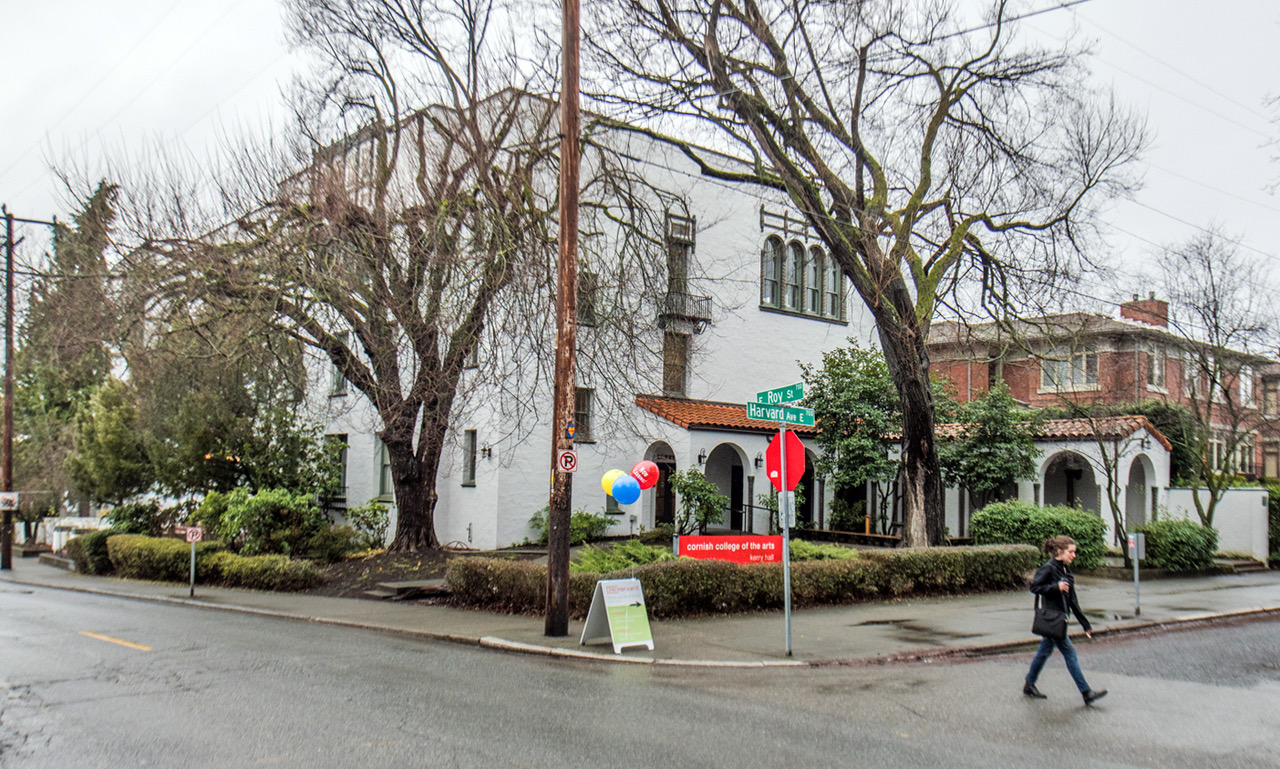
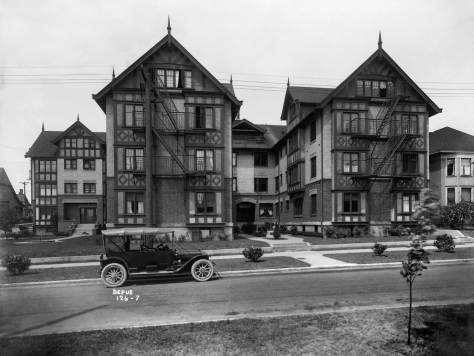
THEN: Cornish School under construction in 1921 at its new campus at Harvard Avenue and E. Roy Street. (Courtesy, Museum of History and Industry)NOW: The arts academy’s “purpose-built” home is named Kerry Hall for the philanthropist Mrs. A.S. Kerry, who co-founded the Music and Art Foundation that ran Cornish School as a non-profit.
Cornish, a few years later aka “in the 1920s.”
11th Hour investing in Cornish construction. An adver clip from The Times for March 14, 1921.Advers from June 30, 1921 include the announcement that the Cornish move off Broadway to Harvard would be delayed but for only a few days.A clip from The Times for July 10, 1921Another Times clip from July 10, 1921.The Times summary of some of the events connected with the school’s dedication. A Times clip from July 24,1921.Nellie Cornish
Construction for the new campus of ‘The Cornish School for Drama, Music, Dance’ began on the first day of 1921. The work was rushed forward so that the school could open early in September, on time for the still young institution’s eighth season. Perhaps predictably, in late summer agents with homes to sell or apartments to rent in the neighborhood enhanced with this new landmark, began running classifieds for their properties with the message “near Cornish School” in both The Times and The Post-Intelligencer. That enticing landmark is under construction in this week’s “then,” although its bricks are not yet adorned with the ornamental tiles and stucco skin that still define its Spanish Colonial lines.
Cornish was founded in 1914 on Capitol Hill in the Booth Building at the SE corner of E. Pine and Broadway, less than a mile south of its new campus. (see below) After a year, in the summer of 1915, it featured two studios, five teachers and eighty pupils. The growth was impressive. Five years later when the enlarged and relocated academy was being planned and the cash to build it first pursued, the school held twenty-seven studios serving 1,154 pupils, led by twenty-six teachers. These halls of ivy then sometimes surely resonated with the reflecting sounds of rehearsing students. (I remember well that joyful, on the whole, noise in the early 1970s when I taught filmmaking to Cornish students, most of whom, like myself, could not afford to make films.)
This school of “allied arts” was founded by its namesake, the confident pedagogue-pianist Nellie Cornish. As late as the 1970s the often-convivial tone of her directions were still remembered by some as sometimes comedic. For instance, at one of the Sunset Club’s Masquerades Nellie proved her sense of humor when she won the “funniest costume” award. Cornish also frequently gave lectures, many of them before the city’s applauded Ladies Musical Club. (Would that there then had been smart phones with digital recorders.)
The Roy Street entrance to the Women’s Century Club served for about a quarter century as the popular door into Jim Osteen and Art Bernsstein’s (respectively, left and right), Harvard Exit Theatre.
For the featured photographs at the top both photographers aimed northwest from the fortunately irregular Capitol Hill intersection of E. Roy Street and Harvard Avenue. Following the Cornish example, this part of the Capitol Hill neighborhood became sophisticatedly snug when joined by the Woman’s Century Club and the Rainier Chapter of the D.A.R. (both built in 1925), and architect Arthur Loveless’s charming Studio Building. Historylink’s principal founder, Walter Crowley, describes the last in his National Trust Guide to Seattle (1998), as a “delightful mimic” of England’s Cotswold villages. Crowley notes that to the north and west of this prospect are the admired homes that make this Seattle’s only residential preserve, the Harvard-Belmont Landmark District.
WEB EXTRAS
Anything to add, boys? For sure Jean, and Ron will start again with some recent* features and I’ll follow with some scans from older clippings. (*Since we started the blog about ten years ago. Jean will know, but he sleeps.)
============
=====
=====
=====
=====
First appeared in Pacific on March 31, 2002
=====
=====
First printed in The Times on March 3, 2002
=====
=====
=====
=====
=====
======
======
======
======
======
First appeared in Pacific on Sunday January 21, 1990.