

(click to enlarge photos)


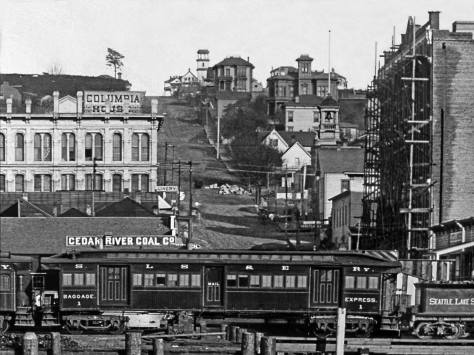
It took the greater part of Jean Sherrard’s 20-plus-foot extension pole to lift his camera pointing east on Marion Street from the prospect the Webster and Stevens Studio photographer used to record this week’s featured “then.” We figure that it dates from 1905 or 1906. The top four floors of the Colman Building, the six-story brick block, right-of-center, were completed in 1905. Facing First Avenue, the Colman survives, extending the full block between Marion and Columbia Streets.

It was James Colman, one of Seattle best-known pioneers not named Denny, who built his namesake landmark. The brilliant engineer and Scottish immigrant is also honored with a park on Lake Washington Boulevard and Colman Dock, the long wharf that has been the center for Puget Sound transportation since the late nineteenth century. The Dock is directly behind and over the right shoulder of the photographer of the featured photo at the top. Here the nine tracks of Railroad Avenue separated the Colman Dock and the West Seattle Ferry Dock from the photographer and the bustling business of Marion Street.


The four-story stone building on the right (of the featured photo at the top) , the Colman Annex, is separated from the Colman Building by Post Avenue, which on some old city maps is called a street and on others an alley. This “Colman Annex” was constructed of east coast stone. It was a lucky break for Colman: when the federal postmaster rejected its delivery – the stone was decreed as too soft for the construction of Seattle’s main post office at Third Avenue

and Union Street – Colman purchased the lot for pennies on the dollar. Many locals will best remember it as the long-time home for Society Candies. More recently a parking lot, the Colman Annex block is now filled by a glass curtain high-rise that celebrates its location as The Post Building. It can be glimpsed through the leaves, upper-right, in Jean’s repeat.

The wagons, above and in the featured photo at the top, most likely have something to do with the delivery of produce. This is the Commission District developed near both the railroads and the “mosquito fleet” steamers that carried fresh fruits and vegetables to the district’s large and generally homely warehouses. They were run by middle-men who were best known as “the sharks” by both the farmers who sold to them and grocers who bought from them. This was the gouging “Western Avenue combine” that truck farmers, home-owners and a progressive city council soon opposed in 1907 with a go-around, the Pike Place Public Market.


WEB EXTRAS
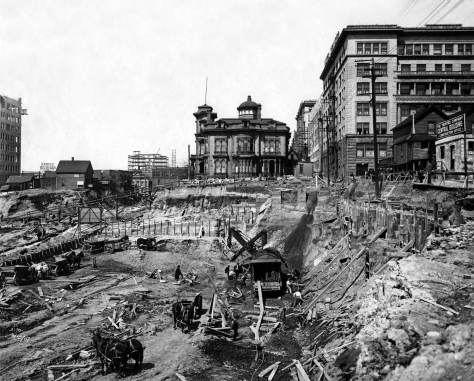
I was shooting on the waterfront for the column yesterday and came across a couple of scenes I can never get enough of. For your enjoyment, here they are:
(Thanks for your spontaneous/impetuous caress of this city Jean – in the right places.)


Anything to add, guys? Surely Jean.





=====

=====

=====

=====

=====

=====

=====

=====

=====

=====

=====

=====

=====

=====
