

(click to enlarge photos)


The address “S.E. Cor. 6th & Bell St.” scrawled on the driveway might alert the reader that this is yet another King County tax photo, one of the few-thousand rescued by Stan Unger from the assessor’s office trash nearly a half-century ago. When Jean and I are through scanning and using a selection among them, usually for this column, we will put them in an archival box tied with blue ribbons and guide them to the Washington State Archives, a more responsible home for the greater Works Progresses Administration (WPA) collection.

[ABOVE, 1938 & BELOW, 1946 – The rectangular roof of the SILVER INN at the southeast corner of Bell Street and Sixth Avenue can be found near the center of both the 1938 detail above and the 1946 detail, below. The nearly vacant blocks to the north of Blanchard Street – it starts in the upper-right corners – is the result of the Great Depression and the little development that followed the market’s bust in late 1929, the years in which the last of the Denny Regrades proceeded east of Fifth Avenue. The Silver Inn was an exception, although not without its owners struggle. The developed neighborhood west of Fifth Avenue, which crosses the lower-left corner, was built up after the Denny Regrade of 1908-1911.]

The likely date for the steady snapshot of the Silver Inn is 1937, the year that the federally funded WPA began its photo inventory of, it was hoped, all taxable structures in King County. These first tax photos generally showed acuity and sometimes, as here, great acuity. That sharpness is the better to read the Silver Inn’s greasy spoon credits: chicken, steaks, and hamburger at depression-time prices that were themselves delicious: “Lunch 35 cents” and “Dinner 50 cents.”

If a reader wishes, he or she will find in the Archive’s tax photos hundreds of hamburger signs hanging high, on or above, the windows of many of Seattle’s more than 800 restaurants listed in the 1938 Polk City Directory. One may visit the Archives on the Bellevue Community College campus. Plan for at least a week of afternoons looking through the many thousands of prints. (We will continue to hope that some happy day they will all be online.)

Born in 1938, I was quickly indoctrinated into hamburger hysteria. With the need for cheap food the “National Hamburger Diet” got off the grill during the Depression, and it kept frying during World War II when many families used their food coupons almost entirely for hamburger. Standing in the kitchen before our mother, my older brother David and I were a devoted duet pleading for hamburgers, but not for their weak substitute mere ground beef. We very much also wanted the sandwich with the buns.


When the Silver Inn was built and first opened by Joe and Minnie Barmon in the early 1930sl, the neighborhood was freshly scraped free of what remained of Denny Hill – eighteen years after its regrade had stalled in 1911 at Fifth Avenue. The new digging in 1929 was inadvertently synchronized with the Great Depression. The Barmon’s nifty box-like cafe was one of the few structures built above the many blocks of graded dirt left by the regrade. Soon after opening the Silver Inn was shaken by an unclaimed bomb that exploded on Bell Street. Thereafter the couple endured several overnight robberies, and then gave up in the spring of 1939 when a beer and wine violation moved the state liquor board to cancel their license.

===============


=======


During most of World War II, the Silver Inn was rented by the dancer Mary Ann Wells, who was for decades Seattle’s most celebrated dance producer. Converted for dance classes, Wells described the transformed Silver Inn to the public and her hundreds of pupils as her “beautiful new school.” Wells was not thrilled when in 1943 the Army Corps of Engineers surrounded the school with barracks for homeless workers, newly arrived in Seattle from the Midwest. All were looking for work, expecting it, and finding it at Boeing and in the shipyards. My second oldest brother Norman was among them. Ted, the eldest, was far away aboard a destroyer in the Pacific.


[A REMINDER: Comparing the two aerial details above – nearer the top of this feature – will reveal the character of the Silver Inn’s immediate neighborhood before and after the building of military housing. Ron Edge distinguishes between the narrow men’s dorms immediately behind the Silver Inn, and the larger women’s housing above the men.]
WEB EXTRAS
On a personal note, I took the ‘now’ for this column on a day when Seattle’s air was rated worst in the world. While shooting the corner, I witnessed one asthma sufferer, bent over, trying to recover his breath before shakily crossing the street. Within a day or so of that photo, I shot another at Lapush’s First Beach, probably one of the most discombobulating sunsets I’ve ever witnessed.

In contrast, let me add in a Lapush sunset from a previous year, smoke free:

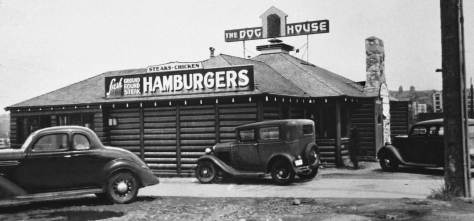
Anything to add, lads? Alas, nothing to compare with you stirring filtered sunsets Jean. Gosh, we do have more stuff on the neighborhood, beginning first below with with the Dog House and its Hamburgers on Denny Way near Dexter and Aurora and so not far from the Silver Inn at 6th and Bell.


======

======

======

======

======

======

======

======

======

======

======

======
MORE TO COME LATE SUNDAY
[Now once again, we climb the stairway to the kind of Nighty-Bears we commemorate to Bill Burden, who we have heard is about to open a coffee shop in Nevada City, California and so closer to Reno than to Oakland.]
