
(Click and click again to enlarge photos)


Published in The Seattle Times online on Dec. 18, 2025
and in Pacific NW Magazine of the printed Times on Dec. 21, 2025
a Postscript to an earlier column,
published in The Seattle Times online on June 8, 2023
and in Pacific NW Magazine of the printed Times on June 11, 2023
Headed home
Newly restored, Marvin Oliver’s poles
soon will return to Steinbrueck Park
By Jean Sherrard
After a long and challenging journey, the two totem poles that stood sentinel for 40 years in Victor Steinbrueck Park next to Pike Place Market are finally on the path home.

Unbolted from their plinths in April 2023, the poles spent months lying side by side in a Discovery Park maintenance lot, exposed to rain, moss and growing doubts about their future. Commissioned by architect Victor Steinbrueck in 1980, designed by late Quinault/Isleta Pueblo artist Marvin Oliver, and largely carved by late non-Native sculptor James Bender, they long have stood at the crossroads of art, identity and civic memory. The

debate over their authenticity, followed by their removal, only sharpened tensions.
For Oliver’s sister Marylin Oliver Bard – whose brother died in 2019 at age 73 – and members of the Steinbrueck family, the poles represent something profound: Marvin Oliver’s work, Victor Steinbrueck’s vision and their shared legacy of collaboration that deserves to be preserved.

In mid-2025, after months of bureaucratic drift, the poles entered a new phase of restoration in Neah Bay, under the care of Makah carver Greg Colfax. If all goes as planned, the poles soon will return to their westward “belvedere” — Steinbrueck’s favored term — resuming their vigil above Elliott Bay.
 Their return has been anything but straightforward. For 19 months, the poles — each 50 feet tall — rested on wooden blocks in the Discovery Park lot. Grass clippings blew over them, algae pooled in open cracks, and new growth sprouted in their damp crevices, which continued to widen. (Tradition holds that if a pole touches the earth, it cannot be revived, effectively ending its life as a cultural object.)
Bard repeatedly visited them from her home in Kingston, whisk broom in hand, sweeping debris from the features her brother had carved. She left a note asking other visitors to show respect. Her worries grew, as did the Steinbruecks’.
“If one wanted to slowly destroy the poles,” says Lisa Steinbrueck, a museum curator and Victor Steinbrueck’s daughter, “this is how to do it.”
Back in 2023, Seattle Parks sought approval to permanently remove the poles from the park, dismissing them as culturally “misrepresentative.” The department argued that the poles, carved by a non-Native artist, perpetuated a “false narrative” that such monuments were Indigenous to local Coast Salish Tribes. The Pike Place Market Historical Commission — citing longstanding guidelines that require the poles’
preservation — rejected the request and ordered restoration to proceed.

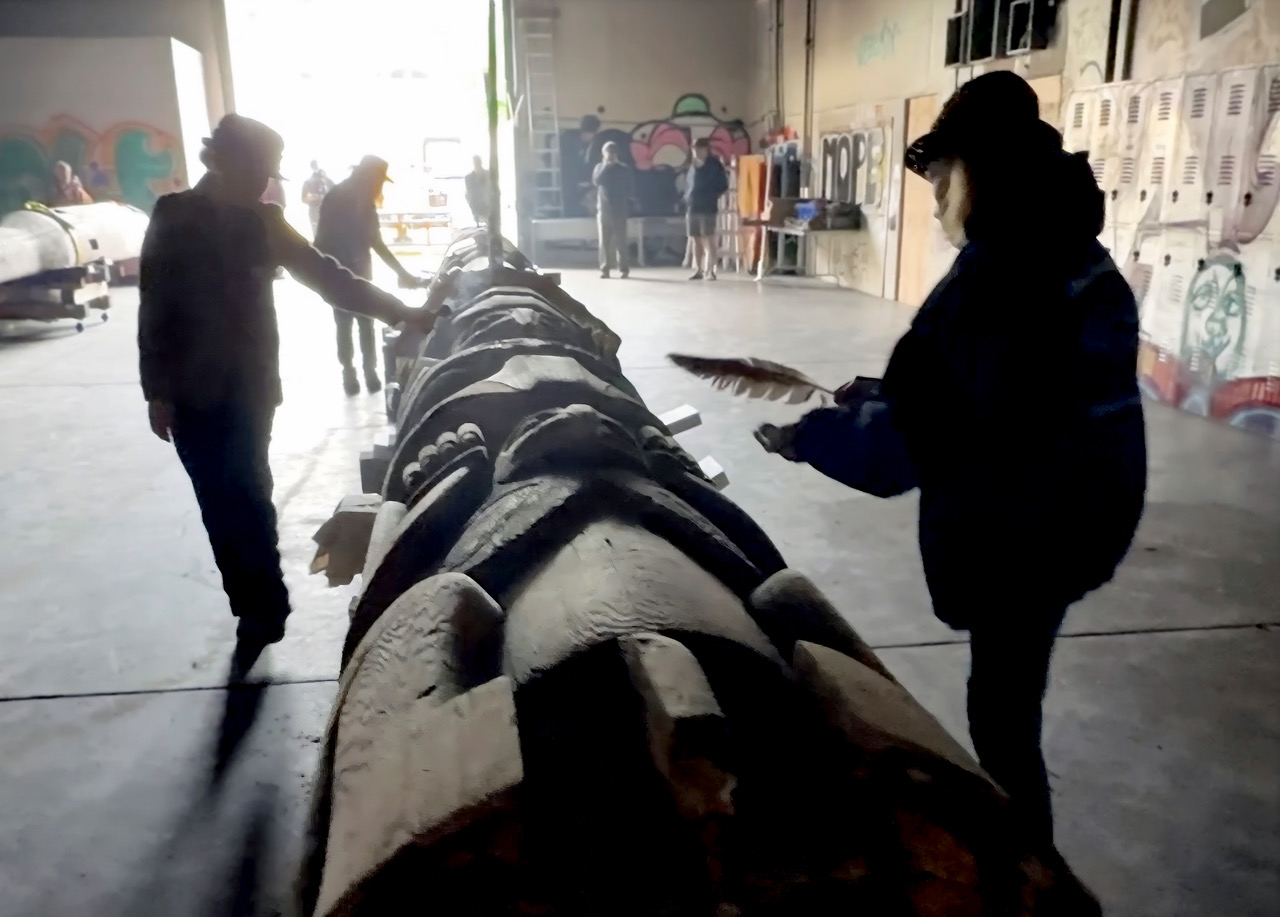
On May 29, Bard requested a traditional blessing before the next phase of their renewal. Inside a cavernous Fort Lawton warehouse, she, Lisa Steinbrueck and Heather Pihl, president of Friends of the Market, circled the poles four times, sweeping cedar and sage smoke over the carvings as Nahaan, a Tlingit artist and cultural practitioner, led a prayer song.
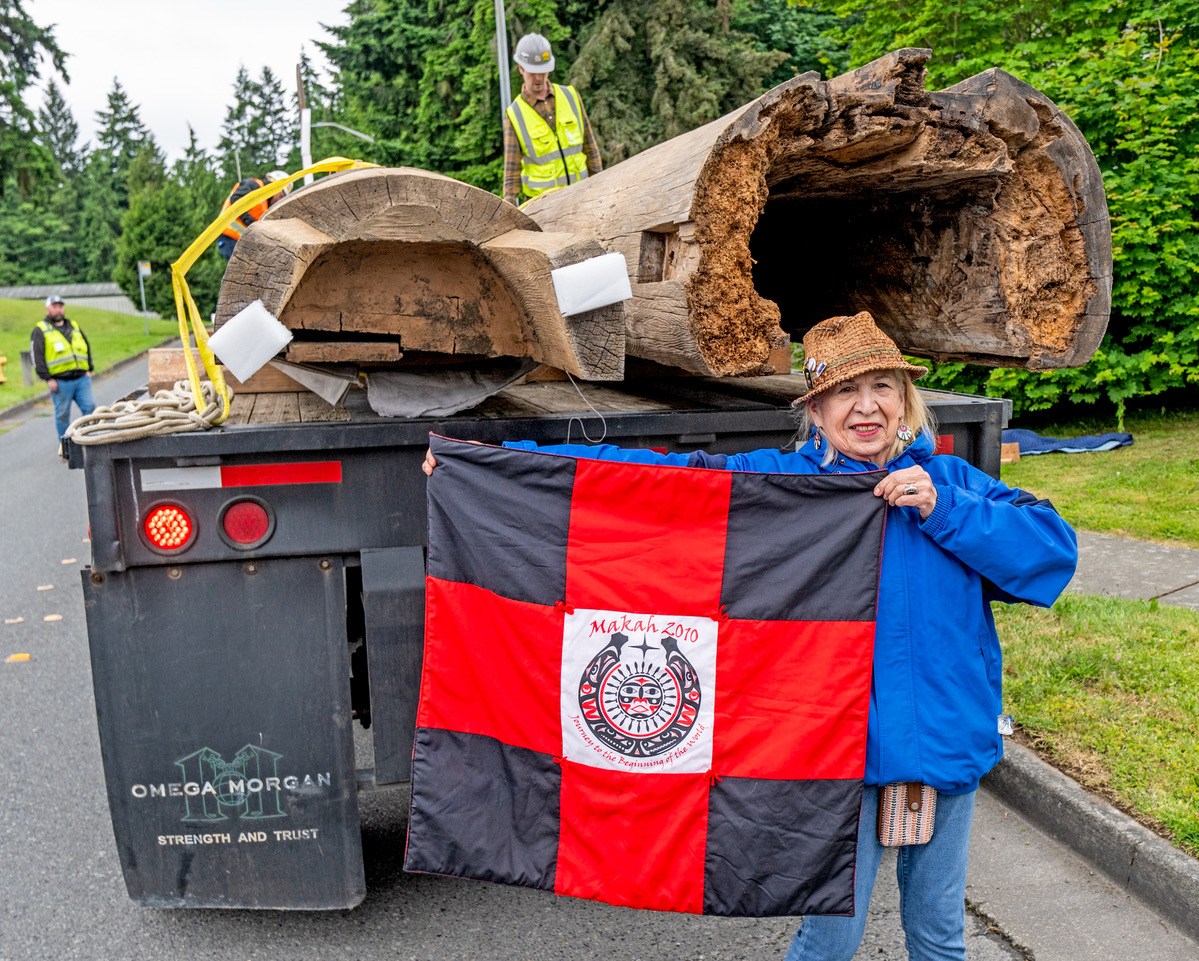
50-foot poles to Neah Bay.” (Jean Sherrard)
The next morning, just after 4 a.m., Bard and David Steinbrueck, the son of Victor Steinbrueck, followed the flatbed truck carrying both poles northwest to the Makah Reservation, where Colfax welcomed them.
He began with the Farmer’s Pole, with its brightly painted back-to-back couple atop the apex. He removed softened cedar and filled cracks with thin shims, then recontoured damaged sections and restored the figures, color-matching new paint to the surviving pigments.
The results astonished Bard. “Her nose is fixed, her eyes are perfect,” she says. “Her hair, her badge — everything. And the farmer — proud again in his blue overalls and red shirt.” After more than two years lying horizontal, the pole is nearly ready to stand.

Work soon will begin on the second, untitled pole, with its raven, bear, spindle whorl, orca and humanfigures. A structural engineer and fabricator must advise on reattachment before the work proceeds. While many repairs are cosmetic, cold weather might delay completion.
Meanwhile, redesigned Victor Steinbrueck Park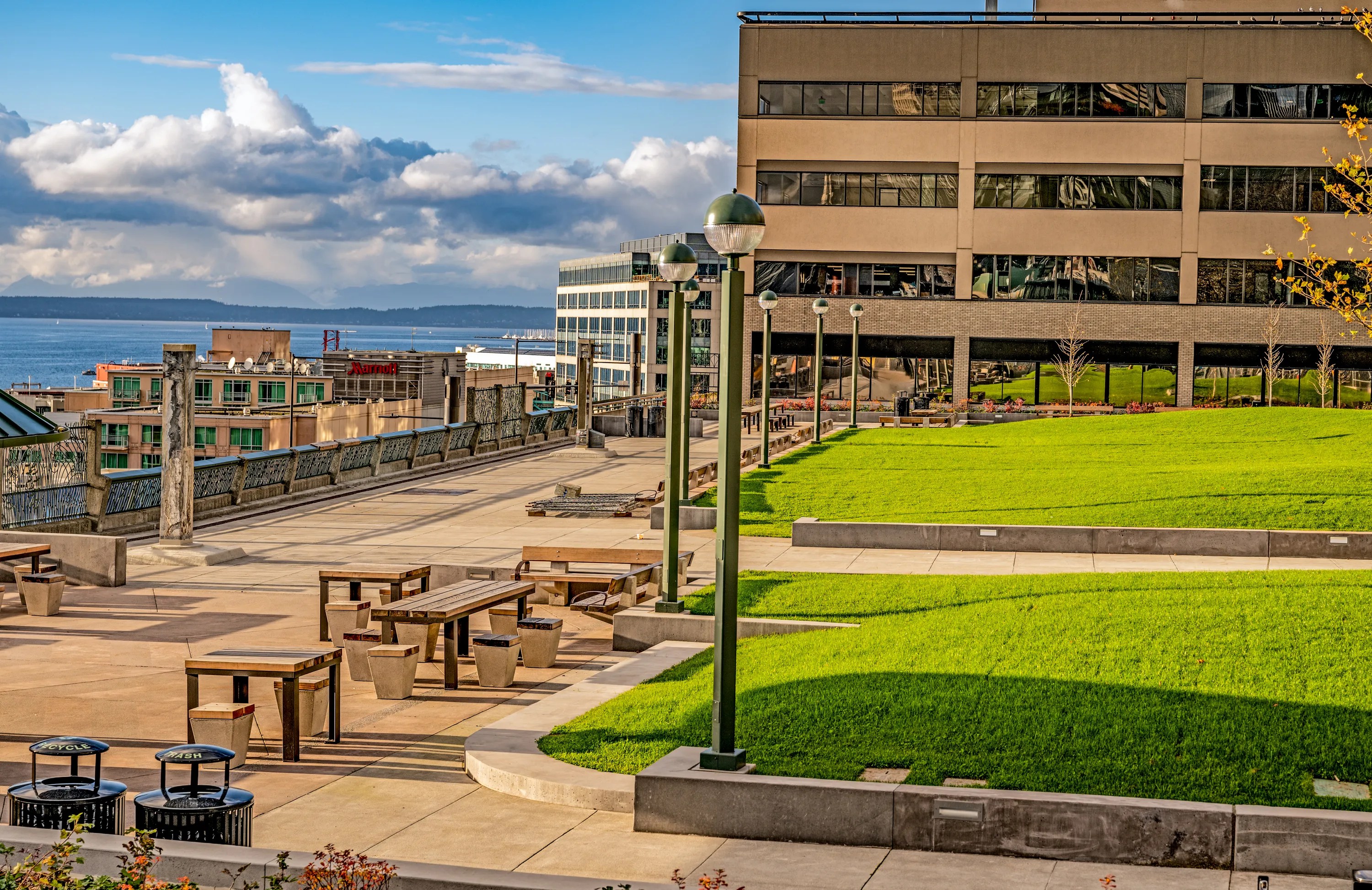 awaits its landmarks. The original plinths remain in place. “This is where they belong,” Bard says. “This is where my brother intended them to be.”
“Victor’s vision was to honor the first people of this land — the Duwamish,” says Lisa Steinbrueck. “The Market stands on their ancestral ground, and this park was meant to acknowledge that truth.”
“We’re glad the restoration is underway,” Pihl says. “We’re working with Parks on permanent signage, and look forward to seeing the poles reinstalled.”
When they return next year, the poles will reunite with the Sound and mountains they were carved to honor, standing as survivors of a journey neither man could have foreseen.
WEB EXTRAS
First, don’t miss the original column on this topic, published June 8, 2023. It has web extras not included here. Also, see other previous posts on this topic: here, here and here.
No 360-degree video for this Postscript.
However, click below for an enlightening 2018 video of Marvin Oliver discussing his art, including these poles.
And here’s a smudging ceremony, conducted shortly before the poles were transported to Neah Bay.