HELIX – The Return of the REDUX From Paul Dorpat and Bill White
The five issues of Helix freshly posted below are a continuation of what was posted previously – where we let off many months ago. With this return we embrace again our intention to post them all, although most likely with less rigor. It may be a month or more before we post another one. In this we also depend upon Ron Edge who has done the scanning, and so well. Bill and I hope that you will also respond and reflect on what you read – any or all parts of it. Record your comments on anything you read in these Helixes, and send the MP3 to Bill at BWhi61@hotmail.com by the end of April, at which time Bill will edit audio histories from the MP3’s he receives and post them here with the Helix issues. If you prefer to post a written commentary or response, please join our Helix Redux Facebook site, home of lively conversations on all things Helix and related. https://www.facebook.com/groups/217636941681376/
POSTSCRIPT: MP3’s received after the end of April may be included in the next issue to be posted.
Below is a photograph of the concert advertised at the bottom of the back cover of Vol. 4 No.8
After an about three month wrestle with our blog’s server we have persuaded it with a little more cash and plenty of pitiful coaxing to do us right, and so have returned for more weekly (we hope) postings of HELIX. This week it is the issue penultimate to the first SKY RIVER ROCK FIRE FESTIVAL. It is for the most part about the line-up of artists expected over that Labor Day Weekend outside of Sultan on Betty Nelson’s strawberry farm. (The berries were not in season.) Again, Bill White and I have returned with some joined reflections on what we find within the tabloid, and this time Bill has also attached a MEDLEY of SONGS performed by SKY RIVER ARTISTS at that time – or nearly then. He found them , of course, on YouTube. Ron Edge is engineering it all – or nearly. The long-distance recording on Skype that features Bill and I did not record off of Skye Itself. Rather, Bill (in Peru) had to fall back on the work of his small recorder set between himself and his computer in his apartment about 100 yards from the Pacific surf. It is a prudent precaution he consistently takes. So this week, while Bill’s voice is not filtered through the computer’s speaker, mine is, and resembles, Ron notes, a “mouse in the corner.”
The cover for this issue uses a photograph of Betty Nelson’s pets – I think – at her “strawberry farm” outside of Sultan, where the first Sky River Rock Festival and Lighter Than Air Fair was held on Labor Day weekend, this year 1968. Whoever laid out the cover continued this tabloid’s tradition of being wrong about the proper volume and issue numbers for the Helix then to hit the streets – and it was on the streets were circulation occurred. There were never very many outlets – just a handful of brave merchants. It was the vendors who kept the paper going – the vendors and record ads and the staff’s collective acceptance of poverty. It was hardly worrisome – with a little help from one’s friends. Again, Bill White and I gab about another issue and Ron Edge puts it and the colorful Helix Logo together, Thanks to us all.
Somewhat true to our new and relaxed schedule of reviewing an issue of Helix every second week – as it also continued to be printed here in the mid-summer of 1968 – we return to talking on top of each other employing (for free) the creative sputter of Skype’s marvelous recording tool.
Ron Edge has suggested that we name this edition – the audio commentary part of it – “Stall the Crowd.” Some ghost has got in the Skype Recording Machine Bill is using and flipped and twisted Bill and my conversation about Helix Vol. 4 No. 3 into what Bill names a “disaster.” But it is also a fanciful flop. Why would this latest instance of our routine conversations via Skype between Seattle and Lima sound like it has now been joined by whales? These third parties are not without their appeal. You may prefer them. Long ago when I first called Bill on Skype I heard the whales, although Bill did not. Well then, I thought, are these the whales that have not made it south of the Panama – our very own gratuitous but graceful sirens, our ghosts of Namus past and all the other Orcas in Puget Sound formally captured by brave but mad whaleboys. But Vol. 4 No.3’s recording oddities are more elaborate than its orca-acapella. Bill continues, “Our voices are out of sync, and getting worse as the recording goes on, until finally we are often talking at the same time on different subjects.” We might do that anyway – but not like this. Then it comes to Bill – the rescue by psychedelic insight. He concludes, “I may have saved it by heavy cutting and accenting the tone of an acid trip . . . some of the passages are quite lucid, others incomprehensible, but there is method here. It is something like two stoners talking.” Still Ron advices “Stall the crowd.” But how? For balance we need something that has clear and familiar continuity and, it turns out, we have it from Bill as well with his guitar relaxing on his and Kel’s Peruvian pallet and singing Dylan’s “Visions of Johanna” under Kel’s direction. Here’s the link. http://www.youtube.com/watch?v=IkZjEZMcLoI
We return to our postings of – if you have forgotten – the Seattle-based tabloid HELIX, which was originally published on newsprint between the budding seasons of 1967 and 70. With this issue Number 2 from Volume 4 we reach the mid-summer excitements of 1968. We were – surprisingly to this reader – still a bi-weekly then. (Surely, we will become a weekly soon.) Our haphazard insertions – as of late we have not made weekly those weekly offerings as originally hoped – are the result of working from two continents, although both are in the Western Hemisphere. During this audio commentary you will sometimes hear a not displeasing percussive sound behind the conversation. It comes from street work outside Bill and Kel’s apartment in Lima, Peru. The conversation between Bill and myself was dropped toward the very end for a short while providing a sonar like intermission. By now Bill has Vol. 4 No. 3 already in hand which was done on Ron’s new* oversize scanner, and so the work of recording/scanning the pages has been made easier for him and the results are somewhat clearer for all of us. (*It may be not new but used. Ron has a profound knack for finding his technology in thrift stores. While this is good for the environment it is not so swell for the gross national product, and that. we know, is an old conflict.)
While Bill White is studying hard for the mid-term – already – in his Spanish language class there in his new hometown of Lima, Peru – he did manage to take this break to discuss with me the July 3, 1968 offering of our 24 page tabloid. Every week I am surprised by what we find including, so far, the fact that we had not yet turned into a weekly. I thought it was long before this. The attentive repeater will have noticed that we have not been keeping up with our weekly pledge, but then no one asked for promises and we have had extraordinary distractions like moving to Peru. By his every description Bill is loving it.
[We will here attach a Spanish translation of the above as supplied by Google. As Kel has instructed Bill these Google translations are often mistaken. This, then, gives Bill another lesson with the chance to correct Google – with Kel’s help.]
Mientras Bill White está estudiando duro para el mediano plazo – ya – en su clase de español hay en su nueva ciudad de Lima, Perú – se las arregló para tomar este descanso para discutir conmigo el 03 de julio 1968 ofrenda de nuestra página 24 tabloide. Cada semana me sorprende lo que encontramos incluso, hasta el momento, el hecho de que no se había convertido aún en una semana. Me pareció que era mucho antes de esto. El repetidor atento se habrá dado cuenta de que no hemos estado al tanto de nuestro compromiso semanal, pero nadie le preguntó por las promesas y hemos tenido distracciones extraordinarias como mudarse a Perú. Por cada uno de sus Bill descripción le encanta.
[Estamos aquí adjuntar una traducción al español de lo anterior según lo provisto por Google. Como Kel ha dado instrucciones a Bill estas traducciones de Google a menudo se confunden. Esto, entonces, Bill da otra lección con la oportunidad de corregir Google -. Con la ayuda de Kel]
With Bill White happily camped in his new Lima flat w. Kel, we now have a second Skype recorded reading of Helix, this one for June 14, 1968. Herein plans are made for the first Sky River Rock Festival – although not named so as yet – Robert Kennedy is shot dead, Lorenzo Milam reveals his esoteric review of KRAB Radio since giving up its management, and Walt Crowley reviews his favorite movie, 2001. And much more.
With Bill White now comfortably set in his New World neighborhood in Lima, Peru and the helpful SKYPE, we can put up the next issue of HELIX, the one probably from June 7, 1968. (The issue was not dated, but surely we are correct or no more than one days off.) Now we will week-in-week-out put these tabloids up – in their proper order – and have a good time both reading them and reflecting on them together. Please notice how the new and drier climate – plus the medicines applied by his doctor Kel – have cleared the stuff in William’s head and he is sounding fine. (SKYPE is, however, kinder to Peru than to Puget Sound. While Bill’s voice resounds, the Skype filters also amplify from our Seattle end that ssscar of recording, the hissing S. We hope to dampen it with our next offering – in a week or so. If not we will live with it. Repeated thanks to Ron Edge for processing all this and adding his art – the coloring of Jacque’s logos – as well.)
This week Bill White and I pause in our commentary on this most recent issue to call Thom Gunn for an elaboration on the “party” – he calls it – that followed his victory in the late spring of 1968 as the newest U.W. Student Body Prexy. He called it “World War Three.” The school administration was not amused. As you may recall, and as Thom described on the phone from Whidbey Island, it was followed by World War Four.
Bill White is off to Peru on Thursday and there is no telling when he will return – if ever. We will try, however, to find a Skype-aided way to continue these readings and comments together. We will also put aside this piling-up of tabloids for a two week break, during which Bill will begin his new and second role on this blog as a travel writer and South American correspondent. So next week no Helix but rather our first “on the road” with Bill White – and on the train to Florida. The following week Bill will be on a cruise ship that will take him from Florida to Lima, Peru. His report will then will be on the sea.
Still a bi-weekly more than a year into it. Soon, I suspect, we will discover that we have become a weekly. In this issue many revelations with reporting by Scott White, Tim Harvey, Paul Sawyer, John Bixler, Henry Erlich, another Crowley Weltschmerz and Cunnick Dump Truck Baby and my own report on the Piano Drop. For that the editor gave himself the centerfold and managed to again almost hide the text behind the split-font superimposed graphics. Three full pages given to record ads means we certainly managed to pay for this issue.
Ron Edge who has made both the weekly scans of every issue and enlivened the chosen masthead with colors copied from the paper itself notes that this week he has nothing to work with. As Bill White and I elaborate at the beginning – or “front page” – of this week’s audio commentary, the cover photo of County Joe was snapped in the SeaTac sundries store. The film was colorless Tri-X. Normally Joe would travel with the band, but this time he was alone. I drove him to the airport. For this “set up” he did his own art direction tucking bills into his shirt and tunneling his vision with a roll found somewhere. The red “Helix”at its center is the only color for Ron to borrow – tomorrow. I wonder what he will do.
In proper order and again below is the next issue of Helix, and the commentary by Bill White and myself. In this issue John Bixler makes his first appearance – on a motorcycle stopped by some plainclothes police ready to slap on him the tough charge of not having paid off a parking ticket. In that reportorial snap, the Helix office can be seen across Harvard Ave. E. (beneath the freeway). Hereafter John will be an enduring participant in our productions, except when he was away doing road work for the band The Youngbloods. In Jef Jaisun’s 1992 shot taken for the 25th anniversary of the founding of Helix – Not So Strait John Bixler appears far right with those posers who made it out of the Blue Moon and onto the sidewalk in front it. They are, right to left, John Bixler, Jacque Moitoret, Tom Robbins, Walt Crowley, Alan Lande, Paul Heald, myself, and standing in front with his own row, Maury Heald. We have printed this earlier and will probably print it again later. (Thanks again to Ron Edge in Lake City for steadfast wrestling all this Helix matter on the blog that ends with the last name of our editor in Paris.)
We searched for the date, but found none, although surely a finer search of the text may stumble on one. Sometime in March of 1968 – perhaps the First of March given that the last issue was dated Feb. 15, 1968. By this time our publishing was routine, but not for long. Soon – perhaps next week? – with the optimism of Spring HELIX will become a weekly.
The audio commentary attached is a continuous confession of my ignorance as I did not prepare for the recording but by arrangement with Bill White entered blind into that tabloid pulp as we looked at it together – I for the first time in 44 years. Bill, however, was prepared to ask me startlingly informed questions from his fresh reading of the entire issue. While not entirely fair it was fun.
Bill White liked this issue and read it from cover-to-cover: page one to twenty. We review it below with an audio link – or two, and an “intermission.”
In this issue Helix gains four pages for twenty in all, although the tabloid is still published every other week. As Bill White notes in our discussion that is attached as an audio file, this Helix it very unlike last week’s. This one is stuffed with counter culture concerns and reports. Volume Tow Number Nine pulls Five R. Cobb cartoons from the Underground Press Syndicate, some representative Alan Watts, and five years after still more about the Kennedy assassination.
The audio attached to this issue is “new and improved.” Bill White, the editor of both the weekly audio and the Helix page on Facebook, interviews me about the issue, to more energetic effect.
Click to Enlarge
On the back cover of this odd issue – 12 pages with neither advertisements nor news – I discover that part of its art involves a snapshot line-up of the Helix staff – or a small part of it. It was printed there in negative, so I “captured” it and inverted it to positive. Still I cannot identify – yet – the three faces on the right. Otherwise the row goes so: far left Joe Caine, I think. Following Joe are Pat Churchill, Tim Harvey and either Billy Ward or Walter Crowley. Bill thinks that it is more likely himself, for he thinks that Walt would not be inclined to lay his cheek against Tim’s shoulder. Continuing: me (Dorpat), Inger Anne Hage – we lived together then – George Geise (George worked at the P-I – like Ray Collins – and was a great and steadfast help in many ways,) Scott White, and Jack Delay. And then, as just noted, I don’t know – although the middle figure could be Bill Ward “again.” Bill agrees that it could be him, although he thinks that the Billy far left – snuggling with Tim – is a more likely Bill. Insights and/or corrections welcomed.
Another flip-flop issue with pages numbered in order and forward to the center within both covers. The color on the covers is unique and the paper too. Most likely Ken Monson printed the covers on his Heidelburg flat-sheet press and then farmed out the inside to a web press. Perhaps it is our first employ of the Mount Vernon Herald and its press to print the innards of this issue.
Leaning into our first winter we wonder how the street sellers will do. We help by giving them – and our own hawking too – this surely lovely cover by Jacques Thornton Moitoret, a dashing figure who grew up, in part, on an oversized Lake Union houseboat. On the inside cover – another not coated surface of common newsprint – you will find an essay that reviews the life and success of HELIX in this its seventeenth expression. Returning to Jacques, I am not sure if the date for this is issue is Dec. 1 or Dec. 2 as rendered by his hand. Check the cover. I think it more likely the former, that is, the first.
Thanks again to Bill White for editing my rambling remarks attached as a audio file below, and thanks to Ron Edge for delivering them to post. And, just now, I notice a letter from drummer Jim Zinn (of Southern Oregon and making music), who put a classified in an early Helix looking for other musicians to form a bind. He found them. Read on . . .
Hi Paul,
I am the Jim Zinn that placed that unclassified in the Helix way back when(1967).
Thanks to the paper, I hooked up with some great guys within 2 weeks of the posting.
We never did amount to much as a band, but had a great time and formed some lasting friendships.
As a side note, One month we even sold the Helix to make rent on the band house on Capitol Hill. We made it.
Thanks again,
Jim Zinn
Last week we noted our intentions of finding and interviewing John Ullman about the Lightning Hopkins concert he and others in the Seattle Folklore Society produced in Oct. 1967. And we did, but are holding back offering it here until John attempts to resurrect a photograph taken during the concert, which he described as wonderfully expressive of it. So we wait. We had hoped that a review of the concert might have been found in the HELIX Vol.2 No. 4, attached below, but we found no blues reviews there, only Ed Varney’s review of SAM’s annual Northwest exhibit.
This issue is the first to use two front covers and the internal flip-flop required to have both act like the “beginning.” Why did we do it? Perhaps, because we could.
Not flummoxed and yet not certain, I ask an old friend, Bill Burden, for his take on a full-page “proposal” that appears on page 10 of this HELIX Vol. 2 No. 2. His recorded response is included in the audio commentary below. Below is a police surveillance photo of Bill taken during his testimony regarding police behavior on the Ave. He had been gassed while at the time – or nearly – working for the mayor’s office promoting a summer youth program.
This HELIX – Vol. 2, No. 1 – comes with a small surprise. We are evicted – or were. I was expecting this, but not so soon. Also within- Robbie Stern, Alan Watts, Black candidates for City Council 1967, Yakima’s “Bitter Harvest,” Don Scott . . .
Gracious, we have completed the first Volume of Helix and are heading for its first winter. Sometime this week we also expect to put up a new Helix feature we are titling HELIX REDUX. It will be numbered as well, and feature interviews, photographs, reminiscences, confessions, links, etc. We hope to encourage you and yours to participate in this, by recording your own reflections and memories and interviews (too) about subjects related to Helix and its times. In this we will – in some way – be making together another journal filled with oddly related features. Bill White – Seattle critic, musician, novelist, poet, pundit of everything – will be the principal editor. Bill was a mere teen with a hammer in the late 60s. He helped construct the stage at the first Sky River Rock Festival and Lighter Than Air Fair in 1968. That is certainly a qualification.
Finding the date for this issue was easy; it is printed on the cover: August 16, 1967, the hottest part of the “summer of love” and a Wednesday. No. 9 continues the 12-page bi-weekly size and schedule, and by now (or then) a kind of Helix style is evident. (You will “know it when you see it.”) Tap the cover below to reach the pdf presentation of the entire issue and if you like there is also a link to an audio review of the issue, which, you can follow while moving through the issue. (Thanks to Ron Edge, again, for scanning and “putting up” this issue and the rest of them too, and thanks again and as well to Bill White for editing away some of the stumbles in the audio commentary.)
The dates we have attached to both No. 7 and No. 8 may be skewered by a day or two or three. We have yet to crack their dates, for neither issue confesses such. The audio below – by Dorpat – is another revelation – for Dorpat – as he reads this issue No. 8, like the rest, for the first time in 45 years, and confesses his own inadequacies in remembering in detail its subjects. To read thru the issue either with the commentary or without it just click the cover.
It seems that Tuesday – not Monday – will become the more likely day of the week these Helix Redux offerings will appear here. (But don’t necessarily count on it. We will still aim for “Wash Day” to hang these sheets.) Here’s another 12-pager. It includes many delights, and I took the opportunity of the attached audio to read one of them: an early Dump Truck Baby feature by John Cunnick in which he reflects on the meanings surrounding having ones own newspaper in its eighth week and still learning. Inside is also an adver for the OCS concert with The Grateful Dead at Eagle Auditorium, and in that line we will attach several snapshots from that bright blue Sunday afternoon picnic with power at the north end of the Golden Gardens parking lot. You will recognize the Dead faces, surely, but also some others I suspect in the rapt listeners. There are a few snaps of other musicians performing as well including one of Larry “Jug” Vanover who will be delighted to see his own slim self in 1967 with jug in hand – I expect.
I’ll not caption any of these Dead photos. There are nine of them and they come from the remnants of the Helix darkroom. I’ve not determined as yet who recorded them. At the bottom of this line-up are four or five shots of other players, include – at the very bottom – one of Larry Vanover with jug in hand.
While preparing the audio – below – first Bill White showed – coming down the steps – and then Jean Sherrard – calling on the phone. Both had intimate memories of one of the subjects included in this Vol. 1 No.6, and so I interview them. The subject is the Last Exit on Brooklyn, a popular cafe that opened in 1967 on Brooklyn Ave. two doors south of 40th Street on the east side. The result of these interviews is a longish (relative to the first five & 1/2 iterations) but invigorated commentary, which begins with what is by now my typical approach to this extemporaneous blabbering – beginning at the front cover and reading along as long as I last – followed by the two interviews: Bill first and Jean second. This has also given me an idea – this idea. To do more interviews on future subjects that are revealed in these issues and to post those too. This is also a lot of fun for me and an extraction from my bunker of writing – even for those interviews I might do by phone.
A brief (sort of) audio commentary is attached directly below. The disciplined listener might want to illustrate the “sound track” by opening the pdf to the paper itself – first – giving HELIX time to materialize before punching the audio button.
This fourth issue is a maturing cache of our typical subjects, which did include, yes, war, drugs, sex and rock-and-roll. Many of its parts are not signed – a frustration now – but within it appears new names that would become stalwarts of HELIX production, names we will recognize and thank, no doubt, down this 2&1/2 year line of putting up every issue and in order. And I have found a few more negatives of that first Flower Potlatch Isness-In at Volunteer Park. Once scanned I’ll attach them below.
An audio commentary is attached directly below. The disciplined listener might want to illustrate the “sound track” by opening the pdf to the paper itself – first – giving HELIX time to materialize before punching the audio button. The audio runs about ten minutes and then prudently adjourns until next week.
As noted above, we have scanned a few more scenes from the first Be-In at Volunteer Park, named, in part, the Potlatch Isness-In.
(Click to Enlarge – sometimes twice)
The grass on the big sloping lawn was just barely dry enough to sit on. Most people stood.Buttons, beads, and God's-Eyes (she holds one in her hands) make us happy.Several dancing snakes wound through the crowds.Hoping, perhaps, for a jam.A jamUnder the spread of the biggest tree on the lawn became - and perhaps already was - a traditonal spot for drum circles to jam. Youth dress with care Drum circle including beat with bongo and pipe.Late that afternoon looking west toward the stage.A band approaching the stage - most likely. The Blues Interchange, on stage.The Blues Interchange still on stage, and Gary Eagle and myself too (holding a flower) far left. I remember well that button-down sweater.Back to the circle with an example of the hip mountain man style with strong chin - or rustic viking.This big haired fellow was a mystery to me even then.
Don Edge, once again, did the coloring of our symbolizing bug or representive logo – the masthead.
We continue to turn the screw – of Helix – reaching now the fourth issue, which is curiously numbered “3&1/2.” This will be explained in the audio link. At the bottom of it all are several snapshots scanned from Helix negatives that I wound up with after the paper folded. We will try to identify the photographer – later. Perhaps it was Gary Finholt. Gary? A few of these are also printed in the gnarly centerfold of Issue Three and One/half.
Artists Gertrude Pacific aka Trudi and Ted Jonsson. Note the issue of Helix that Ted is holding with his left hand. And Trudi is barefoot. One of a few circle dances that was launched. Our Norwegian angle-protector, perhaps, under the park's big spreading tree. Imagine bongo drums here for this was a most p0pular place - under this tree - for drum jams.Flower Isness FashionsI believe that Tim Harvey is far right, with the rolled up white sleeves. Tim was one of the stalwart-editors for Helix.Seattle Magazine - and sometimes Helix too - photographer Frank Denman is aiming on the right. Oh the paisley! bottom-right.While I remember two faces here I cannot name them.On stageThe flutist's name eludes me, but - unless I am mistaken - I once threw his cat across a set in a duplication of the Dada Moment titled "The Dali Atomicus" and photographed by Philippe Haisman in 1948, which includes several flying cats and furniture too. The cat ran up a tree and was not noticed, I believe, until later when "our subject" returned home looking for his pet. By then his somewhat abusive friends, myself included, had left unwitting and so innocent but only sort of.
And LAST for now, JOHN REYNOLDS!
This I pleasantly discovered while scanning the few Be-in negatives I could find includes John Reynolds with beads, bells, Spanish hat, thongs and comfortable clothes, the Far East scholar who named Helix "Helix." I remember the woman that's with him, but not her name.
This week we have made it to the third issue of Helix. (It shows a date – April 27, 1967. A few did not.) Above is Ron Edge’s coloring of the Helix masthead we have chosen to represent this two-plus year project of putting up all the issues. (Last week it was Ron’s brother Don who started this coloring. We are looking for colorists – Photoshop artists to have a go with it. Below is a link to download a blank Helix masthead for those who would like to try their hand at coloring one for use in future post.
Below is another commentary of my first reading of this issue – as with all the others – in 45 years. So far in these rough and recorded remarks my time runs out – about ten minutes – before I get to the centerfold. Let it be.
This is mildly complicated. Above is Don Edge’s coloring of Jacques Thornton Moitoret’s logo for Helix Vol. 1 No. 2 – or part of it: the top part of it. All of Jacques first contribution to Helix is directly below where it wraps page one of that April 13 issue of the then still bi-weekly tabloid. We put up the first issue last week and we will continue to reveal them here for as many weeks as it takes to run through them all. Sometime in late 2014 this will end – or perhaps early 2015. (I have not done the math, nor do I need to until at least late in 2013. I am keeping clam.)
Thanks to Ron Edge for doing all the scanning of the 120-some Helixes, and thanks to both of the Edge’s for their playful recommendation for coloring Jacques’ logo. Somewhere near here a not-yet-colored version will be included that you may wish to color and return to us for posting. This is very much in the tradition of Helix. Not as coloring book, but as parody. Think of it as a loving parody of the Google logo, which changes so splendidly from day to day.
Like this week and last, through the weeks ahead I intend to read each issue from cover-to-cover and record a rough – rather – commentary of first impressions after having not seen any of them – except to glimpse – for forty-five years. (The button for playing this commentary is just below.) I hope that other readers will take moments to respond to what they also may – or may not – find in Helix after so many years. All this may result in some publishing effort near the end – m0re likely after it.
HELIX VOL. 1, NO. 1 – Introduction to Posting on April 2, 2012
As I croakingly describe it in the accompanying audio (linked above) my best plans to comment on the entire first issue of Helix were upset by the time I reached page three of twelve. (It was a small first issue.) Still I did browse the entire tabloid, and was charmed with pleasant and often vivid memories. But the audio commentary is keyed entirely to subjects on those first two pages.
A similar restraint will follow next Monday with the second issue. And so on and on for nearly three years more with a new old issue appearing each week on Wash Day. For this first issue, and the rest of them too, I’ll choose only a few ripe subjects to comment on. (The alternative would resemble biblical commentary piled on by medieval scholastics, a volume many times greater than scripture itself.)
Perhaps I will get to comment later on pages three to twelve, especially if asked about its parts by readers. And it may be that at some point I will return to add something to any page in any of the issues, thereby compiling a Summa Helixa – although not so systematic as Doctor Universalis’ Summa.
Besides the recorded but ragged weekly commentaries, I might also attach more captioned photographs – relevant but not necessarily directly to that week’s issue. I’ll include a few examples at the bottom.
While preparing this first issue I noticed a little hoax on the front cover. It was given the page number 35. It was new to me, but Ron Edge, who is scanning (Blessings to the Scanner) all the issues, was aware of the wild number and thought it was a prankish gift of first issue enthusiasm. Surely that is so, and I suspect Meryl Clemens, one of the paper’s founders and also one of the artists who contributed to the front cover. Ron scanned his own copy, which is better than mine, but still his ink has also faded in 45 years.
Entering the first Helix office at 4526 Roosevelt Way, one was met by an oversize American flag draped along the north wall. Here we see Tim Harvey, the tall short-haired figure with his back to the door. Tim was with the paper from the start. Scott White - facing the camera - and others at the layout table. Geneticist Henry Erlich's "Making the Revolution" board game.
As it developed Henry was certainly the most distinguished among us – a brilliant man of great kindness and charm. With the freedom of blogging I have found his fairliy recent vita and print it here.
AMERICAN MOLECULAR BIOLOGIST
Since the early 1980s, Henry A. Erlich has been well-known in the forensic and medical communities for helping to pioneer the research and development of a polymerase chain reaction (PCR) technique that ultimately lead to a number of important forensic and clinical applications. As a result of the pioneering efforts of Erlich and his team of scientists, the first commercial PCR typing kit was developed specifically for forensic use. Currently, Erlich is the director of the Department of Human Genetics and vice-president of Discovery Research, both for Roche Molecular Systems, Inc.; and the co-director (and co-founder) of the HLA Laboratory at the Children’s Hospital Oakland Research Institutell three located in the San Francisco Bay Area of California.
Erlich grew up in Seattle, Washington. He began his bachelor’s of art degree in 1961 at Harvard University in Cambridge, Massachusetts, where he completed his degree in 1965 with a major in biochemical sciences. That same year, Erlich was a research assistant at Yale University in New Haven, Connecticut. Erlich then began his advanced degree, completing his doctor’s of philosophy (Ph.D.) degree in 1972 from the University of Washington (Seattle) with a genetics concentration. While working on his degree in 1967, Erlich also worked with street gangs as a Vista volunteer in New Mexico. Erlich did his postdoctoral work in microbial genetics (1972975) at Princeton University in New Jersey, where he was employed as a postdoctoral fellow at Princeton’s Department of Biology. Erlich did further postdoctoral work in immunogenetics (1975979) at Stanford University (California), where he was employed as a postdoctoral fellow at Stanford’s Department of Medicine, Division of Immunology.
After completing his postdoctoral studies, Erlich became a scientist at Cetus Corporation, an Oakland-area biopharmaceutical/biotechnology company located in Emeryville, California, where he held various teaching positions and served on the editorial boards of such industry publications as Human Immunology, PCR Methods and Applications, and Technique. Erlich was later promoted to senior scientist and director of the Human Genetics Department, both positions that he held until 1991.
During his early-1980s work with Cetus, Erlich led the human genetics group in the research of PCR techniques. He was especially interested in developing technology for the study of human genetic variation, and with it the applications in forensics and clinical medicine. In 1986, Erlich’s research resulted in development of a PCR technique that ultimately produced a number of clinical and forensic applications. Also in 1986, in what is generally considered the first use of PCR-based forensic DNA (deoxyribonucleic acid) analysis in a U.S. court case, Erlich carried out the confirmation that two autopsy samples came from the same person in the case Pennsylvania v. Pestinikas. About two years later, Erlich and his scientific team saw the development of a commercial PCR typing kit as the first forensic application within the United States of DNA typing of HLA-DQA (human leukocyte antigen with a DQ alpha PCR test) locus.
Erlich transferred to Roche Molecular Systems, Inc., located in Alameda, California, in 1991 when the company acquired the rights of PCR technology from Cetus. Today, Erlich holds three important positions with Roche: director of Roche’s Human Genetics Department, since 1992; co-director of the HLA Laboratory at the Children’s Hospital Oakland Research Institute (CHORI), in Oakland, California, since 1996; and vice president of Roche’s Discovery Research, since 2000. Erich’s work at CHORI puts into clinical practice the technologies that he had developed for PCR-based HLA typing.
The primary research performed by Erlich in concert with Roche involves the analysis of molecular evolution and population genetics of HLA genes along with human genetic variation and genetic susceptibility to diseases, especially on autoimmune diseases such as type 1 diabetes. He also researches the analysis of polymorphism in HLA genes and the development of HLA typing for class I and class II loci within tissue typing and transplantation, anthropological genetics, and individual identification.
Erlich maintains an academic affiliation with the Stanford School of Medicines, where he is an adjunct professor of medical microbiology and immunology. In addition, he also sits on several editorial boards (such as Human Mutation and Tissue Antigens); participates on numerous human genetics committees (such as the International Histocompatibility Council and the National Commission on the Future of DNA Evidence-Research and Development Working Group); and is a member of the American Society for Histocompatibility and Immunogenetics and the American Society for Human Genetics. Erlich has authored several books, with one of the latest titled PCR Technology: Principles and Applications for DNA Amplification.
Erlich has also been bestowed with many honors within genetic research and writing including such awards as the Gideon Goldstein Award (Walter and Eliza Institutes, 1989), the Biochemical Analysis Award (German Society of Clinical Chemistry, 1990), the Brown-Hazen Award (Wadsworth Center for Laboratories and Research, 1990), The Rose Payne Award (American Society of Histocompatibility Immunogenetics, 1990), the Advanced Technology in Biotechnology Milano Award (International Federation of Clinical Chemistry, 1991), the Award for Excellence (Association for Molecular Pathology, 2000), the Profiles in DNA Courage Award (National Institute of Justice, 2000), and the Colonel Harland Sanders Award (March of Dimes Clinical Genetics Conference, 2000).
Phew!
Following geneticist E. Henry (above) we appropriately pick a page from Double Helix, a one-time tabloid published ca. 1972 by Michael Wiater and myself.
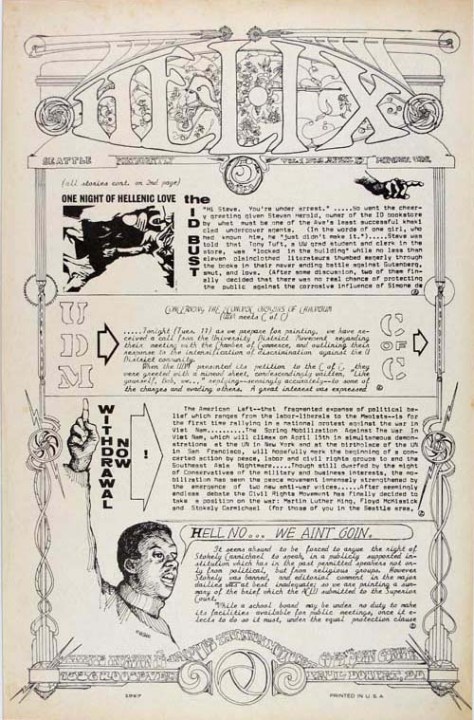
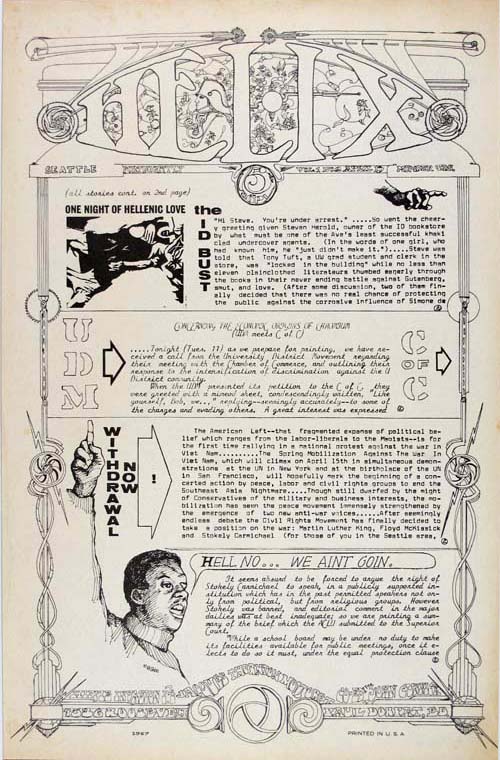
The HELIX cover printed just below appeared first on the 1st of December, 1967, which was still in the first year of the tabloid’s three year – and a few weeks – run. The cover was one of artist Jacques Moitoret’s many contributions to Helix. With age the pulp it was printed on has nurtured its color. Starting tomorrow, Monday April 2, 2012, we will feature it again on the front page of this blog as the front door – or button – to eventually all issues of Helix. We mean to put them up in the order they first appeared. Directly below Jacques’ butterfly is another and longer introduction to this project. You can read it and/or listen to it. The audio, which I recorded at my desk in one take!, runs about eight minutes. (When, in the context of revealing how Helix was conceived, I mention looking “down on 42nd Avenue,” please hear instead, “42nd Street.” It is correct in the copy, but wrong in the audio.)
By those who remember it, Helix may be described as “Seattle’s First Underground” newspaper. This, I think, is too romantic or glamorous. Rather, it was Helix candor – above ground – that was apt. It could be either disturbing or compelling – of course, depending.
Helix was conceived in a conversation with Paul Sawyer, a friend and Unitarian preacher, now deceased. I can recall the moment in color. We were alone in the Free University office (beige walls and gray ceiling), on the second floor above the Coffee Corral on University Way, aka “The Ave.” Under a blue winter sky and from the window I followed a couple walking hand in hand below me on 42nd St., when over my left shoulder Paul suggested, “What we need here is something like the Berkeley Barb.”
Paul Sawyer standing on the beach beside the park on the north shore of Lake Union, just west of Ivar's Salmon House. The photo is dated April 25, 2010. I took it during Paul's last visit to Seattle, a wind up, because he knew that he would not live out the year. He brought with him two boxes of his then new book "Untold Story," the cover's of which we will insert directly below this subject. Below the covers we include a page from Helix that features a poem of Paul's from the paper's first year, 1967.The covers of Paul Sawyers "Untold Story," 2010.
The Barb was one of the many weekly tabloids associated with the 1960s “counter culture” that were blooming then from Boston to L.A. and soon from Atlanta to – with Helix – Seattle. Most of these were loosely connected with university communities and the talents they offered. Here, for instance, Helix bundled Seattle’s University District and the University of Washington as part of a town and gown experiment. That was in the winter of 1966-67.
An early contribution of Walt Crowley's, an allegorical illustration of our struggle with City Council to hold light show dances. We won. Bitter Harvest, another example of the many covers Walt Crowley did for Helix.
Now thru the next nearly three years we will hang from this blog all manner of HELIX, which is every issue from Vol.1 No.1 to Vol. 11 No. 21. By posting one a week, and in the order they first appeared on the street, we expect, or hope, that the paper’s often illuminated pages will stimulate some responses and recollections – some current alternatives for drop out, turn on and tune in. Perhaps remember, reflect and rejoin.
A cover by Alaskan artist, Mary Hendrickson
The first issue of Helix is dated March 23, 1967, although it “hit the streets” a few days later. And then it popped! Pastor Paul was right – it was what we needed. It was our own news and opinion, often otherwise not reported. And it also yielded the small economics of street sales, which helped many get by. At 20-cents a copy our little pulp was enthusiastically consumed, sold by vendors whose enterprise was only limited by the number of copies they could carry and the charms at their corner. (The seller kept half the cover price.)
(Cartoons by Skagit Valley artist Larry Heald above, and below. All three of the artistic Heald brothers, Maury, Paul and Larry, were part of Helix.)
The first issue was late because Grange Press, the scheduled printer, on seeing the flats we delivered to their high-speed photo-offset webs, found the content somehow offensive. At the time this rejection mystified us, but if you choose to browse that same first issue – and it appears here first tomorrow – you may find something in it that hollers for more than editing, perhaps for censorship on the grounds of decency or national security. (And please point it out with a blog response.)
A back cover designed - and layout - by Paul Heald.
With help from some civil libertarians we found another printer, Ken Munson, a union man. Ken pulled good fortunes from the combination of our Grange rejection, and his Heidelberg flatbed press. This meant higher quality pressings and split-font color for the covers and centerfold on an array of colored newsprint. On the day of publication the flatbed also obliged a ritual for the staff that was at once bonding and blabbering. Every issue printed on Ken’s flatbed required hand folding and collating on the big tables in the Helix office.
Helping in the folding and collating line, Scott White turns to the camera. Scott was one of the younger staff members, and with the paper throughout. He was the first person I met in the University District, when we arrived at the same moment at the front door of the then still proposed Free University. He was then still in high school - a brilliant teen. The younger folder this side of Scott I recognize, although I cannot recall his name.Helix was part of the Underground Press Syndicate. We shared each others papers and could reprint content from them. This brought desirable contributions from great sources like cartoonist Art Crumb.
For the first few months Helix was published only every two weeks, but here from the start we intend to bring it back every week, ordinarily on those Mondays that aren’t busy with washing. We may treat Sunday’s Seattle Now & Then as a civic service, and Monday’s Helix as a humanist’s hippodrome. On the distinction of having first heard the voice of Pastor Paul over my shoulder in 1966, and having edited the paper for most of its life, I will introduced each issue with a commentary. Much of it will be new to me too, for although I was the editor through most of its life, I did not read it all. Editing the Helix was sometimes like being a coach, making certain that there were enough players were on the field.
Helix took part in the struggle to save the Pike Place Public Market. Here one of the paper's contributing photographers, Paul Temple, took the cover and centerfold for his study of "market faces."
For much of the staff, myself included, preparing and publishing a paper was like attending school, and many of us stayed involved in community life – even journalism – beyond owning a home and paying taxes. Throughout the weekly routine of publishing a newspaper we were more reporters than hippies, and much of the super sincerity often associated with those we primarily served – “the hips and the rads” – was wrapped by us in irony and the rules of evidence. Ours was a sort of liberal conspiracy of both self-taught and schooled intellectuals who might join a demonstration but when the nightsticks came out we might also think “My how ironic!” while running away.
The 1968 Sky River mud dance before being treated with color and the split-font feature of Ken Monson's flatbed Heidelberg press.The newspaper was the source or center for a variety of efforts off its pages, including be-ins in the parks, concerts at Eagles Auditorium, the Piano Drop and the multi-day music festivals that dropping a piano from the sky inspired - the Sky River Rock Festival in the late summer of 1968 and two more following. It rained that late summer weekend in '68 except for this moment when the sun splattered with the rain. From the stage, Sky River NO. 3, outside of Washougal, Washington.The paper's barely readable report on the Piano Drop, for which the Berkeley band County Joe and the Fish volunteered to play.Years later Country Joe admiring Paul Heald's poster for the Piano Drop. I remember Paul laying it out in the office, and I remember Joe taking it from me for his concert collection. For all the help he gave, Joe deserved a hundred posters.
After the next nearly three years of weekly postings, if we are then still able – I mean standing – with the readers’ help a book might be fashioned from all these reflections and reprints. Then certainly we would also have to edit. Thankfully, already one of our staff, Walt Crowley, wrote his book Rites of Passage which treats on the Helix and the events of that time and it can still be easily found in public libraries and perhaps your own. Add two years more to these about three of weekly offerings and we will be spot on for the paper’s Golden Anniversary. And then surely a few from the original staff will be lingering to lift a toast at the Blue Moon.
An example of an "illuminated page" in the paper. This one with part of a poem by Tom Parsons and a rapidiographed frame by Zac Reisner, another regular. The early romantic artist William Blake was an inspiration for such pages.
Above and below, two political cartoons by artist Mike Lawson.
Springtime is a good time to reminisce about our youthful enthusiasms, while also reflecting on some of our abiding concerns. We hope you respond. We will check for posts for one thousand days, should we survive them what with springtime allergies and day-in and day-out mortality.
Another illumination - this one with poet Gary Snyder and novelist Tom Robbins.The Great Clock was one of the "hoax reports" I created for the paper. It was believable enough to influence friend Tom Robbins' characters in his second novel, "Even Cowgirls Get the Blues." Another Larry Heald sketch, bottom-right, fits the story well. The cover - by Walt Crowley - for our issue closest to the 1969 moon landing.
*There was little that was “underground” about Helix. When the Yakima Eagle printed that they were determined to find out who was printing our paper and lead a boycott against them and us we published the details for them in Helix. Our only underground certainty we discovered after the paper passed away when we surveyed our stripped quarters on Harvard Ave. East. We found that our phone had been elaborately tapped, but then again almost certainly in the interests of decency and national security.
For may years after the paper folded in 1970, the front of our office on Harvard Ave. - just around the corner from what was then still a funky Red Robin Tavern - was plastered with concert fliers. Not so long ago - in 2008 - while driving by the old Helix office site, Jean Sherrard pulled over and posed me in its now tagged ruins for a panorama. The wire tap was far right.Renaissance Blues Man and Photographer Jeff Jaisun's capture of the eight who made it to the sidewalk from the party inside the Blue Moon Tavern celebrating the silver anniversary of the founding of Helix. Left to right are myself (Paul Dorpat), Maury Heald (with the great white beard), Paul Heald (with the lesser white beard), Alan Lande (shaved), Walt Crowley (having a good time), Tom Robbins (shaded), Jacques Moitoret (maybe stunned) and "Not So Straight" John Bixler, looking sort of straight. Except for Maury and Walt, we survive and hope to see each other and you as late as 2017.