
(click to enlarge photos)
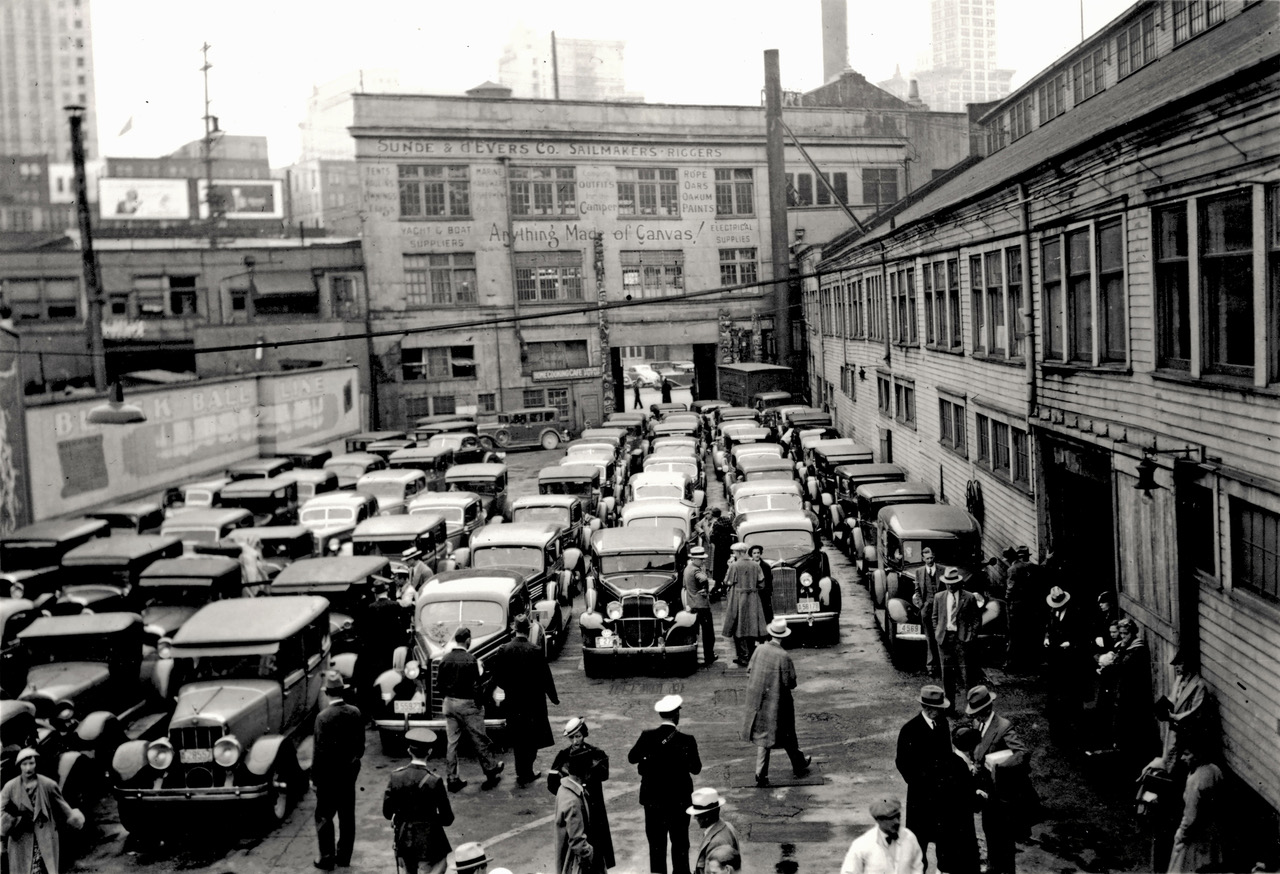

Published in The Seattle Times online on Feb. 22, 2024
and in PacificNW Magazine of the printed Times on Feb. 25, 2024
Think you have a long wait for state ferries? So did Seattle!
By Jean Sherrard
Waiting in line for a ferry, whether in the eight-lane lot of our 1936 “Then” photo or in today’s hugely expanded parking areas, we all have ample time to reflect on the state of Puget Sound car ferries. Their turbulent history began long before our own pandemic-induced cross-Sound woes.
In 1936, the family-owned Puget Sound Navigation Company (PSNC), aka the Black Ball Line, had become the largest inland ferry system in the world. Incorporated in 1900, the ambitious firm already had converted many of Seattle’s passenger-only “mosquito fleet” boats into car ferries, operating from its Colman Dock base. Having just snapped up its main rival, the Kitsap Transportation Company, after a crippling strike the year before, PSNC utterly dominated Puget Sound ferry traffic in the depths of the Depression.

But for owner and company president Capt. Alexander Peabody (1895-1980), storm clouds brewed. With a booming voice and imperious if dapper manner, “Cap,” as he was known to his friends, was notably contentious.

His ferry monopoly — which would last for more than fifteen years — would be eventful, buffeted by labor unrest, a disgruntled riding public and an exasperated state government.
Sneak a glance back at Colman Dock where patient motorists wait to cross the Sound. If Bremerton bound, they might be in for a treat, boarding the Black Ball’s sparkling new flagship Kalakala, whose streamlined design and Art Deco interiors reflected a hopeful future. (For $10, “Cap” had acquired the Peralta, a California ferry burned to the waterline, and built the maritime marvel).
With the openings of Oakland’s Bay Bridge in 1936 and the Golden Gate Bridge the following year, PSNC snapped up surplus wooden-hulled ferries on the cheap from California. Soon, 17 more Bay Area vessels joined the Black Ball fleet, their Golden State yellows repainted in northwest green.

Peabody’s combative instincts were tamed patriotically during World War II when, by U.S. government request, he had kept fares low. Early in 1947, however, he refused to negotiate with Black Ball engineers demanding better pay and shorter hours. Their response: a six-day strike, leaving 10,000 commuters stranded.
Several months later, to recover lost revenue, Black Ball raised rates by 30%, further enraging ferry riders.
When the state rolled back fares, a truculent “Cap” pulled the plug, halting operations for more than a week. Seen as extortion to leverage higher fares, the cutoff triggered increasing calls for public ownership of the ferries. Widely criticized, “Cap” eventually accepted the state’s offer of $4.9 million to buy the Black Ball Line — dock, stock, and ferry.
On June 1, 1951, Washington State Ferries was born.
WEB EXTRAS
More photos of the newly remodeled Colman Dock.


Wow! What an interesting history. The photos are also spectacular. I love this weekly dive into Seattle’s brave, diverse past and the creative ways it continues to morph.