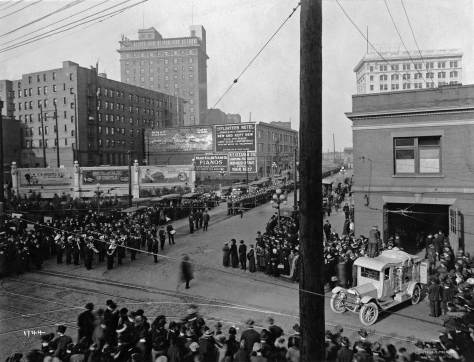
THEN: This Webster and Stevens studio photo dates from either late 1917 or early 1918. The grand Frederick and Nelson Department store, rising above Fifth Avenue, has not yet reached its sumptuous Sept. 3. 1918 opening. In the foreground, the much smaller but also elegant flatiron building, bordered by Pine Street, in the foreground, and Westlake and Fifth Avenues to the sides, was razed and replaced also in 1918 by a three story retail block on the same flatiron footprint. Photos of that replacement will first be found two imagines down. (Courtesy, the Museum of History & Industry)NOW: The featured triangular block was ultimately covered over with the 1988 opening of Westlake Center.
In a note scribbled on the 1937 tax card for this modest block, it is named the “triangle.” Bordered by Pine Street, 5th Avenue, and Westlake Avenue, it is really one of about a dozen triangles attached to Westlake Avenue through its seven-block run between Fourth Avenue and Denny Way. The triangles, and about seven more irregularly-shaped blocks, date from 1906-07 when Westlake Avenue was cut through the original city grid. Thiseccentric
The “Triangle,” an appropriate and descriptive name for the odd block bordered here by 5th Ave. on the Left, Westlake Ave. on the right, and Pine Street at the far south end of the “Triangle.” The photo comes from one of the thousands of “tax cards” produced by a depression-time Works Progress Administration project documenting every (or almost every) taxable structure in King County and a few tax-free churches too.
regrade was meant to channel the increasing traffic to Denny Way, there to continue north through the “funnel,” as the South Lake Union retail neighborhood was then sometimes called, to the picturesque viaduct built in 1890 for pedestrians, wagons and trolleys along the west shore of Lake Union all the way to Fremont.
Looking north on Westlake by the lake in the 1890s. The viaduct continued along the west shore of Lake Union to the Fremont Bridge at Lake Union’s Ross Creek outlet.
The featured photo at the top is one of three Webster and Stevens Studio photographs of the original charmingflatiron with its waving cornice. It sights north over Pine Street along the east side of Westlake. Another of the three photos is printed directly below. It looks in the opposite direction, and shows the same single motorcar parked on Westlake (perhaps the photographer’s) and the produce stand with its fruit and customers protected by an awning opened over the sidewalk. The Pearl Oyster and Chop House is the
The second of three looks at the “Tirangle” looking south-southeast over Westalke Avenue with 5th Avenue on the left and the brand new Frederick and Nelson Department store on its far side.
next storefront south of the produce stand. Taped to it windows are more than one poster promoting the week-long visit to the Metropolitan Theatre, beginning Monday January 7, of the Shakespearean troupe led by the “eminent” Shakespearian John E. Kellerd. It is by this bit of advertising that we can easily figure that the three photos were taken sometime either in late 1917 or early 1918. Frankly, this discovery saddened me because I prefer this little triangle with its curvilinear cresting and large basket-handle windows to its several successors, the first of which is shown on the tax photo printed above, three images back or above . (The third of the three Webster and Stevens photos follows, all are used courtesy of the Museum of History and Industry, aka MOHAI.)
Another of the first of the “Triangle Buildings,” this one looking northwest through the intersection of Pine Street and Fifth Avenue. Frederick and Nelson is just out-of-frame to the right. The Seattle Times building on Westlake between Olive and Stewart is on the far right.Jean’s “repeat” from late August 2016.A 1949 tax-card look at the somewhat modernized Triangle Building.
An 1891 Birdseye and Three Maps – 1893, 1908 & 1912 – of Location
The intersection of Fifth Avenue and Pine Street may be identified in this detail in the 1891 Seattle Birdseye by the number “95” that is written below the scene’s center. The number is the birdseye’s key to the electric trolley garage or barn that crowds the northeast corner of the intersection with its red brick construction. The larger red brick building at the southwest corner of Sixth Avenue and Stewart Street also belonged to the Seattle Electric Company that ran the trolleys. The Norwegian-Danish Lutheran Church holds the northeast corner of Fourth Avenue and Pine Street, bottom-left. The church is featured in the “Extras” below. It is the second one down from the top. The birdseye was published fifteen years previous to the public work of regrading Westlake between Fourth and Pike and Denny Way, and so that cut does not show in it, nor in the 1893 Sanbord real estate (and fire insurance) map directly below. It does, however, show in both the 1908 and 1912 maps that fulfill this quartet. It was, of course, the Westlake Regarde of 1906/7 that created the triangular and other odd-shaped blocks that sided it. With a little patient searching a few of the buildings that appear in the detail above pulled from the 1891 Seattle Birdseye also show in this 1893 Sanborn Real Estate Map. The car barn is upper-right at the northeast corner of Fifth Avenue and Pine Street; the Norwegian-Danish Lutherans are upper left, and the intersection of Fourth Ave. and Pike Street, that thirteen years later was the southern point of origin for the Westlake Ave. Regrade, is at the bottom-left. This point was studies in its own feature and can be found in the Extras stacked below. It is next-to-the-last: twenty-four of twenty-five. CLICK TO ENLARGEHere in the 1908 Baist Real Estate Map, Westalke Avenue has freshly cut its way through the block and the triangle block bordered by Pine Street, at the bottom, and the new Westlake and “old” Fifth Avenues share the center of the detail. Note the electric company’s red brick constructions on the right. These may be studied as well in the 14th Extra stacked below. A detail from the 1912 Baist Real Estate Map, including the triangle block, upper-left, identified as home for the Everett Interurban Station. The Westake Market has taken most of the Seattle Electric block, top-center. Remember: CLICK to ENLARGE
In the 1908 Baist Real Estate map [two illustrations up] only a small wooden shed is foot-printed in the triangle block, bottom-center. By four years later, in the 1912 Baist Real Estate Map, the block has been tightly fitted for the little retail center captured at the top of this feature. Through its few years it was also home for the Seattle station of the Everett Interurban, which started running in 1910.
A clipping from the December 26, 1916 Seattle Times.A steady eye will find the florid roof-line of the triangle block on the far left. The corner of Third Ave. and Pine Street is bottom right. CLICK TO ENLARGEAND SEEN AGAIN in this look east on Pine Street. The curving cornice of the Triangle block is left-of-center, and seems to be crowned by the Westlake Market sign, but is not. That’s across Fifth Avenue, a new use for the old trolley car barn on the northeast corner of Fifth Avenue and Pine Street. CLICK TO ENLARGE
Sometime in 1918 this attractive triangle was razed and replaced with a three-story structure that bordered the block with a foundation sturdy enough to support a twelve-story high-rise that was never constructed. Through its more than half-century of service and two remodels (the tax card tells us in 1949 and 1959),
The Triangle block’s south facade facing Pine Street appears here on the far left with the new Frederick and Nelson beyond it. The view looks east on Pine Street with its back to Fourth Avenue. A similar photo looking east on Pine thru its intersection with Fourth Avenue is at the top of the stack for the Extras shown soon below. The 1959 tax card for the then latest removed of the Triangle aka Silverstone Building.Westlake Ave. sided in 1966 looking north across Pine Street with the Silverstone Building on the right with its Weisfield’s brick face. Westlake is interrupted by a temporary Seafair-related construction. The photo was taken on June 6, 1966 by Frank Shaw.
the three-story triangle serviced many retailers. The tax-photo (two above) illustrating the last of these changes reveals a nearly windowless brick mass impressively filling the block with “Weisfield’s Credit Jewelers” signed in big neon letters on its south façade facing Pine Street. (I remember this and I suspect many of you do as well.)
Judging by the tenants’ advertisements sample above and published in this paper through the first weeks of 1919, the quickly-built three-story replacement was completed sometime in late 1918. Among the first tenants were The Silk Shop, Violet Tatus’ New Hat Shop and the New Owl Drug Company. The building was named the Silverstone
The Triangle block appears at the center-bottom (below the Frederick and Nelson block) of this detail from the 1923 map by Kroll of Seattle’s “business section.”
after Jay C. Silverstone, a Kansas City native who moved to Seattle with his family to found the Boston Drug Company. Silverstone became a super-promoter for properties in this nearly new retail neighborhood. When he added the little flatiron to his neighborhood holdings, the headline for the Seattle Times for Sept. 2, 1917, read “New Retail /District Sets Record Price for Seattle Realty.” Silverstone and his brother Hiram, a physician practicing in Kansas City, purchased the block from Seattle architect John Graham, paying “$56 Per Square Foot for the Westlake Triangle,” which figured to $250,000, most of it in cash.
The Times Sept. 2, 1917 report on Jay C. Silverstone’s record-breaking purchase of the featured little triangle. CLICK TO ENLARGE
BELOW: TWO STRESSFUL SILVERSTONE CLIPS from the TIMES
THE SEATTLE TIMES from April 4, 1916March 27, 1920An undated look north on Westlake to Pine Street with the southwest corner of the Silverstone Building showing on the far right. The Plaza Hotel on the left holds the larger triangle at 5th and Westlake and Pine made by Westlake Regrade in 1906/7.
WEB EXTRAS
Anything to add, lads? Surely Jean. As is his way, Ron Edge has pulled up several neighborhood shots and stacked them below. Held in each are more, some of which will be repeated many times through the selection. Which is our way.
=====
ALSO NEARBY (Chapter – or feature – NO. 20 from Seattle Now and Then Volume One, which can be read from cover to cover on this blog, and it found in the front page bug ”
THEN: F. Jay Haynes recorded this ca. 1891 look up the Seattle waterfront and it’s railroad trestles most likely for a report to his employer, the Northern Pacific Railroad. (Courtesy, Murray Morgan)NOW: For his repeat, about 125 years late, Jean Sherrard looks north from what is left of the old Pier 48 to the King County Water Taxi’s loading dock at the waterfront foot of Yesler Way.
We might wonder what the photographer, F. Jay (“the Professor”) Haynes, found captivating in this long stretch of the Seattle waterfront. It reaches from a small sample of the Magnolia Peninsula on the far left to the outer end of the famous namesake wharf that the pioneer Henry Yesler rebuilt after the city’s Great Fire of June 6, 1889, which destroyed it and practically everything
else on Seattle’s central waterfront. Although difficult to read, both at this size and in the subject’s morning light, the shed/warehouse seen on the far right (of the featured photo at the top) has Yesler’s name printed on its west wall facing Elliot Bay. We will insert here another look at the water end of Yesler’s Wharf most likely photographed in 1890-1. The wharf is left-of-center, and the block-lettered name is the same and easier to read, especially if your click-to-enlarge the pan and all else.
Compare this post-fire view from both the featured photo at the top and the ca. 1887 pan that follows. All three were recorded from coal wharves at the foot of King Street.Another record of the waterfront looking north from the King Street Coal wharf, this one most likely in 1887. Denny Hill, on the far left, has been cleared of trees for development, but there is as yet no Denny Hotel on the top of this the Hill’s southern summit. Yesler’s wharf is at the scene’s center. A detail of the featured docks grabbed from the 1893 Sanborn real estate map. Yesler’s dock is at the top. King Street is just off-frame at the bottom. All is new here – except the pile of ship’s ballast on which “501” is printed. Most of the ballast was dumped there in the 1870s by ships visiting to pick up coal at King Street. With the construction of docks between the bunkers beisde King Street and Yesler Wharf the ballast-dropping was stopped here, and sizeable docks and sheds were constructed above the ballast and/or to its sides. The tuning=fork dock between Madison and Main Streets (marked again by “502”) was fitted with a warehouse at its water (west) end that tended ships, while the east end of the new (in 1882) dock was left open revealing Ballast Island and waiting for later development, both before and after the 1889 fire. Part of Ballast Island is exposed, bottom-right, in this pre-fire 1884 Seattle Birdseye. Note Mill Street at the center. Here off-shore it is part of Yesler Wharf. At the center not Mill Street where it is off-shore and part of Yeslere Wharf (or dock).
We imagine that there may have also been a sensitive side to Haynes’ choice – an aesthetic motivation. The vessel near the featured scene’s center, which atypically reveals no name on its stern, marks a striking divide between the intimate waterfront congestion of barrels and half-covered bricks on this side of Yesler’s dock, far right, and to the left of the steamship, the long and somewhat mottled urban growth that was then North Seattle. Belltown’s gray dapple on Denny Hill’s western slope, left of center, is composed almost entirely of improvised and rent-free squatters’ vernacular sheds, both on the hill and on the beach.
Another Haynes view, this one from some vessel off shore of Marion Street. (It lines up with the photographer’s prospect.) Note Denny Hill on the far left. CLICK CLICK to ENLARGE, please.
Haynes’ subject might also have been assigned. Born in Michigan in 1853, the year Seattle’s mid-western founders moved from Alki Point to this east shore of Elliott Bay, Haynes missed the Civil War but not an apprenticeship with Doctor William H. Lockwood’s Temple of Photography in Ripon (‘Birthplace of the Republican Party’), Wisconsin. In the Temple he learn his trade and met Lily Snyder, his co-worker and future wife. Together, they purchased from the Northern Pacific Railroad a Pullman car, which they fitted for a photography studio. In exchange for publicity photographs of the railroad’s expansion and rolling stock, the couple – while raising a family – traveled the greater Northwest, prospering with their own rolling dark room and sales gallery. To his status as the Northern Pacific’s official photographer, Haynes added the same distinction for Yellowstone National Park, where he has a mountain named for him.
The rising hotel on the hill is seen between the stack and mast rising from another (and unidentified) vessel on the south central waterfront following early post-’89 fire reconstruction. The warehouse rooftops above the vessel are familiar, and the Denny Hotel is still sans tower. But not below. The Haynes photo that follows shows the back of the hotel and tower looking south on Third Ave. thru the intersection with Blanchard Street.Denny Hotel from the rear. This later Haynes exposure looks south across Third Avenue’s intersection with Blanchard Street.
Dating this (at the top) visit by Haynes to Puget Sound has left me with an ‘about’ year of circa 1891, two years following the Great Fire. By obscuring the center of the Denny Hotel on Denny Hill, the steamship’s smokestack also hides the hotel’s tower, the last part of the hotel built, and thereby a perhaps helpful clue toward a more refined date. Finally, with the help of an array of historical photos, Ron Edge, a devotee of Seattle history, has determined that the resting steamship here is the City of Kingston and not, as I first thought, its younger sister, the City of Seattle. Ron discovered that there were small differences between them, especially at the stern on the railing for the lower deck. The City of Seattle had a railing.
The steamer City of Seattle on one of its many runs to Alaska. This is, the caption reads, “just below Dixon’s Entrance. (Courtesy, Cornell University Library)The steamer City of Kingston on the Seattle waterfront. [Courtesy, Michael Maslan]Two looks at the City of Kingston’s stern. Compare it to one of the City of Seattle, the stern that follows.Above: the City of Seattle’s stern.Part of a page on Lewis and Dryden’s history of Puget Sound vessels, including the “companion ships” shown above, published long ago. CLICK TO ENLARGE
WEB EXTRAS
Jean: We had help along the way on taking this photo… Thanks to Laura Newborn from the State DOT for making the connections and Marty Martin, Facilities Manager, for accompanying me onto the decaying Pier 48.
Paul: Jean, strip it, the pier, is of its clues. Do you remember – and did you attend – any of the big Book Fairs that used Pier 48 sometime in 1990s?
Jean: I did not attend, though I vaguely remember.
Marty Martin, facilities manager, DOT, on Pier 48Ravaged surface of the pier, access forbidden
Anything to add, fellow travelers? This week like the last 200 or more we’ll pile on a few more features to the Edge Links that Ron put up. But first a copy of the montage that we used to figure out and describe for Laura and Marty the prospect on Pier 48 that we calculated was the correct one for a proper repeat. The red arrow marks the spot. You may wish to notice the range of freedom Jean has used for his art.
Above Pier 48 from on high, Courtesy of GoogleFurthermore, may we help you?
THEN: The first house for Delta Gamma at N.E. 4730 University Way. (Courtesy, Museum of History and Industry)NOW: The literate developers of the recently constructed Lothlorien Apartments got their place name from fantasist J.R.R. Tolkien’s “The Lord of the Rings.”A Google Earth detail of the feature block frames with a detail from the 1905 Sanborn Map. Delta Gamma has been marked with a red frame. Click-Click to Enlarge. (Courtesy Ron Edge)
The designers and/or carpenters of this slender house may have taken care to give its front porch a stairway both wide and high enough to pose a large group portrait, perhaps of Delta Gamma Sorority’s charter membership. It was the first local sorority to receive a charter from a national organization. The lobbying, which began in 1900, was rewarded on May 15, 1903, the last day of Delta Gamma’s annual convention held that year in Wisconsin. One year later the coeds were living here at 4730 University Way.
From The Seattle Times for May 18 , 1903. BELOW, group portrait of member in 1904.
The Times Oct. 26, 1907 report on a reception given by Delta Gamma to the school faculty is a sign of the convivial role this sorority, and others, played in the social and ceremonial life of the University.
The Greek letters Delta and Gamma are signed on the tower of the featured photo at the top, which seems otherwise useless, since there is neither room enough nor light for either a crow’s nest study or a co-ed’s bed chamber. The photograph’s source, the Museum of History and Industry, gives this University District scene an annum of 1904. The neighborhood was then still more likely referred to either as Brooklyn or University Station. The latter was named after or for the trolley that carried students and faculty to the new university from their remote residences in spread-out Seattle. The former was the name first given the neighborhood by James Moore, Seattle’s super developer, in 1890, the year the future University District was first successfully platted. There was then no knowledge of the coming surprise: the University of Washington. The name Brooklyn was embraced as a cachet pointing to another suburb (Brooklyn) that also looked across water (the East River) to another metropolis (New York.)
A Post-Intelligencer clipping from December 1, 1890From The Seattle Press, Dec. 1, 1890
Columbus Avenue was the name that Moore gave to the future University Way.This was soon dropped for 14th Avenue, until 1919 when the University Commercial Club joined the neighborhood’s newspaper, the University Herald, to run a contest for a new name, which University Way easily won. Brooklyn Avenue and 14th Avenue were Seattle’s first fraternity/sorority rows. In early December of 1904, the Seattle Times reported, “The Beta Chapter of the Delta Gamma Sorority of the state university gave a dancing party at its new clubhouse on Fourteenth Ave. N.E. Friday.”
The rear facade of Delta Gamma shows on the left in another photograph taken by the Webster Stevens Studio and used here courtesy of the Museum of History and Industry. Kappa Kappa Gamma, the primary subject here is mid-block on the west side of 15th Ave. East. The montage of Secret Societies included below dates from Sept 10, 1905. It show a new home for Delta Gamma, most likely on the east side of 14th Ave. aka “The Ave.” (Courtesy, Museum of History and Industry)A page from The Times for Sept. 10, 1905. Note the new home for Delta Gamma, bottom-center of the above montage, and below on its own.. CLICK CLICK to ENLARGE
A Seattle Times clipping from August 21, 1916.
University Way, especially, was a sign of the city’s and its university’s then manic growth. Other Greeks soon joined the co-eds of Delta Gamma at addresses north of N.E. 45th Street in Moore’s then new and only two-block-wide University Heights Addition, which had been platted in 1899. Seven years later, and directly to the east of University Heights, Moore opened his much larger University Park
Looking southeast toward the Cascades and Mt. Rainier. [CLICK CLICK to ENLARGE]
Addition. In this 1904 featured look east from the Ave. we can see that University Park is still a forest. After 1906 it was increasingly stocked with homes for the University of Washington’s growing faculty and Greek community. Many of the students’ ‘secret societies’ first got their start in University Heights, often in mansion-sized houses larger than Delta Gamma’s, which were profitably let go for the developing businesses along University Way. Typically the Greek houses eventually moved to nearby University Park.
On the left, Delta Gamma’s new home in 1916, and a century later, on the right. It was this structure that was arranged for use as the Russian House years after it was moved across 21st Avenue, where it survives.News of the Russian House from The Times for August 2, 1963.
After several moves, in 1916 Delta Gamma reached its present location at the northwest corner of NE 45th Street and 21st Avenue NE in 1916. Twenty years later it ‘moved’ again while staying put. In 1936 the sorority’s house was sold and rolled across 21st Avenue from the northwest corner with NE 45th Street to the northeast corner to become the house for the Phi Sigma Kappa Fraternity. It was later named the Russian House, for its popular Russian studies and “Russian Only” rule. Across 21st Avenue, NE. at the recently vacated northwest corner, the sorority built again, this time the grand Arthur Loveless-designed 80-year-old Delta Gamma house. In sum the sorority has now held to this corner for a century.
Above: From The Times for April 16, 1937.From The Times for September 1, 1936.Pulled from The Seattle Times for November 23, 1936.The north shore of Lake Union circa 1898.
WEB EXTRAS
Anything to add, guys? Yup Jean – from the neighborhood where once we sometimes hung out, and the greater neighborhood where we still live with our lakes. First Ron Edge comes up with about twenty links (again, all of which have their own links, which inevitably include some duplicates), and I will follow Ron’s list with another string of clips – sometime after I have walked the dog. It is now 3:54 AM. And so depending on Guido’s performance, I may wait until tomorrow (Sunday) afternoon to add the promised string.
THEN: The five buildings shown here on the west side of Third Avenue south of Virginia Street have endured with few changes since the ‘then’ photo was snapped in 1936. The exception is the smallest, far-right, the Virginian Tavern now stripped for an open garage at Third’s southwest corner with Virginia Street. The six-story Hardon Hall Apartments, at the center of the five, was renovated in 2006 for low-income housing by the Plymouth Housing Group.NOW: To avoid sidewalk landscaping Jean moved to the curb for his repeat. The 3rd Avenue block between Virginia and Stewart streets has largely escaped the recent structural changes in the Denny Regrade Neighborhood.
Here is yet another billboard negative from the Foster and Kleiser collection that Jean and I have visited a few times for this Sunday feature. The anonymous photographer chose a prospect that exposed the company’s two billboards on the roof of the Virginian Tavern, the tenant of the modest brick building at the southwest corner of Virginia Street and Third Avenue. This time Jean’s ‘repeat’ shows us that in this block not much has changed in the intervening eighty years. To gain some perspective on this booming town, the negative date, December 11, 1936, roughly splits the years between when the first settler-farmers landed near Alki Point in 1851 and now.
Here (above) we are about 100 feet higher and one block further north than in the featured photographs. This is F.J. Haines ca. 1891 look south on 3rd Avenue from the north summit of Denny Hill to Denny Hotel on the front or south summit of the hill. This is remote. Most of Seattle is to the other side of the hotel and below it. (Courtesy, Murray Morgan) This looks north on Third Avenue from an upper story in the Denny (aka Washington) Hotel. The negative was shared with me by Carrie Coe, she did, however, knowo who took it, although it may have been her mother who had talent with her camera. The roof bottom-left covers the frame apartment house at the northwest corner of 3rd and Virginia, the corner taken by the building that covers most of the bottom of the photo below this one. Queen Anne Hill marks most of the horizon.I recorded this in 2003 from the roof of the parking garage at the southeast corner of Virginia and Third Avenue. The view, then, looks northwest with Virginia St/ on the left and Third Ave. on the right. In the ensuing thirteen years the Denny Regrade, aka Belltown. neighborhood has seen many changes with the high rise structures promised or envisioned for it a century ago when the regrading was done.Like the Haynes photo above it, this was taken sometime in the early 1890s and years before the hotel was opened by its fighting developers. The hotel is behind the unidentified photographer of this illustration, which we copied from a piece of stationary. (Courtesy, Michael Maslan)A warning published in The Seattle Times on the day the featured photo was dated and most likely recorded, December 11, 1936.
What were they thinking, the pedestrians and motorists here on Third Avenue? Surely of the kings of England: both of them. This is the day, a Friday, when it was at last fulfilled at 1:52 pm that the Duke of York took – or was given – the throne of his older brother Edward VIII who abdicated it for love. The Seattle Times, of course, trumpeted news about the switch, including a front page photograph of the new king’s daughter, the ten-year old Elizabeth who, an unnamed friend of the royals assured, as an “astute sharp-witted little girl” was figuring it out.
A sizeable detail from the front page of The Seattle Times for December 11, 1936.
The neighborhood was then variously called the Uptown Retail Center, Belltown, and the Denny Regrade. Only the first two names survive. It is likely that many of these motorists on Third Avenue between Virginia and Stewart Streets remembered the regrade itself, and knew that they were driving under what only thirty years earlier was the south summit of Denny Hill.
LaRoche’s early 1890s look north on Third Avenue with his back to University Street. The Denny Hotel effectively looms over the citiyi. The Washington Hotel, formerly the Denny, recorded from the southwest corner of Pike Street and Second Ave. The Pine and Second Avenue regrades encroaching on the hotel began their cuttings in 1903. (Courtesy, Washington State Museum, Tacoma)The lobby. most likely recorded briefly before the hotel opened in the Spring of 1903 to its first guest, President Theodore Roosevelt, With the hotel straddling the as yet undeveloped Third Avenue north of Stewart Street, the lobby was also stationed about 80 feet above Third’s future post-regraded elevation. Passing the mid-point in the hotel’s destruction as seen looking north on Third Avenue through Pine Street.The gone yellow White Garage’s ornamental banding at its cornice (or below it) across Third Avenue from another garage on the avenue’s east side in 2003.
Just left of center, the six-story White Garage, the tallest of the five buildings on the east side of Third Avenue, fails to reach the elevation of the historic summit. It is also short of reaching the elevation of what before the regrading was the basement of the majestic Denny Hotel, a.k.a. Washington Hotel, that sat atop the hill and advertised itself as “the scenic hotel of the West.” Both the south summit and the hotel were razed between 1906 and 1908.
Left-of-center, outfitted and signed for theatre, the Methodist church at the southeast corner of Pine Street and Third Avenue with the east wing of the hotel still holding to the hill above it.The church-as-theatre on the right at the southeast corner of Third Ave. and Pine Street, with the hotel long-gone and the south summit of Denny Hill mostly gone as well.
Given that the featured photo at the top was photographed in the midst of the Great Depression, Third Avenue seems surprisingly rife with motorcars. A review of some historical vehicular statistics may explain the motorized zest. Four blocks away at Second Avenue and Pike Street, and only thirty-two years earlier, the city’s street department counted 3,959 vehicles visiting the intersection, of which only fourteen were automobiles. One year earlier there were no motorcars – everything moved by horse orby pedal. By 1916 many Seattle cyclists had turned into motorists, and Seattle had some 16,000 cars. By 1921, with the doughboys returned from World War I, there were about 48,000 cars in Seattle. By 1929 there were 129,000 cars on the city’s streets.
Of the two billboards above the Virginian Tavern, the one on the left advertises next year’s model 1937 Buick for $1,099. Figured for inflation, the price seems surprisingly affordable. In today’s showroom, the sticker would convert to about $18.400. It seems that despite the ongoing depression, if one had a good middle class job, it was possible to own the mobility and prestige of a brand new Buick.
WEB EXTRAS
Anything to add, fellahs? Ron Edge has put forward this week’s neighborhood links below – neither less nor more than nineteen of them, except that each is also bound to be packed with other links and so on and on. I have not lifted so much. It is, Jean, now nearly 5 am Sunday morning and I’m surrendering to my heart’s beating pleading for sleep. However, should I survive the night I will return tomorrow (Sunday) afternoon to finish up this feature. Now I lay me down to sleep . . . and the rest that passes all understanding.




![THEN: From boxcars and rooftops to the planks of Railroad Avenue, excitement builds for the ceremonial re-enactment of the S.S.Portland’s 1897 landing with its “ton of gold” on the Seattle waterfront, the city’s first Golden Potlatch Celebration. [Courtesy, Michael Maslan]](https://i0.wp.com/pauldorpat.com/wp-content/uploads/2015/07/potlatch-watch-above-railroad-ave-now-mr.jpg?resize=474%2C365&ssl=1)


![THEN: The Gothic University of Washington Campus in 1946 beginning a seven-year crowding with prefabricated dormitories beside Frosh Pond. In the immediate background [on the right] is Guggenheim Hall. (Courtesy, Ron Edge)](https://i0.wp.com/pauldorpat.com/wp-content/uploads/2013/12/frosh-pond-housing-1946-then-mr1.jpg?resize=474%2C365&ssl=1)