Seattle Now & Then: 100th anniversary of Fred Hutchinson’s birth

(click once and twice to enlarge photos)

THEN1: Mayor Allan Pomeroy is at the microphone, and Seafair Queen Carol Christensen stands center stage at this April 18, 1955, rally. Left of center, behind team owner Emil Sick and his trademark bowler, Fred Hutchinson peeks out. For IDs of others onstage, see “extra” photo below. (David Eskenazi collection)
THEN2: Fred poses in the 1955 Seattle Rainiers uniform, from the cover of the April 17, 1955, edition of the Seattle Times Pictorial magazine. To salute the 100th anniversary of Fred’s Aug. 12, 1919, birth, the Seattle Mariners will present Hutch bobble heads to the first 10,000 fans on Sunday, July 7, at T-Mobile Park. For the bobblehead itself, see “extra” photo below. (Josef Scaylea, Seattle Times)
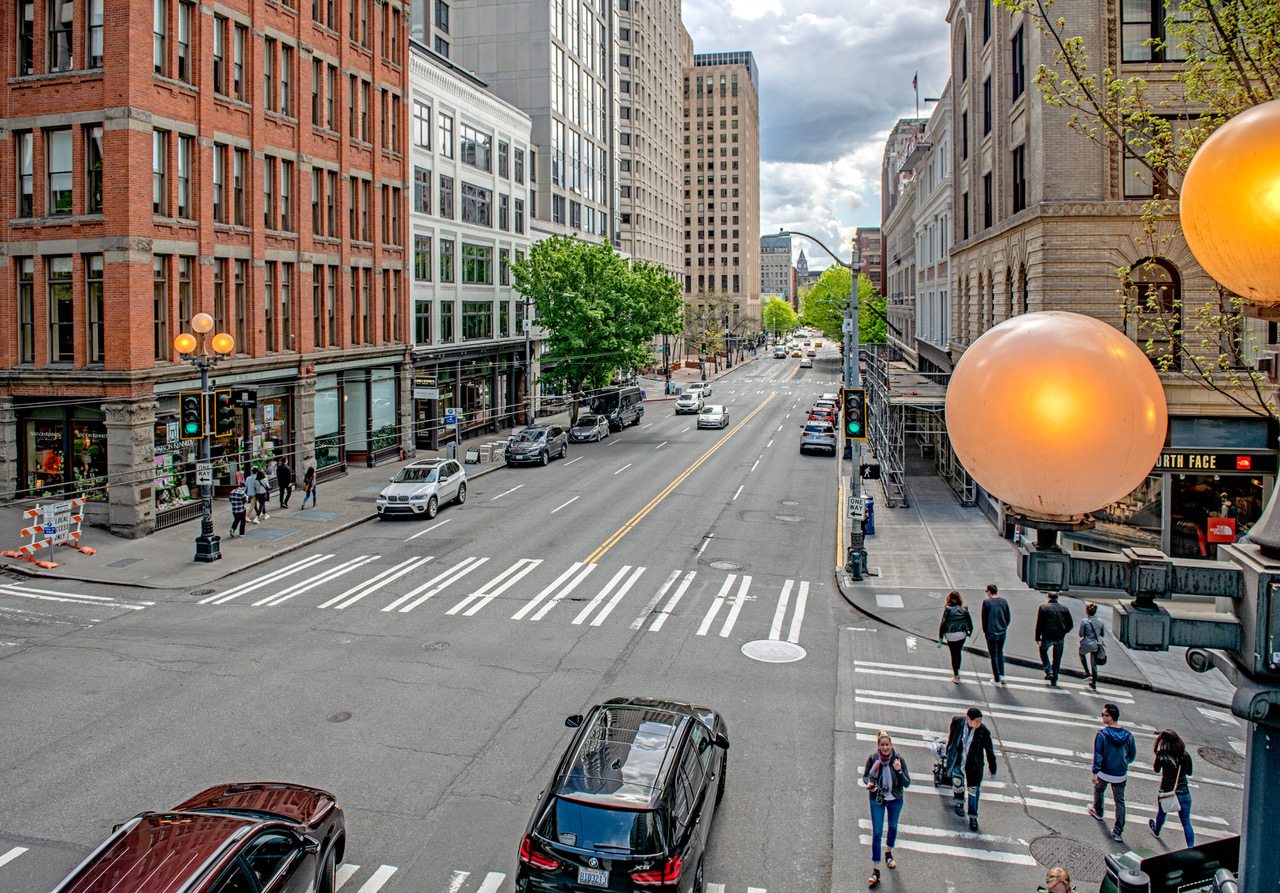
NOW: Family and fans of “Hutch” –- (from left) Clay Eals, Jason Barber, David Eskenazi, Fred’s grand-nephew Brock Reed, Connor O’Shaughnessy, George La Torre, Fred’s niece Charlee Hutchinson Reed, Josh Belzman, Charlee’s husband Paul Reed, Jill Christensen, Tom Kim, Tara Palumbo-Egan, Dan Kerlee, Dave Kolk and Olin Gutierrez –- cross University Street between Fourth and Fifth avenues at the Metropolitan Theatre rally site, now the drive-through entrance of the Fairmount Olympic Hotel. (Jean Sherrard)

(Published in Seattle Times online on June 27, 2019,
and in print on June 30, 2019)

Where’s Fred? 100th anniversary for birth of baseball hero ‘Hutch’
By Clay Eals

Time was, the name Fred Hutchinson stood for baseball excellence. You couldn’t grow up here and escape the “Hutch” legend. Often as a child, long pre-Mariners, I stood in the cavernous foyer of Sicks’ Seattle Stadium (now a Lowe’s Home Improvement store in the south end), looked up and admired Fred’s photographic portrait high on the wall in the Seattle Rainiers Roll of Honor.

Today, “Hutch” signifies cancer research and the pioneering Seattle center, founded by his surgeon brother Bill, that has borne Fred’s name for 44 years. Employing 2,700 scientists and staff, “the Hutch” memorializes Seattle’s first baseball star of national stature. If he were alive, this hometown hero would turn 100 on Aug. 12.

In late 1999, the Seattle Post-Intelligencer named him Seattle’s Athlete of the 20th Century. The Seattle Times rated him second only to a recent phenom, Ken Griffey Jr.

Fred’s deep local significance is disproportionate to his short stints here in professional uniform, and minor league at that. One year was as a pitcher (his Cinderella season of 1938, post-Franklin High, when he went 25-7 for the new Rainiers), and one year plus half of another as a manager (again for the Rainiers, in 1955 and early 1959).

Still, he was the classic local boy made good. His big-league success (notching 95 wins as a pitcher, managing Cincinnati to the 1961 World Series), plus the respect accorded his alternately gentlemanly and fiery persona, gave him a lasting impression. The perseverant Fred also could turn a phrase. “Sweat is your only salvation,” he once told columnist Emmett Watson.

After his lung-cancer death in 1964, sportswriters created the Hutch Award. It didn’t hurt that the namesake’s nickname felt both informal and virile. (One original criterion for recipients, long ago discarded, was “manliness.”) The award grew into one of the Seattle center’s biggest fundraisers.

Our first “then” captures Fred at a peak of popularity, the day before the Rainiers’ 1955 home opener. This 1:30 p.m. rally at World War II-themed Victory Square – in front of soon-to-be-razed Metropolitan Theatre (circa 1911) on University Street – celebrated Fred’s return after 11 years in Detroit. Even the most hopeful fans could not have forecast his craftiness in shepherding a team with no .300 hitter in the regular lineup for the full season or 20-game-winning pitcher to the 1955 Pacific Coast League crown.

In this photo, before a sea of adoring fans (mostly male, mostly fedoraed) and on a stage crowded with business-suited players, the Barclay Girls can-can troupe and the Jackie Souders Orchestra, Fred is a “Where’s Waldo” figure. Try to find him. If you give up, we’ll help you in the first “then” caption and in the “extra” photos below.

WEB EXTRAS

To see Jean Sherrard’s 360-degree video of the “now” prospect and compare it with the “then,” and to hear this column read aloud by Clay Eals, check out our Seattle Now & Then 360 version of the column!

Below are three additional photos, plus, in chronological order, seven clippings from The Seattle Times online archive (available via Seattle Public Library) that among many others were helpful in the preparation of this column.

In the interest of public disclosure, I should note that I worked at Fred Hutchinson Cancer Research Center as a curriculum writer and publications editor from 1990 to 2003. From 1999 to 2001, I conducted more than 100 interviews with family, friends and professional baseball figures, with the intent of writing a biography of Fred Hutchinson. I still nurture that intention. –Clay

This photo is a crop of the first “then” above, with a more complete accounting of those who are onstage (names are in maroon). The IDs are courtesy of David Eskenazi, from whose collection the photo originates. Double-click on the photo to make the names legible.
Here is a closer-in photo of the same scene depicted in our first “then.” Fred Hutchinson (center right) is waving. Looking on are (from left) pitcher Elmer Singleton, catcher Bob Swift, infielder Gene Verble, catcher Joe Ginsberg, coach Alan Strange, owner Emil Sick, pitcher Bill Kennedy and one of the Barclay Girls. (David Eskenazi collection)
This is the Fred Hutchinson bobblehead that will be given to the first 10,000 fans attending the Seattle Mariners game on Sunday, July 7, 2019, at T-Mobile Park. It depicts Fred in 1938, when he went 25-7 in his only season as a pitcher for the Seattle Rainiers. Note that the photographer, Ben VanHouten, positioned the oval on the stanchion to create the illusion that the ball that Fred has just thrown is heading toward you. As the photo depicts, Fred also appears in mid-pitch on the end of each 100-level seat stanchion at the ballpark. (Ben VanHouten)
Feb. 23, 1911, Seattle Times, page 19
Nov. 7, 1911, Seattle Times, page 22
Dec. 26, 1915, Seattle Times, page 18
April 28, 1942, Seattle Times, page 26
Dec. 6, 1954, Seattle Times, page 25
Dec. 7, 1954, Seattle Times, page 25
April 10, 1955, Seattle Times, page 55
April 17, 1955, Seattle Times, page 36


April 18, 1955, Seattle Times, page 28
February 13, 1956, Seattle Times, page 34


Seattle Now & Then: Alaska-Yukon-Pacific Exposition, 1909

(click once and twice to enlarge photos)

Count the flags, big and small, strewn throughout this glimmering 1909 “then.” We calculate at least 75. For detailed maps, engaging narrative and stunning photos on the A-Y-P, check out a centennial book by Alan J. Stein, Paula Becker and the staff of HistoryLink. (MOHAI Panorama Collection)
This vantage, slightly higher than the A-Y-P Ferris wheel, looks north from atop the Unversity of Washington Physics-Astronomy Building. Rising in the foreground is the new UW Population Health Facility, set to open in late 2020. Peeking to its right is a portion of the UW Architecture Building, formerly Fine Arts Building. It, along with the UW Cunningham Building – formerly the Washington Woman’s Building, which was moved north in 2009 to a spot just left of the construction crane in this view – are the only remaining public structures on the  A-Y-P fairgrounds. (Jean Sherrard)

(Published in Seattle Times online on June 20, 2019,
and in print on June 23, 2019)

A fairly wide view of the A-Y-P from 110 years ago
By Clay Eals

Back in 1962, the glitz of the Seattle World’s Fair filled my 11-year-old eyes with wonder. I still treasure its curios, including a souvenir tabloid with a custom banner headline, printed on the spot, employing the six-month show’s crowning landmark to convey whimsy: “Clay Eals Jumps Off Space Needle.”

1962 Seattle World’s Fair tabloid newspaper with custom headline. (Courtesy Clay Eals)

I’m grateful it was fake news.

At no time, in visits that summer, did my child’s mind grasp that this was the city’s second world’s fair. But a nod to its precursor lay in the final word of its alternate name: the Century 21 Exposition.

Fifty-three years before, in 1909, Seattle’s –- indeed, Washington state’s –- first world’s fair embraced the sprawling title of Alaska-Yukon-Pacific Exposition to salute the 1897 Gold Rush and what today we call the Pacific Rim. The A-Y-P opened 110 years ago this month at the University of Washington, which had relocated from downtown 14 years prior, in 1895.

The fair transformed the campus. With attractions from fine art to lowbrow amusements, it also instigated neoclassical (if largely temporary) architecture, Olmsted Brothers gardens, a new statue of the UW’s namesake and a stately promenade and fountain pointing to Mount Rainier.

The sweep was as wide as our “then,” taken atop the A-Y-P Ferris wheel by official photographer F.H. Nowell. It looks north and east, the western border of 15th Avenue slicing by at far left. But this panorama holds irony. While it conveys the fair’s grandeur, it covers only a fraction of its grounds.

Visible are the main entrance at 40th Street, off 15th. A short walk east reveals the George Washington statue (today one block north) and an array of gleaming structures: the Fine Arts Building (center-left), the domed U.S. Government Building, the Alaska Building (center), the smaller Washington Woman’s Building, the Klondike Circle, the Agriculture Building (behind a foreground spire of the Swedish Building) and an unintended presage of World War I, the Battle of Gettysburg cyclorama (“War! War! War! Replete with the Rush, Roar and Rumble of Battle”).

“It’s the greatest cultural event that has ever taken place in the city’s history,” asserts Magnolia’s Dan Kerlee, A-Y-P researcher and collector who runs aype.com, an educational website. He says the 3,740,551 people who attended over 138 days enjoyed a uniquely inspiring, even elegant experience. “If people could walk the A-Y-P today, they would be beside themselves.”

World’s fairs, a prolific phenomenon of the late 19th and early-to-mid 20th centuries, have fallen out of fashion here, the most recent U.S. fairs being 45 years ago in Spokane (Expo ’74) and in Knoxville and New Orleans in the early 1980s. A few hours north, Vancouver, B.C., put on Expo ’86, the last world’s fair in North America. Still, we can smile that Seattle hosted a spectacular pair.

WEB EXTRAS

To see Jean Sherrard’s 360-degree video of the “now” prospect and compare it with the “then,” and to hear this column read aloud by Clay Eals, check out our Seattle Now & Then 360 version of the column!

Below, in chronological order, are clippings from The Seattle Times online archive (available via Seattle Public Library) that among many others were helpful in the preparation of this column.

These are just five of the 54 stories in the Seattle Times that mentioned the A-Y-P during the six-month 1962 fair. Of course, I wish I had paid more attention to these stories back then! Click on any clipping to enlarge it. –Clay

April 21, 1962, Seattle Times, page 1
April 22, 1962, Seattle Times, page 105
June 22, 1962, Seattle Times, page 2
Sept. 14, 1962, Seattle Times, page 52
Oct. 19, 1962, Seattle Times, page 24
AYPE souvenir spoon. (Couresy Margaret McNeill-Law)


Seattle Now & Then: Judkins panorama, 1880s

(click to enlarge photos)

Careful readers may spot clothes hanging on two backyard lines at lower center of this 1885 or 1886 cityscape. This could narrow the time of year Judkins made his recording, but I remember my mother hanging clothes in the backyard during the winter in Spokane. (Paul Dorpat collection)
This prospect looks south from above the entrance to the alley on the south side of Stewart Street between Second and Third Avenues. (Jean Sherrard)

(Published in Seattle Times online on June 13, 2019,
and in print on June 16, 2019)

Stacking up evidence of Seattle’s growth in the 1880s
By Paul Dorpat

This week’s “then” photo looks south toward early downtown Seattle from halfway up the southern slope of then-Denny Hill. With his extension pole, Jean Sherrard lifted his “now” camera to approximate the prospect used by pioneer photographer David Judkins for his panorama – close but, Jean and I agree, still a few feet below Judkins’ roost.

After studying the crowd of clues showing in Judkins’ prospect, Ron Edge, our feature’s frequent sleuth, agrees that Judkins’ photo was recorded in 1885 or 1886. That was three or four years before the Great Seattle Fire of June 6, 1889, destroyed about 30 city blocks, including almost everything shrouded here behind the industrial smoke ascending from the right (west).

In early photographic cityscapes, stacks were frequently embraced as the most obvious signs of a community’s industrial success. They stood as booming pillars of pride, and a study of Seattle’s demographics from that time – city directories, tax records and such – confirms it.

In his typewritten “Chronological History of Seattle from 1850 to 1897,” Thomas Prosch, the owner/editor of the Seattle Post-Intelligencer and the city’s busiest booster, included a panegyric to the growth of his city, which since the 1880 national census was the largest town in Washington Territory, surpassing Walla Walla by a few hundred citizens.

“The boom that began in 1886 and grew in volume and force in 1887 continued with unabated activity and vigor in 1888,” Prosch wrote. “It was manifested in a thousand ways, but particularly with real estate speculation, in the platting of additions to the city, hundreds of new buildings, scores of graded streets, the new railways, banks, hotels, stores, factories, shops and people.

“The inhabitants of Seattle, who numbered 3,533 in 1880 and 9,786 in 1885, increased in number to 12,167 in 1887 and to 19,116 in 1888. Much as this great increase signified, it was dwarfed by that of the next two years, for the census of 1889 showed Seattle to have 26,740 inhabitants and that of 1890, 42,837.”

(Such rapid growth some 130 years ago should excite a “Wow!” from some of our readers. Want more? Our blog features a complete copy of Prosch’s thick chronology from the mid-1890s.)

The most striking aspect of this “then” photo may be the two hand-drawn Mount Rainiers, the result of merging the panorama’s two halves, each of which sported a peak. Did Judkins believe anyone would fall for his manufactured substitutes? In 1885, it was still difficult to photographically record bright, snow-covered icons such as “The Mountain That Was God” (title of a 1910 guidebook self-published by John H. Williams).

WEB EXTRAS

To see Jean Sherrard’s 360-degree video of the “now” prospect and compare it with the “then,” and to hear this column read aloud by Paul Dorpat, check out our Seattle Now & Then 360 version of the column!

Anything to add, fellas?

This morning Jean it will be alas and good night, aka nighty-bears (copy write: Bill Burden).  That is we will soon  again climb the stairs to our small bed resting beside a full-wall reflection – a ballet practice mirror.  (The sometimes frightening effect some early mornings is to awaken with sunrise and face myself.  At eighty it is not a flattering confrontation.)  Now Jean reminds me that this week we promised something more about the Thomas Prosch’s sustained contribution to recording Seattle history.  That will need to wait for later this week.  Now, I’ll be climbing the stairs, again to nighty-bears.  At eighty I use two canes.  Below, as a consoling custom we will again attach some relevant clips.

======

======

======

======

======

======

======

======

======

======

=====

=====

Seattle Now & Then: The Great Seattle Fire, Part II – Out of the Ashes

(click to enlarge photos)

THEN: Built in 1883, the luxurious Occidental Hotel covered the flatiron block bounded by Second, Yesler and James. In our “then,” its three-story stone monolith looms over a crew of weary firemen. Locals rated the Occidental “the largest and best equipped house north of San Francisco.” Destroyed in the Great Fire, it was succeeded by the Seattle Hotel, which held court for 70 years.
NOW: Erected in 1961, the “sinking ship” garage proves a dismal replacement. Dismay at the loss of the Seattle Hotel incited a passionate preservationist movement in Seattle. It might be said that it was the “sinking ship” that launched a thousand faces.

(Published in Seattle Times online on June 6, 2019,
and in print on June 9, 2019)

From ‘the hideous remains’ of the Great Fire, a new and improved Seattle rises
By Jean Sherrard

Thirty eight years after its founding, Seattle catapulted to worldwide attention via reports of catastrophic destruction.

The June 6, 1889, fire that incinerated more than 120 acres and nearly 30 blocks of downtown occurred on what might be called a slow news day. Only one week earlier, a burst dam in Johnstown, Pennsylvania, had swept away more than 2,200 lives, shocking the nation (in response, generous Seattleites pledged $576 for flood relief). The fire that leveled the wooden business district of our pioneer town – although it caused no fatalities aside from a Panglossian “million rats” – was also featured in newspapers across the country.

Within days, a New York Times headline read: ‘The Great Seattle Fire … It May Be a Blessing in Disguise.” Seattle land tycoon Henry Dearborn, visiting the East Coast, predicted: “The fire has cleaned out all these [tinder boxes] which were a constant menace to the city” but soon would be replaced “by fine, fire-proof structures.” Seattle residents enthusiastically agreed.

At first, however, hometown papers adopted a gloomier tone. The morning after the fire, the Seattle Daily Press succumbed to purple prose: “Besides the smoking, tomblike ruins of a few standing walls … people are left living to endure with sheer despair … blackness, gloom, bereavement, suffering, poverty, the hideous remains of a feast of fire.”

A spectacular Ron Edge find and stitch. The brick foundations on the right are the remains of the Frye Opera House, pictured in last week’s ‘Then’ photo just before it burned to the ground.

Yet the same morning, 600 citizens gathered at the surviving Armory on Union Street between Third and Fourth avenues in a display of civic gratitude and confidence. The crowd cheered the news that arch-rival Tacoma had offered aid and succor, as had San Francisco and other cities and towns. When some suggested that aid pledged to the Johnstown homeless be diverted for Seattle use, the crowd shouted, “To Johnstown! Let it go to Johnstown!”

Echoing through the Armory was a commitment to “pull all together” and “rise like a phoenix” while constructing a new city of brick and stone. Streets would be widened and leveled, while a fervent appeal was made to “Seattle Spirit.” On Saturday, June 8, Post-Intelligencer headlines affirmed: “A New Seattle Will Arise … Sweet are the Uses of Adversity.”

Another Ron Edge special. In this panoramic view, Front Street (1st Avenue) is being rebuilt. The Pioneer Building foundation is being lain on the left. The corner of the same building appears on the left in our ‘Now’ photo above.

Operating from tents, local businesses prepared to rebuild. Impresario John Cort, having reopened his burned-out Standard Theater under a canvas big top, featured a joke that brought down the house: “How’s business?” asked the straight man. The comic replied, “Intense!”

The pun proved prophetic. In less than two years, Seattle’s population nearly doubled to almost 45,000, and 3,500 new buildings arose, mostly in the devastated core. Voters authorized a more dependable city water system, and a municipal fire department formed. Thus, just in time for the 1897 Gold Rush, a small pioneer town reintroduced itself as an ambitious young city.

WEB EXTRAS

For a good time, click on through to our spoken word 360 video.

Anything to add, firebugs?   A few off fires.  We will be restrained.

======

=====

=====

=====

=====

=====

=====

=====

=====

=====

=====

Seattle Now & Then: The Great Seattle Fire, 1889

(click to enlarge photos)

THEN: Only a handful of images exists of the actual fire — taken by professional photographer William Boyd, whose studio was lost to the flames. Shot from the corner of Spring and Front streets, our “Then” photo looks south to smoke billowing up from Madison Street, where the fire began. The grand pioneer landmark Frye’s Opera House looms large (upper left), just after catching fire. None of the visible structures survived. (courtesy, Wayne Pazina)
NOW: Every building in our current prospect manifests Seattle’s postfire (and oft-voiced) cri de coeur: “We want a city of brick and stone!”

(Published in Seattle Times online on May 30,, 2019,
and in print on June 2, 2019)

130 years ago, poor planning added fuel to Seattle’s Great Fire
By Jean Sherrard

Great cities often have burned to the ground, some over and over again until they got it right. New York, Boston, Chicago and London were reduced to cinders yet repeatedly rebuilt. The cruel lesson: Invest in incombustible masonry and stone, or pay the fiery piper.

One of the few shots of the fire in progress (courtesy, MOHAI)

Young, aspiring Seattle learned that lesson at 2:30 p.m. June 6, 1889, when Swedish immigrant John Back, 24, overheated a glue pot in a cabinet shop in the basement of the wooden Pontius building at Front Street (now First Avenue) and Madison Street.

From the Post-Intelligencer: “I was about 40 feet away,” said Mr. Kittermaster, a fellow employee, “and I saw Back seize a pail of water to throw upon it. I shouted for him not to do it, but [he] seemed excited and danced about with the pail before he dashed the water.” The hapless Back recounted, “I run and took the pot of water … and poured it over the pot of glue, which was blazing up high. When I throw the water on, the glue flew all over the shop into the shavings, and everything take fire.”

Firefighters battle on with rapidly diminishing resources! (courtesy, MOHAI)

In minutes, Seattle’s first steam fire engine arrived but had trouble finding the source of the flames through the billowing smoke. In a miscalculation of planning, downtown hydrants had been planted at two-block intervals, with hoses a block too short. Led by Mayor Robert Moran, crews fought a valiant but losing battle. Overburdened city water mains lost pressure. Streams from the abbreviated hoses eased to a trickle.

At First and Marion, in the basement of the Dietz and Mayer Liquor Store, whiskey barrels exploded, fueling the flames, which spread quickly to nearby saloons. By late afternoon on this hot, blustery day, the entire Denny block was a raging inferno.

Against a cacophony of steam whistles and pealing church and fire bells, homeowners and business owners raced frantically to save possessions, loading up wagons and retreating up to First Hill, south to the tidelands and even out onto the doomed docks.

Post-Intelligencer editor Thomas Prosch wrote, “For a couple of hours after the fire crossed Yesler, the spectacle was a magnificent one, the flames rising high in the air … while the noise of falling walls, the crackling, the occasional explosions, the shouts, added to the flare and heat in making the scene a memorable one.”

Seattleites watched that scene with horror and fascination as their firetrap of a city burned. In 12 hours, the downtown business district — 29 blocks and nearly a square mile — had gone up in smoke.
Amazingly, no one died, though it’s estimated the fire did $20 million worth of damage, in 1889 dollars.

Next week: the aftermath, and the phoenix arising from its ashes — a Seattle that rapidly learned the lessons of brick, sandstone and an abundant water supply.

WEB EXTRAS

Please click on through to our 360 video of the current location plus a spoken word version of the column.

Anything to add, les pompiers?

As usual dear captain – a jumble or a farrago of fire – a few more repeats from the time and/or the event.

======

======

======

======

======

======

======

======

======

======

======

======

======

======

WE RETURN NEXT WEEL WITH MORE FIRES (scattered) & RUINS