Seattle Now & Then: Our first April Fool’s Quiz

(Published in the Seattle Times online on March 28, 2021
and in PacificNW Magazine of the print Times on March 25, 2021 )

Then you see it, now you don’t — our first April Fool’s quiz
By Jean Sherrard

(For those visiting this blog following The Seattle Times link, we offer extra tomfoolery! Perhaps you’ve discovered the editing error in the print edition of the magazine. If so, add a fourth category to our grading rubric: consider yerself a Queen City Queen/King!)

We at “Now & Then” admit that we can be lured into April folly any old day of the year. While fishing the currents of popular history, we occasionally pull in old boots and dogfish. This year, we extend the opportunity to our dear readers to troll along.

Our “Then” photo, looking north at Seattle’s downtown business district, is a revelation. Fearless photographer Frank H. Nowell arranged for an early ride up to the unfinished (and unwalled) 35th-floor observation deck of the famed, pointed Smith Tower. In 1913, one year before the tower opened, Nowell captured this early panorama from the loftiest human-made structure on the West Coast.

Following in his footsteps 108 years later, I repeated the panorama (“Now 1”) and made several telling discoveries — of alteration, misinformation and exaggeration — ideal for an April Fool’s multiple-choice challenge in which we peel back a layer or two of the Smith Tower’s terra-cotta clad onion.

(click to enlarge photos)

THEN: This 1913 view is from the Smith Tower’s unfinished 35th-floor observation deck. (Frank Nowell)
NOW 1: This “Goldilocks” view (not too high or too low — just right!) from the Smith Tower’s 35th-floor observation deck has lured generations of photographers. (Jean Sherrard)

Question 1
GONE BUT NOT FORGOTTEN

In our primary pair of photos, several decades of growth have obscured the northern prospect. Which of the following can still be seen?

A: The Central Building

B: Queen Anne High School

C: Lake Union

D: The Rainier Club

E: St. James Cathedral

NOW 2: These views looking north along the Second Avenue canyon were taken in 2018 and 2021. In the earlier photo (left), the Needle’s saucer is scaffolded for renovation. (Jean Sherrard)

Question 2
NEEDLE IN A HAYSTACK

Our second pair of photos reveals a more recent switcheroo. In a view north along the Second Avenue canyon, the Space Needle has seemingly disappeared. Where has it gone?

A: Magician David Copperfield followed up his Statue of Liberty vanishing act.

B: The Space Needle was returned to the box it came in.

C: Yet another condominium joined the fray.

D: Amazon created a new pop-up Seattle headquarters.

E: Regraded Denny Hill re-emerged to assume its rightful place.

NOW3: Text of a plaque installed at the Smith Tower’s entrance in 1989 is not entirely accurate. It reads: “Seattle’s first skyscraper opened on July 4, 1914. The 42-story Smith Tower was the tallest building outside of New York City and Seattle’s tallest for nearly fifty years. It was built by Lyman Smith of Smith-Corona and Smith & Wesson fame, from Syracuse, New York. Sheathed entirely in terra cotta, the building was designed by the Syracuse firm of Gaggin & Gaggin. In a race to construct Seattle’s tallest building, Smith also hoped to anchor the “Second Avenue Canyon” area as the center of downtown. He died before the tower was completed.” (Jean Sherrard)

Question 3
FISH TALES

At the Smith Tower’s front entrance, a brass plaque has misinformed passersby since 1989. Which of the following statements are not true:

A: Lyman Cornelius Smith was from Syracuse, New York.

B: The Smith Tower is 42 stories tall.

C: Smith was a founding partner of Smith & Wesson.

D: L.C. accumulated much of his wealth manufacturing typewriters.

E: In 1914, Smith Tower was the tallest building outside of New York City.

(scroll down for the correct answers and a grading rubric)


(keep going)


(a bit further)


(Burma Shave!)


Answers

1: A, D and E

2: C

3: B (even a generous observer counts no more than 38 stories)
C (Horace Smith founded Smith & Wesson) and
E (at 495 feet, Cincinnati’s Union Central Tower was 30 feet taller).

The Rubric

One correct answer: You’re a Mercer Mess
Two correct answers: You’re a Pike Pundit
Three correct answers: You’ve attained Seattle Chill

WEB EXTRAS

For a spectacular 360 degree view from Smith Tower’s 35th floor Observation Deck (along with Jean’s dulcet narration), click on through.

Seattle Now & Then: Baseball’s ‘Western Wonder’ Vean Gregg — 1922 and 1925

(Click and click again to enlarge photos — and these severely horizontal gems fairly demand to be enlarged!)

THEN1: When the Seattle Post-Intelligencer printed a closer image from this March 28, 1925, photo shoot for Vean Gregg Service Station at 2006 Rainier Ave., the headline read “3 Gallons and You’re Out.” However, Vean is not in the picture. The station bore the Gregg name through 1927. (David Eskenazi collection) Here, thanks to automotive informant Bob Carney, are the years and makes of the cars (from left): 1920-21 Dodge touring car, 1922-24 Studebaker roadster (behind front row), 1923-24 Oldsmobile coupe, 1922 Chandler two-door sedan, unidentified, 1925 Nash two-door sedan, 1920s Model T Ford with cargo box (behind front row), 1925 Willys-Knight touring car, 1922-1925 REO Speedwagon truck, 1920s Model T Ford.
NOW: On the same triangular lot, celebrating the Vean Gregg Service Station site 96 years later are (from left) baseball historians David Eskenazi and Eric Sallee, the owners of eight vintage cars from the Evergreen As and Gallopin’ Gertie Model A clubs and Daniel Tessema and Mesh Tadesse of today’s YET Oil and Brake Services. Here are the names of the car owners and their cars (from left): Win & Cathy Brown, 1931 Tudor Delux; Christy & Robert McLaughlin, 1931 Blindback Sedan; Rich Nestler, 1930 Coupe; Steve Francois, 1931 Delux Roadster; Ahna Holder & Tammy Nyhus, 1931 Roadster; Don Werlech, 1931 Coupe; Dale Erickson, 1931 Coupe; and John Hash, 1931 Victoria.

(Published in the Seattle Times online on March 18, 2021
and in PacificNW Magazine of the print Times on March 21, 2021)

Baseball’s ‘Western Wonder’ knew how to fuel a negotiation
By Clay Eals

On a late-1950s Saturday morning when I was a tyke, my Kentucky-born dad beckoned me to the living room and pointed at the CBS Game of the Week on TV. “Take a look: The pitcher’s a southpaw.” I peered at the screen and blurted out, “He’s left-handed, too!”

This lefty appreciated the impromptu vocabulary lesson. And trust me, in this righty world, lefties give each other a certain recognition and respect. Of course, that extends to Vean Gregg.

What, you haven’t heard of Gregg? Obscurity can’t dim the fact that among early big-league pitchers, the Chehalis native, raised mostly in the Eastern Washington border town of Clarkston, was a phenom.

THEN2: Vean Gregg, the lanky, 6-foot-2, 180-pound “Western Wonder,” shown at age 37 in 1922, winds up for the Seattle Indians. Newspaper crop marks are intact in this scrapbook photo. (David Eskenazi collection)

Nicknamed the “Western Wonder,” Sylveanus Augustus Gregg dazzled in 1911 as a Cleveland Naps rookie. The 26-year-old won 23 games and topped the American League with a 1.80 earned-run average. The fierce Ty Cobb called him the toughest lefty he ever faced. Gregg became the only 20th century hurler to win at least 20 games in his first three years in the majors.

Then came severe, mysterious arm pain and so-so seasons. A plasterer by trade, he even abandoned the pro game for three years. But he built a delightfully local comeback.

For the Seattle Indians based at Dugdale Park (future site of the storied Sicks’ Seattle Stadium and today’s Lowe’s Home Improvement on Rainier Avenue), he won 19 games in 1922, led the Pacific Coast League in earned-run average in 1923 and, with 25 wins, spurred the team to its first PCL pennant in 1924.

Gregg could taste a big-league rebound. In February 1925, with the Washington Senators calling, his brother, Dave, a journeyman righty who ended up pitching just one inning in the majors, opened a service station one-half mile north of Dugdale on Rainier Avenue. In this owner-dominated era, the siblings hatched a plan.

The trick was to name the station for Vean. “The idea,” says Eric Sallee, who with fellow Seattle diamond historian David Eskenazi has written extensively about Gregg, “was to prove to the Seattle and Washington team owners that he had another way to earn a living besides baseball.”

The ploy worked. The Senators snagged him for $10,000 and three players. But arm pain and humdrum performances soon resurfaced. He split that season with Washington (his last stint in the majors) and a Class A minor-league team. Other than one-third of an inning with Class AA Sacramento in 1927, his professional career was over. After pitching for semi-pro teams, he retired in 1931. For 37 years, he ran a Hoquiam sporting-goods store and cafe called The Home Plate. He died in 1964.

The triangular lot on Rainier still hosts a service station. It all reminds me of my usual advice to my daughter: Life is negotiable. And lefties get frequent practice.

WEB EXTRAS

To see Jean Sherrard‘s 360-degree video of the “Now” prospect and compare it with the “Then” photo, and to hear this column read aloud by Clay Eals, check out our Seattle Now & Then 360 version of the column!

Below are 25 additional photos, two book chapters and, in chronological order, 31 historical clippings from The Seattle Times and Seattle Post-Intelligencer online archives (available via Seattle Public Library) and other online newspaper sources that were helpful in the preparation of this column.

Special thanks to local baseball historians Dave Eskenazi and Eric Sallee , Rich Nestler of the Evergreen A’s Model A Club and automotive informant Bob Carney, as well as Joseph Bopp, Albert Balch curator and Special Collections librarian at Seattle Public Library, for their assistance with this column!

With vintage clothing and equipment, Eric Sallee (left) and Dave Eskenazi have a catch on the day of the “Now” shoot, Feb. 20, 2021. (Jean Sherrard)
Win & Cathy Brown and their 1931 Tudor Delux on the day of the “Now” shoot, Feb. 20, 2021. (Jean Sherrard)
Christy & Robert McLaughlin and their 1931 Blindback Sedan on the day of the “Now” shoot, Feb. 20, 2021. (Jean Sherrard)
Rich Nestler and his 1930 Coupe on the day of the “Now” shoot, Feb. 20, 2021. (Jean Sherrard)
Steve Francois and his 1931 Delux Roadster on the day of the “Now” shoot, Feb. 20, 2021. (Jean Sherrard)
Ahna Holder and her 1931 Roadster on the day of the “Now” shoot, Feb. 20, 2021. (Jean Sherrard)
Don Werlech and his 1931 Coupe on the day of the “Now” shoot, Feb. 20, 2021. (Jean Sherrard)
Dale Erickson and his 1931 Coupe on the day of the “Now” shoot, Feb. 20, 2021. (Jean Sherrard)
John Hash and his 1931 Victoria on the day of the “Now” shoot, Feb. 20, 2021. (Jean Sherrard)
Three Greggs (from left) Vean, circa 1924; Vean, 1910 with Portland Beavers; and Dave, circa 1912, Vaughan Street ballpark. (David Eskenazi collection)
Cy Young (left) and Vean Gregg, 1911. (David Eskenazi collection)
Plows Candy card of Vean Gregg, 1912. (David Eskenazi collection)
Vean Gregg in The Sporting News supplement, Nov. 2, 1911. (David Eskenazi collection)
Vean Gregg with Portland Beavers on Obak cigarette baseball card, 1910. (David Eskenazi collection)
Vean Gregg on Portland Beavers, postcard, 1910. (David Eskenazi collection)
Vean Gregg (left) with Boston Red Sox rightfielder and pitcher Smoky Joe Wood, 1914-1915. (David Eskenazi collection)
Vean Gregg Service Station, 2006 Rainier Ave., March 28, 1925. (David Eskenazi collection)
Vean Gregg Service Station, 2006 Rainier Ave., 1925-1926. (David Eskenazi collection)
Vean Gregg autograph. (David Eskenazi collection)
Matchbook cover from Vean Gregg’s The Home Plate, Hoquiam. (David Eskenazi collection)
Token from Vean Gregg’s The Home Plate, Hoquiam. (David Eskenazi collection)
Vean Gregg portrait from the collection of Sam Thompson, who writes, “He was a friend of my dad’s many, many years ago. They owned service stations on Rainier Avenue at the same time. I remember going to see him in Hoquiam, probably around 1960, and being lifted into his arms. Haven’t thought about him in years until reading your article. Thanks for bringing back fond memories!” (Courtesy Sam Thompson)
April 21, 1910, Oregonian, page 8.
April 24, 1910, Oregonian, page 3.
Jan. 14, 1912, Billy Evans article. (Eric Sallee collection)
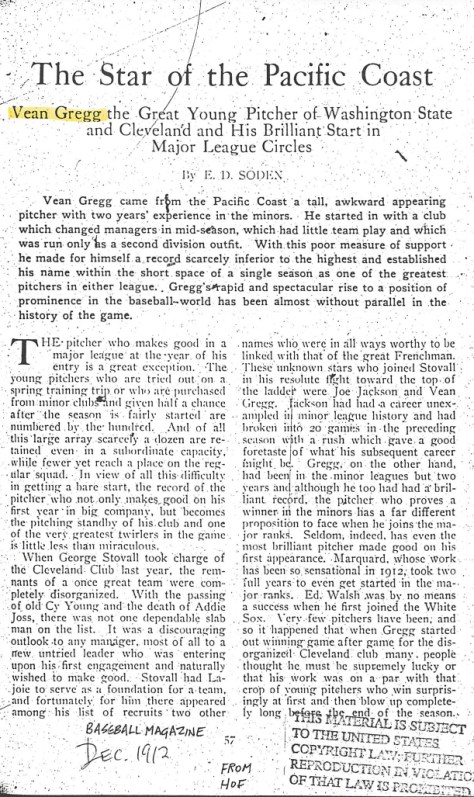
December 1912 Baseball Magazine article on Vean Gregg. Click the page to open the pdf. (Eric Sallee collection)
June 21, 1913, Cleveland Press. (Eric Sallee collection)
Jan. 12, 1922, Seattle Times, page 15.
Feb. 20, 1922, Seattle Times, page 10.
March 19, 1922, Seattle Times, page 19.
April 23, 1922, Seattle Times, page 34.
June 7, 1922, Seattle Times, page 14.
Jan. 14, 1923, Seattle Post-Intelligencer, page 37.
July 13, 1924, from a Seattle newspaper. (Eric Sallee collection)
July 7, 1924, Seattle Times, page 17.
July 13, 1924, Seattle Post-Intelligencer, page 54. (It turns out that the P-I was one year early with its 40th birthday celebration.)
Jan. 7, 1925, Washington Post. (Eric Sallee collection)
Feb. 17, 1925, Seattle Times, page 17.
Feb. 18, 1925, from a Seattle newspaper. (Eric Sallee collection)
Feb. 18, 1925, Seattle Post-Intelligencer, page 7.
March 29, 1925, Seattle Post-Intelligencer, page 34.
March 29, 1925, Seattle Times, page 22.
April 21, 1925, Seattle Times, page 28.
April 25, 1925, Seattle Post-Intelligencer, page 4.
May 8, 1925, Washington Post. (Eric Sallee collection)
June 8, 1925, Seattle Post-Intelligencer, page 9.
July 19, 1925, Seattle Post-Intelligencer, page 8.
June 27, 1925, Seattle Post-Intelligencer, page 7.
June 31, 1925, Seattle Post-Intelligencer, page 5.
Dec. 28, 1925, Seattle Times, page 17.
Feb. 19, 1926, Seattle Times, page 29.
June 5, 1931, Tacoma News-Tribune, page 21.
Aug. 31, 1933, Seattle Post-Intelligencer, page 4.
July 5, 1949, Oregonian, L.H. Gregory column, page 23.
Vean Gregg chapter of “They Tasted Glory” book. Click image to read pdf. (Eric Sallee collection)

Seattle Now & Then: Before Smith Tower, 1908

(click to enlarge photos)

THEN1: A gaggle of storefronts anchors this view, facing east, of the busy northeast corner of Second and Yesler in 1908. The businesses are (from left) Babcock’s Café and Grill, Alexander Gandolfo’s grocery featuring butter, Bartell’s Owl Drug Store (open day and night!), Nessim Alhadeff’s Palace Market, later Palace Fish and Oyster (likely an Alhadeff stands in the shop’s meat-arched entry), and Joe Dizard’s cigar store. All but the café moved to nearby locations after being demolished. (Courtesy, MOHAI 1983.10.7669.3)
THEN2: (From left) George H. Bartell, Sr. (1868-1956) founded the nation’s oldest family owned drugstore until its sale to Rite-Aid last October. L.C. Smith died at the age of 60 four years before his namesake building was completed. Nessim Alhadeff (1864-1950) was patriarch to another Northwest business and racetrack dynasty, besides helping to establish the largest community of Sephardic Jews outside New York City. Future maritime restauranteur Ivar Haglund (1905-1985), in the lap of father Johan, purchased the Smith Tower for $1.8 million in 1976, famously adorning it with a fish windsock. (Courtesy, Paul Dorpat, Public Domain, and Ivar’s)
NOW: L.C. Smith’s namesake building (1914) claims a dubious 42 stories on a bronze plaque besides its entrance, although the most generous observer would count 38. Originally tarred as ungainly (“a giraffe”, sniffed one critic), steel-framed and clad in white terra cotta, it stands today as a beloved Seattle landmark. (Jean Sherrard)

(Published in the Seattle Times online on March 11, 2021
and in PacificNW Magazine of the print Times on March 14, 2021 )

Commercial visionaries meet for a towering talk in 1909
By Jean Sherrard

The place: inside Bartell’s Owl Drugstore on Second Avenue, just north of Yesler Way. The milieu: a lovely evening. This vignette is imagined, but the historical details are factual!

The proprietor arranges a display in his shop window. The entry bell jingles. In walks a well-dressed customer.

Smith: George Bartell, isn’t it?

Bartell: Lyman Cornelius Smith, as I live and breathe. Let me guess. You’re here for the Alaska-Yukon-Pacific Exposition?

Smith: Indeed. All the way from Syracuse in upstate New York, and well worth the trip. Seattle has surely proven her mettle with this magnificent world’s fair.

Bartell: So what can I do you for, L.C.? Liver pills, trusses? Our new Syrup of Hypophosphates is a fine picker-upper.

Smith: I have news, George. I’ll be turning 60 next year. I’m no Carnegie, but I’ve done all right.

Bartell: Can’t hardly go wrong manufacturing shotguns and typewriters, L.C.

Smith: Truth is, I’m inclined to erect something special right here on this spot. Make my mark.

Bartell: Mighty kind of you to give me notice personally.

Smith: You’ve been here, what, 10 years?

Bartell: Eleven. After my year in the Yukon in ’98.

Smith: Didn’t “pan out,” eh? (He chuckles.) I was thinking 18 stories tall, but my son Burns wants to go higher.

Bartell: Just opened my fourth drug store, L.C. I say go big or go home.

Smith: Which is why I asked my architects — the Gaggins brothers — to up the ante. How’s 42 stories sound?

Bartell whistles appreciatively.

Smith: Tallest building west of the Mississippi. Steel-framed, white terra cotta, my initials carved on every floor.

The bell jingles again. In walks a man in a butcher’s apron. He offers a package.

Man: Two pounds of nice fresh cod for you, George. Just what the doctor ordered.

Bartell: L.C., this is Nessim Alhadeff. Runs the Palace Market next door.

Alhadeff: Sold Mr. Smith oysters a few years back when I first signed the lease. Are rumors true? You will tickle the sky?

Smith (with a laugh): Scrape the clouds, Nessim. And how’s family life?

Alhadeff: My brothers are here working for me now — all from the Isle of Rhodes. My English is still not so good, but getting better.

Yet again, the bell jingles. In walk a man and boy of 4 or 5.

Man: Got anything for an upset tummy? My boy ate too much cotton candy at the fair.

Bartell: Seltzer, maybe?

Man: Say “Thank you,” Ivar.

WEB EXTRAS

For our 360 degree video in living color (and dramatic black and white), narrated by Jean, please click on through here.

Seattle Now & Then: Yakima exaggeration postcard, early 1930s

(click and click again to enlarge photos)

THEN: Mount Rainier and its foothills falsely rise above the north end of downtown Yakima’s Second Street in this early 1930s exaggeration postcard. The 11-floor Larson Building at left entered the National Register of Historic Places in 1984. Got an old exaggeration postcard? Scan and send it to ceals@comcast.net so that we can share it here. (Courtesy Dan Kerlee)
NOW: The Art Deco walls of the Larson Building still reign over downtown Yakima. Since 2016, its Second Street façade has been illuminated with multiple colors at night under downtown’s Larson Light project. (John Baule)

(Published in the Seattle Times online on March 4, 2021
and in PacificNW Magazine of the print Times on March 7, 2021)

With exaggeration postcards, we’re not in Kansas anymore
By Clay Eals

As springtime wanderlust beckons, so does a road trip. Just fill the tank and drive someplace civilized but close to nature. If the town seems nice enough, consider moving there.

That’s the underlying message of our 1930s “Then” postcard. It positions the Eastern Washington burg of Yakima as a gateway to recreation on the most topographically prominent peak in the then-48 states.

Oh, but what was a newcomer or out-of-stater to think? On the card, Rainier looks as close to downtown as the fictional Emerald City appeared to Dorothy and her cinematic compatriots.

Reality was quite different. This view of Second Street, anchored by the majestic Larson Building at left, looks north, while the mountain, as locals know, rises to the west. Even if someone standing at this vantage swiveled to gaze left, Rainier would be much more distant and invisible.

This is what collectors term an exaggeration postcard. Call it early-day Photoshop. Such mass-produced novelties often superimposed outrageously enormous vegetables or fake animals (“jackalopes,” anyone?) to promote fertile farming or abundant hunting. The intent was to bring a vacation laugh to folks back home.

The whimsical cards also fed tourism, as business districts everywhere strove to survive during the Great Depression. Yakima — at 27,000 population, part of a “trading territory” of 100,000 residents, according to a 1929 chamber of commerce brochure — was no exception. (Included were 3,000 Yakama tribal members on a 30,000-acre reservation.)

Adelbert E. Larson in the early 1930s. He died in 1934 at age 71. (Courtesy Yakima Valley Museum)

If any downtown feature was a flashy draw for visitors, it was the Larson Building, constructed in 1931 by entrepreneur and civic leader Adelbert E. Larson, who devoted himself to the city he adopted in 1884 when he arrived as a 22-year-old, legendarily carrying all his belongings in a pack.

Though the financial crash had begun when Larson broke ground on the area’s first skyscraper, he “persevered because he wanted people to continue to believe in the future of Yakima,” says John Baule, archivist and longtime former director of the Yakima Valley Museum.

The resulting edifice rose to 11 stories. The Society of Architectural Historians says the detail and prestige of this John Maloney-designed structure is rivaled statewide only by Seattle’s 1929 Northern Life Tower. Inside and out, it stands as an Art Deco masterpiece.

Just north, the white Yakima Trust Building is the other remaining structure from the postcard. The massive Donnelly Hotel and other storefronts on the east side of Second Street fell victim to urban renewal in the 1970s and 1980s. A planned plaza was never built.

The result was street-level parking — the likes of which would never be seen in Oz.

WEB EXTRAS

John Baule (Washington Trust for Historic Preservation)

Below are a two-part Yakima Chamber of Commerce brochure, an additional photo, a National Register nomination and, in chronological order, 14 historical clippings from The Seattle Times and Seattle Post-Intelligencer online archives (available via Seattle Public Library) and other online newspaper sources that were helpful in the preparation of this column.

Special thanks to John Baule, archivist for and, from 1992 to 2016, the director of Yakima Valley Museum, for his assistance with this column!

1929 Yakima Chamber of Commerce brochure, part one. (Courtesy Yakima Valley Museum)
1929 Yakima Chamber of Commerce brochure, part two. (Courtesy Yakima Valley Museum)
A Boyd Ellis postcard of downtown Yakima’s Second Street from the same vantage as our “Then” postcard, circa 1937.
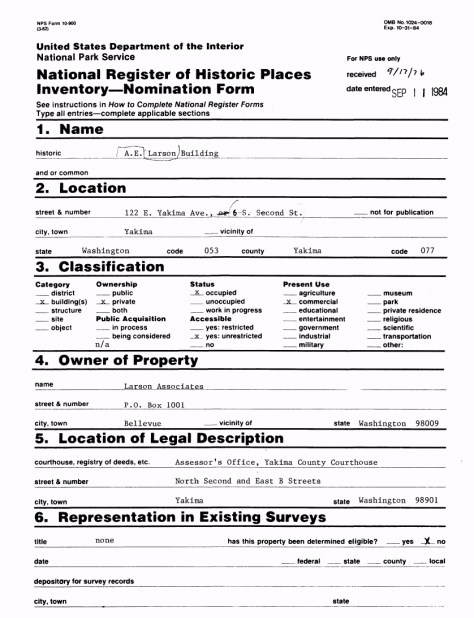
The 1984 nomination of the A.E. Larson Building to the National Register of Historic Places. Click to see full pdf file.
Aug. 12, 1930, Oregonian, page 9.
Oct. 6, 1930, Seattle Times, page 33.
Dec. 21, 1930, Seattle Times, page 19.
Feb. 1, 1931, Seattle Times, page 12.
April 17, 1931, Seattle Post-Intelligencer, page 11.
May 13, 1931, Seattle Post-Intelligencer, page 11.
Oct. 18, 1931, Seattle Times, page 4.
Oct. 18, 1931, Seattle Times, page 38.
Nov. 22, 1931, Seattle Times, page 30.
July 8, 1932, Seattle Post-Intelligencer, page 14. The Larson Building is at bottom left.
Feb. 18, 1934, Seattle Post-Intelligencer, page 36.
June 8, 1934, Seattle Times, page 34.
June 9, 1934, Seattle Post-Intelligencer, page 8.
Feb. 23, 1936, Seattle Post-Intelligencer, page 96. She was an active socialite in Yakima.