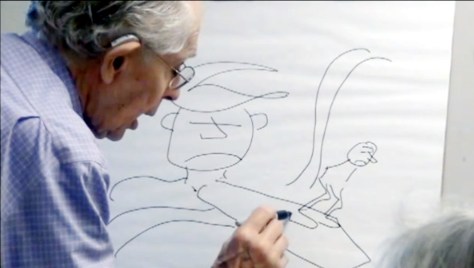
THEN 1: Bob Hale creates a weather cartoon in 1956 at the KING-TV studio at 320 Aurora Ave. N. (Courtesy Peter Blecha)NOW: As engineering tech Bob Konis trains a camera on them, KING-TV meteorologists Rich Marriott and Rebecca Stevenson (holding her own weather cartoon) watch as Peter Blecha stands in for Bob Hale, displaying an original 1962 KING weather cartoon by Hale outside the KING studio in SoDo. Blecha has aggregated more than 200 Hale artifacts. He showcases Hale’s art on Facebook and penned a recently posted Hale essay at HistoryLink.org. (Jean Sherrard)
Published in the Seattle Times online on Aug. 26, 2021
and in PacificNW Magazine of the printed Times on Aug. 29, 2021
Old Sol came alive in Bob Hale’s wild art on early Seattle TV
By Clay Eals
Many of us ride a media treadmill, ingesting recorded events that we re-run at our command. But the most astonishing stuff of life often is ephemeral, solely in the moment. In other words, “You have to be there.”
Like the weather itself, Bob Hale, Seattle’s original cartooning TV weatherman, once wove such momentary magic. Maple Leaf-based historian Peter Blecha, though just a tyke at the time, was “there” to revel in it. He methodically collects all things Hale to keep his hero’s legacy alive.
Early TV weather reporting, Blecha says, was retrospective, documenting yesterday’s rain with only a touch of Farmer’s Almanac-like prediction. Hale helped change that. A commercial artist who left Bellingham for Seattle in 1938, Hale began doing illustrated forecasts for KING-TV’s fledgling news shows in 1955.
THEN 2: One of Peter Blecha’s many Bob Hale finds is this cover for a 1962 cartoon booklet, “Web Feet and Fir Trees.” It incorporates a trademark Hale self-portrait. During the World’s Fair year, he did many of his comic weather segments from the Coliseum (today’s Climate Pledge Arena under renovation), depicted here along with other fair symbols: the Space Needle, Pacific Science Center and the Monorail. (Courtesy Peter Blecha)
Hale’s magic derived from delivering jokey meteorological details while drawing wildly comic cartoons with personified characters such as Sammy Seagull. It was all live, in real time. Adults and kids alike couldn’t take their eyes off him.
His personal appearances, ad work and zany products (cans of “Pure Puget Sound Air”) ballooned. Clients ranged from Sunny Jim peanut butter to Seattle Rainiers baseball. His fame matched that of local TV’s other stars, from child-focused Wunda Wunda to sportscaster Rod Belcher.
A warm smile gave Hale a genial persona, while his eyeglasses and balding dome conveyed authority. But his calling card was a sharp visual style.
“He loved drawing people and critters in motion, Old Sol grimacing, shaking its fists, clouds angry with menacing eyes,” Blecha says. “It wasn’t just cutie-pie, easygoing fun. He was purposely adding drama to what otherwise could be a dry situation. He also was possibly projecting tensions from his own life.”
The tensions, Blecha says, included being a closeted gay man who battled alcohol addiction. His KING reign ended in 1963, the station eventually replacing him with cartoonist Bob Cram. Short stints followed in California TV and, in 1968-69, back in Seattle at KIRO-TV. Alcoholism recovery became a late-life cause. In 1983 at age 64, he died in obscurity.
Hale’s broadcast tapes do not survive, and he typically gave thousands of his KING drawings to kids. Undeterred, Blecha is preparing a cartoon-heavy Hale biography. It will reflect the quaint, in-the-moment sentiment of E.R. Babcock of Vashon Island, who, in a 1969 Seattle Times letter, lamented KIRO’s dismissal of Hale:
“In a world and area where protests, taxes, wars, politicians and you-name-it hog the news programs, it was a real pleasure to have a little humor on something, thank God, we mortals have no control of yet — and that is the weather.”
WEB EXTRAS
To see Jean Sherrard‘s 360-degree video of the “Now” prospect and compare it with the “Then” photo, and to hear this column read aloud by Clay Eals, check out our Seattle Now & Then 360 version of the column!
Special thanks to Denise Frisino, Harry Faust, Barbara Manning, Libby Sundgren and Peter Blecha for their invaluable help with this installment.
Below are three additional photos and, in chronological order, 64 historical clippings from The Seattle Times and Seattle Post-Intelligencer online archive (available via Seattle Public Library) and other online newspaper sources that were helpful in the preparation of this column.
We also present three videos: (1) a 360-degree Bob Hale residential room mural from 1946 previously unseen until now, (2) a story by KING 5 meterologist Rich Marriott about Hale in 1973, and (3) an assemblage of images and footage of Bob Cram that was shared at Cram’s 2017 memorial service.
VIDEO: Harry Faust of north Seattle describes the room of his house that is decorated with a 360-degree mural of skiing images drawn by Bob Hale in 1946. (Clay Eals)This panorama shows the 360-degree mural of skiing images drawn in 1946 by Bob Hale on the bedroom walls of Harry Faust’s north Seattle home. (Clay Eals)VIDEO: 1:31: KING 5 meteorologist Rich Marriott tells a childhood story about Bob Hale from 1973. (Clay Eals)VIDEO: This collection of video and images of Bob Cram was distributed at Cram’s memorial service in 2017. (Courtesy daughter Robin Hall)Frames from 1959 TV commercial for a weight-loss product. (Courtesy Peter Blecha)Frames from 1959 TV commercial for Tirend, a caffeine product. (Courtesy Peter Blecha)May 9, 1951, Seattle Times, page 6.April 11, 1954, Seattle Times, page 60.April 29, 1956, Seattle Post-Intelligencer, page 94.Dec. 2, 1956, Seattle Post-Intelligencer, page 63.Jan. 9, 1957, Seattle Times, page 7.July 3, 1957, Seattle Times, page 30.Sept. 13, 1957, Seattle Times, page 22.Jan. 27, 1958, Seattle Times, page 10.Aug. 8, 1958, Seattle Times, page 36.Sept. 17, 1958, Seattle Times, page 14.April 22, 1959, Seattle Times, page 33.July 30, 1959, Seattle Post-Intelligencer, page 23.March 19, 1960, Seattle Post-Intelligencer, page 10.July 15, 1962,Seattle Post-Intelligencer, page 54.Aug. 1, 1962,Seattle Post-Intelligencer, page 17, Emmett Watson column.Aug. 29, 1962,Seattle Post-Intelligencer, page 17, Emmett Watson column.Sept. 9, 1962,Seattle Post-Intelligencer, page 119.Oct. 14, 1962, Seattle Times, page 87.Nov. 25, 1962,Seattle Post-Intelligencer, page 28.Nov. 25, 1962,Seattle Post-Intelligencer, page 34.Nov. 25, 1962,Seattle Post-Intelligencer, page 30.Dec. 4, 1962,Seattle Post-Intelligencer, page 10.Dec. 30, 1962,Seattle Post-Intelligencer, page 34.March 24, 1963,Seattle Post-Intelligencer, page 71.March 24, 1963, Seattle Times, page 61.Aug. 27, 1963,Seattle Post-Intelligencer, page 15, Emmett Watson column.Sept. 2, 1963, Seattle Times, page 30.Sept. 3, 1963,Seattle Post-Intelligencer, page 19, Emmett Watson column.Sept. 10, 1963, Seattle Times, page 16.Sept. 29, 1963, Seattle Times, page 27.Feb. 12, 1964,Seattle Post-Intelligencer, page 6, Mike Mailway column.Feb. 23, 1964, Tacoma News Tribune, page 8.June 26, 1964, Seattle Times, page 43.Sept. 30, 1965,Seattle Post-Intelligencer, page 8, Emmett Watson column.Jan. 30, 1966, Seattle Times, page 97.Feb. 6, 1966, Seattle Times, page 100.April 24, 1966,Seattle Post-Intelligencer, page 134.May 9, 1966, Seattle Times, page 28.July 14, 1966, Seattle Times, page 28.Nov. 23, 1966,Seattle Post-Intelligencer, page 2, Emmett Watson column.Sept. 1, 1967, Seattle Times, page 20.March 13, 1968, Seattle Times, page 57.March 14, 1968,Seattle Post-Intelligencer, page 5, Emmett Watson column.March 29, 1968, Seattle Times, page 29.April 30, 1969, Seattle Times, page 38.May 1, 1969,Seattle Post-Intelligencer, page 50.May 4, 1969,Seattle Post-Intelligencer, page 63.May 9, 1969,Seattle Post-Intelligencer, page 4, Emmett Watson column.May 18, 1969, Seattle Times, page 146.June 1, 1969,Seattle Post-Intelligencer, page 131.June 5, 1969,Seattle Post-Intelligencer, page 64.July 21, 1969,Seattle Post-Intelligencer, page 6, Emmett Watson column.Nov. 27, 1970,Seattle Post-Intelligencer, page 65, Emmett Watson column.Dec. 17, 1970, Seattle Times, page 20.July 2, 1972, Seattle Times, page 61.Jan. 17, 1973, Tacoma News Tribune, page 34.Feb. 1, 1973,Seattle Post-Intelligencer, page 11, Emmett Watson column.Aug. 18, 1974, Oregonian, page 167.April 20, 1975,Seattle Post-Intelligencer, page 2.July 17, 1975,Seattle Post-Intelligencer, page 11, Emmett Watson column.Sept. 7, 1975,Seattle Post-Intelligencer, page 29.May 27, 1979, Seattle Times, page 168.Dec. 6, 1981, Seattle Times, page 44.June 13, 1982, Seattle Times, page 274.
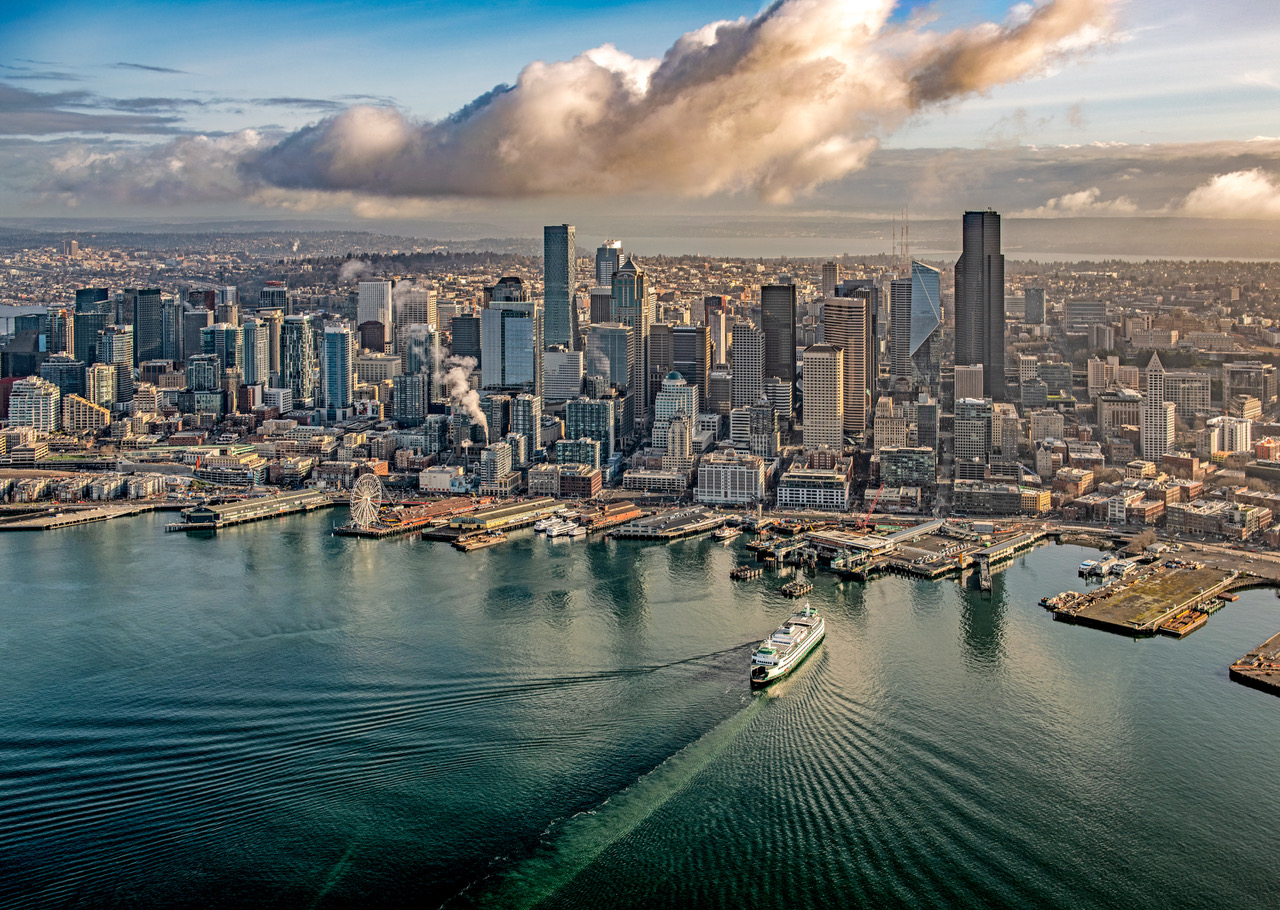
THEN 1: Vessels representing several classes populate this postcard: (from left) the steamer Iroquois, the ferry Kalakala, the tug Goliah, a pair of mystery craft that stumped even our experts, the Coast Guard cutter Tallapoosa and the Army Corps of Engineers dredger Michie. Also note the painted-on (and super-sized) Mount Baker. This historical postcard is still quite popular on eBay. (Courtesy Ron Edge)THEN 2: Charles F. Laidlaw’s unretouched 1936 original bears a handful of docked ships: (from left) at Pier 6 (now Pier 57 with the Great Wheel), the British freighter M.S. Devon City; at Pier 3 (now Pier 54, home to Ivar’s), the Bureau of Indian Affairs cutter North Star; and at Pier 1 (now Ferry Piers 50-52), the freighter SS Susan V. Luckenbach. Mid-World War II, on May 1, 1944, the military renumbered all the piers. (Courtesy Ron Edge)NOW: This aerial photo was taken on Saturday, Feb. 27, 2021. The Washington State ferry arriving at Colman Dock is the genuine article. (Jean Sherrard)
(Published in The Seattle Times online on Aug. 19, 2021
and in PacificNW Magazine of the print Times on Aug. 22, 2021)
An aerial depiction of Seattle’s too-busy bay feels right for its time
By Jean Sherrard
The camera never lies, so goes the maxim. Yet photographers have stretched the truth on occasion, long before Photoshop made fakery a breeze.
Last Feb. 27, Clay Eals and I chartered a helicopter, the left door removed for photography. This week’s “Now” photo, from 800 feet above the waterfront, illustrates the potential for spectacle and perspective.
Seeing this elevated view, photo historian Ron Edge responded by sending me our serendipitous first “Then” photo — a shot I’d never seen. “Pretty close!” Ron marveled.
It was a prevalent postcard of a vibrant Elliott Bay, taken Sept. 15, 1936, by pilot/aerial photographer Charles F. Laidlaw, who apparently captured a miracle of near-misses. In it, various crisscrossing vessels provide visual bon-bons for today’s maritime historians.
Most recognizable at lower left is the beloved, streamlined ferry Kalakala, placed into service in 1935 and departing Colman Dock on the Bremerton run that she would make for 30 years. Above left, the night steamer Iroquois arrives from Victoria via Port Angeles. Puffing from Pier 3 (now Pier 54) is the sturdy oceangoing tug Goliah, built in 1882 and later converted from steam to diesel. Barreling south is the Coast Guard cutter Tallapoosa, fresh from fleet duties with the Bering Sea Patrol. At lower right, the Army Corps of Engineers dredger Michie heads due west.
Whew! Such a spectacular view of Seattle’s busy port.
Trouble is, it’s mostly fiction. Skillfully inserted, complete with brushed-in wakes and waves, none of these vessels (identified by veteran ship historians Michael Mjelke and Paul Marlow) were present in Laidlaw’s original photo, our second “Then.”
One explanation for the empty bay lies in the widening ripples of the Great Depression. Imports and exports had plummeted since the 1929 crash, threatening maritime commerce with ruin.
By the mid-1930s, widespread labor unrest sporadically shuttered ports along the West Coast. Under sympathetic President Franklin Roosevelt, unions flourished. William Randolph Hearst’s Seattle Post-Intelligencer even paused publication for the first time since its 1863 founding due to striking writers and editors.
What’s more, Puget Sound’s Mosquito Fleet, dozens of lively craft ferrying passengers and cargo bowed to grander but fewer vessels. “Suddenly, in the mid-(19)30s, people found that their Fleet was gone,” wrote marine historian Gordon Newell. “(Seeing) the quiet reaches of the Sound, they began to feel that something fine and exciting was missing.”
In that context, Laidlaw’s marine manipulations feel right for the time, a quiescent harbor being no subject for a popular postcard. With no end in sight to the Depression, maybe Seattle was ready for a boost, even one fabricated with a photographer’s fib.
WEB EXTRAS
In place of Jean Sherrard‘s usual 360-degree video of the “Now” prospect, below we have aerial video of downtown by Clay Eals.
Here is a two-and-a-half-minute video tour of downtown Seattle from the air on Feb. 27, 2021. Jean Sherrard takes stills while Clay Eals takes video.
THEN: This 1918 view looks south and slightly east along 59th Avenue Southwest through the Schmitz Park arch, which stood from 1913 to 1953. Alki Elementary School, which was built in 1912 and stands in upgraded form today, is faintly visible behind the 1917 Paige auto, whose slogan was “the most beautiful car in America.” (Debbie Lezon collection)NOW1: At the same vantage, the northwest corner of today’s Alki Playfield, present-day family matriarch Vicki Schmitz (left) provides a human welcome while leaning on the hood of a gleaming 1940 Mercury convertible coupe owned by Lee Forte (second from right). In the driver’s seat is his son, Omri, and behind Lee is their neighbor and this column’s automotive consultant, Bob Carney. They are West Seattleites all. (Jean Sherrard)
Published in the Seattle Times online on Aug. 12, 2021
and in PacificNW Magazine of the printed Times on Aug. 15, 2021
Backed by a bustling beach, old-growth endures at Schmitz Park
By Clay Eals
Next time you pull out your phone and aim it to snap a picture, consider the scene playing out in exactly the opposite direction. Sometimes what’s behind the camera is as important as what’s in front. Context can be everything.
Our 1918 “Then” photo illustrates the point. We are in West Seattle, looking south and slightly east to a unique, old-growth preserve, Schmitz Park. Yet over our shoulder lies our city’s sandy, saltwater showcase, Alki Beach.
Beneath a stone-pillared arch leading to the park, three gents in hats, suits and ties, with an equally fashionable woman in the driver’s seat, are eyeing the camera — and the beach. These unknown adventurers have pulled a 1917 Paige touring car to the side of 59th Avenue near its intersection with Lander Street, beyond which the park’s sturdy trees are visible in the distance.
The philanthropic Schmitz family donated the hillside property to the city in portions from 1908 to 1912, with the proviso that it be maintained largely in its natural state. The arch, erected in 1913, served as a grand entry through which motorists could parade their vehicles and pedestrians could stroll to the sanctuary.
NOW2: The reverse view today, with Alki Beach one-half block away. (Clay Eals)
But how did visitors get here? Likely via the beach directly in back of the photographer, one-half block away.
Of course, Alki was the site of the city’s first non-Native settlement in 1851, thus its vaunted “birthplace.” When this photo was taken, 11 years after West Seattle’s annexation to Seattle, Alki had become a crowd-pleasing daytime destination and summertime retreat. Easing access was a just-opened wooden swing bridge across the Duwamish River mudflats, augmenting a streetcar that had served the coastline since 1908.
Alki Beach Park had opened formally in 1911, its bathing pavilion drawing 73,000 visitors in 1913 alone. A mile northeast, on piers above lapping waves stood the private Luna Park amusement center, all of which but a natatorium (saltwater pool) closed in 1913 after a raucous, seven-year run.
Given the pressures of Seattle’s gargantuan growth, it’s astonishing that bastions of beauty survive intact near this photographic site. Creek-centered and trail-lined, 53-acre Schmitz Park remains a sensory refuge from urban life.
Likewise, Alki Beach Park encircles the peninsula’s northern tip on the water side of Alki and Harbor avenues, still providing a panorama nonpareil. One shudders to envision the vanished vistas had the city not acquired and protected these precious parcels.
So as we navigate and reinvigorate our society post-virus, we might do well to express gratitude for the context of our lives, before and behind us, a century ago and now.
WEB EXTRAS
To see Jean Sherrard‘s 360-degree video of the “Now” prospect and compare it with the “Then” photo, and to hear this column read aloud by Clay Eals, check out our Seattle Now & Then 360 version of the column!
Below are several interpretive signs from Schmitz Park plus, as provided and annotated by our ace automotive informant Bob Carney, a complement of vintage photos of cars on Alki Beach. Thanks, Bob!
Entry pillar to Schmitz Park. (Clay Eals)Schmitz Park trail sign. (Clay Eals)Schmitz Park restoration sign. (Clay Eals)A history sign at Schmitz Park. (Clay Eals)Cars line Alki Beach in 1912. Cars represented include Model T Ford, Packard, Hudson, Buick and Olsmobile. “Latham” on building at right could stand for C.W. Latham, West Seattle real-estate agent. (Bob Carney collection)Above the women lounging on Alki Beach are several cars (from left): unidentified, 1925-26 Chrysler, 1920s Model T Ford, 1925-26 Chevrolet and three more 1920s Model T Fords. (Bob Carney collection)Circa 1945, this view of Spud Fish & Chips on Alki Beach features these cars (from left): unknown, 1940 Oldsmobile, 1938-39 Ford, 1940s Oldsmobile and 1937 Chevrolet. At left are signs for the Alki Beach Cafe and a souvenir and gift shop. (Bob Carney collection)A woman displays a new-looking 1950 Studebaker Land Cruiser across from the “Birthplace of Seattle” monument on Alki Beach. In the background are (left) a 1942 Chevrolet and a 1946-48 Ford. (Bob Carney collection)
UPDATE: You may recall our “Now & Then” column on the La Quinta Apartments from Jan. 28, 2021. The La Quinta tenants are attempting to buy the building, and today they announced that the sale of La Quinta to a developer has been successfully delayed to allow the tenants to prepare their offer. For more info, visit this link.
=====
UPDATE: The Seattle Landmarks Preservation Board voted unanimously on March 17, 2021, to designate the La Quinta apartment building an official city landmark. Congratulations!
=====
Here is our “Now & Then” column from Jan. 28, 2021.
(click and click again to enlarge photos)
THEN: Two years after the complex opened, this photo of the La Quinta Apartments from a 1929 Anhalt Company brochure exemplifies the pitch therein: “ ’Every Man’s Home Is His Castle’ is an Ideal realized to an unusual extent for tenants of Anhalt Apartment-Homes.” (Courtesy Larry Kreisman)NOW: Socially distanced and momentarily unmasked, two dozen current and past tenants of La Quinta Apartments (some leaning from windows) are joined by historian Larry Kreisman (left) and Historic Seattle’s director of preservation services, Eugenia Woo (fourth from left), in displaying support for landmarking the Spanish Eclectic-style complex. For more info on the campaign, visit vivalaquinta.com. Following are the names of everyone. On the parking strip (from left): Larry Kreisman, Jacob Nelson, Brandon Simmons, Eugenia Woo, Alex Baker, Lawrence Norman, Tom Heuser (Capitol Hill Historical Society president), Juliana Roble, Eliza Warwick, Rebecca Herzfeld, Gordon Crawford, Samantha Siciliano, Ryan Batie, Michael Strangeways, Chelsea Bolan, Jerry Jancarik, Sean Campos, Clea Hixon, Jenifer Curtin, Marta Sivertsen, Aaron Miller, Finn (dog) and Mariana Gutheim. In the windows (from left): Zach Moblo (above), Ryan Moblo (below), Carlos Chávez (waving flag), María Jesús Silva (above) and Begonia Irigoyen (below). (Jean Sherrard)
(Published in the Seattle Times online on Jan. 28, 2021
and in PacificNW Magazine of the print Times on Jan. 31, 2021)
U-shaped edifice courts its tenants in 1927 and today
By Clay Eals
How can a house feel more like a home if the home isn’t a house? That’s no trick question. It was a real concern for prolific Seattle developer Frederick Anhalt during the Roaring ’20s nearly a century ago.
Of note among some 45 buildings Anhalt constructed were 19 apartment complexes on Capitol Hill and in Queen Anne. Each exuded unique charm that eludes the modern tendency toward mega-unit boxes.
The first example of Anhalt’s approach and execution presides in our “Then” photo. Built in 1927, the La Quinta Apartments at 1710 East Denny Way in south-central Capitol Hill clearly reflect Spanish influences, with red-clay roof tiles and stucco embedded with colored stones and panels artfully arranged in arches.
Even more significant, however, is the early use of a U-shaped footprint surrounding an ample courtyard filled with foliage and places to sit. It’s long been a welcoming centerpiece for residents of the dozen apartments (two floors each), including units in the pair of turrets at the inner corners. This element creates the notion of “home” even today, when social gatherings are discouraged but an uplifting vision can provide at least the sense of belonging.
Frederick Anhalt, circa 1929. The self-taught builder, who lived to age 101, died in 1996. (Courtesy Larry Kreisman)
“I thought that people should have a nice view to look out to and the feeling that they were living in a house of their own, different from their neighbor’s,” the developer reflected in the 1982 book “Built by Anhalt” by Steve Lambert. “It didn’t seem to make sense … to spend a lot of extra money on a building site just because it had a pretty view in one direction. Somebody else could always put another building between you and your view.”
Small wonder that a for-rent ad in the Nov. 6, 1927, Seattle Times labeled La Quinta “the prettiest and best-arranged individual apartment building in Seattle.”
Today, tenants echo the sentiment. “I know all my neighbors, I talk to them all, I trust them,” says Chelsea Bolan, a resident since 2003. “You interact, you share, you see each other all the time.”
“There just aren’t places like this anymore,” says Lawrence Norman, who grew up there when his dad owned it in 1964-74. “It brings community together. That’s a special thing, and I think that should be preserved.”
Historic Seattle agrees and is nominating it for city landmark status. The first hearing is Feb. 3.
Heartily endorsing the effort is longtime architectural historian Larry Kreisman, who wrote the 1978 book “Apartments by Anhalt” and salutes the developer’s boomtime vision: “For an expanding middle class, Anhalt made dense city-living palatable.”
WEB EXTRAS
To see Jean Sherrard‘s 360-degree video of the “Now” prospect and compare it with the “Then” photo, and to hear this column read aloud by Clay Eals, check out our Seattle Now & Then 360 version of the column!
Below are five additional photos, a brochure, a landmark nomination, a support letter and, in chronological order, 10 historical clippings from The Seattle Times and Seattle Post-Intelligencer online archive (available via Seattle Public Library) and other online newspaper sources that were helpful in the preparation of this column.
Special thanks to Eugenia Woo, Larry Kreisman and the residents of La Quinta for their assistance with this column!
The 1937 King County assessor’s tax photo for La Quinta. (Puget Sound Regional Archives)Panorama of the La Quinta apartments taken Dec. 28, 2020. (Clay Eals)Detail of La Quinta exterior art, Dec. 28, 2020. (Clay Eals)La Quinta entry gate, Dec. 28, 2020. (Clay Eals)La Quinta entry sign promoting landmark campaign, Dec. 28, 2020. (Clay Eals)1929 Anhalt brochure cover. Click it to see full 16-page brochure. (Courtesy Larry Kreisman)La Quinta landmark nomination cover, December 2020. Click it to see the full nomination.Click to see pdf of two-page landmark support letter by Larry Kreisman.Nov. 6, 1927, Seattle Times, page 54.Oct. 31, 1931, Seattle Times, page 9.April 17, 1932, Seattle Times, page 36.April 24, 1932, Seattle Times, page 34.Aug. 28, 1932, Seattle Times, page 15.July 16, 1933, Seattle Post-Intelligencer, page 45.July 30, 1933, Seattle Post-Intelligencer, page 41.Nov. 18, 1939, Seattle Post-Intelligencer, page 1.Nov. 8, 1976, Seattle Times, page 7.
(Published in the Seattle Times online on Aug. 5, 2021
and in PacificNW Magazine of the print Times on Aug. 8, 2021)
In wartime fear, ‘empathy is the only thing that can bind us’
By Jean Sherrard
This week we interview Frank Abe, author of the graphic novel ‘”We Hereby Refuse: Japanese American Resistance to Wartime Incarceration” (Chin Music Press and the Wing Luke Museum of the Asian Pacific American Experience, 2021), illustrated by Ross Ishikawa and Matt Sasaki, and co-authored by Tamiko Nimura.
This powerful account of courage and confrontation offers compelling lessons for us today.
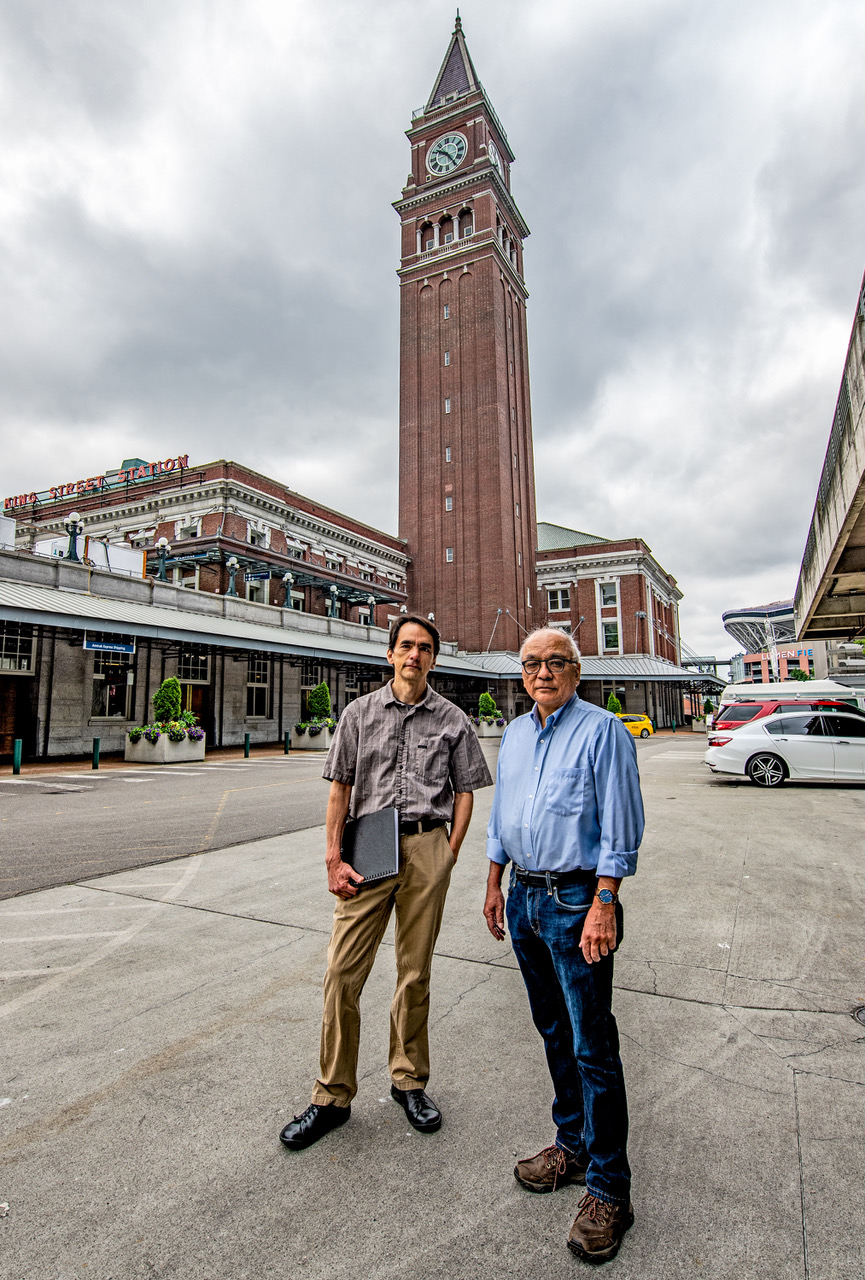
THEN1: In Ishikawa’s illustration of departure from King Street Station, detained immigrant husbands and fathers clutch paper sacks they were given to replace their confiscated suitcases. At right are the outstretched arms of wives and children screaming their goodbyes in Japanese and English.NOW1: Seattle writer Frank Abe (left), also a documentarian and ex-KIRO reporter, stands beside illustrator Ross Ishikawa, cartoonist and animator, on the King Street Station platform. (Jean Sherrard)
Jean: When and where does this story begin?
Frank: It begins with the FBI arresting 150 immigrant leaders in Seattle in the hysteria following the start of World War II. The men were marched in the pre-dawn hours from the U.S. Immigration Detention Building to King Street Station, where The Seattle Times captured a photo of them on the platform boarding a train for the Department of Justice alien internment camp at Fort Missoula, Montana. When I first saw this photo, I knew it would be central to the story of Jim Akutsu, one of our three main characters.
THEN2: The Seattle Times photo of March 19, 1942, that inspired Abe and Ishikawa.
Jean: Why a graphic novel?
Frank: It matches the epic sweep of a movie at a fraction of the production cost. I asked Ross to draw Jim’s mother as clawing through the bars and screaming to her husband after reading the description in the Times of “tear-stained eyes” and the din of “staccato chatter” in the morning air.
Jean: Your book takes an uncompromising view of systemic exclusion and racism.
Frank: Many fathers were separated from their families, who were themselves incarcerated at camps like Minidoka, Idaho. Jim and his brother Gene refused to be drafted until the government restored their citizenship rights, starting with their freedom. We emphasize that the government was responsible for targeting these families based solely on their race.
A full page from ‘We Hereby Refuse’
Jean: The storytelling has a documentary feel to it but also feels intensely personal.
Frank: Everything is drawn from the historical record. Readers can immerse themselves in the personal stories of our characters in a way that generates empathy. Empathy is the only thing that can bind us when the same elements of wartime fear and ignorance of the “other” survive to this day.
Jean: So the empathy signals a warning bell along with possible remedy?
Frank: Our book opens with the FBI knocking on the door to arrest Jim’s father. It ends with ICE breaking down the door to deport unwanted immigrants. In 1941, America feared a second attack from the Pacific. Just one year ago, we had a pandemic-era president dog-whistle “China virus” and “Kung flu,” received by some as permission to kick and punch Asian Americans on the street. Some things haven’t changed.
WEB EXTRAS
This week features a special 360 degree video of Jean’s 12-minute interview with Frank Abe at King Street Station. Includes select illustrations from “We Hereby Refuse” plus Frank’s reading from the John Okada’s classic “No-No Boy.” Not to be missed. (And if you’d prefer to hear just the audio of Frank’s chat with Jean, click right here!)
Illustrator Ross Ishikawa and writer Frank Abe pose in the courtyard of King Street Station.