Seattle Now & Then: For April Fool’s, a newcomer’s guide to Seattle’s quirky codes

(please click to enlarge photos)

Salisbury Cathedral

Published in The Seattle Times online on March 30, 2023
and in PacificNW Magazine of the printed Times on April 2, 2023

‘Meet me at the Pig’: A newcomer’s guide to Seattle’s quirky codes
By Jean Sherrard

Forty years ago, on our honeymoon, my girlfriend and I — oops, “wife” was still a new and foreign concept — stopped in Salisbury, England. Hiking ancient Roman roads, we encountered a friendly gent.

“Are you a local?” we asked.

“Oh no,” he confided, “I was born four miles from here.”

Today, to help relative newcomers navigate potential April Fool’s foibles, our crack “Now & Then” team shares some quirky codes and stubborn semaphores from “Then” days that persist in the “Now.” Of course, only a small subset of Seattleites can truly claim lifelong residence. For the rest, here’s a helpful cheat sheet.

Grammar and pronunciation

Telltale tyro signs include adding definite articles to freeway names. It’s never “the 5” or “the 405.” Plain I-5 and 405 suffice. And “just Puget Sound,” says writer Adam Woog. He also recommends learning to pronounce a few place names. Puyallup (rhymes with “you gallop”), Sequim (“Skwim”) and Duwamish (“Doo-WOMM-ish”) for starters. Try not to giggle when old-timers occasionally still say, “Warshington.”

“The mountain,” when it’s out. Robin Walz offers the following meteorological advice: “If you can see the mountain, it’s going to rain. If you can’t, it’s already raining.”

The mountain

Though we are surrounded by mountains, “the mountain” refers only to Rainier. Historian Robin Walz suggests a handy conversation starter: “The mountain is out today.”

(Column partner Clay Eals notes that when he was young and the mountain was “out,” as in the above photo, and when his mother, Virginia, would drive him and his brothers across the Mercer Island floating bridge, she would point south and exclaim, “Get out your ice-cream spoons!”)

Cars and trucks roostertail along I-5 in a rare spring “downpour.” Frustratingly, there is no wiper preset for Seattle rain.

Rain

Former Port of Seattle commissioner Peter Steinbrueck observes that while many other large cities have more rainfall than Seattle, we have more words for it, including “mist, sprinkles, showers, drizzle, sleet, snowy mix and downpour.”

Photo archivist Ron Edge stands patiently at the corner of 145th and 15th on Shoreline’s border, ignored by a friendly scofflaw recently arrived from New York City.

On the road

“We don’t know how to drive,” insists column founder Paul Dorpat’s friend Pam Heath, “particularly at four-way stops.” But she and photo archivist Ron Edge agree on jaywalking. “Just don’t walk,” demands Edge. Heath adds, “I’ve seen folks at crosswalks waiting for the light to change at 2 a.m. Did I mention it was pouring rain? And they didn’t have umbrellas.”

Umbrellas

Don’t need ’em. Stalwarts revel in “liquid sunshine.” Wags jest, “It’s a dry rain.”

A bronze statue of beloved TV clown J.P. Patches in Fremont do-si-do-ing with partner Gertrude. Their theme songs: a divinely silly William Tell Overture/“Dance of the Hours” medley performed by Spike Jones.

Kid stuff

Carol Wilkensen (Seattle-born on April 1) suggests arrivistes seek out YouTube clips of J.P. Patches or Stan Boreson, two bright stars of local children’s TV. Boreson’s home-spun ditties include the apropos: “Zero dacus, mucho cracus / hallaballu-za bub. / That’s the secret password that we use down at the club.”

At the Pike Place Market, locals meet “under the clock, by the pig.”

Places we visit — or don’t

“The Market” (never “Pike’s Market”) where we meet “under the clock” or “by the pig,” suggests Vanya Sandberg.  Visits to the top of “The Needle” are rare.

At nearly $30 a trip, locals rarely visit the observation-level “saucer” section

All preceding suggestions need be taken with a shaker of salt. And it’s time to fess up: I’m not a Seattle native. This April Fool was born miles away — in Renton!

WEB EXTRAS

No locals wait in line at the Market Starbucks–what’s more, it’s a mystery why anyone would!

Only visitors wait in line at the not quite “original” Starbucks, says Pam Heath

Below we also add a few more helpful suggestions from our locavore correspondents. Please feel free to send in a few of your own!

ROBIN WALZ:
I remember we called soda “pop.” Friends back East have commented on this repeatedly over the years. Might be a thing in the West generally, not just PNW.
How about “liquid sunshine”?
The following aren’t turns of phrase, but are certainly more well loved locally than elsewhere.
Idaho Spud candy bars:
Idaho Spud copy.jpg
The entire line of Brown & Haley candies:
Mountain Bar.jpg
VANYA SANDBERG:
The Rainier beer commercials (specifically the motorcyle noise “raaaaaiiiinieeeeeer beeeeeeeeer”
The phrase, “The mountain is out!
Also applets & cotlets, Frangos…
“Meet you by the pig” is DEFINITELY for locals. At the market, got separated from my French friends. They insisted they were waiting by the pig. It turned out they were at another pig, in a pkg garage, maybe on Western, nowhere close to the fish market. (There’s more than one pig near the market??!!)
PAM HEATH:

There are a few words that are at least west coast local when I grew up.

For example, we stand in line, not on line (like at the Market Starbuck’s). We certainly don’t queue or queue up (except me, having watched too many British PBS series).
And we drink pop, not soda. (Or is pop a Southern thing? It’s what I grew up calling it, raised by Texans.) Soda is what I drink with so-so bourbon.
Definitely not Pike’s Market. Pike Market or the Pike Market are barely OK, but mark you as an outsider.
We know how to say Puyallup. Also Duwamish. Sequim. Even Pshyt. Spokane. Tulalip. Uwajimaya.
The difference between cedar and Doug fir?
King County was named for a slave owner and was re-named for MLK (first county in the nation to do that, I think).

Ever notice on TV or in movies, Seattle is the place furthest from anywhere else. Like a family member lives in Seattle, or moves to Seattle. Frasier came to Seattle because it was as far away from anywhere else which could still be considered civilized. This has faded out, perhaps, thanks to the tech worker influx.

We would never do the Underground Tour. Do locals ride the Wheel? Certainly don’t go to the Market Starbuck’s. Nor Bruce & Brandon Lee’s graves. Or Jimi Hendrix.

Aurora and 99 are used interchangeably, which may confuse some non-natives. In the South Country is Pacific Highway S also ID’d as 99?

We slide through stop signs. Generally, we don’t know how to drive, things like four-way stop rules. On-coming cars that for no good reason wait for you to turn left before they go (not like when on-coming traffic is backed-up and they aren’t going anywhere anyway). What the heck? The Seattle Nice.

There’s definitely a passive-aggressive thing about driving the speed limit in the inside lane. “I’m doing the speed limit, why should I move over?” I don’t see that elsewhere.

I have seen people waiting for the light to change before crossing – at 2 am. Not crossing against the light in general is a give-away.

Pedestrians are NOT the lowest form of life.

Schooners, not half-pints.

The Needle is used at least as often as the Space Needle. The Center, not Seattle Center. The Regrade, not Denny Regrade or the Denny Regrade.

How we pronounce “route.”

Skid Road.

Sodo. And why it’s called that.

The King County Airport is still Boeing Field.

We hate the cruise ships. Or at least the boatloads of tourists they eject daily in the summer.

The Mountain, not Mount Rainier.

ROB & CAROL WILKINSON
  1. Zero dacus, mucho cracus / hallaballu-za bub / that’s the secret password that we use down at the club/ Zero-dacus, mucho-cracus / hallaballu-za fan / means now you are a member of KING’s TV club with Stan.” And No Motion Shun” This was our go-to TV program in the fifties and sixties. Stan played the accordion – He inspired my first expression of musical interest and within minutes my parents bought me one. They said I would be popular at parties. I was. But theirs not mine. By the way No Motion Shun was the name given to Stan’s lethargic dog named after the Slow Motion IV, the hydroplane that set a speed record. No one outside of locals have ever heard of Stan or No Motion Shun. Speaking of hydroplanes…
  2. Miss Thriftway, Miss Bardahl, Miss Wahoo, Miss Hawaii Ki, Miss Pay n Pak, Miss Budweiser etc. were all household names for the hydros we worshiped as kids. If you were to mention Bill Munice or Miro Slovak to anyone outside of Seattle, they would have no idea who you were talking about. Still on Hydros…
  3. Thunder Boats. This was the name all hydros were given for the deafening sound they made from unmuffled Alison and Rolls Merlin 3000 hp engines. It was wonderful! If you said to an outsider “let’s meet at the Pits”  they would immediately know what you were talking about. It’s now the Stan Sayres Memorial Park. We watched the hydros from:
  4. The Floating bridge (the name before the 520 bridge was built but lasted for a long time). After 520 was as built it remained The Floating Bridge for “natives” and 520 was “the toll bridge” ($.35 tolls. No one took it because it was too expensive).
  5. Pill hill was, of course, the name given to the hospitals on Capitol Hill.
  6. For those with money they might going to the Golden Lion for dinner. It was in the Olympic Hotel and featured décor (highly inappropriate at any time in history), of the British Colonialization of India. The waiters even wore turbans. Back to kids TV programs…
  7. Wunda Wunda is my name.oh boys and girls, I’m glad you came. We’ll have fun and we’ll play games. Won’t you play with me?
  8. If you owned a boat in Seattle in the olden days, Doc Freeman’s was your place to buy gear for your boat. It seemed like everyone owned a boat. “Boating Capitol of the World” we were called. Sadly, this landmark went the way of Hardwicks, Jensen Motorboat Company and many others, but long before.
  9. Kalakala was the go-to ferry to Vashion Island as I remember. An awesome ride with its classic rattle and Art Deco streamline design. Outside of Seattle few would know about the Kalakala.
  10. If someone today asks me where Lowe’s Store is located I tell them it’s down where Sick’s Stadium used to be, until I realize they are either too young or not from around here.
  11. Let’s meet at Dag’s. Dag’s was the favorite before Dick’s and Burgermaster for a cheap burger, fried and a shake. It’s long gone but those of us of a certain age remember it well.
  12. The Aqua theater at Green Lake
  13. Chubby and Tubby where we bought cheap Xmas trees, shoes and jeans. It was a favorite place to go for discounted everything.
  14. Boo-boo and Fifi, Duh..
    (Jean comments: Rob and Carol are recalling Bobo, our local–and beloved–gorilla. Not to be confused with Yogi Bear’s adenoidal sidekick Booboo)
  15. Maynard hospital named after David Maynard, Seattle pioneer. Where Carol was born.
  16. Armory now MOHAI.
    (Jean comments: Of course, R&C are referring to the Naval Reserve Armory.)
  17. RH Thompson expressway. Few outside of Seattle would remember this transportation mistake, but if you lived around here this was a big deal in the 1960’s.
  18. Mossback was often how my parents described what it was like living in the rainy, cold  (mossy) Pacific Northwest. Of course, it’s also what conservative, curmudgeons are called as well but I believe we defined it differently back then. Although, I’ve definitely developed some curmudgeonly qualities as time marches on –  to go along with the moss!
PETER STEINBRUECK
Hmmm giving some thought to this, I can easily identify non-Seattle natives by a number of traits, behaviors such as those impersonal footwalkers who never look at you, let alone give a friendly “hello” as they pass by and are the same people who like to complain about the so-called “Seattle Freeze,” which we real natives know as a unusual cold wind that blew in from somewhere else!

Another dead giveaway is “Pike’s Market,” which of course is confused with “Pike’s Peak,” and has nothing to do with the Pike Place Market.

And our neighbor state to the south of Washington is mis-pronounced “Ore-gone.”

People not from here are under another big delusion that it rains alot in Seattle. In fact, many other large cities such as New York City, Boston and Washington DC receive more rainfall than Seattle does, which just have more names for than most other places, including “sprinkles, showers, drizzle, sleet, snowy mix, and downpour.” People from the east and other cold places usually like to wear scarves,  heavy wool button down overcoats in winter, which are unnecessary, impractical for drizzle, and can make you too hot in our mild climate even in winter.

Then there’s the Seattle hipsters, so into the “lumberjack metro“ look, beards and all, particularly popular among high income techies who can afford $350 flannel shirts from Filson’s, once the working man’s Alaskan outfitter established in Seattle in 1897 during the pioneering days of the Klondike Gold Rush.

COLLEEN CHARTIER

I come from somewhere else. In fact, several somewhere-elses.

But I have lived in Seattle for 50 + years among many friends and family who were born and raised in Seattle.  I’ve heard tell of it all. Wunda Wunda, JP, Stan, thunderboats, Sick’s, Dick’s, Dag’s, Beth’s, the Market and more.

I’m now claiming some historic chops with my half-century of residence and my long proximity to those folks born here. 
So, may I add a reference to the brilliant game show spoof, “Pike or Pine?”, and a huge appreciative shout-out to “Almost Live” for thinking of it?

This question often comes into my head when I’m navigating to destinations on those two streets. And I laugh. 

Which reminds me of a pervasive and useful sentence for getting around the downtown core, “Jesus Christ Made Seattle Under Pressure”.

Translated it refers to the correct sequence of proper-named streets, two by two, south to north: James, Cherry, Columbia, Marion, Madison, Spring , Seneca, University, Union, Pike and Pine.

This trick saw me through my delivery days when I worked at the venerable sign shop, Balliet Screen Graphics.

JOHN WILLIAMS  (once a Seattle tour guide)

image0.jpeg


Seattle Now & Then: Rosario Resort, 1921

From Feb. 13, 2024, an update:

(Click and click again to enlarge photos)

THEN1: Dominating the Rosario music room, circa 1921, is its 1,972-pipe Aeolian organ, hidden behind nonfunctional, decorative mahogany pipes. Here, visitors enjoyed daily organ concerts directed by Moran. At center above is a stained-glass depiction of Belgium’s Antwerp harbor that Moran commissioned. (Asahel Curtis, courtesy Rosario Resort & Spa)
NOW1: For the first time after a 15-month pandemic shutdown, Christopher Peacock, general manager of Rosario Resort & Spa, performs for guests several piano pieces, accompanied by island images, in the mansion’s music room on Jan. 21. Peacock, who also plays the room’s Aeolian organ from a balcony, has provided regular concerts for visitors for an astounding 42 years. In 1985, the historian published a 72-page, 123-photo book, “Rosario Yesterdays,” that is still on sale. More info: RosarioResort.com. (Clay Eals)

Published in The Seattle Times online on March 23, 2023
and in PacificNW Magazine of the printed Times on March 26, 2023

The ‘happy airs’ of Orcas waft from Robert Moran’s Rosario Resort
By Clay Eals

Early on a Sunday 102 years ago, “strains of wonderful music” awoke newspaper writer Dolly Madison as she stayed at the Orcas Island mansion of retired Seattle mayor, shipbuilder and philanthropist Robert Moran.

“Hazy visions of heaven, with its choirs of sweet singers and golden harps, arose,” she wrote. “Near and nearer the sound traveled. The faint notes of a pipe organ became discernible. The music grew louder; then louder. Phrases were recognized. Suddenly an avalanche of sound pealed forth; low, deep notes; the warbling of birds; then the snatches of happy airs.”

THEN2: In this southwest-facing view from the 1920s, Moran’s Rosario five-floor mansion, situated on the east leg of Orcas Island, overlooks Cascade Bay. The island’s west leg is in the background. (Asahel Curtis, courtesy Rosario Resort & Spa)

Her senses didn’t deceive her. Routinely, Moran manipulated player rolls to create sunrise sounds on his 1,972-pipe German organ — an Aeolian (after the god of wind). The 1913 instrument still weaves magic in the five-floor, 117-year-old “Shangri-La” that Moran named Rosario, for the nearby strait.

NOW2: The same vantage today shows Robert Moran’s mansion and grounds at Rosario Resort & Spa. The complex includes a marina, dining, lodging and next-door proximity to Moran State Park. (Clay Eals)

Expanded and run as a resort under several owners since 1960, it’s again for sale. The Barto family of Anacortes seeks an entity to implement a 10-year, Seabrook/Suncadia-like redevelopment while retaining Moran’s vision and integrity.

Moran (1857-1943) forged an impressive if improbable existence. Born in New York slums, he arrived at Yesler’s wharf in Seattle at age 17 with only a dime. Seven years hence, the entrepreneurial machinist founded Moran Brothers drydock, which over two decades built steamers, barges and the USS Nebraska, a battleship active from 1904 to 1923.

THEN3: Robert Moran in 1889, while serving as Seattle mayor in the year of the Great Fire. (Seattle Municipal Archives)

Along the way, Moran won two one-year terms as Seattle mayor, straddling the city’s devastating Great Fire in 1889. Though lauded for swift recovery measures, Moran later deflected such praise:

“The fire simply cleared the ground and made it possible to build what is today one of the most beautiful cities in the United States,” he told the Seattle Post-Intelligencer in 1909. “It did more than that, however. As the electrical engineer would say, it put the ‘peak’ load on its citizens, morally and physically.”

Moran was facing his own challenge of destiny. Told by doctors at age 47 that he had six months to live, he left his Seattle empire and in 1906 decamped to peaceful Orcas, “the gem of the San Juans.” There, he bought thousands of acres and carefully built his waterfront Rosario estate in the new landscape amid family and frequent guests, living to age 86.

Guiding him were the hand-hewn Arts & Crafts movement, his long-held shipbuilding sensibilities and a deep respect for nature, which inspired his donation of what became next-door Moran State Park, including the breathtaking 2,400-foot Mount Constitution.

Who will carry on Moran’s life-enhancing showpiece? Perhaps they only will need to experience its music.

VIDEO (33:06): Click the image above to see Christopher Peacock perform part of his Jan. 21, 2023, concert on the Rosario Resort & Spa’s 1,972-pipe Aeolian organ. (Clay Eals)

WEB EXTRAS

Special thanks to Patty Johnson, Scott Cameron, Meg Eals and especially Christopher Peacock for their invaluable help with this installment!

To see Clay Eals’ 360-degree video of the “Now” prospect and compare it with the “Then” photos, and to hear this column read aloud by Clay, check out our Seattle Now & Then 360 version of the column.

Below are 5 additional photos and, in chronological order, 63 historical clips from The Seattle Times and Seattle Post-Intelligencer online archive (available via Seattle Public Library) and Washington Digital Newspapers, that were helpful in the preparation of this column.

THEN4: Visitors in the 1920s enjoy the southern veranda of Robert Moran’s Rosario while others play croquet nearer to Cascade Bay below. Today the veranda is enclosed as a dining area. (Asahel Curtis, courtesy Rosario Resort & Spa)
NOW3: Robert Moran’s mansion at twilight. (Clay Eals)
NOW4: The resort’s bowtie pond, which Moran built in 1915 for his wife Melissa’s canoeing. (Clay Eals)
NOW5: A Visitor Center placard at Mount Constitution in Moran State Park salutes Robert Moran’s contribution of the park land to Washington state. (Clay Eals)
NOW6: A Visitor Center placard at Mount Constitution in Moran State Park quotes Robert Moran’s desire to respect the natural aspects of thousands of Orcas Island acres that he purchased, many of which he donated to the state. (Clay Eals)
Oct. 15, 1904, San Juan Islander.
March 24, 1906, San Juan Islander.
Feb. 2, 1907, San Juan Islander.
May 12, 1908, Seattle Times, p12.
June 6, 1909, Seattle Post-Intelligencer, p95.
Aug. 22, 1909, Seattle Times, p50.
Aug. 22, 1909, Seattle Times, p55.
July 14, 1910, Seattle Times, p18.
Nov. 20, 1910, Seattle Times, p23.
Aug. 2, 1912, San Juan Islander.
July 29, 1917, Seattle Post-Intelligencer, p47.
June 27, 1921, Seattle Post-Intelligencer, p11.
June 27, 1921, Seattle Post-Intelligencer, p11A.
July 17, 1921, Seattle Times, p9.
July 18, 1921, Seattle Times, p15.
Aug. 23, 1925, Seattle Times, p82.
July 20, 1928, Seattle Post-Intelligencer, p8.
May 25, 1927, Seattle Times, p1-3.
April 30, 1933, Seattle Times, p28.
July 30, 1933, Seattle Times, p27.
Sept. 12, 1935, Seattle Post-Intelligencer, p6.
Sept. 30, 1938, Seattle Times, p13.
Oct. 7, 1938, Seattle Post-Intelligencer, p1-4.
Oct. 9, 1938, Seattle Times, p11.
Oct. 8, 1938, Seattle Post-Intelligencer, p6.
April 1, 1943, Anacortes American.
Feb. 21, 1949, Seattle Times, p24.
Sept. 11, 1955, Seattle Times, p140.
Feb. 22, 1958, Seattle Times, p10.
Dec. 14, 1958, Seattle Times, p120.
April 10, 1960, Seattle Post-Intelligencer, p4.
July 15, 1961, Seattle Times, p9.
March 4, 1963, Seattle Post-Intelligencer, p9.
March 1, 1964, Seattle Post-Intelligencer, p35.
March 1, 1964, Seattle Post-Intelligencer, p36.
April 20, 1968, Seattle Post-Intelligencer, p23.
July 29, 1979, Seattle Times, p26.
April 22, 1980, Seattle Times, p28.
April 23, 1980, Seattle Post-Intelligencer, p18.
Feb. 15, 1981, Seattle Times, p254.
Feb. 15, 1981, Seattle Times, p264.
Feb. 15, 1981, Seattle Times, p265.
Feb. 15, 1981, Seattle Times, p266.
Feb. 15, 1981, Seattle Times, p269.
Feb. 15, 1981, Seattle Times, p267.
Nov. 1, 1981, Seattle Post-Intelligencer, p24.
Jan. 26, 1984, Seattle Post-Intelligencer, p21.
Feb. 24, 1984, Seattle Post-Intelligencer, p25.
Aug. 24, 1984, Seattle Post-Intelligencer, p21.
Aug. 25, 1984, Seattle Times, p1.
Aug. 25, 1984, Seattle Times, p11.
Sept. 9, 1984, Seattle Times, p56.
Sept. 1, 1985, Seattle Post-Intelligencer, p162.
Jan. 12, 1986, Seattle Post-Intelligencer, p156.
Sept. 27, 1987, Seattle Times, p118.
Sept. 27, 1987, Seattle Times, p121.
Sept. 16, 1990, Seattle Times, p179.
Sept. 16, 1990, Seattle Times, p183.
Sept. 16, 1990, Seattle Times, p181.
Sept. 16, 1990, Seattle Times, p185.
July 18, 1993, Seattle Times, p107.
July 18, 1993, Seattle Times, p108.
Oct. 26, 1995, Seattle Post-Intelligencer, p62.
June 5, 1996, Anacortes American.
April 30, 1998, Seattle Post-Intelligencer, p10.
Oct. 30, 1998, Seattle Post-Intelligencer, p20.
Oct. 9, 1999, Seattle Post-Intelligencer, p30.
Dec. 31, 1999, Seattle Post-Intelligencer, p40.
April 8, 2001, Seattle Times, p173, “Now & Then.”
Sept. 11, 2002, Islands Sounder, p1.
Jan. 15, 2004, Seattle Post-Intelligencer, p54.
Jan. 15, 2004, Seattle Post-Intelligencer, p55.
May 19, 2004, Seattle Post-Intelligencer, p104.
Aug. 13, 2008, Seattle Post-Intelligencer, p21-24.
Aug. 13, 2008, Seattle Post-Intelligencer, pC1.
Aug. 23, 2008, Seattle Times, pC1.
June 24, 2021, Islands Sounder, p1.
Aug. 25, 2008, Islands Sounder, p1.

Seattle Now & Then: West Montlake Park, ca 1925

(click to enlarge photos)

THEN: In this mid-1920s photo, facing north and taken from the Seattle Yacht Club tower, West Montlake Park fronts Lake Union’s Portage Bay. At upper right is the University Bridge. At lower right, a single lamppost peeks through birch leaves. (Courtesy Seattle Yacht Club)
NOW 1: On a mid-February afternoon, Colleen Chartier and Rob Wilkinson stand on the lawn of West Montlake Park. The newly installed colonnade stands sentinel along the lakeside path.

Published in The Seattle Times online on March 16, 2023
and in PacificNW Magazine of the printed Times on March 19, 2023

Colonnade of continuity lights up Portage Bay in Montlake
By Jean Sherrard

In 2019, photographer Colleen Chartier and urban planner Rob Wilkinson, neighbors in an elongated oval that divides the Montlake Cut from the SR-520 corridor, learned that their street’s beloved but decrepit 100-year-old lampposts were soon to be removed and replaced with modern counterparts.

For the two, the pending loss was personal. With their spouses, both had raised children in the neighborhood, and each of the 14 columns — though dinged, rusty and layered in peeling paint — was a repository of community memory.

What’s more, the gently tapered, cast-iron lampposts, installed circa 1920, were identical to those still lighting the Olmsted Brothers-designed Volunteer Park on nearby Capitol Hill. Destined for the scrap heap, these historic artifacts just had to be saved.

Former partners in Art-on-File, a small photography business, Chartier and Wilkinson had traveled the world for decades, documenting public art and architecture and changing cityscapes. From their explorations, the two understood that the colonnades (literally, rows of columns) of ancient Greece potently symbolize strength, endurance and importance.

Brainstorming a rescue plan, they recalled the colonnades in the disparate cities of Buenos Aires, Argentina, and Moline, Illinois. “These,” Chartier says, “are urban spaces where land and water meet, enhanced by necklaces of lampposts.”

Erecting a similar colonnade in nearby West Montlake Park, fronting Portage Bay, appealed to them both. “The idea was beautiful and simple,” Wilkinson says. “Elegantly laid out, we thought it would be irresistible.”

Wilkinson and Chartier stand on either side of a 12-foot-high lamppost. Topped with Greek design feature called an Ionic capital, most columns bear the stamp of their fabricator, Olympic Foundry Co. of Seattle.

Seattle City Light, however, was hesitant, citing legal liability. But Wilkinson persisted, eventually tracking down Dan Peters, the contractor tasked with disposing of the old fixtures. After hearing the pitch, Peters responded, “No problem, dude. Where do you want them?”

But where to temporarily cache 14 lampposts, 600 pounds each? Nearby Seattle Yacht Club offered storage for six months, which became an even more generous three years. The rest of the neighborhood was equally supportive, many enthusiastically underwriting restoration of the columns and erection of the colonnade.

Battered, peeling lampposts before restoration were stacked near a side wall of the Seattle Yacht Club for three years. (Colleen Chartier)

More hurdles followed, some bureaucratic, others pandemic-related. Progress slowed. Wilkinson and Chartier prepared an exactingly illustrated 40-page proposal that kept inspiration alive while shepherding the project from permitting through bidding and construction.

The colonnade at dusk (Rob Wilkinson)

Today, after 3-1/2 years and hundreds of hours of donated labor, the colonnade stands. Was it worth the trouble? Without a doubt, asserts the pair.

“It’s about presenting these commonplace artifacts in a way that honors their inherent beauty,” Chartier says.

“We’re battle-scarred,” Wilkinson adds with a rueful grin. “It turns out that building something so simple and lovely is really, really hard.”

WEB EXTRAS

Fascinating extras, this time round. First, check out our 360 on-site video of the column, read by Jean.

Then scroll down for some remarkable documentation of this amazing project. To begin with, the PDF of their 40-page proposal, beautifully crafted to ensure greatest impact.

The top of a restored lamppost, featuring a plexiglass globe, “lighthouse” base and orange marine solar beacon with a Fresnel lens.
Wilkinson, an experienced craftsman, also fabricated the painted wooden lighthouse-style bases upon which marine solar beacons are mounted.

More photos from Chartier and Wilkinson taken over 3 1/2 years.


Seattle Now & Then: Birdland, 1961

Update: Click image below to see 7-minute KING5-TV story on Feb. 28, 2025, about Barney Hilliard and Jackson Street jazz scene.

Update: poster for May 23, 2023, event in Tacoma

(Click and click again to enlarge photos)

THEN1: In this view looking southwest as pedestrians with umbrellas cross East Madison Street, the Birdland neon sign oversees the arterial’s intersection with 22nd Avenue, circa 1961. When the city rezoned the Birdland property in 1963, the landowner’s attorney, John Ehrlichman, later the infamous counsel to President Richard Nixon, said the neighborhood needed a supermarket, noting that Birdland would “definitely go.” In 1965, Birdland was razed, and an Albertsons rose in its place. (F. Herrick, University of Washington Special Collections)
NOW1: Standing in East Madison Street next to the Summit at Madison Park complex to match the “Then” view are (from left) award-winning Seattle percussionist D’Vonne Lewis, displaying a cymbal, and Seattle’s Dave Lewis Jr., holding an umbrella —grandson and son, respectively, of the late pianist and organist Dave Lewis (1938-1998), whose Dave Lewis Combo played Birdland throughout the club’s 10-year run. At right, holding tenor sax, is Barney Hilliard, who played in the combo from 1953 through 1959. (Jean Sherrard)

Published in The Seattle Times online on March 9, 2023
and in PacificNW Magazine of the printed Times on March 12, 2023

Seattle’s midcentury rhythm-and-blues crowd flocked to Birdland
By Clay Eals
NOW2: Barney Hilliard displays his tenor sax, which dates to 1965. He retired from performing 10 years ago. (Jean Sherrard)

Barney Hilliard stands beside the imposing, six-floor Summit at Madison Park, a self-described boutique retail-residential complex. Signs for Safeway and Starbucks hover above while cars whiz by on the adjacent arterial, freshly paved for the pending installation of a new RapidRide G bus line.

Any visible residue of history at 22nd and East Madison seems to have vanished.

But to Hilliard, 85, a lifelong tenor-saxophonist from Renton, it still feels like home. His school buildings — Horace Mann Elementary, Edmond Meany Junior High and Garfield High — are mere blocks away, as are YMCA and YWCA branches and churches. Likewise is true for the sites of long-gone restaurants, a pharmacy and a shop that sold rhythm-and-blues records that were banned from radio airplay.

And on this very corner stood the hub. “This was the place to be,” Hilliard says. The place was Birdland, also known as Club Birdland.

The cover of Peter Blecha’s new book “Stomp and Shout” (University of Washington Press)

Named after legendary saxophonist Charlie “Bird” Parker and New York’s Birdland club, the Central District incarnation drew national acts from Cal Tjader to Big Jay McNeely for 10 years. The hot spot, razed in 1965, is a focus of Peter Blecha’s new Northwest music-history book “Stomp and Shout.”

THEN2: Facing east, with streetcar tracks in the foreground, this 1937 view is of Birdland’s early predecessor, the Gala Theatre moviehouse, with blank marquee, one year after it closed. (Courtesy Peter Blecha)

Formerly the Gala Theatre moviehouse in the silent 1920s and into the early sound era (it screened “Frankenstein” in 1932), the two-floor building later hosted Democratic and Republican rallies and other gatherings. In 1942, soon after the U.S. entry to World War II, it also was a “civil control station” to register Japanese residents for forcible evacuation from Seattle.

THEN3: Facing east, this 1951 view shows the building’s conversion to Eastside Hall, formerly the Savoy Ballroom. A barely visible “Aframerican” sign hangs in the shade beneath the overhang. (Courtesy Museum of History & Industry)

It became the Savoy Ballroom, then Eastside Hall, when the city council, seeking to better serve Seattle’s Black community in 1946, relaxed its “unwritten but rigid policy” forbidding cabarets east of Eighth Avenue.

The Dave Lewis Combo, May 1957, at Birdland. Second from left is Barney Hilliard. (Courtesy HistoryLink.org)

By the time the $1,000 Birdland neon sign went up in 1955, Barney Hilliard and friends had formed what became the influential Dave Lewis Combo, playing teen dances “from West Seattle to Ballard and all the high schools in-between.” Because the integrated Birdland stayed open until 3:30 a.m., the versatile “covers” band could finish a gig elsewhere and return to the club to enjoy late shows. In late 1956, the Lewis troupe landed a prime perch: opening act for the house.

THEN4: In this view looking northeast along East Madison Street, the Birdland neon sign (right) anchors a busy East Madison Street, circa 1958. (University of Washington Special Collections)

Hilliard left the combo in 1959. For decades, with a law degree he assumed noteworthy, Seattle-based business, nonprofit and governmental roles. But he kept soaring with his sax, retiring only 10 years ago. He traces everything back to Birdland. With a hearty smile and laugh, his emotion for the era is right in tune:

“It was labor of love, but it was mainly love. We just loved what we were doing.”

NOW3: Chatting in front of the Summit at Madison Park complex, former site of Birdland, are (from left) D’Vonne Lewis, Barney Hilliard and Dave Lewis Jr. (Jean Sherrard)
NOW4: A portrait of percussionist Donovon D’Vonne Kranzler-Lewis, 10-year-old great-grandson of the late Dave Lewis. He regularly performs with his father, bolstering the family tradition. (Courtesy D’Vonne Lewis)

WEB EXTRAS

Special thanks to Barney Hilliard, D’Vonne Lewis, Dave Lewis Jr., Molly Woolbright, Kait Heacock and Peter Blecha for their invaluable help with this installment!

Events for “Stomp and Shout” are scheduled April 19, 2023, at Town Hall Seattle, with music by the D’Vonne Lewis Combo, and May 23, 2023, at McMenamins Elks Temple in Tacoma, with music by Girl Trouble. For more info, click here.

To see Jean Sherrard‘s 360-degree video of the “Now” prospect and compare it with the “Then” photos, and to hear this column read aloud by Clay, check out our Seattle Now & Then 360 version of the column.

Below are an essay, a video interview and, in chronological order, 40 historical clips from The Seattle Times and Seattle Post-Intelligencer online archive (available via Seattle Public Library) and Washington Digital Newspapers, that were helpful in the preparation of this column.

Click the image above to read a reflective Feb. 9, 2023, essay on Birdland by Barney Hilliard.
VIDEO (15:29): Click the image above to see a video interview conducted Feb. 4, 2023, of tenor saxophonist Barney Hilliard at the former site of Seattle’s Birdland club at 22nd and East Madison. (Clay Eals)
June 19, 1926, Seattle Times, p13.
Oct. 8, 1926, Enterprise.
Feb. 25, 1927, Enterprise.
May 10, 1928, Enterprise.
Dec. 20, 1928, Enterprise.
Dec. 8, 1932, Enterprise.
Feb. 3, 1933, Seattle Post-Intelligencer, p14.
July 20, 1933, Seattle Post-Intelligencer, p4.
March 6, 1936, Enterprise.
Feb. 28, 1941, Enterprise.
Sept. 15, 1945, Seattle Post-Intelligencer, p16.
May 10, 1942, Seattle Times, p11.
March 1, 1946, Seattle Post-Intelligencer, p4.
Feb. 19, 1946, Seattle Times, p24.
March 1, 1946, Seattle Times, p21.
Oct. 29, 1952, Seattle Times, p2.
July 6, 1951, Seattle Times, p14.
May 24, 1955, Seattle Post-Intelligencer, p32.
June 19, 1955, Seattle Post-Intelligencer, p66.
July 7, 1955, Seattle Post-Intelligencer, p5.
July 30, 1955, Seattle Times, p20.
Aug. 25, 1955, Seattle Post-Intelligencer, p14.
April 19, 1956, Seattle Post-Intelligencer, p8.
June 21, 1956, Seattle Post-Intelligencer, p13.
Aug. 8, 1956, Seattle Times, p2.
Aug. 9, 1956, Seattle Post-Intelligencer, p38.
Dec. 28, 1962, Seattle Post-Intelligencer, p44.
Aug. 16, 1963, Seattle Post-Intelligencer, p34.
Aug. 16, 1963, Seattle Times, p21.
Oct. 6, 1963, Seattle Times, p31.
Nov. 13, 1963, Seattle Times, p65.
April 14, 1964, Seattle Times, p4.
Feb. 26, 1965, Seattle Post-Intelligencer, p22.
Sept. 1, 1965, Seattle Post-Intelligencer, p31.
Sept. 1, 1965, Seattle Post-Intelligencer, p34.
Dec. 7, 1969, Seattle Times, p71.
March 23, 1967, Seattle Post-Intelligencer, p7.
Dec. 6, 1970, Seattle Post-Intelligencer, p82.
Nov. 18, 2007, Seattle Post-Intelligencer, p109.
Nov. 18, 2007, Seattle Post-Intelligencer, p114.

Seattle Now & Then: The Emancipator, 1958

(click to enlarge photos)

THEN1: The Emancipator in late summer, 1958, prior to its record-breaking catch. Aided by a suspended power block, crew members haul in the last fathoms of seine net. (Ray Faddish)
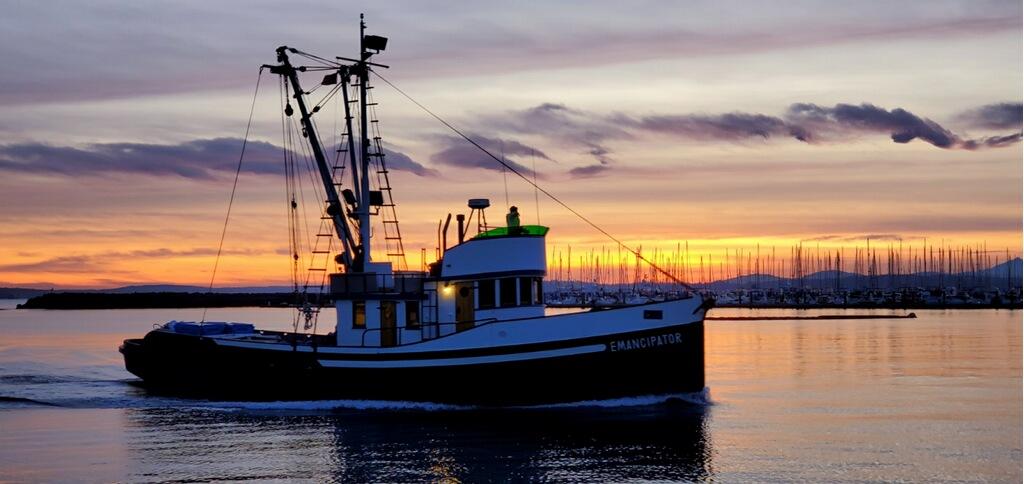
NOW1: The 65-foot Emancipator, now restored, berthed at Ballard’s Fisherman’s Terminal. It continues life as a tender, transporting over a million pounds of fish last year. Owner/operator Brad Buske stands at the prow. (Jean Sherrard)

Published in The Seattle Times online on March 2, 2023
and in PacificNW Magazine of the printed Times on March 5, 2023

Fish stories come true on Ballard’s legendary Emancipator
By Jean Sherrard

Brad Buske’s earliest memories are of old salts playing pinochle, smoking cheroots and telling fish tales on the Everett waterfront, where his family runs a seafood processing company. One story consistently stood out, burnished in the retelling, and Buske knows it by heart.

It happened in the late summer of 1958 after a robust season for sockeye in Puget Sound. Of 400 local purse-seiners vying for salmon, the Emancipator, a sleek 65-foot wooden boat built in 1918 by the Skansi Bros. of Gig Harbor, had finished among the top 10 boats for gross stock. In 28 consecutive days, its nets had hauled in a respectable 25,000 fish.

When the state fish commission offered a last-minute extension, declaring a one-day open season on Fraser River sockeyes, Emancipator owner and skipper Nick Barhanovich jumped at the chance. “And if we happened to catch a few fish,” recalls crew member Ray Fadich in his 2020 book “The Big Run,” that would be “icing on our cake.”

The cover of “The Big Run” (2020) by former crew member Ray Fadich. The book details the dramatic story of the Emancipator’s 1958 bonanza along with colorful portraits of its crew.

Joining a flotilla of competing boats near Point Roberts, the Emancipator initiated a set and then began pulling in its seines. What happened next was mind-boggling.

Within the enclosed circle of nets, Fadich describes a “frenzy” of teeming fish, “water boiling as if in a huge cooking pot.” The delighted crew filled the hold to the brim, then loaded the deck gunnel-deep till the stern was almost awash. Fadich worked the bilge pumps till he was “blue in the face” just to keep the vessel above water.

THEN2: Filling every available deck surface during the big 1958 catch, 80,000 pounds of sockeye salmon threaten to swamp the boat, while crew members attempt to adjust the load. (Ray Faddich)

That single set comprised 15,000 fish — nearly 80,000 pounds. It was one of the largest single catches in Puget Sound history.

Today, Brad Buske, 36, is the proud owner of the Emancipator, which he bought for a dollar in 2013. “By that time, the boat was basically floating dirt,” he says. “We removed the old fish hold with a shovel.”

The Emancipator was transferred to Port Townsend, where Buske says master shipwrights rebuilt it beam by beam: “We did our best to keep all the lines as original as possible, trying to preserve its history — not to create a dead replica but a working boat with a purpose.”

Buske views himself a caretaker of that history. “To me,” he says, “this boat is a living thing. There’s oil and sweat and fish juice soaked into its timbers.”

NOW2: In the 105-year-old wheelhouse, simplicity reigns. The original wheel remains in place, as does the chain connecting it to the flying bridge above and rudder below. In busy Puget Sound, Buske eschews any autopilot mechanisms, preferring to steer the boat manually. (Jean Sherrard)

Several months a year, with Buske at the helm, the Emancipator continues to ply Puget Sound as a tender, transporting fish between the today’s salmon fleet and his family’s cannery, adding salty chapters to its ongoing story.

WEB EXTRAS

For our 360 video of this column, narrated by Jean, please join us at  Fisherman’s Terminal.

More photos of the Emancipator included below:

The boat Buske bought for a buck, before reconstruction, in dry dock in Port Townsend.
After months of skilled labor by shipwrights, the Emancipator is much restored and ready to get back to work.

Passing through the Ballard Locks: