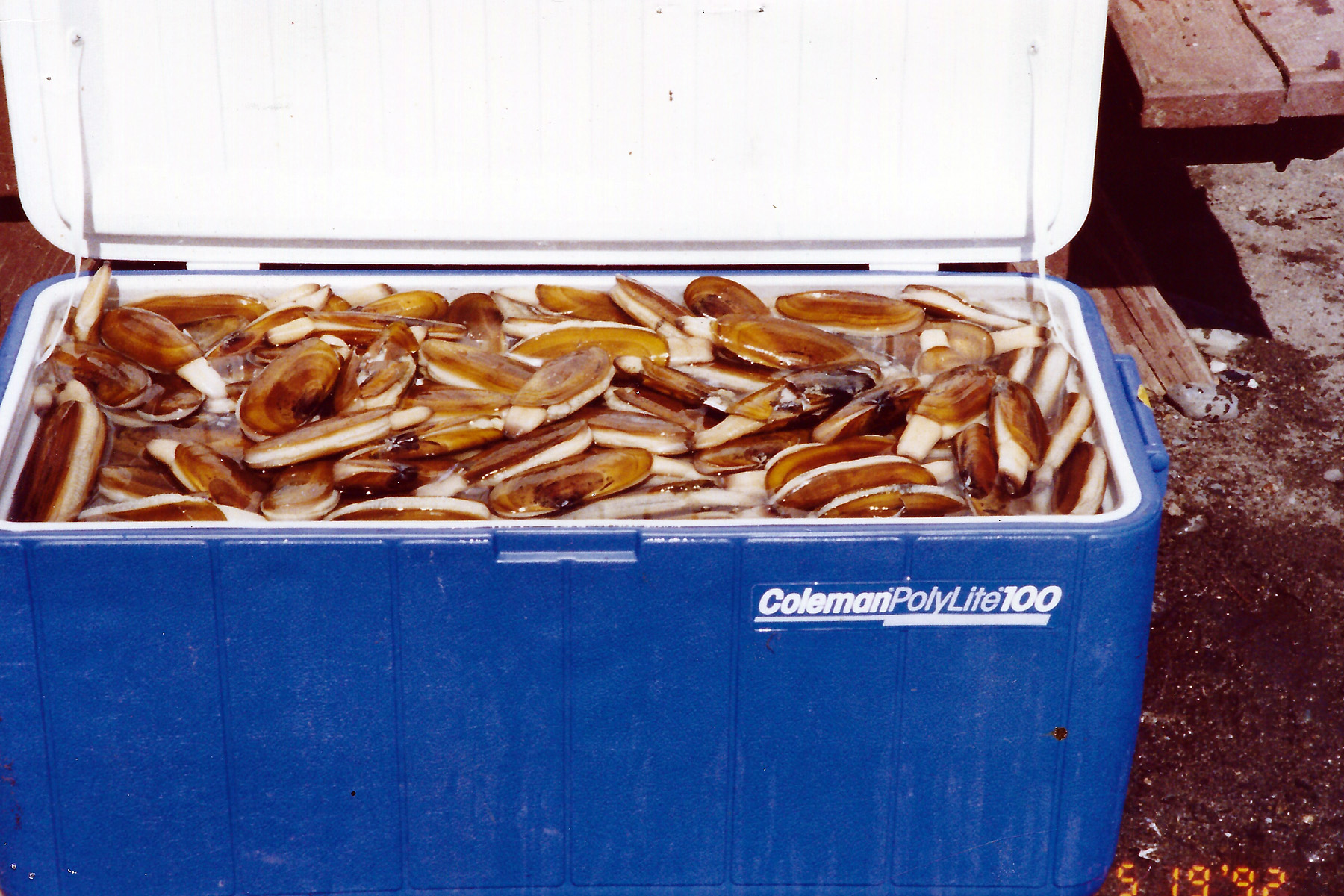
Seattle Now & Then: Tengu Club fishing derby at Seacrest Park, 1989

(Click and click again to enlarge photos)

THEN: At a 1989 Tengu Club weigh-in at West Seattle’s Seacrest Marina are (from left) Mas Tahara, Doug Hanada and Ron Hanada. A 30-minute documentary on the nine-decade history of Tengu Club, a project of club members including Tahara’s cousin Hilary Hutcheson, will be shown for free at 1 p.m. Sunday, Feb. 16, 2025, at Seattle University’s Pigott Auditorium as part of a Japanese Day of Remembrance observation. A 2025 derby also is in the works. (Courtesy Doug Hanada)
NOW: At the same spot at the Seacrest Park dock are Tengu Club members (from left) former president and club historian Mas Tahara, longtime president Doug Hanada, Nelson Park, Linda Ishii, Rick Mamiya, Nancy Ishii, Oscar Hicks, Chris Peeler, Guy Mamiya, Dan Hicks, Shawn Herzog (orange shirt), Sammy Hicks, Sam Hicks, Lisa Hicks, Irene Kiga and Ed Toyoji. (Clay Eals)

Published in The Seattle Times online on Jan. 30, 2025
and in Pacific NW Magazine of the printed Times on Feb. 2, 2025

Compassion bolsters winter fishing for 90-year-old Tengu Club
By Clay Eals
NOW: A plaque mounted on a stone at West Seattle’s Seacrest Park honors the Tengu Club. (Clay Eals)

Up, down, up, down.

Over and over.

Perseverance, patience, peace.

This approach has buoyed a little-known organization that has plied the waters of Elliott Bay off West Seattle most every winter for nine decades.

The all-volunteer Tengu Club, an aggregation of Seattle-area Japanese Americans and others, has forged a hearty culture and tradition of yearly fishing derbies.

NOW: This Tengu creature, with elongated nose, is the cover image for Mas Tahara’s self-published book “Tales Told by Fishermen & Women of the Tengu Club of Seattle.” (Clay Eals)

Early on, Tengu became the club’s name based on reddish-faced supernatural beings in Japanese folklore with long noses that grow as they tell lie after lie — much as those who fish are prone to do.

Tengu Club’s durability, however, is no exaggeration. It stems partly from a fishing method members developed long ago called “mooching” — constantly moving a herring-baited line up and down, imitating the flutter of a wounded fish to entice bigger ones to bite.

NOW: Tengu Club historian Mas Tahara displays a 1969 derby poster. (Clay Eals)

The club’s venerated historian, Mas Tahara, 89, of northeast Seattle, also sees significance beyond its fishing. The underlying point, he says, is kizuna, a Japanese word that means enduring bonds.

“Tengu is people,” he says. “”It’s very, very important for anyone. It makes people alive.”

Summoning that spirit was a challenge when the club began in the mid-1930s. Though well-publicized spring and summer fishing derbies proliferated throughout Puget Sound, Japanese people weren’t invited to participate.

Sept. 6, 1940, Time magazine

Ostensibly this was due to the success of mooching, as noted in the Sept. 16, 1940, edition of Time magazine. Describing the Sound’s 25 established salmon derbies, the article stated, “Japanese are barred (because they are too skillful).” But Tahara and other Tengu Club members assert that discrimination also was a factor.

To provide an alternative, Tahara says, Tengu Club set its derbies in the winter, a relatively unpalatable time for local fishing. The weather is bracing, and the fish typically available then are juvenile blackmouth salmon, smaller than their fair-weather adult counterparts.

A screen shot from the Tengu Club documentary.

Tengu Club’s contests ceased after Japan’s Dec. 7, 1941, attack on Pearl Harbor and the U.S. relocation and incarceration of Japanese Americans during World War II. Post-war, in December 1946, Tengu derbies resumed, lasting days and even weeks, and continue today.

Click this image to download Doug Hanada’s Excel file going back to 1946.

Derby data starting in 1946, kept by Doug Hanada, longtime president, show 100-190 annual members through the mid-1990s, dropping to 20-35 in more recent years. Still, they’re a hardy crew.

Tahara emphasizes a pair of longtime Tengu Club philosophies: maintaining dignity and momentum in the face of unavoidable hardships, and extending goodwill by opening derbies to non-Japanese.

“We always try to see things with compassion,” Tahara says, “and we are always interdependent.”

The resulting camaraderie in the cold and wet, he says, is precious.

The Tengu Club documentary will be shown during this Feb. 16, 2025, commemoration.

WEB EXTRAS

Big thanks to Mas Tahara, Doug Tanada, Nancy Ishii and Linda Ishii for their invaluable help with this installment!

To see Clay Eals‘ 360-degree video of the “Now” prospect and compare it with the “Then” photos, and to hear this column read aloud by Clay, check out our Seattle Now & Then 360 version of the column.

Below, you also will find a video interview of Mas Tahara and Doug Hanada, a dissertation (at the end), 85 additional photos and 18 historical clips from The Seattle Times and Seattle Post-Intelligencer online archive (available via Seattle Public Library), Newspapers.com and Washington Digital Newspapers, that were helpful in the preparation of this column.

Family and friends of Mas Tahara (center) gather Jan. 3, 2026, in Mill Creek to celebrate his 90th birthday. (Holli Margell)
THEN: Kyle Hanada, 4, and father Ron exult in a bountiful catch in 1989. (Courtesy Doug Hanada)
THEN: Displaying their Tengu derby catch in the late 1980s are (from left) Earl Welch, Mayor Charles Royer and John Jutte. (Courtesy Doug Hanada)
THEN: At a Tengu dinner on Jan. 22, 1994, Doug Hanada (left), who had caught a 12-pound 10-ounce blackmouth salmon, receives a second-place trophy from Dean Olson. (Courtesy Doug Hanada)
NOW: At his northeast Seattle home, Tengu Club historian Mas Tahara displays his gyotaku art. For this Japanese tradition, ink is applied to a fish that is pressed onto paper. (Clay Eals)
NOW: At his northeast Seattle home, Tengu Club historian Mas Tahara points out a club painting. (Clay Eals)


Following are 40 historical thumbnail photos, courtesy Doug Hanada, of Tengu Club events (click once or twice to enlarge):


Following are 17 thumbnail photos, courtesy Doug Hanada, of the Jan. 8-9, 2022, Tengu Club Cracker Derby (click once or twice to enlarge):


Following are 20 thumbnail photos, courtesy Doug Hanada, of the March 25, 2022, Tengu Club Banquet (click once or twice to enlarge):


Following are 3 thumbnail photos, courtesy Doug Hanada, of the April 29, 2022, Tengu Club Fish Fry at the home of member Dan Hicks (click once or twice to enlarge):

Jan. 1, 1947, Northwest Times


Nov. 25, 1947, Northwest Times
Oct. 25, 1948, Seattle Times, p19.
Nov. 22, 1948, Seattle Times, p19.
Dec. 23, 1957, Seattle Times, p18.
Jan. 25, 1954, Seattle Times, p20.
Dec. 22, 1958, Seattle Times, p13.
Nov. 9, 1959, Seattle Times, p17.
Nov. 10, 1959, Seattle Post-Intelligencer, p19.
Dec. 8, 1959, Seattle Times, p41.
Jan. 8, 1960, Seattle Times, p14.
Jan. 6, 1974, Seattle Times, p169.
Jan. 6, 1974, Seattle Times, p170.
Jan. 6, 1974, Seattle Times, p172.
Oct. 25, 1974, Seattle Post-Intelligencer, p23.
March 9, 1983, West Seattle Herald.
Sept. 29, 1983, Seattle Post-Intelligencer, p21.
Oct. 16, 1997, Seattle Post-Intelligencer, p30.
Dec. 27, 2002, Seattle Post-Intelligencer, p34.
Feb. 26, 2008, Seattle Post-Intelligencer, p9 and 12.
Click this image to download a pdf of a 2020 thesis by Gavin Aubrey Tiemeyer that mentions Tengu Club several times.


Seattle Now & Then: Loch Kelden (the Denny Mansion) razed

(click to enlarge photos)

THEN1: A 1913 photo of Loch Kelden’s entry foyer. The fireplace welcomed visitors coming through the mansion’s front door, which looked east over Lake Washington. (courtesy MOHAI)
NOW1: Minutes before demolition, Aaron Blanchard poses for the last photo of the mansion’s interior. “We have mixed feelings taking apart a historic place like this,” he says, “but anything we don’t rescue just ends up in a landfill.” EarthWise has reclaimed building materials for resale in its stores since 1991. (Jean Sherrard)

Published in The Seattle Times online on Jan. 23, 2025
and in PacificNW Magazine of the printed Times on Jan. 26, 2025

Lakeside Denny manor falls victim to religious landmark loophole
By Jean Sherrard

Turns out the mission was impossible.

Loch Kelden, ivy-covered in 1926. The three-story, 7,700 square foot mansion stood on a 50-acre waterfront estate, bordered by old growth forest. (Courtesy MOHAI)

Readers may recall our caper last March, attempting to visit Loch Kelden to capture one last photo before its approaching demolition. The three-story Spanish Mission Revival mansion overlooking Lake Washington had been completed in 1907 by Rolland Denny, the youngest member of the pioneer Denny Party.

We requested a final tour from the Unification Church, which had used the 1.7-acre property as a domicile and retreat since 1974. With its $6 million sale to developers still “pending,” the church turned us down.

So we took to the water. Accompanied by Rolland’s

Maria Denny poses on the bow of a cabin cruiser last spring.

great-grandniece Maria Denny, we boarded a cabin cruiser and, floating offshore, took “now” photos of the mansion gleaming over her shoulder.

Demolition was delayed, but sadly only by months.

A final view of Loch Kelden’s exterior, taken Dec. 18, 2024, moments before the walls came down.

Days before Christmas, we received news that the end was nigh. Mere minutes remained before the main structure of the house would be leveled. I grabbed a camera and made a bee line to Loch Kelden.

Unattended, I toured the denuded mansion, snapping photos. Soon I was joined by Aaron Blanchard, director of operations of EarthWise Architectural Salvage.

“We removed beautiful fir paneling, pocket doors,

The mansion’s front door and horsehair terra-cotta cornice was molded in the shape of a clamshell.

leaded glass and stained-glass windows,” he said, along with 8-10,000 board feet of old-growth wood. EarthWise also saved the mansion’s front door, rumored to contain wood from the original 1851 Denny cabin.

“Incredibly cool,” Blanchard said, “was the horse-hair terra-cotta cornice above the door in the shape of a clamshell.” (The clamshell could be a sly reference to infant Rolland Denny’s survival, credited to Duwamish-provided clam nectar.)

After our spring caper, readers expressed shock and dismay over the pending demolition. Many asked how such a historic structure could be torn down without public input. What about city landmark status?

Jeffrey Karl Ochsner, University of Washington professor of architecture.

University of Washington architecture professor Jeffrey Karl Ochsner notes that the state Supreme Court affirmed in 1990 a claim by Seattle’s First Covenant Church that landmark designation infringed on religious freedom.

“The First Covenant ruling created a loophole in landmarks law,” Ochsner says. “Now what happens is a consecrated church building owner reaches a deal with a developer while the church is still consecrated. Then they get a demolition permit. This bypasses the landmarks process. Next the church deconsecrates and sells to the developer. The demolition permit transfers along with the property.”

An excavator with a grapple bucket topples the south end of the mansion, turning structural timber into matchsticks.

For Maria Denny, the razing feels “like the loss of a family member, and it’s sad to think that a little piece of history is gone.”

Some may quarrel with “little” — in this specific case, and as an example for our city’s future.

WEB EXTRAS

Click through for our narrated 360 video featuring the demolition.

For those interested in a public discussion of the issues raised by this demolition, please join us on Feb. 4th at the Good Shepherd Center.

Also, a few last views of the mansion’s interior and exterior, minutes before destruction.


Seattle Now & Then: Suess window, Frye Hotel, 1980

(Click and click again to enlarge photos)

THEN: This 1980 photo of a three-panel window was taken at downtown’s Frye apartment hotel by West Seattle’s Curt Green, a descendant of the Smiths of Seattle’s early-1900s Suess & Smith art-glass company. After “Now & Then” sought details about the massive piece in 2020, readers responded that its Bavarian scene depicted ruins of Heidelberg Castle in the background and, up front, the two lead characters from a 1901 play, “Old Heidelberg,” which became an operetta and feature film, “The Student Prince.” (Curt Green)
NOW1: Here is a front view of the window’s middle panel, recently uncrated by Cathedral Glass in Portland after 26 years of storage in Skagway, Alaska. The firm’s owner, Nicholas Heinze, found that each of its three panels consists of about 190 pieces, 10 to 14 of which are cracked. He estimates needed repairs would cost $26,000. The notation “b. in” was added to the photo by Heinze. See all six Heinze photos below. (Nicholas Heinze, Cathedral Glass) If you have ideas for repairing and situating this piece, email Launi Treece.

Published in The Seattle Times online on Jan. 16, 2025
and in Pacific NW Magazine of the printed Times on Jan. 19, 2025

Bavarian art-glass window resurfaces, but where will it shine?
By Clay Eals

Long missing, a Northwest art-glass masterwork has re-emerged. But will the enormous window ever again gleam in public?

THEN: Suess Art Glass workers pose outside their store along Western Avenue circa 1906-09. The company’s name is fired onto a corner of the recently recovered Bavarian art-glass window. (Museum of History & Industry, Courtesy Deborah Suess Weaver)

The puzzle surfaced in 2020 when we profiled Seattle’s Suess & Smith Co., owned by German specialists in leaded, cut and stained glass who worked from 1901 to 1906 on Western Avenue in today’s Belltown. The firm morphed in into Suess Art Glass Co. and moved in 1909 to Virginia Street near Westlake Avenue, operating until at least 1951.

One of Suess’ distinctive creations — a 12-by-8-foot, three-panel landscape — depicted a verdant Bavarian scene and hung inside the Frye apartment hotel at Third and Yesler. There, in about 1980, Smith descendant Curt Green photographed it in hotel owner Abie Label’s office. Backlit, its rich hues glowed.

Later, the piece vanished. Since 2020, readers have filled out some details of its origin and whereabouts.

In 1967, Label first saw the window at the old Arlington Hotel at First and Spring, where a maintenance worker found it stored and damaged. “It had been there for decades,” says Label’s business partner Robert Roblee. Label made repairs and moved it to the Frye, where it hung for 30-plus years. Phyllis Lamphere, a former city council member, was a fan, often showing it to visitors.

Label’s friend, Robert White, a West Seattle dentist, bought the window from Label for $5,000 and crated and shipped it to Alaska in 1998 for display at a Skagway sculpture garden but died before that could happen.

NOW: After shipping the crate of three window panels to Seattle and storing it in Federal Way, Robert White’s daughter Launi Treece and her daughter Cassie (hidden) secure its triangularly stabilized crate to the bed of a family truck last August. The Heinzes then carefully drove it to Cathedral Glass in Portland. (David Treece)

When White’s widow, Diane, sold the garden to the Skagway Traditional Council in 2023, the stored crate emerged. Family shipped it to Seattle, stored it in Federal Way and last summer drove it to Cathedral Glass in Portland for evaluation.

NOW: For the first time since 1998, the window panels are exposed to light, at Cathedral Glass in Portland. After the firm’s owner, Nicholas Heinze, evaluated the piece, he re-crated it. Its future home is unknown. (Nicholas Heinze, Cathedral Glass)

When Cathedral owner Nicholas Heinze uncrated it, he found a mixed blessing. “It’s master-level stuff,” he says. “It blew us away. There’s magic in it. It was touched by hands that really knew what they were doing.” But he also spotted significant degradation.

Restored, it could be insurable for $144,000, but repairs would run $26,000 — sobering ballpark figures. The pressing question is: Where will it land? White family members speculate: a museum, train station, airport? A restaurant in Leavenworth?

“At first it was fun, as in ‘Wow, look at this amazing, historic thing,’ ” says White’s daughter, Launi Treece of Renton. “But the last few months, it’s been disheartening to learn how much damage there is, and it’s been hard to find a buyer. On one hand, it’s a treasure. On the other hand, we don’t know what to do with it.”

Who will supply the next piece of the puzzle?

WEB EXTRAS

Big thanks to Launi Treece, Diane White, Dakota White, Nicholas Heinze, Curt and Paula Green, David Label and Robert Roblee  for their invaluable help with this installment!

No 360-degree video this week, but below, you will find 9 additional photos and documents and 1 historical clip from The Seattle Times and Seattle Post-Intelligencer online archive (available via Seattle Public Library), Newspapers.com and Washington Digital Newspapers, that were helpful in the preparation of this column.

And be sure to click here to see our May 2020 “Now & Then” column about this window for further details and a wealth of “web extras.”

NOW: After shipping the crate of three window panels to Seattle and storing it in Federal Way, Robert White’s daughter Launi Treece (left) and her daughter Cassie finish securing its triangularly stabilized crate to the bed of a family truck last August. The Heinzes then carefully drove it to Cathedral Glass in Portland. (David Treece)
July 18, 2007, Seattle Post-Intelligencer, obituary of Frye apartment hotel owner Abie Label, who discovered the Suess window in 1967 at the old Arlington Hotel at First and Spring.
A March 2, 1998, letter from Felix Sernius to Robert White. (Diane White)
Nicholas Heinze’s evaluation of the Suess window panels in August 2024.

Click the thumbnails below to see the photos taken in August 2024 by Nicholas Heinze of Cathedral Glass of the three Suess window panels — two for (exterior and interior) for each panel:


Seattle Now & Then: The Overlook Walk

(click to enlarge photos)

THEN: A look south from the Pike Place Market’s western extension in snapped on January 11, 2019. The Alaskan Way Viaduct and its automobiles curve above the waterfront below. Permanently closed on Feb. 1, the Viaduct was replaced by the two-mile long State Route 99 tunnel. (Jean Sherrard)
NOW1: From the same prospect, a photo taken in late November 2024 reveals the contours of the Overlook Walk, which opened Oct. 4. (Jean Sherrard)

Published in The Seattle Times online on Jan. 9, 2025
and in PacificNW Magazine of the printed Times on Jan. 12, 2025

Seattle’s new Overlook Walk conjures up a ‘people’s viaduct’
By Jean Sherrard

For those who recall magician David Copperfield’s temporary vanishing of the Statue of Liberty, I have another disappearing act up my photographic sleeve.

Our “Then” photo, snapped just west of the Pike Place Market, shows the Alaskan Way Viaduct, torn down beginning in 2019.

For the forgetful or those unacquainted with this simultaneously beloved and detested ribbon of elevated highway, the viaduct’s double decks provided commuters with incomparable two-minute vistas of the city and Elliott Bay. The sinuous concrete structure bisected the city for 66 years, its traffic-induced bang, clatter and roar, amplified by concrete, thwarting normal conversation on the waterfront.

But presto change-o!

In our “Now” photo, the vanished viaduct is replaced by the newly

A night time view…

inaugurated Overlook Walk, an elevated park redefining Seattle’s relationship to its waterfront. Generous curved walkways, wide staircases and ample terraces allow visitors to freely wander and appreciate the marvels. And the loudest sounds are the cries of gulls.

But don’t take this conjurer’s word for it.

Looking south from the roof of the new Aquarium annex

On a December visit to the Overlook, palming a copy of the 2019 photo, I polled locals and tourists alike, asking them to comment on the abracadabra. Many pulled insightful rabbits out of their lined winter hats.

Jenny and Peter Stuijk often have hiked the area from their Ballard home, but rarely made it past the Port of Seattle’s Centennial Park on the north waterfront. “For us, the Overlook is like a front door to the Pike Place Market,” Jenny says, and Peter finishes her sentence: “And the setting is breathtaking.”

“It opens up right in front of you,” says Seattleite Andrew Mosoreti, “and you can feel the living city on the Sound.” Workmate Gunnar Brent concurs. “For the first time in my life,” he says, “downtown and the waterfront are connected.”

Teresa (left) and Rosemary Koenig enjoy the variety of viewpoints. “I love the look of the city behind us,” says Rosemary, a recent Seattle transplant.

Rosemary Koenig and her visiting mom Teresa appreciate the Overlook’s gentle curves. “I prefer a meandering path to a straight shot,” Rosemary says. “Add in a cello,” Teresa says. “I’d love music to amble to.”

French-born Seattle resident Sandrine Morris would conjure up street artists and musicians “to fill the big open space.”

Paul and Judy Rietmann gaze across Elliott Bay from an Overlook Walk terrace. “Best of all,” says Paul, “it’s not in some expensive restaurant. The views are free all the way down to the water.”

Enchantment struck Tacomans Judy and Paul Rietmann. “This is a real gathering place,” Paul says. Judy slyly adds, “It’s a people viaduct.”

“I’m very impressed,” says Port Townsend’s Joe Breskin, comparing the Overlook to New York’s famed High Line park. “It’s the first investment in public space of this scale since Century 21’s World Fair campus.”

“It’s fabulous,” Leilani McCoy says, “with or without a kid.”

No mere sleight-of-hand here. To quote David Lee of Bellevue, “Quite magical!”

WEB EXTRAS

For a 360 degree narrated video of the column, click here!
More photos from the Overlook and environs:

A children’s play area just below the Market
A view south along the waterfront

From the top of the Aquarium Annex


Seattle Now & Then: Seattle International Raceway, Kent, 1979

(Click and click again to enlarge photos)

THEN: During a weekend race, 11 members of the Washington Motorcycle Road Racing Association line up with eight bikes in 1979 at the northwest end of the pit wall at Seattle International Raceway in Kent. (Courtesy Bruce Scholten)
NOW: At Pacific Raceways (formerly Seattle International Raceway), 25 WMRRA members with 13 motorcycles gather at roughly the same spot. They are (front, from left) Tim Fowler (#219, Group W Honda 160), Tico Sandoval (#213, WMRRA second vice-president, Group W Honda 160), Duncan Craig, Tim O’Mahoney (#220, Group W Honda), Bruce Scholten, Jeff Wieand (#228, Group W Honda 160), Kristie Tenneson (ex-president), Chris Loomis (ex-president); C.J. “Siege” Hobbs, Michael Meagher (#125, on wife Jane Steele’s Yamaha RZ350 Yamaha), Adam Faussett (#24, Tiger Tail Yamaha), Dan Zlock (#125, top hat), Kevin Pinkstaff (2024 champ, yellow ski hat), Garrett Visser (#284), Dale Zlock (crouching with trophy), Vance Visser, Steve Ishii (#141), unidentified, Martha Young-Scholten, unidentified, Brian Burchill (#48), Matt Staples (#17), unidentified, Marc Brown (#135) and Steve Delvechio. The association enjoyed a 50th anniversary banquet and award ceremony Dec. 14 at Green River Community College. For more info, visit WMRRA.com.

Published in The Seattle Times online on Jan. 2, 2025
and in Pacific NW Magazine of the printed Times on Jan. 5, 2025

For 50 years, racing motorcyclists have thrived on ‘need for speed’
By Clay Eals

I’d like to think I can write about anything, but some topics give me the willies. Such as motorcycles.

In 1972, a friend and I, both 21 and riding a Triumph 650, improbably survived an accident unscathed while cruising at 70 mph on Interstate 5 in Oregon. A novice biker, I’d foolishly forgotten a posted “abrupt edge” construction sign, so while crossing to the left lane while passing a truck, I dumped our bike. Astounded and aghast after we spun to a halt, I vowed never to ride a motorcycle again.

And I haven’t.

THEN: At Seattle International Raceway in 1979, sidecars (three-wheelers with driver and passenger) speed through a curve. Today called Pacific Raceways, the nine-turn course has a 125-foot elevation gain. (Courtesy Bruce Scholten)

So last fall when a colleague suggested I showcase the 50th anniversary of the all-volunteer Washington Motorcycle Road Racing Association (WMRRA), I gulped. Could I go there? Maybe I could explore the group’s longevity by uncovering the zeal of its members.

THEN: Bruce Scholten (center) and Chris Miyamoto confer as Jim Garrison refuels Team Holy Grail’s Honda during a six-hour endurance race in 1979 at SIR. (Courtesy Bruce Scholten)

When asked, they eagerly cite a “need for speed,” embodied by events where some exceed (no typo) 140 mph.

“You feel like you’re flying. It’s the most fun you can have outside your house, legally or illegally,” says club historian Bruce Scholten. “Unless you jump in now and then, you feel like your life is meaningless.”

Scholten, of Edmonds, entered sanctioned races in the mid-1970s at Seattle International Raceway, now Pacific Raceways, in Kent. There, on its 2.25-mile course, members seek high average lap-speeds in 10-minute races and hours-long “endurance” runs. They also vie regionally.

NOW: “Mr. WMRRA” is former racer and president Chris Loomis. “It’s been a wonderful 50 years. More exciting than being a Marine. Next to the Marines, it’s been my life.” (Clay Eals)

Such contests invigorate Shoreline’s Chris Loomis, an oft-president dubbed Mr. WMRRA (spoken as WOMM-ruh) for his half-century’s involvement. He calls the club’s 400 members “family.”

The sentiment also feeds ex-president Colt Bristow, of Auburn. “We all know how dangerous street riding can be between cars, trucks, speed limits and road conditions,” he says. “But this is the only environment of people who are vested in your family and well-being and want to see you have fun and be competitive and provide a prepared, groomed, custom experience at its absolute potential.”

NOW: Colt Bristow, former president: “Racing is focus. When you’re on the bike and you’re at that level of attention, you are solely focused on what you and the machine are doing at the given time.” (Clay Eals)

Some, Bristow admits, make “exceeding thresholds” the goal. “Unfortunately, they tend to get hurt more,” he says, but at least WMRRA provides nearby medical response.

Speed, says Dale Zlock of Spanaway, a veteran racer with his brother Dan, fuels success. He says he nearly died at an out-of-town race in 1987. “I broke multiple bones and ruptured some internal parts. I’m lucky to even be here, so yes, that does go through your mind,” he says. “But you put it aside. It goes into another compartment. You go out and do what you got to do.”

NOW: Veteran racers Dale (left) and Dan Zlock. Says Dan, “It’s not the work, it’s not the equipment. Winning is what drives you. The feeling of winning never goes bad, never gets old. And staying at the top of the game.” (Clay Eals)

Well, the gears may not lock into place for me, but these racers’ passion is palpable.

WEB EXTRAS

Big thanks to Bruce Scholten and Martha Young-Scholten for their invaluable help with this installment!

To see Clay Eals‘ 360-degree video of the “Now” prospect and compare it with the “Then” photos, and to hear this column read aloud by Clay, check out our Seattle Now & Then 360 version of the column.

Below, you also will find video of longtime WMRRA members talking of their passion for the association and for motorcycle racing in general, 6 additional photos and 10 historical clips from The Seattle Times and Seattle Post-Intelligencer online archive (available via Seattle Public Library), Newspapers.com and Washington Digital Newspapers, that were helpful in the preparation of this column.

THEN: In 1979 at SIR, nationally rated racer Diane Cox leans in. (Courtesy Bruce Scholten)
THEN: In 1986, Craig Tinder (02) and Lars Gilmour (13) lean into Turn 10 at SIR. (Bruce Scholten)
THEN: Ray Baker (66) races with a prototype Yamaha in 1987 at SIR. (Bruce Scholten)
THEN: Steve Trinder (4) leads Shawn McDonald (28) and Doug Renfrow (2) past a tire wall circa 1989 at SIR. (Courtesy WMRRA)
NOW: Former racer Christopher James “Siege” Hobbs displays his WMRRA artwork. “Once you start racing, you’re a racer,” he says. “There’s no backing out or retiring from it. You can sell your bikes, but you’ve still got that spark.” (Clay Eals)
NOW: The 2.25-mile course at Pacific Raceways features nine turns and a 125-foot elevation gain. For more info, visit PacificRaceways.com. (Courtesy Pacific Raceways)
June 1, 1975, Seattle Post-Intelligencer, p23.
Nov. 14, 1975, Seattle Times, p21.
June 9, 1978, Seattle Post-Intelligencer, p23.
Sept. 8, 1982, Seattle Times, p98.
June 6, 1986, Seattle Post-Intelligencer, p20.
June 10, 1988, Seattle Post-Intelligencer, p24.
Dec. 20, 1992, Seattle Times, p117.
April 20, 2000, Seattle Post-Intelligencer, p39.
July 20, 2004, Seattle Post-Intelligencer, p27.
June 20, 2004, Seattle Post-Intelligencer, p32.