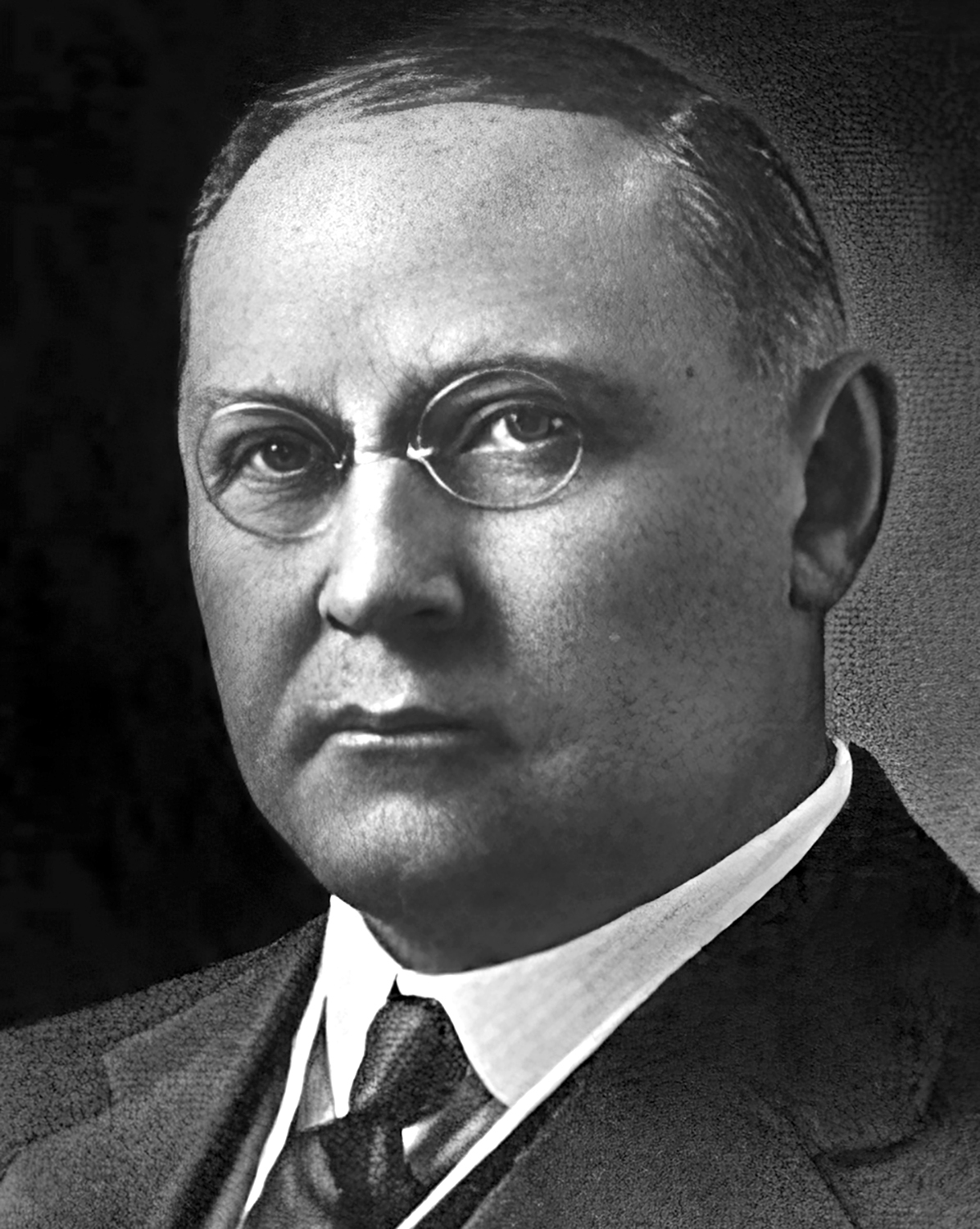
The paper was written by Brady Judd, a master’s degree student in history at Western Washington University in Bellingham.
Judd, originally from Bothell, examines the successful grassroots campaign to save the West Seattle moviehouse in 1989 when it was threatened with demolition.
He asked that his essay be published on our blog, and we are happy to oblige. You can download a pdf of the paper by clicking here. And if you wish to contact Judd, please email him here.
THEN: In November 1915 and decked in patriotic bunting, the then-three-year-old Clemmer Theatre, 1414 Second Ave., boasts the silent film “Carmen,” starring “The Vamp” Theda Bara. Owner James Q. Clemmer sold the movie palace after World War I. Later renamed the Columbia Theatre, it operated through January 1932. (Courtesy Puget Sound Theatre Organ Society)NOW: Eric Flom, creator of the online “Northwest Picture Show,” holds a portrait of James Q. Clemmer in front of the former Clemmer Theatre site. Renamed the Columbia, the theater closed in 1932. Remodeled as the Boston Building, it later hosted apparel, linen and tailoring shops and a Democratic campaign office. Enlarged as a parking garage in 1969, it was anchored by the Snug Restaurant through the 1980s and today houses a Vietnamese eatery, “Hot as Pho!” (Clay Eals)
Published in The Seattle Times online on Sept. 18, 2025
and in Pacific NW Magazine of the printed Times on Sept. 21, 2025
Kirkland historian brings web close-ups to Seattle’s silent-film era
By Clay Eals
When was the last time you saw a movie in a theater? Today, many stream movies from anywhere but theaters. No surprise, given society’s embrace of the convenience and selectivity of the internet.
THEN: The banner for Eric Flom’s “Northwest Picture Show” website at NWPictureShow.com. (Courtesy Eric Flom)
So maybe it fits that a comprehensive new history of our region’s early movie exhibition is virtual, not physical. The fledgling but voluminous website “Northwest Picture Show” supplies chronologies and anecdotes aiming to lure movie-maven Alices into a rewarding rabbit hole.
Eric Flom (Clay Eals)
It’s the creation of Eric Flom, by day a benefits writer but at all other times a deep documenter of local theater lore. The 57-year-old Kirkland resident has devoured vintage trade magazines, newspapers and theater programs for the past 25 years.
With 236,000 words posted on his illustrated site (and 128,000 more coming this fall), Flom admits, “Brevity is not my strong suit.”
THEN: The cover of Eric Flom’s 2009 book “Silent Film Stars on the Stages of Seattle.” (McFarland & Co.)
A fan of the pre-sound era, Flom isn’t averse to the limiting yet tangible medium of books to tell its stories. His 300-page tome “Silent Film Stars on the Stages of Seattle” (2009, McFarland) appraised our city’s turn-of-the-20th-century stage performances by scores of future celluloid luminaries, from Theda Bara to Buster Keaton.
But today the internet is Flom’s vehicle. Arguably his most significant narrative examines the Clemmer Theatre, which opened April 10, 1912, at 1414 Second Ave. downtown.
Capitalizing on widespread film fervor, James Q. Clemmer, the theater’s dream-big owner, became the first to construct an enduring palace in Seattle expressly designed for movies, not stage shows. The $100,000 project featured interior Roman columns and murals, 1,200 seats and a $10,000 pipe organ.
The alternate claim to fame, or infamy, for Clemmer is that he outflanked other local operators to mount lavish screenings of “The Birth of a Nation,” D.W. Griffith’s cinematically innovative but racist 1915 epic about the Civil War and its aftermath.
Clemmer, who thrived in the Seattle theater business until his 1942 death at age 61, was a lifelong pitchman. In 1915 for Moving Picture World, a Seattle financier illuminated Clemmer’s aggressive approach:
“He came rushing into my office, pulled off his coat, unrolled a set of plans and started to talk. I excused myself, rushed into the next room and locked the safe. I was afraid he would grab my money, push me into the safe and run. Before he was through talking, I began to tremble in my boots for fear that I could not remember the combination to the safe in time to grab some of the stock of the Clemmer [Theatre] before it was all gone.”
Just one of myriad in-person, scene-stealing stories that Flom brings alive online.
To see Clay Eals‘ 360-degree video of the “Now” prospect and compare it with the “Then” photos, and to hear this column read aloud by Clay, check out our Seattle Now & Then 360 version of the column.
Free all-day history conference Saturday, Oct. 11, downtown
If you’re enjoying “Now & Then” every week, you may want to immerse yourself in local history for a full day — and for free, no less.
The Pacific Northwest Historian Guild ‘s 32nd regional history conference will take place all day on Saturday, Oct. 11, 2025, at the Seattle Public Library downtown.
Lorraine McConaghy
With the theme “Challenging History,” the conference features a keynote address by local historian Lorraine McConaghy, as well as sessions covering a wide range of topics, from research challenges and waterscapes to labor politics and historic preservation.
Jean Sherrard (left) and Clay Eals
The conference also includes a special lunch presentation by yours trulies Clay Eals and Jean Sherrard, and it will conclude with a wrap-up session.
In addition to the presentations, attendees can visit a book table with works by conference presenters and displays from sponsors.
Registration is required but is free. You can register and find the full schedule here. Day-of check-in begins at 8:15 a.m., and the program starts at 9 a.m. The wrap-up runs from 4:45 to 6 p.m.
In addition, a night-before reception and annual meeting will be held at 7 p.m. Friday, Oct. 10, 2025, at the Mountaineers Seattle Program Center. Admission is $15 for Guild members, $25 for others.
THEN: In this 1934 photo looking south from the Pike Street trestle, the rotting heart of Railroad Avenue has been uncovered in preparation for building a new seawall from Madison to Bay streets. (Paul Dorpat collection)NOW1: Standing atop the new Seattle Aquarium annex are HistoryLink staffers (from left) Nick Rousso and Elisa Law, with Jennifer Ott, executive director and author, hoisting a copy of her just-published book. The view looks south along Alaskan Way, whose honorary name is now Dzidzilalich, Lushootseed for “little crossing-over place.” (Jean Sherrard)
Published in The Seattle Times on-line on Sept. 11, 2025
and in PacificNW Magazine of the printed Times on Sept. 14, 2025
Seattle’s waterfront past can illuminate its future, new book says
By Jean Sherrard
“No light, but rather darkness visible
Serv’d only to discover sights of woe…”
— John Milton, “Paradise Lost“
Had English poet John Milton toured the shadowy underbelly of Seattle’s waterfront — as seen in our 1934 “Then” photo — he might have found his own words apt. Rotting pilings, crumbling fill and the stench of decaying waste lay mostly hidden from public view.
“Where the City Meets the Sound: The Story of Seattle’s Waterfront” boasts 208 pages and more than 290 images. For more info, visit HistoryLink.org.
In “Where the City Meets the Sound: The Story of Seattle’s Waterfront” (HistoryLink, 2025), author Jennifer Ott, HistoryLink’s executive director, traces this shifting edge between land and water.
HistoryLink’s 30th book charts the transformation from a Lushootseed crossing-over place, where a tidal lagoon met the Duwamish River’s mouth, to the parks, overlooks, boat tours and civic gathering spaces we know today. In the
At the foot of Washington Street in 1892, a mix of Native canoes and pleasure craft mingle on an early version of the waterfront. Nearby Ballast Island, an artificial island built from the dumping of ship ballast, was used as an encampment by Indigenous workers. (Paul Dorpat collection)
1850s, the lagoon’s disappearance, Ott notes, “made it harder for Native people to claim space. Effectively, they were made invisible — a tension that still goes on today.”
While celebrating the waterfront’s feats of engineering, Ott also recovers overlooked stories of marginalized people and events. “Seattle’s urban history,” she says, “is about how the city was built and the choices that were made involving massive transformations of the landscape.”
Dockworkers load ships in 1935. Their work continued as the seawall was installed beneath the waterfront. (Courtesy MOHAI)
She cites the many communities — from Native peoples, immigrants, dockworkers, fishers and more —without whom the waterfront would not exist and thrive.
In the late 19th and early 20th centuries, patchwork seawalls, pilings and landfills replaced tide flats with
Photographed by Anders Wilse, an 1899 view shows the waterfront from University Street. West Seattle presides across Elliott Bay. (Courtesy MOHAI)
solid industrial ground. South of Pioneer Square, more than 3,000 acres of tidal wetlands were filled, dramatically reshaping the Duwamish delta. Along the central waterfront, the plank-paved Railroad Avenue, built on pilings over Elliott Bay, became Seattle’s maritime front door, but also, in Mayor John Dore’s 1934 words, “a death trap” and “a menace to the life of all that use it.”
The waterfront’s Depression-era seawall, built from 1934 to 1936, secured the shoreline from Washington Street to Bay Street. Above it, Railroad Avenue was rebuilt as Alaskan Way. Two decades later, the 1953
The Alaskan Way Viaduct, 1953
Alaskan Way Viaduct loomed over the stretch — a postwar icon that Ott calls a “psychological and visual barrier” separating the city from its bay. “The waterfront became fly-over country,” she quips.
Today, with the viaduct gone and the seawall rebuilt
Jennifer Ott at Pier 69 celebrating a Sept. 9th book launch
for seismic safety, the waterfront once again is being reimagined. Ott shows that Elliott Bay’s edge is more than a physical boundary. It’s a mirror reflecting Seattle’s shifting priorities.
Documenting its past, she suggests, can illuminate a path forward, bringing long-buried layers into the light. What’s more, “in understanding these layers,” she says, “we are given a deeper connection to this special place.”
WEB EXTRAS
For a narrated 360 degree video on location at the waterfront, click right here.
Jennifer Ott tells stories of the waterfront on the waterfront (Jean Sherrard)
THEN1: The two-story white terra cotta Rhodes Mansion in 1916. It was designed by A. Warren Gould, also noted for his Arctic Building in downtown Seattle. (Courtesy Tom McQ)NOW1: A slightly nearer view of the mansion today, its lawns and gardens still carefully manicured. The Kentucky Bluestone walkway was installed in 1928 by Harriet Rhodes. After her death, subsequent notable residents included Capt. Alexander Peabody, owner of the Black Ball Line ferries, and the Callison family, whose company supplies most of the world’s mint products. (Jean Sherrard)
Published in The Seattle Times online on Sept. 4, 2025
and in PacificNW Magazine of the printed Times on Sept. 7, 2025
When Seattle department-store magnate Albert Rhodes died unexpectedly on a business trip in 1921, a
Harriet Rhodes, ca. 1916. (Paul Dorpat collection)
life’s work may have been interrupted, but his grieving widow, Harriet, took the helm, dauntlessly proving herself in an otherwise male domain.
Up to that point, their lives might accurately have been described as charmed.
The first of four Wisconsin-born Rhodes brothers to arrive in Puget Sound, Albert settled in Tacoma in 1889 and worked as a traveling salesman. He found a
Albert Rhodes, ca. 1920.
partner in love as well as in work and civic life when he married Harriet Williams from Dallas, Ore.
As the brothers’ Tacoma stores boomed, Albert opened his own Seattle branch, the Rhodes Company, in the Arcade Building at Second and Union in 1907. Its original 20-foot storefront rapidly expanded, cementing itself as a wildly successful retail force.
For their residence, Albert and Harriet enlisted noted Seattle architect Augustus Warren Gould to design a Mediterranean Revival showcase sporting spectacular
A view from the gardens looking northwest. Just beyond the statue of Cupid, is the Aurora Bridge. (Jean Sherrard)
Lake Union views from north Capitol Hill. In 1915, the couple moved in permanently. The Rhodes mansion — popularly dubbed “the castle on the hill” — immediately became celebrated as an architectural jewel.
Still standing on busy 10th Avenue East, the gleaming white terra cotta edifice hosted lively social and civic gatherings, while husband and wife were no less committed to their hundreds of employees.
Lauded for paying the highest department-store wages in the United States, Albert also served as wartime president of the Seattle Chamber of
The Rhodes Brothers 10-cent store on 4th Avenue, pictured here in 1924.
Commerce, promoting the city’s interests nationwide. He took pride in an unwavering commitment to civic duties. “Every man,” he insisted, “owes public service, without pay or reward, to his community.”
During a 1921 trip to New York City, he was stricken with the “Spanish flu,” which culminated in a fatal heart attack. “No death of recent years,” editorialized The Seattle Times, “has stirred the city so deeply as of this widely known merchant prince.”
Flags across town were lowered to half-mast to mark his passing. Dressed in black for years to come, Harriet
The mansion’s lavish sitting room in 1928. Its interiors had a Mediterranean motif, including black marble stairs and hallways, pink marble bathrooms, solid gold mirrors and a dining room imported from an eighteenth-century Italian villa. (Courtesy Tom McQ)
assumed the role of company president, and under her guidance the Rhodes department store expanded exponentially, filling an entire block with 10 floors of merchandising.
Significantly, the booming business remained
The sitting room today, visited by HistoryLink co-founder and executive director emeritus Marie McCaffrey. The Italianate influences can still be found throughout the mansion’s interior. (Jean Sherrard)
committed to the general welfare and equitable treatment of employees. With no children of her own, Harriet reportedly knew most of her staff by name. In return, they affectionately called her “Aunt Hattie.”
In 1944, she died after a trip to New York, staying at the Waldorf Astoria Hotel, where Albert had breathed his last. Her closest friends suggested that “knowing she was ill, [Harriet] made the journey out of sentiment.”
THEN: West Seattle’s Longfellow Creek, looking south from its culvert and trash-catcher north of West Seattle Golf Course on Feb. 9, 1938. (Seattle Municipal Archives)NOW: (From left) “The Freelance Beaver Detective” Pamela Adams, waterway documentarian Tom Reese and filmmaker Kay D. Ray stand next to Longfellow Creek’s northern culvert and its trash-catcher “Monstro.” (Clay Eals)
Published in The Seattle Times online on Aug. 28, 2025
and in Pacific NW Magazine of the printed Times on Aug. 31, 2025
A new West Seattle film encourages us to leave it to the beavers
By Clay Eals
We’re deep into a construction craze, the landscape changing overnight. Of course, this is hardly news anymore. Except this particular furor is fueled by … beavers.
Mr. Busy from “Lady in the Tramp.” Click image to see clip.
Yes, beavers, the sizeable waterborne rodents that many of us have encountered in copious cartoons, from Mr. Busy in “Lady and the Tramp” to the dam builders in “Curious George.” With exaggerated buck teeth and paddle tails as tools of their trade, these amiable avatars sport wide-eyed smiles and hardhats to convey a busy, zesty persona.
But few Seattleites have seen actual beavers. That’s because they surface primarily at night. So we aren’t aware of their existence here.
NOW: Pamela Adams’ beaver-advocacy T-shirt bears the pun “Thank Chew.” (Clay Eals)
Pamela Adams is out to change that. The one-time California fine-arts student and insurance broker moved to Alki three years ago and joined a wide if unheralded world of beaver advocates, morphing into what she calls “The Freelance Beaver Detective.”
That’s also the title of Fauntleroy filmmaker Kay D. Ray’s new 56-minute documentary, which, besides Adams, features other beaver promoters and city officials, along with waterway chronicler and former Seattle Times photographer Tom Reese.
Longfellow Creek (King County)
Adams’ passion to track beavers found a ready “lab” in one of Seattle’s 49 streams, West Seattle’s Longfellow Creek.
Stretching 4-1/2 miles, according to the documentary (nearly 3 miles in daylight), it runs south to north, from Roxhill Park and beneath Westwood Village mall to the creek’s buried endpoint, beneath Nucor Steel and the West Seattle Bridge, in Elliott Bay.
NOW: An adult beaver and kit (baby) communicate along Longfellow Creek near Yancy Street. “The Freelance Beaver Detective” will be shown Sept. 14 in the global Documentaries Without Borders International Film Festival. The film is competing for a prize in the category of “wildlife, nature, animals.” For more info, visit FreelanceBeaverDetective.com. (Pamela Adams)
Despite myriad human barriers, Adams says the creek boasts five beaver families that diligently chew trees and build dams and lodges, creating ponds that foster other wildlife — a far cry from the fur trade of centuries past when beavers were hunted to near-extinction for their pelts.
NOW: A beaver chews on a branch along Longfellow Creek. (Courtesy Kay D. Ray)
“The beavers are actually water keepers,” Adams says in the film. “They’re doing what they can, what they’ve always done for thousands of years, and they are part of our ecosystem. In this place that we have urbanized, we’ve channelized, we’ve paved over, they’re doing the natural process.”
NOW: An adult coho reaches fresh water while swimming from the creek’s northern culvert into a daylight section of Longfellow Creek to spawn. (Tom Reese)
A key example: Just north of West Seattle Golf Course, the creek’s culminating culvert and a trash-catcher that Reese nicknamed “Monstro” (for the vicious whale in “Pinocchio”) have existed for at least 87 years. Today, Reese says beavers’ tenacious ponding has helped adult coho salmon to spawn there.
Adams’ advocacy does require compromise. She works with Seattle Public Utilities to keep ponds from flooding footbridges and other property. She also buys and installs wire fencing to protect homeowners’ trees.
But it’s hard not to be captivated by the film’s industrious critters. In scores of sequences, many recorded with night-vision cameras, the real beavers are more compelling than any cartoon.
WEB EXTRAS
Big thanks to Pamela Adams, Tom Reese and Kay D. Ray for their invaluable help with this installment!
To see Clay Eals‘ 360-degree video of the “Now” prospect and compare it with the “Then” photos, and to hear this column read aloud by Clay, check out our Seattle Now & Then 360 version of the column.
THEN: West Seattle’s Longfellow Creek, looking north from its culvert and trash-catcher north of West Seattle Golf Course on Feb. 9, 1938. Above, a car points westbound on Andover Street. (Seattle Municipal Archives)NOW: (From left) “The Freelance Beaver Detective” Pamela Adams, waterway documentarian Tom Reese and filmmaker Kay D. Ray sit atop Longfellow Creek’s northern culvert and the trash-catcher “Monstro.” (Clay Eals)NOW: An adult beaver and kit (baby) chew on a branch and foliage along Longfellow Creek. (Courtesy Kay D. Ray)
THEN: Isaac Ebey’s original homestead, destroyed after he was killed in 1857, stood just below the line of forest at the far upper left. Captured by Asahel Curtis in the early 1900s, this photo shows Ebey’s Landing with remains of the original dock extending into Admiralty Inlet.NOW: Today, Ebey’s Landing is the only designated national historical reserve in the United States. The park provides access to miles of picturesque beach as well as a cliffside trail above. After Isaac Ebey’s death, his house was demolished. Its wood was repurposed to build the nearby Ferry House, a hotel, tavern and trading post.
Published in The Seattle Times online on Aug. 21, 2025
and in PacificNW Magazine of the printed Times on August 24, 2025
‘Almost a Paradise’ for settlers was
a paradise lost for Coast Salish
By Jean Sherrard
In times of anti-immigrant fervor, a gentle reminder seems pertinent that most of us are descended from recent arrivers.
Isaac Neff Ebey (1818-1857) circa 1850s. For more, please visit HistoryLink.org.
Col. Isaac N. Ebey, of Missouri, landed in the Pacific Northwest via San Francisco, seeking a home for his extended family. In the spring of 1850, he hired canoes to explore today’s Puget Sound — a reconnaissance that preceded Seattle’s Alki Landing Party by more than a year. Letters home describe a land of exceptional beauty, suitable for colonization.
Finally, Ebey chose to settle on Whidbey Island, taking full advantage of the Oregon (Territory) Donation Land Law, which granted married couples 320 acres each if they committed to working the land for four years.
Their square mile, Ebey wrote his brother Winfield,
A view of Ebey’s Prairie from the bluff. Coast Salish people harvested camas bulbs here for thousands of years before Isaac Ebey planted wheat, potatoes and onions on his Donation Land Claim.
was “almost a Paradise of Nature,” and he encouraged his extended family to follow him and his close friend Samuel Crockett to the island prairie. By 1854, they were joined by nearly 30 Ebeys and Crocketts, lured from across the United States.
While these pioneers quickly established profitable farms, the original Coast Salish inhabitants, living here for millennia, were displaced without compensation — a toxic model being repeated throughout the territory.
Isaac’s 61-year-old father, Jacob Ebey, took up
Jacob and Sarah Ebey’s farmhouse stood on the bluff directly above their son’s holdings. Following Isaac’s death, sons Ellison and Eason were brought up here by their grandfather. Their stepmother, Emily, fled Whidbey Island, never to return.
residence on his own 320-acre spread atop a bluff overlooking his son’s land. Soon, Jacob built an 18-by-40-foot, 1½ story home for eight family members and found success planting wheat, oats and potatoes while raising livestock, including a small herd of dairy cows.
Isaac’s fortunes also rose. Besides farming his land, he worked as a lawyer and customs official and served as a territorial legislator. Sadly, wife Rebecca Davis Ebey, who had joined him with their two sons in 1851, died in 1853 after a difficult childbirth. Ebey subsequently married young widow Emily Sconce.
In 1855, Territorial Gov. Isaac Stevens toured the region, insisting that tribes sign federal treaties to formalize the vast transfer of land from Indigenous to white hands.
Bitter disputes raged as Native populations already diminished by disease and displacement were corralled into reservations.
With tensions rising, the settlers built blockhouses — the mid-19th century equivalent of “safe rooms” — to protect themselves.
The Jacob Ebey-built structures remain on the bluff, now a museum operated by the National Park Service
Jacob Ebey erected a thick-timbered blockhouse a stone’s throw from his farmhouse, anticipating confrontation with local tribes. On Aug. 11, 1857, however, the family’s security measures were breached.
In retaliation for the killing of 28 tribal members by the U.S. warship Massachusetts, a raiding party, likely from the Kake nation of Tlingit from southeastern Alaska, killed and beheaded newcomer Isaac Ebey at his home, just above the beachfront landing that still bears his name.
WEB EXTRAS
More scenes from the bluff below Jacob Ebey’s cabin.
THEN: The Panama Hotel circa 1930-31, two decades after it was built, at the southeast corner of Sixth Avenue South and South Main Street. (Courtesy Jan Johnson)NOW: From the corner of Sixth and South Main, owner Jan Johnson salutes her Panama Hotel. At right is a green Japantown (Nihonmachi) sign she affixed to the building last year. (Clay Eals)
Published in The Seattle Times online on Aug. 14, 2025
and in Pacific NW Magazine of the printed Times on Aug. 17, 2025
Poignant past could guide the future of Japantown’s Panama Hotel
By Clay Eals
On the corner of Sixth and South Main, the brick building stands resolute. Its west face meets an angled sidewalk. At the corner, turning east, the sidewalk inclines further. Up close, the five-floor structure resembles a statuesque promontory.
THEN: “Hotel on the Corner of Bitter and Sweet.” (Ballantine Books)
Bypassed by busier traffic in the Japantown (Nihonmachi) sector of the Chinatown-International District west of Interstate 5, the edifice may appear obscure.
Its legacy, however, is not.
This is the 115-year-old Panama Hotel, the title setting for Jamie Ford’s best-selling 2009 historical novel of heartrending cross-cultural romance, “Hotel on the Corner of Bitter and Sweet.”
NOW: A still-intact (but unused today) Japanese sento, or communal bathhouse, remains in the hotel’s basement. (Courtesy Panama Hotel)
Designed by Sabro Ozasa, Seattle’s first Japanese architect, the Panama was built during construction of the famous canal thousands of miles south. From the outset, it was a single-room-occupancy (“workingman’s”) residence for immigrants. Its basement included what is described today as the last intact, albeit unused, Japanese-style communal bathhouse in North America.
NOW: Here is part of the hotel’s display of 8,500 household items left behind by 37 Japanese families who were removed from Seattle and incarcerated during World War II. (Courtesy Panama Hotel)
The hotel’s poignant fame, center stage in the novel, derives from a preserved cache of 8,500 items, from suitcases, baskets and trunks to books and myriad household items, all left behind by 37 Japanese families whom the U.S. government forced into incarceration during World War II. Their materials — “saved for a happier time that never came,” wrote Ford — make the place both a museum and a shrine.
At the vortex of this city-landmarked “treasure” (the term used by the National Trust for Historic Preservation) is its passionate owner, Jan Johnson.
She grew up in Olympia and West Seattle, studying art in Italy before becoming so inspired by the Panama’s saga and surviving original features in 1985 that she purchased it soon afterward.
NOW: In this west-facing view, a 2003 portrait of former owner Takashi Hori and his wife Lily is part of a front-wall entry display installed by owner Jan Johnson. (Clay Eals)
The seller was Takashi Hori, who was raised near Chehalis and in Seattle and secured a University of Washington business degree. He had bought the hotel in 1938 before being removed in March 1942 like the others whose belongings linger there.
Over the decades, Johnson’s motivation hasn’t varied: “It’s the history and the education and the knowledge and to save the building.”
Daily, she juggles renting rooms, supervising a tea-and-coffeehouse, handling maintenance, even trying to launch a Panama Hotel nonprofit, while touring streams of guests. During one hour in June, visitors included an Australian tourist and a curator for L.A.’s revered J. Paul Getty Museum.
It’s daunting work for someone well into retirement age. The situation cries out for sensitive benefactors, says Historic Seattle’s Eugenia Woo, a longtime Johnson champion. “The hotel has an authenticity you can’t re-create,” she says. “It needs people who appreciate history and can run it like a business.”
Which begs the question: Will the Panama’s future be bitter? Or sweet?
THEN: The Panama Hotel in 1937. (Puget Sound Regional Branch, Washington State Archives)THEN: The Panama Hotel in 1964. (Puget Sound Regional Branch, Washington State Archives)NOW: A rentable room at the Panama Hotel. (Courtesy Panama Hotel.)
WEB EXTRAS
Big thanks to Nancy Ishii, Reina Endo and especially Jan Johnson for invaluable help with this installment!
To see Clay Eals‘ 360-degree video of the “Now” prospect and compare it with the “Then” photos, and to hear this column read aloud by Clay, check out our Seattle Now & Then 360 version of the column.
Looking east on South Main Street next to the Panama Hote is a Japanese float for a Potlatch parade in 1941, shortly before World War II. (Courtesy Dan Kerlee, from Wing Luke Museum)Click above to download pdf of Oct. 5, 2021, Seattle landmark nomination for Panama Hotel.Click above to download pdf of Nov. 24, 2021, Seattle landmark staff recommendation for Panama Hotel.Click above to download pdf of Jan. 19, 2022, Panama Hotel landmark presentation.Click above to download pdf of Feb. 1, 2022, landmark designation report for Panama Hotel.Nov. 15, 1911, Seattle Times, p40. (There was no accompanying story.)Jan. 7, 1920, Seattle Post-Intelligencer, p168.March 12, 1925, Seattle Times, p16.Sept. 20, 1944, Seattle Times, p10.Sept. 22, 1944, Seattle Times, p13.Sept. 24, 1944, Seattle Times, p2.Sept. 15, 1954, Seattle Times, p45.Feb. 4, 1963, Seattle Times, p2.Aug. 19, 1964, Seattle Times, p1.Aug. 20, 1964, Seattle Post-Intelligencer, p1.Aug. 20, 1964, Seattle Post-Intelligencer, p6.Sept. 21, 1973, Seattle Times, p30.May 1, 1993, Seattle Post-Intelligencer, p9.July 23, 1999, Seattle Post-Intelligencer, p1.July 23, 1999, Seattle Post-Intelligencer, p11.Nov. 3, 2002, Seattle Times Pacific magazineNov. 3, 2002, Seattle Times Pacific magazineNov. 3, 2002, Seattle Times Pacific magazineNov. 3, 2002, Seattle Times Pacific magazineNov. 3, 2002, Seattle Times Pacific magazineNov. 3, 2002, Seattle Times Pacific magazineNov. 3, 2002, Seattle Times Pacific magazineNov. 3, 2002, Seattle Times Pacific magazineFeb. 28, 2005, Seattle Post-Intelligencer, p9.Feb. 28, 2005, Seattle Post-Intelligencer, p10.Oct. 7, 2005, Seattle Post-Intelligencer, p84.Feb. 10, 2009, Seattle Post-Intelligencer, p22.
THEN1: In May 1984, (from left) Steve Dunnington, Lee Lauckhart and Sebi Nahmias stand at the newly constructed metal grill featuring worldwide newspapers and magazines. (Courtesy Lee Lauckhart)NOW1: Artist Billy King (left) and Lee Lauckhart stand at the former site of the newsstand where “Read All About It” is inscribed on the pavement between their feet. “I chose Oct. 25 for our opening,” Lauckhart says with a chuckle, “because that was the only day a spotlight was available for rent.” (Jean Sherrard)
Published in The Seattle Times online on Aug. 7, 2025
and in PacificNW Magazine of the printed Times on August 10, 2025
For 40 years, Pike Place Market newsstand let us read all about it
By Jean Sherrard
We know of at least one canary that thrived in a coal mine against the odds. “From the start,” says Lee Lauckhart, now 84, “everyone tried to convince me print media was doomed.”
For 40 years, however, he ignored the naysayers, owning and operating “Read All About It,” his beloved newsstand in the Pike Place Market, beginning in 1979.
“Every day, we’d see dozens of regulars who became good friends,” he recalls warmly, singling out longtime
THEN2: This vibrant color portrait of a still-thriving “Read All About It” was crafted by Seattle artist Billy King in 2007. A longtime friend and customer, King gifted the original print to Lee Lauckhart. (Courtesy Billy King)
co-workers for special praise. “We were just like family.”
Born in Seattle, Lauckhart graduated from the University of Washington in 1968, signing on with Thurston County as a “registered sanitarian” before joining the “back to the land” movement: “I spent four years as a Snohomish dirt farmer.”
Stints selling newspapers in New York’s Gramercy Park then driving taxis in Seattle “were pretty nip and tuck,” he says. Then one of his cab fares offered him a job making “horseshoe nail” jewelry in the Pike Place Market. It felt like coming home.
Lauckhart sells Sunday papers from an older version of the booth in the summer of 1979. Six-year-old daughter Aana reads the comics section. (Courtesy Lee Lauckhart)
Just divorced, he found housing for himself and his young daughter in the Market’s newly renovated Leland Hotel, “the one with the ‘Meet the Producers’ sign on it,” Lauckhart recalls.
In 1979, after four years as a “crafty,” he had a lightbulb moment. Friend and longtime newspaper hawker Sebi Nahmias had a coveted license to sell local dailies from his stand at First and Pike.
Lauckhart, then in his late 30s, made Nahmias an offer:
A spread of the newsstand’s selection of international newspapers.
that together they open a general-interest newsstand in the Market offering publications from around the world. Soon joined by partner Steve Dunnington, they comprised an irrepressible entrepreneurial trio.
“Read All About It” opened Oct. 25, 1979, on a 10-by-30-foot pitch in the Market’s southeast corner.
Customers delighted in the sheer variety of magazines and newspapers.
The newsstand was an unqualified success — and its location didn’t disappoint. “First and Pike,” Lauckhart says, “was the busiest intersection in the Pacific Northwest.”
A slew of innovations followed. The partners arranged for daily New York Times deliveries (before dawn each
Sunday morning was a big day for newspaper sales.
morning via Flying Tiger Airlines) while negotiating contracts with newspaper and magazine publishers across the globe.
After four decades, however, the final curtain. Thousands of newspapers had been shuttered, writing the final epitaph for purveyors of print media.
A lost world of newspapers and print magazines – never to be seen again
Lauckhart, by then the sole owner, stubbornly held on as a matter of principle. For 10 years, he paid employees out of the newsstand’s dwindling profits while surviving solely on Social Security.
On Dec. 31, 2019, the “Read All About It” canary, one of the last of its kind, finally sang its swan song.
THEN4: Curtains for the newsstand, snapped on Jan. 23, 2021 more than a year after its closure. (Clay Eals)
Billy King, noted NW muralist — once voted Mayor of the Market– is a longtime pal of Lee Lauckhart’s. He created the print of “Read All About It” featured above.
When we prepared this column, Billy was hard at work restoring a mural painted years ago for Maximilien, a French restaurant in the Market. Check out a few pix of Billy at work:
Finally, Lee Lauckhart’s favorite photo of the newsstand in situ, taken for a now-defunct rag called Endless Vacation.
Lee Lauckhart’s favorite photo of the newsstand depicting its spot in the Market.
THEN: A stunning photo captures the Oct. 23, 1979, crash of Miss Budweiser during its attempt to break the world water speed record. Driver Dean Chenoweth, ejected from the cockpit, was injured but survived. The hydroplane itself was destroyed. (Cary Tolman, Seattle P-I)NOW: David D. Williams, executive director of the Kent-based Hydroplane and Raceboat Museum, Thunderboats.Maestroweb.com, hoists a display print of the 1979 crash, standing beside Miss Budweiser’s virtually identical replacement boat, which has been fully restored by the museum on site. (Jean Sherrard)
Published in The Seattle Times online on July 31, 2025
and in PacificNW Magazine of the printed Times on August 3, 2025
What’s the big deal? A longtime Seattleite finally catches Hydro Fever
By Jean Sherrard
After two hours this spring at Stan Sayres Pits on Lake Washington, I finally flipped for the hydros. The impossibly sleek, brightly colored, vintage unlimited hydroplanes streaking across blue-gray waters on a cloudy morning sent my aging heart all a-flutter.
Miss Bardahl streaks across Lake Washington in front of the Mercer Island floating bridge. (Jean Sherrard)
When I grew up in Seattle, the hydros’ throaty roar left me underwhelmed. I never leashed a plywood model
The 1958 Miss Bardahl, nicknamed the “Green Dragon,” was the first boat built by acclaimed designer Ron Jones. (Courtesy Hydroplane and Race Boat Museum)
of Miss Bardahl to my Stingray and raced through puddles trying for a roostertail. Crossing the Lacey V. Murrow floating bridge during the Seafair races was the closest I got to the action.
David D. Williams, executive director of the Hydroplane and Raceboat Museum in Kent, hooked and landed me during the museum’s spring testing event.
Lovingly restored Miss Bardahl and Miss Wahoo are displayed at Stan Sayres Pits during the Hydroplane Museum’s spring testing event. “The best way to explain their history,” Williams says, “is to watch these dynamic, beautiful machines in action.” (Jean Sherrard)
“Our mission is to honor, celebrate and preserve the legacy of hydroplane racing,” Williams says, and it’s only after seeing them “on the water bouncing around at 160 mph that you will truly understand how they captured the imagination of an entire city.”
With a lifelong passion for the sport and a breadth of knowledge of history, technology and the culture of speed, Williams is head torch carrier for a golden age of hydroplanes. “My childhood,” he says, “was a tent raised on two tent poles. There was Christmas and there was Seafair.”
The Notre Dame roars away from the pits.
After World War II, hydroplane racing scaled up exponentially, inspiring and transporting legions of fans. By 1955, Seattle’s population reached 457,000. That year, 500,000 people from across the state crowded the shores of Lake Washington to watch the races live.
In his seminal 2007 book, “Hydroplane Racing in Seattle,” Williams details what might be described as an inevitable arranged marriage. “We were the boating capital and the aviation capital of the country — and the best of both of those worlds coalesced into hydroplanes.”
Before Seafair and its “hydro fever,” there were only two games in town: Husky football and Pacific Coast League Seattle Rainiers baseball. Today’s deep civic pride in the city’s major sports franchises, Williams says, “was born and bred … when Seattle sports fans first found their collective voice cheering for the hometown’s Slo-Mo-Shuns.”
Today’s turbine-driven hydroplanes, while safer, quieter and faster, somehow sidestep the intimate if raucous sensory nostalgia — and admittedly lethal
Visitors tour the Hydroplane and Raceboat Museum in Kent. “There’s no one else in the world,” Williams says, “doing what we do on this scale.” (Jean Sherrard)
danger — of an earlier age, documented by the Hydroplane Museum and its dedicated volunteers.
“These [older] boats were the heart and soul of our community for the better part of 40 years,” Williams says. “In noise and spectacle and goosebumps, they win hands down.”
Seeing and hearing the vintage boats do their thing in person goosed my own bumps. Who knew a rooster tail could make this boomer crow with joy?
WEB EXTRAS
To check out our narrated 360 degree video shot in the Stan Sayres Pits, speed on over here.
More photos from the pits — plus some other extras!
And a few from the Hydro Museum:
Several contributions from Seattle historian Peter Blecha:
A homemade hydro from 60-70 years ago from the collection of historian Peter Blecha. (Courtesy Peter Blecha)A homemade hydro from 60-70 years ago from the collection of historian Peter Blecha. (Courtesy Peter Blecha)A homemade hydro from 60-70 years ago from the collection of historian Peter Blecha. (Courtesy Peter Blecha)A homemade hydro from 60-70 years ago from the collection of historian Peter Blecha. (Courtesy Peter Blecha)
Several contributions from Dina Skeels, Seattle Times designer:
Aug. 4, 1962, Seattle Post-Intelligencer, showing Bill Benshoof, a Boeing electrical engineer, as part of the crew atop Miss Bardahl. (Courtesy Dina Skeels)In 1968, Kevin (left) and Doug Benshoof pose with an in-construction limited hydroplane built by their dad, Bill Benshoof, in the Lake Hills neighborhood of Bellevue. (Courtesy Dina Skeels)In 1968, Doug Benshoof poses inside an in-construction limited hydroplane built by their dad, Bill Benshoof, in the Lake Hills neighborhood of Bellevue. (Courtesy Dina Skeels)
(Above) A friend of Dina Skeels pilots the same hydro in a canal at Ocean Shores in 2021 before the boat was restored.