
(click to enlarge photos)
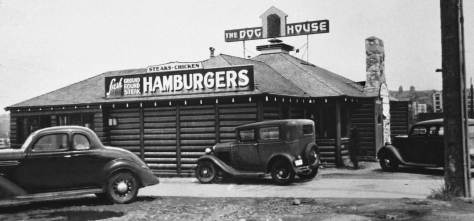
- THEN: The Dog House at 714 Denny Way was strategically placed at the southern terminus for the Aurora Speedway when it was new in the mid-1930s. (Photo courtesy of Washington State Archive, Bellevue Community College Branch)


- NOW: Near the southwest corner of what some refer to now as Allentown, a new business block has recently replaced what was for many years the site of a strip club. (Photo by Jean Sherrard)

When it became certain that Aurora Avenue would be chosen for the city’s principal speedway north from the business district, the neighborhood around its southern origin at Denny Way began to fill in with automotive enterprise: car parts, gas, beer and hamburgers.
Bob Murray sited his new highway Dog House on the best short block available, on the north side of Denny Way between Aurora, where a driver would soon be allowed to reach speeds of 30 mph, and Dexter Avenue, which was also wide and strait and almost as convenient as Aurora for reaching the new – in 1932 – George Washington AKA Aurora Bridge over the ship canal.
Throughout its length the Aurora speedway profoundly affected not only this neighborhood but also whatever it cut through, like Queen Anne Hill, or flew over and cut through, like Fremont. With the opening of the Aurora cantilever bridge in 1932, northbound traffic switched nearly en masse from the Fremont bascule bridge. Already floundering from the Great Depression Fremon then lost its traffic too.
But not the Dog House. It survived with comfort food, a comforting name and its convenient location. In 1940 it was joined, one block to the west by another eccentric, the Igloo. Together they flourished until their gateway to the Aurora speed way was bypassed in the mid-1950s with the opening of the Battery Street tunnel. “All roads (still) lead to the Dog House” but would you stop? Traffic heading north then through this tunnel-connector between the new – in 1953 – Alaska Way Viaduct on the waterfront and Aurora passed under Denny Way at a speed inconvenient for circling back to either the Dog House or the Igloo.
While the Igloo closed, the Dog House moved nearby to 7th and Bell and survived until the last whiskey was served to the sing-along organist on Jan. 31 1994. It was still a workingman’s and workingwomen’s bar filled with tough sentimentality even on that last night. The bartender’s closing hour instructions are quoted in Floyd Waterson’s historylink reminiscence, article #3472, “It’s time folks – get the X out of my bar. I wanna go home; they quite paying me.”
DOG HOUSE EXTRAS
Here, for your kind canine consideration, we include more dog (and one cat) photos.

- Under whitewash and a new roof sign, the Dog House in 1945 with its legal address (Addition – Block – Lot) scrawled above what will be its street address for a few years yet.


- Odman’s Fine Foods, 1953

Reuben and Richard Odman moved their namesake “fine food” restaurant into the Dog House once Bob Murray moved out to his new and nearby location on 7th Avenue. Murray made certain that former customers kept with him by lifting a billboard shouting – seen here on the right – “The Dog House has MOVED” with a big arrow pointing towards 7th avenue. From the east the sign blocked any easy view of Odman’s. It must have peeved the brothers. The Odman’s Westernaire Room was one of only thirty-three cocktail lounges listed in the City Director for 1955. This tax photo dates from 1953, and it is clear that the art of taking snapshots for the county assessors office has continued to slip significantly since the late 1930s WPA survey.

- Paul’s 2001 repeat

I snapped this repeat of the old Dog House site in 2001, safely from my car, keeping well away from the lure of the posted banner that indicated I could “Make Big $$$, Earn $1,000 or More a Week” while the Déjà vu (which seems to have been there for decades but could not have been) was “contracting entertainers.” Most of the cash promised would have been in very loose change.

- It was unseasonably hot during Folklife last Spring, and here are two tired dogs to prove it.


- Here – from last fall – is a potential Wallingford instance of pet owner’s abuse by a neighbor’s dog. Copies of this sympathetic and yet anxious flier were posted on power poles requesting that the unnamed owner of an unnamed Wallingford dog living somewhere near 4th Avenue and 43rd Street do the right thing and share the mid-sized nipper’s health history.


- Patsy the seal with dog and Ivar

In the late 1930s when Ivar Haglund first opened his waterfront aquarium (Then on pier 3, which was renamed pier 54 during WW2, and this might be a reminder to consult this DSB site’s generously illustrated history of the Seattle Waterfront.) his star baby seal Patsy went moody and refused to feed. As with almost every turn or happenstance in his professional life as a fish monger (both swimming and cooked) Ivar turned the problem into an opportunity for promotion. Here a generous dog owner has pulled his generous dog from her pups for Patsy’s nutrition. Did it work? The answer to that requires more research.

- Dog with cat by Sykes

From Dog House to dog in house with a cat. This peaceable kingdom was photographed by Horace Sykes, long-time Magnolia resident and a “master of the picturesque” with his landscape Kodachromes, which we will soon feature on DSB. Horace took this snapshot sometime in the 1940s or early 50s. He rarely either dated or named his subjects. Horace passed in late 1956 at the age of 70. Too young for such an artist and Mutual Insurance Company Inspector – retired.

- Another Sykes home view, this time with two dogs and a Christmas Tea – with eggnog or rum – and unidentified friends. Horace’s wife Elizabeth is on the right.


- Okanogan parade with dog by Horace Sykes

Another and rare snapshot by Horace perhaps while on an insurance investigation. Typically, he neither named nor dated the scene. But from internal evidence we know that this is the town of Okanogan and that’s the local high school band coming on. To keep to our dog motif, the man in logger’s wear parading nearly alone in the foreground presents, with the help of a dog, his allusion to a real parade commonplace, posts: like marching veterans from local VFW posts and marching bands from posts too. Here his dog carries a sign that reads, “Any Old Post.” And that is brilliant parody on the sometimes smug military variety. The broad rope required to handle this “float” is a nice touch too.


