Seattle Now & Then: the Maple Leaf water tower, shortly after 1949

(click and click again to enlarge photos)

THEN: Our auto informant Bob Carney identifies a 1942 Nash awaiting a fill-up in this photo looking southeast from Northeast 88th Street and Roosevelt Way. Likely taken shortly after 1949, the image features the recently erected Maple Leaf water tank and, to its right, a sliver of the open-air reservoir. (Courtesy the Maple Pub and Seattle Municipal Archives)
NOW: Standing next to popular Cloud City Coffee and in front of the yellowing deciduous leaves of early fall is Donna Hartmann-Miller, who led input of the Maple Leaf Community Council for the design of Maple Leaf Reservoir Park. Pointing to the park’s icon – its illustrated and now-empty water tank – she says, “I like getting the community involved in things. That’s what it’s all about, isn’t it?” (Jean Sherrard)

(Published in the Seattle Times online on Oct. 31, 2019
and in the PacificNW Magazine print edition on Nov. 3, 2019)

Empty tank holds a reservoir of affection in Maple Leaf
By Clay Eals

Who doesn’t love a maple tree?

One stood tall and lush in our front yard when I was a child. Its leaves grew to be enormous and green, then yellow and brilliant autumn orange, their sturdy stems becoming curled handles to pick up and twirl. Combing the woods across the street for trees to climb, we kids gravitated to maples. Big branches. No sticky pitch.

Such notably Northwest nuances underlie the fondness bred in residents of Seattle’s Maple Leaf neighborhood, especially for its sizeable symbol: the water tower and now-empty (!) tank at the southeast corner of Northeast 88th Street and Roosevelt Way.

Erected in 1949 to replace two smaller ones built in about 1915, the tank was painted by the city in 1986 with a pleasing pattern of interlocking white maple leaves on a sky-blue background. The adornment followed a national distinction secured by then-Mayor Charles Royer, the naming of Maple Leaf as Neighborhood of the Year over 2,000 other contestants by Nashville-based Neighborhoods USA.

The Seattle Times editorially saluted the honor, appropriating the melody of “Seattle,” the Perry Como hit, with substitute lyrics that included “full of houses, full of trees / full of homespun families / and an absence of yuppies …”

Certainly “yuppies,” a term emerging in the 1980s, were scarce when our “Then” photo was taken, not long after 1949 and looking southeast toward the tank as it presided over an enormous, open-air, ground-level reservoir completed in 1910. The image evinces a nearly rural air, with scattered structures and byway businesses offering garden supplies and gasoline, supplemented by a low billboard for General Tire downtown.

In fact, one could – and still can – stand near the foot of the tank and see downtown, for Maple Leaf, at 446 feet above sea level, is essentially tied with Queen Anne as the third highest hill in Seattle.

The neighborhood’s boundaries, distinct on the sides (Interstate 5 and Lake City Way), are fuzzier south to north (roughly from Northeast 80th to Northgate). But its soul is singular, says Donna Hartmann-Miller, who worked at legendarily friendly Maple Leaf Hardware and for 10 years led the local community council’s shaping of the modern, 16-acre Maple Leaf Reservoir Park, a $55 million project dedicated in 2013 that included covering the reservoir.

Meanwhile, worried that the tank – which held eight million pounds of water 100 feet aloft – would falter in an earthquake, Seattle drained it in 2009. Today, a nearby antenna tower generates city revenue.

Anything but empty is the tank’s imposing civic appeal. “It’s balanced and symmetrical – it’s Americana,” Hartmann-Miller says. “Everybody talks about it with affection.”

Just like, perhaps, a maple leaf.

WEB EXTRAS

The $55 million figure above is a correction. In the column printed in the Nov. 3, 2019, Seattle Times, the incorrect figure of $6 million was used. The park development itself cost $6 million, but the entire project, including covering of the reservoir, cost $55 million.

You can see the same column reprinted in the Maple Leaf Community Council newsletter, page 3.

To see Jean Sherrard’s 360-degree video of the NOW prospect and compare it with the THEN photo, and to hear this column read aloud by Clay Eals, check out our Seattle Now & Then 360 version of the column!

Below are two photos of Maple Leaf Reservoir Park and two  clippings from The Seattle Times online archive (available via Seattle Public Library) that, among others, were helpful in the preparation of this column. Enjoy!

The sculpture at Maple Leaf Reservoir Park, symbolizing the use of water from both the Cedar River and Tolt River watersheds. (Clay Eals)
The title and credits for the sculpture at Maple Leaf Reservoir Park, symbolizing the use of water from both the Cedar River and Tolt River watersheds. (Clay Eals)
Jan. 11, 1949, Seattle Times, page 4
Nov. 6, 1964, Seattle Times, page 9

Seattle Now & Then: The Flight to Mars, 1962

(click to enlarge photos)

THEN: The Seattle World’s Fair’s Flight to Mars, in a photo taken from the Skyride terminal
ramp in 1962. After its deconstruction in 1996, versions of the ride could be found at the
Burning Man festival in Black Rock City, Nevada, in the early 2000s and, most recently,
in Dallas in 2009.
NOW: We return to “the scene of the crime” with Neal Kosaly-Meyer, who works in visitor services for the Museum of Pop Culture. As a 10-year old, he was an eager repeat rider of the
Flight to Mars. “It was absolutely terrifying,” he recalls with relish.

(Published in the Seattle Times online on Oct. 24, 2019
and in the PacificNW Magazine print edition on Oct. 27, 2019)

At Fun Forest, we rode the chill-filled Flight to Mars

By Jean Sherrard

“From ghoulies and ghosties
And long-leggedy beasties
And things that go bump in the night,
Good Lord, deliver us!”

Inspired last summer by that traditional Scottish poem, I asked archivist Ron Edge to send me his scariest photo for a Halloween column. What he forwarded triggered a small avalanche of memories.

In the late 1960s, I and thousands of other student volunteer crossing guards were bused to Seattle Center’s Fun Forest, the then-flourishing amusement park, for a day of unlimited free rides as a reward for our service to local school districts. Arriving on a typically gray morning, my friends and I made a beeline for what we agreed was the best — and most chill-filled — ride: the Flight to Mars.

Leering, gaptoothed gargoyles from space covered the exterior walls, portending further spine tingles and terrors within. As 11-year olds, we were in the Goldilocks zone: too old for trauma, too young to scoff. The  beetle-shaped cars were two-seaters — my best friend Alan and I could scarcely conceive of their future romantic uses — and we clutched the restraining bar as the car lurched forward and clattered through swinging doors into darkness visible.

Lit by black light, sudden, lurid tableaux flared up. Enacted by jerkily primitive animatronics, scenes of murder and mayhem scattered retinal imprints ’round every twist and turn in the tracks. Echoing along the dark corridors, the delighted shouts and screams of otherwise-sober members of the junior safety patrol were punctuated with expletives that would have appalled our elders in broad daylight. Mere minutes later, we emerged, pulses still pounding with adrenal fizz.

The Flight to Mars that we experienced was a second installment of the ride in this week’s “Then” photo, from the Seattle World’s Fair in 1962. When the fair ended, the ride was put into storage for several years, until it was rebuilt on the same spot, where it remained a Fun Forest staple for nearly three decades.

Today, the campus of Paul Allen’s Museum of Pop Culture (originally the EMP Museum, designed by Frank Gehry and completed in 2000) encompasses the entire footprint of the Flight to Mars.

In spooky synchronicity, the spirit of the ride might be said to haunt the lower levels of MoPOP. Its current dungeonesque exhibition, “Scared to Death: The Thrill of Horror Film,” sports a labyrinth of scenes that echo and amplify the anxieties of the season.

Happy Halloween!

WEB EXTRAS

A few photos snapped in the dungeon. Neal Kosaly-Meyer kindly volunteered to pose amidst the horrifying tableaux. For our narrated 360-degree video of the occasion, click here.


Seattle Now & Then: Norton Building, 1959

(click and click again to enlarge photos)

THEN: Roger Dudley Jr. photographed the Norton Building in 1959 looking northwest from the Dexter Horton Building roof. Built in 1924 at Second Avenue and Cherry Street, the Dexter Horton’s 15 stories were not so alluring to panoramists as the Smith Tower, dedicated in 1914, a block-and-a-half south on Second Avenue at Jefferson Street and about 40 spectacular stories high. (Photo by Roger Dudley, courtesy Dan Eskenazi)
NOW: The Norton Building peeks out today from the same vantage. (Photo by Jean Sherrard)

(Published in Seattle Times online on Oct. 17, 2019,
and in print in PacificNW magazine
of the Seattle Times on Oct. 20, 2019)

Seattle’s first tall curtain wall conveys egalitarian modernity
By Paul Dorpat

Seattle’s first “glass box” of size, the Norton Building, opened on Oct. 30, 1959, at Second Avenue and Columbia Street, with its principal tenant, Canadian Bank of Commerce, holding the ground floor. Named for pioneer lumberman Matthew G. Norton, the edifice was then easily Seattle’s grandest display of modernity.

I was there – nearly. Living and studying in Spokane, I made yearly trips to visit Ted, my psychiatrist oldest brother in Seattle, not for therapy but for brotherly love, lunch on the waterfront and, in 1959, an inspection of the Norton and its glass curtains.

Not counting the four-story stone base, the Norton’s unadorned sides climb 17 stories wrapped in tempered grey glass and anodized aluminum. Ballard-based Fentron Industries proudly pointed out in the opening hoopla that Fentron “had been given Total Responsibility for detailing, extruding, fabricating, alumiliting and erecting the curtain walls of the Norton Building.”

The skin’s aluminum bound the Norton so tightly that its floors were mostly free of interrupting posts. This interior decorating freedom is anticipated and exposed in photographer Roger A. Dudley Jr.’s portrait of construction in 1959. The west end of the building, on the left, is aglow in the afternoon sun.

I knew Dudley, a past president of the Photographers Association of Washington, and benefited from his generous sharing of historical photographs – not, however, this one. Another friend and vintage collector, Dan Eskenazi, introduced me to a collection of Dudley’s 1950s work that Dan acquired long after Dudley’s death in 2003. Included is his Norton coverage, 4-by-5-inch negatives of the building’s attended parking off First Avenue, its cornerstone dedication with members of the Norton family, the building’s long escalators, examples of its big open floors and the sculpture plaza at its Second Avenue entrance.

Seattle architect Susan Boyle, with her encyclopedic sensitivity to modern architecture, provides more insight. Another old friend, she belongs to Docomomo WEWA, short for the International Committee for Documentation and Conservation of Buildings, Sites and Neighborhoods of the Modern Movement. (WEWA is for Western Washington). The organization provides tours of the Norton.

“The Norton Building,” Boyle writes, “embodies all that was progressive in mid-century post-war architectural design: functionality combined with beauty, a faith in technology and new materials, use of efficient construction systems and an optimism about the future of Seattle as an urbane urban place.

“The escalator from the First Avenue-level parking garage was a modern way to arrive to work. The original building provided a publicly accessible sculpture garden on a west terrace off the main lobby, and open-plan upper floors that allowed office tenants maximum flexibility. The resulting space was consistent throughout, with ample daylight from perimeter windows, and it offered an egalitarian work environment.”

WEB EXTRAS

Below are seven clippings from The Seattle Times online archive (available via Seattle Public Library) that, among others, were helpful in the preparation of this column. Enjoy!

Jan. 11, Seattle Times, page 109
Jan. 19, 1959, Seattle Times, page 6
March 26, 1959, Seattle Times, page 17
May 17, 1959 Seattle Times, page 13
July 13, 1959, Seattle Times, page 33
Oct. 25, 1959, Seattle Times, page 77
Oct. 29, 1959, Seattle Times, page 18

Join us on Saturday afternoon for ‘Seattle Now & Then’ event at new West Seattle bookstore

The events

Jean Sherrard and Paul Dorpat hold forth at Oct. 7, 2019, event for “Seattle Now & Then: The Historic Hundred” at Redmond Library, sponsored by the Redmond Historical Society.

Earlier this month, on Oct. 7, 2019, we had a bang-up book event for Seattle Now & Then: The Historic Hundred at Redmond Library, sponsored by the Redmond Historical Society. You can see the resulting video at our events page (scroll down). It was our 33rd event on behalf of the book, which was published just one year ago on Paul Dorpat‘s 80th birthday.

The next event is 3:30 PM this Saturday, Oct. 19, 2019, at a brand new bookstore, Paper Boat Booksellers, 6040 California Ave SW in West Seattle. The presentation will showcase a slide show of “then” and “now” images from the book.

If you haven’t had a chance to pick up a personally inscribed copy of the book ($49.95 plus $5 sales tax), or just want to see authors Paul Dorpat and Jean Sherrard in action again, this is your chance!

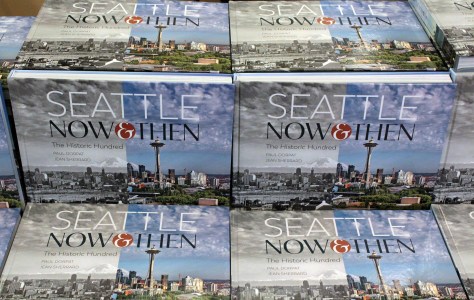
Books on display. (Photo by Gavin MacDougall)

You can re-live an event or experience it anew! Videos of 29 of the book’s 33 events are posted on the events page of our website.

The media

Clay Eals

Clay Eals, the editor of Seattle Now & Then: The Historic Hundred, who also wrote the book’s introduction, will be the guest of former Seattle City Council members Jean Godden and Sue Donaldson on “The Bridge” radio show at 3-4 p.m. this Thursday, Oct. 17, 2019, on SPACE 101.1 FM.

Jean Godden
Sue Donaldson


How to order

Want to place an order for Seattle Now & Then: The Historic Hundred? It’s easy. Just visit our “How to order” page. You can specify how you want Paul and Jean to personalize your copy. Mailed orders will reach mailboxes in about a week.

As Jean looks on, Paul signs a book for Nancy Guppy of The Seattle Channel’s “Art Zone.”

Thanks!

Big thanks to everyone who has helped make this book a successful tribute to the public historian who has popularized Seattle history via more than 1,800 columns for more than 37 years, Paul Dorpat!

— Clay Eals, editor, Seattle Now & Then: The Historic Hundred

Seattle Now & Then: Bothell’s Main Street, 1913

(click and click again to enlarge photos)

THEN: This May 29, 1913, print, looking west along Main Street and damaged as if run over by one of the parading flivvers, comes from the scrapbook of Bothell pioneer Carlton Ericksen. The three most prominent cars are likely (from left) a 1908 or 1909 International Harvester Auto Buggy, a 1911 Stoddard-Dayton and a 1912 Studebaker Everitt-Metzger-Flanders, as identified by West Seattle’s Robert Carney. The 1908 Hannan Building, Bothell’s first brick structure, to the left of the white banner, is the only depicted edifice that still survives. The closest building later became the site of Meredith’s 5 & 10, managed by Dave Johns, father of U.S. Sen. Patty Murray. For more on Bothell’s Main Street, see the photo-filled book “Bothell Washington Then & Now” (2008, Bothell Landmark Preservation Board). BOTHELL HISTORICAL MUSEUM
NOW: Redeveloped after a massive 2016 fire, Bothell’s Main Street features an expansive crosswalk and recessed parking. With Alexa’s Café (red umbrellas, formerly Meredith’s 5 & 10) behind them and a booming Bothell in the distance, (from left) passersby Alistair and Hopi Shull of Kettle Falls and Renewal Israel of Bothell join Pat Pierce and Jim and Margaret Turcott of the Bothell Historical Museum and King County librarian Kirstie Cameron to echo the 1913 scene. In its 50th year, the museum will host a free, illustrated talk on local roads and cars at 7 p.m. Thursday, Oct. 17, at the Bothell Library. JEAN SHERRARD

(Published in Seattle Times online on Oct. 10, 2019,
and in print in PacificNW magazine
of the Seattle Times on Oct. 13, 2019)

The Good Roads cause cruises through Bothell’s Main Street
By Clay Eals

We all imagine Main Street as a hospitable hub for shopping and schmoozing. But sometimes it is a thoroughfare as much as a destination.

This applies to a burg like Bothell, which – perched along the Sammamish River near the northern tip of Lake Washington – served for most of a century not as somewhere to go but mostly as “on the way to.”

In the late 1880s, a railroad carried coal circuitously from Issaquah north around the lake and through Bothell to Seattle. Likewise, the nearby Sammamish River (before its water level plummeted with the 1917 opening of the Lake Washington Ship Canal) carried logs and passenger steamers along a similar route. In little time, newfangled automobiles followed suit.

Thus, in concert with the statewide Good Roads movement, led by Seattle’s Sam Hill (later known for building the U.S./Canada Peace Arch and Stonehenge replica at Maryhill), this coterie of cars bustles east on Bothell’s Main Street on May 29, 1913.

Gov. Ernest Lister joined locals to salute the completion of a four-mile highway between Bothell and Lake Forest Park to the west, which helped connect Bothell with Seattle (today’s Highway 522) and Everett (Highway 527).

The celebrated segment, left in the dust by our “Then” motorists, was made of red brick, an upgrade from muddy, rutted terrain. The brick soon proved slippery, so eventually it was repaved – all but a 1,000-foot stretch that survives in a landmark park southwest of downtown Bothell.

Bothell Mayor Sidney F. Woody, from Dec. 5, 1915, Seattle Times

Boosting Bothell’s roads in that decade was a colorful land agent-turned-mayor, Sidney F. Woody, who pushed for a 10-mph speed limit through town and in 1912 became the first to be cited for breaking it. The Bothell Sentinel said Woody, a “high-class, single-minded talker,” prevailed in court by challenging four eyewitnesses, including one who insisted the errant speed was at least 12 mph “but had no instrument by which he could prove it beyond a peradventure of a doubt.”

Perhaps Woody’s constituents acquitted him two years later when he created the Chuckhole Club. His scheme, which the Seattle Times termed “clever,” asked motorists to carry spades and interrupt their automotive errands to fill in one rut every month, aiming to eradicate 12,000 craters a year.

Participants were to swear to a Woody-written pledge, vowing that non-compliance would mean “no less a penalty than that of having my axles broken in twain, my springs smashed to smithereens, my wheels torn off at the hubs, my tires blown out, my carburetor filled with water and my gasoline tank emptied 10 miles from a station, so help me Sam Hill and keep me busy.”

Spoken like a politician on – where else? – Main Street.

WEB EXTRAS

To see Jean Sherrard’s 360-degree video of the NOW prospect and compare it with the THEN photo, and to hear this column read aloud by Clay Eals, check out our Seattle Now & Then 360 version of the column!

Besides the extras below, please visit the web page for “On the Road: Bothell Auto History,” a free public event set for 7 p.m. Thursday, Oct. 17, 2019, at Bothell Library, sponsored by the Bothell Historical Museum.

Below are (1) 13 photos of Bothell’s Red Brick Road Park and in chronological order, (2) two additional photos from the Bothell Historical Museum, (3) two additional photos from the Museum of History & Industry, (4) a four-minute video about the park and (5) eight clippings from The Seattle Times online archive (available via Seattle Public Library) and two from the Bothell Sentinel that, among others, were helpful in the preparation of this column. Enjoy!

Red Brick Road Park. CLAY EALS
Bothell Mayor Sidney F. Woody (center left) presents Gov. Ernest Lister a key to the city during May 29, 1913, ceremony feting completion of Bothell’s red brick highway. BOTHELL HISTORICAL MUSEUM
This northbound view of Bothell’s Second Street Bridge indicates the 10 mph speed limit, which Mayor Sidney F. Woody, who promulgated it, was the first to break in 1912. BOTHELL HISTORICAL MUSEUM
A car traveling eastbound, “Seattle to Bothell” on Feb. 9, 1915. MUSEUM OF HISTORY & INDUSTRY
A car stuck in the mud on the way to Bothell, Feb. 9, 1915. MUSEUM OF HISTORY & INDUSTRY
VIDEO: “Bothell History … The Red Brick Road.” (3:47) CITY OF BOTHELL
May 12, 1912, Bothell Sentinel, page 9, BOTHELL HISTORICAL MUSEUM
May 13, 1913, Seattle Times, page 2
May 15, 1913, Seattle Times editorial, page 6
May 24, 1913, Seattle Times, page 8
Dec. 28, 1913, Seattle Times, page 16
June 21, 1914, Seattle Times, page 4
Oct. 18, 1914, Seattle Times, page 45
Oct. 29, 1912, Seattle Times editorial, page 6
Dec. 5, 1915, Seattle Times, page 24
Sept. 12, 1931, Bothell Sentinel, page 8, BOTHELL HISTORICAL MUSEUM

Seattle Now & Then: The Seattle Masonic Temple (now the Egyptian Theatre), 1916

(click and click again to enlarge photos)

THEN: This photo first appeared in The Seattle Times on Aug. 6, 1916. A workman perched outside the second-floor window adds finishing touches to the newly completed building. At sidewalk level, a makeshift sign importunes passersby with an offer of “Free Wood.” (Ron Edge collection)
NOW: Snapped on a balmy Saturday evening during the 2019 Seattle International Film Festival, our “Now” photo features an eager crowd lining up at SIFF Cinema Egyptian. This year, SIFF marked its 45th anniversary in a 44- year history. Triskaidekaphobic staffers banished year 13, skipping directly from the 12th to the 14th anniversary. (Jean Sherrard)

(Published in Seattle Times online on Oct. 3rd, 2019,
and in print on Oct. 6th, 2019)

A ‘monument to Masonry’ — and the movies
By Jean Sherrard

Inspiration always has bolstered the brickwork at the southeast corner of Harvard and Pine.

From its construction in 1916 as a Masonic Temple, the brick-and-terra-cotta building was the collaborative effort of 18 Masonic lodges.  Designed by legendary Seattle architect Charles W. Saunders (whose many credits include the Alaska Building, the Terry-Denny Building in Pioneer Square and the University of Washington’s Denny Hall), the 63,000- square-foot structure was built for $250,000.

“When the last touch is finished,” claimed lodge president Frederick Johnstone, in an August 1916 Seattle Times interview, “it will be one of the finest temples west of Chicago.”

Marking the occasion, a week-long “housewarming and carnival” was planned for early October, during which the 8,000 members of Seattle Masonic lodges, their families and friends and the general public would be invited to visit this “monument to Masonry.” Festivities would include “all sorts of ‘dignified stunts’ and dancing, accompanied by splendid music.” The addition of the celebrated “Captain, the horse with the human brain,” who could answer “with nods and hoof beats a great variety of questions,” would cap the week of celebration.

Indeed, the crowds were wowed by the Masonic masonry. The temple boasted a full stage with dressing rooms and the latest in “indirect lighting and … independent ventilation,” plus an 1,800-seat auditorium, not to mention “one of the finest dance floors on the Pacific Coast.”

Flash-forward several decades. Long after Captain’s hoof beats had faded away, the temple accommodated local Masonic lodges, besides serving as a venue for community ceremonies, celebrations and performances, ranging from cellist Pablo Casals to our own Paul Dorpat, who recalls attending a summer rock concert in 1967, “when this then-inhibited 30-year-old Lutheran first unzipped his knees with hours of free-form hippie-dancing.”

By the late 1970s, big changes loomed. “Capitol Hill was becoming a tough neighborhood,” says Jim Russell, current secretary of St. John’s Lodge in Greenwood. “It was hard just finding a safe place to park. The temple also needed extensive restoration, and our membership numbers were declining.” In 1992, nearby Seattle Central College purchased the building to expand its growing campus.

Down the hill, a young but burgeoning Seattle International Film Festival had lost its primary venue, the Moore Egyptian, and was seeking a suitable replacement. Visionary founders Dan Ireland and Darryl MacDonald leased the temple’s massive auditorium, remodeling and rechristening it the Egyptian Theatre.

Since those early days, SIFF has grown exponentially. With more than a dozen venues, this year’s festival showcased 400-plus films from nearly 90 countries for some 140,000 attendees. Known since 2014 as SIFF Cinema Egyptian, the theater also screens films year-round and is celebrated as Seattle’s premiere single-screen historic theater, even without an educated horse.

WEB EXTRAS

Check out Jean’s narrated 360-degree video, shot on the penultimate weekend of this year’s Seattle International Film Festival.