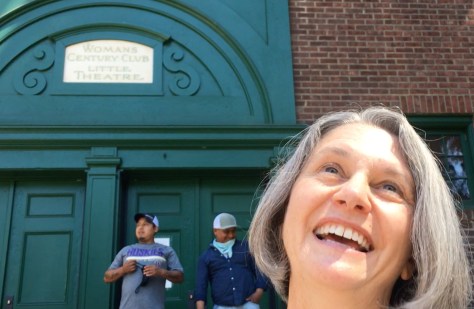
THEN: A half-dozen Woman’s Century Club members stand in 1925 on the steps of the club’s newly erected headquarters. Women-centric institutions with roots in the neighborhood include Nellie Cornish College of the Arts and the Rainier Chapter of the National Society Daughters of the American Revolution, all part of the Belmont-Harvard Historical District. (Pemco Webster & Stevens Collection, Museum of History & Industry)NOW (with names): Club members (from left) Cindy Hughes, Cheri Sayer, Debra Alderman, Diana James, Michele Genthon, Sara Patton, Jackie Williams, Denise Frisino, Carla Rickerson, Janet Wainwright, Michael McCullough, Saundra Magnussen-Martin, Twila Meeks and Patty Whisler stand before the Woman’s Century Club building, now the Mexican Consulate, while protesters gather at right, seeking safety for displaced families. The club’s annual fall reception will take place at noon Friday, Oct. 22, either in person or online. For more info, visit WomansCenturyClub.org. (Jean Sherrard)
Published in the Seattle Times online on Sept. 30, 2021
and in PacificNW Magazine of the printed Times on Oct. 3, 2021
‘Important conversations’ fuel 130-year Woman’s Century Club
By Clay Eals
For whom is the 19th century known?
Answers abound, but a half-dozen progressive women from Seattle claimed it as their own during the century’s final decade.
Because of educational, occupational, social and political strides, especially the right to vote, this local group adopted the phrase “the Woman’s Century,” forming a club with that name in 1891. The designation also took off nationally throughout the 1890s.
Late 1899 or early 1900 Singer ad, McClure’s Magazine. (Courtesy Debra Alderman)
To no surprise, the appellation was appropriated commercially. The Singer Manufacturing Co. placed full-page ads headed “The Woman’s Century” in turn-of-the-century editions of McClure’s Magazine. The ads touted Singer sewing machines and typewriters for providing “increased time and opportunity for women’s rest and recreation or for other occupations from which they had been debarred.”
In Seattle, club founders were more high-minded. An early organizational history states that amid “the sordid atmosphere of a rapidly developing western city,” they felt the need to gather “for intellectual culture, original research and the solution of the altruistic problems of the day.”
Such sturdy stock flourished in the club’s early decades. In 1926, members helped elect the first female Seattle mayor, Bertha Landes, a former club president. In 1933, they hosted a reception for famed aviator Amelia Earhart.
The club’s talks and teas held an additional purpose, to raise money for a permanent headquarters and theater on Capitol Hill. A three-story brick edifice, with “Woman’s Century Club” etched above its entrance, took shape in 1925 at the southeast corner of Harvard and East Roy.
Club events took place there for 40-plus years, but thinning membership prompted its sale in 1968 and conversion to what became the charming Harvard Exit Theatre, with movie auditoriums on two floors. The club still met in its parlor, but screens went dark when the building was resold in 2014 and renovated by Eagle Rock Ventures. The main tenant today is the Mexican Consulate.
Debra Alderman, club vice-president. (Clay Eals)
Now based at Dearborn House on First Hill, the club sponsors provocative presentations and funds an annual scholarship for a young woman “with promise.”
Members appreciate the club’s focus on history and the arts. They also revere its trailblazing legacy. In its 130th year, Debra Alderman, vice-president, says, “We need to continue to have important conversations.”
We are a little more than one-fifth of the way through the 21st century. For whom will it be named?
WEB EXTRAS
To see Jean Sherrard‘s 360-degree video of the “Now” prospect and compare it with the “Then” photo, and to hear this column read aloud by Clay Eals, check out our Seattle Now & Then 360 version of the column!
Here are video interviews of three Woman’s Century Club leaders: (1) Cheri Sayer, treasurer and past president, (2) Debra Alderman, vice-president, and (3) Twila Meeks, scholarship chair.
VIDEO: Click on photo to see Cheri Sayer, treasurer and past president, reflect July 19, 2021, on Woman’s Century Club, 2:27. (Clay Eals)VIDEO: Click on photo to see Debra Alderman, vice-president, reflect July 19, 2021, on Woman’s Century Club, 4:07. (Clay Eals)VIDEO: Click on photo to see Twila Meeks, scholarship chair, reflect July 19, 2021, on Woman’s Century Club, 2:29. (Clay Eals — apologies for poor framing in spots)
And here, in chronological order, are 21 historical clippings from The Seattle Times and Seattle Post-Intelligencer online archive (available via Seattle Public Library) and other online newspaper sources that were helpful in the preparation of this column.
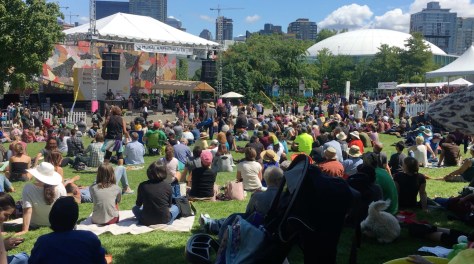
THEN1: On a visit to Seattle on Aug. 28, 1965, three years after the Seattle World’s Fair, and posing in front of the mural created for the fair by his great uncle, is a grinning 3-year-old Brian Horiuchi, second from left, with family members (from left) Brian’s mother, Maynard Cooke Horiuchi; aunt, Gloria Lewis Horiuchi; cousin, Mark Shigetoshi Horiuchi; grandmother, Takeko Horiuchi; and uncle, Arthur Horiuchi. (Courtesy Brian Horiuchi)NOW1: Cosima Horiuchi, 5, twirls as 15 other Horiuchi descendants join her on July 13 in front of the Paul Horiuchi mural at Seattle Center. Cosima’s dad, Brian Horiuchi, fourth from right, beams as he stands not far from his great uncle’s corner signature. Here is the full lineup (from left): Cosima Horiuchi, Trish Howard, Karen Ooka Hofman, Grant Wataru Horiuchi, Halli Hisako Horiuchi, Hiro Hayden Horiuchi, Hannah Amaya Horiuchi, Ottilie Horiuchi (purple hair), Cheryl Ooka (obscured), Naomi Ooka Bang, Greg Bang, Lucius Horiuchi (boy), Brian Horiuchi, Rowan Manesse, Mark Shigetoshi Horiuchi and Kassie Maneri. (Jean Sherrard)
Published in the Seattle Times online on Sept. 23, 2021
and in PacificNW Magazine of the printed Times on Sept. 26, 2021
In celebration out of darkness, Horiuchi mural inspires reunion
By Clay Eals
Memorable moments abound naturally at Seattle Center, our collective keepsake from the 1962 World’s Fair. And for me, its touchstone is the amphitheater west of the Space Needle, anchored by the rich hues and galvanizing composition of its 60-by-17-foot mosaic mural by Paul Horiuchi.
Both arresting and unifying, the juxtaposed Needle, green grass and mural bear a timeless appeal, enveloping us like a hug. Where else, over the past six decades, could we rather have passed time alone in urban contemplation or enjoyed an outdoor experience with a festive crowd?
I’ve long presumed that the mural’s warmth and complexity derived from the art itself, but thanks to a recent reunion of Horiuchis at the mural, I know it also springs from a stinging saga.
THEN2: Paul Horiuchi relaxes Oct. 6, 1978, while visiting Kobe, Japan. (Courtesy Brian Horiuchi)
Born in 1906 in Japan, Horiuchi first delved into ink-wash painting as a boy. He came to the United States in 1920, becoming a railroad worker in Wyoming until World War II, when he was fired for being Japanese and lived largely in hiding with his young family in a truck while laboring as a janitor and gardener.
Postwar, after a move to Seattle, Horiuchi’s artistic career took off. Fifteen years later, the Century 21 Exposition commissioned what became the soft-spoken collagist’s best-known and most beloved piece. His melding of odd-shaped and multi-colored chunks of glass from Venice, Italy, was touted in 1962 as the largest single work of art in the Northwest.
Brian Horiuchi, a descendant and L.A. screenwriter-director who organized the reunion, sees accessibility and emotional truth in his great uncle’s creation.
NOW2: Paul Horiuchi’s 1962 mural signature. (Clay Eals)
“Though it’s abstract, it doesn’t strike me as intellectualized or at all forced,” he says. A family gathering at the amphitheater, he says, becomes a pilgrimage to a tangled but triumphant legacy: “I think there’s celebration with the darkness, for sure.”
His 5-year-old daughter, Cosima, a budding artist, catches the symbolism while twirling before the parabolic mural: “It’s about feelings.”
NOW3: Horiuchi mural plaque, 1962. (Clay Eals)
My own feelings about the mural hover to amphitheater events such as Pete Seeger inspiring a 1997 Northwest Folklife audience to sing along to “Amen/Freedom/Union” with the new Seattle Labor Chorus, as well as, more recently, the perennially mesmerizing performances of Eduardo Mendonça and Show Brazil.
The long ribbon of such occasions bespeaks permanence — and survival amid sporadic talk of redesigning Seattle Center, especially a scuttled late-1980s Disney scheme.
The mural’s endurance also breeds comfort that its maker expressed in a handwritten message, shared at his 1999 memorial service:
“I have always wanted to create something serene, the peace and serenity, the quality needed to balance the sensationalism in our surroundings today.”
NOW4: This view matches and expands the straight-on vantage of our THEN. Those posing are (from left) Grant Wataru Horiuchi, Halli Hisako Horiuchi, Hiro Hayden Horiuchi, Hannah Amaya Horiuchi, Lucius Horiuchi held by Rowan Manesse, Ottilie Horiuchi (purple hair), Cosima Horiuchi, Brian Horiuchi, Mark Shigetoshi Horiuchi, Kassie Maneri, Karen Ooka Hofman, Trish Howard, Cheryl Ooka, Naomi Ooka Bang and Greg Bang.
WEB EXTRAS
To see Jean Sherrard‘s 360-degree video of the “Now” prospect and compare it with the “Then” photo, and to hear this column read aloud by Clay Eals, check out our Seattle Now & Then 360 version of the column!
Also please click here to see a Queen Anne Historical Society story on the mural’s 2011 restoration.
We present an array of additional extras related to this column’s topic.
Here are video interviews of four Paul Horiuchi descendants attending the July 13, 2021, family reunion at the Seattle Center Mural Amphitheater: (1) Brian Horiuchi, (2) Mark Horiuchi, (3) Grant Horiuchi and (4) Trish Howard.
VIDEO: Click photo to see an interview with Brian Horiuchi, 7:07. (Clay Eals)VIDEO: Click photo to see an interview with Mark Horiuchi, 14:47. (Clay Eals)VIDEO: Click photo to see an interview with Grant Horiuchi, 8:27. (Clay Eals)VIDEO: Click photo to see an interview with Trish Howard, 3:06. (Clay Eals)
We also present two other videos from the Seattle Center’s Mural Amphitheater: (1) a May 25, 1997, Pete Seeger performance of “Amen/Freedom/Union” at Northwest Folklife Festival and (2) a May 28, 2018, performance, also from Folklife.
VIDEO: Click photo to see folk legend Pete Seeger lead the newly formed Seattle Labor Chorus in “Amen/Freedom/Union” on May 25, 1997, at the Mural Amphitheater, 6:44. (Clay Eals)VIDEO: Click photo to see a short glimpse from May 28, 2018, of another Mural Amphitheater performance, 0:15. (Clay Eals)
Below we present three examples of other Paul Horiuchi artworks from the private collection of Brian Horiuchi and Rowan Maness.
This 1944 Paul Horiuchi painting depicts Brian Horiuchi’s father, Lucius Horiuchi, and aunt, Marie Horiuchi, walking by the guard tower of the Minidoka relocation camp in Hunt, Idaho. (Courtesy Brian Horiuchi and Rowan Maness)This July 21, 1976, Paul Horiuchi collage is done with paper strips. On its reverse side, the piece is titled “Reflections” and is dedicated to Brian Horiuchi’s mother and father, Maynard and Lucius, on Lucius’ 48th birthday, from Paul and his wife Bernadette Horiuchi. (Courtesy Brian Horiuchi and Rowan Maness)This Paul Horiuchi watercolor was painted in 1952. On its reverse is this note: “This watercolor was done after WWII by Paul Chikamasa Horiuchi (represents an area of Alkai (sic), outside Seattle). Paul gave this to Lucius in either 1957 or 1959 in Seattle. (Lucius was visiting Paul’s shop; and Paul was grateful for little favors Lucius extended to Paul’s mother who lived in Oishi, Yamanashi-ken, Japan.)” (Courtesy Brian Horiuchi and Rowan Maness)
Here, in chronological order, are 22 historical clippings from The Seattle Times and Seattle Post-Intelligencer online archive (available via Seattle Public Library) and other online newspaper sources that were helpful in the preparation of this column.
THEN: The nearly completed Clallam County Courthouse looms above the Lincoln Street ravine, whose elevated plank roadway provided temporary passage during the extensive regrading. Snow-topped Olympics suggest that this exposure is from late fall of 1914. The four-faced clock’s maker, E. Howard and Co., also supplied Seattle’s King Street Station Tower clock (1906). (Paul Dorpat collection)NOW: Today’s courthouse at 319 Lincoln St. continues to house county administrative departments, the county prosecutor and county permitting office as well as courtrooms in use today. The building was added to the National Register of Historic Places in 1987. On this late summer day, the Olympics are largely smothered in smoke. (Jean Sherrard)
(Published in The Seattle Times online on Sept. 16, 2021
and in PacificNW Magazine of the print Times on Sept. 19, 2021)
Tower lets Port Angeles hear a regular ring of promise
By Jean Sherrard
On a warm evening in mid-August, smoke from hundreds of British Columbian fires had crossed the Strait of Juan de Fuca, turning the sun an unsettling red over Port Angeles, where I’d paused for a photo and a bite to eat. Offering solace, the Clallam County courthouse bell tolled the hour as it had for over a century.
For Port Angeles, 1914 was a banner year, pregnant with promise. A gleaming hydroelectric dam had just been erected on the Elwha River, supplying the county seat’s electrical needs. The city’s first large sawmill was built on the waterfront and connected by rail to stands of virgin timber to the west. A vast regrade was well under way, raising the waterfront, filling gullies and lowering the steeper hills. And work on the new courthouse, featured in our “Then” photo, was largely complete.
Evidence of the area’s human habitation reaches back almost three millennia, with two Klallam villages sharing the harbor for at least 400 years. They called it I’e’nis (reportedly meaning “good beach”), which morphed into two names now in use: Ediz Hook (the city’s long and protective signature sand spit jutting east into the Strait) and snow-fed Ennis Creek, which empties into the bay.
Port Angeles’ natural, deep-water harbor was noted by Spanish explorer Francisco de Eliza in 1791 and dubbed Puerto de Nuestra Señora de los Ángeles (Port of Our Lady of the Angels). One year later, British Royal Navy Captain George Vancouver, a staunch Anglican, shortened the name to its current two words.
In the mid-1850s, the first permanent white settlers arrived, staking Donation Land Act claims near Native villages. Over succeeding decades, land speculators, shady political operators, a utopian colony and pulp and paper mill operations flourished while ejecting the Klallam from their ancestral homes.
Designed by early 20th century Seattle architect Francis W. Grant, the two-story neo-classical brick and terra cotta-trimmed courthouse was nothing if not aspirational. Built to replace a wooden structure destabilized by the regrade, its graceful, sturdy lines reflected bright boomtown hopes. Locals also appreciated its rock-bottom price of $64,000.
The four-faced clock/bell tower — today proudly featured on the Clallam County seal — was installed after a serendipitous discovery. Francis Grant unearthed an unclaimed, Boston-based E. Howard and Co. clock, manufactured in 1880 and shipped around Cape Horn to Seattle. It languished in storage for decades until the architect encouraged Clallam County to pick it up for a $5,115 song.
It continues to sing to this day, faithfully striking every half hour.
WEB EXTRAS
No 360 video this week due to the theft of my monopod on a beach near La Push. However, a few oceanside photos may help salve the loss.
THEN: In 1925, streetcar tracks gracefully inscribe brick-lined curves in the paved intersection before the renamed University National Bank, which anchors the northeast corner of 45th and University Way. (courtesy MOHAI)NOW: Michael Oaksmith, President of Development for Hunters Capital stands with the Beezer brothers’ creation across the street. The city-landmarked building has been lovingly remodeled, with a restoration of much of its early elegance. After 108 years as a bank, most recently a Wells Fargo branch, the structure is repurposed for shops and offices. (Jean Sherrard)
(Published in The Seattle Times online on Sept. 9, 2021
and in PacificNW Magazine of the print Times on Sept. 12, 2021)
Twin architects banked on a legacy of faith plus finance
By Jean Sherrard
Keen to serve both God and Mammon, Louis and Michael Beezer defied scriptural maxims to the contrary. Twins whose architectural firm produced edifices for faith and finance, they skillfully negotiated the two worlds.
Born on July 6, 1869, in Bellefont, Pennsylvania, the Beezers arrived in Seattle in 1907. Different from competing firms, they were hands-on designers, overseeing every step of the construction process.
In 1908, their vision for a new “mosquito fleet” terminal at Colman Dock, with its Italianate clock tower and dome, drew acclaim, Thereafter, the industrious pair enjoyed commissions from Alaska to California.
The Beezers were devout Roman Catholics whose extensive work for the Archdiocese of Seattle included the Immaculate Conception School (1909), Dominican Priory of the Blessed Sacrament (1909–25) and Edward J. O’Dea High School (1923). After the St. James Cathedral dome collapsed beneath a 1916 record snow, a trusted Louis Beezer helped rebuild the destroyed sanctuary while improving its abysmal acoustics.
Financial institutions provided bread to match the ecclesiastical butter. The Beezers’ neo-classic banks throughout the West include the focus of this week’s column.
Having relocated from downtown digs in 1895, the University of Washington was booming — in both enrollment and revenue. Its beleaguered comptroller regularly ferried cash and checks to central-city repositories, spending a half-day or more in weary commute.
Providing a sober solution was the University District’s first financial institution, Washington State Bank, founded in 1906 by professors, administrators and business leaders — and we do mean sober. By state law, the sale of alcohol was banned within two miles of campus.
By 1913, the bank, expanding with the university, commissioned the Beezers to erect a stately, two-story structure at 45th and University Way. It was such a calm, rural intersection that neighbors described choruses of frogs serenading from nearby ponds and swamps.
The establishment’s ground floor and basement offered opulence and security, while a lofty, second-floor ballroom and concert hall welcomed fraternity and community dances.
Our “Then” photo depicts a livelier U-District, packed with shops and businesses catering to students. A banner stretched across 45th Street publicizing a “University Legion Frolic” accurately dates the photo to 1925. In late September that year, the new American Legion Hall on the southwest corner of 10th Avenue and 50th Street hosted the affair, which promised dancing, “free vaudeville” and a “Young Woman’s Popularity Contest.”
We offer a fiery footnote: In 1976, the legion sold its hall to Randy Finley, who converted it to the Seven Gables Theater. Shuttered in 2017, the charming moviehouse burned down last Christmas Eve.
WEB EXTRAS
We visit 45th and University Way for a 360 degree video featuring the column. To watch, click here.
Mike Oaksmith and Noah Macia admire the downstairs vault of the University National Bank.The spacious second floor was once used as a ballroom.
THEN: In this Tacoma Historical Society lobby card for the 1927 silent film “Eyes of the Totem,” filmed in Tacoma, actress Wanda Hawley, playing a homeless single mother, wears sunglasses while sitting at the base of the Tacoma totem pole, searching for the killer of her husband. This view is at 10th and A streets looking east to the Municipal Dock and tideflats, including Tacoma Lumber Co. (The pole was moved one block north in 1954.) The historical society has just released a digital version of “Eyes” for rental or purchase. (Courtesy Tacoma Historical Society)NOW: A Tacoma Power worker uses a chainsaw to slice a midsection from the 118-year-old Tacoma totem pole. (Jean Sherrard) See below for many more NOW photos.
Published in the Seattle Times online on Sept. 2, 2021
and in PacificNW Magazine of the printed Times on Sept. 5, 2021
Tacoma’s totem-pole takedown aims to ease tribal trauma
By Clay Eals
All the arguing over tearing down what some consider to be inappropriate public monuments becomes palpable once you hear the revving-up of chainsaws.
The roar came to Tacoma’s Fireman’s Park, the South A Street vista overlooking the port’s industrial tideflats, at 7 a.m. Tuesday, Aug. 3. That’s when Tacoma Power workers hoisted cherry-picker buckets and began slicing into pieces a 118-year city landmark — the Tacoma totem pole.
Capped by an eagle, it was erected just before then-President Teddy Roosevelt’s May 22, 1903, visit to Tacoma as a lasting way to promote the City of Destiny in favorable comparison to northern neighbor Seattle. Described as 75 to 105 feet long, with some 15 feet underground, the pole bore a plaque calling it “the largest totem pole in the world,” a status touted for decades but eclipsed elsewhere.
First it stood at 10th Street next to the old Tacoma Hotel, then was moved one block north in 1954. It came down in 1974-76 for extensive restoration and was steadied in 2014 by a tall metal brace.
Its most prominent national role came in the 1927 silent film “Eyes of the Totem” (working title “The Totem Pole Beggar”), helmed by famed director W.S. Van Dyke and restored and re-premiered in 2015 by the Tacoma Historical Society. As shown in our “Then” photo, the pole figured strikingly in the melodrama.
NOW: The carved eagle atop the 118-year-old Tacoma totem pole is held by a strap around its neck as a Tacoma Power worker below uses a chainsaw to cut the uppermost slice off the pole. (Jean Sherrard)
Trouble is, the pole, long said to have been carved by Alaskan Natives hired by Tacoma businessmen, recently has been deemed both inauthentic in origin and purpose and unrepresentative of the indigenous Puyallup Tribe, which sought its exile. “There has been a lot of trauma,” tribal council chair Annette Bryan has said, “and we have to tell the true story to be able to heal.”
Tacoma officials agreed. They plan to commission new Coast Salish art for the park while storing the pole’s pieces and working with the historical society to display them with appropriate interpretation.
Debate rages on, however. Doug Granum of Southworth, who led the pole’s mid-1970s restoration, calls its amputation tragic. “Destroying history,” he says, “is right out of the Communist playbook.”
The feelings of Don Lacky, former member of the Tacoma Arts Commission who fervently pursued the pole’s preservation, are more mixed. “I can understand why the Puyallup nation finds it offensive,” he says. “It would be like Russia putting up a monument here in the United States.”
Meanwhile, 46-year Tacoma resident Verna Stewart, one of a few non-city staff or media witnessing the two-hour chainsaw takedown, was grateful to see removal of what she calls “another American history lie.”
WEB EXTRAS
To see Jean Sherrard‘s 360-degree video of the “Now” prospect and compare it with the “Then” photo, and to hear this column read aloud by Clay Eals, check out our Seattle Now & Then 360 version of the column!
We present a huge collection of extras related to this column’s topic.
Below are 14 additional NOW photos, four other photos, one postcard and, in chronological order, 119 historical clippings from the Tacoma News Tribune and other online newspaper sources (including two period movie reviews!) that were helpful in the preparation of this column.
We also present four videos: (1) comments from Amy McBride, Tacoma’s arts administrator, (2) comments from Don Lacky, former Tacoma arts commissioner, (3) comments from Verna Stewart, 46-year resident of Tacoma, and (4) a start-to-finish, 43-minute account of the totem pole’s takedown.
In addition, we present a provocative essay by Southworth artist Doug Granum, who led the restoration of the totem pole in 1976 and strongly opposed its takedown. Below the essay are photos of the pole taken by Granum prior to its 1976 restoration.
We also present (1) an Aug. 5, 2021, press release from the Tacoma Historical Society announcing the ability to see online its restoration of the 1927 silent film “Eyes of the Totem” and (2) extensive packets from three recent meetings of Tacoma’s arts and landmarks preservation commissions. The packets include letters from citizens, staff assessments and historical photos and graphics.
In addition, here are two “Eyes of the Totem” video links:
NOW: In this southeast-facing view in the post-sunrise haze of Tuesday, Aug. 3, the 118-year-old Tacoma totem pole stands in the city’s Fireman’s Park one half-hour before its takedown by a Tacoma Power crew. (Jean Sherrard)NOW: Prior to the cutting, the 118-year-old base of the pole proudly proclaims “Largest Totem Pole in the World.” (Jean Sherrard)NOW: In this south-facing view early Tuesday morning, Aug. 3, the 118-year-old Tacoma totem pole is framed by artist Lance Kagey’s new Port of Tacoma sculpture called SWELL, which was installed last December in the city’s Fireman’s Park. (Jean Sherrard)NOW: A Tacoma Power crew lifts a cherry-picker bucket to the top of the Tacoma totem pole in preparation for slicing it in pieces on Tuesday morning, Aug. 3. (Jean Sherrard)NOW: A Tacoma Power worker steadies the top (eagle) section of the pole after it was sliced off, while a second bucketed worker looks on. (Jean Sherrard)NOW: The top (eagle) portion of the pole is eased downward to a waiting truck. (Jean Sherrard)NOW: The top (eagle) portion of the pole is eased downward to a waiting truck. (Jean Sherrard)NOW: A Tacoma Power worker eyes a mid-section where it is attached to its metal brace. (Jean Sherrard)NOW: Tacoma Power workers tie off a midsection of the pole before slicing it with a chainsaw. (Jean Sherrard)NOW: The carved eagle that made up the top portion of the 118-year-old Tacoma totem pole rests with other pieces on a Tacoma Power truck, ready to be stored by the city for possible later display by the Tacoma Historical Society. (Jean Sherrard)NOW: A Tacoma Power worker wields a chainsaw to slice another midsection off the 118-year-old totem pole. (Jean Sherrard)NOW: Pieces of the 118-year-old Tacoma totem pole rest in a city truck next to the pole’s stump. (Jean Sherrard)NOW: A Tacoma Power worker uses a chainsaw to slice off the pole’s stump. (Jean Sherrard)NOW: The moon rises on the evening of Aug. 15, 2021, near the top of the metal brace for the Tacoma pole in Fireman’s Park. The brace was installed in 2014 and was not removed on Aug. 3 because city officials say it may be used later in conjunction with Coast Salish art. (Clay Eals)VIDEO: Click above to see Amy McBride, arts administrator for the City of Tacoma, explain the city’s perspective on Aug. 3, 2021, the morning of the city’s removal of the Tacoma totem pole from Fireman’s Park downtown. Video length: 1:56. (Clay Eals)VIDEO: Click above to see Don Lacky, a former arts commissioner for the City of Tacoma, explain his perspective on Aug. 3, 2021, the morning of the city’s removal of the Tacoma totem pole from Fireman’s Park downtown. Video length: 5:29. (Clay Eals)VIDEO: Click above to see Verna Stewart, a 46-year resident of Tacoma, explain her perspective on Aug. 3, 2021, the morning of the city’s removal of the Tacoma totem pole from Fireman’s Park downtown. Video length: 1:24. (Clay Eals)VIDEO: Click above to see the entire takedown of the Tacoma totem pole on Tuesday morning, Aug. 3, 2021. Video length: 43:01. (Clay Eals)TWO-PAGE ESSAY: Click above to download and read a pdf of the case made by Southworth artist Douglas Granum, who led restoration of the Tacoma totem pole in 1976, for why it should not have been removed.THEN: This is a composite photo of the Tacoma totem pole as it lay in Doug Granum’s care for restoration in 1976. Double-click it to see the full detail. (Doug Granum)THEN: The deteriorated top (eagle) portion of the Tacoma totem pole lies in Doug Granum’s care for restoration in 1976. (Doug Granum)THEN: The deteriorated top (eagle) portion of the Tacoma totem pole lies in Doug Granum’s care for restoration in 1976. (Doug Granum)NOW: The four lobby cards for the restored 1927 silent film “Eyes of the Totem” are sold by the Tacoma Historical Society. (Tacoma Historical Society)1906 boosterish postcard depicting the Tacoma totem pole alongside the peak with the indigenous name of Tahoma that carries the official moniker of Mount Rainier, designated by explorer George Vancouver in 1792. Some Tacoma-area interests have striven for a “Mount Tacoma” name, as printed on the postcard, for more than a century. (Image courtesy Dan Kerlee)Click above to download and read the Aug. 5, 2021, press release from the Tacoma Historical Society for details about the online opportunity to see the organization’s restored version of the 1927 silent film “Eyes of the Totem.” (Tacoma Historical Society)Click above to download the extensive packet from the June 4, 2013, meeting of the Tacoma Arts Commission in which the Tacoma totem pole was a prominent topic.Click above to download the extensive packet from the May 12, 2021, meeting of the Tacoma Landmarks Preservation Commission in which the Tacoma totem pole was a prominent topic.Click above to download the extensive packet from the May 26, 2021, meeting of the Tacoma Landmarks Preservation Commission in which the Tacoma totem pole was a prominent topic.May 25, 1903, Seattle Post-Intelligencer, page 7.April 25, 1923, Tacoma News Tribune, page 17.April 2, 1925, Tacoma News Tribune, page 8.April 4, 1925, Tacoma News Tribune, page 4May 23, 1925, Tacoma News Tribune, page 7.Dec. 23, 1925, Tacoma News Tribune, page 1.Jan. 11, 1926, Tacoma News Tribune, page 8.Jan. 22, 1926, Tacoma News Tribune, page 12.Jan. 29, 1926, Tacoma News Tribune, page 8.Feb. 11, 1926, Tacoma News Tribune, page 14.Feb. 18, 1926, Tacoma News Tribune, page 8.Feb. 20, 1926, Tacoma News Tribune, page 16.Feb. 23, 1926, Tacoma News Tribune, page 8.March 6, 1926, Tacoma News Tribune, page 1.March 6, 1926, Tacoma News Tribune, page 2.March 13, 1926, Tacoma News Tribune, page 8.March 29, 1926, Tacoma News Tribune, page 23.April 9, 1926, Tacoma News Tribune, page 12.May 13, 1927, Motion Picture Daily review.May 15, 1927, Film Daily review.June 11, 1927, Tacoma News Tribune, page 4.Sept. 5, 1929, Tacoma News Tribune, page 1.Dec. 16, 1938, Tacoma News Tribune, page 17.July 24, 1940, Tacoma News Tribune, page 3.July 25, 1943, Tacoma News Tribune, page 1.July 25, 1943, Tacoma News Tribune, page 11.Jan. 31, 1945, Tacoma News Tribune, page 1.June 2, 1945, Tacoma News Tribune, page 4.May 13, 1949, Tacoma News Tribune, page 1.Nov. 1, 1950, Tacoma News Tribune, page 7.March 16, 1952, Tacoma News Tribune, page 67.Aug. 19, 1952, Tacoma News Tribune, page 1.Sept. 24, 1953, Tacoma News Tribune, page 14.Oct. 3, `953, Tacoma News Tribune, page 16.Oct. 9, 1953, Tacoma News Tribune, page 20.Oct. 23, 1953, Tacoma News Tribune, page 46.Oct. 28, 1953, Tacoma News Tribune, page 7.Nov. 1, 1953, Tacoma News Tribune, page 23.Nov. 4, 1953, Tacoma News Tribune, page 2.Nov. 19, 1953, Tacoma News Tribune, page 1.Nov. 30, 1953, Tacoma News Tribune, page 4.Dec. 3, 1953, Tacoma News Tribune, page 1.Dec. 3, 1953, Tacoma News Tribune, page 3.Dec. 6, 1953, Tacoma News Tribune, page 6.Dec. 16, 1953, Tacoma News Tribune, page 1.July 13, 1954, Tacoma News Tribune, page 14.July 28, 1954, Tacoma News Tribune, page 15.Nov. 21, 1954, Tacoma News Tribune, page 33.Nov. 25, 1954, Tacoma News Tribune, page 1.May 8, 1955, Tacoma News Tribune, page 28.May 24, 1959, Tacoma News Tribune, page 22.July 7, 1959, Tacoma News Tribune, page 9.July 12, 1959, Tacoma News Tribune, page 64.July 29, 1959, Tacoma News Tribune, page 18.Aug. 2, 1959, Tacoma News Tribune, page 1.Aug. 16, 1959, Tacoma News Tribune, page 1.Aug. 16, 1959, Tacoma News Tribune, page 10.Aug. 17, 1959, Tacoma News Tribune, page 1.Aug. 23, 1959, Tacoma News Tribune, page 77.Aug. 23, 1959, Tacoma News Tribune, page 78.Sept. 1, 1959, Tacoma News Tribune, page 10.Aug. 2, 1959, Tacoma News Tribune, page 2.Sept. 2, 1959, Tacoma News Tribune, page 41.Sept. 6, 1959, Tacoma News Tribune, page 9.Sept. 10, 1959, Tacoma News Tribune, page 12.Sept. 12, 1959, Tacoma News Tribune, page 6.Sept. 17, 1959, Tacoma News Tribune, page 44.Oct. 25, 1959, Tacoma News Tribune, page 60.April 10, 1960, Tacoma News Tribune, page 72.June 19, 1960, Tacoma News Tribune, page 65.June 19, 1960, Tacoma News Tribune, page 66.Dec. 11, 1960, Tacoma News Tribune, page 33.June 24, 1962, Tacoma News Tribune, page 69.July 3, 1966, Tacoma News Tribune, page 12.March 19, 1969, Tacoma News Tribune, page 54.March 23, 1969, Tacoma News Tribune, page 20.April 26, 1969, Tacoma News Tribune, page 2.June 10, 1969, Tacoma News Tribune, page 4.June 27, 1969, Tacoma News Tribune, page 95.June 29, 1969, Tacoma News Tribune, page 37.Feb. 1, 1970, Tacoma News Tribune, page 32.Jan 4, 1973, Tacoma News Tribune, page 25.Aug. 17, 1974, Tacoma News Tribune, page 1.Oct. 27, 1974, Tacoma News Tribune, page 5.Nov. 1, 1974, Tacoma News Tribune, page 2.March 12, 1975, Tacoma News Tribune, page 3.March 22, 1975, Tacoma News Tribune, page 3.April 15, 1975, Tacoma News Tribune, page 13.July 17, 1975, Tacoma News Tribune, page 4.Dec. 11, 1975, Tacoma News Tribune, page 55.March 17, 1976, Tacoma News Tribune, page 3.July 10, 1976, Tacoma News Tribune, page 3.Sept. 12, 1976, Tacoma News Tribune, page 7.March 20, 1977, Tacoma News Tribune, page 13.May 19, 1978, Tacoma News Tribune, page 23.Nov. 1, 1981, Tacoma News Tribune, page 116.Nov. 1, 1981, Tacoma News Tribune, page 117.Click to download pdf of article from June 7, 1996, Tacoma News Tribune, page 8.Click to download pdf of article from May 2, 2013, Tacoma News Tribune, page 1.Click to download pdf of article from May 17, 2013, Tacoma News Tribune, page 1.Click to download pdf of article from May 19, 2013, Tacoma News Tribune, page 1.Click to download pdf of article from May 23, 2013, Tacoma News Tribune, page 3.Click to download pdf of article from June 2, 2013, Tacoma News Tribune, page 1.Click to download pdf of article from June 5, 2013, Tacoma News Tribune, page 1.Click to download pdf of article from June 5, 2013, Tacoma News Tribune.Click to download pdf of article from June 13, 2013, Tacoma News Tribune.Click to download pdf of article from Sept. 26, 2013, Tacoma News Tribune, page 1.Click to download pdf of article from Sept. 29, 2013, Tacoma News Tribune, page 1.Click to download pdf of article from May 9, 2014, Tacoma News Tribune, page 3.Click to download pdf of article from May 24, 2015, Tacoma News Tribune, page 1.Click to download pdf of article from Sept. 18, 2015, Tacoma News Tribune, page 20.December 2017 article in Grit City online.Click to download pdf of article from March 17, 2021, Tacoma News Tribune.March 21, 2021, Tacoma News Tribune, page 4.Click to download pdf of article from June 30, 2021, Tacoma News Tribune.July 1, 2021, Tacoma News Tribune, page 2.July 7, 2021, Tacoma News Tribune, page 7.July 11, 2021, Tacoma News Tribune, page 8.