THEN1: At 15 feet, 4 inches tall, Great Northern steam locomotive #1246 was a draw at Woodland Park Zoo for 27 years starting in 1953. A companion miniature train, not shown, served as a kiddie ride during the same era. This postcard view, taken prior to a needed, periodic repainting, is circa 1969. (Seattle Municipal Archives)NOW1: Standing before Great Northern locomotive #1246 at Snoqualmie’s Northwest Railway Museum are (from left) Richard Anderson, executive director; Saxon Bisbee, collection care project manager; Emily Boersma, volunteer and program coordinator; Selena AllenShipman, visitor services assistant; Kiley Neil, visitor services and collections assistant; Kacy Hardin, retail and visitor services manager; Cole Van Gerpen, trustee; Cristy Lake, deputy director; and volunteers Steve Olson and Robert Stivers. The steamer arrived at the museum April 27. At rear is the museum’s restored Northern Pacific switcher locomotive #924. For more info, visit TrainMuseum.org. (Clay Eals)
Published in The Seattle Times online on July 27, 2023
and in PacificNW Magazine of the printed Times on July 30, 2023
An overdue return trip for railway workhorse and zoo touchstone
By Clay Eals
We at “Now & Then” usually take our “Now” photos at, or near, the same spot as the “Then” images, but this week, the spatial spread is greater. We’re talking 35 miles.
At least the locales are in King County, and you may abide the distant pairing because the fundamental function of our subject is to move people and things from one place to another.
THEN3 (online only): A Seattle Transfer Co. crew moves locomotive #1246 to Woodland Park Zoo prior to a July 18, 1953, dedication ceremony that drew 500 people and Koondi, a zoo chimp. (Walter Ainsworth Collection, Great Northern Railway Historical Society)
Those who lived here as children between 1953 and 1980 (or as adults with kid-like awe) likely recall with warmth and admiration, if not worship, the colorful locomotive #1246 that greeted visitors inside the south entrance of Woodland Park Zoo. The Great Northern Railway gifted the steamer to the city on the cusp of dieselizing its locomotive fleet.
THEN2: Locomotive #1246 rolls south across the Ballard railroad bridge circa 1940. (James Turner, Great Northern Railway Historical Society)
Built in 1907, it had what today would be called a “wow” factor. To fully appreciate the gleaming engine, more than 15 feet tall, you had to look way up. In person, it demanded honor and deference — more than could be conveyed by mere visual or verbal depiction.
Of course, #1246 possessed a mobile past that long predated its stationary role as a zoo touchstone. For decades, it toiled on rails from Portland to Vancouver, B.C., and over the Cascades to and from Wenatchee.
THEN4: Interpretive text on locomotive #1246 explains its historical significance. (Cordell Newby)
For a time during the locomotive’s zoo stint, a placard heralded #1246’s historic status as a consolidation-style engine, featuring two small pilot wheels followed by eight 55-inch-diameter drive wheels:
“They were slower and less spectacular than earlier, lighter types, but their initial (starting) tractive effort was superior, and they could start and pull longer trains. For more than 75 years, they were the workhorses of American railroads, and their performance in mountainous terrain played a significant part in the development of the west.”
The narrative fits “The Railroad Changed Everything” tagline of Snoqualmie’s Northwest Railway Museum, which brought #1246 back to King County in late April after nearly 30 years of negotiations with owners in desert-like southern Oregon. Though looking “like it was pulled up from the bottom of a lake,” says Richard Anderson, executive director, it is reassuringly intact, complete with “grime and grease” from when it last operated 70 years ago.
Restoration will take years, but Anderson says #1246 already stands as a “massive and powerful” asset among the organization’s 75 rail vehicles. “You can walk right up to it and touch it,” he says, and the steam legacy adds “a sense of life.”
Eventually it will bolster an anticipated 35,000 square-foot addition to the museum’s current 24,000 square feet — just in time to awe the senses of a new generation of children.
NOW2: Cole Van Gerpen, who grew up in the Snoqualmie Valley, was a Northwest Railway Museum volunteer from age 8 to 15, then became a ticket agent and administrative assistant before joining the board as a trustee. Locomotive #1246 represents, for him, “very much an industry and a history behind American culture — and the culture of the world as a whole — that’s very human-driven more so than I think any other industrial or mechanical thing that we have.” (Clay Eals)
WEB EXTRAS
Thanks to Kevin Weiderstrom, Bob Kelly, Richard Anderson and Dan Kerlee for their invaluable help with this installment!
To see Clay Eals‘ 360-degree video of the “Now” prospect and compare it with the “Then” photos, and to hear this column read aloud by Clay, check out our Seattle Now & Then 360 version of the column.
Locomotive #1246, working in Everett prior to 1953. (Courtesy Kevin Weiderstrom)Locomotive #1246 in place at Woodland Park Zoo, 1953-1980. (Great Northern Railway Historical Society)Locomotive #1246 in place at Woodland Park Zoo, 1953-1980. (Great Northern Railway Historical Society)Locomotive #1246 in the process of being moved to Northwest Railway Museum in Snoqualmie. (Northwest Railway Museum)Locomotive #1246 in the process of being moved to Northwest Railway Museum in Snoqualmie. (Northwest Railway Museum)Locomotive #1246 in the process of being moved to Northwest Railway Museum in Snoqualmie. (Northwest Railway Museum)Locomotive #1246 in the process of being moved to Northwest Railway Museum in Snoqualmie. (Northwest Railway Museum)Locomotive #1246 in the process of being moved to Northwest Railway Museum in Snoqualmie. (Northwest Railway Museum)Locomotive #1246 in the process of being moved to Northwest Railway Museum in Snoqualmie. (Northwest Railway Museum)Locomotive #1246 in 1953, in Interbay prior to being moved to Woodland Park Zoo. (Great Northern Railway Historical Society)Locomotive #1246 in 1953, in Interbay prior to being moved to Woodland Park Zoo. (Great Northern Railway Historical Society)Locomotive #1246 in 1953, when it was moved to Woodland Park Zoo. (Great Northern Railway Historical Society)Locomotive #1246 in 1953, when it was moved to Woodland Park Zoo. (Great Northern Railway Historical Society)Locomotive #1246 in 1953, when it was moved to Woodland Park Zoo. (Great Northern Railway Historical Society)Locomotive #1246 in 1953, when it was moved to Woodland Park Zoo. (Great Northern Railway Historical Society)Locomotive #1246 in 1953, when it was moved to Woodland Park Zoo. (Great Northern Railway Historical Society)Wreck of locomotive #1246 in Wenatchee, 1943 or 1947. (Courtesy Kevin Weiderstrom)Wreck of locomotive #1246 in Wenatchee, 1943 or 1947. (Courtesy Kevin Weiderstrom)Wreck of locomotive #1246 in Wenatchee, 1943 or 1947. (Courtesy Kevin Weiderstrom)Wreck of locomotive #1246 in Wenatchee, 1943 or 1947. (Courtesy Kevin Weiderstrom)Wreck of locomotive #1246 in Wenatchee, 1943 or 1947. (Courtesy Kevin Weiderstrom)Wreck of locomotive #1246 in Wenatchee, 1943 or 1947. (Courtesy Kevin Weiderstrom)Wreck of locomotive #1246 in Wenatchee, 1943 or 1947. (Courtesy Kevin Weiderstrom)Wreck of locomotive #1246 in Wenatchee, 1943 or 1947. (Courtesy Kevin Weiderstrom)Wreck of locomotive #1246 in Wenatchee, 1943 or 1947. (Courtesy Kevin Weiderstrom)Wreck of locomotive #1246 in Wenatchee, 1943 or 1947. (Courtesy Kevin Weiderstrom)Wreck of locomotive #1246 in Wenatchee, 1943 or 1947. (Courtesy Kevin Weiderstrom)Wreck of locomotive #1246 in Wenatchee, 1943 or 1947. (Courtesy Kevin Weiderstrom)Wreck of locomotive #1246 in Wenatchee, 1943 or 1947. (Courtesy Kevin Weiderstrom)Wreck of locomotive #1246 in Wenatchee, 1943 or 1947. (Courtesy Kevin Weiderstrom)Wreck of locomotive #1246 in Wenatchee, 1943 or 1947. (Courtesy Kevin Weiderstrom)Wreck of locomotive #1246 in Wenatchee, 1943 or 1947. (Courtesy Kevin Weiderstrom)Wreck of locomotive #1246 in Wenatchee, 1943 or 1947. (Courtesy Kevin Weiderstrom)Wreck of locomotive #1246 in Wenatchee, 1943 or 1947. (Courtesy Kevin Weiderstrom)March 8, 1943, Seattle Times, p5.Oct. 21, 1947, Seattle Post-Intelligencer, p12.May 1, 1953, Seattle Post-Intelligencer, p1.May 1, 1953, Seattle Post-Intelligencer, p6.May 14, 1953, Seattle Times, p25.June 4, 1953, Seattle Post-Intelligencer, p6.June 4, 1953, Seattle Times, p16.June 17, 1953, Seattle Times, p31.June 18, 1953, Seattle Post-Intelligencer, p9.June 19, 1953, Seattle Post-Intelligencer, p26.June 19, 1953, Seattle Times, p1.June 20, 1953, Seattle Post-Intelligencer, p11.June 23, 1953, Seattle Post-Intelligencer, p1.June 24, 1953, Seattle Post-Intelligencer, p16.July 15, 1953, Seattle Times, p42.July 18, 1953, Seattle Post-Intelligencer, p4.July 19, 1953, Seattle Post-Intelligencer, p1.July 19, 1953, Seattle Post-Intelligencer, p29.July 24, 1953, Seattle Post-Intelligencer, p3.Sept. 19, 1955, Seattle Times, p6.Nov. 8, 1959, Seattle Times, p156.Nov. 8, 1959, Seattle Times, p157.Sept. 24, 1967, Seattle Times, p46.Oct. 1, 1967, Seattle Times, p3.Oct. 1, 1967, Seattle Times, p4.Oct. 14, 1970, Seattle Times, p14.Jan. 2, 1980, Seattle Times, p13.Jan. 7, 1980, Seattle Post-Intelligencer, p13.March 13, 1980, Seattle Post-Intelligencer, p43.June 26, 1980, Seattle Post-Intelligencer, p1.Dec. 20, 1982, Seattle Times, p30.From Seattle’s John Cox, who contributed the photo: “The name of the man on the left has dribbled out my left ear. The man on the right is Bill Blume, longtime general foreman at Interbay Roundhouse. There were a lot of stories about Bill and his very short fuse. He was famous for yelling, throwing his hat down on the ground and telling someone they were fired. As soon as the person would walk away he would yell, ‘Where the hell ya think you’re going! Get back to work!’ One day he was in the backshop and something set him off. He threw his hat down and stormed off. One of the cab carpenters was there and promptly nailed his hat down on the wooden stringer next to the pit where it landed! Another time he went in the spin cycle outside near the main line, ripped off his hat and threw it in the general direction of the main line. A passenger train came by and sucked it up! Bill Blume was the railroad’s answer to Mr. Dithers, or the Terrible Tempered Mr. Bang in the Toonerville Trolley cartoon!”
THEN1: Taken from northeast Queen Anne Hill, this 1910 view shows the coal gasification plant fully operational. Just behind it, across Portage Bay, stands the University of Washington, site of the previous year’s Alaska-Yukon-Pacific Exposition. Virgin timber on the horizon lines what are known today as the View Ridge and Hawthorne Hills neighborhoods.NOW: On a balmy June evening, park visitors dot Kite Hill. The preserved cracking towers, sometimes called Seattle’s iron Stonehenge, are the sole survivors among what were more than 1,400 U.S. gasification plants.
Published in The Seattle Times online on July 20, 2023
and in PacificNW Magazine of the printed Times on July 23, 2023
Gas Works: a belching hellscape turns post-industrial paradise
By Jean Sherrard
There was a time when gas lighting had no ulterior motives. The steady golden flame was an assurance of illumination on demand and a promise of innovations to come.
When the Seattle Gas Lighting Company lit up 5 city streets and 42 private homes on New Year’s Eve 1873, the sound of corks popping must have been accompanied by sighs of envy from denizens of darker Seattle.
For the fortunate few early adopters, the first gas, converted from Eastside coal, was delivered through hollowed-out cedar logs.
The nascent utility of settlers Arthur Denny and Dexter Horton grew rapidly to match increased demand, supplying more than 1,200 customers by 1892. By then, gas increasingly provided both light and heat for home appliances.
Eastern investors further expanded the utility, moving its production facilities to Brown’s Point on north Lake Union in 1906. Coal gasification was an immensely filthy process, requiring vast quantities of water that the then-undeveloped 20-acre lakeside tract could accommodate.
Over the next 50 years, belching out smoke, flames and fumes while contaminating soil, groundwater and sediment, the plant was an unwelcome neighbor, even after converting to marginally cleaner oil gasification in 1937. Many Wallingford houses were built to avoid the hellish view of tower effluvia. Complaints about the facility poured in throughout its half-century tenure.
: Spewing smoke and flames is the Seattle Gas Lighting Company’s facility, in a dramatic nighttime photo from 1947. For gasping, soot-covered Wallingford, it was a nightmare.
Relief greeted the plant’s closure in 1956 when the Trans Mountain Gas Pipeline opened, bringing natural gas from Canada to Washington state. The utility, renamed Washington Natural Gas, left 20 noxious acres behind. Given the view location, however, calls soon mounted to convert it into a city park.
Enter noted landscape architect and University of Washington professor Richard Haag (1923-2018). His 1962 proposal for adaptive reuse was revolutionary — and initially controversial. Following cleanup of the polluted site, Haag advocated preserving the 5-story cracking towers while converting the plant’s boiler house to a picnic shelter and its exhauster-compressor building into a brightly painted children’s play barn.
Richard Haag visits Gas Works Park in 2015 with colleague Thaisa Way, University of Washington professor of landscape architecture and author of “The Landscape Architecture of Richard Haag.” The concrete pillars once supported tracks for coal trains supplying the gasification plant.
A 45-foot high Great Mound (aka Kite Hill), made of construction fill, would cover polluted soil while providing breathtaking vistas from what had been a choking hellscape.
In October 1973, Gas Works Park began opening in stages, and was immediately acclaimed as one of Seattle’s favorite parks. Designated a Seattle landmark in 1999, it was listed in the National Register of Historic Places in 2013.
Today, park cleanup is ongoing. Reducing toxic lake sediment is next in a series of environmental remediations. But this rough diamond in the crown of Seattle parks is worth the effort — no gas lighting required.
WEB EXTRAS
For Paul Dorpat’s original 2015 column featuring an interview with landscape architect Richard Haag, click here!
THEN1: As far as the eye can see, a crowd of 30,000, including many Boy Scouts, assembles at an Elks-sponsored picnic at Woodland Park on July 27, 1923, to hear an address by President Warren G. Harding. (Museum of History & Industry)NOW1: Giraffes patrol the stretch of Woodland Park where Harding spoke in 1923. Today it constitutes the African Savannah of Woodland Park Zoo. At right is presidential historian Mike Purdy, who notes that Harding’s speeches were both alliterative and elliptical. Purdy cites William Gibbs McAdoo, ex-secretary of the treasury and future U.S. senator, who called Harding’s rhetoric “an army of pompous phrases moving across the landscape in search of an idea.” To see Purdy’s books and writings, visit his website. (Clay Eals)
Published in The Seattle Times online on July 13, 2023
and in PacificNW Magazine of the printed Times on July 16, 2023
A century ago, a Seattle speech foreshadowed a president’s death
By Clay Eals
Today we ruminate over presidents of advanced age. But a century ago, the U.S. president was Warren G. Harding, then just 57.
In 1923, his third presidential year, Harding mounted a grueling, two-month journey through the American West, with final stops planned in Washington, Oregon and California. Before sailing north to Alaska (then a territory), he addressed 25,000 on July 5 in Tacoma. Back south in Seattle on July 27, he spoke to 30,000, including many Boy Scouts, at Woodland Park and 30,000 at filled-to-capacity University of Washington (now Husky) Stadium.
Six days later … he died.
His Seattle speeches were the last for a president who — despite affability, enthusiasm and a statesman’s countenance — left professional and personal scandals in his wake. Today, historians rate him among America’s worst presidents.
A rural Ohio newspaperman who had risen to U.S. senator, Harding was a reluctant compromise candidate during the 1920 Republican convention in Chicago, emerging from a proverbially smoke-filled room.
Three years after his election, his 5 hours in Seattle played an unintentional role in his demise. He had traveled 5,246 miles via rail, car and steamship in just 22 days. After his Woodland Park appearance, plus a downtown parade and reception at Volunteer Park, his major speechifying ended at the UW.
THEN2: Some 30,000 gather for a speech by President Warren G. Harding on the afternoon of July 27, 1923, at University of Washington (now Husky) Stadium. (Courtesy Ron Edge)
There, wrote biographer Francis Russell, Harding’s cheeks looked green, and his jaws were “set in pain.” While speaking, the president “hesitated, slurred his words [and] called Alaska ‘Nebraska.’ ”
Midway, Harding “began to falter, dropped the manuscript and grasped the desk,” recounted Herbert Hoover, secretary of commerce (and later president), who sat behind Harding, picked up the scattered sheafs and quickly organized and fed Harding the remaining pages. Harding, Hoover wrote, “managed to get through the speech.”
NOW2: Graduates, family and friends assemble June 10 at Husky Stadium for University of Washington commencement. (Jean Sherrard)
“PRESIDENT ILL!” screamed a Seattle Times banner the next day. Reportedly contracting ptomaine from poisonous crabmeat en route from Alaska, Harding was ordered to bed rest on his train. His tour abruptly ended.
“PRESIDENT IS DEAD” shouted the Seattle Post-Intelligencer front page on Aug. 3. His evening passing, in a San Francisco hotel, came from a heart attack. Five hours later, in Vermont, his vice-president, Calvin Coolidge, was sworn in as his successor.
“He had no business being president, but strange things happen,” says Mike Purdy, presidential historian, of West Seattle, who says Harding lacked the wisdom and vision for the role.
Harding himself offered confirmation: “The presidency is hell. There is no other word to describe it,” he once said. “I knew this job would be too much for me. I am not fit for this office and should never have been here.”
THEN4: Harding waves to the crowd as his car circles Husky Stadium prior to his speech.(Museum of History & Industry)NOW4: Graduates bear colorful attire June 10 at UW commencement. (Jean Sherrard)
WEB EXTRAS
Thanks to Ron Edge, Greg Lange, Wendy Malloy, Gigi Allianic and Craig Newberry of Woodland Park Zoo, the PBS series “The American President” and especially Mike Purdy for their invaluable help with this installment!
To see Clay Eals‘ 360-degree video of the “Now” prospect and compare it with the “Then” photos, and to hear this column read aloud by Clay, check out our Seattle Now & Then 360 version of the column.
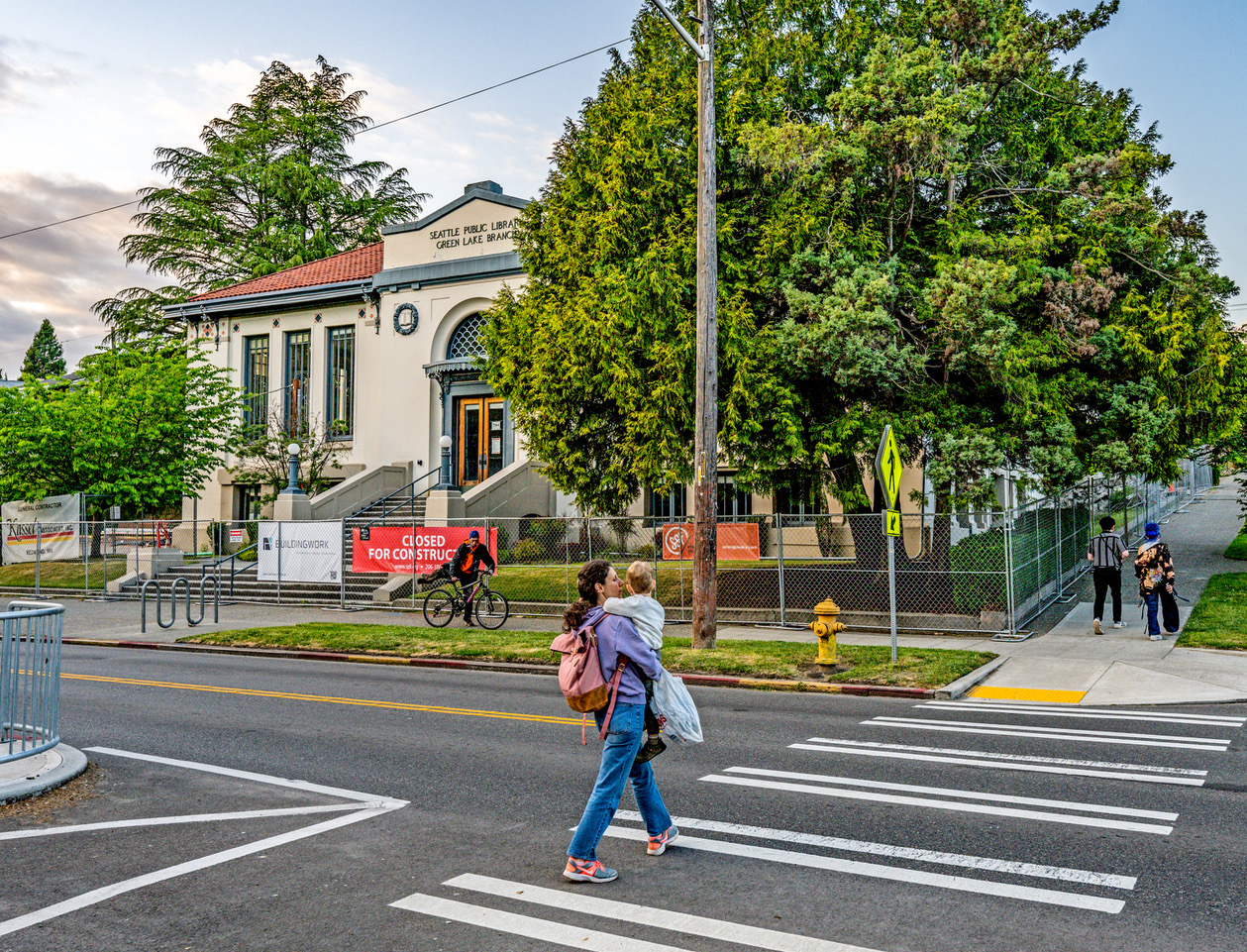
THEN1: The Green Lake Branch of the Seattle Public Library, just before opening its doors in July 1910. Most likely librarian Mayme Batterson and children’s librarian Loretta Cole are posed among the threesome on the front steps. (Courtesy Museum of History & Industry)NOW1: Today’s Green Lake Branch perches above the shores of one of Seattle’s most popular parks. In 2019, voters approved a levy to earthquake-proof the building, which will re-open in 2024. (Jean Sherrard)
Published in The Seattle Times online on July 6, 2023
and in PacificNW Magazine of the printed Times on July 9, 2023
Renovations will bolster Green Lake’s ‘heart of the community’
By Jean Sherrard
While today’s billionaires are blowing up rockets in Earth’s lower atmosphere and dreaming of colonizing Mars, one of the richest men in the world at the dawn of the 20th century devoted himself to building an enduring legacy of brick and mortar.
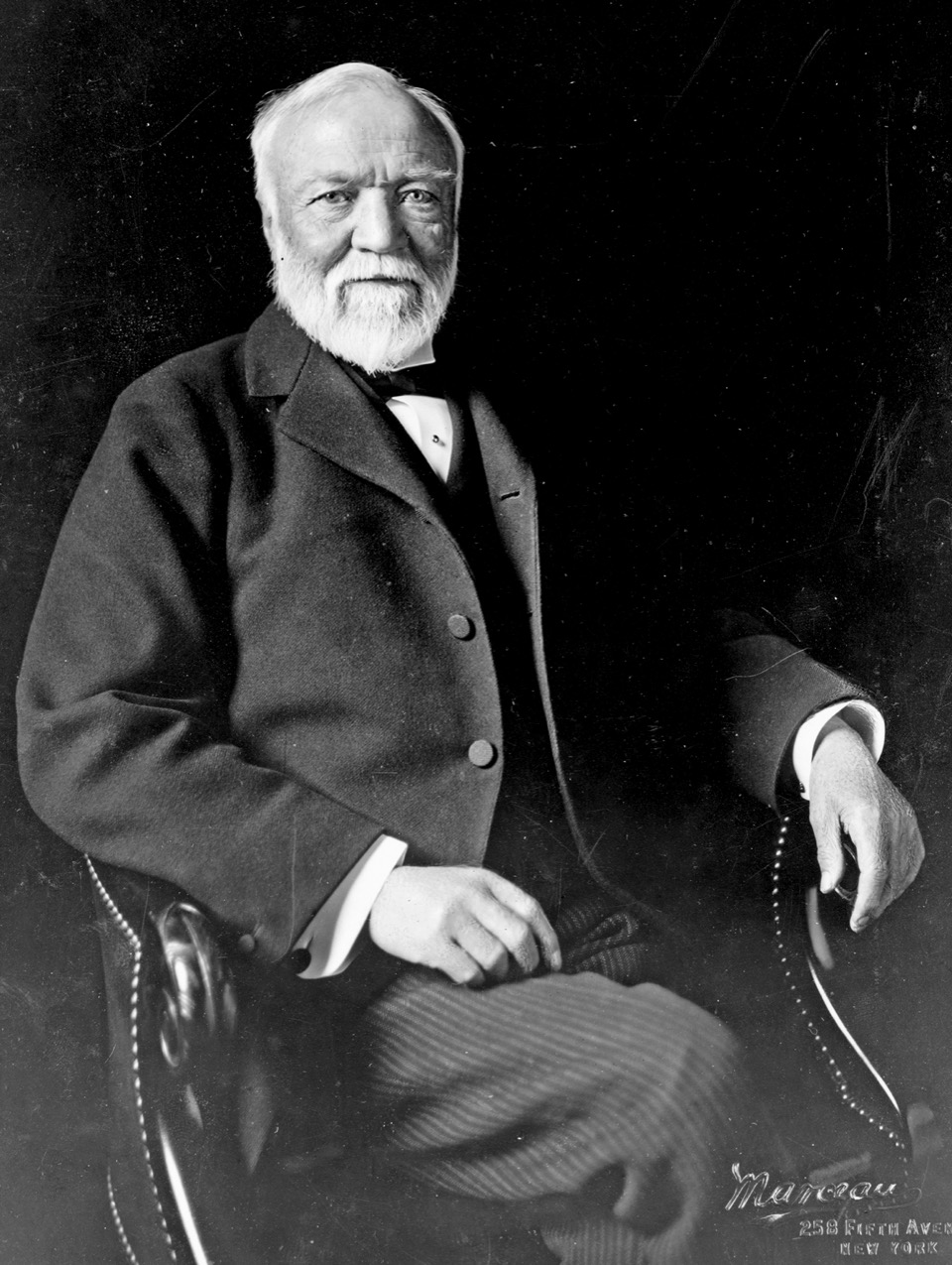
Industrialist, bibliophile and philanthropist Andrew Carnegie (1835-1919) emigrated from Scotland to the United States with his working-class parents in 1847. At 13, he worked in an Allegheny cotton mill, changing bobbins 6 days a week, 12 hours a day. From these unlikely beginnings, Carnegie’s industrial innovations and political machinations resulted in a vast steel empire.
A notorious strikebreaker noted for paying his workers abysmally low wages, the complicated robber baron also publicly supported progressive tax laws, including estate taxes. Famously he insisted, “The man who dies rich, dies in disgrace.”
Philanthropist Andrew Carnegie in 1913, age 78. His sale of Carnegie Steel to US Steel in 1901 made him one of the richest men of his era.
Indeed, by the time of his death, Carnegie had donated 90% of his wealth, largely in funding construction of 2,509 libraries throughout the English-speaking world — 1,689 in the United States alone.
Moreover, committed to wide accessibility of literature and reading, Carnegie promoted unrestricted “open stack” policies, encouraging library patrons to browse freely among shelves of books.
One of 7 extant Carnegie library buildings in Seattle, the Green Lake Branch was built on land purchased chiefly by neighborhood contributions. Carnegie’s foundation fronted $35,000 (around $1.2 million in today’s dollars) for construction of the two-story edifice.
Designed by Seattle architects Woodruff Somerville and Joseph Cote in French Renaissance Revival style while hewing to Carnegie’s prescriptions, the elegant structure has more than held its own, nominated to the National Register of Historic Places in 1982 and designated a Seattle landmark in 2001.
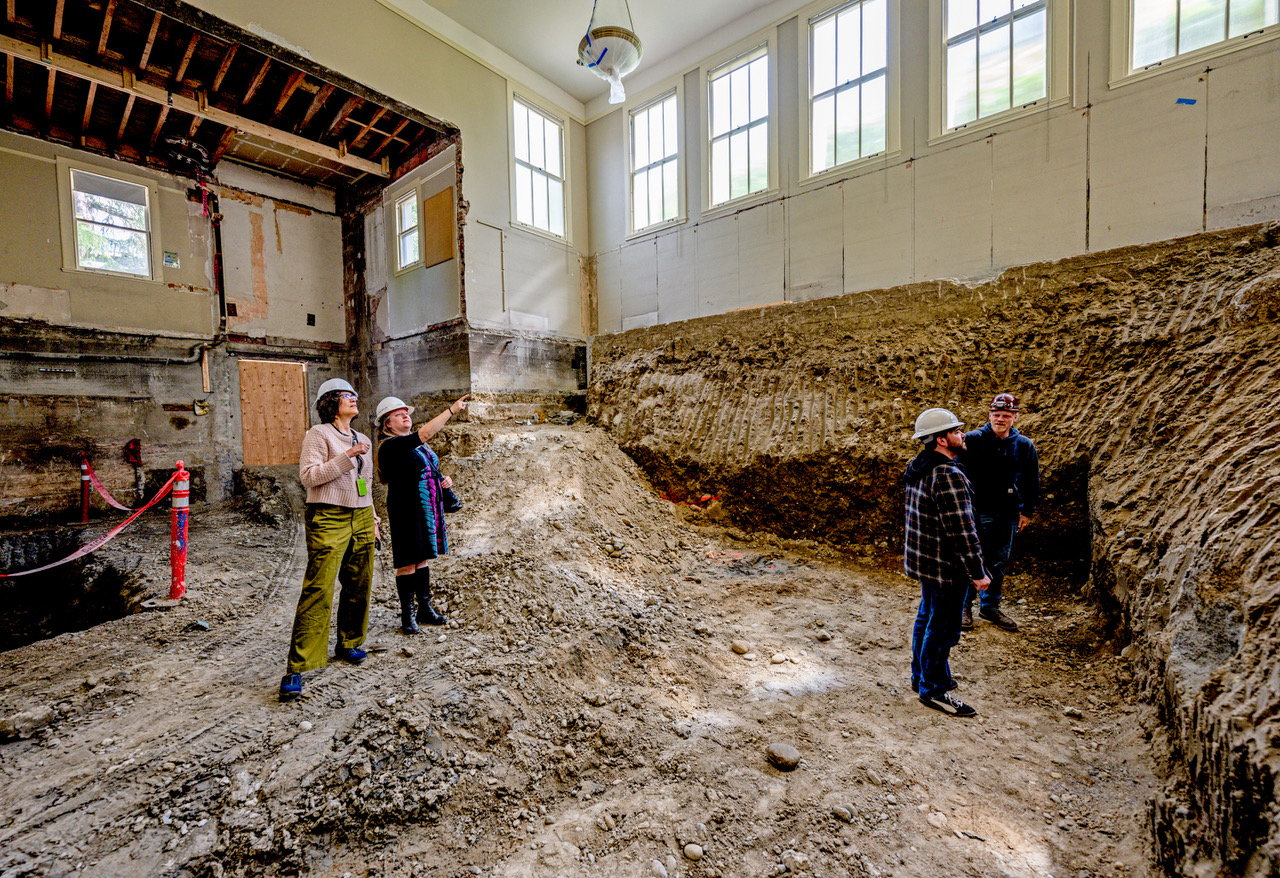
Dawn Rutherford, the Seattle Public Library’s interim northwest regional manager, and Elisa Murray, digital communications specialist, provide reflections at the branch, the first of three unreinforced masonry Carnegie library structures to be shuttered for seismic retrofitting, ADA accessibility upgrades, conversion to an electric heat pump system and significant interior renovations.
Library staffers Elisa Murray (left) and Dawn Rutherford look up from a freshly dug pit where seismically reinforced foundations are to be poured. Project engineer Jordan B. and superintendent Danny Werven (right) examine exposed glacial till. “Almost as hard as concrete,” Werven says. (Jean Sherrard)
Will Carnegie’s investment in libraries continue to yield dividends in today’s digital era? “The more we’re online,” Rutherford says, “the more we need a physical place that we can come together.” For young and old, she says, seeking to understand and adapt to changing technologies, libraries remain “the beating heart of the community.”
Besides, Murray adds, “People still love their books, and at the library, books are our baseline.”
Not having died with the most toys, Carnegie, a man of seemingly irreconcilable contradictions, left behind gifts that will enrich and enlighten terrestrial communities for generations to come.
WEB EXTRAS
More interior photos of seismic and facility improvements:
The original commemorative plaquePreparing the library’s foundation for new footings to support the retrofit.The former children’s sectionConstruction seen from the main floorFrom left, Elisa Murray, Dawn Rutherford, Jordan B. and Danny Werven stand above the abyss.