THEN1: Three engineers adjust steam-plant settings on boiler-room control panels at the 85-foot-tall Georgetown steam plant. Seattle City Light purchased the facility in 1951. The plant continued to generate backup power into the 1970s, when it was decommissioned. Little information accompanies the original photo aside from an approximate date of 1909 (Seattle Municipal Archives)NOW1: Elke Hautala, Cari Simson, and Genevieve Hale-Case, executive director of the Georgetown Steam Plant Community Development Authority, assume equivalent poses. Since the 1980s, the steam plant has hosted City Light and community events in its vast industrial-era chambers. (Jean Sherrard)
Published in The Seattle Times online on Oct. 26, 2023 and in PacificNW Magazine of the printed Times on Oct. 29, 2023
Ghost stories arise from horrific Georgetown steam plant casualty
By Jean Sherrard
You might say they see dead people.
As Cari Simson and Elke Hautala researched the Seattle Electric Company’s Georgetown steam plant, erected in 1906, they found grim accounts of a horrific accident.
Cari Simson (left) and Elke Hautala stand in front of the steam plant near the northwest corner of the King County Airport. In addition to their ongoing research, they share duties of event production with the Friends of Georgetown History, a group that this month hosted its 20th annual Georgetown Haunted History Tour.
One of the first West Coast reinforced concrete structures, the steam plant originally powered the Interurban Railway between Seattle and Tacoma and supplied direct current for Seattle streetcars and alternating current for Georgetown.
Hautala examines the plants controls
In April 1908, a defective steam pipe burst in the boiler room, hurling two Georges — George Tucker, chief engineer, and George Love, oiler — 25 feet to the concrete floor below. Despite their gruesome injuries, observers reported that Tucker coolly directed workers coming to their aid with “wonderful nerve.”
: The steam plant’s turbine room, next to where George Tucker was critically injured in the boiler room. For more stories of ghosts and history, visit FOGHI.org, and stay tuned for a podcast in 2024 about the Potter’s Field.
The men were taken to nearby Seattle General Hospital, where Tucker, 32, lingered for 10 days before succumbing to his burns. Love was sent home three months later, finally able to walk again.
Here, Hautala and Simson introduce spine-tingling elements to the narrative.
Since Tucker’s demise, they assert, tales of paranormal activity have proliferated. Pallets of tools and equipment have moved inexplicably. Plant visitors have been startled by footsteps on vacant stairs and machines springing to life on their own. Talk about Halloween-ish things going bump in the night!
Steam plant interior
Simson, an event producer and environmental consultant, has a hair-raising but benign explanation.
“We believe that George Tucker’s ghost is benevolent,” she says. “He may be stuck with unfinished business, trying to make sure his men complete their work safely.”
Puckishly, Hautala, visual anthropologist, filmmaker and performer, adds, “Call us ghost-curious.”
Hautala performs a seance in this year’s Georgetown Haunted History tour.
Skeptics might note that this knowing credulity serves a purpose. “Covering these hidden histories and coming up with ways to share them with the public is part of what inspires us,” Hautala says.
“We think of these as echoes of history,” Simson says, “here to remind us of something important.”
Their spirited partnership began during the pandemic, when they researched a lost cemetery at the nearby Duwamish River. From 1876 to 1912, impoverished and dispossessed locals were buried in the Duwamish Poor Farm Cemetery, most in graves unmarked. In 1912, the U.S. Army Corps of Engineers, before dredging and straightening the river, disinterred this Potter’s Field.
Near the site of the Georgetown potter’s field, removed in 1912
“There were 3,260 people buried there, of whom 855 had names associated with them on headboards,” Hautala says. “All of them were cremated and essentially erased to history.”
The crematorium stood in this field behind Simson and Hautala
Dedicated to unearthing and documenting these forgotten lives, neither researcher is shy about their goal.
“We aim to create a visceral thrill and engagement surrounding history,” says Simson.
“The haunted, spooky and paranormal,” Hautala adds, “provide the perfect framework.”
WEB EXTRAS
To view our narrated 360 degree video, click here.
A few photos from this year’s Georgetown Haunted History Tour below:
Charlotte Bushue, featured in this installment of “Now & Then,” died of a sudden illness Friday night, Oct. 20, 2023, at Swedish Cherry Hill. Charlotte’s son and daughter asked that this be known. Charlotte became an instant friend to me. Jean Sherrard and I hope this installment serves as a fitting tribute to her. — Clay Eals
=====
(Click and click again to enlarge photos)
THEN1: Jean Frazier, 23, sits amid the Paradise wildflowers during her stint as a guide at Mount Rainier National Park in the summer of 1926. Today, modernized trails protect the natural areas. (Courtesy Charlotte Dean Bushue)NOW: Charlotte Dean Bushue repeats the 1926 pose of her mother at the foot of the Skyline Trail near the Henry M. Jackson Visitor Center at Paradise. The mountain’s national park was established in 1899. (Clay Eals)
Published in The Seattle Times online on Oct. 19, 2023
and in PacificNW Magazine of the printed Times on Oct. 22, 2023
Lofty Mount Rainier beckons
to young woman in 1926, and her daughter today
By Clay Eals
Invariably, it looms large. Some days it sparkles, taking our breath anew, though we’ve seen it countless times. Other days it faintly hovers in the haze. Still other days, it’s invisible, but we know it’s there.
Of course, I’m speaking of Mount Rainier. From one generation to the next, it’s the rock of our Northwest identity.
I renewed my awe for this perennial presence at a talk by historian Dan Kerlee last May at the Mirabella Seattle retirement community. Also attending was resident and Seattle native Charlotte Dean Bushue.
THEN2: Perched in 1926 on Pinnacle Peak, south of Mount Rainier and Paradise, is guide Jean Frazier. (Courtesy Charlotte Dean Bushue, 29 of 42)
Afterward, I learned that Charlotte, 88, had brought along a battered box of 42 professional photos taken at and near Rainier’s Paradise trail base in 1926. Several of the 8-by-10s depicted Charlotte’s then-23-year-old mother, Jean Frazier, working as a guide that summer.
The box by her side, Charlotte reflected on her mom, who graduated college with honors and held several jobs: “She was a smart lady, and she liked to do unique things.” During the Depression, Frazier worked at a Seattle bank, “sitting at a table at the entrance to the bank with a pile of cash, reassuring the public that their money was safe. Can you imagine doing that now?”
THEN3: Guides, including Jean Frazier at left, ponder 14,411-foot Mount Rainier, likely from the Glacier Vista trail in 1926. The peak’s Native identity translated to “The Mountain That Was God,” also the name of its most enduring guidebook. (Courtesy Charlotte Dean Bushue, 42 of 42)
Frazier also adopted a homemaking trajectory. She married in 1929, gave birth to Charlotte in 1935 and another daughter in 1938. The three followed Frazier’s husband through stateside military service during World War II. Frazier embraced entertaining guests, playing bridge and hiking the Silverton/Big Four region of the Washington Cascades. “She was tough, just her personality. With what we went through as a family during the war, I think it was tough for her not to have a profession.”
THEN4 : Guides gather at Paradise in 1926. It is not known if Jean Frazier is among them. The sign reads, “An invitation: Moving picture and lantern slide lecture every evening in auditorium. Everyone invited. Rainier National Park Co.” (Courtesy Charlotte Dean Bushue, photo 3 of 42)
The keepsake box symbolizes a formative season that Frazier apparently treasured but didn’t chronicle or discuss with her children. But the photos themselves — showing a vibrant young woman alone and with peers crossing meadows and cavorting on shorter nearby peaks, with lofty Rainier as a backdrop — tell a vivid tale.
An alternate NOW portrait of Charlotte Dean Bushue, at the foot of the Skyline Trail at Paradise. (Clay Eals)
Today, active like her mom, Charlotte golfs and organizes walks at Mirabella. In August, I drove her to Paradise, where she readily repeated her mom’s 97-year-old pose. She beamed with satisfaction: “That she had that experience makes me happy.”
The twin gazes of mother and daughter, backed by gleaming grandeur, reflect the warmth of youthful dreams. And Charlotte’s tenderness beckons most anyone’s Rainier yearnings, certainly my own.
As a child, I often was driven by my mom across the Mercer Island floating bridge. On a clear day, she would point south and proclaim, “Get out your ice-cream spoons. The mountain’s out!”
WEB EXTRAS
Thanks to Dan Kerlee, Brooke Childrey and especially Charlotte Dean Bushue for their invaluable help with this installment!
To see Clay Eals‘ 360-degree video of the “Now” prospect and compare it with the “Then” photos, and to hear this column read aloud by Clay, check out our Seattle Now & Then 360 version of the column.
To see information on the Mount Rainier guide service, automobile rates and hotel rates in 1920, see this National Parks History page.
Below are two additional videos of:
Charlotte Bushue reflecting June 2, 2023, on her mother, Jean Frazier.
Dan Kerlee‘s presentation on the history of Mount Rainier on May 24, 2023, at Mirabella Seattle retirement community.
Charlotte Bushue stands at the entrance to Paradise Inn on Aug. 1, 2023. (Clay Eals)Cover of the 1932 third edition of the guidebook “The Mountain That Was God.”Photo #4 of 42 professional photos of Mount Rainier and environs, saved by Charlotte Bushue, daughter of Jean Frazier, who worked on Rainier in 1926 as a guide. (Courtesy Charlotte Bushue)Photo #2 of 42 professional photos of Mount Rainier and environs, saved by Charlotte Bushue, daughter of Jean Frazier, who worked on Rainier in 1926 as a guide. (Courtesy Charlotte Bushue)Photo #5 of 42 professional photos of Mount Rainier and environs, saved by Charlotte Bushue, daughter of Jean Frazier, who worked on Rainier in 1926 as a guide. (Courtesy Charlotte Bushue)Photo #6 of 42 professional photos of Mount Rainier and environs, saved by Charlotte Bushue, daughter of Jean Frazier, who worked on Rainier in 1926 as a guide. (Courtesy Charlotte Bushue)Photo #13 of 42 professional photos of Mount Rainier and environs, saved by Charlotte Bushue, daughter of Jean Frazier, who worked on Rainier in 1926 as a guide. (Courtesy Charlotte Bushue)Photo #12 of 42 professional photos of Mount Rainier and environs, saved by Charlotte Bushue, daughter of Jean Frazier, who worked on Rainier in 1926 as a guide. (Courtesy Charlotte Bushue)Photo #11 of 42 professional photos of Mount Rainier and environs, saved by Charlotte Bushue, daughter of Jean Frazier, who worked on Rainier in 1926 as a guide. (Courtesy Charlotte Bushue)Photo #10 of 42 professional photos of Mount Rainier and environs, saved by Charlotte Bushue, daughter of Jean Frazier, who worked on Rainier in 1926 as a guide. (Courtesy Charlotte Bushue)Photo #9 of 42 professional photos of Mount Rainier and environs, saved by Charlotte Bushue, daughter of Jean Frazier, who worked on Rainier in 1926 as a guide. (Courtesy Charlotte Bushue)Photo #8 of 42 professional photos of Mount Rainier and environs, saved by Charlotte Bushue, daughter of Jean Frazier, who worked on Rainier in 1926 as a guide. (Courtesy Charlotte Bushue)Photo #7 of 42 professional photos of Mount Rainier and environs, saved by Charlotte Bushue, daughter of Jean Frazier, who worked on Rainier in 1926 as a guide. (Courtesy Charlotte Bushue)Photo #14 of 42 professional photos of Mount Rainier and environs, saved by Charlotte Bushue, daughter of Jean Frazier, who worked on Rainier in 1926 as a guide. (Courtesy Charlotte Bushue)Photo #15 of 42 professional photos of Mount Rainier and environs, saved by Charlotte Bushue, daughter of Jean Frazier, who worked on Rainier in 1926 as a guide. (Courtesy Charlotte Bushue)Photo #16 of 42 professional photos of Mount Rainier and environs, saved by Charlotte Bushue, daughter of Jean Frazier, who worked on Rainier in 1926 as a guide. (Courtesy Charlotte Bushue)Photo #17 of 42 professional photos of Mount Rainier and environs, saved by Charlotte Bushue, daughter of Jean Frazier, who worked on Rainier in 1926 as a guide. (Courtesy Charlotte Bushue)Photo #18 of 42 professional photos of Mount Rainier and environs, saved by Charlotte Bushue, daughter of Jean Frazier, who worked on Rainier in 1926 as a guide. (Courtesy Charlotte Bushue)Photo #19 of 42 professional photos of Mount Rainier and environs, saved by Charlotte Bushue, daughter of Jean Frazier, who worked on Rainier in 1926 as a guide. (Courtesy Charlotte Bushue)Photo #20 of 42 professional photos of Mount Rainier and environs, saved by Charlotte Bushue, daughter of Jean Frazier, who worked on Rainier in 1926 as a guide. (Courtesy Charlotte Bushue)Photo #27 of 42 professional photos of Mount Rainier and environs, saved by Charlotte Bushue, daughter of Jean Frazier, who worked on Rainier in 1926 as a guide. (Courtesy Charlotte Bushue)Photo #26 of 42 professional photos of Mount Rainier and environs, saved by Charlotte Bushue, daughter of Jean Frazier, who worked on Rainier in 1926 as a guide. (Courtesy Charlotte Bushue)Photo #25 of 42 professional photos of Mount Rainier and environs, saved by Charlotte Bushue, daughter of Jean Frazier, who worked on Rainier in 1926 as a guide. (Courtesy Charlotte Bushue)Photo #24 of 42 professional photos of Mount Rainier and environs, saved by Charlotte Bushue, daughter of Jean Frazier, who worked on Rainier in 1926 as a guide. (Courtesy Charlotte Bushue)Photo #23 of 42 professional photos of Mount Rainier and environs, saved by Charlotte Bushue, daughter of Jean Frazier, who worked on Rainier in 1926 as a guide. (Courtesy Charlotte Bushue)Photo #22 of 42 professional photos of Mount Rainier and environs, saved by Charlotte Bushue, daughter of Jean Frazier, who worked on Rainier in 1926 as a guide. (Courtesy Charlotte Bushue)Photo #21 of 42 professional photos of Mount Rainier and environs, saved by Charlotte Bushue, daughter of Jean Frazier, who worked on Rainier in 1926 as a guide. (Courtesy Charlotte Bushue)Photo #28 of 42 professional photos of Mount Rainier and environs, saved by Charlotte Bushue, daughter of Jean Frazier, who worked on Rainier in 1926 as a guide. (Courtesy Charlotte Bushue)Photo #30 of 42 professional photos of Mount Rainier and environs, saved by Charlotte Bushue, daughter of Jean Frazier, who worked on Rainier in 1926 as a guide. (Courtesy Charlotte Bushue)Photo #31 of 42 professional photos of Mount Rainier and environs, saved by Charlotte Bushue, daughter of Jean Frazier, who worked on Rainier in 1926 as a guide. (Courtesy Charlotte Bushue)Photo #32 of 42 professional photos of Mount Rainier and environs, saved by Charlotte Bushue, daughter of Jean Frazier, who worked on Rainier in 1926 as a guide. (Courtesy Charlotte Bushue)Photo #33 of 42 professional photos of Mount Rainier and environs, saved by Charlotte Bushue, daughter of Jean Frazier, who worked on Rainier in 1926 as a guide. (Courtesy Charlotte Bushue)Photo #34 of 42 professional photos of Mount Rainier and environs, saved by Charlotte Bushue, daughter of Jean Frazier, who worked on Rainier in 1926 as a guide. (Courtesy Charlotte Bushue)Photo #35 of 42 professional photos of Mount Rainier and environs, saved by Charlotte Bushue, daughter of Jean Frazier, who worked on Rainier in 1926 as a guide. (Courtesy Charlotte Bushue)Photo #36 of 42 professional photos of Mount Rainier and environs, saved by Charlotte Bushue, daughter of Jean Frazier, who worked on Rainier in 1926 as a guide. (Courtesy Charlotte Bushue)Photo #37 of 42 professional photos of Mount Rainier and environs, saved by Charlotte Bushue, daughter of Jean Frazier, who worked on Rainier in 1926 as a guide. (Courtesy Charlotte Bushue)Photo #38 of 42 professional photos of Mount Rainier and environs, saved by Charlotte Bushue, daughter of Jean Frazier, who worked on Rainier in 1926 as a guide. (Courtesy Charlotte Bushue)Photo #39 of 42 professional photos of Mount Rainier and environs, saved by Charlotte Bushue, daughter of Jean Frazier, who worked on Rainier in 1926 as a guide. (Courtesy Charlotte Bushue)Photo #40 of 42 professional photos of Mount Rainier and environs, saved by Charlotte Bushue, daughter of Jean Frazier, who worked on Rainier in 1926 as a guide. (Courtesy Charlotte Bushue)Photo #41 of 42 professional photos of Mount Rainier and environs, saved by Charlotte Bushue, daughter of Jean Frazier, who worked on Rainier in 1926 as a guide. (Courtesy Charlotte Bushue)Jan. 15, 1926, Seattle Times, p9.May 4, 1926, Seattle Post-Intelligencer, p28.June 13, 1926, Seattle Post-Intelligencer, p68 and 76.
THEN1: In front of 9,000 fans on Oct. 19, 1924, in a barnstorming game at Dugdale Park, Babe Ruth eyes the arc of a hit after a mighty swing. The photo is featured in the “Baseball All-Stars” exhibit at the Museum of History & Industry. At right, Ruth’s name is etched backward in the image’s negative. (Courtesy Museum of History & Industry, Seattle Post-Intelligencer Collection)NOW1: Mike Burns of Fremont uses a Babe Ruth-model bat to mirror the slugger’s 1924 swing at the home-plate display at Lowe’s Home Improvement, formerly the site of Dugdale Park and Sick’s Stadium. Burns’ grandfather, Bobby Burns, starred at first base for Seattle amateur teams and is named in a program for the Oct. 19, 1924, exhibition game as batting fifth behind Ruth. Mimicking the catcher with period mask and mitt is Devorah Romanek, exhibit chief at the Museum of History & Industry, whose “Baseball All-Stars” exhibit runs through Nov. 5. (Clay Eals)
Published in The Seattle Times online on Oct. 5, 2023
and in PacificNW Magazine of the printed Times on Oct. 8, 2023
The charming, barnstorming Babe Ruth captivates Seattle in 1924
By Clay Eals
With major-league baseball’s post-season swinging into high gear, “Now & Then” eagerly commemorates the first sighting of the Babe in our woods — George Herman “Babe” Ruth, that is.
Given today’s seemingly endless playoffs, this year’s champion team may not emerge before Nov. 4. But in the simpler schedule of 1924, the sole post-season play was the World Series, which that year ended Oct. 10. Immediately afterward, star ballplayers barnstormed, playing coast-to-coast exhibition contests, mostly west of the Mississippi — land of no big-league ballclubs.
Thus, 99 years ago, Seattle caught its first in-person glimpse of the megawatt New York Yankees outfielder known as the Bambino.
At age 29, Babe Ruth already had patented the persona of a slugger, having hit 284 of what became 714 career regular-season home runs. His 1924 batting average (.378) topped the American League. Sportswriters’ synonyms for him soared. (Sample: the “Supreme Socker.”) And his on-field performance reinforced a joyful, larger-than-life charisma. People of all ages, especially kids, revered the man.
THEN2: From grass near home plate, Babe Ruth watches a hit fly away, perhaps during a pre-game session in which he batted balls to more than 1,000 kids stationed in centerfield at Rainier Valley’s Dugdale Park. In Portland the same day, the Seattle Indians clinched the Pacific Coast League pennant.(Courtesy Museum of History & Industry, Seattle Post-Intelligencer Collection)
Sponsored by the Seattle Post-Intelligencer, Ruth visited Seattle with teammate Bob Meusel.
In front of 9,000 fans in an Oct. 19 game enlisting local amateurs at Rainier Valley’s Dugdale Park, Ruth played errorless first base and, befitting his roots, pitched one inning.
A Babe Ruth home-run ball from the Oct. 19, 1924, exhibition game at Dugdale Park, signed by the Babe. (Courtesy Dave Eskenazi)
In nine at-bats, he belted three homers and a double. His first four-bagger, the P-I’s Royal Brougham reported tongue-in-cheek, “hit Mount Rainier on the first bounce!”
During a late inning, Brougham wrote, a “curly-headed tot” ran out to Ruth, who bent over, shook the boy’s hand, patted his head and “sent him away happy.” Seventy-one years later, Dr. Bill Hutchinson told the P-I the boy was his 5-year-old brother Fred, who later gained fame as a big-league pitcher and manager and cancer-center namesake.
THEN3: During his 1924 visit to Seattle, Babe Ruth perches on a car to toss baseballs to two-dozen capped boys. That fall, Ruth’s and teammate Bob Meusel’s teams traveled 8,500 post-season miles and played in 15 cities for 125,000 fans, Ruth hitting 17 homers. Ruth returned to Seattle in 1926 and 1947. He died in 1948 at age 53. (Courtesy Museum of History & Industry, Seattle Post-Intelligencer Collection)
Ruth, here for two days, also hit balls pre-game to 1,000-plus kids in centerfield, visited hospitalized children, spoke at a banquet, “directed” conjoined twins who played “The Strike-Out Blues” on saxophone, and tossed autographed balls to fans from the P-I building at Sixth and Pine.
He even spoke against a statewide initiative to abolish private schools, saying that if not for a Baltimore industrial reform school, he “probably never would have been heard of.” The measure was defeated.
Before leaving Seattle, Ruth penned for a Western Union messenger a homily both touching and timeless:
“You can knock a home run always doing your work properly and travel the bases until you reach home plate. Success. Don’t alibi if you miss one. Play the game fair. Be there in the pinches, and in your business life you can be the ‘King of Swat’.”
WEB EXTRAS
Thanks to Dave Eskenazi, Mike Burns, and, at the Museum of History & Industry, Devorah Romanek, Julianne Kidder and Allie Delyanis for their invaluable help with this installment!
To see Clay Eals‘ 360-degree video of the “Now” prospect and compare it with the “Then” photos, and to hear this column read aloud by Clay, check out our Seattle Now & Then 360 version of the column.
In addition, here is a special letter from 1944 from Babe Ruth to P-I sports editor Royal Brougham, courtesy of Cathi Soriano:
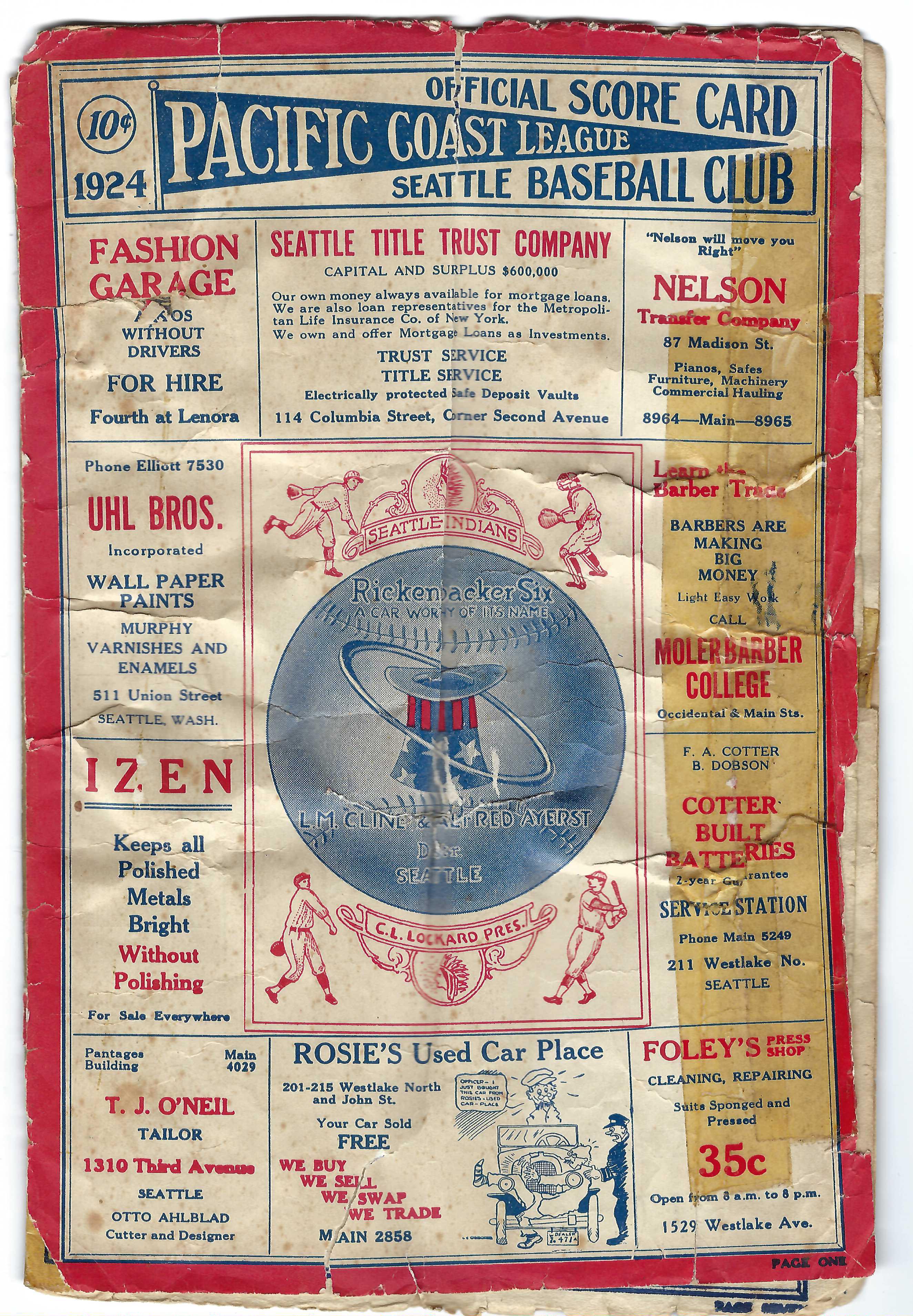
Gathering at the Lowe’s home-plate display for the “Now” photo shoot are (from left) Seattle baseball historian Dave Eskenazi; Devorah Romanek, exhibit chief at the Museum of History & Industry; and Mike Burns, grandson of Bobby Burns, who batted behind Babe Ruth in the Oct. 19, 1924, exhibition game. (Clay Eals)Before the “Now” photo shoot, Mike Burns (left) talks with historian Dave Eskenazi about the Babe Ruth-model bats that Eskenazi brought to the shoot at Lowe’s Home Improvement in the Rainier Valley. (Clay Eals)In the Museum of History & Industry’s “Baseball All Stars” exhibit, which runs through Nov. 5, private-collection game-worn jerseys and bats from Babe Ruth, Ted Williams, Roberto Clemente, Willie Mays, Sandy Koufax, Ichiro Suzuki and Ken Griffey Jr. mix with gems contributed by historian Dave Eskenazi, the Black Heritage Society, the Seattle Mariners and MOHAI from Seattle’s pre-Mariners years, including local Black, Asian and Native teams such as the Seattle Owls, a 1938 state-championship Black women’s softball team. (Clay Eals)Newly added first-floor panels at the Museum of History & Industry for its “Baseball All-Stars” exhibit depict gems contributed by historian Dave Eskenazi, the Black Heritage Society, the Seattle Mariners and MOHAI from Seattle’s pre-Mariners years, including local Black, Asian and Native teams. The exhibit runs through Nov. 5. (Julianne Kidder)A newly added first-floor panel at the Museum of History & Industry for its “Baseball All-Stars” exhibit. Panels depict gems contributed by historian Dave Eskenazi, the Black Heritage Society, the Seattle Mariners and MOHAI from Seattle’s pre-Mariners years, including local Black, Asian and Native teams. The exhibit runs through Nov. 5. (Julianne Kidder)A newly added first-floor panel at the Museum of History & Industry for its “Baseball All-Stars” exhibit. Panels depict gems contributed by historian Dave Eskenazi, the Black Heritage Society, the Seattle Mariners and MOHAI from Seattle’s pre-Mariners years, including local Black, Asian and Native teams. The exhibit runs through Nov. 5. (Julianne Kidder)A newly added first-floor panel at the Museum of History & Industry for its “Baseball All-Stars” exhibit. Panels depict gems contributed by historian Dave Eskenazi, the Black Heritage Society, the Seattle Mariners and MOHAI from Seattle’s pre-Mariners years, including local Black, Asian and Native teams. The exhibit runs through Nov. 5. (Julianne Kidder)A newly added first-floor panel at the Museum of History & Industry for its “Baseball All-Stars” exhibit. Panels depict gems contributed by historian Dave Eskenazi, the Black Heritage Society, the Seattle Mariners and MOHAI from Seattle’s pre-Mariners years, including local Black, Asian and Native teams. The exhibit runs through Nov. 5. (Julianne Kidder)Outside its front entrance on July 4, the Museum of History & Industry issues a pre-All-Star Game welcome to its “Baseball All-Stars” exhibit, which runs through Nov. 5. (Clay Eals)A portion of the Oct. 19, 1924, exhibition-game program shows Babe Ruth batting fourth, followed by Bobby Burns batting fifth. Contrary to the program details, however, the Seattle Post-Intelligencer reported that Ruth, not Burns, played first base for most of the game. Batting first, “Torrence” represented later Seattle sports legend Roscoe “Torchy” Torrance. (Courtesy Mike Burns)A full page of the Oct. 19, 1924, exhibition-game program showing the “Seattle All Stars,” including Babe Ruth batting fourth, followed by Bobby Burns batting fifth. Contrary to the program details, the Seattle Post-Intelligencer reported that Ruth, not Burns, played first base for most of the game. (Courtesy Mike Burns)Another full page of the Oct. 19, 1924, exhibition-game program showing the opposing team, the “Timber League Stars,” and showcasing the sponsoring Seattle Post-Intelligencer. Courtesy Mike Burns)Another full page of the Oct. 19, 1924, exhibition-game program. (Courtesy Mike Burns)In this September 1924 view of the City Sash & Door town team at Dugdale Park. Bobby Burns, grandfather of Mike Burns in the “Now” photo, stands in the back row, third from left. (Cowan photo, courtesy Mike Burns)In this alternate view from September 1924 of the City Sash & Door town team at Dugdale Park. Bobby Burns, grandfather of Mike Burns in the “Now” photo, stands third from left. (Cowan photo, courtesy Mike Burns)In this 1916 view of the Stacy Shown Jewelers town team, Bobby Burns stands at center. (Courtesy Mike Burns)Batting possibly for the Seattle All-Stars in the Oct. 19, 1924, exhibition game, Bobby Burns takes a high pitch for a ball. (Courtesy Mike Burns)Four generations of Burnses in 1957: (from left) Mike Burns, nearly 3; Mike’s dad, Bob Burns, 22; Mike’s grandfather, Bobby Burns, 61, who batted fifth, after Babe Ruth, in the Oct. 19, 1924, exhibition game; and Mike’s great-grandfather, Bill Burns, 83, in front of his house in Ballard. (Courtesy Mike Burns)
NEWS CLIPS
The following clips are related to Babe Ruth’s two-day visited to Seattle in 1924.
The following clips are related to Bobby Burns and to the Seattle town teams he played for (Stacy Shown Jewelers and City Sash & Door). Burns was selected to bat fifth behind Babe Ruth in the Oct. 19, 1924, exhibition game.