THEN: The Freedman Building on Maynard Avenue was construction soon after the Jackson Street Regrade lowered the neighborhood and dropped Maynard Avenue about two stories to its present grade in Chinatown. (Photo courtesy Lawton Gowey)
NOW: The Freedman survives in an international district often distinguished by ornate four and more story brick business blocks and hotels. (Jean Sherrard)
Since first coming upon this professional view of the Freedman Building years ago I have kept it to one side, hoping that some day I might “bump into” Freedman, its namesake. Now twenty years or so of the Internet later and help also from the Seattle Public Library’s Seattle Room librarian, Jeannette Voiland and genealogy specialist John LaMont, we probably have our Freedman, and he’s from out-of-town.
The address here is 513-17 Maynard Ave., between King and Weller Streets, one lot closer to the latter. Between 1907 and 1909 this neighborhood was both scraped and filled during the Jackson Street Regrade, locally second in size only to the reduction of Denny Hill.
Louis Freedman shows up in the trade publication Pacific Builder for Aug. 21, 1909 as a citizen of Portland, Oregon intending to erect a four-story brick and concrete building at this address to cost $40,000. He chose Seattle architect W.P. White to do the designs, which decades later a U.S. register of historic places described as “One of the most elaborate facades within the (International) district, the Freedman represents a higher level of refinement and proportion of line and detail than many of its neighboring hotel structures.”
The Adams Hotel, the building’s principal tenant, appears with an advertisement in the Great Northern Daily News for Dec. 16, 1912. In the 1938 tax records the hotel’s condition is described as “fair” with 80 rooms, 18 toilets and six tubs. It operated until 1972 when it went dark for 13 years, opening with fewer and larger livings spaces in 1983 as the Freedman Apartments.
Finally we will include one anecdote in the life of the Freedman.
Early on the morning of Oct. 16, 1923 Fred H. Mitchell, a “rent car driver” patiently waited in the drivers seat while two men who had hired him filled his car with boxes of cigarettes bound for Auburn. When two curious cops on patrol interrupted, the cigarette thieves calmly carried on and left through the building’s back door, which they earlier broke open. For unwittingly acting his part in a Chinatown episode of the Keystone Kops, the innocent Mitchell was hauled to jail and spent the night.
This "now-and-then" feature first appear in Pacific Magazine on Jan. 1, 2006. As the text below explains at the time the Wing Luke Museum was still active in its campaign to raise funds for the conversion of the East Kong Yick Building into a new home for the museum, a task which has since accomplished to considerable effect. Photo courtesy of the Museum of History and Industry AKA MOHAI. This "repeat" of the East Kong Yick building was photographed in the late autumn of 2005 before the Wing Lunk Asian Museum had moved in. Aside from the fourth floor balcony overlooking King Street and a change in the building's cornice, at first inspection not much has changed in the Kong Yick building at the southwest corner of 8th S. and King Street since the Webster and Stevens photography firm took the historical photo ca. 1918.
(This feature first appeared in Pacific Magazine on January 1, 2006. The text below has not been changed. Of course, The Wing Luke Asian Museum was successful in raising the last third of the 23 million needed for moving two blocks from their old location to this new old one.)
The Wing Luke Asian Museum has raised more than two-thirds of the 23 million it needs to restore and arrange the 60,000 feet within these brick walls into a new home for what is the only pan-Asian Pacific American museum in the U.S.
The opportunity to move less than two blocks from its now old home on 7th South near Jackson (in a converted car repair garage) into the East Kong Yick Building on King Street is motive enough to sustain an ambitious capital campaign. But this opportunity for the museum to expand its role in the community required the cooperation of an earthquake and the 95 year-old building’s many shareholders – some of whom had lived or worked in the building or even descended from those who had built it.
As the old story goes, in 1910 — soon after the extensive Jackson Street regrade had lowered this intersection at 8th s. and King Street about as many feet as the four story building is high – 170 Chinese-American shareholders joined to finance the building of the East Kong Yick and its neighbor across Canton Alley (here far right) the West Kong Yick building. And many of them also joined their hands in the construction.
In 2001, the hotel’s ninety-first year, the Nisqualli Earthquake shook up both the building and the hotel’s by then venerable routines. The Kong Yick had been home not only for single workingmen – Chinese, Japanese and Filipino – but also families and the extended family associations that were the sustainers for a vulnerable community of minorities. This social net was also a social center where basic needs and services were charmed with entertainments: the many traditional games and shows that the immigrants had brought with them and loved. After the quake the building’s shareholders turned to the museum for help.
The Wing Luke Asian Museum plans to move over to East Kong Yick in 2007. Part of its designs include preservation of the building’s Wa Young Company storefront (third from the alley, near the center) and the hotel manager’s office. One of the buildings typical rooms will also be restored and appointed with traditional fixtures and furniture.
The tenement on the far right sat at the northwest corner of 6th Avenue and Lane Street in what is now commonly referred to as Chinatown. The view looks northeast although more north than east. The photo is used courtesy of the Museum of History and Industry, aka MOHAI. This now-then feature first appeared in the Pacific Magazine for Oct.16, 2005.Much of Chinatown in this southwest part of it was raised above the tideflats during the Jackson Street Regrade of 1907-09. This view was taken from a basement grade - used for a daylight parking lot - south and east of the intersection of 5th and Lane. It too looks to the north by northeast. Part of the south facade of Uwajimaya Village shows above.
Between 1907 and 1909 while the destruction of Denny Hill was daily attracting its own unpaid force of sidewalk inspectors (otherwise idle), Seattle’s other big earth-moving project, the Jackson Street Regrade, was underway. By comparison to the Denny Hill excitements this “second place regrade” was underwhelming to the curious public – until they started lifting the neighborhood.
The Jackson Street Regrade was named for its “Main Street” and northern border. On Jackson dirt was mostly removed — lowered nearly 90 feet at 9th avenue. But here at 5th and Lane, three blocks south of Jackson, the blocks were lifted with dirt borrowed from the burrowing and sluicing along Jackson and King Street and also from the low ridge to the east.
About fifty-six city blocks were reshaped by the Jackson Street regrade, twenty-nine of them excavated and twenty-seven – including these – raised. In particular, these blocks just east of 5th Avenue straddle both the old waterfront meander line and the trestle of the Seattle and Walla Walla railroad after it was redirected in 1879 to the shoreline south of King Street. The wood-boring Teredo worms had quickly devoured the original trestle that headed directly across the tidelands from the Seattle Waterfront.
In these raised blocks the city was responsible for lifting the streets to the new grade. The property owners, however, were required to both first lift their structures and then also to either fill in below them or construct what amounted to super-basements. Many chose the latter.
Later this subterranean region would build its own urban legends of sunken chambers reached by labyrinthine tunnels and appointed for gambling, opium and other popular and paying pastimes. The contemporary use for this particular underground at the corner of 5th Avenue and Lane Street is as a parking lot for the International District’s by now historic Uwajimaya Village.
Another 1908 look into the neighborhood being raised during the Jackson Street Regrade. The top of the then but three year old Great Northern tower pokes between the elevated building on the right and the trestle on the left. Courtesy, Museum of History and Industry aka MOHAI.
Here’s a slightly different perspective of one of my favorite places. Drove over this week to capture the subtle greens of spring, which so quickly shift to summer gold and tawny.
THEN: The clerk in the city's old Engineering Vault attends to its records. Now one of many thousands of images in the Seattle Municipal Archives, this negative is dated Jan. 30, 1936. (Check out http://www.cityofseattle.net/cityarchives/ to see more.)NOW: City archivist Scott Cline, left, and deputy archivist Anne Frantilla look to Jean Sherrard from out of the deep storage of the modern, climate-controlled archives in City Hall.
It is more than rare when this little weekly feature moves from repeating a “place” to repeating a “theme.” Still, these two places are not far apart; they are kitty-corner across Fourth Avenue and James Street.
The 1936 “then” was photographed in the city’s “Engineering Vault,” then housed in the County-City Building, long since renamed the King County Courthouse. Plans, graphs and maps are held in the tubes on the right. On the left are more rolled ephemera and shelves holding the punch-bound, engineering-project forms and reports that I was introduced to 40 years ago.
The “now” photo is of its descendant, the Seattle Municipal Archives. City archivist Scott Cline says the old records were “a great benefit for the archives; our collection was originally built on the strength of engineering and public-works records.” Cline has been city archivist since the archives’ formal beginning in 1985. Since then he has improved the place and its services while winning prizes from his peers. In 1999 Cline hired Anne Frantilla as deputy archivist. Julie Viggiano, Jeff Ware and Julie Kerssen followed in 2005.
Our archives are at least one happy example of how things may improve. In his recording of the contemporary archives, Jean Sherrard has posed Cline and Frantilla in the one aisle that is open in the long rows of files showing on the right. The rows can be quickly moved by motor along tracks in the floor.
This Tuesday, at 1 p.m., the archives will celebrate their 25th anniversary in the Bertha Knight Landes Room at City Hall, 600 Fourth Ave. I have been asked to take part by showing some slides on the growth of the city and its services, like this one. The public is encouraged to attend.
Sally and Ron and Jean did you know that your crows are members of the same family with the Steller Blue Jay? As are the ravens, rooks, jackdaws, jays magpies and nutcrackers. This afternoon, and very near to my own front door, I heard this Steller jumping from branch to branch, breaking dried twigs it seemed, and sometimes rattling, which dear Wikipedia indicates is the “sex-specific” vocalization for the female Steller. See how close – ten feet perhaps – she allowed me to approach her.
The posting of Ron’s crow tale below reminded me of another crow story – actually a crow and falcon story from a couple of years ago.
On a roof across the street from where I live in North Greenlake, a falcon was perched for about half an hour. It wasn’t long before crows found it and commenced to attack. The peregrine falcon had flown off from its handler at Woodland Park Zoo and seemed puzzled and alarmed by the diving crows, but was only driven off after the following picture was snapped, using a telephoto lens.
Peregrine falcon and attacking crow
Officials from the zoo combed our neighborhood minutes later, but to no avail. The missing falcon was found early the next morning near Northgate.
“I have been feeding a crippled crow for about a month now. He has a broken ankle and has learned to walk with his foot bent under. We have worked out a routine to distract the rest of the crows, giving him time to swoop down and grab the food I throw to the garage roof. They are really bright birds.”
Ron Edge joins the site to give us two for the crow – a crow on his garage roof, and then a sensible reflection on crows, which he has pulled from the Monday July 15, 1878 issue of the Daily Intelligencer, a precursor of the recently demised Post-Intelligencer. It is titled, “Feeding Instead of Killing Crows.”
Ron notes that if you take some time to browse YouTube you will find pet crows, playful crows, and problem-solving crows, for instance, crows that build tools to fetch food from crannies. For the toolmaker you can use Ron’s links.
Paul. The Orpheum Automobile Hotel was the cause for our reacquaintance a few years ago. Do you remember? You sent me off to Greg Lange at the Bellevue archives where I discovered this beautiful (and now digitally cleaned up) 1937 King County WPA survey photo. I spent considerable time walking the site and offer here the gorgeous original and my 2007 shot, taken with a Nikon Coolpix 995. The mosaic brickwork on the facade is just visible, peeking out from under the metal screens, if you're looking for it. If I recall correctly, the stone facing around the driveway openings is gone, a victim of the same remodel. I can almost imagine men in tails and women in furs, pulling up to a waiting valet attendant in bow tie and white gloves, before crossing the street for a concert at the Orpheum. Maybe one day I'll return with my 4x5 on a sunny winter Sunday for a serious attempt. The WPA photographer who took the survey photo was a real artist.David Jeffers repeat of the WPA tax photo he found at the Washington State Archive on the Bellevue Community College Campus.
THEN: Thanks to Pacific reader John Thomas for sharing this photograph recorded by his father in 1927. It looks north across Times Square to the almost completed Orpheum Theatre. Fifth Avenue is on the left, and Westlake on the right.NOW: Razed in 1967, the Orpheum was soon replaced by the "corncob architecture" of the Washington Plaza Hotel, later renamed the Westin. In this view from the corner of Olive Way and Fifth Avenue, Jean Sherrard has adjusted his prospect a few feet in order to look around the monorail support.
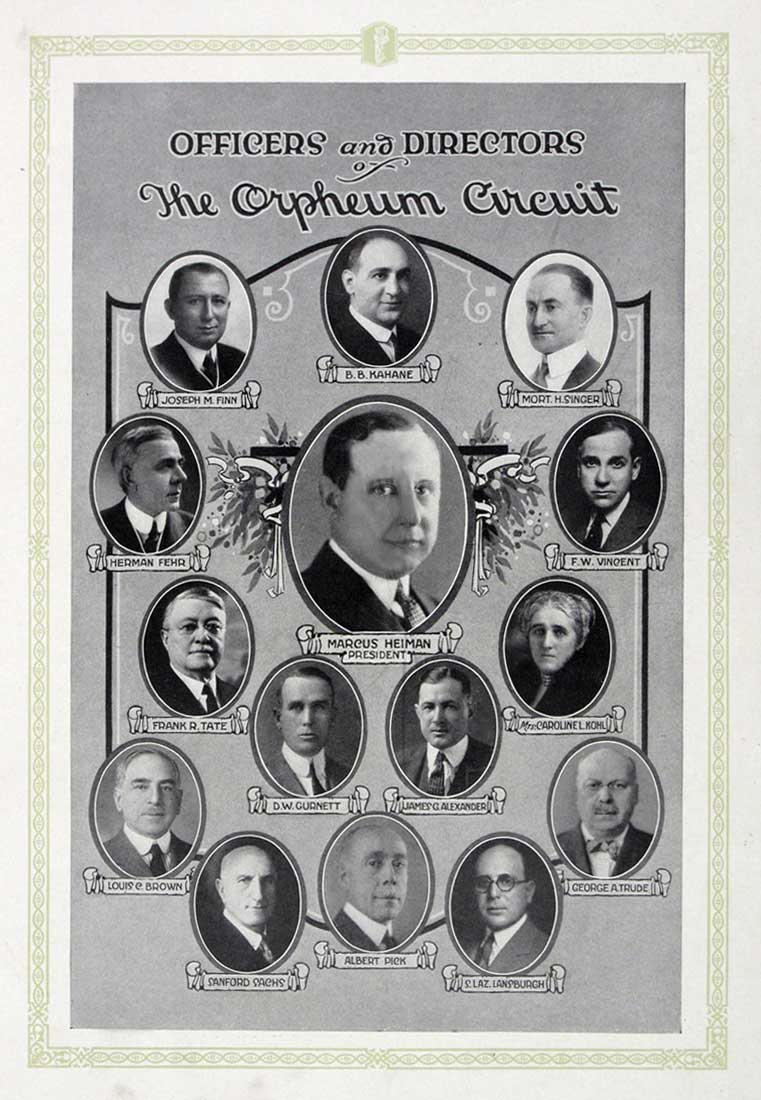
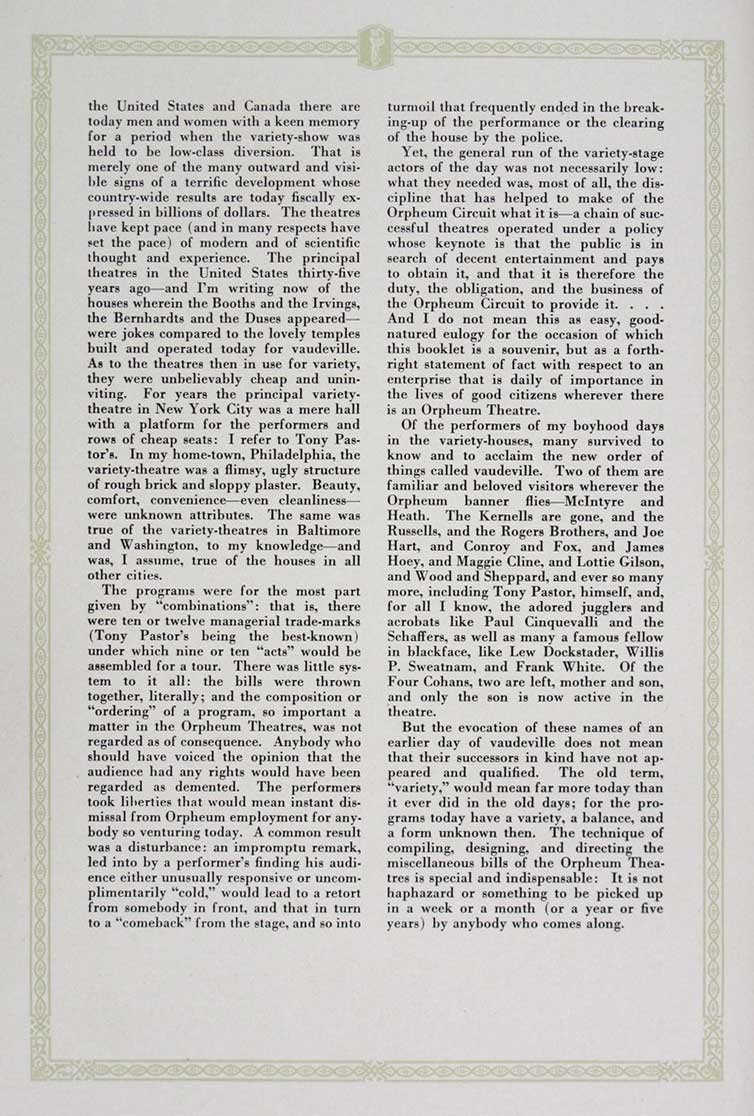
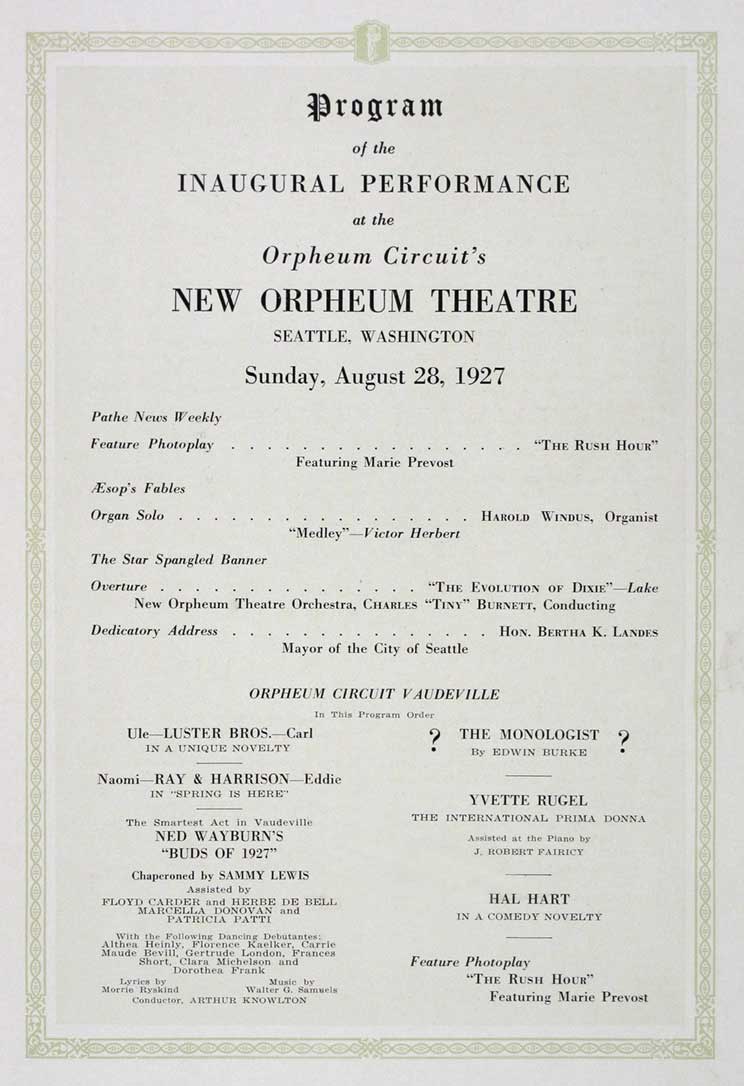
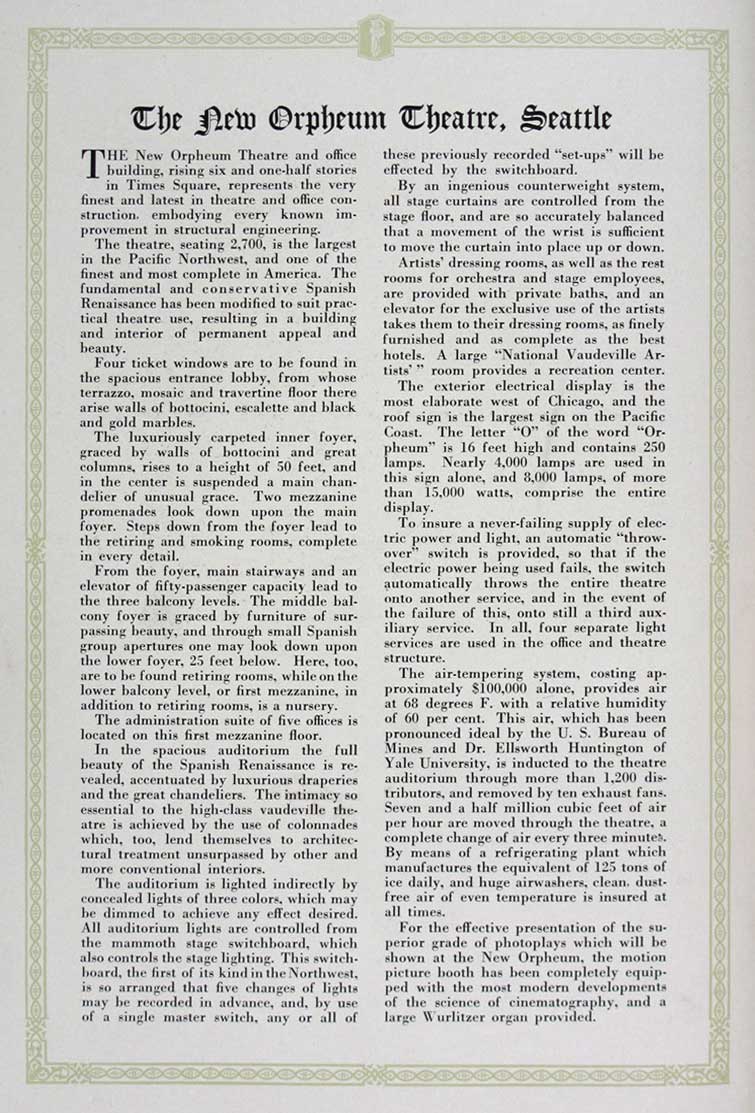
When it opened on Times Square in the summer of 1927, the Orpheum Theatre was the largest venue for films and vaudeville in the Pacific Northwest. However, in six months the distinction of its 2,700 seats was surpassed only six blocks away when the Paramount Theatre opened with 4,000 seats. The Paramount, of course, has survived, while the Orpheum was razed in 1967 with hardly a protest.
Six years earlier, the destruction of the Seattle Hotel in Pioneer Square was vigorously protested because it was the cornerstone of that neighborhood. But here uptown in the mid-1960s the unique three-block diagonal cut of Westlake, from its origin at Fourth Avenue and Pike Street to Sixth Avenue and Virginia Street, was being discussed as the best place to create a civic center that Seattle did not have since the city’s commercial interests moved north into this retail neighborhood. This aura of progress by building something “new and modern” surely dampened preservationist enthusiasm for the Orpheum.
Right after the two-day auction of its lavish appointments, including the marble cut from floors and walls, the theater was destroyed. Surprisingly, the tear down took so long it broke the wrecker’s budget. The sturdy Orpheum was more reluctant than expected.
This “Spanish Renaissance masterpiece” was one of Seattle architect B. Marcus Priteca’s greatest theaters. And in spite of the squeeze of its location his Orpheum was in every part sumptuous from sidewalk to sky. The roof sign was the largest on the coast. Meant for Vaudeville as well as films, it had 14 dressing rooms, all but two with baths.
The Orpheum opened with the film ‘Rush Hour’, and although designed for live performance, it kept for the most part to movies through 40 years in business. I remember seeing both “Never on Sunday” and “Goldfinger” there in the mid-1960s, and confess to being more interested in the films than in the theater (or even aware that it was doomed). Perhaps if it had been in Pioneer Square. (Later I purchased in a garage sale a nicely cut piece of marble that was, I was told, salvaged from the lobby. It was then my belated part in preservation. Now it is on my desk.)
McGraw
WEB EXTRAS
Jean writes: Stepping out into Fifth Avenue gave me a better view of the “corncob” and the statue of Governor John McGraw (1850-1910), which existed both ‘then’ and ‘now’.
The Westin (née Washington Plaza) Hotel unobstructedA blown up detail of McGraw's statue shows the governor and former Seattle police chief peeping from behind the firs.
Anything to add, Paul? Yes – a few things Jean. And will first say that it is a fine hide-and-seek with the Police Chief in the bushes, you show above. Another evidence of what a shadow is life. How brief and how forgotten. A man of such note, now unknown but to a few. Not even this monument in one of the landmark intersections of the city will instruct or distract citizens enough to make much mark for the identity of Governor McGraw, pawn of the railroads. Still surviving in a few libraries are copies of McGraws “In Memoriam” chap book served up at his memorial service. This cover was copied from the library of our regular supplier of “Edge Clipping” – Ron Edge.
First another photo of the new Orpheum, followed by another now-then feature first published in 1993, and more, which will be captioned in its places.
Could this have been the official portrait of the theatre? The Chorus Kid, a 1928 silent film, is on the Orpheum Marquee. So here is the nearly brand new theatre in all its majesty and a year before the Great Depression would dim even this lustre. This pix, like many others, was got from Lawton Gowey, and below we'll also include two of the site that he took. Hopefully David Jeffers, our local silent film expert, will check in and instruct us some on this 1928 offering and this theatre too in its first years.
GOLDEN ANNIVERSARY FOR THE SEATTLE SYMPHONY.
(This story was first published in The Seattle Times Pacific Magazine on Dec. 5, 1993.)
In 1953,The Seattle Symphony Orchestra promoted its golden anniversary with a pubic campaign to discover “Where were you on the night of Dec.28, 1903?” – the night Harvey West directed the Seattle Symphony’s first concert in the ballroom of the Arcade Building at Second and Seneca.
Arthur Fiedler guest-conducted the Seattle Symphony for this Nov. 3 concert, and local virtuoso Byrd Elliott was featured with Prokofieff’s Second Violin Concerto. The Orpheum was filled to its 2,600-seat capacity.
Earlier, in January of 1953, Arturo Toscanini’s assistant, the violist Milton Katims, made his first appearance here as guest conductor. The Seattle Symphony was then still playing in the Civic Auditorium, an acoustic purgatory that violinist Jascha Heifetz called the “barn.” Heifetz’s opinion was shared and extended by Sir Thomas Beecham. The already-famous English maestro conducted the Seattle Symphony during much of World War II and, before leaving here, famously called Seattle a “cultural dustbin.”
The symphony’s first postwar conductor, Carl Bricken, resigned in 1948. The musicians soon formed their own Washington Symphony League and scheduled a season of 16 concerts at the Moore Theatre with a conductor of their own choosing, Eugene Linden of the Tacoma Symphony. This rebellion was short-lived, and the following year the organization was reformed. Milton Katims, the Seattle Symphony Orchestra’s guest conductor became its residence conductor with the 1954-55 season and he stayed on until 1976.
In 1993 when this feature was first published, the Symphony was it its 90th season and, the story noted then, “is quietly campaigning for a new auditorium.” It got it, of course.
Lawton Gowey's 11th Hour of the Orpheum in 1967.Frank Shaw's look into the wreckage.Lawton Gowey's repeat of the theatre site soon after the Westin Hotel was completed. Note McCraw standing revealed. A different and earlier Orpheum Theatre, this one on the east side of Third Avenue between Jefferson and James Streets, where the City-County Building was raised in 1914 (if memory serves, which is to say, without checking). For a while this Orpheum was the longest theatre in town. Some spoken lines were relayed by helpful customers who on hearing them from the middle of the theatre would then turn and shout them to the back. The players would ordinarily wait. This theatre was so long that it could be raining at the front door on James Street when sunlight was streaming through the windows on Jefferson Street. This theatre was so long that the ushers were organized into two platoons: east and west. This theatre was so big that the pigeons who lived on one end of the roof knew nothing of those at its other end. The theatre had to wait on the destruction by fire of the Yesler Mansion that stood on this block from the mid 1880s until 1901 when it was home for the local library. Only the books that were checked out survived. Those who returned books late were especially thanked - we hope. This theatre was so long that when it was razed the two crews working from either end wound up six inches off.
Frank Shaw recorded this scene from the Spring Festival of Fun, on March 14, 1964, in the rain at Westlake Mall. Now 1964 is not so long ago. Hopefully someone will help us identify the keepers of these daffodils and nurturers of this fun.
The first Downtown Seattle Spring Festival of Fun was promoted mid-march in 1964. It was another try at adding some zing to a city who felt deprived of it since its Century 21 left it a Seattle Center in the fall of 1962 but not yet much to use it for. As the southern terminus of the Worlds Fair’s Marvelous Monorail, the Westlake Mall was also developing into another and smaller Seattle center. The Ides of March – the next day, March the 15th – was designated the festival’s Waterfront Day. Joe James manager of Ye Old Curiosity Shop was the chairman. Ted Griffin, the manager of the marine Aquarium at Pier 56, which had done well during Century 21, two years later was struggling to draw visitors. Days before the March fun Griffin announced his plans to stage an octopus wrestling match at his aquarium. Every Old Settler understood that Griffin’s promotion was inspired by the “Great Rassel of 1947” when Ivar Haglund brought out from the east the pugilist Two Ton Tony to take on Oscar, the star octopus at Ivar’s Pier 54 Aquarium. Griffin’s bout did not make such a splash, but his great celebrity was less than a year away when he captured and put on show at his far end of the pier the killer whale Namu. For Ivar’s part in the ’64 Festival he arranged the musical accompaniment for the Ide’s Waterfront Day with Pep Perry’s Fire House Five Plus Two playing for the open house at the new fire station, which still stands at the foot of Madison Street, and next door to Ivar’s Acres of Clams.
We include below four displays of the same southeast corner of 46th Avenue and Corliss Street, for the years 2007 through this year, 2010, all of them photographed during the afternoon of the 8th day of March. It is radiant evidence of our early spring after the warmest January in Seattle’s history and then a mild February following it. One neighbor notes that his budding dogwood does not ordinarily show itself so until the time of his daughter’s birthday in early April. These are not his dogwood but another neighbor’s cherries. All four images involve a merging of left and right halves. The joining is not always perfect, but close enough for these cross-references. After three-plus years of walking the neighborhood almost every day I have many hundreds of impressions of this corner and a few hundred more. Without a computer and digital photography this would have cost a fortune. With them it was just a few thousand snaps and a lot of walking.
[click to enlarge and then click again]
46th and Corless, southeast corner, Seattle's Wallingford Neighborhood, on the afternoon of March 8, 2007.Same southeast corner sometime on the afternoon of March 8, 2008.Entering or escaping some sturm und drang on the afternoon of March 8, 2009.This year the southeast corner of 46th Avenue and Corliss Street holds a soft repose in a late afternoon light on a radiant eighth of March.
Below are a handful of the thousands of photographs taken from the Smith Tower through its now 96 years. The most popular prospects were north to the central business district and west to the harbor, but if Mt. Rainier was showing this southern view might be captured too. One could look above and beyond the industrial “park” to the the national park. (Actually, Mt. Rainier can be seen in only one of the views included here.) The Frye Packing site can be found in all of them, although not always the same plant. It is above the Great Northern tower – somewhere above it. The most recent view is from 1982, and the only one I photographed. Perhaps we can stir Jean to return to the observation tower for a “now” recording that will display the recent glories of SODO, and the enduring ones of “The Mountain That Was God.” Watch for “Jean’s Turn in the Tower” coming to this blog soon.
The Smith Tower was dedication on July 4, 1914, however photographers reached the top already in 1913. Without study (of its "internal evidences") I give this a ca. 1914 date. Lawton Gowey took this 1961 view and the two that follow, from 1971 and '76. Note that the Seattle-Tacoma 1-5 Freeway has not as yet "upset" the Beacon Hill greenbelt.This view from 1971 has its nearly new Interstate-5 but as yet no Kingdome.The nearly new Kingdome in 1976. Another by Lawton Gowey.Looking south-southeast from the Smith Tower in 1982.
Looking southwest from Walker Street to the burning ruins.
THEN: A few minutes out on its first test a still secret and as yet unnamed B-29 turned back for Boeing Field, and did not make it. The view looks southwest from Walker Street to the severed north wall of the Frye meat-packing plant at 2203 Airport Way South. (compliments The Museum of History and Industry, the P-I Collection.)NOW: Dating from 1985, the contemporary structure mostly replaced the repaired Frye plant. The new structure was built on the meat plant’s foundation. (Now photo by Jean Sherrard.)
Twice I have heard from persons who were working downtown – one in the Exchange Building and the other in the Smith Tower – during the Second World War who described the strange bomber, trailing smoke, sputtering and flying much too low over the business district as it headed south in what test pilot Edmund T. Allen probably knew was a hopeless attempt to make it back to the Boeing Field it had left minutes earlier.
At 12:23 they heard – and many also saw – the still secret B-29 Superfortress first sever with arcing explosions the power lines north of Walker Street and then slam into one of the biggest structures in the industrial neighborhood, collapsing the northwest corner of the Frye meat packing building that was dedicated to the slaughter of pigs and the manufacture of, among other products, Frye’s big buckets of Wild Rose Lard. (The cans were famously illustrated with its namesake rose.)
Those who heard the surreal chorus of squealing pigs that followed the explosion described it as terrifying.
The death toll for that Feb. 18, 1943, included one fireman, twenty Frye employees and the ten from Boeing who stayed with the plane and two who did not. Most were engineers. Earlier when the bomber was close to colliding with Harborview Hospital, two engineers bailed out but there was not enough distance between the plane and First Hill for their parachutes to open. Eighty pigs did not make it to slaughter.
This famous press photo and scores more are included in Dan Raley’s new book “Tideflats to Tomorrow: The History of Seattle’s SODO.” For readers who have not heard, SODO – meaning “South of the Dome” – is the name for the neighborhood south of King Street, long ago reclaimed from the tidelands, but more recently divested of its Kingdome. All that is recounted in the book and much more.
Reader’s can contact the publisher via fairgreens@seanet.com, or check their neighborhood bookstore – those that have survived.
WEB EXTRAS
Jean is away in Illinois attending a Knox College theatrical performance in which his youngest son, Noel, plays one of the principal parts. When the last performance was completed and the congratulations too, Noel went off with the players for the cast party and dad returned to his room in a converted Ramada Inn on the town’s principal square. There from his lap top he inserted this week’s story of the B-29 crash into this blog and asks me, “Anything to add, Paul?” Yes Jean we’ll put up the map we arranged to help locate the proper spot on which to shoot your “now.” And it also shows the crash site at the northwest corner of the Frye Plant. And we have grabed a low-resolution aerial that shows the damage looking to the southeast. A look at the Frye’s first plant on the same site when it sat of pilings over the as yet unreclaimed tideflats follows. Then up to the Frye Mansion on First Hill, at the s0utheast corner of 9th Avenue and Columbia – one block south of St. James Cathedral. Here we first insert a photograph of the old Coppins Water Tower. From the mid 1880s to about 1901 the big well below that tower was the principal provider of fresh water on First Hill. The Frye mansion took it’s place. Emma and Charles Frye collected genre paintings and . . . well more is told below with the feature that first appeared in The Times in 1997.
(As Ever – Click Images to Enlarge Them – sometimes click twice.)
The map we assemble to determine the proper prospect from which to repeat the original photo of crash site at the northwest corner of the Frye Packing plat at Walker Street and 8th Ave.The damage seen from the sky. The view looks to the southeast.The Frye Packing Plant at the same location but here still held on pilings above the tidelands. Courtesy, Lawton GoweyCoppins Waterworks at the southeast corner of 9th and Columbia. Coppins was the principal provider of fresh water to much of First Hill Neighborhood before the city's Cedar River Gravity System began its service in 1901.Emma and Charles Frye's mansion replaced the water tower. Note the one-story wing to the far right, attached to the south side of the home. This addition of 1915 served as a second "home" for their growing collection of genre art, most of it purchased in Europe. (Courtesy Frye Museum)The Cathedral Convent built on the former site of the Frye mansion. Photo was taken in March, 2001.The Frye's home gallery. The door leads into the relative dark of their home. The added exhibition space was brightened with skylights. The joyful nude with uplifted arms - to the left of the doorway - appears again below in the 1952 interior of the then new Frye Museum a block away from the home on Terry Avenue. (Courtesy Frye Art Museum)
[Here we hope to insert the “now” that appeared in Pacific in 1997. It is temporarily in a shuffle of negatives – somewhere in this studio.]
THE FRYE’S SALON
(This first appeared in Pacific Magazine, April 6, 1997)
Here’s an aside to the hoopla encircling the reopening in new quarters of the 45 year old First Hill institution, the Fry Art Museum: a short notice of whence came these paintings of cattle, angles, graybeards and bucolic paths.
After returning from Europe in 1914 with more paintings for their swelling collection the Fryes joined a large gallery to the south wall of their big home on the southeast corner of 9th Avenue and Columbia Street. Soon its four walls were filled “salon style” with ornately framed oils crowding one another from the Persian rugs on the floor to the skylights. This view of the gallery’s northwest corner reveals a fair sampling of the type of often sentimental realism the couple preferred in their art.
Charles Frye who made his considerable fortune as the Northwest’s biggest meat-packer, was especially fond of animal subjects including the German master Heinrich Zuegel’s “Cattle in Water”, here the second oil up from the floor in the second row right of the gallery’s West (left) wall. In the contemporary scene Zuegel’s cattle have been returned with the help of real estate maps, aerial photography — the gallery skylights show well from the sky — and a 100 ft tape measure, to within five or six feet of their original place on the north gallery wall.
(Now we identify below some persons as seen in the “now” photo that appeared in Pacific, but again, not yet here. We will insert that photo from 1997 – when we find it . . . again. Temporarily we will include, directly below, the clip from Pacific.)
A clipping - only - of the April 6 1997 feature as it appeared in Pacific Magazine.
Found! - the original negative, or nearly. 3/27/10
All this figuring puts the painting in the living room of the St. James Cathedral Convent which replaced the Frye home in 1962, ten years after the Frye collection had been moved one block east to the then new namesake museum. Standing about the painting — and supporting it — are Sisters Anne Herkenrath and Kathleen Gorman, right and center respectively, both distinguished members of the order Sisters of the Holy Names and therefore long-time Seattle educators.
With the sisters is artist and author Helen E. Vogt. The Frye’s great niece was practically raised in the Frye home and lived with them in the early thirties while an arts student at the University of Washington. As part of my “art direction” for the “now” scene I asked Helen Vogt to hold a copy of her most recent book Charlie Frye and His Times. Before the opening of the Seattle Art Museum in 1933 Seattle’s largest art gallery was the Frye’s, and the public was free to visit it. Pacific Readers wishing to know more about Seattle’s early art history should consult Vogt’s biography of Seattle’s one-time cattle king — packed and framed. Those wishing to make a closer inspection of Zuegel’s deft impression of Cattle in Water, and hundreds more paintings from the Frye’s collection should visit the museum at 704 Terry Avenue. The admission is still free.
The main exhibition space in the Frye Art Museum when it opened in 1952. The picture is a fine example of a "set-up" architectural photograph, with the persons chosen, their locations and gestures too. (Courtesy Frye Art Museum)The new Frye Art Museum in 1952 (Courtesy Frye Art Museum)The new Frye Art Museum in 2001.
Here – at last – we can compare two “big snows” on the Queen Anne Counterbalance, that unique stretch of hill climb that reaches from Lower Queen Anne to Upper. For a few decades these blocks were fitted with an underground trolley counterbalance. It featured a tunnel running beneath and in line with Queen Anne Avenue – but only here where it climbs the hill. Running on tracks within the tunnels was a peculiar “box car” made of concrete, which when hooked by cable to the bottom of the trolley helped pull it to the top of the hill – while the box car descended in the tunnel – and also helped brake it by climbing the hill when the trolley came back down it. And none were left on top. This unique device would not have been bothered by snow, unless it was a really big snow. The 1916 Snow was such a pile that even the counterbalance cars here on Queen Anne Hill were stopped – like the one we see stalled in the middle of the Avenue between Mercer Street (behind the photographer) and Roy Street, behind the car. Perhaps the motorcar is also stuck – but not the horses.
Jean is away to Chicago this weekend to see his son perform in a play. When he returns he will link this little blogaddendum directly to the blog’s history of Seattle snows. [Jean’s note: it can be done, Paul; yea, even from the city of big shoulders – or thereabouts]
The Queen Anne Avenue Counterbalance seen from Queen Anne Avenue, twixt Mercer and Roy streets, during the stall of the "Big Snow of 1916."The snow of 1968-69 while not so deep as that of 1916 was still one of the most impressive of our "modern snows." This view looks north from the southeast corner of Queen Anne Avenue and Roy Street. The Counterbalance Hill has been barricaded to traffic. I wanted to put this up in January 2009 when I worked on this blog's Pictorial History of Seattle Snows, but I had to wait patiently for this slide to rise again to the surface of the light table, which is did earlier today. Queen Anne resident Lawton Gowey took this photo on the last day of 1968. The Bayview Retirement Community on the hill was then but one decade old.
WE INTERRUPT WITH THIS BLOGADDENDUM
A good look up the Queen Anne Counterbalance, sans snow. The tunnel and tracks of the Queen Anne Counterbalance.