The future Federal Courthouse site packed with ice in 1937. (Courtesy, Ron Edge)
THEN: Show here in late 1939, across the intersection of Spring Street and 5th Avenue, the building site chosen for the Federal Courthouse, was surrounded for the most part by hotels, apartments, schools, churches, and, to the west across 5th Avenue, the lush landscape of the Carnegie-built Seattle Public Library, here lower-right. (Courtesy, Museum of History and Industry)
NOW: Jean Sherrard set his “repeat” wider in order to better show the courthouse’s position in the neighborhood.
For its April 22, 1940 edition, the Seattle Times perambulating wit responsible for this paper’s once popular feature “Strolling Around the Town” visited the work on Seattle’s new Federal Courthouse. The writer described the workmen pouring concrete for the “elevator’s penthouse twelve stores above the street.” There they “paused, mopped their brows and surveyed the flag they had hoisted on a temporary pole.” It was the informal “topping off” of the U.S. Justice Department’s modern addition to Seattle.
Like the Smith Tower, which it otherwise does not resemble, the Fed’s modern box glows in proper light. It too is covered for the most part with terra cotta tiles with a reflecting color that the contractor N.P. Severin – of Chicago – described as light peach-bloom. The austere structure’s few ornaments and color choices were, of course, its architect’s, Louis A. Simon, who like the $3 million that paid for this our first modern box, came to us from the other Washington.
Naturally, local architects and contractors could have used such a federal plum during the depression. Soon after the federal funding was announced in the summer of 1936, James A. Wood, Seattle Times Associate Editor, lamented that once again, it seemed, the city would miss the opportunity to build a needed civic center around the new courthouse. Instead, the fed’s purchased the Standard Station and its sprawling parking lot across 5th Ave. from the Carnegie Library, which a half-century earlier was the first site for Providence Hospital.
Pulled from The Seattle Times for Sept. 37, 1937.Groundbreaking news in the Times for June 17, 1939.From The Seattle Times, Jan. 14, 1940
The work went fast, beginning with the groundbreaking in the summer of 1939 when Federal Judge John C. Bowen, shovel in hand, decided to “start the dirt flying.” By late October of 1940, the F.B.I. and many other federal enforcers were ready to move in. City Light was soon shamed into clearing the block of its weathered utility poles, which were described as “a ‘disgrace’ to the sightlines of the new building.” The imperial fuss over the earnest new courthouse was also “expressed” on the front lawn. The Times Stroller returned in the summer of 1941 and described what is still seventy years later an inviting green expanse as “stuffed with red-white-and-blue shields upon which appeared the words: ‘U.S. PROPERTY KEEP OFF THE GRASS’.”
August 7, 1941, from the Times.Almost complete the Federal Courthouse poses still surrounded by the city's offensive poles. (The link directly below will open the Times page that uses the above photo and much more.)
The courthouse front lawn looking north to the Olympic Hotel on March 13, 1963. Another photo by Lawton Gowey.Lawton Gowey photographed this from the 8th floor of the City Light Building (on Third Ave.) on June 7, 1960. He recorded two of Seattle's then best examples of modern architecture, the relatively new Seattle Public Library on 4th Ave. with the Federal Courthouse behind it on 5th. There is as yet no SeaFirst tower to get in the way of Lawton's vision from his office at City Light.After its 1967/8 construction, Lawton Gowey look east into the curtain of the SeaFirst Tower. Here he has visited a friend's office on the 33rd floor of the tower, and from there looks down - and east - to the courthouse and a front lawn only mildly tinted by the summer of 1981. Lawton dates his slide that year on July 15.
WEB EXTRAS
The top of the parking garage offered several unique perspectives of the city – here’s a few taken on the fly:
Anything to add, Paul?
Surely Jean, although only a few from the site. By introduction a slide I took on May 19, 1997 of the plaque set at the front stairs to the courthouse. It commemorates Providence Hospital, the former occupant of this block borders by 5th and 6th Avenues, and Madison and Spring Streets.
THE BUILDERS HOSPITAL
(First appeared in Pacific, August 24, 1986)
This wonderfully detailed historical view (above) looks southwest from the old metropolitan campus of the University of Washington. The photographer (probably Charles Morford) carried his camera to the cupola (most likely) of the Territorial University building for an elevated sighting of his primary subject, Providence Hospital.
The scene is relatively easy to date. The hospital’s central tower on Fifth Avenue and its south wing at Madison Street (here on the right) were completed in 1887. Central School, behind the hospital, left-center, burned to the ground in April, 1888. Since the leaves on some of these trees and bushes seem to be just beyond budding, and there is no wind-stacked mulch of autumn collecting in the gutter along Seneca Street below, we can say, almost confidently, that this scene was shot in the early spring of 1888. It may have been but a few days before that unnaturally hot bright April night when men armed with brooms and pails of water darted across the Providence roof dowsing and sweeping aside the embers falling from the flaming school and sky.
An earlier look at the same neighborhood recorded from the Territorial University's main building. Note that the hospital's central tower on 5th Avenue is not as yet in place.
But in the Spring of 1888, the sisters were less worried by physical fires than by Protestant ones. A century ago the religious temper was somewhat less ecumenical than it is now, and the quality of care given by the strange-to-Protestants, black-habited Sisters of Providence was chronically embattled by anti-Catholic resentment and rumors. When the Episcopalians opened Grace Hospital in 1886, the open competition for patients resulted in the area’s first health insurance plan. The Grace administrators offered, for five and ten dollars, yearly health bonds to the Catholic sisters’ “bread & butter” clients, the working class.
The Protestant's Grace Hospital was too costly to keep open.
The sisters responded with their own plan. After eight months the Sister Chronicler wrote, “Our tickets are doing well, even in the territory of our adversary . . . A good number of patients left his hospital dissatisfied, while ours leave happy. His hospital is luxuriously furnished with Turkish carpets, furniture with marble tops, and so forth. Ours is simply furnished, but our Sisters are so devoted that they aptly compensate for the lack of wealth.”
In 1893, the overextended Grace Hospital failed following the economic panic of that year. But Providence survived and kept enlarging. When the last addition along Madison Street was ready in 1901, Providence Hospital was the largest in the Northwest.
Looking northeast across Madison Street and 4th Avenue to the block-long Providence.
The sisters survived in a hospital of their own making. The restrained but satisfying symmetry of the completed plant was designed by artist-architect Mother Joseph, who was also the founder of the Sisters of Providence in the Northwest. Self-taught, she was known as “The Builder,” and was ultimately honored by the American Institute of Architects as the first architect in the Northwest.
The sisters arrived in Seattle in 1877, accepting a contract to care for the county’s poor house in Georgetown. The next year, they bought the John Moss residence at Fifth and Madison, and under Mother Joseph’s supervision, converted it into their first hospital. Seventy-five beds were added to those in the Moss home when the first wing (at Spring Street) of Mother Joseph’s structure was dedicated on Ground Hog Day, 1883.
After 28 years at Fifth Avenue and Madison Street, the sisters moved in 1911 to their present site at 17th Avenue and Jefferson Street. The central tower of that surviving hospital is a brick variation on Mother Joseph’s frame tower along Fifth Avenue and so may remind us of “the builder.”
The "new" Providence Hospital on Second Hill.
Recently, the hospital’s tower part of what is now called the 1910 Building was threatened when its original construction was found wanting by modem earthquake standards. [A reminder: this feature first appeared in 1986.] However, the tower escaped the wrecker’s ball (or imploder’s charge) when the neighborhood’s Squire Park Community Council successfully campaigned to save it. This preservationist’s success included a reciprocity. For its part Providence Hospital agreed to restore and reinforce the 1910 tower, and the council agreed to not stand in the way of the hospital’s plans to add a modem wing (construction began in 1989) to their old hospital.
=====
Both views, above and below, look west through the intersection of Spring Street and Sixth Avenue.
SIXTH & SPRING – 1909
(First appeared in Pacific, June 18, 2006)
When its last of several additions was attached along Madison Street in 1901, Providence Hospital became the largest hospital in the Pacific Northwest. Mother Joseph, “The Builder,” – as she was called – of this and many more structures for the Sisters of Providence, died the following year in Vancouver, Wash., where she first “answered the call” with her Bible in 1856.
This rear view of the hospital looks west across the intersection of Sixth Avenue and Spring Street, most likely in the spring of 1909 when the Dept. of Public Works was regrading Spring and Seneca streets east of Fourth Avenue. The cut here at Sixth, as revealed to the left of the steam shovel, is at least 20 feet.
Aside from its central tower facing Fifth Avenue, the part of the hospital most evident here is the first wing that was dedicated on Feb. 2, 1883. With architect Donald McKay, Mother Joseph designed a three-story frame hospital with a brick foundation, large basement, open porches and the first elevator in town. Mother Joseph also supervised the construction.
Despite the Protestant town’s general prejudice toward Catholics, the hospital was busy. Epidemics of many sorts and accidents at work were commonplace. The work day did not shrink from 12 hours to 10 until 1886.
In 1911, Providence moved to its new plant at 17th Avenue and East Jefferson Street. Two years later, Seattle’s progressive mayor George Cotterill temporarily converted this old Providence – then vacant – into the Hotel Liberty for homeless and unemployed men. However, as Richard Berner explains in his book, “Seattle 1900-1920: From Boomtown, Urban Turbulence, to Restoration,”* there were no sisters of any sort at the hotel. “Women were not allowed . . .and had to shift for themselves.”
(*Berner’s illustrated history can be studied on this blog.)
Two looks, above and below, north from the Smith Tower were photographed respectively, 1913/14 and ca. 1946. The first show Providence about the time that Mayor Cotterill used it to shelter homeless men. The second subject records the luminous aspect of the nearly new courthouse on the right.
=====
The "new" brick Central School at the southeast corner of Sixth Avenue and Madison Street.
CENTRAL SCHOOL
(First appeared in Pacific June 17, 1990)
Among the distinct pleasures of doing this work are the discoveries shared by readers. One uncovered this view of Central School, among a handful of glass negatives forgotten but snugly preserved in a small wooden box.
When fire destroyed the city’s first high school, the Seattle School District took the opportunity to raise this heroic Gothic building in its place. Central School was built on the ledge of First Hill, where the pitch of Madison Street’s steepest part Relaxes for its less strenuous climb east of Interstate 5. Now part of the 1-5 ditch, it was once a commanding setting filling the block bounded by Marion and Madison streets and Sixth and Seventh avenues.
Central High was razed by a sensitive wrecker named Henry Bacon. “I’m far-from a new hand in this game, but this is the strangest job I’ve ever worked on,” Bacon said. Even the building’s interior walls were 2 feet thick, and all of Seattle-baked brick. The wrecker estimated that there were 2 million bricks.
Central School circa 1945 without its towers.
The envelope protecting the glass negative for this view was dated 1902 – the year Central’s ascendancy as a high school was considerably diminished with the construction of Broadway High School on Capitol Hill. Central served as a primary school only until 1938; for a time, it was used as a vocational school, but after the 1949 earthquake the towers were dismantled and the big brick pile closed for good. Henry Bacon finished this work in 1953.
=====
In 1883 the largest school in Washington Territory opened on the south side of Madison Street between 6th and 7th Avenue. This wooden Central School survived only five years before it burned to the ground in 1888. A larger Brick Central School followed and the last parts of it survived until razed in the early 1960s for the pit that would become the Seattle Freeway.
OLD CENTRAL’S FACULTY in 1883
(First appeared in Pacific, Jan. 15, 2006)
Thanks to Gilbert Costello and his namesake collection at the Seattle Public Library this portrait of the Central School faculty not only survives but also is carefully annotated on its flip side. There at the center is the official stamp of the “photographic artist” Theo E. Peiser who arrived in Seattle, by most descriptions, in 1883, which is also the year that this view was most likely recorded. The hand-written notes explain that here are the “Old Central Teachers” at the “opening of Central.” Actually, this is the second “Old Central” and it is brand new.
The statuesque long coat on the left is Professor Edward Sturgis Ingraham, who arrived in Seattle in 1875 and ten days later became the head of the community’s schools. In 1883 he completed his first year as the first Superintendent of Seattle Public Schools and got married. The 31-year old professor (taught for the most part in the “school of experience”) and Myra Carr, 24, chose the eighth of April for their wedding because it was for both of them also their birthdays. One month later on the seventh of May Ingraham marched his students and faculty three blocks east up Madison Street from the really old Central School on 3rd Avenue to this new and then largest school in Washington Territory. Behind that front door are twelve classrooms and every one of them measures 28 by 35 feet.
Aside from Ingraham and the Janitor on the far right the scene shows ten teachers, but only eight are named: Pearce, Nichols, Penfield, Condon, Piper, Kenyon, Vroman, and Jones. This last, O.S. Jones is the “other man” on the right. (If he looks like a younger version of the man with the brooms it is because the janitor is his father.) In 1884 Jones would pose on different steps when he became the principal of the then new Denny School at 5th and Battery. Only bad health in 1913 stopped him from teaching.
Another of Ingraham at Central Schools steps, this time with some of his scholars divided by sex in an "A Class."
Follow another lift from the Seattle Public Libraries Costello scrapbook on the early history of Seattle Public Schools. First the pictures of five Central School teachers, followed by his description.
=====
Construction on the Seattle Freeway, Jan. 26, 1963, looking north from Jefferson Street. Photo by Frank Shaw.Another Frank Shaw recording, looking north from near Jefferson on August 15, 1964. Included in the changes is the IBM Building, It rises in the later photo directly behind and above the Federal Courthouse.
Jean it is once more time for “nighty bears,” the silly but endearing expression for “good night” first taught by Bill Burden, my old housemate from 1978-79. A few weeks past Bill was in town and Jean you remember that we attended the party that Michael DeCourcey gave for Bill and his friends hereabouts at Michael’s new home near Granite Falls. Jean did you make any snapshots of it all?
Later this morning after breakfast – and a few hours sleep – I’ll go searching for some TDA protest photographs taken at the front door to the Federal Courthouse now long ago.
====
TDA aka “THE DAY AFTER”
Among the many protests staged at or near the front door of the Federal Courthouse, the most frenzied one was on Feb. 17, 1970 for a demo named TDA for “The Day After.” Even without digital equipment it was well recorded by participants, media and surveyors for the local police and other authorities. The few shots below come from a collection of surveillance photos shot by a stringer for a local TV station. I purchased them in a garage sale many years ago. The bottom photo is from a different and unidentified protest at the courthouse. It is probably from an early assembly protesting the war in Vietnam. Walt Crowley, the figure in profile bottom right, looks to be still in high school. Walt was the primary founder of historylink.org, and his historylink description of the TDA protest can be reached by clicking the photo that includes him.
Well! There is Walt Crowley at the bottom-right corner of this early anti-war protest at the Fed. Courthouse. At the time, Walt was most likely still in high school. Click the picture and it will bring up Walt's historylink essay on TDA, for which a few pictures follows. Some of those other figures are also familiar to me, although I no longer remember their names.TDA troopers at the damaged door to the Fed. Courthouse.Earlier - protestors at the door. Jeff Dowd - one of the Seattle Seven - is center-right.A detail of Jeff appearing as an avenging angel while facing the protestors at the Fed.Courthouse doors. Jeff would later "cool it" as "The Dude" - an L.A. model for living-in-ones-pajamas cool celebrated in the by now cult film the Big Lebowski. Doing it in the road: 5th Avenue in front of the Fed. Courhouse. "Those times." It is probably not Feb. 17. Too balmy. Seeing the phalanx of uniforms up the block we suspect that many of those sitting here would soon be running. They are young - or were.
This small bistro has kept all the soul of rue Mouffetard market.
The name of the bistrot is a pun. Of course, we walk there because the street is pedestrian, and the wine glasses have stems too, it is an opportunity to meet and talk, read the newspaper, eat very well, see exhibitions and raise glasses to our friends …
Ce petit bistrot a gardé toute l’âme du marché de la rue Mouffetard. Bien sûr on y vient à pied car la rue est piétonnière, et les verres à vin sont à pied aussi, c’est l’occasion de se retrouver pour discuter, pour lire le journal, se restaurer superbement, voir des expos, et trinquer à la santé des amis…
Claude Derrien, the owner of the bar and the barman Nicolas
THEN: The Schmitz Park arch straddled 59th Avenue Southwest facing Alki Beach from 1913 to 1953. (Courtesy Seattle Municipal Archive)NOW: Players in the annual “Old Ball Game” at Alki Field break from the diamond to pose for Jean Sherrard at the corner now nearly 60 years without its rustic arch.
In a Seattle Times Classified Ad for August 1913, C.W. Latham, a dealer of West Seattle real estate, asks “Don’t you think it is a good time to come over and select that home site by the seaside?” Latham’s list of reasons for moving to Alki was its new “$200,000 bathing beach, $60,000 lighthouse, and $75,000 new school.” And it was easy to reach the beach. Direct 5-cent trolley service from Seattle began in 1908. The dealer gave no address for his office. His instruction that it was “near the Schmitz Park Arch” was good enough.
Prolific postcard artist Frasch's 1910 glimpse into Schmitz Park. (Courtesy, Michael Maslan)
The arch may have been better named the Schmitz Boulevard Arch for it was not in the park but rather faced the beach. In 1908, one year after West Seattle was incorporated into Seattle, the 2,700 foot long boulevard was graded to the park proper, which was then first described as a 40 acre “cathedral” of old growth forest. In 1908 the German immigrant-philanthropists Emma and Henry Schmitz donated both the park and the boulevard to the city.
Looking down from the back of some higher structure along Alki Ave, this public works photo looks east-southeast over the arch (with urns to its sides) and the tennis courts of the Alki Playfield to the West Seattle horizon. (Courtesy Seattle Municipal Archive)
A stripped log spans the arch’s columns made rustic with a facing of river rocks. The construction is here still a work in progress, for the two additional posts to the sides have not yet been topped with their keg-sized stone flowerpots. The new Alki School, seen here far left across Alki Field, is partially hidden behind one of these incomplete shorter columns. The school’s primary classes opened in 1913, also the likely year for this pubic works photograph, which we first discovered in “West Side Story,” the 1987 history of West Seattle edited by author Clay Eals.
Another roadside attraction on Alki made of river rocks (or rounded rocks rolled from somewhere.) Courtesy, John Cooper.
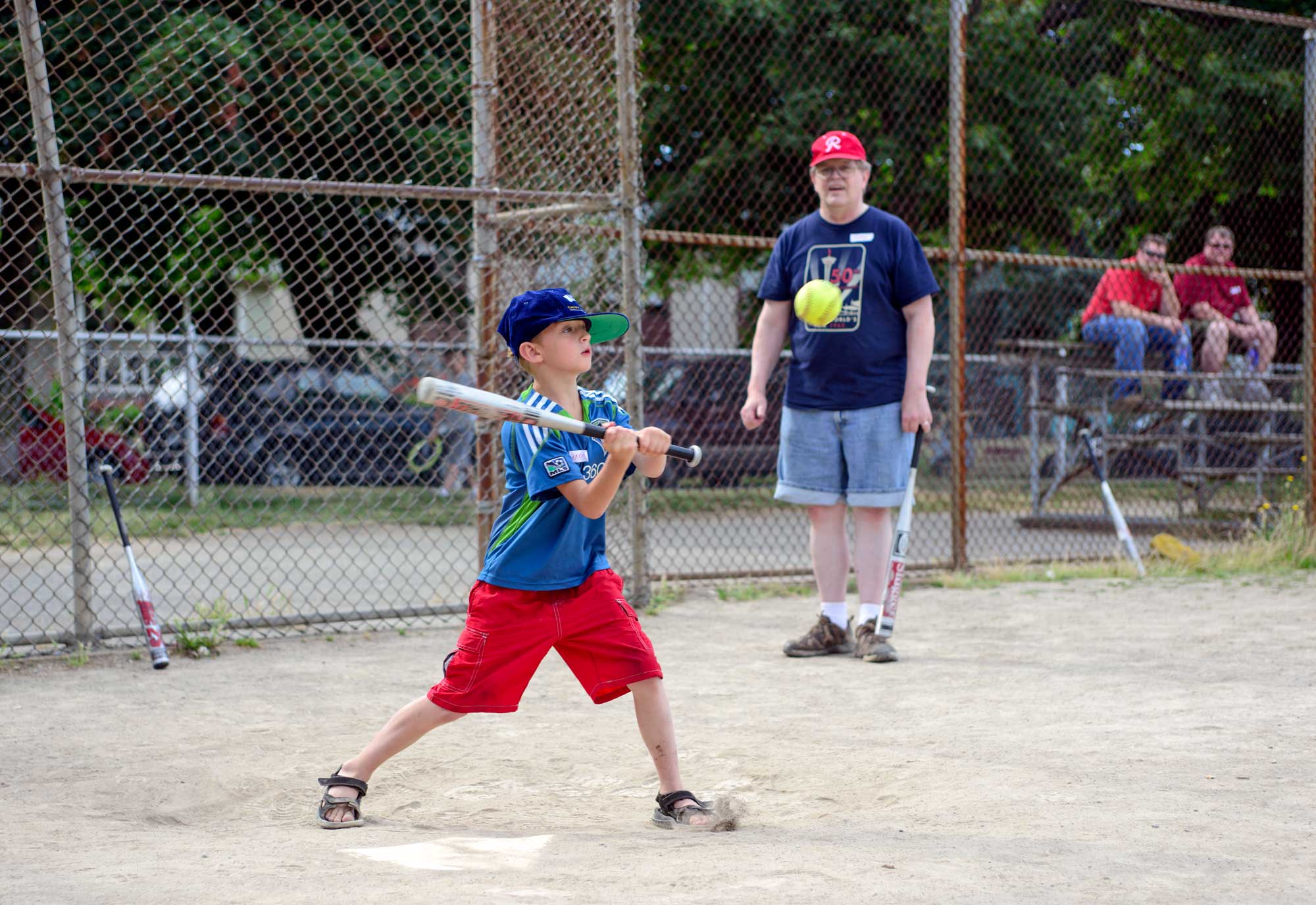
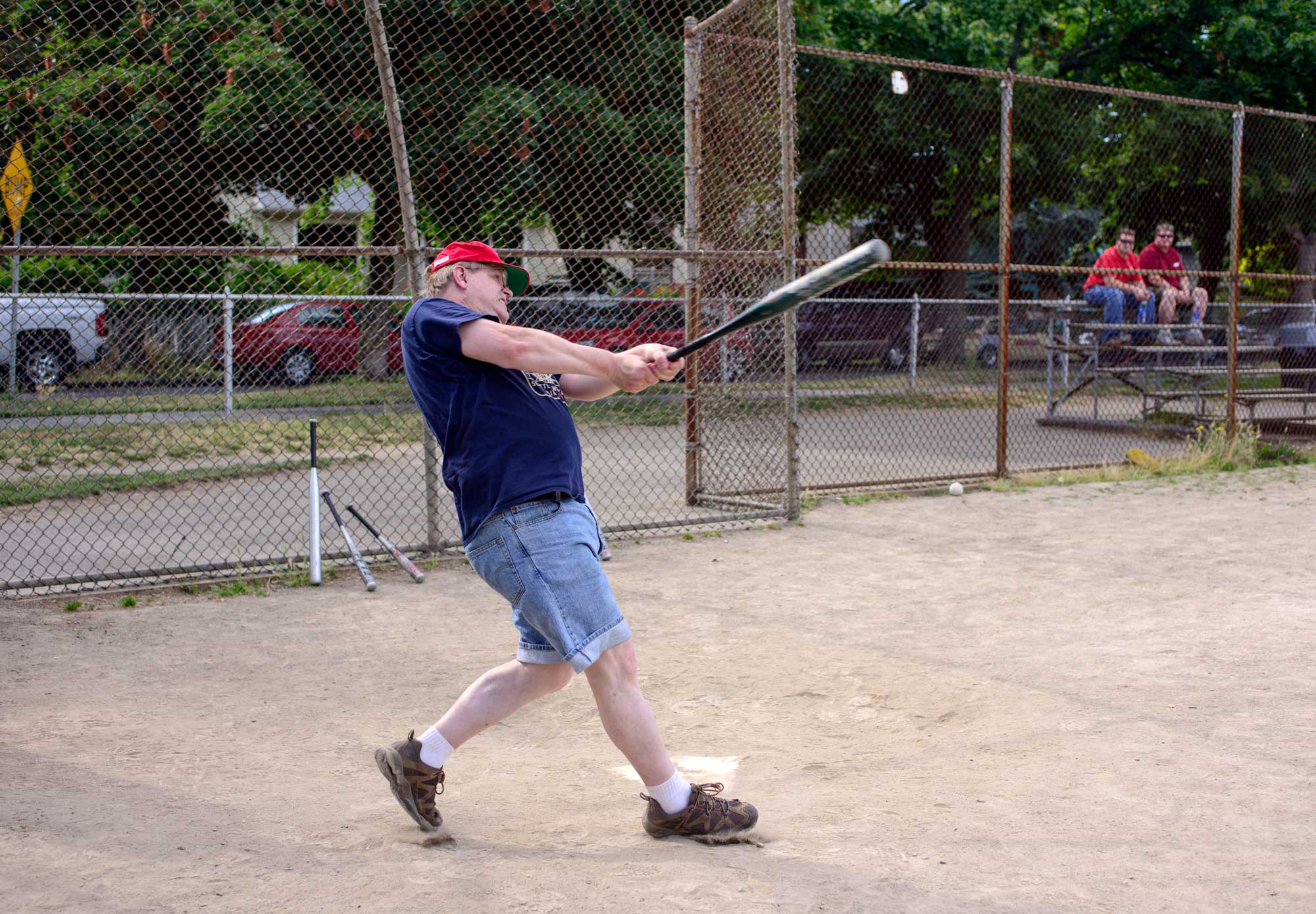
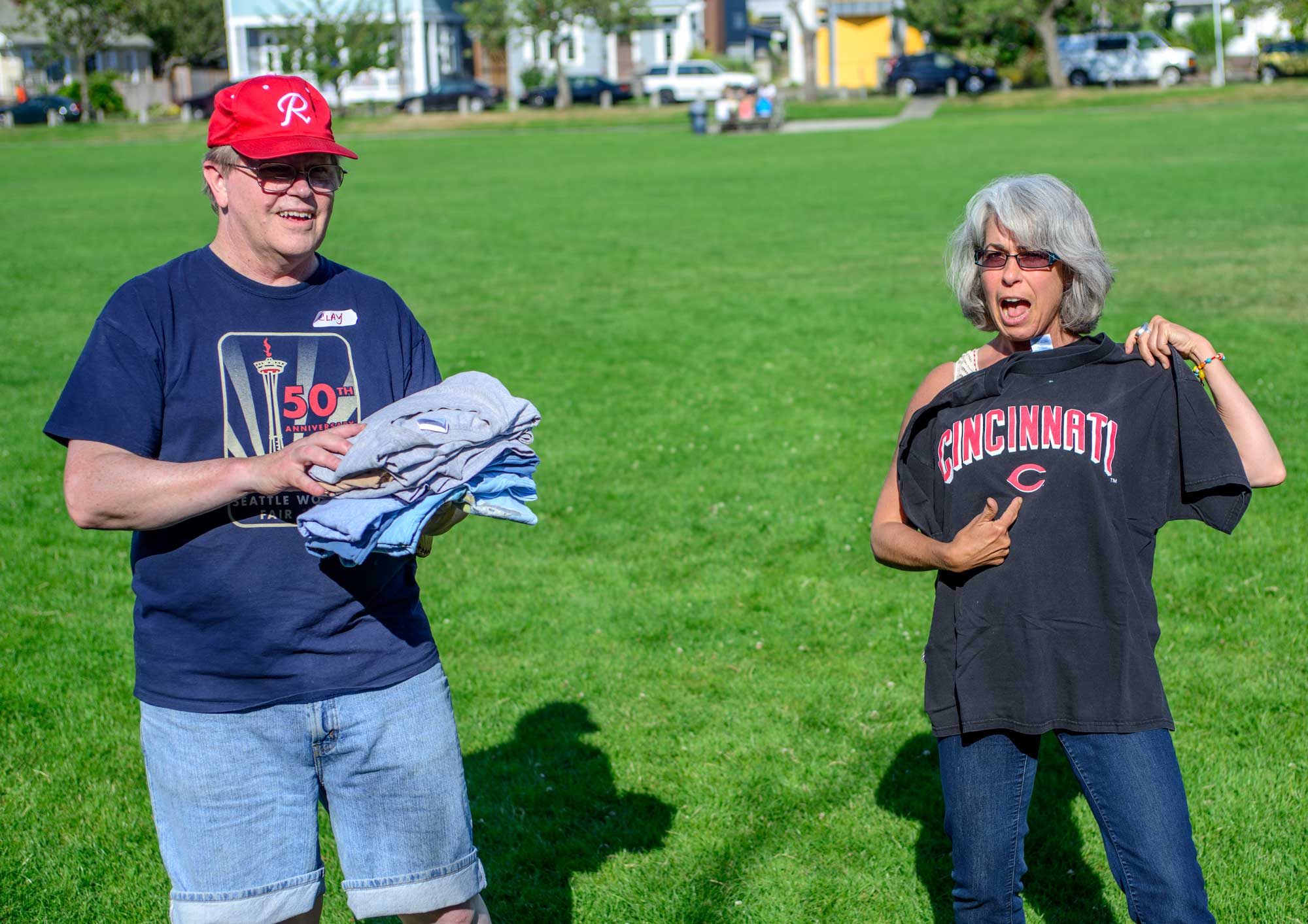
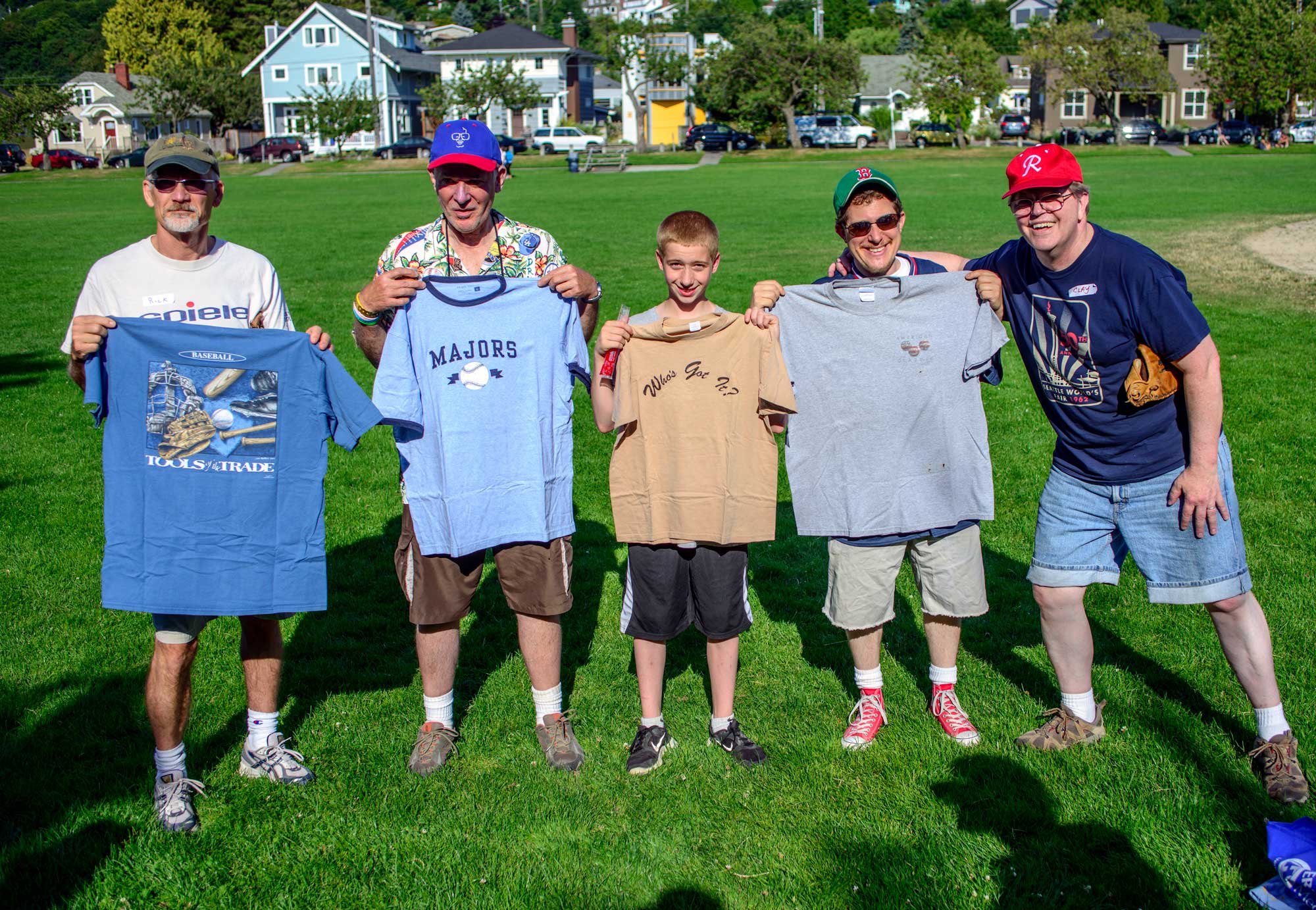
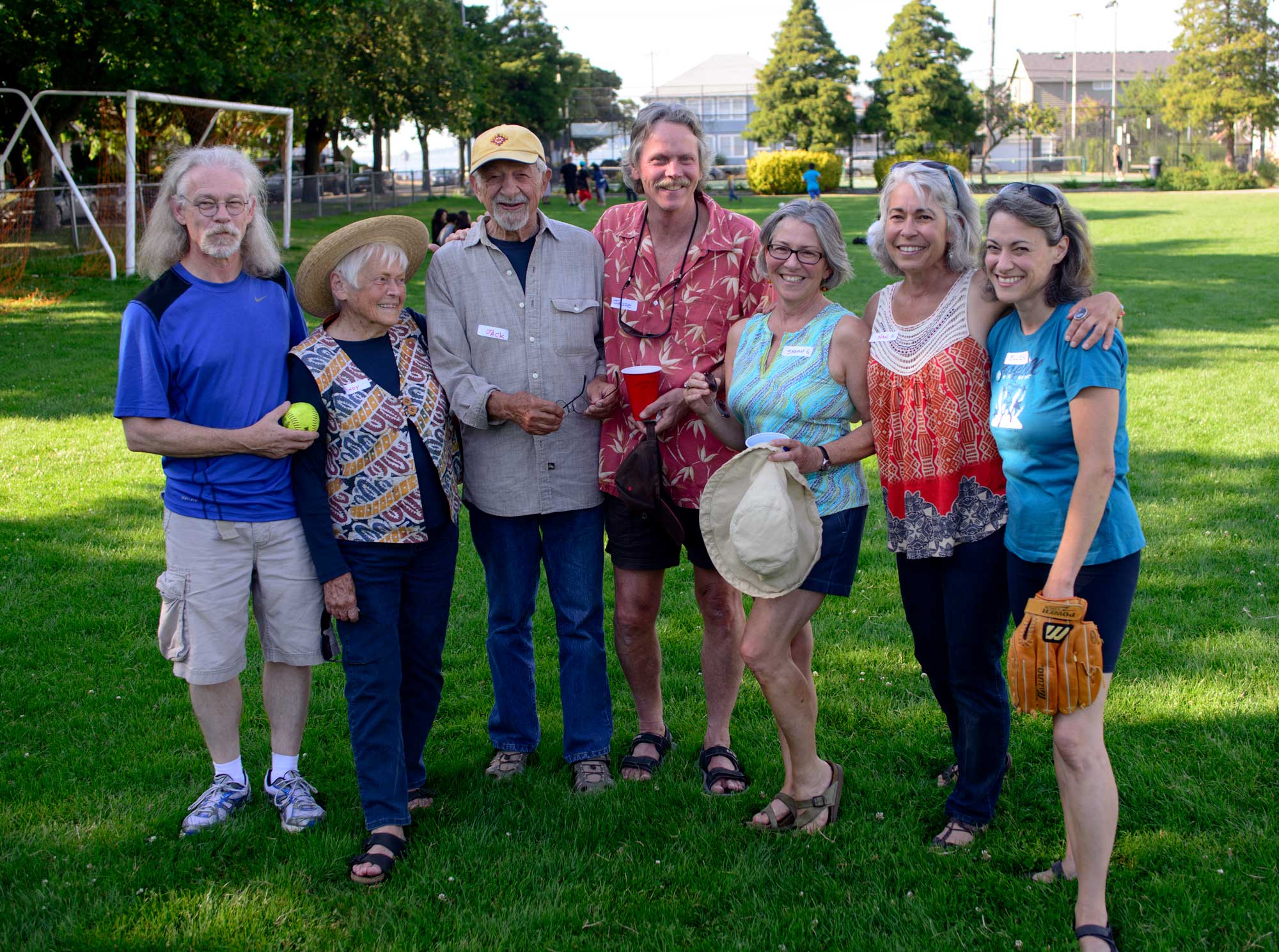
Clay, by now an old friend, along with David Eskenazi, Seattle’s baseball historian, lured Jean Sherrard and I to their annual summer softball game at Alki Field. Jean and I, in turn, lured their players off the baseball field and onto 59th Avenue West. Jean explains.
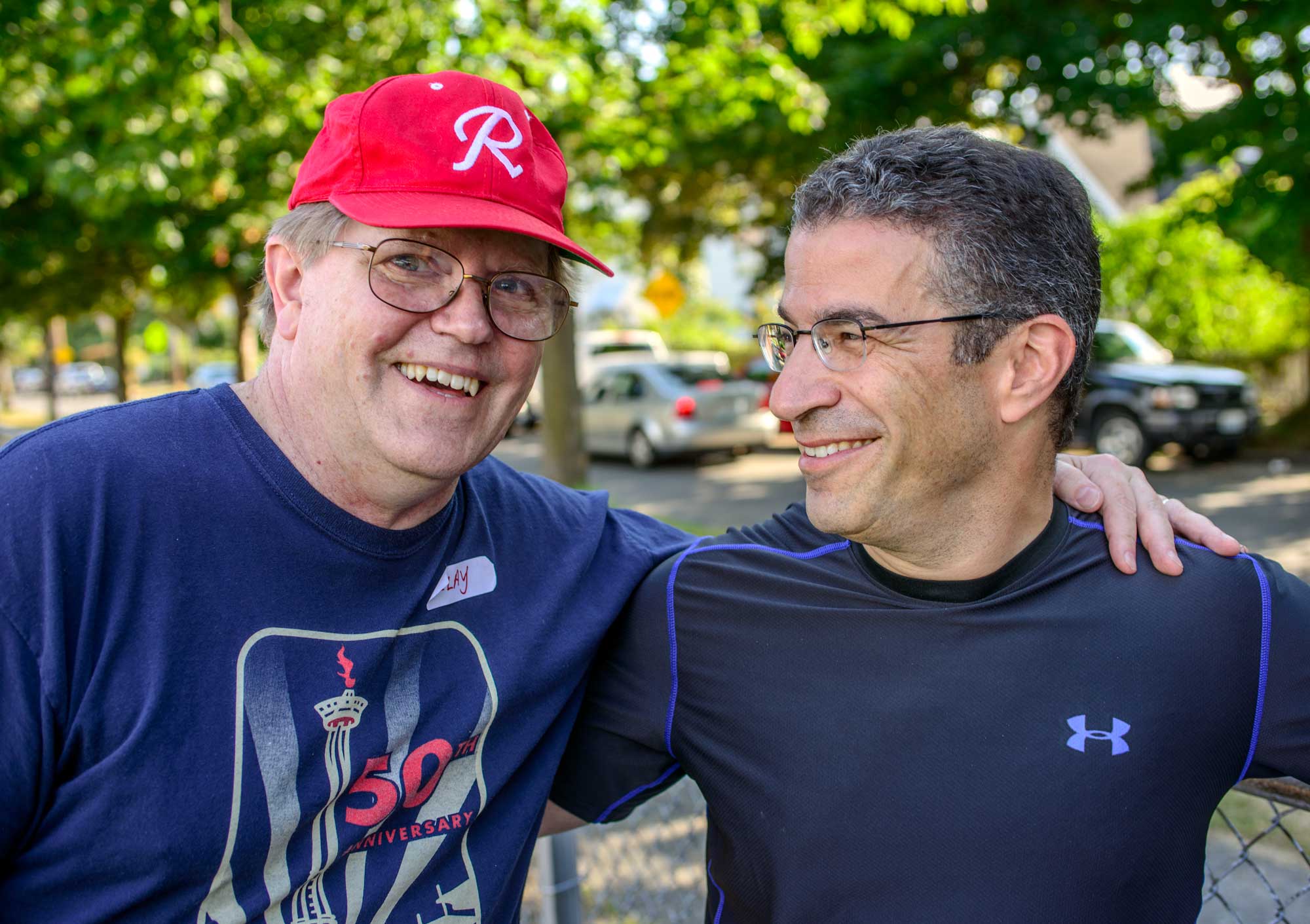
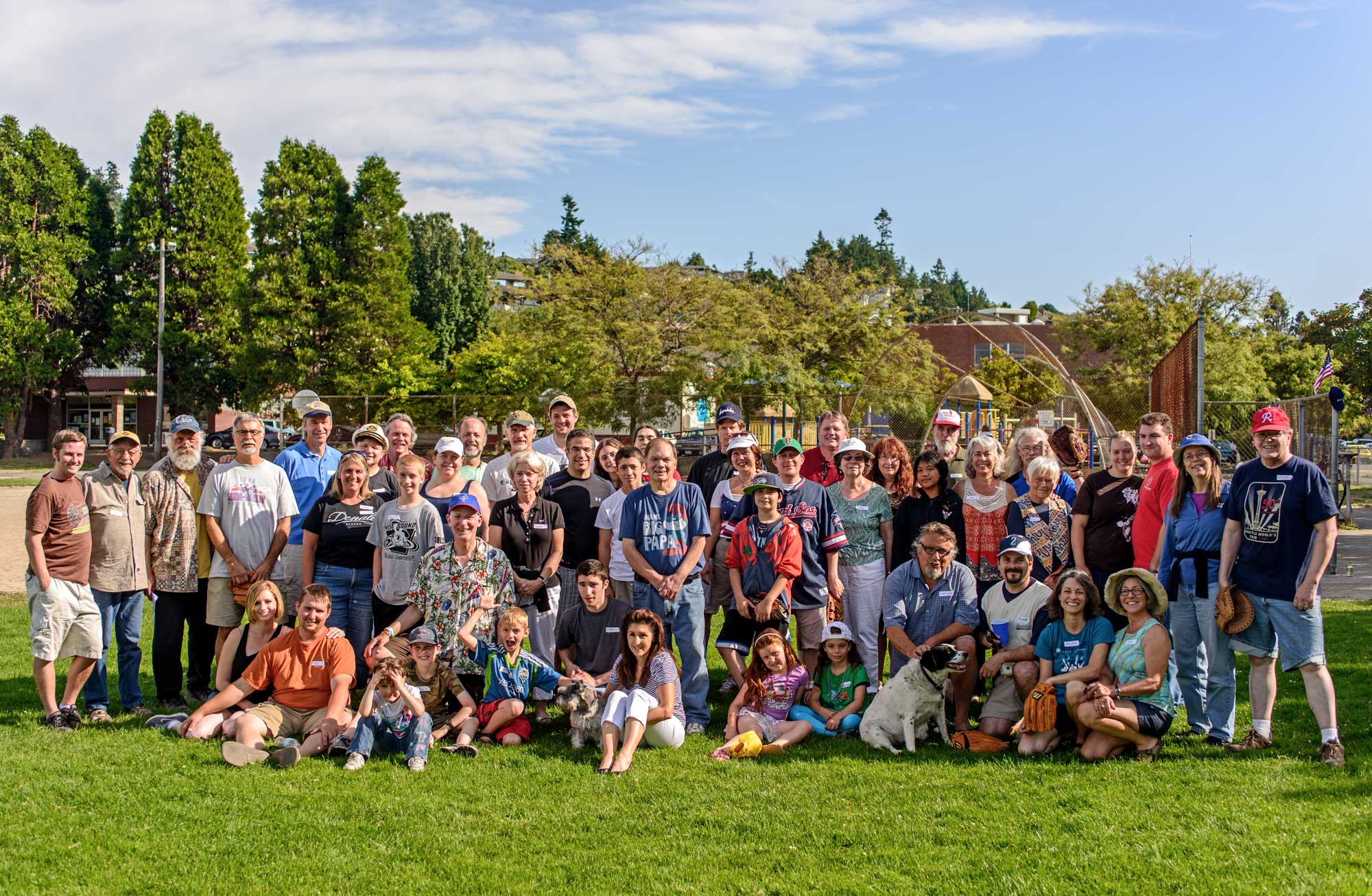
“Herding the two dozen or so cool cats that comprised Clay and David’s annual baseball game/gathering was an amiable chore. We ambled from the diamond to 59th and SW Lander during the seventh-inning stretch, following rousing choruses of “Take me out to the ballgame,” the National Anthem and unanimous sighs of regret at Ichiro’s loss. On this glorious July day, the amenable players, on command and between passing cars, spread themselves across the avenue with one caveat from the photographer: ‘If you can’t see me, I can’t see you’.” Both David and Clay can be seen. (They can be seen again below in a manly embrace in the 11th of Jean’s snapshots of the Alki Players.)
WEB EXTRAS
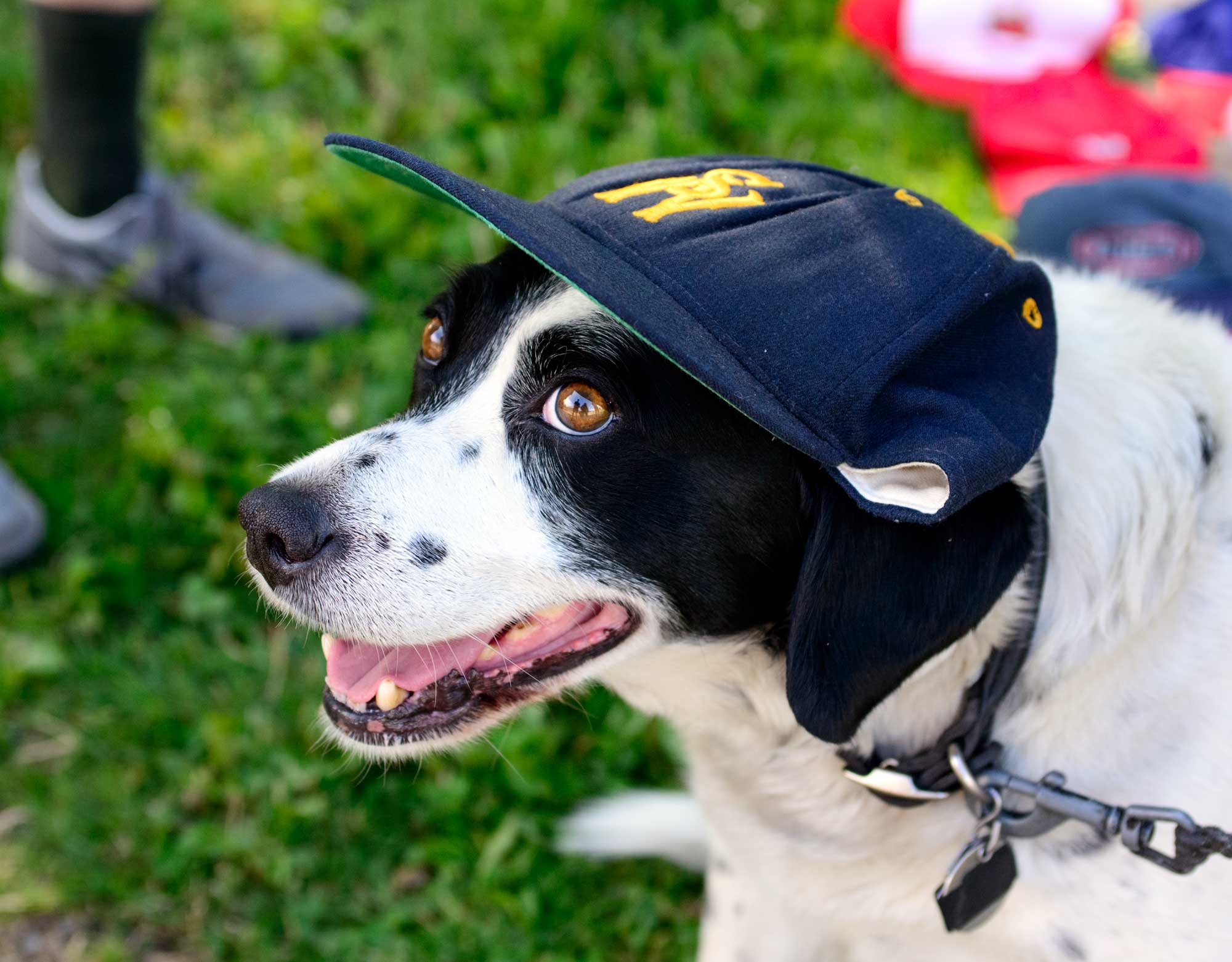
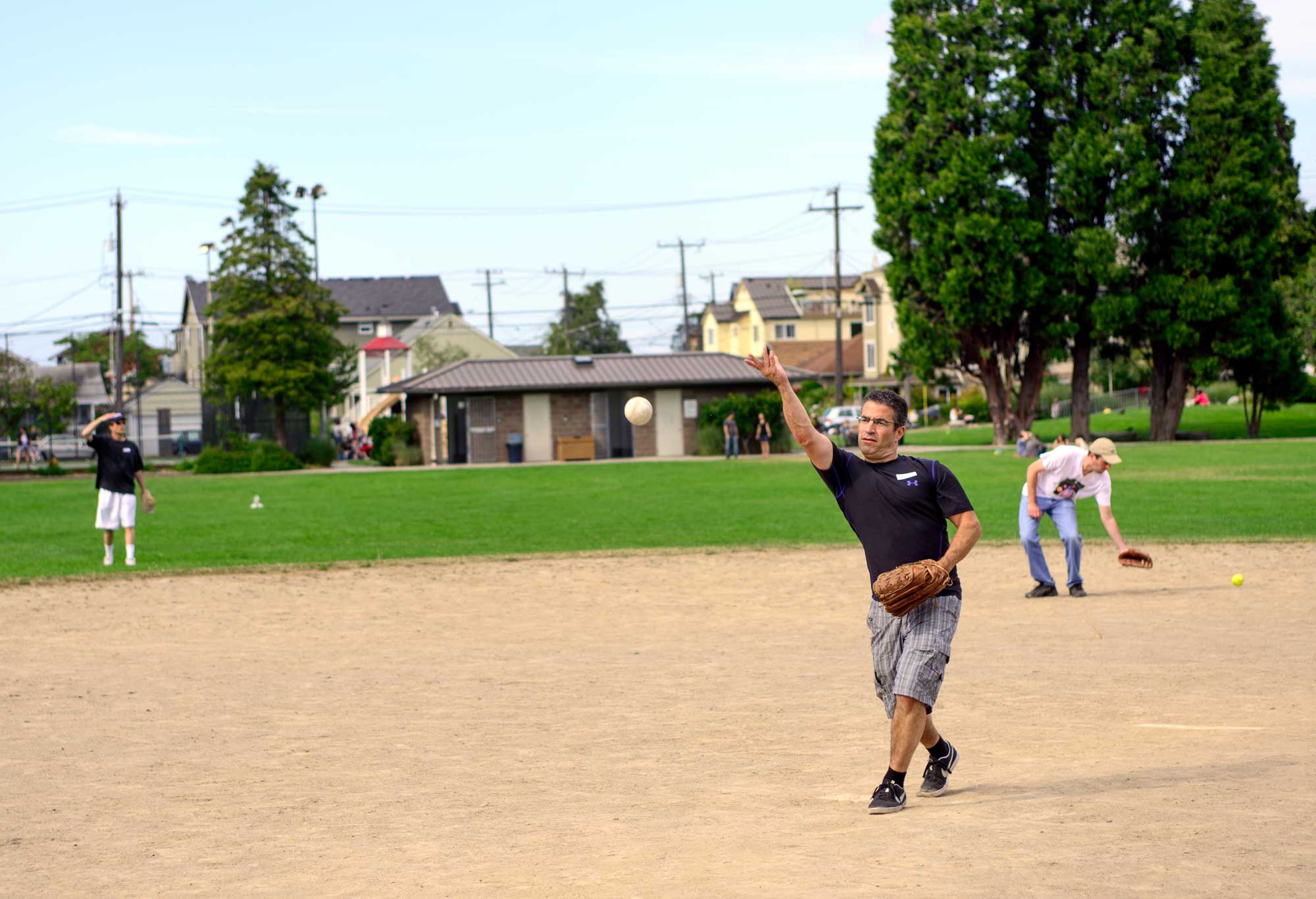
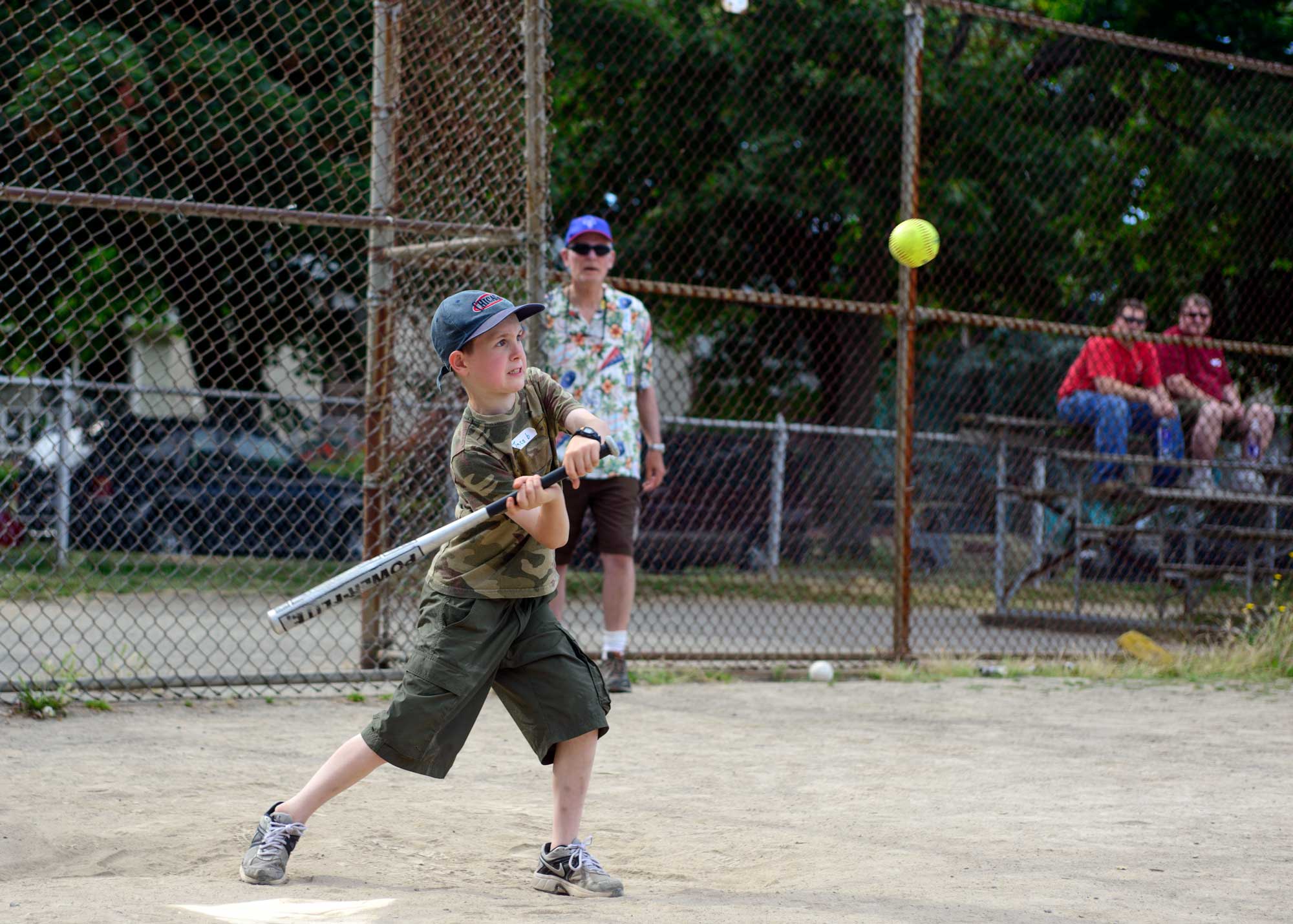
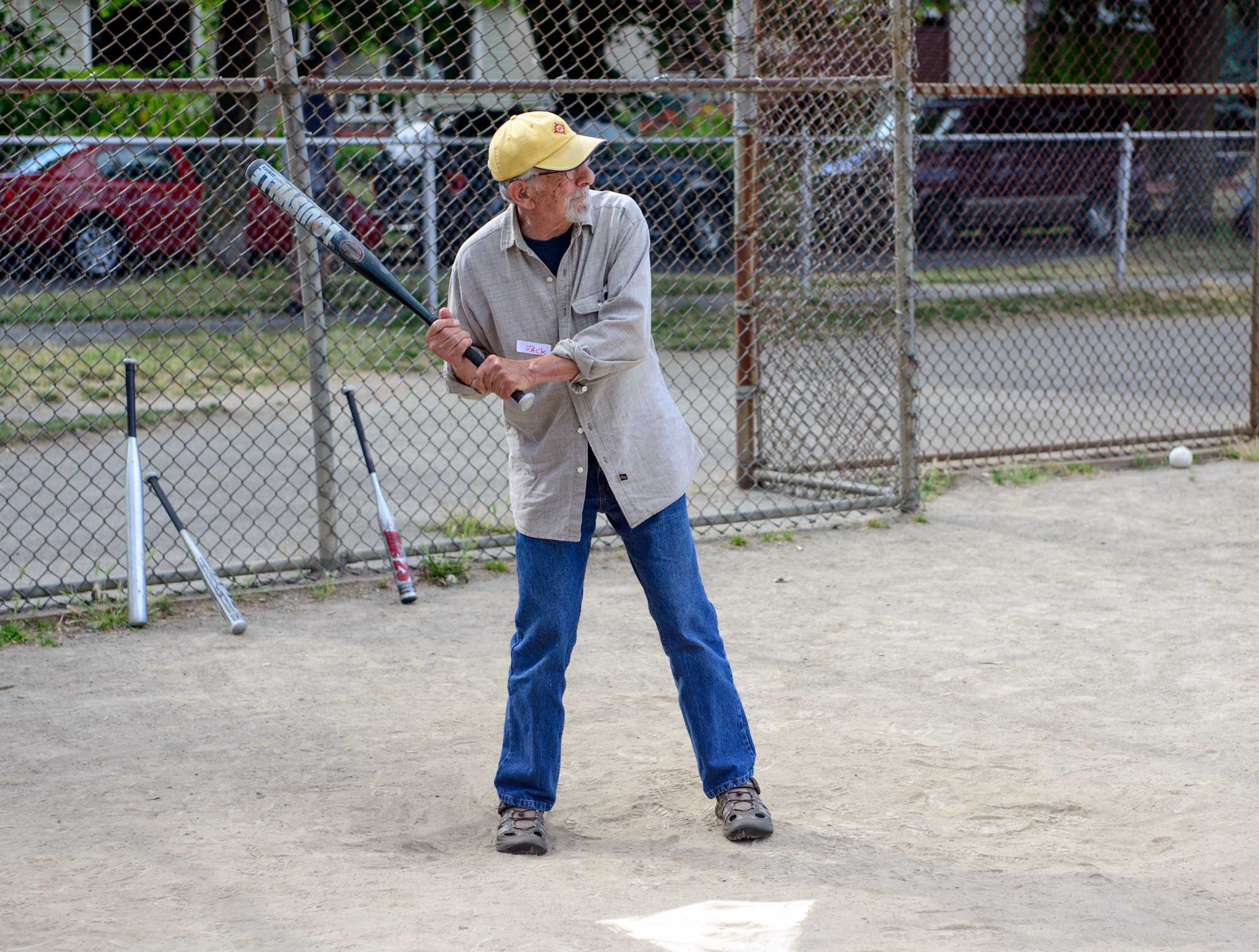
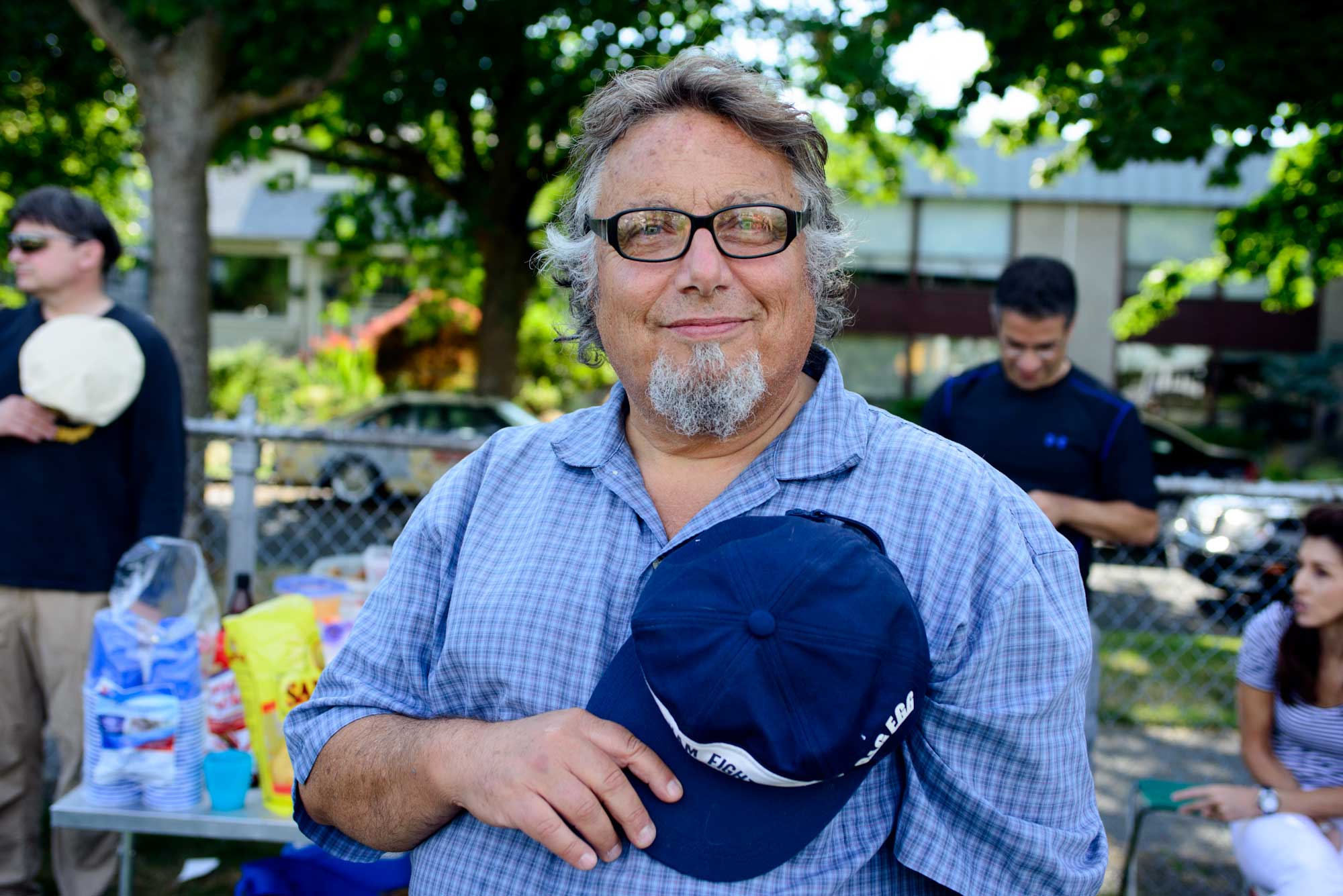
I’m posting a few thumbnails of the annual game, Paul. These include Lil Eskenazi, the team mascot, the oldest and youngest players, mighty Clay Eals at bat, pitcher Dave Eskenazi, T-shirt prizes, and a few more highlights.
And here’s the group portrait – enough players for two teams with more than three outfielders for each:
Anything to add, Paul?
Yes Jean – a few related features from the past, and we may be repeating some of them – even from this blog. Remember, rather than check we promote a policy of benign redundancy in which every story or feature or photo is made fresh by context. We use the musical analogy of a leitmotif. First, here’s another “artist’s league” group portrait from long ago – ca. 1976 – in Cascade Park or playfield, about two blocks east of The Seattle Times. Remarkably, one of the players in this group has made it – with a borrowed glove – into Jean’s 2012 portrait straddling 59th Ave. SW at Lander Street. (Possibly this fond bit of local softball ephemera has also appeared here earlier.)
Cascade Players off Pontius Ave. N. A Google-Earth inspection of our play field, Alki Beach, Schmitz Park, and Alki Elementary too. (The U-Shaped school is directly below the ball diamond.) Compared this to the two maps directly below. The one grabbed from the real estate plat for Alki Point and the other from our 1912 scan of the Baist Real Estate Map.Curiously the two maps do not agree on the location for the school. You can determine which is the closer by comparing the maps with the satellite photo.
=====
Spud began on Alki Beach in 1935 as a seasonal sidewalk service in a clapboard shack. Here in the late fall of 1938 it is boarded up until spring. Now Spud is a year-round two-floored emporium that seats 80-plus lovers of deep-fried fish served with both tradition and a view of Puget Sound. [Historical view courtesy Washington State Archive, Bellevue Community College branch.]
SPUD on ALKI
(First appeared in Pacific, Feb. 16, 2003)
Brothers Jack and Frank Alger opened The SPUD on Alki Beach in June of 1935. It was the beginning of summer but also the dead of the depression. At 10 Cent for a cardboard boat stuffed with fries and two big pieces of breaded ling cod the English-born Alger’s fish and chips serving was affordable, delicious and filling – but only in the warmer months. In late fall the stand was closed and looked as it does here in this Works Progress Administration tax inventory photo recorded on Oct. 14, 1938.
To either side of SPUD in 1938 was a line of small beach homes, a few small apartments, Turner’s Shell station, Sea Home Grocery, Seaside Pharmacy, Alki Bakery, two groceries, a barber, a cobbler, a plumber, a tailor and four other eateries — two serving hamburgers and hot dogs and the other two fish and chips. Most commonly on Alki Ave. s.w. were the vacancies but most importantly for the life of the beach was the Alki Natatorium Swimming Pool built across from Spud on pilings over the tides.
Following the war the shanty seen here was replaced with a nifty modern plant featuring portholes, and SPUD written in big bas-relief block letters over the front door. Sheltered inside was a counter with four stools. By then there were Spuds at Green Lake and Juanita as well. The family continued to run the Alki Spud until Frank’s son Rick decided prudently at the age of 55 that he needed “to slow down and enjoy life more.” Recently retiring to build their “dream home” on Hood Canal Rick and Terry Alger sold Spud to Ivar’s.
SPUD in the dark, ca.1945SPUD - 1948SPUD - 1961
It was a both sensitive and poetic choice for also in 1938 when Ivar Haglund opened his first café – a fish and chips stand at the entrance to his aquarium on Pier 54 — the Alger brothers helped him. Roy Buckley, Ivar’s first employee, learned his fish and chips while working at Spud. All of them, Frank, Jack, Ivar and Roy were West Seattle lads.
Roy Buckley when still working for the Algers.
While both Spud and Ivar’s survive in 2003, we may conclude by listing a few popular restaurants of 1938 that do not. All are still savored in memory only. Manca’s and the swank Maison Blanc; The Green Apple (home of the Green Apple Pie); The Jolly Rogers, The Dolly Madison Dining Room, and Mannings Coffee (several of them); the Moscow Restaurant and the Russian Samovar; Ben Paris downtown and Jules Maes in Georgetown; the Mystic Tea Cup, and the Twin T-P’s, Seattle’s Aurora strip landmark most recently lost to a (w)reckless midnight wrecker.
A visit to SPUD on ALKI offers more than breaded fish. Here ca. 2003 an exhibit of Alki Beach now-and-thens is being hung on the south wall of the fish-and-chips second floor dining room. The stairway to this exhibit of Alki repeats is also replete with other historical photographs of the neighborhood.
Two Examples of the Alki Ave now-then repeats, follow.
=====
In 1910 the city purchased much of the Alki Beach waterfront for the development of a groomed park and the seawall showing on the far right of the “now” scene. Both views look east on Alki Beach from near 64th Avenue SW. About one century separates them. (Historical photo courtesy of Lawton Gowey – Contemporary photo by Jean, now nearly eight years past.)
ALKI BEACH BATHING
(First appeared in Pacific, Nov. 10, 2004)
This beach party scene comes from that most popular and yet unknown source: somewhere. The beach is familiar enough – at the scene’s center is Duwamish Head marking the entrance to Elliott Bay – but neither the year nor the group nor the photographer whose back is to Alki Point are identified.
Depending upon who is throwing it this scene is a stone throw or two from the site where the Denny Party landed on Nov. 13, 1851. Judging from the costumes and the development (or rather lack of it) on the beach it was photographed about a half century later. Most likely then if this is not a group from the neighborhood its members came to their picnic by boat for the electric trolley did not reach the beach until 1907, the year that West Seattle incorporated into Seattle.
By the time this driftwood tableau was photographed the attraction of Alki Beach as a summer retreat was already commonplace. After regular steamer service was launched across Elliott Bay in 1877 the Daily Intelligencer advised “Now is a good time for picnics on the beach at Alki Point, so it will pay some of our new settlers to go over and see the spot where Messrs. Denny, Maynard and others lived during the ‘times that tried men’s souls.’” (I found this reference in “The West Side Story”, the big book of West Seattle history.) We can only imagine what pains those we see frolicking and lounging here gave to the hardships of the founders.
There is a revealing similarity between the beach visitors in the “now” and the “then” scene: how few of them there are. Alki Beach was frequented by throngs after the arrival of the trolley and the 1911 opening of Alki Beach Park with its oversized bathing and recreation pavilion – 73,000 of them in 1913. By comparison Jean Sherrard took this week’s “now” photograph last July 24, one of the hottest days of the summer. While there are surely many more offshore attractions in 2004 then in 1913 when it comes to chilling dips we may also have become less robust.
=====
About 80 years separate the two later afternoon views on Alki Beach Park. Both look to the southwest from near the foot of 61st Avenue Southwest. (Historical photo courtesy of Washington State Historical Society, Tacoma, and, again, the contemporary one by Jean.)
ALKI BEACH PARK MAKE OVER
(First appeared in Pacific, Nov. 17, 2004)
Last week’s “then” looked northeast on Alki Beach. This week’s record surveys the same stretch of sand but in the opposite direction. Why spend two weeks on one beach? Because about a quarter century separates the two historical photographs – last week’s and this one – and the changes are revealing.
As shown seven days ago a picturesque litter of driftwood distinguished the ca. 1900 West Seattle waterfront. Here a quarter-century later the same waterfront is littered instead with bathers in wool suits and separated from a wide planked promenade by a seawall. Actually the change from the irregular strand landed on by the founding settlers of 1851 to a groomed shoreline occurred very rapidly after the city condemned and purchased in 1910 the nearly 2500 feet of this shoreline between 57th and 65th Avenues Southwest.
In quick order the city built a large bathing pavilion (the historical photo is photographed from its roof) and the wide walk protected by the sturdy wall. This radical makeover was dedicated on Independence Day 1911 and the following year the covered bandstand was extended over the tides. That first year the city’s Parks Department estimated that 103,000 persons were attracted to the 75 concerts performed from its octagonal stage.
A 1912 off-shore look at the Alki Beach facilities. This was taken from a Fickeisen family album, and used courtesy of Margaret & Frank Fickeisen.Another early off-shore look at the big bath house. Looking northeast from the bath house portico to Duwamish Head with Luna Park, far right, and a temporary Alki Beach pier that once serviced whaling ships. Magnolia is far left.
In 1925 the wooden seawall was replaced with a concrete one that was designed to protect the beach with a concave profile that inhibited the undertow of high tides. In five years more the seawall was extended in the other direction (to the northeast) to within 150 feet of Duwamish Head. At last in 1945 this gap was also acquired and improved to make a continuous recreational shore between the Head and the string of homes that lie between the public park and the closed – since 911 – Alki Point lighthouse (1913).
This chronology was gleaned from the book “West Side Story” and Don Sherwood’s unpublished (but often photocopied) manuscript history on local parks. (You can find it all on the Seattle Park Department’s web page – the history part of it.) Much on Alki Beach history is featured in the exhibits and publications of the Log House Museum (one block from the beach at the corner of Stevens St. and 61st Avenue) and – as noted and shown above – also in permanent display on the walls of the by now venerable SPUDS fish and chips on Alki Avenue.
Ivar "Keep Clam" Haglund's aunt and uncle, Rena and Al Smith, once owned a good part of Alki Point - as did Ivar - inherited from Ivar's grandparents who settled on the point in 1868 after purchasing it from pioneer Doc' David Maynard. (That story will soon be told in detail in "Keep Clam.") The Smiths built this bath house to service their Alki Point restaurant, the Stockade. (Courtesy, Bob Bowerman)Another changing house of similar construction as the Smiths but only perhaps on Alki Point.
=====
For the 19 years that the Alki Natatorium covered the beach it was closed and or in disrepair about as much as it was open to plungers and other recreations. The sprawling facility was camped on the tides side of Alki Avenue between 58th and Marine Avenues Southwest. Historical Pix courtesy of Don Myers.
ALKI “NAT”
(First appeared in Pacific, Feb. 6, 2005)
If we could but read the license plate on the bumper of the car (that looks very much like the one my dad drove the family west in from North Dakota in 1946) we could date this stark portrait of the Alki Natatorium. Since much of the glass along the Alki Avenue façade is busted out we know that this scene was photographed sometime when the fitful entertainment center was not serving.
But when jumping there was more than swimming here. For instance, the neon sign with the diving swimmer also advertises dining and dancing at the Shore Café. And at least during the late 1930s when the Premier Amusement Company was running it, the “Nat” was also a skating rink.
This natatorium was the last of three built along the beach. The first opened near Alki Point in 1905, but quietly closed while planning an “Oriental-styled” enlargement complete with “real Geisha Girls” serving tea and the “world’s largest swimming pool.” The second opened in 1907 with Luna Park at Duwamish Head. And although the amusement park was soon closed for introducing “lewd and disorderly behavior” the big indoor natatorium stayed open until 1931 when it was one of many targets torched by an arsonist that year.
Perhaps the short-lived natatorium at Alki Point before the light house - photographed - perhaps - from the Alki Point Wharf included in the map below.The Alki Point natatorium is marked in this real estate promotion of May 20, 1905.
Three years later this “Nat” opened a short distance up the beach from the Municipal Bath House towards the Head not the Point. The “Nat” managed to survive the Great Depression but not a lawsuit by an injured swimmer in 1939. In 1942 the Seattle Park’s Department renovated and reopened it in time for the preoccupations and parsimony of the war, and the place again closed. Especially when dark, its great expanse of roof glass was pelted by naughty children (read boys) with rocks borrowed from the beach. Several moves by the Parks Department and City Council to restore it following the war turned out to be good intentions only and in 1953 the Alki Natatorium was razed to the beach.
THEN: With their windows open, joyful Seattle University co-eds greet Spring and a Seattle Times photographer from their First Hill mansion-dormitory in April 1959. (Picture courtesy, Lois Crow)NOW: 53 years later co-eds Frances Farrell and Lois Crow, left and right, return to 718 Minor Avenue and different steps. Jean Sherrard has also posed me “hiding my shame” – for past mistakes - in the tree behind them.
Looking up the front steps of Seattle University’s McHugh Hall (the name and address are painted on the steps) we count nine coeds waving to a Seattle Times photographer. The subject was first published in this paper on April 12, 1959, along side a second photo of the dorm’s oversized bathtub, both used to illustrate a feature written by Frances “Fran” Farrell and titled “It’s HOME to Seattle U. Co Ed’s” Fran’s SU instructor in journalism advised her to write something for publication and the Times liked her story on McHugh Hall – her school dorm converted from the Anderson Mansion on First Hill – so well that they gave it a full page.
In Jean Sherrard’s “repeat,” Fran, on the left, stands on newer Swedish Hospital steps beside Lois Crow. With two others they shared a dorm room on the top floor – here upper right in the “then.” Barbara Owen, one their upper-class quartet, waves from the open window. Fran Farrell chose her subject with enthusiasm. “Living in McHugh was a complete delight! As upper classmen we wanted someplace with more independence and camaraderie and we got it at McHugh.” Freshmen and sophomores were housed in Marycrest, a new six-story dormitory. It held none of the ornate charms of a lumber baron’s mansion.
Jean suggests that I ask readers if this week’s “now” is familiar. He knows that it is. As the “repeat” for a different story, we used this location recently – last May 19th. And there I – but not Jean – made a big mistake. What I had learned years earlier – and earnestly believed until the Saturday before the Sunday publication – was that our May subject was Mrs. Anderson posing in her celebrated coach in front of her mansion here near the southeast corner of Minor and Columbia. But – and alas – it was instead Mrs. Burke posing in her coach in front of her First Hill Manse, but three blocks away. (If it helps, they remain short blocks.) When Lois Crow, already an acquaintance of mine, discovered my mistake and shared it with me that Sunday morning, I was at least able to tell her that I too had discovered it a day earlier, but that it was too late to stop the presses.
We encourage you to read Fran Farrell Vitulli’s Times feature on the Anderson manse. You can access it readily through the Time’s older archive (1900 to 1984) serviced on the Seattle Public Library web page. It is a service that also offers what we may call the “joys of the key word search.” You can also find a facsimile of Fran’s feature printed in Jean and my blog noted at the base of this writing. And there, if you will, you may study my full confession, at once contrite and illustrated.
WEB EXTRAS
Anything to add to this moving mea culpa, Paul?
Yes indeed, Jean!
As explained in this week’s feature, but more elaborately last May in this blog’s 11th hour anticipation or “catch” for the mistaken feature published in Pacific then – the one proposing to be about Mrs. Anderson and her famous First Hill carriage but actually showing Mrs. Burke and her’s, also on First Hill – here is the link to that May 17th feature. It repeats, again, my full confession. It also includes – perhaps as compensation Ron Edge suggests – a long list of other features having to do with First Hill and a few other large Seattle homes. Thanks for your compassion. To get to this replete repeat either CLICK THIS LINK or the picture below. The picture is of another Anderson: Anderson Hall on the U.W. Campus. After her lumberman husband’s death, Mrs. Anderson paid for its construction as a warm and useful tribute to him. It was appropriately built for the school’s Dept of Forestry.
In proper order and again below is the next issue of Helix, and the commentary by Bill White and myself. In this issue John Bixler makes his first appearance – on a motorcycle stopped by some plainclothes police ready to slap on him the tough charge of not having paid off a parking ticket. In that reportorial snap, the Helix office can be seen across Harvard Ave. E. (beneath the freeway). Hereafter John will be an enduring participant in our productions, except when he was away doing road work for the band The Youngbloods. In Jef Jaisun’s 1992 shot taken for the 25th anniversary of the founding of Helix – Not So Strait John Bixler appears far right with those posers who made it out of the Blue Moon and onto the sidewalk in front it. They are, right to left, John Bixler, Jacque Moitoret, Tom Robbins, Walt Crowley, Alan Lande, Paul Heald, myself, and standing in front with his own row, Maury Heald. We have printed this earlier and will probably print it again later. (Thanks again to Ron Edge in Lake City for steadfast wrestling all this Helix matter on the blog that ends with the last name of our editor in Paris.)
THEN: Photographed on April 30th, 1921, the Palace Hip at the southeast corner of Spring Street and Second Avenue mostly prospered until it closed in the Spring of 1929, still months before the crashing start of the Great Depression. The Seattle Times explained, “The heyday of vaudeville is over and with it into history fades one of its former strongholds.” (Courtesy Museum of History and Industry. A Webster and Stevens studio photo.)NOW: In 1930 the Palace Hip was converted into a parking garage and remained so until an office building in 1986 replaced it.
Dazzled – we hope – last week by a musical pig dancing above the sidewalk on Second Avenue north of Madison Street, we made promises to visit this week another attraction on that block. By the time the Pig ‘N Whistle opened in 1919, its neighbor the Palace Hip Theatre, across Second at its southeast corner with Spring, had been showing animal acts and much more on stage for ten years.
The name blazoned here on and above the theatre’s boisterous corner marquee was its third. The theatre opened as the Majestic on August 30, 1909, changed to Empress less than two years later and in 1916 with a remodel turned over again into the Palace Hip (short for Hippodrome.)
Soon after the summer opening this newspaper surveyed its wonderful construction. “The entire designing and constructing of the Majestic Theatre in somewhat over five months from the date of John W. Considine’s order is an apt illustration of the Seattle Spirit.” Considine was the super-impresario and Edwin W. Houghton the happy if frantic architect, who proudly revealed to the Times reporter, “I was fortunate enough to have a client that had good enough judgment to select an architect whom he thought was capable and then leave him to do it.”
While the theatre’s dog acts were often splendid, they were but one of ordinarily six or seven acts that took the stage twice a day. By some accounts it was Seattle’s “greatest house of vaudeville.” Of the hundreds upon hundreds of acts – comedy, song & dance, animal – that landed here for a run of a week or two, Charlie Chaplin and Stan Laurel (later of Laurel and Hardy) are the most abiding names. David Jeffers, Seattle’s historian of silent film, confesses, “I dream about this place. A Greco-Byzantine interior of ivory and gold and 1500 seats!”
Thru its two decades the Palace Hip ran vaudeville, showed films, and staged plays. For all of these a theatre-goer’s visit to the confectionary across Second was often a capper to any show.
WEB EXTRAS
Anything to add, Paul?
Yes Jean – a few past features from the neighborhood, some of which has already appeared here, still we put them forward again following thereby a kind of Wagnerian formula of motifs repeated in new settings. Since five of these features include theatres we have a second motif. We’ll begin though with BUCK JONES in the BIG PUNCH, the Fox film advertized on the marquee and in broadsides pasted to the Palace Hip’s exposed walls at the corner and near the ticket window.
From mid-block between Seneca and Spring looking south on Second Ave. ca. 1908. Frederick and Nelson Department Store is still in the Rialto Building right of center, and Considine will soon take the southeast corner across Spring Street on the left and replace it with his and architect Houghton's Majestic. By some agency when the Palace Hip was still the Majestic the name and even the style of its signage was repeated for the second floor cavity carver name the Majestic Dentists. The corner's oddly consistent promotions were topped by a tooth outlined with electric lights. From a similar point-of-view as that above, Lawton Gowey recorded this look south on Second and thru Spring Street on April 6, 1967. Another Gowey recording of the block, this time on July 26, 1972 when the theatre's corner was taken by a Donut shop. Back again with Lawton and the donuts on July 26, 1981. Here on May 23, 1981 Lawton Gowey concentrated on the old theatre's Spring Street facade. The August 22, 1930 Times clipping that follows announces the plans to convert the old vaudevillian into a parking garage that would endure decades longer than the theatre..The Seattle Times, August 22, 1930.Showing the neighborhood, grabbed from the 1912 Baist Seattle map of footprints.
Still on Second Ave. at Spring Street but this time looking north thru the latter to the Lois and Pantages Theatres one block along and to either side of Seneca Street on the east side of Second. (Courtesy, Museum of History and Industry)
The Pantages Theatre at the northeast corner of Second Ave. and Seneca Street.
PANTAGES VAUDEVILLE
(First appeared in Pacific, May 20, 1990)
Alexander Pantages built his namesake vaudeville house at the northeast corner of Second Avenue and Seneca Street in 1904. It was “the little Greek’s” second theater. The first, “The Crystal,” also on Second Avenue, was a converted storefront that Pantages opened when he landed in Seattle with a small fortune finagled in the Alaska gold rush. As Murray Morgan describes Pantages’ gold-field strategy in his Seattle history “Skid Road”: “He abandoned his dream of finding gold in the creek beds and concentrated on removing it from the men who had already found it.”
Pantages sold the sourdoughs vaudeville, at $25 a seat in his Orpheum theater in Nome. The price of admission to his first Seattle shows was a dime for a mixture of stage acts and short, jerky films. Pantages (or his legend) was illiterate, but having roamed the world before landing here he could converse in several languages. His English, it was said, was as bad as any. But he knew what the public wanted.
Pantages built a vaudeville empire that ultimately surpassed all others. Somewhat like royalty, his daughter Carmen married John Considine Jr., son of his chief competitor. At its peak the Pantages circuit included 30 playhouses he owned outright and 42 others he controlled. To an act he liked, he could offer more than a year of steady employment. Pantages sold his kingdom for $24 million in 1929 – before the crash.
Considine and Pantages, left and right.
To Pantages the best act he ever booked was the violinist he married. Lois Pantages always played the first act whenever her husband opened a new house. The first of these was across Seneca Street from the Pantages. He named it after his wife, and until it was destroyed by fire in 1911, the Lois was a successful theater. Also in 1911 Pantages purchased Plymouth Congregational’s old church grounds at the northeast corner of Third Avenue and University Street, and built his New Pantages Theatre, designed by architect B. Marcus Priteca, between 1915 and 1918. Later renamed the Palomar, it was a showplace many Seattleites will remember. (This Pantages/Palomar is a subject that has been treated on this blog. Please try the search box for it – if you will.)
Another Webster and Stevens Studio look up Second Across Spring Street with both the Lois and Pantages theatres up-the-block and the Savoy Hotel too.And more with the Baillargeon Building on the right at the northeast corner of Spring and Second. This enchanting tableau looks across Spring Street to the early construction scene for the Baillargeon Building at the northeast corner of Spring with Second. Note at the top the Savoy Hotel is getting some added stories. The date, 1907, is evident at the bottom-right corner. This is pulled from an album having mostly to do with the construction of the Seattle Gas Company’s facilities at what is now Gas Works Park. (Courtesy Michael Maslan)
NEXT a look west on Seneca across Second Ave. to a pioneer home.
Above: The scene looks west on Seneca to its northwest corner with Second Avenue, where, depending upon the date stands either the Suffern residence or Holy Names Academy, the city’s first sectarian school. (Pix courtesy of Michael Cirelli). Below: With the economic confidence gained by the Yukon and Alaska gold rushes of the late 1890s, most of Seattle pioneer residences then still surviving in the central business district were replaced with brick commercial blocks.
The SUFFERN HOME
(First appeared in Pacific, June 17, 2007)
Sometime in the 1870s John Suffern built a sizeable home at the northwest corner of Second Avenue and Seneca Street. We see it here but not knowing the date of the photograph cannot say if the Sufferns are still living there or if it is in the learned hands of the Roman Catholic Sisterhood of the Holy Names.
Suffern is first known hereabouts for his iron works and second for both building and captaining steamboats on Puget Sound. After Issaquah pioneer Lyman Andrews stumbled upon some exposed coal on his claim in 1863 he carried a few lumps of it in a sack to Seattle where Sufferen tested it in his kiln and found the Issaquah coal excellent for firing. In another ten years east side coal became Seattle’s principal export – most of it to California railroads. By 1879 Suffern had turned to drugs. That year’s directory adds an “e” to him name and lists him simply, “Sufferen, J. A. druggist, cor. Second and Seneca.”
The following year, 1880, the Sisters of Holy Names bought his property for $6,800 and arranged the home for their first Seattle school. The Holy Names official history explains, “The building consists of two stories and a basement. In the latter are the kitchen, cellar and pantry. The parlor, music room, office and Sister’s refectory are on the first floor, the chapel, community room and a small apartment for the Superioress are on the second floor.”
Also in 1880 the Sisters of Holy Names built a second and larger structure on their property to the north of this white (we assume) house. The addition included two large classrooms and a second floor dormitory for the city’s first sectarian school. It opened in January 1881 with 25 pupils, and grew so rapidly with the community that in 1884 the sisters built another and grander plant with a landmark spire at 7th and Jackson Street. The not so old Suffern home survived the city’s “great fire” of 1889, but was replaced in the late 1890s with the surviving brick structure, now (in 2007) the comely home for a Washington Liquor Store, and a custom tailor.
=====
Above: Looking north on an unpaved Second Avenue in July 1889. The nearly new tracks on the left served the first electric trolley on the Pacific Coast when the conversion was made from horses to dynamos earlier in March. Second was paved in the mid-1890s and thereafter quickly became Seattle’s “Bicycle Row” with many brands to choose from sold mostly out of small one story storefronts, especially in this block between Spring and Seneca Streets. (Pix courtesy of Michael Maslan) Below: The widened Second north of Spring Street was half quiet when photographed on a late Sunday afternoon.
THE CANVAS RECOVERY
(First appeared in Pacific, Oct. 7, 2007)
The city’s “great fire” of June 6, 1889 consumed most of the business district – more than 30 blocks – but not this block, the first part of Second Avenue that was not in some part scorched. After the disaster it quickly served in the rebuilding that turned practically every available lot and lawn on Second into a sewn strip of temporary tents. The Times for June 10 reported that while “the slabs and sawdust piles are still burning and sending clouds of smoke back over the town” over 100 permits had been issued to put up tents.
Judging by the canvas signs, the large tent on the far left, at the southwest corner of Second and Seneca Street, is shared by two firms: Doheny and Marum Dry Goods and the “manufacturers agents”, Avery, Kirk and Lansing. Before they were for the most part wiped out by the fire the two businesses were already neighbors at the northwest corner of Columbia and Front (First Avenue).
Around two o’clock on the afternoon of June 6, or bout a half-hour before the fire started, Avery and his partners were suddenly $2,500 richer, when W.A. Gordon, a young man recently arrived from Maine, invested that amount, “everything he had” the papers reported, in the business. The sudden cash most likely helped with the construction of the big tent. Still we do not see Gordon’s name stitched to it.
We know from a Times article of August 2, titled “A Tent Occupant’s News” that a firm doing business on Second just north of Seneca had paid $2 a month per running foot for space to construct the framework for a tent and cover it with canvas “at the expense of several hundred dollars.” Now less than two months later the landlord was asking the city to remove the tent for the construction of a building. The threatened residents appealed, “We do not want to be thrown into the street.”
A few tents did business for a year before the city council decided there were “buildings enough for all” and ordered the last of them removed.
=====
Above: The post-1889-fire story directly above this one looked north on Second Avenue from Spring Street through a block of temporary tents and small frame structures in the summer of the city’s June 6,1889 fire. This view reveals part of the same block 32 years later in 1921. Below: A part of the Baillargeon/Pacific Security Building, far right, survives into the “now” scene. Built in 1907, it is, for Seattle, an early example of a steel-frame structure covered with terra-cotta tiles and ornaments.
THE ELEGANT STRAND THEATRE
(First appeared in Pacific, Oct. 14, 2007)
Here the gleaming symmetry of the Strand Theatre rises above the confused queue of a sidewalk crowd jostling for tickets to Wet Gold. The elegant Strand opened as the Alaska Theatre in 1914. Two years later this then overworked name was dropped for the London sophistication implied in the new name “Strand.”
Most likely this is a first run showing of J. Ernest Williamson’s 1921 hit Wet Gold, the story of a sunken ship, its gilded treasure and the passions released in finding it. Resting nicely on the theatre’s terra-cotta skin, the film’s sensational banners are nestled between the Strand’s classical stain glass windows. Williamson became a pioneer of undersea photoplays by attaching an observation chamber to an expandable deep-sea tube invented by his sea captain father. The younger Williamson called it his “Photosphere”.
I’ve learned from Eric Flom’s historylink.org essay on the Alaska/Strand that Frederick & Nelson Department Store was contracted to furnish and decorate the interior and that the elegance begun on the street was continued in the theatre’s lobby with onyx and marble. Before the 1927 introduction of synchronized sound the silent films shown at the Strand were generally accompanied by its Skinner Opus No. 217 pipe organ, which later wound up in St. Paul’s Episcopal Church in Bellingham.
Flom also notes that this 1114 address on 2nd Avenue (the east side between Spring and Seneca Streets) was showing films years before it’s terra-cotta makeover. The Ideal Theatre opened there in 1909 and in 1911 it too was renamed The Black Cat, which, as noted, was elegantly overhauled three years later into the Alaska/Strand. Flom has tracked the 1,110-seat Strand “well into the 1930s.”
=====
Above: Publisher William Randolph Hearst paid $200,000 for exclusive reporting rights of the Graf Zeppelin’s 21-day trip around the world in Sept. 1929. The big blimp neither stopped in nor flew over Seattle; still a world map (without poles) was painted by the Foley Sign Company and attached to the front of the Coliseum Theatre as part of the promotion. So that the pedestrians at 5th Avenue and Pike Street might be reminded of their place in the world, the lettering for “Seattle” was made larger than for any other city on the map. (Photo courtesy G. Sales) Below: Jean took the “now” from the third floor of the Washington Federal Savings Bank, kitty-corner to the Banana Republic, which in a local example of “adaptive reuse” arranged the landmark Coliseum Theatre for selling clothes and such in 1994, four years after the theatre went dark.
COLISEUM THEATRE – ADAPTIVE REUSE
(First appeared in Pacific – and here too – Aug 17, 2008)
Seattle architect B. Marcus Priteca designed the Coliseum Theatre, Fifth Avenue and Pike Street, for owners C. D. Stimson and Joe Gottstein. The theater opened on January 8, 1916 under the management of John von Herberg and Claude Jensen. The Coliseum was one of the first large theaters in the country to be designed specifically for showing motion pictures. That the stage was a bit small for the largest of vaudeville acts did not matter for it was claimed to be the largest and most lavish of theatres built not for stage acts but for films. As the legend matured it was also the first.
Pantages concocted a neo-classical temple of such flash that the facets of its glazed white terra cotta façade were designed with the help of sciography: the study of sun angles. At night inset electric bulbs threw their own shadows. The lavish appointments continued inside with, by one report, “a symphony of upholstering,” which did not, however, dampen acoustics that were considered the best in Seattle – perhaps in the world! The theatre orchestra of eight players – plus a “giant Moller Pipe Organ”- were all Russians, again, the “highest paid in the U.S.” Fountains framed the orchestra pit and songbirds in wicker cages accompanied the players. By one count there were thirty canaries — probably the best fed in the nation. High above, the Big Dipper twinkled from the ceiling.
Released in 1929, “Tide of Empire” is the western melodrama advertised on the marquee. By the close of 1930, the star, Renee Adoree (meaning “reborn and adored”) had appeared in 45 films, the last four talkies, but not “Tide of Empire.” It was produced in the transition to sound and had only a sound tract for effects and music. Adoree’s role is reborn with a Google search for “youtube tide of empire, 1929.” From the Coliseum’s big screen it’s a bittersweet reincarnation as a low-resolution postcard-sized rendering on a computer screen, but the French-born star still dazzles.
=====
Above: The Metropolitan Track’s Hippodrome was nearly new when it hosted the A.F. of L. annual convention in 1913. (Courtesy Old Seattle Paperworks) Below: Without a phalanx of posing delegates to protect him Jean wisely stayed away from the center of the intersection at 5th Avenue and University Street for his repeat.
POSING Beside The HIPPODROME – AFL CONVENTION, 1913
(First appeared in Pacific, Dec. 7, 2008)
The by then venerable American Federation of Labor, the A.F. of L., held its 33rd annual convention in Seattle in the fall of 1913. Some of the convention’s grander events, like it’s Nov. 11 opening ceremonies, were held in the then nearly new Hippodrome at the northeast corner of 5th Avenue and University Street. About 3000 attended to hear the region’s star politicians, like Seattle’s progressive (although sometimes also puritanical) Mayor George Cotterill and the state’s governor Earnest Lister, shout their speech across the great new hall.
The Hippodrome’s promised construction may have been one reason that the union felt it could meet in Seattle. And yet the new hall was kept to only one story and designed as a temporary structure. The build-up of the ambitious Metropolitan Tract, the “city within the city” on the leased land of the original University of Washington campus, would take time and so was in need of some inexpensive fillers like the Hippodrome until grander structures could replace them. The Skinner Building (seen in the “now”) took the corner – and the rest of the block to Union Street – in 1925-26.
At some point during the convention its 327 delegates poured out of the Hippodrome to pose for a panoramic camera. We have cropped the picture. When tightly packed, the posers extended from the southeast to the northwest corners of the intersection in an arch that centered at the entrance to the hall, as seen here.
Readers who know their Greek will have figured that the name “Hippodrome” was chosen by the Metropolitan Building Company not in reference to its original use for an open Greek racecourse. Rather, it was for association with the name-familiar Hippodrome Theatre in New York, which when it was built in 1905 was called “the world’s largest theatre.” Houdini made a 10,000-pound elephant named Jennie disappear from its stage with the mere firing of one blank from a pistol. Would that it had been a hippopotamus.
=====
Above: Looking south across Spring Street and into the pit along Third Avenue for its 1906-7 regrade. Courtesy Lawton Gowey Below: Jean used his ten-foot extension pole again to reach an altitude more in line with the old grade of Third Avenue before its reduction.
THIRD Ave. REGRADE south from SPRING STREET
(First appeared in Pacific, Sept. 18, 2011)
The steam shovel at the intersection of Third Avenue and Spring Street works on making one of the deepest cuts during the Third Avenue Regrade, which extended the eight blocks between Cherry and Pike Streets. Like Biblical signs, the shovel spews the good and the bad – steam and smoke – from its roof. An empty wagon waits for the shovel to pivot with its first contribution.
Behind the rising effluvium are a row first of storefronts holding a laundry, a plumber and an undertaker. Beyond them is the popular Third Avenue Theatre with the open tower at the northeast corner of Third and Madison. Its 16-year run is about to end a victim of grade changes on Third. Across Madison are two more towers, both churches. First, the First Presbyterians at the southeast corner with Madison and one block south the second sanctuary for the first congregation organized in Seattle, the Methodist Episcopal Church at Marion Street. Both parishes moved to new sites because of the regrade.
Upper left is the west façade of the Lincoln Hotel at the northwest corner of Madison Street and 4th Avenue. The regrading on both Fourth Avenue and here on Third were temporarily stopped in the summer of 1906 by an injunction brought by the hotel charging “damaged property” – indeed. More than damaged the hotel was destroyed by fire in 1920. The regrading of both Third and Fourth Avenues was necessary, it was explained, if the retail district was to spread east. First and Second were both filled and the steep climb to Third and Fourth needed to be eased.
Frank Carpenter, a visiting journalist featured in the Post-Intelligencer under the head “Ourselves As Others See Us,” described 1906 Seattle as a “city of ups and downs. It has more hills than Rome . . . The climate here gives the women cheeks like roses . . . I am told that men measure more around the calf and chest than anywhere outside the Swiss Mountains. The perpetual climbing develops the muscles and at the same time fills the lungs with the pure ozone from the Pacific.”
=====
NEXT a few items pertaining to the regrading on Spring Street, most of it east of Second Avenue as Spring it brought down to the new and lower grades on Third, Fourth and Fifth Avenues. We’ll get oriented, again, with the detail from the 1912 Baist map.
Note please the position of the Lincoln Hotel at the northwest corner of 4th Avenue and Madison Street, here far right in the second block up from the Marion Streete bottom of the detail. The Lincoln was used as a prospect for the early-century look - below - over our neighborhood before the regrading of Spring and, for that matter, Second and Third as well.Circa 1900-01, looking northwest from the Lincoln Hotel - at 4th and Madison - over Third Avenue to Spring Street where it drops steeply still to Second Avenue. Note the small and ornate Boaz Hotel mid-block on the north side of Spring between Third and Fourth. (The waterfront is in transition, with the long Northern Pacific finger pier No. 4/55 on the far left built at an angle and still at a right-angle to the waterfront the smaller post '89 Fire Arlington Docks to the right - north - of the new pier. You may wish to consult the blog's pictorial history of the Seattle waterfront for more on these changes.)Using Google Earth, the Baist Map and a free hand to mark that frame the Boaz Hotel - or its place - in both the Google view and the historical view printed just above. The Spring Street regrade east of Third Avenue. The grade at Third was hardly changed but that extended climb between it and Sixth Avenue was "significantly lowered." Note that some of the Boaz Hotel can be seen on the left, mid-block between Third and Fourth. The west and north facades of the Lincoln Hotel show above-right.During the regrade west on Spring from the alley between 3rd and 4th Avenues. Note that the Boaz Hotel is almost hiding one block distant on the right.
CONTRIBUTIONS from 2 ANDERSONS – Rick & Lenny – at the TIMES
The July 23, 1981 dating of this feature by Rick Anderson helps explain historian Lawton Gowey's visit (see above) to the corner three days later on July 26. Lawton was reading Anderson, and his office in the City Light Building was nearby.
NEXT & LAST – 1960 NOSTALGIA
(double-click to enlarge)
HUGH PARADISE's sort-of-familiar Seattle skyline recorded from Latona (Wallingford) in 1960. There is here as yet no Space Needle and no SeaFirst tower, but the pyramid top of the Smith Tower breaks the horizon. There is as yet no Ivar's Salmon House promoting a view in 1969 that includes the modern additions. At the very bottom is Lawton Gowey's June 1, 1960 portrait of the then new modern Seattle Public Library on the same block where the post-modern library now unfolds. What a lovely gilded bug is that heading north on 4th! Can you still hear it? In between is Lenny Anderson's Feb. 1, 1960 Times feature on a by-gone Seattle inspired in part by a faded sign on the Palace Hip, which then still had more than two decades left for service to mostly Central Business District workers with cars. How man of these commuters could manage a confident definition of "Vaudeville?" How many could spell it?
(Double Click to Enlarge)
Quiz: How many of Anderson's choices do you recall?North on 4th from Madison, June 1, 1960. Lawton Gowey
We searched for the date, but found none, although surely a finer search of the text may stumble on one. Sometime in March of 1968 – perhaps the First of March given that the last issue was dated Feb. 15, 1968. By this time our publishing was routine, but not for long. Soon – perhaps next week? – with the optimism of Spring HELIX will become a weekly.
A few days ago, I went to the bell tower of the church Saint-Etienne du Mont to photograph the dome of Pantheon, which will soon be restored.
The ascention in the dark and narrow tower was difficult, because though a broken window, pigeons had entered and had set up their nests on the steps, and for the first time I could check the expression « to walk on eggs »
I was very curious about seeing my neighborhood very familiar to Paul and Jean .
At the top, there was a lot of wind, the area under the bell was unprotected, and I was cautious, but which was amazing was the sight of Clovis Tower of Lycée Henri IV.
Clovis tower is all that remains of the abbey church of Saint Genevieve built during the Middle Age, now integrated to the Lycée.
We can see the different style between the bottom of the tower built in the eleventh century and the upper part dating from the fourteenth century. Too antiquated the spire was destroyed in 1764.
Far away, there are the contemporary towers built in the 80 thirteenth arrondissement…
Je suis allée dans le clocher de l’église Saint-Etienne-du-Mont il y a quelques jours pour photographier le dôme du Panthéon qui va être bientôt restauré.
L’ascension dans la tour étroite obscure de l’église était délicate, d’autant plus qu’à travers une vitre brisée des pigeons étaient entrés et avaient installé leur nids sur les marches, d’ou l’expression « marcher sur des œufs »…
J’étais très curieuse de découvrir la vue de mon quartier que Paul et Jean connaissent bien.
Au sommet, il y a avait beaucoup de vent, l’espace sous la cloche était sans protection, j’étais prudente, ce qui était prodigieux était la vue de la Tour Clovis du Lycée Henri IV.
La tour est le dernier vestige de l’église abbatiale de Sainte Geneviève édifiée au Moyen Age.
On peut distinguer la différence de style entre le bas de la tour construit au XI ème siècle et la partie supérieure datant du XIV ème siècle. La flèche du clocher très vétuste a été détruite en 1764.
Au loin on distingue les tours contemporaines des années 80 du XIII ème arrondissement.