Seattle Now & Then: Seward Park, 1903

(click and click again to enlarge photos)

THEN: With Bailey Peninsula (later Seward Park) behind them, a trio looks west from the dock of the summer cottage of Tekla Nelson, widow of Nels Nelson (co-founder of downtown’s Frederick & Nelson department store, now Nordstrom), circa 1903, some 13 years before the water level dropped nine feet with the opening of the Lake Washington Ship Canal. On the far side of the dock and house, the water sometimes rose high enough to make the peninsula an island. (Courtesy Marilyn DeWitte and Rainier Valley Historical Society)
NOW: A cyclist skirts two leaders of the Wild Isle in the City project, author-researcher Paul Talbert (book in hand), president of Friends of Seward Park; and photographer-archivist Karen O’Brien (with dog, Buddy, hidden), president of the Rainier Valley Historical Society, as they pose on South Orcas Street near the park entrance. They will present an illustrated talk at 7 p.m. March 10 at Third Place Books, 5041 Wilson Ave. S. (Jean Sherrard)

(Published in the Seattle Times online on Feb. 27, 2020
and in the PacificNW Magazine print edition on March 1, 2020)

The future of a pristine peninsula through the eyes of the city
By Clay Eals

Playing outlaw Butch Cassidy in 1969, Paul Newman nonchalantly expressed one of my favorite movie maxims: “Boy, I got vision, and the rest of the world wears bifocals.”

Of course, vision pertains as we struggle with today’s urban development maelstrom. But go back more than a century to when much of Seattle’s destiny was uncertain. Take South Seattle’s Bailey Peninsula, not yet known as city-owned Seward Park.

Many, indeed, wanted to take it – city government picturing it as a park in 1892, as did the famed Olmsted Brothers landscape consultants a decade later. Other interests touted it as a golf course, a stockade and a scout camp. It even was pronounced by a nearby land agent to be the “logical” site for our first world’s fair, the 1909 Alaska-Yukon-Pacific Exposition. “The majority of the people of Seattle would like this location,” Columbia Realty claimed June 17, 1906, in an ad in The Seattle Times.

The fledgling fair quickly opted for the University of Washington, rejecting “beautiful” Bailey Peninsula as “badly isolated, and there is no positive assurance that the grounds can be had from the private owners.” The Pennsylvania-based Bailey family and owners of other smaller portions of the peninsula held out for a high price, and in 1911, four years after the land was annexed to Seattle, the city stuck to its vision. Leveraging condemnation and court proceedings, the city bought the parcel for a whopping $322,000.

Crucial to the pristine peninsula’s appeal was its size, nearly 200 acres. Instantly it became the city’s largest park. Boosters called it “a wonder of the West.” No surprise, then, that the city named it for statesman William H. Seward.

In 1867, as President Andrew Johnson’s secretary of state, Seward had purchased for the United States (from Russia) the enormous Alaska territory. A white expansionist, Seward drew native criticism near Ketchikan, but his endearment to Seattle grew after the late 1890s when the city exploded as the jumping-off point for the Gold Rush, which lured 100,000 prospectors through Alaskan ports.

Like a thumb penetrating Lake Washington, Seward Park always has embodied unusual geography. In early days during spring runoff, water covered its isthmus, and the peninsula became an island. But when the new Lake Washington Ship Canal dropped the lake level by nine feet in 1916, any future island status evaporated.

From planning to politics, from geology to greenery, emphasizing the beloved park’s diversity of uses and users, its story is told precisely and pictorially in the 336-page coffee-table book Wild Isle in the City: Tales from Seward Park’s First 100 Years, published last fall by Friends of Seward Park. Even read with bifocals, it’s clearly a validation of vision.

WEB EXTRAS

To see Jean Sherrard‘s 360-degree video of the “Now” prospect and compare it with the “Then” photo, and to hear this column read aloud by Clay Eals, check out our Seattle Now & Then 360 version of the column.

Below are three additional photos plus 27 clippings from The Seattle Times online archive (available via Seattle Public Library) that, among others, were helpful in the preparation of this column. There’s also a bonus at the end. Enjoy!

The cover of Wild Isle in the City, which will be the subject of an illustrated talk at 7 p.m. Tuesday, March 10, at Third Place Books Seward Park, 5041 Wilson Ave. S.
A 1913 south-facing view of the Nelson cottage, far in the distance. (Seattle Municipal Archives)
A portion of the 1908 Baist Map of Seattle showing then-privately owned Bailey Peninsula. (Courtesy Karen O’Brien)
Sept. 24, 1905, Seattle Times, page 20
May 27, 1906, Seattle Times, page 28
June 5, 1906, Seattle Times, page 4
June 17, 1906, Seattle Times, page 29
June 23, 1906, Seattle Times, page 2
Sept. 28, 1906, Seattle Times, page 10
Feb. 10, 1907, Seattle Times, page 8
April 8, 1909, Seattle Times, page 8
May 2, 1909, Seattle Times, page 14
May 15, 1910, Seattle Times, page 28
June 3, 1911, Seattle Times, page 16
June 4, 1911, Seattle Times, page 6
June 11, 1911, Seattle Times, page 6
Feb. 10, 1912, Seattle Times, page 5
March 3, 1912, Seattle Times, page 72
April 6, 1912, Seattle Times, page 3
Nov. 5, 1912, Seattle Times, page 7
July 13, 1913, Seattle Times, page 11
Aug. 12, 1913, Seattle Times, page 6
Aug. 15, 1915, Seattle Times, page 4
Aug. 22, 1915, Seattle Times, page 4
Sept. 23, 1915, Seattle Times, page 5
Jan. 14, 1917, Seattle Times, page 30
Jan. 28, 1917, Seattle Times, page 32
Oct. 27, 1917, Seattle Times, page 2
Jan. 5, 1919, Seattle Times, page 16
Jan. 5, 1919, Seattle Times, page 21
=====
Nels and Tekla Nelson’s residence was in the Capitol Hill neighborhood best known by its “granite pile,” Broadway High School, seen here behind and to the right of the Nelson home. Most of the residences in this part of Capitol Hill have been replaced by apartments, and Broadway High (most of it) was razed for Seattle Community College.

(This column first appeared in Pacific magazine
of The Seattle Times on March 15, 1992.)

Nelson home on Boylston
By Paul Dorpat

Standing on his front lawn, Charles Whittelsey aimed his camera across Boylston Avenue toward Nels and Tekla Nelson’s home at the northeast comer of Olive and Boylston. The Nelsons’ was the most lavish residence on the block. Nels was C.D. Frederick’s partner in what was one of the Northwest’s largest mercantile establishments: Frederick and Nelson. Whittelsey, an accountant for the city’s water department, photographed this view in 1906.

The city directory lists the Nelsons at their new home at 1704 Boylston in 1901, the year construction began on Seattle High School (Broadway High). Whittelsey’s snapshot includes, behind and right of the Nelson home, a good glimpse of Broadway High’s western stone facade.

Born in Sweden in 1856, Nels Nelson crossed the Atlantic as a teenager. In the years before his arrival in Seattle, he farmed in Illinois, mined for gold and raised livestock in Colorado, and there met C.D. Frederick.  In 1891 Nelson visited Frederick in Seattle and stayed as his partner. The following year Nelson helped found the local Swedish Club and in 1895 he married Tekla, another Swedish immigrant.

Nelson was C.D. Frederick’s second partner. J.G. Mecham, his first, left their then still-mostly-used-furniture store soon after Nelson arrived with his $5,000 raised in Colorado on cattle. The three, however, remained friends. After Nelson died in 1907 on the Atlantic while returning from an unsuccessful attempt to renew his health at a Bavarian spa, Mecham remembered him as “truly one of God’s noblemen. With his passing I lost a valued friend.”

The Nelsons had three sons, but no grandchildren by them. In 1913 Tekla married Daniel Johanson, another Swedish immigrant, a mining engineer, fish wholesaler and ship builder. They lived in the Boylston home until Daniel died in 1919. Daniel and Tekla had two children of their own, Sylvia and Tekla Linnea, and ultimately one grandchild, Marilyn DeWitte, a Kirkland resident.

Seattle Now & Then: Our Deepest Snow, 1880

(click to enlarge photos)

THEN: This 1880 scene, recorded by the Peterson Brothers from their photography studio at the foot of Cherry Street, looks east across Front Street (now First Avenue). Henry Yesler’s Hall, having narrowly avoided collapse, stands at right. Up the hill, on Fourth Avenue, stands First Baptist Church. The 64 inches of snow that fell is still a local record. (Paul Dorpat collection)
NOW: In a view up Cherry Street through swirling snow on recent January afternoon, Jean’s red umbrella caps the scene, protecting his camera. As typical for modern times, the snow did not stick around. (Jean Sherrard)

(Published in the Seattle Times online on Feb. 20, 2020
and in the PacificNW Magazine print edition on Feb. 23, 2020)

Seattle’s Deepest Snow, at First & Cherry, 1880
By Jean Sherrard

Since 2005, when I began contributing photos to this column, whenever flakes of snow begin to fall, I pack a camera bag and hit the slippery Seattle streets, clutching a sheaf of old photos to repeat. However, in those 15 years I’ve repeatedly failed to capture snow blanketing First and Cherry, as shown in this week’s classic “Then” photo from 1880. The Captain Ahab in me calls it my “white whale.”

Longtime Seattleites may recall wistfully the rare blizzards of 2018, 1996, 1969 and 1950 (whose 20-inch blitz set the latter-day record for greatest one-day snowfall).

Their effects were dwarfed by Seattle’s second biggest snow, beginning Feb. 1, 1916, when 21.5 inches nearly KO’d the young city. On Groundhog Day afternoon at 3:13, the dome of St. James Cathedral collapsed under the extra load, only hours after a morning Mass attended by a group of schoolgirls from Holy Names Academy.

The dome of St. James Cathedral litters the sanctuary floor on Feb. 2, 1916

My grandmother Dorothy later recalled that as a girl of 10 she joined thousands of skaters on frozen Green Lake in the cold snap preceding the snow.

The immensely popular Green Lake Ice Rink of late January, 1916

But the king of snows in the Queen City was crowned the same year that Seattle, its population having grown to 3,500, overtook Walla Walla as the region’s largest town.

In a “state of the territory” address published Sunday, Jan. 4, 1880, in the Seattle Intelligencer, territorial Gov. Elisha P. Ferry warmly promoted our region’s temperate, near-Mediterranean climate. “Ice and snow,” he wrote, “are of rare occurrence and almost unknown in Western Washington.”

That same evening, the weather gods replied with a vengeance. Bitterly cold winds invaded homes “through cracks not before known to exist,” the paper reported. The next day, snow began to fall and continued through the week, collapsing awnings and threatening buildings across town.

Yesler’s Hall, used for dances, concerts and theatricals, was “in danger of wrecking; the walls cracking and opening from the enormous weight upon [its] roof.” Only the quick action of men paid an exorbitant $1 an hour to shovel off the snow averted disaster.

At week’s end, the Intelligencer projected the snow “would average a depth of six feet on the townsite of Seattle.” In a petulant potshot (take cover, Elisha), it continued, “If any one has anything to say of our Italian skies and climate, shoot him on the spot.”

On Jan. 12, the Seattle Fin-Back, a free weekly rag, polled elderly natives on “the snow question.” Chief Seattle’s daughter Kikisoblu, known as Princess Angeline, said she “had never seen so much snow at any one time.” Old Ned, however, who lived at the foot of Battery Street, was less impressed. He boasted that he had “seen snow 50 years ago over seven feet deep” when Angeline was a mere child.

A studio portrait of Kikisoblu, Chief Seattle’s daughter
WEB EXTRAS

Check out Jean’s visit to First and Cherry in our delightful 360 video.


Seattle Now & Then: All roads lead to Roadhouse at Fall City, mid-1930s

(click and click again to enlarge photos)

THEN1: About to cross the Snoqualmie River and cruising northbound on U.S. Highway 10 past the Riverside Tavern is a 1934 Ford Model 40 Deluxe Tudor Sedan, according to our auto informant, Bob Carney. An eye-catching corner sign advertises Alpine Ice Cream, produced by Alpine Dairy, formerly Northwestern Milk Condensing Co. and Issaquah Creamery and later part of the Darigold Cooperative. (Fall City Historical Society)
THEN2: A multi-pointed sign depicts mileage to various locales from Fall City, adjacent to the two-floor Riverside Inn, in this photo published July 23, 1950, in The Seattle Times. Room prices at the Riverside started at $1.25, and meals at 50 cents.
NOW: Braving the snowy chill of mid-January are (from left) Donna Driver-Kummen and Sheryl Gibler of the Fall City Historical Society, with Cynthia Heyamoto and John Manning, owners of The Roadhouse Restaurant and Inn. The two worked there a half-dozen years before partnering to buy the business. Says John: “We’re passionate about food, we’re people persons, it’s a historic building, and out here you’re really not that far from anything. It was a no-brainer.” (Clay Eals)

(Published in the Seattle Times online on Feb. 13, 2020
and in the PacificNW Magazine print edition on Feb. 16, 2020)

In riverside Fall City, all roads lead to The Roadhouse
By Clay Eals

What comes to mind with the word “roadhouse”? For me, the answer is cinematic – the scenes of Madonna and others in the 1992 film “A League of Their Own” dancing raucously to a big band in a World War II-era saloon called the Suds Bucket. For others, the term may summon the 1990-1991 and 2017 episodes of TV’s mystery/horror series “Twin Peaks,” set partly at a seedy rural outpost known as The Roadhouse.

In either incarnation, a roadhouse bore a smear of the unsavory, given that an isolated establishment along a country highway could produce experiences as fleeting as the travelers it served.

Such may have been true at times for the business depicted in our 1930s “Then,” the Riverside Tavern, built between 1916 and 1920 (accounts vary). It perched in Fall City along the Snoqualmie River and U.S. Highway 10, better known as the cross-state Sunset Highway in the decades before Interstate 90 bypassed the burg 2 miles south.

But as ownerships changed and the Riverside gained a second floor (mid-1930s), morphed to the Colonial Inn (1966) and evolved with an extensive renovation (2008) to the name it bears today, The Roadhouse Restaurant and Inn, it became a community hub. Known for fine food and likeable lodging, it primarily serves locals and the surrounding, increasingly suburban cities fueled by our region’s tech boom. (It doesn’t hurt that the “Twin Peaks” producers filmed exteriors at this very spot.)

It stands near a unique crossroads, what might be called a double-Y intersection that straddles the river and leads motorists to nearby Preston, Redmond, Carnation and Snoqualmie. A 1950 Seattle Times photo depicts a multi-pointed sign outside the building denoting mileage to those Eastside destinations as well as to Seattle (25), Ellensburg (87) and Spokane (270).

Fall City itself possesses a curious nomenclature. The hamlet of 2,000 never formally incorporated, and while it sits less than 3 miles downstream from Snoqualmie Falls, its name may have nothing to do with that spectacular cascade. Robert Hitchman, writing for the Washington State Historical Society in 1985, asserts that the name derived from a fellow named Fall who started a ferry nearby in the 1870s.

Ruth Pickering

The 14-year-old Fall City Historical Society, led by the indefatigable Ruth Pickering, keeps track of this ambiguity while shepherding a searchable online collection and producing a stuffed slate of events and projects, including 520-page and 350-page history books and an annual calendar.

Though the historical society operates from the second floor of Fall City United Methodist Church, fittingly its most prominent display of photos and artifacts can be found inside – you guessed it – The Roadhouse.

WEB EXTRAS

To see Jean Sherrard‘s 360-degree video of the “Now” prospect and compare it with the “Then” photo, and to hear this column read aloud by Clay Eals, check out our Seattle Now & Then 360 version of the column.

Here is video about The Roadhouse Restaurant and Inn:

VIDEO: John Manning and (briefly) Cynthia Heyamoto, co-owners of The Roadhouse Restaurant and Inn in Fall City, tell the story of their business. (8:32)

Below are two additional photos plus two clippings from The Seattle Times online archive (available via Seattle Public Library) that, among others, were helpful in the preparation of this column. Enjoy!

Riverside Tavern, circa 1930. (Fall City Historical Society)
Colonial Inn, post-1966. (Fall City Historical Society)
Feb. 11, 1950, Seattle Times, page 2
July 23, 1950, Seattle Times, page 77

Seattle Now & Then: The Trianon Ballroom, 1927

(click to enlarge photos)

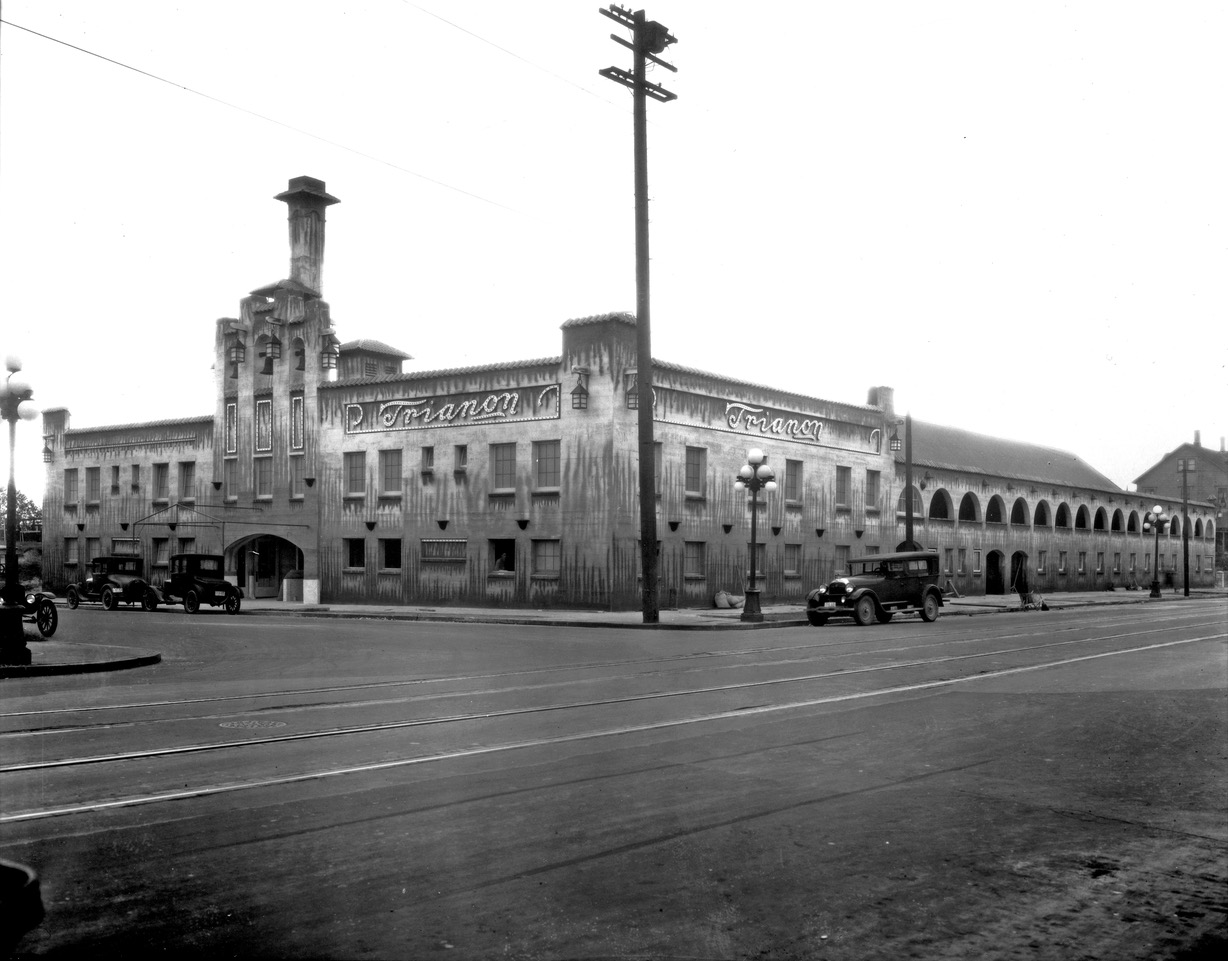
THEN: This 1927 vantage looks northwest along Third Avenue toward the full block between Wall and Fir streets, where, the just-completed Trianon Ballroom would prove an anchor in the emerging Denny Regrade business district, attracting thousands of dancers each night. (Museum of History and Industry)
THEN 2: The Trianon’s opening night booklet, recently tracked down by collector Ron Edge. For a link to the pdf, please see below.
NOW: The Trianon interior was entirely remodeled in 1985, with stores on the ground floor and offices on the second floor. Preserved was the original, Moorish-style brick façade with arched windows. Lining a Third Avenue crosswalk, a group of accommodating couples celebrates this upcoming Valentine’s Day with waltzes and Lindy Hop. The dancers are (from left): Monique and Charlie Catino, Jamie with daughter Frances Alls, Maria Mackay and Joe Breskin, Casey Engstrom, Leslie Howells, Liz Wentzien, Ethan Sherrard, Gary Sandberg (hidden), Anne Kiemle, Kael Sherrard, Lynn McGlocklin (face hidden, with raised arm), Solika O’Neill and Riley Miller

(Published in the Seattle Times online on Feb. 6, 2020
and in the PacificNW Magazine print edition on Feb. 9, 2020)

Tripping the light fantastic at Seattle’s Trianon Ballroom, ‘Cupid’s Headquarters’
By Jean Sherrard

Advertising that patrons would “trip the light fantastic,” the legendary Trianon Ballroom, designed by architect Warren H. Milner, opened its doors on May 20th, 1927, at Third Avenue and Wall Street. With its springy, white-maple floors, overseen by a giant, silver, clam-shaped bandshell, the Trianon quickly became Seattle’s premier dance palace.

Held the same day Charles Lindbergh flew solo across the Atlantic, the Trianon’s inaugural drew the city council, chamber of commerce and Bertha Landes, Seattle’s first female mayor. Four-thousand dancers foxtrotted to the sounds of Herb Wiedoft and his Brunswick Recording Orchestra. Between sets, dancers were entertained by vaudeville acts and a dancing exhibition by Priscilla Pharis and George Blanford, a couple who had triumphed at a recent dance marathon in Los Angeles.

The Mediterranean-style dance palace showcased the nation’s biggest of big bands, including Benny Goodman, Duke Ellington, Guy Lombardo and Louis Armstrong, along with the local Max Pilar and Vic Meyers bands. (In 1932, Meyers, swapping bandstand for grandstand, would be elected Washington state’s lieutenant governor, serving 20 years.)

The Trianon became “Cupid’s headquarters,” contended Ted Harris, its longtime manager, in a 1975 Seattle Times interview, “because so many guys and gals met their future mates there.” Couples, he said, gathered on the long, open balcony, with its 17 arched windows facing Third Avenue, for “a little romantic action.” For late-night swing shifts and visiting servicemen during World War II, the Trianon remained open till 5 a.m.

Despite condemnation from some Seattle pulpits, couples continued dancing cheek to cheek at the Trianon until its closing in 1956. By then, ballroom dancing was declining in popularity as youths of America fell under the spell of the less formal dance moves of rock ’n’ roll.

Here we must sound a particularly sour note.

Through much of its tenure, the Trianon’s owner, John E. Savage, insisted upon a segregated dance floor, claiming repeatedly (and falsely) that a city ordinance prohibited “mixed [race] dancing.” The result: hugely popular African American musicians were welcome to perform, while African American dancers were turned away. For Seattle’s growing black community, this irony was painfully bitter, scarcely remedied by management’s “compromise” of selected Monday night shows set aside for “Colored Folks.”

After the ballroom’s closure, the building was converted for use as a Gov-Mart department store, then into an exhibition warehouse for a business selling pool tables, shuffleboards and jukeboxes.

Before partitioned office spaces took over the vast Trianon interior, the maple floor was cleared one last time. On May 18, 1985, two days shy of the 58th anniversary of its original opening, the Trianon held its last dance in the ballroom. All were welcome.

WEB EXTRAS

As promised, here’s another of column regular Ron Edge’s found treasures: a pdf of the opening night booklet for the Trianon (18 Mb).

For more Now & Then fun, click through to this week’s 360 degree video, narrated by Jean.

And a few late-breaking photo additions from Paul:

A Trianon Ballroom interior – hundreds of dancers pose
Another interior with tables and chairs
A colored postcard

More glass-neg images from Tom Reese

Tom Reese identifies this as Portland, Oregon. See the caption for his waterfront detail below. (Courtesy Tom Reese)


Bonus round — three more glass-neg images
By Clay Eals

Remember last week’s post with 15 unidentified glass-negative images submitted by Tom Reese, former longtime photographer for The Seattle Times, who bought the negatives from the Antique Mall of West Seattle?

Many of you commented with clues to when and where the photos were taken.

To further the discussion Tom has scanned three more glass negs from the same batch, and they appear here, with captions supplied by Tom. Please add further comments. It’s possible that one or more of these could become the basis of a future “Now & Then” column!

This is a detail of the Portland, Oregon, waterfront depicted in the uncropped scan at top. Says Tom, “The side-wheel paddle steamboat T. J. Potter looks to be in its original state, before remodeling in 1910, and since it’s still in Portland that probably means it’s in its first years after going into service, 1888 or so. Wikipedia says it moved to Puget Sound after running the Columbia River. Looks like the remains are on a beach near Astoria.” (Courtesy Tom Reese)
Says Tom: “Another Northwest-looking town.” (Courtesy Tom Reese)
Says Tom: “Absolutely no idea. What an immense building. European? The figure at the top looks like a soldier hoisting a rifle.” (Courtesy Tom Reese)

Happy 02022020 !!!

I love to explore the off-beat perspectives that are revealed from the rooftops of Paris. Traditional spacial perception no longer has relevance from these lofty vantage points and, from a bird’s eyeview,  trafffic regulations appear arbitrary and self-important pedestrians are reduced to the size of tiny insects.  The atmosphere is at once calm and infinitely cool.!!   Here we are in  Quartier Saint-Merry in the center of Paris with the old houses covered with tiles, flamboyant gothic belltower of the church Saint Merry built at the XVIth century  with chimeras and angels on the right further on  Tour Saint Jacques built at he same time and in the center the top of Notre-Dame…