Seattle Now & Then: James J. Hill, Empire Builder, 1909

UPDATE: On Dec. 30, 2024, Stephen Sadis reports: “We are very excited about getting the cover story in Columbia Magazine’s winter issue.  It focuses on the accomplishments of James J. Hill in the Northwest. Also, beginning in February, “The Empire Builder” documentary will be broadcast throughout the Northwest on Cascade PBS (details to come).”

To download a pdf of the cover story, click the cover above right!

=====

(Click and click again to enlarge photos)

THEN1: In this west-facing image, James J. Hill (lower left, near flag) addresses 20,000 on June 1, 1909, the opening day of Seattle’s first world’s fair, the Alaska-Yukon-Pacific Exposition, in an amphitheater approximately where the Padelford Hall parking garage stands today at the University of Washington. (Romans Photo Co., courtesy Stephen Sadis)
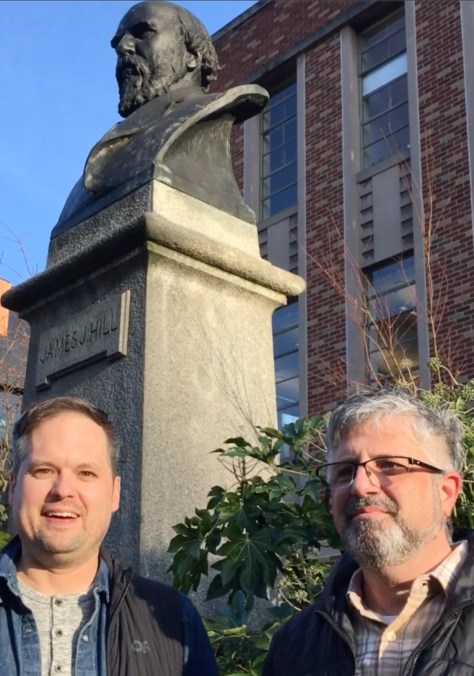
NOW: Stephen Sadis (right) and Kyle Kegley of Sadis Filmworks, sadisfilmworks.com, stand next to the James J. Hill bust and engraved railroad panel outside More Hall at the University of Washington. No plaque exists nearby to explain the stature of the Canadian-born, Minnesota-based Hill. The bust’s base originally was taller when it was unveiled Aug. 2, 1909, during the Alaska-Yukon-Pacific Exposition at a nearby site, west of today’s Drumheller Fountain on the UW campus. (Jean Sherrard)


Published in The Seattle Times online on Feb. 23, 2023
and in PacificNW Magazine of the printed Times on Feb. 26, 2023

Documentary launches up-Hill quest to honor the ‘Empire Builder’
By Clay Eals
THEN2: This northbound view on Fourth Avenue on Nov. 2, 1953, shows the Great Northern Railway sign, with its mountain goat and “EMPIRE BUILDER’ slogan, at the juncture of Olive Way and Stewart Street. In South Seattle, the former name of today’s Martin Luther King Jr. Way was Empire Way, in Hill’s honor. (Seattle Municipal Archives)

When I routinely rode with my dad to his downtown office in the late 1950s, he drove north along Fourth Avenue. Looming as we approached the nexus of Olive and Stewart, Seattle’s version of Times Square, was an enormous, elevated sign featuring a scaffolded Great Northern mountain goat atop a showy slogan: “EMPIRE BUILDER.” Through the windshield, I and countless others were absorbing a layered message.

“Empire Builder” referenced the passenger train from St. Paul that had crucially connected our city to the rest of the country in 1893, post-Great Fire. The catchphrase also echoed the sobriquet for the railway’s indefatigable founder, who helped turn Seattle into a metropolis — yet whose name is little seen or celebrated today.

The cover of the new documentary. Click it to rent or purchase it at GreatNorthernFilmWorks.com.

Seasoned West Seattle documentarian Stephen Sadis seeks to change that, in a manner as audacious as his subject. His new “The Empire Builder: James J. Hill and the Great Northern Railway,” is a four-hour tour de force, the result of on-and-off research for 20-plus years, summoning 5,000-plus images, maps and film clips and dozens of interviews to tell its larger-than-life story.

Hill (1838-1916) was a town speculator, agriculturalist, shipping magnate, banker, collector, philanthropist, longtime husband and the father of 10, but his legacy rides with the “Iron Horse” and its inescapable impact, which inspired Sadis’ fascination.

“If I told you,” he says, “that tomorrow when you wake up you could travel from Seattle to New York in 10 minutes, that’s the kind of change that occurred in the mid-19th century, from a six-month wagon trek across the country to a four-day train ride. That transformation is the key.”

THEN3: A portrait of Hill from 1902. Quoted in the documentary, Hill says of the Great Northern line, “Most men who have really lived have had in some shape their great adventure. This railway is mine.” (Courtesy Stephen Sadis)

Through Hill’s saga, Sadis and producing partner Kyle Kegley weave the personal (Hill’s right-eye blindness from a bow-and-arrow accident as a child) with the enterprising (Hill’s insistence on fashioning efficient and enduring rail lines) while repeatedly giving voice to the trains’ displacement of Native Americans.

The tale hits a peak with Hill’s opening-day speech for the 1909 Alaska-Yukon-Pacific Exposition at the University of Washington. For an industrialist, the bent is surprising, as bold and prescient as its source — and certainly relevant today:

“Will you realize what this country will become when stripped of its forests — the washing away of the soil, the inevitable changes in climate when the forests have gone? …

“You have but to raise your eyes and be in the presence of some of the grandest works of God. Soil, climate, resources, all favor you. You will never again know isolation. The spaces once separating you from the rest of the country have been conquered. Remain as you have been, the architects of your own fortunes.”

WEB EXTRAS

Special thanks to Stephen Sadis and Kyle Kegley for their invaluable help with this installment!

To see Jean Sherrard‘s 360-degree video of the “Now” prospect and compare it with the “Then” photos, and to hear this column read aloud by Clay, check out our Seattle Now & Then 360 version of the column.

Below are an additional photo, a video interview and, in chronological order, 12 historical clips from The Seattle Times and Seattle Post-Intelligencer online archive (available via Seattle Public Library) and Washington Digital Newspapers, that were helpful in the preparation of this column.

From roughly the same vantage as the “THEN2” image above is this color view of Fourth Avenue at dusk in the late 1960s, possibly from a postcard. The lighted Great Northern mountain goat (deep center) is backed by a red circle. Some letters are burned out in the “EMPIRE BUILDER” sign below.
VIDEO (4:00): Click this image to view a 4-minute interview with Kyle Kegley (left) and Stephen Sadis about their new James J. Hill documentary. (Clay Eals)
Oct. 5, 1896, Seattle Times, p5.
June 1, 1909, Seattle Star, p1.
June 2, 1909, Seattle Post-Intelligencer, p13, featuring the complete text of his speech on opening day of the Alaska-Yukon-Pacific Exposition at the University of Washington. The text continues and concludes in the next clip.
June 2, 1909, Seattle Post-Intelligencer, p16.
Aug. 1, 1909 Seattle Times, p3.
May 14, 1916, Seattle Post-Intelligencer, p19.
May 29, 1916, Seattle Times, p1.
May 29, 1916, Seattle Times, p4.
May 29, 1916, Seattle Times, p8.
May 29, 1916, Seattle Times, p9.
May 30, 1916, Seattle Times, p6.
March 26, 2006, Seattle Times, p169, “Now & Then.”

Seattle Now & Then: Dick’s Drive In, 1963

(click to enlarge photos)

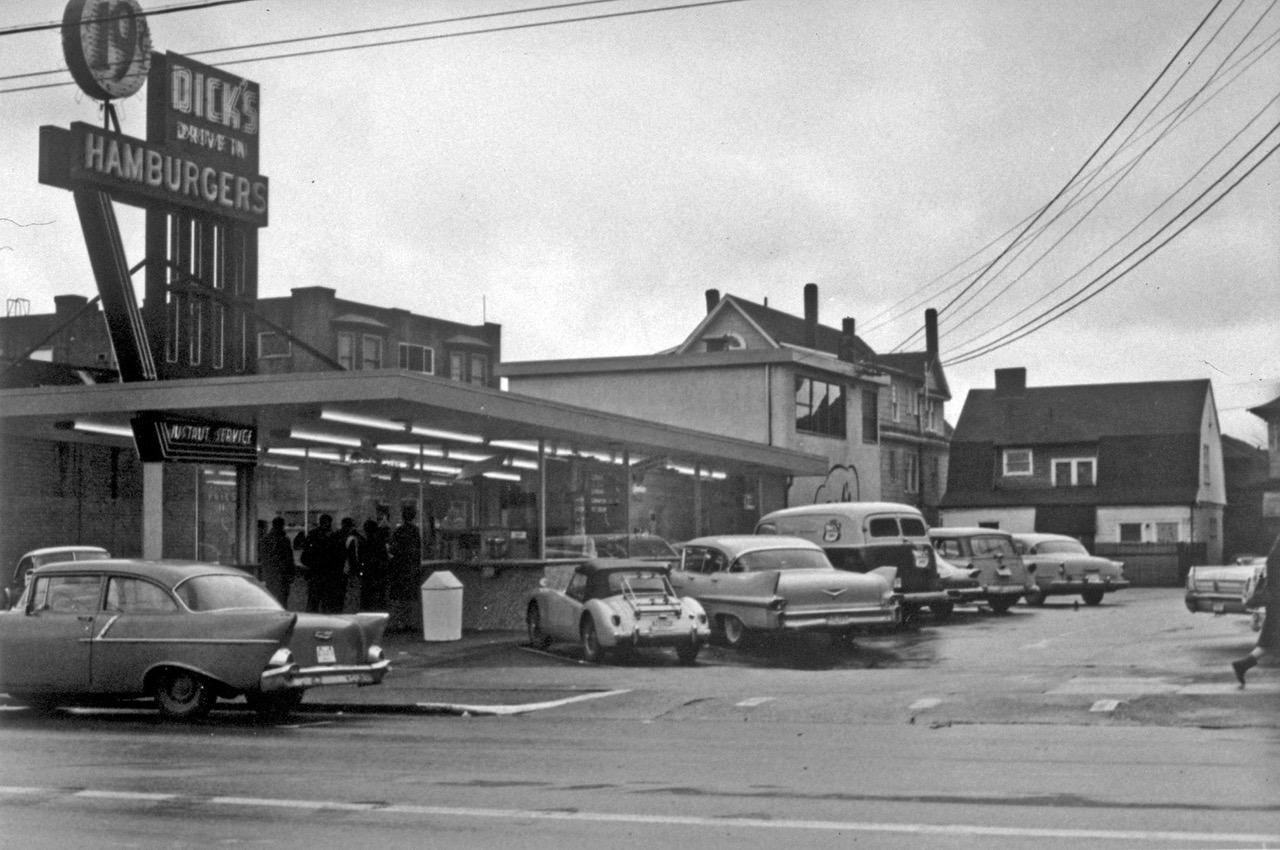
THEN: The Dick’s on Broadway shown, Carney says, in “1963 or later. (Courtesy, Dick’s Drive In)
NOW: The Broadway Dick’s today. Its menu, largely unchanged over 69 years, boasts fresh (“never frozen”) hamburger meat, hand-cut fries (with a whisper of grease) and hand-dipped milkshakes. (Jean Sherrard)

Published in The Seattle Times online on Feb. 16, 2023
and in PacificNW Magazine of the printed Times on Feb. 19, 2023

Coming to our late-night rescue for 69 years: Dick’s Drive-In
By Jean Sherrard

“You don’t know where I’ve been!” the angry guy repeated.

“You don’t know where he’s been!” chimed in his sidekick.

The muzzle of a gun he pointed at me seemed as enormous as a Kalakala ferry porthole on a night crossing.

“I, I don’t know where you’ve been,” I agreed, quaking, my hands raised. What to do? Should I meet his eyes or not? I was fixated on the deadly weapon.

It was the early 1980s. I had just finished performing in an Empty Space Theatre play on Capitol Hill. After a convivial beer or two at the Comet Tavern, I stopped off at Dick’s Drive-In on Broadway. Just as I joined the line to order, a parking-lot scene was coming to a climax.

A young mixed-race couple (black guy, white gal) in a convertible sipped on milkshakes while two white guys in fatigue jackets circled them in a lather, hurling racial epithets.

“C’mon, cut it out,” I called, fortified by Redhook and youth.

That’s when the gun appeared.

The line parted around me like the Red Sea, but someone shouted, “Leave him alone!” Moments later, customers and servers behind the windows took up the refrain: “Leave him alone!”

The gun barrel wavered indecisively, then lowered. The guy and his sidekick hopped in their car and peeled out of the lot. The Dick’s crowd had come to my rescue.

My Deluxe and Fries were particularly tasty that night. In the immortal words of the Bard, all’s well that ends well.

THEN: The first Dick’s Drive-in opened in Wallingford in January 1954. Our automotive informant Bob Carney dates this color photo to “1963 or later,” noting the “pretty fine assortment of wheels” in the parking lot. (Courtesy, Dick’s Drive In)
NOW: Dick’s in Wallingford, mid-winter, just before sunset. Then and now, Dick’s has paid wages and benefits above the industry standard, offering college scholarships to interested staff. (Jean Sherrard)

Richard Spady (1923-2016), eponymous co-founder of Dick’s, whose family still owns the small chain of drive-ins, opened his first restaurant in 1954 in Wallingford. He and his partners adopted simple principles: quality ingredients and quick service. They found almost instant success and stuck with the formula.

Sixty-nine years later, long lines continue well past midnight. The oldest fast-food joint in town is still one of its most popular, repeatedly topping polls for the region’s favorite eatery. Afficionados include songsters Sir Mix-a-Lot and Macklemore. Both immortalized Dick’s in rap.

The late Microsoft co-founder Paul Allen also was a customer. So, still, is his partner Bill Gates, who, legend has it, once flamboyantly tried to pay for a cheeseburger with a $1,000 bill. But times have moderated the local billionaire, who now seems to prefer anonymity.

THEN 3: A repeat visitor to the Wallingford Dick’s, Bill Gates orders his usual in 2019: a Deluxe, Fries and a Coke, recalls Paul Rich, who commemorated the moment with a cell-phone photo. (photo: Paul Rich)

Ten years ago, late one weekday evening, Gates and I approached separate windows at the Wallingford Dick’s and coincidentally called out the same order: a Deluxe, Fries and a Coke. He was alone and unassuming, wearing the same sweater he’d worn on “The Daily Show” the night before.

WEB EXTRAS

For our narrated 360 degree video featuring this column, please head over in this direction.

Seattle Now & Then: Jefferson car barn, 1924

(Click and click again to enlarge photos)

THEN1: This elevated, hand-tinted image, circa 1924, overlooks the Jefferson streetcar barn and yard, opened between late 1909 and early 1910. Among the vehicles are smaller Birney-brand streetcars whose open backs were being enclosed by Seattle Municipal Railway. The twin towers of Immaculate Conception Catholic Church at 18th & Columbia, built in 1904, peek out hazily at upper right. (Courtesy Danny Eskenazi)
NOW: To replicate the lofty “Then” vantage, streetcar historian Mike Bergman stands atop the four-floor Craft Apartments building at 1316 E. Jefferson St. In the background is Seattle University’s soccer stadium, Championship Field, site of the former Jefferson streetcar barn and yard, with the towers of Immaculate Conception Catholic Church at upper right. (Clay Eals)

Published in The Seattle Times online on Feb. 9, 2023
and in PacificNW Magazine of the printed Times on Feb. 12, 2023

The legacy of Seattle’s streetcar mindset isn’t black-and-white
By Clay Eals
Calvin & Hobbes, Sunday, Oct. 29, 1989.

In the beloved “Calvin & Hobbes” comic strip, Calvin asks his dad on Oct. 29, 1989, “How come old photographs are always black and white?” His dad’s classic response: “The world was black and white then.”

The jest underscores how hand-tinted images — like this week’s “Then” photo, circa 1924 — can let the color-habituated among us better envision city life a century ago.

Looking north and slightly east, we hover above East Jefferson Street in an impressive “bird’s eye view” of the Seattle Electric Company’s centrally located, all-wood streetcar barn and yard between 13th and 14th avenues on First Hill.

The Seattle Electrics baseball team, likely photogrphed at the Jefferson site. (David Eskenazi collection)

Erected on former pro-baseball grounds and replacing a barn at Sixth & Olive downtown, the storage and maintenance complex was to have been opened for the 1909 Alaska-Yukon-Pacific Exposition, but its launch came shortly afterward. At its north side, a tower stored water for potential fires while the city completed its fire-hydrant network.

THEN2: Twenty-nine streetcar staff pose on April 24, 1924, at the Jefferson Street barn and yard. For a time, the “trainmen” (motormen and conductors) mounted an amateur baseball team called the Jefferson Car Barn boys. At right is a 1923 or 1924 Ford Model T touring car. (Courtesy Danny Eskenazi)

With electrified streetcars continually rolling in and out, the unfenced facility became a busy community landmark, referenced for decades as a locator in classified ads for nearby apartment and room rentals and cafes. It hosted various meetings and even served as a draft-registration site in 1940.

The last Seattle streetcar ran in 1941, but the Jefferson hub operated for 44 years past the city’s rail-to-rubber conversion to trolley coaches. In 1984, the city sold the property to Seattle University, which 10 years later converted it to a soccer stadium, dubbed Championship Field in 1998.

Cover of “Seattle’s Streetcar Era.”

Despite today’s focus on light-rail expansion and getting people out of cars, Seattle’s matrix of now-vanished streetcars produced a higher per-capita use of public transit, notes Mike Bergman, retired Sound Transit and King County Metro planner and author of “Seattle’s Streetcar Era: An Illustrated History, 1884-1941.”

“I think there was more appreciation of the system then,” he says. “The highest levels of ridership occurred during the first and second World Wars, when population densities were far less. Part of it was lower car ownership. Fewer people could afford a car. Fewer still could afford two cars.”

Gradually and relentlessly, he says, automobile and petroleum interests converted the public mindset to individualized travel. “They certainly made it easy to fill up your tank, and it was really cheap,” he says. “It also became a status symbol.”

Bergman optimistically projects another mass-transit heyday, fueled by increased urbanization: “I just don’t think all of those people will be able to get around solely in cars.”

Here we can return to the comic Calvin. In the 1989 strip’s closing panel, he tells his tiger friend Hobbes, “The world is a complicated place.”

WEB EXTRAS

Special thanks to collector Danny Eskenazi , Zachary Tartabull of the Craft Apartments and historians Dave Eskenazi, Bob Carney and Mike Bergman for their invaluable help with this installment!

To see Jean Sherrard‘s 360-degree video of the “Now” prospect and compare it with the “Then” photos, and to hear this column read aloud by Clay, check out our Seattle Now & Then 360 version of the column.

Below are 4 additional photos and, in chronological order, 21 historical clips from The Seattle Times and Seattle Post-Intelligencer online archive (available via Seattle Public Library) and Washington Digital Newspapers, that were helpful in the preparation of this column.

YMCA baseball field at 14th & Jefferson, 1902. (Asahel Curtis, courtesy of Museum of History & Industry)
Jefferson car barn, 1910. (Seattle Municipal Archives)
Jefferson streetcar barn, February 1916. (Courtesy Bob Carney)
Jefferson car barn, Dec. 11, 1936.
Oct. 3, 1909 Seattle Times, p40.
Dec. 25, 1908, Seattle Times, p7.
Feb. 20, 1910, Seattle Times, p48.
March 6, 1910, Seattle Times, p54.
March 20, 1910, Seattle Times, p54.
June 28, 1919, Seattle Times, p2.
June 29, 1919, Seattle Times, p24.
July 1, 1919, Seattle Times, p14.
Feb. 13, 1920, Seattle Times, p28.
Feb. 8, 1920, Seattle Times, p76.
March 6, 1922, Seattle Times, p1.
March 6, 1922, Seattle Times, p5.
Jan. 19, 1927, Seattle Post-Intelligencer, p9.
Feb. 25, 1927, Seattle Times, p33.
Feb. 25, 1927, Seattle Times, p34.
Feb. 22, 1940, Seattle Post-Intelligencer, p1-2.
March 9, 1940, Seattle Times p3.
March 16, 1940, Seattle Times p2.
Aug. 7, 1940, Seattle Post-Intelligencer, p4.
Oct. 10, 1940, Seattle Times p9.
April 13, 1958, Seattle Times p127.
July 22, 1962, Seattle Post-Intelligencer, p74.
Oct. 2, 2005, Seattle Times p245 “Now & Then.”

Seattle Now & Then: Magnolia Bluffs, 1913

(click to enlarge photos)

THEN: Looking northwest in 1913, the lighthouse compound stands sentinel on a sand spit, named West Point by U.S. Naval Lieutenant Charles T. Wilkes in 1841. The photographer in the photo is a rare addition to the scene.
NOW: The same view today from an approximated location. Ian Miller estimates that the bluffs have receded 25-50 feet over the past 110 years.

Published in The Seattle Times online on Feb. 2, 2023
and in PacificNW Magazine of the printed Times on Feb. 5, 2023

Magnolia Beach offers proverbial wave of the future
By Jean Sherrard

In 1913, below Magnolia Bluff and today’s Discovery Park, a Webster & Stevens photographer captured this revealing pair of images of South Beach. In the northwesterly view, gleaming West Point Lighthouse anchors a sand spit, known to the Duwamish as Per-co-dus-chule or “thrusts far out.”

Early mariners knew the peninsula as Sandy Point and welcomed installation of the lighthouse in 1881, the first on Puget Sound, to warn of the hazardous shoal at the north end of Elliott Bay, site of many shipwrecks.

The lighthouse compound was accessible only by water until the arrival of the Army at nearby Fort Lawton in 1900, when a steep dirt road was cut from the top of the bluff down to the shoreline. Even then, lighthouse keepers and their assistants led an envied if isolated existence.

In 1984, West Point Lighthouse was one of the last stations on the West Coast to be automated. Owned and operated by Seattle Parks since 2004, its beacon continues to guide sailors safely home.

But what of nearby 300-foot Magnolia Bluff, lined with native madrona trees? Theories abound as to its misnaming. Most likely Navy Captain George Davidson erred during his 1856 survey of Puget Sound, confusing one broadleaved evergreen for another.

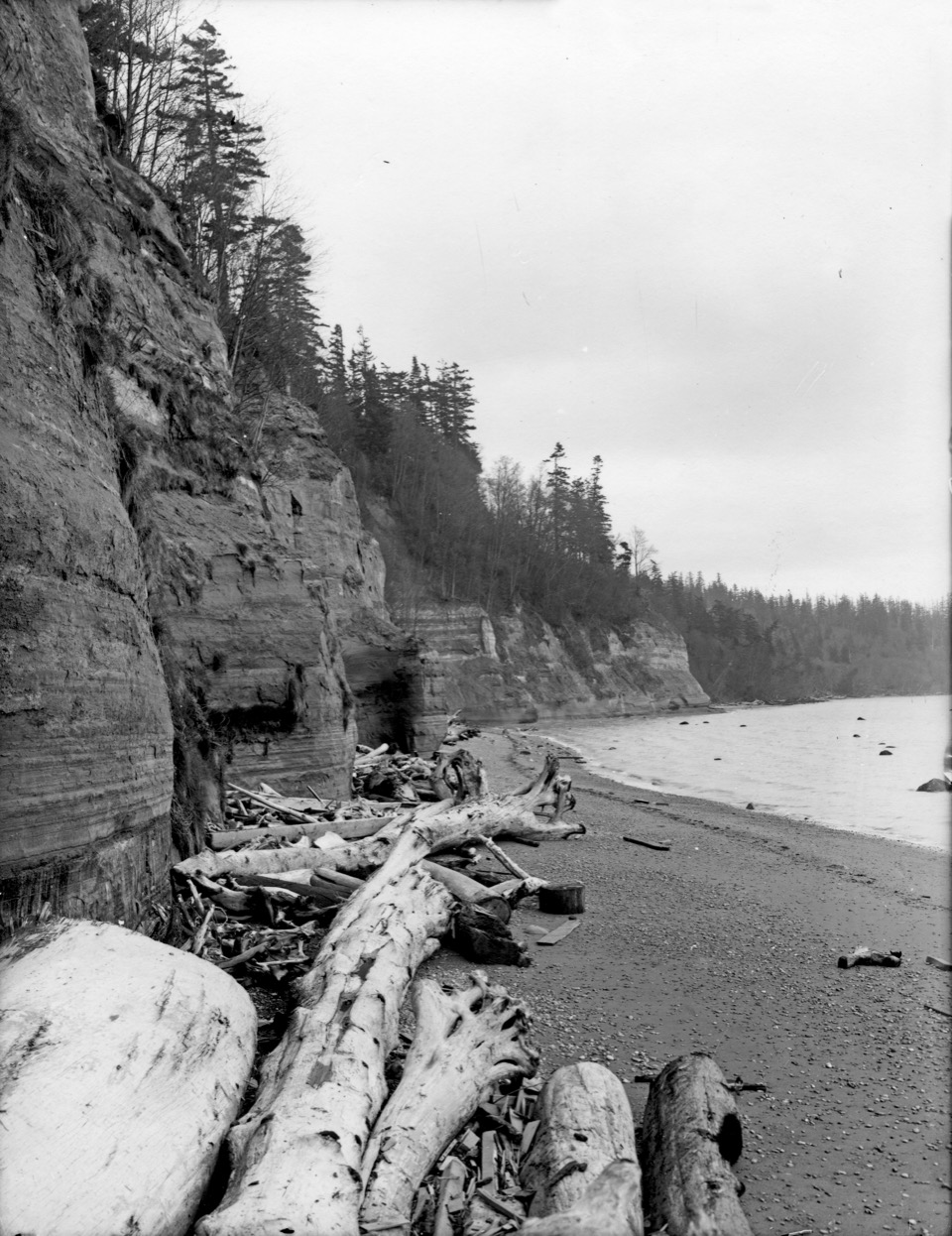
THEN: Looking southeast along South Beach, much of the bluff remains undeveloped. Huge logs adorn the shoreline, likely products of a booming timber industry. (MOHAI)

The beach itself also invites puzzlement. Aside from the absence of color, little seems to distinguish then from now. But Port Townsend oceanographer and coastal hazards specialist Ian Miller begs to differ.

“It’s hard to express how excited I [am] by these 110-year old photos,” he says. “We have so few historical images of these bluffs and shorelines, and I’ve never seen anything like them.”

For Miller, two elements warrant particularly close study: the size and quantity of logs on the beach and the coarsening of its sand and gravel, both of which provide vital environmental clues. Today, with much of Puget Sound “armored” by seawalls, riprap and hard surfaces, natural beach formation has been significantly disrupted.

NOW: The sand and gravel beach offers a popular hike on a bright winter’s day.

South Beach, however, nourished by the gradual erosion of its towering bluffs, has maintained equilibrium, rebuilding itself through sedimentation over time. Its sands provide vital spawning grounds for smelt and other forage fish, prey for salmon. “From an ecological standpoint,” Miller says, “these are very important elements of the marine food web.”

What will the next 100 years bring? “As sea levels continue to rise,” Miller says, “this section of beach may provide a microcosm for Puget Sound restoration.”

In other words, reducing coastal “armor” and allowing resilient shorelines to erode and rebuild naturally may be the wave of the future.

WEB EXTRAS

For our 360 video version of the column, click here.

NOW3: West Point Lighthouse, encircled by riprap, stands 23 feet tall above the beach. Built of brick and concrete with a stucco exterior, its original Fresnel lens was replaced by a modern Vega Rotating Beacon.

And here are four related “Now & Then” columns by Paul Dorpat, from 1984 through 1991: