A Visit to Bérangère's Paris: Fête de la Musique

(Click to enlarge photos)

Corner of rue Saint Séverin and rue Saint Jacques

Bérangère sent us these remarkable photos of a renowned Paris festival last week. She writes:

Since its creation in 1982, “Fête de la Musique” is an event we wait for, the most popular:  everywhere in France, amateurs or professional musicians can play in the street, courtyards, parcs, gardens, hospitals, museums, castles….

We may discover many different kinds of music.  In Paris there are big concerts organized: Place de La Bastille, République, classsical concerts in the old district “Marais “, and Rock and Roll in quartier Latin.

There are many people in the street coming from far, visiting Paris, walking from band to band, with a large thirst although it was quite chilly yesterday.  Here are a few snapshots:

lomont_029

Fontaine Saint Michel
Rue Saint Jacques
Rue Saint Jacques
Place Saint André des Arts
Rue Danton
Rue Danton
Ambiance Métro Odéon
Rue de l'Ecole de Médecine
Rue Antoine Dubois
Rue Antoine Dubois

lomont_092

Seattle Now & Then: The Mount Vernon Ferry

(As ever, click on photos to enlarge)

mt-vernon-ferry-then-mr
THEN: In a 1884 election Mt. Vernon surprised La Conner by winning the Skagit County seat. Here, ca. 1890, Mt. Vernon has besides its 800 citizens and one ferry, great prospects. (Photo courtesy Skagit County Historical Museum’s Research Library.)
NOW: At the time Jean Sherrard recorded this repeat of the ferry photo in 2006, Mt. Vernon was preparing a comprehensive plan for its historic downtown that included an appointed promenade along its waterfront.  You may wish to see how this county seat with by now nearly 30,000 citizens is doing by visiting Mt. Vernon’s Saturday Farmers Market along the revetment.
NOW: At the time Jean Sherrard recorded this repeat of the ferry photo in 2006, Mt. Vernon was preparing a comprehensive plan for its historic downtown that included an appointed promenade along its waterfront. You may wish to see how this county seat with by now nearly 30,000 citizens is doing by visiting Mt. Vernon’s Saturday Farmers Market along the revetment.

We would imagine that it was Gilbert LaBerge and/or Fred Barnier who arranged for their Mount Vernon ferry to be photographed with the burgeoning Skagit County Seat on the far shore, except that one of them is cut off at the knees – either Gilbert or Fred.  The ferry proprietors are both listed in the 1889-90 Washington State Gazetteer as are all the Mt. Vernon hotels whose signs may be read on the far shore – three of them.

The original photo in the Skagit Valley Historical Society’s research library has a caption scrawled on the border: “Mt. Vernon before the fire of 1891.”   The fire destroyed most of the business district shown here and so a new commercial strip was built two blocks to the east, or further from the river.  With the arrival also that year of the Seattle and Northern Railroad, the Skagit River and its steamers got competition in moving the valley’s produce, lumber and citizens to markets.

Two years later in 1893 the first bridge across the river – a wooden truss with a draw span – was built here.  Although more convenient, the bridge was still not much faster than the ferry.  Signs on either side warned, “$25 fine for riding or driving over this bridge faster than a walk.”

The 1889-90 Gazetteer includes an impressive list of Mount Vernon concerns, including two banks, four churches, a skating rink, two music teachers, a cornet band, a sawmill, stores for all the necessities and a few luxuries like jewelry and a billiard hall.

In 1890 the Skagit News (also a book store and job printer) was already six years old and today’s Skagit Valley Herald is its descendent.  (For a great illustrated horde of  “Northwest Corner” history just visit yet another publication, the skagitriverjournal.)

WEB-ONLY EXTRAS

Let’s begin with Jean’s eerie/lovely view from the bridge, just a little bon-bon for all you Mount Vernon lovers.

Evening on the Skagit

And now, more of the historical:

The Black Prince at Mt. Vernon

Of the three sternwheelers pointing upstream on the Skagit River at Mt. Vernon, the middle one, the Black Prince, can be identified by its nameplate.  A quick survey of citations in the McCurdy Maritime History for Puget Sound reveals that this 92 foot long freight and passenger steamer was built in Everett in 1901 by Robert Houston for service on both the Skagit and Snohomish Rivers.  Beginning in 1923 it was kept around the Everett harbor for use in towing, and then oddly stayed in Everett after it was dismantled in 1936.  The upperworks were carried off by the Everett Yacht Club for a clubhouse until 1956 when the members wanted something new.  What parts of the Black Prince club members did not carry home for souvenirs became kindling, perhaps, for a Port Gardner incinerator.

mt-vernon-fm-hill-web
Mt. Vernon from the hill
Then: Mount Vernon pan from bridge
Now
Now

The bend in the river seen from the hill is the same as that seen from the bridge in the panoramas – then and now – of Mt. Vernon’s waterfront.  It is our speculation – waiting for correction by some Skagit River historian (Noel?) – that this view was taken from a point that now would be suspended over the I-5 Freeway that passes between the business district and the residential hill to the east.  By these impressions the timber trestle is where South Second Street still rises from the business district, although now on a concrete span over the freeway.   And so our hunch also has it that the street on the far left is South Third Street.  (Noel? We mean, of course, Noel Bourasaw founder and nurturer of the on-line publication, the skagitriverjournal.)

(If the Then and Now images directly above seem familiar, you may be the proud owner of the Dorpat/Sherrard tome Washington Then and Now.)

The Skagit County Courthouse
courthouse-now
Now, the Matheson Building

Built in 1892-93 at Mt. Vernon’s First and Pine, southeast corner, the old Skagit County Courthouse survives there as the Matheson Building, but without its playful top story.

Second Street
Second Street then
Looking north now
Looking north now

Mount Vernon, Second Street and looking north to the trestle that figures in the earlier “Mt. Vernon from the Hill” photo, included with this posting.  Judging from the motorcars, this view dates from circa 1920 (some car-sensitive reader can probably nail the date), while the “hill” picture is from about 1900.  Note that the wooden John Deere building on the left remains today, although obscured by trees.

Skagit River ferry
Skagit River ferry

Before the bridges, and even after them at some crossings, ferries like this one on the Skagit, were ready for a fee to take one and much more to the other side.

Seattle Waterfront History, Chapter Six

Migrant Fill and Bones -2

Now picking up those bones left hanging at the end of Part 5, historian-educator David Buerge suggests that with the 1865 expulsion and restricted access to their traditional cemetery at Seneca Street, the native people “are likely to have attempted to establish another cemetery further north.  Traditionally, native funeral grounds were situated north or west of house sites.”  Since Elliott Bay is west of Baq’baqwab, Buerge’s burial ground may have been somewhere north of Bell Street.  As noted earlier, in public works like the walling off of the Belltown Ravine for the Elliott Avenue extension in 1912-14 the fill that comes from nearby is obviously favored over dirt got from more remote locations.  Consequently the bones found in the 1912-14 fill may have come from a native gravesite associated with the Baq’baqwab camp but not directly at it.  This explanation would make the earlier placing of the bones with the fill an ironic instance of the “return of the native” – this native – to his or her home.  By about the late 1880s, Buerge notes, “burials would have been carried out in reservation cemeteries or in more isolate, outlying spots.”

[Remember: CLICK – often twice – to Enlarge.]

belltown-rav-trail-dtl-web
Trail to Lake Union

The Belltown Ravine was apparently spring fed in season and allowed an easier access to the hill above the waterfront.  Or did it? The bluff was not so high at the south entrance to the Ravine.  In the detail attached above a path can be seen, top-center, ascending the bank at that point in the ca.1902 photograph recorded from the off-shore RR trestle.  The whole scene from which this detail was pulled will be included as scene number 211 in a latter and as yet unnumbered part of this history.  Yes it did. A trail that followed the easier grade up the verdant ravine would have had its own appeal even when not especially needed, except by the old or infirm.  Buerge notes that a feature of the north camp was “a trail that left the beach and connected with the southwestern end of Lake Union.”  Such a trail has been marked on the federal topographical map surveyed in the mid-1870s – the map described above in chapter four.   Perhaps even more than the spring of fresh water the path would seem to center the Baq’baqwab site.  Buerge points out that “informants in this century remembered when parties left their canoes on Lake Union’s shore and walked the trail over to the bay.”  In this line (or path) the pioneer William N. Bell, Belltown namesake, concluded his 1878 interview with a H.H. Bancroft researcher from California with a suggestive recollection about the trail to Lake Union.  “Boren and I, I suppose, were the two first white men that were ever at Lake Union.  Shortly after we had agreed to take our claims here (early in 1852) Boren and I came here and happened to land at the end of the trail that went to the lake, and we just went over.  The Indians told us there was a little lake there, and also a big lake.”  The “big lake,” you may have figured, the locals would name Lake Washington.

wa-mont11b-grab-web

1880s Belltown Beach Community

After the Battle of Seattle in 1856 the Bell family fled to California and left their land in the stewardship of those who stayed in spite of the fearful uncertainties and regional loathing that followed.  When William Bell returned for good to his claim in the mid-1870s, he was soon acting the landlord as he promoted his “North Seattle” or “Belltown.”  The proprietor back on his hill may have hastened another native diaspora, this one at the north camp, Baq’baqwab.  Buerge again: “One group appears to have resettled at the south eastern shore of Lake Union until burned out in 1875, while another moved north to the lighthouse at West Point. The houses of Baq’baqwab appear to have been moved off the bluff and down onto the beach.”   For that period of the late 1870s and early 1880s there is little photographic evidence of Baq’baqwab beach, aside from panoramas recorded from the King Street Coal Wharf.

north-beach-c1881-web

One from the early 1880s shows two beach huts to the north of the entrance to the Belltown Ravine. [42-43] Another detail from the late 1880s includes the “cubist” or architectural shapes of beach shacks (mostly their roofs) above the interrupting Seattle Lake Shore and Eastern Trestle that in 1887 was built just off shore along the waterfront. [44] As already observed, the trestle generally obscures the beach.  A few photographs of a beach community there survive from the late 1880s and after.  They show mostly tents and draped lean-tos. [45]

indian-bell-beach-c88-web

Another scene with beach, bluff and assembled natives is included directly below for some scholarly reader to research the “fingerprint” of the bluff.  Since the names of those posing are most likely lost to us by now, it is only the clinging landscape on the cliff that might identify this as a Seattle waterfront scene, and if so then most likely below Belltown.  This record was included in a small collection of photographs depicting only Seattle scenes.

indian-n-beach-seatl-webb

By the time that seasonal migrations of native workers to the hop fields of the White River (Green River) Valley began in the 1880s, as Buerge notes, the beachside “remnant of Baq’baqwab became the focus of large seasonal encampments when native agricultural workers congregated there and to the south at Ballast Island.”  (As will be described and illustrated below in yet another unnumbered chapter, this was the island made from ships ballast, which during its few years of supplying a campground for the migrant Indians was also a parody of their former winter camp on what, as noted in chapter four, U.S. Navy Lieu. Charles Wilkes named Piners Point.  In the late 1880s, when Ballast Island was formed and first used by the itinerates, their former winter camp of Jijila’lec with its long houses and ceremonies would have still been easily remembered and vividly recalled for those too young or too new to remember it.)  With the failure of hop agriculture in the White and Snoqualmie River valleys in the early 1890s, the native encampments at and near Baq’baqwab also dispersed.  In their place, especially after the economic panic of 1893 extended into a depression, the new community of squatter’s shacks described earlier was built along the beach below Denny Hill. This community was a polyglot of natives and down-and-out immigrants – mostly the latter.

snoqualm-hops-peiser-web

snoqualm-hops2-peiserweb

Above are two views of hop harvest time in the Snoqualmie Valley with Mt. Si on the horizon recorded by pioneer Seattle photographer Theodore Peiser. He arrived in Seattle in the early 1880s and stayed for more than twenty years.  Much of his early work was destroyed in the city’s “Great Fire” of 1889.

Baqbaqwab Suburbs & the Seattle Center Swale

We may note that the Baq’baqwab community, the north camp, developed (or was followed by) what may be considered its own northern suburbs.  The 1899 view recorded by Anders Wilse looks at a summer camp in the small bay north of Broad Street. [46]

wilse-broad-dugouts-web

But the north camp once extended at least as far as Harrison Street, where nets were set up to catch fowl that flying between the Bay and Lake Union, passed low over the swale that once dipped between Queen Anne and Denny Hills.  (This future site of Seattle Center is also described in tribal memory as a potlatch grounds.)  As late as 1961, on the eve of the 1962 Century 21 Worlds Fair, Seattle Times reporter Charlotte Widrig interviewed William Criddle, a relatively late settler, about life on the beach below Seattle Center.  “William was two in 1889 when his father Frederick J. Criddle, a shipwright, brought his wife and six children here from Cornwall, England and settled on the bay at the foot of Mercer Street (below Kinnear Park) One of the early day sights Criddle recalled was a row of Indian tents stretched for a mile along the beach near his home, where Indians from Bellingham and other northerly regions camped while en route to harvest the hop crops in the White River Valley.  ‘My brother and I liked to visit the camp and sometimes did a little trading.  One of the items we acquired was a dugout canoe.  Elliott Bay was alive with salmon in the fall.  When I was about 9 years old, my brother frequently took me fishing in the dugout.’ ”

wa-mon12-grab-web

robinson-pan69-whole-web1

1869: The Robinson Panorama

The earliest photographic record of the beach and bluff of the Baq’baqwab site is included in the 1869 panorama (often alluded to above and now considered in some detail) of the community and its central waterfront.  The beach below Bell Street is some distance from Robinson’s prospect and so not the sharpest of subjects in the panorama.  We will return to a consideration of this part after first examining the photograph for other revelations – especially those involving the waterfront.

robinson-no-end-detl-web

The photographer George Robinson, a 44 year-old “Victorian” from British Columbia, was a multi-talented (photography, dentistry, and the managing of mines) enthusiast who purchased his photographic equipment in an auction five years before his Seattle visit (it turned out that his gear had previously been stolen by the consignor) and opened a photographic gallery in Victoria.  In the spring of 1869 Robinson announced that he was leaving his gallery to concentrate on dentistry (the man knew how to use his hands) but several photographs of his date from 1869 or later, including his four Seattle views that when knit together become the single most revealing photograph of pioneer Seattle extant. [47]

[The two-floor presentation of Robinson’s pan printed just below, is the best doorway to its details.  Remember to CLICK TWICE.]

robinson-pan-layered-web

William H. Seward’s Visit on the Wilson G. Hunt, July 21, 1869

Robinson dated his Seattle panorama 1869.  We may want to narrow it to July 21st or 22nd.  “Big Night on the Waterfront” is how the local Gazette described the visit of U.S. Secretary of the Interior William H. Seward to Seattle on July 21, 1869.  It was the Seward whose grandest “folly”, some of his contemporaries claimed, was to acquire Alaska from the Russians.  While en route to inspect this chilled and sprawling purchase Seward stopped off at Seattle and made a speech for the citizenry that assembled at Yesler’s Wharf to get a good look at Lincoln’s appointee and savor his compliments.  And Seward did boom for and about them, advising the community that Washington Territory’s was a “glorious future.”  Seward came and went on the sturdy steamer Wilson G. Hunt.  It had been freshly delivered to Victoria from the Columbia River in part as an attempt to break the transportation and freight monopoly on Puget Sound of the Eliza Anderson, and its runners were probably pleased to get the Seward assignment because their Hunt was not doing so well against the Anderson.  Almost certainly that is the Hunt pulling away from Yesler Dock.  Although her name cannot be read, that is the shape of her.  Clearly if Robinson arrived in Seattle from Victoria with Seward he did not leave with him.

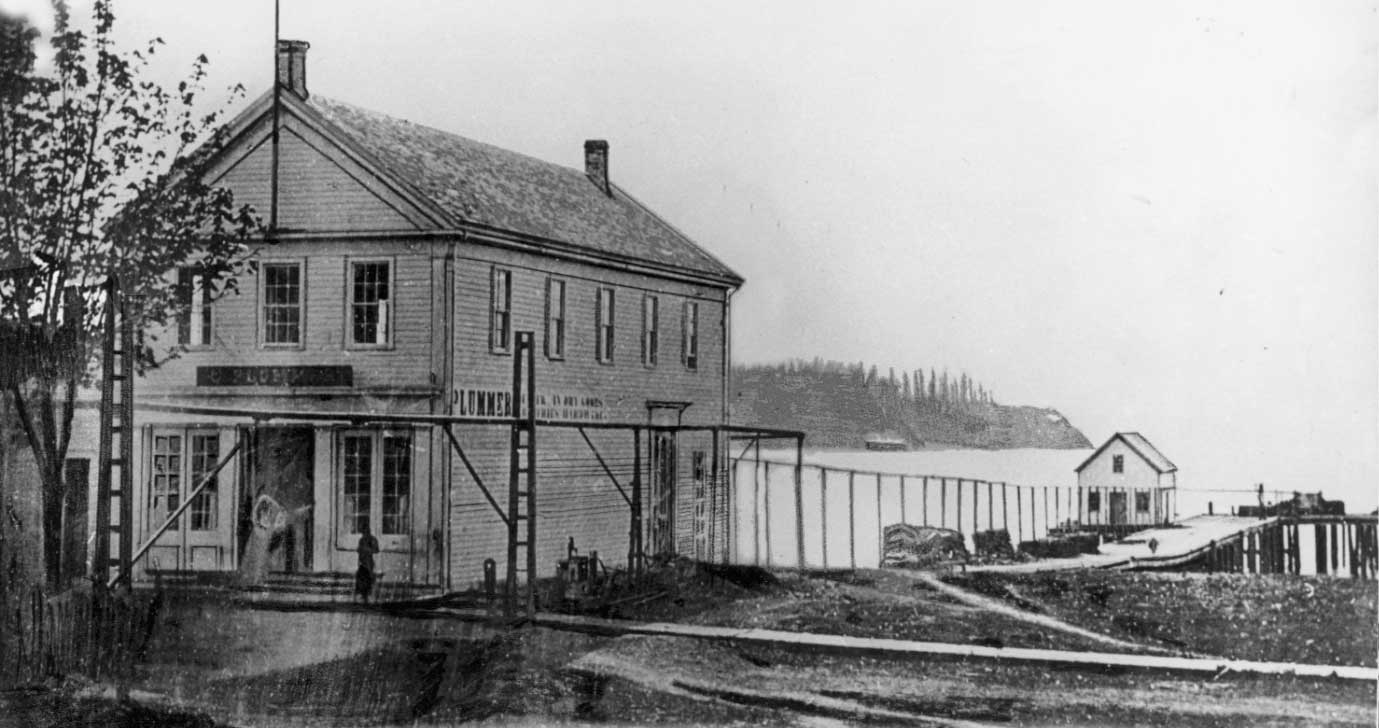
plummer-hall-web

In – or about – 1858 Charles Plummer built a second story hall above the store he opened in 1853 at the southwest corner of Commercial Street (First Ave. S.) and Main Street.  It was a needed venue for performances, dances, and early meetings for groups like the Masonic Lodge and the Good Templars.  It was also the chosen prospect for both Sammis’ ca 1865 panorama of Seattle and Robinson’s 1869 recording.  Sammis view was taken from the crest of the roof, which could be reached by a ladder permanently attached to the roof on its south side and directly over the sidewalk.  Robinson went only to the second floor hall, where from a window some distance from the street he recorded the four parts for his panorama.  The flume-delivered fresh water wharf that extends into the bay off of Main Street never made much on an impression, largely because of the growing success of its neighbor to the north, Henry Yesler’s wharf, which through the pioneer years was all that the community needed.  Charles Plummer’s time in Seattle was too often tragic.  Ellender, his wife, died in 1859 giving birth to twin sons, and Charles lived on only until 1866.

As just noted in the caption above, Robinson took his photograph from a second floor window of the Snoqualmie Hall (AKA Plummer’s Hall) at the southwest corner of Commercial (First Avenue S.) and Main streets.  We may imagine – or expect? – that he waited until the moment his hometown steamer left Seattle without him.  (If Robinson timed the opening of his shutter with the Hunt’s departure, then of the four negatives the one on the far left – or west – with the ship underway may well have been struck first.)  Two additional Seattle subjects survive from Robinson’s visit.  One, printed directly below, is of Commercial Street from the street and shows the ladder that Sammis climbed four or five years earlier to record his panorama.   The other a view to the central waterfront from the end of Yesler’s dock.  We will consider both again below in a later chapter.

robinson-commercial-web
robinson-commer-now-webYesler’s Wharf

Because of Robinson’s timing we know that this – or nearly this – is what Seward saw on his Seattle whistle stop.   Excepting the wharf on which he delivered his pep talk, the structures in the village and the few cleared acres that were still crowded by the virgin forest, most of what he examined — the waterfront especially – had not been tampered with much since the visits of Wilkes in 1841, the settlers in 1852, the Coast Surveyors in 1854, and in 1856 that self-style heroic defender of Seattle, Lieu. Phelps, U.S. Navy.   However, Seattle would change considerably in 1869, after Seward was gone.  The biggest changes were Yesler’s.  He replaced his old steam sawmill of ’53 with a new and improved one, and this time much of it was built on the wharf.  This second of Yesler’s mills burned down in 1879 but was replaced with a mill that lasted until another fire took it in 1887. (We will include views of these mills in other contexts and chapters below.)

Although Yesler’s was the first steam sawmill on Puget Sound in 1853, by 1855 there were twenty of them operating on the “Mediterranean of the Pacific”, and some were many times bigger than Yesler’s.  Also as noted above, especially after he extended its length in 1859 to 200 feet, Yesler’s wharf became the hub of much Puget Sound commerce.  A year later he opened a gristmill to produce flour and by 1867 was getting 24 barrels of it a day.  Yesler’s wharf helped Seattle get its jump on the “old wealth” that would sustain the city during the economic crashes that were arranged down the years with depressing rhythm in 1873, 1883, and 1893 – especially 1893.   Then, as noted earlier, the singular and so more vulnerable wealth of the company town Tacoma was not so resilient.  (That the next big recession came in 1907 – not 1903 – added some syncopation to this blues calendar.)  According to Seattle’s principal pioneer historian Clarence Bagley, for many of the earliest years of settlement “Yesler’s wharf was all that was needed.  Plummer’s at Main fell into disuse and decay.”  As is revealed in the surviving photograph of Plummer’s Snoqualmie Hall (above) the flume, like the one showing in the 1859 photograph of the Yesler Home noted above in chapter three, carried water to supply ships at a wharf that resembles more a dock than a pier. [48]

sammis-pan-of-city-web

Sammis Panorama ca. 1865

Besides its extraordinary sharpness – one can count the trees on Denny Hill – as noted Robinson’s is the first photographic record of Yesler’s wharf.  His panorama also includes the first picture of any vessel on Elliott Bay (again, the Hunt), and most of the central waterfront as far north as Broad Street.  The closest features on the waterfront are the Indian dugouts at the foot of Washington, far left, beside the then still future site of Ballast Island.  The businesses, far right, on Commercial Street appear in the other and earlier panorama of pioneer Seattle by E. M. Sammis (note above) that is conventionally dated 1865 but may be from 1864. [12] Sammis also exposed his smaller view from Snoqualmie Hall, although he climbed the ladder on its south roof to the crest of the building. (During Robinsons 1869 visit he also made a street level record of Commercial Street that was photographed looking north with his back to Jackson Street. [49] It shows the ladder that Sammis climbed up the south side of the roof of Plummer’s Hall.) When Commercial Street is compared between the two panoramic views – Sammis most likely from 1865 and Robinson from 1869 — it is clear that little has changed in the generally dull first years following the Civil War.  But, as noted, the last months of 1869 made it Seattle’s first boom year.

1869: First Boom Year for Seattle

A review of the “local joy” of 1869 includes Seattle’s second but first successful incorporation and the considerable rise in real estate values attendant with the Northern Pacific’s survey of Snoqualmie Pass.  At the time this work strongly hinted that at last Washington Territory’s first governor Isaac Stevens’ 1855 recommendation would be heeded — that Seattle be selected for the western terminus of any transcontinental railroad that took the northern route on the basis of its relatively low Snoqualmie Pass to the east and its harbor.  (Of course that railroad would also get much of the territory along the way with huge land grants on the promise to reach the shores of Puget Sound.)  Stevens called Elliott Bay Puget Sound’s “unequalled harbor.”  (However, Tacoma might make a good defense of Commencement Bay as “more unequalled.”)  The most immediately influential change region-wide in 1869 was the completion of the Union & Central Pacific railroads to California.  The rush of immigrants – including many traumatized Civil War vets carrying land privileges with them – inevitably pushed in all directions, including north, along the coast.  Also, we know, the California railroad would became a great consumer of Seattle coal beginning in 1872 as we will describe in another chapter below.

Denny Home at First & Union & Beach Below

Robinson’s view also includes one landmark in the middle distance – Arthur and Mary Denny’s Carpenter Gothic home. It sat at the southeast corner of First and Union and is a handy reference to the waterfront. [50]  Below the Denny home, the 1869 panorama shows a rare structure on the beach at the approximate waterfront foot of Union Street.  As yet, I have not identified its owner or use.

denny-hm-robpan69-web1

The glass-faced skyscraper shared by the Seattle Art Museum is the fourth structure to hold the southeast corner of First Avenue and Union Steet.  The 1926 Rhodes Department store building was razed for it.  Rhodes had replaced the Arcade Annex, which took over the corner only after the Denny’s landmark residence was destroyed in 1907.   Theodore Peiser probably recorded this view of the Denny home soon after he arrived in Seattle about 1883.  Six years later Peiser lost nearly everything – including, most likely, the negative for this print – to Seattle’s “Great Fire” of 1889.  When it was built in 1866 this then showy home crafted for the “father and mother of Seattle” was a fancy farmhouse quite detached from its neighbors and remote from Seattle’s business district.

a-denny-home-then-web

Seattle architectural historian Dennis Andersen uncovered the following quote in the Puget Sound Semi-Weekly.  It appears in the July 9 1866 edition, and so three years before Robinson took his panorama.  “Yesterday we were shown through the new residence of Hon. A.A. Denny, our delegate in Congress.  It is an irregular, Gothic cottage, the plan of which was executed by Mr. S. B. Abbott, who has superintended the work throughout.”   Anderson notes that Abbot, the architect, “likely used any one of a number of pattern book resources for his design . . . He may be the same Abbott who was accused of absconding with railroad construction payroll receipts a few years later.  All must have been forgiven or at least forgotten, because he visited the city in 1901 and was interviewed in the PI as a ‘wealthy banker and oil man’.”  The Peiser view is used courtesy of Sue Champness.

a-denny-home-now-web

Looking further up the waterfront in Robinson’s 1869 panorama, the beach does not seem to be sited with the structures of any settlement or shore.  Still, small tents and lean-tos on that distant beach may be too small to record with definition.  What appears to be driftwood may in some instances be shelters.  Although relatively detailed for its size and age, as noted the panorama is still constructed from small negatives.

robinson-no-end-detl-web1

North End Mystery

The Robinson pan includes a north end mystery: two light-colored architectural forms on the bank above the beach. [51] If I have figured it correctly they are near Battery Street and so also very near the site of the Bell family’s first cabin.  (The Bell cabin was destroyed by Indians in the 1856 “Battle of Seattle.”) During the fighting it was visible from the Decatur and the sailors regretfully watched its destruction.  When they were ready to shell the house the captain of the ship gave an order to stop all firing.  As Bell later recalled, “The men were awfully displeased about the order, because they would have bursted (sic) some of them if they had put a shell in.”)  While the forms are too simple and distant to identify they look more artificial than natural. Whatever they are, they are unique – the only light and horizontal forms north of the beach structures just noted near the foot of Union Street.  (If the reader has trouble detecting them in the full pan, the forms begin in the foreground with the little steamer that is moored to the south side of Yesler Wharf. From its wheelhouse, lift the eye directly up to the distant beach.  There the forms are set in darker vegetation just above the exposed bank that rises from the beach.  A little ways to the right of the mysterious forms the darkened landscape dips to the beach.  Again, if I have done my figuring correctly, this is the entrance to the Belltown Ravine discussed above – and sometime soon again below.

The mid-1870s topographical map (noted above) also shows what appear to be two structures on the lip of the bluff near the future foot of Battery Street – although about one city block separates the rectangular marks in the map, which is more than the photograph suggests.  Again David Buerge offers an interpretation for the photograph and perhaps for the map as well.  “I would suggest that the double structure in the Robinson panorama may be the two standing long walls of a longhouse, minus its roof planks and side walls, part of whose length may be hidden by vegetation.  The evidence is that the picture was taken during the summer, which was when the people were off at various camps.  It was not uncommon for them to remove planks from their house to use in constructing a deck joining two canoes to help haul gear and for temporary lodging at these camps.”  So by Buerge’s figuring it is then at least a possibility that these gray-white forms that contrast so strikingly with their dark setting, are the reflective sides of aging and silvered cedar slabs and/or posts associated with the construction of long houses.   (Another less distinguished form in this neighborhood at least hints at the angles of construction.  It appears north of the stepping forms and is also a lighter color than the surrounding bank, although not lighter than the beach.)

edison-color-indian-mat-web

This hand-tinted lantern slide shows the use of mats as a ready material for draping a residence.

Frederick & Nelson's First Big Store

fred-nelson-blog-web

D. E. Frederick and Nels Nelson opened a second-hand store in Seattle in 1890. Soon they found it easier to buy unused merchandise than ferret out the old. So they discarded the nearly new trade, and in time their store became the largest and finest department store west of the Mississippi and north of San Francisco. In 1897, in the first flush of the Klondike gold rush, the store was moved into the two center storefronts of the new Rialto building at Second Avenue and Madison streets. In 1906 the partners bought out the block, and Frederick & Nelson stretched their name the length of an entire city block, from Madison to Spring Streets, along the west side of Second.

This week’s historical scene shows Seattle’s first grand emporium during, or some time after, 1906. [Truthfully, this is NOT the photograph that was used in the Times 23 years ago, but it is similar.] Ordinarily, shopping at Frederick & Nelson was not like joining rampaging consumers at a big store’s big sale.  At Frederick’s, you were invited to take classes, visit an art gallery, chat with friends over tea or just ride the wonderful hydraulic elevator. A big center room with a high ceiling for hanging tapestries and Persian rugs was a kind of sanctuary for consumption. Years later, you might not remember what was bought but you would recall the “aura” of the experience of having really purchased something. This touch of class also was found in the elaborately decorated show windows along Second Avenue, and even in the street itself. Every morning, Frederick and Nelson’s 16 heavy teams of horses paraded from their stables down the length of Second Avenue.

Nelson died in 1906, but Frederick continued to make the right moves, including the one in 1918 that took him “out of town” north to the main store’s modern location at Sixth Avenue and Pine Street.  In 1929, Frederick retired to his home in the Highlands and sold his grand emporium to Marshall Field & Co. of Chicago. After his death 20 years later, his old golfing crony, the then 95-year-old Seattle Times columnist C.T. Conover, recalled Frederick as a kind of heroic capitalist saint who “left a record of straight shooting, fair play, honorable dealing, enlightened vision, common sense, civic enterprise, noble spirit and generous support of every worthy cause.”

[In searching my “lists” I discover that I have returned to Frederick and Nelson more than six times over the past 23 years, and will try to insert the others soon and in line.  This first instance was first published in Pacific on Sept. 28, 1986 and used the photograph insert directly below.   It was then still long before the big store folded for want of a suburban parking lot around it and competition from “warehouse wholesalers.”]

fred-nel-snt-web

Seattle Now & Then: Real Change

(click to enlarge)

native-basket-seller-then-mr
THEN: Roughly a century ago, engineer Leo Snow took this candid photograph of a single Native vendor set up at the corner of Second Avenue and Madison Street. (Courtesy Dale & Eric Cooley)
NOW: Appropriately, for the contemporary repeat Jean Sherrard recorded Cassie Phillips, a Real Change newspaper salesperson, showing her fare at the same corner.

Clearly, the northwest corner of Second Avenue and Madison Street was good for sales both inside and out. In 1906, the Frederick & Nelson department store expanded from its mid-block quarters in the block-long Rialto building to both corners, at Madison and Spring streets. While the corner sign does not promote baskets, it does list carpets, and its sidewalk “competitor,” the basket vendor recorded here by amateur Leo Snow, also offers mats. Snow’s snapshot is wonderfully unique for its bright-eyed candor.

As confirmed by many other photographs, including a 1911 postcard printed in “Native Seattle,” historian Coll Thrush’s nearly new book from UW Press, this was a popular corner for both selling Native crafts and recording them doing it. Thrush’s postcard shows three of what the postcard’s caption calls “Indian Basket Sellers” huddled at this corner.

When I began giving illustrated talks on Seattle history long ago, I often included a slide of Native American vendors in my show. Many were the times that seniors in the audience would recall having been with their mothers while buying a basket from Chief Seattle’s daughter, and often off this very sidewalk. Since the 86-year-old Princess Angeline died in 1896, this “princess claim” was impossible, I gently explained. Still, however slanted, the memory of sidewalk meetings with Native Americans was still cherished in 1975. Sometime after the farm boy Snow got an engineering degree from Ohio University in 1902, he folded a three-piece suit in his duffle bag and hopped a freight train to Seattle. He was soon on the streets looking for a job. In 1945, Snow retired after working 37 years for Puget Power, and along the way took many more sparkling snapshots with his foldout Kodak.

[ Below is another example of sidewalk sales at the northwest corner of Madison Street and Second Avenue sometime after Frederick and Nelson moved there in 1906.  This view is numbered.  Unlike Snow’s candid recording this was shot with commercial hopes – hopes that were probaby fulfilled for I have seen prints of this scene in different collections.]

fred-nel-family-web

Fremont Solstice Parade

Photos taken along the parade route culminating at Gasworks on this marvelous day of bright sun and looming clouds.  Be forewarned: this collection of thumbnails contains a smattering of nudity (although nothing terribly explicit).

Seattle’s own carnival, with a sense, somehow, of decorum and civility thrown in.  This solstice celebration has more of a flirty Finnish sauna than wicker man buzz.

Walking away after parade’s end, I saw a tourist approach a couple of cops:

“Excuse me, officer,” she said, “but isn’t nudity against the rules?”

“Not today, ma’am,” the older of the two cops replied with a grin.

(click twice for full size)

Seattle Waterfront History, Chapter 5

[Click – twice – to enlarge]

pike-wharf-ruins-c81-web1

Denny Hill (with two summits) from the King St. Coal Wharf, ca. 1881.  Virginia Street was platted and eventually graded in the depression between the hill’s two summits.  The still forested Queen Anne Hill marks the horizon.   Courtesy U.W. Library

Denny Hill & The Waterfront
Of all Seattle hills, it is the missing one, Denny Hill, that most shaped the waterfront because through much of the hill’s length – roughly from Wall to Union Streets – it fell directly to the waterfront.  The lowest of Seattle’s central hills, Denny Hill crested like a ripple cast south from the much higher Queen Anne Hill.  David and Louisa Denny’s claim – Seattle Center – was in the trough between them.  Below Denny Hill the waterfront is the deepest, and there also the width of the made (or reclaimed) land is narrower than that section of the waterfront that is south of Union Street.  (Some of Denny Hill wound up on the waterfront but not nearly as much as some wanted.  Most of the hill was dumped just off of the waterfront creating a reconstituted Denny Hill in Elliott Bay that for the safety of shipping required dredging.)  Although the two summits of Denny Hill were razed between 1906 and 1911, the hill’s skirt, its lowest parts, the bluff and/or bank, is still hinted behind our applications and in a few places even exposed. [31]

wa-9-for-blogweb1

Bank & Bluff

We will for the moment neglect the old harbor south and east of King Street, the part that once rinsed the salt marsh behind Gas Cove and splashed against the sometimes steep sides of Beacon Hill, and concentrate on the central waterfront north of King Street as far as Broad Street (where a slight prominence distinguished it in both the 1841 and 1854 maps.)  The native embankment along this line varied in both height – from a couple of feet to about one hundred – and pitch – from precipitous to something one could easily scramble.  As we will see below the little bluff at King Street seems even lower in the photographs than its depiction in Phelps drawing.  Just north of Washington Street, where at high tide the bay could intrude east to the salt marsh, the native ridge was so low that it might have been used as a bench for sitting.  Just north of Yesler’s wharf a knoll rose at the foot of Cherry Street, an obvious close-by prominence upon which to build the blockhouse.  This Cherry hump was later lowered with the 1876 regrade of Front Street (First Avenue) between Mill Street (Yesler May) and Pike.  North of the knoll the waterfront bank stayed low – something the athletic shellfish grubber could easily jump from – until near Madison.  North from there it climbed as part of what was really the southern slope of Denny Hill – or its cross-section as carved by the tides and storms on Elliott Bay.  This growing bluff was broken with a gulch at Seneca Street (the contents of which we will describe below).  Its elevation at University Street was such that steps were built there between Front Street and the waterfront even before the 1889 fire.  Following the fire the steps were quickly replaced but then soon usurped by a timber bridge that let wagons move directly from Railroad Avenue to Front Street without having to first travel south along the frequently congested waterfront to Madison Street.  Although Front Street was still higher above the waterfront at Union Street than at University, it was also further from the waterfront because it is between University and Union that the shoreline turns to the northwest.  A rather steep wagon road was in use here for a few years from the 1880s into the 20th Century.  Now, while standing at the waterfront foot of Union it is hard to imagine it. [32] [33]

North of Union Street

North of Union the bank became briefly a cliff.  (In the panoramic photograph ca. 1881 [31] this section is darkened by its greenbelt.  Although steep it can still support trees.  In a detail from 1887 the cliff north of Union is exposed. [34])  A short distance north at Pike, the hillside was again not so steep, and beginning with the Coal Railroad’s incline in 1871 there have been a number of different hill climbs built at Pike.  North of Pike near Virginia Street the bluff began to again define itself, and north from there it grew and reached a somewhat dangerous height approaching seventy feet at Lenora Street. [35] This was both railroad land and a squatter’s milieu – as we will again note in detail below.  Two or three steep stairways that resembled ladders climbed the bank in this section, making it possible for the agile to pass between the beachcomber’s community on the shore and the shantytown on the ledge above them.  It was a both challenging and engaging place to live – and cheap too.  North from between Lenora and Blanchard the elevation of the bank descended and again petered out before it reached Broad Street.  Just north of Broad there was a small cove (the site of the Olympic Sculpture Garden). It was bordered by a new but modest bluff that continued with a few small dips north to Queen Anne Hill.  There the terrain suddenly ascended to the forest that was dedicated in 1887 as Seattle’s second public park, Kinnear Park.

Seneca Street Ravine

As already hinted two ravines – one small and one big – cut through this central waterfront bank, and both played special parts in Indian life before and after the settlers arrived to both name and claim them.  These ravines are now lost – filled-in and covered.  The smaller one was at Seneca Street.  In This City of Ours, a book of historical Seattle trivia written in the 1930s for the Seattle School District, J. Willis Sayers, the author, advised students that while out on a walking tour of First Avenue they should “stop a moment at Seneca Street.  This crossing, in early days, was a bridge; under it was a ravine through which passed all the travel from this section of the beach to Second Avenue.”   It is curious that the aging Sayers, who was himself nearly a pioneer, did not note that just above the waterfront at Seneca there was also an Indian burial ground.

Indian Cemetery

Years earlier another pioneer, A. Denny-Lindsey, included Seneca in her observations regarding early Seattle waterfront life for the June 22, 1906 issue of the Post-Intelligencer.  “The Indian cemetery that was on a bluff at what is now the foot of Seneca Street was a spot of great interest to us children.  The graves all had more or less of the personal belongings of the deceased on them.  The graves were shallow and we saw many ‘good Indians’ who were mummified.  A number of graves had roofs built over them of cedar slabs with posts driven at the four corners.  These were hung with clothing, tin ware, beads etc.  Some of the bodies had been laid to rest wrapped in rush mats and canoes turned over them.  Others were in the hollow trunks of large cedar trees.  Infants were almost invariably entombed in this manner.  When the banks would cave away during a thaw after a hard freeze it would expose bones and many stone implements and quantities of blue Hudson Bay beads.  Some of these beads were the size of a robin’s egg.  They are very rare at the present day.”  The Denny daughter’s description of the mortified Seneca is something of a rhetorical jumble as she concludes her description of the burial ground with a digression into pungency.  “The Indian camps were not as sweet as clover beds, for the hundreds of drying salmon that were hung on poles over small fires and inside the mat houses, also the strings of clams, were very loud in odor.”

It should be noted that while A. Denny-Lindsey does not mention the ravine, she does put a rather elaborate burial grounds both at the “foot of Seneca” and “on the bluff”, not that there is a contradiction in her description, only some confusion.  It is easiest to think of her graveyard as “on the bluff” and so really above the waterfront foot of Seneca.  And yet the ravine would have considerably increased the footage available for anything including graves.  And she does also make note that “the banks would cave away” from the gravesite. But when this sizeable funerary ground is mixed with Sayer’s pioneer throughway, a bridge, and the spring that another source describes as sometimes irrigating the ravine (and surely through time forming it), it is difficult to know where to put it all.  Certainly a mix of exposed graves, overturned canoes, spring freshets and tramping pedestrians would be messy in the extreme.  When the “hollow trunks of large cedar trees” is figured in it seems likely that the daughter of David and Louisa Denny is making something of an inventory of gravesites scattered along the ridge.  There certainly were other graves on the ridge besides those beside the Seneca ravine.  For instance, during an early grading of First Avenue in 1876 a little ways north of Marion Street, according to David Buerge, an expert on the region’s native culture, “a half-mummified body in a stone cyst tomb beneath a five-foot high grave mound” was uncovered.  Native American bones were also uncovered during the Port of Seattle work on the Bell Street Harbor in the late 1990s although, as we will explain below, it is more likely that they were not buried there but rather carried there during an earlier development.

Front & Seneca

In 1876, when Seattle first got resolute about grading streets, it turned the natural ups and downs of Front Street (First Avenue north of Yesler) into one smooth and wide avenue between Yesler Way and Pike Street.  For this the Seneca Avenue Ravine was partially filled and capped with the timber cribbing that was a feature of most of the new street work on First.  (If there is a record of what became of the graveyard at Seneca during this work I have not stumbled upon it.)  Thirteen years later the city’s “Great Fire” of 1889 burned through both the timber retaining wall and planking at Seneca Street exposing the ravine, or what remained of it, for as just noted most but not all of it had been filled for the 1876 regrade. (This scene will be visited and illustrated below at least twice more.)  Because the Front Street Cable Railway used its namesake avenue it received speedy attention after the June 6 fire. The Times for June 10 reported, “A large force of men are at work on the Front St. cable, near the crossing of Seneca.  It was at this point that the fire crossed over from the electric light building and burned the beer saloon on the northeast corner of Front and Seneca.  The burned space in the road is about 50 feet.”  Also on the 10th the Seattle Daily Press noted, “Repairs on the Front St. cable road commenced yesterday.  The bridge destroyed by the fire at Seneca Street was rebuilt, and in a few days new rails will arrive to replace those destroyed.  It is thought in the course of a week the Front Street Cable cars will be running.”   In 1922, part of the bulkhead at Seneca Street was replaced.  Much later, during work on the foundation for the Harbor Steps development between Seneca and University Street, parts of both the original 1876 bulkhead and its repairs following the ’89 fire were once more exposed, to the considerable surprise and delight of the engineers involved.  The general pioneer sweetness of this part of the waterfront – north of Columbia Street – was so corrupted following the 1889 fire that it became a cause of the Council.  David Kellogg moved his tanning and hide depot onto the ruins and built a new waterfront warehouse between Seneca and University streets.  On June 6, 1891, or two years to the day following the fire, the Post-Intelligencer reported Kellogg’s depot had “caused many hot debates in the city council by its offensive odors.”  (Considering the graveyard at the ravine, followed by Kellogg and his rendering, any future archeological probing near the foot of Seneca may test the popular sense that the smell of a place is often the last thing to abandon it.  That is, be prepared for both the macabre and the noisome.)

wa-mont-10-blogweb

Belltown Ravine

The second ravine that once interrupted the bank on the central waterfront was much the larger.  Since it survived into the early 20th Century there are a number of photographs that hint of it, although none so far uncovered look directly into it from its mouth.   The Belltown Ravine (the name I used while studying it for evidences of the source for the human bones uncovered during the construction of the Port of Seattle’s Belltown Harbor in the late 1990s) was between Blanchard and Bell streets, somewhat closer to Bell.  Topographic maps show the ravine extending as far east as First Avenue, a considerable distance from the Bay. [36] A photograph from the mid-1880s looks down from First Avenue over the inland end of the ravine into some fill dirt, which has been dumped perhaps from the 1882-83 regrading of First Avenue north of Pike Street. [37]  An early description that appeared in the Post-Intelligencer for June 26, 1891 gives some indication of the depth of the ravine, or gulch as the reporter calls it, near Western Avenue, a block or more east of its opening.  Under the title “A Boy’s Great Fall”, the report continues, “Yesterday afternoon about 3 o’clock the little 8-year-old son of Andre Mikulicich, fishmonger at 115 Bell Street, fell from the encased sewer pipe which extends across the gulch between Bell and Blanchard and Front and West Streets.  The distance of the fall was nearly twenty-five feet.  The casing is only eight inches wide, and the temptation to small boys to try to cross over the gulch on it is almost irresistible.  It is about seventy-five feet long.  It was thought for a time that the little fellow was killed, but he eventually regained consciousness and gives promise of living to a ripe old age yet.”

belltown-rav-1st-c84-web

Belltown Ravine partially filled at Front Street (First Avenue) in the mid-1880s.  Courtesy MOHAI

Belltown Waterfront Community

Two partial views of the entrance to the Belltown Ravine were recorded from the offshore railroad trestle.  Both show the community of squatters shacks nestled between a jerry-rigged seawall and the opening.  (We will show the earlier view here and attach the later view, no. 212, in the “image stream” below.) [38]  The earliest view dates from the late 1890s and includes part of the bank that runs south from the ravine.  The beginning of the south side of the ravine – the corner where the bank turns east into the ravine – shows on the far left of the photograph by the Norwegian photographer Andres Wilse.  The second intimate view dates from about 1902 or 3 and looks over the same community of shacks, but in the opposite direction.  Other photographs from the water and also from West Seattle are obscured at the ravine’s lowest elevation where it meets the bay behind the railroad trestle.  The ingenious cluster of squatters’ shacks at the entrance was moved in 1903 with the beginning construction on the north portal to the railroad tunnel.  At first, this did not change life deeper within the ravine.  But soon during the various stages of the Denny Regrade the ravine was filled until it was closed off at its entrance with the 1912-14 extension of Elliott Avenue between Bell and Lenora Streets.  The human remains that were found during excavations for the Port of Seattle’s Bell Street project in 1998 were probably carried there in the fill that was used to extend Elliott Avenue across the opening of the ravine.
Native Bones

The bones were discovered near the south entrance to the ravine.  Although there is considerable correspondence between the city and F. McLellan, the contractor who placed the 1912 fill, there is no record of where he got it.  McLellan was required to find his own dirt and carry it to the site.  Obviously, the shorter the move the less the expense.  By 1912 the Denny Regrade had reach 5th Avenue and stopped.  With the cutting, a temporary bluff was left along the east side of Fifth Avenue.  The freshly graded land between First and Fifth Avenues was in many sections still in rough state.  It is possible that McLellan got his fill from the “rough edges” of the momentarily stalled Denny Hill regrade.  The use of fill dirt from the Denny School site at Fifth and Battery for the 1914 construction of the Port of Seattle’s off-shore headquarters at the foot of Bell Street indicated that it was still possible to take fill material from the regrade.  A 1912 correspondence, between city engineer Dimock and a neighborhood property owner named Oldfield, is also suggestive.  It regards the latter’s willingness to sell cheap to the city fill which was conveniently near at hand for the Elliott Ave. project – some six or seven hundred yards of it.  Oldfield writes, “If this should interest the contractor because of its nearness to where the arterial is required he can have the same at a very low figure.”  Dimock’s answer is evidence of how little the city knew or recorded from where the fill in their improvement might come.  “McLellan is required to supply all earth needed for fills on the same and it will be necessary for you to arrange with him. I will, however, transmit your letter to him for such action as he may think necessary.”

belltown-ravine-wilseweb

Beach community at foot of Belltown Ravine, by Andres Wilse, ca. 1898  Courtesy, MOHAI

BAHK-bah-kwhb-Muck-muck-wum

Soon after the bones were found and identified as most likely native remains it was speculated that they might be connected with Baq’baqwab (BAHK-bah-kwahb), the other Native American community on the central waterfront that was long in use before the mid-western farmers arrived.  (We will refer to this as the “North Camp” to distinguish it from the larger south camp on Piners point already described.) The Lushootseed place name Baq’baqwab is the plural form of ba’qwab, ‘meadow’ and was associated with the meadows between Queen Anne Hill and the now-vanished Denny Hill that stretched from the bay to the southern end of Lake Union.”  As local historian David Buerge notes, “The site was probably chosen because of its proximity to potable, fresh-water springs, draining from a nearby area know as boloc (bo-LOTS). That part of these meadows nearest Baq’baqwab was distinguished for its salal berries.  This suggests that the beach site camp named for the meadows was not necessarily identified with the meadows broadly conceived (including the present site of Seattle Center) but rather an entree to them with the advantages of being near both the bay and springs.  With this interpretation the beachside borders of Baq’baqwab were flexible, inflating and shrinking with whatever operations or ceremonies were current, like the acts of medicine men and bird-netters.  (The first settlers on Puget Sound – by a few millenniums – had apparently no tradition or use for arbitrary borders – legal and proprietary – that would at once rationalize and alienate the “given” topography and yet were of such great interest and fenced security to the latecomers from Illinois and New York.  In that sense Baq’baqwab had no borders.)

Two daughters of the pioneers recalled the site.  In Pigtail Days in Old Seattle, one of the little classics of pioneer reminiscences written by members of the Denny family, the author, Arthur and Mary Denny’s granddaughter Sophie Frye Bass, recalls, “Bell Street ran from Depot Street, now known as Denny Way, to salt chuck (water) where the beach was fine and sandy, and there were springs of good water.  It was one of the camping grounds of the Indians while they hunted and fished.  They called it Muck-muck-wum but we call it Bell Street Dock.”  By Abbie Denny-Lindsey’s recollections, “In Muck-muckum (Belltown) there was a permanent camp where the medicine man lived.”  Buerge advises that Bass and Lindsey-Denny’s names — Muck-muck-wum and Muck-muckum, respectively – were tongue-tortured variations on Baq-baqwab created by occidentals “struggling with the native language.”

The structures that the Denny descendents remembered were not the long houses that were most likely built above the beach somewhere near the lip of the low bank but later beach structures.  Native accounts put two medium-sized (50 to 100 feet) longhouses at this the northern of two native camps on the central waterfront.  David Buerge continues, “While visitors increased the population at the site periodically, the longhouse inhabitants were permanent residents who, at death, were interred in an extensive local cemetery.”  However, Buerge also admonishes, “we know little about the actual history or size of Baq’baqwab even during the early years of pioneer settlement.  The native census made in 1856 by Indian Agent George Paige identifies Cultus Curley’s band encamped about one mile north of Seattle numbering 30.”  Buerge figures that “thirty inhabitants would have fit comfortably in the two longhouses described.  However, these numbers probably swelled after the citizens of Seattle first incorporated themselves in 1865 and wrote laws that prevented the camping of Indians on any ‘street, highway, lane or alley or any vacant lot in the town of Seattle.’  With this exclusion by statute some of Duwamish Indians still living at Jijilalec, the southern camp, would have moved north to Baq’baqwab.  It is believe that among the exiles was Chief Seattle who apparently had houses erected there to stay with his retinue when he was not at Fort Kitsap.  However, since the Chief died in 1866 in the old man house at Suquamish it would not have been a long stay beside Bell Street.  At some point Angeline, his daughter, moved into a shack near the waterfront foot of Pike Street and remained there until her death in 1896.”

angeline-by-haynes-web

Princes Angeline by F. J. Haynes, 1890. [The 1891 date listed for this Haynes photo in the montage above is wrong and one year later.] Courtesy Tacoma Public Library

Princess Angeline’s Cabin

Some historical references to Angeline’s beach shack put it near Pine Street but most describe it as closer to Pike than Pine.  Most likely it was between them but closer to Pike or some little ways north of the lowest steps in the stairway that now reaches the market.  As noted earlier, this slope was a little ways south of the point where the bluff near Virginia Street began to form extending north as far as Vine Street (with the Belltown Ravine interruption.)  And as also treated above – and will be noted again below – this natural separation also began the division of the beachcombers below from the higher – in elevation and income – residents of Shantytown above.  But without a bluff Shantytown extended to the beach on Pike Street.  In 1890 the Northern Pacific photographer F. J. Haynes visited Angeline and her hut and its proximity to the beach (far left) is revealed in the photograph he recorded of the scene. [39] In 1891, her prosperous neighbor on First Avenue, the lumberman Amos Brown, built her a better hut that was likely very near the spot of the old one. [40]  (Determining the precise location for the Angeline home is as yet an unsolved puzzle.  And, again, was the second home built on the site of the first?  Before his sudden death in 2001Seattle historian Michael Cirelli was on the trail of Angeline’s home.  He was not able to show me a photograph he’d found of her second residence that he claimed included the stump that appears on the right of the Haynes view.  Up close a stump could be as convincing as a fingerprint, but this was a neighborhood of shacks and stumps.  A recent discovery may have located Angeline’s last home but cannot be shared with Cirelli.  Angeline’s “Brown home” may appear in a view recorded from the Schwabacher’s Dock at the foot of Union Street after her death.  The two finished sheds look alike and the place is within feet of the conventional descriptions just noted. [41]  This image was struck during the historic docking of the “gold ship” Portland in 1897.  Although Angeline died the previous year someone else, perhaps her grandson Joe Foster who had lived with her may have still resided there.  That may be Foster on the far right of the 1890 Haynes view.)

[When there is time to “groom” it for this site, Chapter Six, of this pictorial will begin with more speculations about the bones found at the foot of Bell Street, followed by contemporary descriptions of the cosmopolitan community of shacks that developed there following the 1893 economic crash, and the years also of booming growth of the city.  The next chapter will then move south to Yesler’s Wharf for a revealing study of both the Sammis (1865) and Robinson (1869) panoramas of pioneer Seattle and a broad sketch of the community’s first boom year, 1869.]

PROTESTS – Two in One, Summer of 1970

whaleseattle7protest-web

This is an addition to a feature that appears six stories below this one, the “Seattle Now and Then” about the 1911 visit of the steamer Suveric at Pier 56 (Or Pier 5 before the renumbering during WW2.  For more on this renaming  check out Part One of the Waterfront History posted on this blog-web.)  That posting also recalled the Seattle Marine Aquarium that opened on the pier for Century 21 in 1962 and carried on into the ’70s.   The walking photographer Frank Shaw is also responsbile for this slide taken on the sidewalk beside the pier in 1970.  There are two causes getting broadside attention here.  Behind the woman with the poodle someone is protesting the aquarium whale show at the other end of the pier.  The woman in blue inspecting the photographer is demanding the release of the Seattle Seven, most of whom were University of Washington students (and one professor) whose protests over the Vietnam War put them in court and ultimately in or on a prison farm for a few months for contempt of court.  The students that is.  The professor never served any time.  You can read Walt Crowley’s summary of this on historylink.  For even more, Google Seattle Seven, but don’t be mislead by that other “Seattle Seven” – some group of businesses that would never have been cast into or onto a prison farm.

Harborview Hospital with a Glimpse of Childhaven from the Sky

harborview-aerial-ca39-web

[Please CLICK to ENLARGE]

This aerial of the First Hill neighborhood around a nearly new Harborview Hospital is included here because it also shows the Seattle Day Nursery at the northeast corner of Broadway and Boren and Alder.   This Sunday’s “now-and-then” features Childhaven and is printed here directly below this short description of the aerial photograph. The nursery appears far into the upper-left corner.  I confess that so far I do not know the year the aerial was taken.  I am, however, confident that there is enough “information” in it to determine the year.  Hopefully a reader will figure it out before I do.  I will note a few of things only.

Harborview was dedicated in February 1931; one month after the King County Courthouse was razed with the help of 200 sticks of dynamite.  The courthouse held the brink of First Hill facing Seventh Avenue between Terrace and Alder Streets.  That is the cleared and seemingly groomed block just right of center.  Now covered with a helicopter pad, one of Harborview’s lidded parking lots hides in much of that block.  (Perhaps this aerial is from as early as the late spring of 1931.  The Hospital and the ground certainly seem new – hardly disturbed.  The sun is far to the north, judging from those shadows.)

Trinity Episcopal Church shows at the bottom left corner – at the northwest corner of James Street and Eighth Avenue.  On the far right is the fanciful architecture of Seattle City Light’s first substation, located near what would have been the northwest corner of Yesler Way and Seventh Avenue, had Seventh been graded through that steep portion of First Hill.  City Light’s competitor, Puget Power, appears bottom center with the big dark roof and “forest” of power poles.  The Seattle Freeway runs over it now.

The steepest part of the hill appears as a white scar between Trinity Church and Harborview.  This was a cliff.  The aerial’s upper-right corner includes a short stretch of Jackson Street around Ninth Avenue.  Between 1907 and 1909 this section and much else endured the Jackson Street Regrade, which both lowered and raised parts of the neighborhood now variously called Chinatown and the International District.

Of course, this aerial – looking to the southeast – includes many surviving structures that I have not pointed out.  But, again, neither have I conclusively dated it.  The first 700 units of Yesler Terrace were funded in 1939.  A repeat aerial – a “now” – would show their pattern covering much of the right side of this aerial, which is here still variously crowded with Carpenter Gothic classics and a few cheaply built homes that during the Great Depression turned to shacks.

Seattle Now & Then: Childhaven

(Please click to enlarge)

childhaven-then-lr
THEN: “Users” of Seattle Day Nursery’s recreation patio tip their cups together in 1942. (Historical photo courtesy Museum of History and Industry)
NOW: Still located at the First Hill corner of Boren and Alder, but in new quarters since 2004, staff members of the renamed Childhaven gathered their own children to pose for Jean Sherrard’s centennial year repeat.

In 1942 a Post-Intelligencer photographer visited what were the three centers for a charitable institution then still called Seattle Day Nursery.  The two branches opened in 1925 in West Seattle and in the Cascade Neighborhood, the latter on a lot later razed for the Seattle Freeway.  The main branch was housed in a pleasing brick home built for it in 1921 here at the six star corner of Boren, Broadway and Alder on Capitol Hill.

The children tipping their cups in the historical view are all “clients,” some – maybe most – of them from homes where father is off to war and mother working on the home front, perhaps at Boeing.  In ’42 Seattle Day Nursery was 33 years old and still run by volunteers until 1959 when a professional staff was hired.  All the children in Jean’s “repeat” belong to staff members of Childhaven, the name for the day nursery since 1985.

This is the institution’s Centennial year.  It began in 1909 in the basement of the First Presbyterian Church as a way of helping mostly single mothers who needed to do paying work during the day.  It developed into an activist advocate for the youngest among us who were born to abusive parents who themselves were often repeating a cycle of abuse put on them by their parents.

The philosophical, inventive, persuasive, and dogged Patrick L. Gogerty became the institution’s director in 1973, and used his own abused childhood as a source of both wisdom and compassion in guiding Childhaven into its new mission of “breaking the cycle of abuse and neglect.”  For Childhaven’s next one hundred years Goberty advices “Support it. Nurture it. Love it. Just like you do with kids.”

WEB EXTRAS

childhaven-bricknew-web
The Seattle Day Nursery nearing completion in 1921

Brand new in 1921, landscaping for the Seattle Day Nursery is far from finished.  And yet the nursery is in use.  Children appear to be looking back at the photographer across Broadway Avenue from behind the metal fence on the front porch.  Among the signs leaning against the classy brick home on the right is one for Harry Bittman who is described as both architect and engineer for the new building.   This charity began in 1909 and so is celebrating its centennial and still at this First Hill intersection of Boren and Broadway and Alder, but as Childhaven, the nursery’s “modern” name.  

cascade-neighb-playfield-we
Recess at the Nursery

Another of the Post-Intelligencer’s 1942 records of the nursery, although here of exercising children recessed from its branch in the Cascade neighborhood to show their simian skills for the photographer.  The view looks east from the Cascade playfield.  Cascade school is on the right facing Pontius Avenue and Harrison Street is on the left to the far side of the high steel fence.  The fence and a playfield are still in service, but the nursery and school are both gone from the Cascade neighborhood, which began it steady loss of “residential stock” and families following the Second World War, as it became increasingly a neighborhood of warehouses and light manufacturing.

The Gainsborough

Most often we choose to retrieve these older now-then features when they dove tale by theme or location with a story that appears now – on a contemporary Sunday – in Pacific Northwest Magazine.  In the past two weeks – or so – we have included three features that relate to the main intersection of First Hill, which is where Boren Avenue and Madison Avenue cross.  We have given touchstone descriptions of the Perry Hotel, the Carkeek Mansion, the Seattle Tennis Club and we also included with the last a second glimpse of the Stacy Mansion and the University Club.  We will visit those again, but later.  Nearby is a high-rise neighbor to these big First Hill homes, the elegant Gainsborough.

gainsborough-then-web22

Built for class the high-rise apartment at 1017 Minor Avenue on First Hill was named after the English King George III’s favorite painter, Thomas Gainsborough.  As a witness to the place’s status, Colin Radford, president of the Gainsborough Investment Co. that built it, was also the new apartments’ first live-in manager.  And the apartments were large, four to a floor, fifty in all including Radford’s (if I have counted correctly).  What the developer-manager could not see coming when his distinguished apartment house was being built and taking applications was the “Great Depression.”

The Gainsborough was completed in 1930 a few months after the economic crash of late 1929.   This timing was almost commonplace for the building boom of the late 1920s continued well into the early 1930s.   The quality of these apartments meant that the Gainsborough’s affluent residents were not going to wind up in any 1930s  “alternative housing” like the shacks of “Hooverville” although the “up and in” residents in the new apartment’s highest floors could probably see some of those improvised homes “down and out” on the tideflats south of King Street. (We intend to soon post some of our features on Hooverville, in celebration of these apparently, by comparison for most, more mildly deprived times.)

Through its first 78 years the Gainsborough has been home to members of Seattle families whom might well have lived earlier in one of the many mansions on First Hill. Two examples: Ethel Hoge moved from Sunnycrest, her home in the Highlands, to the Gainsborough after her husband, the banker James Doster Hoge, died in 1929.  Before their marriage in 1894 Ethel lived with her parents on the hill near Terry and Marion.  Eleven years ago (in 1998 if memory serves) the philanthropist-activist Patsy Collins summoned Walt Crowley and I to the Gainsborough.  After explaining to her our hopes for historylink.org she gave us the seed money to launch the site that year.  Earlier Patsy was instrumental in preserving the Stimson-Green mansion, also on Minor Avenue, a home that her grandparents, the C.D. Stimsons, built in 1900. (Most likely – according to our nurtured habit – we will soon post our feature from a few years past on the Stimson-Green mansion.)

gainsborough-now-web

Then Caption:  The Gainsborough at 1017 Minor Avenue was one of large   handful of distinguished apartment buildings built or planned in the late 1920s.  The picture was given courtesy of Michael Maslan.  Well preserved, the elegant Gainsborough continues to distinguish the First Hill neighborhood. (The now photo was taken by Jean of this blog-webpage.)

Perry Hotel Postcards from John Cooper

John Cooper, our friend and often source for historical imagery for one project or another, on reading the recent posting here on the Perry Hotel sent along a few hand-colored postcards, mostly of its sumptuous interior.  (click twice – not once – to enlarge.)

perry-hot-details-1_2_3web

The next three postcards from John are concluded with a general  exterior view that was most likely rendered before the building was completed and available to be photographed.   Note the caption at the top of the last postcard.  It reads, in part, “Only families and children admitted.”   Well beyond childhood, the then barely nascent airplane manufacturer, William Boeing, was one of the Perry’s early residents.  We learned this from historian Paul Spitzer, one of whose keen interests is Boeing History having been years past the company’s historian-archivist.

perry-postcards-4to6-web

Finally – for now – John Cooper also brought by a snapshot he took perhaps ten years ago of a sign promoting the Missionary Sisters of the Sacred Heart’s first plans for developing their razed Perry Hotel/Columbia Hospital plant.  I remember this well.  The promotional company hired to market these “Luxury Apartment Homes” enlisted me to help them do some neighborhood selling by scheduling me to give a lecture on First Hill history to prospective luxury buyers and thereby also to help me pay the mortgage on my non-luxury but comfortable Forsaken Art House in Wallingford.  It never happened, for the project fell through for want, it would seem, of luxury buyers.  The sisters second plans – now in place – involved a much greater component of non-luxury living.

perry-luxury-apts-web

John Cooper has sent along yet another view of the Perry Hotel, this time as the Columbus Hospital.  John is almost certainly the greatest collector hereabouts of the thousands of postcards produced by Ellis, an Arlington based photographer who criss-crossed the state many times over several decades recording landmarks of every sort.   This view – judging from the motorcars in it – dates from about 1950.  I was then 12 years old and knew every model and how they differed from the year before, but by the time I was sixteen I lost interest in car designs and bodies by Fisher or whomever and  I have long since forgotten these distinctions.  So perhaps some reader who has retained a senstivity for all this will come up with a date.  John Cooper has learned the Ellis is not reliable, using the same number more than once and in different years.

columbushosp-c49-ellis-web

First Hill Tennis & Cracked Crab

tennismatch-spectaters-web

[As ever, CLICK to ENLARGE – and then click again.]

Every summer the Olympic Tennis Club on First Hill would stage a grand tennis tournament between its men members. But on the contest’s opening day in July 1895, the net crowd was able for the first time to watch women in a skilled volley.

An article in the Seattle Post-Intelligencer predicted, “What is likely to prove the most successful, as it certainly is the largest, tennis tournament ever held in the Northwest began yesterday noon on the grounds of the Olympic Tennis Club at the corner of 12th Avenue (now Minor Avenue) and Madison Street . . . The crowd was of the right sort and the number of pretty girls in summer costume did much to stimulate the spirit with which the matches were played.” [Does any reader have any clear understanding of what is meant by this “stimulate the spirit with which the matches were played?”] This was the club’s fifth year of tournament play on its clay courts behind the Martin and Elizabeth Van Buren Stacy Mansion on Madison. But 1895 was the first time “pretty girls” took to the courts themselves in singles and doubles matches.

women-doubles-tennis-web

The historical photo of a women’s doubles play is one of two 1895 tournament scenes recently uncovered by the local collector Michael Maslan in a First Hill family album.  (Well not so recently.  This was first printed in the Times nearly a quarter-century ago on August 18, 1985.)  We include them both here: the women’s doubles above and the men’s singles below.  (That’s the Carkeek mansion on the left with the tower at the southeast corner of Madison and Boren.)

tennis-mens-singles-97-web

If this is the women’s doubles championship match, then the winners, Miss Anderson and Miss Known of Tacoma, will defeat Miss Riley and Miss Gazzam of Seattle and win a pair of silver scissors with a thimble in a case as well as a cut-glass silver-mounted ink stand.  (Are they now more likely to get something crass, like cash?)

The clubs courts were located behind the Stacy mansion and on what has more recently been developed for super-sizing and French frying.  This is the parking lot for First Hill food that is never cracked crab.  I have taken slides of this McDonalds lot three times, I think, but I have failed to mark the date on this one.  I believe that Jean has also visited this place and not to eat, and if I am correct in this he’ll soon date his recording and post it beside this undated shot.  Perhaps some reader with a special sensitivity to motorcar models will by studying the several examples in this lot be able to determine the year. Unfortunately, the photograph is not sharp enough to read the date on a license plate.  [Remember, click to enlarge.]

mcdonalds-parkg-99-web2

The following year, 1896, the Olympic Tennis Cub changed its name to the Seattle Tennis Club. In 1903 the crowded club built additional courts up Madison Street at Summit Avenue, and in 1919 it migrated far up Madison to its new and present home on the shores of Lake Washington.

university-club-web

The Stacy Mansion – seen here looking kitty-corner across Madison and Boren and to the northeast – is preserved at the northeast corner of Madison and Boren. It is one of the few remaining remnants of the old and often elegant wealth that was once First Hill society. For more than a century it has been the home of the University Club for men. The members all have some association to the University of Washington or its several boards or extra-academic enterprises.  Many years ago I was invited into this sanctum as the evening’s speaker for an annual membership banquet.  Every table was crowded for a crab feast and the members and their wives were all fitted with billowing bibs of such size that a stranger entering that dining room and not knowing what was being served might have wondered for a moment if they had stumbled by mistake into a maternity ward. This was not likely to happen for it would be hard for a stranger to get into that club. At the “speakers table” and directly across from me sat Charles E. Odegaard – someone certainly related to the University.  Odegaard crack crab with the rest of us. After the comforting and filling dinner the lights were lowered, I began my slide-illustrated talk on First Hill history and the former president of the University of Washington promptly went to sleep.  I have had this effect on other occasions; still I take strength in the confidence that most stay awake, and a few even ask questions.   (Of course my “now” view of the University Club was a “while” ago.  It is also unmarked, and for the moment I cannot date it.)

university-club-now-web

Seattle Now & Then: Pier 56 Visitor, 1911

(Please click to enlarge)

THEN: The S. S. Suveric makes a rare visit to Seattle in 1911.  (Historical photo courtesy of Jim Westall)
THEN: The S. S. Suveric makes a rare visit to Seattle in 1911. (Historical photo courtesy of Jim Westall)
NOW: When most maritime work moved south of King Street to the reclaimed tidelands Seattle’s Central Waterfront turned to play and tourism.  At the foot of Seneca Street this features at one time or another Bob Campbell’s Harbor Tours, the Seattle Marine Aquarium briefly with NAMU, Trident Imports and now the flotilla of Good Time Waterfront Tour boats.
NOW: When most maritime work moved south of King Street to the reclaimed tidelands Seattle’s Central Waterfront turned to play and tourism. At the foot of Seneca Street this featured at one time or another Bob Campbell’s Harbor Tours, the Seattle Marine Aquarium briefly with NAMU, Trident Imports and now the flotilla of Good Time Waterfront Tour boats.

Judging from the posters tacked to the railing, the S. S. Suveric visited the Seattle waterfront sometime in the late spring of 1911. The broadsides for several popular Seattle venues: the Pantages Theatre, Dreamland, the Majestic Theatre, the Grand Opera House, the Orpheum, Luna Park (at Duwamish Head), and the Lois Theatre all promote programs that date sometime between June 10 and July 1 of that year.

Its unique “fingerprint” also easily identifies the place.  The windows atop the pier peeking around the bow of the Suveric are five panes wide and three high.  It is Pier 56, also long known as the Arlington Dock.  From the time of the Alaska gold rush in the 1890s to the First World War, Frank Waterhouse, an English stenographer turned shipping magnate, ran steamships in every direction from this slip for himself and also for the United Sates Shipping Board.

The seemingly aimless “waterfront watchers” standing near the rail – especially on the far right – may wish to “go down to the sea again.”  They are held above the tides on a wooden trestle.  The concrete and steel seawall was not constructed here for another 24 years.

Probably the S.S. Suveric’s most famous journey came soon after it was launched at Glasgow in 1906.  For 52 days the 460-foot steamship carried 1328 Portuguese immigrants – 459 men, 283 women and 582 children – from Madeira to Honolulu.  Thirteen children died at sea and eight more were born.  F.P. Sargent, the U.S. Immigration Inspector at Honolulu, noted, “They are a good, strong, clean and fine looking lot of people. I have seen many, many shiploads of immigrants, but must say these are the brightest and best appearing lot I have every helped inspect.”  And many of the immigrants carried violins.

Pier 56 Aquarium in the 1960s – Very Big Sharks and NAMU

(click to enlarge photos)
aquarium-6-62mr-web

June 1962

The five photographs included here were taken from several sides of Pier 56 (excepting the north side) and on the sidewalk there, between 1962 when Ted Griffin opened his aquarium at the end of the pier and 1970 when he was getting regularly advised at the sidewalk to free his mammals.   The copy that follows is part of a considerably longer piece I have written on the history of Seattle aquariums.  It is still rough and so not yet published.  Actually it never will be “normally” published.  Instead it will be part of the longer Ivar biography I’m writing – the one that will be both read and heard on DVD to avoid the cost of pulp and waste of paper while sharing the longer story of Seattle greatest self-promoter with those who enjoy having someone read to them on and on about tricksters.

Ted Griffin must be counted among the handful of exalted characters to have worked Seattle’s waterfront.  His stage was at the end of Pier 56, and he was candid about its shortcomings. That is, Griffin’s visionary interest in his aquarium came with modesty.  ‘Someday Seattle is going to have its own Marineland.  This we hope is just a prelude.” At the start “this” was 6,000 square feet of covered space, an impressive cadre of skin-diver friends and other volunteers.  But most saliently “this” was, in the figure of Griffin, then still in his twenties, a kind of energized ego whose want of subtlety was made up for with physical courage combined with a heroic sentimentality that the ironic Ivar, who closed his aquarium nearby on Pier 54 in 1956, could only wonder at – and did.

Griffin’s Seattle Marine Aquarium opened on June 22, 1962 or in the ninth week of Century 21 and adjacent to the fair’s waterfront helicopter pad at the end of Pier 56.  The chopper noise had to have irritated the dolphins.  At 20,000 gallons Griffin’s main tank alone was much larger than all of Ivar’s combined, but most of his specimens and claims for them were the same.  Griffin noted, “Puget Sound has more beautiful marine life than anywhere else in the world – even Key West, Florida.”  But, as most locals old enough to remember the city’s Namu enthusiasm will know, what Griffin really wanted was a whale – a killer whale. In 1962 Ted Griffin was not yet publicly association with whales, although privately he pursued them both in his dreams and in speedboats.  At the opening of his aquarium the Times columnist and nostalgic humorist John Reddin noted, “Thus far the only whale is the figure on their outdoor sign.”  But Griffin and his curator Eric Friese would harvest other excitements like Homer, an octopus captured on Puget Sound, which at 88 pounds was a record-breaker for captured octopi.

pier-56-7-19-62web

July 19, 1962 (Courtesy, Seattle Public Library)

Early in 1964 when things were getting desperate his publicist learned that that there were big sharks prowling the bottom of Puget Sound.  He asked if they had teeth, and when assured that they did the press agent convinced Griffin that he should go after them.  This was a deep pursuit or not a superficial one.  The six-gill sharks were hooked with a very sturdy line that was longer than Queen Anne Hill is high.  The line was tied to a buoy and dressed with ham, raw beef, and lingcod.  For the aquarium the sharks were cash cows.  The lines were long.  (The revelation of what lurks in the basement of Elliott Bay was made, unfortunately, ten years too soon to further benefit from the release of Steven Spielberg’s film Jaws, otherwise – to use an example — even those seasoned and burly members of the West Seattle Polar Bear Club might have reconsidered their annual New Years Day plunge at Alki Beach and visited the aquarium instead.  Such fears, however, would have been highly irrational for to be in any danger of these sharks – and they still patrol the Sound – the Polar Bears, or any swimmers for that matter, would have to dive to at least 500 feet — the level at which Griffin caught his.  The beach at Alki is thankfully shallow.

Keeping the sharks alive was measurably more difficult than catching them, that is, it was impossible.  In captivity – and in daylight – the Elliot Bay leviathans lost their appetite and most importantly their motivation.  Entering the pool and the unknown armed only with his wet suit Griffith would prod and push at them to move.  He also force-fed them with mackerel.  In spite of it the sharks all soon expired and hopes of maintaining the impressive draw their exhibition engendered were lost.  Still during this brief but sensational excitement the aquarium prospered and was able to stay open after the sharks’ last roundup.

trader-cove-p56-7764-web2

July 7, 1964  Courtesy, Seattle Public Library

But at noted it is killer whales not six-gill mud sharks with which Ted Griffin will be linked as long as men like to chase and capture things.  Rodeo style, Griffin first tried to lasso a whale by jumping on its back and throwing a net around it.  In the summer of 1965 Griffin’s whale mania was no longer a private matter.  A fisherman in whose nets a young male killer whale became entangled somehow learned of the aquarist’s quest.  Griffin rushed north to Namu, British Columbia to negotiate.  All the bidders except Griffin retreated when they reflected on what it might take to move the whale.  When, as Griffin retells it, “I was the only one left.  They cut me a deal.  They quoted me $50,000.  I agreed to pay them $8,000, which was approximately the price of the nets.”  He flew back to Seattle and collected the eight thousand from friends and businesses on the waterfront.  When he returned to Namu he carried a gunnysack filled with small donated bills amounting to the eight Gs.  Griffin named the whale for the place, and the fame of Namu began the moment it set off on its 19-day and 450-mile odyssey to Seattle accompanied by a strange flotilla of advertising subsidized Argonauts, featuring celebrities and representatives of the competing media like Robert Hardwick of KVI-AM radio and Emmett Watson then of the Post-Intelligencer.  The floating pen that Griffin and his new partner Don Goldsberry fashioned from oil drums and steel lines became a kind of bandwagon as Griffin’s list of volunteers – including, in absentia, Ivar — swelled.  Griffin asked Ivar to pay for bringing the whale back.  Ivar countered with an offer to feed the often soaked swashbucklers and their hounds as well as send Claude Sedenquist, his head chef, along to do the cooking.  The reluctant chef’s recollections of the trip are worth introducing.

namu-and-ferry-web

Namu in his tank was the water end of Pier 56.

“Ivar told me ‘Pack up a bag, you’ve got to go pick up a whale.  You’re going north with Watson to bring back Namu.’ I objected.  ‘Ivar we have got the Captain’s Table to open.’  Ivar answered, ‘No you have got to go.  After all when you return you can learn from someone else’s mistakes at the Table.’  So I obeyed and Ivar paid for all the food and fuel.”  But not the nets.

We will probably continue this story here later on.  As noted it is part of a work-long-in-progress on an Ivar biography called “Keep Clam.”  Other roughs from that work have been give rough premiers here and can be found in our earliest archives -whenever we manage to rescue them from what we are told is a temporary digital disappearance.

whaleprotest-62270-web

Whale sidewalk protest in front of Pier 56 on June 33, 1970.  Photo by Frank Shaw.

Putting PORTOLA in its Place – A Case of Mistaken West Seattle

[First we interrupt this history to share some current events, compliments of one of our correspondents, film historian David Jeffers.  Please note.]
“The 35th Annual Seattle International Film Festival will host a week of films at West Seattle’s historic Admiral Theater, June 5-11 as part of their 2009 program.   Details regarding tickets and showtimes for the 25 scheduled films are available at http://www.siff.net.  My previews for some of the Admiral shows, as well as other SIFF films, are available at http://www.SIFFblog.com.”
portala-queen-annegrab-web

When our good friend Clay Eals decided that with a little help from some other friends – well folk – Seattle’s part in Pete Seeger’s nation-wide 90th birthday party could be celebrated at West Seattle’s Admiral Theatre he had reasons to feel confident.  First his acclaimed big biography Facing the Music (now into its second printing) of folksinger Steve Goodman was issued in 2007 and ever since Clay has been traveling the county sharing the stories he gathered and polished accompanied by musicians in the cities he has visited who also loved celebrating and singing Goodman’s songs.  That then is reason one – Clay has been doing concerts steadily.  Second – and here we will with some shame use for the first time a by now tired but still woefully current expression and also pledge to then abandon it – Clay is truly a West Seattle icon.  More to the point of the Portola and Admiral Theatres, it was as president of the Seattle Historical Society in 1989 that Clay led the successful citizen action to save the Admiral.  And before that as editor of the West Seattle Herald, Clay edited and published in 1986-87 West Side Story, the oversized history of his extended neighborhood.   Again, he did it with the help of many folks and friends, because he knows them and has many.  Clay is one of the easiest persons to work with and/or just be around.  But it was during these fateful years – 86-87 – that something bad happened in the editor’s office.  Clay made a mistake.

How did we uncover this all-to-human quality in Mr. Eals?  Years ago in celebration of Clay’s efforts in saving the Admiral, I wrote a “now-and-then” about it for Pacific Northwest Magazine. With Clay’s Pete Seeger party we revived it on this blog, and also put in additional pictures that never made it into the paper.  (Pulp is costly.)   We posted all that here on May 5th last.  Soon after the Seeger concert and that blog-work I remembered a photo the West Seattle Historical Society had shared with me earlier.  It was of a theatre that, it claimed, was the predecessor of the Admiral, and even more.  It was still there – in the Admiral.  The old Portola had been transformed into the Admiral’s lobby.  Since once can add anything relevant to one’s blog whenever, I thought to join the Portola picture to our story.  But to make certain that it was what is claimed, I also thought it wise to ask some questions, especially of local theatre historian David Jeffers who is often helpful with these puzzles.  Next, David joined Jean, and Clay and me in an e-mail conversation.

Now we may with compassion describe Clay’s not-so-fateful error.  The Portola-Admiral story (and mistake) is told on pages 213-214 in West Side Story.  We have attached the relevant parts here.

westsidestory-p213-web

westsidestory-p214web

The older of the two pictures identified as the Portola appears first above, on page 213.

Clay begins, “Thanks for the prod to follow through with what I know about the Portola. I’m sorry I’ve been mostly absent the past week. I’ve been (ungrammatically) laying low the past week in recovery from the Seeger event. It may not have seemed like much to undertake, but it was a month of full-bore organization and promotion, and with a full-time-and-then-some day job to maintain, I left a lot of other life on the cutting-room floor. I’ve been picking up the pieces, but rather slowly.”  Next, Clay goes to the question at hand.  “Our source for the photo was Lucille’s Photographic Salon, which was located in the mid-1980s a couple blocks north of the Junction . . . [I – that is this editor, Paul – remember the electric Lucille well. I met her at a West Seattle Historical Society function long ago.]   . . . Lucille (and husband Lincoln) Mason had saved quite a few iconic [Clay uses it too!] West Seattle images from the past, having come across them in the course of their work, and they were a credible source, which is why we trusted the identification of this photo, but can we be absolutely sure? As with many photos, I recall that this one merely had a handwritten label on the back. One way to document it is to get the original and enlarge the reader boards straddling the ticket booth and the poster beneath to see if the word ‘Portola’ appears there.  Short of that, one could identify the movie(s) being shown, find the year of release (on imdb.com,) then go to corresponding microfilm of the Times and P-I to nail down a movie ad or listing for the Portola.”  Clay also notes, “If you have ‘West Side Story’ handy, [we nearly always do] you will see that the Portola photo you are considering posting is the one on page 213 [see above], which is pretty undistinguished, but if you flip forward one page, you will see on 214 a photo of the Portola from the 1930s that is instantly recognizable as the front of the Admiral — at least the left front, into which you now enter the lobby but then entered the theater itself. The clue is the two “portholes” in what would be the second-floor level and what today is the second floor. There is a little room off the second floor where the Admiral stores old dusty stuff, and those same two portholes shine light into that room.”

However, Clay goes on to suffer doubt.  “The building in the older photo (page 213) doesn’t look a whole lot like the building in the newer 1930 photo (page 214), which suggests that it was rebuilt significantly at some point between the two years the photos were taken but retained its name of Portola. Just put the two photos side by side, and you can see they are hardly the same building. When precisely did the rebuild occur? I do not have a clue.”

jeffersdorpat-spl-10237web

David Jeffers visits with the editor following a Seattle Public Library lecture in 2007.

Come now David Jeffers describing how he demystified the impaired caption on the backside of what we will call the “Lucille print.”  He did it by establishing that Portola #2 and the questioned Lucille’s Portola #1 were two buildings and far apart.  The editor will make only the tinyest of changes to David’s often philosophical description.  It is a revealing testament to an inquiring mind.

“Much of our history is forgotten, not lost, and only awaits re-discovery.  Seattle reads more books and sees more movies than average America, and this is not a recent development.  Just as every neighborhood has a branch of the Public Library, in the years before television they all had a movie house, typically within easy walking distance.  One of these forgotten theaters stood on the Northwest corner of Queen Anne Avenue North and West Boston Street.  The Queen Anne Theatre opened for business in 1912 and closed, as did many, with the advent of sound.  City directories and insurance maps confirm this information.  Tax records list a build date of 1911 for the structure located at 2201 Queen Anne Avenue North; they also include a WPA (Works Progress Administration) era photo (post-theater) from the nineteen-thirties and indicate the brick and mortar structure survives today, an example of adaptive reuse.  [The editor suggests a visit to Google Earth to fine what holds that Queen Anne corner now.] As with many of Seattle’s neighborhood theaters from the silent era, this is all the documentation my research has found.  I have surveyed the site, but had never seen a photograph of The Queen Anne Theatre as such, until recently.

2201-qa-tax-car-web

Tax cards like this one can be had for most structures in King County built before 1937.   With tax number or legal description in hand, contact Greg Lange (another sometime contributor to this page) at the Washington State Archive in Bellevue at 425-564-3942 to order photographic prints of structures of interest and/or their tax cards – like this one.  The prices are not gouging, and once you have your print in hand or on platen it is permitted to Photoshop away the white writing.

portala-queen-annegrab-web1

Another insertion of the shamed Portola above and the tax photo for 2201 Queen Anne Avenue, top.

As a devoted reader of Now and Then, I look forward to my weekly dose of urban archeology on the back page of Pacific Northwest Magazine. More recently, I’ve also become a follower of this web site, in part an interesting and informative elaboration of Paul’s column.  Whenever the subject strays anywhere near silent era movies, my particular area of interest, like a dog chasing a fire truck, I’m compelled to throw in my two cents. Paul, West Seattle’s Log House Museum, Clay and (bless his heart) Pete Seeger, all deserve credit for this new discovery.

The oldest photograph of West Seattle’s Portola Theater I know comes from UW Digital Collections and is dated 1930. [Again, see page 214 above.] I provided a link to that online image, posted with my comment to Paul’s Admiral Theater piece from May 5, “A Bonus Seattle Now & Then: We Shall Overcome…”  Later that week, Paul sent me the image of a theater with no marquee, purported to be The Admiral’s predecessor, The Portola (ca.1919).  I had previously seen a tiny example of this photo on The Puget Sound Theater Organ Society web site and have since learned it was published in West Side Story, a history of West Seattle, in 1987.  Significant differences in the 1919 and 1930 images immediately drew my attention.

The older photo offers a host of clues, including movie posters and an adjacent business.  Anne of Green Gables (1919) starring Mary Miles Minter is clearly identified in the largest poster. The American Film Institute online Silent Film Catalog lists the release date for Anne of Green Gables as November 23, 1919.

The business name ” C. P. Martinez” appears to the right of the theater entrance.  Polk’s City of Seattle Directory shows listings for C. P. Martinez, ” Real Estate, Rentals, Insurance and Mortgage Loans, Notary Public 2203 Queen Anne Av” from 1915 through 1944. This was Martinez’ only directory listing found in those editions and his street address is clearly visible in the original 1919 photo.  [Seen in detail near the bottom of this post.]  The Queen Anne, or Queen Anne and Boston Theatre at 2201 Queen Anne Avenue North were listed in Polk’s from 1912 to 1927.  The first listing for West Seattle’s Portola Theatre located at 2343 California Avenue was in 1920.

admiral-5129-rear-web

A recent survey of The Admiral Theater revealed a rear wall [above], which appears to be reinforced concrete with pour lines showing an older form construction using wooden planks.  Tax records show a build date for The Admiral of 1942, which seems to indicate The Portola was demolished entirely.  No written record should be taken as gospel however, and certainly there are folks living in the neighborhood that witnessed the construction/remodel in 1941.  Local theater owner John Danz purchased the theater, added the present-day auditorium and reopened in 1942.  Based on my research I believe the shell of The Portola survives today as the lobby and entrance of The Admiral.  A comparison of these images, the 1930 Portola, The Admiral today, the 1919 photo and the 1937 tax photo of 2201 Queen Avenue North reveal similarities in placement, construction and dimensions, confirming their identity.

admiral-theat-7742-web

Admiral Theatre from 1942 Tax Photo.

admiral-by-jeffers-web

photo by David Jeffers

Finally, how was this 1919 photo misidentified?  A series of well-intended assumptions, ownership of the 1919 photo, a lack of architectural familiarity and supporting research are easy answers. Portholes were a commonly used element in theater architecture of the day.  Numerous Seattle theaters included them as second story mezzanine, office or projection room windows in their design. They are clearly seen in the photo. While their etymology is unrelated, porthole and Portola (a proper noun) sound quite similar. A list of suburban theater advertisements including Anne of Green Gables at The Portola was published on March 11, 1920 in the Seattle Daily Times. This indicates the film was shown on that date in that theater.  The Queen Anne likely screened the same print before or after and did not advertise. Neighborhood theaters drew most of their business from moviegoers who passed by daily or saw “coming attraction” announcements at earlier shows.  Someone undoubtedly found the same advertisement, which led to a persuasive misidentification of the photo.

“I See Dead Theaters.”  A part of our cultural history, neighborhood theaters have come and gone.  Many survive in anonymity today, waiting to be rediscovered.  A favorite example is 615-617 South Jackson Street.  Volume 1 of the 1916 Sanborn Digital Atlas, available through ProQuest on the Seattle Public Library web site, identifies the northwest corner of the Bush Hotel, built in 1915 as ” Moving Pictures “.  Located in the International District, this theater may have existed only briefly and may not have advertised in English language newspapers.

Another is The Mission Theater, located at 1412-1414 4th Avenue, from 1914 to 1920.  Who would suspect a stand-alone theater with a facade designed to resemble an Old Spanish mission ever existed on the east side of 4th Avenue between Pike and Union?  The Mission advertised heavily and a single head-on photo was published when the theater opened, but I’ve never come across any image showing this theater in context with the neighborhood.

Still another is West Seattle’s Alki Theater, whose address is given only as ” Alki Av btw 59th and 61st Ave SW” from 1914 to 1917 in Polk’s City Directories for those years.  The Alki does not appear on any map or advertisement I have seen.  There are many other Seattle movie theaters I am able to identify by only a single unsubstantiated reference.  The search continues… “

2203-queena-detail-web

Finally, but hardly sounding contrite, Clay Eals also gets a look at the blow-up of the questioned Lucille photo and seems to be happy that he is on top of Queen Anne Hill. “Paul, David, Jean: What a difference a good, high-resolution scan makes. Yes, this photo can’t be from the Portola/Admiral site, for no other reason than the address number, 2203, doesn’t match today’s 2343 for the Admiral. Other cool stuff: 1. The reflection in the ticket-booth window of letters on a business across the street. Can’t fully make them out, but they appear to be LEIBLY NALL and then, below, in curved letters (and a clearer clue), STANDARD GROCERY. 2. Another feature that night, besides “Anne of Green Gables,” is “The Hall Room Boys” (with subtitles: “Nothing but Nerve,” “Ham’s Gills” and “Flanagan and Edwards.” Interesting that imdb.com says “The Hall Room Boys” was made in 1910, while “Northing but Nerve” was made in 1918. Nothing in imdb about “Ham’s Gills” or “Flanagan and Edwards.” 3. There’s a behatted guy standing inside C.P.’s office, eerily looking at the photo. Could it be C.P.? Lots of fun!”

Yes, Clay is swell to be around.

larry-paul-bob-clay-web

Clay Eals on the right with an open copy of the West Side Story.  He shares the stage with three commonplaces of Seattle heritage.

[We repeat]
The 35th Annual Seattle International Film Festival will host a week of films at West Seattle’s historic Admiral Theater, June 5-11 as part of their 2009 program.   Details regarding tickets and showtimes for the 25 scheduled films are available at http://www.siff.net.  My previews for some of the Admiral shows, as well as other SIFF films, are available at http://www.SIFFblog.com. ?<05:30:09.doc>

The "Carkeek Cultural Center"

[This combines two from Pacific Northwest Magazine: features for July 10, 1988 and May 7, 1995 mixed with parts of a work-in-progress on the general subject of  the  uses of Seattle heritage.]

Remember, in all cases CLICK TWICE to Enlarge.

1-carkeek-mansion-web
1aa-carkeek-color-now-web

At least five years ago when I photographed the colored snapshot directly above, Bartell Drugs was the most recent tenant to hold the southeast corner of Madison Street and Boren Avenue where the Carkeeks built one of the first big homes (top) on First Hill in 1884. (Courtesy, Dennis Andersen)

The Carkeek mansion at the southeast corner of Boren Avenue and Madison Street survived 50 years, half a century less than its last resident, Guendolen Carkeek Plestcheeff.  Her father, Englishman Morgan Carkeek, became one of the community’s principal contractors soon after his arrival in 1870 at age 23. His credits included Seattle’s first brick structure, the Dexter Horton Bank (later SeaFirst) and the downtown Carnegie Library.  Morgan returned to England in the late 1870s to court and marry Emily Gaskill, a confident Londoner, whom he brought back to Seattle. She landed on First Hill as an immigrant but developed rapidly into an “old settler,” although a rather plush one.  And she soon became the leader of First Hill culture.  Their first child, Vivian Morgan, was born in 1879.  In 1884, the couple built the family home, using a pattern design by New York architects Palliser and Palliser. One of the original big homes on First Hill, it included fireplaces in all the principal rooms, 14-foot ceilings, abundant stained glass, and mahogany and redwood woodwork throughout.

1c-ca-1911-founder-costum

Most like taken during the 1911 costume party at the Carkeek home.  Looking younger than in any of the other photographs feature here, Emily Carkeek sits on her plush rug, second from the right.  Courtesy, Seattle Public Library

Emily Carkeek took to the study of Seattle-area history, and she organized her women friends, mostly, to take it on as a steadfast responsibility and a club concern.  On Nov. 13, 191l, the 60th anniversary of the landing of the Denny Party at Alki Point, Emily and Morgan, by then a pioneer contractor of great account, stood side-by-side at the wide front door of their First Hill mansion.  They were only a few feet from the public sidewalk at the southeast corner of the major First Hill intersection of Boren Avenue and Madison Street.  When they built their big home a quarter-century earlier much of First Hill was their yard.  By 1911 this natural sweep had given way to a crowded cityscape. The Carkeeks welcomed guests to a costume ball where the prescribed attire was pioneer – something their forebears wore, often from the attic and redolent of mothballs.  For refreshment the guests were appropriately served clam chowder made with Puget Sound butter clams.  This clam-sustained masquerade became a nearly annual event that was sufficiently governed by pedigree, economics, and creed that it was by invitation only.   For large group portraits the Carkeek’s guests were sometimes squeezed onto the porch and front steps.

Many of those called to the earlier balls walked there, for they still lived on First Hill, which in 1911 remained exclusive in pockets.  Others traveled from the grander parts of other hills: Queen Anne, Capitol, and the ridge above Lake Washington.  Some had earlier fled the raucous encroachments of the spreading boomtown “lowlands” for the gracious privacy of the gated and guarded Highlands.   For these it was not a short haul to First Hill, even in a chauffeur-driven motorcar, and the streets were often bumpy.  But visiting First Hill was like coming home, for many of the Highlanders had lived there earlier before the apartment buildings, large and small, begin to fill the lots between big homes.  On the Carkeek’s guest list we might not expect to find anyone from Alki Point, Ballard, Denny Hill (what remained of it), Beacon Hill, Columbia City or Georgetown.  And nearly all those invited were of Northern European pedigree.  Most would have preferred churches without Stations of the Cross or scrolls.  Most likely they were worth enough to at least consider building a brick block in the business district with their family name attached.  Their wealth would have been preferably old, although new money was also appreciated.

1d-angeline-costume-web

The only natives attending would have been whoever came costumed as one.  Chief Seattle’s daughter, Princess Angeline, was a popular masquerading choice.  Later it was claimed that some of Angeline’s original duds had been recovered, cleaned and made available for impersonations.  They apparently became part of the new historical society’s collection and so worn with great privilege by a deserving or collared member in sartorial service of the princess’ memory.

1b-emily-carkeek-1914-web

Looking some years older than in the 1911 posing from the living room carpet, here Emily, second from the right, is seen in a detail pulled from a 1914 portait taken by the Webster Stevens Studio of the historical society costume ball shown whole below.  (Courtesy, Museum of History and Industry)

Ideally, the Carkeek’s heritage balls were a theatre of community concern in which the players were asked to show interest for something greater or more extended than family history while also including it.   History was something deeper than ancestral links or comforting nostalgia, as wonderfully centering as those can be for anyone while reflecting beside one’s own hearth with a family crest or resting with one’s embroidered pillow.  Bundled in bonnets and layers of mid-Victorian fancy work, the guest were also encouraged to carry to the ball the works and widgets of history besides those they wore: the documents, artifacts, photographs that collecting societies and their museums are as a habit after.  And these First Hill balls did the trick, they led directly to the building of the Seattle Historical Society at the Carkeek home, which for the many years that Emily held sway might as well have been called the “Carkeek Cultural Center.”

Three years more and in the nip of winter, the Carkeeks played hosts again for heritage, and the formal founding of the Society.  Typically, five of the six trustees were men assigned for the formality of signing the charter.  The exception was the steadfast and affluent Margaret Lenora Denny, who in 1905 had donated the Founder’s Pylon at Alki Point, a kind of white man’s totem with none of those animal faces that might and often did offend tastes refined on European classics.  Later that Thursday afternoon of January 8, 1914 when the charter was safely put away in its envelope, the articles of incorporation were signed, and for this it was women only holding the fountain pens.   At the lead, of course, was the English born and raised Emily, the pillar of gumption who, as far as I can determine, was somehow completely neglected by Clarence Bagley everywhere in his big History of Seattle, including his chapter twenty-seven titled “Women’s Work,” even though caring for community history, like caring for orphans, was then still largely the work of women. Excepting the higher paying jobs of directorships and such where the old prejudices regarding women and employment held sway much more then than now, community heritage and culture generally have been promoted and nurtured by women more than men.  The more poignant and witty of pioneer reminiscences were, it seems to my review, more often written by women like Sophie Bass, Roberta Watts and Inez Denny. Their books share the kind of generous community concern for heritage that Clarence Bagley might have also called “Women’s Work” but did not.   Bagley included sketches of women’s vital activism for the vote, their roles as teachers, librarians, prohibitionists, and spirited philanthropists with concerns for public health, children in need, and much else, but there is no mention of history or heritage.

Published in 1916, Bagley’s grand history failed to make note of the heritage activism on First Hill.  Aside from chapter twenty-seven, women as actual subjects in Bagley’s history seem to be under veil. Men dominate as content and most of them are boss/leaders of one sort or another. In the July 1913 issue of The Washington Historical Quarterly, Miss Bessie Winsor of Seattle, the Secretary of the State Federation of Women’s Clubs, notes that in the more than 200 women’s clubs then in the state, embracing about five thousand members, two-thirds of them would be studying history during the coming year.  Also in 1913 Clarence Bagley was the President of the Washington State Historical Society, and U.W. History Prof. Edmund Meany, whose steady championing of the Denny Party helped raise the Alki Point founders pylon in 1905 with men’s names only, was the Managing Editor of the Quarterly.  We may wonder what were they thinking, and yet both omissions are signs of the half-wittedness of that time regarding gender.  If I have counted them correctly, of the more than 900 biographies included in Bagley’s volume three – entirely a “vanity volume” – only six are directly about women. Consequently, they are the very few described as more than helpmates and mothers, although they were ordinarily expected to be those as well.  As aptly noted by an anonymous wit, “With marriage a wife loses more than her maidenhead; she loses her maiden name, and later she herself will be hard to find.”  One of the greatest challenges in doing public history is finding the women, and the irony is that it is women who have most often cared for it.   Of course, it is also true that the women who nurture the study of history are often enough supported by men who may do little more than work and attend to their own manly things.

3-carkeek-14costume-web

Dressed in mother’s fancy work and spilling from porch to lawn for a Founders Day,  November 13, 1914 pose of the new Seattle Historical Society’s membership.  (Courtesy, MOHAI)

On the next available Founders Day, November 13, 1914, it was practically only women who stepped across the Carkeek threshold and all of them were again dressed in their mother’s and grandmothers fancy work, posing several times on both the porch and inside to show it.  Emily Carkeek appears third from the right, and looking somewhat older than she does in the living room pose shared above. The only exceptions to pioneer dress, again, were the women who took the parts of Indians.  Out of costume, it was women who attended the Historical Society’s early meetings, took on research projects, collected artifacts from their pioneer families, and still found occasions to put on old clothes.  It was once the practice for almost any group interested in culture – the arts, heritage, and philanthropy – to have been founded, attended, and run by women.

15-carkeek-costume-web

Possibly the 1915 Founder’s Day costume ball.  Looking older, Emily appears all in black just above the scene’s center.  (Courtesy, Lawton Gowey)

In another costume tableau of the Seattle Historical Society (included below) – perhaps from 1915 – one man is included.  He is upper-right and may have snuck into the scene. A few of these period costumes may be included in the Society’s collection at the Museum of History and Industry. In the condition I found this group portrait the posers in it were not identified. The only face familiar to me here is that of Emily Carkeek herself.  She looks straight into the camera at the center of the fourth row down from the top.  Two rows behind her and also at the center, the woman with the large while plume in her hat resembles the artist Harriet Foster Beecher, but it is almost certainly not she.  On March 30, 1915, Harriet Beecher along with the historian-journalist Thomas W. Prosch, his wife Virginia McCarver Prosch and pioneer Margaret Lenora (Lenora Street) Denny all drowned when the Carkeek’s Pierce-Arrow touring car crashed off the Riverton Bridge into the Duwamish River.  (A thorough essay on this tragedy can be found on historylink.)  Only the chauffeur and Emily Carkeek survived.  Both Virginia Prosch and Margaret Denny were involved either as officers or trustees of the historical society and neither of them appears in this cheerful group portrait.

16-carkeekstacy-ec-fmcopweb

17-ranke-stacy-cark-c05-we

Fifteen years or less separates these two looks toward Madison Avenue.   The comparison is a good example or evidence of Seattle’s boom years following its “Great Fire” of 1889.   The older scene dates fro the early 1890s, and was taken from the southeast corner of 9th Avenue and Columbia Street where from the prospect of the tower of Coppin’s water works, the principal source of fresh water on the hill then, the photorapher looks north to the Carkeek home, left of center, at the southeast corner of Boren and Madison.  The bottom view (directly above) was photographed one block to the north from the southeast corner of Marion and 9th, the construction site for St. James Cathedral, which was dedicated in 1907.  A likely date for this view, which shows the Carkeek home on the far right, is 1906.  (Courtesy, Lawton Gowey.)

Between the crash and Emily’s own death in 1926 First Hill society had increasingly dispersed as apartment buildings and institutions filled in the hill.  The once comfortable and club-like center for heritage declined, and the society’s oldest members continued to die off.  The only “benefit” that accrued with the steady loss of “originals” was the obituaries.  Both the University of Washington’s Northwest Collection and the Seattle Public Libraries “Seattle Room” are well stocked with them.  Often as elegiac as Seattle historians Frederick James Grant’s and Clarence Bagley’s biographies were elegiac, these death notices are often stocked with good stories and on occasion even revelations.

Morgan Carkeek’s obituary of April 1931, and the other stories of his passing that soon followed, included more evidence of the Carkeek family’s keenness for history. His will included a $5,000 trust fund for the Seattle Historical Society. When the couple was still alive, a donation of land was made to the city for the building of a Carkeek Park in which they envisioned a museum dedicated to local history.  The grandest of Morgan’s bequeathals, $250,000, went to Guendolen, who was listed in the obituary as living in Paris, although at the time was a patient at Seattle’s Swedish Hospital. In the spring of 1934 and in the depths of the Great Depression she and her husband Theodore Plesthtcheeff, a decorated Russian soldier from World War One, opened the Carkeek home for its last costume ball.  The party was covered by The Seattle Times, whose reporter described the company dancing to Victorian hits such as “Under The Shade of an Old Apple Tree,” and Guendolen as “a brunette and possesses a striking individuality.”  As a reminder of the home’s roots in the 1880s when it first took on the role of the smartest destination on First Hill, Guendolen, the paper reported, wore an “exquisite yellow satin evening gown of the period of 1885.” The couple, however, made it easier on their guests, instructing them to wear Gay ‘90s attire.

The Carkeek’s boy Vivian was for a time president of the Seattle Historical Society, but took probably more interest in old world legend than in Northwest history.  He grew up enchanted by Celtic mythology, and became the keeper of the family’s Anglo-Saxon flame. When Vivian graduated with the fire class from the University of Washington’s Law School in 1901, Guendolen was but ten years old.  Soon she was packed off to England as a teenager for an English education, while Vivian stayed in Seattle, practicing law and studying old tales. More than a student of the King Arthur legend, the lawyer was a true believer and for years the national president of the Knights of the Round Table.  The stained glass in the Carkeek mansion featured depictions of these tales – not ones from Seattle history.

In 1938 the daughter assumed the mother’s roll as president of the Seattle Historical Society and held that position until the society’s Museum of History and Industry (MOHAI) was dedicated at Montlake in 1952.  During the dedication she first stepped forward to honor her parents dream of a museum, and then handed the keys to a representative of municipal government.  The city already owned the Montlake neighborhood property on which the museum was constructed.

19-gas-c1986

I recorded this view of the Chevron pumps standing in what was the front room of the Carkeek home. The date is about 1986.

Soon after its last costume party in 1934, the Carkeek home was razed for a Standard Oil gas station.  It was the best – or worst – sign for how this “heritage crossroads” at Boren Avenue and Madison Street in the once exclusive neighborhood had become a common place.  The symbolism continued in the 1990s when the pumps were covered with a new wing of the, it seemed, ever-expanding Swedish Hospital. A portion of the ornate wrought-iron fence that surrounded the mansion’s grounds survives, moved across Madison Street to the University Club.

20-guendalen-peek-14web

Is it or is it not Guendalen peeking upper left in the detail from the 1914 Costume party?

A permanent exhibit on First Hill history can be found in the lobby of the hospital’s new wing.  (At least it could be the last time I visited the place in 1995.)  Webster and Stevens Studio’s 1914 recording of the costumed posing on the Carkeek porch was included in the exhibit along with many other photographs, artifacts and ephemera of the Carkeeks and their hilltop community.  A cut out figure of Guendolen as an older child takes her place in the exhibit.  But does she also appear in the 1914 porch recording peeking far left over the last or top row of the society’s costumed founders while, we imagine, standing on her toes.  To me, at least, the young woman there looks sufficiently like Guendolen Carkeek for me to be kind to my own whimsy and imagine it is she.  However, when I put this proposition to her she replied.  “Never.  I would not be caught dead with those old fogies.”  Her answer was another amusing example of this original’s “striking individuality.”  She may have been winking when she denied it.   In 1988, the year I interview her, Guendolen Carkeek Plestcheeff was 95 years old.  Here mold was broken at 101.

Below: Part of the First Hill history permanent display in the Swedish Hospital addition that took the place of the gas station that took the place of the Carkeek Mansion.


21-carkeek-group-health-web