
Our Daily Sykes #283 – . . . Down This Road Before . . .

(click to enlarge photos)


Call it the spiritual urge to approach heaven or public relations; the Roman Catholic Church has had a historic knack for putting their parish footprints on tops of hills or on horizons. St. James Cathedral is Seattle’s best example of a landmark sanctuary. Dedicated late in 1907, it’s twin towers, cupola and reflecting skin lent a plush interruption to the First Hill skyline and for years St. James watched over the city, and the city look up at its good shepherd.
Most likely within the first year after the cathedral was topped-off the commercial photographer William Romans left his studio on the sixth floor of the Colman Building and headed for the nearly new Great Northern Depot on King Street. The depot with its Venetian tower first opened in the spring of 1906. Perhaps Romans noted the dynamic sky beginning to brew over the city and decided its chiaroscuro delights would make an exquisite backdrop for the gleaming St. James, and it does.
One cannot reach the top of the depots’ tall campanile by elevator but rather, as both William Romans and Jean Sherrard discovered, by an exposed stairway. Given the effort it is perhaps not surprising that so few photographs taken from the vertiginous tower survive.
Two other cross-topped churches appear here. Directly below St. James near the base of Roman’s real photo postcard stands the cathedral’s predecessor, Our Lady of Good Help at the southeast corner of Fifth Avenue & Jefferson Street. To the right of St. James but lower on the hill stands Trinity Episcopal Church at the northwest corner of 8th and James. It was built after the congregation’s first sanctuary at 3rd and Jefferson was destroyed during the city’s “great fire” of 1889. It is the rare survivor of First Hill history that can be also found in Jean Sherrard’s “now.”
This side of St. James, very little survives from the hill-climbing field of mostly flats for workers – many of them single women – who once walked to their jobs in the Central Business District. We will note one abiding five story brick: the Madison Apartments facing its namesake street one block north of the Cathedral on 9th. Its rougher alleyway façade appears on the left horizon to the right of a First Hill grove of leafy street trees.
First, Paul, a confession (perhaps appropriate considering this week’s subject). Our ‘Now’ photo was cropped from a much larger shot, which I include below:

(please click here for the rest of the story)


Jean writes: We at DorpatSherrardLomont occasionally come across miracles, marvels and gold nuggets which, of course, we pass along to the co-conspirators who visit this blog.
Might we suggest, the following jewel of a video by Vaun Raymond, celebrating the 100th anniversary of the Port of Seattle.
Paul adds: It was a pleasure to be framed by Vaun’s camera. He has the knack.


(click to enlarge photos)


Certainly, many Pacific Northwest readers recall the construction in the mid-1970s of Waterfront Park and to the north of it the municipal aquarium. To help us remember, Frank Shaw photographed the entire process with his prized Hasselblad camera. Because Shaw was good about dating his subjects, we know that this work on the Waterfront Fountain by Seattle sculptor James FitzGerald was nearing completion by Sept. 27, 1974. We also know that the man on the ladder applying finishing touches to that sculpture could not be FitzGerald, who died nearly a year earlier.
This waterworks was the last of five fountains that FitzGerald designed for public places in Seattle. His wife, Margaret Tomkins, also an artist, and his assistant, Terry Copple, completed it. Of course, I wondered if that was Copple on the ladder. An old friend, filmmaker Ken Levine, attended the fountain’s installation and was confident that FitzGerald’s daughter, Miro, was there as well. I had not seen Miro in a quarter century but Levine had her address, so I wrote, asked and she answered that it definitely is Terry Copple in the photo. He helped complete the casting and final finishing during a difficult time of grieving for her family, she said, adding that she had worked in a restaurant with Copple and introduced him to her dad.
“Terry was a caring, dear person who worked from his heart in all he did,” she wrote. “Sadly, he passed away a few years ago in Vacaville, Calif.”
Miro, also an artist, lives in Sedona, Ariz., where for several years she was assistant director of its Arts Center. Recently retired, Miro can now give more of her time to painting — trying, she explains, to “capture the incredible Southwest landscapes.”
Anything to add, Paul?
Jean, the tasks remaining in preparation for our – with Berangere – early April opening at MOHAI of the “Repeat Photography” show (the last exhibit, they say, in the museum’s old Montlake location) weighs heavy on my head and I must give my time to it. And yet there are some things to pull from some of the same past writing that was used to created the Pictorial History of the Seattle Waterfront, which is now up on this site as a pdf file. Until “nighty bear” time (we thank Bill Burden for that good night signal) we will slip a few things in that relate to the Pike wharf site. We’ll begin with a splendid slide that Frank Shaw took of the performing Fitzgerald fountain on November 26, 1974.

Another of James Fitzgerald fountains in included in Shaw’s collection of colored slides and black-white negatives, most of them shot with his Hasselblad. The sculptor’s Fountain of the Northwest was created for the city’s new playhouse in 1961, and was one of the artistic attractions of the 1962 Century 21 held there. Fitzgerald – and others – like this one so much that he made two of them. The other is on the Princeton University Campus, a kind of fountain of the northeast.

We’ll follow now with more of Shaw’s recordings of the Waterfront Park, during its construction with 1968 “forward thrust” funds – belatedly – and after its completion. We will not include his many photographs of the building of the waterfront aquarium. We’ll save those for another time when we are less taxed.


We will turn now to older subjects, but ones that are still linked to the waterfront neighborhood near the foot of Pike Street. First a look at the first structure built by the first settlers with California money to exploit the rich coal deposits on the east side of Lake Washington. When it was new in 1871, the Pike Street Pier and Coal Wharf competed with Yesler’s Wharf as the biggest structure in town. First we see it from the back of the Peterson & Bros photography studio at the waterfront foot of Cherry Street.


MIIKE MARU Aug 31, 1896.
After a sustained recession of three years following the economic crash of 1893, locals were alive to anything that might indicate a return to the three years of prosperity that followed the city’s Great Fire of 1889. Nothing before the arrival of the gold rush ship Portland the following year seemed so promising as the appearance of the Japanese liner Miike Maru at Schwabacher wharf on Aug, 31, 1896. It marked the beginning of a direct and regular service to Japan that since this beginning has only been interrupted by war.
The steamer arrived at 3 o’clock in the afternoon amid a welcoming uproar of factory whistles. The Schwabacher Dock served as the terminal of this new service until it was moved at the turn of the century two piers south to Frank Waterhouse’s Arlington Dock or Pier 5 and still later to “Empire Builder” James J. Hill’s Great Northern docks at Smith Cove.
This view looks north from near the foot of Seneca Street. The fanciful construction of the Clark and Bartette boathouse is evident on the far right. The Schwabacher pier shed that shows to the far side of the Miike Maru is a transitional structure between post-89fire sheds and the 1899 warehouse, long familiar on the waterfront. The top-most roofline (with two small vents) of the Ainsworth and Dunn’s Seattle Fish Company dock at the foot of Pike Street shows just above the Schwabacher roofline.


SCHWABACHERS WHARF FOLLOWING THE 1889 FIRE
With University Street and the ruins behind the photographer the above view looks north to Schwabacher’s wharf not long after the June 6, 1889 fire. The photographer stands on the Rams Horn trestle – the Seattle Lake Shore and Eastern trestle is on the left. A box car is used as a wall on the Rams Horn. It is nailed in place.
The June 19, 1889 issue of the Post-Intelligencer can be read as a caption. “Most of the shipping in the harbor now lies between the wharf at the foot of Union Street and the wharf at the foot of University Street. This is now the shipping center, it being all that was left outside the fire, except Mannings wharf in north Seattle [at Wall and Vine]. The Seattle Times description of June 22 continues this description. “One cannot have a correct conception of the pressing needs of wharfage and more warehouse facilities at the present time without seeing the crowded condition of affairs on Schwabacher Wharf. At this wharf the wholesale grocer business of the Schwabacher firm is carried on, and besides it is the docks for all the O.R. & N. Company’s steamers. The warehouse facilities are also inadequate, as goods are dumped onto the wharf and have to remain there without shelter until called for. The ocean steamer Mexico on her last trip from S.F. had a large cargo of merchandise freight, all of which was discharged on the wharf, and left exposed to the elements until called for by the merchants. In addition to this the company have to keep a special policeman to guard those goods by day and night . . .”

The ‘TON OF GOLD” Ship PORTLAND, JULY 17-18, 1897
No arrival on the Seattle waterfront created such a sustained stir as the sixty-eight passengers who disembarked from the steamer Portland carrying bags of gold dust onto the Schwabacher Wharf. (above) The crowd that gathered on the wharf at six in the morning knew they were coming because a Post-Intelligencer reporter earlier chartered a tug to meet the Portland as she entered Puget Sound. Returning quickly with the story the P-I’s “Ton of Gold” issue came out about the time the Portland came in. Within ten days 1,500 locals had fled the city for the Yukon. The best sign of the Seattle hysteria came from its mayor, W. D. Wood. Visiting in San Francisco he wired home his resignation and headed much further north than his home on Green Lake.
It is probably impossible to determine at what point in the Portland’s short stay that this view of it resting in a low tide between the Schwabacher and Seattle Fish Co. wharves was photographed. A portion of the Schwabacher pier shed appears on the far right. There is plenty of room on the apron to build a bigger warehouse, and here for the curious to visit a scene they sensed was historic even at the time.
On July 22 the Seattle Times reported that preparing to return north the ship had “cleared at the customs office this morning. The crowd of people at the wharf occupies every square foot of space and this morning and afternoon a constant steam of people, men, women, boys and girls were down to see the Portland off. It is a sight to witness the departure and a tedious delay for those who must wait. Many are the pathetic scenes of wives and mothers bidding farewell to husbands and sons who are off for the fields of gold.”
The “color” of the waterfront in the post-Portland months – and years – is captured in the somewhat gaudy prose of a 25th anniversary commemorative article in The Seattle Times from July 16, 1922.
“Arrival of the gold ship Portland in July 1897 launched Seattle on one of the most thrilling and picturesque epochs in her shipping history . . . in a few months transformed Elliott Bay from a moderately active harbor into a strenuous and crowded shipping center . . . In a comparatively few months Seattle was able to boast that she could handle 15,000 men to Alaska every thirty days and she made good the boast with characteristic decisiveness . . . Up to Feb 1898 the first class fare to Skagway and Dyoea was $40. It was then raised to $50 and the second class fare was increased from $25 to $35. In announcing the increase in rates, Seattle newspapers used the headline, ‘Rates Go Sky High.’ In April, however, the fares dropped to $10. The following Sept brought another drop, the first class fare falling to $25.
The stampeders who poured into Seattle the first winter 1897-98 had an inspiring war cry, ‘Klondike or bust, march the fust.’ By Feb 1898 the movement had grown to gigantic proportions and Seattle steamships were shooting back and forth as fast as their engines could drive them. There were thirty-two scheduled sailings from Elliott Bay in Feb., l39 in March and 36 in April or 107 sailings in 99 days. Thousands of Argonauts poured into the city from all over the world each week and other thousands departed at the same time for the Golden North.
As the Klondike rush subsided in 1900 the Nome rush began calling more thousands to the North. In the spring of 1900 no less than 45 steamships were coming and going between Seattle and northern ports. As many as five vessels arrived or left here in a single day. In 1901 eighty ships went from her to Nome alone.”

WILLIAM HESTER AND HIS MARITIME CAMERA AT PIKE STREET
Although the ship is unidentified the two posing women are probably the photographer’s friends and not shipmates. Women friends often accompanied the marine photographer William Hester while he solicited work on ships visiting the harbor. His normal bread-and-butter subjects were the ship’s crews and captain. And they, of course, were likely to welcome Hester’s companions as much as the photographer himself. This turn-of-the-century scene looks at the Seattle skyline from the slip between the Pike Place pier, out of the picture on the left, and the Schwabacher Wharf on the right. We repeat, the latter pier was later replaced by the open water of Waterfront Park.”


The S.S.OHIO ENROUTE TO TROUBLE
Written across the base of the subject above is it’s own helpful caption. It reads, “S.S. Ohio Leaving Seattle for Nome Alaska, June 1st 1907.” A broadside or poster tacked to the slab fence between the crowd and the ship promises “Fast and Improved Steam Ships between Seattle and Nome, Frequent and Regular Sailings.” A year later the White Star Steamship’s Ohio left Seattle for Nome also on the first of June. So it was regular.
It was also unlucky. In the 1907 sailing the Ohio struck an iceberg in the Bering Sea and 75 panicked passengers jumped overboard to the ice. Four perished before they could be returned to the ship that was not sinking. In 1908 the Ohio’s captain was careful to the extreme, infuriating many of its passengers who missed what they imaged were their best Nome chances while the ship waited for the ice to melt. In one year more the Ohio hit an uncharted rock in Swanson’s Bay, B.C. but the captain managed to make a run to shore and all but four of the 214 on board survived before the 360 foot-long steamship slipped away. When it was new in 1873, the Ohio was the largest vessel built in the U.S.
We may wonder at the size of the crowd here – far too many than can fit on the Ohio. Obviously the embarking of a vessel to Alaska even towards the end of the Yukon-Alaska gold rush era was enough excitement to bring out spectators in pants. Judging by their hats, caps and bonnets practically everyone of these figures – excepting the women in the light-colored frock, center-bottom – are men in the uniform of the day: dark suits.
The truth is that going to Nome in 1907 – or ten years after the local excitement connected with the Yukon-Alaska gold rush era began with the 1897 arrival of the S.S. Portland and its “ton of gold” – was still ordinarily a “manly affair”, meaning that many and perhaps most of those on board were still hoping to get rich quick on or near the beaches of Nome by some combination of sweat and luck.

There remain a few more subject to put in line here and, no doubt, many mistakes to proof. I’ll return to them after a late breakfast. Now I’m away – I repeat – to Nighty Bears, that wonderfully silly cave of sweet dreams. I’m back, kind of, at 12:30 Sunday afternoon. First here is another look at the Ohio, a close-up from the southeast corner of the Schwabacher Wharf.


TWO A. WILSE LOOKS SOUTHEAST from the PIKE PIER

As the gold rush stirred in the Schwabacher slip it also climbed to the pier. Encouraged by the wealth got in part from warehousing and wharf rates the already venerable firm built a much larger warehouse on its wharf. Two photographs by Norwegian photographer Anders Wilse from the same position on the roof of the Seattle Fish Company Wharf (Pier 8/59) record the big changes on the neighboring Schwabacher pier.
Both views look southeast over Railroad Avenue to the varied rooflines of the Diamond Ice plant and the hotels on First Avenue. The conical tower of the Arlington Hotel (the old Gilmore block) surmounts the intersection of First and University Street from its southwest corner.
In the above view a small structure appears lower-left at the northeast corner of the Schwabacher Wharf. Above it is the rear (west) wall of the Vendome Hotel on First Avenue. A portion of the same small structure appears on the far left of the later Wilse view, below. Although it holds the same position (one point in a triangulation when the photographer’s prospect is considered) with the structures across Railroad Avenue, it has been separated from the Schwabacher wharf which has been reconfigured about ten yards to the south. The north wall of the much larger pier shed (it fills most of left half of the frame) stands about ten feet south of the crest of the roof in the old shed that appears on the right of the earlier photograph.

Another and later Wilse view (below) looks back at both the Schwabacher Wharf and the Seattle Fish Wharf from the back of the First Avenue hotel row between Seneca and University Streets. The view reveals the considerable size of the penultimate but short-lived Ainsworth and Dunn’s Seattle Fish Co. pier (8/59), as well the first photographic evidence for wharf structures (8&1/2 — 60-61) built north of it between Pike and Pine streets on the site of the future municipal aquarium.


W. W. ROBINSON
An early look down from the bluff upon the new Pike Street Wharf as home for its first primary tenant, the hay and grain dealer W. W. Robinson. Willis Wilbur Robinson was born in Kansas in 1871 and came to Mount Vernon in 1890 where he had success as a farmer and learned the wholesale trade in hay and feed. He is first listed as operating at the Pike Street Wharf in the 1905 city directory. His stay at the foot of Pike Street last until about 1909 when he moved his operations to the new reclaimed industrial area south of Pioneer Square. Before the railroads took charge of moving commodities like Robinson’s hay, stern-wheeler steamers capable of reaching up the Puget Sound tributaries like the Skagit River, on which Robinson’s farm was located, handled most of it.


The CATALA [Canadian Queen] (This feature was first printed in Pacific ten years ago.)
As the “Queen” of the Union Steamship Fleet the Catala was a tramp steamer dressed in a formal. For nearly 35 years her pointed bow was eagerly greeted at the logging camps, canneries and isolated villages between Vancouver and Prince Rupert, British Columbia. Here she rests on the Seattle Waterfront waving the Stars and Strips as a sign of a new service that was also a rescue.
Headed for scrap in 1959 the Catala was instead gussied-up to perform as a “boatel” on Seattle’s waterfront during 1962 Century 21. Along with the 682-foot-long Dominion Monarch and the 537-foot-long Acapulco the 253-foot Catala was the smallest of three liners outfitted to serve as hotel ships during the worlds fair. According to Gene Woodwick, the vessels sympathetic chronicler, the Catala was also the only one to make a profit and stay for the duration of the fair. The steamer was already familiar to Canadians and many of the guests that enjoyed her plush quarters during the fair were the loggers, fishers and shore-huggers who had once ridden her.
Built in 1925 in Montrose, Scotland her last stop in 1963 was at Ocean Shores where she was set up again as a “boatel” with 52 staterooms, a restaurant and lounge, but this time for fishers. During the night of New Years Eve, 1965, the Catala was driven ashore by 70 mph winds. Picked by scavengers and salvagers she remained a picturesque wreck until bulldozed over.
Gene Woodwick (She is also the director of the Ocean Shores Interpretative Center.) is pleased to note that on New Years Eve 2001 – thirty-five years after blown ashore – another storm exposed the keel and remaining ribbing of the Catala, which then resumed her very last service as a maritime relic.
If you have a Catala story (or photograph) to share, Gene Woodwick would love to hear from you. You can contact her thru this blog with a reply.
THE END OF THIS FEATURE – for now (and then).


Our struggles seem to have paid off. For the time being, we’re no longer receiving threatening emails from our provider. Thus, until further notice, the Baist map and our selection of books are back on-line. Enjoy!
As a little bon-bon, I’m including two images shot on Sunday from the Smith Tower. The downtown pan will be featured in our MOHAI show this April, the other is a unique view into the elevator door gap at the observation deck.
(click, of course, to enlarge photos)


(click TWICE to enlarge photos)


Seattle’s first commercial center was built on a small peninsula south of Yesler Way, which the exploring Navy Lieutenant Wilkes called Piner’s Point in 1841, a decade before the first settlers arrived. The commercial buildings, upper-right, are on Piner’s Point. To the south the peninsula ended with a small bluff at King Street. Beyond that were the mudflats seen here, and to the east a salty marsh that was flooded at high tide. This little inlet east of Piner’s Point was called Plummer’s Bay for a pioneer that lived beside it.
This view was – I think – recorded from a knoll that once topped Beacon Hill like a hood ornament. If Charles Street had climbed the hill it would have reached the knoll. Charles is one block south of Dearborn, and if I have calculated it correctly that wide pathway extending from the bottom of the photograph to the bay is Dearborn – or very near it. This is a quarter-century before there was any Dearborn Cut through the ridge that previous to the cutting merely slumped between First and Beacon Hills.
Jackson Street is on a timber quay far right, and King Street is the narrow-gauge railroad trestle curving quickly to dry land to be free of the wood boring Teredo worms. Here pioneer Joe Surber built the trestle with piles 65-feet long because of the mud. It took only two poundings of his pile driver’s hammer to push the piles through 35 feet of mud to hardpan. The King Street rails can be followed west to the King Street wharf, where the coal brought from mines near Renton was delivered to ships. This wharf, here with a coal collier tied to its north side, was the biggest thing in town and coal Seattle’s biggest “cash crop.”
In “Orphan Road,” Kurt Armbruster’s helpful sorting of the often snarled history of railroading hereabouts, the author names the wide trestle extending out of frame to the left the “broad gauged strip” because regular gauge track was laid on it. Armbruster has it completed in Sept. 1883, which most likely means it was then “connected” with the Point. The laying of tracks followed. The date for this scene may be as late as early 1884. If you can see it, the little cupola or fog bell tower built atop the south end of the Ocean Dock, right of center, was completed in mid-December of 1883.
(Greetings, Paul and friends. As we are trying to run a leaner, meaner operation here at DorpatSherrardLomont, we are reducing the size of our front page. For those interested in more content supplementing and expanding upon this week’s ‘Seattle Now & Then’, please click on WEB EXTRAS.)
Greetings, friends and visitors!
We at DorpatSherrardLomont have received a number of unhappy messages from our server complaining about this blog’s excessive usage of server resources. We’ve done our best to streamline the blog in a variety of ways, hoping to reduce our usage stats, but evidently not enough.
To that end, over the next couple of days, we’re pulling our largest files available for download – the Dorpat and Berner books & the Baist map – temporarily off line. This is an attempt to avoid having our plug peremptorily pulled.
Please bear with us as we determine new and more efficient methods to continue to provide quality free content.
Best,
The Management (Paul, Jean, BB, and Ron)


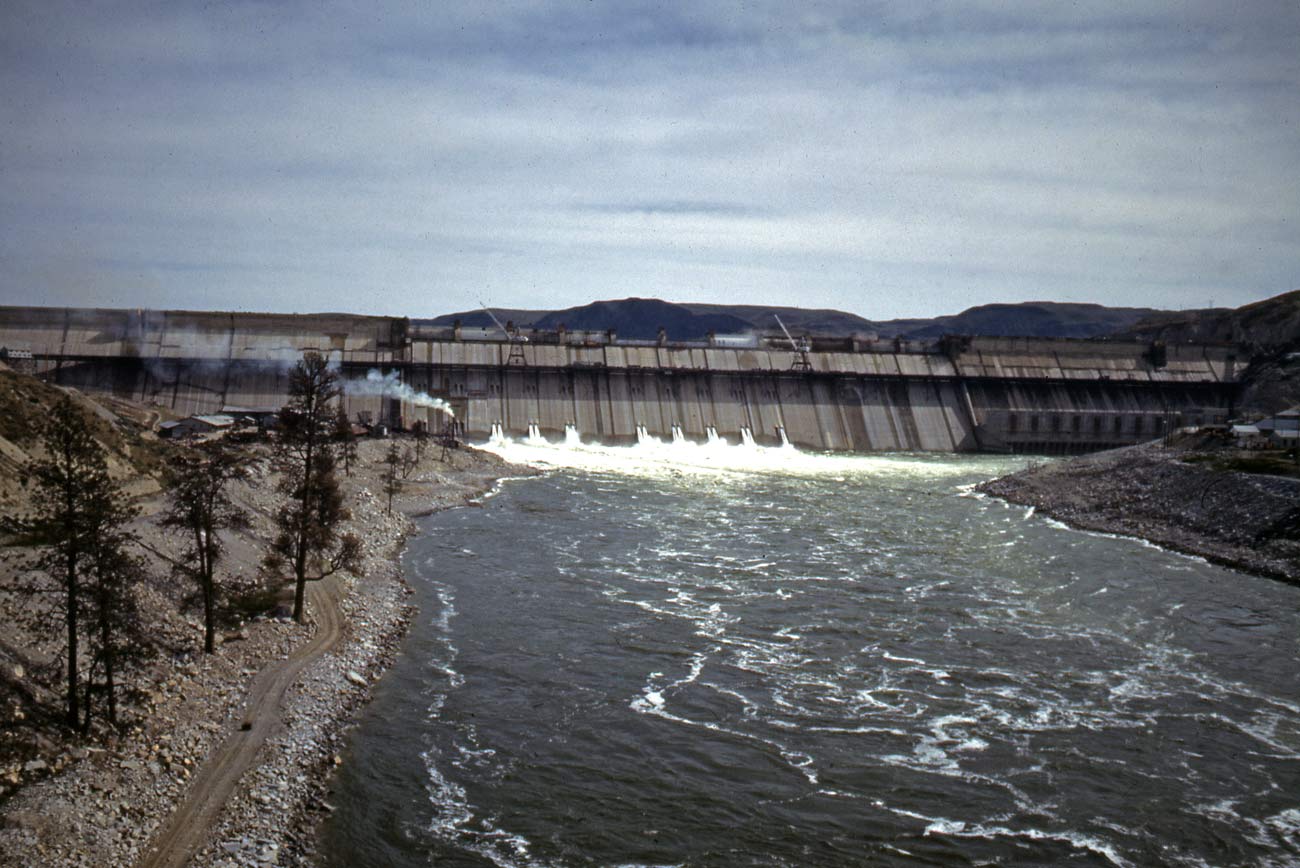
(Click TWICE to Enlarge.) It is fairly easy to at least imagine Horace’s motivation for pulling over on this country road to record the line of gravel as a repeat of the line streaming above him. The curve of the dirt road follows that of the vapor. In the post-war years Spokane had two military airports west of town, Geiger Field and Fairchild Air Force Base. The latter was soon sending hybrid B-36s droning over the city. Extremely ponderous these over-sized flying tanks were retired early, made obsolete by the B-52, a serious cold war bomber. I no longer remember what sort of marks these jets were leaving in the sky in the 1940s, so this vapor trail does not lead me to its maker. I remember the fascination of them though. In the summer it was something to lie in the grass and watch their creation. The tail gave a substance to the airplane it did not have without it.
(click to enlarge photos)


How many Pacific readers can name the make, model and year for the motorcar at the lower-left corner of this look down Fourth Avenue and through its intersection with University Street? I cannot, although I nervously propose that it at least resembles a 1909 Pierce-Arrow. Perhaps a modern urge led the unnamed photographer to include the car in the composition. It is in fine contrast to the two horse express wagon heading south on 4th at a pace that is not a gallop. A century ago there were still many more horses on Seattle streets than automobiles.
Above the car is the brand new Cobb Building with terracotta Indian heads banding the façade at its 9th floor. The Cobb took its first occupants early in the summer of 1910, and most of them were dentists and doctors. The Metropolitan Building Company designed it for them – the first building on the Pacific Coast predisposed for the efficient handling of tooth extractions and the mysterious request, “cough please.”
Right of center are the White and Henry Buildings. Both were completed in 1909, the White first at Union Street. Hip to hip they were the first two-thirds of what by 1915 was the block-long White Henry Stuart Building, an elegant show strip for this make-over of the old Territorial University campus into “a city within a city.” The majority of the residents there had connections with lumbering. The trio and all else on that block were razed in 1977 while the Rainier Bank tower with a pedestal boldly resembling a golfing accessory was completed.
To me the Cobb seems to still be preparing to open, so I choose a warm spring day of 1910 for this recording. Three years earlier this part of 4th was about 30 feet higher and covered with campus grass. Fourth neither climbed nor crossed Denny Knoll. It stopped at Seneca Street on the south and Union on the north. The 1907 lowering of the campus and the regarding of Fourth was completed during the first weeks of construction on the White Building in 1908.
Anything to add, Paul? Yes Jean, a few things and some of them more than once. There will be some repetition of points or observations in the three stories I have brought along. They appeared in Pacific years distant from each other, and all have something like thumbnail writing in them, mentioning the basics. And these basics overlap.


DENNY’S KNOLL

DENNY’S KNOLL
In January of 1979 the Olympic Hotel was nominated for the National Register of Historic places. We might have hoped that years earlier the same had happened for the old Territorial University which once stood in its place. The old school was surrounded with living memories as profoundly loving as those offered the Olympic Hotel by citizens successful in their efforts to save it from demolition. However, in 1907, the year of the university’s removal, a booming spirit of progress was simply too insistent to be forestalled by cherished memories of school days. (Actually, 1907 developed into a crashing year economically nation-wide. The local regrade projects on Denny Hill and Fourth avenue then became acts of faith conceived in good times but underway in hard times. The 1907 recession inspired anxious memories of the 1893 crash. Digging into hills and streets was a good way to relieve these flagging recollections.)
This photographic image, clouded with exhaust fumes of steam shovels and the dust of cave-ins, is of Fourth Avenue being cut through the site of that old school. The photographer is above University Street and his or her camera sights south across Fourth towards Seneca. There in the center of the picture the gathering cloud half obscures what was the location of the old university. The building was 20 to 30 feet higher as the exposed cliff on the left reveals.

Atop the cliff is a sign reading “Metropolitan Building Co., Lessee of University Tract.” That name “Metropolitan” was chosen to help attract eastern capitol to finance a project its local boosters advertised as showing a “business boldness amounting almost to romance . . . it will probably be the largest commercial development of its kind undertaken in any part of the world.” And the signing of that lease in the late winter of 1907 turned into a very big deal indeed. Within five years the entire grass-covered tract of the old campus was congested with buildings returning rents to Metropolitan and lease monies to the university.
The photographed of the regrade was taken during the winter of 1907-08. For many years before, the only thing growing on this knoll – beside young minds – was the deep grass, maples and first that girdled the western slopes of Denny Knoll’s greenbelt of inviting calm. From 1861, the year it was built, through the many decades of its dominance as the young community’s most imposing landmark, the clapboards, cupola and fluted columns of the old university shone with a hard white enamel.

When in the mid-1890s the regents moved the university to its present Interlaken location, their images of the old acreage switched from one of academic sanctuary to the pragmatic stage of real estate. Successfully resisting a city plan to turn the knoll into a park, they dickered for a decade while the city doubled in size and commerce began to press in on the picked fence. Still in 1907, when the deal with Metropolitan went through, the old university building was not destroyed.

It was moved 100 years or more to the northeast, near Fifth and Union, where it waited while its alumni, under the charismatic urgings of Professor Edmond Meany, tried to gather support to have the building either relocated to the new university site or somehow saved. They failed and had to settle for those fluted columns alone, which now stand at the present site of the “University of a Thousand Years.”

Above: The columns in their present on-campus home in late November, 1993. This tree encircled park is call the Sylvan Theatre and on some moonlit nights you may find ecstatic dancers there.

YWCA (The feature that follows looks through the same block on 4th Avenue, south of University Street, as that watched during the 1907-8 regrade, above. This was copied from Seattle Now and Then Volume One, which can be seen in-toto on the blog, by approaching it through the “History Books” button on the blog’s front page. But please be patient with the download time. Read something else while you wait . . . perhaps.)
(Here especially click TWICE to enlarge the text.)


FOUR SUBJECTS on UNIVERSITY STREET BETWEEN 4TH & 5TH AVENUES.


THE YOSEMITE
Look closely and you will find the Cobb Building in the off-shore view below.


THE PIER & THE SIDE WHEELER
We will consider two contrasting profiles here. One is white – all 282 feet and 3 inches of the Yosemite — and the other dark – the west end of Pier 57. Both are over water but only the former is afloat, and yet not for long.
The crowed skyline here is filled will clues so this view is relatively easy to date. On the far left horizon the White Building at 4th and Union is completed (in 1908) and to the right of it the structural steel for its adjoining neighbor, the Henry Building, is about to receive its terra-cotta skin. This is either late 1908 or 1909. Also in 1909 the 46-year-old Yosemite while on excursion with about 1000 passengers broke her back on rocks near shore in the Port Orchard Narrows. This may be her last formal profile.

At the foot of University Street Pier 57 was long associated with the Chicago Milwaukee and St. Paul Railroad (CMSPRR), and was often referred to as the “Milwaukee Dock” in part because that name still has such a euphonious ring to it — “The Milwaukee Dock.” Of course it had other tenants as well and in 1902 (seven years before the CMSPRR arrived in Seattle) the ends of the Pier were blazoned “The Agen Dock.”
It was named for John B. Agen who founded the Alaska Butter and Cream Company in time to feed at least some of Alaska when gold was discovered first in the Yukon in 1897 and soon after on the beaches of Nome. Consequently Pier 57 had two rooms for cold storage. Here, however, Agen’s sign is gone, the Milwaukee sign is not yet up, and the Arlington Dock Company is – for the moment – obviously in charge.
Two things more about the Yosemite. Built for the Sacramento River in 1863 it was sent north twenty years later. In 1895 the maritime encyclopedia of the time, Lewis and Dryden’s Marine History, described it as “the handsomest as well as the fastest steamer which had yet appeared in Northwestern waters.” It was long rumored that the side-wheeler was purposely driven to the rocky shore for the insurance money. No one was hurt and apparently the owner collected.

THE METROPOLITAN TRACT again


When the University of Washington moved to its new campus in 1895, it left behind a 10-acre campus on Denny’s Knoll – roughly between Third and Sixth avenues, and Seneca and Union streets. The popular proposal to make a park of the site might have proceeded quickly and cheaply except for the UW regents’ prudent aversion to mere recreation. Still, the old campus was a sort of Central Park for the 12 more years before it became a “city within a city.”
In 1907 the Metropolitan Building Co. assumed a 50-year lease on the old campus and raised its first two show “skyscrapers,” the White and Henry buildings south from Union Street along the east side of Fourth Avenue. Chester White was the new company’s president and, like Horace Henry, he was also a stockholder in the venture and a lumberman. Most of the office space was quickly taken over by the regional lumber firms. The success of this development played an important part in the voters’ rejection in 1912 of the comprehensive metropolitan Bogue Plan, which would have included another grand style civic center on the freshly cleared and subdued Denny Regrade.

In 1915 the Stuart Building was added at the corner of University Street, completing the coherent façade along Fourth Avenue. In this view, which dates from the late 1920s, the developer’s metropolitan vision has been nearly completed with the 1925 addition of the Olympic Hotel (far right) and, one year later, the Skinner Building, (far left).
The White-Henry-Stuart Building and the block it sat on were razed in the mid 1970s for the construction of the Rainier Tower on what continues to be University of Washington property.


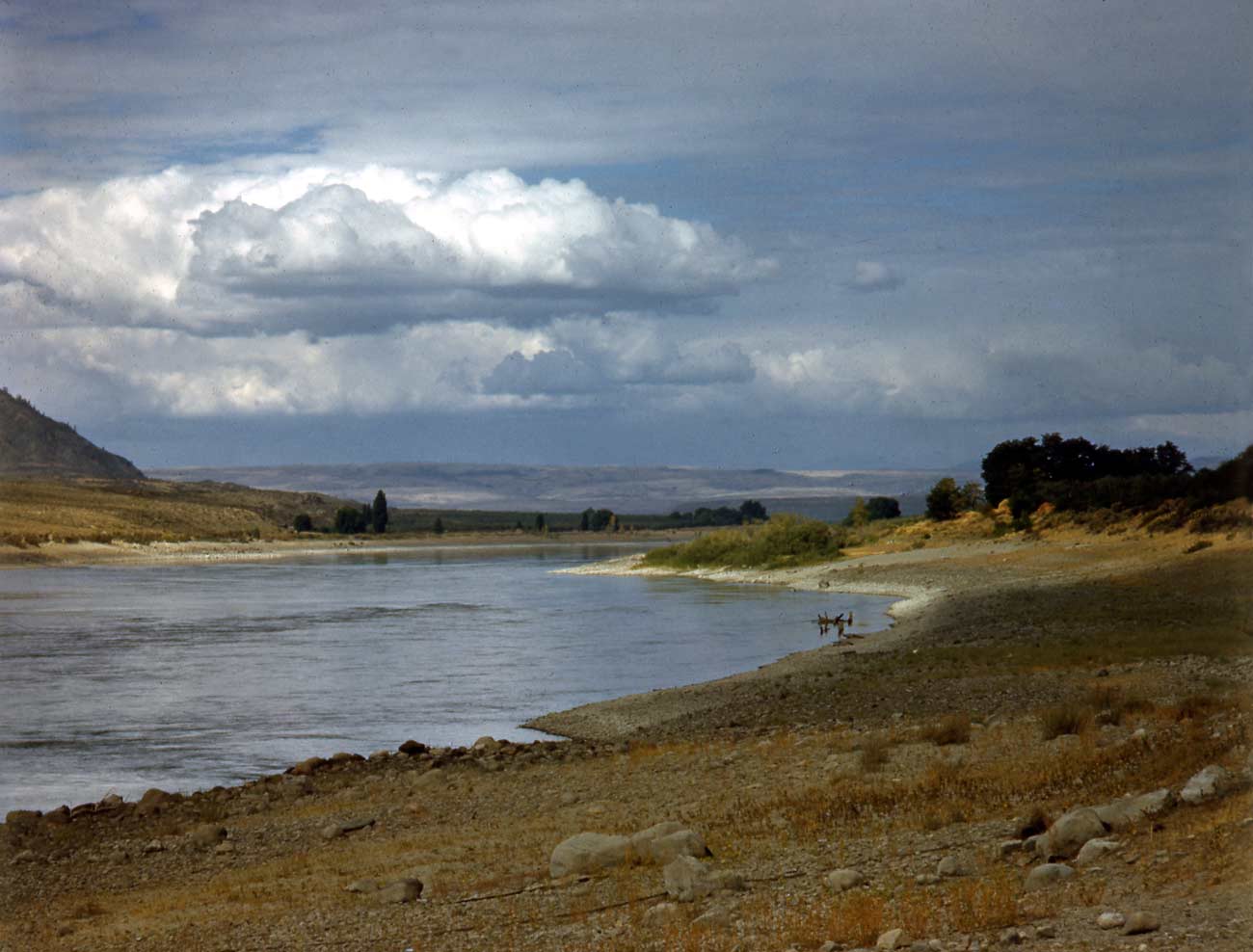
About one mile south on Washington State Highway 28 from where Horace Sykes might have taken a Kodachrome of Rock Island Dam head on at its face he instead found this perch above the Columbia where across the river the dam peeks around a curve and stage left – on the right – cliffs rise like stage curtains. And Sykes also found a poseur for the foreground too. Here a rock stands above the river like a pulpit.
