[The feature that follows first appeared in Pacific Northwest Mag. for Nov. 1, 2009.]
Normal
0
0
1
341
1949
16
3
2393
11.1282
0
0
0
Normal
0
0
1
51
292
2
1
358
11.1282
0
0
0
The hand-written caption “Prof Conn family” can be imperfectly read at the base of this week’s historical subject. I know Conn not for his professing but for his photographs. His views around Green Lake and Ravenna are probably the best record of those neighborhoods in the 1890s. Through the years of this feature I have used three or four of them.
Conn has here joined his wife Margaret and son Neil to pose on the front law of their home, I assumed. So I was surprised that none of the few addresses listed for George E. Conn could be stretched to approximate this view, which includes a patch of Green Lake in it. My solution was a turn to Rob Ketcherside and his zest for then-and-now hide-and-seek, supported by his spatial relations intelligence and gift for modern on-line research. Rob soon determined that my assumption about the “family home” was wrong. The Conns are here posing on the front lawn of East Green Lake’s biggest realtor then, W. D. Wood, who was also briefly – about the time this photograph was recorded – Seattle’s Mayor for parts of 1896-7. Wood took, as it turned out, a permanent leave of absence from politics to follow the gold rush.
While “Professor” Conn, shown here posing with his familynear the east shore of Green Lake, is listed in city directories as a school teacher at both nearby Latona and Green Lake schools his name does not appear in the Seattle School District’s archives. Eventually, the Conns moved to Thurston County where the “professor’s” teaching at a “common school” is traceable in the 1920 census.
In the “now” view Ketcherside, on the left, joins author and Green Lake historian Louis Fiset on the north side of Northeast 72nd Street and near where the Conn’s pose in Wood’s lawn overgrown with flowers. Years ago Fiset introduced me to the Woods, who in 1887 purchased these east Green Lake acres, which included the cabins still standing here on the right. He bought it all from Green Lake pioneer Erhard Seifried, AKA “Green Lake John.” Both Rob and Louis (and Ron Edge too) have helped me with the details of this story. Readers can find many of Ketcherside’s own “now-and-thens” on Flickr or search Flickr for his name under “people.”
More than twenty years of work went into shaping Green Lake’s new shoreline and with it the enlarging of Green Lake Park. (Courtesy of Paul G. Pearson)The East Green Lake Playfield, shown in part here, was the largest addition of park land made from fill piled on top of the old lakebed. The view looks north along the curving western border of that fill.
[What follows first appeared in Pacifric Northwest Mag. 8/28/05.] Thanks to Paul G. Pearson who sent along this week’s revelation of how a new shoreline was constructed for Green Lake, and with it the gift of a new city park.This view of a pile driver constructing its own throughway across the East Green Lake Bay was photographed in 1912.One year earlier the lake was lowered seven feet with mixed results.It robbed the lake of its natural circulation by drying up the stream that ran between the Lake and Union Bay on Lake Washington. (Decades of “Green Lake Itch” would follow.)But it also exposed a shoreline that was the first ground for the new park that was extended with fill.
The pile driver is following the curves of the Olmsted Bros. 1908 design for Green Lake Park.Following the driver a narrow gauge railroad track was laid atop the trestle and by this efficient means dirt was dumped to all sides eventually covering the trestle itself.(Unless contradicted, it is likely that the trestle seen here in the “then” survives beneath the park visitors walking the Green Lake recreational path in the “now.”)
In all about two miles of trestle was built off shore from which more than 250,000 cubic yards of earth was dumped to form the dike.After another 900,000-plus cubic yards of lake bottom was dredged and distributed between the dike and the shoreline it was discovered that when dry the dredgings were too “fluffy” to support the park’s new landscape.More substantial fill from the usual sources – like street regarding, construction sites and garbage then still rich with coal ashes, AKA “clinkers”– was added.
The historical photograph was recorded by the Maple Leaf Studio whose offices were one block from the new Green Lake Library seen here on the far right of their photograph.The exposed shoreline is also revealed there.Next week we will take a close-up look at this same section of E. Green Lake Way North in 1910 when the library was new and Green Lake seven feet higher.
The double block on E. Green Lake Way North between Latona and Sunnyside Streets was developed in the early 1900s with the typical late-Victorian Seattle homes shown here. Most of these homes survive.
When Green Lake was lowered in 1911 the exposed lake bed was developed as verdant park land.
[What follows appeared first in Pacific Northwest Magazine, Sept. 4,2005] Now we return to Green Lake as promised last week. For its obvious changes this comparison hardly needs a caption – but we will still offer one.In the 1910 photograph the lake still rests against it northern shore. That was the year that the Green Lake Library opened and while we can see it on the far right we cannot, of course, tell if all the tables and books are yet in place. As noted last week, after the lake was lowered 7 feet in 1911 this shore, like all others, was exposed. The Seattle Park Department did not simply drop a few grass seeds and plant a few exotics on the exposed beach but rather prepared and extended the new park land with considerable fill. The results – 94 years later – are spectacularly revealed in the “now.”
Most of the homes showing in the historical view were built in the first years of the 20th Century — Green Lake’s boom years. It is a double block extending between Latona and Sunnyside Streets. With three exceptions these homes survive, although most have had lots of changes. For instance, the big house on the left at 7438 E. Green Lake Way North is here nearly new. Built in 1908 it has by now lost its tower, but gained much else. (But you’ll have to visit the sidewalk beyond the park trees to inspect these additions for yourself.) The missing homes have been replaced with a row of three non-descript multi-unit boxes. At least from this perspective, for these the park landscape is an effective screen.
One of Green Lake’s principal early developers, W.D. Wood, proposed to the city in the early 1890s that they acquire the lake’s waterfront for a surrounding park. Had the city followed Wood’s advice there would have been no need to lower the lake and so dry up the stream that ran from its east side to Lake Washington. Nor of course would the homes we see here have been built on park land. Wood, a man of ideas and initiative, was later elected Mayor of Seattle in time to resign and join the Yukon gold rush n 1897.
Perhaps among our many enthused readers is a bark expert who will share the names with John and the rest of us, starting top-left, moving right and numbered one through 12.
We have pulled some more morphology from John Sundsten, the anatomist collector. John confesses that he does not know the names – neither scientific nor popular – for many of the trees whose barks he has recorded here.We admire his candor.“I am a good anatomist and a lousy naturalist. Some of them have names indicated with a brass plaque, but most do not.I just like bark.I like bark texture and bark color.You may write that barks are my friends. I shot them with my little camera last month while strolling around the lake counterclockwise in the early morning.”The U.W. scientist wonders, “There seem to be a lot of ladies with dogs and old couples at that time of day. Are there then two kinds of people? Clockwise and anticlockwise people, and what does their choice of walking around Green Lake say about right and left brain function, or no brain function, which is probably true for me. The barks go into folders, and I have a lot of other folders, ones with trees and animals and masks (mine) and oysters and such. It is like getting in the stuff for the long winter to come. And I presume some day it will.”John adds, “It occurs to me that I have a folder with about twenty Green Lake Park benches.”We may be seeing some Sunsten seats here soon.
John concludes, “I’ve included a long shot. It came out well, I think.” And we agree.
We welcome John Sundsten and his eye for fine lines. The emeritus associate professor in the U.W. Department of Biological Structure took the “snaps” below while on a walk around Green Lake on Monday last – Oct. 26, 2009 – after dropping his daughter off at Garfield High School. John is a neuroanatomist who’s interests extend well beyond grey matter. He is also a carver, an oyster harvester (on Hood Canal shoreline that has long been in the Sundsten family) and a contrabass flute player. He lives in Wallingford and we sometimes walk the ‘hood together. It occurs to me now that John’s Green Lake recordings may also serve as a challenge to Jean Sherrard, of this blog, to again go down to the lake with his Nikon, and for you readers an encouragement to walk the lake this fall.
[Click to Enlarge]
Some of the "autumnal structure" along the shores of Green Lake, 10/26/9.
May the tender prejudices of friendship be temporarily put aside for an unbiased look into the qualities of a close friend? I doubt it, unless one stumbles into it.
Click to visit
Vinburd first visited my e-mail box snuggled between two opportunities: one that I help spend the good fortune of a doctor in Nigeria and the other a cheap deal on guaranteed Viagra from Sepulveda. While I wondered what qualifies as a Viagra guarantee, I did not read the gentle blogger named Vinburd until his or her fourth sending, and then I noted to myself, “Bill should read this!” As I prepared to forward Vinburd to Bill I discovered to my surprise and delight that Vinburd was Bill.
With this blog’s introduction to Vinburd (as a buttoned link) and in line with full disclosure, it was Bill Burden who introduced me to Berangere Lomont – of this blog – in 1977. They met, with full Mediterranean exposure, on a boat from Athens to Venice, as Bill was on his way to picking grapes in the south of France during the late summer of 1976, which some of you will remember, perhaps with no particular relevance, as America’s bi-centennial.
And it was I who introduced Jean Sherrard first to Bill Burden in 2001 and then to Berangere in 2005 when Jean and I visited her and her family in Paris. Bill joined us from Saudi Arabia where he was momentarily consulting on something and his daughter Caroline drove down from Germany with her two children.
The accompanying picture is proof of place for at least Jean, Bill and I, but not of our age now. We were directed by Berangere to smile for her where millions of tourists before us have posed with their backs to the Sacre Coeur and on the steps to the top of Paris’ highest hill. Grandfather Vinburd is at the middle. (Although snapped only four years ago, to me we look uncannily young. But then I am currently negotiating my first mid-life crises with my first old man crisis at the same time – this week at the age of 71. Bill is a few years behind me and Jean is still in his prime.)
L-R: Paul, Bill & Jean (photo by Berangere Lomont)
I met John William Burden in the Helix (a newspaper) office during the summer of 1969. The U.W. Grad student in Old English (think Beowulf) was doing public relations (long hair and all) for the “Mayor’s Youth Division.” (Now I wonder, did he think that an “underground tabloid” like ours would have been a pipeline to Seattle’s youth?) We soon became friends and although he moved back to Southern California in the late 1980s we have never been out of touch. He still flies north often, although by now it is as likely for funerals as weddings that we and many friends are reunited.
We lived together for two years in the late 1970s in an old asbestos faux-war-brick workers home next door to the Cascade Neighborhood playfield. There every Sunday in summer we set out the bases for “artist league softball,” a warm tradition that survived for perhaps five years. Bill was then working as an independent carpenter and late 70s hot tub hysteria was splashing his way. (Several friends had them and we were still young enough to comfortably strip with them and even strangers.)
When I met him Bill was married with two children. I watched them grow up. In those sometimes intuited “groovy times” Bill was already a generous and encyclopedic wit willing to use his vocabulary and allusions and so never boring. Jean is the same. One of my fond Parisian memories from 2005 is seeing the two of them side-by-side in animated conversation as they walked across the pedestrian Pont des Arts while we were all returning to Berangere’s Left Bank home from a visit to the Louvre. That, dear reader, is spanning high culture.
Paul, furthest right, bottom row. Bill, with bat next to Paul.
I’m confident that many of you will enjoy following Bill’s reflections on a variety of subjects, both the eternally recurring ones and those that are more contemporary. And here’s some more fan-mag-like twitter stuff on Vinburd. He has traveled almost everywhere. He loves skiing and more than once chose his home site in order to be near the slopes. He is an expert fly fisherman and for a time was a columnist on the subject. This fly-fishing fits his Vinburd persona very well. Of course, so does his wine making. I love his Chateau Fou. Now you may, if you like, imagine taking a walk with Vinburd, and with his blog, Will’s Convivium, you can, if you are so moved, have an invigorating conversation with the oldest brother of Lawburd, Newsburd, and Bigburd.
SOFTBALL PLAYERS IDENTIFIED (see above photo)
With help from a few of those pictured we will identify most of those players in the Artist’s Softball League who managed to pose together on a Sunday afternoon during the summer of 1978 in the Cascade Playfield with Pontius Avenue behind them between Thomas and Harrison Streets. Many are missing including Philip Wohlstetter who helped with the identifications and who this weekend may have been in Paris, and Doug Barnett, who had the mightiest swing among us having slugged a softball from home plate over the fence bordering Harrison Street.
Bottom Row, Left to Right: Who is the bearded man with the white shirt and in profile? We do not know as yet. (Continuing) David Mahler, Irene Mahler (supporting the bat), Bill Burden AKA Vinburd (supporting the other bat), Paul Dorpat.
Second Row, Left to Right: Bob Clark stands with glove and Paul Kowalski next to him has a glove too. Annie Carlberg holds her glove aloft. Judith Connor, with the striped shirt, soon after moved to Japan. Barbara Teeple, with long hair, stands next to someone for now identified only as “Ann Rich’s boyfriend.” Billy King holds his hat. Man behind Billy looks a lot like the “Ann Rich’s boyfriend.” Hmmm. Norman Caldwell, who lived three feet from the playfield, separating it from Bill and my home.
Top Row, Left to Right: Norm Langill, who helped with the captions and played with style; Andy Keating, who hit with power and later moved to New York and Merilee Tompkins with her hands on Andy and David Rosen. (This year David generously let me share his studio overlooking Lake Union.) Next, Norm Engelsberg with the big hair and Lisa Shue in white. Lisa played the cello and lived next door with Norm Caldwell. Neither the dog nor man in striped shirt standing aside to the right are as yet identified. This is more than 18 players – this Sunday enough for two teams and base coaches. We used no umpires.
Here at DorpatSherrardLomont there’s always room for improvement, even long after the fact. On occasion, we will make discoveries related to previous columns – buried treasures usually overlooked in the rush to find supporting materials for Seattle Now & Then.
Last August, Paul related how he had misplaced slides of the Palomar Theatre’s demise. He has now found them and, as promised, they are posted below. To view the original column – now amended – click HERE.
Lawton Gowey has dated this 11th-hour photo of the Palomar Theatre, April 21, 1965, and describes the "On Stage Boeing Musical, April 23, Annie Get Your Gun," performed by Boeing Employees, as the Palomar's "last public show."The razing of the Palomar was well along when Lawton Gowey recorded this slide of the destruction on June 22, 1965.His water department office nearby, Gowey took this photo on April 7, 1978 of the parking garage that replaced the garage.
“A sampler of five of about 200 Wallingford (not near London but rather a neighborhood in Seattle, Washington) scenes photographed earlier this afternoon.
Four subjects from the about 200 photographed Saturday (10-24-9) while on a Wallingford walk. If anyone knows the familiar name for that exotic leaf please share it with a comment. (Click twice to enlarge.)
Amateur photographer George Brown most likely took this view of Portland’s 1905 Lewis and Clark Centennial Exposition from the north porch of the Washington State Building. Brown also played clarinet in Wagner’s popular concert and marching band, which was probably performing at the Expo. (pic courtesy of Bill Greer) Northwest historian and Portland resident Richard Engeman and Portland author Claire Sykes gave each other courage as they climbed to the roof of the Montgomery Building to record this tree-topping view of the neighborhood of warehouses and light industry that has taken the place of Guild’s Lake and the LCCE’s 1905 site. (Now photo by Richard Engeman and Claire Sykes)
[Click to ENLARGE]
The official map of the LCCE shows the location of the Washington Pavilion, below-the-center, from which the historical view was most likely taken.
[Click to Enlarge photos]
From LCCE to AYP
Normal
0
0
1
386
2205
18
4
2707
11.1282
0
0
0
A few days more than one hundred years ago the Alaska Yukon and Pacific Exposition concluded its four-and-one-half-month run on a University of Washington Campus that was landscaped for it and arranged with sublime edifices in the classical style, most of them temporary plaster-on-wood creations, but splendid and convincing.The state legislature agreed to help fund the AYP (for short) if at least three of the new buildings were made to stay put following the exposition for use by the school, which the politicians had long made a habit of neglecting.
Throughout our recent summer – now in flight to California – Seattle has celebrated the memory of that “first worlds fair’ with elaborate exhibits, symposiums, special events, web pages, reenactments, and publications.(This centennial got considerably more attention than the city’s own sesquicentennial of a few years back.)Who could have expected a show of such wonderful energy and insight?You may have devoted your warm months to just tracking it all.If you missed it altogether, you must have stayed in the basement.
Seattle’s AYP was “motivated” more than inspired by Portland’s Lewis and Clark Centennial Exposition (LCCE), of 1905, part of which we see here.Godfrey Chelander, a Seattle exhibitor for his Arctic Brotherhood, returned to Seattle from the LCCE with the desire to make a permanent Alaska exhibit here.James A. Woods, then city editor for The Seattle Times, turned the permanent exhibit into a summer-long worlds fair, partly as a way to show-up Seattle’s principal cultural and economic rival, Portland.And it did with rough statistics. AYP had more exhibits and with 3,770,000 visitors twice the gate.
But could the AYP have been more sublime than this LCCE setting to the sides of Portland’s Guild’s Lake. The site was conveniently near the business district, two trolley lines and the Willamette River and looked towards Mt. St. Helens, which was then still sublime on its own.And Guild Lake was manageable.In summertime it was but 2.5 feet deep.It required no extraordinary engineering to build the 1000 foot long Bridge of Nations, left of center, from the Expo’s main campus, mostly out-of-frame, to its US. Government Buildings beyond.
[The summer-long and more AYPE centennial is in hibernation, perhaps until its sesquicentennial in 2059.But we will not let it go entirely.We are attaching a hamper of AYP related pictures with captions that we will pull from our nearly 40-year stock as we can.That is, this hamper will continue to grow and always in this place – hanging from Portland and its own fair of 1905.]
REST in PEACE – An AYP HAMPER
No. 1The AYP Bird’s Eye, Some Maps & Panoramas
The official AYPE Bird’s Eye was, of course, drawn from plans a few months before the fair opened to help promote it. In the interim the fair changed but the drawing did not. So there are a few mistakes, which wishing to be fair we will not point out, because we do not know all of them. (This Bird’s Eye is another Edge Clipping, and thanks to Ron Edge for helping with it.)
Normal
0
0
1
25
143
1
1
175
11.1282
0
0
0
Quickly built, used and dismantled – except for those few “permanent buildings’” – the Expo, by some headine maker’s decree, became “Seattle’s forgotten worlds fair.” At least most of the structures and appointments were soon cleared from the campus. The exceptions were the few permanent buildings intended for school use following the fair. The juxtaposition below of the UW section from the 1912 Baist Real Estate Map and part of the AYP birdseye printed just above shows how drastic was the razing of AYP. But the inserted map is stingy. It shows in red the permanent campus brick facilities but also omits survivors from the fair, including the extremely wooded Forestry Building which hung around campus for many years after the fair serving at times both as a museum and as home for the school’s school of forestry.
This “temple of timber” was, it seems, the most popular building at the fair. It is number 20 in the expo’s official map below. The reader may wish to try a game of referencing other numbered structures in the map to those appearing in the bird’s eye. In this the map is also good evidence for what is awry with the premature bird’s eye.
Ron Edge here contributes another of his “clippings”. This one an earlier map of the Expo from 1906, which looks both familiar and strange.
The Expo was also recorded from on high.
Photographed from the Expo’s “captive air balloon” this aerial appeared on the front page of a local daily. It was an early use of an oversized half-tone and the captions told a half truth about how the pilot was lost in clouds until they opened to reveal the above. The clouds included at the top of this aerial are almost certainly a pre-photoshop invention. The balloon was also used to take one of the masterpieces of local historical photography, a panorama of about 180 degrees that, however, showed little of the fair but much the neighborhood including Union Bay, Madison Park, Capitol Hill, all of Portage Bay, and wrapping as far to the northwest as Latona and part of Wallingford beyond it.
[Click TWICE to Enlarege the Enlargement]
The panorama is not attributed. Original prints were part of a small archive of University District materials kept by a neighborhood bank. When it was sold to a California “financial institution” I helped persuade the last manager of the community bank to donate the collection to the Northwest Collection at the University of Washington. Somewhere there the five parts of this pan – here only crudely welded together and retouched – are kept in an archival folder waiting for someone to have high-resolution scans done from them with the intention of joining them together and giving this treasure the care and study is deserves. Two trolleys can be found on 40th Street heading for the fair, although portions of the Pay Streak seem unfinished suggesting that the pan was recorded some little time before the Expos opened. The balloon from which the above panorama was shot in five pieces shows in the pan below. It hovers over the end of the Pay Streak, the position it held to take the above pan.
The two-part pan above (here melded at the center to either side of the tree) is one of the sharpest and most revealing of the many panoramas of the Expo that were taken from Capitol Hill. Later we may attach close-ups of a number of the buildings that can be seen in the pan either with numbers to cross-reference them or with a challenge to the reader to figure it out on their own. (In that event we could arrange them so that the first building shown is the farthest to the left and the last one included the farthest to the right and so on inbetween – perhaps.)
Stereo close-up of the photogapher's balloon.
Next we will show a few more pans from Capitol Hill, the first from when construction expo construction was in its mid-stages. The future Pay Streak (the Carnival side of AYP) is merely a cleared path leading north from the photographs bottom right corner where the Portage Bay waterfront has been prepared with pilings for the many attractions that appear there in the balloon pan above. Meany Hall, one of the intended permanent buildings, shows left of center, and to the left of it is the AYP’s administration building.
Another an much wider view of the Expo from Capitol Hill extends far to the west – as far as Seventh Avenue and just beyond it a portion of the low ridge that still rises west of the I-5 Freeway. The Avenues below, right to left, are Seventh, Eigth, Ninth, Roosevelt Way, 11th, 12th, Brooklyn, University Way and 15th Avenue.
Follow now two more pans from Capitol Hill, the first by Asahel Curtis and the other from a few years after the fair – cira 1915 – when most the imposing structures that appear in the Curtis view and the others above it were remembered with pictures like these.
Now we will conclude with a few photographs of the Arctic Circle, which was the sublime Beaux Arts center of the fair. The Drumheller Fountain AKA Frosh Pond is a survivor of this grand hydraulics. Now we sing a lullaby to the fair so that it may sleep better while waiting for its sesquicentennial in 2069, and the likelihood that again by then many will be clueless about “Seattle’s forgotten world’s fair”.
A family - we think - at the fair.Somehow the Expo's official photographer, Frank Nowell, took this view looking into the Arctic Circle and across the first landscaping of the Rainier Vista. The mountain, of course, is here behind you. (The Manufacturer's Building is far right, and will be shown in part with the next two scene's below.)A construction scene looking across the Cascades to the Manufactures building.Sortect officials and VIPs inspect the fair during its late construction. The Manufacturers Building is beyond.The first of four unofficial photographs of the Cascades by photographers who were not allowed to use large format cameras. This snapshot is signed by Goetze.Oakes, one of the more prolific real photo postcard "artists", captured this view of the Cascades.The illuminated Cascades by Phillip Hughett, courtesy of Jim Westall.
Next follows two photographs of the Hawaii Building both, like the illuminated Cascade directly above, recorded by Phillip Hughet. The Hawaii building was the next structure up the Cascades from the Manufacturers Building on the northeast side of the Cascades.
Hawaii Building. Courtesy Jim WestallHawaii Building by electric light. Courtesy Jim Westall.Two by Price, a name long connected with photography. Price photo has for years operate customer services on Roosevelt in the same retail strip with Magnolia Hi. Fi. and the Sunlight Cafe, although much longer than either of them. Both these look towards, right to left, the Manufacturers Bldg, the Oriental Bldg, and the Hawaii Building.
The next scene was recorded sometimes after the fair and most of its temporary structures are removed. Meany Hall appears on the left horizon, and the once cascading steps above the fountain are evident on the right. Right-of-center, Parrington Hall (built as Science Hall) appears, and unlike Meany Hall, which was weakened by an earthquake and removed, Parrington Hall survives.
Contemporary U.W. Map superimposed on a fragment of the AYP Map. The Arctic Circle fountain, AKA Frosh Pond, appears upper right. The map was created by Dan Kerlee one of the real and devoted experts and collectors on AYP. Dan has had a busy year. Visit his AYPE.com web page.U.W. Physics Bldg, right, and part of the Suzzalo Library, left. The Physics building stands in part on the old footprints of both the AYP's Oriental and Hawaii Buildings. The roses here bloom where once the cascades fell. The photographer Robert Bradley date this June, 5, 1959.
In Jean Sherrard’s and my book Washington Then and Now we featured the Arctic Circle with the “then and now” that follows.
Finally – perhaps – a uncrowded scene to help us reflect on the AYPE for fifty years more.
MORE BLOGADDENDA
It is rare to catch such a cherished scholar-author as Portland’s Richard Engeman on the roof of a large Portland warehouse smiling. Richard explains the unique recreation of the jumbo sign behind him. “Did Claire or I send you a pic of the wonderful sign on the top of the Montgomery Park building? It was recycled from when it was the regional warehouse for Montgomery Ward–changing the sign meant changing only two letters.” Claire Sykes took the portrait. This, of course, is also the prospect from which Claire and Richard recorded the “now” repeat of this blog’s recent report on the 1905 Lewis and Clark Centennial Exposition campus.
Richard Engemann atop old Montgomery Ward building (photo by Claire Sykes)
You see above the “young hero” of CINEMA PENITENTIARY grown a bit older but still dashing. Below him is Georgianna Carter, an early influence on White who appears in the excerpt below. I took Bill White’s portrait at last year’s University District Fair, but he was not new to me. I’ve known Bill since he was a teenager in the late 60s, but I did not know then about his enthusiasm for film. Recently a movie and music reviewer for the Post-Intelligencer, this energetic “young” critic, poet, novelist and singer-songwriter has some time to give to reminiscing about his life with film since the P-I failed, and CINEMA PENITENTIARY is one issue of his new-found “idleness” that is still issuing. Bill White knows whereof he writes. His memory of the thousands of movies he has watched and studied since he first slipped milk money through the windows of box offices is extraordinary. Many of his stories connected with Seattle theatres and the movies they show will flip readers, even those who did not spend the greater part of their summer vacations from primary school watching films first in Renton and then in downtown Seattle theatres. Here follows an early issue from Bill White’s CINEMA PENITENTIARY. For those who have not yet found it, a sample of Bill White’s reviewing appears below with the blog insertion that precedes this one. There Bill reviews Forever Amber, which in 1949 appeared at the Colonial Theatre on 4th Avenue between Pike and Pine Streets. Our critic also winds up in and out of the Colonial at the conclusion of this excerpt from . . .
Bill White’s CINEMA PENITENTIARY.
In 1958, I was seven years old and lived in Bryn Mawr, a small community outside of Renton, Washington. My street was originally named after John Keats, but after a year got the number 85. Somebody must have thought it easier for a kid to find his way home through numbered streets than named ones. In Renton, on Third Street, there were three movie theatres. On one side The Roxy catered to adults but sometimes showed movies for the whole family. The Renton, which was right across the street, had movies for normal teenagers, while The Rainier, at the end of the block, offered unsavory fare for the budding delinquents who passed weekend nights there. The Rainier was my favorite of the three theaters.
Since I went to the movies all the time, a kid in my class at school tried to impress me with the boast that he got to see movies on Saturday afternoons at the downtown YMCA for two cents. I convinced my mom to get me a membership and let me make the twelve-mile trip into downtown Seattle every Saturday with my new friend. For a while, I enjoyed the trampoline, the swimming pool, the wrestling matches and the pool table as much as the two cent movies. Then I met a kid about three years older than myself who convinced me to forego the athletics and follow him to a real movie theater that was five blocks away.
The Embassy's 3rd Avenue Entrance
The Embassy showed a different kind of movie on each day of the week, and Saturday it was science fiction and horror. That first Saturday, I saw “Invasion of the Saucer Men,” pygmies with giant heads and long fingernails who stabbed lethal doses of alcohol into the bloodstreams of teenagers, “The Devil Girl From Mars,” an alien bombshell who walked along deserted mountain roads in a sexy black costume on her way to destroy the human race, and “Night of the Blood Beast,” who impregnated an astronaut with a litter of alien parasites and then stopped the male mother’s heart without destabilizing his blood pressure.
The Embassy was a masterpiece of spatial disorientation, due to its having two entrances, one on the corner of Third Avenue, next to the G.O.Guy drug store, and the other around the corner on Union, across from a pool hall that I did not discover until some years later. The floor plan of the theater seemed to vary in accordance with the angle through which it was entered. Finding one’s way out was even more difficult, and I was never sure from which exit I would emerge.
When I left that theater, having seen those movies, while Russian satellites spied on us from Earth’s outer orbit, in a year in which we practiced the duck and cover techniques of surviving a nuclear attack, at a time when our drunken fathers were beating our promiscuous mothers, when schoolmates would tell you the toilets were broken just to see if you would try to hold it in after lunch and shit your pants in class, in those times the titles of these movies were poetry that I rolled over my tongue like the soft drool of melted salt-water taffy.
Had the movies existed only in the spatial time of their unreeling, they might have been forgotten. They lived, however, in my lingering isolation from the real world. I had searched the ordered and disordered faces on the screen for some familiar human expression, but found only odd approximations. And the oddest face belonged to Georgianna Carter, who posed throughout “Night of the Blood Beast” like a burlesque dancer on an archeological dig. Four years later, at the same theater, I would see her again, recognizing her right away, in a Jack Nicholson biker movie that was the only other thing in her life she ever did.
The Garden ca. 1950. Photo by Robert Bradley.
On this first Saturday, coming out of the Third Avenue doors while Miss Carter wondered if humanity had been right in killing the blood beast, I spied the marquee, two blocks up the street, of another theater. From the outside The Garden seemed fancier than The Embassy, if only because of its larger marquee. Admission to The Garden was also a quarter, but you only got two movies instead of three. And they changed twice a week instead of daily. Since I didn’t want to worry my mother by arriving home four hours late, I waited until the next weekend to see the theater’s interior.
The Garden was like the Roxy in that it combined adult and family fare. But instead of getting a preview of “Butterfield 8” before a Jerry Lewis movie, the kids at the Garden got to see the whole movie. It was like trespassing on the Roxy on Parent’s Night Out. After a double feature of “Peyton Place” and “Love in the Afternoon,” I walked up Pine Street to 4th Avenue and discovered The Colonial. It was smaller that the Garden, and also offered bi-weekly double features for a quarter.
Since “Peyton Place” had been over twice the length of two horror movies, it was already getting close to the time my bus was scheduled to leave Second and Madison, so I shouldn’t have gone in, but I paid my quarter anyway, figuring that if I just watched one movie, I would be able to catch the next bus, and wouldn’t get into much trouble.
When I went inside, “Battle Hymn” was on the screen. One of the things about going to these theaters was that you never got there at the beginning of a movie. You just went in, sat down, and started watching the movie at whatever point you walked in on it. Then, after watching the other features, you stayed and watched the beginning of the one you walked in on the middle of. I didn’t even stay until the end of the first one, it being a pretty boring thing with Rock Hudson as an ex-bomber who built an orphanage for Korean kids who lost their parents in the aerial attacks for which he felt guilty.
The Colonial on the west side of 4th Ave. between Pike and Pine, ca. 1947. Photo courtesy Municipal Archive.
The first thing that struck me about The Colonial was the absence of a concession stand. Even the popcorn came out of a vending machine. No concessions also meant no authority figures in the lobby, and that gave a feeling of freedom to do whatever I wanted.
Unfortunately, it gave everybody else that same right, and four years later, during the summer I lived with my mother and sisters on Queen Anne Hill, the summer I turned eleven years old and spent virtually every day in one or the other of these three theatres, a man changed seats several times before slipping into the seat next to mine, where he made a quick and clumsy grab for my dick.
I ran out of the theater and up the street into a department store where I jumped on the escalator and rode eight floors to the restroom where I hid and panted and waited for the fear to subside. Then I ran all the way home, not even slowing to look at the posters of future movie releases that filled the windows of a reprographics shop on Second Avenue in the near deserted area between downtown and Queen Anne Hill that came to be known as Belltown.
I never returned to The Colonial, but continued to patronize the Embassy until it started showing porno movies in the early seventies. It wasn’t that I had anything against porno; I was just afraid to go in there. I kept going to The Garden even during the porno era because they kept the place clean and ran advertisements in the daily newspapers. Sometimes the critics would even review them, which helped me pretend they were real movies, and not just smut.
The Colonial, October 6, 1966. Photo by Frank Shaw.
Film and Music critic Bill White has kindly responded to our request that he write a review of the film showing at the Colonial Theatre in 1949, as revealed in the Kodachrome night slide feature Westlake Night Lights in the Seattle Now and Then published just below this insertion.
An historical romance set during the reign of Charles II, “Forever Amber,” directed by Otto Preminger in 1947, is as dark and claustrophobic a look at society in collapse as any of the underworld-themed B-movies released during the same time. Two years later, Anthony Mann would accomplish something similar with “Reign of Terror,” although his film of the French revolution was a modest black and white production running less than 90 minutes, while “Forever Amber” was shot in Technicolor and ran nearly 2 ½ hours.
It wasn’t until Francis Coppola’s “The Godfather” that the interiors on a major studio film were underlit to such infernal effect. Cinematographer Leon Shamroy, who took the opposite approach the year before in “Leave Her to Heaven,” in which he contrasted the dark story with a brilliantly vibrant visual palette, makes the royal court of Charles II as ghoulishly oppressive as the decaying chambers of Roderick Usher. Although Shamroy won four Oscars for his cinematography, including one for “Leave Her to Heaven,” and was nominated for another eleven, he is largely forgotten today.
The story of Amber begins in 1644, during Cromwell’s rebellion against King Charles I, when the baby girl is discovered and taken in by one of the Puritans who later stands against the restoration of the monarchy in 1660, when Amber resists her foster father’s decision to marry her off to a neighboring farmer. He responds to her refusal by telling her that “vanity is Satan at work in the female soul.” Paradoxically, it is the vanity of the male sex that makes Amber’s tale such a miserable one.
As Bruce Carlton, the callous privateer whose love Amber is obsessed with securing, Cornell Wilde walks atilt with surety of his superiority to every other living thing, including King Charles, who banishes him to the sea when threatened by his sexual rivalry.
George Sanders is suitably disdainful as the king who can stop the performance of a play by his appearance in the royal box, but relies on a revolving cast of compliant female subjects to maintain the illusion of being loved. In the end, when he leaves Amber’s quarters after her final rejection of him as a man, he calls “come, my children,” to a pack of faithful dogs.
It is Linda Darnell’s voluptuously cheap incarnation of Amber that gives the film its poverty row atmosphere. She lowers the bar, just as Jennifer Jones did the previous year for David O. Selznick in “Duel in the Sun,” on any grand aspirations producer Darryl Zanuck might have had for a prestige film. It is because she drags the story into the gutter that gives “Forever Amber” its scent of damnation, and lifts it above the conventional drivel of those romantic melodramas commandeered by the crippling competence of a Bette Davis, Vivian Leigh, or Katherine Hepburn. The screen would not again be endowed with such a fleshy heroine until Elizabeth Taylor embodied Cleopatra in 1963, a film that was also produced at 20th Century Fox by Darryl Zanuck,
“Forever Amber” was one of the few films director Preminger didn’t produce himself, and evidence of Zanuck’s interference is all over it. This is one of the factors that make the film such a fascinating artifact. Although Preminger remained under contract to Fox for another five years, the name of Zanuck never again appeared on one of his films.
THEN: Great railroad signs, theatre signs and ranks of neon were still the greatest contributors to night light at 4th and Westlake in 1949. (Photo by Robert Bradley compliment of Lawton and Jean Gowey)
[Here follows the main body of text.]
This week’s view north on Fourth Avenue from Pike Street shines with neon and those by now nostalgic flame-shape municipal light standards that once graced nearly all the streets in the business district and a few beyond it.
Written on the slide with a steady hand is its most important information – except the photographer’s name. “4th and Pike, Night, Kodak 35mm, Ansco Film, 8 f-stop, Dec 22, 1949.” The shutter was left open for 10 seconds, plenty of time for the passing cars to write illuminated lines along both 4th and Westlake with their headlights. With help from the Seattle Public Library’s Seattle Room I found the photographer: Robert D. Bradley.
I was given this slide and several thousand more in 1984 – a quarter century ago! – by my friend Jean Gowey, who was then recently widowed by her husband Lawton. With thanks Lawton’s name has often appeared here as responsible for providing many of the historical photographs I have used through the now 27 years of this feature. Beyond his professional life of keeping books for the Seattle Water Department, Lawton was very good at playing the organ for his Queen Anne neighborhood church and both studying and sharing his love for local history. Hoping that I would make good public use of Lawton’s own color photography tracking the changes in the business district, Jean included them in the gift.
Along with Gowey’s slides came Bradley’s, and like this night shot, most of them are examples of cityscape beginning in the late 1940s and ending with his death in 1973. The largest part of Jean’s gift, Horace Sykes’s thousands of Kodachrome landscapes of the west from the 1940s and early 1950s, have little to do with Seattle but much to do with the human heart. Until his death in 1956 at the age of 70, Sykes was a relentless explorer and a master of picturesque landscapes. Almost certainly, Sykes, Gowey and Bradley were also friends.
I have often used both Gowey and Bradley’s recordings to better understand the modern changes of Seattle. And now at last at 70 I am also exploring the west with the enchanted Horace. I include now directly below an example of a Horace Sykes Kodachrome landscape. Most of his slide are not identified, but that will make more the adventure of studying them – a Sykes Hide and Seek. (For instance I for now speculate that the blow “burning bush” photo is of a scene on the Yakima River.) We intend to eventually give Horace and his art is own picturesque “button” here at dorpatsherrardlomont.
WEB EXTRAS
To illustrate the point above about Jean’s street lights reiterating the radiant Christmas star that once the Bon and now Macy’s hangs from its corner at 4th and Pine here’s two snapshots of it by an old friend, Lawton Gowey. (As with the survival of Bon-Macy’s Christmas Star above, I was wrong in this as well, first identifying the two Kodachromes as by Robert Bradley, a friend of Lawton’s too. ) The second also shows the Colonial. The oldish car in the foreground in both belies the year. The original Gowey slides are dated, Dec. 22, 1965. Note that except for the Great Northern RR’s neon goat the transportation being promoted here is by air not rail. Below the two Gowey recordings is Jean standing in the street with his gear and either preparing to take or taking his long exposure photograph of the intersection that appears above with its fortuitous stars.
The almost unique – for Seattle – flatiron block bordered by 4th Ave., Pine St., and Westlake Ave., was formed in 1906 when Westlake was cut through the neighborhood from Pike and 4th to join Westlake at Denny Way. In the below photo the Plaza Hotel, which took that pie-shaped block first, is under construction, and on the left 4th Avenue still climbs the southeast corner of Denny Hill. The photo of the same intersection below this construction scene was recorded in 1908-9, when 4th still climbed the hill.
The area-wide mass transit proposed during the teens was only partially fulfilled here on Westlake with the building of the Century 21 Monorail.
We will conclude this “web extra” with two more postcards. The top one is from 1938 – at least that is how I have marked the date. Besides the fire engines it show both a trackless trolley heading south on 4th and a trolley heading west on its Pine Street tracks. The postcard below it dates from after WW2 and can be compared in detail with Bradley’s Kodachrome slide used at the top.
This conjunction of the apple tree on the bottom and the American Elm above and behind it is one of the 400-plus subjects that I have photographed most days since July, 2006. Through most of the year their coloring makes it easy to distinguish between them, but here fall tinting nearly blends them. The apple is on 42nd Street between Sunnside and Eastern Avenues, and the Elm with its twin – together they are listed as Seattle “landmark trees” – tower high above the northeast corner of Eastern and 42nd.
With toes centered on the same line and holding my camera high over my head as I remembered holding it the day before and may other days before that too, here is the same apple and elm on the third of April last. You may remember we had a long winter and a late spring this 2009.
The top visit was recorded on Oct. 14, 2009, and the above “repeat” earlier on April 4, 2009. Chosen from hundreds to show more changes, the four examples just below descending date from Dec. 23, 2008; May 1, 2009; July 4, 2009; and October 20, 2009.
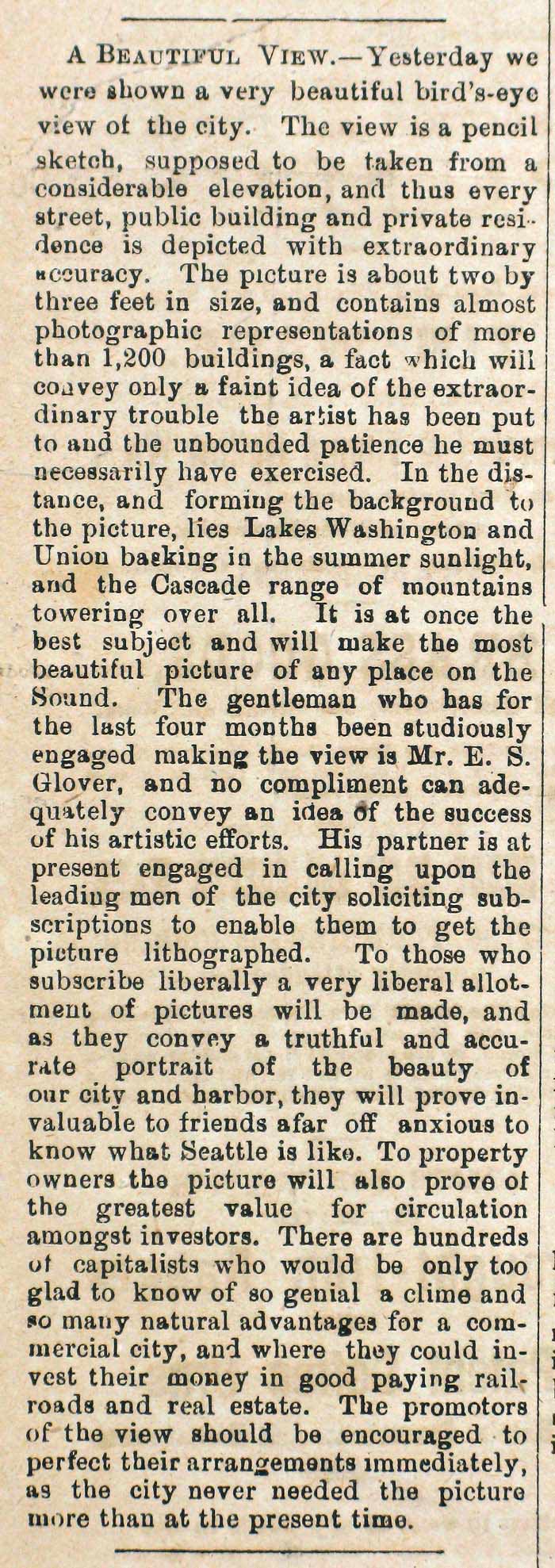
Ron Edge pulls below a few clippings from his newspaper collection and some other ephemera – mostly photographs from the Peterson and Bros. studio – that move well with the first fairly faithful litho birds eye of Seattle, the one drawn here in 1878 by E. S. Glover. The litho will be printed first followed by the text about it’s creation that Ron found in his collection of old Post-Intelligencers, the P-I for May 31, 1878.
This 1878 Birds Eye was the first such for Seattle. Others would follow in 1884, 1889, and 1891. The one from 1891 is most understandably the most lavish and the artist, like Glover in 1878, attempts to be impossibly faithful to what in 1891 was a city as jumpy as fruit flies in August. In 1891 the population here was over 50 thousand. In 1878 is was under three thousand. Glover and his partner could reasonably expect that nearly all of them would be eager to search into this birds eye for their home and/or business. Lots of the lithos were sold and a few of these examples of tender ephemera survive, some are for sale at a dear price.
E.S. Glover and his unnamed salesman partner did not spend all of 1878 in Seattle sketching and soliciting. That year they did much the same for Victoria, Port Townsend, and Olympia. (Those who wish to ask the roadshow appraiser “And what might this be worth?” can search the web for examples. For instance, a local dealer is asking more than $3,000. for the Olympia litho.) In 1879 the partners move on to Portland. Ten years later they had sketched and printed their way as far as Anniston, Alabama. In the three years before arriving in Seattle in ’87, these artful dodgers made and sold birds eyes in Ogden, Helena, San Diego, Anaheim, Santa Barbara and Salem.
Taking a slice from the’78 litho it is easy to appreciate the opportunity for “identity” available to those who owned and studied their own copy. This slice extends from the King Street Coal Wharf on the far right to the Pike Street Wharf and coal bunkers on the far left. In the full litho one can find a train heading up from Lake Union to drop its coal at the end of the Pike Street wharf. Actually, this year the King Street wharf – seen here far right with coal trains heading both to and from the pier – took over the business of coal transhipment on the Seattle waterfront and operations on the two piers – at King and Pike Streets – never overlapped. The Seattle and Walla Walla Railroad was the name of the citizen-promoted line that brought coal to King Street from Newcastle on the east side of Lake Washington and through Renton. It never made it close to Walla Walla, which was its heartfelt intent, as a gesture of independence from the Northern Pacific Railroad that had put its hip to Seattle while embracing Tacoma. (There is much more about all this in my Pictorial History of the Seattle Waterfront that is so far seen only in part on this blog. It and I wait for more time to bring along the rest of that book.)
Below is a 1879 adver for the S.W.W. that appeared in the city’s 1879 directory. It is followed by a related Edge Clipping from Jan 31, 1878, about the work done in driving piles for the tideflats trestle to the King Street wharf.
Some of the sharpest work of the Peterson and Bros photographers makes wonderful illustration of the 1878 Birdseye. The brothers’ studio was at the waterfront foot of Cherry Street. First, below we print a page from the city’s 1879 directory that advances their competence. And following that we include one of Ron’s recent acquisitions. It is easily one of the real classics of Seattle historical photography – a wide view of the waterfront taken by the Petersons from the elbowed end of Yesler’s wharf in 1878. We invite you to compare this pan in detail with the slice of the birdseye from the same year printed above. You will be rewarded with many correspondences. To help, Yesler’s Wharf at the foot of Mill Street (Yesler Way) is the largest assembly of off-shore construction showing to the left of the King Street Wharf in the birdseye. [Making it easy, Yesler’s Wharf is at the center of the scene.] In 1878 it was still the hot spot of Seattle’s transhipment, with hardly any thing else needed in the way of wharfs and waterfront warehouses – except those for coal.
Next Edge takes a small section from the above classic and enlarges it as a witness to the sharpness of the Peterson Bros work. The subject looks through the future location of the Pike Place Market to the western slope of the front hump of Denny Hill, which in 1878 was a mere quarter-century from the beginning of its “humiliation” with the Denny Regrade. The home on the far right is Orion Denny’s at the northeast corner of Front Street (First Avenue) and Union Street.
Just below is another Peterson look towards Denny Hill, also from 1878. It shows a smooth Front Street two years after its own regrade. Again, on the horizon is Denny Hill. The photo was taken from the front of the Peterson studio at the foot of Cherry Street. The Elephant Store on the right is at the southeast corner of First (Front) and Columbia Street.
Next descending from the studio onto Front Street and turning to the south, the Petersons show the line of storefronts along the west side of Front Street in the long double-block between Columbia Street and Pioneer Place (Square). Their studio to the rear of one those retailers. According to Ron Edge this stereo is “something I forgot I had.” Considering in what good order is the Edge collection this forgetfulness is uncharacteristic. We print it in stereo so that those among our readers who have a talent for creating three dimensions with these old stereos with out the little hand-held optics most of us need can be about the business of relaxing their eyes into whatever crossing is needed to pull out that always sensational 3-D effect.
Next we visit the Petersons – some of them – at home, most likely at the steep northwest corner of 8th Avenue and University Street. This family portrait is most appealing, and the people in it are as well. On the far wall is a certificate from a musical academy, and above the door in the same wall is an embroidered sign reading “Home Sweet Home.” The portrait of Lincoln on the right suggests that the Petersons were Republican, the progressives of that day. The many women of this family – some looking like sisters – are separated from the but two men beyond. They – the men – may be in the kitchen. One of the brothers may be behind the camera. It is a liberated family decorated with much of the stuff that was a demonstration of Victorian good culture, and with provincial touches too, like the painting of the mountain, lake and dugout canoe on the left wall.
Ron has also pull up P-I clips describing the gathering of information for the city’s 1879 directory. Directory-making was a task considerably more involved than drawing a birds eye, however fine its verisimilitude. This Edge Clipping concludes then with the first page from the 1879 directory.
Below the following seven illustratons with shortish captions, is a “reprint” of this weeks now-then from Pacific Magazine, and a fine description by Jean of his visit with 90-year-old (and looking 77) Mercedes wonder-salesman Phil Smart on Capitol Hill’s Auto Row.
It was, as the above advert understands, one’s “itch to grasp a steering wheel” that turned Capitol Hill in to Seattle’s Auto row, and primarily on Pike Street and Broadway Avenue.
Still in 1909, the year of the primary now-then scene printed a few photos below, the best and cheapest way to grasp a steering wheel was to take your turn for a photo opportunity at the Alaska Yukon Pacific Expo that year.
Here is more evidence of auto-heat on Pike Street, the Mills Motor’s used car lot between Summit and Crawford Pl. Street car tracks are still showing on Pike and that’s the Covenant Church on the left.
A glimpse into early 20th-Century Capitol Hill. Here a Frasch photo titled Lincoln Park – but known better as Broadway Playfield – looks south towards Second Hill. Construction of the Providence Hospital tower is dimly evident on the horizon near the center. The new hospital was officially opened in 1912.
The joys of dependable motoring were for many never more reliable than with the Dodge Dart. Dart was low priced and it kept on running. This promotional game was staged for long-time Seattle commercial photographer Roger Dudley. Thanks to Danny Eskenazi for sharing it.
Not on Capitol Hill – or even about cars – but in the state’s capitol. Here is one view of the rotunda-dome repeated 16 times – the Joys of Photoshop. The photograph from which this montage was constructed was recorded during our – Jean and my – visit to Olympia during Christmas season 2007 to help promote our book of state repeats, “Washington Then and Now.” The picture included directly below, and the last of the seven that prelude this week’s now-and-then on Pike Street’s Auto Row, is a 1926 construction scene of that same rotunda. This view and its repeat are included in the book just noted, which you can see in great detail on our webpage that is pretty much devoted to it: washingtonthenandnow.
THEN: The brand new N&K Packard dealership at Belmont and Pike in 1909. Thanks to both antique car expert Fred Cruger for identifying as Packards the cars on show here, and to collector Ron Edge for finding them listed at this corner in a 1909 Post-Intelligencer. (Courtesy Museum of History and Industry.)NOW: Jean Sherrard has posed a celebrating “Senior,” AKA Phil Smart, at the front door of his Mercedes dealership. This year Senior has been meeting the public for a half century here at the corner of Belmont Avenue and Pike Street.
The whereabouts of Seattle’s first Auto Row is easily figured by counting the locations listed in the 1911 Polk City Directory under the simple heading “Automobiles.” Of the forty-one sellers named, thirty-one are either on Broadway Avenue or Pike Street, with 17 and 14 dealers respectively. “Auto Row,” then, was two rows intersecting.
In 1903 there was but one dealer listing for automobiles, and it was not on Capitol Hill, but on “Bike Row,” or on Second Avenue, near Madison Street. There Fred Harrell’s Cycle Company sold motorcars as an alternative to bikes and trolleys for a very few well heeled customers. Our first auto, a Wood’s Electric, arrived here in the summer of 1900. Another twenty years of improvements in machines and roads were needed for the motorcar to become commonplace following World War One.
The historical scene here is from 1909 when this garage and showroom at the northeast corner of Belmont and Pike was brand new, and owners Arthur Nute and J. Trafton Keena had set their joined initials, “N & K,” in tiles at the top of buildings supporting columns. We may imagine the urge to drive away with one of the luxury Packards twice on display: in the show room and on the street.
A century later luxury cars are still sold at this corner and the dapper and gregarious Phil Smart, standing near the front door, is celebrating both his golden anniversary here with Mercedes, and this September his own 90th birthday as well. “Senior,” Smart’s popular name, is the neighborhood’s good-humored stalwart.
Also this year the Seattle City Council under the leadership of councilman Tom Rasmussen, gave its unanimous decision to designate this now old “Auto Row” neighborhood as a conservation district with incentives to restore or incorporate old buildings, like this one, into future plans.
WEB-ONLY EXTRA
Phil Smart Senior at his desk, a treasured portrait of George S. Patton on the wall behind him.
Jean writes:
Phil Smart Senior, affectionately known around the dealership he founded as “Senior”, gamely posed for our repeat, even renting a bowler from Brocklind’s for the occasion. He welcomed me into his office with the genuine charm and affability of a great salesman – in the best sense and perhaps the rarest, that of a man who knows and perhaps fosters a simple truth: it’s not just about the car, it’s about you and me.
He told me about his hero Patton – a rare portrait of whom hangs on his office wall – in whose motorized unit he served during the war, thereby missing the birth of Phil Smart Junior. About his long marriage to his wife and sweetheart. About his forthcoming 9oth birthday, at which I expressed genuine amazement – really, some are blessed with damn fine genes.
With picture of himself in North Africa
Senior still comes into the office several times a week, and he hasn’t lost the touch. During our session for the repeat photo above, wearing the bowler, and leaning casually up against the brick wall, he bantered easily with every passerby, offering them a sweet deal. And as I left, even I felt the pull – and I write as someone who has a built-in resistance to a sales pitch – but I really wanted to buy a car from that man.
In helpful response to the “stubbed toe” picaresque printed yesterday (and just below) Ron Edge – more often known here for his “Edge Clippings” – sends along the above with this note. “This 1937 aerial has a few of the landmarks you mention on your blog posting, including a good view of the golf course.” Surely. Where once little white balls were hit about now gallbladders are removed. The new addition to University Hospital was snapped by me over the hedge on monday last at the lower-right corner. 15th Avenue is far left and the next avenue to the right of it is what was in 1937 still an open section of the campus’ Stevens Way. It passes under a Seattle Lake Shore and Easter RR (Northern Pacific) viaduct (Burke Gilman Trail) that is still there. 100 years ago that extended avenue was the promenade for the 1909 Alaska Yukon and Pacific Exposition’s carnival side, The Pay Streak. (The Sunday after next we will feature here a lot of AYP pictures in a “wrap-up” – a film term I think – of the summer-long centennial.) The big and long south campus buildings that I did not name in “stubbed toe” are the Stronghold and William H. Foege Genome Sciences buildings – if I have read the U.W. Map I have now consulted correctly. These new health sciences buildings are east of a 15th Avenue that was freshly redirected to the southwest to make room for them. Only a wee bit of the old residential neighborhood west of 15th shows in the aerial, but one can find that northwest corner of 41st and 15th shown in “stubbed toe”, and discover a five story apartment there in 1937. Again, I don’t remember it. And notice how in 1937 forty-first ave. continued directly on to the campus. One block north the big and white Wesley student center is easily spotted at the northwest corner of 15th and 42rd, with the Methodist church just beyond it at 43th. Two blocks more (there is no 44th St. in this section) is the old Presby church, the brick block at the southeast corner of 47th and 15th. (It is hard to make out but it is there.) The new red brick Gothic structure that took its place and more dates from the early 50s. Turning west on 47th and continuing on to Wallingford there is no Baptist church to be seen. It is hidden behind the Meany Hotel and General Insurance Co. (Safeco) buildings. The aerial looks as far north as the reservoirs around 75th. The green belt of the Ravenna and Cowen Parks ravine intercedes. Calvary Cemetery is upper right and below it are the nursery fields in the rich soil of what is now the concrete spread of University Village. Below that at the curve where Montlake Blvd NE turns into NE 45th Street one can glimpse a tiny (very) early example of the fill work on the old Lake bottom (dropped 9 feet in 1916 for the opening of the ship canal) that will eventually turn those acres to driving more golf balls, parking, and playing games of many kinds. Thanks Ron.
In our “Seattle Now and Then” feature in Pacific Northwest, Jean ordinarily takes the “repeat” or “now” photographs for historical views I find and we discuss, but this week was different.Because of a stubbed toe Jean was lying flat with his foot elevated for relief.I took the opportunity of Jean’s suffering toe to go off on my own and see if I still remembered how to “repeat.”The subject is the Arboretum viaduct.In about a month that feature will be printed in The Times and here as well.I have driven under this bridge many times in the last 45 years but never have I stopped to either study it from below or walk over this brick adorned reinforced concrete span of six arches.Listed on the National Register of Historic Place, it is appreciated.W. R. B. Willcock, a Seattle architect who later led the University of Oregon’s department of architecture, designed the viaduct.His task was to build a picturesque span that would complement the park and be used for both pedestrians and sewerage.The former walk on top of the latter.Below the paving runs a pipeline, a connector in the North Trunk Sewer line, which was built early in the 20th Century to move wastewater from the western shore of Lake Washington to Puget Sound where it could be released into, it was still thought, the eternal flushing of the tides.
The viaduct crosses the Lake Washington Boulevard east-west in line with Lynn Street, and on Lynn is how I approached it from the West.After completing my contemplative stroll across the 180-foot long span, I turned around and took the above view looking back at it to the West.Then I did another about face to look east again and into the arboretum for the forest view below where two paths lead away, but I took neither.You may remember that Monday Oct. 6 was an exhilarating example of an Indian Summer day.Depending upon whether you stood in the sun or shade, the temperature swayed between warm and crisp, and out of a cloudless sky sunlight scattered through the first leaves of fall.
I next found the proper place to make a faithful repeat of the historical view of the viaduct I carried with me and, as noted above, both the “then and now” will appear here in about one month.While standing beside the boulevard I photographed this charming detail of the span’s lighting standard and the moss that is a rustic cosmetic for its decorative brickwork.Such make-up takes time and is hard to convincingly copy or fabricate in a factory.By now enjoying my little camera I continued snapping through the open driver’s window at mostly familiar subjects as I drove home from the arboretum to Wallingford. I will next print a few of them here with brief comments.
I first visited Seattle from Spokane in the early 1950s to attend my oldest brother Ted’s graduation from the University’s then nearly new Medical School.The health sciences campus was then routinely modern but dull.Here over a hedge on the north approach to the Montlake Bridge I glimpsed a recent addition to the hospital, one that plays “boxes and balls” with its masses.
Most of the University’s “south campus” that is east of 15th Avenue has been in the caring hands of the health sciences so long that it is difficult to remember what was or might have been there earlier.I know, although I don’t remember it, that before WW2 much of it, including the original hospital location, was a golf course where the school’s faculty could escape students, except those with clubs.But west of 15th, along the north shore of Portage Bay and extending from there north into the commercial heart of “Univercity” – once a proposed name for the University District – was a neighborhood of small homes and maritime enterprises of many sorts.The latter, of course, kept close to the bay.Some readers may remember how the movement to save this community from University expansion began in the late 1960s but was soon overwhelmed by a University District version of “manifest destiny.” The growing university overwhelmed all protests for it had no growth alternatives so attractive as this “Lower Ave” neighborhood, and the U.W. was our gorilla.The buildings snapped above are examples of the sometimes tasteful and oversize constructions that now dapple the blocks that were once nicely stuffed with modest homes, often vine-covered and sometimes rotting.
The gorilla, we know, also moved west across 15th Avenue and into the University District when opportunities allowed.I no longer remember what was once on the northwest corner of 41st Street and 15th Avenue, but the school-related structure that now holds that corner is, like the latest additions to the hospital, another example of recent architectural style.Here the mixing of angles and curves is for me at least both satisfying and comical.The structure appears something like an allusion to a cathedral – in miniature – but also a homage to Katzenjamer Kastle where masses of different shapes and materials are hinged together.
My next going home snap was a block north at 42nd and 15th – again the northwest corner. For nearly 35 years – up until this past spring – this point of view looked across a parking lot to the Café Allegro in the alley north of 42nd.The Allegro considers itself the oldest surviving espresso bar in Seattle.Sitting inside or on the benches that line the alley or even on the traffic dividers of the parking lot has been the habit of many regulars– myself included in the 80s.(Here I get out of the car to print a snapshot at the Allegro counter from 1987 of barista Mary Anne Schroeder on the right, and I. H. F. Hername on the left.Well Hername really has her name, but I Have Forgotten it.)
For 34 years of espresso ingestion when one lifted their eyes above the asphalt lot, the view across 15th to the tall trees on campus was a calming antidote for caffeine and the stresses of study and/or the discomforts of carping roommates.About 1969 (The actual date is in old notes somewhere.) the parking lot, which was built mostly for overflow University Book Store use, took the place of the stately white frame Wesley House, the big student center for the adjoining Methodist Church.The church tower is seen two photographs above on the right.Then followed the parking and the Allegro’s 35 years of anxiety about loosing to some other big thing the mostly clear view to the green campus.And now they have it.The 6-story George F. Russell Jr. Hall is another Wesley Foundation production, so that in some part the renters of the new halls will be help the church’s student ministry.Seen here and “now leasing” the new hall includes near the top of its promotions some unintended ironies. “You’ll love the views and abundant light from the large office windows . . . You can see downtown Seattle, Lake Union, Portage Bay, University Campus, and the U. District.”Nathaniel Jackson, an old friend and Café Allegro’s owner, has learned to put the best construction on this construction. “The Turner Company made a huge effort and I respect them for reaching out to us and doing everything that they could to make the pill go down with a little sugar.I even got a hard hat out of it with ‘honorary superintendent’ written on it.Allow me to wax eloquent through my tears of joy.This is a new beginning for Cafe Allegro.And think of it. (And her Nathanial cannot help laughing.) They have cut down the trees!”Well not all the trees but noticeably three or four on what was known for a while as “Hippy Hill,” the just on campus safe retreat for both town and gown to avoid the local constabulary and indulge in their own tears of joy and calming antidotes.Nathanial adds, “They did a fine job on the alley. Because of the fight we made, they made an effort to improve it.”The two imperfectly merged snapshots below of the Allegro interior shows through the plate glass some of the alley work when it was still a work in progress earlier this year.
Less then two blocks north of corner mates Café Allegro and George Russell Jr. is University Presbyterian.On the east side of 15th I photographed it through the windshield while on the move.This century-old congregation is easily the biggest congregation in the University District, and more.It is one of the largest on the West Coast.With several ministers, scores of staff, a big organ, a professional choir, and a power list of political parishioners, University Presbyterian is always being tested by the biblical epigram, “He that is last shall be first.”
Only three blocks west of the Presbyterians and yet polar to it is a kind of tentative “last” – the latest District church to publicly wonder how to keep going, here in its now 70 year old sanctuary on the southeast corner of 47th Street and 12th Avenue N.E.Again I have snapped it from the driver’s window.Some will remember this congregation from the 1980s when it was the second church in the U.S.A. to declare “sanctuary” for Central Americans in flight from the American supplied violence there.Since then it has also become a “sanctuary” for gays who still cherish the church.Here’s a quote from the church’s description of itself.“Sanctuary has echoed in many commitments here: welcome to lesbian, gay, bisexual, and transgender people; support for conscientious objectors; a kitchen for hungry folks; a haven for women in transition from shelters to permanent housing; and safe and affordable childcare for children from a diversity of families and ethnicities. It all sounds like ‘sanctuary’ after awhile. Sanctuary is, in that sense, a place – this whole place – filled with a commitment to welcome and witness. Don’t be surprised if you are confused by the word when it is used here. It reverberates all over the place.”
Midway between the triumphant Presbyterians and the humble Baptists is University Seafood and Poultry at 1317 NE 47th Street.This wonderfully gleaming specialty retailer is like an import from a Paris sidewalk except that University Seafood may have fresher salmon than any Parisian fishmonger.Perhaps.The truth is the only thing I know about fish sales is Ivar’s antics of long ago.University Seafood is a survivor and must have a long list of customers that cherish the place.It has been around the corner from The Ave as long as I can remember.
Two blocks west on 47th from the Baptists, a left turn on Roosevelt Way and a long half block south, on the right is the entrance to Trader Joe’s parking lot.It is a wonder of the collective driving skills of its mostly liberal clientele.It may be that college graduates also drive better.Here they need to.The slots for cars in this lot are absurdly tight, the corners sharp, and the place is almost always packed.Although the deepest parts of this covered garage are dark indeed, muggers are not a threat for they prefer the large open parking lots surrounding suburban malls.Also if someone yells “Help!” in this lot it is likely that a dozen heroes will appear in an instant. At Northgate they may run for the mall. The above photo was snapped at the entrance.It is a both a fine example of how creeping ivy and a few low bushes can soften a concrete wall and a contrast to the hard responsibilities of parking at Trader Joe’s that will soon follow.
Back home in time to walk about the neighborhood I snapped first this natural demonstration of the “solitary effect,” a principle of aesthetics that I remember from the 1940 Magnus opus “The Arts and the Art of Criticism” by Theodore Meyer Greene.Greene might have written his chapter on the “solitary effect” about that red flower.His big book had staying power.It was still read in the late 50s when I was in college and I have my copy yet.But what would Greene make of the below, an example of what I refer to as my UFOs, or unidentified flattened objects.This UFO was photographed again on Monday last, off the curb and lying in the street at the southwest corner of Sunnyside Avenue and 42nd Street.Fallen needles decorate I don’t know what, except that the traffic has flattened it.And yet it still has “depth.”I checked in passing.It was still there today. For identification of the location only, on the lawn behind this UFO is the red maple at the bottom of this post.
THEN: With feet nearly touching the Madison Street Cable Railway’s cable slot, five “happy workers” squeeze on to the front bumper of an improvised Armistice Day float. (Photo courtesy Grace McAdams)NOW: Practically all the early 20th Century structures built along the wide Second Avenue have been replaced and the retail street lined with trees. (Jean Sherrard)
The Seattle Sunday Times for Nov. 10, 1918 was packed with wartime stories.This newspaper, like most others, had been preoccupied with the war since the U.S. declared it against “the Huns” (also known as Germans) 19 months earlier.But The Times was also beginning to introduce lighter touches in its war reporting, like quotes this Sunday from a Seattle soldier’s happy letter to his mother about “naughty Parisians” and another about Yankees not fancying the “Pink Teas” with which some Brits attempted to entertain them.
A much greater playfulness was announced early the next morning — not in print but by The Times whistle.Awakened sleepers knew the meaning.The war was over.
The “monster impromptu parade” began when the early shift in the shipyards was let go to celebrate.By ten a.m. thirty thousand shipyard workers, joined clerks, trolley conductors, teachers, doctors, bankers, and bakers in a parade that circled the business district accompanied by sirens, horns, the back-firing explosions of opened mufflers and a percussive orchestra of garbage cans “borrowed” from every alley.
It was an “ecstasy of joy,” an “orderly disorder,” “a spontaneous combustion of Seattle’s heart and soul.” And there were, The Times noted, “autos and trucks crowded with flag-waving pretty girls” like we see here crossing Madison Street southbound on Second Avenue.
This snapshot by grocer Max Loudon is but one of about two hundred captioned photographs included in the new illustrated version of Richard Berner’s local classic “Seattle 1900 – 1920 From Boomtown, Through Urban Turbulence, to Restoration.”The book appears now on dorpatsherrardlomont, the blog-webpage routinely noted at the end of this feature.Take a moment to examine this important part of the “Seattle Canon” and you may read it all.
We are pleased now to introduce Seattle 1900-1920: From Boomtown, Urban Turbulence to Restoration, the first of Richard C. Berner’s three books named together Seattle in the 20th Century.When the details, stories, and insights are explored with a close reading, Berner’s accomplishment is by far our widest opening into Seattle’s twentieth century, the first half of it, from the 1900 to 1950.
Those fifty years were also the second half of Seattle’s first hundred years, if we begin our counting with the footsteps of mid-western farmers settling here in the early 1850s.
Richard Berner, a recent portrait
Volume one was first published in 1991 by Charles Press, and the publisher – “Rich” Berner himself – made a modest list of its contents on the back cover. We will repeat it. “Politics of Seattle’s urbanization: dynamics of reform, public ownership movement, turbulent industrial relations, effects of wartime hysteria upon newfound civil liberties – all responding to the huge influx of aspiring recruits to the middle class & organized labor as they confronted the established elite. Includes outlines of the economy, cultural scene, public education, population characteristics & ethnic history.” …