Seattle Now & Then: 3rd and Pine 1917

(click to enlarge photos)

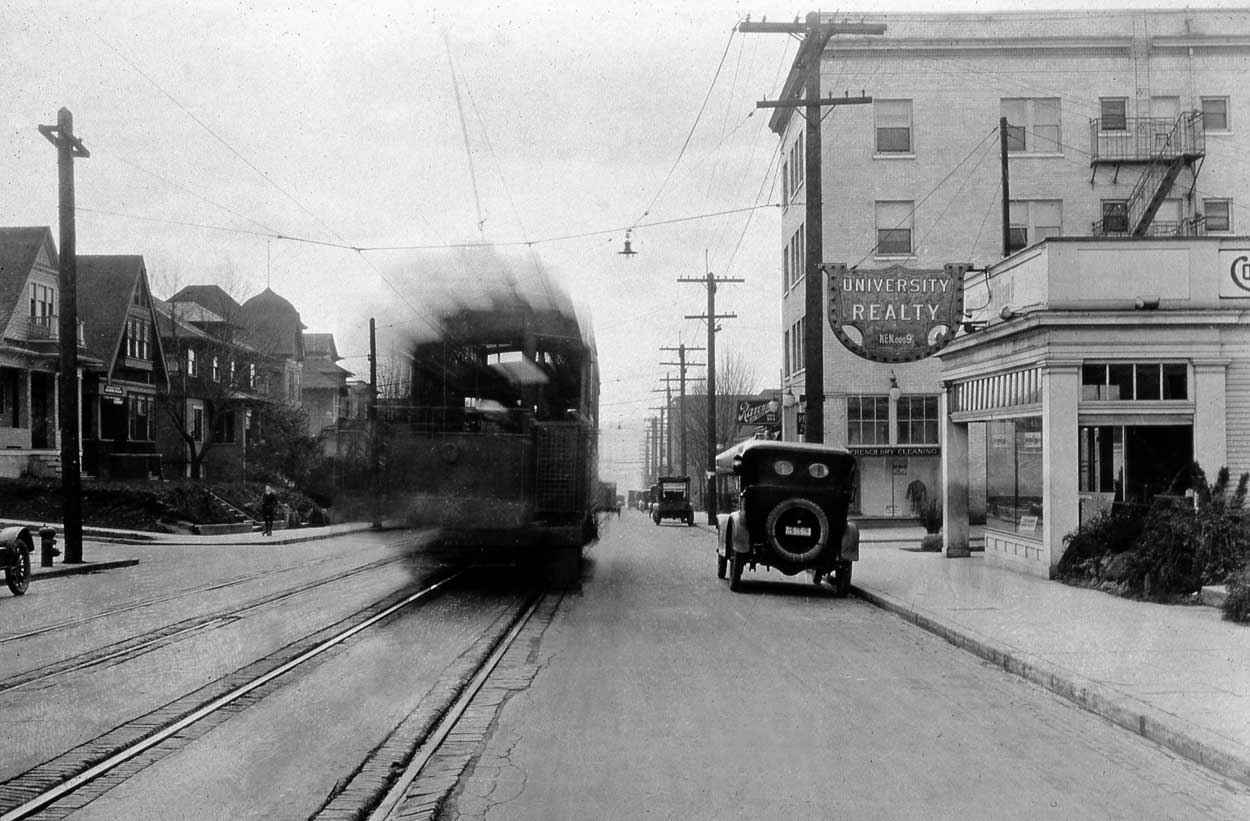
THEN: Where last week the old Washington Hotel looked down from the top of Denny Hill to the 3rd Ave. and Pine St. intersection, on the left, here the New Washington Hotel, left of center and one block west of the razed hotel, towers over the still new Denny Regrade neighborhood in 1917. (Historical photo courtesy of Ron Edge)
NOW: Using his extension pole, Jean Sherrard took care to show the Securities Building at Third and Stewart by moving his prospect a few feet closer to Third Avenue then the position taken by the historical photographer. In the “then” the top three stories of the Securities Building show, upper-right, above Fire Station #2.

First introduced last Sunday as a ca. 1905 subject, here is 3rd Avenue and Pine Street a dozen years later on Jan. 23, 1917.   Ron Edge, who found the photograph, also uncovered its occasion by using his Seattle Public Library card and searching The Seattle Times on-line.

Ron determined that this is the first stop on a long funeral cortege that carried the body of fire Chief Fred Gilham from the department’s Headquarters, then at 3rd Ave. S. and Main, to the Chief’s assigned Station #2 facing Pine here at Third.  The white hearse, here uncannily lit by the winter sun, next led a brass band (you can see the horns across Third Ave. on the left) and long lines of uniformed “fire fighters from eight cities in two states,” The Times reported, to First Presbyterian Church for the funeral service.  From there the hundreds of mourners went on to Lake View Cemetery for the interment.

Nearly twenty-five years with the department, Gilham died from effects of a Saturday morning fire that three days earlier crashed the roof of the Grand Theatre on Cherry Street.  Attempting to reach the cries of his men – all of them survived – Gilham became lost in the smoke and fell from a balcony to the theatre floor.

Fred Gilham’s brick Station #2 on the right (of the top photo) replaced a wooden one in 1906. (More on this below.) In 1921 the station moved to its then new quarters at 4th and Battery, and this two-story brick corner was arranged for sales including the United Auto Stage Terminal on 3rd, the Fashion Bootery, and the Smart Shop Ladies Apparel, “we give credit.”   The Bon Marche (in the “now” as Macy’s) replaced the shops and the entire block in 1928-29.

For the Oct. 14, 1900 opening of "Whose Baby Are You?" Pioneer photographer Peiser recorded the Seattle Grand Opera House interior from the stage with a great flash!

WEB EXTRAS

Anything to add, Paul?

Yes Jean I have collected a few subjects and as early morning fortitude allows I’ll put them up.  (I mean, I may have to finish it much later this morning and after breakfast.)

First an advertisement for the Seattle Opera House.  It is not dated.  The poor lighting hints that it was copied at a window.  The tableau – I presume – of the Harlem Railroad Bridge tragedy might have used the high ceiling of the theatre’s stage to create the effect . . . unless I am corrected by someone with better understanding of theatre mechanics.

Next a variety of subjects from the neighborhood.

A "now" for this, when it is found, will look directly into the east facade of the Bon Marche facing 4th Avenue. Courtesy Louise Lovely

DENNY AKA WASHINGTON HOTEL

The looming presence of the Denny Hotel, looking down on the city from its prospect atop Denny Hill, was a sublime delight mixed with nervousness. Soon after its construction this Victorian showpiece became increasingly more of a specter than a hotel. Planned before the city’s Great Fire of 1889, the Denny was built in the first two years after the fire. Squabbling among its developers – which included city father Arthur Denny – kept the imposing landmark closed and unfurnished.

The sudden crash of the 1893 economic panic kept the doors shut for another 10 years. It took Teddy Roosevelt to unbar them during his brief visit to Seattle in May 1903. Seattle super-developer James Moore managed to both exorcise the dismal record of the hotel – he renamed the Washington Hotel – and fulfill its great promise almost instantly with one good night’s sleep for the president of the United States.

Moore’s hotel prospered through the summer. Consequently, rather than fight the city’s plan to cut into the Hotel’s landscape when it regraded Second Avenue north of Pine Street, Moore announced that he would cooperate and build a block-long-theater along the exposed east side of Second between Stewart and Virginia streets.

Moore’s plan for a blending of the hotel he had saved with a theater to memorialize him failed. Moore got his namesake theater (it survives at the southeast corner of Virginia Street and Second Avenue) but soon lost his hostelry when the razing of Denny Hill lowered the site of the “Scenic Hotel of the West” by about 100 feet between 1906 and 1907. With it went the grass, the Victorian terrace and the view.

The top scene is made especially pleasing by the inclusion of the row of nearly new terraced apartments at the southwest comer of Fourth Avenue and Stewart Street.

********

The DENNY aka WASHINGTON HOTEL LOBBY

(First published in Pacific on Feb. 18, 1996.)

This view of the Washington·Hotel lobby was published mid-summer 1903, in an advertisement in the periodical Pacific Northwest. The caption reads, in part, “It is impossible to print more than a hint of the praise that has been spoken of the Washington of Seattle. Suffice it to say that within the two months after the date of the opening, May 16, 1903, the hotel was completely filled each day, and many who had not engaged rooms in advance were turned away.”

This is an architectural shot meant to reveal the glory of the place – the soft chairs, plush Persian carpets, stuffed elk and grand stairway. Most likely the photograph was taken before the hotel’s first patron, President Theodore Roosevelt, registered that spring during his tour of the West.

Planned in 1888, construction began on the Denny Hotel (its first name) in the summer of 1889. Through the same months many other buildings – including several new hotels – were also being raised below it, as the city rebuilt after its Great Fire of June 6 of that year.

Inflated building costs, rancor among the hotel’s promoters and the economic crash of 1893 combined to keep the Denny Hotel dark and empty. It loomed above the city for 13 years before Seattle’s greatest early-century promoter, James A. Moore, filled it with furniture and opened it as the Washington. Less then three years later he closed it, persuaded to allow the hotel’s destruction for the razing also of Denny Hill.

For comparison with the "old" Washington Hotel lobby, here is the lobby to the New Washington Hotel, which still stands at the northeast corner of 2nd Ave. and Stewart Streeet as the Josephimun.

Moore’s turreted hostelry looked south in line with Third Avenue, its lobby about mid-block between Stewart and Virginia Streets. The contemporary photograph (when I find it) looks west across Third Avenue and through the elevated former site of the landmark, at about the level of its ground floor. It was recorded from an open window on the ninth-floor stairwell of the Securities Building, about 90 feet above the regrade.

**********


Fire Station #2 at its original location, the northeast corner of Third Ave. and Pine Street.

FIRE STATION #2 – 3rd & PINE

(First appeared in Pacific Feb. 11, 1996)

Seattle’s Fire Station #2, at the northeast corner of Third Avenue and Pine Street, was one of three fanciful frame and shingle stations quickly built after the Great Fire of June 6, 1889. It opened for Captain W. H. Clark’s Engine Company No. 2 on July 21, 1890, two weeks after Station No.3 opened on Main Street between Seventh and Eighth Avenues South. Three months later Station No.4 completed the. triad at Fourth Avenue and Battery Street.

An early 1890s look east on Pine Street from near First Avenue with the Methodist Church on the right at the southeast corner of Pine and Third, and the Fire Station on the left. The photo is by LaRoche.

The city’s volunteer fire department was demoralized and disbanded by its failures during the ’89 destruction of the business district. Although many of these volunteers were soon hired as professionals by Gardner Kellogg, the city’s first paid fire chief, they resented the weight that insurance companies charges gave to their charged inadequacies, rather than to the failures of mechanics and water pressure in the city’s private water system. The new stations, new rigs and, of course, new uniforms helped some to dissipate these ill feelings.

A LaRoche recording of the city from the top of Denny Hill in the early 1890s. Both Fire Station #2 and the Methodist Church are held in the lower left corner.

The top portrait of Fire Station No.2 and its crew was probably photographed between the 1901 publication of the Seattle Fire Department Relief Association’s history of the department – the view does not appear in the book – and the 1903 lifting of the entire station one-half block east on Pine Street during that street’s regrade. The three women posing on the balcony above the steam fire engine, hose wagon and crew pose are probably wives of the fire fighters.

The new #2 at the northeast corner of 3rd and Pine.

By late 1906 a new brick station was built here and this short-lived frame creation beside it destroyed. Immediately the work of regrading Denny Hill began behind the new quarters. Station No. 2’s last move came in 1921 to its present location at Fourth Avenue and Battery Street, across from the original site of Station No.4, which in 1908 moved north to the future site of the Space Needle.

The new #2 with its teams posing at open doors.
After it was deserted for a new station at 4th and Battery, Fire Station #2 was refitted for shops.


**********

(This caption also dates from Oct. 2, 2002.) Built in 1890, the Methodist Protestant Church at the southeast corner of Third Ave. and Pine St. was razed when it was still young for the 1913 construction of a commercial building.  There, under golden arches, countless cheap burgers have been sold.  Now the nonprofit Housing Resources Group (HGR) is replacing the upper floors of the Third and Pine Building with 65 unites of low-income housing and renaming it the Gilmore Building after John Gilmore, the retired president of the Downtown Seattle Association who helped found HRG in 1980.

METHODISTS at THIRD & PINE

(First appeared in Pacific, Oct. 20, 2002.)

The first two churches in Seattle were both Methodist, although one was Methodist Episcopalian and the other Methodist Protestant (MP). The Methodists had split in 1830 over how much power to give bishops. In 1865, when the Methodist Protestants of Seattle built their church, the primary difference between it and the other was not doctrine but color. The first church was white and the new MP sanctuary was painted brown. From then on they were known simply as the white and brown churches.

Looking from Denny Hill across the rear of the Methodist Church to First Hill.

Here, however, the brown church has lightened up. Actually, this is the third “permanent” home for the MP congregation. The original brown church at the northwest corner of Second Avenue and Madison Street was replaced in 1883 with an enlarged sanctuary. Its new stone veneer skin, however, did not save it from the “Great Fire” of 1889.

This is the parish that the congregation, after worshiping for a year in tents, built in 1890 at the southeast corner of Pine Street and Third Avenue.

Looking southeast from the roof of the New Washington Hotel to the razing of the Methodist sanctuary at Third and Pine. The Federal Hotel, bottom right, is the old Plummer Block that was moved to this position from its original location at the southeast corner of Third and Union - before the Post Office. Behind the church, additional stories are being added to the Northern Bank and Trust Co. Building at the northeast corner of 4th and Pike. It is now called the Seaboard Building.
Another and later look from the roof of the New Washington Hotel. The church has been replaced by a new and modest business block. The new Fire Staiton #2 is at the lower-left corner.

Clark Davis became pastor in 1885. He bought the lot and built this church for about $40,000.  Next door he raised a comfortable parsonage for himself, his wife Cleo and their two sons. The Gothic Revival sanctuary could seat 1,000 and often did. Clark was a “go-getter” and in 1896, after resigning his pastorate, he went for and won the jobs of registrar at the University of Washington and secretary to its Board of Regents.

The Methodist church is here busy with the Third Avenue Theatre, on the right. On the far side of Pine, Denny Hill is nearly razed - that part of it. The Third Ave. Regrade has added a story to the church-as-theatre and also to the frame hotel on the far left.

The Pine Street Regrade (1903-06) lowered this comer 10 feet and converted the church basement into its first floor. With regrades on Third Avenue and Denny Hill coming at them, the parishioners sold their comer for $100,000 and moved in 1906 to a new stone church on Capitol Hill. As soon as the Methodists moved out, the Third Avenue Theater moved in.


**********

HOLE IN THE HILL

This curious look into the Denny Regrade peers north across Pine Street.  The photograph was recorded mid-block between 3rd and 4th Avenues probably in either late 1906 or early 1907.   The brick paving on Pine Street was laid soon after the street was lowered about twelve feet at 3rd Avenue. Completed in the Spring of 1905 the Pine Street regrade was prelude or practice for taking away the rest of the hill: the two humps of it north and south of Virginia Street.

The two regrade “inspectors” sitting on the planks to the right of the power pole are looking north into what little remains of the south hump.  Only a few months earlier Denny Hill had risen 100 feet higher than shown here and held above it the grand architectural pile of Gothic towers and wide porticos first named the Denny Hotel.  Because of its lordly prospect this landmark was publicized through its brief life as “The scenic hotel of the West.”

Another but more modest landmark missing from this hole is the old North School that opened in 1873 directly in front of the knees of the “inspectors.” The school closed in 1887 the year Fire Station #2 was built next to it to the west.   The arched doorway on the left is the eastern bay of Fire Station.  Some of the dirt taken from this part of the hill survives a little more than one block east beneath Nordstroms.  It fills what was the swap at 5th Avenue.

North School at Third and Pine before Fire Station #2.

The distant row of houses at the scene’s center is imminently doomed.  They face 4th Avenue from its east side directly north of Stewart Street.  The ornate structure with the small tower, right of center, has been moved temporarily from harms way to the east side of 4th Ave.  It was originally built on the west side of Fourth.

The narrow gauged railroad engine on the right of this early-20th Century Denny Regrade scene can be imagined as plowing into the Bon Marche’s window display near the corner of Pine Street and 4th Avenue – except that the Bon was built in the late 1920s, a quarter of a century after this week’s historical photograph was recorded.

**********

PLUMMER BLOCK at THIRD AND UNION (Southeast Corner)

(First appears in Pacific, Dec. 13, 1987)

In 1889 Edward Plummer, the 29-year-old son of the deceased Seattle pioneer Charles Plummert, used some of his inheritance to purchase the southeast comer of Third Avenue and Union Street from another pioneer, Sarah Denny. Plummer financed the $32,OOO asking price half in cash and half via mortgage. The site had formerly held John and Sarah Denny’s home.

After the Great Fire of 1889 accelerated the city’s spread north the opportunistic Plummer quickly erected an ornamental two-story frame lodging and commercial building and named it immodestly after himself. “The building was a gold mine.” the Post-Intelligencer observed later. “Plummer’s revenue is said to have been no less than $850 in rentals each month. By the time that turn-of-the-century description was printed,  the corner had been purchased as the site of a new combined federal post office, customs house and courthouse.

The government paid $174,750 for the corner but Plummer didn’t get a cent of it. The P-I noted that “like many other property owners who were caught in the crash that came in 1893, Plummer thought the golden stream would never stop flowing and used his income in speculation. One morning he woke up bankrupt. Plummer thereafter “earned his living by hard labor” the newspaper reported, working for the city’s water department as a coal passer and then a pick-and-shovel hand.

Plummer’s building, however, was saved by moving it up the center of Third Avenue to the southwest junction with Pine Street. Plummer’s name,  however, was stripped from its corner tower, and the building was renamed the Hotel Federal.

Hotel Federal at the southwest corner of Pine Street and Third Avenue before the Third Ave. Regrade.


**********

Above: The southeast corner of Third and Union before the post office was built and after the Plummer Building was moved two blocks north up Third Avenue. Below: The dismal glass curtain Post Office below has had its skin modified – and improved – since this shot of it was taken a few years back.

BEFORE The POST OFFICE, & AFTER The PLUMMER BLDG.

(First appeared in Pacific, Sept. 15, 2002)

It is likely that the intended subject in this scene is its vacant lot. In 1901 the federal government paid Seattle clothier Julius Redelsheimer $174,000 for this comer. A year earlier he purchased it for a mere $60,000 from Sarah Denny, the widow of John Denny, the father of Seattle founders Arthur and David Denny.

Years earlier, this southeast comer of Third Avenue and Union Street was the home site of John and Sarah. After her husband’s death, Sarah sold the comer in 1889 to Edward Plummer, the son of another Seattle settler.  Plummer put up his Plummer’s Block, an ornate, two-story business block that brought him good rents until the “Panic of 1883” bankrupt first his renters and then Plummer himself.  His namesake cashcow then reverted to Sarah.  (This is recounted in the feature printed on top of this one.)

The government chose the comer, in part, because real-estate agents proclaimed: “Our site is perfectly level and will not have to be filled or excavated. More important still, it will not be affected by a regrade on Third Avenue.”  In this they were wrong. When the Third Avenue Regrade interrupted construction of the classical post office, the width and elevation of Third were changed sufficiently to require steps to ascend to the lobby from a narrow sidewalk.

Federal Building under construction. Plymouth Congregational Church at the northeast corner of Third and Univesity Street, shows right-of-center.

On one of the longest planning and construction schedules set for any local building, the job of building the Post Office ran from 1901 to 1909. By then the Armory, facing Union on the left, was replaced with a brick business block while Plymouth Congregational Church on the right was only two years from being replaced by Alexander Pantages’ namesake theater. Many locals will still remember the beau-arts post office and terra-cotta clad theater. The classical post office was replaced with an undistinguished glass-curtain one, and a parking garage long ago dislodged the theater.

The nearly new Post Office / Federal Bldg.


************

ELLIS ON THIRD

(First appeared in Pacific, May 10, 1998.)

Perhaps Washington State’s most prolific postcard photographer was a Marysville schoolteacher who was persuaded in 1926 to stop preparing for classes and instead purchase a photography studio in Arlington. J. Boyd Ellis might have dedicated himself to wedding work were he not convinced by an itinerate stationery salesman to make real photo postcards of streets, landmarks and picturesque scenes that the salesman would peddle statewide. Postcard collectors such as John Cooper, from whom this week’s scene was borrowed, are thankful. .

It’s fairly easy to date this home front street scene, which looks south on Seattle’s Third Avenue from Pine Street. Across the street and just beyond the very swank Grayson women’s apparel is Telenews, a World War II entertainment oddity that showed only newsreels. The marquee promises “50 World Events.” We can figure the date from the headline emblazoned there: “YANKS TAKE BIZERTE!”

On May 7, 1943, the North Africa campaign was all but over when Allied forces marched into Bizerte on the north coast of Tunisia. Five days later about a quarter million Axis soldiers capitulated.

Across Third Avenue at the Winter Garden – most of the marquee is visible at far right – James Cagney’s “Yankee Doodle Dandy” is playing. The vaudevillian George M. Cohan’s life story was one of the period’s great patriotic hits. It is likely that both the newsreels and the song-and-dance biography were well-attended. With war work running around the clock, many theaters, including the Winter Garden, never closed.

This is Ellis scene No. 1011; Cooper has more than 3,000 Ellis cards. For the collector Ellis is a great confounder, for he used some numbers more than once. Ellis’ son Clifford carried on his father’s recording into the 1970s. Cooper suggests that their most popular card shows a young Clifford riding a geoduck. That card is still for sale.

***********

THE WINTER GARDEN

(First appear in Pacific, July 13, 2003.)

In 1979, the 59-year-old Winter Garden theater, on the west side of Third Avenue mid-block between Pike and Pine streets, was closed and remodeled for a Lerner’s store. A downtown branch of Aaron Brothers, an art-supply chain, is the most recent proprietor.

In the summer of 1920 one of the last remaining pioneer homes on Third Avenue was razed for construction of the Winter Garden. This mid-sized theater of 749 cushioned seats was made exclusively for movies – not vaudeville. The Winter Garden opened early in December, taking its name from a famous New York City theater, the successor of which staged the 15-year Broadway run of “Cats.”

The proprietor of Seattle’s Winter Garden, James Q. Clemmer, was the city’s first big purveyor of motion pictures. He got his start in 1907 with the Dream Theater where he mixed one-reelers with stage acts. Eventually, he either owned or managed many if not most of the big motion-picture theaters downtown.

Except for a few weeks in 1973 when the IRS closed it for nonpayment of payroll taxes, the Winter Garden stayed open at 1515 Third Ave. until 1979. In the end it was known simply as the Garden, a home for X-rated films where the house lights were never turned up. Here it is in 1932 showing a remake of a 1919 silent film, “The Miracle Man.”

In the late 1950s, when television cut into theater attendance, many of the downtown theaters, the Garden included, played B-movies in double and triple features. In 1962, an eleven-year-old Bill White would walk downtown from his home on Queen Anne Hill and spend the quarter his mother gave him for bus fair to watch movies in what he describes as “the dark comfort” of the Embassy, the Colonial and the Garden. White, whose mom thought he was at the YMCA, grew up to be an expert on films and a movie reviewer.

*********

CINEMA PENITENTIARY

We have asked Bill White to let us print a dark – or flickering – confessional excerpt or two from “Cinema Penitentiary,” his early education in the motion picture theatres of Renton, first, and then Seattle.  And he has agreed.  Here’s Bill who was writing reviews regularly – both film and music – for the Post-Intelligencer before it cashed in.

Here are two excerpts from my movie house memoir, “Cinema Penitentiary.”   The manuscript runs 90,000 words and covers the years 1958-1981. These selections are from the early chapters, and are set in and around the Garden Theater.

At the corner of Third and Pike, I felt like a gnome caught between two giants. I peered through Kress’s glass doors, and saw a machine popping fresh popcorn in the center of a display featuring vertical glass tubing filled with marvelous candies.   Then I looked across the street to Woolworth’s and wondered if it too was like some imagined, idyllic theater lobby, filled with the smell of popcorn and the sweetness of a candy factory.  The crosswalk light changed, and I was carried further up Third Avenue in the current of Saturday afternoon’s shopping crowd.  Then I was in front of the theater. From the outside, The Garden seemed fancier than The Embassy, if only because of its larger marquee. Since I didn’t want to worry my mother by arriving home four hours late, I waited until the following Saturday to go inside.

The Garden was like the Roxy theater in Renton  in that it combined adult and family fare.  But instead of getting a preview of “Butterfield 8” before a Jerry Lewis movie, the Garden often double-billed the adult feature with a family movie.   After seeing “Peyton Place” and “Heaven Knows, Mr. Allison,” I walked up Pine Street to 4th Avenue and discovered The Colonial. It was smaller that the Garden, and also offered   double features for a quarter.

Since “Peyton Place” had been over twice the length of two horror movies, it was already getting close to the time my bus was scheduled to leave Second and Madison, so I shouldn’t have gone in, but I paid my quarter anyway, figuring that if I just watched one movie, I would be able to catch the next bus, and wouldn’t get into much trouble.

One of the things I noticed about the adults in these theaters was that they rarely arrived at the beginning of a movie.  They came and went as they pleased, so I did the same, coming into the middle of  “Battle Hymn,” which had Rock Hudson as an ex-bomber pilot who rescued over 1,000 people from an orphanage that was in the path of invading Chinese during the Korean War to atone for having killed 27 children in an accidental bombing of a German orphanage during World War Two.

At the Garden, I was no child among parent-like people, but one of the anonymous figures taking refuge in a movie theater. The woman who sold me the ticket never told me I was too young to see the features inside.  I paid my quarter, got my child’s ticket, and went inside where the secrets of the adult world were brought into the open where I could contemplate and try to understand them.

In the summer of 1962, I was learning more about my father from “Home From the Hill” than I had while playing center field for the little league team he used to coach.  He had put me in center field because I was a lousy ball player and did not have many opportunities to embarrass him way out beyond the batting capabilities of most of the kids. Once in a while I would fumble a pop fly, but there was always the sun to blame for my lack of hand to eye co-ordination. My inability to hit the ball was another issue, one that could not be so easily explained away.

“Don’t be afraid of the ball,” the coach would yell at his sissy son, like some French officer in charge of the firing squad telling the Spanish prisoners not to be afraid of the bullets. When I realized that I was just as likely to be hit by the ball by standing there dumb as by swinging the bat, my father’s estimation of my athletic abilities was fractionally heightened.  “Go out swinging, boy!” he would cry, seeing no shame in failure if the failure was the failure of action and not the result of passivity,

Unlike Robert Mitchum in “Home from the Hill,” my father had no bastard son to take on hunting trips.  He had no source of secret pride.  The only manhood he had was his own, and violence toward those weaker than he was the easiest expression of that manhood.  Maybe if my mom had also been a drunk, my father wouldn’t hit her so much,” I thought while watching “Days of Wine and Roses.”  Although the movie was about alcoholism, it didn’t have much to tell me about my dad’s drinking.  This drinking between a man and a woman created a different world from that of an alcoholic family man.

I did learn one thing from that movie, though.  I learned that when a serious movie was made about adult problems, it was usually shot in black and white.  The opposite was the case for movies about troubled adolescence.  Whereas the cheap JD movies came out in black and white, the important ones, like “Rebel Without a Cause” were in color.  I guessed this was a way of telling the audiences that, even though the movie was about bad kids, it wasn’t just for thrill-seeking teenagers, but for the contemplation of serious-minded adults.

Inane war movies like “Marines, Let’s Go” were in color, but the ones with ideas, like Phil Karlson’s “Hell to Eternity,” about how the attack on Pearl Harbor affected the friendship between a white kid and a Japanese-American family, were in black and white.  Musicals were almost always in color, as were Westerns.  “The Man who Shot Liberty Valance,” which I saw with my father in a South Dakota drive-in, was in black and white.  This bothered me. Years later, when I was reading books on Hollywood directors, I discovered that movie had bothered a lot of people, but for different reasons.  It was dismissed as an “indoor western,” which meant, I guessed, that it lacked the rock formations that distinguished many of John Ford’s Westerns. That didn’t bother me, though, because I saw it at an outdoor theater, surrounded by the black hills of Dakota.  I think it failed because   the adults did not consider it a serious enough Western to warrant its being filmed in black and white.


*******

A few of the ornaments or details above have not survived into the below – like the two newsboys standing in the niches above the first floor.

PUGET SOUND NEWS COMPANY Bldg.

(First appears in Pacific, June 4, 2006.)

In “CARL F. GOULD: A Life in Architecture and the Arts,” authors T. William Booth and William Wilson tell us that when the aesthete Gould took his eclectic talent into company with Charles Herbert Bebb, it was a splendid marriage.  The architect-engineer Bebb brought to the new partnership a portfolio stuffed with influential . political and commercial contacts.

Bebb also carried a number of projects from his former prosperous partnership with Lois Leonard Mendel. Among these was the “ensemble” of buildings at the Hiram M. Chittenden Locks, the splendid Beaux Arts Times Square Building (a former home of The Seattle Times), and the less ambitious but still tasty Puget Sound News Co. building seen here on the west side of Second Avenue, second lot south of Virginia Street.

Gould and Bebb joined their complementing talents in 1914, the year Gould also founded the Department of Architecture at the University of Washington. The following year the university named Gould head of the department, and awarded Bebb and Gould the commission to plan the UW campus into the field of mostly Gothic landmarks we cherish today. With its Gothic ornaments, the terra cotta-faced Puget Sound News Co. building can be easily imagined on that campus.

Booth and Wilson put the construction date in 1915, though the tax records have it one year later. A tax assessor’s photo of 1937 includes the north facade, where we learn the nature of this “news” company. The company sign reads (without benefit of commas) “The Puget Sound News Co. Wholesale Booksellers News Dealers Stationers School Supplies Holiday Goods.” They might have added “Postcards,” for a quick internet search of the company name brings forth many examples of regional postcards for sale that were published early in the 20th century by the PSN Co.

************

BELLTOWN SCHOOL

(First appeared in Pacific, May, 12, 2002.)

Here is Belltown school, but when the photo was taken is uncertain. The draft of “Building for Learning, Seattle Public School Histories, 1862-2000” gives a “circa” date of 1880, and that will do. It is exactly halfway into the life of this sturdy but stuffed schoolhouse at the northwest corner of Vine Street and Third Avenue.

Belltown School was built during a bit of a boom in 1876. Austin Bell, namesake for it and the neighborhood, sold the comer property to the school district for $200, and for another $2,642 a local contractor named M. Keezer put up this two-story structure.

At Third and Vine, the new schoolhouse was only eight blocks north of North School, on Pine near Third. (A photograph for that is attached directly below.)  The psychological distance, however, was greater, for Denny Hill then still stood between them.

By 1882 all of Seattle’s public schools were overflowing. At a January mass meeting in Yesler’s Hall, “10 gentlemen and five ladies” were appointed to visit and describe the schools. At North School, teacher Miss Sandersen declared that for her 40 seats she had 74 students, and that if any more enrolled she would “commence hanging the little fellows on the hooks on the walls of the room.” The air at North School was so stale that the newspaper reporter who tagged along noted that more than one of the visitors left with a headache.

The investigating committee concluded that if changes were not made, the city’s schools would soon become a “disgrace and a stench in the nostrils of all public-spirited citizens.” The following year the 12-room Central School was opened at Sixth and Madison, and in 1884, after another multi-room school, Denny School, was built nearby at Fifth and Battery, Belltown School was closed.


*************


Our Daily Sykes #409 – Collected Cartoons

A small collection of clipped cartoons figure in Horace Sykes collection of Kodachrome slides – at most a dozen.  Here are seven, which I have titled.  A title is a kind of second caption.  Two of these date from 1955, which is a year before Horace’s death.  I am old enough to remember all  these cartoon artists, although I could not name them – never could.  It is worth remembering when they were published.  But I’d not know what insights follow – easily.

Common Sense
Imagination
Insight
Judgement
Psychology
Tolerance
Discipline


Our Daily Sykes #408 – Approaching Storm (over the Snake) #2

This is revealing. I figured that this was probably the Snake River, but then it occurred to me that long ago near the beginning of these daily sykes I put up another storm over the snake - with #30 , I think. (Or near it.) What is revealing is how different they are. Some of the same landmarks are shown and they were photographed form the same prospect, but the earlier one shows more sky and this more earth - land that with this coloring and line resembles - somewhat - an animal. Between them the Kodachrome processing, and photoshop/scanning too, joined to "express" the volatility of this emulsion and color generally.

Seattle Now & Then: 3rd and Pine

(click to enlarge photos – sometimes click twice!)

THEN: The steps, left of center, and above the steps the one-block long counterbalanced trolley connect to the front door of the Washington Hotel at the top of Denny Hill. The unnamed photographer looks across Pine Street and north on Third Avenue. (Courtesy Lawton Gowey)
NOW: Since 1928/9 the Bon Marche – now Macy’s – has held the northeast corner of Third and Pine and much else. For nearly a quarter century previously it was home for Seattle Fire Station No. 2.

This week and next we will abide near the southeast corner of Pine Street and Third Avenue.  The two subjects are but twelve years apart, however, as you will see next week the difference is total.  An exception might be the curb showing here, in part, behind the man crossing Pine Street.  The shadowed hole to the right of the pedestrian was home for Seattle Fire Station No. 2 until 1903 when it was moved a half-block east to make room for a new brick station that will be revealed in next week’s “then.”

While not the earliest of the several regarding projects that cut into Denny Hill the Pine Street regrade was still early. It began in 1903 and continued into 1905 when it paused waiting for the earth movers to return in 1906 to begin carving away the south summit of the hill seen here with the Washington Hotel atop it.

I’ll pick late 1905 for this recording but it could be early the next year.  The classy closing party for the hotel was held on May 7, 1906, which was only three years after it first opened to its first guest, then Pres. Theodore Roosevelt.

On the occasion of the landmark’s last good-byes, one of the more influential characters in Seattle history, Judge Thomas Burke (of the museum, trail and monument) lamented to the press “It is a matter of the greatest regret that the Washington Hotel is to be taken down . . . It would have been much better to have saved Denny Hill and to have carried Third Ave under it, (with a proposed tunnel) thus . . . preserving the natural beauty that means to much to any city . . . The site would have been ideal for a park, or even for an art gallery.”

Next week a new corner.

WEB EXTRAS

Anything to add, Paul?

Yes Jean but less than planned.  I have made a blog blunder.   That is, I prepared extras for a different feature, one that comes around, it seems, in two weeks.   Still in a scramble I have tried to make a small redemption with a few things having to do with the hill and the hotel.  I am also a little shy about confessing what a horde of features I have written about that damn hill and hotel.   So here is only a pinch.  We’ll start with two looks at the counterbalance that took folks up the one block from Pine Street to the portico of the hotel.  We’ll follow that by grabbing an early feature that appeared in the first collection of the now-and-then contributions in 1984, “Seattle Now and Then, Vol. One.”  It is a pretty long feature on the Denny Hotel.  Again we will grab and half-illustrate it.  It was first written when I was still doing two pages in Pacific.   The joint operating agreement with the P-I put a stop to that – I think it was.

A close-up of Moore's counterbalance to his hotel, renamed Washington, from Denny, when he first opened it in 1903.
Both the hotel and its counterbalance mostly destroyed. On the right is the new fire station at the northeast corner of 3rd and Pine and still under construction.
The city as seen from the "scenic hotel," photographed by A. Wilse before the hotel opened or its counterbalance installed. Third Avenue is below and a part of the old frame fire station appears at the bottom left corner. A likely range of dates is 1898 to 1900. Courtesy Lawton Gowey.

The above first appeared in Pacific on May 29, 1983.  The “now” below was photographed this year (2011) for the pair’s part in our exhibit on “Repeat Photography” currently up at MOHAI until next June, 2012, when they take it down and leave the 1952 plant for their new one in the revamped naval armory at the south end of Lake Union.   (Historical picture courtesy of Murray Morgan)

DENNY HOTEL

For 16 years from 1890 to 1906, the Denny Hotel stood high above the city. From where it topped the front hump of Denny Hill, the Denny, renamed the Washington in 1903, nearly met the hotel’s huckstering attempts to exaggerate its glories.  And example: From this “largest and best equipped hotel in the Pacific Northwest,” one could have “one of the most beautiful views that can be found anywhere in the United States.”

For years Arthur Denny had reserved this six-acre double block atop his original donation claim for a state capitol. He called it “Capitol Hill.” However, in 1888 he was convinced by fellow patriarchs, Thomas Burke included, to abandon these political dreams for another stately speculation.

A clear-cut Denny Hill, on the left, as seem from Elliott Bay in the late 1880s. Here the hill is still without the hotel or much else. The front hump (or south summit) shows but not much of the back elevation.

As the local historian Thomas Prosch described it only a few years later: “It was thought that if a large, showy, modern house were built upon an eligible, commanding site, with spacious grounds and grand view, properly managed and with the money-making idea of secondary consideration, that tourists from all parts of the country would be attracted to it, and that the town would be greatly benefited thereby.”

Denny agreed that his most eligible hill would be the first asset of the Denny Hotel Company. And the plans were indeed lavish, inspired by something more like civic pride than a quick profit. The 200,000 locally subscribed dollars were for a hostelry with 100 more rooms than the competitive Tacoma’s prestigious Tacoma Hotel.

The Tacoma Hotel as seen from the Murray Morgan Bridge, although long before it was so renamed. Courtesy of Murray Morgan.
A steamer's stack hides the center portion of the Denny Hotel, when it was still a work-in-progress. Construction shots of the hotel are more than rare. This is the only one I've seen - I think. (Please show me more.) It was photographed by Haynes, the Norther Pacific Railroad's official photographer on his visit here in 1890.

The beginning of construction on the Denny was announced in the March 20th issue of the Weekly Intelligencer, only two-and-a-half months before the Great Fire of June 1889 would wipe out most of Seattle’s hotels. Ten years and ten days later, the March 30, 1899 issue of the P.I. still vainly promised that “within six weeks from today the building which bears the honored name of the pioneer founder of Seattle, will be completed to the original plans and ready for occupancy.” It actually would not open to its first guest, Teddy Roosevelt, for another four years. What happened?

The cost of building the Denny Hotel had more than doubled when the international crash of 1893 stopped the work and put all parties in the courts. While this litigation dragged on toward the twentieth century, the city was running wild with a population and building boom that by 1900 would completely surround Denny’s vacant hotel and make it the centerpiece of over 500 structures that covered his namesake hill. But for more than a decade only a solitary watchman lived in this nearly completed “castle” whose looming presence above the  city must have seemed haunted on moonlit nights.

There had been no “quick profits” with the Denny. Yet, after the developer James A. Moore took it over in 1903, spent over $100,000 repairing and appointing it, and renamed it the Washington, it became a paying hotel every day. (It is not recorded whether T. R., its first patron, paid for this inaugural slumber.)

The Denny Hotel fitted with opening-day bunting. Teddy Roosevelt's portrait hangs over the front door. Courtesy, University of Washington Libraries, Special Collections.

Moore set competitive rates with the “hotels downtown by the depots,” attracted special events and conventions to its larger halls, and proclaimed the clumsy but effective line, “a trip to Seattle without a stop at the Washington is no kind of a trip to brag of at all!”

But even before the spring day in 1903, when the Washington Hotel opened to its impressed guests, the regrade rhetoric was preparing for the “great work” of both closing the hotel and dropping the hill beneath it into the sea. Only when Moore was at last convinced that a “New Washington” highrise (today’s Josephinum) on lowland could make more coin than this grand hotel on the hill, did he surrender to the city engineers and their urge to flatten North Seattle into today’s Denny Regrade district.

Mr. and Mrs. Moore hosted the Old Washington’s last hurrah on Monday night May 7, 1906. The lobby and grand ballroom were draped with scotch broom, Easter lilies, ferns, palms, rhododendrons, roses, and carnations. Red tulips shaded the lights. Mrs. Moore was draped in cream silk, lace, and diamonds. Many more of the distinguished guests wore black lace, white chiffon and taffeta, yellow satin, and lots more diamonds.

Both one of the party guests and one of the hotel’s original investors, Judge Thomas Burke, on the hotel’s last day announced to the press: “It is a matter of the greatest regret that the Washington Hotel is to be taken down, and what used to be known as the Denny Hill is to be leveled . . . From a commercial point of view and certainly from an aesthetic one, it would have been much better to have saved Denny Hill by carrying Third Avenue under it, [with a proposed tunnel] thus obtaining the desired result while preserving the natural beauty that means so much to any city . . . If the city could have acquired the hotel, the site would have been ideal for a park, or even for an art gallery.”

This might sound familiar. (Footnote from 1984. “In 1983, when I first wrote this, I was thinking of the failed proposal for an art museum in Westlake Mall.  However, there is a long list of frustrated opportunities for preservation and innovative use of old and cherished resources – buildings and hills included. To think the City Hall might have been moved from its travel lodge into the Smith Tower.”)

This postcard is slightly misleading. While the center photo of the three the "same spot," it is also seen from the opposite direction.
The artist's vision of "the city on a hill" includes it's own hill, the pimple-like swelling on the far left. Otherwise it is all city-grid and most importantly those ships in Elliott Bay, the artist's real affections.
Heads up for the hotel in it last days intact. Courtesy Ron Edge
The Hotel is more than half razed, but a gleaming new Washington Annex holds the southeast corner of Stewart and 2nd Avenue - now a parking lot. The first steel members for the new Washington Hotel at the northeast corner of 2nd and Stewart are evident on the left.

Above: An early 20th-Century scene during the Second Avenue Regrade looking east into its intersection with Virginia Street.  A home is being moved from harm’s way.  The hotel on the hill behind it would not survive the regrade’s spoiling.  (Photo used courtesy of Ronald K. Edge) Below: The Moore Theatre at the southeast corner of Virginia St. and Second Avenue and, behind it to the right, the New Washington Hotel, replaced the hill here and the old hotel.  (Photo by Jean Sherrard.)

MOVE IT!

Like the next “now and then” comparison below, this one looks towards the front entrance of the Moore Theatre.  We may imagine this view also peeking into the lobby, or where its plush appointments would be admired about two years after this unique photograph was recorded.  It looks east through the intersection of Virginia Street and Second Avenue, during the razing of Denny Hill for the Denny Regrade.

Use Jean Sherrard’s “now” view to grab a sense of where the Moore marquee would later stand after the regarding on Second Avenue was completed and the theatre quickly constructed.  It would materialize to the far side of the steam-power excavator with the black roof, which stands right-of-center beyond the house-moving trestle.  This crude but workable timber skid temporarily crosses the curving tracks used for the regarding work of removing the hill, most of it into Elliott bay.

Of the scores of homes that covered Denny Hill few were saved.  This Italianate box being inched along the skids was one of the survivors.  The grand Victorian landmark looming behind it was not.  The Washington Hotel was one of the greater architectural losses in our still brief history.

Built in 1890 straddling Third Avenue on the front (south) hump of the hill, the hotel did not open until 1903 when James Moore – of the theatre – purchased it from its squabbling owners, and welcomed Theodore Roosevelt that spring as it first guest.  Moore’s first plans were to enlarge the hotel and put a roof garden on his promised theatre that would blend with the landscaping for the hotel.   About the time this photo was recorded in late 1905 or early 1906 he changed his mind, and allowed the hotel to be destroyed with the hill.

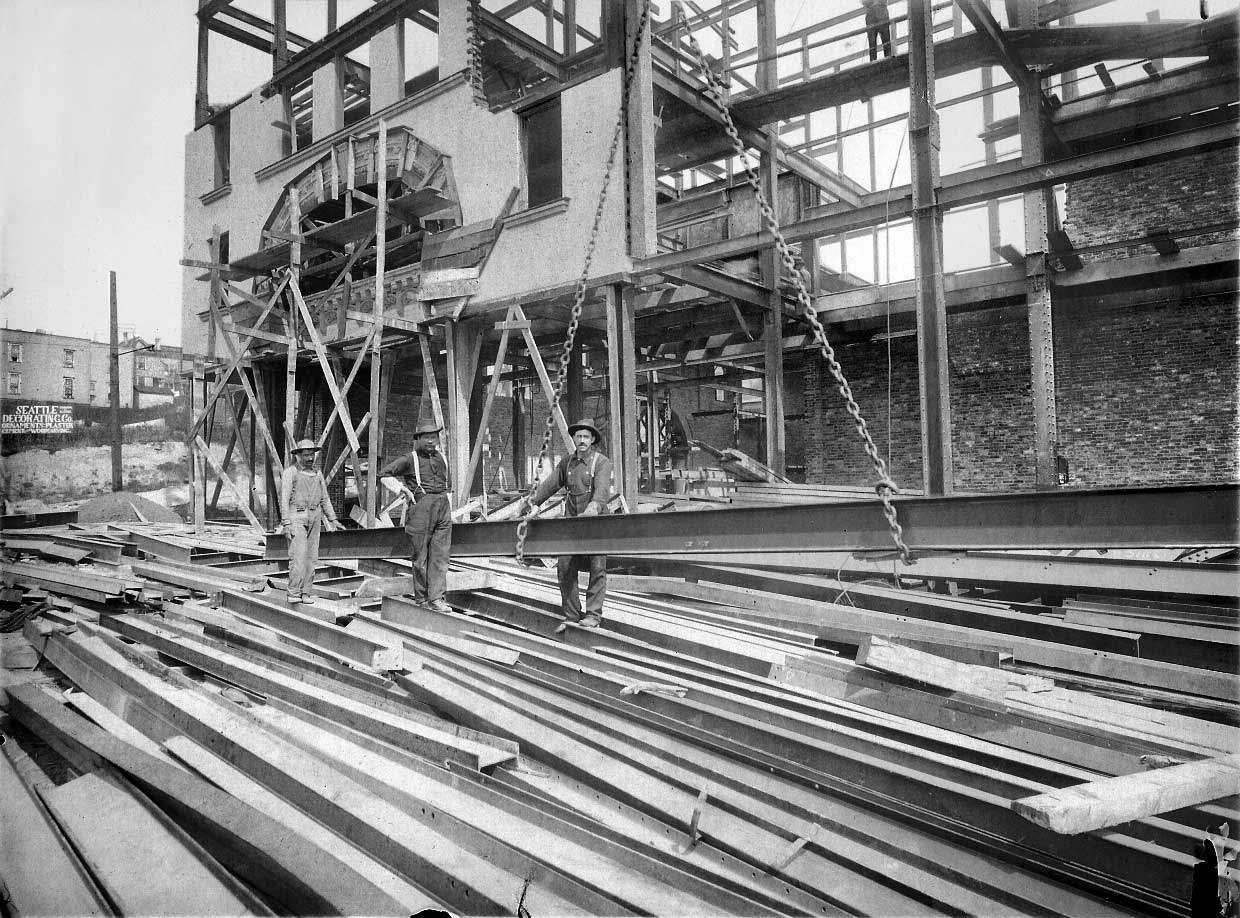
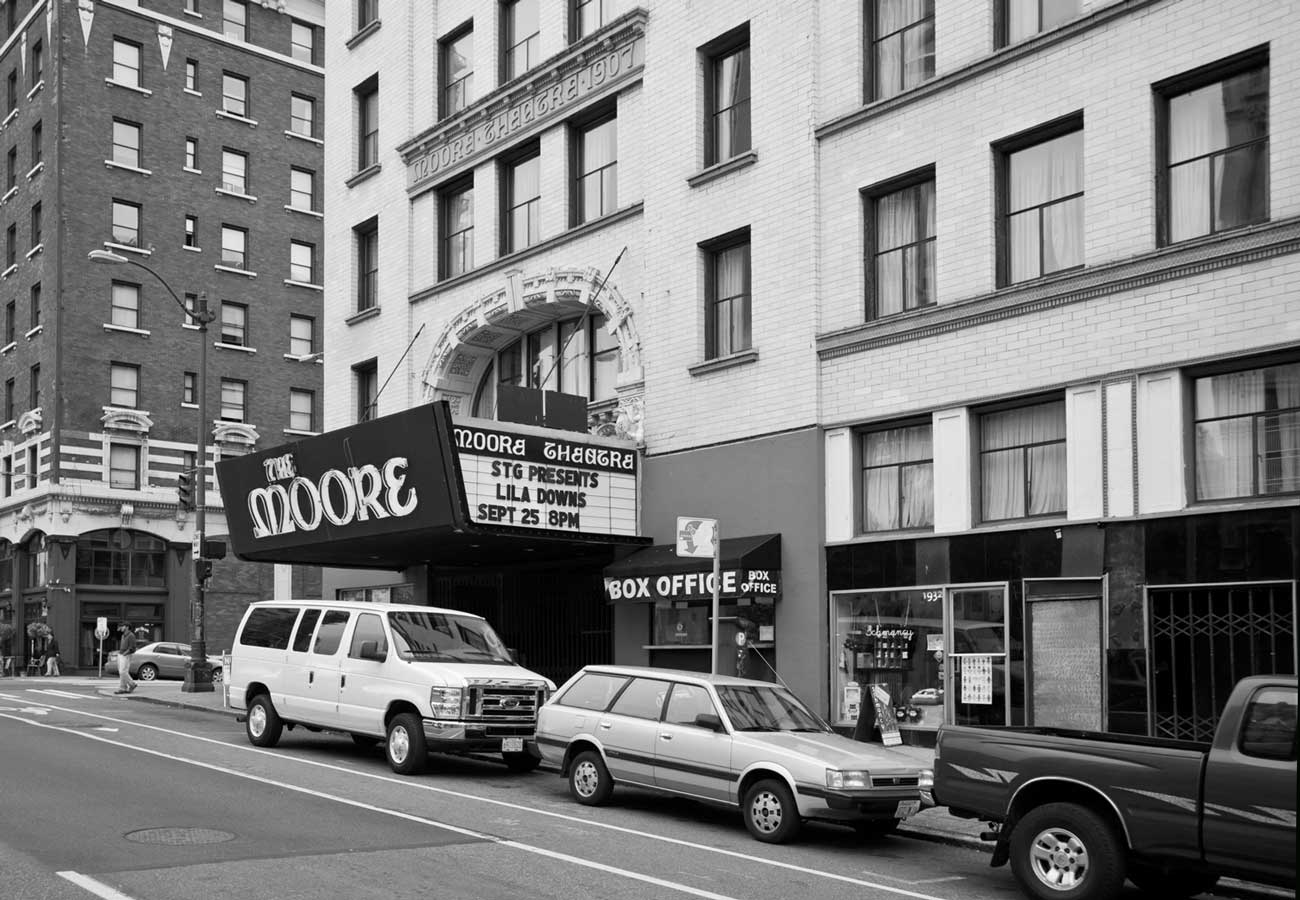
ABOVE: Steel beams clutter the center of a freshly regarded Second Avenue during the 1907 construction of the Moore Theatre.  The view looks north towards Virginia Street. Courtesy,  Lawton Gowey   BELOW: One hundred and one years later, the Moore is one of early-20th Century famed theatre architect Edwin W. Houghton’s few survivors.  (Pic by Jean Sherrard)

MOORE THEATRE CONSTRUCTION

(First published in Pacific in 2008)

Last year (2007) with deserved fanfares and events, the Moore Theatre celebrated its centennial.  First imagined in 1903 by its namesake James Moore, Seattle’s super-developer at that time, the opening night curtain did not open until Dec. 28, 1907.  Many in the overflow crowd were devoted to live theatre, but then the dulling effects of television were still decades away although the delights of silent films were available.

The inaugural night’s VIPs, included Governor Albert E. Mead who from the stage gave a learned speech on the part played by history in theatre, for the Moore’s inaugural faire was an operetta, “The Alaskan.”  The scenario was taken from the book of the same name, written by Joseph Blethen who was also the librettist.  Since the author was the son of Seattle Times publisher Col. Alden J. Blethen, the family newspaper fittingly declined to review what was described in another newspaper as “the event of the season.”

This moment in the Moore’s construction was also recorded in 1907.  The theatre was built very quickly.   Moments before the doors opened to the happy crowd, workers were still installing their seats.

James Moore was another one to climb the stage to share some wit.  Once the thankful and admiring applause stopped — and here I borrow from Eric Flom’s historylink essay on the theatre — “Moore’s comments were brief and, quite literally, off-the-cuff.  ‘In anticipation I wrote out a very good speech.  I wrote it on my cuff and I laid out that cuff tonight to wear.  Mrs. Moore is a careful sort of woman and she discovered what she believed as a soiled cuff and took it away.  So I come before you speechless.’”

Now (that is, in 2003) but four years short of its centennial, the Moore Theater at Second Avenue and Virginia Street has run touring plays, vaudeville, opera, concert series, musicals, political rallies and lectures.  Beginning in 1935 it became the venue for impresario Cecilia Schultz, one of Seattle’s cultural treasures, and in 1976 the Seattle International Film Festival got its start here.

MOORE THEATRE NEARLY NEW

(First published in Pacific in 2003.)

When the Moore Theater opened in December of 1907 its namesake James Moore, then Seattle’s resident super-developer, claimed it was the third largest in the county.   Moore was himself both large and large-mannered.  When he died in a San Francisco hotel in 1929 this motivating maxim was found in his papers: “Make no little plans. They have not magic to stir men’s blood.  Make big plans.”

At the opening night performance of “The Alaskan” a packed crowd gave Moore a standing ovation.  Some were already standing for the audience was a few hundred more than the 2436 seat fire code capacity.    From every point on the floor one could see Moore, for the innovative balcony was supported by such hefty steel girders than none of the action or oratory on the widest and deepest stage in town was obscured by posts.

That was on the inside.  On the outside the Moore was restrained like we see it here looking north on 2nd Avenue towards Virginia Street.  This is still very early in the life of the theater.  Construction is not yet completed on most of the store fronts to either side of the also unfinished stone arch to the Moore Hotel.  Most likely it is the spring of 1908. “Coming Thro The Rye” a fine fair weather musical fabricated from the lines of the poet Robert Burns is advertised on the marquee.   (Burn’s ballad is now a popular selection for karaoke artists.)

A part of the old Denny Hill neighborhood is glimpsed on the far left across Virginia Street.  Moore first proposed his theater in the fall of 1903 when Seattle contractor C.J. Erickson started lowering Second Avenue to its present grade between Pine and Denny Streets.  Before this Second Avenue regrade the intersection at Virginia Street was in the valley between the south and north summits of Denny Hill.  It was described as the “saddle on a two-humped camel.”

After the road work the intersection at Virginia was the highest on Second — as it is now.  For those who wanted it lower, like city engineer R. H. Thomas, it was forever after the regrade’s stupid “terrestrial dunce cap.”  The intersection’s altitude was left as is to serve the theater because the megalomaniac Moore had won his argument with Thomson to keep it so. It was one of the few concessions that Thomson, whom The Seattle Times described in 1907 as one who could “bring the mayor of the city on his knees begging favors,” made in his nearly 20 years with the city.

Readers wishing to learn more about this landmark theater can consult  for the detailed essay on it by Eric L. Flom.

Above: Webster and Stevens, the studio responsible for recording these soldiers marching south on Second Avenue towards Stewart Street, describes the scene simply as “drafted men.”  The next photo in the studio’s numbered stock at the Museum of History and Industry is also a parade shot and it is dated September 20, 1917.  We may safely assume that this too is that parade.  (Courtesy Museum of History and Industry)  Below: A few of the most substantial structures survive from the 1917 parade scene into the contemporary street setting that also looks north on Second Avenue to Virginia Street.

DRAFTED MEN

By the fall of 1917 Seattle was well practiced in patriotic parading.  The first wartime parade for Prepardeness stuffed the central business district with flag wavers on June 10, 1916.  It required another nine months of Pres. Woodrow Wilson’s promoting the idea of joining a war to “save the world for democracy” before the periodic hoopla turned outright bellicose.  On April 3, 1917 congress was ready to back Wilson’s war plan and the following day uniformed sailors paraded the downtown sidewalks carrying signs reading, “We are recruits and have answered our country’s call.  Why don’t you?”

Also on the 4th, Seattle’s third daily, The Seattle Sun, got downright threatening.  Across the top of the front page it trumpeted, “Today, in this land of ours, there are only two classes of people.  One class consists of Americans.  These will stand solidly behind President Wilson.  All others are TRAITORS.”

Two days more and on April 6 congress voted 373 to 50 to fight Germany – or “the Hun” or “Kaiserism” or “Prussian savagery.”  That evening a “monster parade” was staged downtown.  Then after weeks of arguing for conscription the president got it on April 28 when the draft law passed.  Eight senators voted against it.  The Star tarred these with a shame list explaining that this war was, after all, “a fight made in behalf of all humanity.”

For its June 18 night parade the Red Cross asked merchants to “darken all electric signs” in order to “enhance the value of the spectacular features of the parade.”  The next big parade – this one from Sept. 20 — was called to exhibit Wilson’s new warriors.  And filling the force had been made easier in early July when the war department revised its policy about small men.  Thereafter one needed to stand shoeless at least 5’1” and weigh at least 110 lbs when stripped to shorts.   One recruit, a 21-year-old janitor at St. James Cathedral, ask for an exemption because he had earlier lost most of his trigger finger.  He was denied and told to use his middle finger.

The startling differences between this week’s now and then are the results of more than 110 years of development.   The older photograph looks northeast from a 4th Avenue prospect on Denny Hill. The contemporary scene was recorded in line with the old but from the top of the 4-story garage on the east side of Third Avenue.

FROM ONE HILL TO ANOTHER

When detailed panoramas like this rare look from Denny Hill to Capitol Hill are printed small we are left for the most part with describing impressions and larger features like the fresh grade of Denny Way, upper-right, where it begins to climb Capitol Hill.

The original print shares the photographer’s name, A.J.McDonald, on the border.  McDonald is listed only in the 1892-93 Corbett Seattle Directory.  Perhaps the economic panic of 1893 drove him back to California.   The California State Library preserves a large collection of his San Francisco subjects but only a few Seattle scenes survive in local collections.   Probably most of his Seattle subjects – maybe all -were taken during the photographer’s brief stay here.

The street on the right is Stewart, and its most evident part is the then still steep block between 8th and 9th Avenues.   The large box-shaped building at the northwest corner of 9th and Stewart is home for Hendrick Bresee’s Grocery.  He appears in the 1892-93 directory with McDonald.  Ten years later it was J. M. Ryan’s Grocery.  In 1910 the intersection was lowered fourteen feet.   One block west at 8th Avenue Stewart was also raised with fill, thereby creating the contemporary gentle grade between 8th and 9th appropriate for the Greyhound Bus Depot built there on south side of the street in 1927.

In 1892-93 Westlake Avenue between Pike Street and Denny Way is still 15 years in the future and Virginia Street, one block north of Stewart, has not yet been developed through the two steep blocks east of 8th Avenue.  Cascade School, one of the scene’s future landmarks opened in 1895.  But the scene is dappled with many residents.  All of them are relatively new, the creations of Seattle’s explosive growth in the early 1890s, including the Gothic steeple of the Norwegian Danish Baptist Church at the northeast corner of 6th Avenue and Virginia Street that appears at the border on the left.

Ten years before McDonald recorded this cityscape it was practically all forest.  A few stragglers stand above City Park (Volunteer Park since 1901) on the rim of the ridge that in 1900 James Moore, its primary developer, named Capitol Hill.   [For more on Capitol Hill history please consult historylink.org]

Bert in Robert, Wisconsin gets a letter from  . . . whom?  Perhaps it is Eva.  And is that Eva posing with a dirt “spike” on the Denny Regrade behind her?   Eva – if it is she – lives in Hermiston, Oregon, and misses Bert, if we can believe her.   We cannot know what is wrong with Uncle Will.  The postcard “taken in Seattle last summer”  is a rare moment of candor, even if it is posed.   Most regrade shots are about the often dramatic public works with the human content incidental.  (Click to Enlarge)

Our Daily Sykes #403 – MESA VERDI with SHOE

Closer yet and yet not the same camp - it seems. Although similar, these details are different than the parts of the Square Tower that can be studied in #400 and #402. Here for the pleasure of your hide-and-seek there is a human foot (with shoe) to search for and easily find. And there are also many footsteps. Perhaps it is no longer permitted to walk around these ancient ruins. And yet there are neither taggings nor graffiti shown here. (Click to Enlarge)

OUR DAILY SYKES #401 – Pot of Gold

A Fairy's or Leprechaun's or Coyote's or Little Person's promise that if set free he or she or it will tie a ribbon around the tree below which a great treasure is buried, is like a rainbow's promise of a pot of gold waiting at the end of it. With the ribbon the party of the second part finds that every tree in the forest has been wrapped with a ribbon. With a party in the canyon lands of Utah and Arizona the quest is all so confused because the color of the soil can make it seem as if gold has been strewn everywhere. (Click to Enlarge)

Our Daily Sykes #399 – Lake Mead & the Muddy Mountains

I know this is Lake Mead, and I am proposing that those are the Muddy Mountains on its north side. Lake Mead is, of course, impounded behind Hoover Dam. As with practically every other reservoir it has an ominous contrived shoreline. Here when the Colorado River is running low the lake tugs its pants down revealing, as it were, the tan line at the belly - the body art of the Army Corps' earth work. Slip into this lake and you may not be able to get out. (Click to Enlarge)

Seattle Now & Then: Antique Alki Swimwear

(click to enlarge photos)

THEN: A century ago the Seattle Parks Department built the large Alki Beach Municipal Bathhouse seen here behind the four posing flappers. None of the woman are identified. The bathhouse was a city-wide magnet for summer fun with thousands often swarming this beach on weekends. (Courtesy Southwest Seattle Historical Society.)
NOW: In early 20th Century swim attire on loan from the Goodwill collection of antique apparel, four West Seattle enthusiasts pose in front of the west wall of the replacement Alki Bathhouse. After the original structure surrendered to age in 1955, part of its west façade became the foundation for the west wall of the new structure shown here. (Now photo by Clay Eals)

Next weekend, July 23 and 24, you may wish to visit Alki Beach for its Alki Arts Fair.  Former West Seattle Herald editor, Clay Eals, who is also the step-in photographer for this week’s “now” repeat, and for his friend, Jean Sherrard (Jean is away) notes that this beach fair is a “fun raiser” and not a fundraiser.  Past editors are permitted such pleasantries.

Apropos the “now” photograph that Clay has both snapped and arranged, the weekend’s beach celebration will include a fashion show of antique swim wear, much of it more than a century old.  For his “repeat” Clay persuaded four West Seattle women to take poses, which are improvisations of those held by the four flappers kneeling in the sand, ca. 1920.  It took no coaxing on Clay’s part for the members of this modern quartet are connected with the Southwest Seattle Historical Society’s landmark Log Cabin Museum.  Both Clay and Carol Vincent, far left, are former presidents of the Society.

Continuing to the right from Vincent, the remaining contemporary women are, Lucy Kuhn, Kerry Korsgaard and Charlene Preston.  The swimsuits they model were all loaned to the Society out of Goodwill’s historical collection of diverse duds.  They date from ca. 1910 and so are typical of swimwear at least a decade older that the more revealing suits chosen by the women in the “then.”

Wool was once the commonplace material for swims suits, and it may be that all eight of these women are dressed in it.  Considering how much of Seattle’s weather in 2011 has resembled Juneau, Alaska’s, wool might be an appropriate material to wear to the beach next weekend.  We hope not.  Whatever, readers are encouraged to come join in the fashion show this weekend wearing their grandmother’s suit – or grandfather’s – if they can find them.  If not, be creative.

Similar prospect but at higher tide.
The wind is straightening the flags and cooling the swimmers or freezing them, depending.
Tide’s out so if the sun is shining the sand will warm the incoming tide.

Detail from contemporary bath house door.

WEB EXTRAS

Anything to add, Paul?

Yes Jean, a few past features that touch on Alki Beach. First some things on the natatoriam that was one on the beach between Duwamish Head and Alki Point and also something on another and earlier but short-lived ‘nat that was at Alki Point.

For the 19 years that the Alki Natatorium covered the beach it was closed and or in disrepair about as much as it was open to plungers and other recreations. The sprawling facility was camped on the tides side of Alki Avenue between 58th and Marine Avenues Southwest.   Historical Pix courtesy of Don Myers.

ALKI “NAT”

If we could but read the license plate on the bumper of the car (that looks very much like the one my dad drove the family west in from North Dakota in 1946) we could date this stark portrait of the Alki Natatorium.  Since much of the glass along the Alki Avenue façade is busted out we know that this scene was photographed sometime when the fitful entertainment center was not serving.

But when jumping there was more than swimming here.  For instance, the neon sign with the diving swimmer also advertises dining and dancing at the Shore Café.  And at least during the late 1930s when the Premier Amusement Company was running it, the “Nat” was also a skating rink.

The short-lived Alki Point Natatorium is marked on this 1906 real estate sales map. Note that there is, as yet, no bath house.
It is tempting to think that this is the Alki Nat photogaphed from the dock also indicated on the map. I found this in a collection of unmarked Seattle postcards. No one, so far, has come up with another explanation for this, nor for another photograph of the, again, sort-lived nat on the point.

This natatorium was the last of three built along the beach.  The first opened near Alki Point in 1905, but quietly closed while planning an “Oriental-styled” enlargement complete with “real Geisha Girls” serving tea and the “world’s largest swimming pool.”  The second opened in 1907 with Luna Park at Duwamish Head.  And although the amusement park was soon closed for introducing “lewd and disorderly behavior” the big indoor natatorium stayed open until 1931 when it was one of many targets torched by an arsonist that year.  (More on that below.)

Three years later this “Nat” opened a short distance up the beach from the Municipal Bath House towards the Head not the Point.  The “Nat” managed to survive the Great Depression but not a lawsuit by an injured swimmer in 1939.  In 1942 the Seattle Park’s Department renovated and reopened it in time for the preoccupations and parsimony of the war, and the place again closed.  Especially when dark, its great expanse of roof glass was pelted by naughty children (read boys) with rocks borrowed from the beach.  Several moves by the Parks Department and City Council to restore it following the war turned out to be good intentions only and in 1953 the Alki Natatorium was razed to the beach.

An Alki Point public works fantasy from the early 1950s.  As ever Click to Enlarge.


=-=-=-=-=-=-=-=-

Whatever its name or primacy the Alki cabin in this photograph was razed in the fall of 1892.  The photograph is not dated.  Its site may have been lost as well – temporarily.  The contemporary photograph looks towards the corner of Alki Avenue and 63rd Avenue S.W., the original location of the Founder’s pylon that commemorates the builders of this log cabin. (The pylon has long since been moved across Alki Avenue.) Historical photo courtesy of Seattle Public Library.

The Stockade

LOW DOWN ON THE DENNY CABIN

[Nov. 2004]

Our punning headline plays with the uncertainty about this celebrated photograph.  Is this the Denny Cabin or the Low Cabin?   To add to the confusion, for reasons that still grieve John and Lydia Low’s descendants, the Low Cabin is most often called the Denny Cabin?

After scouting and then choosing Alki Point for a townsite John Low hired the teenager David Denny to build a cabin beside Alki beach while he returned to Portland to bring back his family and the rest of what later became known as “The Denny Party” and not the Low Party.  The foundation was laid on Sept 28, 1851 and when the immigrants (22 of them) arrived on the schooner Exact on Nov. 13th the cabin still had no roof.  Injured by his axe, a dismal David welcomed his older brother Arthur so, “I wish you hadn’t come.”

The Museum of History & Industries diorama of the Denny Party landing.

While building a second cabin – the Denny Cabin – the dampened settlers crammed into the Low Cabin.  So the Low Cabin was first cabin, but in practically every printing of this photograph the structure is described, in some variation n, as “The Denny Cabin, the settler’s first home on Alki.”  I think it is the Low Cabin.  Greg Lange, of the Washington State Archive, thinks it is the Denny Cabin – or the second cabin.

Drawing with the cattle yoke showing in the photograph.
Drawing with notes but sans yoke.

Both Greg and I are members of the growing “Cabin Committee”—hitched to the Southwest Seattle Historical Society.   (Since this is a committee without meetings you might like to join.)  Members agree to two collective goals.  The first is to investigate and share the early history of the Alki townsite and its architecture.  The second is to identify where this cabin sat, and for this our standard is both liberal and circumspect.  We want to locate it to within “the length of a medium sized horse, from nose to extended tail.”

When this was first printed in Pacific in 2004 the CABIN COMMITTEE boldly promised to make its public report on Nov. 13, 2005, the centennial of the First Founders Day and the dedication of the Alki Beach landmark, the “Birthplace of Seattle” Pylon.  Here in 2011 we are still working on that report.  Our calling has been more difficult than we imagined.)

A 1951 Centennial reinactment of the 1852 landing. Courtesy, MOHAI


–=-=-=-=-=-=-=-=-=-=-

The Museum of History and Industry library dates this photograph of the Alki Beach Founders Pylon from September, 1949.  The library’s records do not, however, name the members of the monument’s small crew of tenders. Let us know if you know.  In the “now” repeat, Jim Seaver, one of SPUD’S proprietors, studies the pylon  (Historical photo courtesy of the Museum of History and Industry.)

SESQUICENTENNIAL ADIEU  (aka Swept Away)

At the beginning we may have had a hard time either pronouncing or spelling it.   Now three years and four days latter while bidding it adieu we should be practiced in saying “Sesquicentennial” and pleased as well to review it.  Seattle was founded in 1851.  In 1852 King County was separated from Thurston County, and in 1853 Washington Territory from Oregon.

The first year of the three-year celebration featured a re-enactment of the original pioneer “Denny Party” landing near Alki Point 150 days later to the day – the thirteenth of November.  Both days – in 1851 and 2001 – turned exceedingly dismal with heavy rain. The children of the founders dedicated the Founder’s Pylon at the West Seattle site in 1905, and here in 1949 an unidentified quartet is cleaning it up, perhaps in early preparation for the Seattle Centennial of 1951.

In addition to staging the re-enactment at Alki the Southwest Seattle Historical Society (of the Birthplace of Seattle — Log Cabin Museum) also made two important additions to the Founders Pylon in 2001: plaques recognizing the roles of both the Duwamish Peoples and the Pioneer Women in the origin of the city.  The original carvers failed to mention either.

The added plaques.

For the city’s sesquicentennial the Museum of History and History mounted its “Metro 150 Exhibit” and also gathered a committee of local historians to do the impossible: name the 150 most influential citizens in the city’s first 150 years.  The committee generally favored cultural figures over politicians.

Above and below: two looks at the pylon in its original location on the front lawn of the Stockade Restaurant.

Perhaps the most enduringly useful child of our triple anniversary will be historylink.org, the on-line encyclopedia of Seattle and King County history that was launched in 1999 by local historian-pundit Walt Crowley his wife Marie McCaffrey (and myself in a lesser role) in anticipation of the sesquicentennial. On March 2, 2003 – Washington’s 150th anniversary – HistoryLink began to also explore state history with its pithy essays.  For more in this line on-line open historylink.org and type “sesquicentennial” in the key-word line.

Pylon 1905 dedication photogaphed from the Stockade balcony.
Survivors of the 1851 Denny Party landing pose with the Pylon in 1905. Carson Boren wears the beard. To his left (our right) is Mary Denny, Arthur’s wife.  Next to her is her son Roland Denny who was a babe-in-arms when the party arrived.
A page from a scrapbook and a lesson too. Never use scotch tape with fastening ephemera.


=-=-=-=-

SEATTLE’S LONG BRANCH

(First appeared in Pacific on Sept. 2, 1984)

For a few thousand years winds and tides have been manufacturing a fine sand on West Seattle’s Alki Beach. Its exposed and rather shallow shore has made an excellent resort but a lousy port.

Yet it was the port that the original settler, Charles Terry, was looking for when he stepped ashore here with the Denny Party in November 1851. Terry had visions of turning this beach into a big city and almost immediately opened the New York Cash Store on this exposed point.

When the Dennys, Borens, and Bells left it to found and settle Seattle on the east short of Elliott Bay early in 1852, Charles and his brother Lee embraced it and named the whole peninsula New York after their home town. For the younger Lee it was probably homesickness that motivated the naming for he soon returned to the real Gotham. But the enterprising Charles stayed on his point New York and sold necessities like grindstones and brandy. It was a good place from which to spot customers.

And the customers could see the point, however, some of them didn’t share Terry’s big-city vision. So, to his name they added the Indian-trade-talk word for “in a while.” It stuck, and for a while it was New York-Alki or New York-in-awhile (or bye and bye) before the point became just plain Alki.

In the summer of 1852 while Terry was in his New York-Alki selling brogan shoes and hard bread to the settlers who didn’t have their own stores, the real New Yorkers were escaping the heat of Manhattan for the recreational sands of a New Jersey resort named Long Branch. Fifty years later West Seattle’s beach would be compared to this New Jersey resort and not New York.

In 1902 the hottest trading on Alki was not in hickory shirts but in bathing suits. Under the heading “Bathing At West Seattle Draws the Summer Crowds,”a summer edition of the Seattle Newsletter drew this analogy: “West Seattle is to Seattle what Long Branch is to New York – the haven of the Sunday crowds and an ideal bathing resort.”

This historical beach scene accompanied that article, which went on to say, “The Seattleite sweltering from the sun’s warm rays can within 15 minutes reach West Seattle and enjoy a swim along as fine a beach to be found anywhere in the world. A welcome breeze is always present from Duwamish Head to Alki Point. For three miles the beach is lined and dotted with tents, with here and there frame refreshment houses, bath houses, dime side shows, merry-go-rounds, ice cream stands and sandwich counters. It is estimated that at least 2,000 people are camping on the beach this summer and on pleasant Sundays the ferry carries hundreds who merely go to see the sights, bathe, buy red lemonade and peanuts . . . there is really no inconvenience in coming from and returning to town.”

The Newsletter predicted, “Some day, when a driveway is built along the shoreline connecting the ferry landing, or with a road circling the head of the bay, Seattle’s Long Branch will be an even more extensively visited resort.”

The trolley made it to Duwamish Head in 1907 and on to South Alki within the year following, making big changes on the beach.
Before the beach was graded and reclaimed for tracks and a road the trollies ran above a trestle thru part of their trip around Duwamish Head and onward to Alki Point.
A smaller trestle for pedestrians was constructed between the tides and the beach community of tents and otherwise sheltered campers and purveyors.

=-=-=-=-=-=-=-

In 1910 the city purchased much of the Alki Beach waterfront for the development of a groomed park and the seawall showing on the far right of the “now” scene.  Both views look east on Alki Beach from near 64th Avenue NW. About one century separates them. Historical photo courtesy of Lawton Gowey.  Contemporary photo taken by Jean Sherrard.

ALKI BEACH PARTY

(OCT. 2004)

This beach party scene comes from that most popular and yet unknown source: somewhere.   The beach is familiar enough – at the scene’s center is Duwamish Head marking the entrance to Elliott Bay – but neither the year nor the group nor the photographer whose back is to Alki Point are identified.

Depending upon who is throwing it this scene is a stone throw or two from the site where the Denny Party landed on Nov. 13, 1851.  Judging from the costumes and the development  (or rather lack of it) on the beach it was photographed about a half century later.  Most likely then if this is not a group from the neighborhood its members came to their picnic by boat for the electric trolley did not reach the beach until 1907, the year that West Seattle incorporated into Seattle.

By the time this driftwood tableau was photographed the attraction of Alki Beach as a summer retreat was already commonplace.  After regular steamer service was launched across Elliott Bay in 1877 the Daily Intelligencer advised “Now is a good time for picnics on the beach at Alki Point, so it will pay some of our new settlers to go over and see the spot where Messrs. Denny, Maynard and others lived during the ‘times that tried men’s souls.’” (I found this reference in “The West Side Story”, the big book of West Seattle history.)  We can only imagine what pains those we see frolicking and lounging here gave to the hardships of the founders.

There is a revealing similarity between the beach visitors in the “now” and the “then” scene: how few of them there are.  Alki Beach was frequented by throngs after the arrival of the trolley and the 1911 opening of Alki Beach Park with its oversized bathing and recreation pavilion  – 73,000 of them in 1913.  By comparison Jean Sherrard took this week’s “now” photograph last July 24, one of the hottest days of the summer.  While there are surely many more offshore attractions in 2004 then in 1913 when it comes to chilling dips we may also have become less robust.

Not an afternoon for a beach party. Duwamish Head is in the distance, and a pier shed stocked with whaling gear shows far left. Part of the bath house is far right.
Alki Beach has been cleaned and regularly kept clear of driftwood in this real photo postcard by the prolific Ellis. The Alki Bath House, painted white, appears up the beack, at the center. Courtesy, John Cooper


=-=-=-=-=-=-

About 80 years separate the two later afternoon views on Alki Beach Park. Both look to the southwest from near the foot of 61st Avenue Southwest. (Historical photo courtesy of Washington State Historical Society, Tacoma. Contemporary photo by Jean Sherrard.)

ALKI BEACH PARK

Last week’s “then” looked northeast on Alki Beach.  This week’s record surveys the same stretch of sand but in the opposite direction.  Why spend two weeks on one beach?  Because about a quarter century separates the two historical photographs – last week’s and this one – and the changes are revealing.

As shown seven days ago a picturesque litter of driftwood distinguished the ca. 1900 West Seattle waterfront.  Here a quarter-century later the same waterfront is littered instead with bathers in wool suits and separated from a wide planked promenade by a seawall.   Actually the change from the irregular strand landed on by the founding settlers of 1851 to a groomed shoreline occurred very rapidly after the city condemned and purchased in 1910 the nearly 2500 feet of this shoreline between 57th and 65th Avenues Southwest.

In quick order the city built a large bathing pavilion (the historical photo is photographed from its roof) and the wide walk protected by the sturdy wall.  This radical makeover was dedicated on Independence Day 1911 and the following year the covered bandstand was extended over the tides.  That first year the city’s Parks Department estimated that 103,000 persons were attracted to the 75 concerts performed from its octagonal stage.

From the band stand

In 1925 the wooden seawall was replaced with a concrete one that was designed to protect the beach with a concave profile that inhibited the undertow of high tides. (See the Ellis postcard one feature up.)  In five years more the seawall was extended in the other direction (to the northeast) to within 150 feet of Duwamish Head.  At last in 1945 this gap was also acquired and improved to make a continuous recreational shore between the Head and the string of homes that lie between the public park and the closed – since 9/11 – Alki Point lighthouse (1913).

This chronology was gleaned from the book “West Side Story” and Don Sherwood’s unpublished (but often photocopied) manuscript history on local parks.  Much on Alki Beach history is featured in the exhibits and publications of the Log House Museum (one block from the beach at the corner of Stevens St. and 61st Avenue) and also in permanent display on the walls of the by now venerable SPUDS fish and chips on Alki Avenue.

These look to the greater part of Alki Beach that runs northwest from the bath house, which is seen here during a ca.1913 storm. At the bottom of this view is the beach looking southwest from Luna Park. The chain dance was recorded by Max Loudon. Below are three or four more of the athletic and convivial Max’s beach shots.  In his album there are several other examples of such early 20th-century pulchritude.

With this view of Max’s unnamed subject we learn the setting. An outside wall of Luna Park, below Duwamish Head, shows in the background. All these are courtesy of Grace McAdams, Max’s sister.


LUNA PARK

(First appeared in Pacific on Sept. 5, 1983.)

Where West Seattle drops its northern face into Puget Sound, a tideflat continues for a hundred yards or more. Here for centuries an aquaculture of mussels and clams thrived in a deposit of Duwamish silt cleaned by the tides. It was, naturally, a favorite place for the natives. This changed in 1906.

West Seattle residents understood that their exposed Duwamish Head with its shallow tideflat was a tough location for ship-tending piers, and in 1906 their city council agreed it was the perfect place for “the greatest outdoor amusement park in the Northwest.” The pile driving began for an acre or two of thrilling rides and gaudy amusements.

In the spring of 1907, Seattle looked across Elliott Bay at a Duwamish Head with an altered profIle. At night the tideflats would sparkle with thousands of lights that lined the Chute-the-Chutes Water Slide, the Figure Eight Roller Coaster, the Giant Swing, Canal of Venice, Merry-go-round, Salt Water Natatorium, and Dance Palace. With Luna  Park the West Seattle

City Council had found another way, besides the ferry from MarionStreet, the trolley along Railroad Avenue, and the real estate atop the bluff to get Seattle to West Seattle. There was another attraction: the “best-stocked bar on the bay.”

Luna, the name for the Roman goddess of the moon, makes one think of romance or lunacy or both. It was the latter that disturbed the residents of West Seattle. The spirits that escaped from their “longest bar” threatened to drive some of them crazy with drunken revelers running the length of Alki Beach. These citizens of West Seattle accused their council of planning a beachhead of bars for “the boozers from Seattle” and thereby turning their “Coney Island of the West” into the “Sin City of West Seattle.” When the council conceded and voted to stop building bars, the citizens soon went further and voted no more council. The 1907 election count was 325 to 8 for annexation to Seattle.

In 1907 Seattle was in an expansionist mood, annexing Ballard, Columbia City, Rainier Beach, as well as West Seattle. It was also in one of its moral moods, electing for mayor a judge named Moore who promised to close the town to unnatural vices and open  it to municipal ownership of those “natural monopolies” like water and light. This is just what the citizens of West Seattle landslided for: better city services and an administration with a moralist’s nerve to fight vice.

But like the phases of the moon, Seattle’s moral moods waxed and waned. In 1910 Seattle allowed its new Mayor, Hi Gill, to once again open up the city. This, of course, now included West Seattle, Luna Park and its one long, well-stocked bar.

Almost as soon as Gill took office, a group calling itself the “Forces of Decency” tried to take it back by recall. These progressives, prohibitionists, and newly enfranchised women voters were aided by the muckraking reportage of the Seattle Post-Intelligencer. One P.1. story was headlined “Many Drunken Girls and Boys at Luna Park.”

The January 31, 1911 accusations claimed that at “the Sunday night dances at Luna Park . . . girls hardly 14 years old, mere children in appearance, mingled with the older, more dissipated patrons and sat in the dark corners drinking beer, smoking cigarettes and singing.” Against this spirit of righteousness, his honor Gill temporarily lost his honor in the February recall election.

Gill is best remembered for allowing his chief of police Wappenstein and a few of the latter’s shady cronies to build a 500-room brothel on the side of Beacon Hill. In this Luna Park was implicated. Its manager W. W. Powers, a Gill supporter, was also, the P.1. reported, “the owner of 50 shares of stock in the corporation organized to erect a brothel on a public street at 10th Avenue S. and Hanford Street.”

The industrial-sized brothel with its back to Beacon Hill.

Two years later in 1913, most of Luna Park was closed. Three years later, Gill was once again elected mayor of Seattle.

One of the above views of Luna Park looks west from atop the Figure Eight roller coaster. The merry-go-round’s onion-domed round house is easily found. In the distant center of the photograph is the Bath House. The water was cold and salty. An indoor balcony circled the pool at the level where the roof line meets the great arching domed windows. From there one could enjoy the swimming without getting wet.

In 1931 swimming was still a favorite recreation at Luna Park but the Merry-go-round, Figure Eight, Sunday dances, and Infant Electrobator were long gone. In April of that year, the Natatorium also was gone, torched by an arsonist.

Now the stubby remnants of those Luna Park pilings, which once supported a popular culture of dime sensations, show themselves only at low tide mixing with kelp, clams, barnacles, and human waders. Up the beach on the Alki strip, one can visit, or more properly “cruise” what is still on hot summer days one of the most popular outdoor amusement resorts in the Northwest.

Carl Hinckely and his pig were popular entertainers on the Luna Park boardwalk.


=-=-=-=-=-=-=-=-=-=-=


ALKI POINT LIGHTHOUSE

(First appeared in Pacific on May 19, 1985.)

“YE LIGHT MUST NOT FAIL”

The Alki Point lighthouse was constructed in 1912 and completed the following year. The historical photo dates from then. The guard fence is not yet up, and the ladder leaning against the lighthouse’s west wall (on the right) leads to an oil lantern which may have been used, during construction, as a temporary warning beacon to Mosquito Fleet steamers slipping through the night between Seattle and Tacoma.

Alki’s first warning light was also just a simple lantern hung from a pole. Sometime in the mid-1870s Hans Martin Hanson, who in 1868 bought the point from pioneer Doc Maynard, began his public service of lighting that lantern every night, or encouraging his son Edmund to do it.  Edmund soon passed the responsibility on to his cousin Linda Olson who each night and morning precariously negotiated the planking above an old swamp that separated the sandy tip of Alki Point from the rest of the peninsula, to ignite and dowse the light, trim the wick, and polish the brass.

Detail of a 1899 NOAA map of Alki Point shows the marsh that the Linda Olson crossed to reach the lantern.  Another map detail shared by Ron Edge. 

In 1887 the U.S. Lighthouse Service took notice and replaced the homemade beacon with a lens-lantern mounted on a scaffold. But the tending was still kept in the Hanson-Olson family when Hans Hanson was appointed the official keeper of the light. The pay was $15 a month, and it was probably Linda Olson who kept walking the plank.

Hans Hanson died in 1900, but not before he divided his land among his children. Edmund got the tip of Alki and the tender’s job. Ivar Haglund was Edmund Hanson’s nephew, and remembered him as an odd sort of lighthouse keeper. Edmund was a fashionable dresser with yellow gloves, top hat, and cane and, like Ivar (who was an uncommon sort of fish-seller), he wrote jingles and told stories to the accompaniment of his guitar. Ivar remembered these performances as “incredible, but of the sheerest delight.” The young nephew was, no doubt, both charmed and influenced.

In 1911 Edmund sold the point to the U.S. Lighthouse Service, and with the $9,999 he gained, took his wife, children, and guitar on an extended vacation to California. By 1913, the 37-ft. octagonal tower was up and its light flashing every second for five seconds followed by five seconds of darkness.

The Alki light was converted to electricity in 1918, and 21 years later its control and keeping were handed over to the Coast Guard. In October 1984, its operation was made fully automatic.

Its last officer in manual charge was Coast Guardsman Andrew Roberts. (Roberts stands on the bulkhead at the right of the contemporary scene.) Roberts, who must have one of the Coast Guards’ better billets, now caretakes the grounds and leads weekend tours of the tower. Visitors are invited to sign in on the lighthouse log and make their comments.

There, many pages earlier, in 1954, H. Nelms wrote, “Looked on by ye land-lubbers with but a passing glance, looked on by ye seafarers as a beacon of hope, ye light must not fail.”

(As noted above, this feature first appeared in Pacific more than a quarter-century ago.  No doubt Guardsman Roberts has long gone from the Point, and the last time I visited it I was turned back from even approaching the lighthouse campus.   This, off course, was another 9-11 inhibition.  This feature also appears in Seattle Now and Then Volume 2, the 42nd chapter or feature therein.  You can find it on this blog’s homepage under or within in the books button.)

That’s it for now Jean – it’s rolling towards 3am, and so it is once more (and with fond thoughts for Bill Burden the originator long ago of the nightly goodbye, “Nighty Bears”) it  is Nighty Bears to you and our readers, what there are of them – bless them.  Tomorrow (later this morning) after breakfast I’ll add something on the Alki Beach SPUD.   And proof it too.

=-=-=-=-=

SPUD

On Sunday Morning (Remember the poem of that title by Wallace Stevens, with its chocolate, coffee, oranges and fish and chips?) we conclude with a visit to SPUD.  This Alki Beach institution is old – older even than I am old, but not by much.   It is also well-stocked with beach heritage.  We mounted a “permanent” exhibit on its walls about eight years ago.  Near the bottom we will attach a pix or two of the hanging when it was in process.  We encourage visitors to Alki Beach to visit it and the West Seattle Historical Society’s Log House Museum, which is a short stroll away from SPUD – behind it and off the beach.


Probably the earliest view of SPUD, copied from a 1938 tax card. Courtesy Washington State Archives.

Brothers Jack and Frank Alger opened The SPUD on Alki Beach in June of 1935.  It was the beginning of summer but also the dead of the depression. At 10 Cent for a cardboard boat stuffed with fries and two big pieces of breaded ling cod the English-born Alger’s fish and chips serving was affordable, delicious and filling – but only in the warmer months.   In late fall the stand was closed and looked as it does here in this Works Progress Administration tax inventory photo recorded on Oct. 14, 1938.

To either side of SPUD in 1938 was a line of small beach homes, a few small apartments, Turner’s Shell station, Sea Home Grocery, Seaside Pharmacy, Alki Bakery, two groceries, a barber, a cobbler, a plumber, a tailor and four other eateries — two serving hamburgers and hot dogs and the other two fish and chips.  Most commonly on Alki Ave. s.w. were the late depression vacancies but most importantly for the life of the beach was the Alki Natatorium Swimming Pool built across from Spud on pilings over the tides.

Following the war the shanty seen here was replaced with a nifty modern plant featuring portholes, and SPUD written in big bas-relief block letters over the front door.  Sheltered inside was a counter with four stools.   By then there were Spuds at Green Lake and Juanita as well.   The family continued to run the Alki Spud until Frank’s son Rick decided prudently at the age of 55 that he needed “to slow down and enjoy life more.”   Recently retiring to build their “dream home” on Hood Canal Rick and Terry Alger sold Spud to Ivar’s.

This is one of several night exposures of popular cafe’s shared with me by Larry Polmateer

It was a both sensitive and poetic choice for also in 1938 when Ivar Haglund opened his first café – a fish and chips stand at the entrance to his aquarium on Pier 54 — the Alger brothers helped him.   Roy Buckley, Ivar’s first employee, learned his fish and chips while working at Spud.  All of them, Frank, Jack, Ivar and Roy were West Seattle lads.

SPUD ca. 2002. The Alki Point historical exhibit hangs on the walls of the upper floor and in the stairwell as well.

While both Spud and Ivar’s survive in 2003, we may conclude by listing a few popular restaurants of 1938 that do not.  All are still savored in memory only.  Manca’s and the swank Maison Blanc; The Green Apple (home of the Green Apple Pie); The Jolly Rogers, The Dolly Madison Dining Room, and Mannings Coffee (several of them); the Moscow Restaurant and the Russian Samovar; Ben Paris downtown and Jules Maes in Georgetown; the Mystic Tea Cup, and the Twin T-P’s, Seattle’s Aurora strip landmark most recently lost to a tasteless midnight wrecker.

Mounting the SPUD exhibit on Alki Point history.
A move from personal reflections to neighborhood history – the mirrors come down and the now-then’s go up.

A "now and then" example from the SPUD show.

Another


Our Daily Sykes #398 – Rattlesnake Mountain Over the Columbia River

In the past year and more we have sampled at least two other recordings of this sunset subject - Horace Sykes looking west from the south bank (the Kennewick side) of the Columbia River to Rattlensake Mountain, right of center, and the smaller Red Mountain, left of center. A possible explanation for this abundance is that from Seattle the Tri-Cities would have been a common enough destination for one heading on to the Palouse or Hells Canyon or Utah, all popular destinations for Sykes. (Click to Enlarge)

Paris chronicle#21 Anish KAPOOR at the Grand-Palais

For Monumenta 2011 of  last May and  June, the artist Anish Kapoor was invited to appropriate 13,500 m2 of the Grand-Palais  and created an art-work especially for this  event.

He set his immense inflated sculpture Leviatan within the Grand-Palais.

Already at the entrance visitors were amazed, facing infinity they were taken by vertigo.  The guard had to push them inside!

“It’s a sensory experience” explains Anish Kapoor, “both intense and huge, as if we were entering in a giant body and we discovered again our first sensation of the uterine world.

The audience may find lost feelings, archaic and universal in the dark translucence of this monument, which transforms the overhead light of the Grand Palais.”

En Mai et Juin derniers dans le cadre de «  Monumenta 2011» , l’artiste Anish Kapoor a été invité a investir les 13500 m2 du Grand-Palais  et à créer spécialement une œuvre pour cet evènement .

Il a installé son immense sculpture gonflable : Léviatan.

A l’entrée, les visiteurs étaient pris de vertige en face  de cet infini, au point que que le gardien devait les pousser à l’intérieur.

« C’est une expérience sensorielle dit Anish Kapoor, à la fois intense et colossale, comme si l’on entrait dans un corps géant et que l’on retrouvait la sensation première du monde utérin.

Le public retrouvera comme par magie , une sensation perdue, archaïque et universelle dans l’obscurité translucide de ce monument que modifiera la lumière zénithale du Grand Palais »


Our Daily Sykes #395 – Return to Sunrise Point

This blog has visited this prospect - nearly - before. There are differences between the earlier record from Sunright Point and this one, but they are clearly the same place. The first showing was as Our Daily Sykes #18, last year on April 30. Both exploit the warm inclinations of the Kodachrome emulsion and make Bryce Canyon's hoodoos appear like transluscent class art. Our Daily Sykes #384 - a little ways below - was also of Bryce, it seems looking the "other direction." (Click to Enlarge)

An Introduction to the EDGE EDITION of the ILLUSTRATED HISTORY of the SEATTLE WATERFRONT

Table Of Contents

Part One

Part Two

Part Three

Part Four

This illustrated history of Seattle’s waterfront is a collection of touchstones – a roughly chronological one.  As the table of contents reveals it is bumpy and reading it is more like walking on a beach of river rocks mixed with polished pebbles than down a graded road.

The writing was done over a four month sprint and modestly supported with tax dollars –  your taxes if you pay them.  The client was your Seattle City Council, and its agent, the then city  councilman Peter Steinbrueck.  Peter felt that members of the council should know more about the waterfront’s past in order to act wisely with issues of its future.   In 2004 it was on the verge of the big changes that are now in 2011 beginning to unfold.

City Hall printed and spiral bound perhaps 100 copies for local libraries, city council members and a few others who were interested.   It has, I have learned, been useful to a few public historians, but I imagine that its concilmanic uses have been minimal.  It is, after all, the normal routine of deliberating politicians to be engulfed with reports and this one is two inches thick.  Perhaps Peter’s peers puttered with the pictures.   (Repeat that seven times fast, for that may be all the time you have.)

Now with the help of Ron Edge’s machinations – scanning and sectioning – you too may easily read this “Edge Edition” from cover to cover.  If you do I guarantee at least a feel for the history of our waterfront, but, again, a bumpy one.  Or you are encouraged to enter this field of historical touchstones at any point and leave so too.   Whichever, this may be satisfying.

Paul Dorpat 7-10-2011

 PDF of complete book

Seattle Now & Then: War Bonds on The Ave

(click to enlarge photos)

THEN: Beginning in 1942 and thru the duration of World War Two, 45th Street in the University District was regularly blocked for rallies pushing the sale of War Bonds. (Historical photo courtesy of the University Book Store.)
NOW: Jean Sherrard has stepped back to reveal a wider look at the University District’s main intersection. He looks east on 45th Street and thru University Way.

About fifteen well-turned women straddle the center line of 45th Street where it begins its climb east of University Way, aka “The Ave.”   All are wearing corsages and most are standing tall atop high heels.  The women are selling World War 2 bonds and are included in a demographic typical for those times: all are white and the musicians on the stage behind them are all black.  Behind the band a higher stage imitating a ship, spans and blocks 45th Ave.

University District citizens and students were repeatedly prompted to buy stamps and bonds here at the neighborhood’s main intersection.  This ersatz ship was one of several street-straddling sets used throughout the war.  Here locals enjoyed good live music – jazz, swing and military – rousing speeches from heroes – both real and rehearsed – and appearances of visiting celebrities including actresses and community queens that might have inspired those dreamy cartoons painted on the noses of Flying Fortresses.

Canvassing door-to-door for pledges to buy bonds, Seattle neighborhoods competed with each other in bonds sales.  In one timed competition, Ballard raised 81 thousand dollars, West Seattle 120 thousand while the victorious University District, sold 125 thousand worth of stamps and bonds.  In his University District history, “UniverCity,”  Roy Nielsen notes that the “northwest premier of the movie Orchestra Wives with Glenn Miller showing then at the neighborhood’s Egyptian Theatre probably helped the U. District cause.”

By newsreel – in theatres and not yet on TV – Pres. F.D. Roosevelt first announced the bonds drive in May of 1941.  He encouraged Americans that by making “a slight sacrifice here and there, the omission of a few luxuries, all of these will swell the coffers of the federal treasury.  The outward and visible tokens of partnerships through sacrifice will be the possession of these defense bonds . . .” FDR ended his speech with an earnest “I know that you will help.”  Months later following Pearl Harbor the name was changed to “War Bonds.”

WEB EXTRAS

Anything to add, Paul?

Jean, as the early morning hours permit – a few.  All stay on or close to the Ave.  There are many more that we will not put down – this time.  More Ave features will surely come forward later.

Bill White, while on his morning walk, took a few “nows” early this morning to fit a few of these “thens.”

CIVIL DEFENSE SANDBAGS ON THE AVE.

Before Dec. 7, 1941, many Seattle neighborhoods were already mobilized to assist in relief programs for the thousands of Western European refugees scattered by Hitler’s World War II blitzkrieg. After the Japanese attack on Pearl Harbor, locals also organized to defend themselves against the dreadful chance that bombers from across the Pacific would soon come flying over Puget Sound. This scene shows the helmeted University District civil-defense sandbag forces mobilized in front of Davis and Westby Cabinet shop, 5211 University Way N.E. It was most likely photographed by James S. Bush, who lived nearby at the corner of 56th Street and Brooklyn Avenue.

According to his daughter-in-law, Sue Bush, James Bush ran an air-raid office from the basement in the family home. His official stationary reads, “Captain, Air Raid Wardens, Section Four, Zone one.” Bush was familiar with protocol; he served in the Navy during the World War I.

This sandbag scene was, no doubt, a common one in city neighborhoods, where the home forces were organized into captains and block wardens. Curiously, there are no white helmets on the heads of women here. That many of the men standing over the sand carts are quite young suggests that Bush recorded this scene not long after Pearl Harbor and before these youngsters were fitted for uniforms and sent away to a foreign front.

Another WW2 bond rally - this one on Brooklyn Ave. just north of 45th.

Readers interested in reading more about the home front may wish to investigate “The War Years, a Chronicle of Washington State in WWII.” The author, James

R. Warren, will be familiar to many readers for the popular articles and history columns he began contributing to local newspapers in the 1950s. His new book is a joint production of the University Press and HistoryLink; readers can sample it at http://www.historylink.org, the local Web site of Seattle and King County history.

THE AVE – AUG. 3, 1945

This scene on University Way was photographed on Aug. 3, 1945 – just 11 days before the Japanese surrendered in World War II. Of course, the few pedestrians included here could not have known what was coming. The weekly University Herald published a day earlier still included the “Ration Calendar” describing what stamps were valid for what commodities. The front page of the Herald features several wartime stories with a University District angle, including a picture of handsome 25-year-old Marine 1st Lt. Harold P. Logan, a former UW student on temporary leave. Logan, the story explains, was “back from Luzon after blasting Japanese targets in the path of advancing Army ground forces” in the Philippines.

The view looks southeast to the intersection of 42nd Street and “The Ave.” All these structures survive, though not uniformly well. In particular, the white corner home for Collegiate Shoe Renewing (downstairs), the photography studio of Dorothea Zeckendorf Aranyi (upstairs) and the simple clapboard storefront next door have been boxed together with a skin that its creators must have thought nifty. Now it is merely dismal.

The Hollywood Dance Studios, right of center, has an advertisement in the Aug. 2, 1945, Herald.  It reads, in part, “Children’s New Summer Classes, Tap, Ballet and Acrobatic. Under personal supervision of Eugene H. Miller.” Schwellenbach Real Estate, far right, also has an ad. It demurely explains: “Don’t consult us if you want to make a fortune when selling your home. But should you need sane, intelligent assistance, we would be glad to help.” That does not sound familiar.

Another repeat from earlier this morning snapped by Bill White.

A SLOWER AVE.

The contemporary intersection of Northeast 45th Street and University Way is one of the busiest in the city – an average of 35,000 vehicles enter it every day. The older view, however, predates this congestion by several decades.

The historical scene w as photographed soon after the University District’s first bank, the University State Bank, moved into its new home in 1913. Its name appears above the comer door in restrained Roman lettering. Now, the financial institution’s newest corporate name, First Interstate, is tacked to the bank’s gleaming white terra-cotta

skin. (This has changed again since this was first published on 8-19-1990. Now after years of heated banks merges and collapses, it is a Wells Fargo bank and so it has been fitted with access to the rear for horse-drawn coaches with yelping drivers and bags full of gold coins contributed under duress or confusion by widows, clever claims jumpers and neighborhood grocers.)

The four-story brick building across 45th Street from the bank is now the home of Bartell Drugs, which this year (1990 still) celebrates its centennial in Seattle. Bartell bought the building in 1926, and moved in next door to Martin and Eckmann’s Men’s Shop, which was then on the comer. Earlier, the haberdashery partners bought out the business and lease of the Collegtown Shop, whose signage is showing in the older view.

Eventually, in 1949, Martin and Eckmann’s moved into their then-new building across University Way. Now the home of Pier One Imports, that structure is included on the right of the contemporary scene. (Ahh but Pier One Imports is another casualty of something – perhaps a loss of the sense that an import is somehow special.  It is now commonplace but still cheaper for our consumer culture that is elaborately supplied by things made on the other side of the Pacific Ocean.) The three-story brick pile with the comer bay windows which it replaced shows in the older scene.

Again, the NOW was recorded early this morning July 9, 2011 by Bill White. The sun is still coming out of the northeast, and the place is nearly abandoned. Bill likes the silence and solitude of the district at such times, and the moment does repeat the slower qualities of the historical view well.

UNIVERSITY STATION

(Appeared first in Pacific on July 30, 1995.)

When the University of Washington moved its campus to Brooklyn in 1895 very few students moved with it. With no dormitories and few rentals, the center of Brooklyn was where trolley conductors called, “All out for University Station.” One block off campus at the corner of Beacon (Northeast 42nd Street) and “The Ave” (University Way), the school built an open shed where its commuting students and faculty could wait for the electric cars of the Third Street and Suburban Railway.

A tax photo of the corner ca. 1937.

In the years when “University District” was being increasingly substituted for “Brooklyn,” University Station became a metonym for the neighborhood. For many years University of Washington printed stationery gave its location as, simply, “University Station, Seattle.” In 1902 the meaning was doubled when the Latona Post Office was transferred to just across The Ave from the Station.

The station’s Varsity Inn, a combination store, hotel and restaurant, managed to bake its way into the hearts and stomachs of North Seattle. In between the salted peanuts and the bon bons, the Christmas dinner advertised for 1907 included cheese straws, bouillon, spiced pears, veal with currant jelly, roast turkey with dressing and cranberry jelly, broiled chicken, oyster sauce, French peas in cream, asparagus on toast, a choice of fruit or lobster salad, velvet cream with coconut macaroons, Christmas plum pudding with hard sauce, and a variety of homemade pies (see the sign over the door).

Looking through the intersection of the Ave. and 42nd during a U. District Street Fair in the 1990s.

In 1905 the waiting station was moved onto the east side of The Ave, and then in 1907 was removed for the double-tracking of the street in preparation for the summer-long 1909 Alaska Yukon and Pacific Exposition on campus. After the AYP the University District’s center moved two blocks north to 45th Street, and soon the term “University Station” was little used, except by old-timers.

Kitty-Korner in 1994 - if memory serves.

UNIVERSITY BOOK STORE MOVED TO “THE AVE”

(First appeared in Pacific, Sept. 12, 1999)

In 1924 University of Washington President Henry Suzzallo was clear that an off-campus move for the Universlty Book Store would be temporary. The shift was made necessary by a coincidence of fire – actually, the threat of it – and the student government’s preoccupation with balls (footballs and basketballs) at least as much as books.

A fire in the Mines Building stirred a campus-wide search for fire hazards, such as stacks of paper, bound and unbound. The bookstore had spent three years in the basement below the school’s largest auditorium, Meany Hall. With a two-week eviction notice and no sign of the long-promised student-union building – ASUW leaders were preoccupied with constructing sports pavilions – University Book Store was allowed to make a provisional home in an “Ave” storefront made available by the eviction of a pool hall. It required three days and 45 truck trips to haul the stock – mostly textbooks and student supplies – off campus to 4326 University Way.

"Driver Hurd Porter in a delivery wagon of Murphy's Meat Market on University Way N.E. at 43rd Street looking north. About 1905." The caption was pulled from Roy Nielsen's book "UniverCity."

Doors first opened Jan 28,1925, the bookstore’s 25th year. Suzzallo’s worries were alleviated by the store’s generally happy reviews. Sales jumped 23 percent the first year. “Ave” merchants were pleased that the store added charm to the University District’s increasingly cosmopolitan mix of shops and was paying rent like the rest of them.

This top view was photographed sometime between 1927, when architect Bebb and Gould’s elegant facade first distinguished the store (note the Husky gargoyle above the sign), and 1930, when yet another Academic Gothic front was constructed for a store by then many times larger than the pool hall but still smaller than Husky Stadium.

The second “plant” for the University Book Store is seen here in part to the right of the electric trolley, which is making one of the last runs on the “Ave” before trackless trolleys and buses took their place in 1940.   Below is Jean’s repeat from earlier this winter.

A BIGGER UNIVERSITY BOOK STORE

( First appeared in Pacific, Jan. 22, 1995, or four years before the feature printed just above, which repeats some of the points made again – but earlier – below.)

The University Book Store’s abrupt move to University Way in 1925 was expected to be short-lived. A fire marshal concerned about Meany Hall’s concert goers gave the student-run establishment two weeks to leave the auditorium’s basement.

The bookstore had expected to take new quarters in a planned student union building but suddenly needed a temporary home. The state Legislature obliged by expelling a pool hall at 4326 University Way. The student body’s decision to build Hec Edmundson Pavilion before a student union and the store’s early success on The Ave kept it there. This year (1995), the University Book Store celebrates its 70th year off campus (and its 95th year overall) with warranted pride: This student store is the leading bookseller among all college book stores in the nation – including Harvard’s. The book store’s first Ave quarters were charming, a white brick facade with a Husky head in bas-relief centered high above twin Gothic arched front doors.  But with the store’s popularity they were quickly outgrown.

The much larger gothic block shown here replaced it in 1930. The Husky’s head was the one feature moved from the first quarters to the top of this new facade, which resembled the new academic quarters then being built on campus. While spacious, the inside was also cozy. The book department offered a fireplace and deep cushioned rocking chairs

for browsers. The store’s gracious devotion to books included publishing them. The University Chapbooks series, printed on the bookstore’s own in-house letterpress, was widely distributed and respected, and was edited by playwright and UW Drama Department head Glenn Hughes.

There’s some Indication that Seattle is an inordinately literate and book-buying community.  It is rated so by more-or-less informed but disinterest agents.  The University Book Store is still (or was still in 1995) this town’s biggest seller of books.

CHRISTMAS on the “AVE”

If color could be added to this Christmas scene, the multi-hued glow of University Way’s neon would conspire with the lighted wreaths and strands to create a most festive “Ave.” And the seasonal warmth would be kindled by the orange trolleys, their glow reflecting from the wet pavement.  (Yes Orange.  We’ll attach an example below – although not from the Ave.)

This Christman on the Ave view was photographed in the late 1930s by Lawrence Lindsley, a photographer with pioneer links. The grandson of David Denny, Lindsley did most of his shooting in the Cascades, but he kept a studio in his Wallingford home, and occasionally carried his camera to the Ave. For this holiday record, Lindsley climbed atop the University Book Store’s marquee and sighted north beneath the sturdy block letters of the book store’s neon sign.

In 1939 the Ave’s commercial culture was represented on this double-block between Northeast 43rd and Northeast 45th by more than 30 stores. Included were a dressmaker, tailor, sporting-goods store, stationery shop, Woolworth’s 5-and-l0-cent store, a florist, two barbers, four restaurants, a hardware store, jewelry store, two beauty salons, a furniture store, grocer, baker, the Hollywood Dance Studio (part of the sign shows under the neon “T” in the University Book Store sign), a Masonic lodge, Bartell drugs, a bank, Martin & Eckmann’s Men’s Clothes, a nut shop, a shoe repair and two shoe stores. The signs for both Gallenkamp and Nordstrom shoes are alight on the left. Nordstrom chose the Ave for its second store in 1924, a circumstance that the chain later memorialized in the name of its considerably enlarged Place Two, still on the west side of this block. (No not “still.”  It is now a sporting goods store.)

Jean recorded this on a cold February evening after Rich Berner's presentation on his "Seattle in the 20th Century" (Three books, the first one of which may be read on this blog.) series at the U.Book Store. He used his pole (Jean for the photo not Rich for the lecture.)

And in 1939 this block also featured four book stores. The eventual demise of three of these was, perhaps, inevitable as the University Book Store developed into one of the largest anywhere.


OUR EGYPTIAN

(First appeared in Pacific on June 29, 1986.)

In 1925 the University District tried to change its name. It had become such a metropolitan neighborhood that it promoted itself as “UniverCity.” The name didn’t catch on but the district itself did.

One large addition that year was the University Book Store, which moved out of its basement rooms in the old Meany Hall and onto University Way. At the time this move off campus was expected to be temporary, but business on the “Ave” proved so good the bookstore stayed put.

Another evidence of this cultural vigor was district resident and promoter T. L. Murphy’s decision to clear a few front yards and houses, including his own, on University Way north of 45th St. and erect a showpiece 1,300-seat theater. The two historical photos here show Murphy’s home (behind the car) and the Egyptian Theater which took its place,

opening on Christmas Day, 1925. Here the theater is two years old. The license plates on the auto parked below its marquee reveal the 1927 date.  The matinee line of Gang comedy fans waits beside what is now the north door to Pay ‘N Save Drugs.  (Or was when this was first published in 1986.  Pay ‘N Save is long gone as most recently is its replacement, another drug company whose name I have now lost.)

Both these historical scenes are included in the Roy Neilsen’s book, UniverCity: The Story of the University District in Seattle. The commercial urge which replaced the theater with the drugstore in 1960 also unfortunately covered the building’s original delicate details with an undecorated modem facade. This conversion also replaced the theater’s charming chain-supported marquee with the drug store’s plastic sign.

In 1936, or one year before Roy Neilsen graduated from the University of Washington, the district branch of Pacific National Bank started collecting District photos through contests and other promotions. Roy Neilsen eventually became the manager of that bank, and now nine years retired, he returns a part of that collection to his neighbors through his book.  (The bank’s and Neilsen’s collection of district photographs was steered to the U.W. Northwest Collections.)

The roofline of this 1960 look at the drug store that replaced the Egyptian reveals the building's original intentions with the backstage raise for storing the mechanics to lift and hide stage props.
A 1994 look at the block.

UPPER AVE

(First appeared in Pacific on July 11, 1993.)

In 1921, Seattle citizens were concerned and sometimes obsessed with its tired trolleys and deteriorating tracks. So the subject of this Engineering Department photograph probably was the street, University Way. The scene looks south on “The Ave” across 47th Street Northeast. The date, March 17, is penciled on the back of the original print.

This photo also tells a good deal about the movement of commerce north to “The Upper Ave.”    The four-story Adeline Apartments on the right is nearly new here. RE-NU-DYE Works occupies the storefront on the corner; one door south is Paysse Hardware. Sibbe and Belle Paysse’s hardware was the first business north of the lake and west of Fremont when it opened in 1889 not in Brooklyn (an early name for the University District) but in Latona. When the new University Bridge replaced the span at Latona, the Paysses moved to the Adeline.  In 1928, they sold out to Ernst.

In 1921 most of the east side of 14th Ave. (renamed University Way) north of 45th was still crowded with the big homes of university faculty members and student societies. The furthest roofline visible directly left of the streaking trolley was the mansion-sized neoclassical quarters for Beta Theta Pi Fraternity. The next year, they moved to their present dormitory two blocks east on 47th. By the end of the decade this east side of the street was crowded with businesses including J.C. Penney, which opened in 1928.

The trolley was on the line named for its northern terminus, Cowen Park. Not until 1925 was the park’s pedestrian bridge replaced at 15th Avenue with one for trolleys and other traffic. At last the city’s “far north” was opened to ‘common carriers other than jitneys. It also allowed students of Roosevelt High to catch a streetcar to their new school’s front door.

Above, the Adeline in 1937, and below in 1994.


POST OFFICE on the AVE

(First appear in Pacific on July 19, 1987.)

One summer morning circa 1930, the photographer Lloyd Linkletter climbed to the roof of the two-story commercial building at the northwest comer of 43rd Avenue N.E. and University Way and shot kitty-corner to the future location of the University District post office.  It was not one of those “future-site” photos, for at the time Linkletter could not have known that the random array of clapboard storefronts across the intersection would be replaced in 1937 by the radiantly white-washed P.O..

Linkletter came to Seattle in 1906 on the last of the immigrant trains paying only ten dollars for a one-way fare that was designed to make it easy to move west. For 31 years he worked in the district covering events both on and off campus, moving his studio several times, including a stint on “the Ave” in the Lisbon Apartments, here on the right. When the management raised the rents, the Linkletters made their last studio move in 1931 from the Lisbon and off the Ave. to Brooklyn Street.

The district’s principal photographer died in 1937, the same year that the quaint arrangement of frame storefronts showing here was removed for the construction of the new post office. An estimated 5,000 letters in specially-designed envelopes featuring a sketch of the new post office and stamped with a special opening day cancellation stamp were mailed here on December 30, 1937. That evening a reported “throng” of 2,000 attended the opening ceremonies and were “thrilled” by the state champion University Legion’s drum and bugle corps.

Towering above both the “now-&-then” scenes, the 1927 Gothic belfry of University Methodist Temple gives a distinguished backdrop to the block. The landmark’s education wing on 43rd was added in 1956. These Methodists are one of the oldest congregations in the neighborhood. They were organized in 1891 before they or the district were identified with the University of Washington which was then still downtown.

According to long-time University District real estate scion Don Kennedy, the Lisbon apartments were built in 1908 for tourist accommodations for the summer-long 1909 Alaska Yukon and Pacific Exposition on the university campus. Needing office space, Kennedy bought the Lisbon in 1945, renamed it the Kennedy Building, and in 1948 replaced the old bay windows that overlooked the Ave with a facade of the then-new concrete material called Marble Crete. Both Kennedy and the marble composite are still on the site.  (In 1987, and still may be.  I talked with Kennedy while doing research for this little feature, and he explained to me that he changed the name of the building from the Lisbon to the Kennedy not so much from pride of being the new owner but rather because “Lisbon is too easily confused with lesbian.”)

Above, 1994 and below a warm August evening on 43rd in 1969.  (Or was it ’98?)


HORSE LOGGING on 15th Ave N.E.

(First appeared in Pacific Jan. 1, 1999)

The profile of the University of Washington’s Parrington Hall is still familiar behind trees and bushes in this view, which looks east across 15th Avenue Northeast from near Northeast 41st Street. This may be a scene from the 1916 “Big Snow,” which after the February 1880 storm, was the region’s biggest. Or perhaps it is “about 1906” as Roy Nielsen speculates in “Univercity,” his 1986 history of the University District.   Publishing this neighborhood history was the fulfillment of Nielsen’s retirement plans, and he illustrated it for the most part with photographs – including this one – from the collection of his former employer, the University District’s First Interstate Bank. Nielsen chose the 1906 date because, he explained, it was then that “the area north of the University was logged,” referring no doubt to the formal opening of developer James Moore’s University Park Addition, the blocks now crowded with sororities and fraternities.

Whatever the date, this slippery 15th Avenue Northeast offers a rare opportunity for this horse logger to drag his old-growth treasures to the lumber mill operating on Portage Bay near the foot of Brooklyn Avenue.

In the fall of 1890 James Moore hired Harry Cowan to clear 50 acres east of Latona for the development of his new addition. He called it Brooklyn, which still was its name when incorporated into the city a half year later. Seattle’s 1891 expansion – from Magnolia to the future University District – more than doubled its territory but added only about 2,500 citizens to the city’s population of a few more than 40,000.

Most who lived in Brooklyn were building homes along its “main street,” Brooklyn Avenue, two blocks west of this scene. There, in the spring of 1891, the Post-Intelligencer reported that “fifty beautiful residences were being built by some of the best people in the city.”  Brooklyn was designed to also be the new neighborhood’s business strip, but when the trolley chose 14th Avenue one block east of Brooklyn for its line, predictably businesses built to the sides of the future University Way, aka “The Ave.”

The old photo, on top, is used courtesy of Hank Reverman who also appears in white, above, wheret he stands side by side with Gus, the Blue Moon's owner at the time this story ran (and not so long ago). It is Gus and Hank, side by side, and Hank folds him arms in both the then and the now.

TWICE IN THE BLUE MOON

Here is Henry “Hank” Reverman posing behind the counter of the Blue Moon Tavern – twice.  The newer scene was photographed in mid May of this year when (standing beside him) Gus Hellthaler, the Moon’s present owner coxed the 91-year-old Reverman to return to the tavern he opened in 1934 and draw a few celebrity schooners for the regulars.

The older view dates from a year or two after the twenty-one year old Reverman put the repeal of prohibition and the University of Washington’s “one mile sobriety rule” together and converted a dirt floor garage at 712 NE 45th into the closest legal bar to the campus.  Almost instantly and then regularly a “cash cow” jumped over this moon.  Second only to the then famous downtown sports bar the Ben Paris, the Blue Moon emptied 25 barrels of beer on a typical Saturday.  Since blue laws then kept bars dark on Sunday students who were either old enough to drink or could mature instantly with the help of borrowed identification often carried beer home for the weekend.

Once lubricated Reverman’s typical clientele of sportsman and fraternity brothers could get ornery, so the young owner hired local boxers like Freddy Steele and “Doc” Snell to tend bar.  However, neither they nor the ten dollars a week he paid the police (on their request) could protect him from the liquor agents.  Still Hank Reverman was only closed down once and that for serving an underage coed who gained entry with false ID.  This he soon surveyed was a blessing for it allowed him to wash and paint the floor.

Hank Reverman sold his Blue Moon in 1940 to become a pilot.  During the Second World War he flew C-47s over the hump between India and China and earned three bronze stars doing it.  Soon after the war Reverman opened the Lake Union Flying Service on Westlake Avenue.  He still flies.  Columnist Emmett Watson whom he calls “a damn good pilot.” was one his many pupils and a close friend.  They often flew short hops to Husky football games and longer ones when the trout were biting in remote lakes.   (Hand has passed since this feature first appeared.)

These spirited Blue Moon defenders (during its landmark battle) include the author of the tavern's history, "Forever Blue Moon." Walt Crowley - and his book - were effective preservers of this well-loved watering hole in Seattle's University District. In red and black, Walt wears a hat. He hold Marie with his right hand and Gus with his left. A portion of the Blue Moon Library appears on the left.


Our Daily Sykes #390 – Bryce in Place

I went ahead and named this "Bryce in its Place" for its seems to me that this is like looking out from the clustered towers of Bryce National Park in central-southern Utah to is suburbs where long rows of terraced flats extend thru many natural blocks. In that line it appears like New York's Central Park with the rows of highrises lining its edges along avenues like Park Avenue. (Click to Enlarge)

Our Daily Sykes #388 – "Ancient Teeth"

This unidentified landscape reminds me of my dentist. About 20 years ago my dentist looked into my mouth and commented. "Ancient teeth. Our teeth get older than we do. Many of us are living far too long for our teeth. They were not designed to work after sixty years, or not so well. Now you may wish to floss, but it will make little difference. You will have troubles with these teeth like I do with mine. It is nearly inevitable. We carry ancient teeth you and I. Crumbling ancient teeth." Such honesty is refreshing in any chair, but at such a cost. My dentist has long since retired to play the best golf courses of the world, and let him grind his teeth. He has the best dentures that money can buy.

Our Daily Sykes #387 – Double Arch near Moab, Utah

This Double Arch - its descriptive name - near Moab, Utah and in the Arches National Park, is one of the best known of the more than 1000 arches that span the skies of the southwest - most of them in southern Utah.  The double arch is conveniently a mere half mile from its own parking lot, and according to Google's description "there are no guardrails or fences to prevent visitors form exploring direclty beneth and through the arches. The area was used as a backdrop for the opening scene of Indian Jones.

This Double Arch – its descriptive name – is one of the more popular of the 1000-plus arches that span southwest skies – most of them in southern Utah.  It is conveniently close to its own Double Arch parking area – a half mile hike round trip.   Google Earth notes, “There are no guardrails or fences to prevent visitors from exploring directly beneath and through the arches.  The area was used as a backdrop for the opening scene of Indiana Jones and the Last Crusade.”  On its visit to Utah ca. 1950 the vacationing Dorpats made it to Bryce and Zion but not the Arches.  This failure continued with Indiana Jones.  I saw none of the sequels, and so missed the Hollywood premier of Syke’s Double Arch.

Seattle Now & Then: Colman Dock and the H.B. Kennedy

(click to enlarge photos)

THEN: This circa 1915 waterfront scene at Colman Dock show pairs of steamers, towers and smokestacks. Far left is the singular Hogue Building at 2nd Ave. and Cherry Street. (Courtesy Waterfront Awareness)
NOW: Jean Sherrard’s wide angle “now” of the Central Business district also includes the Hoge building, this time right-of-center and barely detectable beneath its neighbors.

Colman Dock and the “Mosquito Fleet” steamer the H.B. Kennedy were both built in 1908-09: the later in Portland to join the dock after a maiden voyage across the Columbia Bar, up the Washington coast and through the Straits of Juan de Fuca.  Here the 179 foot-long and famously fleet Kennedy is – I think – backing away from the 700-foot dock to resume the back-and-forth “Navy Yard Route” service to Bremerton that it kept at for many years.

This Colman Dock is not quite the same as the one that the Kennedy first made its home in ‘09.  In 1912 the ocean-going steel steamer Alameda crashed into and through the dock’s outer end splashing the first tower and dome-topped waiting room into Elliott Bay.  This new tower and welcoming façade were designed by architect Daniel R. Huntington, whose surviving landmark list includes the Lake Union Steam Plant, the D.A.R.’s “Mount Vernon” home on Capitol Hill and the Wallingford Fire Station, now a health clinic.

Traumas for Colman Dock returned in 1914 when its neighbor, the Grand Trunk Pacific Dock, the next pier to the north, made the biggest fire in Seattle since the “great one” of 1889.  Sparks ignited the top of this Spanish tower, but the fire was hosed before it could reach the clock.   The repaired tower and the dock it topped were razed in the mid-1930s for a new Art Deco-style Colman Dock, which complimented the Black Ball line’s newest flagship, the streamlined ferry Kalakala.  The H.B. Kennedy’s changes included a name change to Seattle and 1924 alterations into an auto ferry.  It kept the same back-and-forth to Bremerton.

Jean Sherrard’s version of what must be one of the most popular photographic subjects in Seattle, is offered considerably wider than the “then” shot in order to show-off the city, and frankly, the clouds above it too.  Both these views and others of the 1909 and 1937 Colman Docks, also recorded from the bay, are part of our exhibit on “Repeat Photography” that is now up at the Museum of History and Industry.

WEB EXTRAS

When I was high atop Smith Tower this past spring, I took shots in every direction. This is one of Colman Dock, looking west.

From Smith Tower

A couple more are details shot from the approaching ferry:

Anything to add, Paul?

Yes Jean, we have some additions, again.  We will start with some links to stories we have done earlier on this blog that touch on Colman Dock.  Below those we will add a few more features (although not many) and pictures.

Seattle Now & Then: Colman Dock

Colman Dock Addendum

Addendum #2 – from Captain Eddie

Addendum #3 – Kalakala Ephemera

Addendum #4  -many more Colman Dock views

This is Addendum #5 to an earlier Colman Dock story

This also includes some looks at Colman Dock – from the bay.

This first shows the dock with a SYKES photo from the viaduct.

Fireboat Duwamish addendum #1

Seattle Now & Then: Lost Landmarks at Pier 51

Seattle Waterfront History Chap. 2

Seattle Waterfront History Chap. 3

Seattle Waterfront History Chap. 7

=-=-=-=-=-=-=-=-

First we will compliment Jean’s contemporary look at Colman Dock and its waterfront from the Smith Tower with a few more from the same prospect.

Colman Dock with its second tower on the left, and the Grand Truck pier with its first and fated tower on the right, ca. late 1913 to early 1914.
Looking back at the Smith Tower in 1913 with the waterfront towers reversed: Colman Dock #2 on the right and Grand Trunk (temporarily) on the left. This is a Webster and Stevens photograph from MOHAI.
A while later - early 1914. The Grand Trunk's demise by fire is near at hand.

The Grand Trunk has not only lost its tower, but it's entire warehouse. Here it is rebuilt sans tower. Colman Dock is on the far left. The Hoge Bldg is on the right. It is another Webster and Stevens studio photo.
A Century 21 waterfront as seen from the Smith Tower in 1962. Note the "botel" Dominion Monarch on the left tied for the duration of the fair on the south side of the Alaska Pier 50 at the foot of Yesler Way. Pier 51, with more parking and the Polynesian Rest. is at center, and the modern Colman dock to the right of it. To the right of the Colman the towerless Grand Trunk dock survives. Ivar's Pier 54 is far left. and Pier 48 far left. Photo by Richard Schneider.
1976 Smith Tower inspection from all of Pier 51 parking and Polynesian Tiki on the left to part of Pier 56 on the right. Photo by Lawton Gowey.
This, perhaps, is the classic Colman with its slips crowded by "Mosquito Fleet" steamers and the steam plant at Post Street streaking the sky with its momentarily airborne droppings. A likely date is 1909.
This 1911 look at Colman Dock has been copied from a photo album of Golden Potlatch photos collected years ago by local photo and ephemera collector-dealer Michael Maslan. Thanks Mike.

1911 GOLDEN POTLATCH

(First appeared in Pacific, Aug. 21, 1983.)

You would be hard pressed today to attract more than 1,000 people down to the Washington State Ferry Terminal, Colman Dock at Pier 52 to watch first a plane fly by and then one boat arrive. Yet that is exactly what caused all the excitement on July 17; 1911, during the city’s six-day Golden Potlatch celebration.

The scene records an afternoon moment on July 17, 1911 during the city’s six-day Golden Potlatch celebration.  The subject is the then three-year-old extended Colman Dock with its impressive dock tower. At exactly 1:25 p.m. (the time on the clock) Eugene Ely, pioneer aviator, took off from the mudflats of Harbor Island in his Curtiss bi-plane and was soon to sweep by overhead to become the highlight of the city’s first summer festival. A short time later, at 2:10 p.m., eyes were turned toward the bay for the arrival (actually a re-enactment) of the steamship Portland with its ton of gold, in approximation of how it had docked fourteen years earlier at the start of the gold rush of 1897.  The ship’s gangway touched down at the slip north of Colman Dock, the king and queen of the event stepped to shore and were led off to a parade through the city streets. A second parade, this one afloat, was part of the festivities and included the H.B. Kennedy and Athlon, both in the 1911 photo.

The Golden Potlatch was a potluck of symbols favoring the sea, economic growth, pioneer nostalgia and sentimentality for native ways at a time when Seattle advertised itself as “the fastest growing city in the world.” The golden portion of the title came from Seattle’s enduring obsession with the earlier gold rush and the belief that it was responsible for the recent prosperity.

Such summer celebrations were to continue for longer than the unfortunate clock tower. The next year the entire front end of the old pier was rammed by a steel-hulled steamship named the Alameda and the tower toppled into the bay.

The Golden Potlatch returned in 1912 and 1913, but then discontinued until revived for a few years during the Great Depression.  World War 11 put a stop to that and Seattle was without any summer celebrations for nine years until the 1950 inauguration of Seafair.

The Athlon, seen above beside Colman Dock in 1911 or 1912, was one of the mainstays of the “Mosquito Fleet”  of small steamers that once buzzed about Puget Sound.

ATHLON

(First appeared in Pacific, Aug. 30, 1992.)

Lying in its slip beside Colman Dock, the Athlon takes on passengers for Bremerton in this scene from 1911 or 1912.  The route is promoted along the crest of the pier shed’s roof: “STEAMERS FOR NAVY YARD AND BATTLESHIPS.”

Built in Portland, the Athlon was named for the Irish town Athlone on the Shannon River. It was built for a rate war on the Columbia, and at 112 feet and 157 tons, was sufficiently fleet to persuade its competitors to cooperate in fixing fares on the river. Having won the battle, it was sold to Puget Sound’s H.B. Kennedy Transportation Co. and in 1901 was put on the Navy Yard Route in competition with Joshua Green’s Inland Flyer. Almost immediately Green and Kennedy joined forces.

In 1913, the Athlon was used by the Puget Sound Steamboat Owners Association in wonderfully absurd parody of proposed safety legislation. Following the letter of the law as originally written in the LaFollette Seamen’s Act, the association stacked or tied 19 lifeboats to the 112.4 foot steamer – eight were crammed on available deck space and 11 others attached alongside in a scow. The law was amended.

In 1914, the Athlon was sold to the Moe Brothers for yet another competition – this time with the Kitsap Transportation Company’s inadequate service to Bainbridge Island and Poulsbo. It remained on this route for six years until Aug. 1, 1922, when in a heavy fog it struck Ludlow Rocks at the entrance to Port Ludlow. The crew and nine passengers made it ashore but, except for what could be salvaged, the Athlon was a total loss.

Both “principal” views look north on the waterfront from a little ways north of Columbia Street.  In the “now” scene the familiar Marion Street overpass to Colman Dock misses “repeating” the Seattle Coal Co. trestle that shows far right crossing Railroad Avenue at Madison Street in the “then” photograph recorded by the Norwegian Anders Wilse during his residency here in the 1890s.   The third view, below the text, features benches at Colman Dock’s Railroad Avenue façade facing east, circa 1909.

GOLD RUSH ODDITIES

(First appeared in Pacific, July, 2005)

With his back to Columbia Street Andres Wilse nearly straddled the most westerly of 16 rails (8 tracks) that crowded Railroad Avenue to record this waterfront gold rush scene.  The year is probably 1898 – but it may be 1899.

The flooring here is not dirt but very worn planking almost pulverized in places – soft but dangerous.  The planks are very thick and could take the pounding.  After about seven years they need replacing.  Beneath this wide trestle the tides slipped back and forth through whatever rubble or refuse might have been dumped there.  Some planks were removable for convenient dumping.

During the Gold Rush this two-block section between Columbia and Madison Streets was an oddity.  The docks were stubby and the services mostly local.  In a 99-day period in the late winter and spring of 1898 one hundred and seven ships sailed for the Klondike from this waterfront, but most of them from piers that were either north of Madison or South of Columbia.

The leaning sign nailed to the wall of the building far left reads, “Portable Aluminum Houses, Frost and Fire Proof, Just the Thing for Alaska, Weight 150 Pounds.”  (But aluminum would have been more useful for flying to the Klondike than for keeping warm there.)  Otherwise – reading more signs – in this section one can buy a salmon either from C&M Fish or AAA Fish, get almost instant nourishment at McGintry’s Oyster and Chops House, board the West Seattle Ferry (through the distinguished façade to the left of the power pole), or catch either of two popular and swift “Mosquito Fleet” steamers: the Greyhound for Edmonds and Everett or The Flyer for Tacoma.

I confess that the contemporary photo was taken a few yards west of the Norwegian Wilse’s position.  (Railroad Avenue was later widened for wagons.)  That way I stayed out of harm’s way and could “repeat” the cluster of men in the “then” with the 4th and 5th graders of Happy Medium School who at the time were on a waterfront tour with their teacher Reba Utevsky.

Above: Seattle’s future business district recorded from the end of Yesler’s Wharf probably in late 1886.  (Courtesy Lawton Gowey)  Below: Colman Dock, left, and the still relatively young city’s skyline have both changed notably in the intervening 120 years or so.      Courtesy of Shawn Devine, Communications Coordinator, Washington State Ferries.

COSMOPOLITAN SEATTLE, CA. 1886

If I have figured correctly this panorama of Seattle’s then still future Central Business District was photographed late in 1886 or perhaps early 1887.   There are so many delicate towers and sun-reflecting facades of residences, churches, schools and a few businesses in this record that one could probably narrow the date to within a month or two – after a day or two of more study.  (Study in the Seattle Room at the public library, or at the Northwest Collection in the basement of the Allen Library at the U.W. or in the library at the Museum of History and Industry.)

A thumbnail orientation, right to left, of the scene starts with Columbia Street on the far right; Central School, at Sixth and Madison, the highest structure on the horizon (with the bell tower); the Fry Opera House at the northeast corner of First Avenue. (Front Street) and Marion Street, the large structure with central tower at the scene’s center; the University of Washington main building with its tower escaping the horizon at the northeast corner of Seneca and 4th Avenue (small but obvious enough); and an early Colman Dock, reaching into the bay.

The implied part in this panorama by the photographer George Moore is his perch, Yesler Wharf.  It’s dog leg end turned far north into the bay and beside providing a traditional prospect for photographers also gave John Colman, the builder of Colman Dock, an obstruction to reasonably sue.  The “Great Fire” of 1889 would solve the problem.

Two 1886 events worth note.   The Budlong Boathouse is at the very center of this pan.  A sailboat is tied to its south side.  The Puget Sound Yacht Club got organize there this year, and also ran its first cup race in August of 1886.

The Anti-Chinese riots of February 1886 was followed by a sullen atmosphere that held throughout the year.  The future Seattle judge Everett Smith was scouting Seattle at that time and wrote home to his brother about the riots.  “Don’t show this letter out of the family. The city is disgraced enough as it is.”  In another letter to his fiancé he answered her question about Seattle’s cosmopolitan potential.  “Cosmopolitan?  I should say so.  Walk down Front Street any day and you meet Chinese, Indians, Irish, Negroes, Italians, Germans, Jews, French, English and Americans from every state. I never saw such a great small metropolis.”

YE OLDE CURIOSITY SHOP

(First appeared in Pacific Oct. 16, 1994.)

Almost certainly the above is the oldest formal (more of less) portrait of what after its founding in 1899 quickly became a waterfront institution.  “Beats the Dickens” is the slogan Joseph “Daddy” Standley embraced in allusion to the Victorian novelist, one of whose popular stories was titled for another Ye Old Curiosity Shop.  But it was not Charles Dickens’ fiction that originally inspired Standley into the buying and trading of Indian artifacts and natural curiosities, but a volume titled “Wonders of Nature” that his third-grade teacher awarded him for having the neatest desk in his class.

This "now" was scanned from the Pacific clipping. We have temporarily misplaced the original.

But now we have found it, or rather them.

After its move to Colman Dock. Courtesy Waterfront Awareness.

As the organized clutter of Daddy’s shot, inside and out, suggests, Standley required a talent for keeping a neat desk if he was not to be overwhelmed by the stuff that went in and out of his waterfront curiosity.  He was, needless to say, a great collector.  Only 10 years after he opened his shop, his ethnological collection won the Gold Medal at the 1909 Alaska Yukon and Pacific Exposition.  Subsequently he sold this entire exhibit to George Heye of New York, the founder and original curator of the Museum of the American Indian.

Daddy Standley with the photographer Link Lingenbrink's not named friend posing in front of Yes Olde Curiosity Shop ca. 1930.

Enter Kat Duncan, a summertime Ballard resident and professor of art history at Arizona State University.  In her study of museums that specialize in the preservation of Indian artifacts, Duncan quickly learned that Ye Olde Curiosity Shop has long been one of the important providers of – as the faded sign above the storefront here puts it – “Indian Curios.”  Duncan was pleased to discover that the founder (who worked to within four days of his death in the fall of 1940) was also a good recorder of his own habits and collector of his own ephemera; order books, diaries, photographs and news clippings.

One of the latter-day rewards of Daddy Standley’s “Wonders of Nature” neatness, is Date C. Duncan’s book history of the shop, “1001 Curious Things: Ye Olde Curiosity Shop and Native American Art.”

An Ellis recording of the shop's interiror. (Courtesy Ron Edge)
At the Curiosity Shop in its neon years. Another Ellis postcard used courtesy of Ron Edge.

Above: The Spanish-style Colman Dock with its landmark clock tower was only four years old when the steel-hulled Alameda cut through its outer end in an outsize docking blunder.  Overhauled with a new tower the 1908 pier was next renovated in the mid 1930s as a moderne terminus for the Kalakala “the world’s first streamlined ferry.” The contemporary Colman Dock, below, dates from 1961 – the dock not the picture.  It dates ca. 2004.

The 1908 Colman Dock with its first tower. Seattle's first steel skyscraper, the Alaska Building at Second Ave. and Cherry Street, breaks the horizon on the left.

IRON INTO WOOD

I was recently reminded by Scott Morris who sometimes helps crew the Virginia V, the last of Puget Sound’s “Mosquito Fleet”, that the reason so many of the ports of call around the Sound were called “landings” is because bringing an unwieldy steamer along side them was a kind of “controlled crash.”

Here are evidences of an uncontrolled crash at Colman Dock on the night of April 25, 1912.  It ranks high on the waterfront’s list of remarkable blunders.  The culprit was not a small Puget Sound steamer but human communication aboard the Alameda, the Alaska Steamship Company’s ocean-going

The Alameda
The bottom photograph of these two, records nearly the point of view of the Alameda's captain O'Brien soon after he called for full steam astern and got it ahead instead.

liner.   With the Alameda resting about 250 yards west southwest of the pier head Capt. John (Dynamite) O’Brien acting as port pilot gave a “full astern” order to Third Assistant Engineer Guy Van Winter who in turn relayed it verbally to Second Assistant Robert Bunton.  Bunton, who was at the throttle, either heard or understood the order as “full ahead” and quickly jerked the Alameda into action with these results.

Coming at it from an angle the iron-hulled ship crunched through the end of Colman Dock dropping its tower into the bay and exposing the passenger waiting room beneath the dock’s dome.  Slowed but

First tower dropped in Elliott Bay by the crashing Almeda.

not stalled the ship continued slicing, sinking the stern-wheel steamer Telegraph that was berthed on the north or opposite side of the pier.  The Alameda might have gone up the waterfront smashing into

The Telegraph in the position she held when sunk by the penetrating Alameda. This look at her is - obviously - before the crash. The Alameda was floated again but the first tower was replaced with the second.

other piers but for the quick thinking of O’Brien.  When the ship surged forward the captain shouted for the anchors to be dropped and after 125 fathoms of chain were out, the starboard anchor caught and the next pier north – the Grand Trunk Pacific Dock, then the largest wooden pier on the coast – was momentarily saved.   It burned down two years later.

On the left, the first Colman Dock tower from the bay, circa 1909. The two piers at the center replaced Yesler Wharf at the beginning of the 20th Century.

No one was killed although a few were injured and/or dumped into the bay. The hardy Alameda was merely inconvenienced, continuing its scheduled run to Alaska only a few hours late.  When the Colman tower was found at sunrise floating in the bay the hands on its big clock read 10:23. (I notice that the clock on the floating tower shown above shows no hands.  There was more than one clock.)

=-=-=-=–=

MORE LOOKS AT THE SECOND COLMAN TOWER FOLLOW

The above dates, most likely, from early 1914 before the Grand Trunk, seen in part on the far left, burnt to the water.

Construction work on Colman Dock's second tower with the Grand Trunk tower beyond it.
When the 1908 Colman Dock was razed for a modern facility in the mid-1930s, the second tower was intentionally dropped into the bay, before being towed away. (Courtesy, Waterfront Awareness.)
Approach the modern Colman Dock probably sometime in the late 1930s.
The "post-modern" Colman Dock with the Kittatas beside it. I think this is from the 1970s, but I do not remember taking it - another of the tempoary drifters in my collection. CORRECTION: Gavin sends along this correction: "The Kittitas was built in 1980. I suspect the ferry is new here and that is why the picture was taken, which would date the picture from 1980, not far from your guess (and some would insist that year is still part of the 70s). Someone adept at dating car models might be able to come up with more." Gavin's note helps me remember the source of the above photo. It was got from Washington State Ferries during the course - in the late mid-1990s of writing the book "Building Washington," which is included on this blog - all five pounds of it made light - and can so be read in toto and for free. See the books button. It appears in chapter 1 "Waterways" on page 39 with other ferries.