A short trip to sunny CA – just north of San Diego. A momentary respite from the rain and recent snow.
(as always, click to enlarge)
Take off over the N gatePort of TacomaMount St HelensReader’s choiceLeucadia surfer accessBeach property by Rube GoldbergA Carlsbad canyon viewCarlsbad powerBuddhist garden by the seasideBlack Buddha blossomsNighty bears…
In 2001, Paul Dorpat, Catherine Wadley and I worked for many months creating a 1-hour documentary history of Bumbershoot. We called it BumberChronicles. Commissioned by One Reel, it aired on KCTS-9 and for several years on The Seattle Channel. Click through to remember (and mourn) the extraordinary arts festival that once was….
THEN: From 1891 to 1909, the St. Francis Hall faced Spring Street on the second lot west of Sixth Avenue. The Hall was photographed by the Norwegian immigrant Anders Wilse in 1900 only weeks before he returned to Norway for photographic work that made him a Norwegian national treasure. (Courtesy, Museum of History and Industry)NOW: The Women’s University Club was built in 1922 with arched windows and its own ornamented side entrance on Spring Street.
When portraits of classes or entire student bodies became increasingly commonplace in the 1880s, a variation arose that required more work in the darkroom. Some professionals offered a montage presentation in which the group portrait included, most often in a corner of the photograph or at other times stretched across the sky, a portrait of the school as well. (An example of such a montage with a pan is attached at the bottom of the blog.) Our corner example in the week’s featured photo was recorded by one of the best photographers to have ever worked in Seattle, Anders Beer Wilse.
An Anders Wilse portrait of the city council accompanying City Engineer Regi Thomson (secdon from the left) on a tour of the Cedar River gravity system water facilities in Seattle, this one in Kinnear Park. (Photo by Wilse, courtesy MOHAI.)
The nineteen-year-old Norwegian emigrated to the U.S. in 1884, first working with the United States Geological Survey, much of it in the mountains of the Northwest. In 1897, the first year of the Yukon Gold Rush, Wilse did not ship north but instead opened his studio in Seattle. He was soon garnering prestigious jobs, such as photographing the construction of Seattle’s community water system that delivered fresh water to the city from the Cedar River.
The 1908 BAIST MAP detail above shows St. Francis Hall in purple-red, upper-right, with its last name “Woodman Hall.” Across Spring Street from Providence Hospital it was also one block east of the then new Seattle Public Library. In the 1912 BAIST MAP detail below the hall is gone, a victim of upheaval connected with street regrades on Spring Street and 6th Avenue.
Francis Hall appears here across Spring Street to the left of Providence Hospital. The photograph was shot most likely from the then new Seattle Public Library and looks east across its back yard to Fifth Avenue. Note the verdant row of poplars bordering Madison Street on the right. CLILCK TO ENLARGE
For this week’s feature, Wilse’s Seattle contacts took him to Rev. F.X. Prefontaine’s St. Francis Hall. For the group shot, the photographer stood on the unpaved Spring Street a half-block west of Sixth Avenue. That the students are generally divided by gender may be by Wilse’s or the teacher’s direction, or by the students’ own proclivity for herding. The portrait is inscribed “class St. Francis School Seattle, Jan. 11, 1900.” The adult on the porch may be Elsie, which the 1901 Polk City Directory names the school’s teacher.
Regrading Spring Street between Fifth and Sixth Avenue. St. Francis Hall is far-right. We wrote a feature on this and it may be found below at the top of WEB EXTRAS waiting as one of the ‘Ron Clips’ of recent blog features.
Francis Prefontaine was Seattle’s first Roman Catholic priest. With aid of both parishioners and protestants, in 1870 he built Our Lady of Good Help, the city’s first Catholic Church. (In 2017 we featured Our Lady twice in PacificNW, on March 12 and 19.) The gregarious priest built St. Francis Hall in 1890-91 and named it for the Italian saint known for his loving sermons to ‘all creatures great and small.’ That the original Seattle priest’s first name was also Francis may be considered a cheerful coincidence.
For Eleventh hour uses of St. Francis aka Woodman Hall a long wood stairway was built up from the new Spring Street grade to the Hall’s porch.
As a secular priest, Prefontaine was not required to make a vow of poverty. His uses of St. Francis Hall were diverse, and for a time in the late 1890s he lived there with his niece Maria Rose Pauze, who both edified and entertained her uncle with her piano playing. She described him as “one to acquire property, clean it up and make a go of it.” Other groups who rented the Hall from the priest were the Knights of Columbus, Professor Ourat (from Florence) with his dancing academy, dancing parties sponsored by the Adante Non Troppo Club, and late in the Hall’s life a fraternity, Woodmen of the World, who arranged to attach their name to the brick landmark. One of the Hall’s last engagements is reviewed in The Times for March 10, 1908: “Knights of Columbus Make Merry at Woodmen of the World Hall . . . The crowd that attended taxed the capacity of the place.” St. Francis Hall did not survive the nearly twenty-foot cuts that came with the 1909 Spring Street Regrade.
The penultimate-new Seattle Public Library, on the right, is under construction in this October 16, 1957 look east on Spring Street from Fourth Avenue. Two blocks up Spring on the left side beyond the Emel Motor Hotel (formerly the Spring Apartment Hotel) the Women’s University Club (site formerly for St. Francis Hall) rises in noon-hour shadows. The Emel was renamed the Kennedy Hotel during the summer of 1969.
WEB EXTRAS
Anything to add, mortals? We welcome Jean back from his adventures in South California so near the variously scorned, beloved and broken border.
======
=====
=====
=====
=====
=====
=====
=====
=====
=====
=====
=====
=====
=====
=====
=====
=====
=====
DENNY SCHOOL CLASS (one of them) POSING IN PORTRAIT ON SCHOOL STEPS IN MONTAGE WITH SCHOOLS FRONT NORTH FACADE on the northeast corner of BATTERY and FIFTH AVENUE.
Notice printed in The Seattle Times for January 7, 1929
WE INTERRUPT Here at the TOP, but BELATEDLY – with something we promised in The Times PacificNW printing of this feature but failed to fulfill – until now. It is a look up Fourth Avenue before its and Denny Hill’s regrade. We insert this photo (shot from the southwest corner of Fourth and Pike) for a comparison between it and this Sunday’s featured photo of the parade scene, now the second photo below. The tardy and intruding photo at the top looks north on Fourth Avenue, on the left, and the nearly new Westlake shortcut to Lake Union, on the right. Pine Street passed left-right behind the triangular HOTEL PLAZA that was wedged between Fourth and Westlake. Therefore, the first block showing in the parade shot is the same block as the first hillside block that ascends Denny Hill behind and to the left of the Hotel. Get it? It once got steep north of Pine but no more since the hill was flushed away.
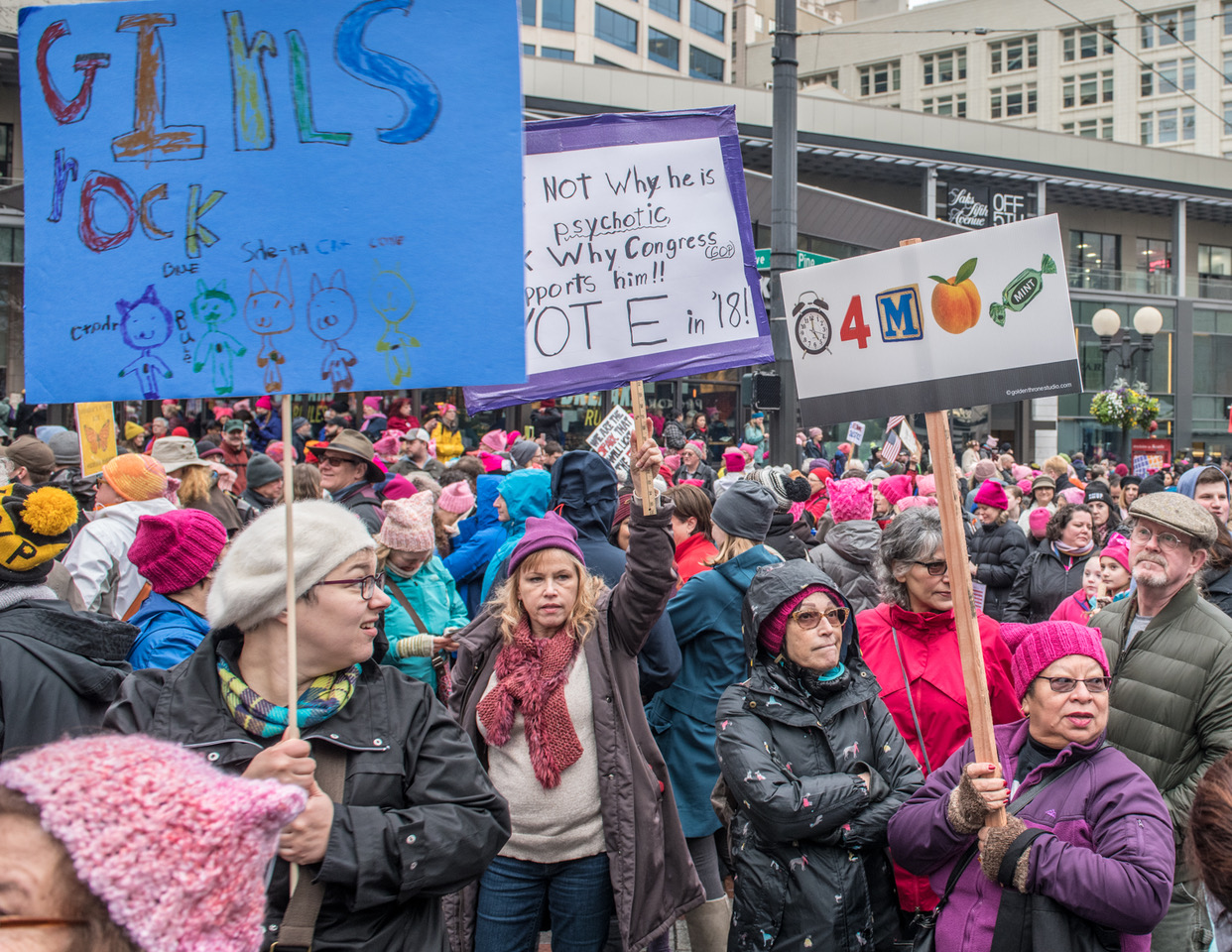
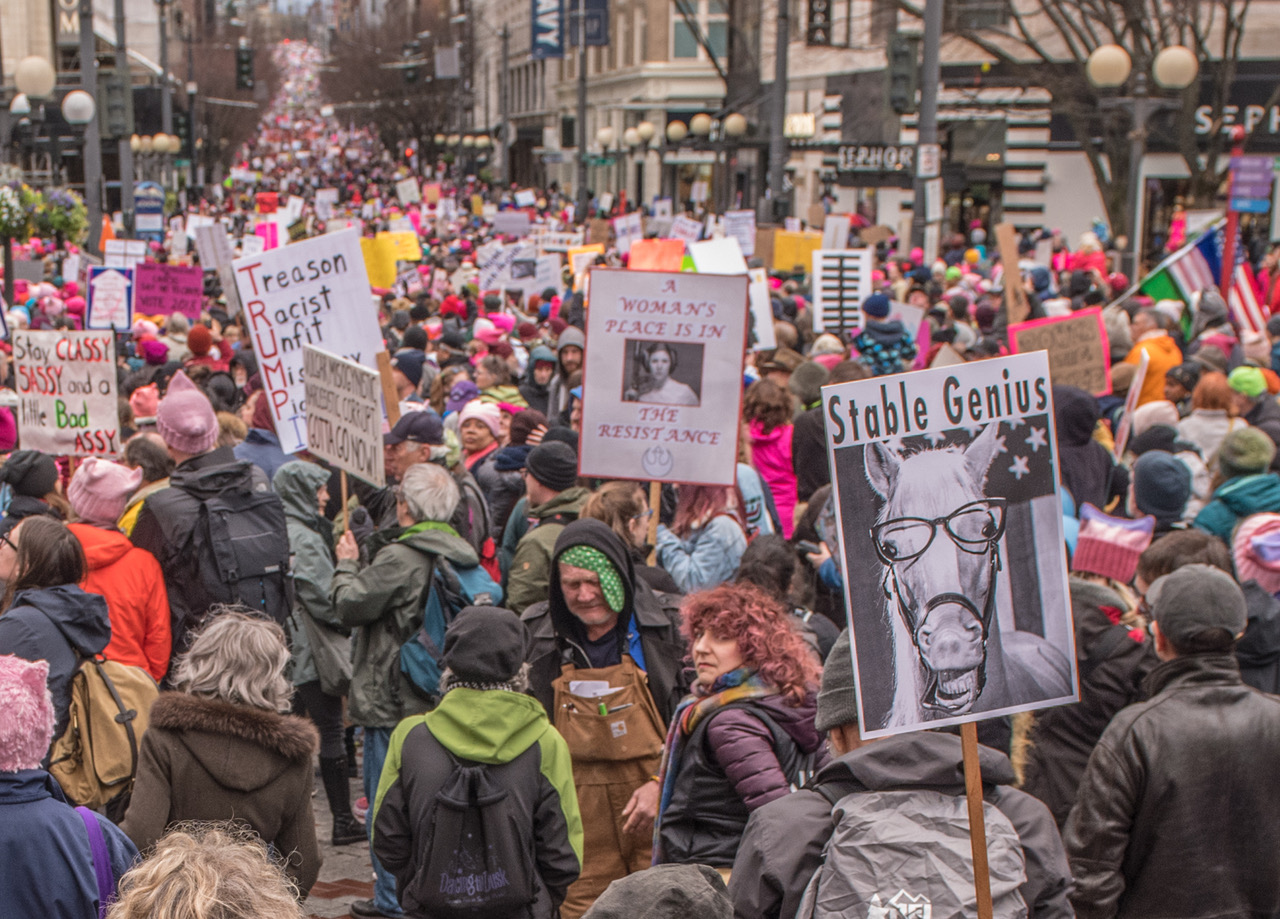
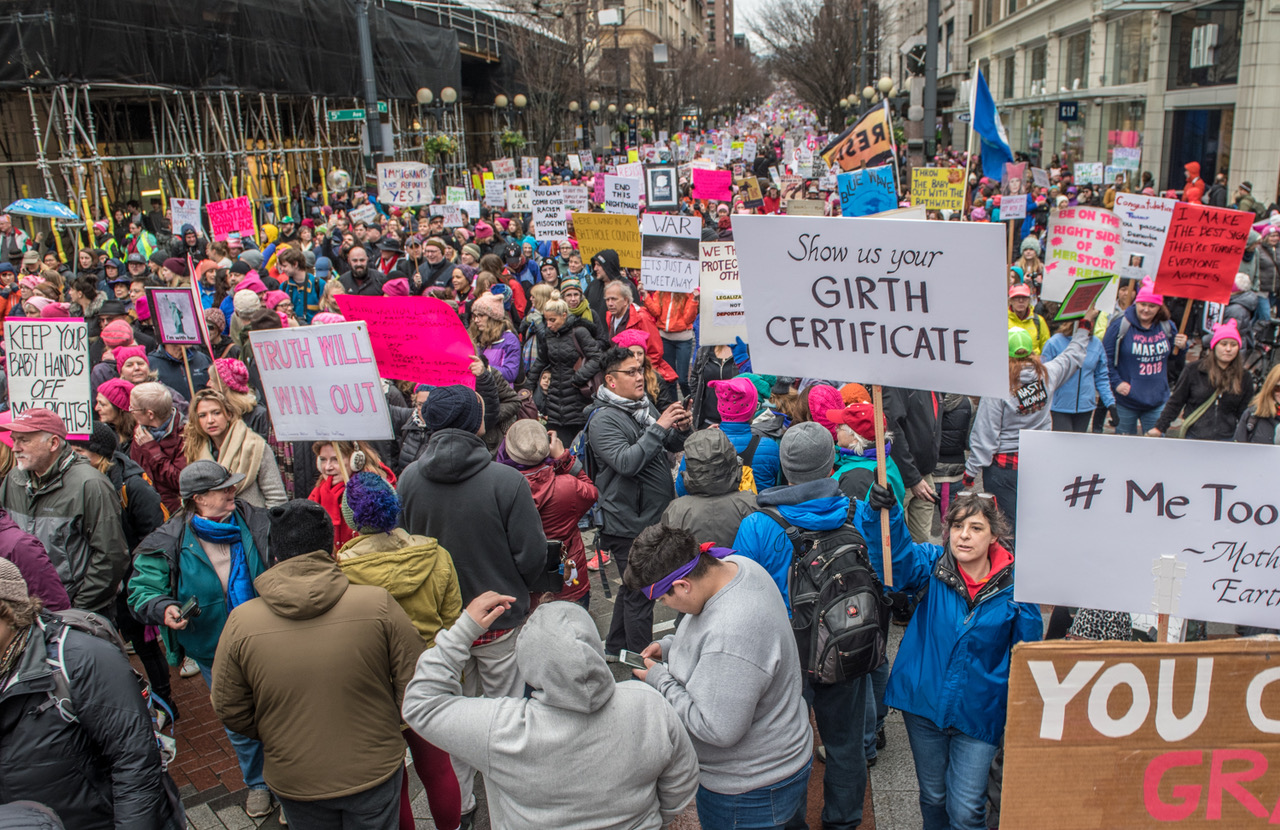
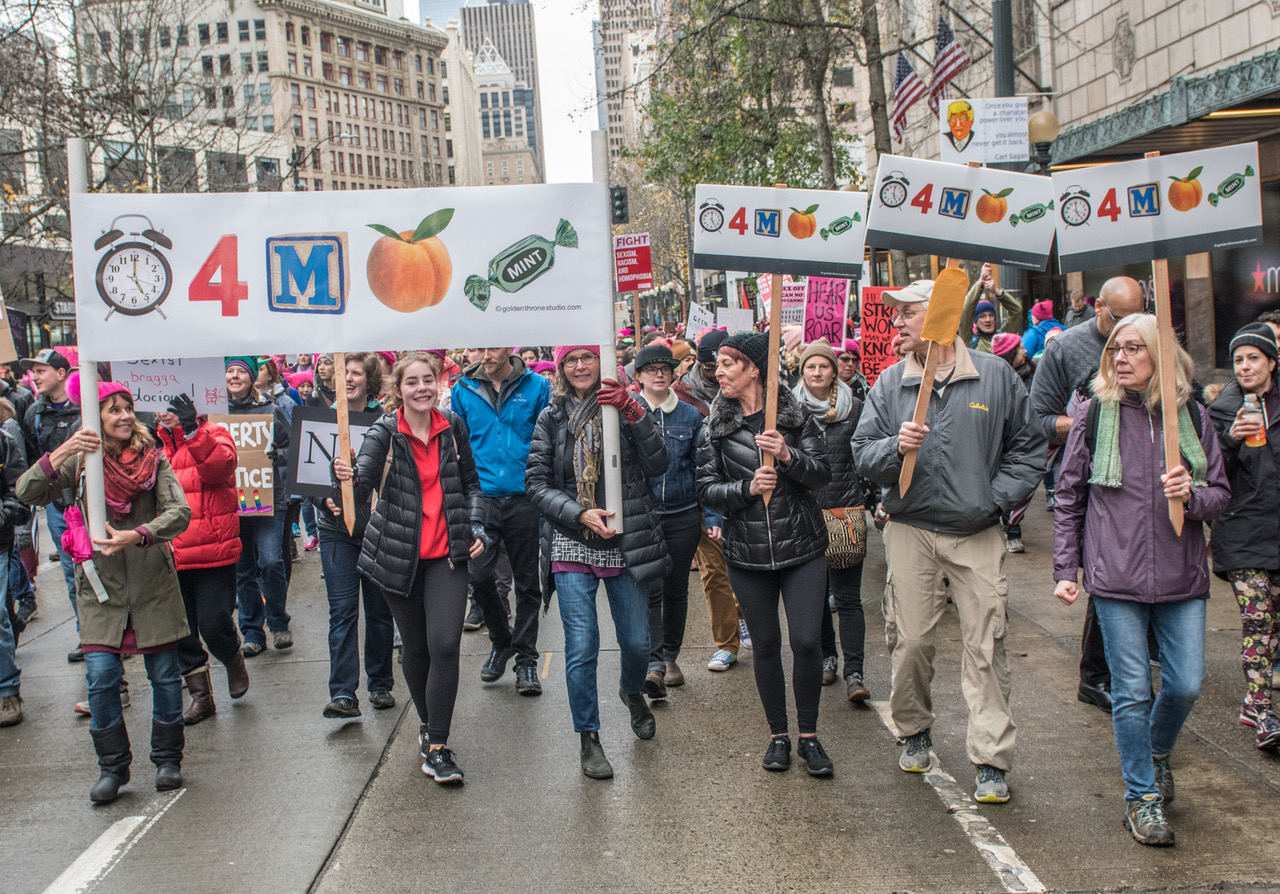
THEN: Fewer than fifty years before this 1953 parade was photographed on Fourth Avenue, the block between Pine and Stewart Streets negotiated, barely, one of the steepest streets on Denny Hill.NOW: On Saturday January 20, last, the second annual women’s march made its turn here from Pine Street north on to Fourth Avenue for its last leg to Seattle Center.
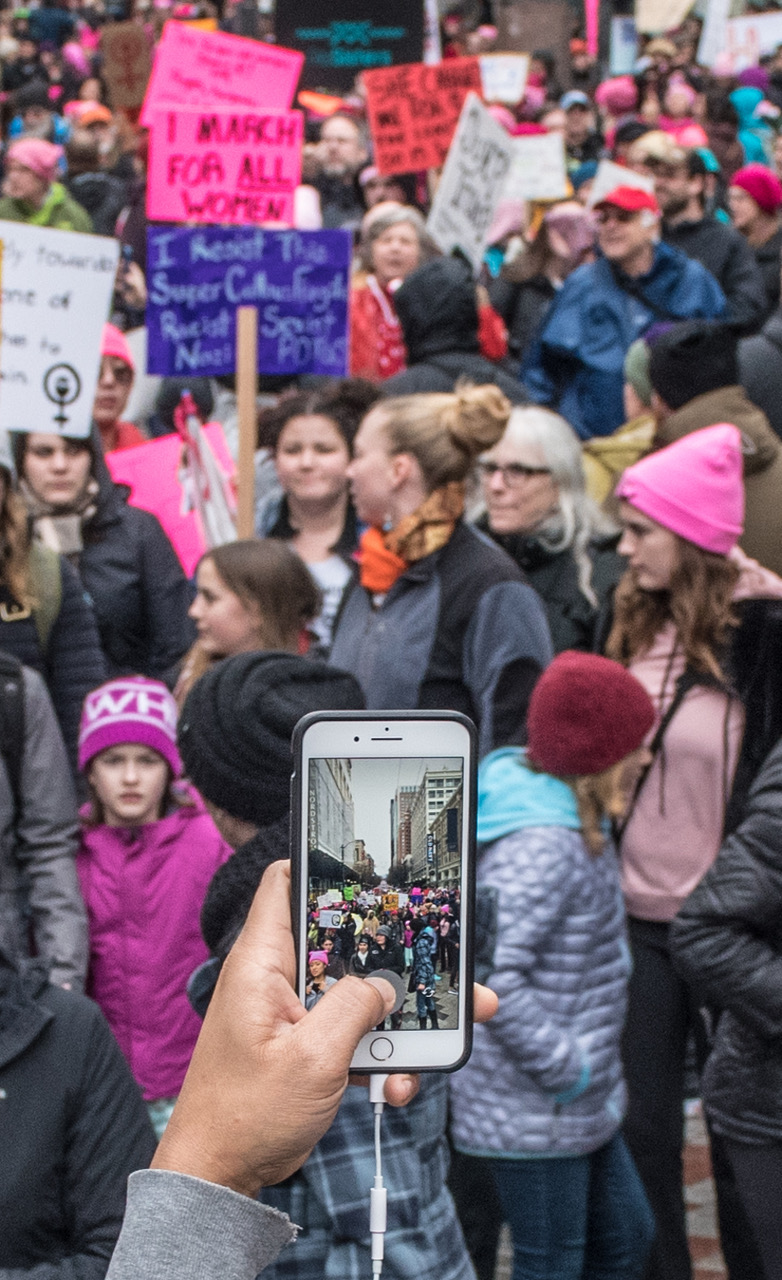
Here we compare Jean Sherrard’s confident and colorful farrago of the recent Women’s March with a manly marching band heading south on Fourth Avenue sixty-five years ago. Its baton-wielding leader is entering the crosswalk of Fourth’s intersection with Pine Street. We have not found the name for this marching band, but hope that the uniforms might be clue enough for an astute PacificNW reader to let us all know. We do know the occasion. It is the Memorial Day parade of May 30, 1953.
The same east side of Fourth Avenue only fifty-two years earlier during the 1911 Potlatch Parade. The Carpenters Hall was built by the local for the carpenters union and was also home for the Hotel Ritz.
The block-long line of businesses on the east side of Fourth includes, right-to-left, the Ben Paris, Raff’s Shoes, the Hotel Ritz, the Up & Up Tavern, Sherman Clay Co. music store, and last, at the southeast corner of Fourth and Olive Way, the still floating Mayflower Hotel. On the out-of-frame west side of Fourth, the Bon Marche Department Store was a block-long point of prestige for its neighbors.
Years later the Mayflower Hotel at the southeast corner of Fourth Avenue and Olive Way and next to it the modernized front of the Sherman Clay Music Store.
Raff’s Shoes was, I think, an economy chain. I remember purchasing a pair of Raff loafers at its Spokane branch, also in the early 1950s. (I may still have them in storage.) Carpenters Local No. 131 built the Hotel Ritz in 1906. It continued to serve as a parody of the Parisian Ritz until well after WWII. Next door to the north, the Sherman Clay Company was Seattle’s music mecca, selling not only instruments but concerts and tickets to them. The coast-wide chain began in San Francisco around 1870. In 1929, when the ornate home on Fourth was about to open, its Seattle manager ironically boasted – just before the Great Depression – “It will be more than a store. It will be a very real Cathedral of Music.” Here on its marquee in 1953, more neon flash is given to radios than to pianos. The Seattle store closed in the fall of 2013. It was the last of the chain.
A Seattle Times clipping for Sherman Clay from July 25, 1920.
We’ll conclude this little cityscape sketch with the once very popular Ben Paris, the combo sporting goods store/restaurant on the far right. We’ll quote from notes Seattle Time’s humorist Emmett Watson shared before his passing in 2001. Emmett interviewed his friend Guy Williams, a wit and legend among local promoters and publicists. Emmett asked Guy and Ivar Haglund, the fish restaurateur who sat next to him, “Where did you guys hang out in the 1930s?” Guy answered, “Ben Paris. Everyone was going there. You could cash your check – if you had one. Get your shoes shined. Shoot snooker. Play cards. Get a roast beef sandwich with plenty of gravy. I mean that was one great place . . . There’s been nothing quite like it. There wasn’t a phony thing about it. There were fighters in there, newspaper guys, politicians Ivar answered “Oh, that was wonderful!”
The Whittelsys caught by a candid camera on April 17, 1937. Through the years of this feature we have used a few Whittelsy cityscape snapshots. The public works department employee and his poet wife lived on the north end of Capitol Hill.
WEB EXTRAS
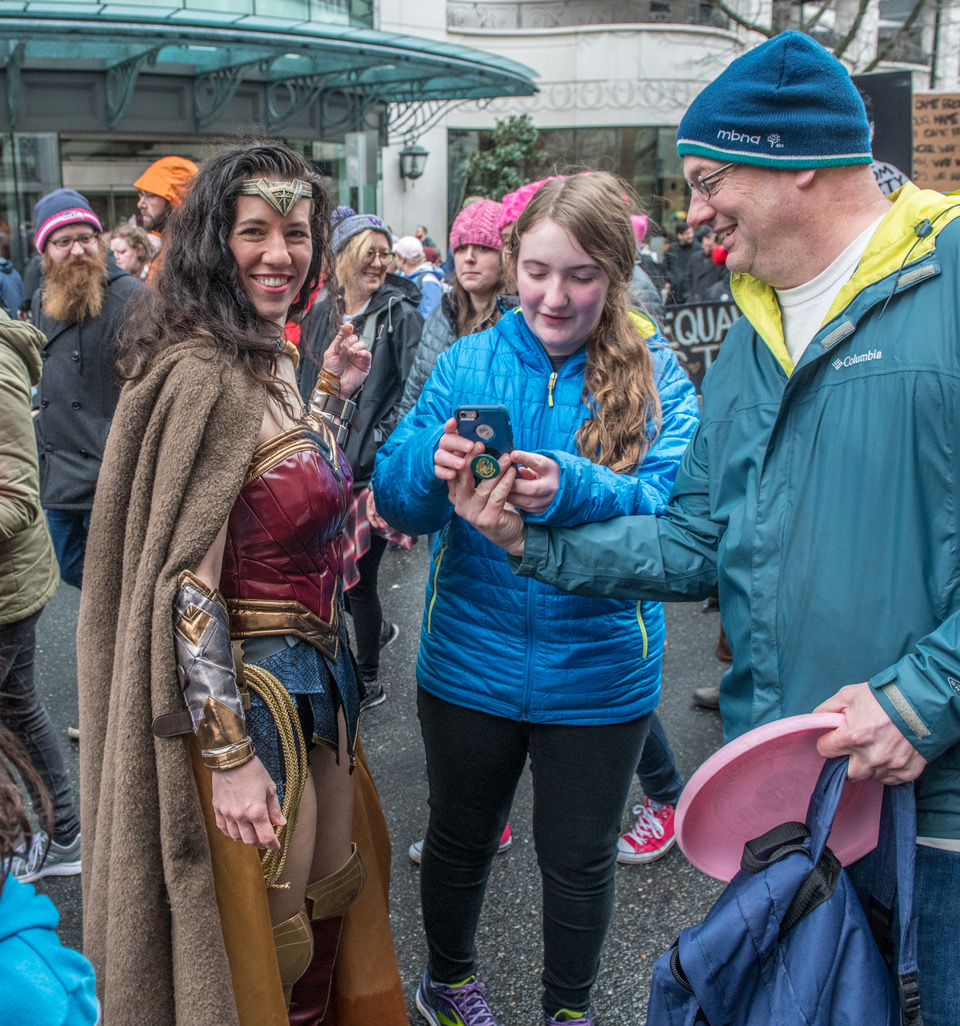
My contribution this week, a few random shots from the Women’s March.
Coming down PineCellphone photos aboundWonder Woman marches too, impervious to cold and rain
============
Anything more to add, kids? Sure PaPa Jean, and more of the same or similar. By now many of these should be familiar to our readers, recalling now that “repetition is the mother of all learning. (Our mothers taught us that.” We will include at the bottom (or near it) MORE PARADES with terse captions. First, Ron’s pulls of nearby and recent features.
======
=====
First appeared in Pacific, June 1, 2008This ca. 1882 look south on Commercial Street (First Ave. S.).was photographed from the Occidental Hotel and like it everything in photograph was destroyed during the 1889 Great Fire, except, of course, for the ruins.
=====
First appeared in Pacific May 11, 1986. Hence the NOW above it thirty-one years old. I shot is from a window in my friend and mentor CLICK CLICK to ENLARGE
=====
A circus parade looking north on Second Avenue from near Spring Street. The Denny aka Washington Hotel is on the horizon. We have long ago written a feature about this photograph but it is not yet scanned in toto, i.e. with text and the “now.”.
=====
POTLATCH PARADES SAMPLER
1912, First Ave. S. and Washington Street.Potlatch Dad’s Day parade, looking north on 2nd Ave. to Marion Street.1912 Potlatch parade totems, looking north on Fourth Avenue from near Virginia Street, the parade’s review stand is on the right and Denny School at the northeast corner of 5th and Battery on the horizon.
=====
=====
1911 Potlatch parade with nearly new Central Building. Courtesy Michael MaslanFruit Harvest Float on Fourth Avenue, 1911 Potlatch Parade.
=====
PREPAREDNESS DAY PARADE, JUNE 10, 1916 (Warming for WWI)
DOUBLE-CLICK to ENLARGE. The Seattle Union Record’s take on preparations for the 1916 Preparedness Day Parade. This may remind you of Trump’s proposed military parade.Looking north on First Ave. fro Seneca Street. We did a feature on this too, but like many others it is not yet scanned in toto.
A rare example of a pre-Jean NOW. I shot this for the Sept 17, 2006 feature. By then Jean and I were momentarily mixing the responsibility of the “nows.” Soon after this he would “take it over.”
The 1916 Preparedness Parade in Pioneer Square aka Place.
INDEPENDENCE DAY ON PIONEER PLACE (aks Square) ca 1900
=====
MORE MILITARY PARADING
Looking south on 4th Avenue over Stewart Street and Olive Way beyond it. The Time Square building – once the home of this newspaper – enters, barely, on the far right. I once knew the occasion for this marching and hope to sometime know again.A Word War I hoopla to recruit investors more than soldiers – it seems, at least, from the banner on the side of the parading tank. This was among a handful of Wesbster and Stevens prints that Old Seattle Paperworks proprietor John Hanawalt shared with me early on in my search for regional historical photos. Thanks again John. His shot is still busy on the Public Market’s lower level.
FAUX MILITARY PARADING
Looking south on Second Avenue through the Knights Templar arch built at the intersection with Marion Street, 1925..
=====
TWO PRESIDENTS OF THESE UNITED STATES
President Harding in Belltown.More of Harding on July 27, 1923. Not feeling well he died in San Francisco a week later on August 2, 1923. (Courtesy, U.W.Northwest Collection aka Special Collections. )Pres. Harry Truman in Seattle for his 1948 campaign.
=====
And NOW FOR SOMETHING COMPLETELY DIFFERENT – A PIONEER PARADE IN RITZVILLE, WA. Jean recorded the “now” for our book (now long out of print) of “Washington State Then and Nows”. Jean is currently at work on a fourth volume of SEATTLE NOW AND THENs, except it wont be titled so. Here’s Ritzville on our visit a few years back. To catch the red-suited marching band, Jean’s NOW is a bit wider than the THEN.
Ritzville’s Pioneer Tower and Modern Art at Washington and Main.
While the lunar new year (of the dog!) doesn’t actually begin until this coming Friday, festivities were begun today in the International District. Your faithful Now & Then operative was there to record a few repeat photos, but got caught up in the fun…
Using his 21′ extension pole, Jean shot high above the crowd looking west towards the King Street stationLion dancers about to parade through the streets. Firecrackers are crackling behind Jean’s back.Minutes later, Mayor Jenny Durkan arrives to kick off the celebration. Her young, somewhat tentative companion helped feed the lions
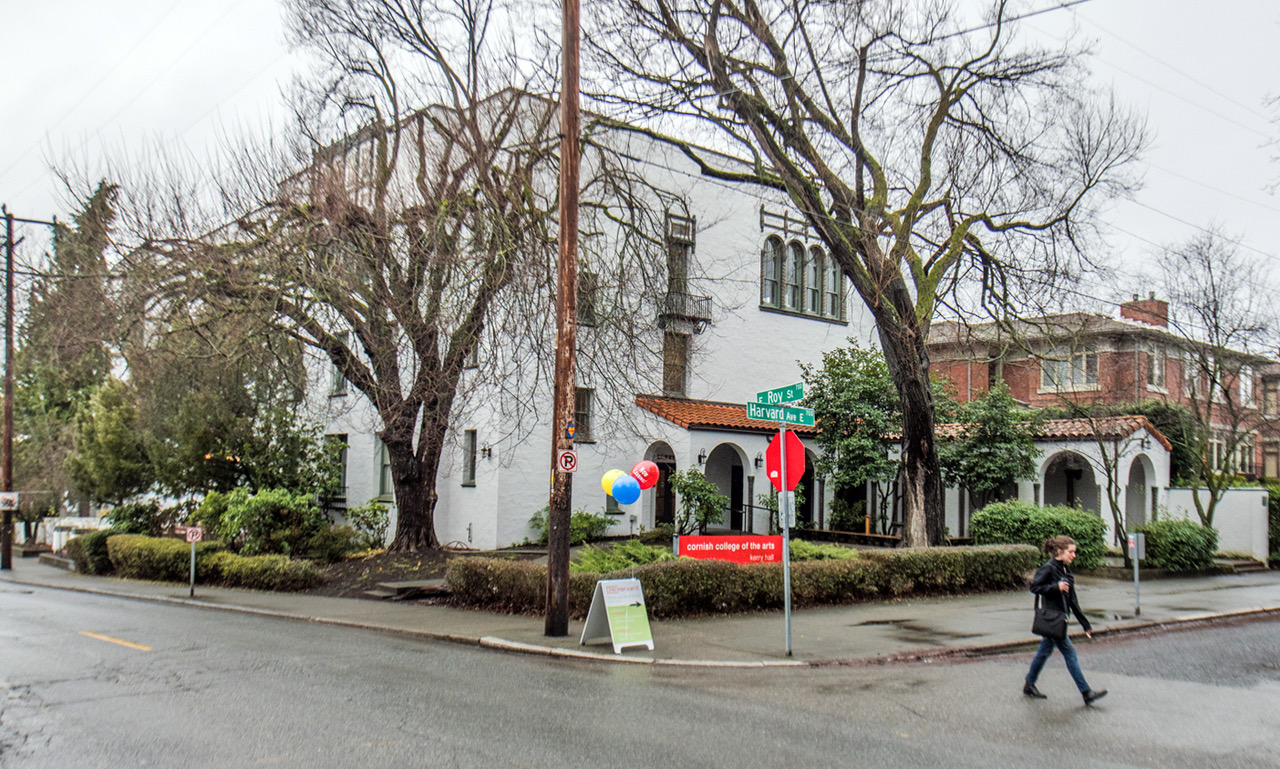
THEN: Cornish School under construction in 1921 at its new campus at Harvard Avenue and E. Roy Street. (Courtesy, Museum of History and Industry)NOW: The arts academy’s “purpose-built” home is named Kerry Hall for the philanthropist Mrs. A.S. Kerry, who co-founded the Music and Art Foundation that ran Cornish School as a non-profit.
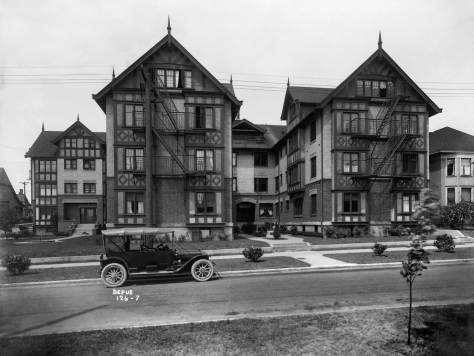
Cornish, a few years later aka “in the 1920s.”
11th Hour investing in Cornish construction. An adver clip from The Times for March 14, 1921.Advers from June 30, 1921 include the announcement that the Cornish move off Broadway to Harvard would be delayed but for only a few days.A clip from The Times for July 10, 1921Another Times clip from July 10, 1921.The Times summary of some of the events connected with the school’s dedication. A Times clip from July 24,1921.Nellie Cornish
Construction for the new campus of ‘The Cornish School for Drama, Music, Dance’ began on the first day of 1921. The work was rushed forward so that the school could open early in September, on time for the still young institution’s eighth season. Perhaps predictably, in late summer agents with homes to sell or apartments to rent in the neighborhood enhanced with this new landmark, began running classifieds for their properties with the message “near Cornish School” in both The Times and The Post-Intelligencer. That enticing landmark is under construction in this week’s “then,” although its bricks are not yet adorned with the ornamental tiles and stucco skin that still define its Spanish Colonial lines.
Cornish was founded in 1914 on Capitol Hill in the Booth Building at the SE corner of E. Pine and Broadway, less than a mile south of its new campus. (see below) After a year, in the summer of 1915, it featured two studios, five teachers and eighty pupils. The growth was impressive. Five years later when the enlarged and relocated academy was being planned and the cash to build it first pursued, the school held twenty-seven studios serving 1,154 pupils, led by twenty-six teachers. These halls of ivy then sometimes surely resonated with the reflecting sounds of rehearsing students. (I remember well that joyful, on the whole, noise in the early 1970s when I taught filmmaking to Cornish students, most of whom, like myself, could not afford to make films.)
This school of “allied arts” was founded by its namesake, the confident pedagogue-pianist Nellie Cornish. As late as the 1970s the often-convivial tone of her directions were still remembered by some as sometimes comedic. For instance, at one of the Sunset Club’s Masquerades Nellie proved her sense of humor when she won the “funniest costume” award. Cornish also frequently gave lectures, many of them before the city’s applauded Ladies Musical Club. (Would that there then had been smart phones with digital recorders.)
The Roy Street entrance to the Women’s Century Club served for about a quarter century as the popular door into Jim Osteen and Art Bernsstein’s (respectively, left and right), Harvard Exit Theatre.
For the featured photographs at the top both photographers aimed northwest from the fortunately irregular Capitol Hill intersection of E. Roy Street and Harvard Avenue. Following the Cornish example, this part of the Capitol Hill neighborhood became sophisticatedly snug when joined by the Woman’s Century Club and the Rainier Chapter of the D.A.R. (both built in 1925), and architect Arthur Loveless’s charming Studio Building. Historylink’s principal founder, Walter Crowley, describes the last in his National Trust Guide to Seattle (1998), as a “delightful mimic” of England’s Cotswold villages. Crowley notes that to the north and west of this prospect are the admired homes that make this Seattle’s only residential preserve, the Harvard-Belmont Landmark District.
WEB EXTRAS
Anything to add, boys? For sure Jean, and Ron will start again with some recent* features and I’ll follow with some scans from older clippings. (*Since we started the blog about ten years ago. Jean will know, but he sleeps.)
============
=====
=====
=====
=====
First appeared in Pacific on March 31, 2002
=====
=====
First printed in The Times on March 3, 2002
=====
=====
=====
=====
=====
======
======
======
======
======
First appeared in Pacific on Sunday January 21, 1990.
THEN: The bank’s namesake president, Dexter Horton, somehow missed this 1882 portrait of bank employees and officers. Horton may have been enjoying a president’s leisure – perhaps duck-hunting. Surely he was not golfing, the sport that first reached Seattle in the mid 1890s on a converted Wallingford cow pasture. [CLICK to ENLARGE] NOW: In the early twentieth century the bank’s rebuilt and enlarge Dexter Horton Building at First South and Washington Street was renamed the Maynard, after another pioneer, David (Doc) Maynard. Later the Dexter Horton Bank moved north to greater financial glories in Seattle’s first financial district. [CLICK TO ENLARGE GREG LANGE]
THEN AGAIN: The sturdy frame – but not the roof – of the Dexter Horton Bank at the northwest corner of Washington and Commercial Streets was one of the few survivors following the city’s Great Fire of June 6, 1889. Details of the bank’s vault, shown in tact in this week’s featured photograph, can be seen on the back wall through the bank’s missing but still guarded front door.The back of Peiser’s print, beside celebrating his talents (those you must read upside-down), has pasted to the back three labels explaining who has the original, the name of the subject, its date, and the blue pen revelation of the five men in the photograph, and the name and date (1953) of the person who donated it to the Museum.
Theodore Peiser, one of pioneer Seattle’s most gifted photographers, is recorded as arriving here in “the early 1880s.” The various accounts run from 1880 to 1883. Part of the problem of tracking his arrival is that much of his earliest work was destroyed in the city’s Great Fire of June 6, 1889. But not this print. For this 1882 recording, Peiser has pressed his back against the front wall of Seattle’s first bank, the Dexter Horton at the northwest corner of Commercial (First Avenue South) and Washington Streets.
Roland Denny was a baby in his mother Mary’s arms when the “Denny Party” landed at Alki Point in the fall of 1851. Roland survived into the late 1930s and his last years were by habit celebrated with news stories and photographs on Founders Day.
On the back of the photo, the names of the five suited men are listed, four within the counter and one without. Not surprisingly, the formally attired two on the left were members of Seattle’s advantaged ‘One-Percent.’ Norval Latimer, far left, ultimately became the director of the bank. Arthur Denny, often referred to as “the city’s founder,” stands at the center, his graying hair contrasting with the dark interior of the bank’s vault, seen through its steel-framed open door. Denny’s position as vice-president lent the bank some status and no doubt allowed him to stay busy managing the sale of the hundreds of parcels or lots carved from his and his wife Mary’s 1852 donation claim, which included most of what is now the city’s Central Business District.
With his family Norval Latimer poses in the family car in front of the family mansion on the southwest corner of Terry Avenue and Columbia Street. The south tower of St. James Cathedral tops the photo on the right. Latimer’s driver sits beside him in the front seat. Norval didn’t drive. Motorcars first arrived – barely – on Seattle Streets in 1900, eighteen years after Peiser photographed Latimer posing like a banker in his bank. (Click to Enlarge)
To the right of the attentive Arthur is his dark-haired son Rolland, who was the bank’s teller. He was a mere baby when his parents and their entourage of settlers, the Denny Party, first landed at Alki Point in 1851. Behind Rolland is B. J. Biggs, the bank’s clerk. Busy with Biggs, and facing him from this side of the bank’s impressive counter is Captain Norman Penfield. Although posed here as a customer, Penfield was a partner with Arthur Denny and Dexter Horton in the Seattle Gas Light Company, and served as its builder and superintendent. In the “now” photo, King County Archives Reference Specialist Greg Lange sits at the Sovereign bar comfortably close to Penfield’s position at the bank’s counter.
Greg Lange, earlier on First Ave. S., behind the counter of what was the Taylor Bowie Book Store. [Click to ENLARGE GREG LANGE] Archivist Lange is a popular lecturer on how to do house history. He is also an expert on Pioneer Square history. While in the featured photo he sits at the bar facing bartender Nat Mooter, Lange explained that following the city’s Great Fire of June 6, 1889, Commercial Street was both lifted – about eight-feet at this corner – and widened from sixty-six feet to eighty-four. Therefore, Lange is sitting at a basement elevation that is about the same as the street’s pre-fire elevation, while because of the street’s widening, his chair should be more properly moved east, somewhere under the sidewalk.
Lawton Gowey kept good track of the changes around Pioneer Square. Here he records the grand entrance to the Maynard Building. It has been freshly clean during the building’s restoration. The small “buttons” attached to the bricks between the open windows on the second and third floors are part of the retrofitting for earthquakes. Lawton dates this slide, June 14, 1974.
WEB EXTRAS
Anything to add, kids? Have we failed you yet Jean? Or the readers – our readers Jean?
Founded in 1906 by the famous Chartier family, this Bouillon (old brasserie) is listed as an historical monument, with its Art Nouveau façade and interiors. This style brought fancy after the architectural uniformity imposed during the construction of Haussmann buildings 30 years before and even now!
Bouillon Camille Chartier has become Bouillon Racine located 3 rue Racine Paris 6eme
Fondé en 1906, par la célèbre famille Chartier, ce Bouillon ( ancienne brasserie) est inscrit aux Monument historiques, par sa façade et sa décoration intérieure Art Nouveau. Ce style, apporta de la fantaisie après l’uniformité architecturale imposée lors de la construction des immeubles Haussmanniens 30 ans auparavant et même maintenant.
Le bouillon Camille Chartier est devenu le Bouillon Racine situé 3 rue Racine Paris 6eme.








 =====
=====






 At Église Saint-Étienne-Du-Mont


