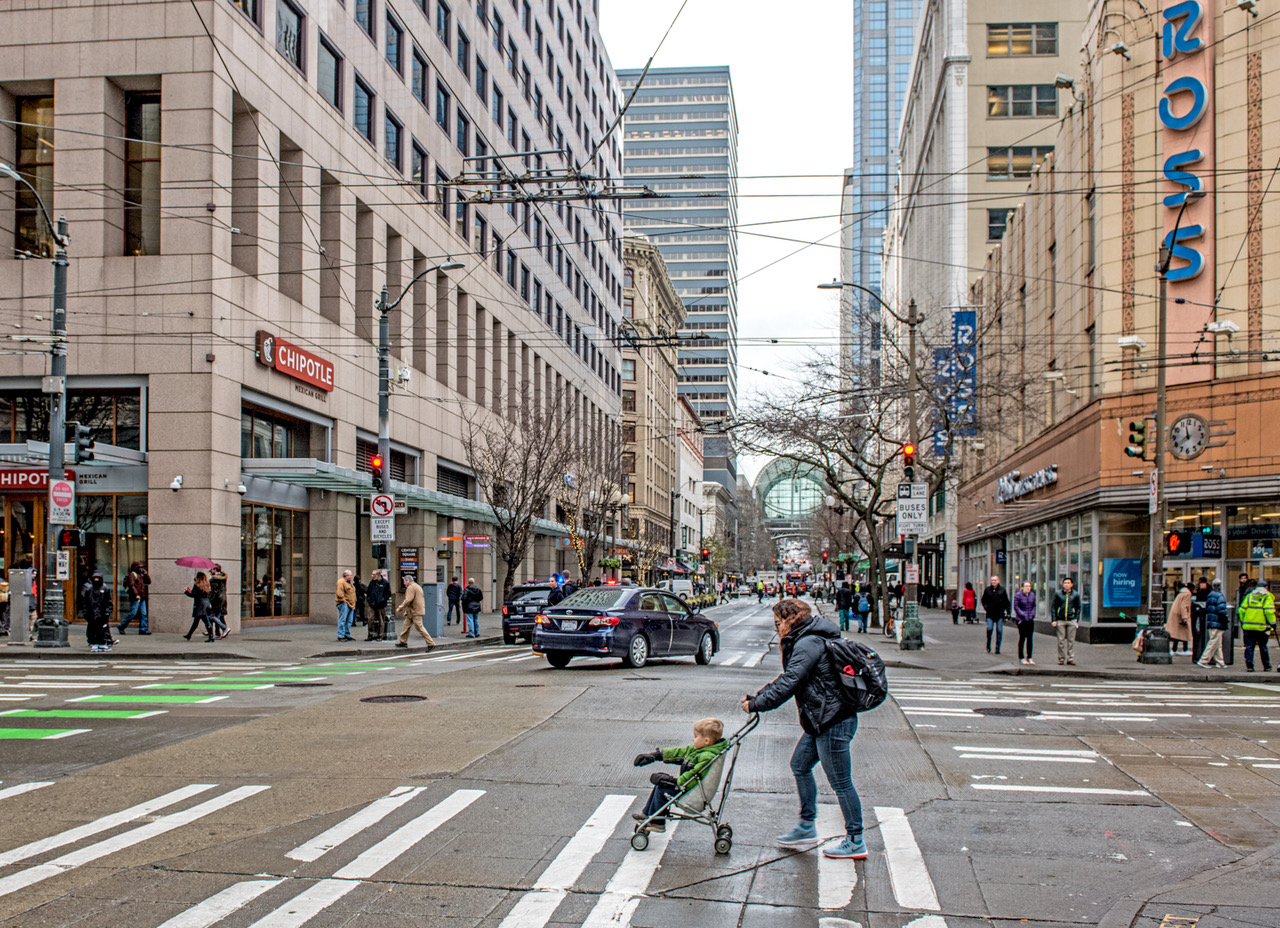
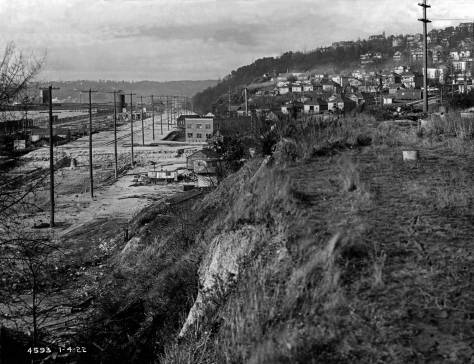
THEN: Thanks to Larry Lowry who long ago shared with me this grand photograph of Dreamland. He noted, “My grandfather, Waverly Mairs, was the ice cream maker at the old Seattle Dairy.” Perhaps, Waverly is also in the photograph.NOW: The Eagles Auditorium replaced Dreamland in 1925. In 1983 the Auditorium was placed on the National Register of Historic Places. It became the home of ACT Theatre in 1996
Once cameras could be used comfortably out-of-doors, one of the sustaining services promoted by commercial photographers was portraits for families posing on the porch or front yard and businesses that grouped owners with their employees in front of the shop or factory that supported them. This week’s feature has both, with a variation.
Pulled from The Seattle Times for August 20, 1934
The man in the dark suit nearest the camera is probably Syvert Stray, proprietor of the Seattle Dairy. He is standing beside, we assume, his wife Lillian, while holding onto the high wagon chair where his daughter poses for the professional photographer. Down the line are the horses and drivers for Stray’s five milk wagons. The twist in this group portrait is that the subjects here are not posing beside the
Shot from the roof of the Cambridge Apartment-Hotel, the Seattle Dairy is boldly signed – right-of-center – at the front of the dairy’s factory on the south side of 8th Avenue. The dairy is one of the exceptions – it was built of bricks. (The accompanying details from the 1908 and 1912 Baist maps show the dairy only in the later one at 1415 Eighth Avenue. Most of the Dreamland roof shows upper left and beside it, to the right, the Unitarian Church with its clipped tower. (By the time of the above photo the Unitarians had moved up to Capitol Hill.) Surely one of the two gas stations are a McKales, and under the management of the milkman Stray and his son. Details of Baist Maps, 1908 on the left beside 1912. {CLICK to ENLARGE]For comparison with the two Baist maps above here is a detail from the ever-helpful 1925 Kroll map of the Seattle Business Section. University Street is on the far right, followed by Union, Pike, Pine Streets leading to the split where Howell Street begins off of OLive Street (or Way). Eagles Hall is marked at its corner of Union and Seventh one block to the left from the details’ east border (far-(right) with University Street. Seattle Dairy can also be bound on Eighth Ave. “behind” the Eagles.
company’s office and/or livery on Eighth Avenue. Rather they are around the corner from it on Union Street. The reason is obvious. They are sharing the splendor of a new and magnificent neighbor. This is the showy south façade of Dreamland, a hall that filled the northeast corner of Seventh Avenue and Union Street.
DREAMLAND at the northeast corner of 7th Avenue and Union Street.The Dreamland interior on November 17, 1911..
This ornate landmark could have held a hundred horses but never did. Rather, it was made for entertainments and engagements. From its arching roof to the hardwood floor this big room was made for dancing, skating, conventions, banquets and shows of many sorts. It was often decorated with streamers hanging from the ceiling. Dreamland was also the political platform of choice for progressives, labor unions, and political campaigning. The dances thrown here were big ones. And the sweating populist spectator sports of boxing and wrestling could fill the place.
Dreamland’s adver. for its opening in 1906.
From its beginning, Dreamland was promoted primarily as a roller skating rink. The opening was “by invitation” on October 14, 1906, for the Monday Night Skating Club. The following night it was promoted in The Times as “the ideal rink for discriminating skaters… with Prof. Chas L. Franks and his daughter Lillian “performing as Champion Fancy Skaters.” Stray, Dreamland’s dairyman neighbor, was also into roller skating, sponsoring a competitive team in the Seattle Roller Hockey League.
“Give a little, Take a little,” Stray gets a deal on a new Rothweiler
In 1915, after Stray bought a Rothweiler truck, an illustrated advertisement of the purchase appeared in The Times. Like the milk wagons Stray was replacing, his new truck was partially covered with a sign naming his dairy. Stray’s spirit for internal combustion developed into his second entrepreneurial passion, as director of McKale’s Inc., a small chain of stylish service stations. The number one McKale’s was on the northwest corner of Union Street and Eighth Avenue, two doors from Stray’s Seattle Dairy.
A McKales on Broadway, ca. 1937. This is the intersection with Roy Street where Broadway “splits” to either side of McKales. From here going north it is still Broadway on the west and 10th Avenue East on the east.
Born in Christiansun, Norway, in 1871, the seventeen-year-old Syvert reached the U.S. in 1888 and Seattle in 1902. Prior to his death in 1934 Stray was a life member in The Fraternal Order of Eagles, whose elegant aerie replaced Dreamland at Seventh Avenue and Union Street in 1925. Since 1997, it is a corner where the play has continued with ACT Theatre.
A flyer for the first Eagles light-show concert, a benefit for FUS, the Free University of Seattle on January 14, 1967. We were “busted” by the police department’s dance squad, a good-cop bad-cop combo, for violating a “shadow dancing” ordinance from 1929. We convinced the team to let the show go on if we turned the lights up, which we did – sort of.
WEB EXTRAS
Anything to add, dreamers? Yup Jean, Ron Edge is now laying upon us a few recent and relevant features and I’ll follow them with some older ones
THEN: An unidentified photographer looks southeast through the intersection of Third Avenue and Union Street during Seattle’s first-ever multi-day summer festival, the Elks 1902 Seattle Street Fair and Carnival. (Courtesy, Lawton Gowey)NOW: In 1903, a year following the Elks’ fair, the southeast corner of Third Avenue and Union Street was given to the Beaux-Arts construction of Seattle’s Central Post Office. It was demolished in 1958 and replaced with the glass-curtain facility still used today.
The arch standing here at the southeast corner of Union Street and Third Avenue was short-lived, like every other ceremonial ornament contrived for the Seattle Street Fair and Carnival, assembled and produced by the Seattle Elks Lodge for thirteen sunny days in August 1902. This arch, the only rustic one, was the odd one of four built for the fair. It was a vernacular showpiece with a somewhat exotic shape, covered overall with cedar shakes, making it regional, while wrapping it with electric lights made it modern.
Elks Carnival ticket booth on Union Street, west of 3rd Avenue.
The other three arches, by contrast, were all-white, reminders of the also temporary Beaux Arts architecture of Chicago’s 1893 Columbia Exposition. The two largest spanned First and Second Avenues widely enough to permit electric trolleys to pass through. With their ornamental splendor, the three classical arches were also unwitting
1902 Elks arch at the intersection James Street and Second Avenue – looking north on Second. Seattle Hotel is on the left and the Collins Building (still standing) is on the right.
premonitions of Seattle’s own World’s Fair, its 1909 Alaska-Yukon-Pacific Exposition. One of the three crossed Union Street about a half-block behind – west – of the unnamed photographer. With two booths asking for the ten-cent admission, it served the fair as the main ticket gate to the fenced celebration.
Elks arch on First Avenue looking south on First..1902 Elks carnival arch at First Avenue and Columbia, looking east on Columbia.
The dime paid for everything that was spread about on the acres selected from the former University of Washington campus. The off-campus Third Avenue block between Union and University Streets was also lined with booths, and Union Street as well, from
1902 Elks on Third too – looking south on Third Ave. with Union to the back.
the ticket booth east into the old campus that was covered with tents such as the one seen on the far right of this week’s ‘then’ photograph. And nearly everything was enveloped in strings of electric lights. The Elks promised that the grounds at night would be “almost as light as day.” Some of the exotic thrills inside the fenced tents were an “Arabian trainer in a den of lions,” a “cage of leopards,” “Jabour’s Oriental Carnival and Menageries Company,” and “a troupe of 160 Orientals, Turks, Assyrians, Egyptians, East Indians, Japanese,” in addition to “dozens of unusual things.” The Elks fair was also distinguished and promoted by daily parades through the city streets. One of the attractions was a “ladies band with eighteen pieces.”
Looking east on Union from Third Avenue during the 1902 Elks fair. The Armory stands mid-block, left-of-center.
Although exceptionally civic-minded, the Plymouth Congregational Church, on the far right at University Street, was not inside the fenced fair grounds. The Armory, the structure with the long roof half-hidden behind the arch, was. Among its many well-promoted events was a contest in the “pretty booth” with prizes for the prettiest girl and the handsomest boy and also “the largest and fattest baby 16 months old.” The judge was a local doctor who prudently fled the Armory following the contests.
This particular chubby baby is a laughing hoax and not the prize-winner noted in the text. We known nothing at all about this baby but that we hope its parents fed him both well and less.
WEB EXTRAS
Anything to add, lodge members? Yes Jean, and we remain faithful to your designs. Before putting forward Ron’s links we will add three more illustrations of the southeast corner of Third Ave. and Union Street: from top-to-bottom, the corner cleared, building the Post Office, the modern class-curtain post office proposed by its architects. Their rendering looks considerably better than the thing itself, however, we recall the Latin aphorism on taste (that we may have misspelled). “De gustibus non desputandum est. ” or “taste is not debatable” except that is surely is debated.
THEN: The prospect looks east on Yesler Way through its intersection with First Avenue. James Street enters the five-star corner left-of-center.NOW: The post-1889 Great Fire Pioneer Building, far left, still holds to its landmark northeast corner of First Avenue and James Street. At least five of the brick landmarks showing in the 1908 photo are still in their place in 2018.
Jean and I first used this Pioneer Square classic years ago on the back cover of our now long out-of-print book, Washington State Then and Now (2007). We described the crowded scene as a celebration connected with Seattle’s summer-long 1909 Alaska-Yukon-Pacific Exposition (AYP). It seemed like a reasonable claim at the time, but it was wrong. We missed both the subject’s evidence and lack of it. There are no AYP signs or flags anywhere to be found. But there is lots of patriotic bunting, especially American flags.
Fleet Week 1908 looking south on First Avenue from Madison Street.
The best clue for identifying the occasion is spelled out in the line of pennants hanging near the top, showing the last five letters for “WELCOME.” The location is Pioneer Square, when it was still more popularly called Pioneer Place, during the four-day visit of Pres. Teddy Roosevelt’s Great White Fleet. Leaving the east coast in December 1907, it required fourteen months to circumnavigate the world with its military parade. Most likely the scene was photographed on May 26, 1908, following the completion of the Grand Parade for the welcomed visitors, It started that morning, but in the photo the pedestrian celebrants cast afternoon shadows.
Fleet Week bunting adorning the Frederick Nelson Department Store, which was then at the northwest corner of Madison Street and Second Avenue. (Courtesy, Michael Maslan)
The popularity of what Seattle called its “Fleet Week” was both overflowing and depleting. Crowd counters estimated that 400,000 watched the parade. Downtown businesses were more than willing to decorate their facades with flags and patriotic festoons; many of the decorations were stunning. Five days before the parade The Seattle Times announced “Seattle Has A Bunting Famine. Merchants were unable to supply another yard of acceptable decorating material to patriotic customers (and) Tacoma and Portland were unable to help.”
Another business block on the parade route, the Haller Building at the norhwest corner of Columbia and Second Avenue. (Courtesy, Michael Maslan)
Most of the fleet’s admirers came from Puget Sound, and extra Mosquito Fleet steamers and passenger trains were enlisted to bring the eager hordes to witness “the largest sea-fighting machines in the world.” The trains were often stuffed beyond standing room, and many seekers from distant communities were left standing on depot platforms. Visitors who managed to reach Seattle often had to camp in the parks. The temporary tent, showing left-of-center in the photograph, tries to help. Its sign reads: “Free Information Bureau, Strangers Directed to Furnished Rooms.”
On Monday, May 25, The Times headlined “Thousands Visit Ships … With every detail outlined by the bright sunshine which followed the dreary rain of yesterday, the eleven huge, white fighting machines now at anchor in the harbor lay in stately majesty in a wide crescent that stretched from Smith’s Cove to the south end of the harbor.” Earlier, when the fleet headed north from their California visits, they inspired thousands of Oregon citizens to sortie to their coast expecting to see the dozen dreadnaughts steam by. However as brilliant as the big ships could be reflecting the fleet’s “peacetime color, white,” the Oregonians saw nothing of the distant White Fleet, except its smoke darkening the horizon.
Another lavish bunting hirty-five years earlie. The Arlington Hotel at the southeast corner of Main Street and Commercial Street (First Ave. S.) celebrates the 1883 visit to Seattle of the Northern Pacific (NPRR) entourage following rr-magnate Henry Villard cross-country with the completion of the NP to Tacoma, which while a point of profound disappointment for Seattle was transcended by the end of the 1890s when the NP began giving full service to Seattle.
We’ve attached a direct closing here for the Fleet Week feature above with another below, a scene on Second Avenue , or beside it showing some of the crowd that paid for their bleachers seats here at the southwest corner of Second Avenue and Virginia Street. (The prospect looks to the northwest.) This added feature includes an array of Fleet Week images including photos of the fleet itself both on the way and in the bay.
WEB EXTRAS
Just for fun, on this lovely near-Spring day, let’s jump across town for a few cherry blossoms, seen from on high with my 21-foot pole. ‘Tis the season for Asian wedding photos – there were five or six sessions going on with tuxedoed grooms and blushing brides through the cherry trees! Enjoy! (A version of one of these shots will appear in a future column):
Anything to add, lads? Fall to the Bottom for Seasonal Salubrious advice Jean.
=======
=====
=====
First appeared in Pacific, March 16, 2003
=====
=====
=====
=====
=====
HOSPITAL ZONE – QUIET PLEASE
====
PAIN IN YOUR STOMACH
=====
=====
EXTRA: SSS A SPRING SKIN WARNING for ERUPTIONS OF EVERY CONCEIVABLE KIND
PULLED forward for the coming season from the Times of June 20, 1904. THIS WILL COST YOU NOTHING.
The Pike Place Market has been one of my stomping grounds since my early teens. Formative place – the first beer I actually purchased was in Post Alley’s long-gone Victrola Tavern at the age of 15 (still in costume as Laertes in a production of ‘Hamlet’ at the Stage One Theatre).
Yesterday, I watched the Pike Place Market Historical Commission at work and was impressed once again by their commitment to fostering and maintaining a thriving market, accessible and accountable to locals and tourists alike.
A few more photos, taken in glorious daylight saving time while the sun sets over a closing market.
Looking directly down Pike – the lovely Market steps descend to the waterfrontLovely even in reverseThe Antwerpen Express out of Hamburg is towed into portEnd of the day…
Every sunny weekend in the Pike Place Market is a revelation – a flood of people, light, and color. In addition, yesterday there were a number of celebrants of the East Indian Holi festival of colors. Here are a few candid shots that for some reason make me happy.
THEN: On University Way, ca 1939, when the 4300 block on The Ave was the busiest book block in Seattle. (Courtesy, Lawton Gowey)NOW: The Ave lost its rails in 1940 but kept its common carriers; this one is heading south to the Central Business District from the Maple Leaf neighborhood.
Heading south on The Ave (University Way N.E.), Seattle Municipal Railway car no. 511 was recorded mid-block between N.E. 43rd and N.E. 45th, very possibly by a rail fan, perhaps James Turner or Lawton Gowey. Both started waiting for and/or chasing trains and trolleys with cameras before World War II. They knew and admired each other and shared their well-wrought snapshots. (Much later Lawton and I did the same.)
Friend Lawton Gowey’s ID card with the city’s Water Department. Lawton was a collector, sharer and student of Seattle history, he also played the organ and led the choir of his church on Queen Anne Hill.By comparison, and for color, Lawton Gowey’s transparency (slide) of car No. 678 in West Seattle and on one of its last runs. Knowing Lawton, it may well have been its last. The car may be posing.
Running on route 15, car no. 511 is heading for Capitol Hill’s commercial arterial, Broadway, as seen printed on the reader board above the center window. The “double-ender” was one of twenty-five trolleys (500 – 524) manufactured in 1906 in St. Louis for use on the already roaring streets of this then (and now) booming city. All were one inch longer than forty feet, and all were scrapped in either 1940 or 1941.
Heading north on a congested University Way, cars 261 and 267 were also built in St. Louis although they are three years newer than the car featured, they too were scrapped in the early 1940s. This was a long exposure. Note the parallel light streams on the south-bound lane. They were “written” by a car that was apparently parked in from of Nordstom Shoes. The trolleys here, and the car between them, are waiting.
The Varsity Theatre opened across the street from the University Book Store in 1940. Perhaps the theatre is hidden behind the cars on the left, or, perhaps, is not there. We prefer to think this photograph was recorded a year earlier, sometime in 1939. Note the American flags flapping above the southbound rails. They could be in celebration for that year’s Independence Day, but not for the 1940 Fourth of July, by which time the Broadway trolley line had been abandoned. The tracks were soon pulled, and The Ave’s pavement then resembled the wartime rubble often printed in the city’s then three dailies: The Times, The P-I and The Star.
On the right of the featured photo at the top, the popular Lun Ting Café opened sometime in 1938. It did not make it into that year’s Polk City Directory. The chop suey and chow mein provider appears here adorned with roof tiles. Roy Nielsen, the author of UniverCity, the Story of the University District, fondly reflects that Ray Chinn, the café’s manager and, like Nielsen, a long-time member of the neighborhood Rotary Club, “was very popular in the District.” In 1970 when the University Book Store expanded into his café, the Rotarians held a mock wake in the café on its closing night. They called it a “Chinese Smorgasbord Inside Picnic”. Chinn reopened nearby on 12th Avenue as a Chinese drive-in.
The worn cover to my copy of Roy Nielsen’s 1986 book UNIVERCITY. Roy was a University District Banker whom I first met not for a loan but when we were both doing research in the University’s Northwest Collection. Once I accompanied Roy to a meeting of the University District’s Lions Club at speak in support of his attempt to get the club’s support (not a loan) for the publishing of his book. He got it.
In 1925 the Associated Students’ University Book Store (UBS) moved to The Ave from its campus home in the basement of Meany Hall. The 1970 expansion was one of its many remodels. In the featured photo, ca. 1939, the Book Store is the gorilla on The Ave’s 4300 hundred block, which was then Seattle’s busiest book block. Nestled near it were also the Washington Book Store, Dearle’s Book Store, and the Bookery and Lending Library. The UBS celebrated its centennial in 2000. A year earlier, I had a fine time in the store’s employ writing and illustrating its centennial history.
First appeared in Pacific on January 22, 1995.
WEB EXTRAS
Anything to add, boys? Sure Jean – lots more features. As friend Gavin MacDougall works his and his scanner’s way through the opera of features we will have a growing horde of stories to share.
For those who haven’t visited Pioneer Square recently, or traversed First Avenue, you’re in for a bit of shock. As the old fellah from Vermont once drawled, ‘Ya cahn’t get there from heah.’ Well…you can, but we recommend you take a bus and walk. Here’s a few photos of the upheaval, which is projected to last for many months (of course, click to enlarge):
THEN: Sarah Sophia Frye Bass, a pioneer Denny family granddaughter grew up on Pike Street in the 1870s. In her oft-read book Pigtail Days In Old Seattle, published in 1938, she noted “it is today the busiest street in town by actual traffic counts.”NOW: In this contemporary look east on Pike Street from Third Avenue, little of the turn-of-the-century street survives.
With the number 677 inked, lower-right, on the original glass negative, this is an early exposure from the Webster and Stevens Studio. Loomis Miller was the last owner of this magnum opus (about 40,000 mostly glass negatives) which PEMCO purchased for the Museum of History and Industry in 1983. The low number of this subject in MOHAI’S “PEMCO Collection” dates it very early in the twentieth century. (I’m choosing a circa 1903 date until corrected.)
Pike Street runs left-right (west-east) in this detail pulled from the 1904-5 Sanborn real estate map. Third Avenue is on the left and Fourth on the right. Both the Heussy Building and the Abbott Hotel can be found in both the map and the featured photo. They face each other across Pike Street at its intersection with Third Avenue..A circa 1904 look south down Third Avenue from the south summit of Denny Hill, the site of the Denny Hotel, aka the Washington Hotel. CLICK TO ENLARGEThird Avenue looking north from Third Avenue with the Denny Hotel on the horizon but still closed. The photo dates from the early 1890s. The hotel opened to its first guest, Theo Roosevelt, in 1903. The Heussy Building, at the northeast corner of Third and Pike, is on the far right.Heussy and his partner Filz advertise two locations for their Parlor Pharmacy, one in “old town,” on Commercial Street south of Pioneer Place, (aka Square), and the other on booming city’s new north end retail strip, on Pike Street and to its sides. Parlor adver appeared in The Times for June 30, 1896. With a little searching you will find optician Elliott’s fairly typical in the “then” hanging from the Heussy Buildgins above the sidewalk.
The photographer – perhaps one of the partners, either Ira Webster or Nelson Stevens – focuses east on Pike Street through its intersection with Third Avenue. While I have just speculated with some confidence on the date, I have no idea what the purpose of the triangular contraption (a kind of designed street clutter on the left) is for. (You will need to enlarge the scan to see this detail. ) With the aid of magnification one discovers that the wood frame holds two gears that may be connected to the large coil of rope partially hidden behind the second man from the left. He is looking in the direction of the “SIGNS” sign attached to the corner of the ornate Heussy Building. Meanwhile, directly below him, another man, smoking his pipe, has improvised the coil as a chair, a modern-looking one.
Pike Street looking east from the northwest corner of Second Avenue to the nearly new Seattle High School on the Capitol Hill horizon in the early 1900s. One block north at Pike’s intersection with Third Avenue, both the Abbot and the Heussy can be found. CLICK TO ENLARGELike the subject above it, this Robert Bradley photo was taken from an upper floor of the Eitel building at the northwest corner of Second Avenue and Pike Street. A Woolworth has taken the old Abbott Hotel corner.Looking south on Third Across Pike Street between two of the business district’s more affordable retailers, Woolworth’s and Kress. The next photo below nearly the same point of view as the above, but from circa 1909. The Addott Hotel is still on the left. South on Third from Pike ca. 1909.Yet another look south on Third Ave. and through its intersection with Pike Street. The long work of building the main post office at the southeast corner of Third and Union has not yet begun. The completed P.O. appears in the photo above this one.
Looking east on Pike (not in the photo directly above, which looks south on Third Ave, but in the featured photo at the top) we can make out, in the half-haze, the Capitol Hill horizon about a mile away. The tracks in the foreground were a feeder to three Capitol Hill trolley lines: one that did not reach the summit, another that did on 15th Avenue and a third that went over it. In the early 1900s tracks were not new on Pike Street. In 1872, there was the narrow-gauge railroad that ran between the Pike
The citizens of Seattle got a free ridge on the first run of the coal railroad between, here, Lake Union and the Pike Street Coal Wharf and bunkers. This the first of Seattle’s coal railroads ran between 1872 and 1878.The coal railroad’s tracks on Pike Street can be found – with a searching eye – in this detail from Peterson and Bro’s. panorama of Seattle taken from Denny Hill in 1878. The nifty home sits here at the southeast corner of Pike and Second Avenue. The rails run through the hand written “Pike St.” left-of-center in the detail. In 1878 the coal company abandoned the PIke Street-Lake Union route to Lake Washington with its new King Street Pier and a largely unimpeded run to the east side coal mines through Renton and around the south end of Lake Washington.
Street coal wharf and the south end of Lake Union. There coal from the east side of Lake Washington reached its last leg on prosperous trips to the fleet of coal-schooners that kept California stoked with our own Newcastle nuggets. The coal was transferred from barges on Lake Union to the coal hoppers waiting at the railroad’s lake terminus, about a block east of where Westlake now crosses Mercer Street. In 1884 the horse cars from the Pioneer Square
Two of the rolling stock for Seattle’s first street railway pose in from of their livery at the northeast corner of Second Avenue and Pike Street sometime in the mid-1880s. The horses were replaced with cable railways and electric trolleys in the late 1880s.
neighborhood on Second Avenue first turned on to Pike on their zig-zag route to Lake Union. In 1889 the four-legged horsepower was forsaken for electric trollies, which were scrapped in the early 1940s when replaced with gas and rubber.
Trolleys on Pike Street delayed by a break in a watermain. A feature for this from January 29, 1995 is included with the Links gathered by Ron and Paul that follow next.
Both the Heussy Block on the left and the Hotel Abbott on the right of the featured photograph were prestigious three-story brick additions to Pike Street in the early 1890s. The timing of their construction was one part fortuitous and the rest self-evident. The booming of Seattle in the 1880s continued into the teens, and the city’s Great Fire of 1889, which was blocks away in the oldest neighborhoods and on the central waterfront, helped quicken the development of this the North End.
Detail from the 1884 Sanborn map ‘our’ corner of Third and Pike upper-left center. The Lutherans showing in the pan that follows are not yet in place.A circa 1885 look south from Denny Hill into what was then still a residential neighborhood with a few institutions like the Territorial University on Denny Knoll, upper-left, and the Swedish Lutheran Church on Third Avenue, on the left. It rests on the second lot north of Pike Street. Here both the southeast and northwest corners of Third and Pike are still only barely developed. Comparing this to the subject that follows, another look into the neighborhood, circa 1909, and a a quarter-century of boom-development is revealed, spread across what was a spread of residences. I’ve timed this ca.1909 because my knees ache, that is, I’m not getting up to find out if it is 1908. There are many clues including the deconstruction of the Methodist church at the southeast corner of Pine Street and Third Avenue, the work of adding floors to the Seaboard Building at Fourth and Pike, on the left, and the development of the Metropolitan Tract top-center. Let us know and we will fix this caption.
We find no motor vehicles on Pike in the featured photo because they were still rare. On December 23, 1904;, the city’s Public Works Department counted the vehicular visits through Pike Street’s intersection with Second Avenue. Nearly lost in the total count of 3,959, a mere fourteen were not pulled by horses.
WEB EXTRAS
Here’s a serendipitous, if unrelated, treat of local restoration. As I was strolling down 1st Avenue and Washington Street this afternoon, I caught a glimpse of an old friend, the harbor pergola back in its rightful spot.
THEN: The harbor pergola, built in 1918.NOW: The pergola re-installed, after years of absence.A King County tax photo from the 30s with detailed information about the structure
Anything to add, fellahs? It is a swell surprise, your pergola. I did not know that it was saved and probably restored for its next century – even. I wrote more about this in The Illustrated History of the Seattle Waterfront – I think we named it. You will find that – or can find it – among the list of books we have published and then also scanned for this blog.
The flood on Pike first appeared in Pacific on January 29, 1995.
=====
The Denny Hotel, the landmark that waiting a dozen years for Teddy Roosevelt’s visit in the Spring of 1903 when it first opened as the Washington Hotel. . Before that it loomed down on the growing city a testimony to the stresses of business partnerships.
=====
Hear Ye, Jean has picked this as one of the about 100 features that will be included in our next volumn of now-and-thens. We are planning for you to purchase it for yourself and loved ones in the months before Christmas, some will call it and/or sing it. (Blessed Bach). Please anticipate Jean’s “repeat” for now until then, and all else that will be included in this Fourth Volume, for which Jean and Clay Eales have conjured a new name, which they promise, will reveal their considerable talens for promotion.
=====
=====
=====
=====
=====
=====
=====
=====
=====
=====
BELOW:
THIRD AVE ON THE OTHER – NORTH – SIDE OF THE DENNY AKA WASHINGTON HOTEL – Looking south across Blanchard Street.
=====
ANOTHER and probablyDIFFERENT HEUSSY and ABBOTT looking across this feature column at each other. One of the primary delights got with doing these Sunday features is the odd matter picked up with research, especially reading old newspapers. Here are TWO EXAMPLES both pulled or picked from The Seattle Times archive. The first is dated Feb 19, 1897 and reveals with the reflections of Dr. Lyman Abbott how far forward Darwin and his “truth of evolution” have ‘evolved’ through the then still lingering 19th Century. The second celebrates the decision of Dr. C.W. Heussy, a young medical doctor, to locate his practice in Seattle.



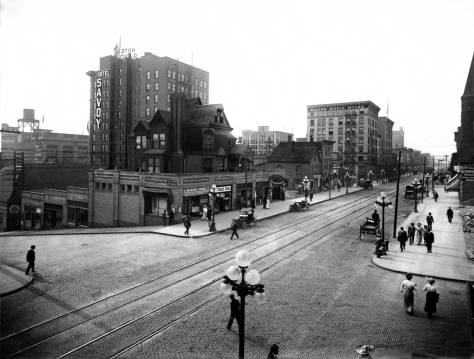
![THEN: Looking north-northeast from a low knoll at the southwest corner of Seneca Street and Seventh Avenue, circa 1916. By 1925, a commercial automobile garage filled the vacant lot in the foreground. [Courtesy, Ron Edge]](https://i2.wp.com/pauldorpat.com/wp-content/uploads/2014/11/seneca-7th-mr-then.jpg?resize=474%2C353&ssl=1)




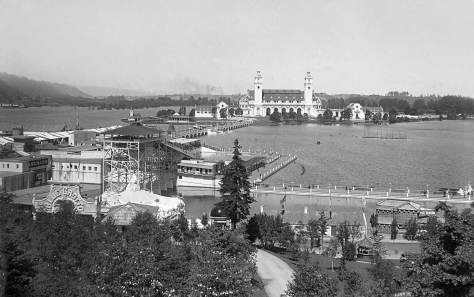




![THEN: The Gothic University of Washington Campus in 1946 beginning a seven-year crowding with prefabricated dormitories beside Frosh Pond. In the immediate background [on the right] is Guggenheim Hall. (Courtesy, Ron Edge)](https://i2.wp.com/pauldorpat.com/wp-content/uploads/2013/12/frosh-pond-housing-1946-then-mr1.jpg?resize=474%2C365)