
Our Daily Sykes #484 – A Single Hydroplane

(click to enlarge photos. click TWICE for the full size of many)


In the ninety years that separate Jean Sherrard’s portrait of the Seattle Kung Fu Society, and the Webster and Stevens Studio’s 1921 record of posing players in Chinatown’s week-long Go-Hing celebration that May, this part of King Street looking east through its intersection with 7th Avenue has hardly changed. Both views also show a lion.
“Go-Hing,” – if I have used my Chinese phrase book correctly – in Cantonese means something close to “pleased to meet you.” Surely civic conviviality was one result of the six day carnival, but its concentrated purpose was to raise relief funds for the famine that had already killed millions in northern China, and encouraged the formation in Shanghai of the Chinese Communist Party in July, two months after the last day parade of Go-Hing, a procession in which this lion played its part.
Go-Hing was also a kind of belated civic atonement for the atrocious treatment of the town’s Chinese residents during the 1886 Anti-Chinese riots. For the carnival, Chinatown was elaborately decorated on the street and off it too in the alley shops and upstairs in the tongs, which were opened to visitors that week. The neighborhoods arts were also put on show and its many talents proven on a stage set up in the intersection of 8th Ave. and King Street. There was dancing in the streets.
Here’s Jean’s description on how he arranged his repeat of the May 1921 photo. “I stopped by the Wing Luke Museum, just up the street in the photos. Bob Fisher, the museum’s Collections Manager, confirmed that the mask in the old photo was that of a lion – not of a dragon as Paul and I had first assumed – which meant we were on the hunt for lion dancers. The museum’s Vivian Chan recommended we visit the Seattle Kung Fu Society, serendipitously located just two doors down from the Milwaukee Hotel. (The hotel is on the left of both views.)
I was heartily welcomed by society founder Sifu John Leong who, in his mid-70s could easily pass for twenty years younger, a testament to the benefits of his life-long discipline. Next year will mark his fiftieth anniversary in the International District. Sifu Leong unpacked his spectacular multi-colored collection of lion heads, and we chose the gold lion featured in our ‘now’ photo, planning to assemble the next day before sunset to repeat the ‘then’.”

Anything to add, Paul?
Yup Jean. But first here’s hoping that this year’s Tale of Hillside Horror (for your Students at Hillside and their annual Halloween Party) went as well as you hoped and even expect when you were putting the story’s last lines to your tablet (for scribbling while you soaked in the tub this afternoon). The combination of horror and bathtub reminds me of the French class, Diabolique. A very scary movie, indeed. Hope to be frightened by your creation.
First, there are several links from past blog efforts that will take one to stories that have something to do, as well, with King Street. The relevance may not be at the top but it is there in every case. Please click them and search them.
Then I’ll put up five more features with a scattering of supporting illustrations. They will concern, in order, the coal trade that came down King Street on a trestle from the late 1870s to the first years of the 20th Century. Next, a few items on gas and the gas plant between 4th and 5th, Main and King – during pretty much the same years as the coal road. Follows the Felker House, Seattle’s first structure built from milled planks and not logs or split cedar. Then a photograph of a Salvation Army parade preparing, perhaps, to serenade a bar on Jackson Street. We will finish up with the “Flower of Italy” on 5th south of Jackson.
Comments: First the links to click – seven of them. Be patient please. It may take moments for a link to materialize.

=======
(Click to Enlarge these Illustrations – often CLICK TWICE to call forth their full size.)


The KING STREET COAL WHARF
(First appeared in Pacific, June 10, 1984)
The biggest thing in Seattle in 1881 was the King Street coal wharf. The Lilliputian pair in the foreground gives the pier its scale. It was both a favorite perch from which to photograph the city and a popular subject itself for photographers throughout the 1880s and 1890s.
In this view the camera looks east towards Beacon Hill, or what is really the ridge that once ran continuously – if with a slight slump – from Beacon Hill to First Hill. The two were not separated until 1909 when work began on the Dearborn cut just a little left of the hump that appears at the photographer’s center horizon. To the right of the railroad’s right-of-way is the beginning of Seattle’s first industrial neighborhood. Most of these manufacturer’s sheds are on pilings driven into the sand. The systematic filling of the tidelands began later, in 1896.
The sheds just behind the water tower are parts of a planning mill for the manufacture of sash and blinds. Behind that is a box and furniture factory, and, further on, the long sheds that cross the center of the scene are the repair shops for the Columbia and Puget Sound Railroad.
The C.&P. S. was originally the Seattle and Walla Walla Railroad, the narrow-gauged line completed in 1878 to the coal deposits east of Lake Washington. The first coal-filled gondolas pulled out of Newcastle on February 5 of that year, and for another half-century delivered much of it the this “south side” of Seattle central waterfront.
Another pioneer landmark, the Felker House, is on the scene’s left. This glossy white clapboard with the dark shutters and second floor veranda was built in 1853 when it shined like a temple amidst the rough log cabins of the then year-old settlement. It was Seattle’s first hotel and often called Mother Damnable’s after its quick-tempered manager, the profane Mary Conklin, who was as salty as her patrons.


(The above dates from the mid-1880s. The Holy Names Academy – with the spire left-of-center, was completed in 1884,)
There were 54 marriages in King County in 1881. Seattle got its first foreign language churches (the German Reformed and the Scandinavian Baptist), a city-wide water company, and a telephone franchise, even though there were no telephones. Other 1881 highlights included the first local demonstration of electric lamps aboard the Willamette, which was one of the 42 steamers licensed that year for business on Puget Sound.

It was also in 1881 that the two newspapers the Post and the Intelligencer came together as something you can still hold in your hands 103 years later. (Or could. As noted above this was first composed a quarter-century ago.)


=======

GAS YARD on KING STREET
(First appeared in Pacific, April 25, 1993)
This view looks east on King Street from Fourth Avenue. The date, March 24, 1907, is scribbled at the bottom of the original print, one of many Seattle Gas Company scenes pasted to the black pages of a photo album shared with me now long ago by my friend Michael Maslan.
The first gas lights illuminated a few intersections and 42 residences on New Year’s Eve 1873. The gas was delivered through bored fir logs imported from Olympia; the plant where the gas was manufactured from coal and stored in a wooden tank was on Jackson Street between Fifth and Sixth avenues, just off-camera to the left.
The photographer’s back is to the King Street Station. The station and the railroad tunnel beneath the city made these reclaimed tidelands just south of Jackson too valuable for mere manufacturing. The album from which this view was copied includes many more on the 1906-07 construction of the alternative gas works in Wallingford – now Gas Works Park.
Soon after this view was recorded, the gas plant on Jackson was razed for construction of the Union Pacific Station, whose rear shows in the contemporary view – when I find it.
Everything in the background of this scene was radically altered in 1909 with the Jackson Street regrade. Among the structures razed was Holy Names Academy on Seventh Avenue, which had opened to girl students in 1884. Its domed spire dominates the skyline, top left.
Most of the dirt scraped away during the regrade was used to reclaim more of the tidelands south of King Street. The wagon, the barrels and the stacks of pipes in the foreground are supported by a timber scaffolding, over which a thin layer of dirt has been spread. With the beginning of the regrade in 1909 this construction was torn away, dropping what we see here (or will later) to roughly its contemporary level as an abandoned railroad yard.


=======

FELKER HOUSE
(First appeared in Pacific, June 18, 1989.)
When Captain Leonard Felker built his hotel at the southern end of town in 1853, he out did the prescriptions of his friend and sometime partner Doc Maynard. Maynard, one of city’s founders, sold the captain the block south of Jackson Street and west of First Avenue South for $350 on the growth-promoting condition that a “substantial building be constructed on the premises within three months.” The captain complied very substantially.
Felker’s two-story frame Felker House was the first hard-finished construction on Elliott Bay with milled clapboard sides, an imported southern pine floor, and lath-and-plaster walls and ceilings. The rest of the less than two-year old village was built from rough planks, split cedar, and logs. The brilliant white hotel was so prominently set atop a low bluff at Maynard’s Point that navigators aimed for it. What else they aimed for at Felker’s hostelry is a natter of controversy.
According to Roberta Frye Watt, a pioneer’s daughter and the author of “The Story of Seattle,” it was clean sheets and Mary Conklin’s cuisine. Conklin, Felker’s proprietor, was “noted for her good cooking, nasty temper and rough tongue.” She was the wife of an old sea captain whom “she could out swear any day.” So, by Frye’s description, it was from a fearful respect that she earned her nickname, Madame Damnable. But according to Bill Speidel, the recently deceased historian and sometimes creator of Seattle’s sinful past, Conklin was called Madame because she ran a whorehouse in the back of the hotel. Whatever the case, uncommon sensation followed this “stout, coarse Irish woman” to her grave where, it was nearly universally believed by Seattle’s pioneers, her body turned to stone – a claim made when her hefty casket was later moved to a new cemetery.
The woman posing between the men on the hotel’s veranda may or may not be Mary Conklin. If we had a portrait of her we would probably still not know, for this surviving view, which is one of the city’s oldest and most valued photographic records, is, no doubt, a few generations removed from the lost and sharper original.


===

The ARMY on JACKSON ST.
(First appeared in Pacific, March 30, 1986)
In 1865, William Booth founded his first mission in the slums of London’s East End. Twenty-two years later, General Booth’s “soldiers without swords” opened fire on Seattle when the young newlyweds, Captains Duke and Harris, held service in a rented room beneath a bar at First Avenue and Washington Street. The sounds of their praying and hymn-singing did antiphonal battle with the honky-tonk piano and laughter above them.
The Salvation Army in its war with the devil developed an elaborate military metaphor. General Booth led a world-wide force of uniformed batteries fighting from Fort Salvations with the battle cry of “Blood [of Christ] and Fire [of the Holy Spirit].”
What distinguished this army, and still does, was its willingness to fight in the meanest streets where the down-and-out often did not hunger after righteousness so much as for a meal. The Salvation Army’s confident compassion is still appealing.
The Army’s most effective form of street fighting used swords that were beat not into plow shares but cornets, trombones and flugelhorns. As General Booth explained, the end of salvation justified any means including brass bands – often accompanied by a formation of Hallelujah Lassies beating their tambourines.
Here we see a battery – with brass band and tambourines – in the mud on Jackson Street sometime in the 1890s – a decade that was peculiarly sinful, especially on Jackson. Writing of Seattle in 1900, Salvation Army adjutant Earnest Hawkes (a fine fighting name) charged that “its hundreds of saloons and scores of gambling dens, concert halls, and dives of various description were filled with a surging, seething mass of people and crime and outlawry that seemed to defy every attempt to suppress it.”
But here they are trying on Jackson Street where this entire line of false front businesses was put up after the fire of 1889 and many were designed for the business of sin. The Palace Theatre (behind the band) was probably a box house or combination saloon-theatre-whore house (it is not listed in any city directory). There a tired and drunken workingman could recline in a half-hidden, box-like loge while he looked upon some stage show and/or participated in his own where half the talent pays the other half.
These theatres were often the targets for the musical ammunition shot from the Salvation Army’s comets and bass drums – the drums were said to beat repentance. Sometimes the theatre’s own band would set up on an outside balcony and fight back. To the avant-garde among them, the cacophony was, no doubt, often quite appealing.

And the Army’s bands could also play popular tunes. Founder Booth agreed with another Protestant composer, Martin Luther, that the devil should not have all the good tunes. But these songs-of-the-day were always accompanied with sanctified lyrics.
Here, however, the cornets are quiet and whatever sin is on Jackson Street is seething behind the clapboards. The Army is at ease and posing for what is probably a scheduled portrait. The occasion might be the beginning of an early morning parade through skid road to wake up the sinners, or perhaps a parade to celebrate the visit of an out-of-town officer.
Perhaps this is the parade for Lieutenant Colonel Brewer who visited Seattle in March of 1900 – a celebration which a Salvation Army reporter remembered this way. “Walking three abreast with the concertina playing, [they] marched up the center of the street. It caused quite a stir, and greatly increased the attendance at the meeting attracting many who otherwise would have been indifferent. The Colonel sprang a surprise upon us by playing a comet solo in the open-air meeting, which was greatly appreciated by the great crowd who stood around us.”


These too make music and see the light. Ivar’s good works on the waterfront were most appreciated by his neighbors. His knack for putting the best construction on anything — including the jokes directed at his singing – shown in the late winter of 1950 when he linked the bright new but glaucous-green light on the waterfront with a traditional celebration. On the sixteenth of March, 1950 at 6:15 P.M. between Bay Street and Yesler Way the new mercury vapor lights were turned on giving the waterfront what Ivar described as a properly “romantic green tinge” for St. Partick’s Day. (Certainly brighter, the green light still seemed to many to be also frightening. They cast a cadaverous tone on human flesh.)
Members of the Seattle Chowder and Marching Society and the Ale and Quail Society, diverted for the moment from their Seafair business, joined with Ivar in parading along Alaskan Way to the music of Jackie Sounder’s Chowder and Marching Band. And as host of the lighting ceremony, Ivar fed them all. It was, the restaurateur mused, “A day to make the Swedish sailors and the Norwegian navigators glad. For the first time since 1852 when the settlers moved from Alki Point to Elliott Bay, there is adequate light on Seattle’s waterfront. In fact, not since Chief Seattle held his big tribal meetings around giant beach fires has the Seattle waterfront been so well lit up.” Dressed in green, the combined memberships posed in front of the Acres of Clams in time to watch the new mercury vapor lights turn on, and some enterprising press photographer climbed above the sidewalk festivities and recorded the moment. Looking like one of the “little people” Ivar gazes up admiringly at the new light from his place between the lamppost and his nearly new Fish Bar.
=======


The FLOWER OF ITALY
(First appeared in Pacific, May 18, 1986)
In 1924 or ’25, Giacomo and Maria Traverso opened their Fiore d’Italia at 414 Fifth Ave. S., between Jackson and King St. South. These Genoese cooks had the knack for fixing delicious traditional dishes, and soon their cafe was favored for serving the best Italian cooking in the city. Naturally, many of their regulars came from the Italian community, most of whom, the Traversos included, lived in or near Rainier Valley.
The aromas that wafted within this flower of Italy were also for many years the favorite lunchtime relief of the city’s garbage collectors, many of whom were, like the Traversos and Christopher Columbus, Genoese. Favorite dishes included: a codfish concoction called Baccala, a generously seasoned cornmeal mush named Polenta, and a meat-and-potatoes mix called Stufato. And every Wednesday Maria Traverso would prepare the week’s noodles for the pasta of the the day.
The Fiore d’ Italia was Traverso’s third and most successful attempt at Italian cooking. In 1917 and 18 the city directories list him at the Pentema Restaurant at 116 2nd Ave. S. But in 1919, with the Pentema closed, the Polk Directory canvassers recorded Giacomo not as a cook but as a wartime shipbuilder. (Traverso, may have taken part in the 1919 general strike which started in the shipyards.) However, as the Traverso’s daughter, Jenny Cella, recalls, her father could not be kept out of the kitchen. Soon he was cooking at another skid road cafe, the Columbus Cabaret at 167 Washington St. South.
The mid-20s opening of the Fiore d’Italia at 414 5th Ave. was not the Traverso’s last move. By 1928 they shifted their cafe a few doors north to 404 5th Ave. South in a storefront below the St. Paul Hotel. Still, the Fiore d’ Italia was the fixture on a block that saw many alterations.
Appearing in this scene to either side of the cafe are the N. P. Restaurant and the Midget Lunch. Neither can be found in any city directory. The Dreamland Cabaret was a short-lived dive in the St. Paul’s basement. It should not be confused with the notorious Dreamland Hotel, a crib house for prostitution that was located but a block-and-a-half away at 6th Ave. and King St. (See accompanying photo.)
Fifth Ave., south of Jackson Street, could be described as the Mediterranean western border of the International District. There were other Italian establishments on the street including a grocery at the comer of Jackson. Here Fifth Ave. is half a street, for it is bordered on the west by the big pit of the railroad yards and grand stations. And to the east is the East, the international community, which is still largely Asian and more often named Chinatown.

This scene (the primary or featured one – four photos up) was photographed by one of the Traverso’s Asian neighbors, Yoshiro Okawa, whose Aiko Photographic Studio was located at 6th Ave. and Jackson Street. For years Okawa’s fine commercial photography “at reasonable prices” was a neighborhood given – until 1942 when the Okawa family, and all Japanese persons in the district were shipped off to internment. Since they could take with them only what they could carry, Yoshiro Okawa’s years of work were destroyed, including the original negative for this record of the Traverso’s cafe. Luckily the print survived. And so did Okawa to open another studio in Chicago after the war. Later he retired to Seattle where he died in 1976 at the age of 85.
====



 There are so many events in the streets of London now ! here in Trafalgar Square, that we can feel already in 2012
: Nelson is standing on his column of course, his ship (the largest model )in a bottle on the right created by Yinka Shonibare attracts so many passers-by, there is a concert, and free hugs…
Il y a tant d’évènements dans les rues de Londres actuellement ! Ici à Trafalgar Square on se croirait déjà en 2012 : Nelson se tient en haut de sa colonne bien sûr, son navire( la plus grande maquette ) dans une bouteille sur la droite crée par Yinka Shonibare attire beaucoup de monde, il y a aussi un concert et des embrassades gratuites…
(click to enlarge photos)


I first showed this Kodachrome slide of the Rivoli Follies, Seattle’s last house of burlesque, to the Daughters of the American Revolution in the mid-1980s. I was asked to do an illustrated lecture (we then still called them “slide shows”) on local history by the DAR’s program director, then also in her mid-eighties, but still wonderfully spry and good-humored. I confess now to including the Rivoli in that lecture in order to ask the members – whom I imagined as more prudent than impetuous — if any of them had gone there to see a show.
The response was startling, and it came first and fast from my “sponsor.” She exclaimed, “Oh I danced there!” This clamors for some explanation.
Lawton Gowey date-stamped his slide April 11, 1967. Knowing Lawton, I think it most likely that he photographed this east side of the block on First Avenue between Madison Street – where he stood – and Marion, because it would soon be razed for architect Fred Bassetti’s Federal Office Building. The Times theatre ad on that spring day for the Rivoli promised “Blonde, Beautiful and Buxom Maria Christy in person! Plus extra added Zsa Zsa Cortez Mexican Spitfire – plus a stage full of beauties” in “4 shows daily.” *
Of course, the DAR’s program manager appeared on stage here much earlier than Ms. Christy and Cortez – perhaps already in the teens, for she was part of a small local class of amateur dancers performing for a mixed audience – often including their parents – at a weekend matinee.
On Oct. 27, 1939 the State Movie Theatre changed its name to Rivoli and its programing to a “vaudeville policy.” Actually, stage acts had been all or part of the entertainment here since 1905 when vaudeville impresario John Considine bought and booked the corner as the Star Theatre. Years later during the Second World War the more loving and/or libidinous urges of young soldiers moved the Rivoli to “refine” its vaudeville policy into programs that mixed B Movies with the refined arts of removing clothes.
* One browsing and perhaps blue reader has found this attachment: a web page dedicated to campy erotica including a moving duet by the Rivoli stars for April 11, 1967. Here’s a desktop “grab” of the Ms. Christy and Ms. Cortez. In the interest of you the reader I turned it on and discovered that about ten second and two winks into the show it stops and asks one to subscribe. At that point I left and returned to this sober and demure blog.

Anything to add, Paul? A few other past Pacific features from the neighborhood, starting with something more on the Star Theatre. Correction – we will start with a few recordings of the Rivoli’s destruction and then of the Burke Block as well in early 1971. This may be the second insertion in this blog for some of these subjects, but who is keep track? We will act as if they bear repeating with this new “cross-reference.”


=–=-=-

The BURKE BUILDING
(First appeared in Pacific, March 3, 1996)
Elmer Fisher was the most prolific of the batch of mostly imported architects who rebuilt Seattle after its Great Fire of 1889. He designed this well-lit red brick pile of Chicago design – modern at the time – for the city’s biggest post-fire shaker: Thomas Burke. Appropriately, Fisher dressed Burke’s namesake building in a uniform of affluence and influence, with hand-carved pilasters, molded corners and tons of marble and granite effects.
At the northwest corner of Second Avenue and Marion Street, in the heart of the city’s financial district, the Burke Building survived in its Victorian raiment well into the 20th century. Its eight stories were transcended by more modern neighbors, first across Marion Street by the 278-foot-high Art Deco Exchange Building in 1929, followed 30 years later by the modern glass-curtain Norton Building, one block south at Columbia Street.

In the mid-1960s the federal government bought the Burke Building – and everything else on its block – after studying more than 40 proposed sites for its new “branch home” in Seattle. If the Henry M. Jackson Federal Office Building had been clad in red brick, as its architect, Fred Bassetti, intended, the Burke Building’s usurper would have, at least, repeated the warmth of its skin. But the office building, late in construction largely because of its price tag, was finally raised without its expensive masonry.
Still, Bassetti and Richard Haag, the site’s landscape architect, did manage to preserve parts of the Burke Building’s ornamental handiwork, along the Federal Building’s Second Avenue Plaza and down the long red-brick stairway to First Avenue along the Marion Street sid
=-=-=-=-

The STAR THEATRE
(First appeared in Pacific, Feb. 10, 1991)
The sign on the Madison Street side of the Star Theatre reads “Continuous Vaudeville.” The general-admission price of one dime bought a seat for eight acts, featuring performers such as ragtime pianists and jazz singers – AI Jolson appeared at the Star in 1907 – and lantern-slide shows illustrating ballads sung by nasal tenors.
The acts were frequently changed. When Seattle’s John Considine, who bought the Star in 1905, signed an act he liked, he could keep the artists at work for more than a year, packing costumes and instruments from coast to coast into scores of theaters he owned or booked.
In 1911, the Star was eclipsed when Considine opened the Orpheum, a grander vaudeville stage two blocks up Madison Street at Third Avenue. This, however, was not the end of theater on the east side of First Avenue between Marion and Madison streets; the Star’s space was converted for motion pictures, first as the Owl Theatre and then as the State Theatre.
In 1885, George Frye had opened his namesake opera house in this same block. It was the best stage north of San Francisco. The last performers to strut this site were strippers. During World War II the New Rivoli Garden Theatre was popular with servicemen. The closure of the Rivoli in the late 1950s marked the end of burlesque in Seattle, and the end of theater on this block. In its place – and all others on the block – the Henry M. Jackson Office Building opened in 1974. (Historical photo courtesy U.W. Libraries, Special Collections.)

=========

The PIPERS on FRONT STREET
(First appeared in Pacific, Oct. 28, 1984)
Front Street couldn’t have been a more appropriate name for First Avenue before the tum of the century. The historic scene, taken in 1878 or ’79, shows Elliott Bay at high tide lapping up against the timber retaining wall that held the street high and dry above the waterfront. This, was Seattle’s first major public work – the regrading of Front Street from a stump-strewn, ravine-ridden path to a filled-in, smooth road with guardrails and a sidewalk promenade.
The photo was taken from a balcony above Maddock’s drugstore at the northeast comer of Front’s intersection with Madison Street. The ” now” shot was taken from the second floor of a brick building which replaced the drugstore after the 1889 fire. (Something we will prove only when we recover it.)
In the far right of the older photo is the balcony of the Pontius Building. The great fire began in the basement. It and the Woodward Grain House (the building that holds the photo’s center-right) were both built on piling. In between them is a gIimpse of a Section of Henry Yesler’s wharf and mill.
Posing in the photograph’s lower left corner are A.W. Piper; his son, Wallis; and their dog, Jack. As the proprietor of the Puget Sound Candy Manufactory, Piper was very popular. He lived in Seattle making candy and friends for 30 years. When Piper died in 1904, his obituary was an unusually good-natured one. He was remembered not only for his great candy and bakery goods, but for his artistic abilities and pranks. “He could draw true to life,” said his obituary, “could mold in clay, cut stone . . . His Christmas display was noted for its Originality, humor and beauty.”
The candy-maker also was unconventional. A religious Unitarian, he also was a socialist member of the Seattle City Council. Many remembered him for being a successful practical joker as well. Once, he mimicked Henry Yesler so convincingly at a public dance that the real Yesler ran home to construct a sign which read, “This is the only original Yesler.” The same could have been said for Piper.

=====

GRANDEST STAGE NORTH of SAN FANCISCO
(First appeared in Pacific, May 5, 1987.)
Several landmarks formed Seattle’s early skyline, the effect advertising the city’s new urban confidence of the mid-I880s. The most formidable in this view is the mansard roof line of the Frye Opera House. When it was completed in 1885, George Frye’s opera house was the grandest stage north of San Francisco. It was modeled after the Bay City’s famed Baldwin Theater, and dominated the northeast corner of First Avenue and Marion Street.
Kitty-corner from the opera house and above a grocery store, the YMCA quarters are marked by what appears to be a banner. The Y moved into this spot in 1882 and out in October 1886, and so this scene dates from sometime in 1885 or ’86. Across the street from the Y, with its own high-minded sign, is the Golden Rule Bazaar. Just above the bazaar and behind the opera house is the Stetson Post Building at Second Avenue and Marion Street. When the Post building was built in 1882 it was the most fashionable address in Seattle.
The mansion with tower and cupola to the right of the Stetson Post is the Stacy Mansion at Third Avenue and Marion Street. This lavish pile of Second Empire architecture lasted much longer than anything else in this scene. In the 1920s, having escaped the fire of 1889, it was pivoted 90 degrees to face Marion Street and became Maison Blanc, one of Seattle’s legendary restaurants. Unfortunately, it was damaged in a lesser fire in 1960.
With its landmarks, what also sets this scene apart are the two sailboats in profile in front of Budlong’s Boathquse. They were rentals from the popular boathouse. In 1886 the Puget Sound Yacht Club was established here.
The Great Fire in 1889, which started at the southwest corner of First and Madison in the far left of this scene, destroyed Frye’s Opera House and practically everything else showing west of Second Avenue.

=-=-=-=-=-

FIRE STATION No. 1
(First appeared in Pacific, Jan 5, 1992)
The ornate brick façade of Seattle’s first dedicated engine house faced Columbia Street west of Second Avenue. It was built in 1883 to house the fire department’s Washington No. 1 – most likely the steam fire engine posed here with its crew.
Earlier, the department’s other engine, the smaller man-powered Washington No.2, was also housed here in a barn. In the summer of 1882, when No.2 attempted to answer an alarm on the waterfront – sans horses – the weight of the rig dragged the men holding its pole down Columbia street and into the bay. Fortunately, both the firemen and the fire engine were pulled from the water with little injury.
By the time of the city’s fire of 1889, the Seattle Fire Department had a half~ dozen pieces of apparatus, but only one, No. 1 on Columbia Street, was horse-drawn. The ornate brick station that No. 1 left on the afternoon of June 6 to fight the “Great Fire” would not welcome it home. Of the 30-some city blocks destroyed that night, all those south of Spring Street and west of Second Avenue, including this one, were razed.

The PROSPECT From the FRYE OPERA HOUSE
(First printed in Pacific, July 16, 2000.)
What this scene lacks in photographic qualities it makes up with architectural highlights. Landmark gables, towers and steeples surmount the blotches, thumb prints and dark recesses of the photographic print. The view looks south-southeast from an upper story of the Frye Opera House at the northeast comer of Front Street (First Avenue) and Marion Street.
Included here is much of Seattle’s first residential neighborhood – the area east and northeast of Pioneer Place (Square). At this time, in the late 1880s, business was still centered at the square. It also ran through the four blocks of Commercial Street (First Avenue South) that extended south from Yesler Way as far as King Street. There, until the mid-1890s, development was stopped by tideflats.
The largest landmark showing here is the Occidental Hotel on the far right. Built in 1883 in the flatiron block (now home of the “Sinking Ship Garage”) facing Pioneer Square, it was expanded east to Second Avenue in 1887 as we see it here. One of the oldest structures – perhaps the oldest – is far left: the Methodist Episcopal Church built in 1855 near the southeast comer of Second and Columbia. In 1887, the congregation moved two blocks to a new sanctuary at Third and Marion and sold its “White Church” -Seattle’s first – to a new proprietor who moved the building two blocks to Third and Cherry and reopened it as a saloon and gambling house.
The centerpiece here (near the center) is the fire station with the bell tower and ornate brick facade facing Columbia Street between First and Second avenues. This was the home of the horses, apparatuses, and firemen who for want of water pressure proved so ineffective during the city’s Great Fire of June 6, 1889. Everything west of Second Avenue in this scene was destroyed, including the fire station.


=-=-==-=-=-

Above: Most of the structures in this view up Front Street (First Ave.) north of Madison St. in 1886 would be consumed in the city’s Great Fire of 1889. The fire started at the Southwest corner of First and Madison. Below: The Alexis Hotel, on the left, and the 20-story Waterfront Tower, on the right, are landmarks in the six-block Waterfront Place, first developed in the early 1980s.

FRONT STREET, 1886
(First appeared in Pacific July 26, 1992.)
The landmark in this scene – the “finest theater north of San Francisco” – is implied. From its fourth-floor roof, the Frye Opera House was an obvious perch from which to look down on Front Street (First Avenue).
The opera house was opened in 1885; this view northwest across the intersection of First and Madison to the waterfront was photographed probably in the summer of 1886. This was the 10th anniversary of the city’s first major public work, which regraded Front Street north of Yesler Way.
Also in 1886, the U.S. Post Office Department reprimanded the Northern Pacific Railroad for regularly holding up (for 22 hours) Seattle mail in Tacoma, the railroad’s company town. The department awarded Seattle the southern terminus for mail collected from communities to the north of the city – a role previously Tacoma’s. Despite the Northern Pacific’s best efforts to neglect or outright inhibit use of the “orphan road” railroad line that ran between the two cities, commerce across it was increasing rapidly.
The northern end of that Seattle spur appears here. This is a rare view of the “Ram’s Horn” track that snaked along the waterfront north of King Street about as far as Pike. It was the trigger for sustained bellicosity between waterfront land owners, shippers and public officials who wanted to get around or under it.
The following year it would be surpassed by a straighter trestle of the Seattle Lake Shore and Eastern Railroad (SLSE), which ran north from the waterfront to Interbay and, eventually, to Canada on what is now part of the Burke-Gilman Recreation Trail. Together the “Ram’s Hom” and the SLSE were the beginning of Railroad Avenue, the wide swath of timber trestles that is now our waterfront.

========

FIRST AVE. North Thru MADISON STREET
(First appeared in Pacific, June 22, 1986)
Although several decades separate our “now” and “then,” not much has changed. Indeed, this First Avenue block between Madison Street (in the foreground) and Spring Street is one of the best-preserved in the city. This lucky situation is the result of some unlucky happenings.
The first of these was the Great Fire of 1889, which razed to a rubble this intersection. Then, before the elaborate post-fire rebuilding could make its way up First Avenue from Pioneer Square, the street (and the nation) suffered another setback: the economic crash of 1893.
In 1897, First Avenue finally enjoyed some fortunate attention when thousands of travelers came crashing through Seattle en route to the lavish hardships of the gold fields in the north. First Avenue was built up from the wealth of the gold rush, and it shows. The three elegant buildings on left, historically the Globe and Beebe buildings and the Hotel Cecil, are all the satisfying 1901 creations of architect Max Umbrecht. In this photo they are brand new, showplaces along what was for a bief time one of the busiest blocks in Seattle. But this elegant energy was short-lived. For all the terra cotta tiles, fluted pilasters and arched bays lavished on these facades, behind them it was primarily a strip of workingmen’s hotels serving the rougher businesses of the waterfront.
The economic crash of 1907, although not as bad as 1893’s, hit this avenue particularly hard. It never really rebounded – never, that is, until now. And the irony of First Avenue’s years of neglect is that it was thereby preserved. (A reminder: this was written a quarter-century ago.)
It was because the Globe Building, on the left, was for years the home of a penny arcade that its savior, Cornerstone Development Co., could renovate it as the centerpiece of its six-block Waterfront Place project.
Here, between Madison and Seneca streets, Cornerstone has saved five architectural delights, including the Globe which is now the European-styled Alexis Hotel. Cornerstone’s one exception on First is its 20-story Watermark Tower at Spring Street. And this is but half an exception since the sculptured tower with its art deco touches and cream-colored tile skin emerges from within the preserved terra cotta facade of the 1915 Colman Building.
A real exception to this ornate First Avenue story is the simple two-story brick structure on the right of this week’s historical scene. Although it is one of the oldest buildings in Seattle, put up soon after the fire of 1889, its longest continuous occupant is still there. This year (1986), Warshal’s Sporting Goods celebrates its golden anniversary at First and Madison. (In that quarter-century since, Warshal’s has gone missing and the corner has been developed to greater heights.)


=-=-=-=


The EXCHANGE BUILDING
(First appeared in Pacific, Jan 10, 1999)
Architect John Graham Sr.’s Exchange Building is one of the graces of local architecture – a modest grace. Facing Marion Street, its great front facade is not shown off as it might have been fronting Second Avenue or looking out to Elliott Bay across First Avenue. Since the opening of the Federal Office Building in 1974 it looks demurely across Marion Street into the fed’s greater but less alluring north façade.
In his contribution on Graham for the U.W. Press book “Shaping Seattle Architecture,” Grant Hildebrand, a professor in the School of Architecture, comes to the mildly restrained conclusion that the Exchange Building is perhaps Graham’s finest work. Hildebrand finds it “an engaging play of Art Deco motifs” and delights in its “all-over massing, but especially in its street-level treatment and its lobby.”
The jewel-like arches at the entrance to the main lobby off Second Avenue are evident in this view. (What follows was written for the clipping included directly above, and not the photograph exhibited above it.) The American flags adorning City Light’s street fixtures are grouped with signs, which read – certainly – “Exchange Building,” but also seem to read “Grand Opening.” Most likely this dates from 1931, when the landmark was new. More evidence: Most of the windows are still without shades, and many of the rooms seem empty.
Graham was born in Liverpool, England, in 1873 and came to Seattle in 1901. A few of his other works are the Frederick and Nelson Building, The Bon Marche, the Dexter Horton Building and, immediately south of the Exchange Building on Second Avenue, the Bank of California. A small portion of its classical front shows here. To quote Hildebrand once more, Graham’s “work was significant . . . because in playing a major role in the making of downtown Seattle, it was invariably executed with a sure and sensitive hand.”

=-=-=-=-=-=


The GARDEN OF ALLAH
(Appeared in Pacific first on Feb. 1, 1998)
Although these two scenes (if we had the “now” in hand, which we don’t for now) were not figured with a surveyor’s chain, a bet that they were photographed from within a few feet of one another is as good as the likelihood that this organist could accompany Jackie Starr, right, in her dosing number. The sheet music, with the title “Oh! What It Seemed To Be,” shows between organist Jimmy Baker and drummer Earl Steves.
The historical scene was photographed a half-century ago on – to use the full title of the book from which the photo was taken – “An Evening At The Garden of Allah, A Gay Cabaret in Seattle.” So, as her closing number perhaps suggests, the elegantly dressed and coifed Starr is not a she but a he.
The Garden began as a Prohibition speakeasy in the basement of the old Arlington Hotel. In 1946 it reopened primarily for the postwar, high-camp performances of mostly female impersonators who, like Starr, learned their art in vaudeville. Resembling Gypsy Rose Lee, Starr once filled in for her so convincingly in a Music Hall performance that the sophisticated New York audience was fooled.
The Garden, which lasted 10 years, was also a sanctuary for Seattle’s gay population. First Amendment rights to comedy, love songs and bawdy routines (tame by today’s standards) were “guaranteed” by police payoffs.
The contemporary scene was shot in the library of Harbor Steps’ new high-rise apartments on First Avenue. Skippy LaRue was a friend to whom Jackie Starr left the photographs used throughout Don Paulson’s remarkable book. With University of Washington associate professor Roger Simpson’s creative help, Paulson shaped his hundred-plus interviews with Garden performers and regulars – including LaRue – into a Columbia University Press publication, which won the Governor’s Writers Award for 1997.


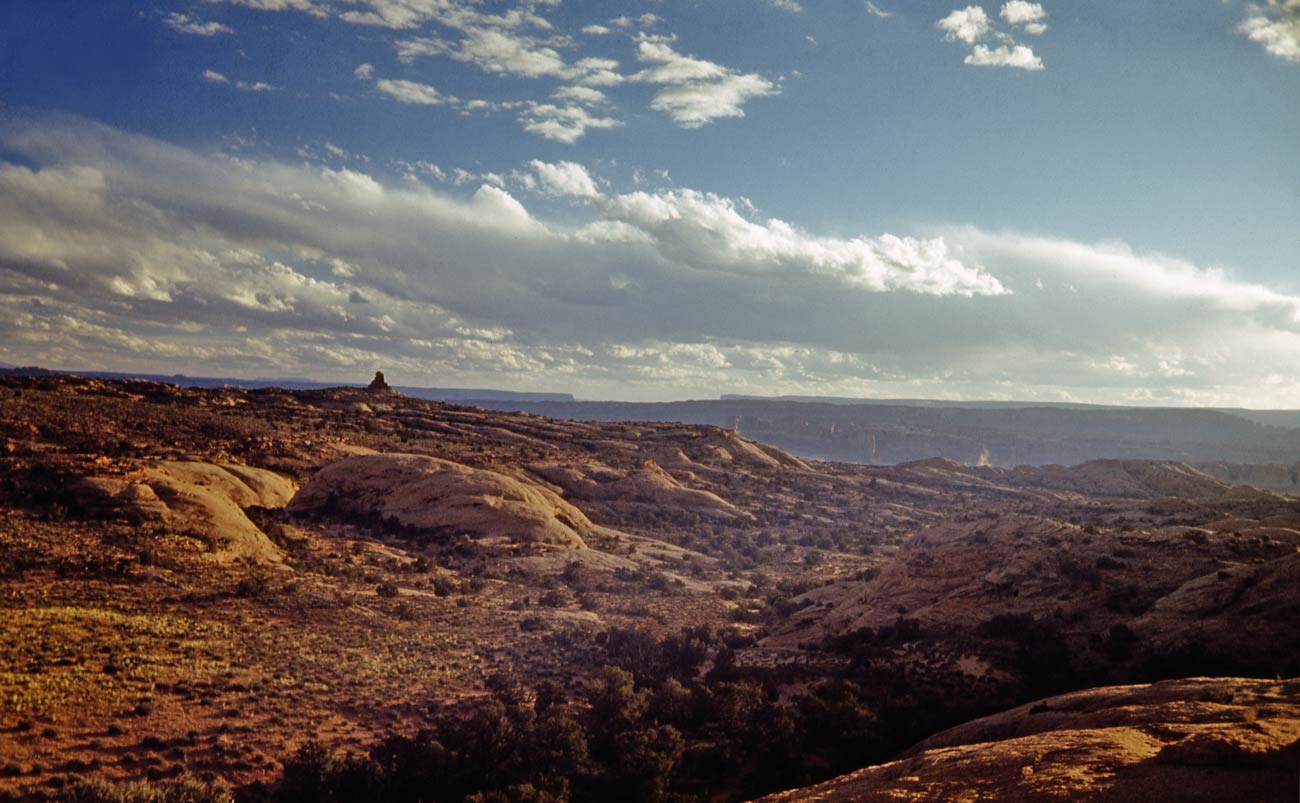
The solitary stack or tower or grain hopper on this horizon reminds me of an artist named Cooper – John Cooper, I think, although I now know a local collector by that name and so may be confused, however the Heald brothers, Paul and Larry/Charles, both artists themselves, would know, for at least Paul taught art in or attended Indiana (or Illinois) University in the mid-1960s when Cooper or Coop’ was there, if that was his name – who in 1968 or ’69 was driving around the United States in an older Cadillac painting grain hoppers (not on them) with whatever media and on whatever surface was available. Coop’s hoppers, I repeat, resembled that landmark left of center in this, of course, unnamed – by Sykes – place. These oversize farming artifacts had, as I remember it, taken on some symbolic role for the often manic Coop who once had exhibited – or assembled – a show of several of them on the campus where he taught. He was a persuasive fellow and traveled – I think I’m correct in this – without funds. I traded him a beer in the Kulshan Tavern – in the Fairhaven part of Bellingham – for a portrait of myself, which he painted on an easel and surrounded with symbols of many sorts like the ying yang and his hoppers. He did the painting in an open field – or vacant lot – near the tavern and the sun was setting over Lummi Island. For me it was a most joyful event. (Click to Enlarge)


(click to enlarge photos)


On a recent visit to Mt. St. Helens with his family, Jean Sherrard stopped off in both Centralia and Chehalis to photograph their railroad depots. Of course, for these “repeat” purposes Jean carried with him historical photographs of the “twin cities” stations. While in Centralia he was blessed with good “now and then luck.” Picking up and letting go passengers, Amtrak’s Coast Starlight packet was also waiting and posing for him.
Both depots are splendid examples of brick depot architecture and next year both will celebrate their centennials. While making preparations for the birthdays, the Lewis County Historical Society and its museum are fittingly sited. Both have a home in the landmark Chehalis depot.
The Centralia Depot was completed quickly in 1912. Many of the estimated 500 workers were, of course, specialists. The floor was made of terrazzo, the roof tiled, the windows leaded, and hardwood oak was used extensively. Anticipating a booming population the station was also built big. It reaches will over three hundred feet, with five sections separated by breezeways. The restoration took much longer – eight years. It was completed in 2002.
Even before railroads were laid thru them, the Lewis County twins served as halfway destinations between the Columbia River and Puget Sound. Now the railroad line between Portland and Seattle – or with its greatest reach, between Eugene and Vancouver B.C. – is Amtrak’s eighth-busies route, carrying the most passengers of any railroads outside of the Northeastern U.S. or California.
For one dollar the state purchased the station from the Burlington Northern Railroad in 1994 and promptly gave it over to the city of Centralia. The depot is listed on the National Register of Historic Places.
This time round, I’ve got a few things to add myself, Paul. Several cribbed from our 2007 book, Washington Then and Now:
First, THE CHEHALIS DEPOT:


Now the Lewis County Historical Museum.
THE CHEHALIS STREET DANCE:


The popular Chautauqua movement began in the east in the 1870s with a mixture of Bible studies and lectures on self-improvement. Here on Market Boulevard in Chehalis the movement has them dancing in the street. The Lewis County Historical Museum figures that this invigorated scene dates from about 1914, and the Chautauqua dances were held at this location until 1918 when the turreted St. Helens Hotel in the background was replaced with the current masonry building. In the right background is the Chehalis City Hall, built in 1912 and still in service, although minus its ornate trim, damaged in the 1949 earthquake that was generally cruel to the region’s cornices. In my repeat, City Hall is barely visible through the trees.
Next, TWO PIONEER SANCTUARIES ON HIGHWAY 6:


Two landmark pioneer churches – at Francis and Claquato – stand above State Highway No. 6 between Chehalis and South Bend. The later (on the right), about three miles west of Chehalis is also distinguished as the oldest standing church in the state. Built in 1858 with a crown of thorns topping its tower the parish lost its parishioners after Chehalis took the county seat from Claquato in the 1870s. Although empty when it was photographed in 1891 it survived for a full restoration in the 1950s. Holy Family Catholic Church in Francis dates from 1892 when the Northern Pacific Railroad was approaching this largely Swiss settlement.
Anything to add, Paul?
Yes, a few subjects Jean, but not the usual horde. Ahh but the above reminds me of what a pleasing time we had building our book “Washington Then and Now,” you traveling the state and me sitting in my basement – for the most – talking with you on the phone.
Here a small back of subjects that are either of Centralia or Chehalis, or they are in the greater neighborhood, like the churches above. I’ll keep the captions brief.


Follow THREE of WINLOCK (“most likely”)


I was going to the opening of the exhibition ” the Comédie Française is showing at Petit Palais ” when I was crossing the bridge Alexandre III, I saw this scene, and I thought the Comedie Française is showing too in the street …
J’allais au vernissage de l’exposition “La Comédie Française s’expose au Petit Palais”, lorsque je traversai le pont Alexandre III, je vis cette scène et pensais La comédie Française s’expose aussi dans la rue…


Jean and I have learned that the Museum of History and Industry is worried about our upcoming talk about our “Repeat Photography” show that is hanging at MOHAI until next June. Then everything comes down for the move to the new home that the Museum is now preparing at the south end of Lake Union.
We have been told that not enough tickets are getting sold. We conclude that either we are not worth the ticket price – ten dollars – or the word about the Oct 13 (next Thursday evening) show has not circulated well. Please study the attached literature promoting the lecture, reflect and, perhaps, check your budget. If you come we will encourage you to ask questions.
–Paul and Jean
(and Berangere too, who, if she can make it here from Paris, will get in free.)

(click to enlarge photos)


In 1940 Seattle Municipal Railways started to abandon its trollies before pulling up their rails, and the old orange-colored cars became increasingly photogenic, especially to Seattle’s rail fans. Lawton Gowey, a rail fan extraordinaire but now, alas, long gone, shared this photo with me many years ago.
The intentions of the photographer – perhaps Lawton’s father – might have been to make another 11th hour recording of a cherished common carrier. Lawton would have known that car No.702, which is stopping for a rider here on 45th Street at Meridian Avenue, was manufactured in 1913 in Cincinnati, Ohio for the then still privately owned Seattle Electric Company. No. 702 was one of twenty-two cars built to the same long design – from headlight to tail light cars 701 to 722 extended 49 feet and 2 inches. Trollies on the Meridian Line were abandoned on May 5,1940 and scrapped soon after.
This trolley portrait was photographed sometime between its May ‘40 abandonment and March 11, 1938, the day the A&P Super Market, here at the northeast corner of 45th and Meridian, and another in Ballard had their grand openings. They promised “always one low price and no specials . . . You will know that you shopped by wisely and profitably at the A&P super market.”
The meeting of 45th Street and Meridian Ave began in the forest, when federal surveyors carrying their Gunter Chains described – and marked – the future streets as the west (Meridian) and north (45th) borders for the 640 acres of federal land section number seventeen. That done the settlers could identify their claims with some precision.
A&P’s brick and tile corner was built in 1929, just in time for the Great Depression. From 1935 thru 1937, at least, the well-ornamented corner was vacant until A&P opened it to “wise” shoppers in ’38 and stayed until 1942 when it too moved on. The northeast corner then went dark again. (Many thanks here to Jeannette Voiland, Seattle Room librarian-historian at the Seattle Public Library’s Central Branch, for helping with the A&P chronology.)
Anything to add, Paul?
SURE Jean, and Ron will start out by making some picture-triggered links to a few other and related features that have appeared on this blog. Then I’ll grab a few past features from Pacific that visit the neighborhood (it’s Wallingford) and whatever else comes forward that seems fit to fit.

FIRST, a few random looks at the same intersection of 45th and Meridian, including another look at A&P MARKET and a sample of its newsprint ads.


Three of four of the hundreds of records I made of this corner between 2006 and 2010 when I walked a Wallingford Walk that – on a full day – include repeating more than 400 sites for animation (or time lapse). About 25 examples of these TIMELAPSES are the Wallingford part of the REPEAT PHOTO show that is now on exhibit at the MUSEUM of HISTORY and INDUSTRY. (Come early to the lecture this coming THURSDAY and watch them – and Paris Now-Then too!)


Follows now a reprint of The Seattle Times full-page photo montage on Wallingford’s 45th Street for the Oct. 25, 1925 issue. Using the same framing I repeated these in early December of 1992. The long Times report that accompanied their montage is on display with many other Wallingford images at the Blue Star Cafe at 46th and Stone Way. Before I could put captions up for the exhibit there, the owner lost interest in the cafe and sold it to the present owner. The pictures are still without captions, except for this S.Times feature. A quick study will reveal that there have been both business and physical changes in the nineteen years since. (Click and click again to enlarge you may be able to read the captions.)


*******

Then Caption: Neighbors pose on the front steps of photographer Lawrence Lindsley’s Wallingford home sometime in October 1918 when the city was “dark” and closed-down during the Spanish Flu’s Seattle visit. The masks were required although the law was rarely enforced. (Picture courtesy of Dan Eskenazi)
Now Caption: Wallingford neighbor’s repeat the 1918 flu shot behind masks pulled from one of the group’s mask collection. Only one among the seven is neither hidden nor unnamed: the Chihuahua Sparky. (now photo by Jean Sherrard)

LAGRIPPE in WALLINGFORD
Dan Eskenazi, Seattle photo collector and old friend of mine, first shared with me these masked ladies posing with masked cats on the unlikely chance that I might know the porch. Had the snapshot revealed a street number the choices would have been narrowed city-wide to a few hundred front steps. But Dan’s little 3×4 inch print does better. The names of the women are penciled on the back. The flipside caption reads, “Top row, Anna Kilgore, E. K. Barr, Ms Anna S. Shaw. Lower row, Penelope and Tommy, Mrs Shaw and Golly.”
So seven creatures including the cats Tommy and Golly and all of them wearing masks by order of the mayor. By the time the 1918 flu epidemic reached Seattle at the end of September la Grippe had caused more deaths world-wide than the First World War. When the rule about masks was lifted for good on Armistice Day, Nov. 11 the streets were quickly filled with bare-faced revelers. Still Dr. T. D. Tuttle, the state’s commissioner of health, warned that “people who have influenza are in the crowds that are celebrating victory. They will be in the street cars, in the theaters, in the stores.” Tuttle also confessed, “the order had been more or less a farce as far as the masks are concerned.” (This explains, perhaps, why there are so few mask photos extant.)
Returning to the snapshot’s penciled caption, four of the five women are listed in the 1918 city directory living at 108 E. 43rd Street, in Wallingford. Since that address is about 100 steps from my own I was soon face to face with Dan’s unidentified porch, except that it was one house west of 108. But this slight move presented an opportunity. It hints, at least, of the photographer.
104 E. 43rd Street was built in 1918, the year that the photographer Lawrence Denny Lindsley, the grandson of city founders David and Louisa Denny, moved in. Perhaps Lindsley took the snapshot of his neighbors sitting on his new front steps soon after he took possession with his bride Pearl. Married on September 20, 1918, tragedy soon followed. Both Pearl and their only child Abbie died in 1920. Lindsley married again in 1944 and continue to live at 104 into the 1970s. When he died in 1974, this son of the pioneers was in his 90s and still taking photographs.


*******

Above: Identified as a scene on the east shore of Lake Union the narrow passage between the photographer and the far shore suggests that the photograph was taken from somewhere near the west side of the University Bridge. (Courtesy, Mike Maslan.)
Below: Photographed from the north shore of Lake Union, at the small waterfront park that borders Ivar’s Salmon House on its west side. At the bottom of the featured text is a look east towards the south end of the University Bridge and thru the lumber mill that once held the lots now holding the Salmon House.

“EAST SIDE OF LAKE UNION”
(First appeared in Pacific about five years ago.)
For the first time in a quarter-century of writing this little weekly feature I am, I admit, tempted to not include a “now” photograph to repeat the historical scene.
In the original Lowman family photo album from which it is lifted the roughly 3×4 inch print is clearly titled, “East side Lake Union, 1887.” We may have a general confidence in the caption, for there are many other photographs in the album that are accurately described. But with this caption we are left hanging and asking, “But where on the east side?”
The earliest photographs of Lake Union are a few panoramas photographed from the since razed Denny Hill in the mid-1880s. None of those, however, help in identifying this extremely rare detail of the lakeshore from such an early date as 1887. We can see that there has been some clearing of the forest back from the far shoreline, and in the immediate foreground a sawed-off stump nestles near a still standing cedar.
1887 was the year in which the Seattle Lakeshore and Eastern Railroad was laid along the north shore of Lake Union through the future neighborhoods of Fremont, Edgewater (near Stone Way), Wallingford/Latona and the University District. Perhaps the photographer hitched a ride on the railroad and took this snapshot looking southeast from near the little north shore park that is now at the foot of 4th Ave. NE (just west of Ivar’s Salmon House). By 1887 Lowman, Yesler’s relative and his business manager, was one of Seattle’s primary capitalists, and could have easily persuaded the engineer to stop anywhere along the line.)
This conjecture may also help account for the how in the 1887 scene the shoreline draws closer to the photographer on the left side of the cedar. Historical maps of the undeveloped east shoreline of Lake Union show such an irregularity just south of where the 1-5 Freeway Bridge sinks its piers on the east shore of the lake.

*******

Above & Below: The assorted littered of shingles, coal, and railroad cars are scattered to the side of the Seattle Lake Shore and Eastern Right of way. The photo dates most likely from the day following the “Great Latona Train Wreck” of August 20, 1894. On the far left a crane has begun the clean up. Boys from the neighborhood sit on the roof of the tiled boxcar at the center. The house on the horizon survives at 3808 Eastern Avenue north. Built in 1890 it is easily one of the oldest north end homes. The railroad right-of-way also survives, sans tracks, as the Burke Gilman Recreation Trail. (Historical photo courtesy of Roy Nielsen)

The GREAT LATONA TRAIN WRECK
At 5pm on the Monday afternoon of Aug. 20, 1894 a west bound freight of the Seattle Lake Shore and Eastern entered the curve at Latona on the north shore of Lake Union. Engineer Osborn looked up and saw several cattle jousting near the track. In an instant a cow was gored and fell directly in front of the train lifting the engine off the track. Osborn cut the steam, threw the reverse lever and held on before he was thrown from the cab. (He survived the ejection well enough to frantically run to Fremont to stop the northbound passenger train.)
Within seconds of the derailment the ten cars filled with tons of coal, logs and shingles telescoped, propelling the coal tender beyond the engine. In the process it sheered the left side of the engine’s cab. When two shingle weavers from a nearby Latona mill first reached the wreck they saw through the still swirling steam and dust the horrific sight of brakeman Frank Parrot’s decapitated body propped against the boiler with his head lying between his legs. The mutilated fireman Thomas Black lay nearby. Black had been anxious to complete the trip and pick up his pay check, for his wife was waiting at home penniless and alone with their two children. She was also eight months pregnant.
To the side of the engine the shingle weavers laid the bodies of the two victims and covered them with green brush. Within an hour the coroner arrived aboard a special train that also carried railroad officials and a wrecking crew of 30 men.
The trail of grease left by the dragged cow was used later to determined the distance the engine bumped along the ties before it veered to the right and buried its nose in the small trees and bushes that lined the embankment. The Press-Times reported on Tuesday that the trail ran “about 200 feet.” The stack of the engine peeks above the upset boxcar, just left of center.
Follow another now-then of the Seattle Lake Shore and Eastern right-of-way, but many years later for the running of the Casey Jones Excursion, the last passenger train to use the tracks on June 29, 1957. Lawton Gowey, rail Fan and photographer, got up early to chase Casey Jones with his camera.


*******

Above: The pile trestle of the Seattle Lake Shore & Eastern Railroad was built along Lake Union’s north shore during the summer of 1887. This scene of the passenger train was photographed a year or two later. (Courtesy University of Washington Library, Special Collections)

SEATTLE LAKE SHORE & EASTERN RAILROAD in WALLINGFORD/EDGEWATER
(First appeared in Pacific August 28, 1984)
Photographer David Judkins and the lumberman J.R. McDonald both came to Seattle in 1883. This week’s view of the train posing on the pile trestle on Lake Union’s northern shore was photographed by Judkins in 1888 or 1889. The name of the steam engine, painted on the coal bin at its rear, is the J.R. McDonald. In 1887, McDonald was named president of this railroad, the Seattle Lake Shore and Eastern.
This is probably the oldest view of Lake Union shot from what is now, part of Wallingford. The familiar ridge of Capitol Hill runs across the entire scene – clear cut on the right, but still forested on the left. The darker firs in the middle distance on the far left are on the peninsular tip of what is now Gas Works Park.
Judkins probably got off the train to take its portrait. He set his tripod a short distance east of the present intersection of Stone Way North and North Northgate Way.
In Judkins’ scene, passengers are leaning out of the windows and doors, from between the cars, and that may be the fireman posing atop the engine’s cowcatcher. The train is pointed toward Seattle, and is possibly returning from its popular Sunday excursion run to Snoqualmie Falls.
Perhaps SLS & E president McDonald arranged with Judkins to have this photo taken of his railroad and his namesake engine. The January 1890 issue of West Shore Magazine featured McDonald as a Northwestern paragon of how “brains, energy and enterprise” had made for the “wonderful development of the west.”
But it really wasn’t McDonald’s engine or his railroad. One month after the West Shore’s praises, McDonald resigned his presidency and sued the railroad for the $6,000 annual salary he claimed was owed him. McDonald had been a regional figurehead for a company financed with eastern capital and managed by easterners. Not needed, he returned to his lumber and his name was retired from the SLS & E’s rolling stock.
*******

Above: The Buhtz family’s barrel factory was one of the first manufacturers to put Lake Union to work. Below: This “now” was recorded today – Oct. 8, 2011 – which is to say (and write) yesterday.

WESTERN COOPERAGE
(First appeared in Pacific March 25, 1990)
When the partnership of Albert Buhtz Sr. and Albert Buhtz Jr. started hand manufacturing barrels on the north shore of Lake Union in 1896, they could make 10 of them in a day. Twenty years later, with more than 50 coopers laboring under their roof, their output had increased a hundredfold. All of the Buhtzes’ barrels were made from Douglas Fir felled at the company’s forest reserve on Young’s Bay near Astoria, Ore., and by 1916 Western Cooperage was also manufacturing barrels in Portland.
This historkal view of the Buhtz factory was photographed about 1910, or not long after the Buhtzes changed their business name from Fremont Barrel Company to Western Cooperage. As the scene reveals, Lake Union then reached in as far as the present Northlake Way. To the left of the factory a Northern Pacific boxcar has been switched from the old Seattle Lake Shore and Eastern right-of-way (now the Burke-Gilman Trail) to the shoreside apron, perhaps to unload the bundles of Douglas Fir staves first prepared at the company’s Oregon mill and here stacked neatly on the timber quay.

Some of the company’s biggest consumers of their Lake Union containers were Alaskan fisherman. Other common products wrapped in a Western barrel were pickles and Washington State berries – although not together. The German immigrant Buhtz Senior was no doubt pleased that his barrels were also used regularly to store sauerkraut.
This factory on Northlake Way kept producing barrels long after the Buhtzes had left the scene. The last assembler was active here into the 1970s. Next a protected home for vessels, the elaborately remodeled barrel factory is now (in 2011) in part home for the Marine Diver’s Institute of Technology.

*******

LATONA BOATHOUSE
(First appeared in Pacific Oct. 6,1996)
Faded considerably from when it was first exposed in the unnamed postcard photographer’s darkroom, this view is a one-of-a-kind record of the Latona waterfront, circa 1911, or at least that part of it east of the Latona Bridge, from which it was photographed.
This captioned commercial view was included in a packet of snapshots, postmarked 1911, which depicted a summer day of canoeing and courting – judging from the messages written on their flip side – on Lake Union, Portage Bay and through the old Montlake log canal. Perhap’s the couple’s canoe was rented from the Latona Boat House.
In 1911 Orick and Florence Huntosh were proprietors there. The listing from the city directory that year reads in part, “Fishing boats and tackle in season, storage and boats to let, Latona Station, 651 Northlake Ave, Phone No. 148.”
Other landmarks include the faded roof line of the University of Washington’s Parrington Hall (upper right), and the Cascade Coal Company’s bunkers and spur (upper left) off the Seattle Lake Shore and Eastern Railroad (Burke-Gilman Trail) right-of-way. Cutting through most of the view, the black line of the city water department’s 32-inch wood-stave pipeline completes its bridging of Portage Bay and goes underground again at Seventh Avenue Northeast.

By 1911 it was known that Latona’s trolley and pipeline bridges would need to be removed for the Lake Washington Ship Canal. In 1912 water superintendent L.B. Youngs recommended that a tunnel replace the pipeline bridge – one big enough to also carry streetcar lines and other traffic. Young’s ambitious solution to cross-canal traffic would have precluded the need for countless motorists to wait on the University Bridge, since it replaced the Latona Bridge in 1919. Three years earlier, the water department’s tunnel carrying a 42-inch steel pipe replaced the old timber trestle seen, in part, here.
*******

Above: Swanson’s Shoe Repair in Wallingford is one of those few specialist shops that has survived in a consumer culture that is increasingly inclined to throw things away rather than fix them. Photo Courtesy of Swanson Shoe Repair.
Below: The lighting fixture hanging from the ceiling and much of Swanson Shoe Repair’s sanders, buffers and stitcher’s survive from the store’s post World War 2 move from downtown to Wallingford’s 45th Street.

“If George Can’t Fix ‘Em, Skip ‘Em”
(dates from 2007)
When Swedish immigrant George Swanson Sr. moved his shoe repair from downtown to Wallingford in 1946 he counted seven cobblers in the neighborhood. Sixty years later the shop’s motto “If George can’t fix ‘em, skip ‘em” seems certified. His is the only cobbler still cutting it on 45thStreet, Wallingford’s “Main Street.”
The historical interior view is easily dated by the Norman Rockwell calendar on the back wall. It shows January, 1950. From the middle of the scene George Sr. peers above a counter-top sign that is still in the shop and even in place although now half hidden beneath a higher counter. Ten years more and George Sr. passed the business on to George Jr., here left of center, allowing “grandpa” to retire to a corner of the shop and concentrate on handcrafting the traditional wooden clogs he first learned to make as a teenager in Sweden. Grandma Hannah Swason is on the right.
Now George Jr’s. son Danny and his sister Patty Mayhle do the cobbling while protecting the shop from unwanted glitz. They appear in the “now” with Danny’s 12 year old daughter Hannah (standing on a stool) and 15 year old son Daniel to the right.


A visit to 2305 North 45th Street, (next to Al’s neighborhood tavern) begins at the windows with its permanent exhibit of cobbler artifacts collected by the three generations of Swansons. Once inside the collection continues throughout the shop to such a depth as to seem archeological. Swanson’s is one of the “stations” on my “Wallingford Walk” and I visit the shop almost daily.


*******

Above: St. Benedict Catholic Church’s original sanctuary was at the southeast corner of North 48th Street and Densmore Avenue North. (Courtesy, Old Seattle Paperworks) Below: A generous panorama of Wurstfest 2008 looks north thru the original site of the parish church.

SOULS & SAUSAGES
The contemporary record was photographed looking thru the site of the old parish – now part of St. Benedict School’s playground – in the embrace of Wallingford annual Wurstfest. The panorama looks north towards North 48th Street with the parish school on the right and the very rear of the modern church that is already 53 years old. (in 2008) It sits at the northwest corner of 48th and Wallingford Avenue.
St. Benedict is one of the oldest North End Catholic parishes; construction began in 1906. The congregation celebrated its first Mass in the basement the following April and continued there until the church’s September dedication. In 1908 the structure’s basement and first floor were busy weekdays serving the parish school, where children entered through the side door, here on the left. Mass was held on the third floor in a sanctuary approached from the front door on Densmore Avenue, here on the right.
By the mid-1930s the congregation left its top-floor sanctuary to celebrate Mass in its new school auditorium and stayed there until the modern church was dedicated in 1955. Soon after the new schoolhouse was dedicated in 1924, the Catholic Progress described it as the “largest and finest Catholic school in the diocese.” Its student body of nearly 400 swelled by the early ’60s to nearly 700. One of its instructors then, Blanch LeBlanc, developed a program for learning disabilities that was copied in Seattle’s schools, where LeBlanc became assistant superintendent.
Historically, Wallingford was a neighborhood of working-class souls -and therefore many sausage eaters. Begun in 1983 as a means of raising money for the parish school, “The Great Wallingford Wurst Festival” has become a community event, attended by an estimated 40,000 – a few more than the 900 families that now belong to the parish.

*******

Built in 1913 in a “shake style” that fit its neighborhood, the Wallingford firehouse was, from the beginning, a joint home for firefighters and police. It stands at the southwest corner of Densmore Ave. N. and 45th Street. The “now” (below) was photograph today! – Oct. 8, 2011.

WALLINGFORD FIRE STATION
(First appeared in Pacific Nov. 11, 1992)
Wallingford’s Firehouse No. 11, was built in 1913. Horse-drawn apparatuses charged from the station’s unique accordion-style doors until 1921, when the animals were replaced by a motor pumper.
Station No. 11 was designed by city architect D.R. Huntington to complement the surge of bungalow-style homes then ascending above Wallingford’s modest properties. The station’s drying tower topped the lot and the immediate neighborhood.
Firefighters shared this cedar-shake station with the police until they left it to them in 1965. The forces stayed on until 1984, when health providers moved in. A year earlier, when the station was first listed on the National Register of Historic Places, the neighborhood’s “re-use task force” determined that a health clinic was No. 11 ‘s most appropriate use, and the landmark fire station became the 45th Street Community Clinic. It is the only community health clinic north of the Lake Washington Ship canal. (Or at least “was” when I first wrote this in 1992.) The clinic’s large Latino clientele is served by a staff bilingual in Spanish.

Part of the old firehouse ground floor is also home for the Wallingford-Wilmot branch of the Seattle Public Library. (No more. The library has moved a block west on 45th.)
*******

Above: When constructed in 1904 Interlake Elementary was literally in the sticks. Below: Since 1985 the classic old schoolhouse has been known as the Wallingford Center.

INTERLAKE SCHOOL
(First appeared in Pacific Oct. 21, 1990)
In 1904, the year the Seattle school board opened Interlake School, the intersection of Wallingford Avenue and N.E. 45th Street was still a mess of stumps and street work. This unkempt isolation was short-lived. Only three years later Lincoln High School was opened three blocks to the west, and trolley tracks were laid from the University District along 45th Street as far as Meridian Avenue, two blocks east of the school. The Wallingford neighborhood was soon full of children, and, in time, Interlake became one of the largest elementary schools in Seattle.
Interlake was an architectural echo of its neighbor to the north, Green Lake Elementary. Both schools, and several others in the system, were concretions of school-district architect James Stephen’s 1902 master plan for outfitting the city with well-lit classically styled frame schoolhouses. That Interlake was not razed (the eventual fate of Green Lake Elementary) after closing in 1981 was the result of a happy wedding of circumstances, including its prime location, its landmark status and the initiative of developer Lorig Associates.
Wallingford Center, opened in 1985, includes 24 top-floor apartments and 38,000 square feet of mixed commercial uses, including two restaurants, a bookstore and a bagel factory. (First written in 1990 the tenants have since changed.) It has developed into the retail focus of the Wallingford community, and this year (again, 1990) was awarded the Seattle Design Commission’s “Neighborhood Design That Works” award.
*******

Above: Carnival rides begin to take shape on the parking lot of Interlake School (The Wallingford Center) circa 1953. The view looks north and a little east from N. 44th Street to Burke Ave. N. The now 103 year old Interlake School – since 1985 Wallingford Center — is just out of the scene to the left. Below: This season since May 16th last, the Wallingford Center parking lot has been a Wednesday destination where families meet farmers, many of them organic growers. (Historical picture courtesy of Stan Stapp.)

WEEKEND CARNI’ – WEDNESDAY MARKET (Carousels & Cauliflowers)
(First appeared in 2007.)
Pacific Northwest readers old enough to remember the post-World War Two years may find sufficient clues in the accompanying photograph to figure out what is being constructed. With the flamboyant font typical of circus broadsides, the purveyor, Earl O. Douglas, has written his namesake company’s tag, “Douglas Greater Shows”, on the sides of the big trucks that carry all the gear needed to assemble a week-end carnival.
Here on the rear parking lot of Wallingford’s Interlake School – since 1985 Wallingford Center — Douglas will soon accept dimes from kids in the neighborhood for admittance to his several thrill rides and some cotton candy.


The historical photos came from Stan Stapp, longtime editor of the North Central Outlook, a weekly tabloid that served Wallingford and adjacent neighborhoods for several decades. This old friend, recently deceased, was known for his vivid memory and could, no doubt, have told me when these pictures appeared in his paper. I made an admittedly too rapid search of Outlook issues from 1949 through 1952 and failed to find this construction scene or any of the other carnival shots that Stan shared with me years ago. (One of the scenes in that small collection included a gleaming 1949 Dodge sedan.)


We don’t need the exact year for Douglas’s visit to Wallingford to make the point how tastes have changed in the ensuing half-century – at least those tastes involved in the innovative use of school parking lots. The cotton candy has been replaced with a cornucopia of fruits, vegetables, confections and some crafts. They are barely restrained beneath by the rows of tents pitched every Wednesday during the warm months beside Wallingford Center. (The Wallingford Farmers Market has since moved off Wallingford Center’s parking lot to the grasses of Meridian Park. I think the move had something to do with Wallingford Center residents complaints about parking, or general commotion to the, for them, himby parking lot.)
The Wallingford Center Farmers Market is the latest creation of the non-profit Seattle Farmers Market Association. It first opened last June and is by now and by habit my favorite Wednesday afternoon destination. (This was true when I first wrote it a few years past. Now I need to concentrate on making it to the new location. Yes the parking is not so convenient and neither are these old legs so steadfast.)
*******

Above & Below: Looking southeast from the corner of N. Allen Place and Interlake Avenue North the circa 1914 view of Lincoln High and its new North Wing looks very much like the contemporary record. The original 1907 symmetrical section faces Interlaken Avenue on the far right and in the “now” view only the 1930 south wing is mostly hidden behind the landscaping. (Historical Photo courtesy Lawton Gowey)

LINCOLN HIGH SCHOOL
This little sketch of Lincoln High School history began by consulting Nile Thompson and Carolyn M. Marr’s “Building for Learning, Seattle Public School Histories, 1862-2000.” And within this nearly new book we learn that although Lincoln High closed its doors to Wallingford teens in 1981 the now nearly century old story of the school on Interlake Avenue is far from over.
First in 1997 it was the students of Ballard who used a renovated Lincoln campus while a new Ballard High School was built for them. Next followed the kids from Latona for their two-year stint during the renovation of their campus and now Roosevelt High is harbored in these egalitarian halls while north end students get their own makeover. (The Roosevelt visit, of course, required a special street parking study inWallingford.) And other schools will probably be coming to Lincoln in the years ahead.
In a way the Roosevelt visit is a return of what that school took from Lincoln when it opened in 1922 capturing about half of the older school’s territory with it.
Early in 1906 an anxious school board committee scouted the Wallingford site when there were still stump fields scattered about from the original clear-cutting of the late 1880s. The 30 room “Little Red Brick Schoolhouse” was built with speed and 900 students were enrolled the following September – many of them from Queen Anne. Two years later Queen Anne got its own high school, which it has also since lost. Still Lincoln kept growing.
This view dates probably from 1914, the year its new north wing (shown here) was added. In 1930 a south wing followed and in 1959 an east side addition as well. That year Lincoln was the largest high school in town with an enrollment of 2,800. And yet acting like a barometer for the cultural changes of 1960s and 1970s in only another 21 years Lincoln High School, home of fighting Lynxes, would close for a rest until it would reopen again and again and most likely yet again and again.

*******

Above and below, looking west on 40th Street through its intersection with Bagley Ave. N.

DURN GOOD
(First appeared in Pacific Oct.8, 1989)
Since historical views off of Wallingford’s 45th Street are rare, this week’s “then” is a lucky find. It’s one of a batch of pictures taken for the Seattle Municipal Railway in 1920-21.
Here, North 40th Street is a good example of the cragged byways that served as neighborhood streets before paving. In wet weather they were reduced to impassable quagmires, although at many intersections pedestrians were given substantial assistance in crossing the street, enjoying the use of wood planks like those seen here in line with Bagley Avenue.
For much of its life the North 40th car line was truly a Wallingford service, running a short shuttle between the old Latona Bridge and Wallingford Avenue. Around 1925, North 40th was paved with six-inch thick concrete slabs, and buses replaced electric trolleys. The streetcars had a brief revival on North 40th in the spring of 1931, but by the fall of that year they were replaced for good by buses and the overhead wires were removed.
This intersection does have its community landmark – the Durn Good Grocery on the left. The grocery at 2133 N. 40th has been around since the early part of the century. In 1912 Michael and Sara Regan ran the store. In 1927 Charles and Caroline Irwin were behind the counter, and lived upstairs. The building is still owned by an Irwin descendant. The place was named the Durn in the 1950s by Charley and Cynthia Robbins, its proprietors at the time. In the mid-1970s, store owner Gerry Baired added the “Good” to “Durn” and soon after sold it to its present owners Suzie and Thorn Swink.
Inside the Durn Good is a collection of nearly 2,000 cut-out color portraits. About 75 percent of the faces exhibited still shop at the Durn Good. (Or did in 1989.)
(Since this was first composed in 1989, Durn Good lost its lease and move a few blocks west on 45th to new quarters at the northeast corner of 40th Street and Wallingford Avenue. For a brief and pitiful time the new owners tried to run their own small grocery store, but were avoided by the many neighbors that stood loyal to Durn Good and its ways. The old site shown here was later converted into a comfortable Irwin’s Bakery & Neighborhood Cafe and has survived as such now for a few years.)
*******

Above: A rare – if not so spectacular – view into a Seattle neighborhood ca. 1906. The then still largely rough University of Washington campus builds a dark curtain of evergreens behind the Latona skyline. Below: A few of the homes showing in the “then” survive in the “now” although with one or two exceptions they are now hidden. “Posing” are a few neighbors who were nearby when I visited the scene. (Historical view courtesy Frank Harwood.)

LATONA GLIMPSE (Looking East on 42ND STREET from 1st Ave. N.E.)
In 1906 or perhaps as late as early 1907, the photographer Frank Harwood visited the northwest corner of the Latona Addition and recorded this view looking east on 42nd Street from 1st Avenue N.E. That the scene does not include any obvious landmarks is part of its unique appeal. It is rare to find early views like this of “mere” residential street — rather than commercial ones. (Perhaps Harwood who lived near Lakeview Cemetery on Capitol Hill was visiting a friend in Latona and/or Wallingford, which was directly behind.)
The 1906 date is figured from the Latona Primary School campus, which appears here right-of-center. The white tower just to the left of the power pole (near the scene’s center) tops the first Latona School from 1891, the year that Latona and Brooklyn (University District) and Fremont (and much else in the North End) were annexed into Seattle. To the left of the tower is the larger Latona School No. 2, which was completed in 1906. So this year it celebrates its centennial, helped along by its 1999-2000 restoration.
The 1907 speculation is figured from the screen of trees on the horizon. That is the part of the University District that beginning in 1907 was elaborately changed for the Alaska Yukon and Pacific Exposition of 1909. None of the grant fair structures are yet apparent here. They would be in 1908. However, at the far left border of the scene is a glimpse of the University’s nearly new Science Hall, later renamed Parrington Hall.
The Latona Addition was filed in 1889, one year before Brooklyn. At the north end of its namesake Latona Bridge it was, at least east of Fremont, the primary business center of the North End throughout the 1890s. In 1902, however, under protest Latona lost its federal post office to “University Station” the then “hip” name the University District.
The UW’s enrollment in 1906 was 1200 students, 65 faculty and 40 non-academic employees. Still that year the North End’s weekly tabloid “Vicinity of University” proposed “why not name the whole of the Tenth Ward Brooklyn instead of University Station, Latona, University Heights, Ravenna, Cook’s Corners, May’s Corners.” Latona is still remembered by its school and street. But what became of Cook and May?


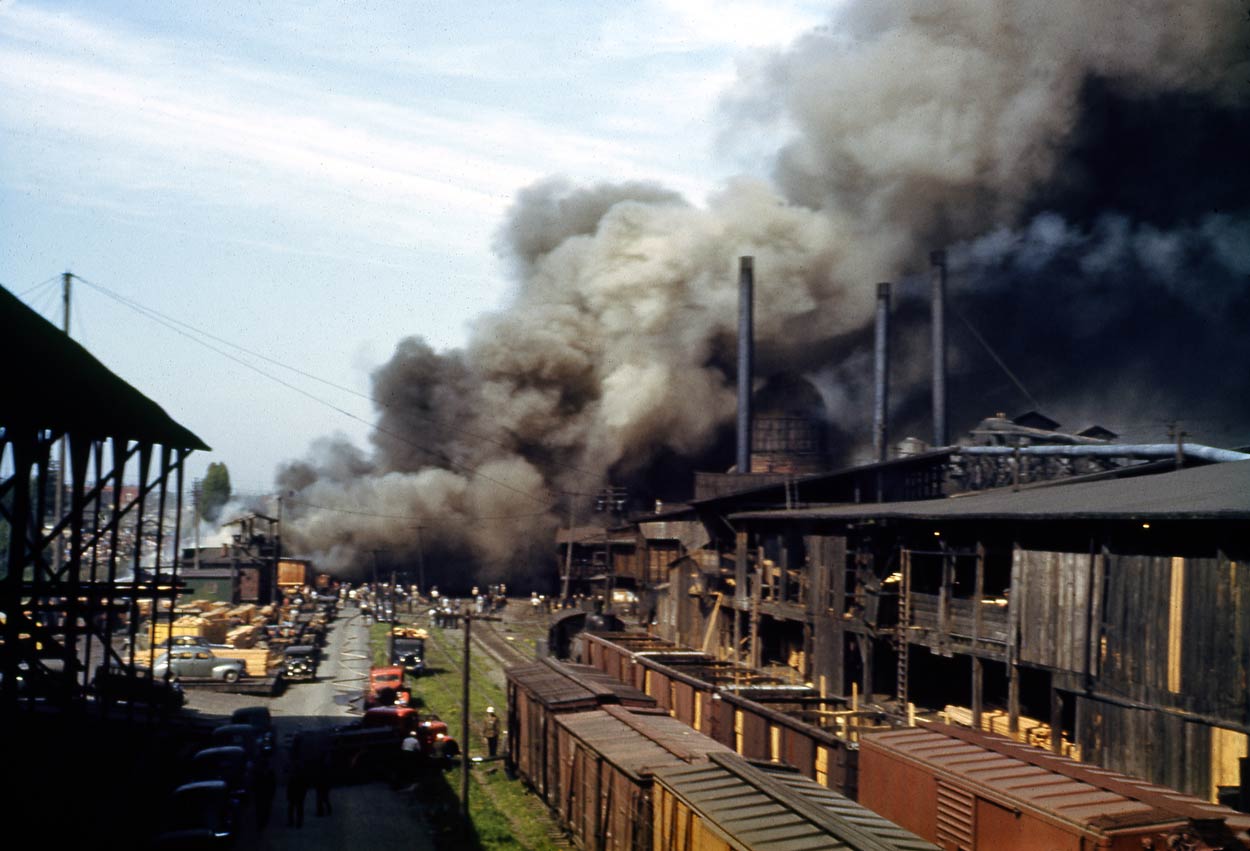

Horace Sykes looking down into the dark and deep waters of Dry Falls Lake. Below or looks at the Vista House that are more revealing than those included with Our Daily Sykes #464. (Black and White postcard used courtesy of Drew Miller. – Click to Enlarge)

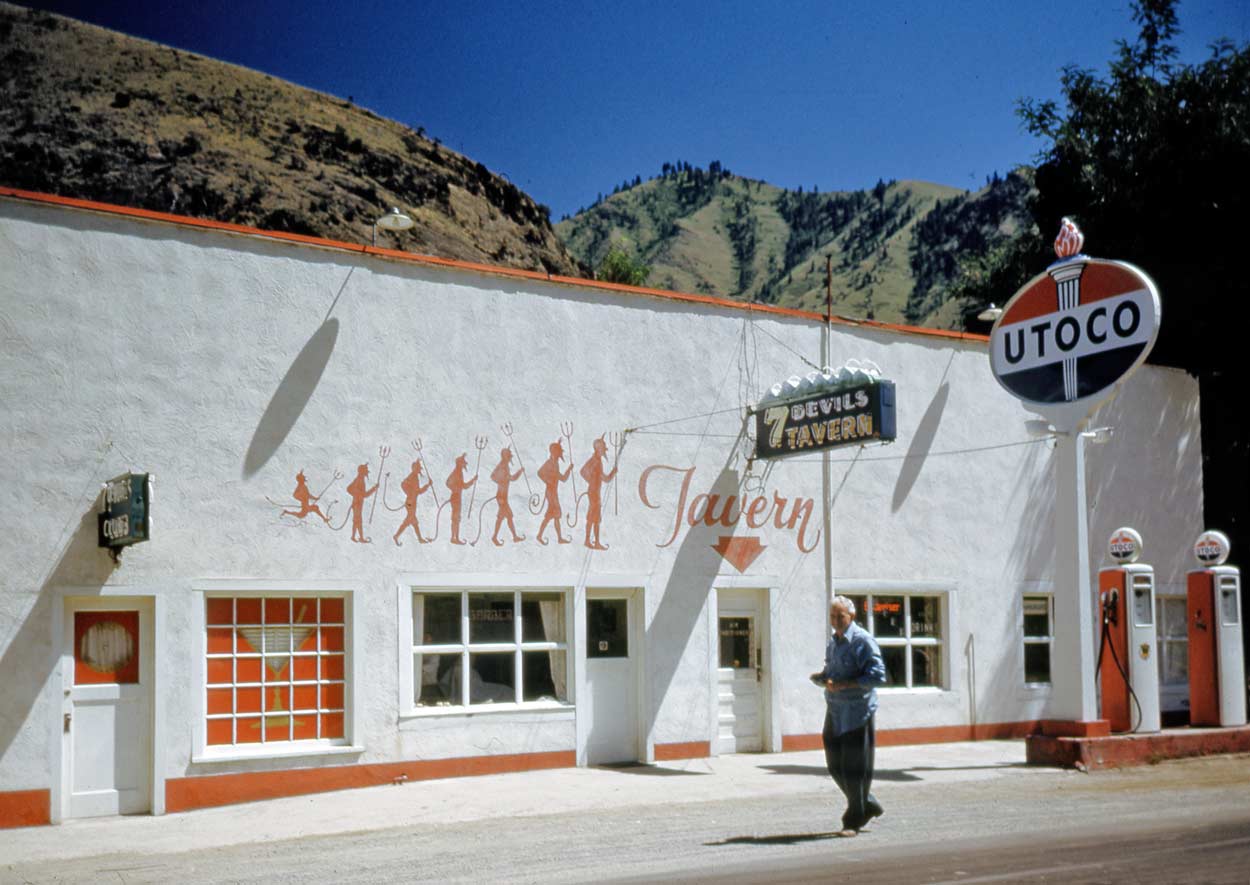
(Click TWICE to Enlarge)
Dry Fall and a glimpse of Dry Fall Lake too. The environs can be learned below from two of the thousands of recordings taken from the visitor’s interpretative center or near it. A brief study below should find the features of the cliff that Horace Sykes shows above. An alternative is penultimate to the bottom where Mrs. and Mr. Giezentanner pose for real photo postcard artist Ellis with some of the Dry Falls Park observation shelter showing on the left. The Giezentanners are described as the caretakers and lecturers for the park. The couple stands on a short bridge that leads to a monolith that is exposed and feels so. That fenced prospect appears in Jean and my book “Washington Then and Now” on pages 144 and 145. Below the Giezentanners is the billboard that for many years romanticized these rocks and imagined falls. The natural interpretation of the place and its historical forces has changed some since the board was raised. You may easily find contemporary interpretations using the net. There is among them a documentary – with animations and working geologists – that about six years ago was shown on PBS. I have lost the title.


(click to enlarge photos)


Saturday, Dec. 14, 1907, a Seattle Times page two headline announced that members of Seattle’s First Presbyterian Church “Will Listen to First Sermon in Half Million Dollar Edifice Tomorrow Morning.” The paper claimed that the new octagonal sanctuary would “seat 2,500 comfortably,” and the congregation’s principal preacher, the tall Tennessean Mark A. Matthews, explained that “there will be no pews for rent, and persons who are not identified with the church as members will be given seats the same as the oldest members of the institution.”
He might have sold tickets. On the Monday following, the Times described the “immense audience” that swelled not only the sanctuary but the neighborhood around it. The streets were “congested for hours” and five thousand were turned away. The enthusiasm was predictable. With his sensational sermons, the charismatic and suitably confident Matthews was the biggest show in town. Since his arrival in Seattle in 1902, he had built First Presbyterian into what was routinely described as “the largest Presbyterian church in Seattle.” Sometimes this was adjusted to “in the world.”

Monday Times coverage of the dedication was printed on page three, while on the front page was another Matthews story that was so foul – it was about two quail – that it now seems fishy. Headlined “Divine Eats Forbidden Birds,” the story describes Matthews “quietly” asking a waiter at the Rathskeller Cafe if he might be served for lunch that same day some quail. Somehow the protracted event was witnessed by the city’s Game Warden. After “two nice hot birds” were served and enjoyed by the cleric, Warden Rief collected the forbidden bones for evidence and arrested the waiter with the likely name John Doe. Rief left no doubt that he thought the Divine was “equally culpable with the waiter” but, he compassionately told the Times reporter, if Mathews “acts properly in the matter I may not prosecute him.”

Visiting the sanctuary of First Presbyterian, my guide pointed over my shoulder at an enormous, vibrant stained glass window, located at the back of the choir loft.

It was donated anonymously by a Boeing chairman in the early 60s.
Evidence for this, I was told, lies in the red pane to the right of Jesus’ foot, which evidently sports the faint image of a Boeing jet, but eludes me.

Can you make it out, Paul?
No, Jean, I do not see it. Perhaps it requires an even greater enlargement that the one you provide above. If you have time and talent to blow it up real good perhaps a 707 will materialize. Will you try it?
I will indeed, Paul.

Sadly, Paul, I still can’t see it. Even though my grandfather, Lewis G. Randal, was a Presbyterian minister, I have long-since lapsed. Can your old post-Lutheran eyes see it any better?……
BUT WAIT! I went to the wrong red pane – the plane is much more evident than I’d assumed. Even an agnostic could see it, Paul!

Something springs to mind here – faith in things unseen? The blind leading the blind? The mile high club?
Btw, anything to add?
Yes, Jean, our gracious friend and contributor Ron Edge is providing some links to other features that have appeared in these pages that relate – however remotely – to this week’s feature. Thanks Ron. After those I’ll gather up some other subjects that have sat in these or other pews.


DR. MARK ALLISON MATTHEWS CARICATURES
In the first years of the 20th Century three collections of caricatures of local VIPs were published, and First Presby’s principal pastor got into two of them – a local record for a “man of cloth.” Top one is from “Men Behind the Seattle Spirit, The Argus Cartoons,” published by Argus editor W.A. Chadwick in 1906. The Argus was a long-lived tabloid. I remember it still from the 1970s. The second cartoon dates from 1911 and is pulled from “The Cartoon, A Reference Book of Seattle’s Successful Men with Decorations by the Seattle Cartoonists’ Club.” Frank Calvert was the editor, and yes there are no women represented in either collection.
(DOUBLE CLICK to read the text.)


MARK MATTHEWS SPEAKS – & WRITES
Matthews arrived in Seattle in 1902, and was soon demonstrating his talents for promotions, which included frequent insertions of his sermons and other lessons in local publications. Here are two examples. The first is copied from Pacific Northwest, the tabloids Nov. 1903 issue, and the second from The Seattle Mail and Herald, from May 23, 1902.
(DOUBLE CLICK to read the text.)


HIRAM GILL (right) & MARK MATTHEWS (left)

NEXT – A PARISH SAMPLER

Above: A procession led by Archbishop Tikhon of San Francisco prepares to carry the church’s relics to the altar during the Dec. 19, 1937 consecration of the then new and unfinished St. Nicolas sanctuary on Seattle’s Capitol Hill. (Courtesy Museum of History and Industry) Below: Jean Sherrard’s contemporary repeat looks east across Thirteenth Avenue near mid-block between Howell and Olive Streets.

ST. NICHOLAS RUSSIAN ORTHODOX CATHEDRAL
(First appeared in Pacific Dec. 13, 2007)
When the St. Nicholas congregation consecrated their new cathedral on December 19, 1937 it was not quite completed. The accompanying photograph of that day’s procession led by Archbishop Tikhon of San Francisco reveals the tarpaper that still wraps most of the sanctuary. Church historian Sergie Kalfov explains that the brick façade was added sometime later in 1938. The sprightly and surviving entryway was also constructed then.
The five cupolas springing from the roof symbolized Jesus Christ and the four evangelists. Kalfov notes that a church with seven cupolas might stand for the seven sacraments, and so on. Ivan Palmov, the architect, was also responsible for the St. Spiridon sanctuary in the Cascade Neighborhood.
Both congregations primarily served Russian immigrants, beginning with those that fled the 1917 revolution, when the church in Russian was persecuted and the Czar Nicholas II and his family assassinated. The Cathedral was dedicated to the memory of the Czar, but its name also refers to the fourth century “wonderworker” St. Nicholas the bishop of Myra in what is now Turkey.
What separated the members of St. Nicholas from those of St. Spiridon was, in part, the former’s continued devotion to the Russian monarchy. This past May 17th the Russian Orthodox Church Outside of Russian and the Russian Church, after nearly 90 years of separation reunited in Moscow. Kalfov explains “St. Nicholas was the first Cathedral to a host a pan Orthodox service shortly after the signing of the Act, where over 14 local Orthodox clergy served for the fist time in such a service.”
The congregation’s 75-anniversary celebration continues until May 22, another St. Nicholas Day.
*******

Above & Below: The obvious continuities between this week’s photographs are the monumental twin towers of St. James Cathedral, upper right, at 9th and Marion and far left the unadorned rear west wall and south sidewall of the Lee Hotel that faces 8th Avenue. Judging from the cars, the older scene dates from near the end of World War Two. The weathered two-story frame building at the scene’s center also marks time. It was torn down in 1950 and replaced with the parking lot seen in the “now.” (Historical photo by Werner Lenggenhager, courtesy of Seattle Public Library.)

NOSTALGIC RECORDER
In 1949 architects Naramore, Bain and Brady began construction on new offices for themselves at the northeast corner of 7th Avenue and Marion Street. Their new two-story building filled the vacant lot that shows here, in part, in the foreground of the older scene. Consequently if I had returned to the precise prospect from which Werner Lenggenhager (the historical photographer) recorded his view ca. 1947 I would have faced the interior wall of an office that was likely large enough to have once held several draughting tables. Instead I went to the alley between 7th and 8th and took the “now” scene about eight feet to the left of where the little boy stands near the bottom of the older view.
That little boy is still younger than many of us – myself included – and he helps me make a point about nostalgia. The less ancient is the historical photograph used here the more likely am I to receive responses (and corrections) from readers. Clearly for identifying photographs like the thousands that Lenggenhager recorded around Seattle there are many surviving “experts.” And more often than not they are familiar not only with his “middle-aged” subjects but also with the feelings that may hold tight to them like hosiery – Rayon hosiery.
Swiss by birth Lenggenhager arrived in Seattle in 1939, went to work for Boeing and soon started taking his pictures. He never stopped. Several books – including two in collaboration with long-time Seattle Times reporter Lucile McDonald – resulted and honors as well like the Seattle Historical Society’s Certificate of Merit in 1959 for building a photographic record of Seattle’s past. The greater part of his collection is held at the Seattle Public Library. For a few years more at least Lenggenhager will be Seattle’s principle recorder of nostalgia.
*******

Above and Below: St. Edward’s Chapel held the northwest corner of Columbia Street and Terry Avenue between 1904 and 1912. It served as the temporary sanctuary for the Catholic see during the development and construction of the St. James Cathedral. Cathedral School, which took the place of St. Edward’s, still holds the corner. Historical photo courtesy of the Archives of the Archdiocese of Seattle.

PRO-CATHEDRAL
In what may be the single surviving photograph of the two together here stand the Cathedral and the pro-Cathedral — the former towering above and behind the latter. (The contrast is made the more impressive by the Cathedral dome which collapsed in the “big snow” of 1916.)
As its name by type suggests, the “pro-Cathedral” was built as a temporary home for worship while the new St. James Cathedral was being constructed. It was designed by James Stephen, a Seattle architect better known for the many plans he created for public school during his term as the Official School Architect for Seattle Public School during the first years of the 20th Century.
Of course, the Catholic pro-Cathedral also had a proper name. A centuryago – this coming Saturday, Nov. 13, 2004 – Bishop O’Dea dedicated St. Edward’s with “full rights of dedication” not typical for a sanctuary so small and short-lived. It was named for the English King who was canonized in 1008, with the added connotation that the Bishop’s first name was Edward and the martyred monarch was his patron saint. Edward O’Dea moved his see from Vancouver to Seattle in 1903. By then Seattle was established as the center of Washington State urbanity and the more likely site for the construction and financing of a Catholic cathedral for the region.
About 200 parishioners attended the dedication of St. Edwards pro-cathedral. Only a year later (less one day) on Nov. 12, 1905 an estimated 5000 were on hand to watch their bishop bending beside a temporary altar helping with the laying of the St. James cornerstone. The Cathedral was itself was dedicated in 1907 and five years later the pro-Cathedral was razed and replaced with the Cathedral School seen here in the “now.”
*******

Above: The landmark Epiphany Episcopal Church at 3719 Denny Way in the Denny-Blaine neighborhood was built in 1911 from designs by Ellsworth Story, a member of the parish. Courtesy, Epiphany Episcopal Church. Below: In order to see around a tree and through the parish landscaping the contemporary photo was recorded from a position somewhat closer to the sanctuary.

EPIPHANY EPISCOPAL CENTENNIAL
(First appeared in Pacific, Jan. 15, 2007)
The city’s boom years of the early 20th century was accompanied by a proliferation of services and institutions into Seattle’s new neighborhoods. This included the churches and this example, the Episcopalians in the Denny-Blaine neighborhood.
Often the idea for a new church was seeded by members of an older or pioneer parish that was founded in the central business district. As Mary Henry, Epiphany Episcopal’s church archivist explains in her historylink.org essay on the parish, the idea for this congregation was promoted when “Bishop F. W. Keator took a group of Episcopalian men from St. Mark’s Episcopal (later St. Mark’s Cathedral) on a yachting trip in Lake Washington and as they passed the Madrona area, he commented on the need for a church in the neighborhood.”
The date for this waterborne inspiration was August 1907, which makes this the Centennial year for the parish. The rustic English Gothic chapel printed here took four years more to build and another sixty-seven years to become an early pick for Seattle’s official registry of landmarks in 1978.
The natural charm of this wood and brick sanctuary was created to compliment the style of the “city beautiful” Denny-Blaine Addition, which is appointed with streets that do not march through the neighborhood on a grid but rather curve through the natural topography as it descends to the shores of Lake Washington. Many of the Denny-Blaine homes are also landmarks, whether listed or not, and a few are by one of Seattle’s most cherished architects Ellsworth Story (1897-1960). Story was both a member of Epiphany Episcopal and the architect of this its first parish.
Mary Henry’s thumbnail history of the parish is, as noted, on historylink.org. and easy to find. (It is Essay 7825.) Later in this its centennial year Epiphany heritage will also get another and longer account with a book history by Barbara Spaeth that is now still a work-in-progress.
*******

Above: Unidentified members of Holy Angels softball team wait and take their turns at bat in this 1937 playground scenes at Ballard’s St. Alphonsus Parish. Perhaps a reader will recognize one or more of these players. Below: The members of the contemporary St. Alphonsus community posing in the “now” scene are named in the accompanying story. (photo courtesy St. Alphonsus School)

‘HOLY ANGELS” AT BAT
(First appeared in Pacific Oct. 11, 2007)
Thankfully centennials will often stimulate an archival rigor in whatever is celebrating its first 100 years. Gloria Kruzner, designated parent-historian for Ballard’s St. Alphonsus Parish School, collected boxes and sacks filled with school ephemera including what she describes as “wonderful and historically significant photos” while preparing her history for the school, which Dominican Sisters first opened as the Holy Angels Academy in 1907, the year Ballard was annexed into Seattle.
This snapshot of eleven members of the 1936-37 Holy Angels softball team is, we agree, a wonderful example. Kruzner has determined that this is a scene from that school term’s “Play Day” program. But who are the players and might a reader know?
1937 graduate Elizabeth Crisman Morrow holds the bat in the contemporary “repeat” photograph. She played shortstop on the 1937 team, but doubts that she is included in this bunch of out-of-uniform players, with the slim chance, she notes, that she is the batter in the historical scene as well.
Behind the players both views show the same three-story brick schoolhouse that opened in 1923 for what was by then with more than 600 students the largest Catholic school in the state. The third floor was reserved for the high school. From the late 1920s on, only girls were admitted to the Holy Angels Academy, which survived until 1972 when it was closed for want of both funds and students. The coeducational St. Alphonsus School carried on with lay instructors and since 2004 with the help of new sisters from the Society of Our Lady of the Most Holy Trinity, (SOLT).
In the “now” reenactment SOLT Sister Mirium James convincingly acts the role of catcher on the far left. Besides the batter-alum, Elizabeth Crisman Morrow, the other members of the Alphonsus community include, left to right, Kathi Abendroth, class of 1955, Maggie Kruzner (daughter of the school historian), Joseph Chamberlin, Megan Chamberlin, Joseph Bentley and Emmiline Nordale who is half hidden beyond the batter. School principal Bob Rutledge is on the right, and climbing the fence, third grader Hanna Nordale takes the part of the “Holy Angel” peering over the fence in the 1937 scene.
*******

Above: Dedicated in 1926 the Seventh Church of Christ Scientists has survived on the roof of Queen Anne Hill as one of Seattle’s finest creations. (Historic photo Courtesy Special Collections Division, U. W. Libraries. Negative no: 26935) Below: Sturdy, intact and wrapped in its own landscape the landmark is yet threatened with destruction for the building of three or four more homes in a neighborhood primarily of homes. Many of the sanctuary’s neighbors are fighting alongside the Queen Anne Historical Society to keep their unique landmark.

QUEEN ANNE LANDMARK – EXQUISITE & SECRETED
On the late morning of Tuesday, May 22nd last (2007), the Washington Trust for Historic Preservation held a press conference intended to turn the fate of one of Seattle’s most exquisite landmarks away from its planned destruction and towards something else – something “adaptive” like another church, a community center or even a home – a big home.
The Trust not only included the Seventh Church of Christ Scientist on its 2007 list of the Washington State’s “most endangered historic properties.” It then also used the front steps of this Queen Anne landmark as the place to circle the wagons for statewide preservation. It was an especially strong sign by the Trust and for its extended family of historians, architects, citizens – including sensitive neighbors of the church – of how cherished is the Seventh Church.
Seattle architect and painter Harlan Thomas (1870 – 1953) created the unique sanctuary for the then energetic congregation of Christ Scientists on Seattle’ Queen Ann Hill in 1926. It was the year he was also made head of the Architecture Department at the University of Washington, a position he held until 1940.
Although a local architectural marvel this sanctuary is not well know because of its almost secreted location. The address is 2555 8th Ave. W. — at the Avenue’s northwest corner with West Halladay Street. Except to live near it or to visit someone living near it there are few extraordinary reasons to visit this peaceful neighborhood, except to enjoy this fine melding of architectural features from the Byzantine, Mission, Spanish Colonial and other traditions.
Since the Trust created it in 1992 the “Endangered List” has not been an immoderate tool in the service of state heritage. Less than 100 sites have made this register, which is really the Trust’s emergency broadside for historic preservation.
*******

Above & Below: For a few years in the 1920s a cross revolved fitfully above the corner of the University Methodist Temple. Since the Methodists moved three blocks to their present home in 1927, the surviving 1907 sanctuary at 42nd and Brooklyn has been used for a variety of sacred and secular enterprises — sometimes together The Vineyard Christian Fellowship of Seattle purchased the building 1991. Fellowship offices in the 1902 chapel receive the rising redolence of the popular Thai restaurant in the basement.

CHURCH of the REVOLVING CROSS
(Appeared in Pacific first in the spring – sometime – of 2007)
For a few years after its remodel in the early 1920s the University Methodist Temple at the southeast corner of Brooklyn Ave. N.E. and 42nd Street was known as “The Church of the Revolving Cross.” The slender spire that had topped the 1907 sanctuary at its corner leaked and was replaced during the remodel with a motorized cross. The mechanism, however, was less than miraculous. It frequently broke down and the cross, seen here, was soon removed.
North end Methodists first met in Latona (now part of Wallingford) in the locally vigorous year of 1891. Seattle annexed new territory as far north as 85th Street in 1891; the first electric trolley crossed the then new Latona Bridge that year. Also in ‘91 the state chose the northeast shore of Lake Union at Brooklyn for a new university campus, although the school waited four years more to make the move. By the time the Methodists built their first small chapel here on 42nd beside the alley in 1902 Brooklyn was just as likely to be called the University District.

The larger corner sanctuary was added in 1907, a year made repeatedly noisy by the dynamite used to shape the nearby campus for the 1909 Alaska Yukon and Pacific Exposition. Besides replacing the spire with the cross, the 20’s remodel also expanded the sanctuary, joining it to the chapel – as seen here. Still in 1927 the Methodists left this clapboard sanctuary for a bigger brick one on 43rd Street, across 15th Avenue from the campus.
Although born in 1927 church historian David Van Zandt was too young to march with the congregation and its preacher Dr. James Crowther the three blocks to its new home. According to Van Zandt, Warren Kraft Jr. is the only surviving church member who walked in that Sunday parade. Kraft was then a two-year-old toddler whose wandering distinguished him at the dedication ceremony. The first words spoken by Crowther from his new pulpit were “Has anyone seen Warren Kraft Jr.”
*******

Above & Below: And official local landmark since 1977, in 2004 the Immaculate Conception Parish at 18th and Marion celebrated its centennial. (Historical photo courtesy Loomis Miller.)

IMMACULATE CENTENNIAL
The twin Italianate towers of the Immaculate Conception Church have distinguished Seattle’s skyline from their pedestal on Seattle’s Second Hill (AKA Renton Hill) for nearly 100 years. The ground was broken for Seattle’s oldest surviving Roman Catholic sanctuary (used continuously for services) in April 1904, and the first ceremonial opportunity that followed was the traditional laying of the corner stone.
The May 15th procession up the hill from the interim parish (in what has since been renamed the surviving Gerrard Building on the campus of Seattle University) to the foundation work for the new parish at18th Avenue and Marion Street was given historical perspective on the spot by diocese Bishop Edward O’Dea. “It is a pleasure to look back into the history of Seattle . . . Twenty years ago one small church sufficed for the needs or our limited membership and now we have four churches and fourteen priests.”
Remarkably, in less than seven months Seattle’s Catholics were ready to march up the hill again for the dedication on the 4th of December. The eight-block procession between the two parishes was led by a platoon of local police and Wagner’s Band, the traditional accompanists for Seattle celebrations. Behind the band marched the Hibernian Knights, the Knights of Columbus, and the Catholic Foresters of Seattle, Tacoma and Ballard — Ballard was then still its own town. Bishop O’Dea and ranked clergy were fit in carriages to elegantly cap but not conclude the procession. “Following them and lining the route” to quote now from an early history of the parish, “was a motley but magnificent parade of priests, sisters and local gentry all in a jovial spirit.”
For the dedicatory High Mass Father Prefontaine, Seattle’s pioneer priest who arrived here in 1867, assisted Bishop O’Dea. The day’s celebrants filled what the local press advised was “the city’s largest seating auditorium.” (The 950 seat record, however, was temporary. It was surpassed by more than one of the large theatres that would soon be built downtown.)


