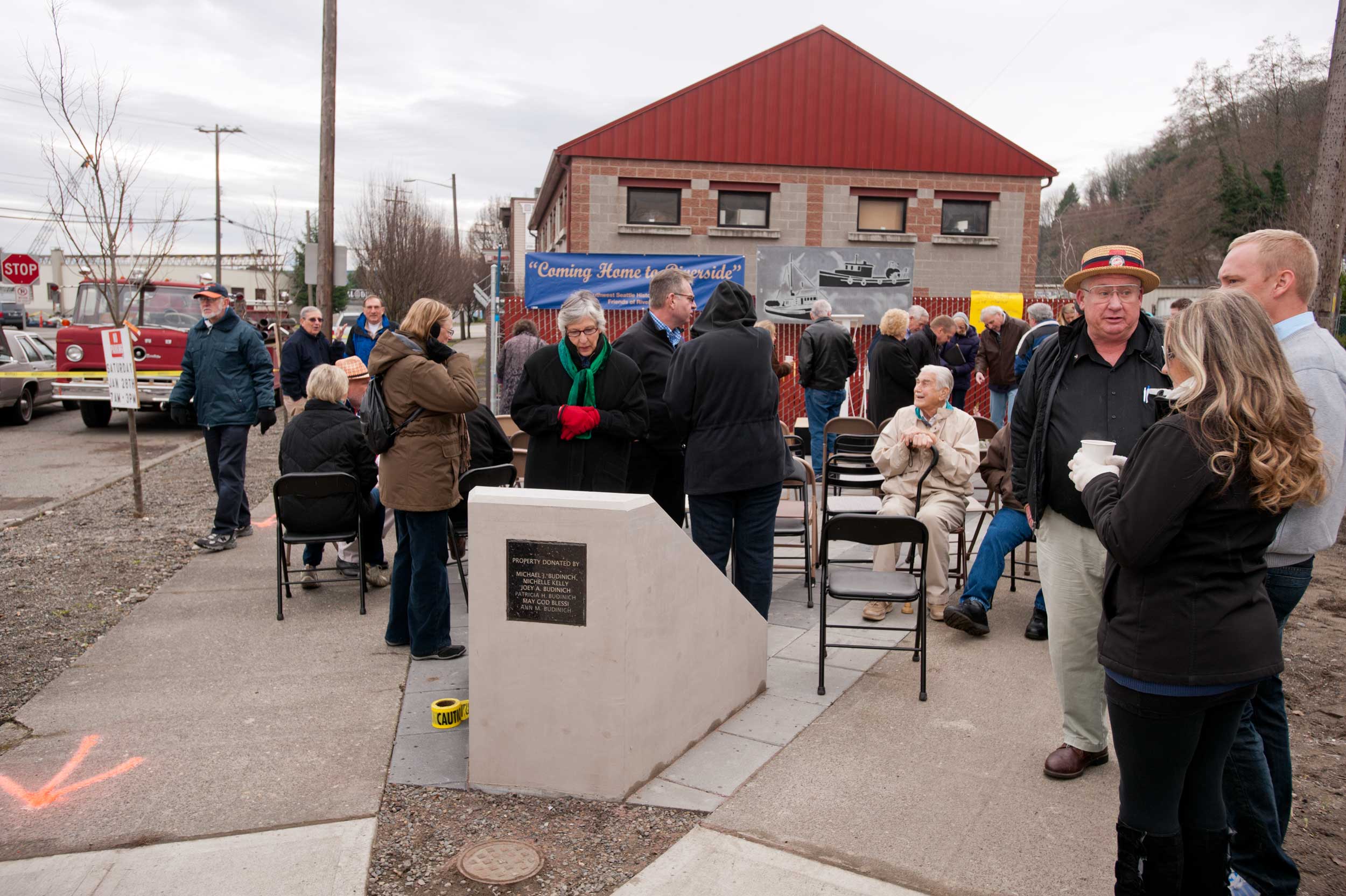
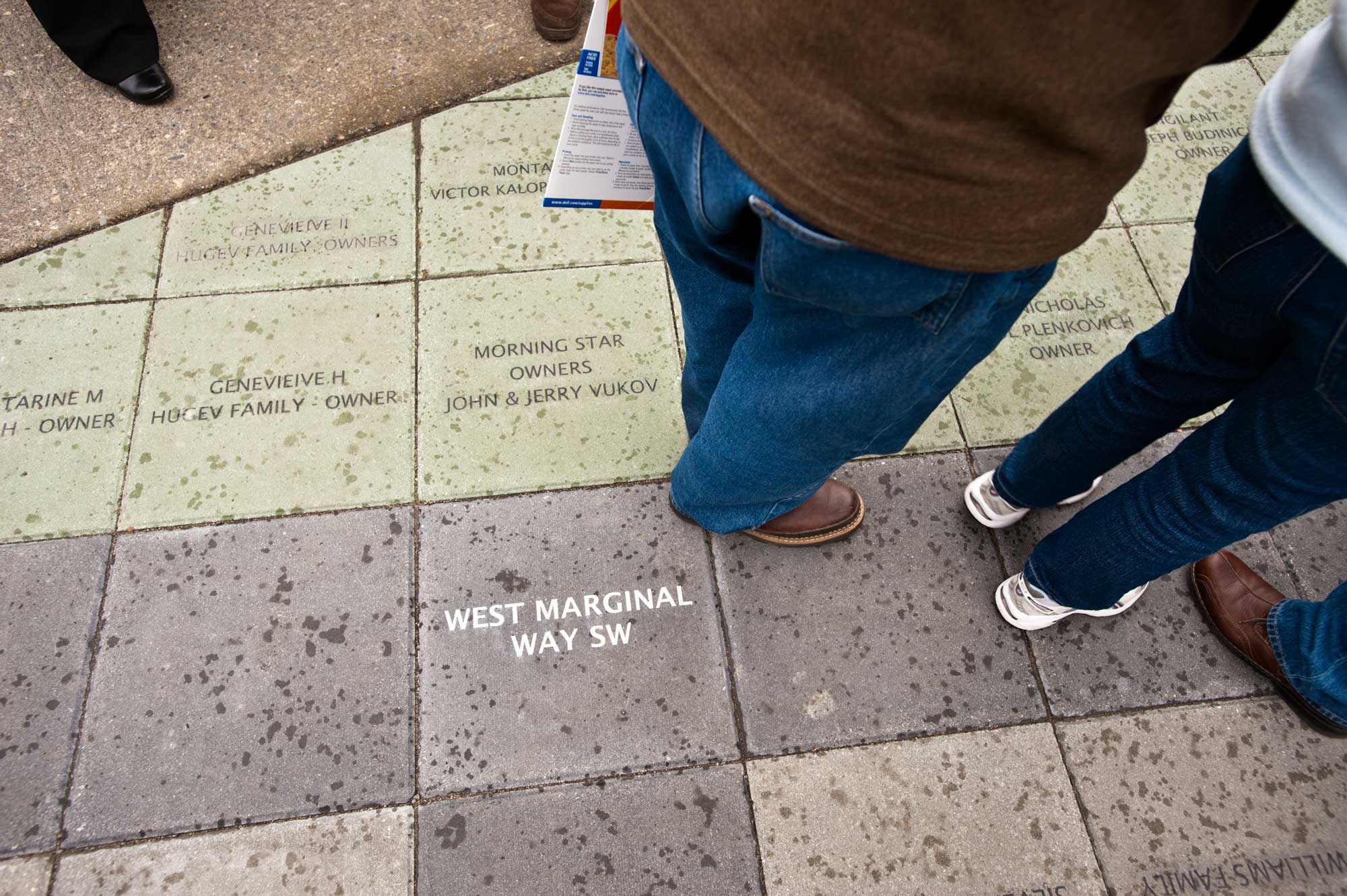
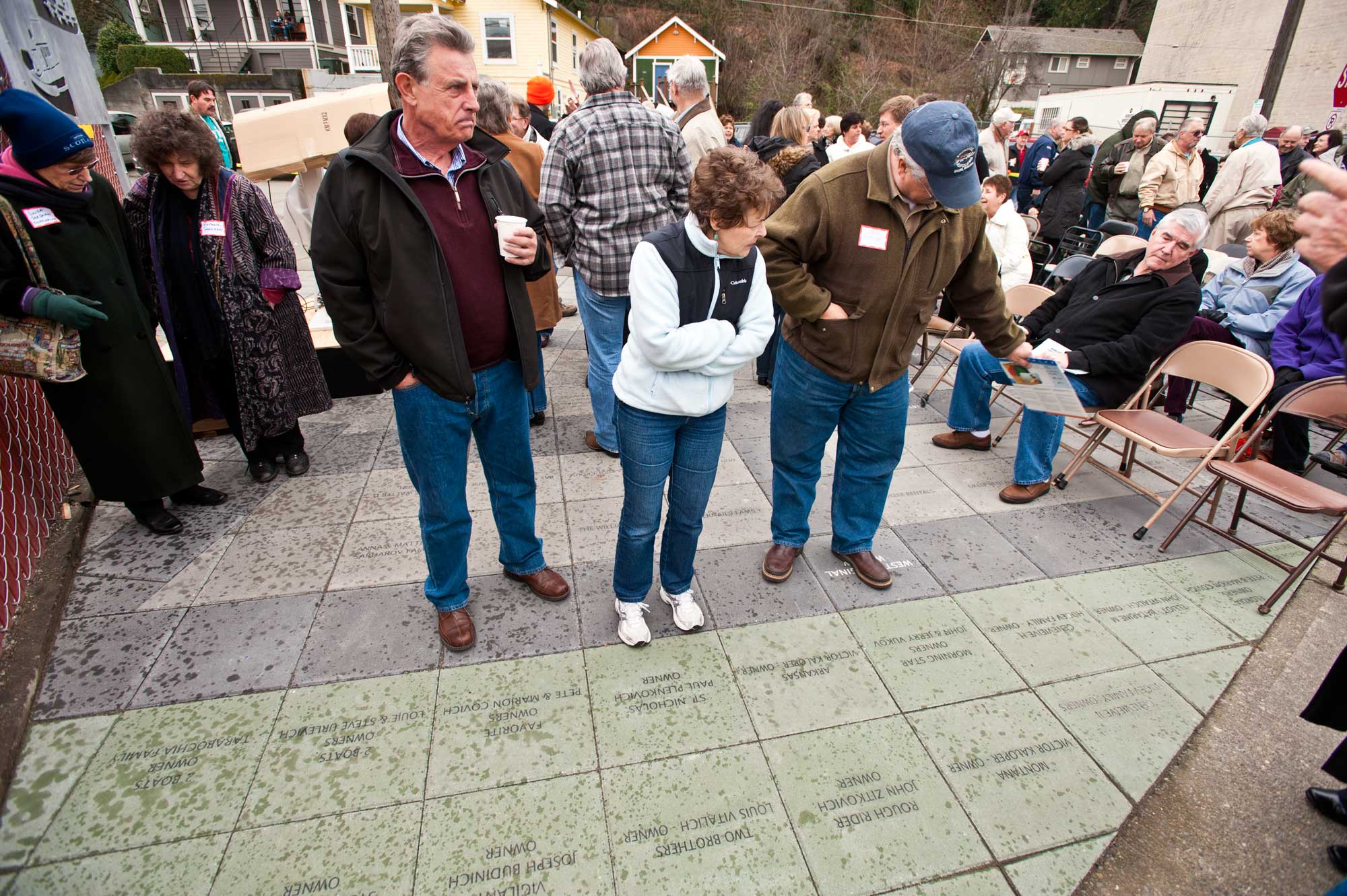
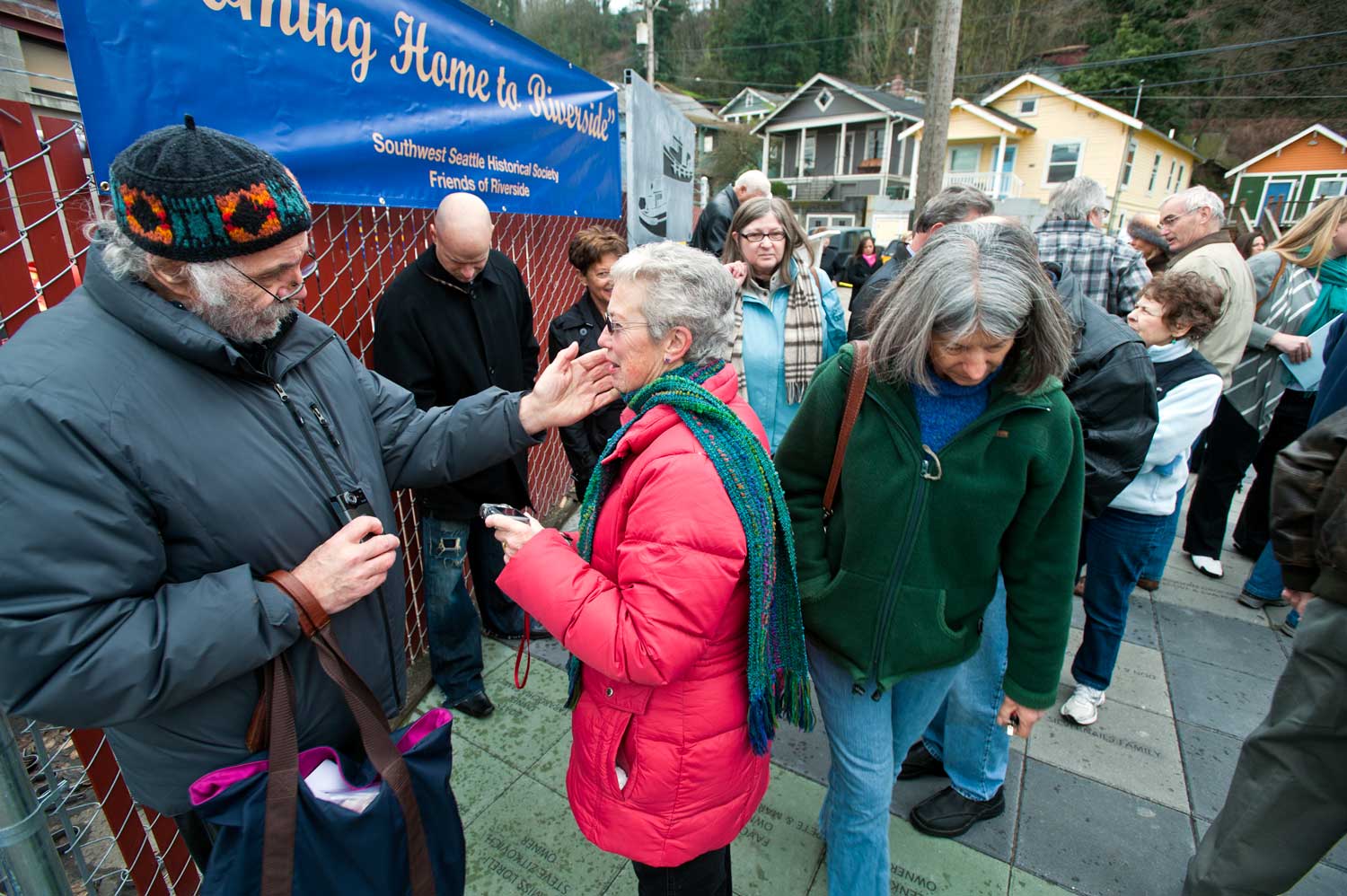
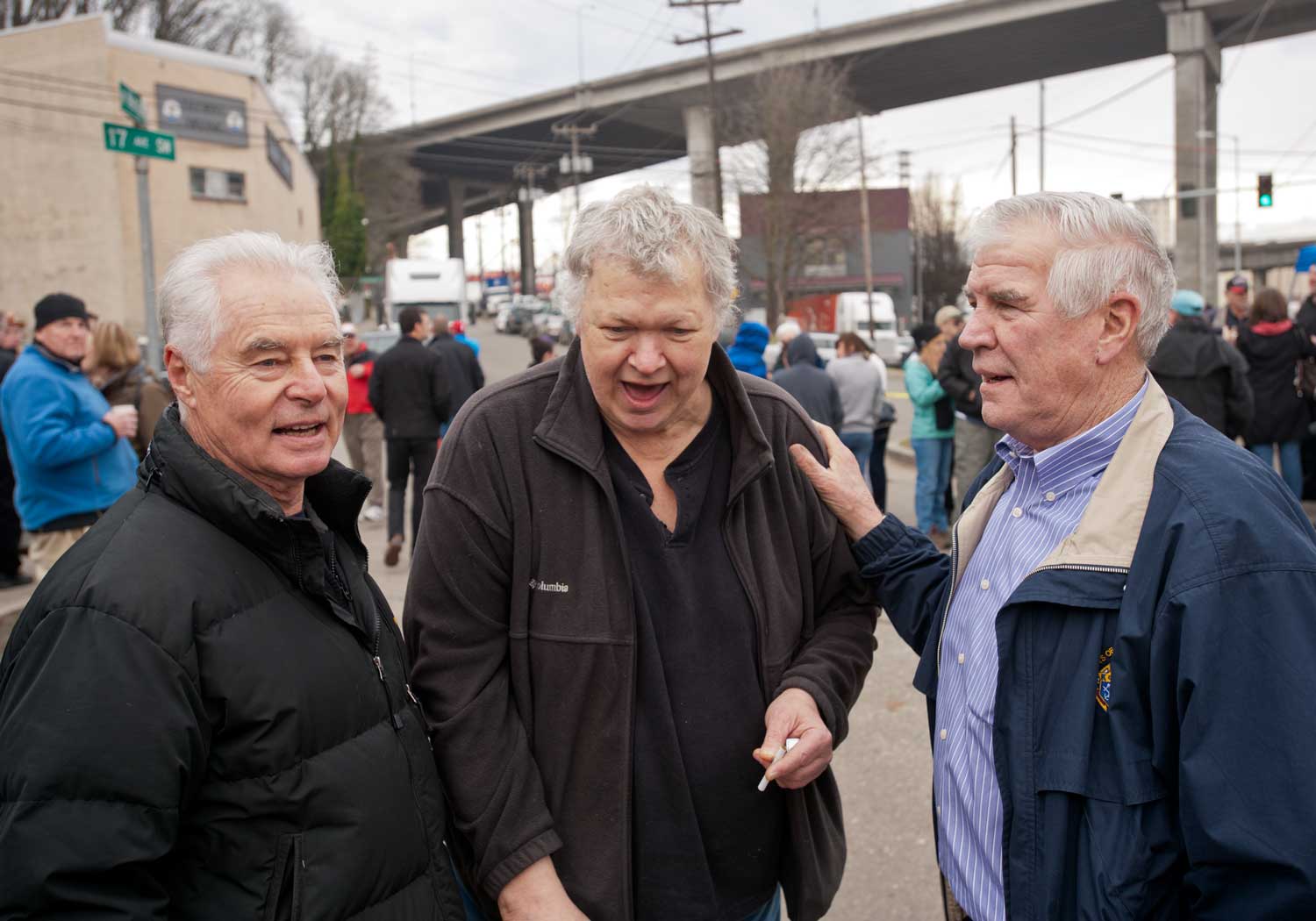
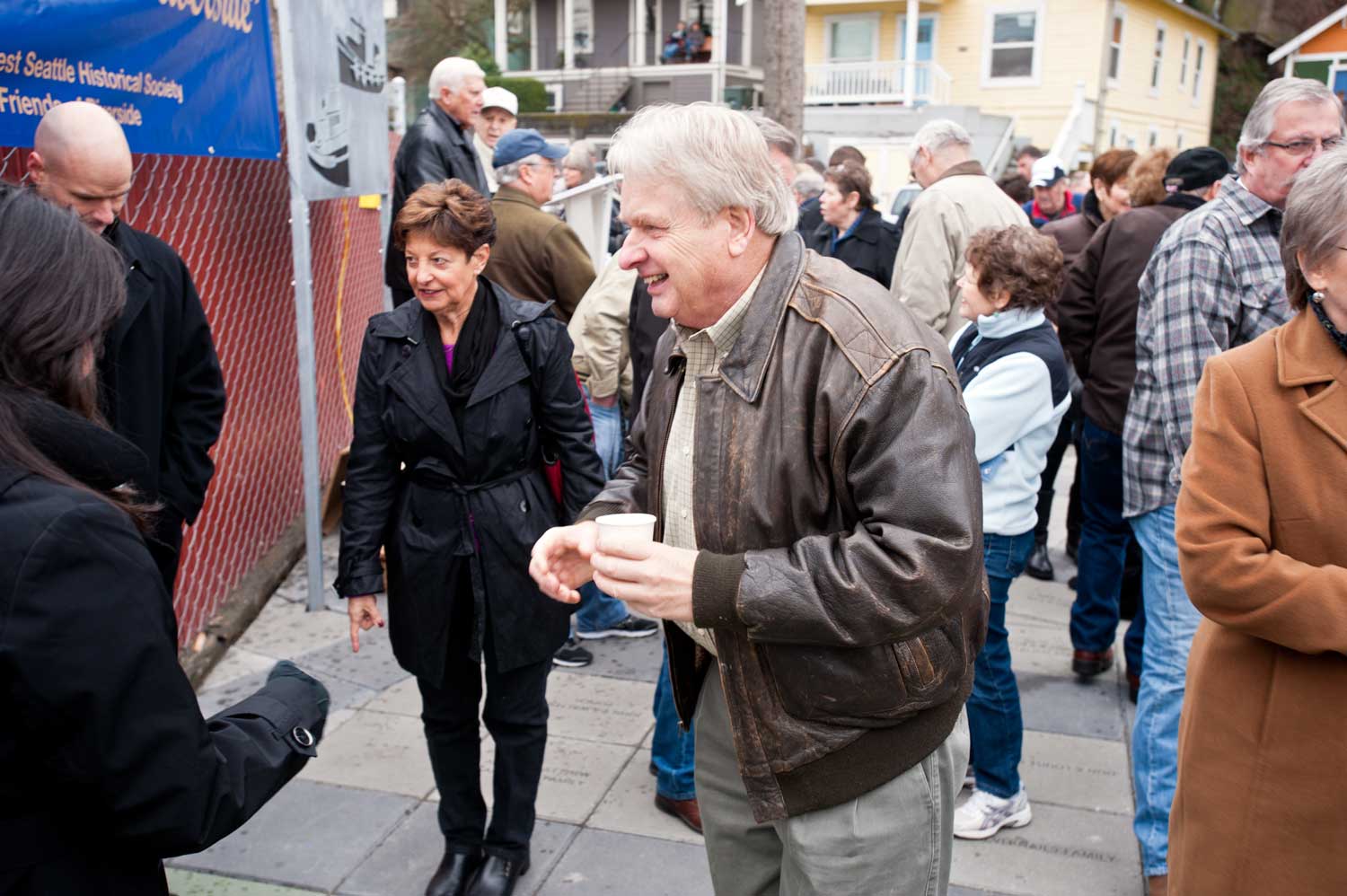
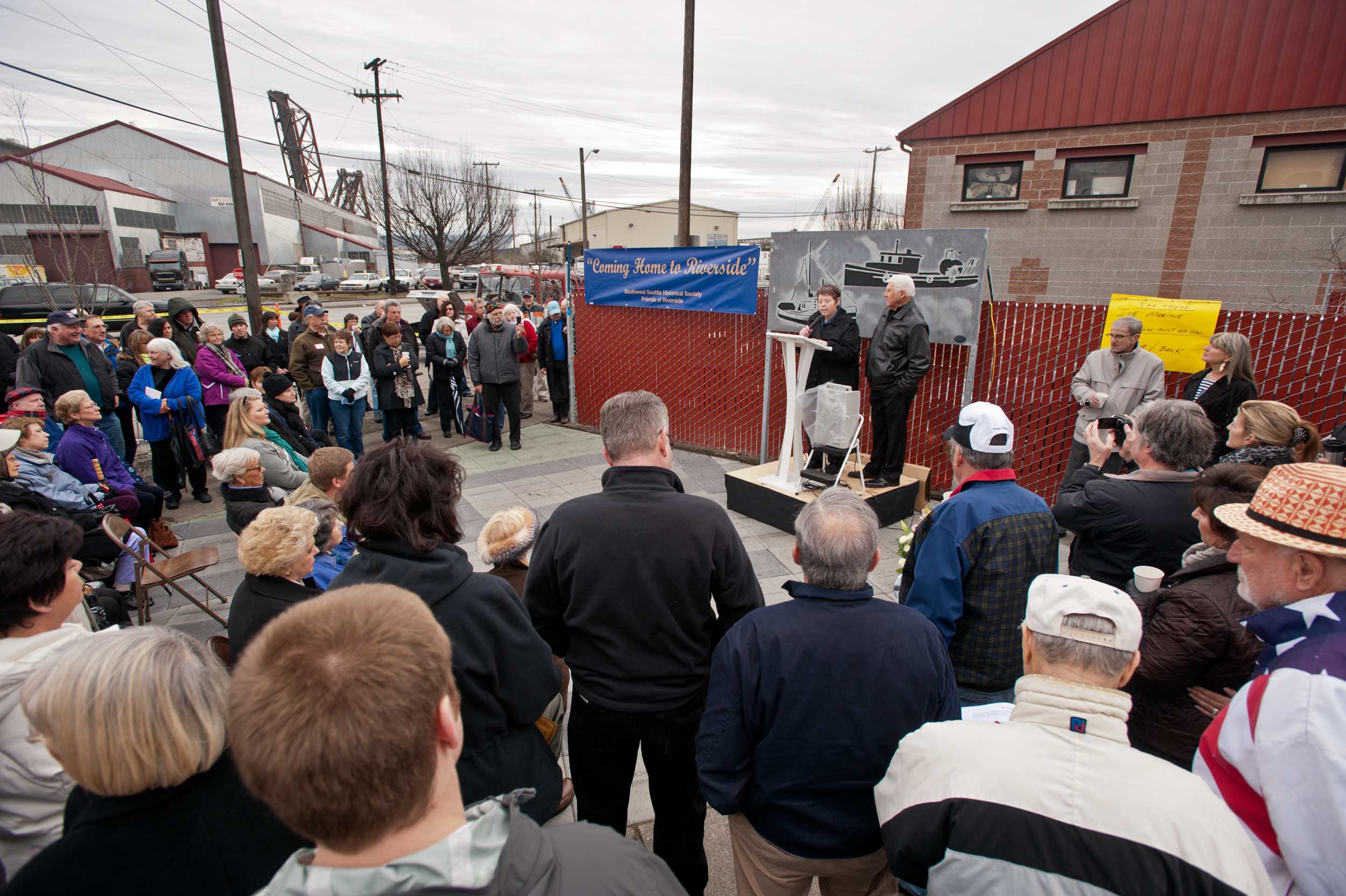
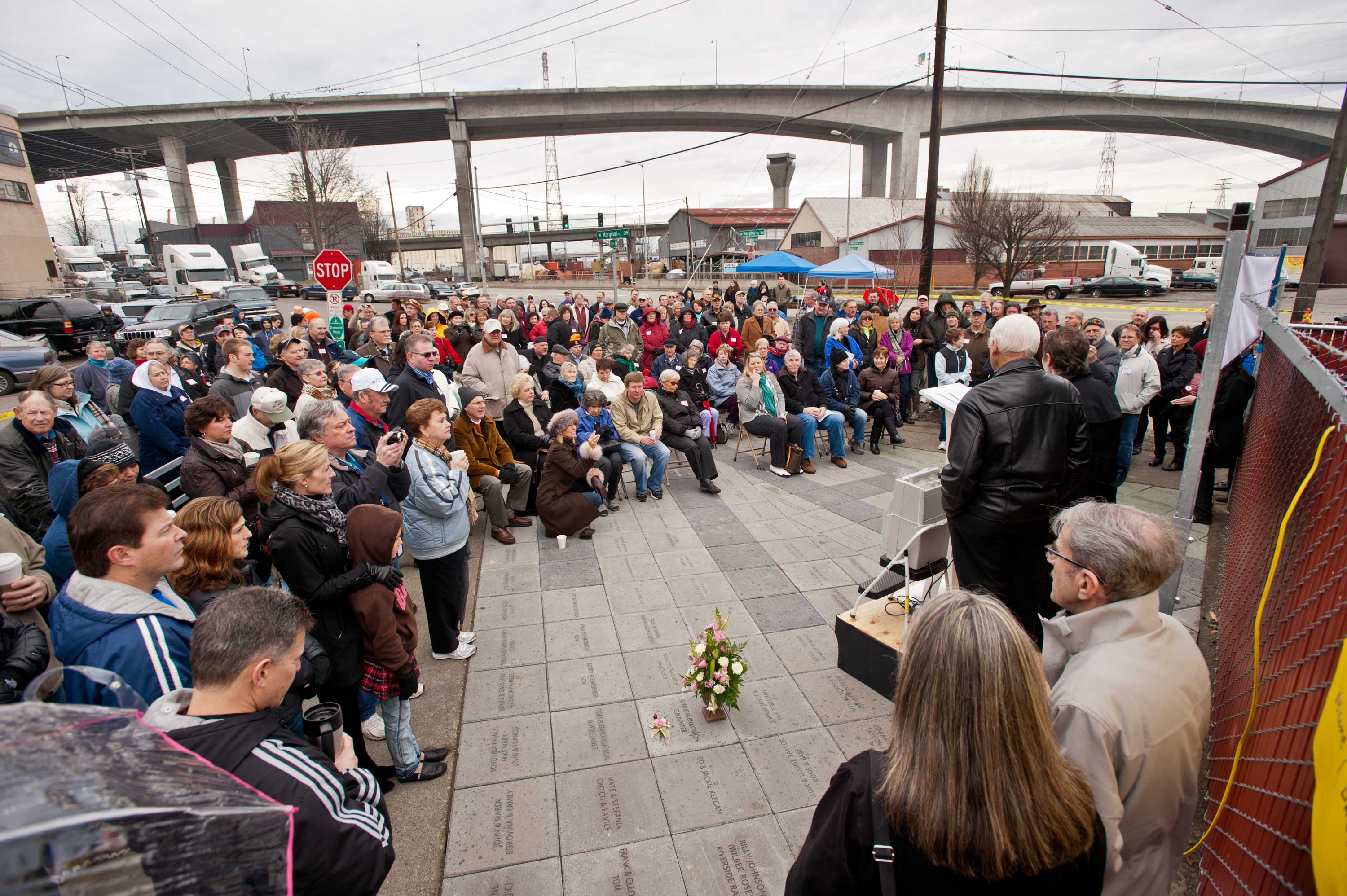
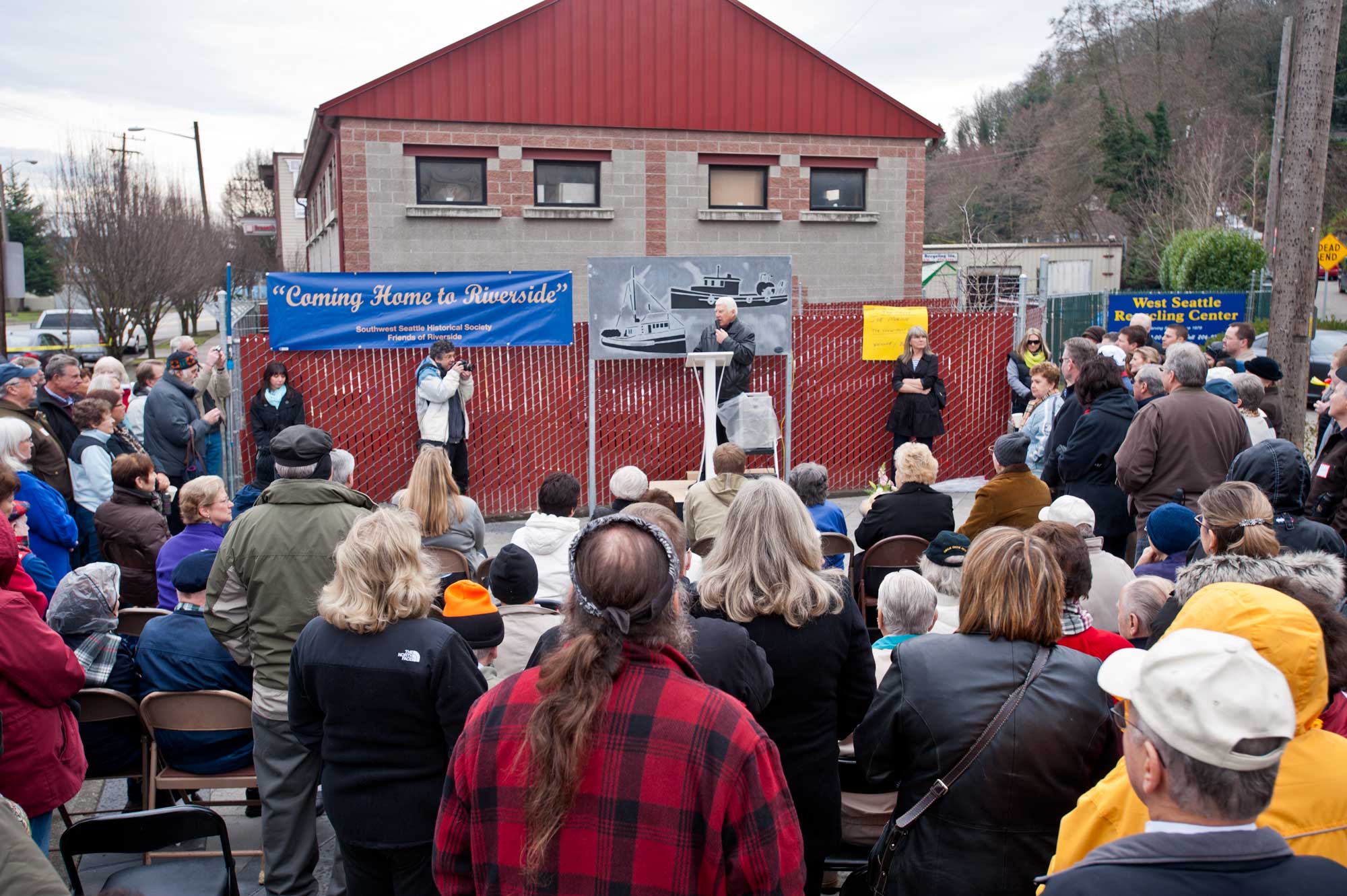
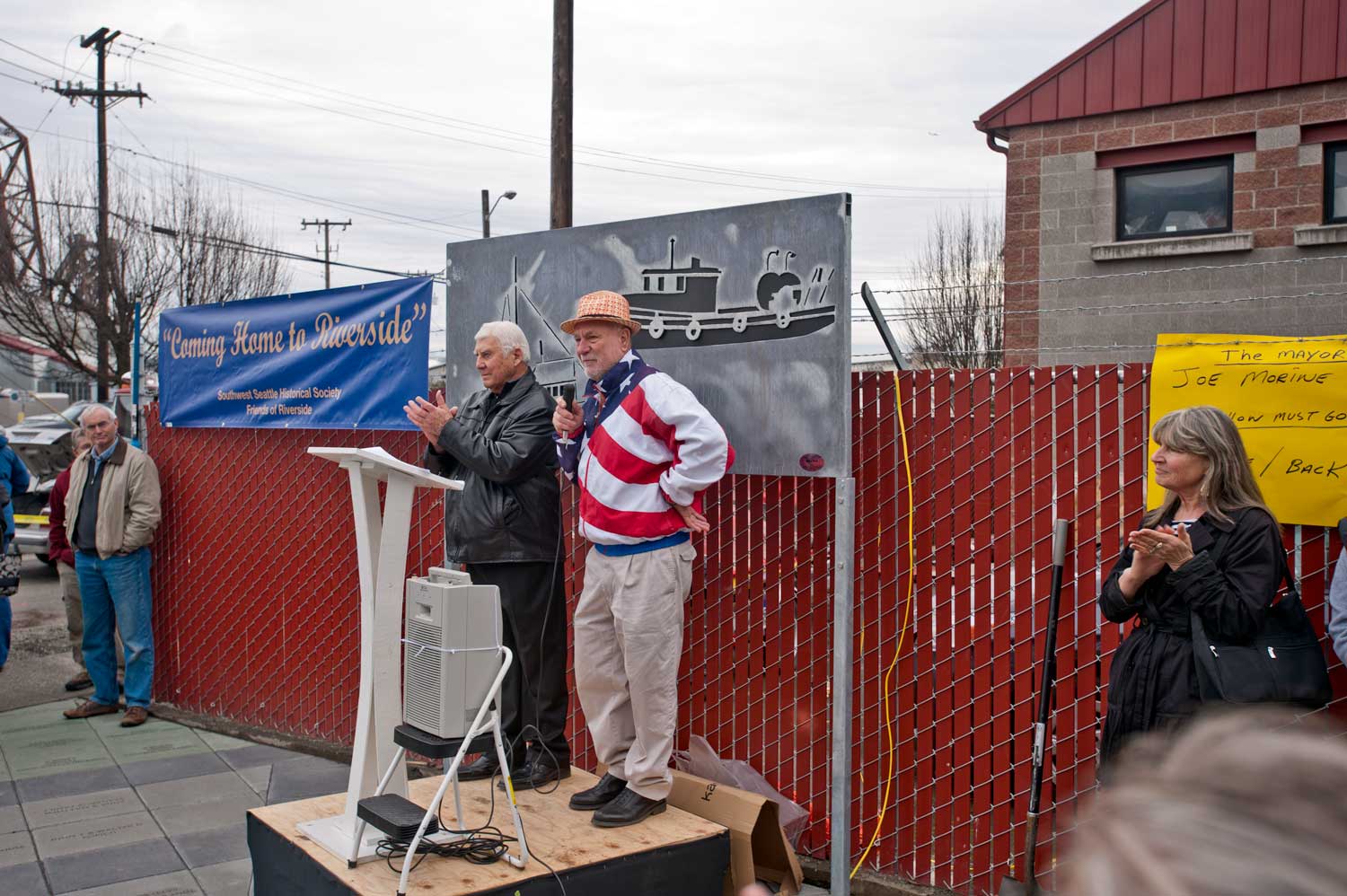
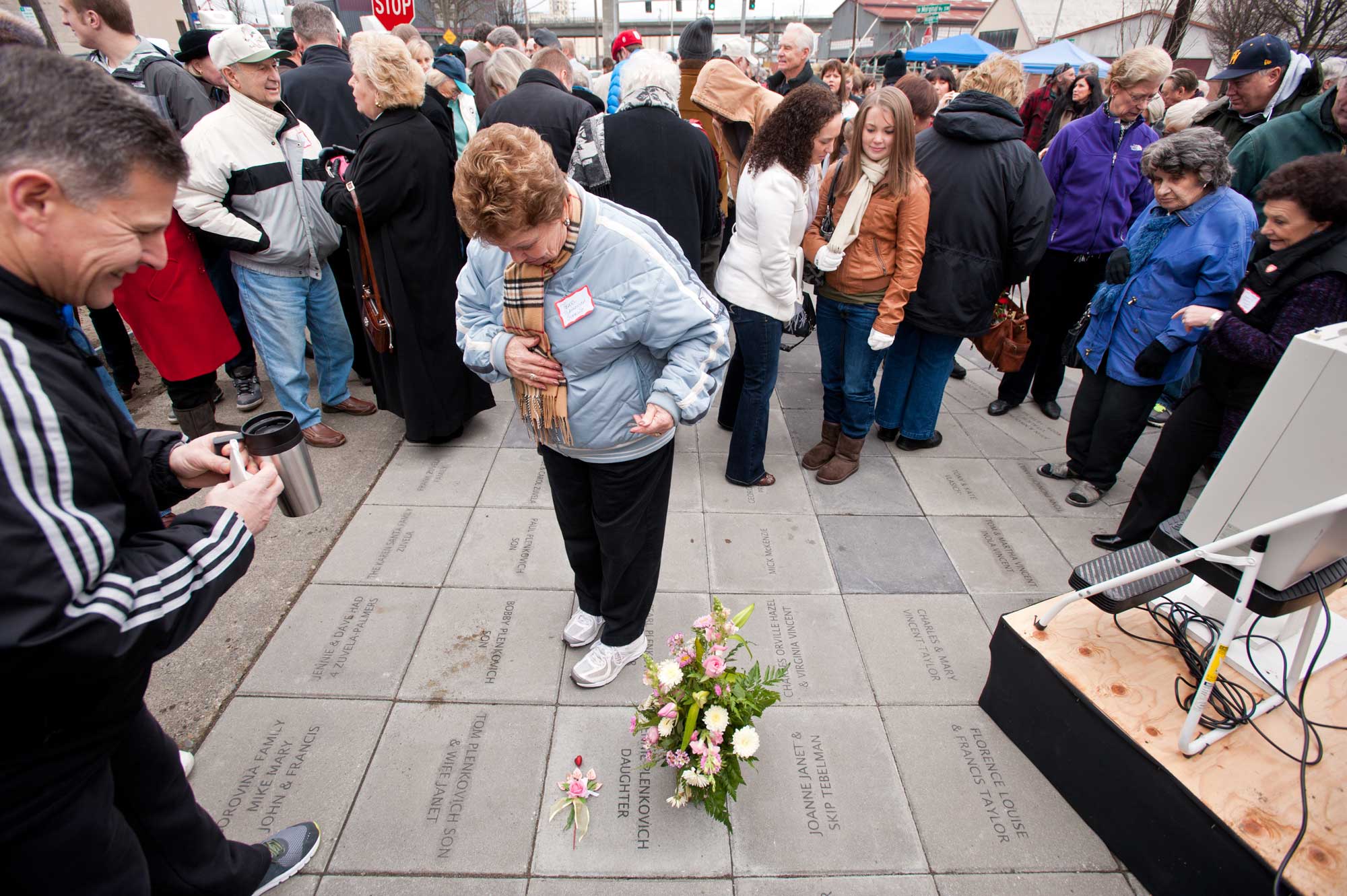
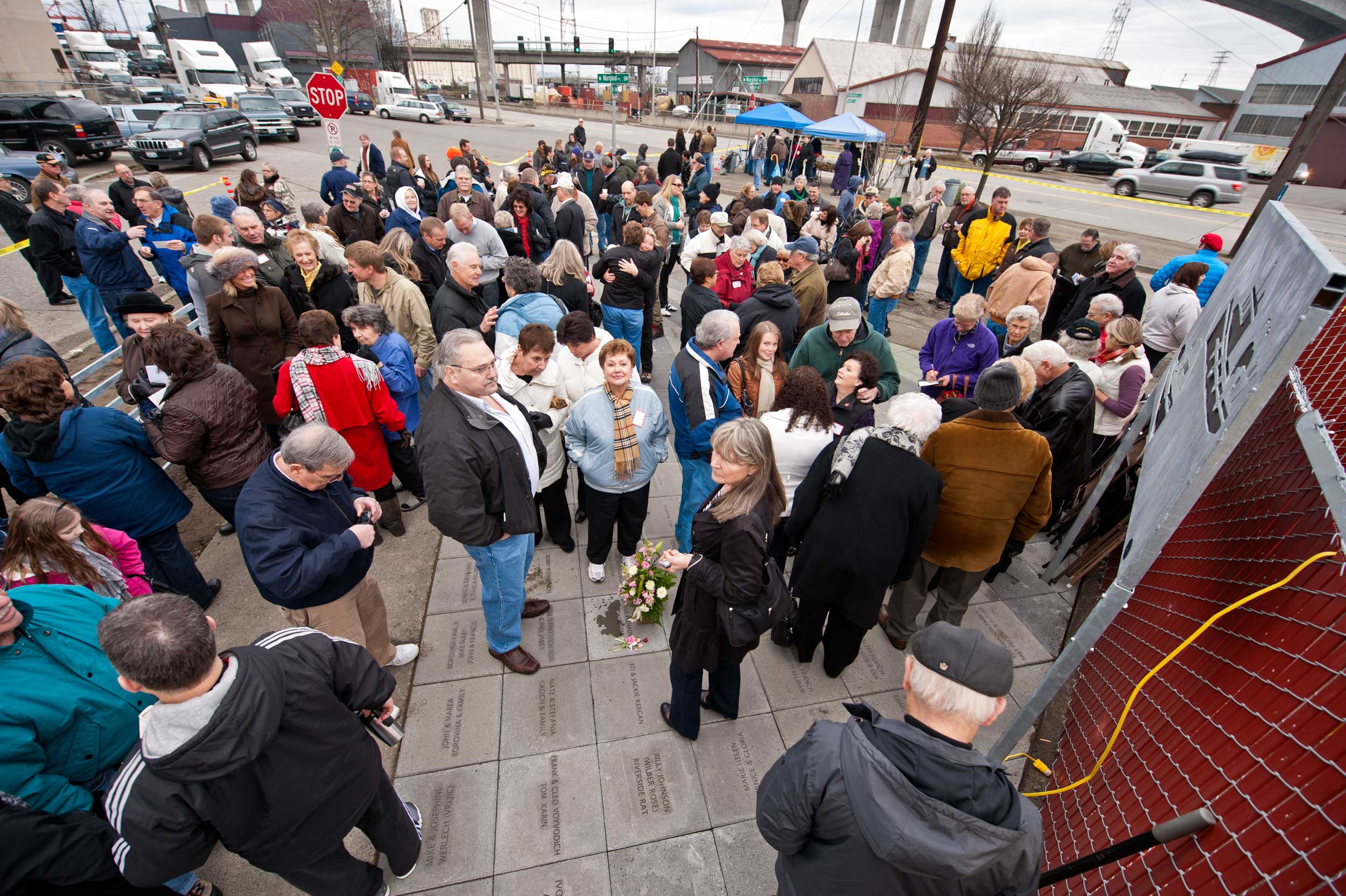
Yesterday, Paul and I had the pleasure of attending the celebration/dedication featured in last week’s Seattle Now & Then.
Here, for your enjoyment are a selection of photos from the event. The top two photos are quite large, allowing visitors to blow them up for greater detail.
Click twice to see full photoFormer Riverside neighbors find their place on the grid
Jean here, with a quick note on behalf of dorpatsherrardlomont. Our server has once again become somewhat unstable, preventing the addition of the usual Web Extras which accompany ‘Seattle Now & Then’. We apologize for this disruption of our regular service, but will try our best to get things back up and running smoothly as soon as possible.
(click to enlarge photos)
We preface the unmarked historical view below with this painted one above, because we got a note from a reader (of both the smaller version that appears in Pacific and the larger one in this blog below), asking for some pointers for finding many of the landmarks noted in the text below: for instance, Second Ave., Union Street, the Denny barn, the Methodist church and the the future site of Plymouth Congregational Church’s first sanctuary. Here it is, the marked version. Have the site/server not given us so much trouble we would have added all sort of other pans and details of the neighborhood. Now that will need to come later, and there will most likely be other opportunities to add such stuff then.THEN: The still forested First Hill, upper left, and Beacon Hill, center and right, draw the horizon above the still sparsely developed north end of Seattle’s residential neighborhood in 1872-73. Second Avenue angles across the center of the subject, and also intersects there with Union Street. (Courtesy, Seattle Public Library)NOW: Looking south through the alleyway between Pine and Stewart Streets. The rear concrete wall of the Nordstom Rack appears center-left. It was completed in 1907 at the northwest corner of Second Ave. and Pine Street, a ten-story home for “Your Credit is Good,” Standard Furniture.
Here an unnamed pioneer photographer has chosen a prospect on the southwest slope of Denny Hill to look south through what was then Seattle’s “north end.” This may be the first look from an elevation that was understandably for years after – until it was regraded away – a favorite platform for recording the city.
The photograph was taken mid-block (block 27 of A.A. Denny’s 3rd Addition) between Pine and Stewart Streets and First and Second Avenues. Jean Sherrard’s now is adjusted to both use and relish the alleyway that runs thru the center of the block. The historical photographer stood a few feet left, behind (or embedded in) the concrete wall, and somewhat closer to Pine Street. He was also thirty or forty feet above Jean, for this part of Denny Hill was graded away between 1903 and 1905.
By a mistake of my own I’d considered 1875 a most “deserving” date for this subject, but I preferred 1876, a boom year for Seattle, and an annum that “explains itself” with Seattle’s first city directory. I was wrong by three or four years. The date here is the blooming months of either late 1872 or early 1873, and the evidence is in two churches – one showing and the other not.
Second Avenue angles through the center of the scene. On August 24, 1873 Plymouth Congregational Church dedicated its first (of now four) downtown sanctuary on Second a little ways north of Spring Street. It would – but does not – appear above the roofline of Arthur and Mary Denny’s barn, here right-of-center at the southwest corner of Second and Union.
Appearing – but barely – also above the Denny barn, but to its right, is the Methodist Protestant Church near the northeast corner of Second and Madison. In 1871 its pastor Daniel Bagley gave it a “remodel,” a second floor with mansard windows. Both additions are showing.
In “This City of Ours,” J. Willis Sayre’s 1936 school textbook of Seattle historical trivia, Sayre makes this apt point about the Second Avenue showing here. “In the seventies it had narrow wooden sidewalks which went up and down, over the ungraded surfaces, like a roller-coaster . . . The street was like a frog pond every winter.”
WEB EXTRAS
I thought I’d throw in a related picture with a short sketch. City alleys provide us with back doors, service entrances, garages – but also occasionally reveal darker aspects. Looking for this week’s ‘now’, I took several photos up and down the alley between Pine and Stewart, and snapped ( and eavesdropped on) two kids, boyfriend and girlfriend, just arrived from a small town by bus. Something heartrending here, with that little pink backpack bobbing down the alley.
Kids in the alley
Anything to add, Paul?
This time Jean’s question is rhetorical. We have had such a time with this blog and its “server” that it is ordinarily impossible to get on it. The chances are that what I am writing here will not be saved. I’ll keep it brief. It seems we must find a different server. This may take a while. Again, if any of your have suggestions in this regard please share them with us. Meanwhile please check the blog daily – if you will – but know that nothing new might appear, and you too may not be able to open it, for instance for browsing through past features. Hopefully we will escape these problems early in February, and come back with a site that is confident and stable.
The trailer packed with deer and moose parts has a license dated 1942 and is parked on Terrace Street (between 4th and 5th) beside the side door to the old Public Safety Building, which since its restoration in the 1970s has been known as the 400 Yesler Building. We don’t know that the animal parts are collected as evidence but we assume it given the location. A different trailer below holds its own gruesome parts and is surrounded by a pack of curious mostly young men. This trailer is parked on Jackson Street east of 5th Avenue and across the street from the Orpheum Cafe, which was then in the building at the northeast corner of 5th and Jackson. That lot is now for parking. Looming in the haze is the 9-story Richmond Hotel at the southeast corner of 4th Avenue and Main Street.
Jean has enlightened me concerning the fate of items added to any of our posts. Depending upon the timing, some readers will never see them. The reason is that the original contents of a posting – and this part is mysterious still to me – are copied by entities, which then share them with others who ask for them. The mysterious but still mighty servers are only interested in “beginnings” and do not write over or add the additions to their original copies of the page. They resemble teachers who will not take late changes – including additions – to a term paper. And so you see the problem of adding information – mostly illustrations – later on. Consequently, we here add addenda (or addendums, if you prefer) fresh and at the blog’s top as late additions to the Riverside story that appears in its greater part below Jean’s restaurant review of Green Lake’s Trattoria Cioppino, which is just below.
Hotel West, but not dated. To the rear, I believe, of Hotel West where something is smoking, right-of-center, April 12, 1923.Hotel West with pile driver from bridge work - not dated - and the profile of Pigeon Point.Map of Pigeon Point from 1895. (Not so long ago)Pigeon Point - and more - from a 1931 Sanborn real estate map. Looking west from Pigeon Point over W. Spokane Street - and the Youngstown Viaduct for trolleys - to West Seattle - July 6, 1931. (Courtesy Municipal Archive)Looking West on W. Spokane Street below Pigeon Point. On top the regraded Pigeon Point appears at the top left corner in a 1930 look from the Youngstown Viaduct, which also includes the Shanghai's alluring promise of dancing to live music. Bottom, the Shanghai has become Marty's Tavern (see the next same day pix below) recorded from the Spokane Street grade in 1962. (Courtesy of the Southwest Seattle Historical Society.)
We interrupt our regular Sunday post of ‘Seattle Now & Then’ (found just below) to introduce a restaurant we’ve come to adore.
Owner/Chef Riccardo Simeone with his eponymous - and swooningly delicious - cioppino
Occasionally, at DorpatSherrardLomont, we come across treasures we feel compelled to share with our readers – often photographic, historical, or quirky – but this is our first culinary treasure: Trattoria Cioppino, opened since late last spring, is the real deal; an Italian jewel on Green Lake’s north end (just across Green Lake Way from the wading pool).
Trattoria Cioppino on a recent snowy evening
This lovely, welcoming little eatery boasts a mouth-watering menu with dishes that are eyes-rolled-back-in-the-head delicious. Jean has, in short order, become a regular, and finds an excuse to return for more as often as possible. To excerpt his Yelp review, the food is delicious in a way that “reaches down to some well-spring of deliciousness” combined with “gorgeous, no-nonsense preparation.”
From the spectacular calamari appetizer – tender, crisp, with a knock-out aoli for dipping (only $8 for a generous serving that satisfies four) – to mains including melt in the mouth gnocchi with succulent and tender boneless short ribs ($14); perfectly seared and savory duck breast with figs; delicate spectacular veal marsala ($17); and a cioppino that blows the roof off, mussels, clams, baby octopuses, and scallops flawlessly cooked and artfully arranged around a slab of buttery moist salmon (enough to feed two, $23).
Not to mention the desserts, all made in-house by Chef Riccardo, ranging from a mouth-watering chocolate vesuvius, to glorious cheesecake with figs, an amazing tiramisu, and a stunning creme brulee. Give me strength! In four visits so far, Jean hasn’t had a dish anything less than delightful. This is truly Italian soul food.
If it isn’t clear by now, this is a place we can recommend without reservation – although it’s wise to call ahead to make your own!
(For more about Trattoria Cioppino and Chef Simeone, click here)
THEN: Propping the game’s head on the erect barrel of his rifle, Riverside resident John Edgar Vincent poses with his fall quarry, circa 1946. (Courtesy of Hazel Vincent)NOW: Reared in the Riverside neighborhood, Jerry Vandenberg, returns to the Vincent driveway to repeat the Vincent family snapshot about 65 years later. The top of the closed railroad bascule bridge on the Duwamish Waterway is evident on the left of both scenes.
As Barbara Vincent Johnson remembers it, her older sister Hazel Vincent Munro excitedly snapped this askew picture of their father John Edgar Vincent soon after he returned from a hunting trip to the Okanogan around 1946. Her machinist dad and her younger brother “drove at night to keep the meat cool. The catch was butchered on the oak table in the family dining room, wrapped and then sped to a cold storage on the waterfront below the Pike Place Market.” For the Vincent family, deer was the “meat of necessity,” along with backyard chickens that were no longer laying eggs. Okanogan venison was especially sweet, their dad explained, because the deer there dined on apples and grain.
The Vincent family lived in Riverside, one of the Seattle neighborhoods uniquely shaped by the city’s hills and waterways. Riverside is nestled – or squeezed – between the Duwamish River, at its mouth, on the east and Pigeon Point on the west. It is small and depending on how you wrap them shaped something like a bouquet of long-stemmed flowers. It comes to a point at its north end, where since 1983 it is hidden below the high bridge to West Seattle.
Next Saturday, January 28, at noon, representatives of the Vincent family and about 60 other historical Riverside families will be “Coming Home to Riverside.” It is a memorial celebration about five years in the making, thanks in large measure to Frank Zuvela, the Budinich family that donated the triangular lot (like the neighborhood), brothers Jerry and Ron Vandenberg, who built there the Riverside Plaza, a monument to the neighborhood and its families.
Jerry Vandenberg standing amongst the pavers, engraved with family names
Frank Zuvela is now 89 but vigorous enough to lead yearly walking tours of the neighborhood. His family arrived at the mouth of the Duwamish in 1904. Like the majority of Riverside’s fishermen families, his forebears came from Croatia. Many owned fishing boats, moored them on the river, and hired Croatian crews from, yes, Riverside. It was a very organic and helping neighborhood even for those like the Vandenberg brothers whose family was Dutch.
With multi-colored commemorative tiles for both families and home sites that are faithfully arranged to repeat the patterns of the neighborhood, this Riverside creation is better visited than described. You may find it at next Saturday’s dedication – co-sponsored by the Southwest Seattle Historical Society – where Marginal Pl. Southwest meets West Marginal Way Southwest.
WEB EXTRAS
Here’s another shot of Jerry, posed above the Vandenberg paving stone.
Jerry's childhood home was on the side of the hill above his right shoulder
Anything to add, Paul? Sure Jean, and we will begin with the “other” photo from the same driveway, or very near it, where John Edgar Vincent stands with his catch propped by the barrel of the rifle that felled it. Here’s John Edge Vincent’s daughter Barbara Vincent Johnson, who has told us that she was standing near the spot her dad stood, although not on it, and on a different day. You noted that when Jerry Vandenberg visited the site with you for the “now” he pointed out that the same house appears in the shots of both the “dears” as you so cleverly punned it. So here is Barbara with whom I had a long and delightful telephone conversation when researching this story.
=====
The feature that follows is “about” the photograph shown above, which I copied from a print. In 1978 or thereabouts I went through all the Engineering Department’s (city of) nitrate negatives, pulling the bad ones. I found among them the negative for the 1918 Riverside scene above. It had gone the way of all nitrate – eventually. It is sort of explosive too. Indeed there is a law against having nitrate film in the city. On that prohibition I once spent a week in the basement of the Whatcom Museum in Bellingham going through thousands of feet of nitrate film of the northwest filmed by Pathe Newsreel Photographer Will Hudson. I could not do the work in Seattle – by law. My selections were transferred to safety film.
We will grab a page from "Seattle Now and Then, Volume One" to show that we used a different title there, and also to share the "now" that appeared first in Pacific.Photographed the same Feb.27, 1918 as the view above it, here the business heart of Riverside is not obscured by the trolley. (Courtesy Municipal Archives)
SIX BRIDGES to RIVERSIDE
(First appeared in Pacific, Dec. 18, 1983)
The contemporary photograph was shot at 11:30 in the morning of November 10, 1983. At that moment 140 feet overhead, the inaugural ribbon was being cut atop the new high bridge to West Seattle. And through the opening rushed the storm-tossed music of the Sealth High School Band, the wind-lifted cheers of West Seattle boosters in their red and white Hi-Yu uniforms, and the “ultimate solution” to 132 years (less about 68 hours) of the often frustrating task of getting to and from West Seattle. (This problem could be said to have begun in the early morning of November 13, 1851 with the landing of the Denny, Boren, and Low families at Alki Point.
This high bridge (the western approach cuts across the top of the “now” scene) is the most recent of six bridges that have crossed the Duwamish here at Spokane Street. The historical scene was photographed from near the western end of the second bridge (and the “now” takes the same line of site). Designed in 1910 and built shortly thereafter, it was given no name but “temporary” in the engineering department’s original plans. All of the first five bridges were, obviously, temporary, and it’s both an engineering and philosophical certainty that the sixth will also be.
This detail from the 1918 Kroll Map shows the swingbridge turning Spokane Street to make a shorter span across the West Waterway. We put the red arrow beside it not to suggest that it was a one-way bridge.
The first bridge was simply a swinging gate in the long viaduct built about 1900 along the future line of Spokane Street from Beacon Hill to Pigeon Point. It crossed above the tideflats and shifting sand islands that irregularly formed the Duwamish River’s estuary into Elliott Bay. (The Spokane Street trestle as seen from Beacon Hill is included in another feature included here below.) Grand plans to build the “world’s largest man-made Island, Harbor Island” and dredge a wider, deeper, and straighter Duwamish resulted in Temporary Bridge No.2 – the one pictured.
Bridge 2 was a swinging bridge. It opened to commerce on the West Waterway by pivoting on a central turntable. But in doing so it also shut off the water supply to West Seattle. The pipes are evident to either side of the roadway. Thus, bathing West Seattle citizens understood that when the bridge was closed, they would temporarily suffer for the long good of Duwamish Valley commerce.
A public works department sketch from Jan. 1, 1917 shows the line of what we call "Bridge #2" on the top and below and paralleling it the plans for "Bridge #3." The next photo below shows Bridge #3 next to Bridge #4, the first of the two Bascules. (Again the red additions are our own. "3." refers to the line of Spokane Street.)
Partly hidden behind streetcar 689 is the sometimes-rowdy barroom business district of Riverside. The ridge behind it is Pigeon Point. Knowing the date of this scene, February 27, 1918, we also know that its rural qualities are deceptive. Directly behind the engineering department photographer, things are quite frantic. There on Harbor Island the largest government contracts in the region’s history were financing the construction of thousands of WWI steel-hulled ships.
After "bridge No. 3" on the right was replace for motor traffic with the first bascule bridge, on the left, No. 3 continued to be used for trolleys. That stor is told below with the feature titled "Shoe Fly."Swing Bridge #3 seen from the Riverside side of Bridge #2 on Feb. 1, 1918.
Looking west to Riverside and in line with "temporary" Bridge #3 on April 12, 1923.The third bridge was much like the second only a little higher and longer. It too swiveled for ships (but no longer carried West Seattle water) and was also labeled on its 1917 plans “temporary” as well.
Looking east from Pigeon Point towards construction work on the second or south bascule bridge (our "Bridge #5) on Spokane Street and over the West Waterway. The date is July 11, 1929. The railroad bridge, on the far right, still stands. Jean's up-close look at it is printed near the bottom of this contribution.
On November 30, 1924, a Miss Sylvia Tell led a group of interpretive dancers from Cornish Arts School to the top of the then brand new steel bascule bridge for some christening choreography. The crowd expected for the official December 21st dedication was more than the bridge could handle, so the entire show was first broadcast the night before on Radio KFOA. The ceremony, both in the studio and on the bridge, was a mix of inspirational music, including a rousing rendition of “Ole South” by the West Seattle Community Orchestra and, of course, speeches. That was bridge number four, although it was named Bridge No. 1 to indicate its hoped-for permanence. Its other name, ” North Bridge” declared that it was only half the story. Within five years Bridge No.2, the South Bridge, was alongside it.
Side by side for the next 48 years, they acted permanent until that lucky morning of June 11, 1978 when local hero-scapegoat, Captain Rolf Neslund, ploughed his gypsum ship, Chavez, into Bridge No. 1 and made it temporary too. Now a ride to West Seattle atop Bridge 6 has the high altitude ease of Cloud Nine. This is the kind of trip that is next to eternity.
=====
Lawton Gowey, who shared this image with us, captions it "W. Spokane Street from Riverside." We are using it for itself but also as a substitute for the image used in Pacific to cover the text below. When we find it, we will attach it. Tis looks west with Pigeon Point behind Hotel West. Lawton Gowey's recording of the West Hotel in Riverside with the flyover on May 30, 1968.Jean's record of what now covers Riverside's old commercial strip at the west end of the bridge.
=====
On April 12, 1923, with his or her back to the West Waterway a municipal photographer recorded this look west into the West Hotel anchored business district at the north end of Riverside.
RIVERSIDE JUNCTION
(First appeared in Pacific, July 28, 1991)
Squeezed between the west bank of the Duwamish River and the steep eastern side of Pigeon Point, the business heart of the Riverside community was once the junction for the streetcar lines that branched to Alki Point, California Avenue, Fauntleroy and Lake Burien. The “then” photographer stood on or near the timber approach to a temporary bridge that once crossed the Duwamish at Spokane Street. Dated April 12, 1923, the scene was recorded more than a year before the first of West Seattle’s two bridges was dedicated.
This subject looks back from west to east thru the Riverside businesses greeting the traffic off the bridges. The bridges showing here, left of center, are the railroad bridge and what we are calling "Bridge #3." Courtesy, Lawton Gowey
Riverside had a collection of storefronts and the Riverside Restaurant. Next to the trolley transfer station was a soda fountain and adjoining waiting room for riders. The Hotel West, the strip’s dominant structure, was used mostly by single men who worked in the sawmills and canneries nearby. The Duwamish was first spanned at Spokane Street in 1902, and the bridges that followed were all necks to an urban hourglass through which traffic moved between Seattle and West Seattle. When the first streetcar lines crossed the bridge in 1907, Riverside was enlivened, and the neighborhood’s vitality was given an old-world charm by its large community of immigrants, many of them Yugoslavians. Riverside’s business fortunes were largely dependent on its role as a junction – a function that was first seriously eroded by the cessation of the city’s trolleys in 1939 and later by the steady conversion of Spokane Street into an elevated speedway. The 1965 opening of the Fauntleroy Expressway, which moved traffic above and by Riverside, was protested by the community for its combined effects on their businesses, their access to the city’s transit and their view of the city across Harbor Island. In the early 1980s most of the site of Riverside’s old business strip was finally surrendered to the high-level West Seattle Bridge.
Hotel West and part of the north end of the Riverside business district appears on the left of this look across the West Waterway during the construction of the first bascule bridge. The Municipal Archive photo is dated April 12, 1923. Again, the West Seattle ridge is on the right horizon and Pigeon Point on the left.
=====
SPOKANE STREET TRESTLE from BEACON HILL
(First appeared in Pacific, April 19, 1987)
One might call this scene “crossing the T’s.” In the historical view, taken circa 1906, two timber-trestle streets intersect. Looking west from Beacon Hill, we see the trestle built above the tide flats south of Pioneer Square on Grant Street, now called Airport Way, running parallel to the tideland shore. If you follow the second trestle, Spokane Street, it leads to the dark peninsula in West Seattle called Pigeon Point.
The first West Seattle bridge across the Duwamish River’s main channel is half hidden behind the screen of steam escaping the engine on the distant track that runs parallel to Spokane Street.
The original negative is part of the Webster & Steven Collection at the Museum of History and Industry. Perhaps the commercial W&S studios photographed this scene for Emmett Nist. That’s his Seattle Tacoma Box Co. sitting on pilings in the center of the photo. The Nist company moved to 401 Spokane Street from its Lake Union plant around 1900 and stayed until 1975, when its Seattle and Tacoma divisions joined in Kent. The old tidelands site at Fourth Ave. South and Spokane Street is now a City Light lot.
Another trestle on Spokane Street although a later one. This subject looks east from the bridge toward Beacon Hill. (Courtesy Lawton Gowey)
=====
WEST SEATTLE FERRY
(First appeared in Pacific, June 16, 1996)
On June 27, 1907 the new and larger ferry West Seattle took the place of Puget Sound’s first ferry, the City of Seattle, for the short hauls across Elliott Bay between the Seattle and West Seattle waterfronts. This was one of several developments that summer that drew these neighborhoods together. Two days later, in a weekend election, the citizens of West Seattle voted for annexation to Seattle. Then came the opening of Luna Park, a gaudy illuminated pier at Duwamish Head, with sideshows, exhilarating rides, an indoor natatorium and “the longest bar in the West.” Yet it was the opening of trolley service to West Seattle over the Spokane Street Bridge that would steal away the new ferry’s passengers and dissipate the commercial joy of its first summer. Purchased by the Port of Seattle in 1913, the West Seattle ferry continued to lose money. Eventually it was given to King County, which leased it to the Kitsap County Transportation Company as a relief ferry on its Vashon Heights run.
This scene is part of a stereograph photographed by Capitol Hill resident Frank Harwood in 1908 or ’09. Its other endearing quality is the confrontation between the prop wash of the ferry as it leaves its slip at Marion Street and the audacious rowboat heading into it.
The West Seattle Ferry dock on Harbor Ave. during the 1916 snow. From bottom to top: Harbor Avenue, the West Seattle ferry terminal with the West Seattle Ferry in its slip; the Seattle Yacht Club; Novelty Mill (some of the pilings are still used for Salty's); Pigeon Point (upper right) and, it seems, the earliest of West Seattle Bridges on Spokane Street, circa 1907. Approaching the its Seattle waterfront slip at the foot of Marion Street and hand-colored by Robert Bradley.
At 328 feet, the modern-day ferry Chelan is more than twice the length of the 145-foot West Seattle. One of the “Issaquah class” ferries constructed for the state in the early 1980s, the Chelan and its five sisters were plagued by glitches in their innovative computer controls. Since their overhaul in the late ’80s, however, the Chelan and the rest have been the reliable mainstays of the system. Smaller than either the jumbo or super ferries, they are able, with the help of variable-pitch props, to quickly pull in, unload, reload and pull out.
=====
FUJII’S BRIDGES
(First appeared in Pacific, Dec. 4, 1994)
Side by side for nearly a half-century, the bascule bridges across the west waterway of the Duwamish River opened for shipping and closed for West Seattle commuters. The steel-and-concrete twins were favorite subjects for photographers and the occasional painter, though they were rarely depicted from between them, as shown here. The painting by Takiuchi Fujii dates from the 1930s. The bridge’s monumental forms are made intimate by the artist’s rendering, which is at once tender and confident. The Seattle Public Works photograph is dated Feb. 8, 1933.
Fujii’s canvas is one of 40 paintings and photographs included in the exhibit “They Painted From Their Hearts: Pioneer Asian-American Artists” showing at Wing Luke Museum through Jan. 15. [A reminder that this dates from 1994.] Many of the 18 artists included, such as sculptor George Tsutakawa, painter Paul Horiuchi and photographer Johsel Namkung, are widely known and collected. But not Takiuchi Fujii.
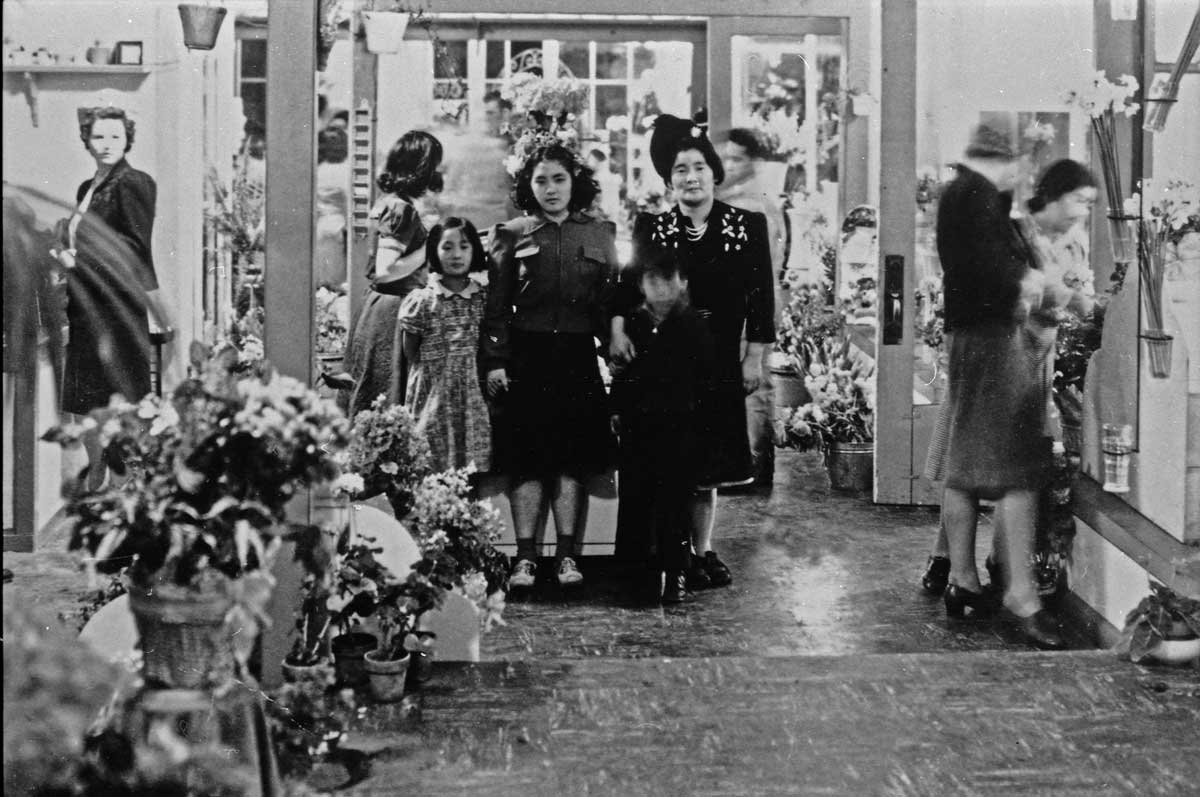
In the early 1930s Fujii and his wife operated a flower stand near Providence Hospital. They had two daughters. In his prime, Fujii was well-known among local artists and was a member of the Group of Twelve, artists who met, exhibited and published together. He was especially close to Kamekichi Tokita, another member of the group, and the two would trek about the city sketching and painting. They were almost certainly painting together when Fujii made this rendering of the bridges. A canvas of this subject from this perspective was painted by Tokita and is part of the Wing Luke Museum’s permanent collection.
Mayumi Tsutakawa, the show’s curator and the sculptor’s daughter, says Fujii appears to have taken his internment at Minidoka Relocation Camp in Hunt, Idaho, very hard. Allowed to take only what he could carry, the 50-year-old artist may well have left his easel and oils behind, and certainly his paintings. Fujii was later described by friends to have fallen into a deep depression, and at war’s end he moved to Chicago. After the war Fujii wrote a few letters to his friend George Tsutakawa, but nothing since is apparently known of his fate.
Fujii’s canvas – and six others, including a self-portrait – survive by the good fortune of being discovered recently, lying bound beneath a dealer’s table at a local swap meet, by Seattle artist – and a sensitive collector too – Dan Eskenazi, who learned that the seller had purchased them at another flea market.
The two bascules side-by-side spied from the Pigeon Point greenbelt. (Courtesy, Ron Edge)
=====
ELEVATED on MARGINAL WAY
(First appeared in Pacific on Aug. 7, 2005)
The modern squabbling over monorails and other rapid-transit fixes is prefigured by the politics that built the wooden trestle shown here. Three mayors – Gill, Hanson, and Fitzgerald – suffered from it, and the Whatcom Avenue Elevated ran for just 10 years.
After the U.S. entered World War I in 1917 and Seattle’s shipyards began getting big orders, the Emergency Fleet Corp. let Mayor Hi Gill understand that Seattle had better figure out its woeful transportation problems or it would get no more munitions money. Gill agreed to this “Whatcom Avenue Elevated” (Whatcom was later renamed East Marginal Way) to speed the workers to the yards south of Pioneer Square.
Looking north on the elevated with his or her back to the curve at Spokane Street on Oct. 1, 1919, less than a month since the line first opened on the 4th of September.
The problem was that when the line opened on Sept. 4, 1919, the armistice was nearly 10 months past and the shipyards were ghost yards. Seattle was then burdened with another responsibility: the vastly overpriced trolley system that the city purchased from its private owners. The sellers had gotten Gill’s successor, the gregarious Ole Hanson, to pay $15 million for a system worth $5 million. Hanson held on for a year, then resigned and left town. His successor, C.B. Fitzgerald, proposed a subway system and was soon voted away.
The viaduct in its last weeks in 1929 where it took is exciting turn from Marginal Way to Spokane Street.Looking west on Spokane Street from First Ave. S. Feb. 20, 1929. The curving trestle where it turns from W.Marginal Way to Spokane Street can be seen in the distance. (Courtesy Lawton Gowey)W. Spokane Street looking west from First Ave. s., like the subject next above it, but from a few months later, Sept. 7, 1929, time enough to begin construction of a timber trestle on Spokane Street, at the scene's center.
=====
For nearly three years, West Seattle-bound trolleys were routed over the first of the West Seattle bascule bridges: the “North Bridge. ” The “Shoe Fly” (the curving contraption on the right) carried the streetcars to the level of the bridge. The contemporary photos were taken from the 1991 swing bridge that replaced the north bascule after the old bridge was knocked from service when a freighter rammed it in 1978. The “High Bridge” on the right was completed in 1984.
The “SHOE FLY”
(First appeared in Pacific, Sept. 19, 2004)
They call it the “Shoe Fly,” and for the nearly three years that it routed streetcars onto the first of the West Seattle bascule bridges (the north one) it was famous for its cheap thrills and intimations of disaster. When the temporary wooden trestle opened in the winter of 1928, West Seattle resident Aura May Mitchell described the thrills in a poem published in her neighborhood newspaper, the Herald: “It twists, and it turns, and it groans, and it cracks,” the poem said. “The strain is most awful! A climbing those tracks.”
The rough exposure of this image is the result of the again in or on its nitrate emulsion.
Many years later, in his book Digressions of a Native Son, Emmett Watson recalled the Shoe Fly and the rest of the trestle. “The way you got to First Avenue from West Seattle was by thumb or streetcar, those rattling old orange things. They clanked and swayed over an incredible old wooden trestle, high above Spokane Street, weaving and shaking until you had to close your eyes to keep from getting a headache.”
An orange trolley somewhere in West Seattle or on its way to or from it, probably from the late 1930s before they were scrapped.
When it was completed in 1924 the bascule bridge was for auto traffic only. The municipal streetcars continued to use a swing bridge that crossed the West Waterway a few hundred feet south of the new steel teeter-totter bridge. However, after it was determined that the pilings for the swing bridge were honeycombed with bore holes compliments of teredo worms, Mayor Bertha Landes closed it down, and the trolley service to West Seattle was cut off. For the few weeks needed to build the Shoe Fly, trolley riders were required to walk across the bascule bridge to board streetcars on the opposite side.
Chilly bridge work on the West Waterfront dated December 1922. Beyond is the swing bridge, (our Bridge #3) which was used exclusively for trolleys once the first bascule was completed.
The Shoe Fly arrangement lasted until the twin West Seattle Bascule Bridge opened Sept. 30, 1930. Thereafter, westbound trolleys used one bridge, eastbound trolleys, the other. And the thrill was gone.
=====
TROLLY WRECK on SPOKANE STREET, Jan. 8, 1937
(First appeared in Pacific, Oct. 2, 1994)
One of the most common recollections of Seattle’s “old timers” – anyone active here before the Second World War [I may need to adjust this qualification since 18 years have passed since this first published.] – is the elevated trolley ride along the Spokane Street viaduct and its old bascule bridges to West Seattle.
That the experience of riding the rumbling and swaying electric cars along the exposed wooden trestle could be more than thrilling is proved in this view of the worst street-car wreck in Seattle history. At about 7:30 on the Friday morning of Jan. 8, 1937, with its air-brakes frozen open, car 671 inbound on the Fauntleroy line lost control as it descended 30th Avenue Southwest and flipped to its side where the track curved sharply onto Spokane ‘Street. Derailments on this old system were not that uncommon and flips not unprecedented. Upended, car 671 did not skid to a grinding stop, however, but collided suddenly with a concrete pillar.
The afternoon Seattle Times listed the dead – Lee Bow, a 50-year-old city fireman, and William Court, a 39-year-old-mechanic – and the 60 West Seattle commuters who were injured with breaks, bruises and lacerations. Of these, one died the next day.
The derailment might have been even more deadly. The pillar that injured some might have saved others when it· prevented the car from falling to the railroad tracks below, the lowest level of this three-tier grade separation at the western end of Spokane Street.
This catastrophe became an anxious symbol for the entire municipally owned trolley system that was in physical, fiscal and political tatters. The coincidence of this tragedy with the campaign to tear up city-wide the system’s rails aroused the hysterical rumor that this wreck and others were planned by those who favored gas engines and rubber tires over electric motors and trolley tracks.
[We will show next a few looks at this tragic intersection through it’s life – with little comment or captioning.]
Looking in line with Spokane Street east to Pigeon Point. Seattle Steel at Youngstown is far right.Dated, June 13, 1929June 26, 1929Circa 1930, the corner begins to take the shape it held for the 1937 crash.
On his May 30, 1968 tour of West Seattle sites for "repeats" of historical views he had collected, Lawton Gowey included the intersection of Avalon Ave. and S.W. Spokane St.
=====
The STAR FOUNDRY
(First appeared in Pacific, 2-15-1998)
The architectural footprint of the Star Foundry, according to the 1912 Baist Real Estate Atlas, faced what were still the tidelands north of Spokane Street. The actual address is 2111 W. Spokane St., a site now part of what may be Seattle’s most confounding intersection: where industrial traffic from Harbor Island, Delridge Way, Admiral Way and Terminal 5 converge beneath the high bridge to West Seattle.
In the older view, the greenbelt of Pigeon Point ascends behind the foundry through property owned, the Baist map says, by Timmerman and Westerman. At what was then still a bulge in Spokane Street, the Star Foundry was on the cusp between two historical neighborhoods, Riverside to the southeast and Youngstown to the southwest. Timmerman and Westerman were foundry men but not at the Star Foundry in 1912. Clyde Dodds, the Star’s proprietor in 1911, was probably also around a year later, offering – as the sign reveals -an impressive array of services in phosphor, aluminum, brass, bronze and, no doubt, iron. The boxes piled in front and the side were used in forming molds.
In 1918 the Star was purchased by German immigrant and foundry molder Wilhelm Jensen. His son, William Frank Jensen, ran the foundry, as did his son, William F. jr., and grandson, Frank Wayne Jensen, who worked for metallurgist Bill Gibbs. Gibbs leased the Star from the Jensens in 1972 and then purchased and renamed it the North Star. At its present south Seattle location (3901 Ninth Ave. S.W.), the North Star works in steel, casting specialized trailer hitches, railroad switches and other railroad crossing parts. Gibbs, with others, is gathering stories and materials for a history of Seattle’s foundries; he can be reached at 206-622-0068. [A reminder that this story was first printed 14 years ago. I think that the Foundry book was either recently published of hoped to be.]
=====
PIGEON POINT FIRE STATION #36
(Feature first appeared in Pacific, August 29, 1993)
When City Architect Daniel Huntington’s Fire Station 36 was opened Jan. 15, 1919, it was the smallest facility in the department, but a Spanish jewel. The view of it here with the engine was probably photographed in the summer of its first year. The station’s staff of five poses with their brand new American La France pumper, engine 10.
Station 36 was only the city’s second built exclusively for motor apparatus. This view of it looks east from 23rd Avenue Southwest toward the north end of Pigeon Point, the ridge, that divides West Marginal Way from Delridge Way Southwest.
Station 36 covered Harbor Island and West Seattle’s burgeoning industrial district south of Spokane Street, now the site of Salmon Bay Steel. The station was built on fill above the tideflats that once made Pigeon Point a peninsula beside the Duwamish River’s estuary. {In the “now” when we find it, the Kenworth wagon at Station 36 barely fit its tiny quarters and crews often found it more comfortable to walk the rig’s tailboard to move from the watch office (here on the left) to the officer’s room at the rear of the station’s garage.
West Seattle fireman John Buckley came to this station in 1947 and stayed until retirement in 1971, the year the landmark was razed. Buckley remembers that one of the last big fires it fought was first sighted from the station itself. “The whole neighborhood was red” when the West Waterway Mill across Spokane Street caught fire and burned to the ground.
The new Station 36 is larger, but undistinguished. Even its size was cut back in 1984, when the station lost its wings to ramps for the new West Seattle bridge. One local example of Huntington’s Mediterranean motifs does survive: his library in Fremont, which opened in 1921.
Here we have found the "now" that appeared originally with the feature on Station #36 when it first appeared years ago.
Here follows three photographs shared by Lawton Gowey, who also took the two Kodachromes in 1968.
Fire Station #36 with the Youngstown Viaduct on Nov. 5, 1930. Lawton Gowey's repeat of the 1930 subject with his own on May 30, 1968.Lawton Gowey looks around the corner "n.e. at 23rd. S.W. to W.Spokane toward Chelan Ave. May 30, 1968" is how Lawton captioned it.
=====
SPOKANE STREET SUBSTATION – 1926
(First appeared in Pacific, March 30, 1997)
Seattle’s municipal power utility opened its South End service center on Spokane Street in 1926 – the year of this photograph – on land recently reclaimed from the tides. Seattle architect J.L. McCauley’s public building was not only functional but attractive. As the historical scene reveals, the restrained ornament used in the service center’s concrete forms has been enhanced with a skillful wrapping of the building in a skin of stucco and off-white plaster.
Signs for the structure’s principal roles -warehouse and shops – adorn its major division, to the sides of a slightly off-center tower where “City Light” is tastefully embossed on the arch just beneath its flag pole. The name is promoted twice on the roof, with block letters about nine feet high illuminated at night with about 400 bulbs for each spelling of CITY LIGHT.
The building survives, although its north wall facing Spokane Street was hidden in the 1960s by the textured concrete panels evident in the “now” scene. [When we find it.] A new north wall is in the works. It will show off to visitors and Spokane Street traffic a curvilinear facade ornamented with public art made from recycled glass. Inside, a two-story skylit atrium will repeat the roof forms incorporated in the building’s original design. This sawtooth roof, which runs nearly the length of the center’s west (right) wall above the shops, is to these eyes the historical plant’s strongest architectural feature.
The electrically roaring twenties were a decade of endless tests for City Light, as it developed the first of the Skagit River’s generators, Gorge Dam, and fought a service war with Puget Power when competing lines for the public and private utilities were still duplicated throughout the city’s streets.
=====
WEST SEATTLE HIGH SCHOOL
(First appeared in Pacific, June 1, 2003)
Here is a Seattle sesquicentennial puzzle for “Now & Then” readers: What do the initials “SWSHSBSLHM” mean? The answer will be revealed for those who continue (or jump) to the end of this feature on what – its graduates claim – is the high school with the largest alumni association in the country. There are about 18,000 with confirmed addresses, and many will be attending the All School Reunion on Friday. A record turnout is expected because this is the first reunion since the school was reopened. [A reminder – this was first published in 2003.]
This week’s comparison reveals that the two-year renovation of West Seattle High School under the supervision of architect Marilyn Brockman was also a restoration. Besides the landscaping, little has changed between the 1937 scene and the “now” view that West Seattle historian Clay Eals photographed. The observant reader might notice that the cupola is different. A 1983 fire burned a hole in the roof, and the original cupola went with it. The new cupola was built to the full size – 6 feet taller – described in the original architect Edgar Blair’s blueprints but not followed in the first construction.
West Seattle High School opened in 1917 to about 400 students, most of whom were girls because many of the boys were either enlistees or working in the mobilization for America’s entry into World War I.
The stories of the West Seattle Indians (this past April renamed the Wildcats) will continue to be told after Friday’s reunion with cherished artifacts, ephemera and photographs in the new exhibit “Rich Traditions” just mounted at the Southwest Seattle Historical Society’s Birthplace of Seattle Log House Museum. And that is SWSHSBSLHM for short. The address is 3003 61st Ave. S.W. Call 206-938-5293 for times.
This is but one of a few hundred negatives I acquired in a garage sale all of whose subjects were of student life at West Seattle High, sometime in the 1970s, if memory serves. I remember scanning at least a dozen of them, but this is the only one that came forward with my first search. There are no captions for them. We may wonder is this table in a lab, home room, or school kitchen?
=====
CLICK TWICE to ENLARGE - We pulled this detail from an aerial taken looking northwest into Seattle from somewhere above Tukwila. The surviving greenbelts of Pigeon Point and West Seattle can be found. The I-5 Freeway is under construction.
(CLICK TWICE to enlarge) This two part pan looks northeast into the city from a place on Pigeon Point that is a few blocks south of the point itself. The two bascules over the West Waterway appear on the left. The Seattle horizon included the Seattle Tower at 3rd and University so this dates from sometime after its completion in 1928. Given time we will figure it out. Or you may.
The birdseye view artists who signed their work Kennedy were mildly prolific hereabouts during the early part of the 20th Century. They were the last of such and most of their work was limited to smaller creations that this one, which was paid for by persons interested in developing the Duwamish Waterway. Not how the river and practicalliy every shore space on Elliott Bay is stuffed with piers and crowded by factories behind them. Here Pigeon Point is on the left.For the better part of the 20th Century the Argus was Seattle's best read weekly journal of news and opinion. It expired under the pressure of the several weekly tabloids - most notably The Weekly - that proliferated later in the century. This fantasy of a West Seattle "high bridge" - airplanes and luxury steamers too - appeared in an early issue of the Argus from the 1890s when the difficulties of reaching West Seattle by any means other than water became a common concern and frequent complaint.
=====
While Jean was busy with his “repeat” of the hunter he took a moment to approach the west approach of the railroad’s old bascule, a surviving feature of the neighborhood, and record both ways – into the bridge and into the industrial side of Riverside with Pigeon Point on the horizon.
(Click to Enlarge) – If anyone would like to suggest a caption for any of these three, please do. They are all about thirty years old, and I shot them. The top one, I don’t know where. The middle one is at the south side of the Fremont Bridge waiting for the Anchor Excursion boat to pass. The bottom one is on Eastlake Ave. climbing the hill south of the Steam Plant. pd
NOTE: We have added a few more Wawona parts to the feature below since first it was posted, in part because our first efforts were interrupted with a closing or crash of this blog. This happens often, and we wonder if we might not be involved in some lukewarm version of a protection racket. Our server tells us that they cannot figure out why it stops, but for a such-and-such more they will keep a close eye on it. They have, it seems, a category of service where one’s site is always on a cusp of working or not working. Or perhaps we are simply special and almost no one dances to the same crash and come back beat. We are welcome to any suggestions or references that will lead us to a reliable server; that is, one with no such special categories.
The ARTFUL WAWONA – JUNE 24, 1964
The primary photo for this feature – printed just below – somehow got removed (probably by me: pd), but we have brought it home again.
(CLICK TWICE to ENLARGE)
In 1964 Ivar Haglund joined Kay Bullitt and Seattle City Councilman Wing Luke in founding Save Our Ships (S.O.S.) and donating 27 thousand dollars towards purchasing the Wawona from a Montana rancher whose urge to haul cattle on it had passed. On the way to its final moorage at the south end of Lake Union beside the Center for Wooden Boats, the Wawona visited many Seattle slips, saltwater and fresh. In the summer of ’64, Fire Chief Gordon Vickery agreed to switch the berths for his two fire boats at the foot of Madison Street so that the larger one, the Duwamish, would not prevent the schooner Wawona from resting beside pier 54, and so directly below the plate glass windows of Ivar’s Acres. Several local artists came aboard and turned their artful hands on the vessel. We can see several of them at work above in Frank Shaw’s photo. The results were sold on board in an art auction with the funds going to the schooner’s preservation fund.
In 1970 the Wawona became the first vessel to be listed on the National Register of Historical Places. Through these years the “museum ship” was embraced and improved by many local carpenters but they ultimately could not keep pace with the rough handling of nature. Always hoping for more pocket help the schooner went bad faster than it got better.
After his first contribution in 1964 Ivar returned to the schooner in 1980. The Seattle Times writer Walter Evans, on his man-about-town beat, made note of Ivar’s new oblation in the issue for Jan 17, ’80. “Ivar went to the bar and came up with a concoction called the ‘Sail Away’ created by Carlos Botera of the Captains Table. It contains guava nectar, papaya nectar, strawberry preserves, orange syrup, light rum and 151 proof rum. You get to keep the cup and the hangover when you order it, and the cash you pay for it, $2.50, goes toward restoration of the historic sailing schooner, Wawona.” This call for aid from the city’s stiffer drinkers could, of course, not revive a campaign to save the schooner. Like perhaps some of those who tried to help out by ordering many rounds of Sail Away, it too fell flat. During the spring of 2009 the Wawona was towed from the Center of Wooden Boats at the south end of Lake Union to its destruction somewhere out of sight.
Resting in the slip between American Can on the right (the future Port of Seattle pier) and Pier 70, on the left, it was from here, most likely, that the Wawona was towed to Pier 54 for its weeks of raising funds for itself. Frank Shaw dates this June 14, 1964. The Wawona when still a working schooner in the slip south of the Port of Seattle's Bell Street Terminal, seen here in background haze. I do not know the date.This look up Yesler Way past the stern of the Wawona is also dated 1964, and so adds some small uncertainty to the claim two captions above that the Wawona most likely was towed from the Pier 70 slip to the south side of Pier 54 that year. It may have come from here between Piers 50 and 51, or perhaps first moved from here to Pier 70. There are other possibilities, of course. On the left is the post-Century 21 location of Ye Olde Curiosity Shop. Since these piers, covering the former pioneer sprawl of Yesler's Wharf (especially Pier 51 on the left), were eliminated for the construction of better vehicle approaches to Colman Dock, the Curiosity Shop has taken the northeast corner - at the sidewalk - of Ivar's Pier 54, in the space where he opened his aquarium first in 1938. (I know this stuff by heart, although not always the spelling.)This profile of the Wawona at the Gas Works - before the park - is neither dated nor attributed. It comes from a mixed collection of slides recorded by Lawton Gowey and Robert Bradley. Slowly I am sorting them out - but not this one yet. I see that the green paint is in poor shape, but I also note that it was green at the end. There are enough Wallingford landmarks or features in this to most likely date is close - after some reference work. Nice sky. I seem to remember the Wawona being here ca. 1970 when Stan James was doing some carpentry on its Captain's quarters. This one I photographed and dated 1997 - not so long ago. Many remember that this was its last roost behind the Center for Wooden Boats. Even such a charmed location did not in the end save it. The S.O.S. that went out in the mid-1960's returned no more echos. (PD)
In the last Seattle Now and Then contribution – Jan. 15, this year – we included a feature titled “Dear Old Seattle.” It was a quote taken from one of the many letters sent by Fred Stanley Auerbach, the young man pictured above, to his parents in the east. As explained, Auerbach was visiting here looking for the best investment chances for family money. Archivist-historian Greg Lange uncovered the letters several years ago and we copied them. Auerbach stayed in the Seattle Hotel, using its stationary. He liked the hotel but in one letter he considers moving to less expensive quarters. We have pulled a few pages – only – from the many that are collected in a bound album. Auerbach was here in 1906, still the time of Seattle’s greatest booming. His handwriting is negotiable and his descriptions often lively. “This is the damnedest town I ever saw . . . I never was in a city in my life where I felt such a stranger and I think the reason is that nobody has been here long enough to feel at home . . . It is all business. You couldn’t imagine anyone saying ‘dear old Seattle.’ If you ask anyone on the street where such and such a street is, one out of every three will say ‘I don’t know I am a stranger myself.’ ” (The letters, as I pulled them, are not always in the order he wrote them.)
CLICK TO ENLARGE
Auerbach came west on the Canadian Pacific Railroad and crashed with it. The top of the two remaining selections describes, in part, that adventure. The last letter witnesses to another crash – a “remarkable accident” – at a Seattle intersection.
THEN: The tarnished recording of Sara and Henry Yesler’s home in Pioneer Square is the oldest surviving photographic evidence of any part of Seattle. It is conventionally dated 1859, or seven years after the first settlers on the eastern shores of Elliott Bay moved there from Alki Point. (Courtesy, Seattle Pubic Library)NOW: Jean Sherrard stands close to the prospect of the historical photographer. James Street is still on the right, and Henry Yesler’s Pioneer Building is behind Jean’s other subjects, left to right, Rich Berner, and this writer.
A few Pacific Northwest veterans among you with keen memories may recognize this “now” as a repeat of itself. That is, this subject first appeared in this feature 30 years ago, minus nine days. Pioneer Sara Yesler stands on the front porch of her and her husband Henry’s home at the northeast corner of First Ave and James Street.
This is the oldest surviving photograph of any part of Seattle, and E.A. Clark, the pioneer photographer who recorded it, was also a sometime school teacher, justice of the peace and King County auditor. Several copies – and copies of copies – have been made, but it seems that the original Daguerreotype or Ambrotype (it is not certain which) did not survive the bumps of pioneer life.
I chose this “oldest photo” as a marker for thirty years of what has been a weekly responsibility that brought with it for me a life of guaranteed zest. What wonderful people and subjects I have met! And, if they will allow it, I thank my editors, Kathy Triesch Saul and Kathy Andrisevic. It was the latter of “the two Kathies” who decided to give this “now-and-then” idea a try in late 1981. I also thank Times writer Erik Lacitis who acted as my go-between then. Those of you who read bi-lines and/or credits know that they are all still at work.
Finally, I thank my friend Jean Sherrard who started helping with the “repeats” and suggested subjects in 2004. I am standing in the “now” at Jean’s recommendation (honestly) and posing with my mentor Rich Berner. When I started studying regional history in 1971, Rich, the founder and head of the University of Washington Archives, was welcoming. Rich is now a lesson in productive longevity. Born in Seattle in 1920, this graduate of Garfield High wrote and published his trilogy on community history titled “Seattle in the 20th Century,” following his retirement from the archives in 1984. Rich and I are now at work assembling illustrated versions of all three volumes – with one down and two to go.
WEB EXTRAS
Happy 30th Anniversary, Paul! For your enjoyment, I’m adding a shot I took of you and Rich at Ivars only minutes after we took the ‘Now’ that appears with this Sunday’s column.
Rich Berner and Paul Dorpat celebrating 30 years of 'Seattle Now & Then'
Anything to add, Paul?
A few more features – four or five of what may be more than thirty features I’ve included in the past thirty years that concentrate on Pioneer Place (or Square) subjects. My hopes to also make a numbered list of the total opera so far – about 1548 features – got a start early this week but soon sputtered when I realized that it would take most of the week to edit, and number even that small horde. At least I now have a start on it.
First I will reprint that “First Photo” story from 30 years ago, and it will include a full confession of my errors at the time. Please be kind.
This clipping clarifies the differences between the first and second photos. A full - I believe - version of the First Photo (and not the second) by E.A. Clark
FIRST PHOTO (and SECOND)
(First appeared in Pacific, Jan. 24, 1982)
Henry and Sara Yesler pose on their front porch for King County’s first photographer, E. A. Clark. Their home sat on the northeast comer of Front Street (now First Avenue) and James Street, since 1889 the site of the Pioneer Building. Behind them two and a half blocks of stump-strewn clear-cut land extend to the line of virgin forest beyond Third Avenue.
The year was 1859 and, although this is most likely not the first photograph Clark took of his community, it is’ the earliest to survive.
(This claim, we now know, is wrong. Rather Mia Culpa. An earlier view of the Yesler home recorded by Clark survives and is also published here. Conventionally the earliest is dated 1859 and the other, one year later, sometime in 1860. How I missed this in 1982 when I first submitted this to Pacific mystifies me now. In 1982 I had been studying local history for eight years, concentrating on its photographic evidences. That I could miss and mess-up this important distinction between the first and the second surviving photographs of any part of Seattle is now, I repeat, stumping me. I may have half-wittedly took another’s authority on No.2, describing it as the “first.” But both of Clark’s Yesler home subjects were printed in Pacific for that Jan. 24, 1982 edition. It was my second (not first) contribution of now nearly 1550 features. I might have blamed my editor for mixing up the two Clark photos, but she did not. My text refers to Henry and Sara Yesler standing on the front porch. They appear together only in the ca. 1860, or second, photo. Sara is alone is the first photo recorded in 1859. I have no “out” – no relief. This miss also suggests that my readers were generally no more experienced on this subject than I, nor more attentive to the problems actually evident in this second contribution to Pacific. I got no letters.)
This is Clark's Second Photo and NOT the First Photo as indicated in the 1982 feature.
E.A.Clark left Pennsylvania in 1850 and went to California – probably for gold. When he moved to Seattle in 1852, he came as a typical pioneer: poor of cash but rich in labor. He also might have come – uncommonly – with a camera. At least, he eventually got one.
E.A. Clark, perhaps a self-portrait
Clark set an early claim on the shores of Lake Washington, but later moved into a Seattle home he either built or bought. He named it his. “What-Cheer-House.” Almost immediately Clark got into school, as a teacher, and into trouble, as the leader of a vigilante gang intent on hanging a native accused of murdering a white man. Luckily for both Clark and the Indian, Sheriff Carson Boren arrived in time to stop the lynching. The schoolteacher eventually became a justice of the peace.
As far as is known, only one other photograph of Clark’s still exists. It also is of Yesler’s residence and was taken less than a year after the first one. Both the scene and perspective are similar, except the town’s first water system has been added. Its flumes extended down James from a spring in the side of First Hill. [Again, that’s photo number 2 printed here directly above Clark’s portrait.]
Now most of those “numerous traces” of his photographic art are lost. But rather than mourn, we are amazed with what survived: those two rough images of Yesler’s home, and the first of Seattle.
(This is getting more embarrassing. The “other photograph” referred to is, of course, not the second photo from about “less than a year after the first one” but the first one itself. And there is so much to prove it. First in the actual second photo the Yesler Home has got an addition to the north (left), and then, as the text notes, the elevated flumes that run down James in 1859 have been cleared away, and water is now delivered to the Yesler Home and the Yesler Mill, and probably the neighbors too, by a bored-log pipeline laid underground. Now, if I were my own child I’d be tempted to slap my knuckles with a ruler, instead I’ll wring them.)
On April 27, 1860, some few weeks or months after taking his second photo of the Yesler home, the still young county auditor died. Clark’s obituary printed in The Pioneer and Democrat read in part: “He has been engaged in the Daguerrean [sic] Business for several years and leaves numerous traces of his skill in that art. He was about 32 years of age and leaves numerous friends to mourn his loss.”
Foundation work for the Pioneer Building began before the Great Fire of June 6, 1889 destroyed the business district. This is an early view of it when nearly new.Pioneer Place and the Pioneer Building in their down-and-out years. Lawton Gowey's slide dates from April 4, 1961.
=====
HENRY & SARAH YESLER, 1883
(First appeared in Pacific, July 23, 1995)
In 1859 Seattle’s first photographer took its first (surviving) picture. The subject was the home of the city’s first capitalist, Henry Yesler. His wife Sarah – only – was standing on the front porch. Here 24 years later are Sarah and Henry back at the same northeast corner of Front (First Ave.) and James Street, beside their home but not on its porch.
Henry is whittling. The mill owner was famous for it. The firs behind the couple and to the left were common pioneer decorations, as were the garlands above their front porch and the Japanese lanterns strung across Front Street (First Avenue). The occasion is probably Independence Day 1883.
While the Yeslers posed, construction was beginning on their mansion in an orchard three blocks behind them. Although fond of Sarah’s apple pie, Henry professed that his “finest fruit” came from the maple trees along his old home’s parking strip (behind the gas light, right). He was referring to the three accused murderers lynched from these “hanging maples” a year earlier. Reported nationally, the lynching and Yesler’s applause supported Seattle’s reputation as a center for the Wild West. In the published cartoon of the lynching, Henry is again depicted whittling. A.W. Piper, the artist, was the community’s favorite confectioner. His Piper’s Dream Cakes were especially popular. Piper was also known for his socialism and his sense of humor. At once costume ball he dressed so convincingly as Henry Yesler that the real Yesler returned home to make a sign reading “The Real Henry Yesler” to wear on returning to the ball.
The whittling Henry appears at the bottom, right-of-center. The view looks north over James Street to the hanging trees.
The Pioneer Building built on this Yesler home site after the “Great Fire” of 1889 was Yesler’s last creation. It was constructed at a slightly higher grade than the Yesler home, and in its basement is Underground Seattle’s museum and gift shop. This Romanesque fancy in brick and stone was at least in part saved by the preservation humor of Bill Speidel’s Underground Tours. I remember that Bill also loved his pies.
Another couple on First Avenue and in front of the Pioneer Building. Sarah and Yesler would have been at the end of the block, and a little to the west or right because the street was widened following the 1889 fire. It was also raised a few feet - just a few. We have yet to figure out actually how many here on the old Yesler home site.The Yesler's mansion facing Third Avenue, north of Jefferson Street. They built is on the site of their orchard and kept many of the trees. Lawton Gowey captioned this slide "new lights" and dated it Nov. 14, 1972. Some of the park's cobblestones are in place, the Pioneer Building, however, is still waiting for its restoration. Considering the widening of First Ave. after the Great Fire of 1889, Gowey is standing near the positions taken by Sarah and Henry Yesler, eight-nine years earlier.Looking south across Pioneer Square, Frank Shaw records a pile of cobblestones, a draped pergola, and a ruined Olympic block across Yesler Way. Shaw dates his slide, Jan. 14, 1973. In styles fitting, we assume, for 1974, four men march across James Street in Lawton Gowey's slide from Feb. 14, 1974. (I remember in the early 70's we had a spell of balmy Februaries.) In the still unkempt Pioneer Building the House of Bargains still holds the corner.Also on Feb. 14, 1974 Lawton Gowey photographed the still painted stone at the Pioneer Building entrance. He returned, below, on Aug. 8, that year to record the effects of sandblasting in removeing the "bad" paint.
========
I have temporarily hidden the photos I took of the downed Pergola, which would have fit better the opening text of the feature below. For the moment, in the place of ruins we will use the above recording of the Pergola when it was nearly new. It is a Webster Stevens negative and along with Jean’s “now” below, is part of the Repeat Photography Exhibit we put up at MOHAI with Berangere Lomont, who contributed its Paris introduction. A reminder that the exhibit is up until or into June of this year. Best to call first because although big it is mounted in a room that is sometimes used for banquets and large meetings, and in those events the exhibit is not open to regular museum visitors.
“DEAR OLD SEATTLE”
(First published in Pacific, Feb. 25, 2001)
It was the ill-rigged morning of Jan. 15 that teamster Pete Bernard turned his big 18-wheel truck into an urban-renewal juggernaut and just clipped – like a minor soccer violation – the Pergola. Promptly the filigreed arcade folded and collapsed to the cobblestones of Pioneer Place (or Square, if you prefer). Stepping down from his big truck, Bernard was some combination of confused, embarrassed and lost. Now, only weeks later [in early 2001], we are beginning to thank Bernard and compare him to other ironic iconoclasts whose momentary clumsiness led to local revivals. Former Seattle Times reporter David Schaefer likens him to Capt. Rolf Neslund, who drove his ship into the old bascule bridge over the East Duwamish Waterway and thereby gave us the high bridge to West Seattle.
I’ll compare Bernard to John Back, the carpenter who burned down the city. When Back dropped a pot of boiling glu onto a floor littered with shavings, he started a conflagration that in about three hours reached the same corner where 112 years later Bernard’s 18th wheel went out of bounds. The fire of June 6, 1889, flattened more than 30 fire-trap blocks; it also left opportunity for the architecturally distinguished, fire-resistant neighborhood that since 1970 has been officially protected as historic.
Looking directly north on First Avenue from Yesler Way and so through the future location of the Pioneer Square Pergola.
Just so, Bernard’s single strike did in an instant what it would have required the city’s fathers and mothers years of soul-searching anguish to attend to and pay for. The Pergola, Bernard demonstrated, was held together by paint and primer. And the trucker was insured.
Given the public concern, Bernard has also reminded us of what a spiritual place is Pioneer Square, with the collection of historical artifacts that stand or have stood there. Certainly, no other Seattle site is such a ritual space, and it is unlikely even the most dogged researcher could list all the special structures – arches, platforms, poles and imaginative constructions – that have been erected at or near this five-corner intersection.
Perhaps the first of these was the flagpole that flew the Stars and Stripes above the intersection during the Civil War. It showed the locals’ strong preference for the Union side. John Denny, father of the town’s own “father,” Arthur Denny, was an old friend of Abraham Lincoln.
The first special ceremonial structure of which a photograph survives is the welcoming arch put across Mill Street (Yesler Way) for receiving guests – most from Olympia – to Seattle’s Independence Day celebrations for 1868.
The Yesler home is on the left and the Occidental Hotel on the right. The arch welcomes celebrants from Olympia and Whatcom to Seattle's 1868 Independence Day festivities.
Grand but temporary arches were raised again in 1883 for the brief-visit of Henry Villard, builder of the transcontinental Northern Pacific railroad, completed that year to Tacoma, and in 1891 for the arrival of Benjamin Harrison, the second president to visit Puget Sound.
This week [Feb. 25, 2001] we feature constructions that were put up in the triangle between 1893 and 1902 and, perhaps with one exception, soon taken down.
The earliest of these is the grandest. Raised in 1893, the “Mineral Palace” was constructed to celebrate the June arrival of the transcontinental Great Northern Railroad. The palace was well stocked with elegantly arranged examples of Northwest products. Our view of it looks down across Yesler Way from an upper floor in the building that still holds the Merchants Cafe.
The next scene also looks down from an upper floor of the Merchant’s Cafe at the foot of First Avenue onto the Fourth of July parade for 1898. It would be hard to overestimate the excitement and noise of this celebration. Seattle was then already enlivened by the Yukon Gold Rush. And more than Independence Day, the crowds are celebrating the great U.S. Navy victory over the Spanish fleet at Santiago harbor in Cuba.
A day earlier the morning paper described the Pioneer ·Square preparations. “The Mutual Life building (here on the left) is one of the most elaborately decorated fronts in the city and makes a fine background for the waving riot of flags and lanterns and bunting that hangs in midair above the triangle.”
The third photo also has to do with the Spanish-American war or a “spin-off” from it. Sixteen months later, locals again bedecked the triangle with arches, a speaker’s stand, heroic portraits and bunting to celebrate the return of Washington’s own volunteers from Companies Band D returning from the Philippines on Nov. 6, 1899.
The observant may notice to the left and just behind the illuminated flags the gleaming back of the Alaskan totem pole stolen earlier that year from a Tlingit village on Tongass Island by a “goodwill committee” sent north to report on Seattle’s role in the great Alaskan gold rush. The old but freshly painted totem was dedicated in Seattle on Oct. 18.
In the most recent historical scene included here, a ball covered with a cluster of electric lights temporarily tops the totem pole. The bandstand below is certainly one of the most beautiful structures to have ever occupied the triangle. How long, I do not know. There is an 1895 reference to Wagner’s First Regimental Band performing in a bandstand in the place, but there is no bandstand in either the 1898 or 1899 photographs.
What we have is a 1902 scene showing Wagner’s First Regimental Band marching north on First Avenue in front of the again-decorated Mutual life building on the right. The occasion is the Elks Seattle Fair and Carnival and the event most likely the Aug. 18 Seattle Day parade. The drapery attached to the Mutual Life Building is the work of Morrison and Eshelman, a real~ estate agency with offices in the basement. A full-page advertisement for the firm in the 1903 City Directory includes these forward-looking observations: “You can’t miss it by putting your money in Seattle. Forces are at work that will surely make her one of the great cities of the world.”
In that boom time there was very little looking back in Seattle. The city was only 50 years old, and most residents were raw. In 1906, Fred Stanley Auerbach, a young visitor scouting real estate opportunities for his parents, wrote home (in a correspondence uncovered by local historian Greg Lange): “This is the damnedest town I ever saw . . . I never was in a city in my life where I felt such a stranger and I think the reason is that nobody has been here long enough to feel at home . . . It is all business. You couldn’t imagine anyone saying ‘dear old Seattle’ . . . If you ask anyone on the street where such and such a street is, one out of every three will say ‘I don’t know I am a stranger myself.’ ”
The building of the Pergola three years after the young Auerbach’s visit may represent the beginning of a “dear old Seattle.” In the late 1960s architect Victor Steinbrueck shared his delight in the half-century-old Pergola. “A bit of architecture which I regard with particular affection is the old iron loggia or pavilion at Pioneer Place. This most historic spot has sentimental value to me as a Seattleite and as an architect . . . Pioneer Place is one of our very few open pedestrian spaces and the only one which retains the character of early times – perhaps not so early, but still the earliest remaining . . . The dark blue-green all-metal loggia has achieved the patina of age with the help of Seattle weather and many pigeons . . . Derived freely from the Renaissance, the cast-iron columns and elaborate wrought-iron ornamentation symbolize the change from past to present technology and ideology. The loggia also serves to remind us that architecture is really for people – to enhance their lives – and it to be measured by what it does to people.”
Soon the Pergola will be back in its place. It will look the same, only brightened. Its formerly hollow and corroding cast-iron posts will be filled with stainless-steel cores so that when that big earthquake rolls through the historic heart of Seattle, the Pergola will stand up to it. Perhaps then we will put an embossed plaque beside the Pergola with its history, an appropriate epigram in a classical language like Latin or Coast Salish, and our sincerest thanks to Pete Bernard.
A Pioneer Place Teepee raised during one of the early summer Potlatch Festivals, 1911-1913.
=====
PIONEER SQUARE & HISTORYLINK
(First appeared in Pacific, July 19, 1998)
My first approach to Pioneer Square for the contemporary or “repeat” side of a now-and-then feature was a wet but not terribly cold mid-January afternoon in 1982.* Through the intervening 16 years [in 1998] I’ve returned to this intersection at First Avenue, James Street and Yesler Way surely more than a dozen times. Pioneer Square is, after all, the center of Seattle and King County’s historical compass, and the landmark district that surrounds it is almost everyone’s second and, for a few, still first -neighborhood.
The elegant four-story landmark in the older view is the Occidental Hotel. Designed in 1882 by Portland architect Donald MacKay in the popular Second Empire style and completed early in 1884, it survived only five years. On the evening of June 6, 1889, heat from the city’s “Great Fire” that day burst its windows before jumping James Street (here on the left) to set the hotel ablaze.
The Occidental Hotel ruins following the June 6, 1889 fire. (Courtey U.W. Library, Special Collections)
The pre-fire view probably dates from the summer of 1888, the year the Occidental was enlarged at its rear, east to Second Avenue. Some of the scaffolding of that work appears just right of the man with the white shirt and vest standing in the bed of the open two-wheel delivery wagon.
Pioneer Square 1909 during that summer's A.Y.P. celebration. The Occidental Hotel was replaced by the Seattle Hotel, center. The Pioneer Bldg is on the left. This image was used in Jean and my book Washington State Then and Now, as was the "now" view that follows and repeats it.
The history of this flatiron block is told in more detail on a new [in 1998] Web site called History Link [historylink]. The hope of this nonprofit project is to use the Internet to write our historical diary. The first step is to list Seattle and King County’s historical canon – our oldest historical texts, photographs and artifacts – as the groundwork for sharing personal, institutional and neighborhood history. For a demonstration, go to http://www.historylink.org. To move quickly to this historical corner, click on “Magic Lantern.” [I’m not certain that the “Magic Lantern” direction will still work, but historylink certainly is working. It is a great addition to local heritage, its delights and lessons, and has long since expanded to cover Washington State as well.]
Lawton Gowey dates his slide June 8, 1961. The destruction of the Seattle Hotel is widely considered the cracked act that led to the saving of much of the neighborhood and the establishment of the city’s preservation offices and rules. A slice of Pioneer Square framed by a Pergola with green Corinthian columns (only). Frank Shaw recorded the scene, but I"m not sure when. The tree planters suggest sometime early in the park's renovation. First Avenue still enters or intrudes thru what will be park land on the right. I remember very well the gaudy Wax and Raine signage. Robert Bradley's mid-afternoon look through Pioneer Place on Aug. 9, 1958.Roughly a conincidental repeat for the Robert Bagley slide above it. I recorded this in Aug. 1996.
* Below and copied from a clipping is that first Pioneer Square “now.”
Copied from a clipping, this was the first "Now" I recorded of Pioneer Square, and the second repeat for this feature. It was meant to repeat one or the other of the Yesler home photos by E.A. Clark seen at the top of this Sunday's blog. It was a raining Dec. 1981 afternoon, but not so cold, as I remember it.
A few years back we published this early "found" map of Africa on this blog - or rather the first run of this blog, all of which was lost in one of those ineffable digital snafu's that tests one's virtual composure. Although we lost the insertions we still have the raw materials - when we remember what they were - including this map of what was once commonly referred to as the "dark continent" and actually seemed darker on the window-shade map of the world that was attached at the top of the blackboard in primary school. Now we pull on a few more maps - early ones - beginning with a really primitive map of Washington State, (also found while picking) followed by another state map, also an early one: the map prepared by Washington Territory's first governor, Isaac Stevens in 1855. It is survey map - his assignment from the other Washington.
The mountains - Cascades and Olympics - are mere impressions in this 1855 map, but the waterways are almost faithful. The pioneers, of course kept close to the waterways. Most importantly, Stevens map shows the first efforts of surveying the land into claimable and taxable real estate. That work extends here north out of Oregon and thru what is now the 1-5 north-south corridor of Washington's denser populations.
Above, are three of the earliest maps of Seattle, and at the bottom is its first real estate map, showing the sectioned fruit of the towns 1853 survey, its first additions on which Arthur Denny, Carson Boren and David “Doc.” Maynard expected to sell lots – and did. The above maps all put east at the top. The top one dates from the 1841 navy survey of Puget Sound, and includes a peninsula, Piner’s point, which when the tides were high and the wind strong out of the west could become an island. It covers an area that now extends from about one-half block south of Yesler Way to King Street, and from the Alaskan Way Viaduct (for a while yet) to some little ways east of Occidental Ave. The tides then also splashed against Beacon Hill. The middle map above dates from 1854, and is the fruit of another federal survey. It includes a few marks for buildings, but none yet for blockhouses. Those troubles came a year later. The bottom of the three maps dates from the mid-1870s and shows as yet no King Street coal wharf. That was built in 1877. The 1870s map also features topo lines. This last map (of the three) marks Mill Street – later renamed Yesler Way – and that line can help one get oriented with the two earlier maps above it.
Finally, and again, the map below is a rationalization of land as marketable. And they didn’t even own it.
Place of meeting between the beautiful gardens of the beginning of the Champs – Elysées avenue and the second part going to the Arc de Triomphe, this round place connects also the Avenue Montaigne and the Avenue Franklin Roosevelt.
In front of the Hôtel Dassault, I remembered that I had admired this building since childhood, because my Mother was working nearby, the hotel was then the main office of the magazine « Jour de France ».
I remembered also a question of Paul a few years ago about the word « Hôtel », in fact complex because it covers three meanings.
– The hôtel where travelers stay,
– the Hotel which is a national institution such as the Hotel Dieu the oldest hospital in Paris, or the City Hall, mayor of Paris,
– and the Hôtel Particulier or mansion, we can describe as luxurious house of lords, noble people, rich or powerful built in Paris since the Middle Ages, like the Hôtel Dassault.
Here, this mansion, built in 1845 for the Marquise de Hon in a neo-renaissance was then called the Hotel de Hon, revised in 1874 in neo-Louis XV, enlarged in 1970 by the owner Marcel Dassault, and finally was bought by Artcurial agency auction. The Hotel and the place took the name of Marcel Dassault, aircraft manufacturer, politician and press manager.
And also you can enjoy the lights installed for Christmas on the Champs-Elysées this year.
Lieu de rendez-vous magnifique en bordure des jardins des Champs – Elysées et du prolongement de la célèbre avenue, le rond-point est une place ronde qui relie aussi l’avenue Montaigne et l’avenue Franklin Roosevelt.
En face de l’Hôtel Dassault, je me rappelai que j’avais admiré cet immeuble depuis l’enfance, puisque c’était le point de rendez-vous où j’attendais ma mère qui travaillait à côté, cet hôtel était alors le siège du magazine Jour de France.
Me revenait à l’esprit aussi une interrogation de Paul il y a quelques années au sujet du mot Hôtel, en fait ambigu puisqu’il recouvre trois sens.
– L’Hôtel où séjournent les voyageurs,
– l’Hôtel : institution nationale comme l’Hôtel-Dieu le plus ancien hôpital de Paris , ou l’Hôtel de Ville qui est la mairie de Paris,
enfin l’Hôtel particulier, demeure luxueuse des seigneurs, des personnes nobles, riches ou de pouvoir construites dès le Moyen-âge à Paris.
Ici cet hôtel particulier construit en 1845 pour la marquise de Hon dans un style néo-renaissance s’appelait alors l’Hôtel de Hon, remanié en 1874 en style néo-Louis XV, a été agrandi en 1970 par Marcel Dassault alors propriétaire, et finalement a été racheté par Artcurial organisme de vente aux enchères, l’Hôtel et le rond point ont pris le nom de Marcel Dassault constructeur d’avion, homme politique et de presse.
Et aussi vous pouvez apprécier les éclairages installés pour les fêtes de Noêl sur les Champs -Elysées cette année.
I have become attracted to messages on the flip side of postcards. Many are better than the offerings of professional greeting card authors, and all – even the most banal – can be revealing . . . of something. A few, like this one, are confessions. If the sample is large enough one could pull a narrative from them.
The aptly named Pulpit Rock looks down about 1000 feet to the Tennessee River valley near Chattanooga, in the southeast corner of the state. Here Mr. and Mrs Scofield (it seems) and their daughter take to the rock. Beside them, on the right, is a robust plaque interpreting the Battle of Waunatchie, named for a suburb of Chattanooga. According to Wikipedia, this battle of Oct. 28-29 1863 was one of the rare night fights during the Civil War, and the fighting was confused on both sides. Lookout Mountain served as a, well, lookout for two confederate officers who were surprised to see, by daylight, a large union force marching along the river. When night well things went to hell. About 1000 – very roughly – were lost or wounded, with the Union army prevailing in part by luck and low light in its attempts to control a supply line to Chattanooga across the river on Brown’s Ferry. If you visit Lookout Mountain – a long ridge – on Google you will discover that it is now covered along its long summit with upscale homes. Perhaps you will also find Pulpit Rock. I did not.
First, Ron Edge – of our Edge Clippings – comments that Frank Shaw’s unidentified shoreline Gazebo (somewhere on Puget Sound) is prefigured with the Madrona Park gazebo. Following that comparison, we include four panoramas of work-in-progress on the Jackson Street Regrade. One of the four is a completion of the half-pan shown here with the Dec. 24 feature on the regrade, which looked northwest into it from near the southeast corner of 7th and Weller. Taken as a cluster the four pans are very revealing and exquisite for study. (They are used courtesy of the Seattle Public Library.)
For comparison one of Frank Shaw's two recordings of the just off-shore Gazebo.The Madrona Park gazebo reached by a steep trail from the park's Lake Washington shoreline. The park was outfitted early in the 1890s to lure riders on the Union Trunk Line's service from Pioneer Square to the park and its attractions. This view by Otto Frasch was photographed ca. 1908. In the intervening years the rustic shelter has grown ragged at the roof. (Courtesy Ron Edge)The bandstands nearby at Madison Park were also examples of park gazebos built by commercial developers - in this case the Madison Street Cable Railway - to attract customers on to the trollies, to the park's attractions, and the surrounding real estate. Lake Washington excursions were also part of the lure, and Madison Park was for many years the easiest way to get by launch to Laurelhurst.
The JACKSON STREET REGRADE ADDENDUM (for Dec. 24, 2011)
CLICK TWICE TO ENLARGE
This printing completes with its left half the full panorama included in the Dec. 24 feature. The photo was taken on Oct. 30, 1908 from the roof of the then new New Central Hotel at the southeast corner of Weller Street and Maynard Avenue. It looks east up Weller from above the alley between Maynard and 7th Ave..Like the pan above it this one was photographed on Oct. 30, 1908. Both were commissioned by Lewis and Wiley Inc, the contractors for the regrade. This view looks south from near Jackson and 7th, and so through the site once held by Holy Names Academy on the east side of 7th between Jackson and King. Note the Beacon Hill horizon. The New Central Hotel shows on the far right. It was the prospect for the first pan, the one shown above this pan. Note also that tidewater still reaches a shoreline at the foot of Beacon Hill. South School is far left, but not for long. Weller street was used temporarily as a route for trolleys to the Rainier Valley, and a trolley or perhaps two can be found in this pan.In this, the earliest pan, Holy Names Academy is still intact, far left. The pipe line close to Weller street runs below the bluff, which will soon be reduced by means of the pipe's cannonade of water blasts. This may be compared to the primary photo used in the Dec. 24 now-then feature, which shows the Academy in ruins. The pans own caption (bottom-right) is in one part blurred, however, most likely it reads, "April 9, 1909 Looking west from 12th between King and Weller." If this is so then here the regreaders have reached the "summit" of the ridge and it has been subdued. Note the Great Northern Depot tower on the center horizon.
THEN: This well-marked block on the south side of Jackson Street includes the Bush Hotel, still a Chinatown landmark. (Courtesy, Museum of History & Industry)NOW: A bank has long since replaced the resourceful clutter of storefronts. Further east on Jackson, the Bush Hotel, restored and in good health, lets it be known that it is now both fireproof and modern.
In the mix of storefront and walk-up businesses in this first half-block on the south side of Jackson Street (north of 6th Avenue,) one could, buy a dress, a watch, rent a Packard, get a bath and/or a haircut, have one’s clothes washed and suit pressed, rent a room with a bed, play pool at the alley, and, no doubt, much more. A likely date for this Webster and Stevens Studio print is 1922 or ’23.
Beyond the alley, the Busch Hotel and its services (including a Chop Suey Noodles café,) fill the half-block to Maynard Avenue. The big hotel was built by William Chappell and lovingly dedicated and signed in 1915 for his wife Margaret’s maiden name, Busch. Like most other hotels in the neighborhood, the Busch Hotel hoped to thrive by bedding passengers arriving at the two nearby railroad depots, also facing Jackson Street.
After William Chappell’s death in 1921, his estate endured a good deal of “legal squabbling” among his heirs. One result was that the hotel’s name was changed from Busch to Bush, a moniker it still holds with its latest “make-over” into affordable housing for senior citizens of the International District. Purchased in 1978 by the Chinatown International District Preservation and Development Authority, the hotel was badly shaken by the Nisqually earthquake of 2001. Tightened and polished it reopened in the fall of 2006.
Among the forty-plus thousand Webster and Stevens negatives preserved at the Museum of History and Industry, understandably this one is often used. Jean and I have also used it in the exhibit of “Repeat Photography” at the Museum, (sponsored, in part, by The Times), which we have mounted with our Parisian friend Berangere Lomont. (The show also features now-and-then pictures of Paris.) The exhibit is up until MOHAI’s planned move from the west shore of Union Bay in Montlake to its new quarters at the south end of Lake Union next June. See it before the move if you can and will. There is plenty of bus service nearby and lots of parking too and the first Thursday of every month you can get in free. Otherwise, if you can, pay and support the place. The telephone number there is 206 324-1126.
WEB EXTRAS
Ooh, I know you’ve much to add this time round, Paul.
Nah – not so much. Time has run from me or I from it. I’m not certain who is responsible. I’ll need to drop some features for later, and there may be other opportunities. How pleased I am to see two familiar Sherrards in your “now” repeat of the 1922 or so look east on Jackson. The family is part of it perhaps, I suspect, because it took the shoot as a chance to visit the International District for its cuisine, a lunch perhaps. Now let’s let the reader decide who or which is yours – those whose sox you bend to mend and to whom you prepare the tenderest roast turkey imaginable. You may not do the mending but you surely do the finest roasting. I know you took a picture of the New Years Eve Turkey you prepared, although you took no pictures of any of the guests. Such is the temperament or concentration of a great chef. How about putting the turkey portrait up below this text? For the hungrier readers the taste of your succulent turkey may then, at least, be imagined.
Paul, I’ll drop in a photo of the turkey here, but I must also mention and display the truffle – a precious gift from Berangere – that was both cut into slices and slipped under the skin of the bird, and grated on top after the last basting of Calvados, squeezed orange juice, and honey. (click to enlarge both the bird and the ‘room)
The turkeyTruffle!
=====
Here's a later look at the same block, although not much later - about 1925. The photo was taken by Yoshiro Okawa, whose Aiko Photographic Studio is upstairs there in the corner building, kitty-korner across 6th Ave. and Jackson. For years Okawa's fine photography "at reasonable prices" was a neighborhood given - until 1942 when the Okawa family, and all Japanese persons in the district were shipped off to internment. Since they could take with them only what they could carry, Yoshiro Okawa's years of work were destroyed, except for prints that were in other hands. This and about 20 other neighborhood recordings made for the Rainier Power Company that financed the building of the Bush Hotel - and much else - were among the saved Okawa images. (Courtesy, Tomio Moriguchi)Another Aiko studio print. This one also about 1925 and after the Busch Hotel dropped its "c."
Follow now two clips from The Seattle Times. The first one an ad for the opening of the new Busch Hotel, published on Oct. 9, 1915. The second, the graphic part of a long description of the new hotel, and most likely a paid for ad as well. It made it in the Times one day later, Oct. 10.
Here’s another neighborhood photo by Okawa.
Above and Below: The above mid-1920s portrait of The Waste Laundry at the northeast corner of Weller Street and 5th Avenue was one of a collection of prints by International District photographer Yoshiro Okawa that were loaned to me a quarter-century ago by Tomio Moriguchi of the neighborhood supermarket Uwajimaya. Thanks again, Tomio. Since 2000 the corner has been part of the expanded Uwajimaya.
THE WASTE LAUNDRY
(First appeared in Pacific, Sept. 6, 2009)
What may we make of the name of this place: The Waste Laundry? The building itself is unique enough, for it is both more and less than it appears.
“More” because it was built on stilts high above the tideflats that once flooded this corner of 5th Ave. S. and Weller Street. Below it there are nearly three stories of fill and/or basements. The building is “less” than it seems because it is really pie-shaped. It was built not to disturb the old coal railroad that ran directly behind it at a slant already a quarter-century before the building was constructed as part of a power plant for generating electricity and heat – not laundering – with steam.
But what of the name? Scott Edward Harrison, of the Wing Luke Museum, determined through city directories that a C.R. Anderson operated an Overall Laundry at this address in 1919, and changed its name to The Waste Laundry sometime between 1923 and 24. That was not long before Yoshiro Okawa, whose studio was nearby on Jackson Street, photographed it. By 1933 both Anderson and the laundry were gone.
Neighborhood tour leader, Lon Elmer, recalls that “waste rags” were once collected and cleaned for the manufacture of high quality paper, although not necessarily thru this laundry.
Seattle writer-reviewer Bill White notes that “waste girls” was a common name used for the women who worked in commercial laundries. White sites Cynthia Rose’s research and reflections on the often-exploitive practices of Seattle’s power laundries in connection with her and others attempts a few years back to landmark the Empire Laundry in Belltown.
We will take Bill White’s lead, and encourage readers to explore Rose’s excellent website www.66bellstreet.com where the culture of waste girls, waste bundles, and waste linens may be delved. The sense of a laundry named for “waste” may be understood then as nearly commonplace.
=====
JACKSON STREET REGRADE, 1883
(First appeared in Pacific, Oct. 17, 1999)
Regardless of the blotches and spots acquired by this photograph as public works chroniclers we cherish it, for photos of early street work in Seattle are extremely rare.
Photographer Theodore Peiser came to Seattle from San Francisco in the early 1880s and set up a studio featuring what he claimed on the back of most prints were “the largest and finest backgrounds and accessories in Seattle.” He learned the handicaps of his new home, promising “First-class Work Guaranteed, No Matter How Bad the Weather.” Soon he said he had “the largest and finest assortment of views of Seattle for sale at reasonable prices.” How many we will never know, for Peiser lost most of his stock in the city’s “Great Fire” of 1889. .
Peiser promised to number and preserve indefinitely all his negatives; this view (lower left) has a high one, 65491. (Since there was not way that Peiser could have taken by then that many saved negatives, the number indicates perhaps a promotional vanity or a code privy to the photographer.) Thankfully, this construction scene also shares a hand-written caption, bottom center: “Jackson Street.” Directly above the street name an uncredited free hand has inscribed the date, 1883, and to the right a refinement of the location, between 10th andJ2th Streets. All very helpful and the hand-written locator may even be accurate. Jackson Street was regraded in 1883.
In late November of that year developer Guy Phinney (of the ridge) paid for a folksy “conversation between two old friends” In a local newspaper. It goes, in part “First: Well old pard I hear you bought a couple of lots on Jackson street today . . . Second: Great Caesar’s ghost, haven’t you heard the news? Don’t you know that street is being graded to Lake Washington as fast as men and money can do it . . . that it will be the great manufacturing street of the city? Why my friend, lots on Jackson street will be worth $10,000 apiece in five years.”
Peiser also claimed “all manner of outsIde photographic work executed on the shortest notice; in a superior style.” Perhaps Guy Phinney paid for negative 65491.
This "now" for the 1883 regrade record by Peiser was scanned from the newspaper clipping, never the best way to get a satisfying image. The truth is the same old one. I could not find the "now" negative although it is surely somewhere within 20 feet of me in this studio.
=====
As with the above 1883 repeat, this one was also copied from the clipping.
JAPANESE BAPTIST SUNDAY SCHOOL
(First published in Pacific, May 24, 1992.)
The Wing Luke Museum, 25 years old this year [In 1992] has mounted its most ambitious exhibit ever. Named for the decree that interned 120,000 mostly West Coast Japanese and Japanese Americans during World War II, Executive Order 9066 is an eloquent survey of a century of Japanese settlement on Puget Sound.
The view printed here of the Japanese Baptist Sunday School appears near the beginning of the museum’s fluently ordered space. Most of these children are Nisei (second-generation Japanese), U.S. citizens born here to immigrants. Many, perhaps most, of them will have had their own families when they were forced into internment 32 years after this scene was photographed.
This is the Sunday school class of 1910, or so speculates Lulu Kashiwagi, historian for the Japanese Baptist Church. Lulu’s mother, Misa Sakura, sits at far left. The baby propped on her lap is most likely Lulu – born that year. Lulu’s older sister Ruth is behind her, held in the arms of a family friend, Mrs. Mimbu. Three of Lulu’s brothers are also in the scene.
Seattle’s Japanese Baptists trace their origins to a night school conducted by their first pastor, Fukumatsu Okazaki, in the community’s first Japanese lodging house, and then in the basement of its first restaurant. This industry soon developed into a Japanese YMCA and in 1899 incorporated as a church. The Rev. Okazaki is pictured here, top center, holding the “J” card.
Churches were the most effective hosts for Japanese workers fresh off the boats. They helped the understandably anxious sojourners find lodging, steered them to suitable employment, conducted English-language classes and offered the security of a caring group for immigrants who had left their traditionally strong family support behind them.
Here the Baptist’s Sunday School is posed on Maynard Street. The tower of the King County Courthouse on First Hill tops the scene. In 1908 the Baptists were forced from their sanctuary at Jackson and Maynard Avenue by the Jackson Street regrade. Within two years they moved into a second home, again off Maynard at 661 Washington St. This part of the International District is still predominantly Japanese.
With the construction of Interstate 5, Maynard Avenue north of Main Street was abandoned. Kobe Terrace Park, named for Seattle’s Japanese sister city, and the Danny Woo Community Garden have since been developed on the site. In the contemporary photo, the athletic 82-year-old Lulu Kashiwagi has climbed upon the park’s gazebo or observation tower, which looks down the center of Maynard Street into the International District.
The Wing Luke Museum’s exhibit, “EO 9066 1892-1992, 50 Years Before, 50 Years After,” will be shown through August. [Again, like the feature, this exhibit dates from 1992. The museum was then still on Seventh Avenue, just south of Jackson Street.
=====
JACKSON STREET EAST of 5TH AVENUE – NARROW & STEEP
(First appeared in Pacific, July 28, 1985)
Of all the Seattle streets regraded early in the century, Jackson received the most extensive work. By 1909, about three years after today’s historical picture was taken, more than 3 million cubic yards of soil was flushed from the slope’s flanks and into the tideflats (now the site of the Kingdome). Its grade was reduced from 15 to 5 percent and the top, at Ninth Avenue, wound up 85 feet lower.
Both the historical photo and its “repeat” (if we could find it) were photographed from Fifth Avenue looking east into a neighborhood that is still ethically diverse. In the older photo there are Asian hand laundries on both sides of the street. Also on the right (in the shadows) are the Idaho Grocery and Ceasare Galleti’s Boot & Shoe Repair. Adding to the mix is the landmark Holy Names Academy. It’s pictured at right center, up on the hill at Seventh Avenue. Built in 1884, it was called the “handsomest building in Washington Territory.”
Another nod for Jackson’s diversification comes from Oennosuke Shoji, founder of the Seattle Japanese Christian Youth Organization on Jackson Street. He remembered the street as being “a hangout for prostitution where about 300 white, yellow and black prostitutes lived.” Most of them came to town in the late 1890s with the gold rush. They were the fleshy side of Seattle’s gilded age.
Looking west down Jackson ca. 1888 from near 9th Avenue and so near the highest point on the ridge before it was cut away 85 to 90 feet with the 1907-1909 regrade. That, of course, is Holy Names Academy on the left and West Seattle far off. Note how the tidewater still fills the bay directly south of Jackson and King Streets where the sports stadiums now rest on their own pilings. This view came courtesy of the British Columbia Provincial Archives in Victoria.
=====
Another rough "now" scanned from the newspaper clipping.
JACKSON STREET, East From near FOURTH AVENUE, 1906
(First appeared in Pacific, March 14, 1999)
More than most, Jackson has been a street in transition. The first Jackson roughed out from Doc Maynard’s 1853 plat was about two blocks long. It ran between the waterfront and the salt marsh. Those were the west and east sides, respectively, of a peninsula first named Piners Point in 1841 by the U.S. Navy. The third side was the tide flats that extended from King Street south to the estuary of the Duwamish River (near the present Spokane Street) and southeast to the foot of Beacon Hill.
Beginning in 1883, Jackson Street was graded primitively between Lake Washington and tidewater. Five years later the cable railway that ran east on Yesler Way to Leschi at the lake returned westbound on Jackson. With the rush of development after Seattle’s “Great Fire” of 1889, Jackson Street was improved with a new timber trestle built over the drained salt marsh. In this 1906 view, a Webster and Steven photographer looks east along that trestle from about Fourth Avenue.
Just out of frame, left and right, are the tanks and processing plants of the Seattle Gas Company. Within a year the company would move to its new Wallingford works (now Gas Works Park) on the north shore of Lake Union. Also within the year began the hydraulics of lowering the ridge – barely seen here on the horizon – that ran between First and Beacon hills. Jets of saltwater shot from cannons did the job. Jackson was lowered 85-90 feet at the first summit of the street near Ninth Avenue.
After Denny Hill, this Jackson Street regrade was Seattle’s largest. Among the institutions forced to relocate was Holy Names Academy at Seventh and Jackson. The gray silhouette of its central spire is visible just right of center and above the roofline of the building with its own tower at the southeast comer of Fifth and Jackson.
=====
And still more clipping compromises . . . Since Jean started taking the repeats they are kept in better order.
WORK in PROGRESS of JACKSON
(First printed in Pacific, April 2, 2000)
Except for the temporary bridge that carries the middle of the historical scene, the neighborhood revealed in this “then” photo seems much the same as that in this “now” photo. The likely year of the older photo is 1911, since the grandest of the surviving landmarks (the New Richmond Hotel, far left, and Union Depot, far right), though seen only in part, are still clearly works-in-progress. Both were completed in 1911.
The photographer looks east and a little south from Fourth Avenue across the temporary timber bridge to Fifth Avenue. In this block, Jackson Street proper, right, has been closed for construction of a concrete bridge paralleling the grand front facade of the combined Puget Sound terminus for two railroads: the Union Pacific and the electric Chicago, Milwaukee and St. Paul.
The neighborhood beyond the bridge and east of Fifth Avenue is nearly new, although the structures facing Fifth – including the three-story Idaho Hotel on the southeast corner – are a little older than those behind them. This is the western border of the Jackson Street regrade, which, when completed in the fall of 1909, opened up Rainier Valley to the Central Business District at grades of 5 percent on Jackson Street, rather than the previous 15 percent. The new neighborhood that developed quickly became Seattle’s International District. (The part of it south of Jackson is, perhaps, more often referred to as Chinatown.)
For most “readers” of this photograph, the rolling stock is no doubt the most fetching subject. Four electric trolleys – three of them westbound – test the strength of the temporary trestle. Together the crowded streetcars, trestle and construction work make a tableau of urban enterprise. It is, however, the streaking team and loaded wagon in the foreground that bring it to life. The driver holds the reins a bit firmer in his left hand than in his right, suggesting that the wagon is completing a tum off Jackson. I will take suggestions as to what is in the bags.
=====
Six of the surviving seven of Tameno Habu Kobata’s children revisited the site of the family’s flower shop, now spanned by the Interstate 5 freeway. They are, from left, Kimi Ishii, Louise Sakuma, Mary Shinbo, Rose Harrell, Jack Habu and John Habu. Two of Tameno’s 22 grandchildren are also Included – Linda Ishii, far left, and Nancy Ishii, kneeling. Nancy Ishii Is responsible for researching the elaborate family history.
CHERRY LAND on JACKSON
(First appeared in Pacific, Feb. 2, 1992)
In the 1930s, the decade of the Great Depression, Cherry Land Florists grew from a small grocery store into one of the largest retail flower shops in the International District. These views were photographed in 1941.
Ten years earlier Tameno Kobata, her husband John, and their eight children – six from her first and deceased husband, Teiji Habu – moved into the storefront at 905 Jackson St. The flowers, which at first were kept behind the fruits and vegetables, eventually took over, and the Kobatas’ little food store became their Cherry Land.
The business was mostly the mother’s doing – the father helped support the enterprise by working a second job as a waiter at the Seattle Tennis Club. The family lived in cramped and often chaotic quarters behind a partition in the rear of the store. A barrel with water heated on a wood stove by fuel scrounged from the neighborhood was the family bath, and the living quarters’ few beds were shared with privacy provided only by blankets hung for partitions.
The oldest girls, Kako and Mary, soon became skilled flower arrangers, and the younger children helped de-thorn roses, fold corsage boxes and prepare ferns for wreaths – after they had completed their homework.
In the sidewalk scene Tameno Habu Kobata and her second son, John Habu, pose between the flower boxes. John, who left home in 1935 at the age of 14 to make his own way in Chicago, returned “amazed” in 1940 to find his family’s flower shop flourishing. Within a year, with his help knocking away walls, Cherry Land expanded to the entire building.
After Pearl Harbor, the business instantly withered. The fear and hysteria of the early days of World War II brought internment for the Habu-Kobata family; and 125,000 other Japanese Ameicans.
At war’s end most of the family was back in Seattle. When their industrious mother, Tameno, died unexpectedly in 1948, sons John and Jack returned to Seattle for her funeral and stayed. In the years after her death Tameno’s many children started a variety of local businesses, including three flower shops – among them Cherry Land Two.
=====
MT. BAKER LINE on JACKSON
(First appears in Pacific, July 2, 1989)
Harold Hill was a trolley fan extraordinare, and one of his devoted efforts was to photograph, line by line, the last days of the Seattle Municipal Railway’s electric trolleys. The Mount Baker half of the Capitol Hill-Mt. Baker line No.14 was abandoned on July 6th, 1940. This is Hill’s record of the old Car 278’s last work, perhaps even its last trip down Jackson Street.
The photo also reveals a sample of the commercial culture on Jackson Street a half-century ago. The shops shown here on the south side of Jackson and east of 23rd Avenue include a Chinese hand laundry, Sun Hing; a shoe repairman, Robert Jorgensen; Ernest Stutz’s Radio Service (he lived upstairs), and Samuel Treiger’s Thrifty Cute Rate Store.
Jackson’s diversity was both ethnic and economic. In the three blocks between 21st and 24th there were Scandanavian, Italians, Jews and Asians running 22 businesses including a mattress company, service station, bakery, drug store, beauty shop, dentist, beer hall, furniture store and Safeway grocery.
The Capitol Hill half of line No. 4 was shut down weeks after this photo was taken. And within a year the rest of the old system was derailed. Most of the cars, including No. 278, were scrapped.
=====
LIGHTER THAN AIR on JACKSON, 1889
(First appeared in Pacific, Aug. 4, 1991)
PROFESSOR PA VAN TASSELL’S first attempt to lift himself and his oiled silk balloon above Seattle failed for want of gas. However, the following day, Jan. 2, 1889, the “aeronaut professor” reached lighter-than-air condition and took off at 1 p.m. with his parachute lightly tied to the side of his balloon. In this view, which looks north across Jackson Street to the Seattle Gas Company’s plant near Fifth Avenue, Van Tassell’s balloon is about to lift off. The top of the daredevil’s white parachute is draped to the side of the balloon, which is connected by a 2-inch pipe to the gas company’s storage tank, far right. The ascent did not disappoint the throng that was perched on every available promontory and along the waterfront. Van Tassell cast off his sandbags, waved goodbye to the crowd, and, the Post-Intelligencer reported, “shot off.” At about 2,000 feet the craft turned to the northwest and the waterfront, where a flotilla of tugs, steamers and rowboats took up the pursuit, encouraged by the pilot’s offer of $10 and a silk hat to the first one to pluck him from the bay.
His craft rising rapidly, the professor strapped one wrist to a ring attached to his parachute, grabbed hold of the ring with both hands and jumped. The next day’s P-I reported that “Van Tassell’s … descent was indescribably thrilling.” When the parachute at last opened the jolt loosened his grip, and the professor was held only by the strap tied to his wrist. After a descent of about two minutes Van Tassell landed in about two feet of water a short way offshore near the foot of Denny Way. The balloon landed in a tree at Smith Cove.
Van Tassell’s act meant a good bit of publicity for himself and the gas company, which was then in a contest with electricity to light the city and would soon originate the effective slogan, “If you love your wife, buy her a gas stove.”
We are adding a new subject category for our blog contributions, and we name it, of course, for the photographer who recorded them: Frank Shaw. I wanted to insert this as an unidentified “Seattle Confidential,” but now instead I do something long intended, sharing images from the Shaw collection that was put in our hands about 15 years ago. We have used and credited Shaw subjects many times already, but now we will also sometimes choose them, so to speak, for themselves. Frank Shaw has most likely identified this scene in his notes, but I’ve not found such as yet. The dock has its own caption, of sorts. The hanging sign reads, “Park Closes at 10 pm.” (Click to Enlarge – sometimes Twice)
(First appeared in Pacific Feb. 28, 1984, and then was included in Seattle Now and ThenVol. 1, which was published later that year. It can be read – all of it – on this blog. Look for the History Books button on the front page.)
The Alaska Yukon and Pacific Exposition officially opened at noon on the first day of June 1909 when President William Howard Taft, pressing a golden key, sent a telegraphic signal from Washington D.C. Soon after the doors of the Forestry Building swung open. Then while the popular Pop Wagner’s band played the Stars and Stripes Forever from the bandstand outside, “the crowds surged through the great structure admiring its massive architecture and its varied assortment of exhibits.” Actually, this building overwhelmed the exhibits inside it.
There were two ways (at least) to describe this outsized “temple to timber”: with poetry and with statistics. The favorite numbers recited were of its 320-foot length — “as long as a city block” – and the 124 logs that supported its roof and two towers. The 80 on the outside were an average 5&1/2 feet thick, 50 feet high, and “left in their natural clothing of bark.” Those inside were stripped of theirs; but all 124, “selected for their symmetry and soundness,” were unhewed and weighed about 50,000 pounds each.
The poetic response to this building saw it as a “taming of the wild forest where the forest is yet seen.” It was likened to an artistic arrangement of wild flowers into a bouquet. The more popular poetry repeated over and over again on postcards and from park benches was that here was “the largest log cabin in the world!”
The building’s architects, Saunders and Lawton, had with substantial grace shaped Washington State forest products into the AYP’s classic revival architectural style. From the outside the Forestry Building looked “like a Greek temple done in rustic.” However, on the inside it was a lumber sideshow, filled with the freaks of forestry-like a pair of giant dice six feet thick, cut from a single block and captioned “the kind of dice we roll in Washington.” Also on show was the “Big Stick” which, at 156&1/2 feet long, was “one immense piece of milled timber,” and the 19-foot thick stump with a winding staircase to a cabin built on its top.
With this kind of preparation it was expected that when the fair was finished its Forestry Building would become the woodsy quarters for the University’s Department of Forestry. Instead, it became home of the Washington State Museum and a growing family of hungry wood-chewing beetles. The latter ultimately pushed out the former, and by 1931 this “temple of timber” was razed to sticks. Now in its place is the brick HUB, or Husky Union Building.
CLICK to ENLARGE - CLICK TWICE TO ENLARGE the ENLARGEMENT
This artfully arranged group is drinking something to violin music. All the posing is wonderfully worked out varied. The subjects circle three in masks, and behind them near the back is another masked character, at the table. A few of them are holding or smoking something. Some are pensive – those in the foreground – others seem to raise their glasses in unison and in a toast to something. What are the couple on the left up to – I wonder. Again – or typically – I know nothing about this odd stereo. Perhaps it is not so rare – a kind of oft printed oddity. Don’t know. Hope you do. Mummers comes to mind but that be only because the big cheeks of the masked trio are mumps-like.
It may be one of the banalities of passing time that moments that are remembered vividly seem more recent than they actually are. I suspect that these three Pike Place snaps of artists Gertrude Pacific, on the left, and Billy King may be a twenty years past or more, although, again, they seem more recent. If it were not for the familiarity of the market and the pick-up truck we might imagine this as somewhere in Rome. I have seen Billy as recently as last summer, for a mutual friend’s memorial, increasingly the kind of event that will put old friends in contact however briefly. It used to be parties or trips to the ocean or openings. Thankfully, it still is for many. By now Billy King is more than a tile in market history. For more than forty years he has sometimes lived there, had studios there, worked there (in a fruit stand, I remember), and recently painted a mural with market subjects near the top of the Pike Street Hill Climb. It is a painting made by command, or popular subscriptions. I confess that I have not yet visited it, although I have seen it on a poster. I have not been to the market for many months. The last time may have been more than a year ago when Jean and I took Steve Sampson to lunch there for his goodbye to join Cynthia Rose in their new home in Paris. Gertrude I last saw a quarter-century ago – or perhaps this is a record of the last time. It is time to go to market again – and Paris. And may I have the good fortune to come upon Gertrude with big hair barely restrained by her knit cap.
I have recently taken a liking to reading the messages on the flip sides of postcards. Here’s a revealing example.
OAK HARBOR on Whidbey Island was named, of course, for trees like the one above, which the settlers discovered surrounding the town site. The trading center was known for its Dutch influences and at least when the W.P.A. Guide to Washington State was first published in 1941, the Dutch language was still commonly heard on Barrington Avenue. The message written on the back of the Ellis real photo card #3454 trumpets that Ralph, the card sender, is “having a wonderful time, working seven days a week.” Not certainly, but most likely, Ralph is helping build the naval air bases – both on water and on land – that were first picked for Oak Harbor in January 1941. Construction work began on the land-based Ault Field, about three miles north of the town, in March 1942. Ralph’s postcard to his sister and Homer is postmarked from Oak Harbor on April 29, 1942. He does not describe his work, and it may have been hush hush. Below the flip side message are three military records copied at the National Archives branch here in Seattle when Greg Lange and I were scrounging for illustrations for the book Building Washington (It is included on this blog as a pdf file.). The first one shows a rudimentary map of the seaplane base in relationship to the town, as proposed most likely in 1941. It is followed by two aerials, both from Nov. 15, 1944 and so during the war.
Reflecting on the size of both the Seaplane Base, above, and the land-based Ault Field, below, there was plenty of work for Ralph to keep busy seven days a week. Still we hope that he managed to get away to visit his sis and her Homer in Puyallup.
The 1941 W.P.A. Writer’s Guild to the Evergreen State notes that Oak Harbor got a shipyard in 1854, its first industry. “The schooner Growler, named for its complaining builders, was launched here in 1859 and became one of the best-known boats on Puget Sound in pioneer days.” The guide continues, “Hollanders began to arrive towards the close of the century, and the extremely fertile countryside was developed with characteristic thoroughness by the Dutch farmers who were attracted here. Today [in 1941] the outstanding annual event is the Holland Days Festival; Dutch costumes are worn, old-country games are played; there are prize contests and a livestock show.”
Barrington Avenue is Oak Harbor’s “Main Street.” Follows three looks into Barrington including the “now” that Jean recorded for our book, Washington Then and Now.
We conclude this visit to Whidbey Island with another real photo postcard from Ellis, the Arlington photographer who drove the state for four decades supplying its gift shops and drug stores with real photographs of state landmarks. Judging from the numbers Ellis used, this card was photograph on the same visit to Oak Harbor as the one at the top. Both Ellis cards are used courtesy of John Cooper.
It is now about 40 years since Bill Burden and I last visited Cherry Falls on Cherry Creek in the Cascade foothills northeast of Duvall. It was Larry “Jug” Vanover who first led me to the falls. Bill, I think, was not along on the first visit. Without a guide it would have been hard to find even with good written instructions. There were many splits and turns in the road that wound up at a gate that was sometimes closed and sometimes not. The last leg required a hike down the overgrown bed of a long abandoned logging railroad to the falls which splashed in a pool that was so shaded that even on the hottest visits the water was bracing. It was, however, a splendid place for Diana and her stags. I did some filming there for the Sky River Rock Fire film, which is now also a 40-year work-in-progress. We visited the pool perhaps a half dozen times after Vancouver’s first help in the summer of 1968. He guided us to the falls following that Spring’s Piano Drop, which was staged on Larry’s perfect (for dropping a piano from the sky) property. Of the piano drop I have both film and stills, but of the falls only film. The subject attached here is unidentified. Although it resembles Cherry Falls – as I remember it – I doubt that it is Cherry Falls. Estimating the height of the man standing on top of the falls to the right, (in this circa 1912 glass negative) these falls might be sixteen or so feet high. I think Cherry Creek falls is somewhat higher. In the late 70s Bill Burden and I with an entourage of innocents in two cars tried to find the falls without Larry’s help. We failed. Perhaps next summer we will try again, but first call Larry.
ADDENDUM
Ron Edge – of our “Edge Clippings” – has found a visit to Cherry Falls by a mountaineer who signs his work “Hikin Coug.” Ron ventures, “I assume a graduate of WAZZU.” Hikin Coug dates his photo from this year – or rather last year, 2011. So thanks to Ron and the Hikin Coug, and all the rest on Cherry Falls that is now up and showing on line. Last time I searched, about six years ago, there were no pictures. While close in qualities the older photo is clearly not of Cherry Falls. Given the characteristics of the collection it came from it is almost certainly from somewhere nearby.