Here’s a sampler of photos from yesterday’s rededication ceremony at Salmon Bay.
This magnificent work of art by one of the northwest’s greatest indigenous artists is well worth a visit.



Here’s a sampler of photos from yesterday’s rededication ceremony at Salmon Bay.
This magnificent work of art by one of the northwest’s greatest indigenous artists is well worth a visit.
(Click and click again to enlarge photos)


Published in The Seattle Times online on May 9, 2024
and in Pacific NW Magazine of the printed Times on May 12, 2024
When we think about bridges, it’s hard to avoid profound symbolism. In a sense, transportation is life. Living, we move. Reaching obstacles, we cross them, often with a bridge.
Untold millions of vehicles cross bridges worldwide each day. So when a span such as Baltimore’s south-bay Key Bridge goes down, taking lives and causing massive disruption, we pay attention.

What’s our state’s deadliest bridge disaster? You won’t find it in populous Puget Sound. Instead, it was in southwest Washington — the Jan. 3, 1923, collapse of 1907’s Allen Street drawbridge connecting Kelso with fledgling Longview west of the Cowlitz River. The official death count was 17, the real number likely higher.

The fatal factor was the icy Cowlitz current that was running 15 feet higher than normal. So forceful was its flow that some bodies were swept downstream for blocks, with others thought to be pulled two miles south to the Cowlitz’ confluence with the wider Columbia River.
Triggering the calamity was a proverbial perfect storm of commerce, weather and what some called neglect.
In 1922, Kansas-based Long-Bell Lumber Co. began developing mills and Longview itself on 11,000 sprawling acres west of Kelso and the Cowlitz. That December, cut logs crowded the Cowlitz, pressing against the span. By Jan. 2, the jams were cleared, but rain poured and heavy worker traffic persisted over the bridge.

The next day, during rush hour at 5 p.m., with an estimated 100 people, 15 cars and two horse-drawn wagons on the bridge deck, a steel suspension cable broke, causing the structure to twist and toss autos and people into the “splashing, grinding horror of the river,” reported the Seattle Post-Intelligencer. Rescues and recoveries extended into the next day and beyond.
A former harbor engineer had warned of the bridge’s poor condition, exaggerating his point by saying, “A toothpick might topple it over.” Other officials and experts were puzzled by the cable snap. Nearby, a stronger new bridge was taking shape but was not completed until four months later.
“Kelso will have the sympathy of the entire state in its dark hour,” The Seattle Times editorialized. “The distressing accident which resulted in the loss of many lives causes a shock which makes mere condolences seem futile and ineffective. Even to communities somewhat inured to accidents of various sorts, the magnitude of Kelso’s disaster has a stunning effect.”
Today, the need for reliable Cowlitz crossings in Kelso is filled by two newer spans downtown, plus a third closer to the mighty Columbia. But the lesson remains: Failure of a bridge can exact a lethal toll.
Thanks to Bill Watson, curator of the Cowlitz County Historical Museum, and especially Dan Kerlee for their invaluable help with this installment!
To see Clay Eals’ 360-degree video of the “Now” prospect and compare it with the “Then” photos, and to hear this column read aloud by Clay, check out our Seattle Now & Then 360 version of the column.
Below, you also will find 1 additional video, 4 additional photos and, in chronological order, 11 historical clips from The Seattle Times and Seattle Post-Intelligencer online archive (available via Seattle Public Library), Newspapers.com and Washington Digital Newspapers, that were helpful in the preparation of this column.
Also, immediately below is the lead sheet for an original song submitted to our blog and written by Paul Backstrom of Kirkland. It includes a reference to the Kelso bridge collapse of 1923.


Join us for an evening of entertaining yet erudite edification at Seattle’s Town Hall, 7:30 PM, this coming Friday! Historical whimsy mixed with a whiff of sulfur and a touch of elysium.
Also, come early (or stay late) to explore the redecorated North Lobby, jam packed with Now and Then comparisons hot off the presses. Reception follows the (very) illustrated lecture.
Paul and I visited the spanking new Museum of History and Industry a couple of days before its grand opening and explored this Northwest treasure. Photos follow from both of us, in no particular order:
(as always, click to enlarge photos)


Notice what these palms contribute to this Wallingford box.
While searching The Seattle Times for something completely different, we came upon this revealing link between the principal cities we often blog about. This appeared first in the Times for Oct. 26, 1930. It can be read if you click it – probably twice. The sculpted illuminations of the page include a novelty that suggest that the art for it may have been arranged far away. Seattle’s skyline is flipped.
(Click TWICE to Enlarge)


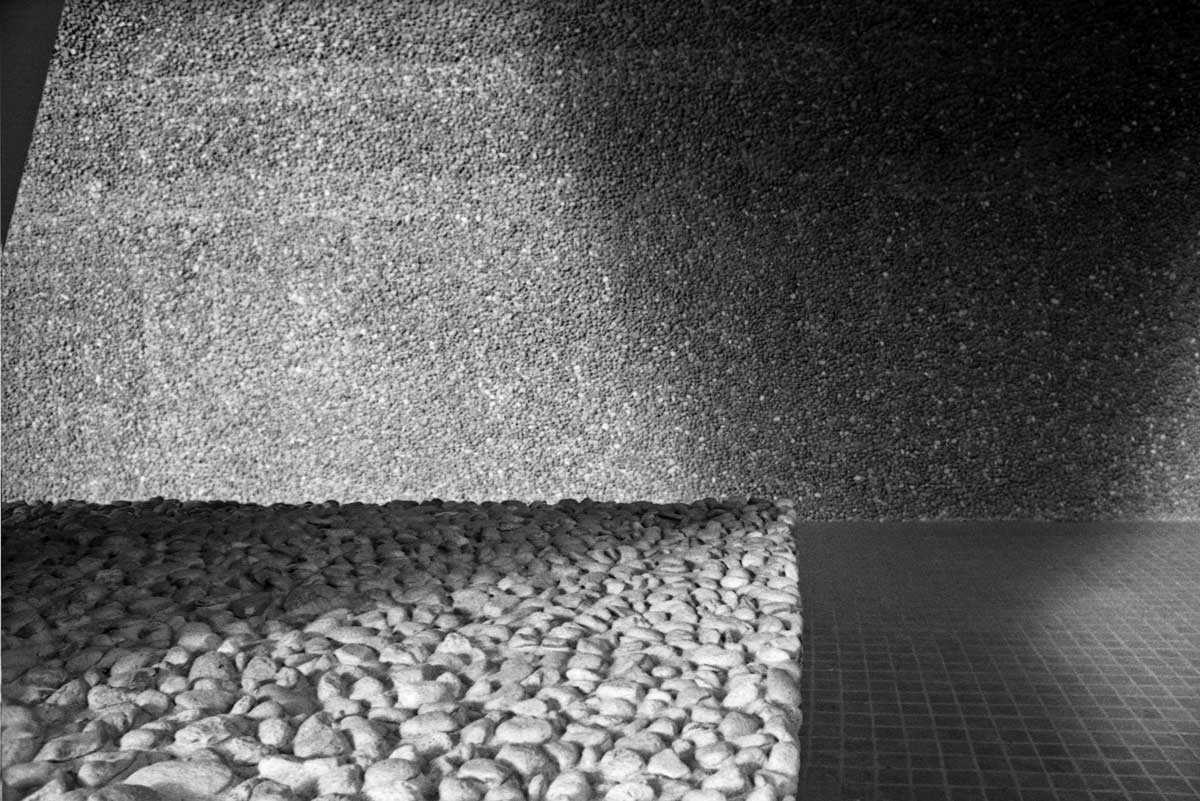


DON SCOTT IS or was one of the Seattle artists, with Rolon Bert Garner and Ken Leback, responsible for EQUALITY, a piece – or several pieces – of sculpture dedicated in 1996 in Sturgus Park at the north end of Beacon Hill in the early afternoon shadow of the Art Deco Marine Hospital, more recently home to an internet distribution company. I photographed this detail from the piece sometime soon after the ceremony.


Driving to Tacoma on old 99 you may miss Secoma, except for the signs, and of the two showing here the bowling alley survives although with mix reviews. (They may have a new sign.) In 1982, the approximate date, there was no exposing media like YELP to broadcast the range of criticisms about almost anything that amounts to another roadside attraction. The complimentary ones seem written to form. The critical reviews make the reviewers seem insulted by the place – their foolishness for paying six dollars for a beer in a place that takes only cash. You wonder if either or both were written by the lane’s owners or its competitors. The winter day we drove to Tacoma was too cold for the feeble heater in the VW Karmen Ghia. Secoma was new to me and the signs big enough to read from a distance that allowed a quick stop. If it is the motel that is having the grand opening then it may be new owners that are celebrating, for the big sign is weathered, although still somewhat grand. There survives a listing for a pubic phone in Secoma, which I imagine is the one set here near the base of the motel sign. It must take enough calls for the tel. company to keep it around. I remember trying the alternative, “Tattle” or perhaps Taatle.” (Click to Enlarge)


From July 9 thru 15 Bob Hope delivered his $100,000 show at the Aqua Theatre on Green Lake before near capacity crowds – first night 5,478 seats of the 5600 capacity. The Crosby brothers had to cancel (we can imagine the skit) but the show moved along fine (the reviewers noted) with the dancer Juliet Prowse doing “Legs” a dance of hers only through holes in a curtain, folk singer Jimmy Rodgers and the Fairmont Singers, and more than an hour of monologue by Hope. Almost as popular were the monkeys – the Marquis Chimpanzees, which “could do anything except recite poetry.” For one song Hope took to a row boat oared by Carol Christensen Hall, a former Seafair Queen. Earlier, of course, he received the obligatory queen kiss from Linda Juel, Seafair Queen for 1962, the year of Century 21. And next year Hope was back again for another encounter with the local queen, who in 1963 was Arelene Hinderlie. Both Juel and Hinderlie are pictured next. All the images, excepting that from 1963, which comes from the Post-Intelligencer, are used compliments of Seafair.


The trailer packed with deer and moose parts has a license dated 1942 and is parked on Terrace Street (between 4th and 5th) beside the side door to the old Public Safety Building, which since its restoration in the 1970s has been known as the 400 Yesler Building. We don’t know that the animal parts are collected as evidence but we assume it given the location. A different trailer below holds its own gruesome parts and is surrounded by a pack of curious mostly young men. This trailer is parked on Jackson Street east of 5th Avenue and across the street from the Orpheum Cafe, which was then in the building at the northeast corner of 5th and Jackson. That lot is now for parking. Looming in the haze is the 9-story Richmond Hotel at the southeast corner of 4th Avenue and Main Street.

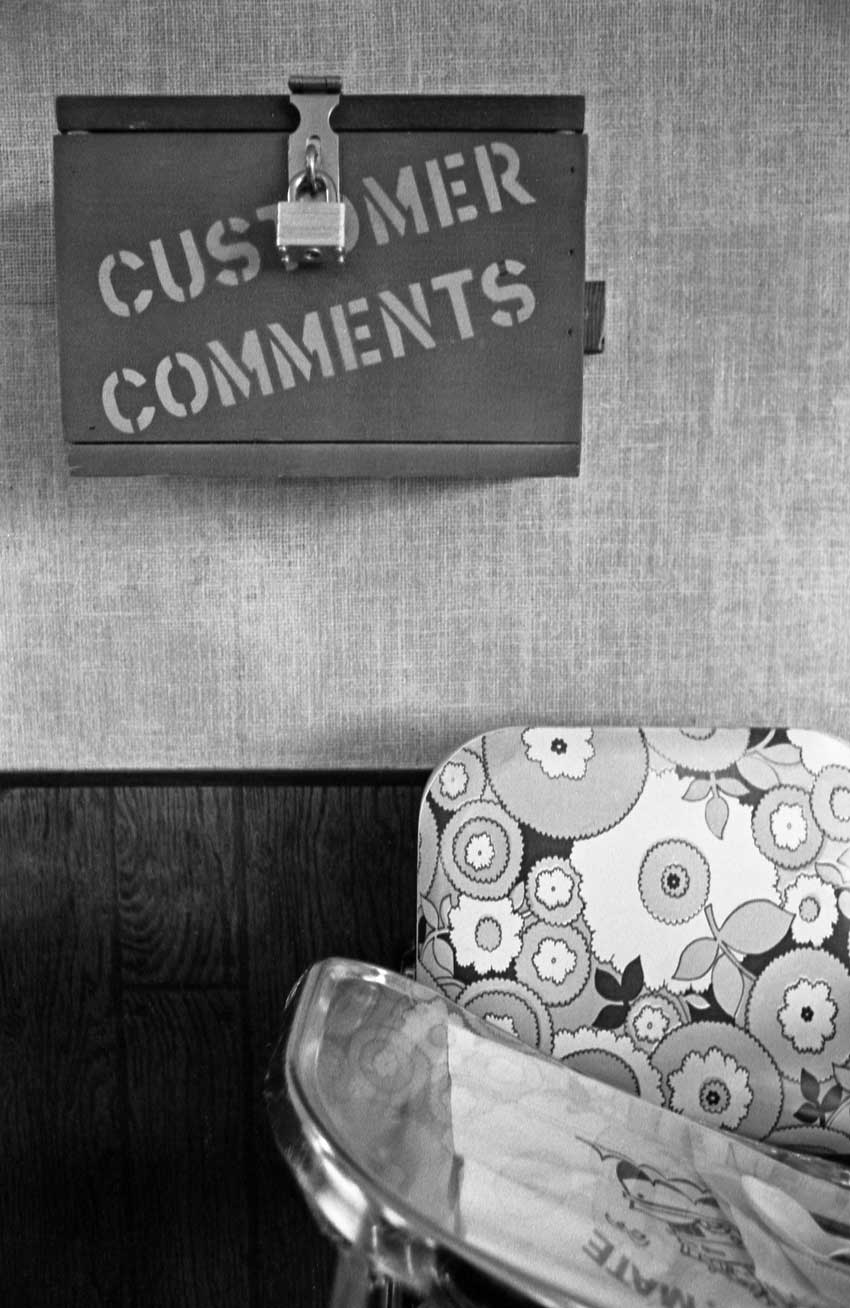

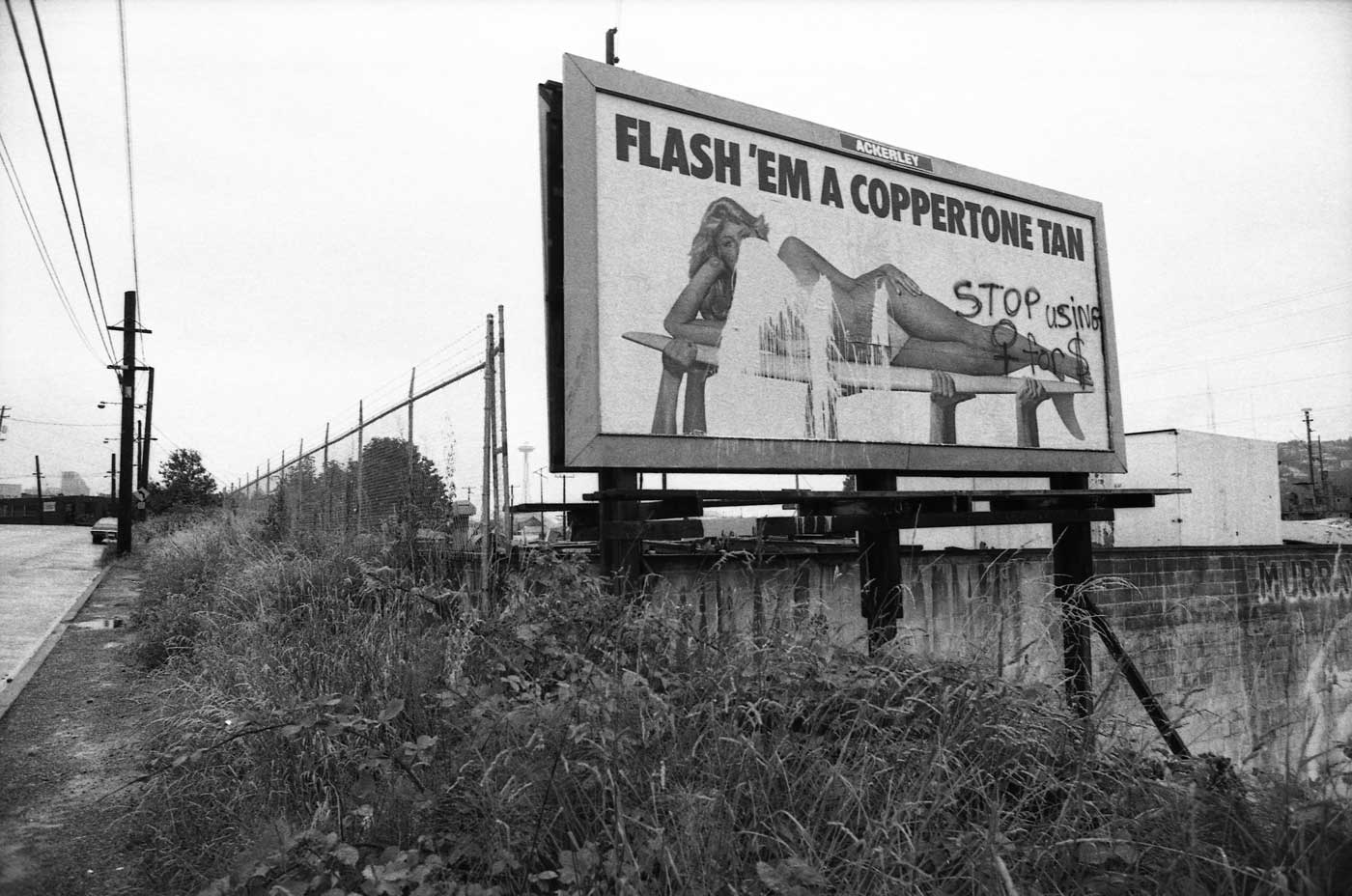
(Click to Enlarge) – If anyone would like to suggest a caption for any of these three, please do. They are all about thirty years old, and I shot them. The top one, I don’t know where. The middle one is at the south side of the Fremont Bridge waiting for the Anchor Excursion boat to pass. The bottom one is on Eastlake Ave. climbing the hill south of the Steam Plant. pd

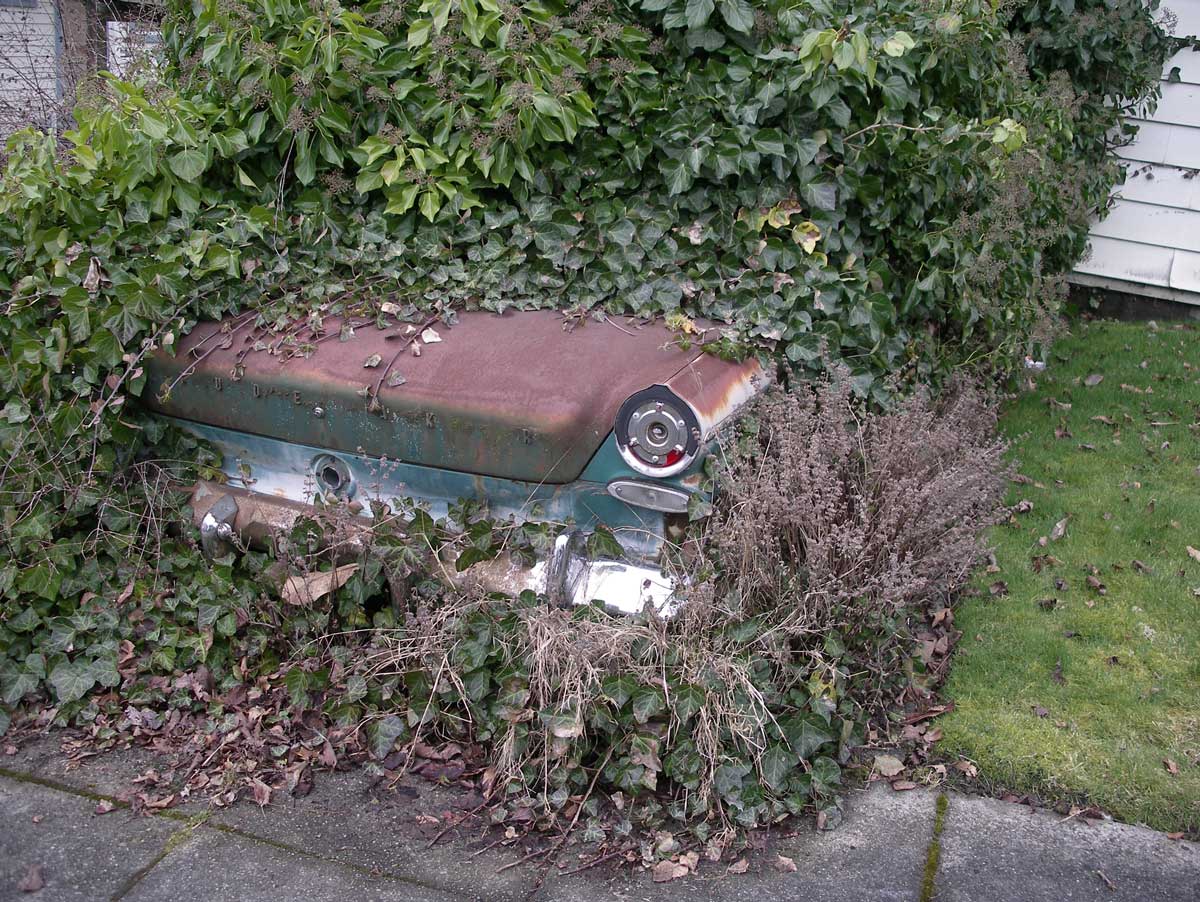
ANOTHER STUDEBAKER
Oh vintage auto pars pro toto
Rust in Wallingford and rest
While waiting like a baked potato
Wrapped in foil and motor oil
For another Studebaker going west


Above, are three of the earliest maps of Seattle, and at the bottom is its first real estate map, showing the sectioned fruit of the towns 1853 survey, its first additions on which Arthur Denny, Carson Boren and David “Doc.” Maynard expected to sell lots – and did. The above maps all put east at the top. The top one dates from the 1841 navy survey of Puget Sound, and includes a peninsula, Piner’s point, which when the tides were high and the wind strong out of the west could become an island. It covers an area that now extends from about one-half block south of Yesler Way to King Street, and from the Alaskan Way Viaduct (for a while yet) to some little ways east of Occidental Ave. The tides then also splashed against Beacon Hill. The middle map above dates from 1854, and is the fruit of another federal survey. It includes a few marks for buildings, but none yet for blockhouses. Those troubles came a year later. The bottom of the three maps dates from the mid-1870s and shows as yet no King Street coal wharf. That was built in 1877. The 1870s map also features topo lines. This last map (of the three) marks Mill Street – later renamed Yesler Way – and that line can help one get oriented with the two earlier maps above it.
Finally, and again, the map below is a rationalization of land as marketable. And they didn’t even own it.


(Click to Enlarge)

I have become attracted to messages on the flip side of postcards. Many are better than the offerings of professional greeting card authors, and all – even the most banal – can be revealing . . . of something. A few, like this one, are confessions. If the sample is large enough one could pull a narrative from them.

(Click TWICE to Enlarge)


(Click to Enlarge)
GERTRUDE & BILLY
It may be one of the banalities of passing time that moments that are remembered vividly seem more recent than they actually are. I suspect that these three Pike Place snaps of artists Gertrude Pacific, on the left, and Billy King may be a twenty years past or more, although, again, they seem more recent. If it were not for the familiarity of the market and the pick-up truck we might imagine this as somewhere in Rome. I have seen Billy as recently as last summer, for a mutual friend’s memorial, increasingly the kind of event that will put old friends in contact however briefly. It used to be parties or trips to the ocean or openings. Thankfully, it still is for many. By now Billy King is more than a tile in market history. For more than forty years he has sometimes lived there, had studios there, worked there (in a fruit stand, I remember), and recently painted a mural with market subjects near the top of the Pike Street Hill Climb. It is a painting made by command, or popular subscriptions. I confess that I have not yet visited it, although I have seen it on a poster. I have not been to the market for many months. The last time may have been more than a year ago when Jean and I took Steve Sampson to lunch there for his goodbye to join Cynthia Rose in their new home in Paris. Gertrude I last saw a quarter-century ago – or perhaps this is a record of the last time. It is time to go to market again – and Paris. And may I have the good fortune to come upon Gertrude with big hair barely restrained by her knit cap.
(Click to Enlarge)
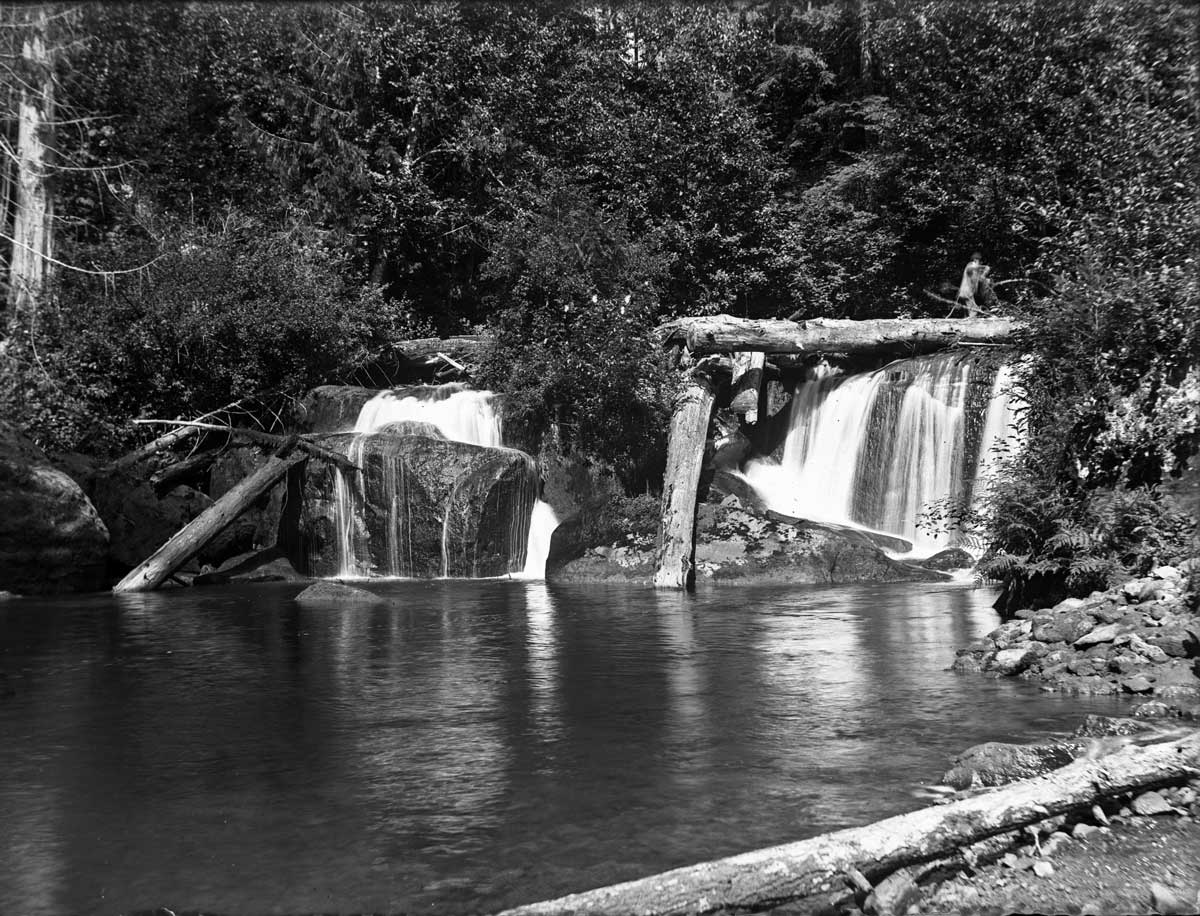
It is now about 40 years since Bill Burden and I last visited Cherry Falls on Cherry Creek in the Cascade foothills northeast of Duvall. It was Larry “Jug” Vanover who first led me to the falls. Bill, I think, was not along on the first visit. Without a guide it would have been hard to find even with good written instructions. There were many splits and turns in the road that wound up at a gate that was sometimes closed and sometimes not. The last leg required a hike down the overgrown bed of a long abandoned logging railroad to the falls which splashed in a pool that was so shaded that even on the hottest visits the water was bracing. It was, however, a splendid place for Diana and her stags. I did some filming there for the Sky River Rock Fire film, which is now also a 40-year work-in-progress. We visited the pool perhaps a half dozen times after Vancouver’s first help in the summer of 1968. He guided us to the falls following that Spring’s Piano Drop, which was staged on Larry’s perfect (for dropping a piano from the sky) property. Of the piano drop I have both film and stills, but of the falls only film. The subject attached here is unidentified. Although it resembles Cherry Falls – as I remember it – I doubt that it is Cherry Falls. Estimating the height of the man standing on top of the falls to the right, (in this circa 1912 glass negative) these falls might be sixteen or so feet high. I think Cherry Creek falls is somewhat higher. In the late 70s Bill Burden and I with an entourage of innocents in two cars tried to find the falls without Larry’s help. We failed. Perhaps next summer we will try again, but first call Larry.
ADDENDUM
Ron Edge – of our “Edge Clippings” – has found a visit to Cherry Falls by a mountaineer who signs his work “Hikin Coug.” Ron ventures, “I assume a graduate of WAZZU.” Hikin Coug dates his photo from this year – or rather last year, 2011. So thanks to Ron and the Hikin Coug, and all the rest on Cherry Falls that is now up and showing on line. Last time I searched, about six years ago, there were no pictures. While close in qualities the older photo is clearly not of Cherry Falls. Given the characteristics of the collection it came from it is almost certainly from somewhere nearby.


JOHN GEORGE – Variations
[To Enlarge the Clips below, CLICK them.]
Ron Edge – of this blog’s “Edge Clippings” – reminded me that The Seattle Times “key word search” service through the Seattle Public Library website, can also read telephone numbers. He quickly determined that the “782 – 2442” painted by some semi-pro free hand on the somewhat seedy door in the photograph above was the tel. number for John George’s Studio of Performing Arts at 5412 Ballard Ave. N. W. (A parking lot now, I believe.) I have a habit of dating old negatives from my wandering prime as “circa 1970s.” The sidewalk weed at the front door suggests that the door behind it was not often used. However, John George was active here from the 1960s into the 1980s. It is, again, the key-word opportunity that gives us at least a minimal sense of what he was about in this studio. Predictably, there were many other John Georges, the most prolific made from one/half of the Beatles. Beyond the Liverpool connection, a racehorse named John George did pretty well at Longacres in the 1970s, and John George Jr. after him in the 1980s. I also pulled two instructive references to a Salish tribal leader in Vancouver. B.C. named John George. Read on – if you will, and CLICK TWICE to enlarge.


Another John George holds our last clipping. This time George speaks with the authority of Ore-Idaho Foods Inc, as their head of international export sales. We learn that the average European eats more potatoes than the average American (although, it occurs to us, that the average American looks more like a potato than the average European.) America in the fall of 1976 – its bi-centennial – had too many potatoes and was ready to ship and share them with Europe.


WHAT HAPPENED
(click to enlarge)
Silently set with a lustre so fitting for some of the dancing days we played within it’s walls, the Oddfellows Ballroom (and like the Eagles Auditorium with an encircling balcony) was wonderfully fit for staging light show dances – and our’s were.
As the poster below elaborately confesses, in 1976 the remnants of 1967 had a big dancing party (we might have called it an A’GOGO-BEIN, except that the connotations of “gogo” were too commercial) here, in this Oddfellows Temple on Seattle’s Capitol Hill, celebrating the 10th Anniversary of the founding of the Helix, the first “alternative tabloid” hereabouts and the local member then of the nation-wide UPS, or Underground Press Syndicate. The Helix was first imagined in the University District, in the upstairs office of the Free University of Seattle (FUS) in the fall of 1966. It sprang of “necessity” from a conversation I had with Paul Sawyer, a Universalist Preacher then, and recently deceased – last year. Paul said, “We need a newspaper – something like the Berkeley Barb.”
The weekly tabloid began publishing in the Spring of 1967. With lots of help from Ron Edge – of this blog’s “Edge Clippings” and more – we hope to put up the entire Helix opera sometime this year. (Ironically, we may have to take on advertising to pay for the added memory required to post it and other over-sized resources. We hope not. Jean especially is committed to a blog free of ads – except, of course, for our own.)

One of my many little ways of negotiating survival during the 70’s was receiving two CETA grants through the Seattle Arts Commission. One was for arranging benefits for local non-profits in the arts and the other for studying local history with a mind to making a film about it. I used this hall for more than one of the big benefit shows, and it was in the AND/OR gallery on the ground floor of Oddfellows where I made my first presentation on work-in-progress on the Seattle Film, which I was then calling “Seattle’s Second History.” Recently, Jean’s youngest son Noel was helping feed the 99%, which was temporarily camped nearby on the Seattle Community College campus. Jean and I met him at the Oddfellows cafe and bar. (They ordinarily promote this space singularly with “Oddfellows” and with neither cafe nor bar. I makes it seem more club like.) The cafe is housed in the same big room that was once home to the principal avante garde-plus exhibit and performance space of the 1970s: the And/Or. In the interests of – or curiosity for – the timeline of this hallowed space on 10th Ave., I asked three persons connected with the busy cafe if they knew anything of its past. Alas, they were all clueless. It seems my prime looks forward from the past, while theirs does the same from the present.
It is often a mixed delight to come upon negatives – like the ones on top and below, both of the Oddfellows – I photographed long ago, for ordinarily I did not date them. While I’m confident that from context – several contexts – I’d eventually be able to date this scene, it would require days for sorting and reflecting through thousands of plastic sheets of negatives. For now I put it sometime in the 1970s. Since I also developed the film It would have been so prudent to have simply marked the negative holders – seven strips deep and five 35mm negs wide – with the date and the place, although ordinarily I still remember the latter.


[Click to Enlarge – sometimes TWICE]
WHITE ROVER DOG FOOD
Now that Christmas is Christmas Past, and all the presents are delivered and opened, it is, we hope you will agree, time for us to think again about our pets, and learn now of the wonderful nutritional opportunity that comes but one time a year – this time. Feed your best friend White Rover Dog Food, the only diet for dogs made from reindeer meat. It’s the well-balanced food that both Huskies and Wolves – like White Rover – prefer.
This first local ad (below) for White Rover Dog Food included an offer hard to resist: 3 cans for 23 cents. The Bartell’s ad appeared in the Jan. 21, 1932 Seattle Times.

For the young, White Rover borrowed on the long-lived popularity of the Hollywood star, Rin Tin Tin. For the older dog food consumers, White Rover recalled the heroics of another Alaskan, the dog Buck, in novelist Jack London’s most popular work, Call of the Wild. (1903) Buck was a combination of Saint Bernard and Scotch Shepherd. White Rover, who walked on his own paws, was a mix of 3/4th Yukon Wolf and 1/4th Husky. (These details and more about White Rover are shared in some of the newspaper clips that follow.) In February, 1932, White Rover promotions found their home in the Bon Marche. The big dog appeared regularly on stage in the department store’s auditorium.

The grandest day of White Rover promotions was bundled on Feb. 19, 1932, when the big dog was given his own car for reasons that are sort of explained in the clipping below. [DOUBLE CLICK this one, please.]

Advertisements continued to appear throughout 1932. The one below dates from Nov. 21 and still pushes the reindeer meat attraction in spite of Santa’s imminent needs.

The last WHITE ROVER DOG FOOD ad I could find with the S.Times (thru the Seattle Public Library) key-word search is for Oct. 15th, 1942. It is one of the few products featured in a (back to) Bartell’s ad that compliments “Mrs. War Wife” for shopping where “bargains are really bargains.” And White Rover Dog Food has pretty much held its price through the Great Depression and into the next Great War: three cans for a quarter. The ad does not mention the reindeer. By then whatever Hollywood associations had helped shine the white coat of White Rover, were dimmed by “the most famous dog in the world.” – Lassie. Eric Knight’s short story “Lassie Come-Home” appeared first in the Saturday Evening Post in 1938, and was then stretched into a novel in 1940 and followed by the first of many films in 1943. It had me crying then.


“WILSON’S HAMBURGERS Ill health forces original owner retirement 265′ frontage Grossing over $4,000 month. Sell business with or without property. Carry contract Mr. Wilson, EM 4521 after 8.” The Seattle Times Classifieds, Dec 8, 1952. [Click to Enlarge]


Jean here: I would conjecture that he may be a very small, well-dressed man. That “boulder”, I’m guessing, is only about three feet high. His sprawled pose on the shore suggests that Gregory Peck saw that photo, and replicated the pose exactly for his love scene with Ava Gardner in “On the Beach”.

putting the oar behind
taking, instead, a camera
from the bag – refined
or in a polite manner, a
scarf falls to the floor of the canoe
to let down her hair and stroke a comb
while drifting on the aquadrome


CLICK to ENLARGE


SCAT PROTEST & STOP REAGAN
(CLICK TWICE to ENLARGE)
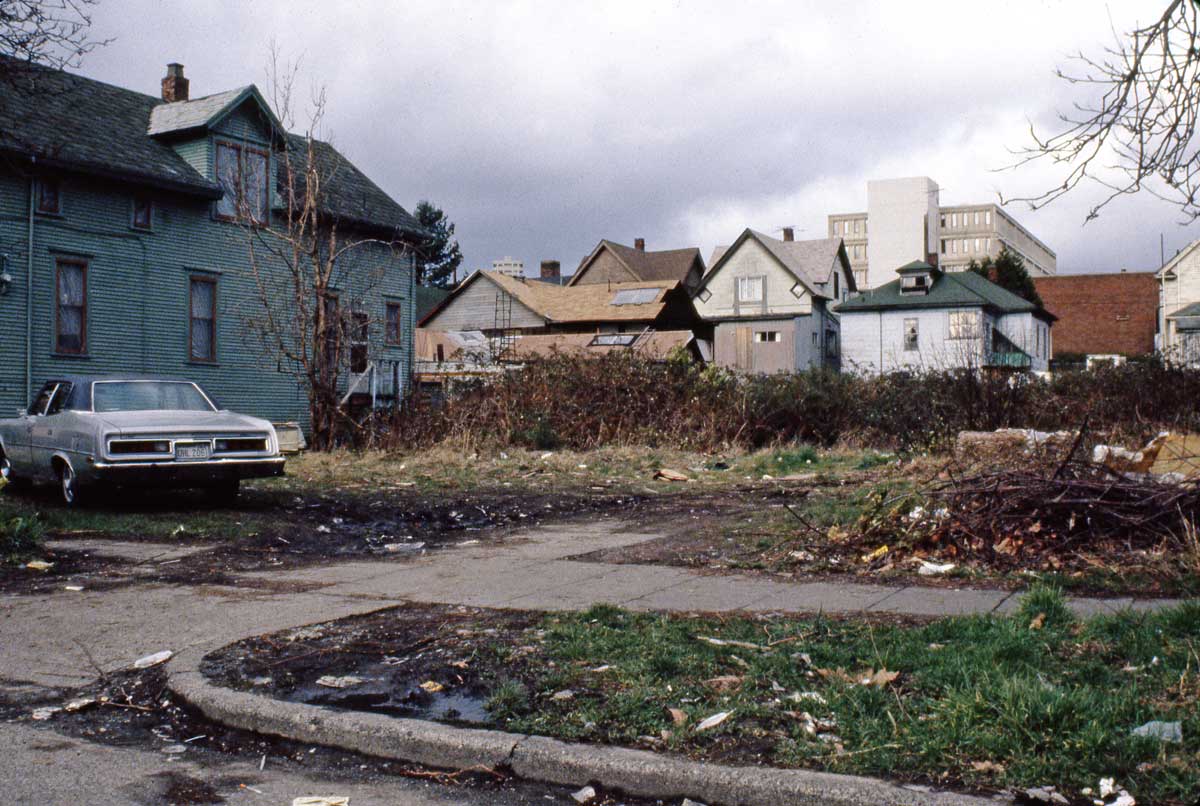
I snapped this home subject while waiting for the traffic light at 23rd Ave. e. and E. John Street on Capitol Hill. I was heading south on 23rd. I have done a poor job of dating the photograph “protest 80s.” Reagan’s terms ran from 1980 to 1988 and Royer’s further, from 1978 to 1990. But John Spellman’s time, as the state’s governor, was limited to one term, from 1980 to 1984. This scene, then, was recorded in the early 1980s. I recall that the signs, toilets and dummies held the corner for a fairly long term, although I don’t think for four years. It seems like someone lives upstairs. Both windows have curtains and the one on the left also shows, it seems, a candle-holder or a bottle with a long neck – wine perhaps.
Can you (or please try to) make something of this protest by reading the signs – the ones that are more or less legible? Here is what I have deciphered.
Far left beneath the windows with bars and above a hanging toilet seat draped (With what?) the sign reads, in part, “Hang in There.”
Above and between the doors: “Toilet Bowl Strut” (I’m not sure of the “strut”) above musical notation with lyrics, we assume, below the notes, “Rock & Roll in Old Toilet Bowl.”
On the same sign “Section 8 / Reagan? /Spellman? / Royer? / Come Look.”
[I cannot make out the sign above the toilet sitting on the porch between the two doors.]
The signs above and below the toilet seat hanging on the post to the right of the doors are deciphered with some doubts. The top one uses letters with odd serifs and what seem to be chopped words. And the sign is bent. Still, it reads, I think, “Toilet bowl Str(?) Reagan” again. The sign below the open toilet seat reads, in part, “Free apartment . . .” but then concludes with “You” including a strange concluding “U” and a last word that seems to read “haul.” So “Free Apartment You Haul.” What can it mean? And is that a minstrel face painted in the frame of the toilet seat above it?
The large sign, top right, reads “Stop Reagan Now??? / Regan condemns / 8 Units. Cheap Rent 25 cents & 50 cents per hour / Let the public look welcome / Can Gov. Spellman / Can Mayor Royer STOP REAGAN”
Of the three signs resting on the window sill, the one on the left may read “Make (or take) free toilet bowl strut [?] lawyers.” The middle sign cannot be read, but the small commercial sign on the right can be. It reads “House for Sale.” It may be an important point.
The big sign below and right of the window reads “Three bedroom apt. / 50 cents per hour / Reagan says no / more welfare / no subsidized”
The next and smaller sign below seems to read “Captain of the heads.” If so it is a pun on both the toilet seats and the politicians.
Finally, the small sign above the toiled seat, upper-right, seems to stutter, “Let it all all hang out”
What can it mean? So scatological with condemned rooms for rent and by the hour.


THE BACHELOR LIFE
(Played by Max Loudon – Click to Enlarge)
The weekly now-then feature in Pacific began nearly 30 years ago, on the Sunday of Jan 17, 1982. One of the pleasant surprises that followed having a place in the big pulp was – and still is – the people who want to share or show old photographs with me. Grace McAdam was one of the first readers to make contact with me – I think it was through the help of John Hanawalt at Old Seattle Paperworks in the Pike Place Market (which, is still imbedded there in the lower level next to the Big Shoe Museum.) Grace brought two albums and several loose snapshots that her brother Max had recorded in the first years of the 20th Century. At the time I met Grace her old brother was no longer living – except through her memories and his pictures and a few letters. All of it revealed a man of considerable zest that included what seems, at least, to have had a passionate commitment to the life of a single in his prime. Grace noted that her brother Max was quite popular with her girlfriends.

The bachelor life of Max Loudon is revealed in the albums he carefully filled with snapshots he took of his many adventures. Included are records of joyful events: the spontaneous November 1918 Armistice Day celebrations on the streets of downtown, the arrival of the circus to the lower Queen Anne fields (now Seattle Center), and skating on Green Lake during the long freeze of 1916.

We’ll include here mostly group shots, and most of these of women. Truth is he took many more pictures of women he worked and sported with then of men. Directly below is a snapshot of Max on the right with his brother Earl standing in their swimsuits at some public beach where they are warned to wash away the sand before they use the pool. It may well be the pool at Luna Park or another on Alki Beach. Below it Grace McAdams romps on Alki beach with two friends. Grace is on the right and Luna Park behind her.


And another of Grace this time “whipped” by her other bother, Earl, as Max snaps.


Born in Nebraska in 1881, Loudon dropped out of Omaha High School at the age of 15 and headed west to Seattle. Here his personable intelligence (aka charm) carried him through an assortment of vocational adventures: manager of a semi-professional baseball team, traveling superintendent for a grocery wholesaler in Montana, manager of the general store for a logging company in Yacolt, Wash., and a trip north to Nome, Alaska, seeking gold – what else? As revealed in his letters home, this last adventure soon turned hellishly cold when his steamer stuck in the ice for two weeks.


Here in Seattle, the young Loudon cut his commercial teeth working nine years for Schwabacher Bros. Wholesale Grocers. He became warehouse superintendent for the Grocetaria Stores, in charge of all departments. His salary -whopping for the time -was $150 a month. I was enough, most likely, to support his sporting life as an amateur boxer for the Seattle Athletic Club, an expert fencer, a medalist marksman and – at least from the evidence of his albums – a man confident in the company of women.

A few of the Loudon’s subjects included here feature Stewart and Holmes Drugstore employees. Some he posed on the alley trestle that runs above the railroad tracks entering the southern end of the city’s railroad tunnel, below Fourth Avenue and Washington Street.


Both Grace and Max followed local theatre on stage and back, and Grace also played some parts.


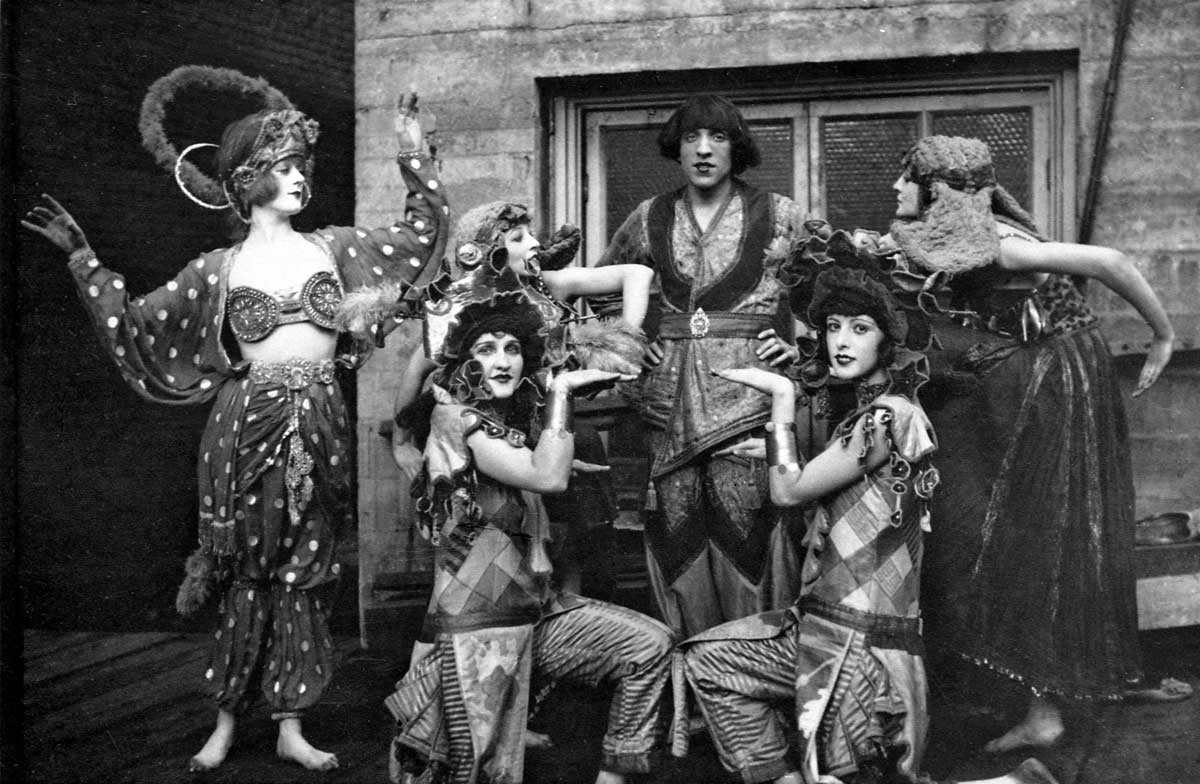


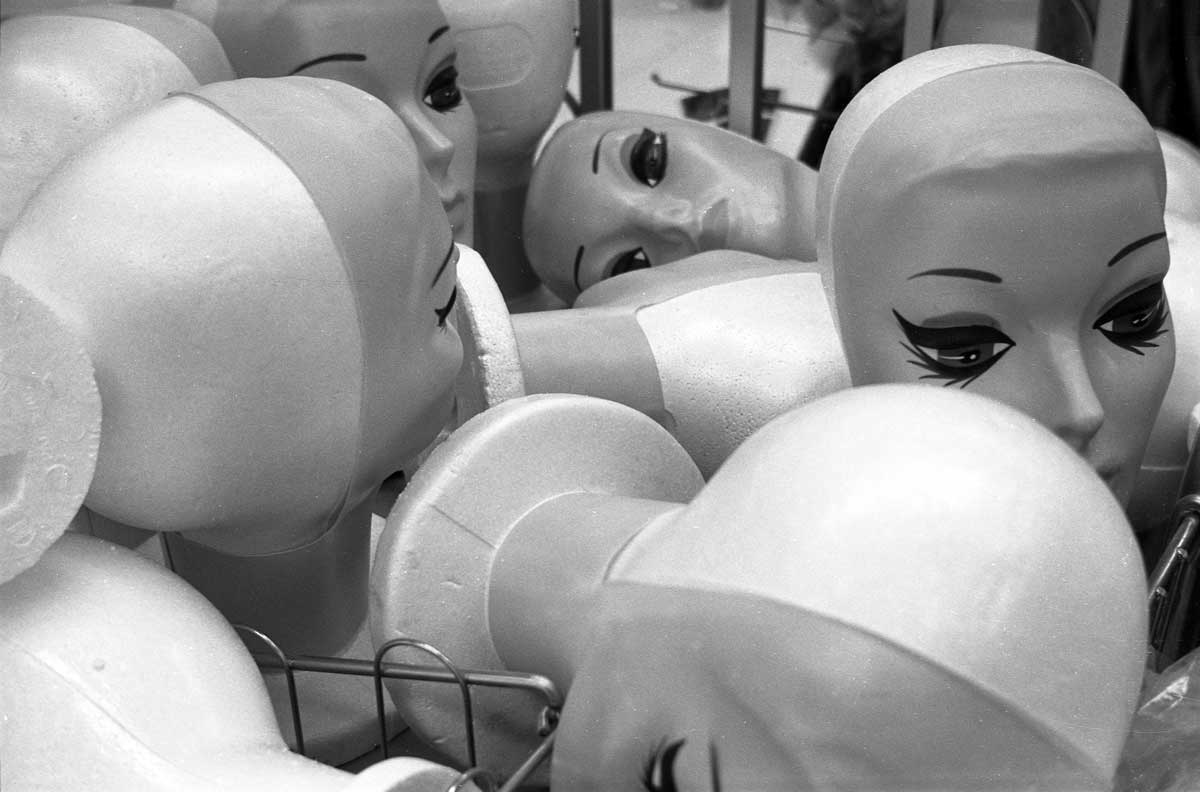
This I snapped during a visit to White Front sometime in the 70s. I no longer remember if the name was joined as one – Whitefront. I remember being startled by the sign promoting Santa before Thanksgiving and the Sat. Nov. 25th date is a clue at least to possible years that the day that the day that is still two days after Thanksgiving came on a Saturday. I remember the Niagara Cyclo massagers but neither Ira Blue nor KGO radio. Here a carboard Ira gives a personal touch to the vibrator. And last, why there would be a table filled with heads for my inspection, that I don’t remember either. Now looking back to the second (middle) subject, I wonder if the blonde on the left might have borrowed her big hair from one of these heads. The White Front building on Aurora near 135th may be a K-Mart now, if it has survived the latest falling. (Click to Enlarge)



(Click to Enlarge)

(Click Twice to Enlarge)


(click to enlarge striped bell bottoms, and perfect profiles diving for body parts.)


It is sometimes difficult for an associate editor to decide on what page to put a story. Instead, we give this wrecked Oakland three chances for broader meaning. It is clearly a WRECK, but it is also an Unintended Effect, and not knowing on whose lawn we have found it, this embarrassment is also somehow confidential, although exposed. Ron Edge contributed this scene, but Ron, for now, is not able to place it, except to note that it comes from a collection of Seattle-based negatives, which are big glass ones. Perhaps some reader can figure the location and make it all less confidential. It seems to me most likely that it is somewhere on the first ridge east of downtown, which is First Hill and Capitol Hill. It is also Ron who calls this unintended wreck an Oakland. He explains that because the original is from a large glass negative he could read the name in a detail of the wheel.


You may find some clues in this mysterious party portrait – or you may not – but when all is described the mystery abides. Who are these people once so confident in their pleasure and now passed or worried perhaps and withdrawn in the past? I may recognize the back of one head – that in the middle background with a hand on its shoulder. However, not wishing to influence your speculations I will not name mine.

Scenes from Seattle – or near it – so confidential we don’t know what they are. Some, we imagine, are erased forever. Others you may know, but we do not.
