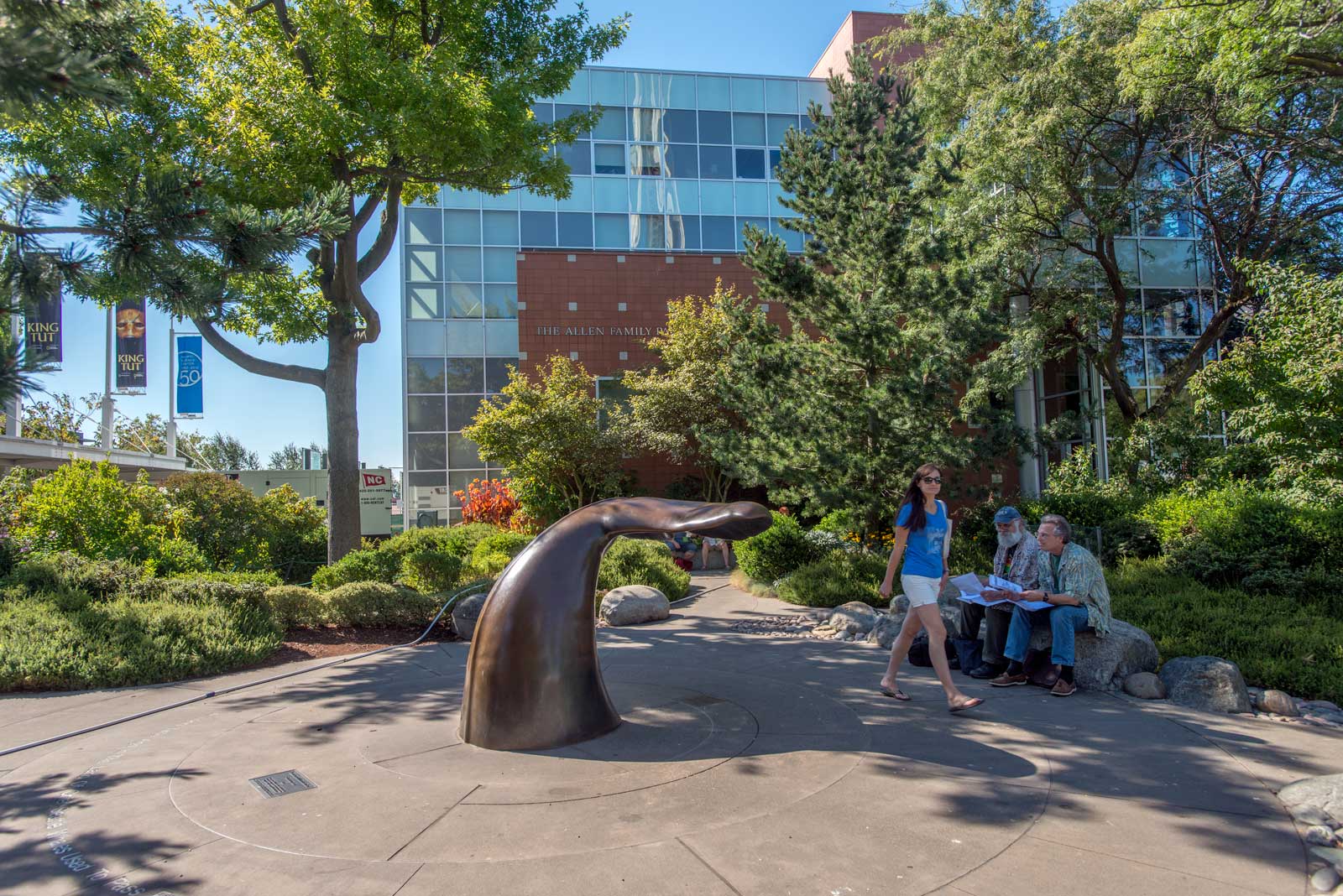
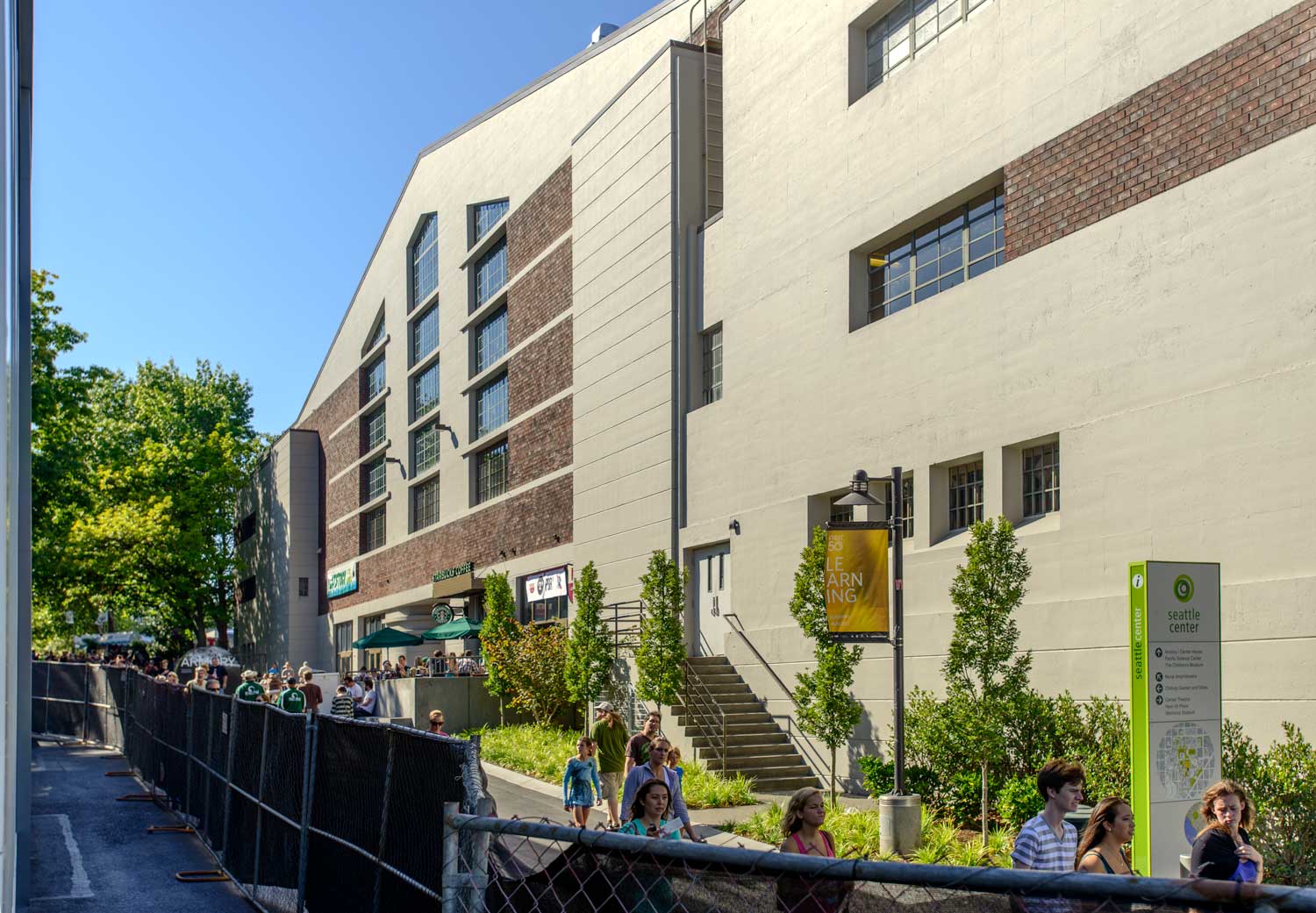
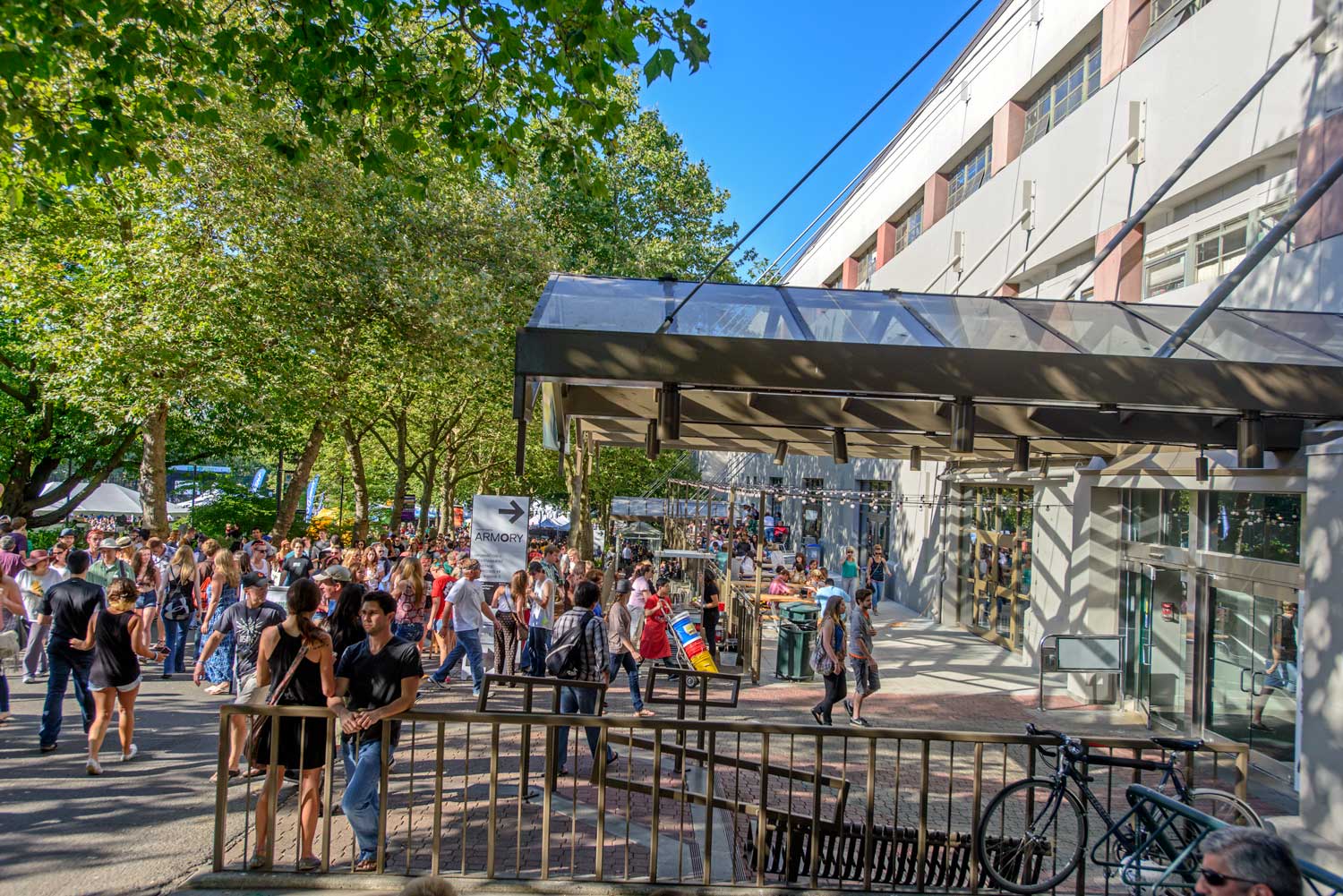
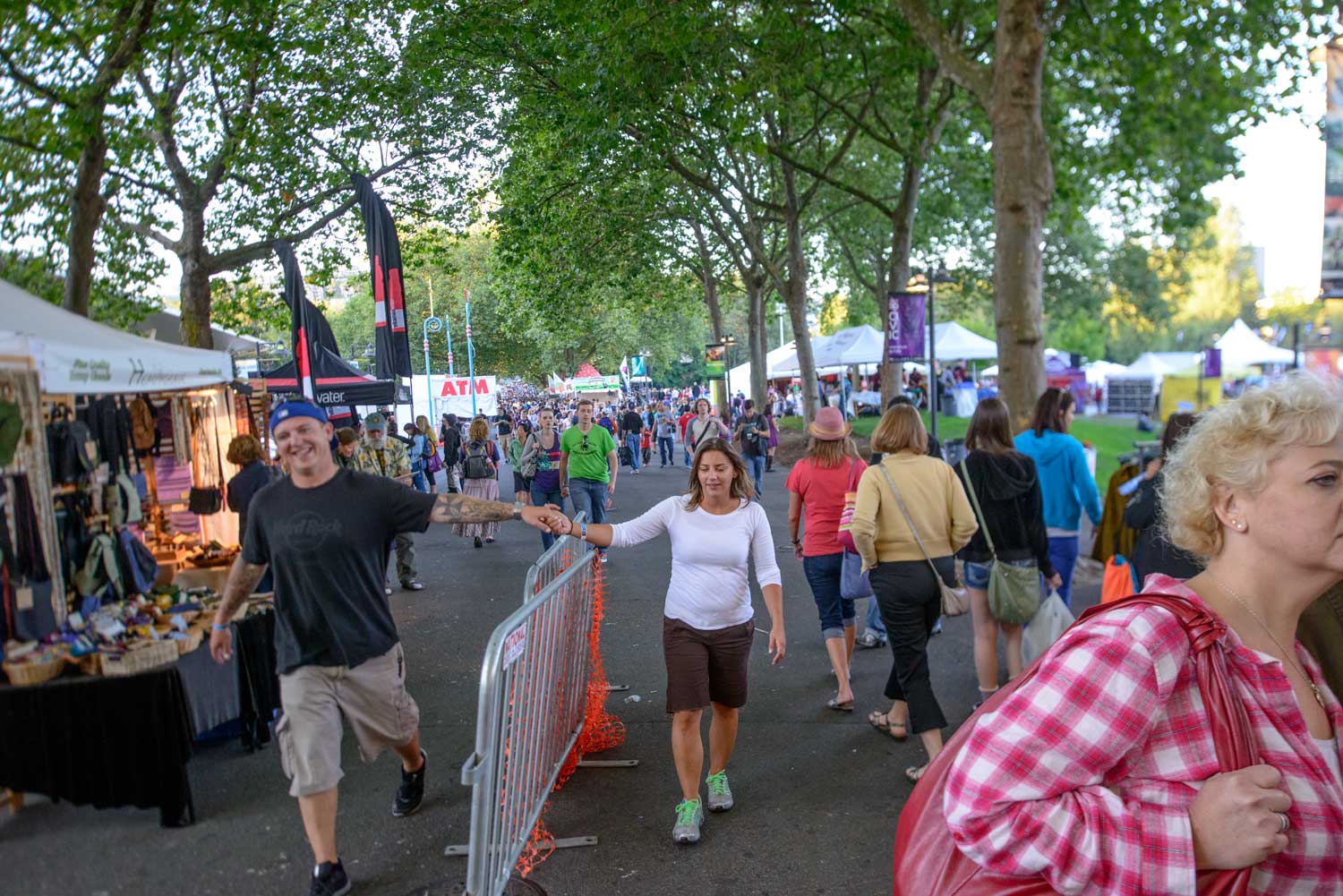
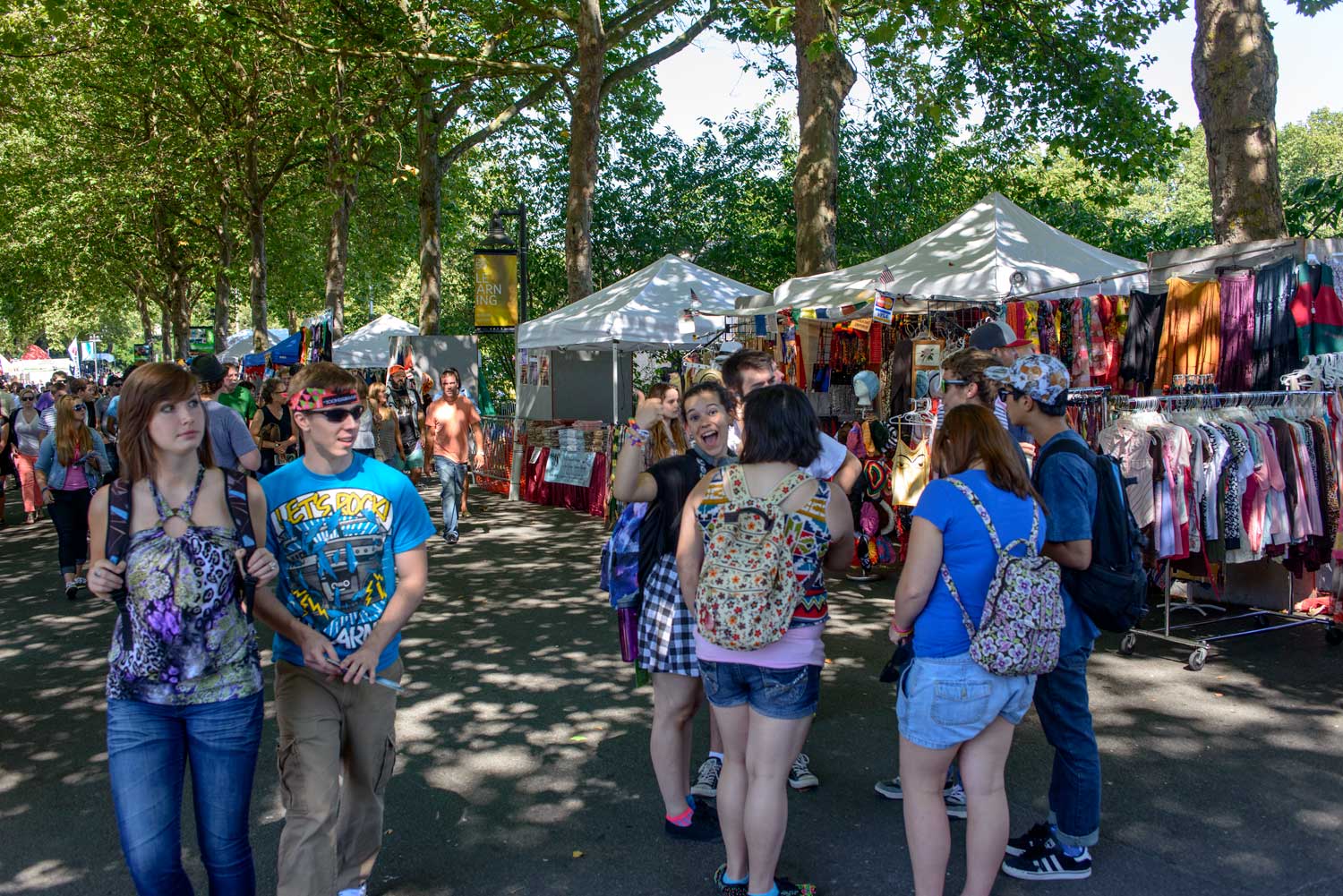
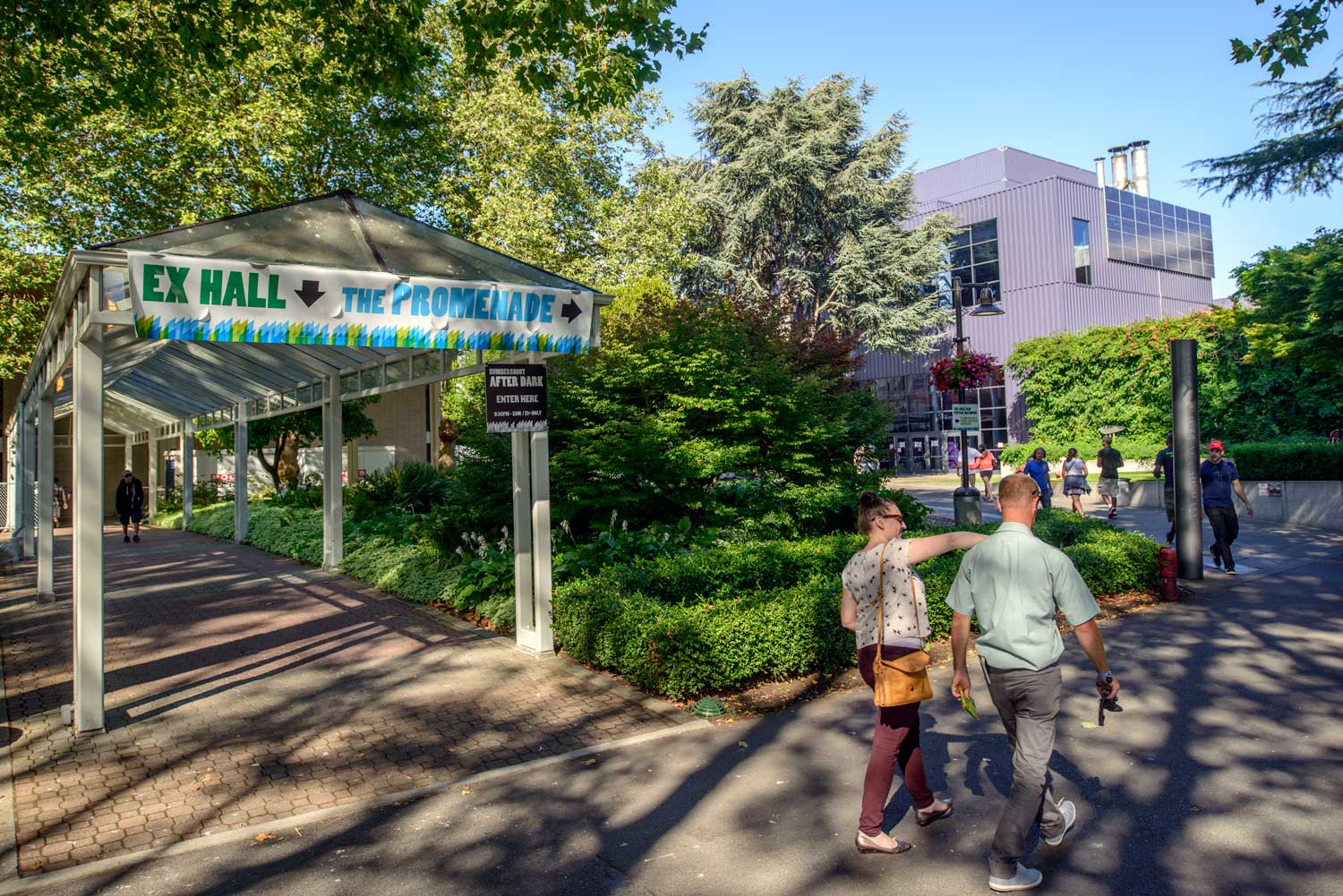
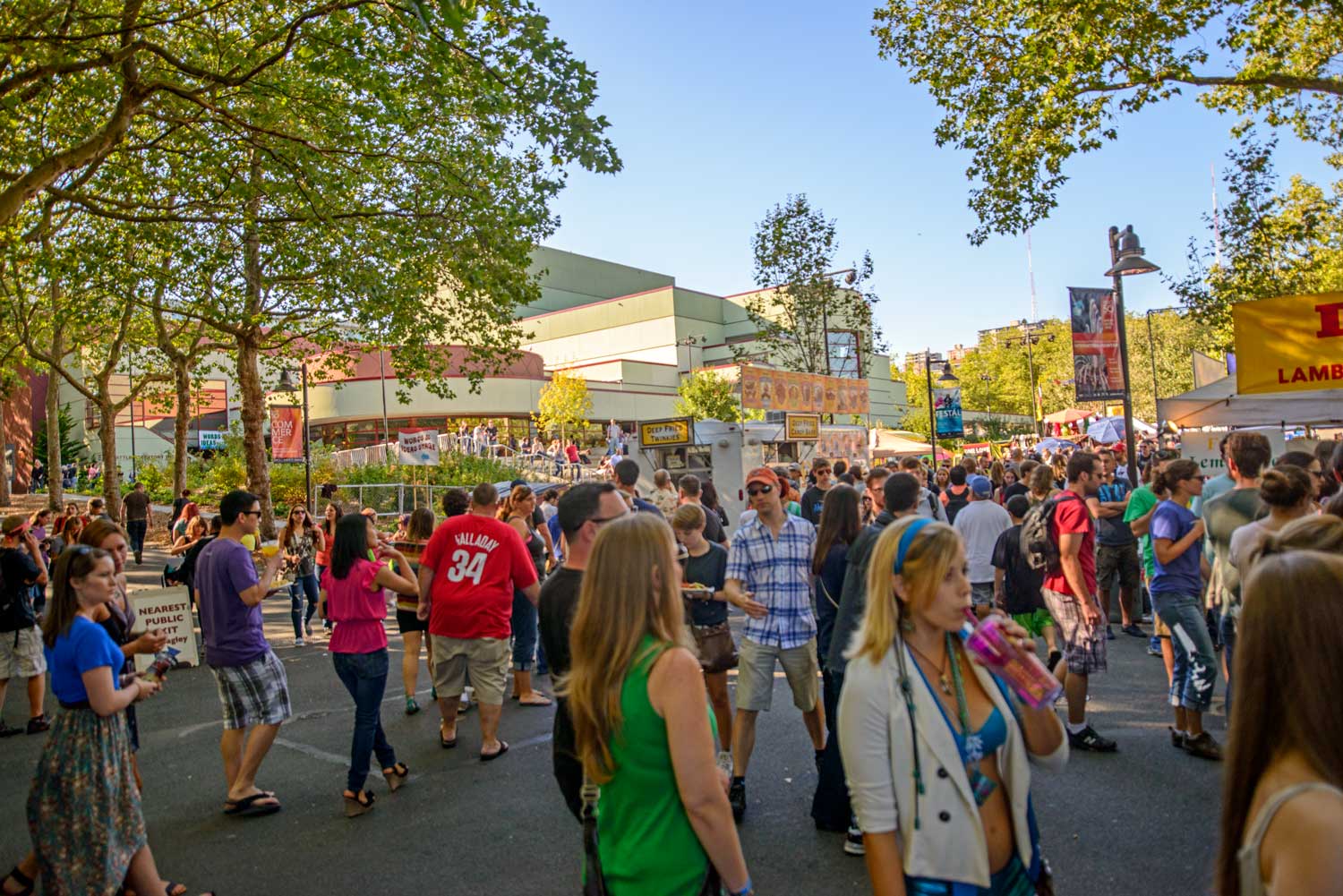
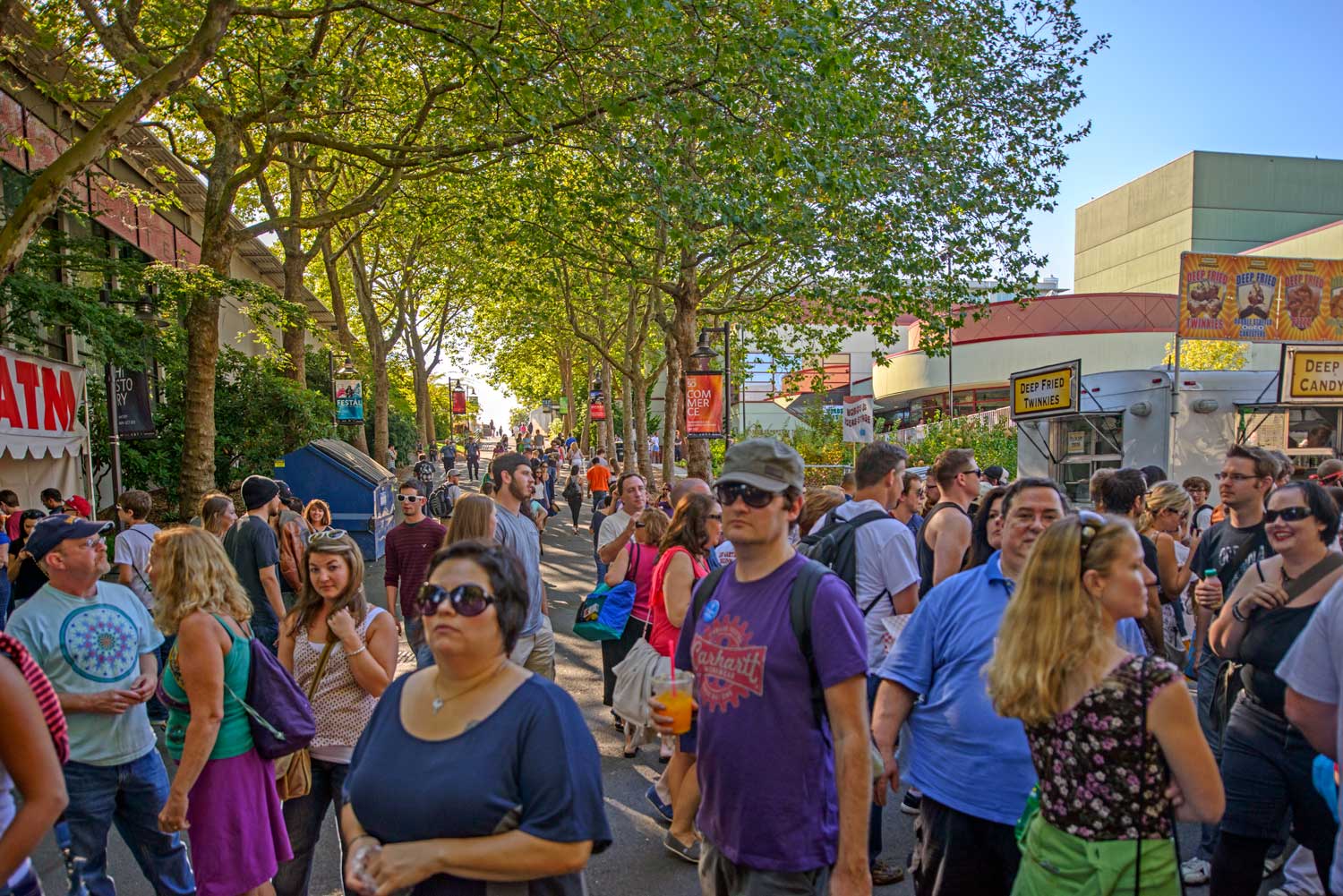
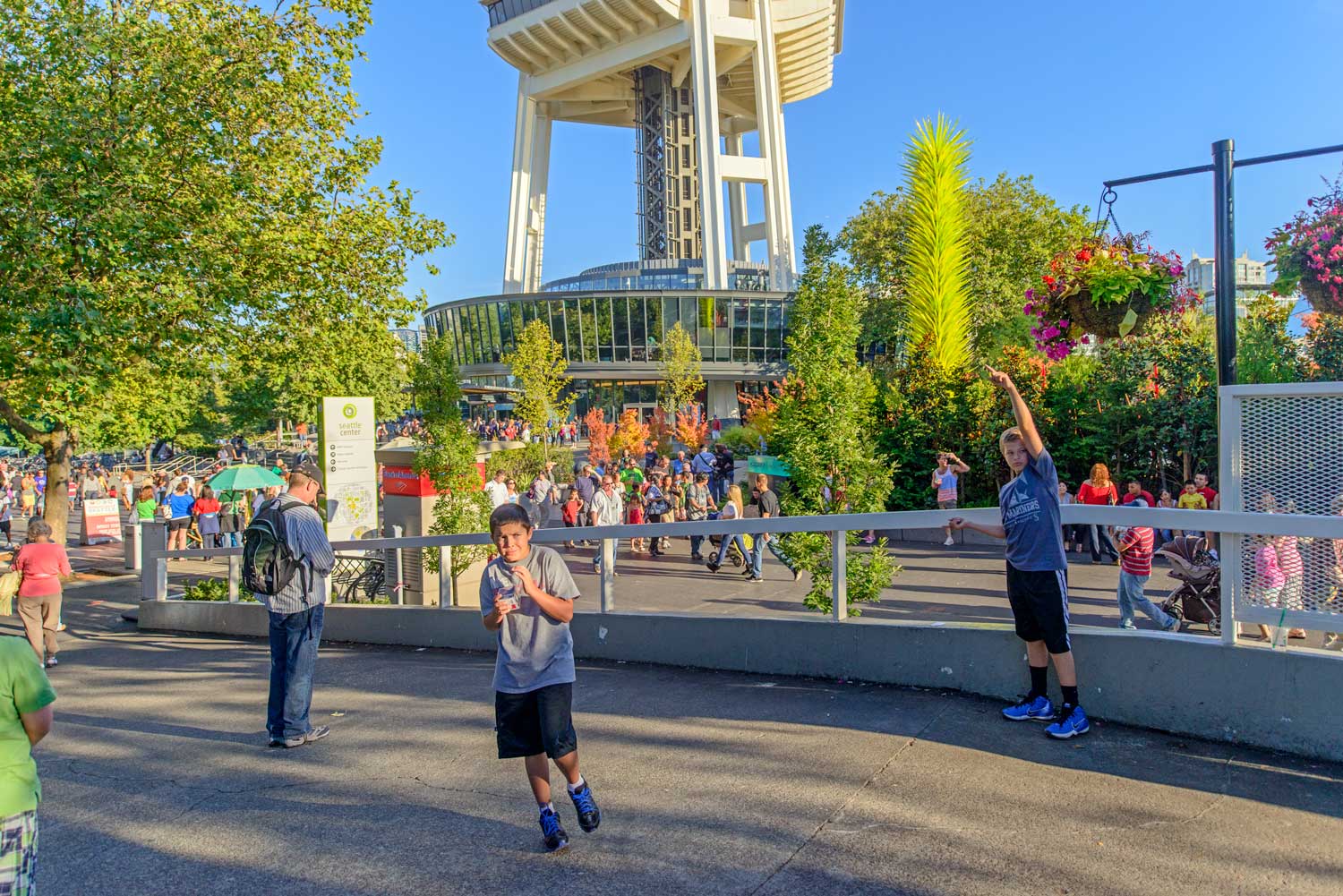
Still quite glorious in its diversity and wide appeal, Folklife is surely one of the planet’s great festivals. As Baby Gramps reflected on Sunday evening, in the Newport Folk Festivals heyday, it drew a respectable crowd of 50,000 –Folklife brings out five times that many. A few snaps from my all-too brief visit yesterday evening and this afternoon.
(as always, click to enlarge photos)
The view from atop the Fisher Green PavilionThe Saints Come Marchin’ In…A sure sign of summer in Seattle – Fountain follies….
Baby Gramps, waiting for a sound check….
Near Broad Street, a gathering of the tribes…
The Mad Robins a cappella contradance chorus. From left: Michael Karcher (caller); Amy Hanson Wimmer, Abigail Hobart, Diana Herbst, Anita Anderson, Isaac Sarek Banner, David Kessler, Melissa Coffey, and Brandon Ananias Martin-AndersonCapoeira on display…A southern view up the Center’s dappled walkwayA brass band plays next to a sign reading, “No Loud Busking here”Last night’s full moon…
For this “Fair and Festival” installment we repeat a Pacific feature we printed earlier in , but now additions to help you, dear reader, find the spot more easily with aerial photographs and other points of view. The Eaton Apartments were set at the northeast corner of Second Avenue and Thomas Street and so kitty-korner from Sacred Heart Catholic Church, once it lost its parish on 6th and Bell in 1928 to the last of the Denny Regrades. The long sky-lighted pavilion built there for Century -21 was named, for the fair, the Domestic Commerce and Industry Building (aka Hall of Industry.) It faced the Plaza of States (aka Flag Plaza). After the fair the building got a new and sensible name: The Flag Plaza Pavilion. It was home in 1978 for King Tut’s first lucrative visit to Seattle. The Eaton Apartments covered about one-third of the Flag Plaza footprint – the most westerly third. We will point it out again below in a 1928 aerial photograph and also in Frank Shaw’s colored slide of the apartment’s back or north facade during its last months before being razed for the fair.
Above: Looking kitty-corner across Thomas Street and Second Ave. North to the Eaton Apartments, ca. 1940. It is a rare recordings of Seattle Center acres before their make-over for the 1962 Century 21. Below: Jean Sherrard visited the intersection during the recent playing of the Folklife festival 2012, and “captured” folk-jazz artist Erik Apoe, with his guitar, leaving the festival after his performance. Bottom: During the 2012 Bumbershoot Jean returned to the corner which included then – for the duration of Bumbershoot – one of the escape gates from the ticketed festival. With his press credentials hanging from this next (although this year they were merely stuck to his shirt) Jean could easily come and go.
THE EATON APARTMENTS
(First appeared in Pacific, Aug. 8, 2010)
I know nothing about the provenance of this photograph, except that it showed up as a thoughtful anonymous gift on my front porch among a small bundle of negatives. Still with the help of a tax card, a few city directories, and a scattering of other sources we can make some notes.
With his or her back to Sacred Heart Catholic Church, an unknown photographer looked northeast through the intersection of Second Avenue North and Thomas Street. The Eaton Apartment House across the way was built in 1909 – in time perhaps for the city’s first world’s fair. It held 19 of everything: tubs, sinks, basins, through its 52 plastered rooms. In the 1938 tax assessment it is described as in “fair condition” with a “future life” of about 13 years. In fact, it held the corner for a full half century until it was leveled to build Seattle’s second worlds fair.
The Eaton and its nearby neighbor, the Warren Avenue School, were two of the larger structures razed for Century 21. However, the neighborhood’s biggest – the Civic Auditorium, Ice Arena, and the 146th Field Artillery Armory – were given makeovers and saved for the fair. Built in 1939, the old Armory shows on the far right. Although not so easy to find it is also in the “now” having served in its 71 years first as the Armory, then the ’62 fair’s Food Circus, and long since the Center House.
This is part of David and Louisa Denny’s pioneer land claim, which Salish history explains served for centuries as a favorite place to snag low-flying ducks and hold potlatches. The oldest user of the Eaton Apt site was even more ancient. The Seattle Art Museum (SAM) brought King Tut, or at least parts of his tomb, to the Flag Pavilion in 1978. It was about then that Andy Warhol also showed up to party with SAM in the old pavilion, which in 2002 was replaced and greatly improved with the Fisher Pavilion.
Readers who have old photographs of this neighborhood from before the 1962 fair (they are rare) or of the fair itself might like to share them with historylink. That non-profit encyclopedia of regional history is preparing a book on the fair, one that will resemble, we expect, its impressive publication on the recent Alaska Yukon Pacific Centennial. As with the AYP book, the now hard-at-work authors are Paula Becker and Alan Stein. You can reach them by phone at 206-447-8140 or on line at Admin@historylink.org.
This Pierson Photo looks northeast over the future fair grounds late in July, 1928. It was printed with caption in the Seattle Times on the 29th of July, with the header for the caption reading "Look, Seattle, at Your Own Civic Center From Air!" The aerial is, obviously, filled with attractions. Our Eaton Apartments site at the northeast corner of Second Ave. and Thomas Street, is easily found centered at the bottom of the aerial. One block north of Thomas is Harrison street, and where it meets Second Ave is the spot where the Coliseum's (aka Keyarena) western anchor or primary strut or beam (or what?) is anchored. Below we will visit the corner, again before the '62 fair.Here thirty-two years later is another aerial that was printed in The Seattle Times on July 13, 1960 - or near it - and photographed by Times photographer Paul Thomas. This one also looks northwest towards Lake Union, and shows the clearing the center well underway for C-21. The Times has helpfully attached identifying numbers, which we will now list. (1) Cleared of the Warren Avenue School and being prepared for the "state-financed Century 21 Coliseum." (2) Civic Auditorium from 1928; (3) Ice Arena (1928); (4) High School Memorial Stadium (ca. 1948); (5) National Guard Armory (soon to be renamed the Food Circus); (6) Nile Temple (kept for the fair and used then as the exclusive Club 21 where VIP's could relax and refresh while escaping the populace horde.) (7) Part of the future site of what the paper names "the five-unit federal Hall of Science" and we know as the Pacific Science Center. Just below and right of the circles "No.5" is the corner of the here razed Eaton Apartments. Frank Shaw's pre-fair coverage of the neighborhood shows here the back side of the Eaton - its north facade. The view looks south and a little east from the north line of Harrison Street, a few feet west of Second Ave. Shaw's photo was, of course, photographed sometime before Thomas 1960 aerial above it. Since 1961 standing here and taking the same aim as Shaw would show that west support for the Keyarena. (Which is more likely the Key Arena.) The next view - one from the Space Needle - in 1962 - marks the spot with a red arrow.The red arrow marks the spot - or near it - where Frank Shaw shot the photo that is placed above this one.That western beam, strut, support, noted here. Photographers have climbed it for the prospect of astronaut John Glenn during his morning visit to the fair. The view looks west somewhat in line with Harrison Avenue, which would put out-of-frame the International Fountain on the right and the Plaza of States (with the state flags) on the left. This is another Times shot - one by their long-time photographer Vic Condiotty. I met Vic in 1982, my first year contributing the weekly "now-and-then" to the paper.
We will wrap No. 23 with another Frank Shaw photo. This one, we figure, looks north and a little east from what would become the Pacific Science Center. The Catholics, at the southeast corner of Second and Thomas, are here right-of-center, which is also often the position of its clerics if not always the parishioners. Far-right, is the yellow strut, beam, girder, stanchion, transverse on the east quadrant of the Coliseum and here under construction. It appears above where the Eaton Apartments would be standing – if they still were. Queen Anne Hill is on the horizon.
To help orient what follows, bottom left, two "fairliners" (the name escapes me) avoid collision as the intersection of Thomas Street and Nob Hill Avenue. We life the view from a popular chapbook published at Fair time. It is filled with Worlds Fair subjects and titled "Worlds Fair Pictorial Panorama" (page 21). This looks east and a little south from the roof of the Food Circus (Center House) to the west leg of the Space Needle. It was from a few feet east of the foot of that leg that the fair and festivals repeating subjects published next were recorded. The Bell Telephone building, seen in part at the bottom-right corner, and the "General Electric Living Exhibit", at the center below, and the "Hydro-Electric Utilities Exhibit," standing like a starched collar on the far right, all make limited appearances in the Fair photo printed next.
(Click to Enlarge)
Sighting west from the foot of the Space Needle nearly three blocks to the tower for the Sacred Heart of Jesus sanctuary at the southwestern and off-campus corner of Thomas Street and Second Avenue. (The church tower is somewhat hidden behind the tree.) To the left of that distant tower sits a portion of the flamboyant roofline of the Christian Witness Pavilion (which we visited yesterday), the rear of Paul Horiuchi's Seattle Mural, at its northern end, and, far left, part of the nearby Hydro-electric Utilities Exhibit. Just left of the Space Needle's foot is part of the General Electric Living Exhibit, and to its left the south facade of the Bell Telephone Systems Exhibit, which resembles an oversize chassis or chamber for a self-inking rubber stamp. Also note the sign post pointing the way to several fair destinations. In Jean's Bumbershoot repeat the Center House (Food Circus) is no longer hidden behind Bell Telephones sprawling "systems exhibit." Note how the Space Needle with its remodel - by now a few years back - covered its ankles then with a skirt, above.
The next attraction south of yesterday’s Christian Witness, the Safeco (or General Insurance) sponsored Official Information Center, was also squirreled into the southwest corner of the future Seattle Center. Jean needed only a short walk south on Second Avenue from the Christians to reach the former site of the open-aired booth with a roof spread low like a turkey’s wings protecting her chicks. It was another eccentric Century-21 roof, in this instance suggesting a Japanese temple. The open inside was staffed with a few female fair polymaths who could – it was expected – answer every questions asked. The place was torn down in 1981 after nearly 20 post-fair years of service as a picnic shelter. Behind it (to the west) behaving like an eccentric tent or a very large box kite was set the Seattle-First International Bank “building.” Design by the fair’s lead architect, Paul Thiry, the bank’s box was destroyed following the fair.
The site is now home for part of the Children’s Garden. Jean Sherrard’s two examples, below, of youthful vigor resting their feet after a day of hide-and-seek are Ron Edge and myself.
An early spring snow on March 3, brought out a Seattle Times photographer to record the chilled fair grounds about six weeks before the fair opened.This "aerial" from the Space Needle reminds us of the bright Salmon-pink coloring of the large Information booth. To the right of Safco is plopped the potato-pocket shape of the Nalley's Space Age Theatre. The Pacific Science Center is on the left, and much of Sacred Heart Catholic Church in the upper-right corner.
In their golden celebration of Century 21 titled “The Future Remembered,” authors Paula Becker and Alan Stein give a touchstone history of the Christian Witness Pavilion (not to be confused with either the Christian Science Pavilion or the nearby Sermons From Science Pavilion.) “Two-thirds of the Christian Witness Pavilion was devoted to a children’s center, where children aged 3 to 7 got childcare mixed with evangelism. A 40-foot stained glass window [see here one the right] in the building’s facade was a major focal point, as was a 16-foot mosaic of 60,000 wooden blocks designed by Stanley Koth. [After the fair, Gethsemane Luther Church restored the blocks in their sanctuary’s narthex, while a Catholic church in St. Paul purchased the stain glass window.] The adult portion of the exhibit consisted of a small theater where visitors experienced a 10-minute sacred sound and light exhibition that employed a rocket launch countdown as metaphor for the journey through life.” By resembling, somewhat, one of the early satellites, the four-armed cross that topped the structure picked-up on the rocket metaphor. We learn as well from historylinkers Paula and Alan that 19 Protestant denominations and 14 Christian-centered agencies paid for this pavilion. The pavilion site is now part of the Center’s Children’s Garden but without the evangelism.
Looking south from the helipad on top of the Food Circus and over the shoulder, bottom-left, of the Bell Telephone Pavilion, to the Pacific Science Center and the Christian Witness Pavilion on the right.A Seattle Times photographer looks through the same block as the above subject taken from the roof of the Food Circus, but here from the "front steps" to the Pacific Science Center and looking north on Second Ave, not south. The by now familiar roof-lines of the Christian Witness Pavilion are on the left. This scene - and many others - were photographed by the newspaper for its April 21 "first day" coverage of the fair.
Perhaps the serendipitous promotion for the Christian Witness Pavilion was its best public relations. It’s hardwood substitute or variation on the Protestants favorite portrait of Jesus Christ, the one by the artist Solomon, arrived more than two months late. (Every Sunday-Schooler should remember it.)
The Solomon sub was lost twice by airlines but when it at last arrived in July it was met with rejoicing and press coverage at least in The Times.
By now one of Seattle’s most cherished landmarks, the Seattle Mural is Paul Horiuchi’s daring glass tile departure from the exquisite collages he constructed from soft and translucent materials like rice paper. While it is now called simply “The Seattle Mural” I imagine it as the Buddhist’s “well-packed region” that is everything – eventually. Follow any line through the mural and eventually – or ultimately – you will end up where you began, and then keep going. Have you sat in the grass for a concert there and wound up wondering through the mural?
(Click TWICE to ENLARGE)
During Bumbershoot 2012 the Seattle Mural was mostly covered by adverts, stage decorations, and large built out video screens like the one showing here at the center. Jean's view repeats Frank Shaw's detail below from the fair. These puff-ball erections that were part of the fair's appointments seem makeshift - or make-do - by now. Part of the Bell Telephone Pavilion shows on the left. It sprawled between the Food Circus (the Center House) and the Seattle Mural, and was one of the fair's clumsier designs. We will see a larger depiction of it later in this fair-festival project and elaborate there. Shaw's 1962 puffs two-up remind me of artist-friend Fred Bauer's capture of this small pruned tree, which holds its own against the ivy that once climbed the exterior wall of one of the structures that the Seattle Center inherited from Century 21. I remember it but by now can now longer claim with confidence, which it was. However, I'll venture this: it may have been the east facade of the Flag Plaza Pavilion directly across Third Ave. (or Boulevard East) from the southwest entrance to the Food Circus. Who knows?Catching Jean Capturing a Glimpse of Horiuchi
For No. 16 we have move from No. 15 south across Republican Street through a portal between two fair buildings that have survived as parts of the Northwest Rooms of Seattle Center, which were once-upon-a-time home for much of Bumbershoot’s now largely lost Literary Arts program – both the readings and the book fair. For some of us this was the most evocative corner of Bumbershoot. While there is some literary art in rock it is not so varied or sustained as it was with Bumbershoot’s Literary Arts part or program.
Opened in 1903 and razed for Century 21, the Warren Avenue School crowded the southeast corner of Republican Street and Warren Ave. This put part of its north end, here on the left, in the Northwest room that was home during Century 21 to the Canadians, and during many Bumbershoots, to the festival's Literary Arts. While the streets are not named in this detail lifted from the 1912 Baist Real Estate Map, it is easy to identify them. Left-of-center in the green block there is the named Warren Ave School, still crowding both Republican Street, above it, and Warren Avenue, to the left of it. The school's footprint held where now, to repeat, are parts of the Northwest Rooms, the Fountain of Creation, and the Coliseum. This detail also shows the by now familiar Sara Yesler Home, aka Wayside Hospital, aka apartment house, at the northwest corner of Republican and Second Avenue, now home of the Rep. The undeveloped block here at the center, a playfield for the school, is now awash with the International Fountain. Mercer Avenue is at the top; Queen Anne Ave, far left; 4th Ave. far right. The section of interest, Section No. 2, is ponderously named the World of Century 21. It concentrates on the Coliseum, and can be compared to the Baist map above. The look down on it all from the Space Needle in 1962 that follows may also be compared to the Baist Map and this Ron Edge sandwich. The International Plaza, Seattle sculptor Everett DuPen's Fountain of Creation and just above or north of the fountain, Century 21's long rooms used as pavilions for, among others, the Canadians, Mexico, Denmark and Japan. Looking northwest from the Space Needle during Century 21. The subjects of both yesterday's No. 15 and today's No. 16 can be readily found below.
During the fair looking east through the Fountain of Creation with the International Plaza’s pavilions on the left – future home for much Jazz and Literary Arts at Bumbershoot.
Jean’s “repeat” put him up against the wall. He remarked “things have been moved.”
Catching a wading Jean getting his shot of the Fountain of Creation from the pool.
The Canadian mark can be read in this twilight look over Everett DuPen’s fountain during the fair.
After the fair as a sign that the Century 21 campus was being turned into a working Seattle Center, this sketch of the fountain and its surrounds appeared in the times. We reprint the caption. FOUNTAIN: The World’s Fair Fountain near the Coliseum designed by Everett DuPen, Seattle sculptor, serves as the foreground for a newly remodeled exhibit-banquet hall occupying the former Canada Pavilion at the Seattle Center. The former Denmark Pavilion, right, will be inclosed and used as a permanent restaurant. (Seattle Times, March 9, 1964)
Ron Edge's now familar superimposition of Century 21 - its outline - and Seattle Center from space, ca. 2007.
(Click TWICE to Enlarge)
Named the “World of Commerce and Industry” and numbered “3,” the northwest corner of Century 21 was only a small sampler of the things it’s ambitious titles* claimed. Included – and here we consult the numbers on the map – were, at least, the United Nations, the African Information Center, Thailand, Philippines, India, Korea, San Marino, Peru and the City of Berlin, all of it west of Boulevard West (2nd Ave.) and north of Freedom Way (Republican Street). While the fair had its share of quasi-democracies – how could one have a worlds fair in 1962 without such fakers – there were, it seems, no Commies. And yet, and as well, how in 1962 could one have a worlds fair without commies. Now they would be welcomed investors. Long since this northwest corner is pretty much filled with the Bagley Wright Theatre. [*The buildings that nearly framed No. 3 were wrapped around the International Mall.]
Titled by its unnamed provider - and perhaps by the anonymous photographer too - "view from Philippines Pavilion," the subject looks south thru the fair's International Mall to the open stage fit with seats to this northern side of the northwest terminus of the fair's Union 76 Skyride.With his back watching out at Mercer Street and with Second Avenue out of frame to the left, Jean's repeat looks along the eastern front of the Bagley Wright Theatre, home for Seattle's Rep. If memory serves me, this was the last "repeat" shot during our three Bumberdays.
Except for the temporary money gate at Bumbershoot, which with our press passes we had not need to either climb over or bust through, this repeat was pretty easy to figure. Jean and I both took repeats of the sunny Century 21 record of the southeast corner of the Food Circus. Jean in the full light, I in the twilight. His, I think, is the more accurate. In ’62 a stairway here then led up to something named La Balcone. Once inside, perhaps the stairs continued to the wrapping balcony that nearly circles the big hall. It may have been French food – perhaps Freedom Fries, named for liberty, equality and fraternity.
First CLICK TWICE to Enlarge. Then seek the southeast corner of the Big No. 11 or the little No. 36.
More than their latest models the Ford company’s Century-21 pavilion was about space, influenced by Sputnik and Buckminster Fuller – a geodesic cap or crown for thinking about space. On its “An Adventure in Outer Space” one flew through the close universe of planets and satellites. I did not visit it, but imagine that it was by today’s simulated trips a passive journey – like TV more than Disneyland. (Neither have I “visited” video games.) Even on Ford’s budget such a trip would be hard to create convincingly in 1962. But with a willing suspension of one’s critical faculties who needs to be convinced? Well, you and I do. This reminds me of the Great Fire of 1666 kinetic diorama at the Museum of London History, which Jean and I visited with a trot in 2005. For a recreation of the fire that flatted much of London one stood in a darkened closet and really suspended one’s disbelief while watching a jerky version of the fire grow through a window, as if seeing it across the Thames.
The Ford Pavilion was at the south end of Nob Hill beyond John and nearly up against Denny Way. Jean’s “now” is adjusted by a few feet to the east in order to include sculptor Alexander Liberman’s assemblage of industrial cylinders, some 40 feet long and sixty-four inches in diameter.
(Click TWICE to Enlarge)
Look for No. 69 on Boulevard 21. Or find the southeast corner of the Food Circus, aka Center House, and look south towards Broad Street.
This is the first photograph that Jean recorded for our fair-festival project. We had just entered the Bumbershoot gate on Mercer with press passes (The only way we could effortlessly afford it.) and followed instructions to the press room where with Ron Edge we were outfitted with other “special” passes and stickers and ephemera into other inner-spaces, which we rarely used, for we kept to the outside for the three days of Bumbershoot.
The proper and polite name for this space in front of the McCaw Hall is the Kreielsheimer Plaza – or is it the Kreielsheimer Promenade? This uncertainly is evidence for what we knew at the time it was being built and dedicated; that is was unlikely that many would remember the proper name. First it was a difficult name, and even if named Jones Plaza it would soon be swallowed whole by McCaw.
On an inspiration, Jean with his tall pole took this shot through the screens that are at night – sometimes – used as surfaces for colorful projections. (As least I hope they are still used so.) Jean and I, along with Mike James, Genny McCoy and Sheila Farr wrote the book history of the Kreielsheimer Foundation, which gave the money for the plaza (or promenade) and about about 100 million more for art around the Northwest, although most of it’s in Seattle. The family name with a difficult spelling is attached to many places hereabouts, but. again, rarely is it remembered or recognized. It’s a shame. While writing the book we grew fond of the family.
Jean’s recording at the top was for his pleasure. In it there is a band playing at the end of this promenade. I knew we had many photographs of the old Civic Auditorium and Opera House too, and we will next attach a few with short captions. None of them will be a “scientific” repeat or prefiguring of Jean’s shot, but they will all be of the place or very near it.
Like new in 1928. The grounds are still rough from all the construction to build a civic center. (Courtesy, Municipal Archive)The Kreielsheimer Plaza was previously a parking space in front of the classic row of front portals to the auditorium - a space where cars and here a nearly double-decker bus were posed for promotions. (Courtesy, Municipal Archives)Some bunting for a Rotary convention in the late 1940s.Jeweler-photographer Robert Bradley's not dated Kodachrome record of the Civic Auditorium. Note the window dressings above the grand entrance. We wonder if it was considered attractive at the time? Do you like it now? This we propose - understanding that we can be very tolerant towards ourselves - was photographed from very near what is since 2003 the Kreielsheimer "space." The date is 1900. You can read it at the lower-right corner. You may have seen some of this earlier. For our fifth offering in this fair-festival package we gathered several shots that looked west and a little north on Republican Street from its intersection with Second Ave. The contemporary subject there is the Bagley Wright Theatre. In an earlier footprint that northwest corner of Second and Republican was held by the Sarah Yesler Home for working women. It had later and much longer use as an apartment house. We see it again here above the tents of the Army's horse and mule men here to watch over the stock headed for the Phillipines. Although not seen, Mercer Street is just out of frame to the right. So how far do you think this is from the big tenement with the tower? If it is one block and a few yards then these soldiers are posing in - or very near - the future promenade. I took this shot of the promenade from the Mercer Street side when Jean and I paid a visit during our production of the book on the history of the Kreielsheimer Foundation. That may have been nine years ago, but it seems to alive to have been so long ago.
This No. 10 comparison on Boulevard East parallels the No. 9 on Boulevard West from yesterday. Both of the unidentified photographers are looking north with their backs near Thomas, although nearer here than there.
The Armory/Food Circus/Center House on the right. (It is the big No. 11 on the map at the bottom.) The Armory was nearly a quarter-century old when it was renamed the Food Circus for the fair when it opened in 1962. It was modern enough to imagine in the twenty-first century - and it made it! As did we!! Two blocks north at Republican Street you will find the uplifting plywood creations of the Home of Living Light, the part of Century 21 that we touched with our No. 7. Remember to CLICK TWICE to ENLARGE. Also, perhaps, consult Ron Edge's Double Exposure below: the helpful sandwich that superimposes a map of the '62 fair over a ca. 2007 vertical aerial of Seattle Center from space.
CLICK TWICE to ENLARGE
By now this should be nearly self-evident. We are standing near the southwest corner of the Food Circus - again, the big No. 11 - and looking north on Boulevard East to No. 22.
Much of where Second Avenue extends gently downhill from Thomas Street thru Harrison and on to Republican where it levels out preparing to soon climb Queen Anne Hill has been used by many Bumbershoots as a Food and Craft Way. During Century 21 this stretch was called Boulevard West and much of it was sided by a colorful array of consumables and cosmopolitan exhibits with price tags squeezed into tight quarters.
(Click TWICE to Enlarge)
Looking north on Second Avenue aka Boulevard West of the Boulevards of the World at Century 21.Fifty years later at Bumbershoot 2012 - still looking north on Second Ave. towards Harrison Street. (A Reminder: All the 'now' repeats in this fair/festival series were recorded by Jean, unless otherwise noted.)
Judging from the Space Needle's shadow, the unnamed photographer for this look west over the "Washington State Coliseum" into the Lower Queen Anne business district was an early bird visitor to the fair on a sunny day. Boulevard West runs through the scene from Thomas Street on the left to mid-block between Harrison and Republican on the right. On the left the shadow crosses what we called the Flag Plaza Pavilion not so long ago - until it was more recently replaced with the grander Fisher Pavilion. The fence at the left of the pavilion at the intersection of Thomas and Second Ave. reminds us that Century 21 was ticketed.
CLICK TWICE to ENLARGE
Leaning again on Ron Edge's superimposed map of Century 21 with a Space Shot from NASA, most likely, and using the Space Needle inspection inserted just above and some common sense we should all readily find the Boulevard of the West. It is also listed on the map's table - at the bottom - twice. The first listing "7" is misleading. Search for the second and generous last listing.
Something like the Pay Streak of nickle and dime amusements at Seattle’s first big fair, the 1909 Alaska Yukon and Pacific Expo. on a U.W. Campus remade for it, Century 21’s Gayway was given to cheap thrills and gaudy sensations, and so was popular. Checking Ron Edge’s double-vision map directly below, the Gayway – section No. 7 – is found sprawling east from the Food Circus between the Monorail terminus and Memorial Stadium. It was filled with the kind of modular constructions that could be brought in big pieces on big trucks and assembled quickly on the spot. Its most eastern and southern parts are now covered by the Experience Music Project (EMP). North of the Gayway, the fair’s most erotic sensations – the intended ones – picked up at the fairgrounds northeast corner, a site we’ll visit later.
(Click the blow – and all else – TWICE to Enlarge.)
Ron Edge's contrivance superimposed a map outlining the major attractions of Century 21 over a recent shot from space, but not recent enough to include the addition of the - or yet another - glass museum.
Remembering that Jean used his ten-foot pole to peek over the southeast corner of the Memorial Stadium to repeat the now-then we featured earlier today, for the repeat below he kept his camera high on the pole and turned about 140 degrees clockwise to the southeast to look over what was the Gayway to the EMP, thereby repeating Frank Shaw’s nearly same prospect to the southeast entrance to the Fair.
Frank Shaw stood very near where Jean poked his camera 50 years later, which is from the roof of the "lip" above the Memorial Stadium's southeast gate. In the foreground he includes most of the Gayway's Hot-Rods, a ride suitable for all ages but doing its greatest service, we suspect, to the awakening glands of adolescents. That's the intersection of 5th Avenue and Harrison Street on the distant left. Capitol Hill, left, and First Hill, on the right, meld the horizon.Jean used a lens considerably wider than Frank Shaw's. Still the meeting of Harrison Street and 5th Avenue can be detected here directly left of the EMP's shining north facade. I am included in Jean's pole shot. See me descending some steel stairs to a dumpster. While not diving there I did snap the squid that appears behind the banner at the bottom-left corner of Jean's repeat. It follows.Like a revolving ball of small mirrors hung above a ballroom floor the eccentrically curving sides of the Experience Music Project seem to scatter strange reflections about the neighborhood. That, at least, is my first interpretation of the strange warm light in the shadows of the landscape on the right behind the bike rack. The wall behind it is part of the Memorial Stadium. Or was that light scattered by the dumpster or a squid on a late Indian Summer afternoon?A fair fair-time reveal of much of the Gayway, Memorial Stadium and, upper-right, some of the fair's sexiest corner as well. Compare, if you will, the forms of these objects of art and entertainment with those in the Edge-Map. Note, for instance, the familiar Hot-Rod attraction's figure-8, right-of-center. From this we can easily imagine where on the stadium wall Frank Shaw stood and where below him a half-century later Jean held his pole. The running track in the stadium is fitted with water for the fair's water-skiing show, evidence for what was then tooted as "the pleasure boat capitol of the world." See the boat run and see the small harbor at the circle's southeast (lower-right) corner.Dipping the Space Needle camera south some to show the monorail leaving the fair, and 5th Avenue on the right. The red construction at center-bottom is the south terminus of the fair's flybye, the Union 76 Skyride. One-half of Hot-Rods' figure-8 is showing in the upper-left corner. And for later reference note the fair's "Giant Wheel" - No. 97 on the map - at the bottom-right corner. Dipping still lower, but now thru the Needle's protective bars, most the Monorail terminus is included, and even the last - most easterly - articulation of the roof on Ivar's fish bar is evident far left just above the bottom-most protective bar. Borrowed - or lifted - from a popular bit of fair ephemera, a slim book with "pictorial panorama" in the title, if memory serves me as well as the book. This look east from an upper floor in the Food Circus shows the night lights of my of the sensational structures seen from the Space Needle shots just shown. Hot-Rod shows, again, above-left. The Memorial Stadium's southeast wall looms in the shadows beside it. On the left, the Calypso is blurred by its speed. The three circles of the Monster, right-of-center at the bottom, may be resting. And there is that Giant Wheel down the Gayway on the right horizon. With neither fanfare nor huckster, the dark rectangle at the center is listed "67-68 Concessions."Still in the heirloom panorama chapbook, but on the ground and with No. 67-68 Concessions on the left. (Apparently the unnamed photographer did not use a tripod. The focus is soft.)A ferris-wheel of sorts beside the Monorail but not, I think, the Big Wheel. It shall be revealed - hopefully by a reader.Returning with Jean to the old Gayway acres, here home for the Experience Music Project and several attractions, which yet have not attracted throngs on this Bumbershoot Sunday. All of this is outside the Bumbershoot gates. Two children or three ride the revolving swings above the painted labyrinth while a puzzled old man in a Hawaiian print shirt looks on holding, perhaps, his life-support in a dark bag.Nearby and still outside the Bumbershoot gate.Looking northwest through the brand new Civic Center from the corner of 4th Ave. and Harrison Street in 1928. The "then" featured at the top of this Sunday Nov. 21, 2012 feature was taken kitty-corner from this prospect, and as noted there just before the green acres of David and Louisa Denny's claim were developed for what we see here. (Courtesy, Seattle Municipal Archive)
The clipping from the Nov. 14, 1993 printing of Pacific. And by the way, the video history of Seattle promoted at the bottom of the clipping is still available – now on DVD. See the “store” connected to this blog for instructions on how to order its sublime story of the “Seattle Spirit.” Although I lived off such huckstering in ’93, this documentary is cheaper now, as am I. (Click to Enlarge)
FINALLY and from the same prospect, there goes the sun.
From the same perspective - looking northwest over 4th and Harrison - this sketch appeared in the April 1, 1951 edition of The Seattle Times. The picture's caption reads in whole, "STADIUM ROOF PROPOSED: The High School Memorial Stadium would resemble this architect's sketch under a proposal by the Greater Seattle Gospel Crusade, Inc. The proposed high, arching wooden roof would cost about $100,000. The gospel group is prepared to spend $30,000 for a canvas cover for use during next summer's appearance in the stadium of Billy Graham, evangelist, and would contribute the $30,000 toward construction of a permanent roof, representatives told the School Board. The board indicated no objections to the project, but pointed out that no school funds were available." We note that this proposal was printed on April Fools Day, but discount it as a coincidence. Still the GSGC may have expected a miracle. Better, perhaps, to pray - but not for rain - before spending thirty thousand on a big tent to turn down the sun.
Here looking northeast over Freedom Way, aka Republican Street, this eccentric home's full name was more revealing: the Century 21 Plywood Home of Living Light. It sat on a Center site that has been variously used during the now 40-plus years of Bumbershoot, most often for one of the festival's smaller stages. Sometimes this lawn immediately south of the Exhibition Hall and contiguous to one of the fairs food fairs was free for sprawled eating serenaded by buskers and jamers. Jean's Bumbershoot 2012 repeat reveals an unusually quiet setting on this lawn directly south of the Exhibition Hall. At some point - not remembered here - the covered promenade on Third Avenue (running north-south between the International Fountain and the west end of the Memorial Stadium) was extended thru the site where once shown "living light."
A better photograph of this plywood construction that suggests that it warrants the name is printed on page 247 of The Future Remembered, historylink and the Seattle Center Foundation’s well-wrought book on both Century 21 and Seattle. For its caption the book’s authors, Paula Becker and Alan J. Stein, explain the intentions of this manipulatable construction – and its name too. “In response to projected overpopulation in the future, the Home of Living Light was designed to provide private refuge on small, scarce building lots. Walls of wood paneling, rigid in one direction and flexible in the other, could take any shape while supporting the required roof loads. Four conical skylights located over each major area of the house and could be turned toward or away from the sun to adjust the level of natural lighting.” Hence Living Light!
Although soft on focus this Kodachrome loom east on Freedom Way (Republican Street) from Boulevard West (Second Ave.) puts the Home of Living Light at home, one block east at Boulevard East (Third Ave.) Also showing is the roof-line stage architecture of both the Playhouse, far left, and the Opera House, at the center,
This leaves only the hide-and-seek securer – Ron Edge’s map sandwich – for the reader to peg the Century 21 location for the Plywood Home of Living Light. HINT: Look for the smugged “60” that reads more like “80.”
Ivar’s Century 21 fish and chips bar – or stand with Hamburgers! – was nestled to the north side of the Monorail terminal. It opened directly onto the southwest corner of the carni’ part of the fair called the Breezeway. Here below – and again – is Ron Edge’s superimposition of a recent space shot of Seattle Center over the 1962 Century 21 map, which both names and numbers its primary parts – but not Ivar’s, as such. DOUBLE CLICK this for your hide-and-seek. (Clue: No. 63)
A recent space shot of Seattle Center superimposed on a 1962 map of Century 21, numbering and naming its parts. (Constructed by and courtesy of Ron Edge)A chummy note from the boss to his staff as they prepared for the fair. Looking south to the full Needle soaring above Ivar's Century 21 Fish Bar (with hamburgers and shakes). The bar with a breeze, designed by architect Howard A. Kinney, using bamboo trellises and fitted exposed timbers with both modern and rustic properties - somewhat like the Polynesian Restaurant on Pier 52. Jean's repeat from this year's Bumbershoot reveals that the "Next 50 Pavilion" is the latest holder on Ivar's footprint. The futurism of this "next 50" years included lots of minimalism, recognizing that we are wearing out the planet and so the Center and Seattle too. Next 50 has none of the forward thrust of Century 21. In this light the decision to put another ticketed glass museum nearby rather than, for instance, the Native American Center promoted by a different cadre of regional sensitives, suggests a "oh what the hell - lets sink with the glass and enjoy the colors along the way - the the money too" fatalism. The use of Seattle Center for a Native American center may have well been without cash register and ticket takers. Appropriately too, for the meadow was once used for native potlatches, those rituals of being admired and thanked for giving gifts and not for selling tickets or trinkets.
Architect Kinney's artistic wife Ginny, decorated much of the bars' interior with collages she constructed from driftwood, shells and other beach desiderata like sand-worn glass. After the fair her panels were installed in the main house at the cattle ranch Ivar then owned near Ilwaco on the Long Beach peninsula. This subject is from Ivar on the farm. Later the panels were moved back to Seattle and some of them are still decorating a hallway at Ivar's Salmon House, as shown next/below.Some of Ginney Kinney's driftwood collages sharing a Salmon House wall with Native American portraits shared by the University of Washington's Special Collections.
Ivar’s mid-20th century band-wagoning with what’s modern was most flirtatiously expressed for the Ford Edsel – although Ivar never purchased one, nor did many others. (CLICK to ENLARGE)
CLICK TWICE to Enlarge and so to seek the intersection of interest northeast of the Coliseum, and so somewhat upper-left. (Courtesy, Ron Edge)
Most of today’s fair/festival repeat looks northwest from the corner of Republican Street and Second Avenue. The centerpiece during the fair was the northwest terminus of the fair’s Union 76 Skyride. Earlier it was the home of a long-lived apartment that, as you will learn from the short feature reprinted as a clipping near the bottom, began in the early 1890s as an ornate home/dormitory for single working women, which was converted into a hospital first and then for most of its life the apartments that were razed for Century 21. The Rep’s Bagley Wright Theatre was completed in the early 1980s, and it survives with some additions, most notably the smaller Kreielsheimer stage at the north end. Again, for a hide-and-seek prelude, we put at the top Ron Edge’s superimposition of a recent photo of Seattle Center taken from space (ca. 2007) with a map of Century 21 that numbers and names its attractions, most of them temporary.
Part of Queen Anne resident Lawton Gowey's pre-fair survey of the site. This, again, looks northwest thru the intersection of 2nd Ave. and Republican Street. The northwest corner during the fair with the Union 76 Skyride overhead and it's northwest terminus at the center. (Courtesy Ron Edge)Jean's repeat at this year's BumbershootMy empty record from last May (2012). The Union 76 Skyride terminus shows - barely - right-of-center at the top. This Century 21 shot from the Space Needle includes bottom-right a reveal of the northeast corner of Nob Hill Avenue and Harrison Street, the subject of our second fair-festival repeat. The keen eye may also find the Belgian Pancake feeder while rolling its way to the upper-right. The promised short history of the corner.As is his revealing and appealing custom, Jean has taken other looks from his prospect. This one aims west on Republican.
SEEK and YE HALL FIND – but best to DOUBLE-CLICKTOO.
Ron Edge's sandwich of a Century 21 features map with a ca.2007 shot from space.Frank Shaw's record of Century 21 construction looking south on 5th Avenue to/thru its intersection with Republican Street.Jean's repeat. (A very few of the "nows" in this fair-festival project were not recorded by Jean and/or his big ten foot pole, so we establish now the practice of attribution. Jean shot this.
Returning to Thomas Street from No. 2 of yesterday, we here look south from the Monorail Century 21 terminus to the base of the Space Needle. We introduce this comparison with another showing of Ron Edge’s superimposed maps: from Century 21 and ca. 2007. Seek and find the spot. (Click TWICE to enlarge.)
This comparison jumps ahead – or behind – to a future Seattle Center scene when there was a yet no Space Needle nor Breezeway nor Monorail, but only the first inklings that these civic acres might be overhauled for all humankind and their most recent and magnificent inventions; that is, for a worlds fair. The approximate date here is 1955, and the view looks west on Thomas Street past a short row of houses and sheds where a ramp to the monorail would be built. A block away Thomas intersects with Nob Hill Avenue and then continues west beside the south facade of the Armory, aka Food Circus, aka Center House. (Click TWICE to enlarge)
TOMORROW – Another look at the Monorail ramp – across it to the base of the Space Needle.
THEN: Somewhat like an oversized doll-house the faux Flemish facades of the Belgian Waffle confectionary were not examples of the “forward thrust” normally expected of Century 21’s architecture. Both views look east on Republican Street. (courtesy Ron Edge)NOW: For his repeat and with his back to the Seattle Center intersection of Republican Street and Second Avenue, Jean Sherrard welcomes the antics of, left-to-right, Mustard Julia Ervin; Bacon Charli Schmit and Ketchup Mary Morrison, who identified themselves as the “street team” for Lunchbox Laboratory, a café in the nearly nearby Cascade Neighborhood.
Last Labor Day Jean and I did some exploring at Seattle Center for a repeat photography project we named “Fair and Festival.” Through that three day weekend during Bumbershoot we hoped to match about 100 historical photographs, most of them from the 1962 Century 21 World’s Fair, with scenes from the 41-year old arts festival that has by now, it seems, gone largely pop.
With a half-century of changes at the Center we soon discovered that our project could be bewildering. Lucky for us collector Ron Edge joined us for two of those balmy afternoons, and with the help of Ron’s historical photographs and overlaid-maps we managed to line up – or correspond – a small horde of fair and festival subjects.
Still the featured photo, but not cropped.
The one we chose for this feature reveals neither the futuristic nor monumental preoccupations of Century 21. We chose the waffles – the popular Belgian ones. When Paula Becker and Alan Stein hit the lecture circuit for “The Future Remembered, the 1962 Worlds’ Fair & it’s Legacy,” their Historylink book history of the fair, they confessed a small irritation over how many of their Century-21 “informants” wound up with the waffles – as did I.
My only visit to the worlds fair was from Spokane in the spring of 1962 as a member of the Whitworth College Choir. That our performance was rained out injured our artist status but we got a free day at the fair. I headed first for the dazzling Fine Arts Exhibit in Exhibition Hall, and followed it nearby to the short row of faux Flemish storefronts seen near the center of our “then.” It sat beside the fair’s Boulevards of the World, on the part named Freedom Way (Republican Street). It was there that my and perhaps your still fond waffle memories were sweetened with strawberries and whipped cream. And the secret we learn – again from Becker and Stein – was in the foundation: the big waffles themselves. The batter was yeast-leavened.
WEB EXTRAS
A snapshot of Paul and Ron, assiduously plotting our next photo opportunity next to the pool:
Paul and Ron Edge
I know you must have something to add, eh, Paul?
Yes Jean I must – you surely do know. One of the embarrassments of our weekly catechism is not merely that I always do have “more” but that you may also often name it, but never do. And here you have put up Ron Edge and me sitting side-by-side and plotting our next repeat, or better your next repeat, which – do you remember? – put you in that pool up to your knees. Still we cannot show that until we can find it. As you also know the time spent at the last Bumbershoot pursuing our hide-and-seek for repeats of mostly shots taken at Century 21 fifty years earlier, we were often enough confounded by it all – even with our aids. Most import was Ron’s map, attached next, that superimposes an aerial of Seattle Center over a simple map of Century 21, which outlines it principal features and numbers and names them too. [Click TWICE] to enlarge.
A 2007 aerial, (which does not include the most recent changes near the Space Needle, those of pricey glass,) over a helpful 1962 outline of Century 21 - its named structures and ways. (Constructed by Ron Edge.)
And then Paula’s and Alan’s “The Future Remembered” – their historylink/Seattle Center Foundation golden anniversary book on the Fair and the Center was certainly helpful as well.
We also studied the several “aerials” of the Century 21 grounds taken from the Space Needle. Those, and much else, were found by Ron and allowed us to march on the Seattle Center campus with more locations than we could repeat. I think we managed to fulfill forty of these – perhaps – and none of the forty included those from the Needle. You – Jean – never made it up there, for we and our three afternoons were spent.
Looking down and west from the Needle in the summer of 1962. Looking north over the "breezeway" and Memorial Stadium from the Needle in 1962. Century 21 was characterized by eccentric roofs.
We added, you remember, to our horde several photographs that are older that Century 21. For instance, there’s one from the mid 1950s that looks west on Thomas Street to the Armory when it still was an armory. We will present or put that up tomorrow. One a day, we mean to put up as many of these 40-or-so as we can figure out with out revisiting the scene. Those that we cannot match for now we will, surely, later – perhaps much later. It was an invigorating three afternoons at Bumbershoot, and it was all made possible compliments of our press passes.
And so fairwell to Century 21 – its 50th. Today, the 14th of October 2012, is but one week from the 21st, the final day of this Golden Anniversary. Many of us will wonder that the half-century has passed so – with such “forward thrust” to quote the slogan of our municipal betterment campaign that soon followed Seattle’s 1962 World’s Fair. By now we, at least, are slowing down and enjoying fond memories.
Detail of the neighborhood from the 1912 Baist Real Estate Map, which can be studied in-toto on this blog. Above and below - 1962 and 2012 in order - looking south on Third Avenue towards its Seattle Center intersection with Harrison Street. (You may with to consult the detail of the neighborhood from the 1912 Baist Real Estate Map included just above.)Bumbershoot 2012 - still looking south on 3rd Ave. towards Harrison.The same site but looking from the eastern rim of the International Fountain, 1962.1972, 10th year anniversary fireworks for Century 21. by Frank ShawJean's catches more sky effects with this look from the northeast rim of the International Fountain southeast towards the Space Needle and through - or over - the intersection of 3rd Ave. and Harrison Street.
=====
We will have another fair-festival repeat up tomorrow and so on day in and day out until we run out. Tomorrow’s will look west on Thomas Street from near 4th Ave. circa 1955, and so since 1962 near the on-ramp for Seattle’s Monorail.