Category Archives: Seattle Now and Then

Seattle Now & Then: Gather Ye Rose Buds While Ye May

(click to enlarge photos)

THEN: When the Phinney (of the ridge) family began developing their country estate in 1889, plans included a small zoo, a hotel, a stone chapel (Episcopalian) a boat house on Green Lake, a hunters lodge beside it, a mansion for the family, a bandstand and this green house. Courtesy, Seattle Municipal Archive.

NOW: A representative sample of zoo enthusiasts head for its entrance on an inviting spring Saturday.

The photographer of this satisfying record of Guy Phinney’s Woodland Park Green House is unidentified because although she or he signed the negative at its bottom-right corner, someone’s fingerprint sooner or later smudged it beyond recognition.  The early view (ca. 1890) looks east-southeast across the park’s extension of Fremont Avenue.

For his repeat Jean Sherrard moved a few feet to the west of the historical prospect in order to include samples of the illustrated banners that now decorate the entrance to the zoo.  Jean used his extension pole to approximate the elevation of the historical view, which was photographed somehow from the roof of the well-wrought stone home in which the Phinney family was temporarily living at this entrance to their big country estate.

The Phinney family shared the park with that part of the pubic that obeyed park rules.  Out of frame to the right was a grand granite arch with “Woodland Park” chiseled across it and next to it a large sign posting the commandments.  These included prescriptions against dogs, guns, spitting, swearing, drinking, picking the flowers, and teasing the animals in the Phinney’s small zoo.  The stars were one bear and two ostriches, caged but not together.

The Phinney’s grand plans for their park, including a mansion for the family, were stopped with the father’s sudden death in 1893.  In 1899 the prudent city council overruled the mayor’s veto and purchased the park for “future generations.”  The green house, which was used to nurture starters for landscaping in other city parks, was succeeded in 1912 by Volunteer Park’s new plant conservatory, and Phinney’s charming glass house for plants was sacrificed for what later, with the activism of the Seattle Rose Society, became Woodland Park’s prized Rose Garden.

WEB EXTRAS

Now we’ve moved to our new Cadillac server, Paul, I’m hoping we can return once again to our tradition of lengthy blog posts on the front page.

So, without linking to an inside page, I ask the weekly question:  Anything to add, Paul?

A little Jean – a few features from the dozen or so subjects I’ve given to Woodland Park or Green Lake over the past 30 years.  The choices here have to do either with matters near to the main entrance to Woodland Park or with ways to get to the park and across it.  We will also include a few distant looks at Phinney Ridge to feel the effects on the horizon of the old growth that was kept in the park part of the ridge for a few years, at least, into the 20th Century.

An original print for this subject identified the place as "Woodland Park" but the name we assume for the subject holding the box camera is a scrawl that may - only - read "J.A. Pierse."
This Woodland Park rose was photographed probably by Robert Bradley on July 7,1962 in the park's Rose Garden, which is a dirt clods throw from the site of the original Phinney green house. The fortunate rose is identified as a Lucky Pierce.
A wider look at the Rose Garden, also on July 7, 1962.
Looking north in line with Fremont Ave. to the granite gate into Woodland Park and the "gardener's home" on the left.
This elevated look into the park was taken quite early and it would seem from something attached to the front gate. The "pedestrians" included here are found in other early shots, probably taken the same day. Many among them may be related to the Phinneys and/or working for them. This and the photo above it are used compliments or courtesy (or both) of the Seattle Municipal Archive. I found them there in the Park Department's Sherwood Files on city parks. There's an example of one of Sherwood's very many hand-written pages near the bottom of all this.
A close-up of the arch, probably recorded somewhat later and after Guy Phinney's death in 1893, nearer the year 1899 when the city purchased the park from his widow. Here the park rules are printed on the sign to the right.

GUY PHINNEY’S CAR

(First appeared in Pacific, March 11, 1990)

The electric trolley on the right of this scene did not, at least in the beginning, have a regular run. Rather, it was the private car of Guy Phinney, and his name was inscribed on the trolley’s sides. The tracks for Phinney’s Woodlands Railroad ran only from his park to Fremont, where it hooked up with the Seattle Traction Company’s line from Seattle.

Guy Phinney brought his car from the East in 1890, one year after he began developing his acres on Phinney Ridge. Soon Phinney made his family car somewhat public, carrying passengers to a park he first intended to be his country estate, but which soon developed into a popular retreat but not without conditions.

Post at the arched granite entrance, Phinney outlined his rules. The first read: “This is a private park, but free to all persons who obey these rules and conduct themselves in an orderly manner.” Rule Two continued, “Positively NO DOGS allowed in this park. Any dog seen within its limits will be shot.” Phinney’s other prohibitions against guns, animal abuse (except his own on visitors), picking flowers and vulgar language were backed up by his physique.  Guy Carleton Phinney stood 6 feet 3 inches and weighed almost 300 pounds.

Phinney does not seem to be included in the above informally posing group at the entrance to his Woodland Park. The year is probably 1890 or ’91. The Phinneys’ dream of building a permanent home at their park was interrupted when Guy died in 1893 at the age of 42. The park and trolley continued to be used for retreats and recreation.  In 1899 Mrs. Phinney sold her country estate to the city for $100,000.

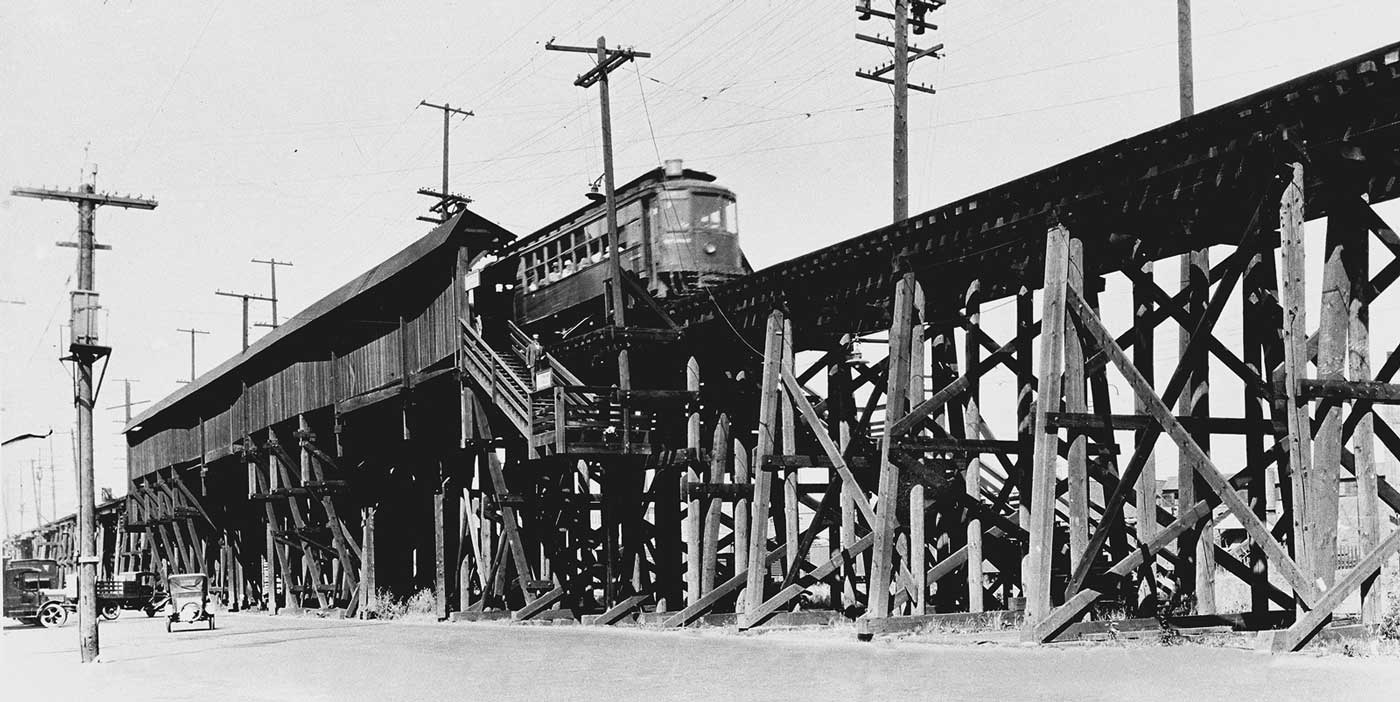
Looking nearly the length of Lake Union from Capitol Hill towards the dapple of construction in Edgewater and Fremont on the far shore in the early 1890s. Some old growth forest still crowns Phinney Ridge. Across the lake the nearly new Westlake trestle is seen hugging to the steep side of Queen Anne Hill. (Courtesy Dennis Andersen)


The Westlake trestle looking north towards Fremont and Edgewater.


This is probably the earliest panorama of the mill town Fremont taken from the Queen Anne side of the Lake Union outlet. It must date from the early 1890s, and before the 1892 opening of the big brick B.F.Day elementary school, which is not in the picture.
An early 20th-Century Oakes recording looking from Queen Anne Hill across the Lake Union outlet to Fremont and a Phinney Ridge profile. Here's B.F.Day school is in the picture, right of center. Here we also find the tall firs of the park, on the horizon, right of center.
Norwegian Sami (Laps) and their reindeer pose before Woodland Park’s granite gate and flower conservatory during their 1898 week-long stay here. (Courtesy, Museum of History and Industry.)

SAMI CENTENNIAL

(This feature first appeared in Pacific June 21, 1998.)

One of the curious stories attached to the Yukon and Alaska gold rushes of the late 1890s is the adventure of nearly one hundred Laplanders – or Sami as they are more correctly called – and their reindeer.

By order of President McKinley the U.S. Army’s Reindeer Service launched an expedition for rescuing reportedly hungry American miners on the Yukon River with meat bought on the hoof in Lapland.  After funds were appropriated by Congress in December, 1897, 538 harness-broken reindeer (all gelded bucks), with their Sami herders, were carried across an Atlantic Ocean stirred by winter storms from Norway to New York’s Pennsylvania Station.  There they were boarded on special trains for a trans-continental trip pursued by a press and public still stimulating on the gold rush story.  With their March 7th arrival on a sidetrack to Fremont these sensational attentions continued.

Sami mother and child

After the reindeer were led up Fremont Avenue to the fenced enclosure of the still private Woodland Park, the Sami and their stock were soon surrounded by locals there to enjoy the Laps and their exotic costumes.  This sightseeing climaxed on Sunday, the 13th when 8000 picnickers came to Woodland Park gawk and talk loudly – to make themselves understood – to the visitors.  The next day’s Seattle Times headlined their report “A Day For Reindeer And Dears That Reign.”

Sami herder

Actually, the Samis’ troubles began here, but not from sightseeing.  Assuming that the reindeer could eat the grass of Woodland Park, Major W.R. Abercrombie, the officer sent to temporally command the expedition, ordered that the larger portion of their packed supply of moss be destroyed.  Twelve reindeer soon died from a combination of park grass and the junk food fed them by curious tourists.  By time the expedition reached the gold fields on the Yukon River months later, the majority of the herd had died of starvation for want of their destroyed staple.  By then, however, it was universally known that the first reports of the miner’s hunger were wildly exaggerated and none of them were found starving.

The expedition’s story was recorded at the time by one of its Norwegian herders.  Pacific Northwest readers who wish to follow this journal and story in detail can read Reindeer and Gold, past Western Washington University’s professor Keith A. Murray’s history of this extraordinary expedition.

Remembering that this feature is now 13 years old, left to right, Carl Nilsen, Scott Granlund, Norma Hanson, Earlene Clark, Paul Tornensis, Tina McMaster and Bill Wilcox, posing here near the contemporary entrance to Woodland Park, will participate in the Sami Reunion planed for the last week of June (1998) in Poulsbo. Most are direct descendants of the Sami who visited Seattle one hundred years ago. The reunion will be joined by a delegation of about fifteen Sami from Norway.
In 1898 Fremont, the Seattle neighborhood that describes itself as “The Center of the Universe”, welcomed about 100 Laplanders (Sami) and their reindeer. Here perhaps the tail end of the herd poses at the intersection of Fremont Avenue and 34th Street. Fremont Drugs, the building upper-left survives, although it was recently moved one block west on 34th to make way for the new commercial buildings now (in 2003) under construction.

FREMONT REINDEER

(First appeared in Pacific, Feb. 23, 2003)

This odd scene of eight or nine reindeer posing near the middle of Fremont’s main intersection of 34th Street and Fremont Avenue was recorded probably on either March 7th or March 15th 1898 – most likely the latter.

On Monday the 7th a few more than 500 reindeer were unloaded at Fremont after a transcontinental railroad journey.   The trip created a nation-wide commotion as locals in most of the towns along the line knew the special trains were coming and lined the tracks to get a glimpse of the herd and the about 100 Norwegian Samis (Laplanders) who cared for it.   It was first reported that they were on a journey of mercy – to carry food to the starving gold miners on the Yukon River.  But by the time the trains left New York it was reported that while the miners were not starving the U.S. Army Reindeer Service would still deliver.

From Fremont the reindeer were marched up Fremont Avenue to Woodland Park and fenced in.   There they also served as a week-long sensation while the Reindeer Service arranged steerage for Alaska.  The human herd that rushed to the park to get a glimpse of the visitors was many times greater than the exotic visitors.  The curious hordes so taxed the electric trolleys that lights dimmed downtown.

On Sunday the 13th it was estimated that 8000 visited the park.   A Seattle Sami – living in Ballard – was hired as interpreter.  One reporter claimed that “stylish ladies kissed the Lapp men” and there was considerable reciprocal drinking as well.  The casualties were 12 reindeer who died from a combination of park grass and snacks fed them by the crowds.   The dimwitted officer in charge had destroyed the moss – their normal diet – shipped with them believing that reindeer could eat hay and park grass instead.

The herd and herdsmen left Woodland Park and their celebrity on Tuesday March 15.  They paraded back down Fremont Avenue to Fremont and there boarded cattle cars for a short trip to the waterfront where the three-masted bark “Seminole” awaited to carry them to Alaska.  The trip that began in Norway on February 2, 1998 reached Dawson nearly one year later on Jan 27, 1899.   Most of the heard was lost to starvation and exhaustion on the overland trek between Haines, Alaska and Dawson.  The miners asked to buy the survivors to slaughter for fresh meat.  They were refused.

A conclusion to the sad Sami story that shows the same Fremont Intersection during the 1916 snow. This surely would have been more inviting to the reindeer.

The GREEN LAKE TROLLEY

(First appeared in Pacific, Jan. 19, 1992)

Beginning in the spring of 1890 it was possible to make a comfortable and relatively speedy trip from downtown Seattle to the north end of Green Lake. Until the completion of the electric trolley to Fremont along the future landfill of Westlake, the Green Lake trip required a ride on a small steamer across Lake Union.

Construction of the Green Lake Electric Railway was made easier with the purchase of the old logging railroad that skirted the east shore of the lake.  The logged-away landscape around the lake was not so picturesque except for one portion, the southwest corner of the lake where developer Guy Phinney’s (hence the ridge) private park was saved from the woodman’s axe. Appropriately, they called it Woodland Park.

Soon after the Phinneys sold their park to the city in 1900, the Green Lake Electric railway was extended along the west side of the lake and through the park. In 1903 Green Lake developer and once Seattle Mayor W.D. Wood wrote, “A first-class electric railroad now belts the lake, so that the beauties and privilege of this lake and of its shores and Woodland park are available to all. Any intrusion of the car line is offset scores of times by the increase of public service and enjoyment afforded by its presence.”

The Olmsted Brothers, the park’s designers, did not agree. They wanted the noisy railway removed from the park, or at least hidden behind paralleling earth embankments. The famous landscaping firm, however, lost this battle to the railway’s owners, the Seattle Electric Company. The trolley entered the park at North 59th Street and Whitman Avenue North and exited at North 55th Street and Woodland Park Avenue. It proceeded directly south through the park atop a system of appropriately rustic wooden viaducts that spanned the undulating topography of the park’s eastern slope.

(It would seem that the above subject was photographed from the rustic stone and timber bridge shown several times below.  It looks north to the trestle that crossed a shallow ravine up which a paved park road now climbs until it is stopped by the Aurora interruption.  This may be used for another now-then.  The prospect may surely be reached by the tall Jean with his 10-foot extension pole.)


INTERLUDE – A ROCK WALL MYSTERY

Earlier this afternoon I searched for a feature I imagined, it seems, that I had written about a rustic bridge that once crossed above the Green Lake trolley as it passed through Woodland Park near its northern border.  The dirt approaches to the bridge were supported by river rock walls and the span itself  was made of rough-hewn lumber.   I could not find it, and now doubt that I ever wrote it.  I should have, for, as we show below, there are many surviving photographs of this landmark, which still exists as a pars pro toto, which Latin phrase is one of the very few fragments that I remember from my high school Latin class.  Another is “Puella est parva.”  In the early 1950s it was still a regular curriculum practice to require young American teen barbarians to study Latin.  Pars pro toto – if I have spelled it correctly – means the “part for the whole.”  All of us are for ourselves the most important pars pro toto in the universe.  Mothers who adore their children may be the exceptions.

Looking north then.
Looking north now. (April 16, 2011) The rock fragment is just south of N. 59th Street and east of Aurora where it passes through the park. You cannot miss the noise of the speedway from the cook-out picnic tables in this part of the park.
Looking south then.
Looking south now
Stone bridge looking north from trestle.

If this is another scene from the 1916 snow, then the bridge came to an early ill end.

A SPEEDWAY BIFURCATION

(First appeared in Pacific, Oct 31, 1993)

This “then” looking north across a field of stumps and through the center of Woodland Park was recorded May 17, 1932 by a photographer from the Seattle Engineering Department. Three days shy of one year later, the first traffic rolled on what its enthusiasts called the “Great Aurora Highway.”

When an ordinance permitting the park’s bifurcation was passed by the Seattle City Council over the objections of the city’s park board, a front-page battle to save the park ensued. The leading advocate of this preservation and opponent of “park vandalism” was The Seattle Times. “It is proposed,” The Times’ editors wrote, “to build an 8,800-foot speedway 106 feet wide over a hill 293 feet high, and through 2,400 feet of the central portion of Woodland Park to save 25 seconds of time required to drive the 9,850 feet by way of Stone Way.” The Times figured the difference was about the length of three city blocks, and said 107 homes would be sacrificed to the thruway.

Much earlier, when the park’s hired landscapers, the Olmsted brothers, were designing the city’s boulevards and parks, they included West Green Lake Way, connected with Stone Way, as the principal route for north-south traffic and thereby circumvented Woodland Park. The landscapers proposed that the undeveloped center of Woodland Park be saved for, among other things, the expansion of the park’s zoological garden. In the meantime the Olmsteds recommended that the old-growth forest in the park’s undeveloped interior be preserved. However,  here are the stumps.

The campaign to save the park failed.  The highway was approved by public vote. Answering an imaginary commuter’s question, “What will I get out of the Aurora thruway?” The Times answered, “A reminder at least twice a day that you sacrificed Woodland Park.”

Another municipal photograph and an early one of the new speedway through Woodland Park. Both view used courtesy of the Seattle Municipal Archive.

FIVE MORE

Looking north into the park from near its entrance at 50th Street and Fremont Avenue.
North through the intersection of 50th and Fremont.
Looking north through the same intersection while turning a few degrees to the west. Connected to the Standard Service on the left is John E. Nelson's Hob-Nob Sandwich Shop. It is listed at 4909 Fremont Ave. N. in the continuous street listings of the 1938 Polk City Directory.
A mere fragment from Don Sherwood's history of Woodland Park. While working as an engineer for the Park Department, Sherwood prepared elaborate histories for all the city parks while also collecting and protecting the ephemera - letters, photographs, maps - and sharing them. Here is page 12 from his Woodland Park history. These can be read on-line through the Seattle Park Departments website. It is easy to find, and look there for Sherwood History Files.
Finally and representing all the remaining attractions of Woodland Park and Green Lake here is the fallen fir that was often used as a platform for posing. It was eventually removed after either rot or lawyers got to it.


An Invite to our MOHAI Exhibit – with a link to the latest blog post

(As readers may have noted, our blog is undergoing significant technical difficulties. This old post from 2011 is showing up without identifiable cause.

Until we figure out what’s wrong, please click on the category Seattle Now & Then. That should forward you to the latest blog post.

Thanks so much for your patience and understanding.)

Paul Dorpat, Bérangère Lomont, Jean Sherrard

This Friday, readers of this blog are invited to join Paul, Jean, and Bérangère for the preview party at their Mohai exhibit: ‘Now & Then‘. This exhibit explores the history of repeat photography through dozens of repeats of Paris (including the very first photographic image of a human being, taken by Daguerre), Seattle, and Washington state.   Wallingford is also featured with 30 time lapse examples (45 minutes running time) constructed from Paul’s 3-plus years of daily walks through the neighborhood in which he resides.  This is raw stuff but often enough thrilling – to Paul and also to Ron who helped so much in assembling it.   Please do come if you can.

Join us at the Museum of History and Industry this coming Friday between 5 and 7 PM. Wine and treats in abundance.


Seattle Now & Then: Monty's Stump

(click to enlarge photos)

THEN: Ambrose Kiehl, the engineer who first surveyed and laid out Fort Lawton, survey’s the fort from the helpful prospect of a tall cedar stump. Behind him is the inlet between Shilshole and Salmon bays, circa 1898. (Photo courtesy University of Washington Libraries, Special Collections.)
NOW: Jean Sherrard photographed his repeat from the second floor of Monty West’s home on West Commodore Way. Before it was hauled away Monty’s stump was behind Jean in the back yard, up the hill and near the family swimming pool.

This Sunday afternoon, March 10, the Magnolia Historical Society celebrates its tenth anniversary with what it expects to be an “entertaining and informative” open meeting. Those who attend will reflect together on Magnolia’s history, sharing a heritage that includes this tall landmark stump.

Monica Wooton, the society’s engaging leader, professes that this record of engineer Ambrose Kiehl surveying Ft. Lawton from this unique prospect is her “favorite photograph” among the large collection of Kiehl’s negatives,

Society member Monty Holmes is confident that Kiehl’s sawyer-made platform was once his.  The alert 82-year old Magnolian was born and raised on the Magnolia side of the Chittenden Locks.  During the Great Depression, for ten cents a bottle young Monty sold fresh milk got from the family’s cows to the WPA (Works Progress Administration) workers who with shovels and wheelbarrows made a graded West Commodore Way out of what the locals still often chose to call West Cow Manure Way.

In 1984 Holmes moved to his new home on West Commodore and the tall charred cedar stump that came with it.  Seeing this scene published last fall in the historical society’s quarterly gave Holmes his eureka! moment. “Here I am overlooking the Shilshole Bay inlet and that stump struck me as the same!”  Holmes explained that in the end his stump was a mere “thread of itself held together by the net of Oregon Grape that covered it.”

Come if you can between 2 and 4 this afternoon to Our Lady of Fatima Parish at 3218 w. Barrett Street.  It is in Magnolia’s verdant Pleasant Valley, which was once a green pasture for the neighborhood’s dairy farms.  Monica will be there, of course, Monty will be there too, and Jean and I as well.  Among other subjects we will be reviewing Monty’s stump story.  He is quite confident about it all, but we still cannot resist the fun of a silly pun.  We are, we confess, for the moment stumped by the stump.

WEB EXTRAS

Anything to add, Paul?

Yes, Jean, much, much more, but you’ll have to click on Web Extras to get to it.


Seattle Now & Then: The Floating Bridge Inauguration

(click to enlarge photos)

THEN: After twenty years of debate about whether to build it and where and how, the first bridge across Lake Washington took 18 months and a few days from ground breaking to accepting its first tolls from drivers happy for the short cut. (Photo courtesy Washington State Archive.)
NOW: For his repeat, Jean Sherrard got within a few feet of the original prospect (now hidden behind bushes) taken by a Port of Seattle photographer at the bridge’s dedication.

Three thousand men got depression-time jobs building the Lacey V. Murrow Bridge – aka the Lake Washington Floating Bridge.  Forty-five percent was paid with a federal public works grant and the rest by revenue bonds secured by the 25-cent tolls. The bridge was formally dedicated and opened in the early afternoon – judging by the shadows – of a sunlit July 2, 1940.

About 2000 people watched from the tunnel plaza area here on the bridge’s Seattle side and hundreds more gathered around the toll booths at the bridge’s Mercer Island end.  Broadcast by radio nation-wide, the floating bridge was christened like a ship. After cutting the red ribbon, Kate Stevens Bates, daughter of Washington Territory’s first governor, Isaac Stevens, let swing and crash against the concrete bridge a yellow urn in which were mixed the waters of fifty-eight of the state’s waterways: lakes, bays and rivers.

With a smile about as wide, turned up and fixed as the grill work of his inaugural chariot, an open 1940 Lincoln Convertible, the state’s Governor Clarence Martin rode twice across the new bridge.  At half way Martin was the first to pay a toll.

We could compare the public effort required to build “the largest floating structure in the world” with our recent struggle to replace the feeble Alaska Way Viaduct with a deep bore tunnel, except that it would take too long.  Instead, we suggest that readers consult Genevieve McCoy’s fine chapter on the state’s bridges that is part our book “Building Washington.”  You can read it for free on the blog noted here below.

One more toot – an announcement.  This “now-then” comparison is one of about 100 such selected for an exhibit of “repeat photography” opening Saturday, April 9th, at the Museum of History and Industry.  Most of the exhibit’s Seattle examples were first published here in Pacific.  But the exhibit – most likely the last one for MOHAI in its old Montlake quarters – also includes examples from Washington State and even from Paris, the birthplace of photography.

WEB EXTRAS

Anything to add, Paul?

Let me coyly answer my own question. I know Paul has some treats hidden away; including one of my favorites: a delightful photo of grinning then-governor Clarence Martin, as described above. For that and much more, click on ‘Web Extras’….

Seattle Now & Then: Lowman and Hanford

(click to enlarge photos)

THEN: For more than half a century Lowman and Hanford was an active printing business in the Pioneer Square neighborhood. This view looks southeast through the intersection of First Avenue and Cherry Street, on the left, to the building row still standing along the eastern edge of Pioneer Place – or Square. (Courtesy Michael Cerelli)
NOW: The Lowman Building at the southeast corner of Cherry and First was completed in 1906. It was recently remodeled inside for low and middle-income housing offering, the ads say, “all the charm of years gone by, updated with amenities for today.”

Aside from the pyramid tower that originally topped the Pioneer Building  (Far right, it was pioneer Henry Yesler’s last contribution to Pioneer Place or Square), everything has survived between this “then” and this “now.”   (As a precaution the tower was removed following the city’s 1949 earthquake.) The historical photo was recorded sometime between 1902 when the top three floors of the slender Lowman and Hanford Building – here covered with signs at the scene’s center – were added to it’s seventh story, and 1905 when the temporary wood structures at the southeast corner of First Ave. and Cherry Street were razed for the construction of the Lowman Building, the dominant structure in Jean’s Sherrard’s repeat.  Here we will insert a front-on photograph also recorded sometime between 1902 and 1905.

The sensational part of the first of these two scenes is surely that signage, all of it promoting the principal commercial interests of James Lowman and Clarence Hanford.  The former arrived at his older cousin Henry Yesler’s invitation in 1877 and was directly made the assistance manager of Yesler’s Wharf. Within the decade he was managing Yesler’s affairs while also in business with pioneer Clarence Hanford running a joined job printing shop and stationary store that also sold books, pianos and such.

Plastering or painting the side of a brick building with signs is, of course, easier when there are no – or few – windows.   Clearly, when he added floors to his and his partner’s business address next door, James Lowman had his taller namesake building envisioned for the corner.  The signs would be short-lived and windows not needed.

(If you CLICK the “web extras” immediately below you will have opened to you four or five more historical features clustered around Cherry Street and supported with many more illustrations.)

WEB EXTRAS

Seattle Now & Then: Madrona Park – End of the Line

(click to enlarge photos – no exceptions made)

THEN: Thankfully, the original photo for this early view of Madrona Park has its date, December 18, 1892 written on the back. (Photo Courtesy, Ron Edge)
NOW: After the city took possession on Madrona Park in 1908 it removed the hotel shown in the historical photograph and later built the bathhouse showing here nearly on the same footprint as the bath house turned dance studio in the “now.” (Photo by Jean Sherrard)

The city’s “great fire” of 1889 excited its already boom town qualities with the great labor of rebuilding more than 30 city blocks from scratch and real estate loans.

The technology for running electric trolleys came to Seattle only months before the fire and following the destruction, trolley systems – in addition to cable cars – began to send out their trunk lines in most directions from the city’s core.  Many in the immigrant tide needed cheaper land to build their homes – sites not in old Seattle but also not far from it.  The new common carriers to Ballard, the University District (still named Brooklyn then), Beacon Hill and those on the east shore of Lake Washington obliged.

Three lines reached the lake – at Leschi, Madison, and Madrona.  There all of them featured parks and other attractions like promenades, canoes for hire and nature trails. The line to Madrona was the last of the three and the final part of it, where the trolley cars descended to the lake, was in the embrace of a picturesque forest.  On reaching the lake riders found bathhouses, a dance pavilion, and rustic benches disturbed along paths that led back into the forest.  The hotel shown here greeted them at lake’s edge.

The Madrona hotel was built in 1892 and that’s the date penciled on the flip side of the original photo card produced by A. J. McDonald, a photographer responsible for a few of the best suburban scenes hereabouts in the early 1890s.  On the left a trolley car stands at the end of its line.  Perhaps McDonald road that car to the park to make this impression, while the conductor waited for him to return for the ride back to Pioneer Square, with a First Hill transfer on Broadway Avenue to a James Street cable car.  The fare from waterfront to waterfront – Elliott Bay to Lake Washington – was five cents.

WEB EXTRAS

For the complete MADRONA PARK STORY with some extras too, please click here.

Seattle Now & Then: Wallingford Fisticuffs

(click to enlarge photos)

THEN: Stan Stapp, publisher of the North Central Outlook, recorded this fistfight in the spring of 1952. In this instance the story came to him. The fists were thrown for the half-witted amusement of other boys soon after Lincoln High recessed for the day. The scene is on North 42nd Street just east of Ashworth Avenue North.

NOW: As John Sundsten posed where the witness in the letterman's jacket stood in 1952, a neighbor walked by and happily agreed to play the part of an anonymous angry fighter. John first thought that the lad in the jacket might be himself. He had one and the timing was right - or close to right he discovered - for the 1950 Lincoln grad. But he could not remember the fight only the street dances and so gave up on the jacket correspondence even before he found the date for this generally grinning blood lust.

I first saw this snapshot of high-school fisticuffs years ago. The venerable North End journalist Stan Stapp shared it with me for possible use in The Seattle Times or an exhibit. It was one part of a thick handful of mostly Wallingford glossies he used as editor, columnist, reporter and photographer for his family’s neighborhood newspaper, The North Central Outlook.

I don’t remember Stapp explaining the circumstances of the scene — whose fist, whose chin, when and where. But Stapp was a 1936 graduate of Wallingford’s Lincoln High School; the family home and newspaper office were two blocks from Lincoln, and the bungalow behind the impetuous teens is also very Wallingfordian. Stapp passed in 2006.

Recently I stumbled upon my copy and showed it to John Sundsten, a 1950 graduate of Lincoln. On first glance, the retired University of Washington neuroanatomist thought, “The boys are dancing. Isn’t that odd.”

After quickly surrendering to the idea that this was a fight not a dance, the peace-loving musician-scientist carried the print to the Fremont Public Library where back issues of the Outlook are stored. Sundsten started with the issues in 1950, the year he graduated. Thumbing forward he soon found the picture and its story on page 3 of Stapp’s weekly tabloid, published May 2, 1952.

It was, not surprisingly, Stapp who took the picture and wrote the copy. He gave no names except that of Wallingford’s juvenile officer, Walter J. Hauan, who took the two pugilists to a Wallingford precinct room. Stapp leaves his story with a happy ending, we assume. He concludes, “Hauan’s fatherly manner of approach has helped clear things up for thousands of local youths in the past.”

WEB EXTRAS

Anything to add, Paul?…..(for the rest of the story, click here)

Seattle Now & Then: Romans' St. James from the Great Northern Tower

(click to enlarge photos)

THEN: When completed in 1907 St. James Cathedral sparkled atop First Hill. This view of it was photographed early in its life from the tower of the Great Northern Depot (Courtesy Fairlook Antiques, Pioneer Square)
NOW: Recently Jean Sherrard scaled the Great Northern tower and photographed in every direction, including this one northeast towards the “former” location of St. James Cathedral. Of course it is still there although when searched for from the depot’s tower it is now hiding behind the recently raised Skyline Retirement Community, one block south of the cathedral, also on 9th Avenue.

Call it the spiritual urge to approach heaven or public relations; the Roman Catholic Church has had a historic knack for putting their parish footprints on tops of hills or on horizons.  St. James Cathedral is Seattle’s best example of a landmark sanctuary. Dedicated late in 1907, it’s twin towers, cupola and reflecting skin lent a plush interruption to the First Hill skyline and for years St. James watched over the city, and the city look up at its good shepherd.

Most likely within the first year after the cathedral was topped-off the commercial photographer William Romans left his studio on the sixth floor of the Colman Building and headed for the nearly new Great Northern Depot on King Street. The depot with its Venetian tower first opened in the spring of 1906. Perhaps Romans noted the dynamic sky beginning to brew over the city and decided its chiaroscuro delights would make an exquisite backdrop for the gleaming St. James, and it does.

One cannot reach the top of the depots’ tall campanile by elevator but rather, as both William Romans and Jean Sherrard discovered, by an exposed stairway. Given the effort it is perhaps not surprising that so few photographs taken from the vertiginous tower survive.

Two other cross-topped churches appear here.  Directly below St. James near the base of Roman’s real photo postcard stands the cathedral’s predecessor, Our Lady of Good Help at the southeast corner of Fifth Avenue & Jefferson Street. To the right of St. James but lower on the hill stands Trinity Episcopal Church at the northwest corner of 8th and James. It was built after the congregation’s first sanctuary at 3rd and Jefferson was destroyed during the city’s “great fire” of 1889. It is the rare survivor of First Hill history that can be also found in Jean Sherrard’s “now.”

This side of St. James, very little survives from the hill-climbing field of mostly flats for workers – many of them single women – who once walked to their jobs in the Central Business District. We will note one abiding five story brick: the Madison Apartments facing its namesake street one block north of the Cathedral on 9th. Its rougher alleyway façade appears on the left horizon to the right of a First Hill grove of leafy street trees.

WEB EXTRAS

First, Paul, a confession (perhaps appropriate considering this week’s subject). Our ‘Now’ photo was cropped from a much larger shot, which I include below:

The complete picture from the King Street Station tower

(please click here for the rest of the story)

Port of Seattle 100th Anniversary!

Jean writes: We at DorpatSherrardLomont occasionally come across miracles, marvels and gold nuggets which, of course, we pass along to the co-conspirators who visit this blog.

Might we suggest, the following jewel of a video by Vaun Raymond, celebrating the 100th anniversary of the Port of Seattle.

Paul adds:  It was a pleasure to be framed by Vaun’s camera.  He has the knack.

(click for video)

Seattle Now & Then: Waterfront Park Fountain

(click to enlarge photos)

THEN: James FitzGerald's Waterfront Fountain was Helen Harrington Schiff's gift to the city in memory of her parents, Edward M. and Margaret J. Harrington. At 16-1/2 feet high and 21 feet long, the bronze fountain puts on a good show.
NOW: Sherrard's repeat of Shaw's recording shows the fountain doing the fulfilling work of entertaining children.

Certainly, many Pacific Northwest readers recall the construction in the mid-1970s of Waterfront Park and to the north of it the municipal aquarium. To help us remember, Frank Shaw photographed the entire process with his prized Hasselblad camera. Because Shaw was good about dating his subjects, we know that this work on the Waterfront Fountain by Seattle sculptor James FitzGerald was nearing completion by Sept. 27, 1974. We also know that the man on the ladder applying finishing touches to that sculpture could not be FitzGerald, who died nearly a year earlier.

This waterworks was the last of five fountains that FitzGerald designed for public places in Seattle. His wife, Margaret Tomkins, also an artist, and his assistant, Terry Copple, completed it. Of course, I wondered if that was Copple on the ladder. An old friend, filmmaker Ken Levine, attended the fountain’s installation and was confident that FitzGerald’s daughter, Miro, was there as well. I had not seen Miro in a quarter century but Levine had her address, so I wrote, asked and she answered that it definitely is Terry Copple in the photo. He helped complete the casting and final finishing during a difficult time of grieving for her family, she said, adding that she had worked in a restaurant with Copple and introduced him to her dad.

“Terry was a caring, dear person who worked from his heart in all he did,” she wrote. “Sadly, he passed away a few years ago in Vacaville, Calif.”

Miro, also an artist, lives in Sedona, Ariz., where for several years she was assistant director of its Arts Center. Recently retired, Miro can now give more of her time to painting — trying, she explains, to “capture the incredible Southwest landscapes.”

WEB EXTRAS

Anything to add, Paul?

Jean, the tasks remaining in preparation for our – with Berangere – early April opening at MOHAI of the “Repeat Photography” show (the last exhibit, they say, in the museum’s old Montlake location) weighs heavy on my head and I must give my time to it.  And yet there are some things to pull from some of the same past writing that was used to created the Pictorial History of the Seattle Waterfront, which is now up on this site as a pdf file.   Until “nighty bear” time (we thank Bill Burden for that good night signal)  we will slip a few things in that relate to the Pike wharf site.  We’ll begin with a splendid slide that Frank Shaw took of the performing Fitzgerald fountain on November 26, 1974.

Another of James Fitzgerald fountains in included in Shaw’s collection of colored slides and black-white negatives, most of them shot with his Hasselblad.  The sculptor’s Fountain of the Northwest was created for the city’s new playhouse in 1961, and was one of the artistic attractions of the 1962 Century 21 held there. Fitzgerald – and others  – like this one so much that he made two of them.  The other is on the Princeton University Campus, a kind of  fountain of the northeast.

We’ll follow now with more of Shaw’s recordings of the Waterfront Park, during its construction with 1968 “forward thrust” funds – belatedly – and after its completion.  We will not include his many photographs of the building of the waterfront aquarium.  We’ll save those for another time when we are less taxed.

In anticipation looking thru the open water between Piers 57 and 59 on May 1, 1973. This "hole" in the waterfront was once held by the prosperous Schwabacher Wharf. Note that the Federal Building on the right is still exposed with its skeleton, knowing perhaps, that it will not receive the brick skin that its architect intended for it. The SeaFirst tower is on the left. In the beginning, 1968, a symbol of its bank's ambition. But it is now surrounded and surmounted and the bank long since merged - or submerged - into a larger bank from beyond.
Pile driving for the northern part of the park, where it nestles against the Pike Street Pier. For many years this was a harbor for the fishing fleet - part of it.
Part of the fishing fleet moored in the slip on the south side of the Pike Pier. This is not a Shaw shot, but one much earlier.
The pile driving continues to the south. November, 8, 1973.
. . . and further still. Jan. 2, 1974.
and continuing . . . Feb. 7, 1974.
March 11, 1974
The earliest concrete forms, March 29, 1974. The Federal Building's substitute skin is also in place.
A choppy Elliott Bay slaps against the forming park on April 11, 1974
Another Frank Shaw recording from April 11, 1974. The by now familiar curving forms of the park are taking shape.
The lighting along the Pier 57 southern side of the park - Nov. 15, 1974.
Although it may seem so the reading child is not sitting on the fountain but on a concrete form behind the fountain. May 7, 1975
Looking south thru the park on Nov. 1, 1981.
By March 3, 1984, ten years after the construction began, Waterfront Park had settled into its familiar uses.

We will turn now to older subjects, but ones that are still linked to the waterfront neighborhood near the foot of Pike Street.  First a look at the first structure built by the first settlers with California money to exploit the rich coal deposits on the east side of Lake Washington.  When it was new in 1871, the Pike Street Pier and Coal Wharf competed with Yesler’s Wharf as the biggest structure in town.  First we see it from the back of the Peterson & Bros photography studio at the waterfront foot of Cherry Street.

The Pike Street Wharf and coal bunkers above the roof crest of a small warehouse build on pilings near the foot of Columbia Street. The wreck of a schooner is the Winward, which is famous for being still there, buried beneath Western Avenue near Columbia. This view dates from 1876. In two years more the Pike Pier was abandoned for a new coal wharf off of King Street. It's connection to the coal fields of Renton, and Newcastle was more direct around the south end of Lake Washington.
Detail from the above of the Pike Coal Pier and its hillclimb to the location now of the Pike Place Market.
The Pike Pier as it appears in Seattle's 1878 Birdseye.
Here the ruins of the Pike Wharf are recorded from the King Street Wharf that replaced it. This detail is part of a sweeping panorama of the waterfront recorded, most likely, in 1881. Denny Hill is in the foreground, and Queen Anne Hill on the horizon.
From the bluff above the waterfront Anders Wilse recorded this wide look at the waterfront in the late 1890s. The old Schwabacher Pier on the right figured in the two most celebrated visits to Seattle in the 1890s: first the inaugural service of a Japanese shipping line, and second the 1897 return of the Portland from Alaska with its now long since legendary "ton of gold."

The Miike Maru tied to the south side of the Schwabacher Warf betwen Union and Pike Streets.  Courtesy, University of Washington Library's Special Collections sometimes called its Northwest Collection and other times generally its archive.

MIIKE MARU Aug 31, 1896.

After a sustained recession of three years following the economic crash of 1893, locals were alive to anything that might indicate a return to the three years of prosperity that followed the city’s Great Fire of 1889.  Nothing before the arrival of the gold rush ship Portland the following year seemed so promising as the appearance of the Japanese liner Miike Maru at Schwabacher wharf on Aug, 31, 1896.  It marked the beginning of a direct and regular service to Japan that since this beginning has only been interrupted by war.

The steamer arrived at 3 o’clock in the afternoon amid a welcoming uproar of factory whistles.   The Schwabacher Dock served as the terminal of this new service until it was moved at the turn of the century two piers south to Frank Waterhouse’s Arlington Dock or Pier 5 and still later to “Empire Builder” James J. Hill’s Great Northern docks at Smith Cove.

This view looks north from near the foot of Seneca Street.  The fanciful construction of the Clark and Bartette boathouse is evident on the far right.  The Schwabacher pier shed that shows to the far side of the Miike Maru is a transitional structure between post-89fire sheds and the 1899 warehouse, long familiar on the waterfront.  The top-most roofline (with two small vents) of the Ainsworth and Dunn’s Seattle Fish Company dock at the foot of Pike Street shows just above the Schwabacher roofline.

Looking north thru the open water made with the razing of the last Schwabacher Warf and the 1974-74 raising of the Waterfront Park.
Schwabacher Pier from the surviving Seattle Lake Shore and Eastern Railway (left) and "Ram's Horn Railway" (right) tracks after the city's "great fire" of 1889. The view looks north with the fire's ruins to the rear of the photographer.

SCHWABACHERS WHARF FOLLOWING THE 1889 FIRE

With University Street and the ruins behind the photographer the above view looks north to Schwabacher’s wharf not long after the June 6, 1889 fire.  The photographer stands on the Rams Horn trestle – the Seattle Lake Shore and Eastern trestle is on the left.  A box car is used as a wall on the Rams Horn.  It is nailed in place.

The June 19, 1889 issue of the Post-Intelligencer can be read as a caption.   Most of the shipping in the harbor now lies between the wharf at the foot of Union Street and the wharf at the foot of University Street.  This is now the shipping center, it being all that was left outside the fire, except Mannings wharf in north Seattle [at Wall and Vine].  The Seattle Times description of June 22 continues this description.  “One cannot have a correct conception of the pressing needs of wharfage and more warehouse facilities at the present time without seeing the crowded condition of affairs on Schwabacher Wharf. At this wharf the wholesale grocer business of the Schwabacher firm is carried on, and besides it is the docks for all the O.R. & N. Company’s steamers.  The warehouse facilities are also inadequate, as goods are dumped onto the wharf and have to remain there without shelter until called for.  The ocean steamer Mexico on her last trip from S.F. had a large cargo of merchandise freight, all of which was discharged on the wharf, and left exposed to the elements until called for by the merchants.  In addition to this the company have to keep a special policeman to guard those goods by day and night . . .”

The ‘TON OF GOLD” Ship PORTLAND, JULY 17-18, 1897

No arrival on the Seattle waterfront created such a sustained stir as the sixty-eight passengers who disembarked from the steamer Portland carrying bags of gold dust onto the Schwabacher Wharf.  (above)  The crowd that gathered on the wharf at six in the morning knew they were coming because a Post-Intelligencer reporter earlier chartered a tug to meet the Portland as she entered Puget Sound.  Returning quickly with the story the P-I’s “Ton of Gold” issue came out about the time the Portland came in.  Within ten days 1,500 locals had fled the city for the Yukon.  The best sign of the Seattle hysteria came from its mayor, W. D. Wood.  Visiting in San Francisco he wired home his resignation and headed much further north than his home on Green Lake.

It is probably impossible to determine at what point in the Portland’s short stay that this view of it resting in a low tide between the Schwabacher and Seattle Fish Co. wharves was photographed.   A portion of the Schwabacher pier shed appears on the far right.  There is plenty of room on the apron to build a bigger warehouse, and here for the curious to visit a scene they sensed was historic even at the time.

On July 22 the Seattle Times reported that preparing to return north the ship had “cleared at the customs office this morning.  The crowd of people at the wharf occupies every square foot of space and this morning and afternoon a constant steam of people, men, women, boys and girls were down to see the Portland off.  It is a sight to witness the departure and a tedious delay for those who must wait. Many are the pathetic scenes of wives and mothers bidding farewell to husbands and sons who are off for the fields of gold.”

The “color” of the waterfront in the post-Portland months – and years – is captured in the somewhat gaudy prose of a 25th anniversary commemorative article in The Seattle Times from July 16, 1922.

“Arrival of the gold ship Portland in July 1897 launched Seattle on one of the most thrilling and picturesque epochs in her shipping history . . . in a few months transformed Elliott Bay from a moderately active harbor into a strenuous and crowded shipping center . . . In a comparatively few months Seattle was able to boast that she could handle 15,000 men to Alaska every thirty days and she made good the boast with characteristic decisiveness . . . Up to Feb 1898 the first class fare to Skagway and Dyoea was $40.  It was then raised to $50 and the second class fare was increased from $25 to $35. In announcing the increase in rates, Seattle newspapers used the headline, ‘Rates Go Sky High.’  In April, however, the fares dropped to $10. The following Sept brought another drop, the first class fare falling to $25.

The stampeders who poured into Seattle the first winter 1897-98 had an inspiring war cry, ‘Klondike or bust, march the fust.’  By Feb 1898 the movement had grown to gigantic proportions and Seattle steamships were shooting back and forth as fast as their engines could drive them.  There were thirty-two scheduled sailings from Elliott Bay in Feb., l39 in March and 36 in April or 107 sailings in 99 days.  Thousands of Argonauts poured into the city from all over the world each week and other thousands departed at the same time for the Golden North.

As the Klondike rush subsided in 1900 the Nome rush began calling more thousands to the North.  In the spring of 1900 no less than 45 steamships were coming and going between Seattle and northern ports.  As many as five vessels arrived or left here in a single day.  In 1901 eighty ships went from her to Nome alone.”

WILLIAM HESTER AND HIS MARITIME CAMERA AT PIKE STREET

Although the ship is unidentified the two posing women are probably the photographer’s friends and not shipmates.  Women friends often accompanied the marine photographer William Hester while he solicited work on ships visiting the harbor.  His normal bread-and-butter subjects were the ship’s crews and captain.  And they, of course, were likely to welcome Hester’s companions as much as the photographer himself.  This turn-of-the-century scene looks at the Seattle skyline from the slip between the Pike Place pier, out of the picture on the left, and the Schwabacher Wharf on the right.   We repeat, the latter pier was later replaced by the open water of Waterfront Park.”

A typical William Hester portrait of a ship's crew - and a typical crew too.

The S.S.OHIO ENROUTE TO TROUBLE

Written across the base of the subject above is it’s own helpful caption. It reads, “S.S. Ohio Leaving Seattle for Nome Alaska, June 1st 1907.” A broadside or poster tacked to the slab fence between the crowd and the ship promises “Fast and Improved Steam Ships between Seattle and Nome, Frequent and Regular Sailings.” A year later the White Star Steamship’s Ohio left Seattle for Nome also on the first of June. So it was regular.

It was also unlucky. In the 1907 sailing the Ohio struck an iceberg in the Bering Sea and 75 panicked passengers jumped overboard to the ice. Four perished before they could be returned to the ship that was not sinking. In 1908 the Ohio’s captain was careful to the extreme, infuriating many of its passengers who missed what they imaged were their best Nome chances while the ship waited for the ice to melt. In one year more the Ohio hit an uncharted rock in Swanson’s Bay, B.C. but the captain managed to make a run to shore and all but four of the 214 on board survived before the 360 foot-long steamship slipped away. When it was new in 1873, the Ohio was the largest vessel built in the U.S.

We may wonder at the size of the crowd here – far too many than can fit on the Ohio. Obviously the embarking of a vessel to Alaska even towards the end of the Yukon-Alaska gold rush era was enough excitement to bring out spectators in pants. Judging by their hats, caps and bonnets practically everyone of these figures – excepting the women in the light-colored frock, center-bottom – are men in the uniform of the day: dark suits.

The truth is that going to Nome in 1907 – or ten years after the local excitement connected with the Yukon-Alaska gold rush era began with the 1897 arrival of the S.S. Portland and its “ton of gold” – was still ordinarily a “manly affair”, meaning that many and perhaps most of those on board were still hoping to get rich quick on or near the beaches of Nome by some combination of sweat and luck.

Piers 56 and 57, left and right, are two of the more than century-old railroad wharves that have helped in the post-world-war–two transformation of our central waterfront from a working waterfront to a playing one. (Historical photograph courtesy Museum of History and Industry)

There remain a few more subject to put in line here and, no doubt, many mistakes to proof.  I’ll return to them after a late breakfast.  Now I’m away – I repeat – to Nighty Bears, that wonderfully silly cave of sweet dreams.  I’m back, kind of, at 12:30 Sunday afternoon.  First here is another look at the Ohio, a close-up from the southeast corner of the Schwabacher Wharf.

A "now" that is by now several years old. I joined two landscape digital records - top and bottom - imperfectly. The sky, at least, is intact. The next subject looks back at this prospect, or in line with it.
Looking back from Railroad Avenue to the end of the Pike Pier with the steamer Eihu Thomson in between. She must have stories to tell. But we will neglect them for this moment.

TWO A. WILSE LOOKS SOUTHEAST from the PIKE PIER

As the gold rush stirred in the Schwabacher slip it also climbed to the pier.   Encouraged by the wealth got in part from warehousing and wharf rates the already venerable firm built a much larger warehouse on its wharf.   Two photographs by Norwegian photographer Anders Wilse from the same position on the roof of the Seattle Fish Company Wharf (Pier 8/59) record the big changes on the neighboring Schwabacher pier.

Both views look southeast over Railroad Avenue to the varied rooflines of the Diamond Ice plant and the hotels on First Avenue.   The conical tower of the Arlington Hotel (the old Gilmore block) surmounts the intersection of First and University Street from its southwest corner.

In the above view a small structure appears lower-left at the northeast corner of the Schwabacher Wharf.  Above it is the rear (west) wall of the Vendome Hotel on First Avenue.   A portion of the same small structure appears on the far left of the later Wilse view, below.  Although it holds the same position (one point in a triangulation when the photographer’s prospect is considered) with the structures across Railroad Avenue, it has been separated from the Schwabacher wharf which has been reconfigured about ten yards to the south.  The north wall of the much larger pier shed  (it fills most of left half of the frame) stands about ten feet south of the crest of the roof in the old shed that appears on the right of the earlier photograph.

Another and later Wilse view (below) looks back at both the Schwabacher Wharf and the Seattle Fish Wharf from the back of the First Avenue hotel row between Seneca and University Streets. The view reveals the considerable size of the penultimate but short-lived Ainsworth and Dunn’s Seattle Fish Co. pier (8/59), as well the first photographic evidence for wharf structures (8&1/2 — 60-61) built north of it between Pike and Pine streets on the site of the future municipal aquarium.

Turn of the century (from 19th to 20th) ephemera from Schwabacher on top, and "chemically pure" Diamond Ice, above.

W. W. ROBINSON

An early look down from the bluff upon the new Pike Street Wharf as home for its first primary tenant, the hay and grain dealer W. W. Robinson.  Willis Wilbur Robinson was born in Kansas in 1871 and came to Mount Vernon in 1890 where he had success as a farmer and learned the wholesale trade in hay and feed.   He is first listed as operating at the Pike Street Wharf in the 1905 city directory.  His stay at the foot of Pike Street last until about 1909 when he moved his operations to the new reclaimed industrial area south of Pioneer Square.  Before the railroads took charge of moving commodities like Robinson’s hay, stern-wheeler steamers capable of reaching up the Puget Sound tributaries like the Skagit River, on which Robinson’s farm was located, handled most of it.

We have dated this aerial ca. 1934, because the 1934-36 seawall construction between Madison and Bay streets is "at hand." Part of pier 57 shows upper-right. First below it is a dock (of sorts) for the Wellington Coal Co. This is followed by the Schwabacher Pier and it by the Pike St. Pier. At the center are two small "fish piers" (now the site of the aquarium), followed by the Gaffney Pier, which is huddled with its partner the Virginia Street pier that gave most of its life transshipping newsprint for the local papers and and other printers. The Pike Street trestle descends from the Market to the slip just north of the Pike Street Pier. We will follow this scene with several photographs taken from the viaduct, a few to the north and a few to the south. First to the north.
Railroad Avenue north from the Pike Street Overpass, ca. 1912. On the left, the combination of a small café and the Reliable Oyster & Fish Company hold what was earlier the San Juan Fish Company pier. Just north are the familiar Gaffney and Virginia Street docks and the latter’s viaduct across Railroad Avenue.
A later look north from the Pike Street Trestle. At this time public workers are preparing to build the Alaska Way Viaduct, which we are now preparing to tear down.
Jean's recent repeat, using his extension pole the high reach of his 6''7" frame.
Looking north from the viaduct in the late teens - I figure. The Pike Street Pier is on the right.
Moments before the first 1934 work on the Railroad Avenue seawall north from Madison to Bay Street. The Pike Street wharf is on the right, here home to volunteer and professional organizations - and businesses - having to do, for the most part, with fishing. The gaping hole in Railroad Avenue reveals the tideflat below the trestle. These were called, by some, "man traps" for a few did fall or drive into them.
Seawall construction between Pier 57, (a sliver of it far left) and both the Schwabacher and Pike Street Piers - the future siting for Seattle's Waterfront Park. (Courtesy Municipal Archive.)
Another of the Post-WW2 waterfront survey photos. This one looks south from the Pike Street Viaduct in line with the future Alaska Way Viaduct, which the photographer, we imagine, was imagining.
Jean's look south with his pole from the line of the old Pike Street Waterfront Trestle.
The Pike Street Watefront Trestle seen looking west from Western Avenue below it. Here the trestle is in its last days before being torn town for the construction of the Alaska Way Viaduct. Courtesy, Museum of History and Industry.
The CATALA in her slip beside the last remaining part of the Schwabacher dock. It served as a boatel during the 1962 Century 21.

The CATALA [Canadian Queen] (This feature was first printed in Pacific ten years ago.)

As the “Queen” of the Union Steamship Fleet the Catala was a tramp steamer dressed in a formal.  For nearly 35 years her pointed bow was eagerly greeted at the logging camps, canneries and isolated villages between Vancouver and Prince Rupert, British Columbia.  Here she rests on the Seattle Waterfront waving the Stars and Strips as a sign of a new service that was also a rescue.

Headed for scrap in 1959 the Catala was instead gussied-up to perform as a “boatel” on Seattle’s waterfront during 1962 Century 21.  Along with the 682-foot-long Dominion Monarch and the 537-foot-long Acapulco the 253-foot Catala was the smallest of three liners outfitted to serve as hotel ships during the worlds fair.   According to Gene Woodwick, the vessels sympathetic chronicler, the Catala was also the only one to make a profit and stay for the duration of the fair.  The steamer was already familiar to Canadians and many of the guests that enjoyed her plush quarters during the fair were the loggers, fishers and shore-huggers who had once ridden her.

Built in 1925 in Montrose, Scotland her last stop in 1963 was at Ocean Shores where she was set up again as a “boatel” with 52 staterooms, a restaurant and lounge, but this time for fishers. During the night of New Years Eve, 1965, the Catala was driven ashore by 70 mph winds.  Picked by scavengers and salvagers she remained a picturesque wreck until bulldozed over.

Gene Woodwick (She is also the director of the Ocean Shores Interpretative Center.) is pleased to note that on New Years Eve 2001 – thirty-five years after blown ashore – another storm exposed the keel and remaining ribbing of the Catala, which then resumed her very last service as a maritime relic.

If you have a Catala story (or photograph) to share, Gene Woodwick would love to hear from you.  You can contact her thru this blog with a reply.

THE END OF THIS FEATURE  – for now (and then).

Frank Shaw's mid-70s recording of the colorful west end of the Pike Pier, the face it showed to fishing boats for many years.

Blog server updates

Our struggles seem to have paid off. For the time being, we’re no longer receiving threatening emails from our provider. Thus, until further notice, the Baist map and our selection of books are back on-line.  Enjoy!

As a little bon-bon, I’m including two images shot on Sunday from the Smith Tower. The downtown pan will be featured in our MOHAI show this April, the other is a unique view into the elevator door gap at the observation deck.

(click, of course, to enlarge photos)

A view of downtown from the Observation Deck (around 500k)
Mind the gap, looking down the shaft from the Observation Deck

Seattle Now & Then: Piner's Point and Plummer's Bay

(click TWICE to enlarge photos)

THEN: An unnamed photograph here looks down from Beacon Hill to the flooded mudflats south of Seattle’s Pioneer Place neighborhood either very late in December 1883 or, more likely, early in 1884. The pilings in the bay that are not useful trestles are land speculators freelance markings meant to set precedents of ownership to the tideflats. (Courtesy Museum of History and Industry)
NOW: We have added some sky and city to Jean Sherrard’s repeat to help orient the reader.

Seattle’s first commercial center was built on a small peninsula south of Yesler Way, which the exploring Navy Lieutenant Wilkes called Piner’s Point in 1841, a decade before the first settlers arrived. The commercial buildings, upper-right, are on Piner’s Point. To the south the peninsula ended with a small bluff at King Street.  Beyond that were the mudflats seen here, and to the east a salty marsh that was flooded at high tide.  This little inlet east of Piner’s Point was called Plummer’s Bay for a pioneer that lived beside it.

This view was – I think – recorded from a knoll that once topped Beacon Hill like a hood ornament.  If Charles Street had climbed the hill it would have reached the knoll.  Charles is one block south of Dearborn, and if I have calculated it correctly that wide pathway extending from the bottom of the photograph to the bay is Dearborn – or very near it.  This is a quarter-century before there was any Dearborn Cut through the ridge that previous to the cutting merely slumped between First and Beacon Hills.

Jackson Street is on a timber quay far right, and King Street is the narrow-gauge railroad trestle curving quickly to dry land to be free of the wood boring Teredo worms. Here pioneer Joe Surber built the trestle with piles 65-feet long because of the mud. It took only two poundings of his pile driver’s hammer to push the piles through 35 feet of mud to hardpan. The King Street rails can be followed west to the King Street wharf, where the coal brought from mines near Renton was delivered to ships.  This wharf, here with a coal collier tied to its north side, was the biggest thing in town and coal Seattle’s biggest “cash crop.”

In “Orphan Road,” Kurt Armbruster’s helpful sorting of the often snarled history of railroading hereabouts, the author names the wide trestle extending out of frame to the left the “broad gauged strip” because regular gauge track was laid on it. Armbruster has it completed in Sept. 1883, which most likely means it was then “connected” with the Point. The laying of tracks followed.  The date for this scene may be as late as early 1884.  If you can see it, the little cupola or fog bell tower built atop the south end of the Ocean Dock, right of center, was completed in mid-December of 1883.

WEB EXTRAS

(Greetings, Paul and friends. As we are trying to run a leaner, meaner operation here at DorpatSherrardLomont, we are reducing the size of our front page. For those interested in more content supplementing and expanding upon this week’s ‘Seattle Now & Then’, please click on WEB EXTRAS.)

Seattle Now & Then: A New Fourth Avenue aka City Within a City

(click to enlarge photos)

THEN: With remarkable haste the first distinguished buildings of the Metropolitan Tract we constructed between 1908 and 1910 on what had been the original campus for the University of Washington. Pix courtesy Lawton Gowey.
NOW: 100 years later the cityscape throws bigger shadows.

How many Pacific readers can name the make, model and year for the motorcar at the lower-left corner of this look down Fourth Avenue and through its intersection with University Street? I cannot, although I nervously propose that it at least resembles a 1909 Pierce-Arrow. Perhaps a modern urge led the unnamed photographer to include the car in the composition.  It is in fine contrast to the two horse express wagon heading south on 4th at a pace that is not a gallop.  A century ago there were still many more horses on Seattle streets than automobiles.

Above the car is the brand new Cobb Building with terracotta Indian heads banding the façade at its 9th floor.  The Cobb took its first occupants early in the summer of 1910, and most of them were dentists and doctors.  The Metropolitan Building Company designed it for them – the first building on the Pacific Coast predisposed for the efficient handling of tooth extractions and the mysterious request, “cough please.”

Right of center are the White and Henry Buildings. Both were completed in 1909, the White first at Union Street.  Hip to hip they were the first two-thirds of what by 1915 was the block-long White Henry Stuart Building, an elegant show strip for this make-over of the old Territorial University campus into “a city within a city.”  The majority of the residents there had connections with lumbering.  The trio and all else on that block were razed in 1977 while the Rainier Bank tower with a pedestal boldly resembling a golfing accessory was completed.

To me the Cobb seems to still be preparing to open, so I choose a warm spring day of 1910 for this recording.  Three years earlier this part of 4th was about 30 feet higher and covered with campus grass.  Fourth neither climbed nor crossed Denny Knoll.  It stopped at Seneca Street on the south and Union on the north.  The 1907 lowering of the campus and the regarding of Fourth was completed during the first weeks of construction on the White Building in 1908.

WEB EXTRAS

Anything to add, Paul?  Yes Jean, a few things and some of them more than once.  There will be some repetition of points or observations in the three stories I have brought along.  They appeared in Pacific years distant from each other, and all have something like thumbnail writing in them, mentioning the basics.   And these basics overlap.

Advertising the Cobb when new.
A nearly new Cobb with the Tuberculosis center on the left, across University Street from the Cobb.
The "City Within A City" from the southwest.

DENNY’S KNOLL

The Fourth Ave. Regrade, 1907-8, looking south from University Street.

DENNY’S KNOLL

In January of 1979 the Olympic Hotel was nominated for the National Register of Historic places.  We might have hoped that years earlier the same had happened for the old Territorial University which once stood in its place.  The old school was surrounded with living memories as profoundly loving as those offered the Olympic Hotel by citizens successful in their efforts to save it from demolition.  However, in 1907, the year of the university’s removal, a booming spirit of progress was simply too insistent to be forestalled by cherished memories of school days.  (Actually, 1907 developed into a crashing year economically nation-wide.  The local regrade projects on Denny Hill and Fourth avenue then became acts of faith conceived in good times but underway in hard times.  The 1907 recession inspired anxious memories of the 1893 crash.  Digging into hills and streets was a good way to relieve these flagging recollections.)

This photographic image, clouded with exhaust fumes of steam shovels and the dust of cave-ins, is of Fourth Avenue being cut through the site of that old school.  The photographer is above University Street and his or her camera sights south across Fourth towards Seneca.  There in the center of the picture the gathering cloud half obscures what was the location of the old university.  The building was 20 to 30 feet higher as the exposed cliff on the left reveals.

The Territorial University at the northeast corner of 4th Avenue and Seneca Street seen from the northwest.

Atop the cliff is a sign reading “Metropolitan Building Co., Lessee of University Tract.”  That name “Metropolitan” was chosen to help attract eastern capitol to finance a project its local boosters advertised as showing a “business boldness amounting almost to romance . . . it will probably be the largest commercial development of its kind undertaken in any part of the world.”  And the signing of that lease in the late winter of 1907 turned into a very big deal indeed.  Within five years the entire grass-covered tract of the old campus was congested with buildings returning rents to Metropolitan and lease monies to the university.

The photographed of the regrade was taken during the winter of 1907-08.  For many years before, the only thing growing on this knoll  – beside young minds – was the deep grass, maples and first that girdled the western slopes of Denny Knoll’s greenbelt of inviting calm.  From 1861, the year it was built, through the many decades of its dominance as the young community’s most imposing landmark, the clapboards, cupola and fluted columns of the old university shone with a hard white enamel.

The Territorial University on the forehead of Denny's Knoll seen here from Denny Hill. Third Ave. is on the right, and Beacon Hill on the forested horizon.

When in the mid-1890s the regents moved the university to its present Interlaken location, their images of the old acreage switched from one of academic sanctuary to the pragmatic stage of real estate. Successfully resisting a city plan to turn the knoll into a park,  they dickered for a decade while the city doubled in size and commerce began to press in on the picked fence.  Still in 1907, when the deal with Metropolitan went through, the old university building was not destroyed.

Moved, turned 90 degrees clockwise and stripped of it columns.

It was moved 100 years or more to the northeast,  near Fifth and Union, where it waited while its alumni, under the charismatic urgings of Professor Edmond Meany, tried to gather support to have the building either relocated to the new university site or somehow saved.  They failed and had to settle for those fluted columns alone, which now stand at the present site of the “University of a Thousand Years.”

Above: The columns in their present on-campus home in late November, 1993.  This tree encircled park is call the Sylvan Theatre and on some moonlit nights you may find ecstatic dancers there.

YWCA (The feature that follows looks through the same block on 4th Avenue, south of University Street, as that watched during the 1907-8 regrade, above.  This was copied from Seattle Now and Then Volume One, which can be seen in-toto on the blog, by approaching it through the “History Books” button on the blog’s front page. But please be patient with the download time.  Read something else while you wait . . . perhaps.)

(Here especially click TWICE  to enlarge the text.)

FOUR SUBJECTS on UNIVERSITY STREET BETWEEN 4TH & 5TH AVENUES.

Street work on the nearly new block with the Cobb Building beyond. The caption writer makes note of the man on the pole but could he really be painting it?
Looking down at University Street from the Cobb Building. The Metropolitan Theatre faced the street mid-block on its south side between 4th and 5th Avenues. Later the Olympic Hotel was built around it. The gas station was an early resident here on University Street.
The wide street was graced with a pylon during World War Two. Many bond rallies and other war-related public events were staged there. This view by Lawton Gowey.
The Metropolitan Theatre continued to book shows for decades after the hotel was wrapped around it to all sides but the one facing University Street. Here's an undated promotional event connected with the opening of perhaps the musical Show Boat (?) (We don't know.)
Another look at the Cobb Building, this time over the shoulder of Plymouth Congregational Church when it still held the northeast corner of University Street and Third Avenue. The colored card is a retouch over an Asahel Curtis photograph from ca. 1911.

THE YOSEMITE

Look closely and you will find the Cobb Building in the off-shore view below.

Probably 96 years separates these two off-shore records of Pier 57 at the foot of University Street. In the older view the dark dock is mostly hidden behind the sleek side-wheeler Yosemite. In the "more contemporary" view, the Pier shows the remodeled lines it received during its makeover in the mid-1970s for Waterfront Park. (Historical view courtesy Lawton Gowey)

THE PIER & THE SIDE WHEELER

We will consider two contrasting profiles here.  One is white – all 282 feet and 3 inches of the Yosemite — and the other dark – the west end of Pier 57.  Both are over water but only the former is afloat, and yet not for long.

The crowed skyline here is filled will clues so this view is relatively easy to date.  On the far left horizon the White Building at 4th and Union is completed (in 1908) and to the right of it the structural steel for its adjoining neighbor, the Henry Building, is about to receive its terra-cotta skin.  This is either late 1908 or 1909. Also in 1909 the 46-year-old Yosemite while on excursion with about 1000 passengers broke her back on rocks near shore in the Port Orchard Narrows.  This may be her last formal profile.

Backing out of her waterfront slip.

At the foot of University Street Pier 57 was long associated with the Chicago Milwaukee and St. Paul Railroad (CMSPRR), and was often referred to as the “Milwaukee Dock” in part because that name still has such a euphonious ring to it — “The Milwaukee Dock.”   Of course it had other tenants as well and in 1902 (seven years before the CMSPRR arrived in Seattle) the ends of the Pier were blazoned “The Agen Dock.”

It was named for John B. Agen who founded the Alaska Butter and Cream Company in time to feed at least some of Alaska when gold was discovered first in the Yukon in 1897 and soon after on the beaches of Nome.  Consequently Pier 57 had two rooms for cold storage.  Here, however, Agen’s sign is gone, the Milwaukee sign is not yet up, and the Arlington Dock Company is – for the moment – obviously in charge.

Two things more about the Yosemite.  Built for the Sacramento River in 1863 it was sent north twenty years later. In 1895 the maritime encyclopedia of the time, Lewis and Dryden’s Marine History, described it as “the handsomest as well as the fastest steamer which had yet appeared in Northwestern waters.”  It was long rumored that the side-wheeler was purposely driven to the rocky shore for the insurance money.  No one was hurt and apparently the owner collected.

THE METROPOLITAN TRACT again

When the University of Washington moved to its new campus in 1895, it left behind a 10-acre campus on Denny’s Knoll – roughly between Third and Sixth avenues, and Seneca and Union streets.  The popular proposal to make a park of the site might have proceeded quickly and cheaply except for the UW regents’ prudent aversion to mere recreation.  Still, the old campus was a sort of Central Park for the 12 more years before it became a “city within a city.”

In 1907 the Metropolitan Building Co. assumed a 50-year lease on the old campus and raised its first two show “skyscrapers,” the White and Henry buildings south from Union Street along the east side of Fourth Avenue.  Chester White was the new company’s president and, like Horace Henry, he was also a stockholder in the venture and a lumberman.  Most of the office space was quickly taken over by the regional lumber firms.  The success of this development played an important part in the voters’ rejection in 1912 of the comprehensive metropolitan Bogue Plan, which would have included another grand style civic center on the freshly cleared and subdued Denny Regrade.

In 1915 the Stuart Building was added at the corner of University Street, completing the coherent façade along Fourth Avenue.  In this view, which dates from the late 1920s, the developer’s metropolitan vision has been nearly completed with the 1925 addition of the Olympic Hotel (far right) and, one year later, the Skinner Building, (far left).

The White-Henry-Stuart Building and the block it sat on were razed in the mid 1970s for the construction of the Rainier Tower on what continues to be University of Washington property.

Not a tract but a taxi. This Metropolitan Cab was caught waiting for a fare - perhaps - on Corliss Avenue during the summer of 2008.

Seattle Now & Then: Lake Union from Smith Tower

(click photos to enlarge)

THEN: The historical look north from the Smith Tower towards Lake Union was most likely photographed by Albert Price, a name that survives with the Price Photo Digital Service in the Roosevelt neighborhood. (Courtesy Lawton Gowey)
NOW: This is one of several views recently photographed by Jean Sherrard from the observation deck of the Smith Tower.

This week we continue what we began last week, comparing early views from the Smith Tower with those Jean Sherrard “captured” on a recent visit to the tower’s observation platform.  Last Sunday we looked east to First Hill, and now north over much of the business district to Lake Union.

In all directions we have cropped the “now” view considerably wider, especially on top in order to include the full height of the Columbia Center, still the tallest thing in Seattle. When nearly complete in 1985, the community’s best-known preservationist, U.W. Architect Victor Steinbrueck, described the Columbia Tower (as it was then called) as “a flat-out symbol of greed and egoism.”  Take it or leave it, at 932 feet it makes the rest of Seattle’s high-rises look like middle management forever waiting for promotions.

There are scores of structures in this historical scene that survive, although, like Lake Union, you can no longer see them from the Smith Tower.  We’ll point out the Central Building at 4th and Marion, bottom-center in the “then.”  In the “now” it half hides behind the cream-white “milk carton” of the 23 story Pacific Building. More exposed are the Rainier Club and the recently saved First Methodist Church, both in part on the south side of Marion Street between 4th and 5th Avenues.  They appear here between the Pacific Bldg. and the Columbia Center.

For a close-enough dating of the historical panorama I depended upon two missing structures.  The sizeable Lincoln Hotel at the northwest corner of 4th and Madison (across 4th from the Carnegie Library, which can be seen at the center of the “then”) burned down on April 7, 1920.  The tidied ruins of part of its foundation can be glimpsed left of center above the Central Building.  The 4th Church Christ Scientist – now Town Hall at 8th and Seneca – was completed in 1922.  Its splendid dome could be seen from the Smith Tower, but not here.  This is too early – perhaps the summer of 1920 or 1921.

WEB EXTRAS

From the Tower’s observation deck, I shot a much wider angle of the Now. Here it is:

Now: wider, deeper

Anything to add, Paul?  Oh Jean just a few photographs, mostly – ones looking north from the tower like those above.  I’ll also attach an early Pacific feature – one from 1982, the year I started writing that weekly feature for The Times. We lean on an old friend who is now long passed, Lawton Gowey, for many of the pictures below.  There are more, but these are what I could find this evening.  (If you are timing this, it is now fifteen minutes after midnight, and I intend on being in bed by 2 a.m..)

The Smith Tower sometime in 1913 when they have reached the tower part of the tower with the structure's terracotta tile sky.
Rod Edge found this one of the complete tower and a fulfillment to the image above it. Ron attaches the detail below that reveals two hanging men working on the pyramid at, we hope, a good hourly wage. This is last detail work. Note that below them the protective cage on the observation platform is not yet installed.

More Smith Tower from Albert Price. This is followed by the annoted negative sleeve that held these two prints and the negatives that made them. He dates it April 2, 1916.
Price has jotted down all the grand statistics and features for the new landmark that locals embraced.
More from Price looking north through the blocks bordered by Second and Third Avenues, left and right respectively. These were taken on the same visit to the observation platform that produced the look north to Lake Union, at the top, and will help us date them all within a quarter- year (say) - when we take the time "later.".
This is not a Price photo. Without study the construction beam on the right (at least I think that's what it is) suggests that this view was taken early in 1912 or even late in 1911.
The view above this one may be compared to this one. And although similar to the one at the top it is not the same.

THE SMITH TOWER

This feature first appeared in Pacific Magazine on June 20, 1982.

Click TWICE to Enlarge.

Before the mid-I960s, when the Seattle skyline began to sprout the modern American silhouette of glass, steel, and polymers, the city’s front face looked much as it did on the Fourth of July, 1914, the day the Smith Tower opened to its admiring public.  At least for a while Seattle had distinguished itself with the tallest building outside of New York – or Chicago – or this side of the Mississippi.  The building’s promoters boasted that one could tour its 42 stories and 600 offices, pass through any of its 1,432 steel doors to gaze at the unparalleled view through a few of its 2,314 bronze encased windows and still feel secure that the 500 foot high edifice stood secure on 1,276 concrete piles reaching 50 feet below to the bedrock.

After the skeleton of structural steel was topped off in February 1913, the terra-cotta skin began to steadily ascend its sides. The completed frame of the “monster structure acts as a guiding beacon to vessels in and out of Elliott Bay . . . The Queen City’s noblest monument of steel is declared by seasoned skippers to be by far the finest aid to navigation ever placed on Puget Sound . . .now Seattle would be better advertised than any place outside of New York,” wrote the Seattle Times.

The recurring comparison to New York extended to the building’s namesake Lyman C. Smith, a New Yorker but from upstate Syracuse. In the early 1890s Smith made what was then the largest purchase of Seattle property in the city’s history. It included the Second Avenue and Yesler Way site. By 1909 the armaments entrepreneur had beat his firearms into a typewriter fortune big enough to finance skyscrapers. During a 1909 visit, Smith unexpectedly met another eastern capitalist with similar ambitions. John Hoge was also in town scrutinizing his site at Second Avenue and Cherry Street, catty-corner to Seattle’s first skyscraper, the Alaska Building. Both Smith and Hoge had monumental plans for enhancing what was already being called the “Second Avenue Canyon.” Since each wished to build a little higher than the other, they coyly agreed that the Alaska’s 14 stories was “about the proper height.”

The dramatically different consequences of their will to build are apparent in the 1913 panorama of the Seattle skyline. The 18 stories of the Hoge are just left of center and left of the Alaska Building.  Hoge began his construction in March 1911 and set a world record for speed of steel framing. The skeleton was up in 30 days. Later that year Smith started his tower. By the time the photographer from the firm of Webster and Stevens climbed the coal bunkers near the foot of King Street and sighted the tower’s newly completed frame, it was already a “beacon to the world.”

For all the Smith Tower’s steady grandeur there are plenty of ironies and oddities connected with its history. The darkest irony is the first. Smith decided to build a tower so high that there would be no danger of anyone, including Hoge, approaching it in his lifetime. Smith died before it was completed.

The building project was announced in 1910, only after Smith received the assurances of the city council that they would not move City Hall from its site at Third and Jefferson Street, a half-block from the proposed tower.  Both Smith and Hoge were anxious to stabilize land values in the southern business district. They were ultimately unsuccessful. Already in 1910 it was the commercial fashion to move north and away from the “old city center.”

The building’s first superintendent, William Jackson, gave the tower its final topping in 1914 with an unplanned 20-foot flagpole from which the Stars and Stripes were waving for the Fourth of July opening. This is the same pole that years later flew another symbol for reasons more piscatorial than patriotic. Ivar Haglund, in 1976 the first local owner of the tower, insisted that the carp he was flying from the top of his tower was not a publicity stunt but an innocent public service for indicating the wet direction of Seattle’s weather. ‘

Top - 1982. Above - 1984.

The city’s skyline, as it appeared above in the spring of 1982, was photographed from the Port of Seattle’s Pier 46, once the location of the old coal docks and now of containers. Orville Elden, a mechanic then for the American President Lines, the pier’s lessee, stands beside one of the cooling units that are regularly spaced between two rows of refrigerated containers. The composition like runway lights forms a line-of-sight that ends in the city’s new corporate center. The Hoge and Alaska Buildings, although dwarfed, are still visible to the left of the light pole. The lights pin point the spot where the Columbia Center’s 76 stories will eventually top off in 1984.   The paired photographs above from 1982 and 1984 were scanned from Seattle Now and Then, Volume One, where this story was reprinted after first appearing in Pacific Magazine long ago.

Compared to Price's photo at the top, here the Lincoln Hotel, far left across 4th from the Carnegie Library at the northwest corner of 4th and Madison, is still standing.
The cars below look like those I remember as a child of seven in 1945 when car models were a matter of great importance.
June 21, 1961. A Lawton Gowey slide.
The big black box usurper in 1971. Another Gowey slide.
Gowey's the "ides of April, 1976."
A Webters and Stevens studio look into the CBD. Seek and Ye Shall Find the Lincoln Hotel.
Lawton Gowey looks north on Second Ave., June 21, 1961.
Again over 2nd, Gowey on August 27, 1971.
April 15, 1976 - again by Lawton.
Photographed looking down from the roof of the Frye Hotel, the Tower's tower has been traded for some Lilliputians on the sidewalk below.

Seattle Now & Then: Harborview from Smith Tower

(click to enlarge photos)

THEN: Sighting east from the Smith Tower in 1930 to the part of First Hill called Profanity Hill. (Courtesy Municipal Archives)
NOW: This past fall Jean Sherrard visited the Smith Tower’s observation deck and shot in all directions, including here east to the full Harborview Medical Center on 9th Avenue.

Last Sunday’s “now-and-then” looked northwest from the roof of the brand new Harborview Hospital into the retail section of the business district.  That photo was recorded near the time that the hospital was dedicated in February 1931.

Now we look back at Harborview when it was still under construction. Here the photographer stands on the observation deck of the Smith Tower on May 30, 1930. Harborview reaches to its 5th and 6th floors, or about half way to its ultimate height, not counting the about three-story cap of its central tower.  There’s another hospital here as well. The tower and top floors of Providence (now part of Swedish Hospital) straddling James Street on 17th Ave. E. are not yet obscured by a full Harborview.

The old King County Courthouse on the right is but seven months and 9 days from being dynamited to its foundation. A belfry at the top has already been decapitated from this ponderous and painful tower.  Here through its 41 years some King County prisoners were executed.  Here in 1930 the building is a danger to enter, and yet it is still home to the county’s prisoners who were still months away from being marched to their new quarters at the top of the King County Courthouse facing City Hall Park.

The drying tower for the Fire Department’s Engine House No. 3 rises above the courthouse roof and just to the right of Harborview.  The station survives, although not its tower.

All the structures in the bottom half of the scene have been long since razed, and the Interstate 5 Freeway now makes its concrete swatch between 6th and 7th Avenues. Bottom-center sits the Pleasanton Hotel with three-story bays, balconies and an arched front door.  The Pleasanton faced Elliott Bay from the east side of 6th Avenue and on the north side of a Terrace Street so steep that it was only climbed by steps – you can see them to the right of the hotel.

WEB EXTRAS

Anything to add, Paul?  Yes Jean, a few related features from the past imperfectly presented.  For two of them I could not – again – find the negatives, and so have substituted scans of clips.   We have done it before and will again.   We start with another and earlier look to First Hill from the top of the Smith Tower.

This is central portion (aka middle) of a panorama taken most likely in 1913 before the Smith Tower's dedication (of July 4, 1914). The full panorama is included after the featured text, which was first printed in Pacific on Jan. 29, 1989. (Somewhere deep in the horde of old "now" negatives rests the repeat I took then.) With rare exceptions all of this handiwork was completed within the previous quarter-century since the city's "great fire" of 1889.)

FIRST HILL PANORAMA from the SMITH TOWER, ca. 1913

The prospect east from the observation disk of the Smith Tower looks at about eye-level with the horizon of the part of First Hill, which has been variously called Yesler’s Hill, Profanity Hill and Pill Hill.

The name Yesler derived from Henry Yesler’s first reserve of timber, which he harvested here after the easy logging along the shore was used up.  The name Profanity comes from the habit of lawyers and litigants acquired after an exhausting climb to the King County Courthouse, the dominant landmark, right of center, included in the detail, which was taken from the pan exhibited below it.   Pill Hill is a reference to the collection of hospitals that have more recently taken the place of First Hill’s mansions.

The older view – photographed most likely in 1913 – and current view  (at least on January 29, 1929 when this was first printed in Pacific) share only two landmarks.  Easiest to located is the Trinity Parish Episcopal Church at 8th and James, the northwest corner.  If you follow the line of the old James Street cable up three blocks you will find the three stained-glass windows on the rear chancel wall of what is the sanctuary for the oldest Episcopalian congregation in Seattle.  The twin towers of the second surviving landmark, Immaculate Conception Church, just escape the horizon near the middle of the 1913 view.  The original neighborhood of homes and apartments between 4th and 7th avenues has been replaced by government buildings and the I-5 Freeway.

The complete Webster and Stevens (WS) studio panorama, although this printing of it is small. (Courtesy of the Museum of History and Industry. MOHAI holds the WS collection on a grant, now years ago, from Pemco.)
The feature printed directly below was first pubished in Pacific early enough to be included in Seattle Now and Then Vol. One, which was printed in 1984. All three collection, Vols. 1,2,3, can be read and "watched" on this blog. The are found under the "history books" button. Of course, they take a while to download! They are big.

COURTHOUSES AND KASTLES

The two most evident structures in the photograph above, taken about 1906, were both once King County Courthouses, and each was called a “castle.” Their somewhat eccentric histories, though quite different, both border on the grotesque.

The frame construction in the center was built in 1882 at the southeast comer of Third Avenue and Jefferson Street, the present site of City Hall Park. It had two careers, the first as the modest home for the county’s courts. But soon after the county moved out in 1890 and up to its new imperious courts overlooking the city (the dome on the horizon), the city moved in.

In the eighteen years municipal government was managed from that comer, Seattle’s population swelled from 40,000 to more than 200,000. City Hall swelled as well into an odd collection of clapboard additions aptly renamed the “Katzenjammer Kastle.”             When, in 1890, King County gave in to the monumental urge to recommend itself with a castle-on-a-hill, it also set off a chorus of complaints. From the start it was called the “Gray Pile,” the “Tower of Despair,” and the “Cruel Castle.” This poetic invective often fell to expletives less literary when lawyers in a hurry were forced to sprint the long and steep steps on Terrace Street to reach their litigation and pant out the abuses that gave the hill its popular name, “Profanity.”

In 1914 a local landmark of both mass and scale was completed with no despair: the Smith Tower. Less than one relatively level block away, ground was ceremonially broken, beginning construction of a new courthouse: the one still with us. The Town Crier, a local tabloid, announced: “In a city and county possessing such structures as the Smith, Hoge, and Alaska buildings and the Washington, Savoy, and other fIne hotels, the old Court House has long stood as a silent and dingy bit of sarcasm… . Fifteen years of effort by county commissioners to reduce profanity in King County to a minimum is now triumphantly consummated!”

Although lawyers and judges no longer needed to climb the hill, that did not end the profane career of the castle on the hill. The Times of January 17, 1926 reported that after 35 top-heavy years “King County’s old Courthouse, rearing its imposing bulk atop steep, slippery Profanity Hill, is in danger of collapse. Beneath its 200-foot tower of tons of crumbling brick . . . are more than 200 human beings, prisoners locked behind bars. The jail is a relic of barbarism. The danger of collapse is no mere fancy.”

The Times writer added to this grave description a dark and ironic revelation: “In the west wing, under the statue of Justice who has lost her scales, is the execution chamber, where records show at least two condemned prisoners have been hanged.”

Six years later on January 8, 1931 36 holes were bored into the crumbling brick pillars then still tentatively supporting the old Courthouse cupola. They shared 200 sticks of dynamite. In the moment it might take an exhausted barrister to mouth a monosyllabic indecency, the old embarrassment was leveled. And now fully revealed behind it and braced against a modem sky, the new King County Hospital appeared ready and waiting for its February dedication. 2 In 1931, the prisoners were moved into their own “penthouse” in the top floors of the new addition to the King County Courthouse looking down on City Hall Park.

Another look at the part of First Hill called Profanity Hill, this time from the second floor of the old Territorial University at 4th and Seneca in 1887. There are no institutions as yet on the hill. Note the distant cliff showing to the right of Providence Hospital. That precipice was between James and Jefferson Streets and stopped 8th Avenue from continuing to the south, without first leaping, (which, of course, it could not do then and still not.)

LOOKING SOUTH FROM THE TERRITORIAL UNIVERSITY in 1887

(correction: The clip below asserts that the view looks southwest from the territorial university.  It is actually southeast.)

The new Providence Hospital in the Squire Park Neighborhood on Second Hill (behind First Hill) on 17th Avenue was first printed in Pacific on June 10, 1990.  (That seems far too long ago.) Here folows another clip substituting for a lost (temporarily) negative.  It should be noted that the new Providence follows the old with a central tower facing the setting sun.   And this is the Providence that can be seen looking over the construction of Harborview Hospital in the photograph at the top.

You will find the substation, here looming down from 7th and Jefferson, in the First Hill pans, above – those taken from the Smith Tower.

THE SEATTLE CATARACT COMPANY

Among the pack of turn-of-the-century power companies vying for Seattle consumers, the Seattle Cataract Company headquarters was cited to show-off.   Built against the steepest grade of First Hill this temple for power generated at Snoqualmie Falls flashed upon the customers and competitors below two electric signs.  The higher sign is evident here in whole, and the lower, in part.

At the southwest corner of the fourth floor the electric letters signing “Snoqualmie Light” illuminate a space the same size as the six windows at the structure’s northwest corner.  The effect makes the symmetry of substation’s west façade more dynamic.   Lower, between the second and third floors, the second sign, “Seattle Cataract Company,” is extended two-thirds of the width of the building.  Much of this second sign is hidden behind power poles.

This view dates from 1900 or 1901 when these looming headquarters were nearly new.  In 1898-99 the civil engineer Charles H. Baker slacked the grandeur of Snoqualmie Falls by diverting the river’s water behind the falls through a rock tunnel.  With a head of 270 feet the borrowed water suddenly turned 90 degree into a chiseled chamber fitted with four water wheels for the state’s first large hydroelectric plant.  The 6,000 kilowatts of power generated there was transmitted to customers from Everett to Tacoma.

When the Cataract company headquarters was built at the southwest corner of 7th Avenue and Jefferson Street – now the northbound lane for Interstate Five – its joined a neighborhood of mostly modest clapboard lodgings like those shown here.  First Hill mansions were at the top of the hill.  The Seattle Photo Company photographer recorded this scene from a back window or porch of the pioneer Kalmar Hotel at the southeast corner of 6th Avenue and James Street.   The old landmark Kalmar was lost to the Freeway in the early 1960s – in spite of efforts by local preservationists, led by architect Victor Steinbrueck, to save it.

The roofline of the First Hill landmark recorded here appears more ornate then it was.  The smaller cupola to the right is not its own, but rather tops the King County Courthouse otherwise hidden behind this the Snoqualmie Power headquarters and substation.  (Courtesy,  Museum of History and Industry)

Another clipping for want of the "real thing", the wandering negative. It has been sleep walking for twenty years. The feature originally appeared in Pacific on August 5,1990.

EUROPEAN ADVICE

We shall wind this Sunday up with some Edge Clippings – two pages from an 1889 Seattle Post-Intelligencer.   It is a curious collection of proverbs translated from European sources.  Like “Our time runs on like a stream; first fall the leaves and then the tree.” Some are by now cliches.  Others offer strange advice.  A few are by now  inscrutable.  Several are examples of what we like to excuse with a . . . “Well you know that is the way they thought back then.  They can’t be blamed for that.” And often they cannot.

CLICK THESE not once but TWICE and they will be easily read.

What then have we learned?

“Don’t throw away your old shoes until you have got new ones.” Still “Everyone must wear out one pair of fool’s shoes, if he wear no more.” But “an ass does not stumble twice over the same stone.”  It is said that “A rich man is never ugly in the eyes of a girl” and yet “fair, good, rich and wise is a woman four stories high.”  Remember then that “a melon and a woman are hard to know (or chose).”

Seattle Now & Then: The Central Business District from Harborview

(click to enlarge photos)

THEN: The photographer of this fresh look into the business district’s north end was most likely from the Post-Intelligencer. The style of grease pencil marking left near the edge of the original negative was typical of the P-I. (Courtesy Museum of History and Industry)
NOW: After gaining permission to visit the roof of Harborview (directly below and south of its central tower) it was, so to speak, an obvious snap for Jean Sherrard to find the exact position of the historical photographer.

A likely year for this look into the Central Business district is the year, or even month*, the photographer’s “platform” – Harborview Hospital – was dedicated.  That was in February 1931. (*I must have been concentrating on the towers and missed the trees.  How painfully silly of me to write “even month” when the trees are all bulked up with leaves. This cannot be February.)

Of course a sincerely excited photographer might have got early access for a wonderfully elevated recording of this part of the business district northwest of the hospital. Directly one block west, however, it may have been still hidden behind the grotesque old King County Court house.  On Jan 8, 1931, it was then razed to rubble by dynamite, a reduction that was also an unveiling of the hospital behind it.  In a few seconds Harborview was the best elevation from which to look at the city in all directions.

This view to the northwest displays what were then most of the city’s new landmarks.   Left of center is the highest among them, the still gorgeous Northern Life Tower (Seattle Tower) completed in 1929 at Third and University.  Right-of-center, the other and “whiter” tower is also nearly new, the 1930 Washington Athletic Club at Sixth and Union.  Directly to the right of WAC is the Medical Dental Building (1924) and behind it, both left and right, are parts of the featureless and flattened blocks left by the last of the Denny Hill Regrades (1929-1931).

The Olympic Hotel (1924) is at the view’s center, and far left is the new YMCA (1929-1931) with its small arched windows high above 4th Avenue and north of Marion Street. The familiar and saved domed of First Methodist Episcopal Church (1910) is just right of the “Y.”  Far right and far off at the base of Queen Anne Hill is the Civic Auditorium (1928).  And for a keen eye the thin white line of the reinforced concrete bridge on Garfield Street can be followed through the distant haze, top-center, in its climb to Magnolia.  The bridge was dedicated early December 1930, mere weeks before the hospital.

WEB EXTRAS

This ‘Now’ was accomplished with the aid of a number of helpful Harborview personnel, particularly Orlando Galves, who escorted me through every door that would open. I snapped a shot of Orlando on the spot, which I include below.

Orlando Galves, Harborview security

Views from the top of Harborview will surely be included in future columns, as well as in our upcoming exhibition at MOHAI opening in April.

Anything to add, Paul?

Yes Jean.  (First a reminder to the readers that sometimes you – at least I on this MAC – will want to click twice on a picture in order to enlarge it to full glory.)

Searching the brand new prospect from Harborview featured above I understandably found quite a few structures that I have visited over the last now 29 years of writing weekly features for Pacific Mag, the inheritor of The Seattle Times’ old Sunday rotogravure section tradition.   I have picked a few of them and will now pour them forth, but I will make a bit of a puzzle.  I will not identify the same structures in the 1931 view from the hospital – except those that appear in the text above proper.  We’ll start with Trinity Episcopal Church which was hit badly by the earthquake now a few years ago.  But the church has bound its wounds and bounded back to do its inner-city service.

TRINITY EPISCOPAL

Looking west on James Street from 9th Avenue. Trinity at 8th is on the right. Note the billboards on the hill to the left. They were controversial at the time.

On the Sunday afternoon of Jan. 20, 1902, Edmond Butler gave his first recital on Trinity Episcopal Parish’s new organ. Since the instrument was declared to be the finest north of San Francisco, the church’s pews were crowded long before Butler took his place behind the console. There, he played a program which a local reviewer reported as “carefully selected with a view to contrast and to show off the capabilities of the instrument.”  Later that night, when Butler and his appreciative audience were fast asleep, the organ performed an encore of its own.

Two days later, after sifting through the ashes, the fire department concluded that it was the organ that had burned down the church. A short circuit in the wiring ignited the chancel and then spread to the nave. There, hidden behind stone walls and dark glass and fueled by Christmas decorations still hanging for Epiphany, the heat built up under the high roof until the windows exploded and the roof fell in with the organ’s last crescendo. Only the rock walls remained. And they remain today as the granite shell for the rebuilt Trinity which we see in both our then and now photos.  (My now was taken long ago.  This first appeared in Pacific on July 31, 1983.) The view is west down James Street and past the parish at Eighth Avenue.

This was not the first time that fire had figured in the building plans of Seattle’s original Episcopal congregation.  Trinity’s first church was built by its parishioners in 1870 at Third Avenue and Jefferson Street. That cozy Gothic clapboard covered a floor of only 24-by-48 feet and was not adorned with a tower until 1880. However, it then made music with the largest bell in Washington Territory.  In 1889 the rector, George Watson, bought property on First Hill where many in his congregation were building lavish homes. The motivation to move followed the destruction of the wooden church during the Great Fire of 1889.  It was the only structure destroyed on Third Avenue north of Yesler Way.

In its new home on First Hill Trinity continued to grow into a family church serving the often upper-crust residents. However, by the early years of this century, this distinguished society was moving out of its mansions as the apartment houses moved in. Trinity was then faced with the difficult decision of whether to follow the flight or stay and serve the central city. It stayed.

Look west on James during the 1916 Big Snow. Billboards are still on the hill and now the Smith Tower (dedicated in 1914) is over it.

CENTRAL SCHOOL

Looking north with his or her back nearly against Mill (Yesler Way) Street, Central School holds the horizon facing Madison Street on its south side between Sixth and Seventh Avenues. On the left is Providence Hospital with its tower. Most of this is now part of the Interstate-5 Freeway ditch.

CENTRAL SCHOOL ca. 1887

Throughout the 1860s and ’70s, the Territorial University on Denny’s Knoll, the present site of the Olympic Hotel, was the crowning landmark on the city’s horizon.

During the winter of 1882-83 eyes for skyline landmarks shifted two blocks east and two blocks south. Grabbing attention was the great white wooden hulk of the new Central School at the southeast comer of Sixth Avenue and Madison Street. With six rooms on each of its two floors and another two stories of tower above, it was the largest school in Washington Territory.  It could seat 800 students.

The new crowning glory was short-lived. In the spring of 1888 the Central School burned to the ground. The five years the school was around covered a time of radical change for Seattle. The school was started amid the small town flavor where everything and everyone was familiar. On Jan. 14, 1882 citizens gathered in Yesler Hall to vote for the speedy construction of the new schoolhouse. Three days later many of these same grassroots, civic-minded agitators pulled from the city jail two prisoners accused of murdering a local businessman named Reynolds. After “encouraging” a confession, the crowd lynched them on two maples along Yesler Way.

During the next few years strangers crowded out the familiar faces. By 1889 outsiders were coming in on the-transcontinental Northern Pacific at a rate of 1,000 a month. From 1880 to 1890 a city anxious to attract immigrants, yet still fearful of strangers, had grown from 4,000 to 40,000.  The 1880s in Seattle was soiled with violent racial resentment in the anti-Chinese riots of 1886.  The ‘80s also brought technological innovations like the telephone, public transportation and a general electric lighting system, and physical devastation like the city’s “Great Fire” of 1889.

The brick Central School with a grand was built on the same footprint - nearly - on the southside of Madison. This recording of it looks south on 6th Avenue towards Madison.
The School sans tower. You might try to date it from the vintage of the cars.

LAROUCHE’S PAN 1890.

Photographed only a year after the fire, the two-part panorama above by LaRouche, looks north of most of the blocks razed by the late spring informer of June 6, 1889.  The dirt street in the foreground is Seventh Avenue.  The pan was photographed from the front lawn of the then new King County Courthouse.

Most of the landmarks shown here had short lives. The spire at the center, topping the First Methodist Church at Third Avenue and Marion Street, was destroyed in 1907 during the Third Avenue regrade.  The building with the square profile on the background horizon, right of the spire, was the York Hotel at the northwest comer of First Avenue and Pike Street. At that point new, it was razed 14 years later because when rattled during the construction of the railroad tunnel beneath the city and directly below it. The Rainier Hotel, the huge and barnlike building left of the power pole on 7th, was built quickly after the fire. Later it became a boarding house for working women.  The Denny Hotel, atop Denny Hill and above the Rainier’s roof line, closed in 1906 closed to the Denny regrade and was soon razed for it.

The longest-lived landmark was the red brick Central School, right of the power pole, at Sixth Avenue and Madison Street. It lasted till 1953, nine years before the 1-5 ditch sliced through its block.

NORTHERN LIFE TOWER

The Northern Life Tower, th enew skyscraper in the view above from Harborview, is seen her from the opposite direction looking south on 3rd Avenue. The Pantages/Palomar theatre is on the left.

The RAINIER CLUB

The RAINIER CLUB

(The following feature on the Rainier Club appeared in Pacific April17, 1988 – the club’s centennial.]

This year the Rainier Club celebrates its own centennial, one year before the state’s. Appropriately, it is writing its own history. In a draft of the book, author Walter Crowley concludes, “as the wheel turns and future generations regard this curious mansion nestled at the feet of skyscrapers, the Rainier Club will still serve as a reminder of the remarkable individuals who shaped Seattle out of forests and mudflats.”

It was only in 1986 that the club was recognized for what it has been since it was first constructed in 1904: a historical landmark. Wishing to keep its options, the club itself for a time resisted the description because the landmark designation restricts a structure’s future to those that preserve its historical integrity. However, Seattle’s central business district would surely be more severe than it already is were it not for the gracious relief of this well-wrought clubhouse.

Modeled after the English example, Seattle’s men’s club held its first meeting on Feb. 23, 1888. The next day’s Seattle Press reported, “the object of the club is like that of a hundred other kindred bands scattered over the face of the civilized world, the pursuit of pleasure among congenial conductors,” Of course, the club is no longer exclusively a men’s club. In 1977 its bylaws were amended to admit women. As of now (In 1988) forty women are numbered among the 1,200 members.

Walt Crowley and Marie McCaffrey at a Rainier Club signing of their new book on the Club's history.

The early view of the club (its third home) looks across Fourth Avenue and dates from about 1909 or soon after the 1908 regrading of Fourth. Of the club’s Jacobean style, the work of Spokane-based architect Kirtland K. Cutter, Crowley notes: “However antiquated the club was designed to appear on the outside, the trustees spared no expense for modem luxuries on the inside, including telephones in every room.” The club’s style was preserved when its size nearly doubled in 1929 with the south extension. That was the work of Seattle architects Charles Bebb and Carl Gould. Within the walls of this chummy setting many landmark projects were planned, including Metro, Forward Thrust and both of Seattle’s world’s fairs.

The enlarged Rainier Club looking north across Columbia Street in 1958. The photo was mostly likely taken by Robert Bradley.

The ELKS LODGE

Elks home at the southwest corner of Spring Street and 4th Avenue, across the street from the Central Library and next to the Lincoln Hotel, here in part on the left.

ELKS LODGE

(First appeared in Pacific August 27,1995)

Seattle’s Elks took three days in 1914 to dedicate their lodge at the southwest corner of Fourth and Spring.  There was plenty to do.  The basement and sub-basement had a Turkish bath, bowling alleys and a big swimming pool. The Lodge Room on the top floor had a pipe organ and this hall was also used for social events. Three floors were reserved for members’ living quarters and, aside from rented shops on the street, the rest of this nine-story landmark was used for lodge activities.

The Seattle lodge was the third largest in the order and, when counted with the Ballard Elks, made Seattle the only community outside of New York with two lodges. Within two years of taking possession of their new lodge, membership swelled to more than 2,000, four times the number that met 10 years earlier in temporary quarters on the top floors of the Alaska Building.

The Ballard Elks on Leary Way

Seattle Lodge 92 of the Benevolent and Protective Order of Elks was instituted in 1888 with eight members. Its records were destroyed in the city’s “Great Fire” of June 6, 1889. The Frye Opera House, the Lodge’s home, was one of the first structures consumed.

Lodge 92 sold its Fourth Avenue quarters in 1958. Nine years later, in preparation for the building’s razing for the construction of the Seafirst Bank tower, bank publicist Jim Faber staged one of great conceptual arts moments in Seattle history. In monumental block-cartoon letters he wrote “POW” on the brick south wall of the old lodge, a target for the wrecker’s ball.

Since leaving Fourth and Spring the Seattle Elks have had two homes: first on the west shore of Lake Union and now in lower Queen Anne. Lodge members have been at Queen Anne Avenue and Thomas Street for a year and half (in 1995) but withheld the dedication until tomorrow’s visit of Grand Exalted Ruler Edward Mahan.

Built later the Yakima Elks exhibits some sympathy for the Seattle Lodge. Jean photographed this in 2005 - most likely - when we were working on our book "Washington Then and Now."

SEATTLE PUBLIC LIBRARY – CENTRAL

Jean's look across 4th Avenue at the Kristalkoolhaus - the latest of three Seattle Central libraries to hold the block between Madison and Spring, nicely contrasts or compares the curves of sculptor Henry Moore's Vertebrae with the elegantly angled glass curtains of the Rem Koolhaas library. This comparison - above and below - will be one of those included in the exhibit that is now in production for an early April opening at MOHAI, the Museum of History and Industry. Jean and I and Berangere are doing it together, and many repeats from Paris, Washington State and Seattle will be featured, along with some examples of animations from my Wallingford Walks, 2006-2009. Please visit it and us at the opening. Check MOHAI's schedule. We will continue to toot this horn.
The text below was written to this look at the McNaught mansion across 4th Avenue. Courtesy, Seattle Public Library
The "Library in between" the "second library" on the same site. This one photographed by Bradley on May 17, 1963. To his left was no Henry Moore sculpture then, but still a gas station and parking lot.

SEATTLE’S CENTRAL LIBRARY

(This feature first appeared in Pacific long ago – on July 25, 1982.)

When local booklovers met at Yesler’s Hall in August 1868 to organize Seattle’s first library association, they appointed Sara Yesler librarian. On the executive board’s list of classic titles for acquisition were Ralph Waldo Emerson’s “Essays,” William Cullen Bryant’s “Thanatopsis” and Percy Shelley’s “Collected Poems.” But one board member objected to the latter selection, calling the poet a “freethinker.” Fortunately for freethinking this objection was overruled.

A board member who was probably an advocate of Shelly was the association’s first president, James McNaught, an erudite young lawyer with bad eyes and thick lenses. Whatever McNaught read, including romantic poets, he held it four inches from his face.

Looking northeast through the intersection of Madison Street and 4th Avenue. Notice the cable car tracks on Madison.

When McNaught arrived in town only one year earlier he created a sensation with his exceedingly high silk hat and long frock coat. But McNaught’s cosmopolitan costume fit neither his new hometown of rough-palmed stump pullers nor his own financial condition. The dapper young McNaught had only enough cash to pay for one week’s board, and no prospects. However, he kept wearing that hat and coat, and 22 years later McNaught was working in New York City as Northern Pacific Railroad’s chief solicitor and commuting to his high fashion home on the Hudson River near WestPoint. When he left his Seattle home on Fourth Avenue, he had a high status among the legal fraternity of Washington Territory.

The home James and Agnes McNaught and their two children left behind in Seattle is the mansion prominent in the historical photograph that is two above. Built at the southeast comer of Fourth Avenue and Spring Street in 1883 for $50,000 it was a monument to the entrepreneur who designed and built it to be conspicuously included in all the local tour books. A home like this one required servants, and there were three or four rooms for everyone. The sumptuous display of furnishings cost nearly as much as the many wings, gables and towers that sheltered them.

About the same time McNaught left town his old friends and associates started a new social organization they called the Rainier Club. Their purpose was to further nurture the success of their “Seattle Spirit” by promoting their social and business connections. The club’s first home was the McNaught mansion, where it stayed until 1893 when the grand still young home was converted into a boarding house.

By 1904 the city had bought the entire block of the mansion site to put up the local library’s first permanent home. The photograph looking across Fourth Avenue from the present location of the Seafirst Building (it’s name in 1982) was most likely taken some short time before the big house was moved across Spring Street to the northeast corner of its intersection with Fourth Avenue. A small portion of the mansion’s southern side is revealed at the far left of the second historical photograph. It focuses on the new Carnegie Library, taken shortly after it was completed in 1907.

The new Carnegie Library before the 4th Ave. regrade.
The library with steps and across Spring Street from the McNaught Mansion -on the far left - that was saved and moved there.
The McNaught mansion, to repeat, was moved from its original footprint to its new home at the northeast corner of Spring and 4th, as it is seen here, in part, on the right high above with a story added during the 4th Ave. regrade.

The Carnegie Library was built with a $220,000 donation from its namesake, Andrew Carnegie, steel magnate and philanthropist. At the time, it was considered the most elegant structure in town. Fifty years later it was described by Kenneth Colman, chairman of the citizens for the library bond issue as “A community eyesore, not fit for a progressive and forward looking city like Seattle.” The bond issue passed and by 1957 the same forces of local modernism that gave us a city hall and Public Safety Building that look like airport hotels were at work on the new library, the one that preceded the one seen over the Moore sculpture in Jean’s contemporary photograph.

The Carnegie's mendary-bindery at the back of the Library - on the 5th Ave. side.
1959 construction on the new Central Library, looking east on Spring and across 4th Avenue.

In our oldest image (by now far above), behind the McNaught mansion we can see the center tower and southern half of Providence Hospital at the present location of the Federal Courthouse at Fifth Avenue and Madison Street. To the right of the hospital and one block east at Sixth Avenue rise the brick towers of the Central School that was completed in 1889.

The buildings in these historical scenes are long gone. Providence Hospital moved to its present location at 17th Avenue and East Jefferson Street in 1911. Central School was leveled in August 1953. The McNaught residence was replaced by the Hotel Hungerford, and the Carnegie Library was leveled in 1956.  There is, however, still some continuity with those first library association meetings where McNaught presided in 1868. Shelley’s poetry has still been neither expunged nor outmoded.

LIBRARY LOBBIES


(This little feature appears first in The Seattle Times Sunday magazine Pacific on April 28, 1991.)

This month (April, 1991) the Seattle Public Library celebrates its centennial.  On April 8, 1891, a reading room opened on the fifth floor of the Occidental Building (later the Seattle Hotel), which filled Pioneer Place’s pie-shaped block west of Second Avenue and between James Street and Yesler Way.

The Collins Bldg, home of Occidental Hotel and Seattle Public Library. This is a very early LaRouche look at it, and soon after its construction following the 1889 fire.

The library moved many times between then and the 1906 dedication of its Carnegie-endowed permanent on Fourth Ave.  This view of the main branch’s vaulting lobby was photographed about 1912 and shows the talents of its architect, P.J.Weber of Chicago.

Although formidable the Carnegie gifted structure was not so safe.  Shakes from the region’s 1949 earthquake revealed what Weber no doubt once knew that neither steel nor reinforced concrete had been used to strengthen the classic structure’s masonry.  Officials (one’s with degrees in engineering) decided the structure might collapse in another quake.

Consequently it was with some prudent justice that the library board’s 1955 campaign for a new plant repeatedly denounced the old beau arts beauty as a “death trap.”  It was demolished in 1957 and replaced what has since been replaced.  The lobby of the current library has its own sublimity.

In or near the lobby of the modern structure that served for the 45-plus years before the post-modern (or is that post-post-modern or neither?) replaced it a few years ago. Here it appears to be an exhibit of regional art that is on show. (Courtesy Seattle Public Library)
The familiar - to many - art screen in the central library that preceeded the library as art screen that we have now.

The WASHINGTON ATHLETIC CLUB

WASHINGTON ATHLETIC CLUB

(First appeared in Pacific on August 22, 1999.)

Is it the example of organizations such as the Washington Athletic Club (WAC) that makes America’s rhapsodies about its can-do qualities seem like science. The WAC’s “myth of origin,” as revealed in its own chronology, begins most practically. In 1928, “California real estate developer Noel B. Clark came to Seattle to develop residential subdivisions and couldn’t find a place to play handball, so decided to start a club.”

America’s self-advertised speed was fulfilled by the initial WAC membership drive. In 90 days, 2,600 physical culturists were persuaded to pony up $100 each. Matters then sped along. Architect Sherwood D. Ford, an English immigrant, quickly shaped the many longings of a large volunteer building committee, and just over two years from the moment Clark felt deprived of handball, a new 22-story clubhouse was in place.

The ground at the southwest corner of Sixth Avenue and Union Street was broken on Dec. 16, 1929, and one year later to the day the new sanctuary – with super-sun rooms, swimming pool, pining room, baths living quarters (for members) and much else, including handball – was dedicated.

The dedication was two months after the market crash of ’29.  But the WAC was well stocked with optimism that prosperity was just around the comer. It wasn’t, and membership soon took a big hit.  Nearly 500 resigned or had their memberships canceled. The club, of course, survived the Great Depression. A 1932 joining with the Arctic Club was neither needed nor consummated. When the Arctic Club at last disbanded in the early 1970s, WAC grew yet again welcoming many of its members.  WAC added $3 million in new facilities, including a larger gymnasium, a women’s conditioning department, a beauty salon and boutique, and – surely in the spirit of Noel Clark – three more handball courts.

.

MADISON STREET Looking East from 6th AVENUE

(Printed first in Pacific on February 2, 1985.)

In 1910, Madison Street, where it climbs First Hill, was a fashionable strip bordered by better brick apartments and hotels. This stretch of Madison was also lined by what Sophie Frye Bass described in her book Pigtail Day in Old Seattle, as “the pride of Madison Street – the stately poplar trees made it the most attractive place in town.”

The strip was not only popular but also populated. Madison was evolving into a vital city link. The two cable cars pictured in the early 20th century view up Madison from Sixth Avenue started running there in 1890 when the Madison Street Cable Railway first opened service up First Hill and Second Hill and through the forest to Madison Park on Lake Washington.

The white sign hanging from the front of the closest car reads, “White City, Madison Park, Cool Place, Refreshments, Amusements.” White City was a short-lived promotion designed by the cable railway’s owners to attract riders onto the cars and out to the lake. White City failed in 1912, but by then the top attraction at the lake end of the line was not the park but the ferry slip and the ferry named after the 16th president of the United States: Lincoln.

Madison’s popular poplars did not survive into the 1930s, according to author Bass. The granddaughter of pioneer Arthur Denny lamented in her book that by then the endearing trees “had given way protestingly to business.”

In 1940, Madison lamented another loss when its cable cars gave way to gasoline-powered buses. Then, 20 years later, the entire block pictured in the foreground of the historical scene gave way to the interstate freeway built in the early I 960s.

Madison Street was named for the county’s fifth president. Arthur Denny, while platting Seattle’s streets in alliterative pairs, named the street one block south of Madison “Marion” after a young brother, James Marion Denny. Arthur needed another “M.”

East on Madison from 6th Avenue, June 19, 1961 when its days were numbered
Madison Street, still looking east over 6th Avenue, this time on April 3, 1965. The old First Presbyterian sanctuary is seen on the left, bordering 7th Ave. between Madison and Spring Streets.
Less than a year later, March 21, 1966
December 18, 1975 with a new Presby sanctuary. This sequence of photos were taken by Lawton Gowey, who was also an organist - for his neighborhood Presbyterian church on Queen Anne Hill.
Finally - perhaps, for Jean recently did a repeat of this for the MOHAI show in April and when I find him I'll urge that it be included here - a repeat I took in May of 1995.
Here's that same location, Paul, taken this winter...

Seattle Now & Then: Seattle City Light

click to enlarge photos)

THEN: Considerably smaller than hoped for, City Light’s headquarters at Third and Madison were dedicated in 1935 with an electric appliance showroom on the main floor and a 240 seat auditorium for promotions and lectures on “the better uses of electricity.” (Courtesy, Mark Ambler)
NOW: Although “proper bidding procedures were followed” the city’s sale of its old City Light Building in April of 1996 for $2.6 million became an embarrassment. In less than a year the buyers resold it for $5.7 million. The newest owners gave it the new skin seen in Jean’s “now.”

On Sept 16, 1935 City Light moved into this its new building at 3rd Avenue and Madison Street – or Spring Street for it stretched the entire block.  The agency’s 1935 Annual Report claimed that it was “the most modern building in Seattle.”  It was also 24 stories shorter than hoped for and about four years late.

City Light purchased this half block in the 1920s primarily to locate its central distributing station for the business district.  Above the basement substation two floors would be reserved for sales and agency offices.  The additional 24 stories would be rented making City Light a landlord – a big one.  From these ambitions the agency, upon reflection, soon withdrew.  It did not want to compete with some of its customers as a landlord. Instead the project and its skyscraper were leased to a private building company. The deal was signed in February 1930, only three months after the economy crashed.  And so soon did these grand plans in private hands.

Green and glowing, the modern City Light Building with its glass curtain. Photo by Robert Bradley

For sixty years it kept to this corner, and along the way added nine stories more of  green class above these two.   In 1995 the agency moved into the Seattle Municipal Tower.

There are, of course, many more stories in the history of City Light than in even its dropped skyscraper of 1930, and now Historylink, the web encyclopedia of Washington State history, reveals and sometimes exposes them in their new book ‘Power for the People.”  It is well illustrated and on the cover David W. Wilma, Walt Crowley and The HistoryLink Staff are credited.  David reminded me that when it was planning the 24 story tower “City Light paid for all its operations out of rates, not taxes, and the rates were dirt cheap.”  You can find “Power for the People” in most surviving bookstores.

YESLER WAY SUBSTATION ca. 1910

(The below first appear in Pacific, March 15,1987)

When City Light built its first installation on the southwest slope of First Hill it assumed a symbolic shape. First, it was a signed symbol distinctive on the horizon.  At night rows of incandescent bulbs outlined the square, fort-like building and radiated the then still relatively fresh romance of electricity. It was saying brilliantly that “the city has plenty of power and it’s all yours.”

In 1902 the citizens of Seattle voted 7 to 1 to pay for the timber dam that city engineers proposed to build on the Cedar River. Power from the dam was planned to light the city’s streets. When the first generator started to hum in 1904 they voted again to extend his public power into their homes.  They would do it competition with private power that was wiring the city as well.

At the rear of the Yesler Way substation.
An early City Light line crew.

By 1911 the likely year this’ view of the substation was shot across the intersection of Seventh Avenue and Yesler Way, City Light was earning twice as much as it was spending. Consequently, it lowered its rates every year, and thereby drove down private power’s charges as well.

The year before, 1910, the installation of the five-ball cluster street lights was completed, inspiring Seattle’s pioneer historian Clarence Bagley to later brag in his 1916 history of Seattle, “This makes the Seattle municipal light and power plant America’s greatest publicly owned system and also makes Seattle America’s best lighted city.”

Looking north from Main Street on Occidental with an example of the city's new 5-globe cluster lights.
City Light's first dam on the Cedar River, ca. 1910
Substation on Spokane Street

THE SPOKANE STREET SUBSTATION – 1926

Seattle City Light opened its South End service center on Spokane Street in 1926 – the year this photograph was recorded – on land then recently reclaimed from the tides. Seattle architect J.L. McCauley’s public building was not only functional but attractive. As the historical scene reveals, the restrained ornament used in the service center’s concrete forms has been enhanced with a wrapping of the building in a skin of stucco and off-white plaster.

Signs for the structure’s principal roles – warehouse and shops – adorn its major division, to the sides of a slightly off-center tower where “City Light” is tastefully embossed on the arch just beneath its flag pole. The name is promoted twice on the roof, with block letters about nine feet high illuminated at night with about 400 bulbs for each spelling of CITY LIGHT.

The building survives, although its north wall facing Spokane Street was hidden in the 1960s by the textured concrete panels. In the spring of 1997 when this text was first written, a new north wall was in the works that would how to visitors and Spokane Street traffic a curvilinear facade ornamented with public art made from recycled glass. Inside, a two-story skylit atrium was planned to repeat the roof forms incorporated in the building’s original design. (I suspect that these changes were completed for in ’97 there was no worrying recession.) The sawtooth roof, which runs nearly the length of the center’s west (right) wall above the shops, is to these eyes the historical plant’s strongest architectural feature.

The twenties were a decade of endless tests for City Light, as it developed the first of the Skagit River’s generators, Gorge Dam, and fought a service war with Puget Power when lines for the public and private utilities were still duplicated throughout the city’s streets.

A short report in the Seattle Star for May 12, 1919, about Seattle council members intentions to visit and study the Skagit as a source of hydropower.

BUILDING WASHINGTON PAGES 284-TO-287

(Later this morning Ron Edge – of Edge Clipping and other services to this blog) will, upon rising, will insert here a link that will speedily take the reader to the four pages in BUILDING WASHINGTON, A HISTORY of WASHINGTON STATE PUBLIC WORKS that treat on the founding and growth of Seattle City Light.  The entire book may be read on this blog, although as a big book it takes awhile to load it.  It is found within our front page button titled “History Book.”)

The Diablo canyon on the Skagit River where City LIght's Diablo Dam was constructed, and began to supply power in the mid 1930s.
Diablo Dam with Ruby Mountain beyond.
Face of Diablo
Steel plate Y for Diablo. R.H. Thomson stands third from right and J.D. Ross fourth from the left.
Penstock
J. D. Ross
Seattle City Light float in the 1969 SeaFair parade.

EDGE CLIPPINGS

Below are a few examples of covers to City Light Annual Reports, that Ron Edge has pulled from his collections.   It begins, however, with the competition – a link to Stone and Webster’s small 1909 booklet in pdf format.   It was published by the city’s private power competition, the Seattle Electric Company, the local holding of the Boston firm.

http://pauldorpat.com/wp-content/uploads/2011/01/seattle_electric_company_1909.pdf

Seattle Now & Then: The Savoy Hotel

(click to enlarge photos)

THEN: Mid-block on the east side of Second Avenue between Seneca and University Streets, The Savoy, in seems, had its windows arranged to allow its name to be stamped with big block letters on its north and south facades. (Courtesy Museum of History and Industry)
NOW: The “Just Wondering” blogger Matt the Journeyman, stands in the “now” at the northwest corner of Seneca and Second. One block north on Second the charming four stories of the Brooklyn Building at the southeast corner with University survive from the “then” into the “now” although they are were hidden behind the street trees when Jean visited the site last fall.

The lifting of the Savoy Hotel in 1905-06 helped advance Second Avenue as Seattle’s urban canyon of steel-framed high rises.

The Alaska Building at Cherry Street was first in 1904. The Empire Building went up at the southeast corner of Madison Street only a few days behind the construction schedule of the Savoy.  (In the late 1970s the Empire was the first of Seattle’s skyscrapers to be spectacularly razed by implosion.) Together the Standard Furniture Building (Broadacres) in 1907 at Pine, and one year later and one block north at Stewart the New Washington Hotel (Josephinum) gave the canyon its northern pole.

The completion of the Hoge Building in 1911 at 17 floors gave a momentary crown to the canyon at Cherry.  But three years later the Smith Tower at Yesler was dedicated with a mysterious 42 stories.   still disagree on what counts as a “story.”   All Second’s “scrapers” except for the Empire and the Savoy survive.

The Savoy’s planners could not have known in 1904 that its position mid-block between Seneca and University Streets would eventually strand it between the new retail district around Pike and Pine and the old Financial district closer to Pioneer Square. But they did soon determine that the height of their slender Savoy was by comparison to the others a mediocre high rise.

Here I introduce the bright blogger Journeyman Matt and his blog “Just Wondering.”  Mat advised me of the Savoy’s height “anxieties” when he revealed that the hotel was first built to a mere eight stories but then quickly cranked up to “Twelve Stories of Solid Comfort.”  Next, working together we illustrated the brief history of its growth, which you can follow on his blog.

WEB EXTRAS

Anything to add, Paul?

A few somethings Jean.  I searched through the list of now nearly 29 years of doing now-then for Pacific and found a half dozen stories that related to the close neighborhood of the Savoy.  However, for the moment, I found the illustrations for only four of them, and I’m including here three of those.  Two of them feature parades: one for bikes and another for elephants.  I’ll put them down now as time allows before I put myself down tonight.  I’ll proof them in the morning.

Looking south on Second towards its intersection with Spring Street. Courtesy Lawton Gowey.

THE BIG BIKE PARADE

On February 18, 1901 a local bicycle merchant, Fred Merrill, staged a media event.. He aroused the community and startled his competitors with a peculiar parade up Second Avenue, then Seattle’s Bicycle Row.

The occasion is recounted in Frank Cameron’s recently published “Bicycling in Seattle, 1879 to 1904.”  (This feature was first published in 1982 when Cameron’s bike history was new.)  Cameron writes, “Most merchants announced well in advance when a shipment of bicycles would arrive; it was cause for some excitement. Few could match Merrill. .A shipment of 400 Rambler bicycles was loaded onto all the express wagons available, and hauled to his store in a parade led by a brass band and two carriages, one for Mr. and Mrs. Merrill, the other for company officers.'”

Cameron is pictured here in the contemporary photograph. (When we can find the negative we will replace this screened rendering grabbed from the book “Seattle Now and Then” that you can visit in toto on this blog.)  The location of the “now” image is the . same as the “then” – one half block north of Spring Street on Second Avenue. Cameron poses as part of a different sort of bicycle delivery: 15 bikes and riders from Bucky’s Messenger Service. The deliverers pedal a total of 500 miles a day, courageously darting through traffic that’s not always willing to share the road with bicycles. Cameron is Bucky’s repairman. He is a complete cyclist: rides them, repairs them and researches them.

Bucky's Bikers on Second Ave. in 1982. Cameron is closest to the camera.

The historical photograph shows a part of the parade, and that may be Merrill in the lead carriage at the far left. The carriage pauses beside his storefront with the sign for “Ideal Bicycles” to pose with a few of those hired wagons for an unidentified photographer.

In 1901 there were more than it dozen bicycle shops on Second Avenue between Marion and Pike Streets. No doubt in February they were all preparing for the spring rush on two wheelers, but none with the showy delivery of the man in the rented carriage.  The city’s first bicycle was brought from San Francisco in 1879 by the book merchant W.H . Pumphrey, for the son of a local bookkeeper named Lipsky. Little Lipsky’s toy required the resilience of youth because the ride was very bumpy. The tires were hard, there were no brakes and, of course, no paved streets.  The flexible pneumatic tire, and a softer ride, first arrived in 1893; in time to test the city’s first paved surface, an experimental block of bricks on First Avenue South between Washington Street and Yesler Way.

By 1896 there was still only one mile of paved streets in Seattle, including these (above) Second Avenue bricks supporting Merrill’s parade. Cameron estimates that in 1896 there were only about 300 cyclists in Seattle. One year later there were 3,000. In 1897 your first desire was to strike it rich in the Klondike, but you might settle for a bicycle.

And all those cyclists formed an effective lobby. The Queen City Cycle Club was founded in the Argus (a long-lived weekly tabloid) offices in 1896 and a year later it became the Queen City Good Roads Club. The Argus ran a regular bicycle column, which promoted the “wheeling” scene. With funds from licenses, benefit races and pledges, bicycle paths were built first around Lake Union and then through a scenic 10 miles to Lake Washington, a portion of that path is today’s Interlaken Boulevard at the north end of Capitol Hill. By 1901, the year of Merrill’s parade, there were more than 10,000 local cyclists. Many wore bloomers, named for “the rational riding costume” for women.

Bicycle racing for men and women was a popular sport, and the city’s planked and cindered tracks were busy with both local contestants and touring professionals. Club retreats took off on weekends for West Seattle, Edmonds, Snoqualmie Falls – even Tacoma.  Some bicycles were manufactured locally. This city was also an exporter and a few of Merrill’s 400 Ramblers were bound for China, Japan and even the gold fields of unpaved Alaska where the buyers expected to cycle to their nuggets and perhaps even over them..

The bicycle bust followed the boom. By 1907 what Cameron calls the “decade of the bicycle” was over. Of the 23 merchants that sold cycles during the boom only two remained in 1907. Many dealers went on to automobiles. The sales were less seasonal and the buyers, though often out-of-shape, were usually well-heeled for putting their leather to different pedals.

Looking north on Second towards University Street and the Brooklyn Hotel at its southeast corner. The Denny AKA Washington Hotel is on the left horizon of Denny Hill.

ELEPHANTS ON PARADE

(This feature first appeared in Pacific Magazine on Dec. 11, 1994.)

The circus parade was a great spectacle and promotion, an anticipated annual ritual in many city’s and towns across the county, and often it would also serve to move the circus from the railroad depot to the performance site. That may be what’s happening with this Ringling Bros. procession on Second Avenue, looking north from Seneca Street around noon on a sunny summer day.

Local circus enthusiast Michael Sporrer describes this as “one of the few Seattle photographs that is really good on elephants.” (I count a dozen – elephants, not photos with them.) In Sporrer’s cataloging of Northwest circus appearances (a decades-old unpublished work in progress) he has Ringling Bros. here for two-day stands in late August 1902, ’03 and ’04. Since the most popular early-century Seattle venue for circuses was the old ballpark on Fifth Avenue North at Republican Street (now the High School Memorial Stadium) these elephants may be en-route from the waterfront train depot to the fields of Lower Queen Anne.

Both First and Second avenues were then preferred routes to Queen Anne and North Seattle. Third Avenue stopped at Pine Street, one block and 100 feet below the front portico to the Victorian Denny Hotel atop Denny Hill. Here, this looming landmark interrupts the left -horizon. To the far left Second Avenue still climbs the western slope of Denny Hill, so this view probably dates from 1902 or even 1903, when the Second Avenue regrading began, which in two years lowered it to its present grade. By 1910 the regarding would raze Denny Hill (including the hotel) as far east as Fifth Avenue.

George Bartholomew’s Great Western Circus was, according to Sporrer, the first real circus to visit Seattle. It came overland from Virginia City, Mont. in 1867-by wagon. By Sporrer’s accounting, the last real full-blown circus parade to trek through downtown Seattle probably was the Cole Bros. Circus procession in 1937. The last big tent show hereabouts was Circus Vargas’ 1988 performance in Renton.

Looking northeast through the intersection of Seneca Street and Second Avenue.

PANTAGES VAUDEVILLE

Alexander Pantages built his namesake vaudeville house at the northeast corner of Second Avenue and Seneca Street in 1904. It was “the little Greek’s” second theater. The first, “The Crystal,” also on Second Avenue, was a converted storefront that Pantages opened when he landed in Seattle with a small fortune finagled in the Alaska gold rush.

In his Seattle history “Skid Road,” Murray Morgan describes Pantages’ gold-field strategy: “He abandoned his dream of finding gold in the creek beds and concentrated on removing it from the men who had already found it.” Pantages sold the sourdoughs vaudeville, at $25 a seat in his Orpheum theater in Nome. The price of admission to his first Seattle shows was a dime for a mixture of stage acts and short films. Pantages was illiterate, but having roamed the world before landing here he could converse in several languages. His English, it was said, was as bad as any, but he knew what the public wanted.

Pantages built a vaudeville empire that ultimately surpassed all others. Somewhat like royalty, his daughter Carmen married John Considine Jr., son of his chief competitor. At its peak the Pantages circuit included 30 playhouses he owned outright and 42 others he controlled. To an act he liked he could offer more than a year of steady employment. Pantages sold his kingdom for $24 million in 1929 – before the crash.

For Pantages the best act he ever booked was the violinist he married. Lois Pantages always played the first act whenever her husband opened a new house. The first of these was across Seneca Street from the Pantages. He named it after his wife, and until it was destroyed by fire in 1911, the Lois was a successful theater. Also ih 1911 Pantages purchased the Plymouth Congregational Sanctuary at the northeast corner of Third Avenue and University Street, and built his New Pantages Theatre there. It was designed by architect B. Marcus Priteca, and completed in 1918.  Later renamed the Palomar, it was a showplace many locals will remember.  (Search this blog for Pantages and you will find stories about the new Pantages/Palomar at Third and University.)

Two looks down at the 1913 Golden Potlatch parade on 2nd Ave. The Savoy - part of it - appears in the scene on the left. The year was chosen because the Smith Tower, far right in the right scene, is topped off but not yet entirely clad. The tower was dedicated July 4,1914, Part of the New Washington Hotel (now the Josephinum) appears on the far left of the left panel, at the northeast corner of 2nd and Stewart. Except for the half block north of Seneca Street, together these two views includes the east side of the "urban canyon," Second Ave. from the Pioneer Square neighborhood on the south (right) to the new Denny Regrade neighborhood on the north (left).
Both the Savoy and Pantages Lois Theatre - named for his wife - can be found in this look of Second through its intersection with Spring Street. Far right, the Smith Tower at 2nd and Jefferson was completed and dedicated in the summer of 1914. The first run of Potlatches last three years, 1911 to 1913. The photos above were dated 1913 on the evidence of the tower. It is topped-off but not yet entirely clad.
The Savoy rises above the drifts of Seattle's second greatest blizzard, that of 1916.

Seattle Now & Then: The Labor Temple

(click to enlarge photos)

THEN: “In what was then a neighborhood of hotels and apartments Seattle’s Labor Temple opened in 1905 at the northeast corner of 6th Avenue and University Street. (Pic courtesy Lawton Gowey)
NOW: “The 36 floors of One Union Square were completed in 1981. What distinguished the structure at that time was it’s aluminum skin, which is still stormtight and shining.”

Throughout the first anxious year of World War Two, the local Federation of Labor Unions completed the construction of their new Labor Temple at the northeast corner of First Avenue and Clay Street, and in the fall of 1942 the member unions – nearly 50 of them – moved to it from their old quarters here at 6th Avenue and University Street.

Reporting on the move, the Post-Intelligencer noted that the old temple would continue to be used for some union meetings until the return of peace permitted an auditorium to be fitted into the new Belltown building.  The P-I also reflected “most of the important meetings and outstanding decisions made by Seattle labor leaders since 1905 have taken place in the old temple.  The general strike in February of 1919 was planned in the building . . . The streetcar motorman’s strike during the last war was also called from the building.”

The Labor Temple, left of center, seen from First Hill. This view of it was used in "Seattle 1900 to 1920," Rich Berner's first of three books on Seattle in the first half of the 20th Century. See below.

The 1905 dedication at 6th and University was two blocks south and four years late.  At the conclusion of the 1901 Labor Day parade a few thousand celebrants gathered at 6th and Pike (not University) to lay the cornerstone for the Western Central Labor Union’s new temple.  William H. Middleton, its optimistic president told the crowd, “In the name of the organized labor, in the name of the great trades union movement and in the name of the Western Central Labor Union, I dedicate this temple for the use of organized labor.  May peace be within its walls and good will always extend to mankind.”

Several strikes and considerable strife between industrial and trade-based labor followed and probably confused the first attempts at building a temple.  Retired U.W. archivist Rich Berner’s first of three books on 20th Century Seattle is the best source for following the labor fireworks of those years.  Now a new illustrated edition of Berner’s “Seattle 1900-1920” can be read free on-line on this blog (click here to download – Rich’s complete book approaches 28 MB, which takes 20 seconds to download with cable, but possibly more time with slower connections) or purchased in hard copy at the University of Washington Book Store.  All proceeds after expenses go to the non-profit encyclopedia of Washington State history, historylink.org.

Here’s a larger rendering of the book’s cover.

WEB EXTRAS

Well, Paul, on this day after Christmas, I thought it appropriate to drag out a production we did together several years ago. It is, of course, our audio dramatization of O’Henry’s THE GIFT OF THE MAGI, which you narrated and I produced for Feliks Banel’s Holiday Express show on KBCS-FM, hearkening back to my days as a radio theatre impresario for NPR. For those who long for yet one more tidbit of Christmas, enjoy.  The rest of you can just cool your heels till next year.

Now, your turn, Paul.  Anything to add?

Jean, mostly another encouragement for readers to check out the book Seattle 1900 – 1920.  It is stuffed with illustrations that are almost always shown on or very near the pages to which they are most relevant.

As you know Jean, Rich begins his 10th decade this coming New Years Eve, Dec. 31.  He will be 90 years old.  Since they cannot find anything wrong with him he may be around until 112.  Here’s the picture you took last year at Ivar’s Acres of Clams.  We took him for lunch.

Rich Berner at the Acres of Clams Dec. 31, 2009, his birthday, with one candle "holding the candle" for 88 more.
The 1942 clipping from which much of the Labor Temple story above was borrowed.
A "buy a bond" float from WW1, which adds the alternative "or fight." The role of the weighty man at the rear is puzzling. Is he preparing to fight or pay out. Or is he there to hold up Uncle Sam? The photo also includes what is probably an "optical allusion." The curtains blowing vigorousy from the open window on the left, are probably not curtains but mutilated photographic print paper. And there on the flatbed is that Horrible Hun, followed below by a Dicks Drive-In (Wallingford) revolving bun and burger notice for a patriotic meal on Labor Day, 2008.

Seattle Now & Then: 'Threading the Bead' Between Magnolia and Ballard

(click to enlarge photos)

THEN: After considering Shilsholia, which sounds similar to the native name for this waterway and means “threading the bead,” Lawtonwood got its name by vote of its residents in 1925. (Courtesy Museum of History and Industry)
NOW: In order to see over the well-packed “East Lawtonwood” Jean Sherrard took his “now” from near the north end of 42nd Ave. Northwest, about 100 feet above the waterway. Behind him in “West Lawtonwood” the homes are often much larger and the lawns too.

Carolyn Marr, the librarian at the Museum of History and Industry (MOHAI) and an authority of the photographer Anders Wilse’s years in Seattle, thinks that this his look east through the entrance to Salmon Bay – from Shilshole Bay – was probably taken in 1900.  That was Wilse’s last busy year in Seattle before he returned to Norway.  During his few years here Wilse received many commissions from businesses and the City of Seattle to do photographic surveys.  But why did he record this bucolic view over a Lawtonwood pasture with seven cows?

It was not long after Wilse recorded this view of the channel that the Army Corps started dredging it in preparation for the ship canal.  Throughout the 1890s smaller “lightening ships” hauled cut lumber from the many Ballard mills on Salmon Bay to the schooners anchored in deep water off of Shilshole Bay.  No vessels here, however.  The channel is near low tide.  You can make out the sand bars.

The home of Salmon Bay Charlie, a half-century resident here, can be found to the far right.  With irregular roof boards it may be mistaken for part of the shoreline.  Charley was one of the principal suppliers of salmon and clams to the resident pioneers on both sides of this channel.  Wilse gives us a good look across the tidewaters into a west Ballard that while clear-cut is still sparsely developed.  The Bryggers settled and developed that part of Ballard, and the few structures seen there may belong to them.

Librarian Marr finds two other related views in MOHAI’s Wilse collection. One looks in the opposite direction across the channel from Ballard, and the other is a close-up of Salmon Bay Charlie’s cedar-plank home.  Marr adds, “Wilse was interested in boats and waterways, as well as Indians.”

One last note: those may be Scheuerman cows.  The German immigrant Christian Scheuerman and his native wife Rebecca were Lawtonwood pioneers.  Settling here in 1870 they multiplied with 10 children.

WEB EXTRAS

Once again guided through the back streets and secret passages of Magnolia, the inestimable Jon Wooton led me to the spot near where Wilse’s ‘Then’ photo had been taken.  The following closer shots of the railroad bridge were taken on return trips over the next couple of days.

The rail bridge through trees
The bridge from the water

Anything to add, Paul?  A few things now and a few more later in the week with a Salmon Bay Addendum.  Here, by near coincidence, is a view of the Great Northern bridge when it was nearly new.  Both views look from the north side of the bay.  This “then” was photographed by James Turner – unless I am corrected.  (Click to enlarge – twice.)

Another Wilse view, like the one at the top. This is from the north side of the bay and so looking southwest past the Lawtonwood head in the direction of West Point. The two sandbars beyond what may be a dugout canoe were two of the remembered features that were dredged away with the building of the Lake Washington Ship Canal.
Hopefully we remember Ambrose Kiehl, the engineer organist, who laid out Fort Lawton, and prepared it for the forces. Here - circa 1899 - he has taken to a stump to do some of his early surveying for the fort. Beyond him is the entrance into the waterway that at some point along the way is a blending of Shilshole and Salmon Bays. (The Locks took care of that ambiguity.)
This, it seems, is the oldest photograph of any part of Salmon Bay - but what part? It was copied from a Lowman Family album, and the date scrawled at the bottom is most likely 1887 and not 1889. Three or four other views of the "north end" appear in the album and they are dated 1887. In 1887 is was first possible to reach Salmon bay from the downtown waterfront aboard the Seattle Lake Shore and Eastern Railroad (SLSER). Of course this group must have come around West Point in their sailboat. The West Coast Improvement Company founded Gilman Park - the first name for Ballard - in 1887, taking advantage of the new SLSER connections. By some calculations it was the most successful of all pioneer developments - suburban ones - hereabouts. Until its 1907 incorporation into Seattle, Ballard was known as "The Shingle Capitol of the World." (Courtesy Mike Maslan)

Next – if we may  – we will reflect on what changes along this way must have transpired in the mere 60 years between the above the photograph and the one that now follows.

The KALAKALA

Before there was the Space Needle there was the Kalakala – serving as the principal symbol of Seattle and Puget Sound.  The ferry was introduced in 1935 to help locals take their minds of the Great Depression.  The Black Ball Line named her after the native Indians’ mythical “flying bird” and advertised her as the “world’s first streamlined ferry.”  The publicity worked.  Puget Sound’s first streamlined symbol was known from Peoria to Peking.

The Kalakala’s function, however, did not follow its form.  It vibrated badly, and was not particularly fast.  Its daily wartime work of transporting nearly 5,000 ship workers between Seattle and Bremerton earned it the proletarian title “Workhorse of the Sound.”

The tear-shaped vessel was first sketched by the avant-garde industrial designer Norman Bell Geddes, and so apparently not by a Boeing engineer as is widely believed.  Bell Geddes managed to design an auto ferry that did not resemble a steam-powered garage.  The Kalakala’s aluminum skin was stretched over the burned-out hull of the San Francisco Bay ferry Peralta, towed north in 1934 for its transmutation.

Here, the Kalakala is on an excursion through the Chittenden Locks on April 24, 1947.  Twenty years later, her wings were clipped and she was towed to Kodiak, Alaska, where she was landlocked as a crab-processing plant.  (This feature first appeared in Pacific on Nov. 3, 1991, when the magazine was still credited to both the big local pulps then, “The Seattle Times/Seattle Post-Intelligencer.” This explains the timing and hopeful fancy of the remaining copy.)

Ever since, persons of energy and imagination have labored to bring the “flying bird” back to Puget Sound, the waterway for which she was once an international symbol.  Most recently this effort has been organized by the Kalakala Foundation.

Salmon Bay Charlie's cedar plank lodgings appear in the featured photo at the top. Here is a close up, and judging from the number "75" it is a very early Webster and Stevens negative - perhaps 1901, and so recorded soon after Wilse had returned to Norway. This was first published in Pacific on January 29, 1984 - a quarter-century ago! - and for the now U.W. Architect and Discovery Park preservationist Frederich Mann led me to it. I asked him to be part of the "now" scene and he is part of it - but not here. As with so many other repeats from the years of doing this weekly business I have secreted it away from myself in one or another of scores of binders. I hope to find it. Fred was a wonderful mensch. The 1984 article follows.

SALMON BAY CHARLIE

Salmon Bay Charlie and his wife lived in their cedar plank home on the south shore of Magnolia’s Salmon Bay. For half a century Charlie, also known as Siwash Charlie, sold salmon, clams and berries to the first settlers and later to the soldiers at Fort Lawton.  Today’s historical view shows Charlie’s house at the turn of the century, taken by the photography firm, Webster and Stevens.

Charlie’s native name was HWelch’teed, and he probably was the last of the Sheel-shol-ashbsh (hence Shilshole) group that centered on this once narrow Shilshole-Salmon Bay inlet to the fresh water interior. (“Sheel-shol-ashbsh” translates to “threading the bead,” which was descriptive of the canoe trip to lakes Union and Washington.) The Shilshole Indians were one of the eight or nine principal tribes who lived in what we now call Greater Seattle. LocaI historian David Buerge has determined that this Salmon Bay site was once the center of a large community whose area extended from Mukilteo to Smith Cove. Here, long before Charlie’s shack was built, three long houses dominated the area. The largest house was big enough for potlatches, the gift-giving ritual ceremony.

The Shilsholes went into a sudden decline a half century before ‘white settlers grabbed their land.  Once about 1800 of their numbers were ravished by “a great catastrophe,” most likely an attack by one of the slave-taking, booty-hunting and beheading North Coast tribes. By the time pioneer Henry Smith settled Smith Cove in 1853, the tribe had dwindled to a dozen families at most.  By the late 1880s there were only two families left.

Steady white settlement, started in the 1875 when German immigrant Christian Scheurman moved to the area, cleared the timber and married a native woman who had ten children before she died in 1884.

In 1895 Seattle boosters organized to attract a military post to the area and gathered the acreage that is now Fort Lawton-Discovery Park. The part of it that is now Lawton Wood, shown in our contemporary photo, is not part of the military holding because Scheurman withheld it.

Soon after the military moved in next door, this protected enclave was improved with mansions of a few of Seattle’s elite. In 1952 these neighbors – about 30 houses sparingly distributed about a generous 30 acres – organized the Lawton Wood Improvement Club waving the motto “To Beautify and Develop Lawton Wood.” By the time that the last of the Scheurmans, Ruby, moved out in the late 1970s the beautifying had turned more to developing, and the lots got smaller.

Any attempt to, recreate the perspective used in the photo of Charlie’s shack would have put in the bay. During the early part of the 20th century, deep-water dredging by the Army erased the old Indian’s promontory. The excavation revealed the many layers of discarded clam shells that piled up over the centuries of native settlement.

In 2003 I returned to the site to deliver a slide show lecture on Salmon Bay to members of the Magnolia Historical Society.   We met in a member’s home that overlapped Charlie’s “property” broadly foot-printed.  The new print of Charlie’s above – and his dog – had surfaced from a collection kept by one of the Society members,  Russ Langstaff.   Here first is the picture, followed by the feature on it that appeared in Pacific, also in 2003.

SALMON BAY CHARLIE’S VISITORS (With some of the news form above used again.)

Later this day – after I have finished writing this  – I am attending a benefit for the Magnolia Historical Society (MHS) as they prepare to write and produce a second volume of “Magnolia: Memories & Milestones.”  We will be meeting at the home of Betty and Tink Phelps and within whispering (that is, not shouting) distance of where the historical photographer stood who took this week’s “then” photo of three black suits visiting Charlie (or Hwehlchtid) the last of the Duwamish Indians to live on Shilshole Bay.  Of course, while I am at the benefit I will photograph the contemporary scene (including some society members) printed here as a “repeat” of the historical photograph.

Magnolian Russ Langstaff found this newest addition to the small store of Salmon (or Shilshole) Bay Charlie photographs while thumbing through the stock of images taken by both his father and uncle early in the 20th Century.  However, it took two-time society president Monica Wooton, while searching for photographs to illustrate the MHS’s first book, to identify this scene as one of Charlie, his dog and his home.

While the towering trio are not identified it has occurred to more than one “reader” of the photograph that perhaps these are the agents from the Office of Indian Affairs who removed Charlie from his home to the reservation soon after his wife Madelline died. That was at the time the Ballard (Chittenden) Locks were under construction.  One source says 1915 and another 1916 for Charlie’s removal.

Although, of all the historical maps of Shilshole Bay that have been found none mark the site of Charlie and Madelline’s home (city maps were generally made to sell property and not to identify and so perhaps help preserve native homes like Charlie’s), the several surviving photographs of this historical home lead us confidently to the Phelps back yard or at least very near it.

Now and Then Captions together: Until about 1916 when it was burned Salmon Bay Charlie’s home was a landmark fixture on the southwest shore or the Magnolian side of Shilshole Bay.  Like the contemporary deck of the Phelps home, this sturdy shack of the last of the Shilshole band of the Duwamish Tribe sat on a promontory or knoll near the foot of what was later developed as Sheridan Street in the Bay Terrace Addition of the Lawtonwood neighborhood.  The site was also dredged for a widening of the waterway into the locks.

(Historical view courtesy of Russ Langstaff. I took the “now,” below, myself.  Jean’s contributions began in 2004.  Will we make a decade together Jean?)

Two views of the home looking to the southeast.

In some now lost time of the 1990s I mounted a large exhibit of Salmon Bay neighborhood pictures in Hirams Restaurant, which overlooked the locks and the bay.  I think the name has been changed twice since, and the pictures were removed during a subsequent remodel, and also apparently destroyed – or lost – by the owner.  This portrait of Salmon Bay Charlies standing with his goods was included in the exhibit and captioned so . . .  “ From his home on Salmon Bay, Salmon Bay Charlie gathered clams and netted salmon for sale or barter with Ballard residents.  After the death of Chief Seattle’s daughter Princess Angeline in 1896, Charlie was the community’s best known native.  He was especially popular among children to whom he would tell stories of his own youth.  This studio portrait was probably marketed as a souvenir.  Soon after his wife Madeline died in 1914 or 1915, the elderly Charlie was sent to a reservation by the Office of Indian Affairs.  Bill Phillips, Charlie and Madeline’s neighbor and probably a relative as well, soon afterward burned down their home.  It was the native’s practice to burn the homes of the dead in order to ritually separate them from earth.”

Before showing the homes of two of Charlies neighbors – those on the south and north sides of Chittenden Locks – we will pause to show a few more salmon.

In Charlie's marketing years if a local settler had the time to do it catching one's own salmon was commonplace and often quick.
Included among the 1909 Alaska Yukon and Pacific Exposition's many plaster-paris figures was this heroic one of a commanding female securing a salmon with her left hand while holding high an electric wire with her right hand. The fish and the wire represented some balance of the past and the future, we imagine.
A subjectd loaned to us from the Ballard Historical Society with a caption that describes it as a scene of salmon processing in Ballard. The year must be guessed at from the uniforms. The labor boss, perhaps, seems to float - or lurk - in the shadows at the rear.
One of the favorite tourist destinations in Seattle, the fish ladder at the locks includes a viewing room where the lucky salmon who have made it past all obstacles - including the seals in the bay - have almost returned home. We use them also as a reminder that we mean to return to this site with another blog addendum, this time to show several scenes from the construction of the locks.

Follows now two past Pacific features about Salmon Bay Charlie’s neighbors, the Shillestads on the Magnolia side of the locks, first, the the Bryggers on the Ballard side following.

BEFORE the LOCKS, the SHILLESTADS

Ole and Regina Shillestad knew each other in Norway. As students, then married here in Seattle. They raised their four children on the south shore of Salmon Bay beside the site of the future Chittenden Locks. The couple acquired this land in 1876.  Four years later they built their home here and planted an orchard of about 30 trees:  plum, pear and apple.  A sliver of the orchard is evident on the left just behind the fence built above the high-side line.

A skilled Norwegian carpenter, Ole built the home himself as well as that of his neighbors, John and Anna Brygger, who lived just across Salmon Bay. (The Brygger home, which survives as part of the Lock Spot Tavern.)  Both homes were ornaments with Shillestad’s hand-cut details.

In 1898 King County bought a portion of the Shillestad property in its campaign to lure the federal government to build locks at the site.  The family home was moved a short distance during the canal’s construction, and when the waters were at last raised in 1916 behind the Lock’s new spillway, the Shillestads picked the fruit of their orchard from a rowboat (perhaps the one seen here.)

After the family moved to lower Queen Anne, the old home was rented often to caretakers of what remained of the old Shillestad family property.  Commercial development of the south shore began shortly after World War II, and for a time June Shillestad and her brother operated the Sealth Souvenir Store and Lunch Counter alongside the spillway dam.  The family home survived until the mid-1970s, when it was replaced by the apartments that now look down on Chittenden Locks.

Another look across the Salmon Bay waterway before the Locks and to the Shillestad's home framed by snow.

The Brygger home as Lock Spot - part of it - in 1991.

THE BRYGGERS of BALLARD by Salmon Bay

Anna and John Brygger moved from their log cabin in 1887 into this, their first finished home.  The lumber for it was logged from their homestead on the north bank of Salmon Bay, towed to Seattle for milling and then rafted back for construction.  John died the following year, but the much younger Anna lived until 1940.

Before his death at age 65, Brygger had his successes.  He was one of the first to try commercial fishing and canning on Puget Sound.  In the summer of 1876, the Intelligencer (a predecessor of the Post-Intelligencer) reported that “Mr. John Brygger, a Norwegian capitalist and fisherman, has purchased a site on Salmon Bay about six miles north of the city, where he has already commenced the business of catching and canning salmon.”  His skill was such that he was able to open a bank in his native Norway with earnings.  This banking confidence he passed on to his son, Albert, who later became president of Seattle’s Peoples National Bank.

The "official" Helix delivery van was a wood sided station wagon like the one above parked between the two wings of the Lock Spot. (Again, the one on the right is the old Brygger home.) But those Helix deliveries began in 1967. This view is what year? 1951? I was then in my last year at Spokane Lutheran Primary School.
This is now added by Ron Edge of this blog. This is that part of the Lock Spot that is not the Bryggers home. Depending on the width of the lens it may be the earliest of the three Lock Spot photos shown here, and taken from the future site/lot of the Bryggers home before its move ca. 1948.

The Brygger home was built on a knoll a short distance north of Salmon Bay  – and the future Chittenden Locks – near the present intersection of Market Street and 30th Avenue Northwest.  In 1948 the site was condemned to allow the extension of Market Street west from 29th Avenue Northwest.  Frank Canovi, Lock Spot Tavern owner, bought the Brygger home and moved the oldest part of it less than 100 yards south of the original site to his popular beer parlor.

[We hope later this week to put up another blogaddendum, this one of the buildings of the Chittenden locks – if time is kind, this week.  And sometimes between then and now, we also hope to proof the above. Now it is time for another visit to the kingdom of slumber that Bill Burden has so honestly named the “nightybears” or “nighty bears.”]

Seattle Now & Then: Fort Lawton Barracks

(click to enlarge photos)

THEN: The prolific postcard producer Ellis probably recorded this view of Ft. Lawton’s new barracks soon after they were constructed in 1942. This was four years after the Army offered to sell its fort back to the city for one dollar, but the city refused for want of depression-time funds to maintain it. (Courtesy John Cooper)
NOW: Jean Sherrard’s repeat of the barracks’ site hints at landscape architect Charles Anderson’s intentions, that the new forest at first conform to the footprints of the old barracks.

There is an artful connection between the barracks in the historical photograph and the trees and bushes in the contemporary repeat.  The connection is subtle enough that Jean Sherrard needed a guide, Jon Wooton of the Magnolia Historical Society, to record his “now” scene.   As they approached the site Jon explained, “It would be obvious if you knew what you were looking for.”  What follows is a paraphrase of his revelation.

These “Area 500” standard army issue barracks were built in 1942 for the military to billet and process troops during World War Two.  Almost sixty years later they were given over to the city to become part of the Discovery Park that already surrounded them.  The Army intended to relinquish the nine-plus acres to the Seattle Park Department “in a condition that resembles the immediate surrounding environment,” which is the “urban forest and sanctuary for wildlife” that makes up Seattle’s largest park.

Once the barracks were torn down and the pavement removed the Army was ready to pay for planting whatever appropriate ground cover the Dept. of Parks prescribed.  And here enters that most clever continuity between barracks and bushes hinted above.

Once selected to design and start the transformation from fort to forest, landscape architect Charles Anderson decided to “hold the memory of the barracks for a while” by filling their old footprints with native plants that would also “escape and colonize the rest of the project.”   In time all intimations of the barracks rectangles will blend into the new native forest of birch trees, alders (about 1000 of them at the start), Oregon-grape, sword ferns, salal, strawberries, roses and more.   The few fir trees seen in the “then” that the military planted to break the monotony of their regulation barracks – some of those were kept.

WEB EXTRAS

Anything to add, Paul?

Yes Jean, and of course.  I’ll not surprise you and say no.  We’ll start with a story first used in Pacific Mag in 1988, and its about Officers’ Row, which survives just west of the World War Two barracks site.  I’ll up the “then” followed by the text, and the add the “now” shot of Officers’ Row that you so presciently took when you visited Discovery Park for the barracks shoot.

OFFICERS QUARTERS WITH THE FIRST RESIDENTS, THE KIEHL FAMILY

In 1901 the Kiehl family, with father Ambrose at the reins, climbed aboard the  family buggy and posed in front of the first-lieutenant quarters at Fort Lawton. The camera was Kiehl’s and so was the officers’ quarters, for as yet there were no lieutenants at Fort Lawton.

The engineer Kiehl was in charge of preparing the site for a fort. The family’s first home on the grounds was a board-and-batten shack (shown in another feature, below), but soon after this the first duplex on officers’ row was completed in 1899 and the family was given permission to move in. They stayed until 1905.

Ambrose Kiehl’s large glass negative for this view was cared for by his daughter Laura (here in the back seat) and given by her to architect and preservationist Frederick Mann. Mann’s consultations in the development of Discovery Park and now the Navy’s preservation of officers’ row make him the respected custodian of the site’s architectural history. (Fred has passed since this feature was first published on Dec. 4, 1988.)

Fred Mann discovered a caption for this scene in Ambrose Kiehl’s catalog to his lavish photographic record of family and fort. It reads, simply, “Billy, Doctor and Wagon. Ft. Lawton, 1901.” Billy and Doctor are the horses. Laura Kiehl recounted for Mann how the Army mule was sometimes substituted when either of the horses was not feeling well enough to cart her the long trek to school. Laura already was a teenager when the lieutenants moved in and the Kiehl family moved out to Queen Anne Hill.

The 12 sturdy Georgian Revival homes along Fort Lawton’s officers’ row (all of them duplexes excepting the captain’s quarters) are on the National Register.

Here’s Jean’s look at the row during his recent visit to Discovery Park to repeat the World War 2 barracks site.

The FIRST CONSTRUCTION at FORT LAWTON – The KIEHL’S HOME and OFFICE

In 1896, Ambrose Kiehl. a civil engineer, photographer, musician and family man from Port Townsend, was hired by the Army to survey and clear the new Fort Lawton site and supervise construction of its buildings. The first structure was the two-story board-and-batten shack shown here. The design is Spartan even by military standards, but it was meant to be only a temporary residence/office for Kiehl’s early work on the fort.

Here the family, Isabella and Ambrose (left and right, flanking their daughters Laura and Lorena), pose for a photographer who was probably Ambrose himself, running into the scene after setting a time-delayed shutter on one of his many cameras. Behind Isabella and supporting the bicycle is the building’s one oddity, the squat, windowless addition extending from the west side. Kiehl prepared his blueprints and then exposed them to the sun by opening the trap door. Solar energy was required because the fort lacked electricity (although it did have a telephone, as indicated by the pole on the right).

The date is probably 1899. The summer before, 97 of Magnolia’s 700 acres donated by citizens for the fort had been cleared. The first seven buildings were completed in 1900.

Eventually, 25 main post buildings were set about an oval parade ground.  One of the first constructed was the camp’s hospital. (It is far left in the 1936 aerial included below.)  After 1910, the Army lost interest in the fort and, in 1938, as noted above, the military offered it to the city for $l. The city declined.  In any case the military might soon have taken it back. During World War II, 450 new buildings were speedily erected to make Fort Lawton the sixth-largest point of embarcation for troops in the U.S.

The Team Grader used in the early construction of Fort Lawton. The Kiehl "shack" appears to the rear.

THE TROLLEY To The FORT

[Much thanks to Jon and Monica Wooton of the Magnolia Historical Society for helping supply some of the illustrations used here.  And Ron Edge – not of Magnolia but of North Seattle – helped as well.]

More than ten years after local boosters began to lobby for a military post, Brig. Gen. Elwell S. Otis noted in 1894 that the rolling plateau on the western head of the Magnolia peninsula ‘might be a suitable place to house soldiers. He advised the War Department that they might be needed to keep the peace in boomtown Seattle. Many and perhaps most Americans were then hurting from the economic depression that had crashed upon them the year before, and Otis noted that in Seattle “now dwell 100,000 people, a part of whom are restless, demonstrative and often time turbulent upon fancied provocation.”

Four years later, clearing began on the acres coaxed from Magnolia pioneers for free or cheap by the local Chamber of Commerce for an as-yet-unnamed fort. In 1899, when construction began, the fort got its namesake hero and added mission from the same source: the Philippines. Maj. Gen. Henry Ware Lawton was killed in action there in 1899 and, as fanciful as it would later seem, the Spanish-American war painted the Pacific Coast with a fear of invasion.

The scene of the guard and waiting station at the Fort Lawton terminus was most likely taken soon after the branch of the Ballard trolley line was completed in the summer of 1905. During the 1909 Alaska Yukon Pacific Exposition, Fort Lawton and every other Seattle destination reached by electric trolleys and cable cars were promoted by the Seattle Electric Co. as tourist destinations. The military obliged with regular dress parades and concerts.

THE 1912 BAIST REAL ESTATE MAP PLATE 34

http://pauldorpat.com/rke/maps/baist/plate_34.pdf

You should be able to click the address directly or map above which will then take you to plate 34 of the 1912 Real Estate Map  for a very detailed examination of it.  Note that the trolley line curves into the fort and reaches its terminus between the map’s “T” and “O” in “Lawton.”

Magnolia peninsula was included in the city's late 1890s system of bike paths. Like the one that follows it, this was photographed by Anders Wilse, who after a few years accomplishing a lot with his camera in Seattle returned home to Sweden in 1900.
Another Wilse record of the bike trail in Magnolia.

Click your mouse TWICE and get good enough detail to study Seattle’s ambitious bike path system in 1900 – and more.  Magnolia’s part is, of course, on the left.  Note that it enters the then still largely proposed Ford Lawton.   The maps shows the path crossing Interbay on a bridge at Interurban, which is still a bridge on Dravus Street.  The wagon bridge to Ballard follows 14th Ave. NW and not the later bascule bridge on 15th.  The Great Northern enters Ballard from Interbay on a curving trestle that comes close to snuggling with the wagon road.  It then ran along the Ballard waterfront, and was only rerouted to its new Bascule bridge at Shilshole when committed construction on the Chittenden locks began in 1910-11.  Far right, the canal showing at Montlake is for logs and not vessels.  The ship canal was dedicated 17 years later.  Find the trestle on Westlake at the southwest corner of Lake Union, and what a strange eastern shoreline the lake shows before most of the public works tampering.  Imagine much of the bike path mileage passed then still through wooden copses thick enough to feel like forests.

A rustic bridge built somewhere on the Fort grounds during the depression as a "make work" project of the E.R.A.. (Courtesy, Municipal Archive)
Another 1934 visit to the Fort's "campus" with a portion of the trolley tracks showing on the left. (Courtesy, Municipal Archive)
Without much to do that was bellicose the Fort was opened to parades and military-style play. Here groups of lads have been lined up to act manly at something in the parade grounds in 1925. (Courtesy Municipal Archives)
Men would be boys and boys would be men, trading heavy backpacks for swagger sticks. Fort Lawton, 1925. (Courtesy Municipal Archives.)
Fort Lawton Hostess House. (Courtesy John Cooper)

Looking east over the Fort in 1936.  (The date was carefully determined with internal evidences by the Magnolia-Ballard wit, Hal Will – since deceased.  The aerial was interpreted for me by Jon Wooton, one of Hal’s many surviving friends.  Click TWICE to enlarge.) Between the shoreline on the bottom right and Salmon Bay on the top, much of the fort is revealed.  (At the very top is the line – left/right – of the Ballard bridge on 15th Ave. nw before the new concrete piers replaced the wood pilings on its long approaches.) Officers Row is this side of the water tower, which is this side of the small forest where the barracks would be built during the Second World War.   The original barracks are the two large u-shaped structures seen from the rear and near the center of the aerial.  The next building to the left was the Fort’s entertainment venue where many bands performed. (The next photo shown features one of them.)  The building to its left near the end of the “block” is the Fort’s stockade.  The long slender buildings on the left are stables for a fort that was designed for the cavalry and not the infantry.  Part of the non-commission officers homes are in a row – with trees – above the stables.  And the hospital is above that, between two roads and two rows of trees.

Elks Band performs at Fort Lawton, Oct. 15, 1948.

Women marching at Ft. Lawton, WW2.

Another and much later aerial shows the WW2 barracks on the right, with the Nike Missile Center interrupting Officers Row. Ballard is beyond.
Real photo postcard purveyor Boyd Ellis' record of the east entrance of Fort Lawton during World War Two when one had to stop at the gate. The trolleys have stopped running to the park by then.
Standing guard at the South Gate. Another Ellis 'card from WW2, or near it.
Still standing guard aboard the Fort's Float at the 1957 Seafair Parade - the lesser part of it that followed down "The Ave" aka University Way in the District, 1957. Students might enlist with plenty of time for range practice before Viet Nam. (Courtesy Calmar McKune)

The NEW MAGNOLIA BRIDGE in 1930

When it was completed in 1930, the sweep of the Magnolia Bridge as it ascends west of Pier 91 was considered a modern engineering wonder.  At nearly 4,000 feet, it was the largest of only three reinforced concrete spans built anywhere. The big bridge was first proposed six years earlier when the West Wheeler Street Bridge was set on fire by a spark from a Great Northern locomotive passing beneath it.

West Wheeler Street Bridge before the fire. The view is from Magnolia looking east to Queen Anne. (Courtesy Magnolia Historical Society)
Wheeler Street Bridge on fire. (Courtesy, Magnolia Historical Society)
Magnolia (Garfield Street) Bridge when new but, it seems, not yet open. The A. Curtis view was taken from Queen Anne Hill looking west towards Magnolia. (Courtesy, Washington State Historical Society, Tacoma)

At first, the Seattle city council refused to build a high bridge to the bluff, since only 4,000 people lived west of Interbay and south of Ballard. The city chose a humble alternative by extending the West Garfield Street Bridge with a timber trestle that reached Magnolia at an elevation just a few feet above high tide.

The unappreciated Garfield Bridge that the city built in hopes of pacifying Magnolia boomer's activism for a high bridge. The date, May 15, 1929, is written on the negative, bottom left. Note here how the old timber bridge takes a sharp turn north for its last leg to Magnolia. (Courtesy Municipal Archive)

Magnolians, however, organized the Garfield Bridge Club and persuaded the city to replace the trestle with the soaring trusses shown here. The strewn timbers of the temporary low bridge, cluttering the base of the new span, are also evident.

This view was photographed Dec. 22, 1930, two weeks after the high bridge was dedicated with band music, the usual speeches and a procession of motorists and pedestrians. Then the tidelands of Interbay still reached far north of Garfield Street, requiring the bridge to be built above piles driven 20 to 40 feet into the ground. Now the tide basin has been reclaimed and blacktopped as a parking lot most often for Japanese imports. (This last about imported cars was true in the spring of 1991 when the above was first written.)

Dedication - the line of cars follows a crowd of pedestrians beyond the curve.
The Auckland Dairy Farm in Magnolia's Pleasant Valley

PLEASANT VALLEY & TWO BOOKS

Magnolia:  Memories and Milestones answer the question those of us who do not live in Magnolia have sometimes asked, “Why go to Magnolia?”  (beyond Discovery Park and the garage sales.)  This book is surely the most elegant neighborhood history yet produced hereabouts.  More than a dozen contributors have managed to fill it with charm and wit.  Hall Will’s chapter “Dumb Stunts and Grade School Memories” is worth the price of the cover.”

Among the chapters are expositions on the pioneers, Fort Lawton and Discovery Park, Interbay and Fisherman’s Terminal, the Village, the farms, West Point and most of the trestles and bridges.

No Seattle neighborhood resembles an island community as much as Magnolia. During the melting of the last ice age it most likely was an island. Well into the 20th century it was almost an island until the Port of Seattle, the railroads and the city began filling in the once extensive Interbay tidelands. Still one must take a bridge to reach Magnolia.

Magnolia is two hills divided by a naturally cleared vale so hidden that Seattle pioneer Arthur Denny, when seeking grazing land for his livestock and following an Indian’s directions, could not find it. Later when the bucolic valley was dappled with small farms, it was called Pleasant Valley.

The early 20th-century view of a part of Pleasant Valley printed above looks to the north and a little east through a portion of the Marymount Dairy farm. The historical photographer – probably a member of the Hanson family that purchased the dairy farm in 1905 – stands either on or near what is now part of the West Magnolia Playground. One of the Hanson children holds a future milker.

To get a copy of “Magnolia Memories and Milestones” call almost any business or organization with “Magnolia” in its name and get directions on how to find one.  (Sorry.  The above was written a decade ago, and Volume One, I believe, is sold out.  It was so appreciated that the Magnolia Historical Society went forward with a second volume, which is still available through the society.)

Delivering Pleasant Valley mile to a Queen Anne Address.
Pages 64 and 65 of the Magnolia Historical Society's first of two hardbound histories of their neighborhood. The text here covers in part the dairy story. For a larger view visit their web page. The book is active as a pdf file there.

THE KIEHL WOMEN at WEST POINT

“Long ago” in December of 1981, historian Murray Morgan, U.W. architect Fred Mann and I drove up to Port Townsend to collect and record some oral history with Laura Kiehl. At the time, Laura was 89 years old and I was carrying a stack of photos printed from negatives taken by her father, Ambrose Kiehl. This week’s historical scene is one of them, and Laura remembered it well.

Laura was born in Port Townsend in 1892. At the age of 4, she moved with her younger sister and parents to Seattle. Her father, a civil engineer, had been hired by the Army to survey the forest wilderness that is now Magnolia Bluffs Discovery Park. He also helped build the fort that local politicians hoped would pad the city’s purse with military money and also help defend Seattle against the rowdy radicals then milling about the city’s economically distressed streets.

Ambrose, who paid his way through college by playing a pipe organ, did his work well in helping design and build Fort Lawton. It breaks the rules of dull rectilinear military-post design and imaginatively nestles the buildings in their striking setting. He used this artistic eye in his photography as well.

In this week’s historical photo, Laura is pictured, second from the left, between her mother, Louisa, and her sister, Lorena. Laura explained that the other three women in the costume of the day were guests, not relatives. The six are wading in the tide flats off the southern shore of West Point. That is the then-still-forested Magnolia Bluff on the left. On the right, West Seattle is barely visible through the haze across Elliott Bay.

In this scene, Laura is a teen-ager. She was always tall for her age, she said. The picture was taken around 1908, the last year of major construction at Fort Lawton, until World War II, when it flourished briefly as the second-largest point of departure on the West ‘ Coast.

Except for the latter day brief activity during World War Two, it became clear soon after the fort was completed that it would never be a big installation, and the locals started musing over what a wonderful park it would make. The Kiehl family had been treating it as a park right along, Laura said. For years they used this beach below the fort to entertain family and friends with clam and salmon bakes and, of course, wading and beachcombing.

Getting to the beach then required a long hike on a path bordered by salmon berries, devil’s club and nettles, and patrolled by giant mosquitoes. Today the nettles are gone, but the beach is still protected from the summer swarms that fill Golden Gardens and Alki Beach. To enjoy the sun-warmed tide pools, you must hike to get there.

Once an adult, Laura pursued more serious outings than beach walking. She graduated from the University of Washington in 1916. Later she became the first woman in the state to be issued a brokerage license. Since no brokerage house would hire her because of her sex, she successfully operated her own office for years in the Smith Tower. Laura died in January 1982, less than two months after our visit.

The above was printed in Pacific in the fall of 1985.  For the now Bill Burden, who took the repeat photos, and I got help from Carson F. who was a good friend of Bill’s daughter Caroline.  Carson persuaded a few of her friends to take the several poses of the Kiehl “wading party” at West Point, and then to improvise with a pyramid on the sands with the, perhaps, inevitable results. I sat on a log and watched.  (Carson is on the far right Imagine! She and the rest are now in their forties. In order at least for the first orderly repeat are Liesel Murray, Erin McCaffery, Terri Sullivan, Sabina Steffens, Leslie Steward and Carson F.)

Long before the fort and the neighborhood an early off-shore view of the West Point Lighthouse.
One on-shore and . . .
. . . Frank Shaw's recording of the light's north side ca. 1970.
Fort Lawton: from cavalry to abandoned motor pool, Feb. 28, 1979. Photo by Frank Shaw.

Seattle Now & Then: Gothic Row on Western

(click on photos to enlarge)

THEN: This row of Victorian homes on Western Avenue did not make it to the 1937 inventory of King County's taxable structures. They were, for some unrecorded reason, destroyed earlier.
NOW: The Battery Street subway extension of the Alaskan Way Viaduct opened July 24, 1954, a little more than one year after the viaduct above the waterfront first accepted traffic in the spring of 1953. Here, the access to the tunnel cuts through the block that once held the Belltown Victorians.

Victorian row houses like these were once wonderfully commonplace in San Francisco, but not so much here. Our few examples have nearly all been destroyed, even the beauties among them like these.

I know practically nothing about this Belltown row, but I would venture that it was constructed either in the early or late 1890s, prosperous years for a booming town that was being steadily enlarged by new residents. (Since writing the above Ron Edge has reminded me to search the 1891 birdseye.  I did and the row is shown.  In place of the line “constructed either in the early or late 1890s,” imagine that I had done my research and written “constructed around 1890.” A relevant detail from the ’91 birdseye in included in the “extras” below, as well as other maps.)

The print I copied has “Western” penciled on the back, and an early-20th-century pan of Belltown shows this row sitting snugly just downhill and west of its principal business block — on First Avenue between Bell and Battery streets — facing Western Avenue.  (I have momentarily lost track of the pan just noted or I would have put it up.  Later.)

Who lived in any of these six ornate flats, beneath their blooming finials, and with their scrolling corbels, box bays, carved panels and playful latticework? I don’t know. (See the comment from Cathy Wickwire who found by searching the newly released Seattle Times database several sitations for the address nailed to this row.) I have a 1903 City Directory and considered running my finger down its pages through about 30,000 home listings looking for any of them between 2306 and 2316 Western Avenue. I have done searching like that in the past and find it relaxing — like knitting, I imagine — but this time I declined.

Those big bay windows with splendid views of Elliott Bay were needed because there were, of course, no windows along the sides of at least four of these flats. Families living here were steps away from many services. They were conveniently close to Denny School at Fifth Avenue and Battery Street, and only two blocks from the waterfront.

Finally, we will give thanks for the resident dog that seems to welcome us at the bottom of the photograph.

WEB EXTRAS

Jean here. In a Viaduct-covered triangle between Western Avenue and the Battery Street tunnel access road just north of the Market, one may find these familiar if now-deserted concrete protuberances, now enclosed in chain link fencing.

Sculptures across Western
Closer, through the chain links

I couldn’t find any signs indicating the sculptor or the name of the sculptures, although I recall some years ago encountering both.

Anything to add, Paul?

Yes Jean, something on row houses, although not all of it tonight.  First let me note that I have never turned my head for those waves of concrete cool whip beside Western Avenue.  Do you remember another under-a-bridge moment with modern art, with the “Wall of Death” below the north end of the University Bridge?  You cannot forget the name for it is written on the art.  For years it seemed uncannily free of grafitti markings.  I imagined that the can artists were frightened by it.

I’ll add a Row House Addendum during the week, I hope.  Here I will show a few maps and birdseyes that do and/or don’t include our Gothrow on Western.   As noted above I remember one image of it that looks from the bay and has the porch crests peaking over some rooftops below them – but I cannot for the moment find it. Perhaps I will before the night is over. (I failed in this, but will keep looking a predict victory in this search.)

Victorian row houses in Seattle are neither so prolific nor resplendent as in San Francisco.  A row of these charmers climbing a San Francisco hill – often steep – is one fulfilled vision of street life for the American cityscape, which more often is a “mixed bag” or dull scatter.  In 1968 during the Helix tabloid’s grass and salad days I visited a few friends in Berkeley and San Francisco.  A Seattle “ex-patriot” Carmella S. was one of them, and she lived in a San Francisco row.  The ceiling of her living room was higher than the room was wide, and she had the walls covered with framed art like in a salon or academy show of the 18th Century (or Seattle’s first Frye Museum when it was still in an annex attached to the Frye home at 9th and Columbia.)

Except for a few churches and the Academic Gothic buildings on the U.W. Campus, Gothic is hard to find around Seattle.  It was thought too playful or naive or ornamental or irrelevant or charming by modern sensitivities and standards and its revival was almost over before it began in Seattle.  “Gothrow” houses date from the later 1890s and early 1890s for the most part.  In this Seattle neighborhood – Wallingford – there are a few Gothic touches and a few rows. On Meridian Avenue near the Guild 45 Theatre on 45th Street they join.   John Sundsten, a semi-retired U.W. Med. School lecturer on Anatomy and sometime learned contributor on similar subjects to this blog, lives in one of them when he is not

on Hood Canal watching the Olympics and his oysters.  Nearby is, by our standards, an old home, and one with Victorian touches. For years it sat empty and tilting until someone purchased it, leveled it, added a floor and had a good time retouching it. It is on Sunnyside mid-block north of 43rd Street.

Still abiding in Wallingford is a home on Corliss Avenue mid-block north of 45th Avenue and Al’s Tavern.  The builder (or more likely later the remodel artist) attached over the front door an intimation of a Gothic ornament.  It is a distinguishing gesture.  This home is one of the 400-plus subjects I tried to photograph every day  – and nearly did – over three-years-plus with the intention of animating them.  (Jean, as you know we intend to include some of these in our MOHAI show with Berangere – of this blog – when it opens next April.)  Here are four of perhaps 800 recordings of what I call “Gothic 2.”  (Here just below Gothic 2 is  Goth 1 where with its restrained garage it is watched from the side.)

A new  and almost churchly Wallingford row at 46th and Meridian (northwest corner) has been oddly overwrought with its own pasties of faux stone and fish-scale siding to add some distinction that warrants the high price of its condos for this neighborhood.  They were mid-way with putting on the roof when I started walking in July of 2006.  Three years later they had still not sold their four opportunities for living within walking distance of the QFC, Al’s Tavern, the Good Shepherd P-Patch and the Guild 45 Theatre.

One of the disturbing distractions perhaps from the sublime intentions of this well-gabled row was the abandoned APEX dry cleaners across 46th where one tenant has labored in the night to write his or her own complaint for our times with spelling impassioned enough to miss the “d” in landlord.  Here the housing bubble has met the soap (or cleaning) bubble and both have fallen.

We return now to Belltown with a Gothrow that long ago momentarily made my heart leap – the three gables above Mama’s at the southeast corner of Second Avenue and Bell Street.  When I started studying the illustrative side of local history in the mid-1970s I did a search for early evidences of the old Denny Hill razed by its namesake regrade. When I first saw these gables in a historical print that was part of a pack of Webster and Stevens studio glossies shared with me by John Hannawalt of Old Seattle Paperworks (lower level Pike Place Market) I had the stirring and uncanny feeling that I have seen these “in person.”  I thought this is a “lost place” – there was no intersection in Seattle that quite felt like this one – in the then existing Seattle.  Soon enough with the help of a street sign on the telephone pole in the print I found the place and so my first evidence of what the hill – in this part looking south on Second Avenue through its intersection with Bell Street – looked like before it was razed. I wrote a longish piece on this discovery for the old Seattle Sun and later used that writing as evidence for my weekly freelance assignment with the Times Pacific Mag 29 years ago this coming January.

Next we will search maps and/or birdseye views from 1878, 1884, ca.1890, 1912, and 1917 for the row on Western, and when included the row at the  Belltown corner of Second Ave. and Bell Street.

Their places are marked but as yet – in 1878 – no Gothrows.  A portion of the Pike Street coal wharf and bunkers appears far right.  1878 was it’s last year, supplanted by new bunkers off King Street.  This birdseye artist is either unaware of or neglected the Belltown Ravine between Blanchard and Bell Streets.

Here another artist has made a kind of mark for the Belltown Ravine – bottom-center – but it is one block too far south.  The still future location for the Belltown Gothrow is marked.  The 2nd and Bell site is not, but you can find it – by now.

Both row sites are marked, and the rows are also in place in this ca.1890-91 birdseye.

Both sites are marked in the above detail from the 1912 Baist Real Estate Map, which we will remind readers has been recently made available in all its 34 plates (in every detail) on this site and can be button-clicked to by visiting the front page.  If we move north through the Baist Map (and you can) we can derive a sense of how many row houses survived then in the neighborhood.  (Or any Seattle neighborhood)  Near the top of the detail included below at the southwest corner of 2nd Ave. and Clay street is a long row across Clay from the marked Seattle Floral Company.  I don’t remember seeing any illustration or photo of this and so don’t know how Gothic it was.  Nearby at the southeast corner of 3rd and Clay is another row, and across Third is another.  Both share the block on 3rd with the Temple Baptist Church at the northeast corner of 3rd and Cedar.  On 2nd Ave. between Cedar and Clay is a small row of three – Gothic or no we do not know.  And finally for this detail at the southeast corner of 1st and Cedar is another threesome.  (With the gift of this 1912 Baist Map on this blog if one had time and a touch of the compulsive-obsessive disorder they could do this for the entire city in 1912.)

And, indeed, having a coloration – or touch – of this condition, I’ll continue north of Denny Way with some more of the 1912 Baist, and minimal comment.  You count the rows.  One rowless comment: the red-marked First Station on the far right is the site since 1960 of the Space Needle’s foundation.  And that would put the Pacific Science Center where?

Below is  a Belltown detail from a much larger 1917 sketch that looks west by northwest over the Denny Regrade – the part completed by then west of Fifth.  The full sketch promotes the new land’s opportunities in the year the Frederick and Nelson Department Sore was getting established as its southeast anchor. Here we have marked with a red X not the Gothrow on Western but the brick building at the northwest corner of Bell and First that hides them – or does not.  We don’t know if they were still around in 1917, but I suspect that they were.  In the upper-left corner of the detail is the bridge across Railroad Avenue that leads to the Port of Seattle’s Bell Street pier.   Bottom-right is the back of the Austin Bell building, only the facade of which facing First was kept in a recent remodel.

When the Denny Hotel, AKA Washington Hotel, looked like “the scenic hotel of the west” as it advertised itself, sitting on the south summit of Denny Hill, straddling the future path of 3rd Ave. between Steward and Virginia Avenues, there were below it. left and right,two distinguished rows “falling down” the hill with the connotation of San Francisco.  The one to the east of Second Avenue was built first and is seen here far left in a pan of Denny Hill taken from First Hill probably in 1903, the year that the hotel at last opened.  Note that the cable railway that climbed to the hotel entrance the one long block from Pine Street and in line with Third Avenue is showing with its car in service above the trestle that crossed Stewart Street.  Also note that there is as yet no row on Fourth Avenue, the first street this side of the cable railway.

The row on 4th shown directly below was surely short-lived.  Styled the same as the row facing Second Ave, it was built after the view above and destroyed in 1906-7 with the razing of the front hump – or south summit – of Denny Hill.  Again, the trestle over Stewart with the posing trolley is seen on the left above the row on Fourth and at the front door to the hotel.

Standing at a prospect near or at the hotel and looking back and southeast at the neighborhood from which a photographer held to make the above prospect of the hotel looking northwest, we will search what is now much of the city’s retail neighborhood for rows of any sorts ca. 1902.

So much to point out so CLICK TWICE TO ENLARGE.  Getting settled, the single Goth spire of the Norwegian-Danish Lutheran Church climbs towards the center of the scene.  It held the northeast corner of 4th and Pine, now the Westlake Mall’s primary structure – the one with an arcade.  Note that to the right of the church on the east side of Fourth Avenue are three variations on “row.”  First at the southeast corner of Pine and 4th are two box-shaped residential structures, each home for perhaps more than one family.  It is now home to the Westlake Mall fountain. Next to the right of the boxes are three attached uniform bays – very stately.  And to the right of that and the intruding tree is another row of two, with gables and boxed bays, and bigger.  It is mid-block on the east side of 4th between Pike and Pine, and so within the spray pattern of the fountain, but pre-regrade and so really several feet above it.

The grid-cutting of Westlake Avenue  is still about four years ahead.  The brick Ranke Building is to the right of the Lutheran spire at the northwest corner of 5th and Pike.  In size and materials it was a distinguished building when constructed around the time of Seattle’s “Great Fire” of 1889, a pacesetter into the new retail neighborhood.  (Ivar “Keep Clam” Haglund’s father, a baker, was living in the Ranke at the time of the fire.  I have yet to determine if it was Ranke’s clapboard structure that preceded this brick one.) To the left of the brick Ranke is the tenement-looking rear wall of the clapboard Idaho Building at the northeast corner of 5th and Pike.  There is a good chance that there were rats in the attic.  On the far left are a few of the trolley bays or service garages of the Seattle Electric Company’s facilities at the northeast corner of 5th and Pine, not yet razed for Frederick and Nelson.

The bare patch left-of-center and below the  horizon is the steep intersection of 9th and University Streets.  It is still steep.  Much of of this is now part of Freeway Park.  Below the patch is the Unitarian Church two or three lots north of the northeast corner of 7th and Union, now part of Act Theatre’s remake of the old Eagles Auditorium (which takes me back again to the grass and salad days of the Helix.)  To the right of the patch and almost reaching the horizon is the back of Congregation Ohaveth Sholum, the first synagogue in Seattle.  It opened one lot west of the northwest corner of 8th and Seneca on Sept. 18, 1892.  Six hundred and eighty persons attended the dedication.  Now the site is filled with the Exeter House Retirement Community, which is across Seneca from Town Hall.  Directly above the Synagogue and on the horizon is the smokestack of the Union Trunk Line (cable and electric) at James and Broadway and to the left of it the tower of Castlemont, the Haller mansion at the northeast corner of James and Minor.  Both the stack and the tower are now replaced by First Hill Pill Hill services.

Three more details to point out.  Far right is the northeast corner of the old Territorial University campus south of Union Street.  Far left and just above the trolley car barn described above is a “row-like” structure at the southwest corner of Sixth and Pine, which we will visit in close-up below.   And left of center is another row – one of three box houses facing Pike on the northeast corner with 6th.  Soon after its construction this row took on the nickname “Bridal Row.”  Here follows a take from Seattle Now and Then Volume One (which can be seen in-toto on this blog.)  It was first published in Pacific on Feb. 20, 1983.  (Click TWICE to Enlarge)

With storefronts along Pine and apartments above them, this row held the southwest corner of 6th and Pine.  (We noted it too in the pan above.)  The back of Bridal Row shows left of center, still at the northeast corner of Pike and Sixth.  The recently doomed Waldorf Hotel is on the far left at the northeast corner of 7th and Pike.

Below is another section grabbed from the 1912 Baist Map.  Just above and right of center is the row shown above.  Across Pine street is the Westlake Market which took over much of the sprawling Seattle Electric block.  The look down at the row may have been taken from the trolley company’s multi-story brick administration building which faced 5th from about the third lot north of Pine.   I’ve not dated the view so there is a chance that it was taken from Frederick and Nelson, perhaps during its construction.  On the map below someone has added “Frederick”  over the Westlake Market property at the northeast corner of 5th and Pine.   The intersection of 4th and Pike is at the bottom-left corner of this detail.

Hoping to return with a mid-week Addendum with more rows, we will conclude with two pans, first another from Denny Hill, this time looking south and southeast in the mid 1880s.  (Click TWICE to enlarge.)

Without dwelling on the parts, here the Territorial University Camps and its lawns and landscape still hold Denny Knoll a decade before moving north to the Interlaken campus, where it remains.  The first Lutheran church in Seattle is directly above the bottom-center of the pan near the northeast corner of Third and Pike.  Second Ave., then, is on the right and both Fourth and Fifth still originate here left-of-center out of Union Street at the northern border of the Campus.  Beacon Hill is on the right horizon and First Hill on the left.  Haller’s mansion can be found there, and Coppins Water tower at 9th and Columbia too.  For those who hold or have learned the pleasures of row-hunting, there are several to be found here.  We conclude with another row – or several.  Rows of sheep grazing somewhere on a northwest range and photographed without any identification by Horace Sykes, most likely in the 1940s.  We used it previously for an early Our Daily Sykes.  (Courtesy, University of Washington Special Collections)

Seattle Now & Then: Street Photography

(click to enlarge photos)

THEN: With a cacophony of marquees and merchant come-ons behind them, West Seattleite Virginia Slate (right), 22, and nephew Jerry Johnson, 8, are caught by a candid street photographer strolling north along the west sidewalk of Seattle's Fourth Avenue between Pike and Pine streets in mid-1945. (Courtesy Clay Eals)
NOW: Retracing the steps of their elders on a crisp October Sunday morning 65 years later before a more subdued swath of regimented storefront signs are Virginia's grandson, Chris Eals (right), 29, and his son, Connor, 11, both of Bremerton.

This past spring, Jean Sherrard and I attended the memorial service for Virginia Lee Slate Eals, mother of our friend, the writer Clay Eals. The oldest of three sons, Clay was the principal eulogist, and his memories of his mother were stirring.

The memorial was held at Park West Care Center, where Virginia spent the last six years of a buoyant life that began 87 years earlier, only seven West Seattle blocks away. The big room was filled with flowers, family, friends and photographs. The candid sidewalk snapshot shown here was among them.

From the 1930s into the 1950s, coming upon sidewalk photographers with the pitch of a candid portrait for a low price was commonplace. Virginia Slate had four of them in her album, all taken in her prime, before and during World War II. Clay explains, “She had many jobs downtown, and several of them were copy-girl type positions, delivering printed material from one place to another, so it’s no surprise that person-on-the-street photographers snapped her multiple times.”

With the then-popular Manning’s coffee house and the Colonial Theatre marquee behind her, both the place and time are easy to identify. The view looks north on the west side of Fourth Avenue between Pike and Pine streets in 1945, the year the films “Castle of Crime” and “Hotel Berlin,” on the marquees, upper-left, were making their American runs.

In 1970, Virginia went back to work, in part to help pay for her sons’ education. Clay notes that her job with the Bellevue Traffic Violations Bureau “was both tough and enlightening.” In a letter to Clay during her 18 years there, Virginia reflected, “It’s amazing how many people are repeaters on traffic violations. I’ve been cussed at and told off, which I was expecting, and also lied to. You can never tell by just looking at people what they are like. … I saw a part of life I’ve not been exposed to before, and it’s fascinating and depressing. It makes you appreciate good friends and family all the more.”

WEB EXTRAS

Hey Paul, this time round, I just know you’ve got a treasure trove to share with us – but let’s begin with Clay’s extraordinary and moving eulogy for his mom Virginia. What’s more, we’ve illustrated it with a sampler of family photographs supplied by Clay.

1948: Virginia Eals, 25, Bon Marche portrait

And now, on to your mini-survey of street photography now and then from around the planet. And of course I’ll prompt this outpouring with my usual query:

Anything to add, Paul?

YES Jean.

First something more about Clay Eals and 4th Avenue north of Pike.   This part of 4th first – here in 1947 with the old Colonial.

On October 18, 2009 we put up on this blog a look at this from about the same year – about.  It was – do you remember Jean? – a night shots with all the lovely neon aglow and you repeating it in the evening too.  I came with you.   That now-then also featured an excerpt from film reviewer Bill White’s work-in-progress, “Cinema Penitentiary.”  If might be something to visit again for those who know how to use the search machinery.   Ask to see anything with “Colonial.”

Next, Clay also figured in another 2009 insertion – the one for June 5th.  This was an article putting the Portola Theatre in its proper place – a long move from West Seattle to Queen Anne Hill.  Ask to see anything with “Portola” or ask for “Eals.”   He comes up in some other stories although he is not identified.  He hides more than lurks.  You can also – you know Jean because you put him there – find him in the “now” repeat shot for this candid photo of his mother in this – and back to it – block.

Now as time allows (bedtime) I’ll lay in three stories that include street candor, followed by examples of another photographer’s (Victor Lydgman) candid shots on Pike Street (mostly) from the early 1960s, and a samples of my own Broadway Bus Stop project of 1976-77.  (About this last I have an uncanny feeling that I showed a lot of these earlier on this blog but I could only find one, and so I will go ahead with it.)  I might mix in some other grace notes if they make themselves heard before another nights “nightybears,” which  you know is our mutual friend Bill Burden’s (of the button on our front page) customary salutation for metabolic closure, that is, which is his “good night.”

MILLER’S CANDOR

This "caught" couple appeared in Pacific on April 18, 1993. The photographer Miller looks north on First, ca. 1902, through its intersection with Union Street.
My "now" for Miller's then was shot - my negative holder tells me - in February, 1993.

The Seattle News-Letter, a turn-of-the-century weekly, published candid photographs of locals on the city’s sidewalks to accompany a gossipy front-page column, “Stories of the Streets and of the Town.”  The couple “posing” here was photographed for the series, although it seems that this shot never made it to print.  Perhaps the photographer could not pry any stories from them.

The photographer was a young Walter P. Miller.  Pieces of his estate, including these negatives for the tabloid – about 100 of them – survived in their original wraps.  Roger Dudley Jr.s’ father worked for Walter Miller and in the mid-1930s bought out the business.  The 3-inch-square flexible negatives were part of the deal.  Roger Dudley Jr. took over his father’s studio 20 years later, and after a quarter-century more of commercial photography he retire and gave the negatives – these candid ones – to me.  Miller lightly penciled the names of most of his subjects on his negative holders.  This couple was one of the exceptions.

According to Lois Bark, costume curator for the Museum of History and Industry [in 1993 when this story first appeared in Pacific – on April 12] the woman is dressed conservatively but still modishly.  Her hat, held in place with a long pin, is most likely straw-trimmed with tulle (a fine net) and artificial flowers.  Her S-shaped figure is a creation of corsets, whale bones, petticoats, hip pads and hooks, and below all that maybe an S-shaped anatomy.  Her two-piece walking dress was certainly black, the common dress color of the time, and most likely wool.  It required help to get on and off and could not be cleaned, only brushed and spotted.

The man is distinguished by his gold chain.  His double-vested waistline is another projection of his affluence or, at least, self-importance.

The couple stands on the southeast corner of First Ave. and Union Street.  The pioneer Arthur and Mary Denny home is directly behind them and over their shoulders at the northeast corner is their son Orion Denny’s home.   In 1852 he became the first boy born to white settlers in the village of Seattle.  He died in 1916.

TWO MORE FROM MILLERS CANDID ONE HUNDRED

Walter Millers example of candid street photography are rare – for Seattle.  Perhaps for anywhere, for the practice of “catching” subjects that were not confused by their own movement was dependent on still subjects and/or fast equipment.

Somewhere near Pioneer Square. I write this indefinite but with confidence for I once knew - figured it out.
Walter Miller also visited Alki Beach with his camera. From this visit he produced a sizeable report for his Seattle Mail and Herald.

MORE CANDOR ON FOURTH AVENUE NEAR (OR AT) PIKE STREET

Although the date for this Fourth and Pike scene is recorded on neither the original negative nor its protective envelop, uncovering it was not difficult.  The newsstand at the center of this view includes copies of both The Seattle Times and the Seattle Post-Intelligencer. A 15-power magnifying glass reveals the date.  It is Monday, July 25, 1938.

The Post-Intelligencer, just above the dealer’s head, announced “A New Forest Fire Rages at Sol Duc.”  A week and a half of record heat had not only encouraged fires around Puget Sound, but also filled its beaches.

On this Monday, Seattle was even hotter with anticipation of a Tuesday-night fight.  Jack Dempsey’s photograph is on the front page of the P-I. The “Mighty Manassa Mauler” was in town to referee what those who sport so consider one of the great sporting events in the city’s history: the Freddie Steele-Al Hostak fight for the middleweight title.

About 30 yours after this photograph was recorded, hometown-tough Hostak, in front of 35,000 sweating fans at Civic Field (now the Seattle Center Stadium) made quick work of the champion Steele.  The P.I.’s purple-penned sports reporter, Royal Brougham, reported “Four times the twenty-two-year-old Seattle boy’s steel-tempered knuckles sent the champion reeling into the rosin.”  Hostak brought the belt to Seattle by a knockout in the first minute of the first round.

The day’s fevered condition was also encouraged at the Colonial Theatre (a half-block up Fourth) where, the Time’s reported, “an eternal triangle in the heart of the African jungle brings added thrills in Tarzan’s Revenge.”   The apeman’s affection for a young lady on safari with her father fires the resentment of her jealous fiancé.  We will not reveal the ending of this hot affair, although by Wednesday the 27th, Seattle had cooled off.

[HERE we remind the reader that another visit to the Colonial was offered on this blog on Oct. 18, 2009 with an excerpt from film critic Bill White’s work-in-progress, “Cinema Penitentiary.”  It is illustrated with a neon-lighted night view of Fourth from this corner  in 1945.  Search for “Colonial.”]

CANDOR (OR FEVERED PRODUCE EXHIBITION) AT THE PIKE PLACE MARKET ca. 1907

FARMERS AND FAMILIES

(This was first published in Pacific on August 6, 2006.  The Pike Place Market and the city were preparing for the former’s100th Anniversary.)

A century ago Seattle, although barely over fifty, was already a metropolis with a population surging towards 200,000.   Consequently, now our community’s centennials are multiplying.  This view of boxes, sacks and rows of wagons and customers is offered as an early marker for the coming100th birthday of one of Seattle’s greatest institutions, the Pike Place Public Market.

Both the “then” and “now” look east from the inside angle of this L-shaped landmark.  The contemporary view also looks over the rump of Rachel, (bottom-left) the Market’s famous brass piggy bank, which when empty is 200 pounds lighter than her namesake 750 pound Rachel, the 1985 winner of the Island County Fair.   Since she was introduced to the Market in 1986 Rachel has contributed about $8,000 a year to its supporting Market Foundation.  Most of this largess has been dropped through the slot in her back as small coins.  It has amounted to heavy heaps of them.

Next year – the Centennial Year – the Market Foundation, and the Friends of the Market, and many other vital players in the closely-packed universe that is the Market will be helping and coaxing us to celebrate what local architect Fred Bassetti famously describe in the mid-1960s as “An honest place in a phony time.”  And while it may be argued that the times have gotten even phonier the market has held onto much of its candor.

The historical view may well date from the Market’s first year, 1907.  If not, then the postcard photographer Otto Frasch recorded it soon after.   It is a scene revealing the original purpose of the Public Market:  “farmers and families” meeting directly and with no “middleman” between them.

Then and Now Captions together:  The Pike Place Market started out in the summer of 1907 as a city-supported place where farmers could sell their produce directly to homemakers.  Since then the Market culture has developed many more attractions including crafts, performers, restaurants, and the human delights that are only delivered by milling and moving crowds.

BELOW THE PIG ON PIKE PLACE

The revered poster wall where Post Alley descends from First Avenue is interrupted by a stairway that leads to the alley from the Pig above it - or near the pig. This "radical juxtaposition" of a young woman in pause and a fireman advancing for the alley I was "given" about two years ago by being there.

ONE BLOCK SOUTH OF THE PIG THE FIREMAN AND THE YOUNG WOMAN SITS THE BED

Without explanation Frank Shaw recorded this bed at the southeast corner of Second Avenue and Pike Street on Sept. 27, 1983, a mere 28 years ago. Is the man handing out fliers on the subject of street living and the homeless? The bed has since been removed.

FOUR FROM JEAN AND FOUR FROM BERANGERE

This morning I suggested to both our Jean and our Berangere that they apply some candor to this and they have with the following examples pulled from their profound larders or happy hordes or profound multitudes.  Four for each – with Jean first.

Pier Music
EMP Maze
Pink Gorilla & Dog - Spectacle
Queen Anne Jump
Some Are Students - All Wear Shoes
Assisted Passion on the Quay
Parisians Walk More Than We Do (Dorpat's caption)
Here is Christophe the sweet owner standing in the doorway of his little bar where the best teachers from Collège de France have been accustomed to come. And inside! Perhaps Claude Levy Strauss with Jacques Lacan and Michel Foucault. The tabac du college de France is located 21 rue Jean de Beauvais 75005 Paris, and so the nearest bar to the College de France.


FOUR FROM VICTOR LYDGMAN – CA. 1962

This quartet hangs around Pike Street too.

First looking south across Pike with the famous doughnut shop on the southeast corner.
Second and Pike Southwest Corner
At the Elbow where Pike Place Originates - the Elbow
Second Ave. south from Pike

BROADWAY BUS STOP – 1976-77

For the two years I lived above Peter’s on Broadway in the grand-box apartment with two floors handed on from Cornish students and faculty to Cornish faculty and students through many years, I took the opportunity to photograph the bus stop across Broadway.  It was laid beside the east facade of Marketime, a big place with food and sundries.  The light was wonderfully mellow as it bounced off our side of Broadway in the afternoons.  In the mornings it slanted from the south – left – directly into the architecture of the bus stop shed and those who were protected by it.  I recorded a few thousand shots, both black and white and color.  The Friends of Rag also put on a fashion show at the bus stop for the project.  I asked many friends to sit for portraits with my zoom lens poking out below the open kitchen window on the second floor above the kindly Peter’s front door.  Peter, I think, was the first gay clothier in Seattle, and he was also one of the first oulets for the Helix weekly in the late 60s.  Here are a few examples taken from the thousands.  A few of these – or others – were exhibited on city buses at the time.  (Not all the buses.)

Asked to "take" a portrait and sit in the shelter Art Bernstein (with Jim Osteen one of the two founders of the Harvard Exit Theatre) brings a broom and tidies up.
Dowager, perhaps, shares a bench with Sleeping Dude
A few Friends of the Rag in a summer show
A few more - with bus full up and leaving without them
Judy "Sabika" - of the popular cafe on Pine Street - in jeans
Friendships made if fleeting
Take notice
Turn or Respond
Ahhh
Wait and Watch
Remember - You Promised to Behave
Remember
A Regular - and more to come
Ask and . . .
Grab
A Regular in Black
Timeless Flower Pattern. It may be noted that in none of these, of course, is anyone holding anything to their ear - it seems.
Friends of the Rag with Bag
Crowd with Smoker
You Cannot Tell
Not their first date
Santa and The Regular in Street Light. The "Regular" hung out at the bus stop but never, as far as I could determine, took the bus. She probably was not homeless, but certainly some combination of curious and lonely. And here is Santa for her. She is amused. Merry Christmas Regular. 1976
A Lesson in Brushing from the Pro, a Metro Attendant.
Graduates waiting for work
You Can Never Tell - Part 2
Morning Shadows
Leaping Girl with Socialist to the Side
You Will Know Them By Their Bags
I Could Teach You to Act
Dude Dudette
Capitol Hil Colossus, 1976

AT LAST MORE SIDEWALK CANDOR

Back on Fourth at Mannings
Not Far Away Beside the Embassy

TWO STREET SNAPS OF DELIA & LEWIS WHITTELSEY

Delia and Lewis, like may others, had a custom of doing much of their shopping downtown, and often the Pike Place Market was among their stops.  As with Clay Eals’ mother Virginia this frequency meant that they had more than one chance to purchase a candid snapshot of them having their ways on a downtown street.  Lewis Whittelsey “contribued” to his blog with his photography on another Sunday.  You can search for him.

The famous and favorite Ben Paris restaurant is behind.


Seattle Now & Then: The Medical Dental Building

(click photos to enlarge)

THEN: Looking south from Virginia Street on 5th Avenue to the new Medical Dental Building, ca. 1925. (Courtesy, Mark Ambler)
NOW: Jean Sherrard climbed to the roof of the Griffin Building at 5th and Virginia for his look south on Fifth.

Soon after the Medical Dental Building at 509 Olive Way was completed in 1925 a photographer climbed to the roof of the Wilson Business College, one long block north at 5th and Virginia, and recorded this view looking back at the grand new health center’s soaring irregularities. The new skyscraper was a brilliant standout for the business district’s north end.  Built on five-star Times Square corner of 5th, Olive, Stewart, and Westlake it gained the charms of asymmetry, a commitment that crowns the top with a small stepping tower.

That the Medical Dental Building it not easily mistaken for any other Seattle structure is because of its odd and soaring shape as much as for its gleaming tiles, which at the time were the preferred skin used in construction projects throughout the business district – if the tiles could be afforded. The new building continued the clean reflecting glow of the brilliant Frederick and Nelson Department Store (1918), seen here behind it at 5th and pine.  It also complimented the brilliance of architects Bebb and Gould’s home for The Seattle Times.  The Times Square Building is both cut like a piece of cake and decorated like one with a terra-cotta egg shell “frosting.”

Apart from these buoyant structures practically all else in this view is dark and made of wood and warm brick.  For instance, the top three stories of the Times home, showing here on the right, rise above the dark Hotel Rainbow. Although here only in its “teens,” the big wooden box with small towers and simple bays was a Victorian hangover constructed soon after the Denny Regrade had completed lowering Denny Hill west of 5th Avenue to its present grades in 1910-11.

The Rainbow sat at the northwest corner of 5th and Stewart and survived into the 1930s when it was replaced with a small service station.  That it is now a mere parking lot puzzles this writer about how such an important site can be so modestly employed.

We will conclude with a readers’ quiz followed by the answer.  What two distinguished landmarks – not surviving in either our “then” or “now” – filled the block showing here on the left or east side of 5th Ave.?  The answer: the Orpheum Theatre (1927-1967) and the Benjamin Franklin Hotel (1928-1967).  Remember them?

WEB EXTRAS

Jean writes: I occasionally find myself wandering Seattle rooftops when searching for ‘Then’ footprints. Here are a few alternate views from the Griffin building:

Looking southeast from the middle of the Griffin Building roof's south side
Facing east. The 'then' photographer stood in the center right corner
On the Fifth Avenue side, looking south. The extremely wide angle captures the nearby and looming Westin towers.

Anything to add, Paul?

Yup Jean, and as time allows and seems prudent I’ll go looking for past features that hang around the neighborhood.  Again, I am more likely to find the “then’s” than the “nows” for over nearly 25 pre-digital years I had a careless habit of not looking back at my own “now” negatives, and they are rather a jumble now, although they are safe in binders and with time they could all be put in order and dated.  But not now.  I will grab what we can before retiring.  Tomorrow – Sunday – I’ll find some more.  Meanwhile please forgive my typos and dyslexic flips.  I’ll hope to discover and correct or flip them tomorrow.  Now we will start with another story that is at the same intersection of 5th and Virginia although much earlier – ca. 1886.  But you know this, because you took the “now” for it recently.  We agree that these two views from Virginia south on 5th will be a pair to use in our show with Berangere at the Museum of History and Industry next April and thereafter for a few months.

THE WAGON ROAD TO QUEEN ANNE

In the mid-l880s there was no suburbia separating the city from the country. This week’s historical scene is evidence of that. It was photographed looking south across downtown Seattle’s northern border. The foreground is bucolic.

The view was photographed from the eastern slope of now-regraded Denny Hill.  The evidence for this claim is the shaft of light that streaks across the scene’s foreground and bathes the fence posts in a late-afternoon glow. That beam cuts through the hill in line with Virginia Street, which was a valley between the two humps of Denny Hill.

After a little homework, I determined that the boxy white building just right of the scene’s center and above the break in the fence sits on the north side of Pike Street in the second lot west of Fifth Avenue. The clear break running diagonally between the buildings across the scene’s center is Fifth Avenue. The view shows Fifth ending at the Territorial University’s greenbelt.

The three principal landmarks – with towers – on the horizon left to right are Coppins Watertower at 9th and Columbia, Central School at 6th and Madison, and the Territorial University at 4th and Seneca. No structures survive from the old scene to the new. And Denny Hill and Denny Knoll have long since been graded away.   In place of the wagon ruts are monorail struts.  The level of the pre-regrade intersection is about 40 feet higher than Jean’s recent “now.”  So the wagon road was in places close to the level of the monorail.  Believe it or not.

FRANK SHAW – 2 TRANSPARENCIES LOOKING SO. on 5th TOWARD STEWART: 1962

Both this Frank Shaw slide and the one direclty below it were photographed on March 17,1962. The monorail is nearly new and no doubt seems the very sign of future transportation. The Medical Dental building is evident to the right of the Monorail and the red brick facade of the Ben Franklin Hotel gives to this recording a warmth when compared to the other, which was taken closer to Stewart. Perhaps Shaw used different film stock for the two shots.
Cooler and closer to Steward and the Medical Dental building too. A sliver of the Times Square Building holds to the border on the right, and the west facade of the Frederick and Nelson Department Store fill the 5th Avenue corridor between them. The drivers and pedestrians below the rolling Monorail surely compared it to the city buses on the street, like those appearing here. The swept-back Chevy heading south on 4th is already about a dozen years old. It may remind us of the Horace Sykes mobile.

TIMES SQUARE

The photograph above of Times Square includes three prominent Seattle fixtures.  One is moving, one is long gone and the third survives. The survivor, of course, is the Times Square Building, home of The Seattle Times from 1916 to 1931 at the irregular intersection of Westlake and Fifth avenues with Olive and Stewart streets. The moving subject is Car 51, one of the six Niles cars that the Pacific Northwest Traction Co. bought from Niles, Ohio, for the Seattle-Everett Interurban. Car 51 continued to serve until the Interurban’s last day, Feb. 20,1939. The missing landmark is the noble little structure in the foreground, built in 1917 for a bus stop and underground rest rooms. It has been replaced by a simple bus shelter.

The same shelter looking east from Westlake on Sept. 18, 1917. Stewart Street is on the right. (Courtesy Municipal Archive)

Times Square borrowed its name from New York City’s Times Square and, like its East Coast namesake, was highlighted by a newspaper. The building, embellished with granite and terra cotta, is perhaps the city’s best memorial to the art of Carl Gould, Seattle’s most celebrated turn-of-the-century architect. He designed it in a Beaux Arts style and this flatiron confection is still widely admired.

Looking down on the Times Square Building from the Tower Building at 7th and Stewart during the summer of 1959.
East on Olive from 4th Avenue with the Times Square Building on the left and the Mayflower Hotel on the right. The Medical Dental Building fills much of the scene's center on the 4th of May, 1956. The brilliant white structure left of center is the parking garage at the northeast corner of 6th and Olive. We featured in this place a few months back. It was named the Fox Garage in the early photograph we used, and you can search for it if you wish to review the significance of this early business district parking facility enclosed and built with many floors.

A LITTER OF TRIANGLES

The 1906 construction of Westlake Avenue left a litter of triangular-shaped blocks on either side of the swath cut by the new street. Ten years later, the wedge at Sixth Avenue and Virginia Street, photographed March 23, 1915, was still a hole surrounded by billboards, as was most of the complementing block across Westlake. Owner T.J. Nestor's small For Sale sign sits atop the Wrigley's Doublemint mural just left of the telephone pole closest to the photographer. Nestor did not have to wait much longer to make a deal. In 1916 the gaudy block was replaced by a two-story commercial building. Through the years its occupants were a sampling of businesses one might expect to find at the northern border of the city's retail core. The list includes a B.F. Goodrich tire store, the Seattle Home Show, the Triangle Hat Shop, Preservative Paint Company, Pacific Lighting Fixtures and Otto's Hamburgers. In 1979, McDonald's, a hamburger vendor with a grill bigger than Otto's, renewed the odd-shaped site with a new brick structure and hopes of servicing the corporation's trillionth customer. The historical view was photographed from the last bit of Denny Hill that survived the early-century regrade. In 1919 this final bit of elevation was also steam-shoveled to the district's present grade.
Looking north down Westlake to Lake Union from the nearly new Medical Dental Building. Much of the "Old Quarter" shows left of center. It was the popular name for the part of the Denny Regrade left untouched when the first lone effort at razing the hill reached the east side of 5th Avenue and stopped in 1911. Left of center is the triangular block at 6th and Virginia seen with billboards in the scene above. Stewart street is on the right. The darkest part of this scene is the "urban forest" of Denny Park at the corner of 9th Avenue and Denny Way, seen here towards the photograph's upper-left corner. The shadows or hazed-over silhouettes of some of the remnants of World War One's unused wooden fleet can be seen anchored in Lake Union, upper right.

HOMES FOR THE SEATTLE TIMES

In “RAISE HELL and Sell Newspapers,” Sharon Boswell and Lorraine McConagy’s 1996 history of Col. Alden J. Blethen marking the centennial of the founding of The Seattle Times, the 69-year-old editor-publisher is shown in shirtsleeves vigorously scooping the first shovel for the 1914 groundbreaking of his new Times Square plant.  As the authors explain, this was a momentary vigor, for Blethen’s health was in steep decline. Actual construction was put off until after his death in July 1915, and resumed by his sons as a monument to their father’s uncommon life.

Boyd Ellis' postcard from the 1930s looking east to 4th where Olive Street on the right make its break with Stewart Street on the left.

The building of Times Square began in September 1915 and proceeded with such speed that one year later, on Sept. 25, 1916, The Times could devote an entire edition to its move north from Second Avenue and Union Street to its new terra cotta-tile palace at Fifth and Olive.

The architects, Carl F. Gould and Charles Herbert Bebb, created a monument as much to Renaissance Revival style as to the Colonel. The new partners repeated the division of labor employed so effectively by Bebb’s former Chicago employers, the famous “prophet of modern architecture,” Louis Sullivan, and his partner, Dankmar Adler. Here the practical Bebb, like Adler in Chicago, handled the business and engineering while the Harvard-educated aesthete Gould, like Sullivan, created the designs. Gould took the Gothic plans Bebb had drawn earlier with another partner and transformed them into this gleaming Beaux Arts landmark.

The rare view (at the top of this feature) of the full northern facade was photographed before much of it was hidden between its neighbors. The flatiron block was Blethen’s direct and proud allusion to the similarly styled New York Times Building, which also faced a Times Square in Gotham.

The newspaper continued to publish here until 1930, when it moved north again, this time to its current offices on Fairview Avenue North.

The home at the northeast corner of Union and Second Avenue, which is left in 1916 for the new Beau Arts beauty.
The Times left its flatiron creation facing Times Square for this bigger plant at John and Fairview.
A 1925 Seattle Times clip that makes note of construction on its new neighbor, the Medical Dental Building.
Front Page for The Times on Oct. 27, 1925. Although the fine print may be hard to read the headlines are suggestive enough of contemporary stories that one could change a few names while keeping the disasters, controversies, tragedies, city politics conspiracies, scandals, accidental shootings, French radicals and the rest. Give it a try. Make your substitutions.

THE WESTLAKE BEAT

I confess to having featured this intersection four times – that I remember – in the now 28-year life of this feature. Here’s the fifth (first put up five years ago), and I wondered then what took me so long. There are so many delightful photographs taken from this five-star corner looking north on Westlake from Fourth Avenue and Pike Street, and we have shown a few already on this blog acting like a webpage. But this scene with the officer probably counts as a “classic” because it has been published a number of times and has not grown tired.

It is only recently that I looked closely at the policeman, and I think I have figured out what he is doing. He is scratching his head. I suggest that the officer may be marveling at the great changes that had occurred in the three years before he was sent to help with traffic on the day this photo was taken. (I’m figuring that this is 1909 or near it.) Heading north for Fremont, trolley car No. 578 to the left of the officer, is only 2 years old, and so is the Hotel Plaza to the left of it. If the officer returns to this beat in a few years, he’ll probably know that there is a speakeasy running in the hotel basement.

Out of the half-studied clutter of my old negative sheets I figure that this was taken in 1992.

Westlake Avenue was cut through the neighborhood in 1906 along what its planners described as “a low-lying valley, fairly level, with just enough pitch to give it satisfactory drainage.” The plan was to connect it with “a magnificent driveway around the lake.  Readers may remember that there have been many magnificent plans for this part of Westlake. Beginning in 1960 with the opening of the Westlake Summer Mall, which quickly changed to Seafair Mall, the blocks between Pike and Stewart streets were dreamed over for a quarter century as the best available site for developing a civic center for a central business district that somehow wound up without one.  One key to this dream was stopping the traffic on Pine Street between 4th and 5th Avenues, a dream accomplished but for only a while.  The big retailers didn’t like it, thinking that any inhibition on the motorcar would make it harder for citizens to reach them.

Westlake is pretty new year. Fourth Avenue on the left still climbs Denny Hill. By 1911 the ascending Fourth would be grade to it present humiliation.

Two colored postcards looking over the Westlake, 4th, Pine Street triangle follow.  For may years grand lighted signs for railroads and coke were displayed at this odd corner.   You are asked to date the cards.  The last has got the name wrong.  Times Square is down the ways at 5th, Stewart, Westlake & Olive.

WAR BOND DRIVE at FREDERICK & NELSON DEPT STORE

The corner of Pine and 5th during the Sixth War Loan Drive.
The same corner, Christmas 1966 (photo by Lawton Gowey)

DURING WORLD WAR II, the local effort and ingenuity applied to the sale of war bonds reached the monumental when for the nation’s Sixth War Loan Drive the “two largest flags on the Pacific Coast” were draped across the Pine Street and Fifth Avenue facades of the Frederick & Nelson department store. In addition to rolling Red Cross bandages and selling bonds and stamps at the main-floor Victory Post, more than 90 percent of Frederick & Nelson’s employees invested at least 10 percent of their income in war bonds. During the Fifth War Loan Drive this was added to management’s investment, pushing Frederick & Nelson’s total purchases past $1.5 million, a prize-winning performance worthy of the Treasury Department’s T-flag award.

With decorative sandbags at the door and sensational battlefield comics on its roof, the Pine Street entrance to F&N continued the you-are-there impressions of the bonds drive.

Billboard-size murals promoting bonds were commonplace outside and inside the store. Facing the bank of main-floor elevators, the names of former employees who were off to the war were displayed on a plaque that read, “Staff members who served you here . . . now serve our country.” To the sides were military uniforms draped on store mannequins.

F&N at Boeing Plant #2

Frederick & Nelson also opened a branch in a white cottage at Boeing Plant No.2, where civilian staples (toilet articles, bras, street suits, work clothing) were available. This convenience also was another way of saving the gas and rubber required to shop downtown. The war revived the flow of cash around Seattle, where nearly 50,000 people were employed making airplanes and twice that number making ships. But necessities were commonly rationed and luxuries postponed. War bonds, the nation’s price administrator explained, were a good way not only to aid the forces abroad but also to help ease inflation on the home front by taking extra cash out of circulation.

The sidewalk at F&N in peace time with a cadre of F&N elevator operators.

The Frederick and Nelson Christmas appointments photographed by either Gowey or Bradley through the door (see the street reflections?) on Nov. 28, 1957.
Another look at F&N north through the intersection of 5th Ave. and Pine Street. This was recorded in the spring of 1996, during the building's long hiatus, after the department store folded in 1992 and Norstrom too possession in 1998.

INTRODUCTION TO THE GIFT 1912 BAIST MAP

Fifteen years ago or so I was invited to give a lecture at a rod and gun club on Whidbey Island. Since I always liked to fish I was at least half in sympathy with the club’s program and so agreed to attend.  It also helped that the manager was a relative.One of the islanders who attended the show was a retired real estate salesman who had worked most of his selling life in Seattle.  He brought me the gift of this 1912 Baist Real Estate Map, and it was surely one of the finest gifts I have ever received and most useful too.

Although clearly used and sometimes improvised with penciled additions, the 1912 Baist is at this writing (in 2010) nearly a century old and still in good shape – except for the index.  That was curled and creased and even torn in places – not that it matters much.  The index is an overall map of the city on which 34 sections are given marked boundaries and numbered within. It is those 34 sections that are treated individually with their own maps. Those are still clear, and that is what matters.

All 34 plates are wonderfully hand-colored and detailed with information like additions that are distinguished by contrasting colors, numbered blocks and within those blocks numbered lots (and often that is all you need to get going with your research). The maps also show footprints of structures, color-coding for types of construction, lines for utilities, and more.

Many of us are simply in love with maps. For us the cheap thrills of hand-wrought cartography can keep us insensitive to the neighbor’s poodle barking at 3 A.M.  Also with this gift of a Baist at your side it may no longer be necessary to drive to the library.  Although that is not ordinarily an unpleasant journey it does take time.  And parking “tokens” that fold or require signatures add up.

Ron Edge is in charge of this all.  Ron is the techno-wit who took the big and heavy Baist map from my basement and made it the very readable resource you get here.  Eventually and increasingly as time allows we will populate each map with symbols – contrasting dots or squares – that you can click for pop up illustrations of the places marked.  (Somewhat like those blue squares on Google Earth, although, we hope, consistently accurate.)

And here we note and make a plea. If you should like to share a photo of your house or some other part of historical Seattle that can be included then send your scans to Ron at edge_clippings@comcast.net.  With few exceptions he will use them on one of the 34 Baist plates – the proper one and in the proper place. So please be pointed about what plate and where on it.   It is Ron who will also first field and interpret your recommendations and complaints.

How can one complain about a century old map?   Turn or click to Plate #4.  There from top to bottom – between Yesler Way and Union Street and about two blocks west of Broadway Ave. – the plate has been frayed or torn.  But for all the blocks this mutilation touches only one of them ruinously.  Block 61 of Terry’s 2nd Addition, between 7th and 8th Avenues and Spruce and Alder Streets, cannot be read.  The information in the remaining torn blocks can generally be inferred.  On two plates users have attempted to sketch in the curves of new city streets that were cut through the printed grid of those plates.  One for E. Olive Way is on Plate 7, and the other, a real impressionistic whopper, is for the long and curving western end of West Seattle Bridge where it climbs the West Seattle ridge.  You will find that scribble on Plate 28.  All the rest of these 34 maps is left to search and enjoy – like the original serpentine course of the Duwamish River (plate 29), the tidelands of Interbay (plate 21), and the place of Foster Island before Union Bay, as part of Lake Washington, was lowered about nine feet for the ship canal in 1916, or four years after these plates were first published.

(Ron Edge is also responsible here for “Edge Clippings,” a blog feature created from historical clippings taken largely from periodicals he has collected.)

Next Ron explains – with illustrations – the “technical story” behind this Baist unfolding.

~~~~~~~~~~~~~~~~~~~~~~~~~~~~~~~~~~~~~~~~~~~~~~~~~~~~~~~~~~~~~~~~~~~~~

The first major decision in digitizing Paul’s 1912 Baist’s Real Estate Atlas was to remove all the 24” by 34” Plates from the bound hardcover book that held them.  This allowed complete access to each of the maps.

The copy station design and photographic process evolved over a 2 or 3 month period. In the final process I used a large flat board made from Pergo flooring material to attach the index map and each of Baist’s 34 linen plates. The hard flat surface allowed me to stretch and aligned each map using double stick tape.

After experimenting with camera settings, lighting and image overlap, I settled on taking 42 digital pictures of each map in sections 4.25″ by 5″.  I built a target frame and laid out a grid so I could record 7 pictures across the length in 6 passes of each map. I used my Canon G10 camera controlled remotely from my computer.

The 42 images were hand cropped and loaded into Photoshop where they were merged into one image.
The full map images were then aligned, color adjusted and then converted into PDF format for the web viewer’s pleasure.

In order to provide good detail and readability the size of the PDF files for each map are rather large and may require some time to open based on your cpmputer and internet access speed.  Once opened these maps can be saved to your computer.

To get the latest Adobe Reader click link: http://get.adobe.com/reader/

As pictures and information are linked to each of the maps as Paul described above they will be updated on the web.

SEATTLE NOW & THEN – Associated Poultry on Fried Chicken Way

Associated Poultry at 90th and Bothell Way (Lake City Way) allowed one to purchase “direct” the same tasty fryers served at the nearby Coon Chicken Inn. (Courtesy of M.L.Graham Collection)
A few years following the razing of the fryer factory in 1950-51, a Shell Station was built at this northwest corner of NE 90th St. and Lake City Way. That too has been replaced by what Jean Sherrard found there, a retirement community. (Jean Sherrard)

ASSOCIATED POULTRY (Click Photos to Enlarge)

With its eccentric sawed-log shell, and the neon chicken perched on a big hanging sign that could be easily read by drivers coming in both directions on Victory Way, (AKA Bothell Way and Lake City Way), the Associated Poultry Company was an almost charming place to “buy direct,” as other sign boards declare, fryers and eggs cheap.

The eggs were gathered from the nesting boxes in the long log box to the rear and there the hens were also knifed, plucked, and trimmed before being brought out to the A-frame show room.  There the fryers were hung above a sawdust floor from steel racks screwed to a knotty pine ceiling.

The Associated Poultry was constructed in 1930 primarily, as another sings reads, to “supply the Coon Chicken Inn,” a road house with live music, and chicken dinners served from its own semi-log quarters nearby on Lake City Way.  It survived for twenty years on Associated Poultry’s fryers; a menu it claimed was homage to southern cooking.  Older readers may remember the front door to this chicken dinner house. One entered through the open mouth of a black face.  It was a grotesque but skilled caricature of a minstrel player more than a West African male.

The Inn closed in the 1949, when America’s “Jim Crow” years of post-civil war race relations were on the eve of being rolled over with civil rights.  A G.I. Joe’s New Country Store moved into the building.  Associated poultry was torn down earlier in 1950-51, and replaced ten years later with a Shell station.

Artifacts from the “Coon Chicken” culture on Bothell Way are exhibited and interpreted at the Jim Crow Museum of Racist Memorabilia on the campus of Michigan’s Ferris State University. The museum’s candid mission is “to promote racial tolerance by helping people understand the historical and contemporary expressions of intolerance.”

Startup Addendum #1 – Real Photo Postcards (mostly) Along Highway #2

Waking fresh from the long night of repeal for daylight savings 2010 Jean awakened to a sky with promise, and when it fulfilled he set out to take more repeats or “nows” for our upcoming show next spring at the Museum of History and Industry.  He will return to put here our Highway #2 parts of Washington Then & Now later with Startup Addendum #2.  Meanwhile I’ll search my collections for Stevens Pass (and routes) related illustrations, most of them what is called by their dealers and consumers, “Real Photo Postcards.”  Depending upon how rare, some of these can be precious, indeed!   My scans are mostly taken from loaned prints or from internegatives I have made from loaned prints.  I learned early on to take nearly every precaution making my internegs – cleaned prints, polarized lights and lens, tech-pan high resolution 35mm black and white film.  Consequently, what you see will be quite close to what I saw when I recorded or scanned the original.   In some instances if the original was faded or cluttered with wear I have  attempted to fix it with a little “photoshop polish.”

Showing now a slew of odd pictures identified by location, we will “startup” at Everett and stop at Wenatchee.  Some of these will relate directly to what Jean will put up with the Startup Addendum #2.   We will keep the captions short – mostly  This is a sample only.

Read all about boomstown Everett's amazing growth in 1892 - until the panic of 1893.
A street scene with distant parade identified as Everett on the back of the postcard, and if there are any doubts with a handsome sign on the left.
Elks home in Everett

Everett, on Hewitt Ave.

The Snohomish River Bridge in 1926, courtesy Dept of Highways, (Click to Enlarge)
Marysville then, ca. 1913.
Marysville now, 2005

Marysville Old & New

Thanks to the popularity of “real photo postcards” we have faithful and often detailed historical views of most communities nation-wide.  The first years of the 20th century was the time of greatest enthusiasm for this sharing and collecting and the date 1913 is postmarked on the rear of this record of the old Marysville business district on First Avenue looking west from State Street.
The three-story Marysville Hotel on the right is impressively fronted with an open veranda.  If the three women standing at its second floor were not preoccupied for the moment with the unnamed “postcard artist” they might have looked a little ways south across First Avenue to the Marysville waterfront on Ebey Slough or two blocks west to the railroad tracks that first brought trains to town in 1889.
That was the old Marysville.  Walt Taubeneck’s mother recalled for him how when the Pacific Highway first entered Marysville in the 1920s from the east on Third Avenue, “First Avenue wasn’t cutting it.  It was built for boats and the railroads not automobiles.  One by one the businesses moved north.”
Taubeneck, an expert on the history of Snohomish County logging, is one of the stalwarts of the Marysville Historical Society.  His friend Arthur Duborko is another.  In 1922 the Duborko family was living temporarily in the Marysville Hotel when it burned down.  The seven-year-old Arthur was playing a quick game of marbles on the rug with a cousin before the two planned to take off for school.  After someone started yelling “fire upstairs!” the boys dropped their marbles and started throwing furniture out the window.  The quick thinking second grader went on to become Marysville’s mayor.
Marysville was founded in the 1870s as a trading post for the Tulalip Reservation.  Now its citizens regularly shop at the Tulalip Mall.  An alternative is the Marysville Mall, whose unadorned rear wall, seen here on the right of the “now” view, fronts First Avenue west of State Street.  (The above first appeared in The Seattle Times Pacific Mag in late Sept. 2005.)

This claims to be an earliy Snohomish street scene with a glimpse of the river. Courtesy University of Washington Libraries, Special Collections.
The flat-bottomed riverboat the Skagit Queen visiting Snohomish.
This pan of Snohomish will appear again - with explanation - in Startup Addendum #2. It will there be accompanied by Jean's helicopter shot that successfully got above the trees that have since lined the banks of the Snohomish River here. (Click to Enlarge)
Snohomish's once famous swing bridge.
Again
Snohomish First Street, its "Main Street."
I remember "Snohomish's Famous Bicycle Tree" when it was a rag of its former gothic glory. As I recall the tree was somewhere near the southeast corner of Harvey Field (an airport) where Airport Way takes its turn to the west. Or it may have been south of there on 99th Ave. S.E.. Surely a reader will confirm or correct me.

The Bike Tree and it rarely revealed neighbor. By Price (of Price photo on Roosevelt Ave. in Seattle.)
The Snohomish County Farm at Monroe.
Here I have juxtaposed two Monroe, WA cards that have to do generally with "education" there. They came from the same collection as well. The bottom card shows the plans for a proposed enlargement, I assume, of the state's school for "bad boys" at Monroe, that dreaded reformatory that all teenage boys have hoped to avoid and/or escape. The "modern" institutional part of these plans are in contrast to the clapboad residentail-like structures to the front and back of them. The postcard on top shows similar clapboard structures and also captions marked both on the negative, "Public School Buildings, Monroe, Washington," and by the user of the product-postcard itself, which has left generous roof for a scrawled commentary or description. The handwritten "This is where I don't go to school." suggests, perhaps, that the author either knows something about these buildings that it's innocent caption does not reveal - that is, that this is that reformatory itself - or he is using the association with the town Monroe and education to make a joke, thinking that the reader will understand that he means this to be the notorious reformatory in Monroe, for purposes of his dark humor, even if it is not.
A Sultan street
Another and later street in Sultan and another real photo postcard by Washington's prolific Ellis.
The swing bridge to pioneer Sultan
A Goldbar hotel
"Old Index Road" Where in relationship to Index, I don't know.
"Index Dirt Road" somewhere near the town.
A bridge at Index with Mt. Persis beyond, by Index resident, Pickett.
Road to Index with Mt. Persis beyond, by Pickett
Index Mercantile by Pickett
Index by Anders Wilse who accompanied the Great Norther Railway survey of Stevens Pass in the early 1890s.. Persis is, again, on the horizon.
Jean's repeat of Wilse's then.
Mt. Index by Ellis
An Index subject with Mt Persis again.
Mt. Index and Persis, left and right, by Pickett
Mt. Persis might look familiar by now.
And the lodge too. Note two sections of the tumbling Bridal falls above the lodge's roof sign that reads "Modern Cabins." The postcard artist Ellis took no chances and offered two mountain toppers for the lodge - one for the partisans of Mt.Persis and the other for the enthusiasts of Mt.Index.
Bridal falls, the "middle falls," I believe. These hydraulics come from the north face of Mt. Index & surrounds.
Another of the "middle falls," and this one with hikers by Pickett
The powerful chute of Sunset Falls is less than one mile upstream on the Skykomish from where the stream that makes Bridal Falls joins the river. By line Sunset Fall is about one mile south the town of Index. Take the road, its about two miles. This is another photo by Index professional Lee Pickett.
Less than a mile up stream from Sunset Falls the river's channel narrows for Canyon Falls. Directly below Sunset Falls the Skykomish is at an elevation of 525 feet, while above Canyon Falls it is close to 645 feet above sea level. Eagle falls, which we features in Washington Then and Now, is about a mile-and-a-half upstream from Canyon Falls.
Lee Pickett's record of his neighbor Gunns Peak, which is due north of the little town of Baring. To my taste for the spectacular joined to the singular Mt. Baring is one of the great peaks of the Cascades and you can see it from HIghway-2, the west and south sides of it. It rises in a most alluring swoop more than 5000 feet above the highway at Baring. And then on the north and east side it falls so suddenly that from certain angles, like from the top of Gunn's Peak, Mt. Baring seems to be undercut on its north side. It might be a good fall for free-fall parachutists. This year, 2010, one (at least) attempted the same and was snagged on his way down, and not far from the summit. The successful rescue operation - which he called for on is cel phone - would have been harrowing. If one visits Gunn's Peak on Google Earth and starts mousing the blue dots near it up will come one of Baring from Gunn's that makes the point. Others will too. There's about a two mile walk from road's end (out of the town of Baring) to Barclay lake, which lies in the canyon directly below the Baring summit. This, you see with its own caption, is yet another Pickett photo.
Looking east over the Skykomish Valley with the gentle swoop of Mt. Baring rising to its three tops on the left. Its steep north side is glimpsed upper-left. The pyramid-shaped peak on the horizon left of center is Mt. Stuart.
Pickett's record of Mt. Baring from its less spectacular west and Highway 2 side. The top of Baring has three facets. Two of them stand here on the left.
It is roughly seven fairly direct miles from Baring to Skykomish, once an important railroad town, and once a favorite stop at its big hotel for skiers breakfasts. This is - evidently - another Pickett recording.

Looking west at the big hotel.

A busy Skykomish with the passenger Great Northern stopping on the right and a swept-fin Cadillac parked on the left.

The Skykomish public school, 1909 (Courtesy U.W. Libraries Special Collections.)
Climbing to the pass (or dropping from it) with postcard purveyor Ellis. (courtesy John Cooper)
Scenes along the wintery way
Many years earlier the Great Northern Railroad being laid along this way in the early 1890s.
Railroad Switchbacks near Stevens Pass
West side of the Great Northern tunnel beneath Stevens Pass.
A few of the 96 victims of the March 1, 1910 avalanche on Windy Mountain on the Great Northern Railroad's route over and under Stevens Pass. Two trains waited days for a storm to pass and the tracks to be dug out so that they could proceed to Everett. They waited near Wellington, a railroad town outside the west side of the tunnel. A turn to war weather brought rain and the avalanches the took the waiting cars into the canyon below Wellington. Many of the dead - once dug out - were dragged on toboggans along the same tracks they expected to travel in the comfort of sleepers and passenger cars - although most of the casualties and deaths were among raliroad employees.

Early at the top with Good Roads supporters in June 1925. Stevens Pass was officially opened on July 11, 1925. Another by Pickett.
Another look at this service station will be shown with Startup Addendum #2, the scene taken from the book "Washington Then and Now."
The Tumwater Canyon on the Wenatchee River is just upstream from Leavenworth. I do not know why these cars are lined up - perhaps for the passes 1925 dedication procession. Photo by Simmer, a photographer who did a lot of work for the Washington State Dept of Highways.
Leavenworth's Front street looking northeast through its curve before the Tyrolian "adjustments" that turned a depressed western town into a tourist destination with the fun for locals of many celebrations and bell-ringing cash registers. Startup Addendum #2 will include views of the changes wrought on Front looking southwest from the far end of it.
Deep drifts on Leavenworth's Front Street. Note the warm and inviting "The Palm."
An early Tyrolian side-by-side with vernaculars somewhere on Leavenworth's Front Street.
The Hotel Edelweiss, a more ambitious Tyrolian (Tyrolean) on Front Street.
Wentathee's "Old Town" on Miller Street - then. (A rough print pulled from an old book.)
Old Town's Miller Street "now" (in 2005).
Wenatchee Ave., Wenatchee

Red Delicious Upon a Green Sky
Especially after the Great Northern Railroad reached Wenatchee - and created a boomtown with it - river traffic with paddlewheels to the navigable river north of town and into the Okanagon River was lucrative. This river bounty was eventually superceded when the railroad ran competing rails north to the same communities and farms along both rivers.
The first bridge across the Columbia for more than railroads was opened at Wenatchee in 1908. More on this with Startup Addendum #2.
The state's first highway north from Wenatchee, named Highway 10 then (ca.1912) and long since U.S. 97.

Seattle Now & Then: The Startup Baptists

(click to enlarge photos)

THEN: In 1911 the street in Startup was still years away from development as part of Highway 2 to Stevens Pass. The view looks due east from 364th Avenue Southeast to Mount Nina and Zeke's Peak, which contribute some of the "water power" for the spectacular Wallace Falls, which can be seen from the highway.
NOW: Since 1990, Startup's German Baptist Church on the left has been home to the Parallax Gallery.

Five years ago when Jean and I were gathering images for our book “Washington Then and Now,” he headed out on Highway 2 for Stevens Pass carrying a handful of historical views of towns – like Sultan, Startup, Gold Bar and Skykomish – along the way.  He intended to repeat them for the book; this “now” of Startup is among them. We have been instructed by no less an authority than Snohomish County historian Louise Lindgren that “the blue paint on the steps to the century-old German Baptist church has faded but otherwise not much has changed since then.”

It was Louise who also introduced us to this fine Lee Pickett photo, most likely taken in 1911.  It was Louise who help organized Pickett’s photographs and direct them into the University of Washington’s Northwest Collection, where many more examples of his Skykomish River valley work can be enjoyed on the library’s website.

In 1990 the Startup Baptists moved three miles down the highway to Sultan and sold their old sanctuary to arts and crafts professionals Toni Makinaw and Bill Schlicker, who then ran a gallery in the sanctuary while raising several children in the living quarters arranged in the rear.  I was introduced to Toni through the regional historian and publisher, Buddie Williams.  Williams has known the couple at least from the day they moved into the church twenty years past, and were then promptly sprayed with mace by a local sheriff who mistook them for invading foreigners, perhaps from Canada or Seattle.

Don Keck lives across 364th Ave. SE (on the left) from Toni and Bill.  A long-time Baptist and church member, Keck tells us that this sanctuary was built in 1903-4, and typically it was church members who held the saws and hammers.

The climb to Stevens Pass can be said to start up at Startup, but it was not named so for that reason.  Rather a local lumberman, George G. Startup, was given the honor.  The town was first platted as Wallace in 1894 but the federal postal authorities soon nixed the name.  Mail to Wallace, Idaho too often wound up in the valley of the Skykomish.  It might have been renamed Sparling, for it was Francis Sparling who first settled here.  The lonely bachelor soon got a wife.  Ohioan Eva Helmic answered his advertisement in Heart and Hand Magazine with an energetic yes.  My Startup advisor Buddie Williams says that Eva was escaping from a spouse intended for her by devout parents. Eva and Francis lived happily ever after.

WEB EXTRAS

Hey Paul, I’ve got a slew of Now and Then photos from Highway 2 starting in Everett and ending up in Wenatchee.  Shall I post them?

Hey Jean, I’d say yes but it is a getting late and we both know what a week you have had.  It is now a better time perhaps for you to retire knowing that another hour of rest will surely be given to you thru-the-night as we stop saving daylight.  Tomorrow you will be refreshed and ready to return to or repeat your tour across Stevens Past and along Highway #2 five years past for our book “Washington Then and Now,” the “slew” you refer to.

Meanwhile I’ll look through my things and pull out a few more photos along the Stevens Pass way, most of them real photo postcards by the likes of Pickett and Ellis.   I’ll be ready to interject them tomorrow following you like the truck with rock salt follows the plow.   The reader, then, is asked to visit the site again Sunday evening before their own “nightybears” to see what we have come up with.  And in preparation, I’ll now put up two photographs that prepare the way.

One is a state map from 1855 with markings that are sometimes accurate – taking into consideration the work of the earliest surveyors – and other times wildly off the mark.  This I’ll follow with a photograph of a van outfitted to install highway signs.  Putting up signs was then not so much the work of the state’s department of highways as of the Washington Chapter of the AAA or American Auto Association.  This “signage photo” comes with a challenge to the readers.  Where it is?  There surely are plenty of clues: all those signs pointing to Snohomish County communities and the number of highway miles required to get to them.

(CLICK TO ENLARGE)

You can find the future route of Highway-2 on this 1855 map of the territory. Look for the Scarhamish (I think it is) River flowing into Puget Sound from the east and the We nat shaw-pam river reaching the Columbia River from the west. There is no Tacoma, Everett, or Wenatchee as yet in this map. Bellingham is Whatcom. The North Cascades National Park is a terra pie-shaped ingonita sitting between two arms of the Cascades. There is neither a Spokane Falls nor a Spokane but most of the dry side of the state - the Big Bend Country - is named the Great Plateau of Spokane. The Grand Coulee is marked and given steep sides but only one of the many lakes that string its length. Port Angeles on the strait has not been founded yet to rival Port Townsend for federal patronage. There is a Port Townsend and Port Ludlow too. Fort Walla Walla is in place but as yet no Walla Walla. Monticello but no Longview. Alki is spelled "Aki" and across an unnamed bay there is Seattle.

WIN A VALUABLE PRIZE!!!

Win a free weekend with all the drug-free services available at the Relax Home In Everett - if it is current. If not win a copy of "Building Washington, A History of Washington State Public Works" - a big 5lb book - if you are the first one to answer correctly the correct location of the photograph that follows - the one with the signs. Part of being the first is convincing us. We don't know where it is, but we are confident that you can figure it out, and win that big book that is filled with highways, and court houses, and irrigation canals, and airports, and bridges, and works of art, and much much more our of Washington.
Name the place and start relaxing - or failing that start reading. So where is it? All those Snohomish County addresses with direction arrows and miles distant should be enough clues to float a blissful patient in the Relax Home Pond. Hint: Marysville is 7 miles one way and Snohomish is 6 miles the other way.

Readers who read comments will find Arthur Allen’s hunch (resting on evidence) that the above photo was taken at Cavalero Corner.  It is there that one can follow the sign both ways and get to Lake Stevens in about the same amount of time.  (It is a big lake, but I’d suggest taking the way to the left if you want to get around it’s north end while on our way to the Stillaquamish River with innertubes – our frequent intentions years ago.)  Below I have crudely merged three Google Earth street views to show – and Arthur will correct me if I am wrong – Cavalero Corner “today.”   The last time I approached it at the east end of the roughly 2&1/2 miles trestle across the flood plain from Interstate-5 there were no flyovers like those you see in the pan.  (Click to Enlarge the Pan Below.)

The FIREBOAT DUWAMISH, Addendum #1

(click to enlarge)

The first of the several fire station #5's at the foot of Madison Street. This one was built after the Great Fire of 1889 to service the then also new fireboat, Snoqualmie. The photograph was taken by the Norwegian Anders Wilse who spent most of the 1890s in the area, and was often hired by this municipality to photograph its public works.

FIREBOAT DUWAMISH & The INLAND FLYER

The fireboat Duwamish is warming up at the end of Fire Station No. 5’s short pier. Built in 1909 at Richmond Beach for the Seattle Fire Department, it was 113 feet long and weighed a relatively heavy 309 tons. This photo probably was taken a year later.

The smoke escaping the fireboat’s twin stacks partly obscures the tower of the Grand Trunk Pacific Dock, on the left. The Grand Trunk Pacific was Canada’s second transcontinental railroad. After reaching its terminus Prince Rupert in 1910, it took up the steamship business as well, running a coastal feeder service from Seattle, Victoria and Vancouver to Prince Rupert.

In its time, the Grand Trunk pier was the largest wood structure of its kind on the West Coast; but its time was brief. On July 29, 1914, it was gutted by the second-largest fire in the city’s history. (The largest was the Great Fire of 1889.) Its location next door to the fire station did not save it, although the fireboats Duwamish and Snoqualmie did help contain the fire.

To the right of the Duwamish, moored at Pier 3, is the Puget Sound steamer Inland Flyer. After 11 years of running on what was called the “Navy Yard Route” to Port Orchard, Inland Flyer was sold to a Capt. R.G. Reeve, who changed its name to Mohawk. This little 106-foot wooden steamer was only 7 feet shorter than the fireboat, but at 151 tons, it was less than half the weight. In 1916, Captain Reeve stripped it of its engine and converted it into a fish barge at Neah Bay.

With the fireboat Duwamish at ease, the steamer Reliance here takes the place of the Inland Flyer beside Pier 3. The small vessel to the right is not identified. This view like the one above it was directed to the University of Washington Libraries Special Collections with a grant from Ivar Haglund. Most of the one hundred or so prints involved were like these of the Seattle waterfront.

Pier 3 – long since renumbered Pier 54 – was constructed in 1900.  For 72 years, first as an aquarium and then as a cafe, it has been the platform for the late Ivar Haglund’s prescriptions in the “culture of clams” on how to “keep clam.” Although Ivar just missed seeing his remodeled Acres of Clams reopen, he did help choose the scores of historical waterfront photographs that now cover the restaurant’s walls. One of Ivar’s favorites was an enlargement of the historical photo discussed here. It is one of a collection of Seattle images uncovered in northern Idaho. One of Ivar’s last philanthropic acts was to help purchase the collection for the University of Washington Library’s Special Collections.

ELEGANT ENDS (above)

Prolific cityscape photographer O.T. Frasch recorded this trinity of venerable ship sterns for a postcard.  The view looks toward the city from either the end of Colman Dock or near to it.

The white terra-cotta skin of the Empire Building at the southeast corner of Second Avenue and Madison Street is the dominant structure in the backdrop. Just to its right, the twin towers of Saint James Cathedral peek above the black stack of the steamer Flyer.

Next to the streamlined ferry the Kalakala, the Flyer is probably the most celebrated vessel to have regularly plied the waters of Puget Sound, and not nearly as abused as the poor Kalakala.  She consumed 24 cords of wood a day in her four round trips between Seattle and Tacoma. In 1918, after more than a quarter-century on the Sound and nearly 2 million miles, she was rebuilt as the Washington for the Puget Sound Navigation Company.

The City of Seattle – blowing steam to  the right of the Flyer – was the first ferry on the Sound, beginning her service on New Year’s Eve, 1888. A tool of the West Seattle Land and Improvement Co., it moved prospective buyers between this slip and the company’s real estate above its ferry dock on West Seattle’s Harbor Avenue. The fare was five cents, and the two-mile run took about 8 minutes.

The ferry City of Seattle was a fixture on Elliott Bay through the 1890s and until 1907, the year of West Seattle’s incorporation into Seattle when the new trolley along Spokane Street as well as a bigger ferry, the West Seattle, took over. Eventually sold to a ferry company on San Francisco Bay, City of Seattle is now a houseboat for an artist living off-shore of Sausalito, California.

The Tourist, far right, was the first vessel to regularly carry cars on Puget Sound. Beginning in 1915, it carried six autos at a time between Seattle and Bremerton.

Another look at the Flyer, and on Elliott Bay as well. Note the gray hint of Duwamish Head in the upper left corner. This comes courtesy of Jim Westall. Below is another Edgle Clipping - this one with a Flyer Christmas Menu - courtesy, of course, of Ron Edge.

CIRCA 1886 LANDMARKS (above)

Several artful landmarks formed Seattle’s early skyline above. The effect presented the city’s new urban confidence of the mid-l880s to those arriving at the largest city in Washington Territory by Elliott Bay, and most did.

The most formidable structure in this view, center-left, is the mansard roof line of the Frye Opera House. When it was completed in 1885, George Frye’s opera house was the grandest stage north of San Francisco. It was modeled after the Bay City’s famed Baldwin Theater, and dominated the northeast corner of First Avenue and Marion Street.

Kitty-corner from the opera house and above a grocery store, the YMCA’s functional quarters are marked by what appears to be a banner. They moved into this spot in 1882 and out of it in October 1886. That information helps us date this scene at sometime in 1885 or ’86.

Across the street from the Y, with its own high-minded sign, is the Golden Rule Bazaar. Just above the bazaar and behind the opera house is the ornate Stetson Post Building at Second Avenue and Marion Street. When the Post building was built in 1882 it was the most fashionable address in Seattle.

The mansion with tower and cupola to the right of the Stetson Post is the Stacy Mansion at Third Avenue and Marion Street. This lavish pile of Second Empire architecture lasted much longer than anything else in this scene. In the 1920s, having escaped the fire of 1889, it was pivoted 90 degrees to face Marion Street and became Maison Blanc, one of Seattle’s legendary restaurants. Unfortunately, it was injured in a lesser fire in 1960 and razed soon after.

For all its landmarks, what really sets this scene apart are the two sailboats in profile in front of Budlong’s Boathouse. They were rentals from the popular boathouse. In 1886 the Puget Sound Yacht Club was established here.

The Great Fire in 1889, which started near the corner of First and Madison in the far left of this scene, destroyed Frye’s Opera House and practically everything else showing west of Second Avenue.  The boathouse, however, survived because it could be floated from harm’s way.

POTLATCH “PORTLAND” LANDING – 1912 (above)

Across the bottom of the negative for this waterfront scene, the photographer has written, “Arrival of Sourdoughs on the Portland.” The allusion is to that legendary moment when the first ensemble of gold rushers returned from the Klondike not only with news of the big strike but with the dust itself – $700,000 of it.

This, however, is not that spontaneous moment, but a staged re-enactment of it, 15 years later to the day, for the Golden Potlatch of 1912, Seattle’s second running of its first summer festival. This waterfront assemblage of hacks and motorcars is awaiting what The Seattle Times described later that day as “a triumph of symbolism” – the Potlatch’s peculiar mix of Native American and gold rush motifs.  It is just after noon on July 17.

For this ritual arrival, the Portland is” carrying the Potlatch’s big chief or Hyas Tyee, dressed, the Post-Intelligencer reported, in his “barbaric headdress and gorgeous blanket,” leading his hybrid court of shamans (medicine men in togas) and “flannel-shirted high-booted sourdoughs” sweating under the weight of their obese gold pokes.

The photographer sights north from near Marion Street and is most likely perched atop a boxcar, a favorite prospect for watching waterfront events when Alaskan Way was still Railroad Avenue. This scene does not wait for the chief and his ersatz band of natives and miners but catches instead the waiting crowd – or part of it. The local pulp’s boast of 100,000 witnesses was, perhaps, not so inflated when we remember that the obstructing Alaskan Way Viaduct was not yet intruding on the view of the many thousands who leaned from the windows and crowded the roofs of the buildings in the business district.

Once on shore, the chief relaxed his “haughty mien and stony gaze” with a most happy decree. “All is as it should be. There is no thought but to find joy, to give and receive happiness and that is Potlatch.”

Most likely a bay-side view of the same celebrated Potlatch 1912 reinactment with the draped Fire Station #5 at the center.

The BLACK BOX (above)

From Elliott Bay and looking up Madison Street – as we do here – it is still possible to see the “Big Black Box” that on its own in 1968 lifted the first shaft for a new Seattle super-skyline.  From most other prospects the thicket of often-taller skyscrapers that have given Seattle its own version of the modern and generally typical cityscape has long since obscured what was originally the headquarters for Seattle First National Bank, R.I.P.

Lawton Gowey photographed the older view of it from a ferry on March 1, 1970.  The long-time accountant for the Seattle Water Department was good about recording the dates for the many thousands of pictures he took of his hometown and lifetime study.

A sense of the untoward size of the “Big Ugly” – another unkind name for it – can be easily had by comparing it to the Seattle Tower, the gracefully stepped dark scraper on the left.  In the “now” it is more than hidden behind the 770 foot Washington Mutual Tower (1988).  After its lift to 318 feet above 3rd and University in 1928 this Art Deco landmark was the second highest structure in Seattle – following the 1914 Smith Tower.  The 1961 lifting of the “splendid” 600-plus foot tall Space Needle moved both down a notch, and inspired the now old joke that we happily repeat.  Soon after the SeaFirst tower reached its routine shape in 1968 it was described to visitors as “the box the Space Needle came in.”  And at 630 feet it was just big and square enough.

Many of Seattle’s nostalgic old timers (50 years old or older) consider the SeaFirst Tower as the beginning of the end for their cherished “old Seattle.”  For the more resentful among them the Central Business District is now congested with oversized boxes that have obscured the articulated charms of smaller and older landmarks like the Smith and Seattle Towers.  Some find solace in the waterfront where a few of the railroad finger piers survive – like Ivar’s Pier 54 seen on the far left in both views.

But Ivar’s has grown too.  In 1970 Ivar Haglund employed about 260 for his then three restaurants including the “flagship” Acres of Clams here at Pier 54.  Now in its 68th year Ivar’s Inc serves in 63 locations.  (This first appears in Pacific early in 2005.)  This summer it will employ more than 1000 persons to handle the busy season’s share of an expected 7 million customers in 2006.  Every one of them – not considering tourists for the moment — will be an “Old Settler” with refined and yet unpretentious good taste – and so says Ivar’s CEO Bob Donegan.

An Acres of Clams clip.
The Duwamish in her slip beside the Acres of Clams. Photo by Werner Lenggenhager, courtesy Seattle Public Library.
Four years ago or five I snapped the Acre's Duwamish Room with its Christmas decore. In his last full year Ivar considered opening the Fireboat Duwamish as a maritime museum in the same slip where it had worked beside Pier 3 (54). His sudden death early in 1985 prevented it.
From the Lenora Street overpass on the bottom to part of Pier 2 at Yesler Way just beyond Colman Dock at the top. Surely there are enough details in this aerial to date it to the year. The Alaskan Way Viaduct opened to traffic in 1953. The International Style glass box Norton Building at the northwest corner of Second Ave. and Columbia Street appeared in 1959 - but not here. These are your limits, now may we ask that you date it?

Seattle Now & Then: The Fireboat Duwamish

(click to enlarge photos)

THEN: The nearly new fireboat Duwamish holds to her Firehouse No. 5 at the foot of Madison Street, circa 1912. (courtesy Lawton Gowey)
NOW: Not as powerful as the Duwamish, the fireboat Chief Seattle, on the right, is yet faster and so better able to serve also as a rescue boat. (Jean Sherrard)

Seattle’s second fireboat, the Duwamish, is now a century old and although no longer chasing waterfront or waterborne fires she apparently could be with a 100-year tune up.  Instead its iron-clad 120 feet floats in her slip beside the lightship Swiftsure at the South Lake Union Park accepting visitors and hoping for enthused volunteers.

The Duwamish was built nearby in Richmond Beach, and her designer, the naval architect Eugene L. McAllaster, made her strong enough to ram and sink burning wooden vessels (if needs be) and flat enough (with a low draft) to chase fires bordering shallow tideflats.  And he equipped her to break records in shooting water at her targets – eventually 1.6 tons of it a second. However, it was a power used more often for water shows during city celebrations or spectacular welcomes for visiting ships or dignitaries when they were still arriving here by sea.

Launched on July 3, 1909, it was then polished, appointed and delivered to waterfront Station No. 5, here at the foot of Madison Street. Soon after the Duwamish took to her slip, the largest wooden dock on the Pacific Coast was built directly south of her.  The short-lived Grand Trunk Pacific dock is seen here sometime before July 30, 1914, when it was consumed in what was then the city’s most spectacular fire since the “great” one of 1889 razed the business district and most of the waterfront.  While the combined barrage from the water canons of the Duwamish and the Snoqualmie, her smaller sister vessel, could not save the Grand Trunk, they are credited with keeping its neighbors, including Fire Station No. 5, from igniting.

The Grant Trunk Dock fire of 1914, with the Duwamish on the left flooding its north side and protecting both Pier 3/54 and Fire Station #5. Far right stands the Colman Dock tower.
A few hours separate the above view from the earlier scene above it. Here the Grand Trunk has been razed to its pilings and one big pier to the south part of the scorched Colman Dock tower has also been removed.

During World War 2, the Duwamish worked for the Coast Guard as a patrol boat.  After returning to her original service she was converted in 1949 to diesel-electric power and thereby became “the most powerful fireboat in the world.”  In 1986, one year after her retirement, the Duwamish was added to the list of Seattle Landmarks, and three years later she was made a National Historic Landmark as well.

WEB EXTRAS

The ‘Now’ photo was taken from the far end of the open air seating alongside Ivar’s. Here’s the Chief Seattle from the other direction, now a backdrop for the feeding of seagulls.

Mother, child, and gulls meet for fish'n'chips

Anything to add, Paul?  Yes Jean, as time allows and before nightybears I’ll add a few past features and other things that gather around the slip to the south side of Pier 3/54.   I’ll start off with a compliment to your mother-child fish-bar dining photo above and then go forward with a feature on the Puget Sound steamer Alida, an early story as our “now-and-thens” go.  It appeared first in the Seattle Times Pacific Mag on August 12, 1984.

These Acres of Clams Fish Stand customers were watching the birds 50 years ago. It is dated Aug. 6, 1960 by its photographer, Robert Bradley.

THE ALIDA

The scene above is the second oldest surviving photographic record of Seattle’s waterfront. The view was made from the end of Henry Yesler’s wharf, and looks across his mill pond to the sidewheeler Alida.  Above and behind the steamship’s paddle is the dirt intersection of Marion St. and Front St. (now First Ave). That puts the Alida in the parking lot now bordered by Post and Western avenues and Columbia and Marion streets – or just behind the Colman Building.

The occasion is either in the summer of 1870 or 1871. The steeple-topped Methodist Protestant Church on the left was built in 1864, as we see it here. In the summer of 1872 its’ builder and pastor, Rev. Daniel Bagley, added a second story with a mansard roof. Bagley was also the main force behind the construction of the University of Washington, the classic white structure with the dome-shaped cupola at the center horizon.

The photograph’s third tower, on the right, tops Seattle’s first public school. Central School was built in 1870 back away from the northwest comer of Third and Madison. If the bell in its bell tower were still calling classes, it would be clanging near the main banking lobby of  the Seafirst tower. (This was first printed in Pacific, Aug. 12,  1984. SeaFirst is by now long-gone.)

The Alida’s 115-foot keel was laid in Olympia in 1869. but its upper structure was completed in Seattle, in June of the following year, at Hammond’s boat yard near the foot of Columbia St., or just to the right of this scene. Perhaps, the occasion for this photograph is shortly after her inaugural launching.

The Alida first tested the water on June 29, 1870. Captain E. A. Starr invited Seattle’s establishment on the roundtrip trial run to Port Townsend. The July 4 edition of the Weekly Intelligencer reported that “During the passage down, the beautiful weather, the delightful scenery, the rapid and easy progress made, and last though not least, the excellent instrumental and vocal music which was furnished by the ladies, all contributed to the enjoyment of the occasion.” The steam to Port Townsend took four hours and eight minutes, and a little more on the return.

The Alida’s 20-year career on Puget Sound began with a few months of glory. She was the first steamship to successfully intrude on the monopoly which another sidewheeler, the Eliza Anderson, had on the Sound. What the Alida’s owners, the Starr brothers, won from the Alida’s triumph was shortlived. She was too slow and too light face the open waters of the straits.

In 1871 the Starr brothers introduced a second and stronger sidewheeler, the North Pacific. For ten years it controlled the Victoria run, while the Alida was restricted to steaming between Olympia and Port Townsend and way points, including Seattle.

The Alida came to her somewhat bizarre end in 1890. While anchored just offshore in Gig Harbor a brush fire swept down to her mooring and burned her to the water.

A year earlier the Seattle waterfront was also swept by fire. When it was rebuilt after the Great Fire of 1889, all of what is water in this historical scene was planked over and eventually filled in to the sea wall that is 500 feet out from First Ave.

THE FIREBOAT SNOQUALMIE

Seattle’s Great Fire of 1889 burned 130 acres of the central business district and left the city’s fire ‘ department red-faced. There wasn’t enough pressure to conjure a flood against the flames, and there wasn’t a hose strong or long enough to reach the fire with salt water pumped from Elliott Bay. When the smoke cleared the message was obvious.        The then mayor, the ship builder Robert Moran, told the enflamed citizens assembled in the armory at Union Street and Fourth Avenue that rebuilding a city should also include a fire department that could safeguard the new quarters.  Within a year the city had five new firehouses, an electric alarm system with 31 boxes and the first fireboat on the West Coast: the Snoqualmie.

The Snoqualmie posing ca. 1901. Pier 3 (54) is behind her.
The Chief Seattle with Pier 54 "parked" behind her in 1997.

The Snoqualmie was designed by William Cowles, a New York naval architect as a 91-foot, coal burning, tug-shaped ship that would do 11 knots and shoot 6,000 gallons of saltwater per minute.  The fireboat’s trial run was a celebrated affair. On deck for a closer look was T.J. Conway, assistant manager of the Pacific Insurance Association. He later announced to the press, “She did very well, splendidly in fact, and l shall feel justified in recommending a liberal reduction in insurance rates here.”

For the businessmen on the waterfront this we delightful news. More than 60 wharves and warehouses with frontage of more than two miles had been put up since the fire flattened everything there south of Union Street.

The end of the coal bunkers that held the foot of Madison Street for most of the 1890s before the construction of Pier 3 (54).

The Snoqualmie made its home in a slip next to Fire Station No.5 at the foot of Madison Street. For 37 years the fireboat wandered up and down the waterfront looking for small fires to put out or big ones to contain. The new fireboat was also used to rescue ships in Puget Sound and even salvage them, using its strong pumps to raise sunken vessels. ‘

The Snoqualmie fought its last fire on Elliott Bay in 1927, the year it gave up its slip to the new fireboat in town, the Alki. For the next 47 years the Snoqualmie helped lower insurance rates on Lake Union and then served as a small freighter between here and Alaska.

The last fire the Snoqualmie attended was its own. Only eight years ago (first published in 1984 that might mean 1976) it burned for 36 hours off shore of the fuel dock at Kodiak, Alaska.

Looking south from Pier 3(54) to the profile of most of Colman Dock with Firestation #5 on the far left, and center-left the fireboat Snoqualmie moored to this side of the "mosquito fleet' steamer Burton. In 1911 the wide waterfront slip between the fire station and Colman Dock was filled with the then largest wooden wharf on the Pacific Coast, the Grand Trunk Pacific Dock.

THE NORTHERN PACIFIC RAILROAD PIERS, 3(54) to 5(56)

In their basic shape, it is easy to compare the past and present of these three piers along the Seattle waterfront. (This would be especially true if we could find the “now” photographed for this story when it first appeared on May 25, 1986, now nearly a quarter-century ago. For the moment the reader is asked to imagine it, or to proceed to the “Keep Clam” waterfront trolley island and inspect it.  And, of course, don’t expect the trolley.)

The timber quay against which these railroad piers were constructed at the very beginning of the 20th-century were built over the tides. The holes or "death traps" evident on the left look down on the bay.

Where they differ dramatically is in their uses. The historical photographer took his shot about 1902, soon after the Northern Pacific Railroad built the piers that were then numbered 3 through 5. (During World War II, in an official “act of war,” they were re-numbered 54 through 56).

The railroad’s first tenants at Pier 3 were James Galbraith and Cecil Bacon who had already been selling hay and feed on the waterfront in the 1890s, before their first step into the 20th century and Pier 54. When the partners moved on to the new pier, they widened their commercial cast to include building materials.

The Kitsap fleet in the slip between Pier 3/54 and the Grand Trunk Dock from which the photograph was recorded.

The early wharf was mostly known for being the home port for many of the vessels in the famous “Mosquito Fleet.”  The Kitsap Transportation company’s busiest packet was for the little steamers that plied Puget Sound waters carrying passengers to the Kitsap mainland and Bainbridge Island.

The next pier north, Pier 4(55), became port for ocean-going steamers that sailed to Antwerp, London, Mexico and San Francisco. But in 1902 the gilded romance of Alaska was the larger allure with the Alaska Commercial Company’s coast steamers named Portland, St. Paul and Bertha carrying gold seekers north to Nome.

The last pier, No. 5/56 was taken over by the English stenographer turned shipping magnate Frank Waterhouse and his steamship line, which was the first to regularly reach the European Mediterranean from Puget Sound by way of Hawaii, the Philippines, Australia and the Suez Canal. Trade with Russia through Vladivostok was also one of Waterhouse’s commercial coups until the 1917 revolution put a stop to it.

Today this section of the old working waterfront is mostly for playing. And one of the very first players was Ivar Haglund who in 1938 opened his little aquarium on Pier 3 and, of course, at the same spot opened his famous “Acres of Clams” during the buoyant clam-happy post-war summer of 1946.  In its abiding dedication to hoaxes, Ivar’s is presently celebrating it’s 100th anniversary on the pier – 30 years early.

Another study of the pier's water end taken from the Grand Trunk Dock. The date for this is about 1911. (Used courtesy of Jim Westall)
When new, Pier 3/54 had as yet no enclosed shed attached to its north side - now the home of Ivar's Acres of Clams. In 1900-01 Railroad Avenue was still not completed to the width it has kept since about 1902. Here the open bay continues on its sun lighted flow further to the east.
The right side of this comparison - of two looks down on the waterfront at the foot of Madison Street taken from the roof (or back window) of the old Burke Building - was recorded on the Spring day in 1903 when Theodore Roosevelt first visited Seattle. The waterfront and business district roofs are jammed with spectators. In the right recording, the north shed to Pier 3/54 has been added. In the photograph to the left it has not. Both were taken by Army Corps officer Major John Millis during his early-century stationing to Ft. Lawton. assignment in Seattle. (Courtesy of Walter and Robert Millis.)
The Alki and behind it the Duwamish sharing the slip between Ivar's Pier 54 and Fire Station #5's dock.
The Alki and Chief Seattle sharing the slip with Ivar's beyond.
The Alki Alone on July 25, 1997.

THE KITSAP

The Kitsap was both trim and dauntless. In 20 years of rate wars, races, collisions and switching routes, the steamer energetically participated in the wildlife of Puget Sound waterways. At 127&1/2 feet and 195 tons, the Kitsap was an average-sized steamer about 12 feet longer than the Virginia V, which most readers will be familiar with as the last survivor of Puget Sound’s “Mosquito Fleet.”

The Kitsap was built in Portland for the Kitsap Transportation Co., one of the two strong arms of Puget Sound navigation. For a quarter century, the KTC competed with the Puget Sound Navigation Company. Oddly, at the Kitsap’s 1906 launching, the presidents for both companies, KTC’s  W.L. Gazzam and PSNC’s Joshua Green, were on board. Four years later Gazzam and Green traded abusive language when the Kitsap was sent to compete with Green’s much plusher and larger but significantly slower Chippewa on the Bellingham run. Green complained to Gazzam that the fleet Kitsap represented a general threat to business because it taught patrons to expect speed.

The comely Kitsap resting at the south side of Pier 3/54/circa 1910.

Green also responded by scheduling a steamer on Gazzam’s Bainbridge Island route. This route war featured at least two bumps between vessels, safety hearings, suspended captains and ruinous effects on Green’s Seattle-Vancouver route. In the rate war that ensued, both companies lowered the fare to Bellingham to a quarter. Smart customers would take either cheap trip to Bellingham and catch the train from there to Canada.

In this ca.1911 view of the Kitsap, the banner strapped to her starboard side reads, “Bellingham-Anacortes-Seattle 25 Cents.”

On Dec 14, 1910, Green inadvertently got even when three days after the Kitsap punched and sank the launch Columbia, the PSNC’s Great Lakes steamer Indianapolis rammed the Kitsap about 400 yards off Pier 3, and sent it to the bottom of Elliott Bay. The Kitsap was raised and towed to West Seattle where it was patched up and ready to compete by the following May.

In its remaining 15 years of service, the Kitsap steamed a variety of courses – her owners acting like coaches looking for winning match-ups with the opposition. Its packets included Poulsbo and Port Blakely, and a longer round trip from Seattle through Harper, Colby, Port Madison and back to the company’s depot at Pier 3 – now, as most readers will know, Ivar’s Acres of Clams.

In the 1920s, cars became a factor. In 1925, 40 minutes were cut from the car ferry Washington’s run between downtown Seattle and Vashon Island when the then-new Fauntleroy ferry dock allowed it to make the crossing in 17 minutes.

The Washington’s old route from the foot of Marion Street was picked up by the Kitsap, by then renamed the Bremerton. (This, its last passenger-only route, is being considered for revival or was when this feature first appeared Sept. 10, 1989.)  A year later, in November 1926, the Kitsap-Bellingham caught fire while laid up at the Houghton shipyards on Lake Washington, and was destroyed along with two other vessels.

THE CAPITOL CITY

What makes this steamer shot instructive in the methods of transportation safety is its revelation of the passengers’ random arrangement at the stern-wheeler’s bow. Many of these passengers are probably sightseers out for a weekend excursion to the Capitol City’s regular ports of call, Tacoma and Olympia.

For sightseers and commuters, the Mosquito Fleet of small steamers was still the way to get around Puget Sound in the early part of this century. Most of the areas with the smaller ports had no rail connection and only very rough roads reaching them – if any. And although the Northern Pacific could get you to Olympia quicker than the Capitol City, the ride was neither as smooth nor as exhilarating.

There was at least one occasion when the Capitol City was in a greater hurry. Late October 1902, off Dash Point near Tacoma, a Canadian freighter struck the steamer and put a large hole in its port side.  It started to go down. The steamer’s engineer answered Capt. James Edward’s call for full steam ahead and dashed for shore, arriving out of steam but safely beached.

The glass negative for this rare view was discovered by a carpenter while remodeling a Capitol Hill home. The amateur photographer, Lewis Whittelsey, was a bookkeeper for the Seattle Water Department. His identity was traced through the coincidental discovery of two more sources of Whittelsey’s work. A friend, Harold Smith, belonged to the same church, Plymouth Congregational, as Whittelsey and had been given two albums of his photographs.  Another friend – and one often credited here – Lawton Gowey, a latter-day accountant at the city’s Water Department, was introduced to three more albums of Whittelsey’s work uncovered in City Hall years after his death in 1941.

The second look (below) at the Capitol City comes from MOHAI and its collection of glass negatives from the professional Webster and Steven Studio.

It's home port Pier 3 looks over the Capitol City on its approach. The old King County Court House stands on First Hill, upper-right.
Pier 3 in the summer of 1989.

THE “WORLD’S FIRST AIR FERRY”

In the summer of 1929 the south skirt to Pier 3 (now Ivars Pier 54) was cut into for a gangway which passengers could walk to Verne Gorst’s new Air Ferry to Bremerton. The historical view was photographed by Asahel Curtis from the long since destroyed Grand Trunk Pacific Dock. (Courtesy, Washington State Historical Society, Tacoma, WA.)

Verne Gorst got started transporting mail by dog team in Alaska, and he kept his memories of that adventure alive by staying a Sourdough Association member in good standing until his death in 1953.  After the dogs Gorst gave a half-century to hauling freight — including the U.S. Mail — and passengers by bus, truck and plane to various destinations between Los Angeles and the Aleutians.  Here he was, perhaps, best know for, he claimed, “the first air ferry in world” running hourly trips between Seattle and the “navy yard city” Bremerton.

Gorst’s June 14, 1929 advertisement in The Times announced that the new line’s eight-passenger closed-cabin Loening Amphibian would leave its berth at the foot of Madison Street the following morning at 9 A.M. for its first service.  If he kept to schedule than this view of the Loening at the foot of the old Gailbraith Dock, Pier 3 (now Ivars Acres of Clams Pier 54) and the line of sportily dressed witnesses on the Pier’s skirt above it have not come together for the inaugural ceremonies. The sun is nearly overhead so its closer to noontime.

Still this is surely a record of some moment in the first year of Gorst’s air taxi enterprise, for by its first anniversary the air ferry was operating not from this improvised float but from a covered hangar tied to the end of Pier 3 (54). (see below) That floating depot was, the Times reported, big enough to house “five planes, a passenger waiting room, two repair shops, a stock room and a five-room modern apartment.”

The careful eye will find the Gorst air ferry's floating terminal at the water end of Pier 3/54 showing above the bow of the passenger steamer heading out to the straits.

Even though his first year ran into the Great Depression Gorst could afford his floating depot for from June to June he had carried more than 25,000 passengers on 2,700 round trips across the Sound.  The one-way hops ran an average of 51 minutes less than the water ferries hour-long ride and if the winds were right the flight could be done in seven minutes.  The Navy Yard was then one of the region’s great tourist lures and, of course, most of those flying there had never flown before. Gorst assured them of the line’s safety with the comforting point that the amphibians could land anywhere along the route.

In 1929 the fare was $2.50 one way.  But in June of 1933, beginning his fifth year, Gorst dropped his round-trip depression-time charge to $1.50.  And in 1934 after a fall storm battered his Elliott Bay Depot he towed it to new quarters at the south end of Lake Union.  There Verne Gorst’s Bremerton taxi service petered out as the Great Depression dragged on.

[Time now to climb the steps to the comforts of slumber, but will continue with an addendum tomorrow including other features and subjects that relate to this busy spot on the waterfront.)

Seattle Now & Then: the 45th Street Viaduct

(click photos to enlarge)

THEN: On June 8, 1939 a photographer from the city’s public works department looked east over the work-in-progress on the 45th Street viaduct and the nurtured wet lands of Union Bay to Laurelhurst. What since the mid 1950s has been the University Village was then still acreage given for the most part to nurseries. (Municipal Archive.)
NOW: Jean visited the viaduct a few days before the “tools” of its reconstruction were removed for an opening to traffic. (Jean Sherrard)

When the bright voters of Seattle agreed to the $365 million “Bridging The Gap” levy in 2006 some of them would have known that the nearly 500 foot long west approach of the 45th Street Viaduct, which also marked the north border of the University of Washington Campus, was a gap in dire straits.  It was made of wood.  Twenty thousand vehicles gave it and the rest of this steep link between the University District and the neighborhoods to the east a daily pounding.

Construction on the viaduct began in 1938 and it opened Sept 28, of the following year.  In his “now” repeat Jean Sherrard chose a prospect several yards west of the historic photographer’s position in order to show the work-in-progress a few days before the viaduct was reopened on Sept. 10 last.  For this the city hosted a street party on the viaduct.  As every paper and street department spokesperson made sure to make note, the opening was in time for the Huskies game against Syracuse, which the Huskies won handily, no doubt in celebration of the department’s finishing on time.

While the University District merchants of 1939 were happy with their new bridge to neighbors in the east, they were yet anxious that another bridge then still under construction, the Mercer Island floating bridge, would divert from their University Way, AKA “The Ave,” much of the traffic and business that came to it around the north end of Lake Washington. The greater surprises to U. District culture came in 1950 and 1956 when, respectively the shopping malls at Northgate and University Village opened.  Because of the latter the 45th St. Viaduct began siphoning perhaps more business off “the Ave” than to it.  Village parking was so easy and at least seemed free.

The location of 45th Street – and so also both its viaduct and campus border – is an accident of the Willamette Meridian: the marked stone near Portland from which Federal surveyors began charting Washington and Oregon in 1851. When with their solar compasses and Gunter chains the surveyors at last reached Seattle and its hinterlands in the mid-1850s, the future 45th Street became a major section line. And as topographical fate would have it, 45th also marked how far north Lake Washington’s Union Bay reached before it was lowered 9 feet in 1916 for the ship canal.  Once securely high and dry, 45th Street could be developed as an arterial for the three-plus miles from Stone Way to Laurelhurst. The viaduct completed that.

WEB EXTRAS

It was an early September evening, just a few days before the viaduct re-opened, that I paid the work site a visit.  Here are a few more shots using a longer lens:

Sand Point Way
Calvary Cemetery - dedicated in 1889 - floats above U Village
Finishing touches

Anything to add, Paul?  As the late hours allow – I’ll restrain myself to a few additions.

First we are all invited to a behind-the-scenes tour of the Seattle Municipal Archives and a workshop on basic research tools for using the Archives.  Both events are on Tuesday October 26 in celebration of Archives Month. There will be two tours, at 11 and 3; the workshop is at 1:30.  Please RSVP to archives@seattle.gov if you are interested!   We will note that the principal historical photos shown above and below were obtained through the Municipal Archive.  This visit is also a fine chance to see – if you have not as yet – the inside of the relatively new City Hall.

NEXT some more from the MUNICIPAL ARCHIVES on 45th Street Viaduct history interspersed with the city’s own history of the viaduct’s several public works between 1939 and now.

It is a helpful habit for Municipal photographers to date their negatives. Here's a view looking east from the original trestle extending from the University District into the farmland that would in time become the University Village.

A HISTORY OF 45TH STREET VIADUCT CONSTRUCTION

Seattle’s topography has always been a challenge to transportation, especially along west to east routes. A concerted effort in the 1930s to ease automobile traffic led to a series of bridge projects including construction of the NE 45th St Viaduct that would provide a direct route from Sand Point Way and Laurelhurst to Highway 99. At that time, the land at the base was mostly farmland. The project was approved in 1935 by Ordinance 65629 with major community support from the University Commercial Club. Construction did not begin until 1938. (The street designation was E 45th Street until 1961 when the directional designation was changed to NE.)

The viaduct was funded with a combination of federal Public Works Administration (PWA) dollars ($103,550), state gasoline tax revenue ($200,000), and a small appropriation in 1939 from the City Street Fund ($8,000). Other PWA-funded projects in 1938 included the Montlake Boulevard pedestrian overcrossing, 24th Avenue Southwest paving, East Madison Street repaving, and the Ballard Bridge.

The project was completed in September 1939 with great fanfare. A celebration luncheon was held at the Edmond Meany Hotel on September 28, followed by a parade that included the Husky Marching Band. The procession made its way from the Meany to the dedication ceremonies where Mayor Langlie cut the ribbon in front of several thousand spectators.

In 1955, funds were approved to widen the viaduct from two to three lanes; construction took place in 1956-1957. The construction was estimated to cost $192,000 and the funds were approved as part of a $10 million traffic improvement bond issue approved by Seattle voters in 1954. Additional funds for this project were approved in 1956, increasing the appropriation from $218,000 to $248,000. A 1956 scale of wages shows that carpenters earned $2.80 per hour in that year. The additional funds in 1956 were for a bus stop and for approaches to University Village. During the construction, traffic was limited to one lane eastbound. Westbound traffic was asked to detour to Blakely Avenue and Ravenna Place. Once the construction was finished, two lanes were designated for westbound traffic and one for eastbound. By the mid-1950s, the farmland was gone, but a Carnation plant and Shell station could be seen on NE 45th.

The protected Seafair Queen - or princess - awaits the moment of ribbon cutting. Does any reader know this queen - or princess?
The ribbon has been severed. Does anyone know the names of these Queen's helpers - or princess?

During a 1972 Engineering Department survey of bridge needs, it became evident that the wooden trestles on the east end of the viaduct were compromised by a 1966 fire and needed to be replaced. After two public hearings, it was determined that there would be no big changes to the viaduct. Work began in January 1976. Federal funds were used to help fund the project, and additional funds were approved in 1976 for rail replacement. In 1976, carpenters earned $8.90 per hour. For various reasons, mostly related to the pilings used and the noise of the pile-driving machine, the work took longer than expected. Neighborhood groups and businesses, as well as the University of Washington, made their concerns about the delay known to the City. The viaduct was closed from January to October 17th, 1976.

In 1983, City funds were approved for deck rehabilitation on the viaduct. Adverse weather and an initial unavailability of specialized equipment needed for the project required the completion date to be postponed until the spring of 1984. A temporary asphalt overlay was installed to enable the viaduct to be used during the time construction was stopped and restarted.

After a fire in January 1996, the viaduct was briefly closed so an inspection could be made of the supports on the west end.

In 2010, the viaduct was closed again for several months for a major project to replace the west approach. Portions of the approach dated back to 1938 and needed to be replaced for safety reasons. The project was budgeted at $30 million and was expected to last about six months.

An aerial from June 1939 showing work in progress on the viaduct - running here across the top.
World War Two aerial looking southwest to the University of Washington across Union Bay. Part of the new viaduct enters (and leaves) the scene on the right. Well-ordered and temporary wartime housing is the photo's centerpiece.
45th Street is blocked off just east of University Way with a stage meant to resemble a war ship for this WW2 Bond Rally. Note that the nifty band is - at least it seems to be - a segregated ensemble of Afro-Americans. And the comely bond-pushers (or sales persons) are a contrast. World War 2 eventually wrought a great break in military segregation. Meanwhile on this day there will be no direct route on 45th - from Brooklyn, for instance - east to the relatively new viaduct.
"Ave" traffic was sufficiently congested by this post-war summer of 1946 to spur a district-wide survey of parking and delays. The view looks south on University Way from a second floor window in the University Book Store.

RAVENNA

(Click to Enlarge)

Looking north-northeast over the Seattle Lake Shore and Eastern Railroad tracts to the town of Ravenna, ca. 1895. The Burke Gilman recreation trail now follows this curve.

Soon after the Burke-Gilman Trail leaves the University of Washington campus it passes north below the ’45th Street viaduct, it begins a gentle but steady curving to the east between the Ravenna neighborhood on the north and University Village on the south.  Although this trail for cyclists and joggers can be vaguely seen in the center of the contemporary photograph (It is not so contemporary, for it dates from 1982), its curving original ‘line of use” is very evident in the historical panorama. Both views look northeast from Ravenna Avenue near Northeast 50th Street.

The Seattle Lake Shore & Easterb Railroad (SLSER) was begun in 1885 by Judge Thomas Burke and entrepreneur Daniel Gilman (hence the trail) and a few eastern capitalists (hence the rails). It was intended to go north around Lake Washington and east over Snoqualmie Pass to Spokane and a probable hook-up with the transcontinental railroads that paused there or promised to. By 1887 it got as far as Union Bay.

One of the SLSER’s most pleased passengers was the Rev. William W. Beck, who besides his spiritual offerings, advertised himself as a “wholesale dealer in gold, silver, iron, coal, timber, and granites.”  But it was with other of his enterprising interests, “parks and townsites,” that the energetic Presbyterian pastor was thinking in 1887 when he stepped off at the railroad’s Union Bay Station, the white structure just right of center.

William Beck bought 300 acres. He would clear much of it to stumps for his townsite, but sixty lush acres he would keep and protect as a park. Both were named Ravenna.  Beck’s lightly settled Ravenna town runs through the center of the old panorama. The southeastern end of his park is evident on the far left. The photograph was taken sometime in the mid 1890s. The park still had a virgin forest of giant cedars and firs, and would remain so until 1911 when Beck sold it to the city.

By Thanksgiving 1887 the railroad reached Bothell, 20 miles out. All along the line the road’s construction brought with it logging camps, mills, mines and towns. It fed mill workers and their families in the new towns of Ballard, Ross, Fremont, Edgemont, Latona, Brooklyn (now the University District) and a milltown on Union Bay named Yesler after the Seattle pioneer.  It is now-part of Laurelhurst.

In 1888 Gilman’s railroad reached the coal miles of Gilman (now Issaquah), and on July 4, 1889, the first of many packed and popular excursion trains left the Seattle waterfront for Snoqualmie Falls.

Preacher Beck had the right stuff: start a town by the railroad only a short ride from the city’s center, promote an industry like the flour mill on the right of our panorama, preserve a park for communing with nature and start a finishing school for Girls. The Seattle Female College is the churchy structure upper center in the panorama.

Seattle Female College in an 1890s snow. Photo by Conn. Courtesy University of Washington Libraries, Special Collections.

But the school closed in 1895, a lingering effect of the 1893 economic crash, the arrival that year of the University of Washington at its new campus nearby and the failure of Beck’s township to develop anything like Ballard, Fremont or Latona.  The Park, however, did well.

On April 1, 1902, .Leon Burley, 10, and his family left their farm near Fullerton, Nebraska, and headed west in a wagon. They reached Ravenna in the fall and rented the then vacant Female College for a temporary winter home. Now (in 1982 still) this Ravenna panorama is filled with loving memories for Leon Burley. He played in the abandoned flour mill, fished for suckers and trout in Ravenna Creek, which transects this view, delivered supplies by wheelbarrow to Roper’s Grocery on 24th Street, the storefront just left of the tree trunk, and with the Beck boys explored their parent’s park.

Burley also remembers attending, in 1912 or 13, a youth Christian Endeavor meeting at the old Female College and hearing his future fiancee, Marie Phillips and her friend Fay Bayley, sing in duet “Saved by Grace.” The meeting was interrupted by fire, and that night Beck’s old school burned down.  All were saved by getting out of there.

Marie Phillips lived in the home which can be faintly seen halfway between the college and the left border of the photograph. It is still there, and is the home of Marie’s sister, Constance Palmerlee, who is writing a history of the Ravenna neighborhood.  (Or was in 1982)

Actually, those trees, that old house and much else in the contemporary view of the Ravenna neighborhood might have been filled with the R.H. Thomson Expressway had not Constance Palmerlee and many other activists in the Ravenna Community Association victoriously fight and beat the freeway.

Ravenna Park ca. 1911. Courtesy Jim Westall
Ravenna Park falls, ca. 1910

RAVENNA PARK

(First appeared in Pacific Oct 9, 1988)

In 1888, the Rev. William Beck and his wife bought a wooded ravine just north of town. A creek flowed through it from Green Lake to Lake Washington. Beck fashioned the area into a retreat where the busy citizens of boomtown Seattle could escape for some communion with nature. Through its first 20 years, thousands paid a quarter to mingle “among the giant firs and beside the laughing brook.”

Some of Beck’s park artifice is evident here, for instance, the ground cover  has been moderately cleared.  Beck also added benches, a bandstand and fountains.

The man leaning against the red alder is surrounded by western hemlock, vine maple, bitter cherry, lady fern, Indian plum, Douglas fir -parts of the ravine’s wild ecology. Whatever trampling those early hordes might have given the ravine, it did not compare to the changes that came after the city bought Ravenna Park from Beck in 1910. The next year the city diverted the warm phosphorus water of Green Lake from the ravine into the North Trunk Sewer line. This left a smaller and cooler creek fed by Ravenna Park’s many small springs.

Now, 77 years later (in 1988), the ravine is more passive than when the ‘Becks charged admission. The Park Department’s economizing neglect has been benign. Nature and the ravine’s volunteer neighbors have conspired to make Ravenna Park an almost wild retreat. How long it will remain so is uncertain.  One of Metro’s alternative plans for separating the North End’s storm drainage from its sewers proposes burying a pipe the length of the Ravenna ravine. It would drain the runoff from the North End’s streets and parking lots into Union Bay. At the same time, the city’s parks department, in trying to clear the waters of Green Lake, wants to bury a second pipe in the ravine that would allow the exchange of water between Green Lake and Lake Washington. The proposal to lay the pipes is not popular with those who like the park the way it is: a wild retreat for urban hikes, botany classes, composers and courtiers. Many of these park users have formed the Save Ravenna Park committee.  (A good reporter would follow all this up 22 years later.  I haven’t.  Perhaps a reader can bring this history up to date.)

A Ravenna Park promotional flier from 1909.
Perhaps the names that match these numbers are on the flip side of the original print - somewhere.
An early park scene, which if memory serves we have posted on the blog once before.
The Seattle Mail and Herald was a popular weekly tabloid hereabouts in the early 20th Century.
A path in the park.
A look north over the campus, 1937. There is as yet no 45th Street Viaduct climbing to the District from the nursery gardens, upper-right, at the north of Union Bay.
Looking northwest across the nearly new University Village. A touch or bit of the Blakeley Psychiatric Clinic appears at the top-middle. My first job in Seattle was tending its gardens in 1965. A large copy of this scene hangs in the clinic's lunch room - or at least did. I gave it to my brother who for decades up until his death three years ago did analysis in his office (with its big plate glass window looking out at its own little garden - like all the rest) at Blakeley. So my gardening was an inside job. Or inside and outside.

A REMINDER: RSVP the Archive and tell them you and yours are coming.


Seattle Now & Then: East on Pine

(click to enlarge photos)

THEN: Only an extended arm of one pedestrian shows at the bottom-left corner of the historical scene. (Courtesy Lawton Gowey)
NOW: A stream of happy weekend consumers nearly fills the north crosswalk at 4th and Pine in Jean Sherrard’s “now.”

This week’s “now and then” looks across 4th Avenue, east on Pine Street, ca. 1918.  A glimpse of the new Frederick and Nelson’s terra-cotta façade gleams at the northeast corner of Pine and 5th Avenue (left of the power pole).  I speculate with oft-humbled confidence that here Frederick and Nelson is still being furnished.  The neighborhood’s grand new retailer opened on Sept 3rd, 1918.  In 1950 four new floors were added to the then 60 year old department store’s first five.

With 4% promised from the sign on its roof, upper-left, the directly named Bank for Savings in Seattle is on the left.  Across Pine the north façade of the Hotel Georgian leaves no clue here that it is a flatiron building built in 1906 at the Hotel Plaza to fill the pie-shaped block created when Westlake was cut through from 4th and Pike to Denny Way.

David Jeffers, our frequent silent film era authority, instructs us on the Wilkes sign, right-of-center.  “This 3-floor structure at the southeast corner of Pine and Westlake opened in 1909 as a Vaudeville house named the Alhambra Theatre, and then jumped the cinema bandwagon in 1911.  The Floorwalker, starring Charlie Chaplin opened on Thursday, May 18 1916 for a three day run . . . The Alhambra included the annoying slogan in all its ads, ‘When it’s a good Chaplin comedy we buy it.’  Unfortunately, it is too late to inquire about the bad ones. In 1917 the theatre was renamed for Seattle’s well-known dramatic company, the Wilkes. It featured live theatre, stock and movies.”

Finally, Fred Cruger, our equally frequent motorcar authority, writes about the cars speeding west on Pine, “Well, I’d bet the one in the background is a Ford, the one closest I believe to be a REO (I was torn between REO and Overland), and the one on the right is a real mystery.  Maybe it’s a trick of the lighting that makes the radiator shell look unusually-shaped, but I don’t recognize it.  If I absolutely had to take a guess, I’d say ‘Metz’.”  Here’s a chance for some Pacific reader to surprise Fred.

WEB EXTRAS

Anything to add, Paul?

A few pictures and one story about dragons.  Most of the relevant stories written heretofore are napping on old floppy disks or waiting for a volunteer to revive them with a character recognition program.  Most of the pictures touch on Pine Street.  But touch only.  The stories must come later with other opportunities.  After they are awakened and/or are rescued. [Click to Enlarge – with the single exception of the pix that follows.  Click it and it will shrink.]

Looking south on Westlake from Pine Street. Note the Chief Seattle drinking fountain (for man and beast) out in the street with little to set it apart or protect it. It was one of three of the same.
Looking east on Pine from the top of the old Standard Furniture Building, which survives as the Rack, or Sack, or Knack. All apply. Fourth Avenue is the first north-south or left-right avenue seen in this view. Courtesy of Jim Westall. (This one we used earlier.)
The entrance to the nearly new monorail. The photographer Frank Shaw looks north with his back nearly at Pike Street. The old flatiron Bartell Drugs is on the left. Date: April 29, 1962.
The view looks east from the Bon's parking highrise at 3rd and Pine. Frank Shaw recorded this on March 17, 1962.
Like the daylighted scene directly above this night view is taken from 3rd and Pine looking east on the latter, and this time also on March 17, 1962. Frank Shaw is, of course, the photographer.
Frank Shaw looks down on the kitschy roof of the Monorail. It was snapped on June 6, 1965.
Shaw's mall on Dec. 13, 1966 looking south on Westlake from near Pine.
An early anti-Vietnam War protest at Westlake Mall recorded by Frank Shaw on April 16, 1966.
A Seafair information booth on the mall. Shaw looks north over Pine between 4th and 5th Avenues. The date:June 28, 1966. Shaw was consistently good about noting the date and more.
”]
Not a Frank Shaw photograph - an unidentified one. The scene looks north from Pine on 4th on May 30, 1953. It shows the once famous Ben Paris sporting goods store.

DRAGON ON FIFTH AVENUE (First appeared Jan 9, 1983 in Pacific.)

In the Western World slaying a dragon is a crowning achievement for any hero, and champions have been rescuing damsels from the fiery embrace of these beasts and also carrying away treasures from their fierce protection for a very long time.

But in the East, the dragon is a different beast, a persistent sign of vital power, fertility and well being.  And a vegetarian. In our historical photo of the Chinese dragon dance, we see the lead bearer carrying a staff tipped with a symbolic fruit.  The dragon wants it, and will dance through many city blocks to get it.  Here it is on Fifth Avenue, with its tail still crossing Pine Street.  This is a long way from the International District where the great dragon is released on Chinese New Year to dance amid fireworks and the persistent beat of drums and cymbals through the streets south of Jackson.  It still is. (I think.  This first appeared in Pacific’s Jan 9, 1983 edition.)

The event pictured here is part of another celebration: the city’s 1909 Alaska Yukon Pacific Exposition.  This may be China Day.   There is no crowd, and the question occurs, what is this herbivore doing on Fifth Avenue?  In 1909, Second Avenue and not Fifth was Seattle’s parade street.  Second was was not planked but bricked, and “canyoned” by skyscrapers like the still-standing Alaska Building, the by now razed Savoy Hotel and the New Washington Hotel (today’s Josephinum.)

We will ask what the man in the Caucasian costume at right is thinking.  Could he be confusing this happy procession of the Asian monster with a fire-breathing history of its European cousin?  Or could he be carrying beneath that derby another kind of demon – that old stereotype of the Chinese “coolie boy?”

The crude image of the opium-eating heathen, who worked more for less and then gambled it away, was the stock response to these Asian immigrants.  By 1909, it had resulted in more than half a century of terrible treatment.  First these “celestials” were used as cheap labor to mine the gold and coal, build the railroads and do domestic service.  Then when the work was scarce they were peculiarly taxed and prevented from owning property, gaining citizenship and sending for relatives and wives.  Often they were shipped or railroaded out of town – both Seattle and Tacoma in the mid-1880s – on the very rails they had helped lay.

Here, on Fifth Avenue, some of them are back.  Both their costumes and cutback hairlines are from the Ching Dynasty, which in 1909 was in its 265th year.   It would have two years to go.  In 1911 demonstrators in the International District would replace the dynasty’s dragon flags with the new republic’s single white star floating on a field of blue and red.  This was a design inspired by the Stars and Strips.

The contemporary scene is changed in every detail but one. The Westlake Public Market behind the dragon’s head has been replaced by Frederick & Nelsons.  (In 1983, yes, but not now in 2010. No no now it is Nordstrom.)  Across Pine the Olympic Stables and behind it the Methodist Church have both and long ago also left this corner on 5th Avenue to Jay Jacobs.  (But now Jay Jacobs has left it too for Gap.)  The survivor: the four-story brick building a half-block south on 5th that is signed the Hotel Shirley in the historical view is now a southern extension of the Banana Republic – I believe.

The dragon still dances every Chinese New Year, but not on this part of Fifth Avenue.

THE DRAGONS of CHINATOWN

This dragon was captured by Frank Shaw in the International District, or Chinatown, depending.  The slides date from April 19, 1966.

At the start.
Temporarily heading east on King Street.
Shaw titles this "A Dragon Drop-out."
Wandering about Chinatown aka China Town.
The dragon used on April, 19, 1969 is identified by Frank Shaw as coming from the Thomas Burke Museum on the U.W.Campus.

Seattle Now & Then: The Top of Queen Anne

(Click photos to enlarge)

THEN: Facing First Avenue North, north of Howe Street in 1889-90, these pioneer homes did not survive the wave of Seattle’s booming growth through the 1890s. They were soon replaced with the “better homes and gardens” that are still familiar on top of Queen Anne Hill.
NOW: Dorretta Reynolds’s descendants pose at the Northeast corner of Queen Anne Avenue and Howe Street with a fire hydrant, which one of the sisters explained is “The brother we never had.” Both views look to the northeast. (Jean Sherrard took the “now.”)

Through forty years now of looking at old photos of where we live – widely conceived – this is surely one of the best finds – except that I did not find it.  Rather Margo Ritter sent me a copy thinking that I might be interested.  And how!

Still I will compliment my intuitions.  Margo advised me that this subject was somewhere on top of Queen Anne Hill, and on studying the photo I soon imagined that the topography worked best when looking northeast from near Queen Anne Avenue and Howe Street.  With sleuthing help from Kim Turner* of the Queen Anne Historical Society, and historians Ron Edge and Greg Lange, that, as it developed, is where we posed Margo with her two sisters for the repeat.  Margo is on the right, Rhonde Rouleau, in the middle and Dorretta Prussing, on the left.

Dorretta is also a “repeat” from the “then” – although she and her sisters’ four or five year old grandmother is not easy to see.  Wearing the speck of a brilliant white skirt, right of center, is great-grandmother Julia Zauner, and sitting on the fence beside her in a white pinafore is her daughter Dorretta Reynolds.  Dorretta’s stepfather Sebastian Zauner, a sashmaker by trade, is with them, in black, and to the left of Julia.

Following Albert and Ed King (other specs in the photo) the Zauners were pathfinders to the top of Queen Anne Hill.  The grouping of these same homes can be found in the 1891 birdseye of Seattle.  There, like here, they are all alone at the end of the road to the summit of the hill.   This surely is the excitement of this photograph.  Here a mere 110 years ago is the first residential development near what would become the commercial heart of the unique “village” on top of Queen Anne Hill.

* A slide of Kim Turner leading a Mt. Pleasant Cemetery tour is included below with the feature on the I.W.W. graves there.

In this detail of the 1891 Seattle birdseye the homes shown above appear at the end of the road, and are circled - here only - with a red marker. Note the Jog near the center of the detail. That is at the intersection of Queen Anne Ave. (Temperance St. then) and Galer St.. North of Galer the road did not follow the present route of Queen Anne Ave. but jogged around that small head and then one block east to First Ave. N. or something that preceded it. We will attach below a larger detail - one which shows the entire Queen Anne Hill neighborhood and more. (Courtesy U.W. Special Collections for this one.)
All of Queen Anne Hill and Lake Union too and more are included in this detail from the greatest of all Seattle birdseye views, the one from 1891. (CLICK to ENLARGE - click TWICE to Enlarge the Enlargement AKA Superenlarge.)

WEB EXTRAS

What a lovely story, full of serendipities. Anything to add to it, Paul?

Yes Jean much to add, and time to do it, at least until I lay me down to what we now call our “Nighty Bears” after the leadership of William Burden, known here for other thoughts with his own linked blog Will’s Convivium, for which he recently revealed he is about to write again.   Some of what follows you know from your trek through this balmy sodden Saturday taking a variety of “repeats’ or “nows” for other Queen Anne subjects.  Some of this will land here this evening.  Some through the week.  For the most part we will stick to the hill, up its sides and to the top like what is on top.   First a confession.  For all our prideful intuitions mentioned in the copy above, and for all the help we got from the local experts, we were told later by Margo (see above) that the photograph had a caption on the back of it – a revealing one.   Here it is, and you will note that it names names, gives a date, and even an address!  All our playful research was confirmed long ago by someone in the family scribbling on the back of the photograph.

There were at least three other photographs taken that day by an unnamed photographer.  They follow.

The home here appears in the first photo to the far left of the row of houses that ran north-south. This one is at a right angle to that row. So this view looks northeast. And here again are, left to right, Albert and Ed King, Julia, her daughter Dorretta (whose father died), and Dorretta's stepfather Sebastian Zauner. Dorretta holds a long handle to a small chariot. Is it a toy, a tool, or both?
Julia and Sebastian with Dorretta with her doll. And here we first notice that Dorretta has had a change of clothes. This looks to the northwest.
Dorretta again with her doll.
Mother Daughter - Julia & Dorretta, 1899.
Dorretta was 16 when she married George Landon. They pose here for their wedding portrait. George and Dorretta are the grandparents of the three sisters posing in the "now" above with the fire hydrant.
The Zauners joined the King brothers in what is called the "Cove Addition" in this 1890 real estate map, which idealizes the then still rough hill and its unsettled top with the markings of dedicated streets, meaning they were declared but not necessarily made. The Zauners did not live for long on top of the hill, and soon moved into Belltown quarters.
Julia and Sebastian soon produced a brother for Dorretta. Here Spencer poses with his dad Sebastian and the family cow beside the family home at 6th and Bell, which was then, before the Denny Regreade, about 65 feet higher than it is now.
Julia show her admiration for the cow with the caress of one arm while holding a pale of milk - we presume - with the other. We suspect that we will learn more about Julia and her family later on.
Dorretta and George had six children. The two oldest, Anna, born in 1902, and Leona, born in 1904, pose here with their grandmother Julia Zauner in the yard of Julia and Sebastian's new home at 2610 First Avenue. The date is 1907. (Editorial note: Their grandmother is beautiful.)
Anna and Leone with there father, George Landon. The first two of the couple's six children died young. Anna at age 12 in 1915, and Leone at age 5 in 1910. The fourth child, Julia died also at age 5, in 1914. The three surviving children all had families: Robert born in 1906 died in 1966, Margaret born in 1911 and died in 1982. The last child Yvonne was born in 1913 and lived until 2006. She was the mother of, again, the three sisters posing above with the hydrant. Dorretta's half-brother Spencer, see posing above with his father Sebastian and the family cow, also died in 1914 at the age of 21.
Dorretta's oldest child Anna posses with her doll on First Ave. front lawn - or back yard - in 1907.
Two ducks - most likely residents - on the same lawn in 1907.
Two tots and one stump also on the lawn in 1907.
Dorretta Landon later

JOHN HAY SCHOOL:  The feature that follows  was first published in Pacific on August 14, 1988.  By now it features a few anachronisms.)

John Hay faces 4th Avenue West north of Newton Street. (Courtesy Lawton Gowey)
Life-long Queen Anne resident Lawton Gowey took this slide through the playground's fence with John Hay reflecting the afternoon sun on March 8, 1981.

In 1905, U.S. diplomat and statesman John Hay died. In Seattle, Rueben Jones, secretary of the school board, suggested Seattle name its new school on Queen Anne Hill after Hay. His widow agreed and sent along a portrait of her husband. John Hay School opened in 1905, and for decades the portrait of the school’s namesake diplomat welcomed the grade school students of east Queen Anne. Now 83 years later, the twin-towered landmark whose back window’s looked across Bigelow Avenue North and down to Lake Union is closed, its fate uncertain. (This feature first appeared in Pacific on Aug.14, 1988.)

School closures on Queen Anne Hill have become a common thing of late, first West Queen Anne in 1981 followed soon after by Queen Anne High.  Now John Hay is closing – or rather moving. John Hay’s faculty and students are relocating five blocks south to Luther Field, across Galer Street from the old Queen Anne High, where a brand new John Hay is being built. This move is not the fault of the old timbered school, which apparent1y is still sturdy, but rather of its 1922 brick addition along Boston Street. The school board has determined that the brick plant might not withstand a serious earthquake. This is ironic because the addition was originally constructed as far north as possible on the school’s lot because, it was thought, the wooden structure’s years were numbered. Now it appears the brick addition may be dragging down the old flexible frame landmark with it.

However, there may be a brief reprise. The new John Hay, which is scheduled to open this fall (1988), may not be ready. Consequently, the old John Hay, which held its last open house for students and alumni this spring, may have to open again. When the students do at last take their five-block walk, the portrait of John Hay will lead them.

Although the image wants for more clarity, John Hay school does escape the Queen Anne Hill horizon in this look across Lake Union from Capitol Hill. Note that Westlake along the western shore still requires a mix of pilings and fill to keep it in service. The scar that runs across the face of the hill marks the western side of Dexter Avenue. Aurora is far from being developed as a speedway in the early 1930s. Some work on Taylor Avenue shows its scars upper-left.
Another soft print, and another look at John Hay, this time from the Queen Anne water tower or standpipe. The view looks northeast, and may be compared to comes below.
In 1978 Queen Anne resident Lawton Gowey climbed to the top of the standpipe and took slides in most directions. This one looks northeast and, again, John Hay can be found in it.

THE BAGLEY HOME Now leaving the top of the hill for its distinquished southern side and a look down and across at the first mansion there: the towering home of Alice and Clarence Bagley.  (First published in Pacific Mag, 9/27/1998)

Clarence and Alice Bagley were the first family to build a big home on the south slope of Queen Anne hill. This view looks over the rooftop of the Bagley mansion, and the tower where Clarence loved to study. The resi­dence was built in 1885 at the northeast comer of Second Avenue North and Aloha Street on a lot given them by Alice’s widowed father, Tom Mercer. Mercer School appears just beyond the home. Capitol Hill is on the horizon and the southern end of Lake Union is barely visible on the left.

Clarence Bagley is perhaps the name most important to the historiography of Seattle and King County. He was only 9 in 1852 when the Bagleys, Hortons, Mercers (including Alice) and Shoudys came west by wagons over the Oregon Trail. When his family moved on from Salem, Ore., to Seattle in 1860, they were the first settlers to arrive here in a wagon.  Clarence walked ahead of the horse. Already scholarly, he was about to begin a life of study on Puget Sound that more than a half-century later would yield six big volumes of history in our pioneer canon.

Bagley learned the skills of journalist and job printer until he settled in as a public works bureaucrat. In 1900, he was appointed secretary to the Seattle Board of Public Works. All the while he was collecting.  He did it so well that when The Seattle Times lost a large portion of its back issues in a 1913 fire, he helped replace them. The University of Washington’s Northwest Collection is also well stocked with Bagley’s clips and other revealing ephemera.

All the Bagley children – four daughters and one son – were married in the family mansion. They regularly returned with their own children, especially for Thanksgiving and Christmas dinners. Alice died there May 10, 1926, and Clarence followed Feb. 26, 1932. He was 88. During most of the Depression the big house sat empty.  It was tom down in 1944.

This "repeat" was taken in closest possible rear window in 1998.
I've never found nor sumbled upon an satisfying portrait of the Bagley mansion. This one was copied from a processes print - in an old newspaper.
What replaced the Bagley home at the northeast corner of 2nd Ave. N. and Aloha Street.
Another look south over the shoulder of the Bagley mansion.

MERCER SCHOOL (First published in Pacific Mag. Aug. 28, 1988.)

}

In 1890, Seattle was a community in which most residents were newcomers.  Approaching 50,000 citizens, the city had grown ten fold in 10 years, and the shock that this immigrant flood had on public works and city services required some drastic solutions – especially in education. Four new schools were opened in Seattle in 1890:

T.T. Minor, named after a former mayor who died in a hunting accident the year before; Rainier, named after an English admiral who fought against the colonies in the War for Independence; Columbia, a name derived from the Italian explorer whose search for India led to discovery of a new continent; and Mercer School, shown here at the foot of Queen Anne Hill and named after Thomas Mercer, a respected elderly settler who lived nearby.

Perhaps the best indication of the community’s affection for Mercer was that after he sold the city the site for the school, they named it after him. Thomas Mercer was also an early director of the school district. Given his overall prominence, we might assume the man standing beside the cow in the foreground is Thomas Mercer himself: There is nothing about the figure that would contradict this speculation. (Included here – nearby – is a short feature on the Mercer home.)

Mercer School was packed its opening year with nine teachers and 456 students in seven grades in seven classrooms. At its peak the school enrolled 649 students. Relief came in 1902 when Warren School was opened at the present site-of the Seattle Coliseum and Mercer’s enrollment was almost halved to 361.  Mercer School closed in 1933, but occasionally was used after that as a training center for public school custodians. The building was razed and replaced with the Seattle Public Schools Administration Building in 1948.  More recently the northwest corner of 4th and Valley has been filled with Merrill Gardens, another upscale retirement community.

Lawton Gowey's 1978 record of the Seattle School District Headquarters that took the place of the old Mercer School in 1948.

QUEEN ANNE’S SOUTH FACE (First published  Nov. 26, 1989 in Pacific Mag.)

CLICK to ENLARGE and sometimes CLICK AGAIN

This mid-1890s view looking north from lower Queen Anne to the Queen Anne Hill horizon was copied from an old album in the Museum of History and Industry library. The scene was recorded from David and Louisa Denny’s home site, between Queen Anne Avenue on the left and the right-of-way for the as-yet ungraded First Avenue North on the right. Mercer Street is screened behind the Dennys’ fence, which transects the scene. The prominent duplex just right of center sits at the contemporary site of Easy Street Records, formerly the home of Tower Books.

Most evident is the swampy condition of the land at the foot of Queen Anne Hill. In the foreground the Dennys have done some clearing, grading and landscaping for a few fruit trees, but across Mercer Street the thicket between the duplex and Queen Anne Avenue is still dense and rooted in a bog. Now the hill’s clear-cut horizon has been replanted with a deciduous forest, which shades a neighborhood of generally low-profile homes and apartments.

Another of Lawton Gowey's 1978 photographic expedition through his own neighborhood.

BOBTAILS to LOWER QUEEN ANNE (This first appeared in the May 3, 1992 Seattle Times Pacific Magazine.)

This recording of Seattle horse trolley nears its lower Queen Anne terminus was shared with my by Lawton Gowey.  Lawton knew the history of Seattle transportation as well as anyone and his photo collection on the subject was most impressive.

Lawton was life-long Queen Anne resident and for years finance director for the Seattle Water Department.  He began his study of Seattle’s trolleys as a teenager. Gowey wrote on the back of the photo: “View apparently taken on what was later 1st Ave. West, between Mercer & Roy Streets. Shows a horse car still in service although overhead had been installed for electric operation.”

Frank Osgood’s Seattle Street Railway began running up Second Avenue Sept.

23, 1884. By the end of the year the system included three miles of track, four cars and 20 horses. Because of Seattle’s steep grades, Osgood was forced to use teams of horses. By the end of the following year the company’s service was extended to Lower Queen Anne, where we “apparently” see it here.

On March 30, 1889, the Seattle Electric Railway began service on the old horse-drawn tramline. A few horse cars continued to operate until April 5. This indicates that this view was likely photographed on a sunny spring day in 1889.

The last evidence of rail transportation nearby on Second Ave. West. (Not First) Preparations are made for tearing up the tracks, ca. 1941. Chandler Hall (apartments) are at the center.

ST. ANNE’S (First appeared in Pacific Mag on Nov. 26, 1995)

Click to Enlarge


The Spanish Mission that Queen Anne Catholics chose for their first parish atop the hill was an exotic landmark among the neighborhood’s clapboards. The rains that swept across the face of the hill soon penetrated its stucco skin. Even in this view, photographed within a few years of the church’s 1908 dedication, the weather’s marks are taking shape on the facade.

The dedication in 1923 of a school behind the church was an addition expected of most prospering parishes. Of course, the new school required a convent for the sisters who taught there. During the school’s construction there arrived from Limerick County what the church’s thumbnail history described as “the handsome Irish priest.” This event was especially fortunate for the new school, for it quickly became the young Father Thomas Quain’s primary interest. Marcelli Hickman, a St. Anne’s parishioner since the mid 1930s, remembers the persuasive Quain’s promotions.

Once the priest announced from his pulpit that he was about to descend to take up a collection for new baseball uniforms and did not want to hear any jingling, only rustling, as he passed the plate.

By the time of Father Quain’s arrival the church was practically a ruin. In 1926 it was rebuilt inside and out and the crumbling stucco was covered with shingles. The congregation grew so that in 1946 the parish converted the basement hall into a second chapel and two 11 o’clock morning Masses were run concurrently, upstairs and down.

When he died in 1959, Father Quain had been at St. Anne’s’ for 37 years. On Dec. 24, he was laid in state in the church’s chancel, surrounded by candles and hundreds of parishioners; many baptized, confirmed and married by this priest. Within four years the congregation moved into its new sanctuary across Lee Street, and the old parish site was cleared to expand the school playground.

THE WOBBLIES in MOUNT PLEASANT CEMETERY (First published in Pacific for June 22, 1997)

Courtesy University of Washington Libraries, Special Collections
The McClure Middle School students posing in the "now" photo beside the three IWW members' single gravestone were taking part in the Queen Anne Historical Society's May 8 (1997) tour of the cemetery led by members of the Queen Anne Historical Society.

This portrait of Industrial Workers of The World members – Wobblies – is either of mourners or celebrants. John Looney, Felix Baran and Hugo Gerlot were among five IWW members killed aboard the “mosquito fleet” steamer Verona as it met a hail of bullets fired by members of the Everett Improvement Club in an event known since as “the Everett Massacre.”

We might expect this to be a scene at the interment of the three at Mount Pleasant Cemetery on Seattle’s Queen Anne Hill after the Nov. 5, 1916, mayhem on the Everett waterfront. However, this may rather be a moment in the 1917 May Day parade when, after several thousand Wobblies and supporters marched from union headquarters in the Pioneer Square district north on Second Avenue and up Queen Anne Hill to the grave site, they marched back again to the county jail. Surrounding it they sang, with the IWW prisoners inside, the songs of Joe Hill, another Wobblies martyr.

Four days later all 74 accused “Verona men” were released after their acquittal in the deaths of two Everett “improvers” the previous fall.

Among the hundreds buried at Mount Pleasant are pioneers William and Sarah Bell, Mayor George Cotterill, Elisabeth Cooper~Levi, founder of the Jewish Benevolent Society; Bertha Pitts­Campbell, founder of the nation’s first black sorority; Sam Smith, longtime Seattle city councilman; and the unclaimed bodies from the 1910 Wellington train dis­aster on Stevens Pass.

The McClure Middle School students posing in the “now” photo beside the three IWW members’ single gravestone were taking part in the Queen Anne Historical Society’s May 8 (1997) tour of the cemetery, which included the reading by students of a poem by Filipino-American poet Carlos Bulosan, who is also buried there. Eighty years and seven days earlier, as part of that May Day parade, a portion of the ashes of another poet, Joe Hill, was also interred at Mount Pleasant while union members sang his songs.

Everett Massacre victims shot while on board the Verona.

Kim Turner, tour leader for the Queen Anne Historial Society, pauses for only a partial repose in the Mt. Pleasant Cemetery on Seattle's Queen Anne Hill.

CLICK TO ENLARGE the 1912 Baist Real Estate Map detail of the Mt. Pleasant Cemetery.

WEST QUEEN ANNE PRIMARY SCHOOL (First printed in Pacific, 6/5/1988)

West Queen Anne School looking northwest from Lee Street and 5th Ave. West.

It is gratifying that no distressing differences exist between this week’s “now” and “then” photos of West Queen Anne School. The survival of this Romanesque landmark is one of Seattle’s better preservation victories. (This appeared first in Pacific’s June 5, 1988 issue.  Since then the “now” negative has been filed in a keeping so safe I cannot find it, Jean’s more timely “now” – taken yesterday Oct. 9, 2010 – proves the preservation point just as well – or better.)

After construction in 1896, the school’s dark red brick made it more of a silhouette than a reflecting surface. This solidity was emphasized first in 1900, when the larger and contrasting light brick high school was built on Queen Anne’s eastern summit, and again in 1916 when West Queen Anne’s wide southern wing was added. The school’s southern wing is the one big difference in this comparison.

The older photo was shot sometime after 1902, when a four-room addition gave the structure its symmetrical appeal. Although the 1916 addition upsets this U-shaped balance, its design and brick and stone detailing are faithful to the original. It was a prudent addition, for by 1918 West Queen Anne enrolled 643 students. This was the height of the neighborhood’s fecundity. A slow decline in the birth rate followed, and enrollment steadily declined until, in 1981, the doors were closed for good. Happily, they were opened again in 1984 to 49 living units.

The conversion from classrooms to condominiums was the consequence of cooperation between the Seattle School District, the Historic Seattle Preservation and Development Authority and a private developing group known as West Queen Anne Associates.

West Queen Anne School when it was nearly new, an imposing interruption on the Queen Anne skyline noticeable from Beacon Hill.
ANOTHER detail from the 1912 Baist Real Estate Map, this one showing the location of West Queen Anne School, St. Anne's Catholic Church, the Fire Station, and much else. We plan to soon put up the entire 1912 Baist Map in its 34 pages and also illustrate them - through time - with clickable dots revealing photographs, clippings and such.

(DOUBLE-CLICK all that follows to find the Old Scratches in the DETAILS)

West Queen Anne School and much else seen in Lawton Gowey's 1978 recording from the old and since razed standpipe.
Here Lawton has turned his lens to the northwest to repeat the historical photo shown below. This too dates from 1978.
The print for this look to the northwest from the Queen Anne standpipe gives it a 1911 date. Note the intersection of Galer St. and Queen Anne Ave. at the bottom.
Continuing Lawton Gowey's 1978 top-of-the-hill survey from the Standpipe. This looks north-northwest.
Lawton Gowey's 1978 look north from the Queen Anne standpipe.

The McGRAW STREET BRIDGE Under the 1916 SNOW (This first appeared in Pacific on March 11, 2001.)

The 2001 "Now" for this Big Snow of 1916 recording of the McGraw Street Bridge has gone temporarily missing as have so many other slides, negatives, prints, clips, all of them still confidently within twenty feet from my shoulders - somewhere.

Early in February 1916, Elizabeth Utke Jorgensen climbed the stairs to the second floor of her and her husband Carl’s home on Nob Hill Avenue and took this photograph of the McGraw Street Bridge. The timber trestle crossing the Third Avenue North ravine was a temporary link in the Queen Anne Boulevard that hill residents promoted and helped pay for during its construction between 1911 and this, the year of the “Big Snow” of 1916.

More than 60 feet deep, the ravine is a unique feature on the hill, and the Queen Anne Historical Society’s published history “Queen Anne Community on the Hill” includes a good description of both its ice-age geology and public-works history.

One of the first women to graduate from the University of Copenhagen, Elizabeth Utke immigrated in the early 1890s to the United States, where she found her degrees in logic and mathematics useless. Pursuing two of the few occupations open to her, she attended secretary school while earning her way as a seam­stress with a knack for “fancy work.” She married Carl Jorgensen, a Norwegian sea captain, and the couple toured the West Coast before winding up in Nome, Alaska, during the gold rush in the early 20th century.

In Alaska Elizabeth designed and built shallow draft landing craft that she and her husband operated in a prosperous lighterage (barge) business, moving miners and supplies between the ships they arrived on and the shallow shoreline of Nome. After returning to Seattle and constructing their home overlooking the ravine, the couple raised a family while Elizabeth continued to practice her skills in photography, sewing and watercolors. Margaret DeLacy has cherished examples -including this snow scene -of her grandmother’s work in all three media.

The contemporary photograph, (missing for the moment), was recorded from the rear window of the Queen Anne Hill home where 75 years earlier Elizabeth Jorgensen photographed a timber-trestle McGraw Street Bridge, above. The 1936 concrete arched bridge that replaced it is now barely visible (indeed) through the branches of the trees that more than fill the Third Avenue North ravine below the bridge.

NOTE: More Queen Anne Hill related features will appear as Queen Anne Addendums through the coming week. (We still have to uncover some of the imagery.)

The U.S. Army Transport Burnside at the Foot of Lenora Street

Shining bright beside the Orient Pier at the waterfront foot of Lenora Street, the cable ship Burnside is here, circa 1910, nearly thirty years old. The length of a football field it was sold in Oakland for scrap in 1924. Courtesy Idaho Historical Society
The Port of Seattle’s joined Pier 66 and Bell Harbor Marina reaches further off shore than the Oriental Pier seen in the “then.” The stern of the French Navy Frigate Le Prairial F 731 shows far left during it’s visit here this year. While Jean Sherrard was eating the cheeses of Perigord France – in France – I took this “now.”

We will say that there are three subjects here: the steel one, floating at the center, and to either side of it two dark structures, both made of wood: the Oriental Pier on the right and the Bell Street trestle on the left.

The date for this look north on the waterfront from the Virginia Street Pier is probably 1910.  That was the last year for the temporary Bell St. trestle, which was extended into the bay to carry thru a flume most of Denny Hill.  By aiming powerful water canons at the hill it was transformed into flowing mud and carried far off shore.

The almost two-block long Orient Pier was built parallel to Railroad Avenue because Elliott Bay was too deep here to sink piles for finger piers. It was replaced in the 1920s with the also wide-bodied Lenora Street pier, which in the 1990s gave way to the Bell Harbor Marina in the “now.”

The U.S. Army Transport Burnside was war-happy America’s first big booty from the Spanish American war.  Built in 1882 at Newcastle on the Tyne, it was sold in 1891 to a Spanish company that named it the Rita.  With its capture off the coast of Cuba in 1898 it was renamed the Burnside and outfitted by the army for laying cable communications, first in the Philippines and then Alaska.  For instance, in 1903 it strung underwater cable between Sitka and Juneau and the following year continued laying it to Seattle.  With a breath of 36.7 feet the Burnside was about one-third the width of the cruise ship taking its place and much more in the “now.”

The top of the Smith Tower, Right of Center in both scenes, is the only local landmark that is easily traced from the “then” to the “now.” The historical photographer looks south from the Port of Seattle’s original Bell Street Terminal across the length of the temporarily sunken steamship Admiral Watson to an old pier that once paralleled the shoreline because Elliott Bay was too deep at that point to build out into it. (Historical photograph courtesy Ivar Haglund.)

STRANGE ENCOUNTERS OF THE WATSON

On the morning of Sept. 29, 1915 the steam schooner Paraiso lost in fog tore an 18-foot long hole in the starboard side of the 253-foot long Admiral Watson along the south side of the Port of Seattle’s original Bell Street terminal.  The Watson’s master Capt. M.M. Jensen saved the ship from slipping into the unusually deep water there by quickly ordering its stern lines cast off and its bowlines winched to pull the ship closer to shore.  Jensen was the hero of the day that saw hundreds of locals catch trolleys and jitneys to visit the sunken Admiral – or at least the top of the steamship so recently refurbished that it was known at the “yacht of the Admiral Line.”

Launched in the east in 1901 the Watson was brought around in 1905 and worked the West Coast on various packets between Puget Sound and San Francisco and also to Alaska until it was sold to Japanese shipbreakers in 1934.  Except for this 1915 accident and a temporary stranding in 1910 on Waada Island off Neah Bay the Admiral Watson with its 135 first-class accommodations, six deluxe suites, and 150 beds in steerage was a very safe and serviceable passenger steamer.

Its greatest encounter was with the legendary “giant seagull” off Willapa Bay. The famous bird landed on the Watson’s wireless antenna when the ship was transmitting the latest ball scores.  Instantly electrocuted, the profound gull fell to the deck.  The sailors quickly measured its wingspan at “six feet three inches tip to tip” and the bird weighed 28 pounds.  For twenty years sailors had reported on the tinkling bell sound the giant made as it circled their ships, and the source for this mysterious music was revealed with the birds demise.  Attached to one of its legs was a silver band and to the band a swinging metal tag. (For those who wish to learn more, this story is told in detail on p. 156 of the McCurdy Marine History of the Pac. Northwest.)

Another view of the Watson above, not to be confused with Emmett Watson, below left, conversing with Murray Morgan, the “dean of Northwest historians,” at the re-opening of the Ivar’s Acres of Clams on Pier 54 “at the foot of Madison” in 1987 – I believe.  I snapped the bottom shot.


COSMOPOLITAN BEACH TOWN BELOW BELLTOWN

Ander Wilse’s turn-of-the-century photograph of the beach community which once covered the waterfront north of Pike Street was photographed looking southeast from the Great Northern tracks near the foot of Bell Street. (Courtesy, Museum of History and Industry.)

In the 1890s the waterfront from Pike Street north to Broad Street was developed into a community of shacks made from scrounged materials, including those deposited by the tides.  There was only one break in the bluff separating this squatter’s strip from their Denny Hill & Belltown neighbors above them.  The north entrance to this “Belltown ravine” shows on the far left of a scene recorded from the Great Northern RR trestle in 1898 or 99 by the Norwegian photographer, Anders Wilse.  North of Bell Street a lower bluff resumed and petered away by Broad Street.  Here the entrance to the ravine is crowded with the waterfront’s most ambitious grouping of shacks, appointed with their own seawall and flagpole.

A Post-Intelligencer reporter who visited this “strange beachcombers village” in 1891 noted, “you can hear a dozen languages and dialects.  Heavy-faced Indians, black-eyed Greeks, swarthy-Italians, red-haired Irishmen and Danes, Swedes and Norwegians with flaxen locks are mingled in this cosmopolitan settlement.  The men fish, do longshore jobs, pick up driftwood and lounge in the sun; while the women stand at their doors and gossip, and the children, too young to know social or race distinctions, dig holes in the cliff and the beach, make houses of pebbles and launch boats in the waves.”

Beginning in 1903, however, construction of the north approach to the Great Northern tunnel beneath the city uprooted this beach community, replacing it with more tracks and fill.  Soon the ravine was also filled with Denny Hill dirt that included at least one native skeleton that was discovered at this site during foundation work on the Port of Seattle’s World Trade Center.

This time looking north through the same section of squatters shacks, and also photographed from the railroad trestle near the foot of Lenora, ca. 1901.
A footprint of some of the same beach neighborhood earlier in 1893. The incursion of the Belltown Ravine can be followed with the map's topo lines.
Dugouts pass off-shore Belltown and the long Orient(al) Pier at the foot of Lenora. A scene from one the Golden Potlatch celebrations staged in the summers of 1911, 1912 and 1913. The two 'scrapers on the horizon are the New Washington Hotel at Second and Steward and the "Your Credit is Good" Schoenfeld's Standard Furniture store at the northwest corner of Second and Pine, now the Rack or the Shelf or the Gap or the Closet or the Nook & Cranny.
Railroad Avenue mess looking north from near Lenora Street. The Oriental longitudinal pier is out of frame to the left. The Denny Regrade flume crosses the scene about two blocks to the north. The spur to the Great Northern's tunnel under the city is hidden behind the sheds on the right.
The Japanese steamer Tacoma Maru is tied here to the Gaffney Dock (now the big shedless wooden pier at the foot of Virginia Street where Summer Nights at or on the Pier once made great joyful noises). The view looks north from the Pike Street Terminal ca. 1911. Built in 1909 for the Osaka Steamship Company, the Tacoma Maru managed in its 35 years afloat to get around. In 1910 it delivered English missionaries to Tristan du Cunha, the "most remote settlement on earth," and in 1942 it carried 1,600 prisoners - most of them English - north from Java to work on the Thai/Burma railway. In 1944, the Tacoma Maru met up with the USS Hake. The submarine came upon three Japanese vessels on the first of February. A recounting reads, "With the three targets in a line of bearing after a perfect approach, the submarine launched a spread of six torpedoes, sinking two fo the three, Tacoma Maru and Nanka Maru. The attack achieved complete surprise and the Hake was not attacked by the screening vessels." A portion of the Denny Regrade trestle appears beyond the vessel.
A revealing look at the spouting flume. Beside it is the U.S.S. Monitor.
The Denny Regrade's Bell Street flume seen from West Seattle's Duwamish Head. Bell Street is at the scene's center. Much of the Belltown Ravine to the right (south) of the street has been filled in. Blanchard Street is far right, and Battery Street on the left. Note the several arms of the flume, which after it poured enough of Denny Hill off the end of any digit of its extended "hand" would drive more pilings to carry the mud further into the bay. Eventually this underwater reconstruction of Denny High climbed so high from the bottom of the bay that it became a "danger to shipping" and was dredged.
The "next regrade" as seen, again, from West Seattle. Here Elliott Avenue has been filled and extended between Bell and Lenora Streets. A corner of Queen Anne Hill appears upper-left. The Belltown Skyline completes the horizon. It includes, right to left, the Sacred Heart parish at 6th and Blanchard, the Denny School (with the tower near the center) at the northeast corner of Battery and 5th Avenue, the Masonic Lodge and the Bell Hotel (at the southeast corner of Battery and First), left of center. Note the long Oriental pier center-right, both the Virginia Street and Gaffney Piers on the right. The date is circa 1913.

FISH DOCKS

Following the extended commotion surrounding the gold rush of the late 1890s the Seattle waterfront settled into vocational routines that located much of the fish-processing north from and including the Pike Street.   South of the Pike Street dock as far as King Street the central waterfront was used generally for transportation and shipping of all sorts.  Not surprisingly many of the longer finger piers there – between piers 46 and 58 – were owned by railroads.

Both these “now & then” look north from the second floor of Pier 59 (at the foot of Pike Street).  In the early 20th century scene Pier 62 – the Gaffney Dock – blocks the view beyond Pine Street.   The short pier of the San Juan Fish Company is on the far right and berthed beside it are the company halibut steamers the Grant, at the center of the photograph, and the San Juan.  The name was borrowed from the islands where James E. Davis, one of the company’s partners, was born in 1871, the first child born to any settler on Lopez Island it was claimed.

One of the venerable old plows on Puget Sound is on the left – the 154-ft. side-wheeler Geo. E. Starr.  When launched near the foot of Cherry Street in 1879 she was the largest vessel built on Puget Sound.  When she retired in 1911 the Starr was tied off shore to a buoy in Elliott Bay to store dynamite.

Following World War 2, Port Commissioner E. H. Savage described the central waterfront as “absolutely obsolete. It belongs to the Gold Rush period.”  As a corrective the Port proposed to build long piers paralleling the waterfront to berth freighters of lengths that would dwarf the Starr.  And in December 1945 the Port started in on this plan by buying up Piers 60 and 61, the home then of two fish companies called Whiz and Palace.  Savage explained, “This property is too expensive for birthing fishing craft.”

When the “container revolution” revised the Port’s post-war vision the old working central waterfront turned increasingly to play.  In 1975 Pier 60 was demolished for construction of the Seattle Aquarium.  In the 1980s the pier sheds on the Gaffney dock and its neighbor the Virginia Street pier were razed to make room eventually for summer concerts.  And in the 1990s a long quay was at last built.  North – not south — of Lenora Street it was designed primarily for tour ships.

(CLICK twice TO ENLARGE) Post-war (1946) newspaper clipping announcing the Port of Seattle's plan to build longitudinal piers along the waterfront south from the Port's own headquarters at Pier 66, Bell Street.
Looking down on Railroad Avenue from the site of the Pike Place Market. On the far left is one of the "fish docks'' noted above. At the center is the Gaffney Pier. Built in 1902 it was an early finger pier north of the big ones built by railroads south of Union Street. This was named for Mary Gaffney about whom I know nothing except that she collected the rents. To the right of Gaffney is the Virginia Street Pier, which for much of its life was identified with pulp or newsprint and supplying local publications with their paper needs. A trestle extended from the Virginia Street Pier to a warehouse on east side of Railroad Avenue. On the far right is the south end of the Oriental Pier at the foot of Lenora Street. (Ivar Haglund lived with his cats, guitar, Hammond organ and zither in the Virginia Street Pier during the early 1950s.)
(Click TWICE to enlarge) A piece of the Pacific Coast Oriental Pier on the left with the Virginia Street and Gaffney piers at the center. The fish piers to the right of them are mostly hidden behind the iron tramp steamer, and the New Washington Hotel is at the top center horizon, ca.1911.
The nearly new Lenora Street overpass crosses through this revealing look south from the Bell Street overpass. It was attached to the Port's Pier 66 headquarters and wharf. Note the Armory on the upper left and a glimpse at the crown of the Northern Life Tower (Seattle Tower), 1928, at the center horizon. The Smith Tower surmounts all on the far right. The scene dates from 1930.
ca. 1960 aerial over the Lenora Street Wharf, which replaced the Oriental Pier in the 1920s. The Port's Bell Street Terminal is on the left, and the Virginia Street Dock (stuffed with newsprint) on the right. The Armory on Western Ave. shows upper-right.

ARMORY ON WESTERN

From this prospect on the bluff below its battlements the military lines and slotted towers of the old National Guard Armory on the slope of Denny Hill stood out like the bastion it was not.  The architectural style was strictly high military kitsch.  It stood on the west side of Western Avenue and filled most of the block between Virginia and Lenora Streets. Now (top-right) from directly below, the site is hidden behind the Alaskan Way Viaduct and the railroad’s retaining wall that leads to the RR Tunnel’s north portal.  Through the Armory’s 59 years the honeycomb of about 150 rooms within its 3-foot thick brick – about one million of them – walls saw more auto shows, conventions, athletics (in its own pool), and community services than it did military drills and standing guard in defense of Seattle.

Built just north of the Pike Place Market on Western Avenue the armory was dedicated on April 1, 1909 or two years after the market opened.  Hence, our 1908 view, bottom-left does not show it, while our 1910 view, bottom-middle, does.  A month later during an indoor Seattle Athletic Club meet an overcrowded gallery collapsed maiming many and killing a few.

The armory was outfitted with showers and free food services during the Great Depression of the 1930s, and during the ensuing Second World War it was used by both the Greater Seattle Defense Chest as a hospitality center for servicemen and by the Seattle General Depot as a warehouse.   Earlier, in 1939, most of the military uses were transferred to the then new steam lined armory that survives as the Seattle Center Centerhouse.

Following WW2 the state’s unemployment compensation offices were housed within these red walls.  In April 1947 a fire that began in the basement furnace room swept through the state offices postponing the payment of nearly 2000 checks to the unemployed and veterans.  With only two exits the building had already in 1927 been tagged as a firetrap, still it was repaired following the ’47 fire, but not following the larger fire of 1962 after which it was merely shored up.  In the January 7, ’62 blaze much of the west wall fell on the northbound lanes of the Alaskan Way Viaduct knocking holes in its deck and cracking its supports.

While asking to purchase the armory from the National Guard the Seattle City Council described its 1959 vision of the armory site that featured some combination of lookout park and garage but without the brick battlements.   Nine years later when demolition expert John McFarland began tearing it down local preservationists, including architects Victor Steinbreuck, Fred Bassetti and Laurie Olin, put a temporary stop to it.  The proposals that quickly followed featured either restoring what was left of the Armory for small shops or saving its “symbolic parts” including a surviving south wall turret for a lookout tower connected with the proposed park.  Revealing a preservationist stripe of his own the contractor McFarland offered to save the armory’s grand arched entrance at his own expense.   In this instance, however, the City Council turned a cold cheek to preservation from all quarters and instructed the wrecker to resume his wrecking.

(Principal historical photo, upper-left, used courtesy of Chris Jacobsen)

The Armory now-then runs across the top of this montage. Below it are three views of the site pulled from the panoramas taken from West Seattle and featured in extensio on our website Washington Then and Now.

ABOVE:  Three looks south on Railroad Avenue (Alaskan Way), before, during and after the mid 1930s construction of the seawall between Madison and Bay Streets.   The top “before” view dates from June 22, 1934.  The bottom “after” scene from 1936.   Note the Lenora Street Pier on the right, and the Virginia Street Dock, right-of-center.  The three were taken from the Lenora Street Viaduct or overpass.  (Courtesy Municipal Archive)

I give this aerial a circa date of 1926 - or perhaps '27. There certainly is enough evidence in it to peg the date probably to the year-month. This I have not done - yet. There is no 1928 Northern Life tower in it. No seawall construction south of Madison, surely. It reaches from the south end of the Bell Street Terminal, far left, to the Grand Trunk Pier at the foot of Marion/Madison, far right.

Mixed Addendums for the Central Bus Terminal & Colman Dock

”]

[This Clipping has now returned – but not yet Warren posing with the repeat.  Here, at least, is the text, and surprisingly it named the man holding the bundle of newspapers in the pix above.]

THE SEATTLE-EVERETT INTERURBAN

When the Seattle-Everett Interurban stopped running 50  years ago (Correction: it has now been 70 years, nearly.) it wasn’t with a whimper.  Car No. 53 pulled into the Seattle depot on the evening of Feb. 20, 1939, loaded with passengers feeling peeved over the trolley line’s demise.

The Interurban ran on its own tracks south of Everett until it reached Seattle’s Northwest 85th Street where it crossed onto city tracks for its final run to the terminal here at Eighth and Steward.  When the city started to pull up its trolley lines in 1939, the Interurban – its patronage increasingly depleted by new auto owners – had little choice but to call it quits.

Now on the golden anniversary (in 1989) of that forced retirement, the 30 years of the Seattle-Interurban’s service are recalled by Northwest rail enthusiast Warren Wing in his book, “To Seattle by Trolley.”  In the contemporary photo (yet to be uncovered for this printing)  Wing poses, book in hand, beside a Greyhound bound for Bellingham.  The North Coast Line’s Interurban also reached Bellingham, although a bus was required between Everett and Mount Vernon, where the passengers transferred again to rail for the last leg to Bellingham some of it over a thrilling trestle below Chuckanut Drive.  (We have n0w put up a pix of that “thrilling trestle” and you will find it “above” under “Chuckanut Drive & The Everett Interurban Trestle Below It.”)

Wing stands a few steps from the spot where in the historical scene dispatcher Delisle Manning prepares to hand over a bundle of Seattle Post-Intelligencers to Car No. 53’s motorman.  Behind Manning, the North Coast Line’s Limited Seattle is cooling after a five-hour run form Portland on old Highway 99.  Both scenes were photographed at what in 1939 was called the Central Stage Terminal and since the 40s the Greyhound Depot.  The terminal was built in 1927.

The Seattle-Everett Interurban begins a trial run to Seattle with a VIP pose in Everett on April 30, 1910. Regular service began in two days. (Courtesy Warren Wing)
The Everett-Seattle Interurban passing the Alderwood-Manor station. (Courtesy Warren Wing)
Approaching the depot at 8th and Stewart. Note the dark facade of the Orpheum Theater at 5th Avenue, far left.

TWO ADDS FOR COLMAN DOCK & THE FERRY FLEET

Like the photograph shown with the freature for which this is an addenbum, this view was also photographed by the A.Curtis studio, and from the Marion Street Overpass. But this one also shows the "ground" floor with Ye Old Curiosity Shop facing the sidewalk. Courtesy Waterfront Awareness
Another low-resolution montage of the Puget Sound fleet. This one shows three of the ferries that kept their California names - look to the bottom for the sisters Shasta and San Mateo. The City of Sacramento is also down there (with its bow cut away for motorcars), and the former Great Lakes steamer the Iroquois was also still around when this montage was completed. But when was that? Answers solicited and published. Use the "comments" entrance please.

Seattle Now & Then: Union Bay Houseboat

Somewhere along the University of Washington's Union Bay shoreline, when Lake Washington was still at its original - although seasonally varying - elevation. (Courtesy Dan Kerlee)

[With the illustrations above and below you should  generally click you mouse TWICE  – 2-times – on them to best enlarge the image to a size most easily read.]

When the photo postcard purveyor M. L. Oakes selected this houseboat for his 667th subject in 1907 (or possibly 1908) there were many more floating homes on Seattle’s waterways than the tightly regulated 400 or so that now survive mostly on Lake Union. This charmer is one of a small community that was moored below the University of Washington on Lake Washington’s Union Bay, then still nine feet higher than Lake Union.  Nearby was the student body boathouse with a dance hall and canoes to use.

This happy shoreline of youth soon became a neverland when Lake Washington was lowered those 9 feet in 1916 and this floating retreat and many others around the lake had to either hope the new beach they were dropped to was as accommodating as the old one or find new moorage.  At Madison Park some of the houseboats – a larger community of them than this – were pulled ashore and survive today as small homes.

I do not know what became of this floating home, but I can imagine it being towed through the then new Montlake Cut and delivered to a new moorage in the large Lake Union community of houseboats.  Perhaps some Pacific reader lives in it now or another reader will find it uncannily familiar and let the rest of us know of it with a letter to the editor.

It is now 10 years since the Times wine expert (since 1967) and Pacific Northwest contributor Tom Stockley and his wife Peggy died in a plane crash.  They had been floating homers.  In 1995 Tom wrote . . .

“Moving onto a houseboat was something of an experiment for my wife, Peggy, and I. We had a year’s lease on a vivid blue Lake Union floating home (with an option to buy), rented our land home and accepted the fact that possessions had to be pared down by half.  Spring was in the air as we carried our belongings down the long dock. Greenery was popping up from window boxes, the ducks and geese were already into their mating rituals and it didn’t take long to notice that the water made reflective ripples on the ceiling. Wow.  About two weeks later, as we sat dangling our feet in the water, Peggy turned to me and said, ‘Do you think you could live here for long?’ ‘Only the rest of my life,’ I laughed, but I wasn’t kidding.”

For my approximation of the historical photographer’s prospect I chose the Wahkiakum Lane overpass of Montlake Blvd NE. It leads to acres of university parking. Bruce F. Miller obliged to pose with his Bacchetta Carbon Aero 2.0. This old friend was then testing his new bike on the Burke Gilman Recreation Trail.

Jean – of this blog – was off in Europe when this feature first appeared in Pacific Northwest Mag.  Consequently he has no chance here to ask “Anything to add Paul?”   But I do – have things to add.   They are what I could more easily find of the many features – relevant to Union Bay or houseboats –  I have pulled together over the last 28 years of doing now-then in the big pulp Times. A few will be pulled from features that were part of the books “Seattle Now and Then,Vol 1” and “Seattle Now and Then Vol. 2.”  Those will be obvious.  They are lifted directly as designed from the books with the help of Ron Edge – of our “Edge Clippings.”   Some wonderfully apt stories will be missing, but their time will come.  Indeed, perhaps for the 30th anniversary of this feature in January 2012 we may have all 1500 or so features up, and all of them with “extras” and some with many.

UNION BAY’S ALASKA YUKON PACIFIC EXCURSION FLEET

Before the nine-foot lowering of Lake Washington in 1916 for the opening of the Lake Washington Ship Canal, the west shore of Union Bay and its U.W. boat house, was a popular recreation center for students. (Courtesy Pemco Webster and Stevens Collection, Museum of History and Industry)

This splendid record of life on Union Bay before its bottom was exposed with the 1916 lowering of the Lake for the ship canal was probably photographed from the old Seattle Lake Shore and Eastern Railroad right-of-way, now the Burke Gilman Recreational Trail.

The boat house in the foreground was built by the school’s associated students in 1906.  It included a dance hall, dresser rooms, lockers, canoe racks and quarters for the keeper and his family.  For the ten years it was moored here the ASUW Boat House was easily one of the most popular campus destinations.  “Canoeing wooing” was then still a commonplace of Seattle dating and courtship.

The occasion for the unusual congestion of Lake Washington “Mosquito Fleet” steamers shown here probably has to do the commuting of visitors to the summer-long 1909 Alaska Yukon and Pacific Exposition on the University of Washington campus.  There are five lake steamers in the scene, but only four are readily seen.  And, if I have identified them correctly, they are, naming them counter-clockwise from the boat house, the Wildwood, the Fortuna, the Cyrene and the Triton.  All but the Wildwood belong to Capt. John L. Anderson who until his death in 1940 ran steamers and ferries on the lake for fifty years.

During the fair Capt. Anderson and his competitors ran 15 minutes commutes between the fair’s landings on Union Bay and Leschi, Madrona, and Madison Park.  An estimated 1,500,000 passengers were handled for these quick hops and for the longer excursion around Mercer Island.

Except for the Fortuna that is seen coming towards shore behind the Wildwood’s stack, all these vessels are empty.  Perhaps, then in this morning scene, the Triton, farthest left beneath Laurelhurst, is returning to Leschi empty to take on more fair goers.  The smaller Cyrene, at the scene’s center, is waiting for her chance to load up for an excursion, and the Wildwood has just left off passengers walking here towards shore along the north (left) apron of the boat house.  Perhaps.

Union Bay is now dedicated to student parking and recreation. Much of these park and play acres was reclaimed from bottom land by the Montlake Dump.  The dump closed in 1964.

(The photo below comes from the Municipal Archive.)

HUSKY STADIUM

A mix of student and alumni enthusiasm that bordered on happy hysteria campaigned for Husky Stadium in the joyful return to spectator sports following World War One.

The site was first aligned by University astronomers to set the axis of the stadium so that the sun would not shine in the eyes of the players – although almost everyone expected it to rain.  Using the same sluicing methods employed to hose gold from the hills behind Nome, Alaska and Denny Hill into Elliott Bay the stadium took only a little more than six months to complete.  The work was finished 12 hours before the inaugural game against Dartmouth College on Nov. 27, 1920.

The Tacoma photographer Chapin Bowen recorded this sweeping impression of that dark day when the University eleven lost to Dartmouth 28 to 7.   The place, of course, was packed and many of the 30,000 seats were warmed by bodies that had earlier paid for the right to sit in them by subscribing into the building fund.  The campaign copy read “Buy a Seat and Build the Stadium.”   Name plaques were also offered for fifty and one hundred dollars.

Since that first lost the Huskies have won about 75 percent of their games here, and the seats have multiplied to 75,000.   In 1968 the grass was replaced by Astro-Turf – a first for a major college.  Visiting teams then both stepped onto ersatz grass and into strange shoes.  The school had to stock an extra 200 fitting pairs for their opponents.

For those who are counting, first in 1923 and thirteen times since the Huskies have made it from here into the Rose Bowl.  Perhaps most impressively the schools’ athletic department claims that Husky Stadium is consistently voted “the most scenic football structure in the nation.”   That probably means more the view from the stadium than of it.

The historical photographer Chapin Bowen carried a heavy tripod and cumbersome panoramic camera to record the inaugural game at Husky Stadium, above.   Jean Sherrard, the contemporary photographer, carried a digital camera small enough to fit in his shirt pocket – and no tripod. The steady Sherrard took four photographs of the Sept 28, 2002 UW-Idaho game, left at half-time and spliced them together on his computer before the home team hung on in the second half to win 41 to 27.  [A mural-size printing of this Husky Stadium then-now can be seen on the north was of the Whale Maker Room in Ivar’s Salmon House on the north shore of Lake Union.  Exhibited there are many other historical photos of the neighborhoods nearby and the lake too. ]

(Given that some of the stories featured below have been lifted from my three Seattle Now and Then books they will include some repetitions of facts and points.  The stories were all written “alone” for the weekly feature with often years between them and so not intended for a book’s continuous narrative or design, although not adverse to it either as long as such a note as this explains the clumsy redundancies that crop up like too many tomatos.)

PLEASE CLICK YOUR MOUSE twice OVER THESE STORIES.  They will then appear big enough to read with comfort.

RUSTIC BRIDGE TO UNION BAY

If we could find the "now" to place this, it would show the main bridge that crosses from the U.W. campus to Hec Ed pavilion.

When the University of Washington moved north in 1895 from downtown, the new site was commonly referred to as the Interlaken Campus. Views such as the one above confirm the name.  Most likely this scene was photo­graphed during or soon after the makeover of the campus for the 1909 Alaska­ Yukon Pacific Exposition. The unnamed photographer looks southeast across Union Bay. Madison Park is right of center, and Webster Point, the southern extremity of Laurelhurst, shows on the left just above the stairway that descends from the pedestrian trestle. Between them we look across Lake Washington to an eastside waterfront softly filtered by a morning haze that hangs over the lake on what is otherwise a bright winter day. This is Medina — or will be. In 1909 no palatial beach homes or bunkers attract our modern flotilla of gawkers.

Lake Washington is here at its old level be­fore it was slowly dropped 9 feet in 1916 for the opening of the Lake Washington Ship Canal. At the old lake level the unnamed island right of center was still separated from Foster Island, behind the screen of trees on the far right. Now joined, they can be explored on the Arboretum Waterfront Self-Guided Trail.

We might have wished that the photographer had shown more of the trestle. It was most like­ly constructed for access to the shore, groomed as a picturesque retreat for visitors to the expo­sition. Its construction of both peeled and un­hewed logs repeats one of AYP’S lesser ar­chitectural themes — the rustic one. The trestle spans the old Seattle Lake Shore and Eastern, the railroad that opened the hinterland of King County in the late 1880s. It first reached this point beside Union Bay in the fall of 1887.

(WHAT FOLLOW is from the book SEATTLE NOW & THEN VOLUME 3.  Remember to CLICK TWICE to see them at a size that is comfortable to read.  Within weeks we will have the entire book – along with Volumes One and Two – up to search and read on dorpatsherrardlomont.)

The above is an example of a “clip” cut from the Pacific Northwest Mag. for – my handwritten scrawl has it – Feb. 18, 2001. (Note that the ASUM BOATHOUSE appears on the left of the above view, just right of the couple on the bench and obscured by a haze holding over the bay.) The features that follow were lifted from Seattle Now and Then Vol. Three.


Logs about to be "let loose" through the gate or lock shown here and down a flume from the log canal and into Portage Bay. Ca. 1907.

THE FLOODING OF MONTLAKE CUT for the SHIP CANAL

“Roaring like a cataract, hundreds of tons of water from Lake Union, unharnessed by a cut in the cofferdam, plunged through the crumbling barrier of earth into the portage channel at 2 o’clock yesterday afternoon marking the formal opening of the eastern end of the Lake Washington canal .  .  .   A cheer went up from the several hundred persons who had gathered to witness the breaking down of the barriers that have separated Seattle’s two great lakes for unnumbered years.”  So reads The Seattle Times for Saturday, August 26, 1916.

The crowd had hoped for dynamite but got laborers with picks and shovels instead.  A shallow trench was all that was needed to release the waters for the cofferdam’s erosion. The moment recorded here is also described by the Times.  “A score or more of spectators had assembled on a large breakwater just inside the cut and were compelled to scamper to safer ground when the water reached the volume of a torrent.”

This view looks west towards the north end of Capitol Hill and above that some of the Wallingford Neighorhood.   The concrete lined Montlake Cut is behind the photographer including the temporary gates at its eastern end.  There from the following Monday August 28th forward into October the waters of Lake Washington were slowly released lowering the big lake nine feet to the level of Lake Union.

The work of dredging the two ends of the cut progressed speedily and on May 9, 1917 the navigable channel between Lake Union and Lake Washington was opened.  The formal dedication of the entire Lake Washington Ship Canal followed two months later on Independence Day.

I wrote a feature for this look across Portage Bay into the Montlake Cut when the dam for lowering Lake Washington was still in place at the east end of the cut. This looks east from the north end of Capitol Hill - in the Roanoke Neighborhood. The electronic file for this missing story is nearly lost in some old computer from the 1980s, and the published clipping is now with the complete pack of them in Jean's hands as he reviews them all for possible inclusion in our exhibit and book on "Repeat Photography" due next April at MOHAI and between covers. I hope my confusion is clarified in that missing text. I note in the story above that the lowering of the big lake into the small one was completed through that dam in October. But here it still is - the dam - and what snow is this? Note the bar or ribbon of dirt that still crossed in front of the cut's western end. The last vestige of the coffer dam, it will require lots of dredging. Perhaps in removing the dam at the east end of the cut they waited for the dredging at its west end. The snow shows that they did not dismantle the dam until later that fall or early winter and so in time for a light snow to fall and hold. (This, of course, is much too late and small to be the famous "Big Snow" of Jan-Feb 1916. All shall be revealed - in time but not out of it.)

The federal land survey reached the Seattle area in the 1850s.  This map from that survey shows the first more-or-less accurate  shoreline of Portage Bay and the Montalke Isthmus that separates it from Union Bay.  Note that Fosters Island, lower right, already has its name.  The lower of two Indian trails across the isthmus runs roughly along the path of the future log canal.  The longer trail above it cuts through the future University of Washington Campus, reaching Union Bay near the athletic department’s offices just north of Hec Ed Pavilion.  A bit of the future Laurelhurst neighborhood shows upper right.  The width of the map is a little more than 2 miles.

Now it is time to go to bed and so we we choose to rock to sleep in this houseboat behind a screen of shore trees included here in another of photographer Oakes recordings along the western shore of Union Bay before the big lake was lowered. Finally, please forgive the typos.

Seattle Now & Then: Dexter Horton's Ruin

(click to enlarge photos)

THEN: After the city's big fire of 1889, its first bank, Dexter Horton's at First Avenue South and Washington Street, although gutted, was still secure in its back-wall vault -both used and guarded.
NOW: Repeating the "basket handle" arching of the burned bank's windows, the Maynard building replaced it in 1893.

Sixty-three safes were counted in the ruins south of Yesler Way after the city’s Great Fire of June 6, 1889; 63 plus one.

The Dexter Horton Bank, Seattle’s first bank, at the northwest corner of Commercial Street (First Avenue South) and Washington Street, was still standing, although without a roof and stripped of its lacquered appointments such as tellers cages, furniture and window casements. But in the back was the vault, the bank’s own safe, seen here over the shoulder of a guard standing at the missing front door. There the valuables survived, and the room and its locks were kept working and guarded for a few weeks after the fire.

Dexter Horton arrived in Seattle penniless but fortunate: He came early in 1853. By working hard in Yesler’s sawmill, and saving his pay, Horton managed to start a store and then, in 1870, a real bank at this corner with a real safe, one he brought back from an extended visit to San Francisco to study banking. Five years later, in 1875, he replaced his timber quarters with this brick and stone creation, one of the first in Seattle.

Before he was a banker, Horton got a reputation for honesty by taking care of working men’s savings as they were off exploring. He secreted their wealth about his store in crannies and most famously at the bottom of a barrel filled with coffee beans.

A few days after the 1889 fire, The Seattle Times suggested that it had, “perhaps, been more beneficial to that portion of the city around Washington Street so long inhabited by prostitutes . . . It may be well to notify the painted element here now that cribs will no longer be tolerated.” In this case, the paper was, of course, half wrong. Both the prostitutes and the bankers returned.

WEB EXTRAS

Not many extra photos on my end this time, Paul.  Just this one, as per your request, with a slightly wider angle, revealing the ‘For Lease’ sign on the second floor:

What about you? Anything to add, Paul?

Yes Jean, and no.  As you know, and now the reader will too, you have at your place the opera of the nearly 1500 now-thens done over the past 29 years as you study them to make choices for the Repeat Photography book we intend to do in concert with a show/exhibit on the same subject at MOHAI.  It opens next April and my! we have lots to do.  You will need to take more than a hundred “nows” (repeats) for the book and exhibit, as well as some more “nows” for new stories in Pacific Magazine through the coming year.   But first you must winnow the horde of now-then stories for the few you prefer, and since you have them all – the clippings – I don’t.   And this returns us to Dexter Horton.  There are three or four apt early stories – from the 1980s – for which I have not digital files Jean (as you know), just the clippings.  So, for the moment, those relevant additional features will not be added.  Instead we might have one story – a more recent one – and a few photographs with captions.

[CLICK to ENLARGE]

Looking north on Commercial Street (now First Ave. So.) probably in 1876. The Dexter Horton Bank appears on the left at the northwest corner with Washington Street. (Click to Enlarge)
Across the intersection of Washington and Commercial (First S.) to Dexter Horton Bank on the northwest corner.

Soon after the '89 fire. (Courtesy Seattle Public Library)
Start of June 6, 89 "GREAT FIRST" looking south from Spring St. and Front St. (First Avenue.) The Frye Opera House, at First and Marion, is left-of-center, and just catching fire.
The fire reaches the foot of Columbia Street and the Seattle Lake Shore and Eastern Depot. (A feature was also composed for this image, but for the moment is not in its place.)
The ruins looking north on Front Street (First Ave.) from near the foot of Cherry Street. It is a puzzle to me how the photogapher got this hight above the street in all that wreckage. Note how the street ends drop gradually into Elliott Bay supported by rubble. This is pre-fire rubble. When the city got further into clean up after this "great fire" much more was added at the street ends.
Looking south along the ruined waterfront. The prospect is from the Front Street (First Ave.) sidewalk in the block between Seneca and University Streets. The large ruin left-of-center is the remains of a cracker factory. The foundation at the bottom right corner is not a ruin, but rather new. It was an important fire-fighter - blocking the northerly advance of the fire along the waterfront. It is the beginning construction on the Arlington Hotel, which was first named the Gilmore Bldg, and last the Bay Building and is now part of Harbor Steps.
Pre-fire (shortly before) look to waterfront from a point near First (Front) and Union. To the right of center two railroad lines nearly touch - the "Rams' Horn" on the left and the Seattle Lake Shore and Eastern on the right. It is there near the waterfront foot of University Street that a bucket brigade was able to thrown enough water at the two trestles to prevent the fire from continuing north along them.
A two-part panorama of the "great fire" ruins taken (I believe) from Mayor Woods home at the northwest corner of Union and Front (First). Note the Arthur and Mary Denny home across First at the southeast corner of Union. Some tents are up, trestle building and planking is well along on the waterfront, and the Front Street Cable Railway is in service. The lines of both the "Ram's Horn" and the SLSE can be detected, although the former is a phantom and will soon be shut off by developers building over it to the dismay and complaints of the unpopular railroad's owners. Beacon Hill is on the horizon.
Rebuildling on Second Ave. north of Spring Street. (A feature story for this is also off alone somewhere.)
Waterfront ruins from Second Avenue near Cherry Street.
An improvised kitchen
"I sit guard."
A mix of ruins and tents seen looking southwest from City Hall, which faced Third Avenue between Jefferson and Yesler. The Dexter Horton ruin appears near the scene's center.
The burned district - part of it - seen from First Hill. The Dexter Horton bank is in the picture, far right, although it does not stick out. Look hard, or compare this view with the one above it - for clues. The view looks southwest to the tideflats - or part of them. The street running through the middle of the scene is Mill Street, renamed Yesler Way. The big-roof building on the right is Turner Hall - for meetings and entertainments. Just above it the roof line of City Hall (Katzzenjammer Kastle) is seen. The white church at the center is the Roman Catholic Our Lady of Good Help parish at the northeast corner of 3rd (now) and Washington Street. On the far left and reflecting the morning sunlight is the first brick home built in Seattle - with the ornamental crest. We will put up a now-then just below for it, but as yet not story - it seems - until I get the clippings back from Jean. (I have not memorized this stuff.)
The first brick home in Seattle when nearly new ca. 1890. South side of Terrace Street just west of 6th Avenue.
The site of the first brick Seattle home is not like this, but it was. That small greenbelt between 5th and 6th Avenues just south of Terrace Street is now filled with another government related structure, I believe. I've not been to this site since I recorded this little forest.

From Left to right, Roland Denny, B.E. Briggs, Dexter Horton, Charles Denny, Arthur Denny, N.H.Latimer. There is more about Latimer below. (Courtesy, MOHAI)
Dexter Horton home at northeast corner of Third Avenue and Seneca Street with the Territorial University to the rear, across Fourth Avenue.
Horton Home site "now" - about six years ago.

THE DEXTER HORTON HOME

Sometime in the 1870s, Dexter Horton moved with his second wife, Caroline Parsons, (his first wife had died) into their new home at the northeast corner of Third Avenue and Seneca Street. From their back porch they could look up at the classical cupola of Territorial University’s main building less than a block away. Except for the low fence that enclosed the campus, the landscape was continuous because Fourth Avenue was then still undeveloped between Seneca and Union streets.

Horton arrived in Seattle in 1853 with little more than the clothes he wore. Like most others, he eventually worked in Henry Yesler’s sawmill. His first wife, Hannah, worked for Yesler as well, managing the cookhouse attached to the mill. With their combined incomes, the couple opened a general store near the mill and even ventured to San Francisco to try their hand in the brokerage business. When they returned to Seattle in 1869 or ’70 (sources disagree), they brought with them a big steel safe and the official papers to start Seattle’s first bank.

The popular story that Horton’s first safe had no back was discounted much later by his daughter, Caroline, who told off Seattle Times reporter Margaret Pitcairn Strachan: “You don’t think my father was that stupid do you?” The daughter speculated that the backless safe was one of her father’s jokes, since he was well known “for telling stories and laughing heartily at them.”

For all its loft and ornament, the banker’s distinguished home was the scene of a constant battle to stay warm in the colder months. Three fireplaces were the entire source of heat. The home’s many high windows admitted drafts at all hours.

But when Dexter Horton died in 1904, a few months short of 80, he was still living here.

=-=-=-=-

Latimer home at southwest corner of Terry and Marion. When Norval Latimer (in the front seat) married Margaret Moore (in the back seat) in 1890 he was the manager of the Dexter Horton bank. When they posed with three of their children for this 1907 view on Terry Ave. with the family home behind them, Norval was still managing the bank and would soon be made both president and director as well.
Margaret Latimer Callahan, the child in the motorcar above, now. The Frye Art Museum is directly behind the photographer.

THE LATIMERS OF FIRST HILL

[This feature first appeared in Pacific in 2006.]

There are certainly two artifacts that have survived the 99 years since the historical view was recorded of the Latimer family – or part of it  – posing in the family car and in front of the family home on First Hill.

We are confident that the scene was recorded in 1907 because a slightly wider version of the same photograph shows construction scaffolding still attached to the north side of St. James Cathedral’s south tower, far right.  The Cathedral is the most obvious survivor.  By the time of the church’s dedication on Dec. 22, 1907 the scaffolding was removed.              The second artifact is the stonewall that once restrained the Latimer lawn and now separates the Blood Bank parking lot from the sidewalks that meet at the southwest corner of Terry and Columbia.

In the “now” Margaret Latimer Callahan stands about two feet into Terry Street and near where her banker father Norval sits behind the wheel in the family Locomobile.   Born on July 22, 1906, Margaret is the youngest of Norval and Margaret Latimer’s children.

For a while, Margaret, it was thought, might be a third visible link between the then and now — although certainly no artifact.  The evidentiary question is this.  Who is sitting on papa Norval’s lap?  Is it his only daughter or his youngest son Vernon?  After polling about – yes – 100 discerning friends and Latimer descendents the great consensus is that this is Vernon under the white bonnet.   And Margaret agrees.  “I was probably inside with a nurse while three of my brothers posed with my parents.”

Margaret also notes that her father is truly a poser behind the wheel, for he was never a driver.   Sitting next to him is Gus the family’s chauffeur with whom he has traded seats for the moment.

The clever reader has already concluded that Margaret Latimer Callahan will be celebrating her centennial in a few days.   Happy 100th Margaret.

=-=-

LANGSTON’S LIVERY STABLE – DEXTER HORTON NEIGHBOR in the 1880s.

The Langston’s Livery Stable was a busy waterfront enterprise through most of the 1880s, Seattle’s first booming decade. (Courtesy MOHAI)
After it was destroyed during the Seattle fire of 1889, the St. Charles Hotel, seen in the “now,” was quickly erected in its place facing Washington Street, and was one of the first “fireproof” brick buildings built after the “Great Fire.”

LANGSTON’S LIVERY

Helen and John Langston moved to Seattle from Kent in 1882 and soon opened their namesake livery stables on the waterfront at Washington Street.  Like all else in the neighborhood it was, of course, destroyed in the city’s Great Fire of 1889.   Sometime in the few years it served those who wished to park or rent a horse or buggy downtown a photographer recorded this portrait of a busy Langston’s Livery from the back of the roof of the Dexter Horton Bank at the northwest corner of Washington and Commercial Street (First Ave. S.).

In Helen’s 1937 obituary we learn from her daughter Nellie that Helen was “known for her pen and ink sketches of horses and other animals and scenic views.”  Perhaps the livery stable sign, far right, showing the dashing horse with buggy and rider is also her work.  It was Helen who saved the family’s business records from the fire and was for this heroic effort, again as recalled by her daughters, “severely burned before she left the livery stable.”  After the fire the couple quickly put up the St. Charles hotel, seen in the “now.”

Helen married the 38-year-old John in 1870, the same year he began providing ferry service across the White River at Kent and three years after he is credited with opening also in Kent “the first store in King County outside Seattle.”  During these pre-livery years in the valley the Langstons also managed to carve a model farm out of the “deep forest.”  Before they sold it in 1882 their farm was known county-wide for dairy products produced by its “75 excellent milch cows.”

After the fire the Langston’s soon opened another Livery Stable uptown beside their home at 8th and Union.  In the 1903 collection of biographies titled “Representative Citizens of Seattle and King County” John Langston is described both as “now living practically retired” and also busy “in the operation of his magnificent funeral coach, which is one of the finest in the northwest and which is drawn by a team of the best horses.” Three local undertakers kept him busy.  For the moment we may wonder – only – if when he died in 1910 the then 68-year-old pioneer took his last ride in his own coach.

=-=-=-=-=-=-

A CLIPPING OF ANOTHER FIRE NEAR PIONEER SQUARE

[And when we find the real photos that illustrate this story, we will plug them into it.]


Colman Dock Addendum #5 – Japanese-American Evacuation, 1942

While members of the Japanese-American families from Bainbridge Island are led across Railroad Avenue to the internment trains waiting to carry them to their California Camp, others looking down from the Marion Street overpass await their turn. Courtesy: P-I Collection, MUSEUM OF HISTORY AND INDUSTRY.

JAPANESE EVACUATION at COLMAN DOCK – MARCH 30, 1942

(This Pacific Mag. feature appeared first in 1999.)

On 10 December 1941 the Associate Press released a story headlined “Arrows of Fires Point to Seattle.”  By latter reports, either buried or not printed, it was noted that white farmers clearing land near Port Angeles started the fires.  The result of this and many other hysterical news stories that followed the bombing of Pearl Harbor was an incendiary to the imaginations of West Coast locals many of whom fully expected Japanese planes to appear suddenly over Duwamish Head.

The bombs were dropped instead on the families of Japanese Americans, Issei and Nisei alike, respectively, aliens living here (often for decades) and their children born into American citizenship.

In “Seattle Transformed” Richard Berner’s recently published history of Seattle in the 1940s, the author’s unadorned telling of these routinely tragic stories reveals their exceptionally personal dimension.  Berner also details the “administrative” side of this moral collapse — the general abdication of democratic courage by public leaders in the name of “military necessity.”  He retraces the tracks of the political juggernaut that carried Japanese-Americans from their homes, businesses, and farms into the deserts of Idaho and California and the tarpaper concentration camps quickly assembled there to enclose them.

Because, it was explained, of their proximity to the Bremerton Naval Yard, the fifty-four Japanese American families farming on Bainbridge Island were the first local group uprooted.  Here on March 30, 1942 their guarded line is led across Railroad Avenue (Alaskan Way) to the train waiting to carry them to the arid isolation of Manzanar, California.  Camp Minidoka in southern Idaho – the eventual destination for the majority of the interned families from the Seattle area – was not yet ready.   Of course, neither the Italian nor German populations living along the Atlantic Seaboard were similarly evacuated en masse to whatever deserts might have been prepared for them in Ohio or Indiana.  The West Coast action was the sad and supremely stupid fulfillment of a by then decades old anti-Asian attitude on the Pacific Coast.

“Seattle Transformed” is the third and last volume in Richard Berner’s series on Seattle in the first half of the 20th Century.  On this subject, readers may also wish to investigate “Paper Trail to Internment,” a facsimile of Nisei Yuriko Watanabe Sasaki’s scrapbook of press clippings compiled in the months following Pearl Harbor.  “Paper Trail” benefits the Seattle Keiro Nursing Home, tel. (206) 323-7100.

Except for the Waterfront trolley (which were still running when this was first posed), trains have been moved off of Alaskan Way, but the Alaskan Way Viaduct has more than substituted their noise and obstruction.

Seattle Now & Then: The Central Bus Terminal

(click photos to enlarge)

THEN: The spire of Gethsemane Church peeks above the tiled roof of a new Central Terminal in 1928. The terminal is nearly new in the photo by Asahel Curtis. The sidewalk awning blocks the full name of the eatery there. On the authority of a 1928 Polk City Directory, it's Terminal Cafe.
NOW: The Lutherans have remained faithful to their downtown mission and survive at the corner of Ninth Avenue and Stewart Street, although from Jean Sherrard's point of view across Eighth Avenue, they are now hidden behind the greatly enlarged shelter for buses.

By the summer of 1943 it became clear that German chances for a 1,000-year reign were dismal. Increasingly, war news encouraged thoughts of what might follow an Allied victory. For its part, the Greyhound Bus Lines began making plans for a postwar Helicopter Bus Line that would use the roofs of company bus terminals to also land helicopters. In Seattle it was soon after the war that Greyhound started paying the tax fees for the Central Terminal at Eighth Avenue and Stewart Street — with its big roof.

Those who have sometimes traveled cheap into the hinterlands associate the city’s central bus terminal with Greyhound — the buses, not the ‘copters that never flew. I answered the Greyhound call here to board for Spokane or Portland or most often Bellingham many times from the late 1950s into the early ’80s.

When this station opened in 1928, it was home for a new fleet of buzzing buses, and the Puget Sound Traction Light & Power company’s Seattle-Everett interurban rail line as well. The new, brick-clad, three-story station with a tiled roof was, in part, the company’s expression of confidence in the future of its interurban. For 11 years more, this was a bus-rail depot, and a glimpse can be had of an Everett Interurban car on the far right of this depot scene. They stopped running in 1939.

The Central Terminal got a remodel in 1947 (for Greyhound) and another in 1962, probably to complement the “forward look” of that year’s Century 21 world’s fair. Most of the textured bricks were hidden beneath a smooth, tiled surface, and more space was given to gaudy signs, increasingly plastic ones.

BLOG EXTRAS

I snapped a couple of shots in and around the terminal, Paul, but time has not been kind to this place. Bus stations, train stations, airports – in their ideal forms they should represent arrival and departure, joy and sorrow in equal measure.  The interior here looks more like an enormous rest room, a constipated limbo of shit-brown floor tiles, fluorescent lights, and barbed wire benches.  Here’s the photo:

Greyhound Station limbo

Tell me it wasn’t always so, Paul.  Are there gorgeous coves and domes hidden behind those ceiling panels?  Terra cotta gargoyles and cupids lurking above?  Or was it always thus?   Jean lets imagine a high center waiting room ringed with murals on the history of wheeled transportation on all four walls with wonderfully cut windows shaping the ceiling to shed light on them.  The top two floors in this fancy would feature a mix of offices and arts-crafts retailers and teachers with windows to the streets and balconies to the terminal waiting room.  The pipe-in music would play traveling songs by Woody Guthrie and Schubert.  But it was not so.  The last time I used the terminal it had, I think, brightly colored plastic bucket seats.  They were not designed for sleeping like the long wooded pews in the railroad depot.  There was a sign on the wall, I remember, that advised, “Persons waiting for buses will kindly limit their reading to True Crime.”  That said Jean, I still think your were a little hard on the floor.

What follows are a few wheel-related subjects – local ones for the most part.  First a look at another intersection that had a busy time once with transportation – the Seattle terminal for its interurban to Tacoma.

In the scene above that is an early look at a Yesler Cable Railway Car and not a Seattle-Tacoma Interurban car.

The text for the above then-now comparison appeared in Pacific - well I have lost track. Sometime in the last eight years.

NOW-THEN CAPTIONS TOGETHER: After the Seattle National Bank Building at the southeast corner of Occidental Avenue and Yesler Way became the depot for the Seattle-Tacoma Interurban railway in 1903 it became popularly known as the Interurban Building. It is the name that is now preferred, although it has also been called both the Pacific block and the Smith Tower Annex.

THE SCARLET CORNER

Not yet 30 the English-born architect John Parkinson moved to Seattle with fateful good timing. He arrived in January 1889, a little less than a half-year before the business district was kindling for the “Great Fire” of June 6, 1889. In the post-fire reconstruction Parkinson’s talent for design was soon patronized and his surviving Seattle National Bank Building displays, to quote the modern expert Jeffrey Karl Ochsner, “a remarkable level of coherence and repose in contrast to the agitated work of so many of his contemporaries.”

The most striking feature of this Romanesque landmark is either the Lyon over the bank’s corner front door or the building’s color: a coherent red from sidewalk to cornice. At its base Parkinson used red sandstone shipped from Colorado rather than the commonplace gray stone quarried in the Northwest and used by most of the bank’s neighbors.

While Ochsner has the bank completed in 1892, that might have been the year for finishing touches. This view may date from the spring of 1891 when the Pioneer Place (Square) neighborhood was decorated with fir trees – like those on the right — for the May 6 visit of Benjamin Harrison. (The President rode a Yesler Way Cable Car – like Car #13 on the left – out to Leschi, boarded the lake steamer “Kirkland” to Madison Park, and returned to town on the Madison Cable Railway.)

In this view a book and stationary store, Union Hardware, and the Wilcox Grocery all face Occidental Ave. The Queen City Business College is on the second floor, while the Washington Temperance Magazine, and several lawyers have offices upstairs.

After a stint as the first official architect for Seattle schools, Parkinson left for Los Angeles where he had more than considerable success. Through his L.A. career the young architect grew old and counted both the city’s famed coliseum and city hall among his accomplishments.

THE SEATTLE-TACOMA INTERURBAN

Looking south on First Ave (not Occidental) and across Yesler Way on July 27, 1927. The Olympic Block (the old one) is on the left and a returning Interurban car holds the avenue. It will circle the block and stop at the Interurban Bldg. on Occidental (one block east) before returning to Tacoma. Thanks to L. Vine for correcting me on this. See the comments for this post to track, once more, another of my falls from grace, yes even from the bottom step. I pleaded lack of sleep. I may now return to doing watercolors. I follow with some small atonement with real photos of Occidental Avenue including a few glimpses of the Interurban Building.
Retrieved partically in atonement for pulling a First Ave. print from a Occidental file and not examining it (see print above this one), here is the subject for which the essay that follows was originally composed now a quarter-century ago. Note the Parlor Car as rear car of three. Courtesy Lawton Gowey

Inside the first class interurban 58 pillowed seats comforted riders who paid an extra quarter over the regular 60-cent fair. Although these parlor cars were the same dark green color as the rest of the Puget Sound Electric Railway’s rolling stock, they were obviously something special, complete with an enclosed view from the observation deck.

Using its corporate initials, the PSEF advertised a ride resplendent with “Pleasure, Safety, Economy and Reliability.” The electrically propelled trip was free of cinders and smoke, smooth and fast.  The trip included the thrill of “going like sixty.”

Looking north on Occidental from Washington Street with an Interurban car (right of center) holding station near the middle of the street.

When the Interurban started service in 1902, the automobile was still a sporting novelty for the well-to-do. The practical and preferred way of getting to and from Tacoma was via the Mosquito Fleet steamers that buzzed about Puget Sound. The second choice was via rail. Heading either south or north, Interurban passengers could glimpse the mountain Tacoma passengers called “Tacoma” and Seattle riders called “Rainier.” The route passed, through hop fields, dairy farms, truck gardens, coal fields, orchards, forests, one tunnel and an Indian reservation. It took an hour and 40 minutes to cover the line’s 32.2 miles. Some stops like Burts, Fioraville and Mortimer are now as defunct as the rail itself. Others like Georgetown, Allentown, Renton, Kent and Auburn are still familiar.

Another look at the Seattle Tacoma Interurban flashing its third-rail electric way through the Green River Valley.

Within the city limits the Interurban ran over municipal rails and attached its trolley poles to electric lines overhead. But as soon as it crossed the city limits, a motorman would lower his pole and hook up with the mysterious third rail, or contact rail, that ran parallel to the other two. This third rail was alive with electricity. School children were regularly warned not to touch it. Chickens, however, were sometimes encouraged to peck at grain strategically sprinkled along its side. Interurban electrocution was a new way of preparing a fowl for plucking.

The Seattle-Tacoma Interurban on the way with its 3rd-Rail on the right.

The Interurban hit its heyday in 1919 when more than 3 million passengers used the line. But within nine years the line’s haul dropped to less than a million. By 1917 Highway 99 was passable and the Model-T was commonplace. Service along the third rail was threatened.

The Interurban Building at the southeast corner of Occidental and Yesler Way on the left. Those may be travelors returning from Tacoma or stops in the valley. Courtesy Lawton Gowey.

At 11:30 Sunday evening on Dec. 30, 1928, the last Interurban cars pulled out from Tacoma and Seattle. The Tacoma bound car left from the intersection of Occidental Avenue and Yesler Way (shown above), for 26 years the location of the Interurban Depot.

Occidental Ave. looking north from mid-block between Washington and Main Streets. The Seattle Hotel's elegant south facade on the north side of Yesler Way shows across the center of the scene.
Occidental looking north from Washington Street with the Occidental Building, right of center, the Seattle Hotel, left of center, and a Seattle Tacoma Interurban line-up at the center. What we will ask of the mural cartoon painted on the south facade of the Interurban Building - what about "After Every Meal . . . "?

JEFFERSON STREET CAR BARNS

Then and Now Captions together:  What is now the southeast corner of Seattle University – it’s Championship Field – was for many years a transportation center for the south end where first the Seattle Electric Company’s street trolleys were sheltered and later the Seattle Transit System’s trackless trolleys.  Both views look northwest from 14th Avenue and E. Jefferson Street.   Historical photo courtesy Warren Wing

The TRACKLESS FLEET

Around noon on the 15th of December 1940 when the winter sun cast long shadows over the Seattle Transit System’s new fleet of trackless trolleys the by then veteran commercial photographer Frank Jacobs took this and a second view of the Jefferson Street car barn and its new residents.   Here Jacob looks northwest from the corner of 14th Avenue and Jefferson Street.  (The second view looks northeast over the fleet from 13th Avenue.)

By a rough count – using the second photograph to look around the far corner of the barn – there are 114 carriers parked here outside for this fleet portrait.  That is about half of the 235 Westinghouse trackless trolleys that were purchased by the city with a loan from the federal government.  The first of them were delivered earlier in March of 1940, and only three years after Seattle voters by a large majority rejected them in favor of keeping the municipal railway’s old orange streetcars.   But the transportation milieu of the late 1930s was even more volatile than it is now and the forces of both rubber and internal combustion  – for the city also purchased a fleet of buses – won over rails and even sacrificed the cherished but impoverished cable cars.

When the Jefferson Car Barn was constructed in 1910 it was the last of the sprawling new garages built for the trolleys in the first and booming years of the 20th Century.  The Seattle Electric Company also built barns in Fremont, lower Queen Anne, and Georgetown to augment its crowded facility at 6th and Pine.  The Georgetown plant was also the company’s garage for repairing trolleys and, when it came time in 1940-41, also for scrapping them.

The finality of that conversion from tracks to rubber is written here in the yard of the car barn with black on black.  Fresh asphalt has erased the once intricate tracery of the yard’s many shining rails.

The Bothell to Seattle coach - early.

WAITING FOR THE INTERURBAN

Top: Public workers put the finishing touches to a refurbished “grand union” of trolley tracks at the intersection of N. 34th Street and Fremont Avenue. The 1923 view looks west a few feet from the future neighborhood landmark, the “Waiting for the Interurban.” Both views look east on 34th. Above: Fremont Historical Society members, and Fremont Art and Transportation walking tour leaders, left to right, Heather McAuliffe, Erik Pihl, and Roger Wheeler, wait with the figures in Rich Beyer’s popular sculpture, “Waiting for the Interurban”.

(This one is about six years old, so don’t try to take the tour described below.)

This week’s historical scene, a 1923 tableau of municipal workers refurbishing a portion of the “grand union” of trolley tracks at 34th Street and Fremont Avenue, allows us to reflect on the histories of both transportation and art in Fremont, the playful neighborhood that signs itself “The Center of the Universe.”

First the transportation.  When a sawmill was built at the outflow of Lake Union in 1888 it was already possible to conveniently get to the new mill town from downtown Seattle aboard the Seattle Lake Shore and Eastern Railroad, which was laid along the north shore of the lake in 1887.  After a trolley above a Westlake trestle was added in 1890 the bridge at Fremont increasingly became the way to get north to the suburbs and remained so until the Aurora Bridge was opened in 1932.

Next the art.  According to Roger Wheeler, Fremont artist and historian, public art as a Fremont fixation began with the formation in the late 1970s of the Fremont Arts Council.  Appropriately its first installation has a transportation theme with some built-in Fremont fun.  The figures in sculptor Rich Beyer’s popular Waiting for the Interurban, will have to wait into eternity for they are pointed the wrong way – north.  The interurban to Everett never turned east on 34th Street and so would have missed them.

Confused or curious?  Readers have two opportunities for direct clarification.  First join Roger Wheeler for his annual guided art tour of Fremont this coming Thursday, July 26.  The tour starts at 7 PM from Beyer’s landmark sculpture.  Next, three weeks later on Thursday August 16, the Fremont Historical Society sponsors another neighborhood stroll.  This time tour leaders Heather McAuliffe and Erik Pihl begin their instructive Streetcar Walking Tour at 7 PM beside the old Fremont Car Barn at N. 34th Street and Phinney Avenue North.

SEEING SEATTLE

TOP: A “special Seeing Seattle Car” poses in Pioneer Square sometimes after its introduction in 1903 but before the completion of the Pioneer Square Pergola in 1909. Courtesy, Lawton Gowey. ABOVE: The Pergola shines after a sun shower last fall. Both views look north across Yesler Way, through Pioneer Square and up First Avenue.

Not so long after the turn-of-the-century consolidation of Seattle’s previously diverse trolley lines the new and more efficient monopoly, the Seattle Electric Company, purchased four “special” cars from the John Stephenson Company of New Jersey.   At 46-feet-long, bumper-to-bumper, they were then the biggest of Seattle’s electric cars, and the trolley company’s special plans for them were clearly signed on their sides.  The four double-ender trolleys — numbered 362 to 365 — carried both visitors and locals on rail explorations of our then manicly expanding metropolis.

Since motorcars were still a rarity in 1903, aside from walking, there were few ready ways to sample Seattle that were not by rail.  From Pioneer Square the trolley lines reached to Lake Washington, Ballard, Green Lake, the University District, Rainier Valley, all destinations with attractions.   So for the purchase of a single ticket a customer could explore almost every corner of the city, including, beginning in 1907, West Seattle.  Since there was no competing cacophony of motorcars, to be heard by their passengers the conductor-tour-leaders had only to bark above the creaking of the long cars themselves as they rumbled along the rails.

By 1907 these “Special Seeing Seattle Cars” were not the only tour in town.  There were then enough paved streets and even boulevards in Seattle to allow open busses to go anywhere hard tires and spring seats could comfortably carry their customers.  These sightseers were also regularly photographed as a group and many among them would purchase a print of their adventure either for a memento or message.  The group portraits were ordinarily printed on postcard stock and of the many sold some carry handwritten flip-side expressions of the joys of seeing Seattle.

An early municipal bus extending service to Ballard and Sunset when trolleys missed much of the neighborhood.
A most impressive double-decker posing at the front door to the city's new Civic Auditorium ca. 1931.
Bound for Spokane or Snowbound, 1929.
Muni. buses wait on Pine Street near Broadway Ave. with an earlier service to Magnolia. Cornish School, at its first location at the southeast corner of Broadway and Pine, is in the background.

THE ART OF BUSES (text for Pine Street scene printed directly above.)

While the subject here is evidently the two new White Motor Company (WMC) buses in the foreground we also catch above them, center left, a glimpse of Cornish School.  Below the eaves the sign “Cornish School of the Arts” is blazoned and to either side of it are printed in block letters the skills that one can expect to learn in its studios: “Art, Dancing Expression, Language.”  From its beginning in 1914 Cornish meant to teach all the arts and the whole artist.
The official Curtis number (38871) for this image indicates that it was probably photographed late in 1919, or two years before Cornish moved from the Booth Building here at the southeast corner of Broadway Avenue and Pine Street north a few blocks on Capitol Hill to another Spanish-styled structure, the school’s then new and still used home at Roy Street and Harvard Avenue.

When the city took public control of all the streetcars in the spring of 1919 they purchased a dangerously dilapidated system at a price so dear it precluded most improvements.  The few exceptions included these buses that were purchased to reach parts of the city that the old private trolley system did not service. These buses are signed for Magnolia where most of the developing neighborhoods were not reached by the street railway line that ran to the front gate of Fort Lawton.

Thomas White began making sewing machines in Massachusetts in 1859.  He was still around in 1901 when his company made its first steam-powered automobile in Cleveland. Gas powered trucks were added in 1910; buses followed.  Vancouver B.C. also purchased WMC buses to service the Grandview area to the east of that city.  The best-known and longest-lived White buses were the red ones used for narrated tours at Glacier National Park.  They were a park fixture (moving ones) until retired with “metal fatigue” in 1999 after 64 years of continuous service.

The WRECK EPIDEMIC of 1919-1920


(Above)  The Green Lake trolley failed to negotiate an odd curve  while on it way downtown on the early winter morning of January 5,1920.  The trolley came to rest wrapped around a telephone pole a few yards south of where the line on Woodland Park Avenue curved through its intersection with 39th Street.   (Historical photo courtesy of Lawton Gowey.)
After the private trolley system was made public in 1919 what Leslie Blanchard in his helpful history “The Street Railway Era in Seattle” calls a “wreck epidemic” followed.  Blanchard described the crash of January 5, 1920 as its “climax . . . one of the most appalling accidents in the history of public transportation in Seattle.”

Heading downtown early in the morning with a full load of workers and shoppers car 721 jumped the track where Woodland Park Avenue still curves through its intersection with 39th Street.  The speeding car fell from its tracks into a sturdy telephone pole (left of center) that opened the car roof like a can of cheap pop.  Of the more than seventy passengers injured seven were seriously so and one of these died the following day.  The wreck was “appalling” because it was an accident made inevitable by the circumstances surrounding the sale of the system.

The Seattle Electric Company sold the dilapidated line to a Seattle mayor, Ole Hanson, who purchased it at such an inflated price that no funds remained for repairs.  At the time Mayor Hanson was more interested in whatever bold moves might make him an attractive candidate for the American presidency.

The Seattle Times’ same day front-page story on the wreck leads off with an ironic listing of conflicting voices.  Councilman Oliver Erickson described the brakes and rails of the system as in “rotten condition.” Thomas Murphine, superintendent of public utilities, described them as “in perfect shape” but that the driver was “new and inexperienced.”  For his part Motorman M.R. Fullerton claimed that the brakes would not work and that “I used everything I had to try to stop the car before reaching the curve.”  Fortunately for Fullerton it was the bad brakes excuse that – unlike his car 721 – ultimately held sway.

A trackless trolley at Pier 54, ca. 1950. In all-black (it seems) the short Ivar appears just left of the center of the posing group. His head chef Clyde is in all white and much much taller.
A postcard recording of Westlake taken from the Josh Green building at the southwest corner of 4th and Pike. Orange buses here mix with tracked trolleys, also orange. Fire engines stand guard.
A snapshot found in a photo album filled with photographs by Boyd, a photographer who arrived in Seattle briefly before the city's "Great Fire" of 1889. The woman on the left is his granddaughter. It seems that she and a friend may be starting a long journey with a ride on a local bus.
Unidentified couple and bus shelter recorded by Frank Shaw in 1977. NOTE: This from Gam - an ID! A minor mystery solved: The unidentified bus stop in Frank Shaw’s picture from 1977 looks to be behind the Hearthstone on Woodlawn Avenue, looking west from 1st Ave NE towards Sunnyside Ave N. YES GAM that certainly is one of those fortress-like Hearthstone railings.

THE BUS STOP @ BROADWAY & REPUBLICAN 1976-77

Here follow three of several thousand photographs I took from the kitchen of a “pad” atop Peters at the southeast corner of Broadway and Republican, on Capitol Hill.  Some of these were posted in the city’s buses.  The project was fun, easy, and relatively inexpensive.  I bought roll film, spooled it and did my own darkroom work.  For color I purchase 35mm motion picture negative film, spooled it, and then rejoined the rolls to be developed very inexpensively (for color) as motion picture film.

Neither on Capitol Hill nor in the mid 1970s but in London in 2005 from a double-decker bus into another bus, and one with a tour leader.

Seattle Now & Then: Colman Dock

(click to enlarge photos)

THEN: The modern tower of the new deco-styled Colman Dock is seen from the Railroad Avenue (Alaskan Way) overpass soon after the remodeled dock's completion in 1937.
NOW: Jean Sherrard used the Marion Street overpass as well for his second-floor record of passenger access to Colman Dock. Far left and below the waving flags and telling time is the big clock from the old Colman Dock Tower. (For it early fate see "Iron into Wood" below.) The clock was removed in the mid-30s for the dock's Deco renovation. Forty years later it was found in parts, which the Port of Seattle purchased and restored as a gift to the Department of Transportation. It was reinstalled at Colman Dock in 1985, although not in a tower, but first inside the waiting room, but then moved to here.

When the brilliantly industrious Seattle pioneer James Colman started to build his namesake dock on the waterfront in the early 1880s, it was hindered by another namesake, Yesler’s Wharf.

Except for specialties like coal and lumber, there was not much need for more docks on the pioneer waterfront because Yesler’s was huge and made an elbow turn north, half-blocking access to Colman’s new endeavor.

Colman took Yesler to court, but Seattle’s Great Fire of 1889 did more to resolve the problem than any judge. It destroyed the waterfront south of Seneca Street, and Yesler’s wharf was rebuilt without the elbow. Colman rebuilt his dock, too, with an impressive facade on Railroad Avenue, which, however, hid two stubby piers behind it. The big change came in 1908 when, in part preparing for the coming summer volumes expected with the 1909 Alaska-Yukon-Pacific Expo, Colman Dock was extended 705 feet into the bay and fitted with a handsome tower and domed waiting room.

Colman Dock quickly became the center of intra-Puget Sound transportation and remains so today.

The 1908 pier shed was replaced in 1937 with the Art Deco expression seen here. It complemented the Black Ball Line’s new streamlined flagship, the Kalakala. After the opening of the Oakland Bay and Golden Gate bridges, also in the mid-1930s, a flotilla of bargain-priced ferries came north to work on Puget Sound. All but one (I believe), the San Mateo, were given local names.

After 15 years of rate hikes, strikes and withdrawals of service, the Black Ball Line was sold to the state in 1951. Ten years later, the Deco dock was replaced with the towerless one still in use and expanding.

WEB EXTRAS

Walking a few steps north, I took another photo of the ferry line:

Headed for Winslow

Anything to add, Paul?  YES Jean.  I have reached into the files and pulled out five previously published features – and they sometimes repeat each other because they all involve Colman Dock – and a few other related photos.

Both views look down on the parking lot for waiting motorists at the north side of Colman Dock near the waterfront foot of Marion Street. Dedicated in 1965, the contemporary ferry terminal is wider than the 1908 structure shown in the “then” view. The parking lot was also pushed north and is considerably wider than the eight lanes available in the 1930s. (Historical photo courtesy of Waterfront Awareness.)

THE WATERFRONT WAIT

Most likely a motorcar historian who knows the models of most brands (as ancient even as the Stanley Steamer which is generally believed to be the first auto ferried across Puget Sound — in 1906) can quickly peg the year this photograph was recorded at Colman Dock.  With little interest in cars since high school I have only two “outside dates” to offer.  In 1937 a new Arts Deco ferry terminal replaced the 1908 vintage wharf shown on the right.  The older view also dimly reveals part of the west façade of The Exchange Building – at First Avenue and Marion Street – in its upper left corner.   It was completed in 1930.

When constructed in ‘08 with a landmark Romanesque tower at the water end, at 700-plus feet long Colman Dock was fitted to its sides with fourteen slips that could be raised and lowered with the tides.  It was by far the busiest “Mosquito Fleet” landing on Puget Sound.  Six of the dock’s births snuggled against its north side, directly where the cars are here parked in the early or mid 1930s.

This extended stage for parking was constructed in the mid-1920s when many of the sleek Puget Sound “Mosquito Fleet” passenger steamers were being humbled with conversion to ferries.  Their pointed bows were cut open and their slim decks fattened over sponsons for cars.  By 1923 the dock’s tenant, the Puget Sound Navigation Company – AKA the “Black Ball” line – figured that it had already handled 28,000 “machines” on the “Navy Yard Route” between Seattle and Bremerton.

In 1935 the streamlined “Kalakala” began landing here.  Built on the burned-out hull of a California ferry, the Black Ball flagship was soon followed by seventeen more Golden Gate ferries, moved to Puget Sound after the opening of the suspension bridges on San Francisco Bay made them obsolete there and cheap here as salvaged goods.  (The San Francisco-Oakland Bay Bridge, opened in late 1936, and the Golden Gate Bridge, the following summer.)

IRON INTO WOOD

The Spanish-style Colman Dock with its landmark clock tower was only four years old when the steel-hulled Alameda cut through its outer end in an outsize docking blunder. Overhauled with a new tower the 1908 the pier was next renovated in the mid 1930s as a moderne terminus for the Kalakala “the world’s first streamlined ferry.” The contemporary Colman Dock dates from 1961.

I was recently reminded by Scott Morris who sometimes helps crew the Virginia V, the last of Puget Sound’s “Mosquito Fleet”, that the reason so many of the ports of call around the Sound were called “landings” is because bringing an unwieldy steamer along side them was a kind of “controlled crash.”

Here is evidence of an uncontrolled crash at Colman Dock on the night of April 25, 1912.  It ranks high on the waterfront’s list of remarkable blunders.  The culprit was not a small Puget Sound steamer but human communication aboard the Alameda, the Alaska Steamship Company’s ocean-going liner.   With the Alameda resting about 250 yards west southwest of the pier head Capt. John (Dynamite) O’Brien acting as port pilot gave a “full astern” order to Third Assistant Engineer Guy Van Winter who in turn relayed it verbally to Second Assistant Robert Bunton.  Bunton, who was at the throttle, either heard or understood the order as “full ahead” and quickly jerked the Alameda into action with these results.

Coming at it from an angle the iron-hulled ship crunched through the end of Colman Dock dropping its tower into the bay and exposing the passenger waiting room beneath the dock’s dome.  Slowed but not stalled the ship continued slicing, sinking the stern-wheel steamer Telegraph that was berthed on the north or opposite side of the pier.  The Alameda might have gone up the waterfront smashing into other piers but for the quick thinking of O’Brien.  When the ship surged forward the captain shouted for the anchors to be dropped and after 125 fathoms of chain were out, the starboard anchor caught and the next pier north – the Grant Trunk Pacific Dock, then the largest wooden pier on the coast – was momentarily saved.   It burned down two years later.

No one was killed although a few were injured and/or dumped into the bay.  The hardy Alameda was merely inconvenienced, continuing its scheduled run to Alaska only a few hours late.  When the Colman tower was found at sunrise floating in the bay the hands on its big clock read 10:23.

THE TELEGRAPH

The sternwheeler Telegraph stirs beside the Colman Dock clock tower only weeks or days before the one was sunk and other toppled together. In the mid-1960s the contemporary Colman Dock was constructed and its staging area for vehicles completed over the slip shown in the historical view. (Historical view courtesy of North Idaho Historical Society.)

This slender representative of the Puget Sound “Mosquito Fleet” was constructed in Everett in 1903 for the Seattle-Tacoma run.  The Telegraph was one of the last sternwheelers built beside these waters.  She drew only 8 feet of water, was 25.7 seven feet wide and 153.7 feet long – more than twice as long as the 72 foot Colman Dock tower seen here behind.   On the evening of April 25, 1912 the tower and the sternwheeler  shared the same fate.   This photograph was taken a few days or weeks earlier.

Here the clock in the tower reads 12 straight up.  The Telegraph is churning the bay with her paddles perhaps beginning its noon departure for Bremerton, its regular destination since 1910 when its Portland builder Capt. U.B. Scott sold her to the Puget Sound Navigation Company.  When the Colman Tower was fished from the bay after sunrise on April 26, 1912 the clock read 10:15.  It was the very minute of the collision the night before.

On the evening of the 25th while Captain John “Dynamite” O’Brien was preparing to land his ocean-going steamer Alameda to the south side of the Alaska Steamship Company’s Pier 2, one wharf south of the Colman Dock, he was waved off to the north side.  Instructing his assistant Robert Bunton to go “full speed astern” Bunton went full speed ahead instead.  Like a hot knife through butter and with hardly a scratch to its steel hull the Alameda drove through the outer end of Colman dock.  Before it was stopped by its own anchor she dropped the tower into the bay and drove the Telegraph — parked then, as here, along the pier’s north side — as far as the Grand Pacific Dock before it sank the sternwheeler.

Remarkably no one was killed.  And aside from a few scratches and brief dunkings no one was hurt.  Without tragedy this collision soon became a cartoon in the retelling.  An expensive cartoon.  After the owners of Telegraph instructed the owners of the Alameda to pay them $55,000 in damages a federal court made them settle for $25,000 on the grounds that sternwheelers were no longer popular.   Still the Telegraph was raised and repaired and the tower replaced.

Colman Dock in the foreground with the Grand Trunk Pacific dock and its tower the next pier north. The floating remnants of the crash hand around the pier.
Rebuilding the waterfront end of Colman Dock, 1912.
The Original Tower ca. 1909 with the Alaska Buildling to the left.
Replacement Colman Dock Tower with Smith Tower
Grand Truck Pacific Dock and rebuilt Colman Dock, left to right, ca. 1912.
Smith tower topped but still to be clad with its terra-cotta skin. Hoge Bldg on the left, with Grand Trunk Dock and 2nd Colman Tower. (Courtesy MOHAI)
Waterfront from Alaska Pier 2 at the foot of Yesler Way north, ca. 1913 or early 1914, but certainly before the July 4,1914 dedication of the Smith Tower, the prospect.
The Victoria pulls away from the slip between Pier 2 (51) and Colman Dock sometime in the early teens. (Courtesy, Lawton Gowey)
The modern Colman Dock from the 1960s is without tower – except for the advertising spire near the sidewalk – and the open water slip along its south side has long since been covered for vehicular access to the Washington State Ferries.

THE VENERABLE VICTORIA

With “clues” from the tower, upper-right, and a scribbled negative number, lower-left, it is possible to, at least, compose a general description of this crowded scene.  The clock turret, here partially shrouded in the exhaust of the disembarking steamer S. S. Victoria, replaced the Colman Dock’s original tower in late 1912.  That spring the first tower was knocked into Elliott Bay by the steel-hulled steamship Alameda during a very bad landing.  The second clue, the number “30339” penned on the original negative by the Curtis and Miller studio, dates the scene – still roughly – from 1914 or 1915.

In 1908 the by then already venerable Victoria was put to work on the Alaska Steamship Company’s San Francisco-Seattle-Nome route.  Considering how packed are both the ship and the north apron of the Northern Pacific’s Pier 2 (at the foot of Yesler way) it is more likely that the Victoria is heading out for the golden shores of Nome rather than the Golden Gate.

The 360-foot-long Victoria was built in England as the Parthia in 1870 and made her maiden voyage that year to New York as the finest ship of the British Cunnard Line, for many years the dominant North Atlantic shipper. With compound engines she required half the coal of her sister ships, and with the gained room was the first Cunnard ship to have, among other niceties, bathrooms.  Eighty-six years later the Victoria (She was renamed with a 1892 overhaul, again in England.) was sold to Japanese shipbreakers and in 1956 her still sturdy hand-wrought iron hull was salvaged for scrap in Osaka, Japan.

Most likely a few Pacific readers will still remember the Victoria from the depression years of 1936 to 1939 when she was laid up in Lake Union unable to meet the cost of U.S. fire and safety regulations.  A least a few eastside readers will recall the steamer from the summer of 1952 and following.  On Aug. 23rd of that year the then oldest steamer in the U.S.A. was tied to the old shipyard dock at Houghton (Kirkland) on Lake Washington where she waited first for an ignoble 1955 conversion into a log-carrying barge, and briefly renamed the Straits, before taking the last of her many trans-Pacific trips.  That most fateful of journeys was her first trip under tow.

The Athlon resting in the slip on the south side of Colman Dock. No tower shows. This is either between towers or the first tower is low enough to be missed from this position.
Another look at the Deco Colman Dock. This impression by A. Curtis.
Colman's deco interior, also recorded by A. Curtis.
Days before the Alaskan Way Viaduct opened to traffic in 1953, pedestrians were given a chance to walk it first. This view of Colman Dock on the right with the Kalakala beside it was, most likely, photographed by Horace Sykes. (There is a slimmer chance that Robert Bradley was the photographer.)

COLMAN DOCK, Ca. 1903

Turn-of-the-Century Colman Dock facade ca. 1903 seen across a rough Railroad Avenue. The first tower and new pier were constructed in 1908.
Similar point-of-view as the ca. 1903 record above it. This worn deco pier was razed for the surviving modern dock, included here directly below.
The most recent Colman Dock.

Here – three photos up –  is Railroad Avenue circa 1903.   With this extended  outer-part there are no tracks and so it is relatively safe for the few suited men shown here to be heading in every direction.  This new section for wagons and pedestrians was built after a tidelands replat reordered the waterfront in the late 1890s. Dock owners like the pioneer engineer and millwright James M. Colman were given the time they needed to conform their  property to the replat.   Because of the prosperity that came also in  the late 1890s with the Yukon-Alaskan gold rush, by the time this photograph was recorded practically the entire waterfront between King and Pike Streets was made over with new piers and a wider trestle.

The first floor businesses on Colman Dock begin on the left with what appears to be a produce stand beneath a striped awning that reads across its hem “parcels checked.”  Next door is the Sunde and Erland Sail Makers and Ship Chandlers, one of the long-lived residents of this dock.  The “electric contractor” Frank H. Folsom is next.  Besides dynamos Folsom offers poles and piles, tug boat services, and “monthly sailing vessels to all California Coast Points.” At the far end is the Loggers Supply Company and to this side of it the furrier Charles Wernecke.  In 1904 Ye Olde Curiosity Shop began its long hold on Wernecke’s storefront, decorating it with whale bones, totems and other Indian artifacts.

In 1903 the roughness of Railroad Avenue itself inspired a muckraking campaign by the upscale businessman’s “Commonwealth Magazine. ”  Quoting, in part, “Few know its dizzy danger . . . [which] has been doubled at night by the lack of light . . .    Strangers arriving in the city for the first time grope around in the darkness and splash into the pools of slimy water or slip through the muddy ditches, as they go up and down to avoid climbing over or under the freight cars  .   . and wonder if they have gotten off at some  small country town by mistake.”   Add the Commonwealth’s exploration into the rotting rubbish beneath this wide trestle (not included here)  and it makes for some retching reading.

Towerless and gray the Grand Trunk dock holds the center of this partial pan of Seattle from Elliot Bay on June 17, 1962, Century 21 Summer. Ivar's Acres of Clams, on the left, has been freshly painted for tourists. The Deco Colman dock is on the right, directly below the Smith Tower. The Alaskan Way Viaduct is here 9 years old.

FIREMAN SAVE THAT TOWER!

Perilously stuck between the Alaska Steamship pier on the right and the blazing Grand Trunk dock on the left, the smoldering tower of Colman Dock is the centerpiece of this 1914 scene shot from off shore.

The destruction of the Grand Trunk Dock at the foot of Madison Street on July 30, 1914 was the most spectacular single fire in the history of the Seattle waterfront.  The “single” condition is important, for the city’s “Great Fire” of June 6, 1889 consumed the entire waterfront south of University Street – about 15 blocks worth.  That inferno did not discriminate.  (Lest someone complain, I have not included the 1910 fire on Wall Street in this ranking because a stiff wind off Elliott Bay kept its impressive incineration to the east side of Railroad Avenue.)

On the far left – nearly out of the picture – is the 108-foot blazing skeleton of the Grand Trunk tower.  This view of its destruction is unique, for the unnamed photographer has turned to shoot what then may have seemed to be the imminent destruction of Colman Dock. And the fireboats Snoqualmie and Duwamish have joined the photographer to also shoot the dock that is not yet doomed. It seems two of their three visible streams are aimed at Colman Dock, one of them reaching the clock tower that is as yet merely smoldering.

When its namesake Canadian railroad completed the Grand Trunk Pacific Dock in 1910 it was the largest wooden finger pier on the West Coast.  Four years later its charred piles were recapped and topped with another long and ornate terminal of the same footprint but without the tower. (This somewhat less distinguished replacement survived until 1964 when it was cleared away for an expanded loading lot north of Colman Dock.)

With the fireboats help Colman Dock escaped its neighbor’s fate.  Badly scorched, the top of the tower was rebuilt and survived until this Spanish-style home of the Black Ball fleet was replaced in the mid-1930s with an art-deco terminal in the style of the fleet’s then new flagship, the Kalakala.

ABOVE: The Colman Dock with its second tower and in its last year before conversion to the Deco-Modern version.  The date: July 16, 1936.  It’s written  along the bottom.  On the far right is Pier 3 later renamed Pier 54. Since 1946 the home of Ivar’s Acres of Clams.  In between Pier 3 and Colman Dock is the Grand Trunk Pacific dock as rebuilt after the grander Canadian dock was razed by the fire of 1914.

The first Colman dock without a warehouse, bottom right corner. Yesler Wharf is beyond it and making access to it difficult. It was something Colman took Yesler to court over. This view from before a 1887 fire on Yesler Wharf, ca. 1885-86.
John Colman
The modern Colman Dock seen from the Smith Tower in 1976. On the left are the old Alaska Piers (formerly site of Yesler's Wharf) stripped of their warehouses for parking and the Polynesian. Between Colman Dock and Ivar's Pier 53 is the former site for the Grant Trunk Pacific Dock, here removed for more ferry parking. Photo by Lawton Gowey

Seattle Now & Then: A Farm near Lake Union

(please click TWICE to enlarge photos)

THEN: It appears that pioneer photographer Henry Peterson has recorded Joseph Raber posing with his family in their garden at the south end of Lake Union in 1882.
NOW: Historian Ron Edge returns to the Raber garden site, now a field of plastic at the northeast corner of Boren Avenue and Mercer Street. The changes are part of the Mercer Corridor Project, which can be studied on the Seattle Department of Transportation website at http://www.cityofseattle.net/transportation/ppmp_mercer.htm.

In the “now” recording, Ron Edge raises his arms in surprised thanks to the highway department. All buildings from this corner of Mercer Street and Boren Avenue have been cleared. In their place Edge stands on a field of stretched plastic, an ironic repeat of the Raber family’s garden. Ron and I agree that the sandbags represent potatoes. To us, the sacks standing behind the quartet of farmers in the “then” photo resemble gunnies stuffed with potatoes.

The historian-collector Edge purchased this farm scene out of admiration for the work of its photographer, the studio of Peterson and Bros. For about a decade after their 1876 arrival in Seattle, Henry and Louis Peterson’s recordings of our city are on the whole the best. This portrait of the Raber farm — now near the Mercer Street exit off Interstate 5 — is rare for its subject and how remote it is from the Peterson studio at the western waterfront foot of Cherry Street. The photographers may well have been friends with the Rabers and even traded this recording for produce. Bartering was then commonplace – and may become so again.

“Joseph Raber farm near Lake Union 1882” is written on the back of the original print. Next to the print’s own caption, the leaning tree on the south shore of Lake Union was very helpful in locating both the place and point of view, which is looking northeast. The tree shows up in several other photographs of the neighborhood (see below). Those clues, joined with property records from the state archives and city directories, made it possible for Jean Sherrard and Ron Edge to return to the garden of sandbags and stand within a few feet of where Raber and the others posed with their crops.

WEB EXTRAS

Anything to add, Paul? – YES JEAN a few pictures and three illustrated “stories” or features that appeared in former years as “now and thens” in Pacific Northwest mag.   First four images relevant to the Raber farm story above.  (Remember please to Click Twice to Enlarge.)

We may have a mere glimpse of part of the Raber farm house in the panorama of the south end of the Lake Union that looks south sometime in the mid-late-1880s from near Boren and John – a bit northwest of Boren and John probably.  Note that the leaning fir tree – our clue from Ron Edge’s Peterson pix of the Raber farm – appears in the pan.  In the detail below the pan I have outlined in yellow what I think-believe-trust-hope is the Raber home, or the parts of it that show above and around another structure that sits between it and the photographer.  Otherwise other recordings of the Raber farmhouse – or parts of it – have so far escaped us.

Click to Enlarge this one – surely.   Another pan looking north to Lake Union from a prospect near Fairview and Thomas.   The leaning lone fir is again helpfully apparent against the lake.  The mill’s position is obvious, left of center, and Queen Anne Hill is on the distant left.  This also dates from the mid-late 1880s.   The Raber farmhouse, if it survived, is hidden behind the frame house that holds the mid-ground, right-of-center.

This look east across the southern end of Lake Union is a puzzle, although surely one that can be unraveled with time.   This is a very early view of the Western Mill – it is still quite primitive – and yet there is no Raber farm to be found here.  It seems most likely that the farm and the lone fir are just out of frame to the left, although this still troubles me.   I expected the farmhouse to be apparent on the left side of this view by the pioneer photographer Peiser.  The date is mid-1880s. The next panorama from Queen Anne Hill – like this one – has considerable text following it, and is one of three features that now follow, which were originally in the only surviving big pulp in town – the Times.

THE BIG FUNNEL

In the interests of promoting the south end of Lake Union as the strategic route for boomtown Seattle’s rapid spread north, an early 20th-Century real estate company called it “The Big Funnel.” In 1906 Westlake Avenue was cut through the city grid thereby linking the business district directly with the lake. Here the way for the funnel is still being prepared by the Western Mill built, in part, over the lake and seen at the center of Arthur Churchill Warner’s ca. 1892 photograph.

When Western Mill was first built in 1882 it was surrounded by tall stands of virgin Douglas fir and cedar. The mill worked around the clock to turn it all into timber and here only a decade later the neighborhood is practically void of trees. A few stragglers survive on the Capitol Hill horizon. Most likely many of the homes that dapple this landscape were conveniently built of lumber cut from the trees that once stood here.

The street in the foreground is Dexter. Beyond it is the trolley trestle bound for Fremont that was built over the lake north from the mill in 1890. Its name, Rollins, was changed to Westlake not long after Warner photographed it. This side of Westlake — the Lake’s extreme southwest corner — was a popular summer swimming hole until it was turned into one of the city’s many dumps and filled in with garbage and construction waste in the late teens. Once landlocked, Westlake was soon widened and paved.

Beyond the Westlake trestle is a millpond littered with logs. There more recently a distinguished line of vessels has been moored. These include ships stationed here after the Naval Armory was completed in 1941.  There the ferry San Mateo rested here until she was towed to Canada.  (When this text was first composed in 1997 the San Mateo’s younger sister ferry the Kalakala was expected to find refuge in this harbor.  She was moored instead on the north shore of the lake.

Now the last of our “Mosquito Fleet” steamers, the restored Virginia V, bobs in these waters as one of the main attractions of the new Marine Center that is rejuvenating the old armory that will soon become the new home for the Museum of History and Industry (MOHAI). Locals with a taste for irony may recall that another Puget Sound steamer, the City of Everett, gave her last days here as the converted Surfside 9 Restaurant. She sank in the 60s after City Light turned off her bilge pumps for failure to pay the electric bill.

THE COAL ROAD – 1872 to 1878

This raw little photograph (above) is probably what it is often described as being: a record of the day when the Seattle Coal and Transportation Company gave locals free rides on its new railway between Lake Union and the ridge above Elliott Bay – where the Pike Place Market now holds.  Immediately left of center stands a woman in a cape and flamboyantly banded dress.  She may be holding an inaugural flag in her left hand – the bright triangular form.  Another flag stands to the right of center and against the sky.

The familiar stack of the little locomotive Ant rises above a somewhat scattered crowd in which every head appears to be posing for the photographer, whose camera looks north in approximate line with present-day Westlake Avenue toward Lake Union.   (The scene may actually be closer to mid-block between Westlake and Terry.) The distant ridge still dark with old-growth forest is the future Wallingford.

The Ant arrived from San Francisco on Nov. 21, 1871.  It took 16 horses to drag it from the waterfront up to Pike Street, where it was set to work building a narrow-gauge track along Pike and down the future Westlake (or near it) to the lake.  There, eight locally made coal cars were routinely transferred form barges and hooked to the Ant.

On March 22, 1872, every citizen was given a free ride; benches were installed for the occasion in the system’s first eight gondolas.  Accompanied by a brass band – for at least the first trip – the train ran back and forth from sunrise to sunset.

The entire route was 17-plus miles long.  It started in the coalmines on the east side of Lake Washington – those around Coal Creek and Newcastle – on another narrow gauge railroad.  The cars were transferred to barges on Lake Washington and then towed by a small steamer to the Montlake portage.  There they were pulled along another railroad track by cattle driven by members of the Brownsfield family that first settled the University District.  The cars were next transferred to barges again for another steam through the length of Portage Bay and Lake Union to transfer at the place shown here for another haul by rail to the over-sized Pike Street Wharf and coal bunkers.  It was an expensive and complex haul in all, but still it paid well, making coal Seattle’s biggest export during the late 1870s.

The last coals from Newcastle traveled this route on Jan. 29, 1878.  By then the Ant had been transferred to the new Seattle and Walla Walla line, which ran directly around the south end of Lake Washington from the company’s new coal wharf off King Street to its Eastside coal fields.   In the detail from the 1878 birdseye of Seattle, there is no Lake Union to be seen.  The coal railroad however is there chugging out of the forest, far right, and heading to the Pike Street Coal Wharf, far left.  Lake Washington is in the distance with a lone steamer heading for a stage connection with Seattle by way of a wagon road on or near Madison.

THE TWO HOMES OF VIRTUOSO CLARINETIST NICHOLAS OECONOMACOS

The splendidly eccentric square-jawed figure of Nicholas Oeconomacos holding his cane, kid gloves and wide-rimmed fedora posed for Arthur “Link” Lingenbrink sometime in the 1920s.  Oeconomacos in his black cape stands above the spring tulips in his front yard at the southeast corner of John St. and Boren Ave.  Link had his own specialties, including storytelling, celebrity chasing and sign painting.

To those who merely saw him with his oversize flat black hat shading his big head, a studded cane, a black cape and the practice of carrying his caged canary on walks downtown, the Greek clarinetist was a valued eccentric. Those who also heard him enjoyed what Homer Hadley, who conducted the Seattle Symphony when Oeconomacos first joined it as principal clarinetist about 1910, described as “the softest clarinet in the world.” John Philip Sousa claimed to Seattle art patron Henry Broderick that Oeconomacos was the best clarinet player ever to appear in his band. Oeconomacos made two world tours with Sousa before settling in Seattle.

Despite his celebrity, Oeconomacos played in the streets during the Great Depression, collecting change in a failed attempt to pay his mortgage. Kicked out of his home on Boren at John (behind the photographer Lingenbrink who took the two views above) he somehow managed to stay in the Cascade neighborhood, moving to 625 Minor Ave. and Roy.  (This home on Minor was about 500 feet due east of the Raber farm – where it had been in the 1880.  The clarinetist’s second home sat in what would be part of the westbound lanes of the Mercer Street exit from Interstate-5.)

(Note the tower atop the Ford Assembly plant, which is still in place but for other uses – perhaps storage units.  It was for much of its life home for Craftsman Press.)   Oeconomacos called his new home the House of the Terrestrial Globe.  (Hence the simple circle ornament top center and another one on the west façade – see below.) The little sidewalk sign at the bottom right-hand corner that reads “Enjoy Living Music” is surely Arthur Lingenbrink’s.  I became very familiar with Link in the early 1980s when he was in his early 90s.  With his brother Paul he was a professional sign painter and a very good storyteller – including stories about his friend Oeconomacos.  I recognize his style.

I purchased this oil of the Garden of Memories from the estate of Ron Philips, another virtuoso clarinetist and principal player with the Seattle Symphony. As a young Seattle player Ron knew Nicholas, although he may have called him Mr. Oeconomacos.

On the far west side of his home, the virtuoso appointed his Garden of Memories with fluted columns and other classical ornaments that reminded him and his audience that he first practiced in the shadow of the Parthenon.  He managed to scrounge the pieces for his sets and applications from thrift and junk stores and the back lots of second-hand building suppliers. It was there, seated in his Greek garden, that Oeconomacos played his last solo concerts of “living music” as the sign reads. The clarinetist was not fond of radio.

The clarinetist's niece posing inside uncle's home for a Post-Intelligencer photographer. Courtesy Museum of History and Industry, as are the other House of the Terrestrial Orb images included here.
Finally - and out-of-focus - this look to Western Mill from the west includes a Native American home made largely of cedar slabs. Can you find it? Capitol Hill is on the horizon. Courtesy, University of Washington, Northwest Collection.

Seattle Now & Then: The Seattle Speed Bowl

THEN: The Seattle Speed Bowl, which was actually in what is now Edmonds, opened for midget racing in 1936.
NOW: Looking fit at age 87, midget-car racer Mel Anthony, inducted into the Golden Wheels Hall of Fame in 2002, stands at Edmonds’ 82nd Avenue West a few yards south of 230th Street Southwest.

After the high bridge over Fremont was dedicated in 1932, Aurora Avenue became the centerline for a wide and long swath of car culture with auto dealers, parts stores, drive-ins for burgers, drive-ins for movies, and more than one race track.  By the figuring of both collector Ron Edge, who lent us this subject, and the by now legendary racer Mel Anthony, this is the first day of racing at the Seattle Speed Bowl.  It opened in 1936 and that’s the date penned on the print.

Anthony, posing in the “now” at the uncannily fit age of 87, first raced here as an adolescent on his big tire bicycle.  He snuck onto the track – the gate was open – and boldly pumped passed a slow-moving grader only to be swallowed and upset in one of the tracks steep turns by sticky bunker oil applied moments earlier.  The operators of both the grader & the oiler enjoyed his fall and laughed.

Through the years Anthony’s wit has made him many friends, and gained him a unique “Sportsman Trophy” in 1950, while his dare-do both won races and put him in hospitals.  Mel always healed and, for our considerable delight, proved to be a very good narrator.  His book “Smoke Sand and Rubber” is packed with stories about racing and pictures too.  The book can be sampled and/or ordered here.

Before this track closed with the Second World War, Anthony competed on its oval in a 1939 Seattle Star Jalopy Race.  He explains “I was 16 and in the lead and then everything fell off.”

After returning from the war in 1946, Anthony raced the regional circuit until 1955.  I remember reading about his midget class exploits while I, an adolescent, was delivering Spokane’s morning paper, the Spokesman Review in the early 50s.  Anthony notes “In Spokane they gave us a lot of INK.”

Recently “Methanol Mel” returned to the track, and so far has remarkably won every midget race he has entered.  Jean Sherrard, who posed Mel in the “now,” describes him as a “wonder of nature and great testimony for genes, very good ones.”  Mel explains,  “Ten or fifteen laps for me now and my tongue is hanging out.  No fool like an old fool.  I have to be very careful.”

WEB EXTRAS

Mel holds up a photo of his current midget racer
Number 12

Paul, there are some remarkable additions to this week’s Now & Then.  Ron Edge has sent us some chunky PDFs of materials he scanned from the early days of midget racing in the northwest.  I’m posting only one of several items here today: The Midget Auto Racing Annual from 1946, the cover of which appears below.

More of Ron’s amazing scans to come, when I figure out how to override the 2 mb limit on our blog server.

UPDATE

The 2 meg limit has been cracked.  Please see below for Ron’s classic PDFs of midget racing history.  (Cautionary note: a couple are pretty large files, and may take time to download if you have a slow server.)

Click to download the 1946 Midget Annual (2 MB)
Click to view complete PDF (6 MB)
Click to view complete PDF (10 MB)

Anything to add, Paul?

Just a wee thing Jean – a now-&-then of a few years past.  You may remember that the above story was begun with a mention of how the George Washington Bridge – AKA Aurora  Bridge – opened up Aurora to its car and speed culture.  Here follows the story from opening day, a picture of the same, and another photo of the bridge from its south end taken early in its life.

GEORGE WASHINGTON MEMORIAL BRIDGE 1932 DEDICATION

One of the great spectacles to have ever been staged here occurred on the six-lanes of the George Washington Memorial Bridge for its dedication on the sunlit winter afternoon of February 22, 1932.  On that day, the 200 anniversary of the “father of the nation’s” birthday, no one called it the Aurora Bridge.  The bridge dedication is still remembered by many locals (I’ve talked with at least five of them.)   What is still vividly recalled is what shows here: a throng of 20,000 crowding the pavement of what one of the scheduled speakers described as “another link in the Pacific Coast Highway, the concrete chain between Canada and Mexico.”

A dedication program that included a few surprises preceded this ecstatic finale.  There were, of course, appropriate times for when bands played, choruses sang, cannons boomed, speakers spoke, and as if on cue the crowd roared.  That the day’s final speaker was the state’s Governor Roland H. Hartley was doubly ironic.  First, Hartley had never been an advocate of the bridge and had once even described paved highways generally as “hard surfaced joy rides.”

The second Hartley irony played like retribution.  The long-winded governor was interrupted mid-sentence by the President of the United State Herbert Hoover.   Since Hartley was then heralding George Washington’s “avoidance of foreign entanglements” he was better interrupted considering that the new George Washington Memorial Bridge was designed in part to promote a better “entanglement” of Canada, Mexico and the U.S.A.   It was, however, not any political nicety that motivated Hoover but rather strict observances of the ceremony schedule that had the president dedicating the bridge at 2:57 P.M. and it was exactly at 2: 57 that he pressed the golden telegraph key from his White House office.

Almost instantly the field artillery on Queen Anne Hill roared, a dozen trumpets blasted their fanfare, the fireboat Alki in the canal directly below the bridge shot water high into the arch made by the bridge, an oversized American flag, upper right, unfurled above the speaker’s platform at the south end of the bridge, and the state governor regrouped to shout into his microphone “The President has just pressed the key!”

What followed was the rush of thousands from both ends of the bridge to its center.  The next day’s Seattle Times reported that “youngsters galloping ahead, were the first to meet across the great span, and a few minutes later the bridge was a black mass of citizens . . . The bridge was dedicated.”

More Dutch Pastries – For Ben Lukoff

I used this contribution from the Muni Archive for a now-then feature in the Times back in 1998.  (Well it would not be forward in 1998, I know, but the more needless words one uses the more time there is to think and even relax in between the meaningful ones.)   The date is hand written below the clipping that follows.   Remember please, don’t stop with one click, CLICK TWICE ENLARGE.  This is in response to Ben Lukoff’s question about the possible existence of other Van de Kamp’s windmills.  He also found one in the Roosevelt district and includes a link to it.  It too no longer turns in the wind.  I remember small Van de Camp’s sections in some supermarkets but no more big windmills when I arrived here in the mid-1960s.  Read on for some description of what happened to this windmill near the north end of the University Bridge.

Seattle Now & Then: Ridgemont Theatre

THEN: In 1947, the Ridgemont Theater at Greenwood Avenue and North 78th Street was already 28 years old. (With this subject and the rest CLICK TO ENLARGE.)
NOW: The Ridgemont still shows a marquee, but it names a condominium not a screen. The hundreds of seats were removed and the theater razed.

A few weeks ago we featured the Green Lake Theater, photographed by Lennard LaVanway in 1947. Here is LaVanway’s Ridgemont Theater, and also from ’47.

I suspect that many readers will remember the Ridgemont as Seattle’s primary “art house” in the 1960s and ’70s. Jim Selvidge, the manager through most of those experimental years, “modestly” describes his theater “as the trigger that led to Seattle’s current reputation in Hollywood for the hippest audiences, the place to go if you want to test a film.”

Many of my best early film experiences in big, dark rooms were had from its seats or from Selvidge’s other repertoire venue, the Edgemont in Edmonds. I thank him. Since most of these were foreign films with subtitles, the Ridgemont was considered by some a “communist front” and the lights of its marquee were at risk — pelted often with rocks, eggs and even excrement.

Likely, though, the dangers were small when the Phinney Ridge theater was showing films like those showing here: “Easy to Wed,” a romantic comedy with Van Johnson, Esther Williams and Lucille Ball, and “Terror by Night,” a Sherlock Holmes thriller in which Basil Rathbone has to solve a Rhodesian diamond theft and find a murderer among the passengers of a train running from London to Edinburgh. Easy to do for Sherlock.

Rapping it now, thanks to local film historian David Jeffers for this tight summary of the Ridgemont’s long life. “It was a big-box neighborhood theater with 452 seats. Opened as Houghton’s 78th Theatre in 1919, Ridgemont in 1922, Bruen’s Ridgemont in 1928, remodeled twice, in 1938 and 1967.” After 70 often adventurous years, it closed in 1989.

Anything to add, Paul?

Yes and Welcome back from your European adventures, with your students from Hillside and then also with Berangere (of this blog).  The Blog has missed you and your mastering.  Now I’ll add a few more photographs, and with little comment.

Another of the Ridgemont by LaVanway. And a different double bill is running, including "My Favorite Wife" a screwball comedy with Cary Grant and Irene Dunn that was originally released in 1940 and here apparently brought back following the war. I've seen it and it bears repeating.
An earlier look at the Ridgemont as Bruen's Ridgemont with the marquee showing The Texan, which was released in 1930 with Gary Cooper and Fay Wray in her first staring role. This may be later for it is unlikely that a neighborhood theatre would get a first run with these stars. Fay Wray's biggest hit came in 1933 with King Kong, a different kind of co-star - animated.

Next up the block to 77th, the northeast corner with Greenwood Ave., and two more by LaVanway.  It is a clapboard that has been now for many years familiar to us as the home of Moon Photo.  (And yes they still do a color run for slide film.)

A fine example - again, recorded by LaVanway - of a post-war modern commercial structure, this one at the northeast corner of Mary Avenue and 85th Street and so at the heart of the Crown Hill neighborhood. The building survives, now home to Chadwick and Winters Land Surveying.

Seattle Now & Then: The Eaton Apartments

Looking kitty-corner across Thomas Street and Second Ave. North to the Eaton Apartments, ca. 1940. It is a rare recording of Seattle Center acres before their make-over for the 1962 Century 21. (Please Click to Enlarge All the Illustrations)
Jean Sherrard visited the intersection during the recent playing of the Folklife Festival, and caught folk-jazz artist Eric Apoe, with his guitar, leaving the festival after his performance. (Photo by Jean Sherrard)

I know nothing about the provenance of this photograph, except that it showed up on my front porch among a small bundle of negatives.  Still with the help of a tax card, a few city directories, and a scattering of other sources we can make some notes.

With his or her back to Sacred Heart Catholic Church, an unknown photographer looked northeast through the intersection of Second Avenue North and Thomas Street.  The Eaton Apartment House across the way was built in 1909 – in time perhaps for the city’s first world’s fair. (It is at least an irony that is was torn down for the second.)  It held 19 of everything: tubs, sinks, basins, through its 52 plastered rooms.  In the 1938 tax assessment it is described as in “fair condition” with a “future life” of about 13 years.  In fact, it held the corner for a full half century until it and much else in the neighborhood was cleared for construction of  Century 21.

The Eaton and its nearby neighbor, the Warren Avenue School, were two of the larger structures razed for Century 21.  However, the neighborhood’s biggest – the Civic Auditorium, Ice Arena, and the 146th Field Artillery Armory – were given makeovers and saved for the fair.  Built in 1939, the old Armory shows on the far right.  (Another view of it is included below.)  Although not so easy to find it is also in the “now” having served in its 71 years first as the Armory, then the ’62 fair’s Food Circus, and long since the Center House.

This is part of David and Louisa Denny’s pioneer land claim, which Salish history explains served for centuries as a favorite place to snag low-flying ducks and hold potlatches.  The oldest user of the Eaton Apt. site was even more ancient.  The Seattle Art Museum (SAM) brought King Tut, or at least parts of his tomb, to the Flag Pavilion in 1978.  It was about then that Andy Warhol also showed up to party with SAM in the old pavilion, which in 2002 was replaced and greatly improved with the Fisher Pavilion.

Readers who have old photographs of this neighborhood from before the 1962 fair (they are rare) or of the fair itself might like to share them with historylink.  That non-profit encyclopedia of regional history is preparing a book on the fair, one that will resemble, we expect, its impressive publication on the recent Alaska Yukon Pacific Centennial.  As with the AYP book, the now hard-at-work authors are Paula Becker and Alan Stein.  You can reach them by phone at 206-447-8140 or on line at Admin@historylink.org.

North and west facades of the Eaton Apartments, right of center, seen looking south from the intersection of Second Ave. and Harrison Street, ca. 1959. The photographer, Frank Shaw, snapped this from a prospect that is now under the roof of the Coliseum - near its east entrance.
Like the photograph directly above it, this too is by Frank Shaw. It looks through some of the same Seattle Center acreage as the one above, although in the opposite direction. Here construction work has started on Century 21, and the prospect is from somewhere near the center of what would become the Pacific Science Center. Sacred Heart Catholic Parish sits at the center of this scene and the long and leaning yellow roof supports for the Coliseum are easily picked out. The primary now-then photos printed at the top were taken within feet of the church's northeast corner, the one here furthest to the right. Evidently there was no prohibitions against burning the wreckage and rubbish of the these blocks in preparation for the 21st Century. Photo by Frank Shaw
Page 356 from King County Plat Book No. 1 dated July 13th (or possibly 18th) 1869, featuring a plat map for David Denny's addition called North Seattle. Gardiner Kellogg, the country auditor, has attempted to give the map some gravitas by rendering depth to some of the letters in "Plat." Kellog's hand writing is difficult for me, at least, to read. We can make out that the streets are 66 ft wide, the alleys 16 feet wide and the lots to be sold are 60 by 120 feet - a typical lot size for that time. This is scanned from a hand-held slide I took from this book with available "bunker" light a quarter-century ago or so at the county archive. The copy is consequently soft in its focus. (Still click the image TWICE to enlarge it TWICE.) The page on the right does not, I think, relate to the North Seattle plat, but it too is hard to read - for me. Is Kellogg's writing "explained" when we understand that he was also a druggist for most of his many years in Seattle, and the first Fire Chief, and the City's Postmaster from 1864 to 1872? It was this year, 1869, that Seattle was at last incorporated, although the north city limit was set at Howell Street. In 1883 it was pushed north to the top of Queen Anne Hill at McGraw Street and so then also included Denny's North Seattle additions. Note the street names on the map - they are legible. Some are familiar, like Mercer, Republican, Harrison, Thomas, and John. Some are not. Temperance, a favorite Denny preoccupation, was later changed to Queen Anne Ave., and Depot Street, which expressed Denny's hope that a railroad depot would be built as its waterfront end, never got its depot. The name was changed to Denny to honor the plat's namesake.
Armory, later named the Food Circus for Century 21. Following the fair's development into Seattle Center, it was renamed again: the Center House. The view looks west on Thomas St. from near 4th Avenue.
WE COME IN PEACE (Victor Lydgman)

BellAddendum: Matts' TWO PIGEONS

This addition to the most recent Seattle Now and Then is sent by frequent commentator and sometimes contributor, Matt Fleagle.  Thanks Matt.  Your sometimes shunning of optics during your walks of exploration is a kind of soft-focus Zen I think.  Two points about your caption.  I agree that your photograph does make an elegant composition, and the box cars – or flat cars with freight – carry it too.  And the pigeons two.  You mention the look down from the bluff at the building of Pier 66.  I did a story on this maybe 20 years ago, and for the “now” I remember being a few yards north of the Lenora Street overpass and also turned a bit more to the west.  They were preparing to tear down Pier 66 at the time.  Perhaps it was more like 15 years ago, but I’m not looking it up for now.  (left)

Here follows Matt’s snap and his explanation.

Paul, I read and commented on your post about the Bell Street overpass. Most interesting to me is the shot dated 5-10-30, which shows not only the "holes" in Railroad Avenue that drop into the tides underneath, but also appears to show the Lenora overpass being built. Fascinating! Looks like you posted all the photos that the piece can hold, but here's one more just for your own amusement. I took this in February from what's left of that Lenora overpass, which as you noted no longer crosses Alaska, but still crosses the tracks. I call this photo "Two Pigeons". I was doing an experiment that I enjoy periodically -- walking around town with my glasses doff'd, which makes me blind to details and makes me more conscious of contours and shapes. Later I laughed when I saw the pigeons in the photo for the first time. The photo roughly coincides with your 1914 shot showing construction of the Bell Street Terminal. Cheers! Matt

Seattle Now & Then: The Bell Street Overpass

Of all the trestles constructed to cross Alaskan Way the longest-lived is the overpass that reaches Colman Dock, the ferry terminal, on Marion Street.  The second oldest is this one on Bell Street. The bridge on Marion was always only for pedestrians.  The bridge on Bell was for many years used also by trucks, cars, and in the beginning wagons as well.

Actually, there have been many other overpasses on our waterfront.  Those at King and Madison were both used for moving coal to ships.  The trestle on Pike was used first for coal and later rebuilt for pedestrians. Bridges at Virginia, Clay and Lenora streets complete the list, but all these are now long gone.

The Bell Street overpass was completed in 1915 soon after the young Port of Seattle’s big Bell Street Terminal opened. The Port was proud of its grand new pier and the bridge helped to safely show it off.  Here was an easy way for produce sellers to move between the Pike Place Market and the Port’s dock with the cold storage it offered.  And the bridge – its sidewalk – encouraged families shopping nearby at the Pike market to also visit the recreation park the Port built on the roof of the Bell Street pier.

There is one concluding note to pull from the “top” of this subject: the Broadway – Empire Laundry.   The name is signed large on the west façade of the four-story red brick power laundry at Bell and Western.  It opened in 1914, a year before the Port got settled one block and one bridge away.  As with other power laundries it was women who did most of the hard work and at measly wages.  Consequently, the women in local laundries went on strike – first in 1917.  Eighteen years later, the organized women of this laundry won the strike of 1935 and the union they formed was for two decades Seattle’s largest organized coalition of women workers.  See www.66bellstreet.com for the full story.

[Please Remember to Click the images below to ENLARGE them.)

The bridge reaching Bell Street from the Port of Seattle’s Pier 66 headquarters was a convenient way to move between the pier and the city without facing the railroad and motor traffic on Alaskan Way (Courtesy Lawton Gowey)
With the destruction of the Port’s Bell Street terminal for the development of its Bell Harbor center for conferences, cruise ships and waterfront curiosities, a new overpass was built, which to these eyes is comely from every angle and, at least on one map, is named the WTO Walk. (Now photo by Jean Sherrard)
The beach below Denny Hill was an ancient campground for Native Americans. This view looks north sometime after the Seattle Lake Shore and Eastern Railroad trestle, on the left, was completed in 1887, and before the beach was developed with squatters' sheds, especially following the 1893 depression. (courtesy University of Washington Special Collections)
Looking into the Belltown neighborhood across Elliott Bay. The Elliott Avenue regrade, which joined it to Western Ave. two blocks south of Bell Street, is easily marked or noticed with its fresh fill. The Port of Seattle Bell Street Pier will soon be construction to the left of this scene, which dates from ca. 1913. (Courtesy Museum of History and Industry Library)
Construction on the Port of Seattle's Bell Street Terminla, ca. 1914.
When completed the Port's new headquarters showed an impressively long waterside facade to Elliott Bay.
Looking southeast from the roof of the port to the Bell Street Overpass and the Elliott Ave, regrade or connector of Elliott to Western at Lenora. The regrade fill is now secured with a ground cover of low shrubs and grasses to the south of Bell Street. Elliott to the north of Bell is, however, still unprotected. (Courtesy Museum of History and Industry)
Part of a Post-Intelligencer report on a Port sponsored dance on its roof garden, 7/13/1915.
The Port's promotion flier for a 1923 Exposition that emphasized its uses to waterfront manufacturers and retailers and also what a good neighbor the Bell Street Pier was for the Pike Place Farmers Market. (Courtesy Port of Seattle)
May 10, 1930, looking south on Railroad Avenue from the Bell Street overpass. This section of Railroad Ave. is still a few years from being filled and guarded by a seawall. Note the gaps, or holes down the way. The track on the left leads to the north portal of the RR tunnel that runs beneath the Central Business District.(Courtesy Municipal Archive)
Railroad Avenue looking south from the Bell Street Terminal, 9/22/31. The Armory at Western and Lenora is on the left, and the nearly new Northern Life Tower (1928) now renamed the Seattle Tower, escapes the horizon at the scene's center. The since dismantled Lenora Street Overpass crosses through the scene. (Courtesy Municipal Archive)
A Nov. 32, 2003 repeat of the view above.
Looking south on Railroad Avenue ca. 1937 from the Bell Street Overpass, following the 1934-36 seawall construction and fill (behind it) from Madison Avenue north to Bay Street.
Same uncertain date, ca. 1937, as the above shot only here looking north on the freshly reclaimed Railroad Avenue, also from the Bell Street overpass.
An early aerial showing part of the Bell Street Pier, at the bottom, the Bell Street bridge, the Elliott Avenue fill and the railroad spur to the north portal of the tunnel. The Empire Laundry is upper-left.
Another aerial of the Port headquarters, the overpass and the Elliott fill, c. 1960. The former Empire Laundry, upper-left, is here home to the Arctic Fur Company.

Seattle Now & Then: The Evelyn May in the Belltown Ravine

(DOUBLE CLICK to ENLARGE) A rare look into the "Belltown Ravine" circa 1900. The scene, which also shows the sloop Evelyn May cradled on shore, was photographed from an offshore railroad trestle. (Coutesy, Ron Edge)
The ravine was filled long ago, and the rough but often charmed neighborhood of squatters' sheds is now spread with a campus of condos and other attractions protected behind glass walls. (Now photo by Jean Sherrard)

It was Ron Edge, a friend and collector and guide for our sometimes feature here of “Edge Clippings,” who gently pulled this week’s subject from a short stack of historical prints and asked, “Do you know where this is?” I did and my heart leaped because of it.  The sheds were easily referenced to two other surviving glimpses into parts of the Belltown Ravine. (See below for one of them.) Ron’s third view is the most recent and the most direct.

The ravine was unique for there were only two breaks in the embankment or bluff that once rose abruptly from the beach to varying heights for the mile between Columbia and Broad Streets.  A small ravine near Seneca Street was used for a tribal graveyard. This much larger ravine between Bell and Blanchard Streets cut nearly three blocks into the northwest slope of Denny Hill before reaching grade near Bell, between First and Second Avenues.

The sheds, some of them built for squatting, were removed when the Great Northern cut into the bank to dig its tunnel beneath the business district.  The ravine was filled by fits between the 1880s and 1920s and then forgotten.  I found its topography on a map when asked to figure out the source of human bones that were found in what I soon determined to be landfill brought from another place.  Since the lost ravine had no name, I took the “explorer’s right” and named it the “Belltown Ravine” for the neighborhood it penetrates.

It was another old friend, the yachtsman, wit and author Scott Rohrer who’s heart also leapt when first shown this photograph.  But Scott’s stir was more for the 32’ sloop Evelyn May here held steady in her cradle at the mouth to the ravine.  Scott identifies Seattle Yacht Club Commodore C.D. Stimson as the one who ordered the Evelyn May and naval architect Leigh Coolidge as the sloop’s designer.  In an essay he wrote on this subject for the Binnacle, fittingly the Yacht club’s periodical, Scott notes, “We have no record of her builder who may have made his home in this little pocket and worked for a larger yard.”  And the maritime historian adds, “She won a number of races, some in heavy weather.”

This topographical map of the waterfront at Bell Street shows the feature of the "Belltown Ravine" intruding into the hillside and neighborhood from the waterfront. Although dated 1893 some of the features - footprints - are the same (or nearly) as in ca. 1900. With this map north is to the left. West is Western. Water is merely a platted street not an "improved" one. Here is runs along the steep incline - sometimes cliff - that connected the beach with the hill above it. Note the steep stairway drawn in between the beach and the west end of Blanchard Street. It - or a variation on it - also appears in the photograph directly below. It climbs the bluff about one-third of the way left of the photograph's right border.
A. Wilse's late 1890s wide view of the entrance to the ravine, or peek at the south side of it, may be compared to the uncredited view at the top. Some of the same structures appear here. Part of Wilse's platform, the viaduct, shows bottom-right. Although Wilse seems a bit high. Perhaps he was in a railroad car.
In this look across Elliott Bay from Duwamish Head the Denny Hill Regrade is well underway with grand effects for the Belltown Ravine. It is mostly filled in. Here the fill dirt can be detected to the right of the trestle-flume that is spouting the hill-as-mud into the bay. You can see the spouting. What you cannot tell is that this trestle extended far off shore, and it was continuously extended as new trestle members - pilings - were driven into the fill when it piled high enough on the floor of the bay to allow for the extending. Ultimately, this created a submerged Denny Hill off shore, which required some dredging for the safety of bigger ships. The principal structures of Belltown, including the brick Austin Bell Building and the Belltown AKA Bell Hotel, a large frame structure, can be found to the left. The sat on the east side of First Avenue between Bell and Battery Streets. (That's the then new Volunteer Park Standpipe on the horizon.) The principal regrading scar that reaches across most of this scene is the moving cliff that marks the eastern border of the regrade work. The cliff was steadily moved or cut to the east until it reach the east side of 5th Avenue where it held until 1929 when the regrading resumed and the razing of Denny Hill was completed by 1931. This scene is but one part of a panorama, which can be seen with three other pans from West Seattle on our web page Washington Then and Now. Please visit it and explore a hundred year comparison of the entire bay (the east side of it). (Keep Clicking to Enlarge - multiple clicks please.)
(CLICK TWICE! to enlarge.) This look into Belltown from Denny Hill is, I believe, by the itinerant Watkins and he took it either in 1880 or 81. (Somewhere, someone knows.) There's the Bell home at the northeast corner of First and Bell Street, right-of-center. No brick building here yet. That's Magnolia upper-right. But the point most fitting here is on the far left. What is it? A fence? That structure with the regular features is too low and roofless to be a building. Note how the landscape is smooth to this side of the structure (a garden in preparation?) and rough to the north or far side of it. I believe that the east end of the Belltown Ravine, just where it approaches First Avenue and peters out, is on the other side of that structure. At this point it is more like a ditch than a ravine. I remain clueless regarding the character/identity of the structure. It seems too substantial for a fence. A low chicken coop?

Seattle Now & Then: Pike Pier

In the gaggle of vessels hugging the sides of the Pike Street pier it is the 1200-ton wooden steamship Santa Ana that shows a full profile.  She may be backing out of the slip between the Pike Street and Schwabacher’s piers.  However, there is a chop on Elliot bay and the black smoke from her stack may be pushed east by a breeze off of Elliott Bay. Perhaps the Santa Ana is coming home from Alaska to her Northwestern Steamship Company (the name is written on the pier) terminus.

The Pike Pier is a triumph of preservation for us, as are the other “Gold Rush Piers” that still line up behind the photographer of this scene – and so behind Jean too.  Both the “now and then” were snapped from the water end of Pier 57, the old Milwaukee Railroad pier.  All of the old piers follow the angle into the bay prescribed for them in 1897, although all were built in the early 20th Century.  The wealth got from warehousing and wharf rates during the gold rush of the late 1890s allowed the dock owners to build these conforming and bigger piers after the greatest excitement of the rush settled down – although some gold fever continued with the rush to Nome during their construction.

The Pike Pier was planned in 1903 and completed a year later by Ainsworth and Dunn.  They also rented space to both the steamship line and the Mt. Vernon farmer Willis Wilbur Robinson, whose name is writ large along all sides of the Pike Pier.  Robinson stuffed Skagit River sternwheelers with hay for delivery to the Pike Pier, until railroads did the hauling cheaper.  About 1911 Robinson’s block letters were replaced by ones for a steamship agent named Dodwell.

Ainsworth and Dunn sold fish primarily.  They started the move of fish merchants to the north end of the central waterfront in the mid 1890s.  Before their lead most fish commerce was handled south of Yesler’s Wharf.  In 1916 Dodwell was replaced by Pacific Net and Twine Company, and from then until after World War Two, Pike Pier was home for fishermen and the professionals who serve and represent them.

[CLICK TO ENLARGE]

Looking north from Pier 57 to Pier 59 with some Schwabacher's Dock pilings showing on the right. The subject was photographed about 1906. (Courtesy Lawton Gowey)
After the Seattle Park Department purchased the Pike Pier in 1973, money consigned from 1968 Forward Thrust bond could be used to build both a municipal aquarium and a waterfront park in the 1970s. The park’s features are just off camera to the right of Jean’s repeat photograph. (Photo by Jean Sherrard)
Persons who have been paying attention to credits for the historical photos (including this week's) used in now-and-then will have seen the name Lawton Gowey a few score times. Lawton and I studied piles of images together now many years ago. He died in the mid 1980s when preparing to play the organ at church as he had done almost every Sunday for decades. Here's Lawton most likely on the day of the waterfront trolley's inauguration, May 29, 1982. He was a rail fan his entire life. The inaugural trolley #99 is behind him. I recognize the friend on the left but do not know his name. Lawton has his 35mm camera hanging from his neck and he is - typically - smiling. They are standing at the foot of Pike Street. I don't know who took this photograph, but thank her or him.
The humbled wreckage of the original Pike pier - the one for coal built in 1871-72 and abandoned in 1878 for the King Street Coal Wharf and bunkers. This view looks north from the end of the King Street wharf and shows both Denny Hill (its two humps) and part of Queen Anne Hill on the horizon. Courtesy U.W Library.
Frank Shaw's recording of the water end of the Pike Pier before its makeover for the Seattle Aquarium. Shaw has dated this view July, 31, 1974. Some construction on the Waterfront Park is apparent south of the Pier.
An early view of the Pike Pier when it's primary tenant was the grain merchant Robinson. Part of the Schwabacher pier is evident on the left. West Seattle's Duwamish Head is on the left horizon.
A circa 1934 aerial of the Pike Pier's section of the central waterfront. The Lenora Pier is at the bottom-left corner. Next - to the right - comes the nearly twin piers at the foot of Virginia Street. Then two smaller "fish and salt" piers, followed by the Pike Pier, the Schwabacher Dock, a narrow "Wellington" dock for loading coal and part of Pier 57 from which Jean and the historical photographer both took their views of the Pike Pier shown near the top of this feature. The 1934-36 construction of the seawall between Madison and Bay streets is not yet underway. Note the running gap ("dangerous death trap") in the Railroad Avenue planking. And there's the Pike Street pedestrian trestle again. It was featured in last week's "now and then."
Another aerial - this one with the viaduct. Pike pier is far right. The subject is dated June 7, 1968, the year of the Forward Thrust bond that would help fund both the Waterfront Park and the Aquarium.
The Dode is tied to the Pike Pier in the slip between it and Schwabacher. The year is ca. 1911.
A 2003 look at the Central Business District skyline from one of the Waterfront Park "trestles" attached to the Pike Pier.

Seattle Now & Then: the Pike Street Hill Climb

(click to enlarge photos)

THEN: This is one of hundreds of images showing how Seattle changed between the early 1960s and the mid-1980s, recorded by Frank Shaw who lived in an apartment on Lower Queen Anne Hill. The Pike Place Public Market and the waterfront were two subjects he often visited.
NOW: Jean Sherrard's "now" repeat of Shaw's Pike Street Hill Climb was photographed on a blustery day in May.

Frank Shaw recorded his look up the old Pike Street Hill Climb less than two months before Seattle Mayor Wes Uhlman grabbed a shovel to break ground here for the grand stairway that Jean Sherrard shows us with his “now.” So it is not so long ago that Uhlman shoveled (Jan. 17, 1977) and Shaw snapped (Nov. 22, 1976). Shaw almost always dated his negatives, and the roving photographer returned many times to this scene to track with his Hasselblad how this public work advanced.

The oldest built hill climb here was a trestle, down and up, which coal cars were winched between the Pike Street Coal Wharf and a narrow-gauged railroad that was run to the south end of Lake Union.

There the cars took on coal from scows that were alternately hauled and floated there from mines on the east side of Lake Washington. It was a difficult route, but it paid very well. In 1878 the entire operation was smartly replaced by a new railroad that ran around the south end of Lake Washington and thereby directly between the coal fields of Newcastle and a new coal wharf at the foot of King Street.

Panoramic photographs from the 1890s of Denny Hill show what appear to be steps near the top of this incline. Otherwise, buildings obscure the view. In 1911-13 a steep pedestrian trestle was built over the dangerous Railroad Avenue, and the trestle continued on high above these steps to connect the Pike Street Pier directly with the then 6-year-old Pike Place Public Market. The trestle was lost to the Alaskan Way Viaduct in the early 1950s, but not the steps below it.

Shaw’s photograph may make some readers downright nostalgic for the old public market and its rough surrounds.

WEB EXTRAS

Looking into the Market from the north on a recent evening:

Evening market

Anything to add, Paul?

Yes Jean – a few more variations on Pike Street Hill Climb aka Hillclimb.

First the wide version of Peterson & Brothers ca. 1877 look north up the waterfront from the back window (or porch) of their photography studio at the foot of Cherry Street. Note the shipwrecked Winward resting off shore (of Columbia Street) for her eventual internment beneath the fill and pavement of Western Avenue and the now long gone Society Candies factory, AKA Colman Building Annex. The more relevant part is upper right where the Pike Street Coal Wharf (and bunkers) reach shore and ascend it with a timber hill climb to carry/crank the coal cars to the trestle filled with eastside coal and then back empty for more. The next subject shows this part of the Peterson subject in detail.
Detail of the above - the ca. 1877 hill climb on Pike Street.
In 1912 (or late 1911 or both) a pedestrian trestle was constructed from the waterside sidewalk on Railroad Avenue, just north of the Pike Pier, over Railroad Avenue and onward and upward to the Public Market. The waterfront part of it was temporarily removed for the 1934-36 construction of the seawall, but then replaced. The trestle appears here, in part, left-of-center.
A ground view of the hill climb trestle on Pike looking west from Western. This was photographed some little time before the trestle was removed for the construction of the Alaskan Way Viaduct.
Seattle Mayor & populist dentist Edwin Brown's mid-1920s proposal for a grand hill climb enclosed in a business block extending from the market and over Railroad Avenue.
Work on the extant hill climb. Photo by Frank Shaw.
Frank Shaw's Pike Street Hill Climb looking up it . . . Feb. 21, 1978
Shaw, again, looking down the Pike Street Hill Climb from Western on Feb. 21, 1978.
Frank Shaw looks east on Pike to the market steps from Western Ave. Nov. 20, 1976

"This Place Matters"

(click – and click again – to enlarge photo)

Today's photo: an enthusiastic group of citizen preservationists rally in support of saving the landmark Homestead Restaurant.

I rode with Jean to his high – second floor balcony – assignment, and can witness to the skill he showed in moving the crowd into a shape most fitting.  The event itself involved a sequence of about eight speakers – preservationists and/or politicians.  Clay Eals was the Master of Ceremonies and he wore his big blue Australian (I think) hat.  (You can find Clay about four persons over from the far right end of the “This Place Matters” sign.  He is in a white T-shirt.)  The sun came out just before Jean started to work.  Every speaker Clay introduced was told that they should keep their remarks to 30 seconds, which means, I think, two minutes, but never more than that.   Our recent mayor, West Seattle’s Greg Nickels was there and with a fine beard too.   He kept his remarks to two minutes, which was in the spirit of 30 seconds.   Greg is in red just up and left from the left end of the “This Place Matters” sign.  The message was also a chanting motif of the event, with each speaker repeating the line while leading the crowd in a chorus of  “THIS PLACE MATTERS.”  At one moment in this chanting I looked too longingly towards the closed chicken dinner house, the  Homestead, and imagined – or heard – in an interval of “This Place Matters” one sounding of “Chicken Platters” while remembering the many poultry feasts we enjoyed during the founding and funding of The Log House Museum.   Someone counted 196 faces in that chorus.  Someone else added three Waldos.  So it was a crowd of two hundred then.

Seattle Now & Then: A View Across First Hill

(click to enlarge photos)

THEN: Looking northwest across a bench in the rise of First Hill, ca. 1887-88. The photographer was probably one of three. George Moore, David Judkins and Theodore Peiser were the local professionals then most likely to leave their studios and portrait work to take this shot from near the corner of Seventh Avenue and Jefferson Street.
NOW: Jean Sherrard's repeat looks from the western border of Harborview Medical Center's campus near what was once the steep intersection of Seventh and Jefferson.

Long ago when first I studied this look northwest across First Hill I was startled by its revelations of the hill’s topography. The hill does not, or did not, as we imagine steadily climb from the waterfront to the east. For instance, here Cherry Street between Fifth and Sixth avenues — the white picket fence that runs across the scene’s center marks the north side of that block — keeps a fairly flat grade and then, where it intersects with Sixth Avenue, defies all our modern expectations and dips to the east.

James Street, on the left, climbs First Hill between Fifth and Sixth on an exposed-timber trestle. To the lower (north) side of that bridge there was about a four-block pause between James and Columbia, Fifth and Seventh, in the steady climbing we expect of First Hill. Now in these blocks the flat Seattle Freeway repeats this feature ironically.

There are enough clues here to pull an approximate date for this unsigned cityscape, which looks northwest from near Seventh Avenue and Jefferson Street. It is most likely sometime during the winter of 1887-88. The best clue is the Gothic spire atop the Methodist Episcopal Church (until recently First United Methodist) far left of center. There is still construction scaffolding on the sanctuary, which was completed at the corner of Marion and Third Avenue in 1889. On the far right horizon is the Central School (it burned down in 1888) and to this side of it the McNaught big home, recently featured in this column, at its original grade on the corner of Marion and Sixth.

This panorama is strewed with other pioneer landmarks, including the Western House at the southeast corner of Sixth and James. It is the large L-shaped box below the scene’s center.

WEB EXTRAS

Anything to add, Paul? – And don’t forget that we’ve got an appointment this afternoon in West Seattle.  At 1:30, we’ll be taking a photo of a crowd in front of the Homestead Restaurant, as mentioned in last week’s column.

Paul replies: I’ll begin by adding my voice to your voice, Jean.  Yes I’ll be at Alki Point to be photographed by you, because, you know I riding over there with you.   And I do have something to add as well to the above story.  This is easy.  May the reader go back to May 1 of this year (nine pages back) and find the now-then feature about the McNaught mansion at 6th and Marion.  It includes other images that relate to this week’s point about the odd topographic ways of First Hill in its ascension from 5th to 8th through a section holding (or whatever) Jefferson through Marion Streets.   One of the pictures supporting that story is the same one that was used for the primary photograph this week.  So the reader gets two captions for one.

On the side and also in closing, I will say I am most startled by finding that “back then” when the flowers of May were asked to wait a while longer by the showers of April, we had only reached Our Daily Sykes #18, and here we are into the seventies.  Horace would be proud of us Jean.

Seattle Now & Then: "This Place Matters"

(click photos to enlarge)

THEN: One of about a dozen photographs commissioned by the first owners of Fir Lodge, the Bernards. The Lodge is on the left, behind the lead team of white horses. The Bernards did not let us know with their own caption why about a dozen white-clad women are posing in the Seattle Transit vehicle on what now is part of Alki Ave. SW. (Photo Courtesy Log House Museum)
NOW: For his “now” Jean wisely chose to climb a balcony on the building that otherwise would have blocked his view of the Homestead Restaurant. Jean will also be the “official photographer” next Sunday July 4th for the Southwest Historical Society’s “mass photo” of citizens showing their support for restoring the Homestead. For that photo Jean will be hollering instructions from a prospect on 61st Avenue – not the balcony.

Fir Lodge was built of Douglas fir logs in 1904 for a local soap maker, William J. Bernard, his wife Gladys and daughter Marie. They stayed three years on Alki Point before returning to the city across the bay in 1907, ironically the first year that trolleys started running regularly from the West Seattle “pioneer” shoreline to Pioneer Square. Of course, Fir Lodge was not the first “log cabin” built on Alki. That was the structure David Denny started building for John and Lydia Low and their four children in the fall of 1851.

Fir Lodge was built to be rustic, but sumptuously. Certainly a good percentage of Seattle citizens and their guests visited it as the Alki Homestead restaurant, which opened in 1950 and became steady for its long run in 1960 when Doris P. Nelson purchased and ran it and devised the “family style” chicken-based menu that seemed as righteously American as the flag, mothers and apple pie, which the Homestead also served. I knew the zestful Doris and the energy she gave to both her landmark restaurant and the establishment of a home for the Southwest Seattle Historical Society in what was the Bernards’ carriage house and is now the Log House Museum. After Doris died in 2004, the landmark kept busy until the roof caught fire in January 2009.

The Southwest Seattle Historical Society, which secured city landmark status for Fir Lodge in 1996, is staging a mass photo event in front of the now silent building on Sunday, July 4, to express continued support for its preservations and restoration. The photo will be used in a poster and distributed widely online. Restoration supporters are encouraged to be part of the photo, and those who do will hold signs that say, “This Place Matters,” a catch phrase of the National Trust for Historic Preservation.

The photo will be taken shortly after 1:30 p.m. following the historical society’s annual all-comers Independence Day membership picnic, to be held one-half block south in the courtyard of the Log House Museum. Politicos who have signed on to be in the photo include King County Executive Dow Constantine, Seattle City Council member Tom Rasmussen and former Seattle Mayor Greg Nickels, West Seattleites all.

WEB EXTRAS

Jean writes: While usually we try to position “Location Now” with “Location Then” as closely as possible, in the comparison above, a photo taken from the original photographer’s spot blocked the Homestead Restaurant completely from view.  But for the exacting, here is a closer approximation of that view.

Repeating the original perspective

In addition, turning 180 degrees offers a familiar scene:

Give me your weary. your wet…

And strolling around the block, we see the Homestead down its front walk:

The Homestead Restaurant

Anything to add, Paul?  Yes Jean – several things to add.

FIRST I’d wished that you had reminded our readers that it is YOU who has been invited to take the GRAND GROUP HOMESTEAD RECORDING this coming INDEPENDENCE DAY.  So now I have made a raucous note of it, and add that it is unique to see with what ease someone as monumental as yourself can easily gain the effective prospect for recording landmarks and masses.  So readers please – if you will – come see Jean and get in front of his Nikon this coming JULY 4 (next Sunday and not this) at 1:30  in the afternoon.  That is (how could this be not clear?) in front of the Homestead Restaurant at the Alki Point address of 2717 61st Ave. SW, and that is ONE-HALF BLOCK in from the STATUE of LIBERTY,  which (back to Jean) you have shown us above in its new setting.

Also below are two more examples of “NOW & THEN” out of old issues of Pacific, and both predictably related to the subject above.  One is about the Homestead, published first in 1994.  It prepeats some of the material used above.  The other is about another log structure on or near Alki Point, the Sea View Lodge.   The first of these also features a few more 1905 photos of the Homestead, inside and out, when it was a nearly new log mansion for the Bernard Family.

Dont Miss: BUCOLIC GHOST BUSTERS

Following the logs is an extensive and gentle parody on ghost-busters, and in this case vampires ravaging the cows of Moclips.  Jean visited Moclips this evening as the speaker for the annual banquet given by the Museum of the North Beach.  That vibrant roadside attraction broke all our records in book sales for “Washington Then and Now.”  We are thankful, indeed we give thanks by making fun with them.

JEAN’S BACK IN THE CANYON AGAIN

One thing more.  In between the Moclips mysteries and the hallowed Homestead is one of Jean’s most wonderfully surreal recordings of the Yakima Canyon landscape.  One ordinarily needs to visit a location many times to bring up such.  And Jean often does drive through the canyon with his close friend Howard Lev on trips that are mostly about checking the growth of Howard’s peppers for his popular and spicy condiment Mama Lil’s Peppers.  I use them in my rice regularly.  (This, I believe, amounts to this blog’s first advertisement, although it was not paid for, except in pickles and without asking.)

A Soap Manufacturer's Log Mansion on Alki Point

One of a handful of photographs taken for the Bernard family of their new Alki Point log mansion in 1905. The group was handed to me for copy by Doris Nelson who took over the mansion in 1960 and continued to operate it as a restaurant until her death in 2004. The rest of the photos will be attached below the copy I wrote (with a few changes) for Pacific Northwest's April 10, 1994 issue. (CLICK to ENLARGE)

The Alki Homestead

Except for its listing in the Seattle Tour Map, the Homestead Restaurant doesn’t advertise.  It doesn’t need to.  The menu is traditional American, with basic entrees such as steak and pan-fried chicken, biscuits, vegetables, potatoes – usually mashed – and apple pie.  What brings customers in is as much the place as the plate.  The Homestead and its carriage house are two of the last three surviving log structures on Alki Point.  (In the 15 or so years since this was first published two others have been found.  Neither is on Alki Point but rather up the hill.  When the addresses are available we will share them – here.)

This view of the Homestead was photographed in 1905 when it was the new home of W. J. Bernard, a Seattle soap manufacturer.  Its builders soon gave it up, however; missionary work interested Mrs. Bernard more than the duties of managing the social calendar of a capitalist’s mansion.

In 1907 Seattle’s New Auto Club bought the log mansion and its adjoining carriage house.  Getting from Seattle to West Seattle by motorcar was then still an adventure and most members made it a two-day excursion.  The clubhouse gave them a night’s lodging and a large kitchen for preparing club meals.

Driving to West Seattle soon became both easy and passé’ and the motorists abandoned their log clubhouse to common uses – a boarding house, family home and since 1950, a restaurant.  Doris Nelson, its present owner, has been with the Homestead since 1960

One of Seattle’s most vital and effective heritage organizations, the Southwest Seattle Historical Society, is working to acquire the Homestead’s sizable log carriage house for a museum.  Considering that Alki Point is (at least one of) the birthplace(s) of Seattle and that the settler’s first structures were rough-hewed, using this log survivor for a museum is a most well-chosen and promising act of preservation.

(Doris Nelson died of pneumonia on Nov. 18, 2004.  Following her death it was hoped, as noted above, that the West Seattle Historical Society might manage to acquire the Homestead and use in, in part, for an expansion from its Log Cabin Museum, which was originally the carriage house for the Bernard family.  Instead, property developers Patrick Henly and Thomas Lin purchased the Homestead and also kept it going as a restaurant of the same style and menu that Doris had developed.  Then the fire of Jan. 16, 2009 made its interruption.)

Bernard family home porch, 1905.
Dining
Fireplace & Piano. Sheet music for "I'm On the Water Wagon" & "Yankee Doodle Dandy" (Click to Enlarge)
Library and fireplace

Finally – we think – how to get to West Seattle before the trolley arrived in 1907.  Ferry City of Seattle takes on passengers at the West Seattle dock on Harbor Avenue.  Actually, the ferry continued to run long after the streetcar arrived.

Sea View Hall

When new in 1904,Sea View Hall at 4004 Chilberg Ave. S.W. was a relatively isolated family cabin. Now the hall seems hunkered in its crowded beachside community. The address has also changed: In the streamlining 1950s, the 4000 block of Chilberg Ave. was renamed an extension of 59th Avenue – and thereby another link to history amputated. Andrew Chilberg and his extended family were leaders of Seattle’s Scandinavian community in the 19th Century. As the president of the Scandinavian National Bank, his vice president was Amund Amunds, a maternal uncle to Ivar Haglund’s mother Daisy. It was from Amunds that Chilberg got his part of Alki Point for development.

Sea View Hall

If there is truth in this naming, then the prospect of Puget Sound from Sea View Hall was most likely unobstructed when the hall was built early in the 1900s. Now that view is somewhat obscured by beachside homes and the hall’s own front-yard landscape.

Sea View Hall is one of the three log-cabin survivor in the Alki Point neighborhood. (The others are the Log Cabin Museum and the Homestead Restaurant.  Recently – in 2010 – John Kelly, West Seattle explorer, revealed to me that he or his had found another, although one somewhat obscures by its size and landscaping.  Perhaps, I learn again the address from John, which was a thrill – a modest one – finding on Google Earth.)  Like the better known still now long-gone Stockade Hotel, his hall was constructed in good part of wood salvaged from the beach, its logs set vertically like a fort.  And “Sea View Hall” was eventually spelled out in “logoglyph” style; letters shaped with big sticks and hung from the roof, or here the upper veranda.  In this early view, the sign has not yet been shaped or placed.

John and Ella Maurer are probably among the at least 23 persons posing here.  In 1954, the hall’s 50th anniversary, John was identified as its builder by his daughter-in-law.  After returning from the Alaska Gold Rush, he had taken up construction and painting, and built this nostalgic summer cabin for his family’s recreational retreat from Seattle. The rustic theme was continued inside with, for instance, a staircase handrail constructed form a peeled log with banister supports fashioned from the same log’s twisted branches.

The Maurers moved on in the 1910s.  In the 1930s, probably, a room made of beach rocks was added to the Hall’s north (left) side.  According to neighborhood lore it was used as a playground for the children living there, and the next name I can associate with the hall after the Maurers seems perfect: Rochfort Percy, listed at 4004 Chilberg Ave. in 1939.  He soon moved on and Alma Kastner followed, converting Sea View Hall into a World War II boarding house.  She kept the sign.  Kastner stayed for about 20 years before passing on this fanciful construction to Allvin and Margaret Ross.  This is still Ross Hall.  (It was when this was first published in Jan 23, 2000.  Perhaps five years hence efforts were made to sell it – and most likely to purchase it too.  What became of that I do not, for this moment know, but will probably be informed by the Log Cabin Museum on the present fate of Sea View Hall.  By then, perhaps, I will also find some of the “now” photos I have taken of it.)

Seattle Now & Then: Seattle City Light Steam Plant

(click to enlarge photos)

THEN: A municipal photographer recorded this view across Eastlake Avenue of the charming Lake Union Water Power Auxiliary Plant on the left, and on the right the first section of the Lake Union Steam Plant in 1917.
NOW: The Lake Union Steam Plant stopped its generating in the mid-1980s. After escaping a proposal in the early 1990s to convert the decommissioned power plant to condos, the still-grand factory was purchased in 1993 by ZymoGenetics. Bruce Carter, the biotechnology company's president, described his new acquisition as "the mother of all fixer-uppers."

The progressive citizen spirit of the 1890s created Seattle City Light in 1902-03 and the construction of the first publicly owned hydroelectric installation in the country. Soon, however, the rock-filled timber-crib dam on the Cedar River was inadequate to serve all the locals wanting their own electricity — which was also cheaper than the competing private company’s.

The two elegant factories, small and big, recorded here in the spring of 1917 were built in response to these surging public-power needs. First was the Mission style Lake Union Water Power Auxiliary Plant on the left. It generated power from water that fell with a head of about 300 feet from overflow at the Volunteer Park reservoir. Locals enjoyed the coincidence that here, too, as with the timber-crib dam, electricity was being generated by the Cedar River, for Seattle’s supply of fresh community water came by pipeline from that source as well.

Snug to the side of the charming “power factory” the much larger and better-known City Light Lake Union Steam Plant was constructed in 1914, enlarged in 1918 and again in 1921. Perhaps somewhat in the public spirit of this pleasantly sprawling City Light alignment, Daniel Riggs Huntington, their creator, was hired as city architect in 1912 and served the city until 1921.

Through its years Now & Then has featured a good sample of Huntington’s creations, including the Fremont branch of the Seattle Public Library (in the Mission style), the Gothic Firland Sanatorium, new concrete piers for the University (Eastlake) Bridge in the late 1920s, and the D.A.R. Rainier Chapter House on Capitol Hill. All of them survive and are well-preserved.

Anything to add, Paul?

Only a few photos Jean – a nearly random sample.

Under a cover of snow the first City Light dam on the Cedar River resembles, perhaps, a Buddhist retreat.
City Light pushing public power with its display upon the sides and roof the Lake Union plant.
Before the freeway (and here long before it) the Lake Union plant could be tracked from a block or two up the hill to the east. The Lake Union Dry Dock Co is just beyond and far across the lake the Aurora Bridge (1932) appears in a haze.
The southwest corner of the plant roasted but not razed by fire.
The plant in 1997 - a good portrait in which to compare the size of the stacks with those in the fire picture next above.
Not, of course, to be confused with the stacks above the Concrete plant at Concrete, Washington.

Jean, I’m revived after six hours of sleep with pleasant dreams.  Now I have more for the Eastlake location.

Not far north of the steam plant site, snuggled between the old Oceanography docks and the chain of houseboats, Terry Pettus park was added to the playing Lake Union sometime, I think, in the 1980s. At least I first stumbled upon it that then and took this snapshot on a summer afternoon. It sits at the foot of Newton Street. The immediate neighborhood also has an intimacy for me for I lived a block away on Newton in 1967-68, and also for a few weeks nearby in a houseboat. It is gratifying that the Seattle Park Department (if it is responsible) named this vacated street end park for Pettus, the depression-era radical journalist who later in his long life became the eloquent advocate of the houseboat community - the Floating Homes Association.

Seattle Now & Then: The View from Belvedere Viewpoint

(Click to enlarge photos)

THEN: The view of Seattle from West Seattle’s Admiral Way ca. 1934-35. (Courtesy Lawton Gowey)
NOW: A few central business district structures and waterfront piers survive, although with few exceptions, like the Smith Tower, they are hard to find or hidden. (Photo by Jean Sherrard)

I will fudge some with this depression-time view of Seattle from West Seattle’s Belvedere Viewpoint, and date it circa 1934-35.   It includes at least one small structure (too small to point out) that was completed in 1933, and it shows Pier 48 near the foot of Main Street before it was widened and lengthened in 1935-36.  That’s my meager evidence.

Embracing the 1934 date may help explain why Elliott Bay is stirred here by but two spiffy white naval vessels, far left, and what I propose is the then nearly-new stern-wheeler Skagit Chief heading north, just above the scene’s center.  Perhaps this is a moment in the International Longshoremen’s Association coast-wide eighty-three day long Waterfront Strike that summer.  The strike inspired The Times to make this satiric account of its effects in the issue for July 8, 1934.

“Seattle exports of wheat, flour, salmon and lumber, produced by industries which give employment to many thousands in the Northwest, reached the same level in June they were when Capt. George Vancouver and his little band of explorers arrived on Puget Sound and began selecting names for mountains, bays and rivers.  They were nil . . . Twenty-five deep-sea vessels with a total net tonnage of 90,007 arrived in Seattle in June compared with 150 deep-sea vessels with a total net tonnage of 503,537 the same month last year.”

Above the bay, a key to comparing about 75-years of changes in the central business district is to find the Smith Tower.  It appears in both views roughly a third of the way in from the right border.  The northwest corner of Harbor Island protrudes into the bay directly beneath the tower.
In the foreground of the “then” but subtracted from the “now,” are the 1,150 foot long Colman Creosoting Wharf and the Nettleton Lumber Company just beyond it, both built above pilings and both long-time fixtures in this southwest corner of Elliott Bay.

WEB EXTRAS

For several detailed comparison views of Seattle’s skyline, taken from West Seattle’s Duwamish Head between 1907 to 2007, please visit our Washington Then and Now site.

Anything to add, Paul?   Yes indeed, Jean.

First a picture of your tail at Duwamish Head.  You have been there often enough steadying yourself and your camera on the railing at Hamilton Park Viewpoint.   This look at you and your hometown is from our visit there this Spring when we attended the memorial service for Clay Eals’ mother near by on California Avenue.  I’ll hope that you remember that it was then that you also took the now photo you inserted just above of the city from the Admiral Way viewpoint at Belvedere Place.  I’ll conclude these additions with a now-then first published in Pacific on October 3, 2004.   It shows the city skyline from Belvedere Viewpoint circa 1958, and still a few years before  the great uplifting of the generic modern skyline – Seattle’s version – beginning, we will say, in 1967 with the construction of the big box, AKA the SeaFirst Tower.  We will also show the penultimate totem in 2004 and another vibrant Kodachrome look at it from the 1960.

Jean "capturing" Seattle from Hamilton Park on West Seattle's Duwamish Head, May 24, 2010.
Seattle through Belvedere Viewpoint ca. 1958.
A 2004 repeat of the view directly above - followed by the now-then that first appeared in Pacific Northwest on Oct. 3, 2004.

The text below anticipates a new totem – only.   Subsequently, the Bella Coola Pole shown above was moved to the Log Cabin Museum, home of the West Seattle Historical Society, and replaced with a less colorful pole but one which is perhaps more “correct” than the loving replica of the Bella Coola Pole done by two skilled Boeing Engineers.  The new pole was carved by Michael Halady, a fifth-generation descendent of Chief Sealth (Seattle).  It is 25 feet high and made from a western red cedar that was approximately 500 years old when it was dropped by tree poachers on the Olympic Peninsula.  It is better to call the new pole a “Story Pole” rather than a “Totem Pole” for reasons you might wish to research on your own.

Here’s a request. If someone is in the neighborhood of Belvedere Viewpoint and carrying a digital camera will then snap it in the direction of the new Story Pole and send the results to us, we will thank them and place it directly below these words with proper credit and thanks.

BELLA COOLA POLE AT BELVEDERE VIEWPOINT – NOW & THEN

Like the “Seattle Totem” at Pioneer Square the West Seattle totem that overlooks Elliott Bay from the top of Admiral Way is a copy of the pole that was first placed there. The two poles, however, were both carved and “shipped” with different motives.

The older and taller pole (by twice) at Pioneer Square was cut in two and “lifted” in 1899 from Tongass Island by a “goodwill committee” of local dignitaries while they were on a kind of giddy celebratory cruise of southeast Alaska during the gold rush. Two years later in 1901 on the coast of British Columbia the smaller 25-foot high pole, shown here in the ca. 1958 view at the Belvedere Viewpoint, was built by Bella Coola Indians to be sold, not stolen. Consequently, according to James M. Rupp in his book “Art in Seattle’s Public Places”, the West Seattle pole with its stacked figures — from the top a beaver, frog, whale and bear – does not tell an ancestral story.

To continue the comparison between the two poles, in 1939 when “Daddy” Standley, West Seattle resident and owner of Ye Olde Curiosity Shop, gave the original Bella Coola pole to the city, the replacement pole at Pioneer Square was being prepared for installation. The original was both rotting and torched by an arsonist in 1938. By the mid 1960s the Bella Coola pole at Belvedere View Point was only rotting, but it was replaced by a near duplicate in 1966, which was carved for free by Michael Morgan and Robert Fleishman, two Boeing engineers.

Now this cedar pole is being eaten at its center by carpenter ants. (Remember this was first written and published in 2004.)  The Seattle Park Department holds funds for its replacement, although it has yet to be determined who will carve it or whether the new pole will be a copy of its two predecessors or of a different design. The pole it will replace – the one showing here in the “now” view – will most likely get a second and more protected life at West Seattle’s Log House Museum.

The slide for this vibrant Kodachrome of the Bella Coola Pole replica is dated Nov. 13, 1960. it was photographed by Robert Bradley. Those colors were neither crushed from berries nor pebbles.

Jean again.  Here’s a shot looking back the other way at Duwamish Head on a recent gusty evening.

From Victor Steinbrueck Park

Seattle Now & Then: Lost Landmarks at Pier 51

(click photos to enlarge)

THEN: Thanks to Seattle Public Library librarian John LaMont for finding Werner Lenggenhager's 1961 record of the stern-wheeler Skagit Belle waiting between now-long-gone Piers 50 and 51. At the water end of Yesler Way, this slip was the pioneer-era site of Yesler's Wharf.
NOW: To help understand the setting south of Colman Dock, Jean's "now" shot is much wider than Werner's "then."

Many Pacific readers will remember the Polynesian Restaurant built at the water end of Pier 51 in 1961, in time for the following year’s infusion of tourists for the city’s Century 21 World’s Fair. Some minority of you will also remember the Skagit Belle, a stern-wheeler parked beside the same pier for yet another food attraction in time for the fair.

This view of the two is by Werner Lenggenhager, the helpful Boeing retiree who, beginning in the 1940s, wandered the city and the state with his camera. This photo is stamped Oct. 28, 1961. The Polynesian is up but not completed, and the stern-wheeler is waiting south of the pier before it was moved to the north slip, fitted for a restaurant and painted like a vaudevillian in pink and blue.

Through its 20 years at Pier 51, the Polynesian was Seattle’s grandest example of Tiki décor, an exotic mix of island styles, perhaps best associated here with the chain Trader Vic’s (not Joe’s). The Polynesian was lost to public domain in 1981 and the expansion of the ferry terminal, Colman Dock.

The Skagit Belle was also short-lived. Built in Everett in 1941, it was the last commercial stern-wheel steamboat on Puget Sound. Soon requisitioned for war service, it wasn’t returned to the Skagit River Navigation Co. until 1947. Three years later it joined the Skagit Chief and the steel-hulled W.T. Preston in a race of stern-wheelers for Seafair. The Preston won. After grounding on a sandbar, the Belle was repaired in Bellingham for her fateful trip to the fair.

The ship sprang a leak in 1965, its pumps failed, and it sank to the bottom, though still tied to the pier. There it languished through eight years of tides and litigation until hauled away in pieces in 1973.

WEB EXTRAS

Jean adds a few photos taken nearby that same afternoon in early April.

Colman Dock from the south
Colman Dock, wide
A dockside park
Dock with Olympics
Dock with Olympics
Ferry ticket gate

Anything to add, Paul?  Yes Jean I did have, and added them too.  But I also neglected to publish them.  The result – all were erased.  I’m off to bed now and will do it all again in the morning.  “It” is several slides of both the Skagit Belle and the Polynesian during the 1960s.    Tomorrow then and nighty bears* to all for now.

* “Nighty Bears” is a welcomed substitute for the commonplace “Good Night.”  It was taught to many of us by Bill Burden in the late 1970s and we have – as extended family – continued to use it.

Polynesian under construction looking east from the end of Pier 51. Note that the Tiki carvings and staining has been applied to the beams before construction. (Photo by Frank Shaw - like the rest of the colored scenes used here.)
Like the above scene this was also recorded on May 6, 1961.
May 29, 1961. The ends of both Pier 50 with the last remnants of its pier shed, and Pier 51 with the Polynesian, as seen from the Pergola at the foot of Washington Street. The Harbor Partorl boat can be glimpsed through the railing.
June 26, 1921. Century 21 is open and the Bounty visits pier 51 and the completed Polynesian. How appropriate.
Feb. 24, 1962. In place now on the north side of Pier 51, the Skagit Belle is still waiting for its make-over.
The sternwheelers paddles, Feb. 24, 1962
Feb. 24, 1962. Another view of its unpolished rear with Colman Dock beyond.
Frank Shaw, it seems, took no slides of the Skagit Belle during Century 21, or following it when the vessel gave its last work as a restaurant. This is one of several recordings of the sternwheeler after it sprung a leak. It dates from June 19, 1965.
May 19, 1965 With Ye Olde Curiosity Shop to the rear.
June 19, 1965 With Pier 51 parking to the rear.
June 16, 1965 With the Exchange Building (1931) and the Norton Building (1959, Seattle's first highrise glass curtain) beyond, left and right respectively.
June 30, 1969: time passes, the litigation continues and the Skagit Belle decays, witness to the struggle of making it on the waterfront.
Pages 38 & 39 out of The Seattle Greeter for Sept. 1962 includes the Polynesian's claim "for an evening quite unlike any other . . ." and a partial list of local bars. Note also that after reading 39 pages of the local attractions that are considered exciting by their owners and the editor at the lower right corner we are instructed that before visiting any of these Seattle attractions one must "See America First." Such is the grandiose excitement of a night on the town. (This is another Edge Clipping with thanks to Ron . . . Edge.)

None of the ABOVE should be confused with any of the BELOW.

The Skagit Chief at the south end of the old Port of Seattle headquarters at Pier 66.
The Skagit Queen nosed into Rosario Beach ca. 1910.
The Skagit County Courthouse in Mt. Vernon ca. 1910. Below is Jean's ca. 2007 repeat of the courthouse long after the humiliation of losing it curvaceous top floor.

Jean's repeat of the Skagit County Courthouse ca. 2007.

Seattle Now & Then: The Neely Mansion

(Click to Enlarge) The Neely family mansion - or big farmhouse - was built in the mid-1890s east of Auburn near a ferry crossing on the Green/White River. (Courtesy Neely Mansion Association.)
The restored big home is located at 12303 Auburn-Black Diamond Road, just east of the Highway 18 Auburn-Black Diamond Road Exist. For more information call (253) 833-9409. (Now photo by Karen Meador)

When I first visited the Neely Mansion with my friend Inger Anne Hage it was a mere 71 years old – my age now.  But now at 116 it looks considerably better than I.  This improvement is the work of the many volunteers who have gathered around it for the restoration and maintenance of this national landmark.

Aaron and Sarah Neely completed the ornate farmhouse east of Kent in 1894.  Aaron was seven when he crossed the Oregon Trail with his parents David and Irene Neely in 1853.  The family came directly to the future White/Green River valley and was thereby among its earliest settlers.

One of the Neely Mansion volunteers, Karen Meador, introduced me to the historical photograph of the mansion and also took the “repeat” during a visit by Neely descendants.  And this would be the proper place to name them.

First the visitors in the “now” photo, left to right. Left to right, Ken Beckman, Aaron Beckman, Grant Beckman, Howard Elliot Neely, and Jane Neely Beckman.  Howard is the 93-year-old grandson of the Aaron Neely who built it. Understanding the difficulty of “reading” the faces of the six figures posing in the “then” we will note two with reserved confidence.  The young boy, third from the left, is – or seems to be -Howard Elliot Neely’s father Aaron Neely Jr., and the woman, far right, his mother Sarah Graham Neely, Aaron Senior’s wife.

The photograph is almost as old as the house, for by 1900 the family missed the social excitements of town life and moved to nearby Auburn.  According to Meador “Through the next several decades the mansion and its 200 fertile acres were leased variously to Swiss, Japanese and Filipino tenant farmers.”  Sometime in the 1960’s it made a transition to disrepair.  That is how we found it while on our way to the Black Diamond bakery.  We peeked in a front window and found a mess.  Now thanks to the Neely Mansion Association this classic Victorian is open and operating.

WEB  EXTRA

Typically, I cannot find the negatives for that 60s trip to Black Diamond for a cinnamon roll when we also stumbled upon the Neely Mansion. This one example of the day's shoot was available because it was used in The Seattle Sun sometime in the mid-1970s. Susan Chadwick, then the editor, asked me if I had anything they could run for Halloween. I thought of - and found! - the Black Diamond trip photos and made this pre-photoshop collage of my distant snap of the mansion with a foreground copied from a TV Horror film (I once knew the name of this actress - David and Bill will know!). I also lifted a storm cloud from a slide that Fred Bauer sent to me in the early 1970s. That cloud is over Inverness, California (at least that is where Fred was then living) and not over Auburn. It was yet another hoax embraced by a tabloid with progressive instincts and at home on Capitol Hill for quite a long run.

Seattle Now & Then: Green Lake Theatre, 1947

(click photos to enlarge)

THEN: Looking north on Woodlawn Avenue Northeast through its intersection with Northeast 71st Street, the scene was photographed in 1947. Many of the structures in this East Green Lake business district survive, although not all. Some, like the closed Green Lake Theater, have been remodeled.
NOW: The tower above the enlarged theater building is incongruous without its Art Deco ornaments and the theater's name. (Jean Sherrard)

I came upon this revealing look into the East Green Lake business district directly after winning a barrel full of umbrellas with the low and only bid of $1.50. I wanted one umbrella, but to get it had to purchase them all at a mid-1980s Wallingford estate auction.

But behind the barrel was a box filled with prints and negatives, including this week’s subject. There were about 400 in all, and all by Lennard P. LaVanway, who had been a Green Lake-based commercial photographer. With very few exceptions, all the contents — weddings, babies, homes, churches, businesses — are images from the general Green Lake neighborhood, and they date from 1946-47.

Here, LaVanway’s centerpiece is the Green Lake Theater in 1947. Both films on the marquee — “The Time, the Place and the Girl” (a musical comedy) and “Falcon’s Adventure” — were released in December of ’46. The theater opened in 1937 with Art Deco features including curves, parapets and a decorated tower.

Lorenz Lukan, the manager and part owner, lived nearby at the Woodland Court Apartments. Lukan’s 1966 obituary in Boxoffice, describes him coming to Seattle in 1891 to become an “early-day film distributor and theater owner . . . He operated the Beacon, Arabian and other suburban theaters in Seattle as Lukan’s Far West Theatres.”

It is a testimony to the exceptional buoyancy of the movie business that such a fine theater could be opened in a Seattle neighborhood during the Great Depression. It is also a testimony to television that it would not last. Stripped of its Art Deco qualities, the not-so-old theater’s long-term tenant is now Pacific Color, which has managed to stay open as a photo-service business despite the digital revolution.

WEB EXTRAS

Jean writes: Just across the street from Pacific Color/once Green Lake Theatre, looms the Pit, several years ago slated for development of something-or-other, now a great empty space, a maw; territory behind chain link, beyond the pale. The eye avoids it, an absence, a blank zone. Terra incognita without monsters.

The Green Lake pit

Anything to add, Paul?  Yes Jean a few things, but not as much as I would like.  It is the usual problem: I cannot find the photographs, either in negatives or scans for two subjects that relate to the above.  One of these “missing” – temporarily – is an early 20th century look at the Maust Transit Company’s pie-shaped livery at Winona and 73rd, now a marblecrete apartment or condo.  The original clapboard was Lennard LaVanway’s studio for a few years following the Second World War.  I came upon a few boxs of LaVanways prints and negatives by attending an auction-run estate sale out of his home on 50th Street N. (near the freeway) about 25 years.  I’ll print some examples of his work below.   There are a number of subject that have made it into “now-and-then” over the past 28 years that have to do with Green Lake, and we will insert two of them next.   And here I must thank you for the bonus, above, of the pit.  I hoped for such.   It is mentioned in one of the two stories to follow.

EAST GREEN LAKE, Ca. 1911

Deciding, perhaps, to stay clear of the mud on Woodlawn Ave. N., the unidentified photographer of this postcard set his or her tripod safely on the sidewalk at the alley.  The subject is therefore peculiarly unrevealing of the clapboard businesses on the left.  (For that we include directly below another view – somewhat later of the same block taken from the street.)  Still the view from the alley looks into the heart of the then booming East Green Lake Business district sometime after 1907 and before 1912.

The scene has its charms.  Note the man waving an American flag while being carted by a friend (or an employee) on a wheel borrow through the street soup.  Perhaps it is the pharmacist L.C. Kidd pushing his brother Dr. A.B. Kidd toward their Green Lake Drug Store – the closest storefront on the far left.  In its 1903 anniversary issue the Green Lake News notes, “Probably no man at Green Lake is better known or more popular than Dr. Kidd.”

The 1907 date was picked because the Green Lake State Bank was built then at the southeast corner of Woodlawn and 72nd Street.  The modest one story structure can be seen over the heads of the couple (father and daughter?) on the sidewalk.  Appropriately the bank was the district’s first brick building and stayed so until the surviving two story brick business “block” was built in 1912 across 72nd Street from the bank on the northeast corner of the intersection.  Here in the “then” scene its more typical pioneer clapboard predecessor is still standing.

The two-story frame building on the right (at the southwest corner) was replaced in 1949 with the stepped structure that appears in the “now’ scene. (When I find it or reshoot it.) The ’49 building was designed to continue the modern lines of the Greenlake Theatre with which it shares the block.  So it had no second floor windows.  The second floor occupant’s may have complained for that cheerless arrangement lasted about one years.  Windows were installed in 1950.

This scene may have been photographed in the late winter of 1911.  “Sure I bet on Hi Gill” is hand written on the border of the original postcard.  The controversial Gill was elected Seattle Mayor in 1910 the same year that Seattle women got the vote.  In a February, 1911 election Gill was recalled as soft on vice.  Most of the 23,000 newly registered women voted against him. But not the owner of this postcard.

Then Caption.  In December 2002 I wrote the following caption: In the about 93 years that separate these views (I hope to find the “now” later and insert it.) of the East Green lake Business District practically all the structures have been replaced.  The brick bank building at the southeast corner of Woodland Ave. and 72nd Street has been drastically remodeled.  The last I looked, which was three hours ago while returning home from dinner with Jean and Karen near Green Lake, the bank corner and everything else on that full block was an impressively huge construction pit.  The plans to build upon it were chilled by the recent economy.  See Jean’s snap of it above.

It took a while to find this scene and the text too, and I have still to uncover the "now" I snapped in December of 2002. I may need to take it again.
I found a pixelated print of it. It will do.
Same scene only from the street and a few years later. Used courtesy of the very courteous John Cooper.
Looking up 72nd from Green Lake Way East. (story follows)

"Now" for the above.   Test now follows.

GREEN LAKE STATION

Thanks to the industry of M. L. Oaks we have a few score photographs of Seattle neighborhoods in the early 20th Century that might otherwise not have been “captured.”  Here with his back to Green Lake, Oaks recorded this view up Northeast 72nd Street and across E. Green Lake Drive North about 1909.

Also close to the photographer – but still like the lake behind him – is the primary stop for the Green Lake Electric Railway that by this time had been making settlement around the lake a great deal easier for twenty years.  Much like the University District, which for a number of its early years was referred to most often as “The University Station”, so this most vibrant of commercial neighborhoods beside the lake was known as “Green Lake Station.”

The number of businesses and services available just in this short block running one block east from NE 72nd Street to its intersection with Woodlawn Ave. N.E. is an impressive witness to the commercial vitality of this then booming neighborhood.  Included here on the right or south side of 72nd  – moving right to left – are Green Lake Hardware and Furniture, a dentist, a real estate office, an Ice Cream parlor that stocks candy and cigars as well, the Model Grocery Co. and the Hill Bros who established the first store in the East Green Lake Shopping District in 1901.   At the end of the block – still on this south side – is the Central Market.  Across 72nd on its north side are the neighborhood hotel, post office and a paint and wallpaper merchant

Completing this tour of 72nd, two blocks to the east the belfry of Green Lake Baptist rises above its southeast corner with 5th Avenue NE.  And to this side of the church, worshipers can complete their cleansing if they feel the need with a visit to the North Seattle Bath House.  But then so can the bankers.  Green Lake’s only brick structure at the time, the single story Green Lake State Bank, is set at the southeast corner of 72nn Street and Woodlawn Ave – at the scene’s center.

Now and Then caps together.  Nothing, it seems, survives on East Green Lake’s NE 72nd Street from the early 20th Century to now.   Both views look east from E. Green Lake Drive North. (Historical photo courtesy of John Cooper)

OTHER VIEWS of the EAST GREEN LAKE NEIGHBORHOOD by Lennard LaVanway recorded following the Second World War.

JAFFE'S DRUGS

Woodland Hardware across Woodland from the Greenlake Theatre and now part of the Jean's big pit pictures above.

LaVanway's post-war studio at Winona and 73rd. Long ago I wrote a now-then feature about this ornate clapboard when it was new and the home of Maust Transfer. I found the text - but not yet the historical photographs.
Same flatiron, same post-war years, ca. 1949.

We will conclude – for now –  with a few of LaVanway’s subjects found at his estate sale about 25 years ago.   After holding on for a few years as a neighborhood commercial photographer (there are lots of baby shots in the collection) LaVanway landed a job at the University of Washington.

Volunteer Doll Repair - exterior.
Inside at Volunteers
Jim the barber at 73rd and Linden
Shell Station at 78th and Greenwood
Same Shell
Here's Bill McCotter and his bride, who somewhat typical of the time is not named. Weddings were an important part of LaVanway's bread-butter. We included a scene from this wedding in an earlier blog post. Perhaps Jean can mark this so that by touching it you may see the other scene from the McCotter wedding instantly.
McAllister's Bikes where Wiwona meets Aurora.
Demure valentine in the studio
Impetuous Youth also in the studio
Kay Lake in some studio. LaVanway liked this subject and kept several of Ms. Lake's posses.

When we find them we will add more LaVanway subjects in a blogaddendum – and other Green Lake stories too, although probably not together.

Seattle Now & Then: Lewis Whittelsey's Survey

(click to enlarge photos)

THEN: Looking north from Seneca Street on Third Avenue during its regrade in 1906.  (Photo by Lewis Whittelsey, Courtesy of Lawton Gowey)
THEN: Looking north from Seneca Street on Third Avenue during its regrade in 1906. (Photo by Lewis Whittelsey, Courtesy of Lawton Gowey)
NOW: With the reduction of Denny Hill west of 5th Avenue in 1911, 3rd Avenue was continued north through the new regrade.
NOW: With the reduction of Denny Hill west of 5th Avenue in 1911, 3rd Avenue was continued north through the new regrade. (Jean Sherrard)

Lewis Whittlesey, a clerk with the Seattle Water Department, visited the Third Avenue regrade in 1906 and took several photographs of its upheaval, including this one that looks north from Seneca Street. After graduating from Amherst College, Whittelsey joined a Rand and McNally expedition into Montana’s Bitterroot Mountains in the late 1890s. It was his first great adventure and last. Upon leaving the expedition, the young surveyor moved to Seattle and was hired by the city, which kept him until his retirement in 1940.

Trained in public works, the city clerk would have known the details of this street work. The parallel timber forms leading up the center of Third probably have to do with the eventual path of the trolley on Third. The stacked bricks to the side are most likely for paving.

With his wife, Delia, Lewis was an active Congregationalist, and he may have chosen this prospect to record the impressive brick pile of Plymouth Congregational Church on the northeast corner of Third and University. Farther on, the sandstone columns of the new federal post office were still a work-in-progress in 1906 and would be for two years more. In the distance, and blocking Third Avenue, the ruins of the Washington Hotel tentatively held on atop the southern summit of Denny Hill. The hotel had its closing ball on May 7. By the end of the year it was razed, and the hill followed.

Within a year of his retirement, Lewis Whittelsey died at the age of 71. His wife donated much of his library to Everett Junior College when she learned of its need for books. She also made a gift of her own book of poems, “Thoughts by the Way.”

Anything to add, Paul?   YES Jean – three groups of photographs for three 3rd Ave. locations related to the above now-then.

POST OFFICE – SOUTHEAST CORNER of 3rd and Union.

Looking south on 3rd Avenue from Union Street in 1902.  Third north of Universithy and much of Union Street too has been gated for that summer's Elks Carnival.   Part of Plymouth Congregational Church is evident upper-left at University Street.
Looking south on 3rd Avenue from Union Street in 1902. Third north of University and much of Union Street too has been gated for that summer's Elks Carnival. Part of Plymouth Congregational Church is evident upper-left at University Street.
This image is new to me.  It surely is the southeast corner of Union and 3rd, but is it also another scene from the 1902 Elks Carnival.  I suspect it is, but have yet to convince myself.   Part of Plymouth Church is on the far right and part of the old Armory is on the left.
This image is new to me. It surely is the southeast corner of Union and 3rd, but is it also another scene from the 1902 Elks Carnival. I suspect it is, but have yet to convince myself. Part of Plymouth Church is on the far right and part of the old Armory is on the left.
The future Post Office corner has been cleared for construction of - the Post Office.  Date is ca. 1904.  Note the Univesity of Washington up on its Denny Knoll (not hill): the first campus.  Again, the congregationalist and the assorted rifles are right and left respectively  Courtesy Lawton Gowey.
The future Post Office corner has been cleared for construction of - the Post Office. Date is ca. 1904. Note the University of Washington up on its Denny Knoll (not hill): the first campus. Again, the congregationalist and the assorted rifles are right and left respectively Courtesy Lawton Gowey.
Post Office under construction.  Plymouth Church top-center.
Post Office under construction. Plymouth Church top-center.
The Post Office when new, ca. 1909.  View looks southeast with Union Street on the left and Third Ave. on the right.
The Post Office when new, ca. 1909. View looks southeast with Union Street on the left and Third Ave. on the right.
The "modern" class curtain post office.  I do not remember when I took this snapshot but estimate about ten years ago.
The "modern" glass curtain post office. I do not remember when I took this snapshot but estimate about ten years ago.
This arrived today, May 18,2010, from Matt the Journeyman showing, he explailns "last year's facelift" to the old straight ahead modern glass curtain P.O. from the 1950s. Thanks much Matt. Readers should know that Matt has his own blog. He writes "Kind of you to post my blog address, though not necessary at all. If you like, the blog name is "Just Wondering" on WordPress but there are a million Just Wondering blogs so the best approach is the URL: http://bythedarkofthemoon.wordpress.com and if you would rather direct them specifically to my post about Third Avenue (since I write a lot about family and other topics, too) you could direct them here: http://bythedarkofthemoon.wordpress.com/2009/11/21/the-return-of-third-avenue/

THIRD AVENUE LOOKING SOUTH FROM PIKE STREET

My unattributed caption reads "Third Avenue looking south from Pike Street, ca. 1898.  The landmark Plymouth Church is in the picture but no Post Office yet a block away.
My unattributed caption reads "Third Avenue looking south from Pike Street, ca. 1898." The landmark Plymouth Church is in the picture but no Post Office yet a block away.
Same block as the above but now the Post Office is in place a block to the south.  The sign on the trolley for the Alaska Yukon and Pacific Exposition guarantees us the year: 1909.  Remember we celebrated its centennial last year.
Same block as the above but now the Post Office is in place one block to the south. The sign on the trolley for the Alaska Yukon and Pacific Exposition guarantees us the year: 1909. Remember we celebrated its centennial last year.
My old friend, now long gone too, Lawton Gowey took this on August 3, 1967: the "Summer of Love."   It too looks south on Third through its intersection with Pike Street.
My old friend, now long gone too, Lawton Gowey took this on August 3, 1967: the "Summer of Love." It too looks south on Third through its intersection with Pike Street.

MORE CHANGES ON THIRD – LOOKING NORTH FROM NEAR SENECA

Note the distant Plymouth Congregational Church at University Street.  This is before the upheaval that began on 3rd in 1906.
Note the distant Plymouth Congregational Church at University Street. This is before the upheaval (directly below) that began on 3rd in 1906. Please note the three story clapboard with two bay windows facing third - on the right, in part behind the power pole. A later version of this structure will be shown below.
The Third Ave Regrade in 1907.  A partially razed Washington Hotel is on the horizon, and Plymouth Church escapes it.  The two-gables structure is on the rigth and to this side a new structure with a tiled front, which would suvive until the city's modern preparations for Century 21.
The Third Ave Regrade in 1907. A partially razed Washington Hotel is on the horizon, and Plymouth Church escapes it. The two-bay structure is on the right and to this side a new structure with a ceramic front, which would survive until the city's modern preparations for Century 21 demanded, we assume, a modern facade.
The same block east side between Spring and Seneca in the early 1950s.  Note that the two-bay-windows three story structure has somehow managed to hold on, but with a faux "war brick" siding.
The same block east side in the early 1950s. Note that the two-bay-window three story structure - now on the left - has somehow managed to hold on, but with a ersatz "war brick" siding. (Courtesy Lawton Gowey)
The Sparkman Realtors prepare their facade for one more in conformity with Century 21.  Date is June 28, 1961.  Another Lawton Gowey snapshot.  Bless him.
Sparkman and McClean prepare their facade in the spirit of and in conformity with Century 21. Date is June 28, 1961. Another Lawton Gowey snapshot. Bless Lawton.
And the modern consquences seen here in 1970.  Thankfully much else in the Central Business District was left along for the Worlds Fair.
And the modern consequences seen here in 1970. Thankfully much else in the Central Business District was left along for the Worlds Fair. This was also photographed by Lawton Gowey.

ANOTHER THIRD AVENUE – A DIFFERENT ONE

We conclude by getting off our own Third Avenue and visiting Vancouver, Washington's 3rd at Washington Street, circa 1942.
We conclude by getting off our own Third Avenue and visiting Vancouver, Washington's 3rd at Washington Street, 1942. Photo by Simmer

Seattle Now & Then: 9th and Yesler

(click to enlarge photos)

THEN: Harborview Hospital takes the horizon in this 1940 recording. That year, a hospital report noted that "the backwash of the depression" had overwhelmed the hospital's outpatient service for "the country's indigents who must return periodically for treatment." Built in 1931 to treat 100 cases a day, in 1939 the hospital "tries bravely to accommodate 700 to 800 visits a day."
NOW: Probably to enliven the street grid, Ninth Avenue was turned west for a new meeting with Yesler Way during the construction of Yesler Terrace in the early 1940s. The still looming Harborview easily led Jean Sherrard to the historical photographer's prospect.

As told by the long shadows and what is printed on the cable tracks climbing First Hill on Yesler Way, this look up Ninth Avenue was recorded late Thursday afternoon Jan. 5, 1940. Seven months and four days later the cable cars would stop running on Yesler Way for good — or bad.

The nearly decade-old monolith (from this angle) of Harborview Hospital looks over charming frame homes and apartments on Ninth. Although certainly not “tenements,” these were among the 150-plus structures destroyed to make room for Yesler Terrace — the Seattle Housing Authority’s first big project to provide low-income, unsegregated housing.

In the Polk City Directory, Japanese names are listed in association with half the occupied residences in these two blocks. Stephen Lundgren, First Hill’s historian and longtime employee of several hospitals on “Pill Hill” (another name for this part of First Hill), tells us that the shoe man advertising his “quick” service seen here across the street at 830 Yesler was Toyosaburo Ito.

Lundgren explains that about the time this photograph was recorded, housing authority social worker Irene Burns Miller visited Ito and his neighbors. Her thankless job was to explain to the shoe repairman and the others that they would need to move out; later, the authority would help them find other housing.

Miller could not yet have known what wartime would bring. After Pearl Harbor, here still nearly two years away, these neighbors of Japanese descent would not be “relocated” to Yesler Terrace but rather “interned” to inland camps. Lundgren notes that Miller wrote her reminiscences of these First Hill neighbors in her book “Profanity Hill,” another name for the area. The Seattle Public Library has a copy.

WEB EXTRAS:

Jean writes: Turning west, I snapped a photo that replicated one of my earliest memories.  My dad, a lowly resident at King County Hospital – now Harborview – moved his young family to Yesler Terrace, where we lived for a couple of years.

My first pet, a collie I unaccountably named Zassie, raised our neighbors’ ire because of her nighttime barking. After several months, my parents capitulated and gave Zassie to a farmer in eastern Washington.  Soon thereafter, our street was victimized by multiple burglaries.  Neighbors pleaded for Zassie’s return, but sadly, she’d been run down on a country road.

Smith Tower loomed large then as now.

Smith Tower from 9th & Yesler

Anything to add, Paul?   Yes Jean, but only a few photographs with small captions.

(Please Remember to CLICK Twice to ENLARGE)

An early look across Yesler Terrace when the landscaping was still new and low.
The cover to a pamphlet promoting the vision of a new hospital on the hill without yet naming it.
Early birdseye rendering of Yesler Terrace.
Ca. 1913-14 look to the King County Court House from a new Smith Tower.  Note Our Lady of Good Help Catholic Church steeple lower left at the southeast corner of 5th and Jefferson.   Also the step climbing Terrace to First Hill are seen right-of-center.
Ca. 1913-14 look to the King County Court House from a new Smith Tower. Note Our Lady of Good Help Catholic Church steeple lower left at the southeast corner of 5th and Jefferson. Also the steps climbing Terrace to First Hill are seen right-of-center.
Harborview from a lower floor in the Smith Tower.  (Courtesy Lawton Gowey)
Harborview from a lower floor in the Smith Tower. The church steeple punctures the bottom border. (Courtesy Lawton Gowey)
Harborview Aerial
Harborview Aerial. Trinity Episcopal Church at 8th and James, bottom-left corner. The graded block of the old and razed courthouse looks raked right-of-center.
Harborview Hospital when nearly new.
A 1950 aerial of Harborview behind the Smith Tower.
Part of the Yesler Terrace neighborhood in 1964 when work on the Seattle Freeway was still underway far left.
Part of the Yesler Terrace neighborhood in 1964 when work on the Seattle Freeway was still underway far left. (Courtesy Seattle Municipal Archive)

Seattle Now & Then: 6th and Marion

(click to enlarge photos)

THEN: The city's regrading forces reached Sixth Avenue and Marion Street in 1914. A municipal photographer recorded this view on June 24. Soon after, the two structures left high here were lowered to the street. (Courtesy, Seattle Municipal Archives)
NOW: The corner's final "humiliation" came as a ditch was dug and lined with concrete in the early 1960s for the Seattle Freeway section of Interstate 5. (Jean Sherrard)

In 1880 or ’81 Joseph and Virginia McNaught began building their home at the southeast corner of Marion Street and Sixth Avenue. It sat on a high point that made it stand alone against the sky when viewed from the waterfront. The couple took some kidding about having moved so far east of town.

Soon after following his brother, James, to Seattle in 1875, Joseph drove a herd of cattle from the Willamette Valley to a beef-poor Seattle. With the profits he then returned east for a law degree and marriage to Virginia. Returning to Seattle, the McNaughts became one of the area’s most entrepreneurial couples with investments in transportation, mining, shipbuilding, Palouse homesteads and stockyards.

For much of the two square blocks between Sixth and Seventh, Marion and Cherry — all of it part of the Interstate 5 ditch now — First Hill was mostly no hill. Parts of it even lost altitude before joining the climb east of Seventh Avenue. With the grading of Sixth Avenue, first in 1890, the home was lowered a few feet. That year it was also pivoted 90 degrees, so what is seen here facing north at 603 Marion previously was facing west at 818 Sixth Ave. The regrade of 1914, seen here, lowered the site about two stories to the grade of this bricked intersection.

By then the McNaughts were in Oregon raising alfalfa hay and living in Hermiston, one of two town sites they developed. The other was Anacortes. Virginia named Hermiston, and it includes a Joseph Avenue.

Later, the old McNaught mansion was expanded for apartments. All the Victorian trim was either removed or lost behind new siding. Through its last years it was joined with its big-box neighbor as part of a sprawling Marion Hotel until sacrificed for the freeway.

Have you anything to add for this scene Paul?    Jean I do but will start out modestly – or rather unprepared.  I need to get to bed.  But I’ll post a few pictures and include minimal captions, which I’ll elaborate on later.

A West Shore Magazine feature on some of Seattle's new landmarks ca. 1887.  Note the McNaught home is included bottom-left.
A West Shore Magazine feature on some of Seattle's landmarks mid-1880s (I'll get the publishing date later.) Note the McNaught home is included bottom-left.
Looking up the draw (now the freeway route) between Sixth and Seventh Avenues from near Jefferson Street ca. 1886. Cherry street, bottom-left dips to the east making this photograph the best evidence for how much of First Hill between Sixth and Seventh and between Jefferson and Marion features a slight pause and regression in the climb of First Hill. There's a pedestrian trestle in there, and also road work on the Seventh Avenue, on the right.  Central School in the block bounded by Madison, Marion, Sixth and 7th Avenues was destroyed by fire in the spring of 1887.  This view may be compared to the next, which was taken later although not much later.  Note the McNaugth mansion to the left of the big fated school.  (Courtesy, Seattle Public Library)
Looking up the draw (now the freeway route) between Sixth and Seventh Avenues from near Jefferson Street ca. 1886. Cherry street, bottom-left dips to the east making this photograph the best evidence for how much of First Hill between Sixth and Seventh and between Jefferson and Marion one featured a slight pause and regression in the climb of First Hill. There's a pedestrian trestle in there, and also road work on the Seventh Avenue, on the right. Central School in the block bounded by Madison, Marion, Sixth and 7th Avenues was destroyed by fire in the spring of 1887. This view may be compared to the next, which was taken later although not much later. Note the McNaugtht mansion to the left of the big fated school. (Courtesy, Seattle Public Library)
Similar scene and time as the one directly above, although a little later.  This scene also shows the nearly level topography on Cherry Street between Fifth and Sixth Avenues.  The dip between Sixth and Seventh is hidden behind the homes on the right.
Similar scene and time as the one directly above, although a little later. This scene also shows the nearly level topography on Cherry Street between Fifth and Sixth Avenues. The intersection of Sixth and Cherry shows above the center of the photograph. The dip between Sixth and Seventh is hidden behind the homes on the right. The McNaught mansion appears again this side and to the left of Central School on the right.

Seattle Now & Then: Bound for Ballard

(click to enlarge photos)

THEN: A Seattle Street and Sewer Department photographer recorded this scene in front of the nearly new City-County Building in 1918.  The view looks west from 4th Avenue along a Jefferson Street vacated in this block except for the municipal trolley tracks.  (Photo courtesy Seattle Municipal Archive)
THEN: A Seattle Street and Sewer Department photographer recorded this scene in front of the nearly new City-County Building in 1918. The view looks west from 4th Avenue along a Jefferson Street vacated in this block except for the municipal trolley tracks. (Photo courtesy Seattle Municipal Archive)
NOW: Jean Sherrard has adjusted his view a little to the north or right in order to see around the vehicle parked on the Jefferson service street.

The top selection is but one of several photographs recorded by an official municipal photographer on January 27, 1918.  (Others are printed below.) The event was the ceremonial journey of two municipal streets cars (the second one is hidden), Seattle Mayor Hi Gill, the City Council, the Police Band and how ever many citizens they could carry for a round-trip run along the city’s new public trolley line that used the then new Ballard Bridge.  The trip and the celebrating began here at the original front door to the City-County building.

The Ballard Booster Club tended to the official ceremony in Ballard.  There shoulder-to-shoulder a crowd of “over 1000,” The Times estimated, filled Market Street “for speech-making and jollification over the completion of the line.”  An elevated platform was built into the street for some shouted lessons in municipal ownership of utilities.  (This scene is depicted below.)

The perennial and often populist councilman Oliver Erickson, from the council’s committee on public utilities, gave the longest speech.  It began, “We are here to dedicate this car line not to the use of private interests to exploit you, but to dedicate it to the common good.”  Mayor Gill also reminded the crowd and reporters, “Now it is up to you to patronize the line.”

The police band performed in Ballard, but first here at the City-County building facing City Hall Park.  After arriving around 2:30 and playing its first tune, the band and the chosen dignitaries boarded the two trolley cars followed by the queue until stuffed.  When the doors were closed many who wanted to take the joyful ride were disappointed.  The cars left city hall at 2:40 and arrived in Ballard at 3:15.  The long and then still wooden southern approach to the 15th Avenue bascule bridge was lined with citizens enthusiastically cheering the cars as they rolled by to the bridge’s majestic steel and concrete center where they stopped and the band stepped out to play again.

WEB EXTRAS

Jean offers an unobstructed wider view of the same location…

Now without UPS
Now without UPS

Anything to add, Paul?    Jean there are a handful of past “now-thens” that would join this one nicely.  But first I must find them, and will as time allows through the week – perhaps not all.

BALLARD CELEBRATES

Ballard-Muni-CelebrateWEB

Both the THEN (above) and the NOW (below), respectively from 1918 and 2007, look northeast through Ballard’s irregular intersection of Market Street, Leary Way, and 22nd Ave. N.E.  By 1918 the east-west thoroughfare of Market Street was taking the place of the narrower and near-by Ballard Avenue as the neighborhood’s principal commercial strip.

Ballard-MUNI-CELEB-NOWWEB

Above are two good reasons to celebrate in the middle of Ballard’s Market Street.  First we’ll give a terse review of the older view recorded by a city photographer on the Sunday afternoon of January 27, 1918.

A crowd of mostly suited males fills the street to listen to Seattle Mayor Hiram Gill compliment them on their “emancipation” from a company that had until this day run with poor service a trolley monopoly.  Accompanied by the city council and the Police Dept. Band, the Mayor rode the 25 minutes from City Hall to Ballard aboard Seattle’s own new trolley, along its new tracks and over its brand new Ballard bascule bridge.

The low platform erected in the middle of Market St. put the Mayor and his entourage in a populist position only a few feet above the crowd.  Marked at its corners by American flags the platform appears very near the center of the scene.  Behind the speaker of the moment, who has too much hair to be Gill, is the ornate street façade of the Majestic Theatre.  Built in 1914 it has with a few name changes became a new and enlarged multiplex in 2000 and been in operation ever since.

On the far right of both views is the 1904 Carnegie Library, which the city sold in the mid-1960s to new owners who have preserved the landmark’s classical revival style.

The modern moment of Market Street’s surrender to pedestrians is, of course, from this year’s (2007) Seafood Festival, Ballard’s growing summer street fair and piscine party.

MUNICIPAL TROLLEY POSING ON THE BALLARD BRIDGE

Ballard-Bridge-TrolleyWEB

BALLARD-BRdg-NOW-WEB

As its destination sign indicates, car No. 108 was “special.”  At 2:30 on the Sunday afternoon of January 27, 1918 “to the music of the Police Department band tooting in competition with the cheers of 200 people,” it began the fledgling Seattle Municipal Railways’ inaugural run to Ballard.  The Seattle Star reported, “Four cent street car service from the heart of Seattle to Ballard!  It’s a reality today, folks . . . in up-to-date cars operated by smiling crews – – – and financed by the plain people of Seattle who put up the money and bought the bonds.”

On board, besides the police band and the Star reporter, were Mayor Hi Gill, the city council, and an entourage of bureaucrats including the street department’s photographer.  The parade of leading streetcar and many trailing motorcars stopped once on the 25-minute inaugural ride to Ballard, and once again on the return trip to City Hall.

Both were scheduled interruptions for the official photographer to record Seattle’s (and so also Ballard’s) new city-owned streetcar on its then brand-new Ballard Bridge.   The historical scene is from the second stop – on the ride back home.  Many of what the Star reporter counted as the “dozens of autos and hundreds of men and women which were waiting for the car when it [first] passed over the bridge” are still there to admire it on its return crossing.  Car No.108’s motorman Dettler and its conductor Johnston pose at the front window, but neither of them is smiling.  Or, it seems, is anyone else.

Moments earlier the serious political purpose of all this was explained to a crowd of over 1,000 at a celebration staged by the Ballard Booster Club on Ballard’s’ Market Street. (Again, the photo shown above.)  Mayor Gill exclaimed, “This occasion marks your emancipation from the financial interests that have fought municipal ownership and operation of cars.”  The City’s Corporation Council added that it was also “A warning!  If utility corporations won’t live up to their obligations, the people will own and operate all utilities.”

Within the year, Seattle did acquire, at an inflated price, the rest of the city’s privately owned and mostly dilapidated trolley lines.  Today, of course Metro’s common carriers are still running over Ballard’s bridge as part of a transit system which in 1984 was the first pubic bus system to receive the American Pubic Transit Association’s Outstanding Achievement Award.  (This last feature first appeared in The Times in 1984 – an early one.)

MUNICIPAL TRANSFORMER ON ALOHA STREET

MUNI-Substa-Aloha-WEB

Once again David Jeffers, man about town, has grabbed a "now" snap of this northeast corner of Dexter and Aloha - and he did it today, at "four his afternoon."  (Of April 26, 2010)  Dave if and when I come upon the "now" I did for this long ago I'll add it to yours, although it will show the old transformer building when it was still around and used as a warehouse, I think.  After visiting the site this afternoon, David reflects, "It's quite a different neighborhood now."  It is, I think. an eddy or splash sent out from Allentown nearby at the south end of Lake Union.
Once again David Jeffers, man about town, has grabbed a "now" snap of this northeast corner of Dexter and Aloha - and he did it today, at "four his afternoon." (Of April 26, 2010) Dave if and when I come upon the "now" I did for this long ago I'll add it to yours, although it will show the old transformer building when it was still around and used as a warehouse, I think. After visiting the site this afternoon, David reflects, "It's quite a different neighborhood now." It is, I think. an eddy or splash sent out from Allentown nearby at the south end of Lake Union.

(ABOVE:  On Aloha Street between Dexter and 8th Avenues, the nearly completed city’s transformer sub-station is readied to supply electricity to the “A Division” – Seattle’s first municipal streetcar line.  – Courtesy, Lawton Gowey & the Municipal Archive)

Most likely City Architect Daniel R. Huntington designed this sub-station at the southwest corner of Lake Union for Seattle’s first municipal railroad.  In many features – the concrete, the ornamental tile, the roofline, and the windows — it looks like a small variation on Huntington’s Lake Union Steam Plant at the southeast corner of the lake.   The original negative is dated March 17, 1914.

The date suggests that some of the workmen making final touches to this little bastion of public works may be feeling the pressure of their lame duck mayor, George F. Gotterill.  In the last week of his mayoralty this champion of public works “insisted,” the Times reported, on taking the first run on the new four-mile line that reached from downtown to Dexter Avenue (the photographer’s back is to Dexter) and beyond to Ballard at Salmon Bay.   Although the double tracks had been in place since City Engineer A.H. Dimmock drove the last “golden spike” the preceding October 10, this transformer sub-station was not completed nor were the wires yet in place for Cotterill’s politic ride.  “The car” a satiric Seattle Times reporter put it, “may have to be helped along by the hands and shoulders of street railway employees . . .”

Fortunately, for everyone but Cotterill and the Cincinnati company that manufactured the rolling stock, it was reported on the day after this photograph was taken that the new cars couldn’t handle the curves in the new line because their wheels were built four inches too close to the framework.

Two months later the first municipal streetcar responded to the call “Let her Go” made by trolley Superintendent A. Flannigan at 5:35 AM on the Saturday of May 23.  Long-time City Councilman Oliver T. Erickson, whom Pioneer PR-man C.T. Conover described as “the apostle of municipal ownership and high priest of the Order of Electric Company Haters,” had just bought the first tickets while his wife and daughters Elsie and Francis tried to “conceal yawns.”   Erickson’s earlier attempts to promote funding for a ceremonial inaugural failed.  By the enthused report of the Star – then Seattle’s third daily – the first ride was a happy one.  “Nobody smiled.  Everybody grinned broadly.  Everybody talked at once.  Nobody knew what anybody else was saying and nobody cared.”

CITIZEN CAR BAR ON 3RD AVENUE WEST

The Seattle Municipal Railway’s first dedicated car barn was built in 1914 on Third Ave. W. about mid-way between the campus of Seattle Pacific College and the construction then underway of the Lake Washington Ship Canal.  (Courtesy Lawton Gowey)
The Seattle Municipal Railway’s first dedicated car barn was built in 1914 on Third Ave. W. about mid-way between the campus of Seattle Pacific College and the construction then underway of the Lake Washington Ship Canal. (Courtesy Lawton Gowey)

Beyond water, waste and power, the progressive urge to extend citizen franchise to transportation built this temple to trolleys – or car barn — on Third Avenue W., a short ways north of Nickerson Street.

By 1914 (notice the year on the shack far left, whitewashed probably by the graduating class of Seattle Pacific College) local riders were increasingly unhappy with the Seattle Electric Company as its system of street railways slipped in both service and maintenance.  On the busiest lines the Jitney alternative featured free lance and unlicensed cabbies running in front of trolleys picking off passengers with the promise of cheaper fares.

Help from the City Council began in 1911 with a successful bond issue for the purchase of the then still independent trolley service into the Rainier Valley.  When this plan failed, the city used the approved funds to construct its own track out Dexter Avenue in 1912.  The four-mile line turned west at Nickerson and continued to the south end of the old Ballard Bridge.  In his book “The Street Railway Era in Seattle” Leslie Blanchard quotes local skeptics as dubbing it “the line that began nowhere, ran nowhere, and ended nowhere.”  Probably east and north side Queen Anne residents felt otherwise.

A dozen new arch-roofed double-truck cars that featured two trolley poles distinguished the new line.  (Three pose in these portals.) The double system was designed to return the electric charge to the second wire rather than through the tracks to the water and gas mains often buried beneath them.  By its electrolytic action the spent charge from single-poled trolleys could increase the corrosion of pipes and so also the coulombs of lawyers.

The need for the city’s own car barn was short-lived.  With the 1919 citywide take-over of the Seattle Electric Company rails and rolling stock, the larger barn and service area in nearby Fremont made this plant expendable.  For most of its “afterlife” the structure was used and enlarged by the Arcweld Manufacturing Company until 1973 when Seattle Pacific University first purchased and then radically overhauled it for the 1976 dedication of the Miller Science Learning Center.

TURNER HALL

Turner-Hall-Jef-St-WEB

(Above) Looking east from Third Avenue on Jefferson Street ca. 1905.  (Below) In 1911 Seattle Mayor George Dilling succeeded with his plans to build a City Hall Park in the place of the then recently raze “Katzenjammer Kastle,” the old city hall named so because of its resemblance to the strange constructions in the popular comic strip of that name.

TURNER-hall-NOW-WEB

When Turner Hall first opened in 1886 it was the second over-sized structure built on what for nearly a century now has been a city green: City Hall Park.   The new venue for variety sat at the southwest corner of Jefferson Street and Fourth Avenue with its ornamented façade facing Jefferson. We see it left- of-center in the historical picture above.

When it appeared Turner Hall was one of a handful of sizeable Seattle stages, until the city’s “Great Fire” of 1889 consumed the others. During the rebuilding of the city it’s role as one of the few surviving stages became crucial for the local “entertainment industry” which by 1889 was.  In his “A History of Variety-Vaudeville in Seattle”, Eugene Clinton Elliott lists a few of the acts that reached its stage.  Dr. Norris’s Educated Dog Show appeared in 1889, and the following year Professor Gentry’s Equine and Canine Paradox kept the mysterious animals coming.  Minstrel shows were also regulars, like McCabe and Young’s Colored Operative Minstrels, which in 1890 appeared at the hall in “The Flower Garden”.  In 1897 the hall’s manager E.B. Friend tried a combination of vaudeville and legitimate theatre, but as one local critic noted, “Attempting to run a Music Hall without beer was like running a ship without sea.”

Turner Hall was somewhat hidden behind its greater neighbor, the County Court House (1882), which faced Third Avenue at its south east corner with Jefferson.  Here, far right, we see only one undistinguished back corner of the government building.  After the city purchased it in 1890 for a city hall it was popularly called the “Katzenjammer Kastle” as it increasingly resembled the haphazard architecture illustrated in the then popular pulp comic the “Katzenjammer Kids.”  Trying to keep up with the then booming city, incongruous wings and nooks were attached as needed.

Like its civic neighbor, the theatre was razed for the development of City Hall Park. When the city suggested a name change to Oratory Park, the press objected on the grounds that free public speech might then be restricted to soap boxes in the park.

[The above two pictures look through the same block on Jefferson – between 3rd and 4th – that is the subject of the first photographer at the top – the one showing the municipal trolley preparing to make its first run to Ballard over the new Ballard Bridge.  The view below puts this same block in the perspective of a photograph taken from an upper story to the northwest.   Here the Katzenjammer Kastle is shown is much of its Korny glory. Behind it is Turner Hall.  Momentarily straddling Jefferson Street in front of Turner Hall is a barn-size structure moved there from the Yesler Property north of Jefferson.  The King County Courthouse looms on the horizon of First Hill.  Yesler Way is on the far right.]

Katzenj-&-Courtho-WEB


Seattle Now & Then: Weights and Measures

(click to enlarge photos)

THEN: A winter of 1918 inspection of some captured scales on Terrace Street.  The view looks east from near 4th Avenue.  (Courtesy City Municipal Archives)
THEN: A winter of 1918 inspection of some captured scales on Terrace Street. The view looks east from near 4th Avenue. (Courtesy City Municipal Archives)
NOW: The bus stop at the southeast corner of 4th and Terrace. King County’s nearly new Chinook Building is upper-left. (Now photo by Jean Sherrard)

The scales spilling on the sidewalk beside City Hall are in such disarray that we can’t believe that these were very nice machines.  Rather, they are captured scoundrels who did not give an honest measure and proved what the city’s investigators reported sententiously as proof that “with certain trade practices custom does not make right.”

Two sturdy officers of the city’s Weights and Measure Division stand between the exposed scales and the department’s trucks.  They may have just returned from one of the city’s open public markets where, the division’s annual report for 1917 explains, “the largest number of transactions in food stuffs occur.”  The division was then also doing “war work” helping the Federal Food Administration search for “food hoarders.”

This view is dated January 1918.  It looks east on Terrace Street towards what is ordinarily still called First Hill, although there have been other names for it as well including Yesler’s Hill, Pill Hill (somewhat later than 1918) and Profanity Hill.  This last came from expressions heard especially on the southern slope of the hill.  But the name also derived from what is just out of frame to the right and, if we could see it, looming high on the horizon, the old and long since destroyed King County Courthouse.

Litigants and lawyers could reach the grotesquely domed courthouse by either the James Street or Yesler Way cable cars or they could swear while climbing the long and steep Terrace Street stairway seen here ascending the hill upper-right from 5th Avenue east to beyond 7th Avenue.  The lower block was a planked path for the most part, and the top half a steep and wide stairway.

Just left of the stairway stands the curiously named Pleasanton Hotel. It is set back a ways from the northeast corner of Terrace and Sixth, and now in the path of 1-5.  To its left and also topping the horizon is the domed roofline of the Seattle-Tacoma Power Company at 7th & Jefferson.  The frame building below it, nearby at the northwest corner of 5th and Terrace, is the ambitiously named Royal Hotel. A small part of the Our Lady of Good Hope Catholic Church’s steeple peeks out upper left.

Jean’s note: This weekend, I’m off in Portland narrating a show. I didn’t quite have time enough to put up the color version of this week’s now, but will when I return.  Anything to add, Paul?

Yes Jean.  First regarding you and your narration this evening of Chopin’s “Letters to Konstantja” to the accompaniment of his music with dance by the Agnieszka Laska Dancers on the stage of the World Trade Center Auditorium in Portland, “break a leg” while climbing it – or rather don’t, for you have been a bit accident prone lately, losing your pens and such.  Here below is another weighted and found wanting picture from Lawton Gowey.  It comes probably by way of the old Public Works Department and eventually will be returned to what is now the Municipal Archive.  It is, I believe, another storeroom of transgressing scales, (STS).  Some of those scattered on the sidewalk above may be here in this room two years later.  As you know the original 8×10 inch negative to this image has great clarity and so on your instruction I searched it in detail with magnification but I found no thumbs.  [Click to enlarge and search]

BAD-scales-collect-WEB3

And in sympathy with the spatial relations seen in the storeroom above, a kind of mingling of boxes and balls, I have printed below something I created yesterday – by coincidence.  I like many others who once used dark rooms for developing and printing, had a practice of exposing strips of photo paper to a negative before exposing an entire sheet of the expensive stuff to a full projection.  While cleaning up a corner of my basement I came upon a box stuffed with these developed test strips, and I knew exactly what to do with the contents – scan them.   I had kept them for possible use in collage but now with digital ease I have used them for this montage.  The circles that appear on all the strips were made from an opaque ring that rested on each strip while it was being exposed in order to hide the paper the ring covered and so see an undeveloped white area when the strip was placed in the developer for slowly revealing the image and testing the exposure.   Here I have made six different montages from these strips.  I then joined them and then flip-flopped them four times to make this mandala-like montage.   The original negatives all have something to do with Alki Beach history and not weights and measures.  They have come, I think, from an exhibit I produced for SPUDS fish and chips years ago.  The exhibit is a permanent one and on the large size too.  [Click to Enlarge and explore the details for historical Alki locations.  Or go have some fish and chips at SPUDS and study the exhibit.]

West Seattle Alki Beach Ca. 1910 Fragments Perhaps as a Buddhist "Well-Packed Region."

Seattle Now & Then: The Float and the Tenement

(click to enlarge photos)

2nd-and-Blanchard-THEN
THEN: This Denny Regrade subject looks northwest across Blanchard Street towards Second Avenue in 1911. Posing for the unnamed photographer are both the “caste” in the float and some residents in windows of the Blanchard Apt. across the street. (Pix courtesy of Michael Maslan Vintage Posters, Photographs, Postcards & Ephemera.)
2nd-&-blanchard-NOW
NOW: For the “now” repeat Jean Sherrard had to step into Blanchard Street to get around parked trucks. (Jean Sherrard)

More than a quarter-century ago I copied this week’s parade scene from an album of 1911 Golden Potlatch subjects generously loaned to me by collector/dealer and friend Michael Maslan.  The intended subject is quite peculiar – a sort of float with four bushes pruned like small trees decorating the corners, a comfortable ensemble of half-costumed characters, two teamsters, two teams and two signs.

The larger sign shows real wit.  It reads, “Everett the Most Prosperous City in the Northwest” and then sites Seattle as if it were a suburb “33 miles south of Everett.”  The sign draped to the horse reads “Washington State Reunion Everett, Aug. 20 & 21 Big Time.”  It is, however, unclear even to the admired Northwest History Room of the Everett Public Library what parts of Washington were reunited in Everett that august of 1911.   A review of the dozens of floats pictured in Maslan’s album reveals that this one is easily the most minimal, perhaps an intended contrast to its own boast of “big time.”

Most readers probably know that the setting here is part of the Denny Regrade, and not so long after it was scraped from Denny Hill.  This block on Blanchard between Third Avenue (off-frame to the right) and 2nd Avenue (on the left) was one of the steepest on the hill and negotiated by steps only.  Before the carving began the block climbed west to east 58 feet from 170feet (at 2nd)  to 228 feet (at 3rd) above sea level.  After the grading it climbed gently in the opposite direct, from east to west, and at a much lower elevation throughout.  These regrade changes were made by blasting the hill with jets of eroding water.

Of the several hundred structures on the hill few were saved.  However, the Blanchard Apartments shown here was one of two big buildings that were carefully lowered with the hill.  A cheap three-story tenement (with three tubs and four toilets for 21 one-room apartments) it was lowered to a new brick first floor with two storefronts.  Built in 1900 – only five years before it’s descension – it kept wearing out until it was razed in March of 1972.  “Run down inside and out” is how the surviving tax card describes it.

JEAN we have a few additions.  [Click to Enlarge – sometimes twice]

This photograph is close to my heart and habits for the last 28 years.  About 1980 I wrote a feature in the old Seattle sun about how exciting it was for me to discover that this was part of the old Denny Hill neighborhood.  It looks south on Second through the intersection with Bell Street.  That artical and my pleading - and Eric Lacitus' advocacy - got me into or onto Pacific for the weekly now-then feature that is now in its 28th year.  The next attachment shows this view again as printed in Seattle Now and Then Volume One, 1984, along with another essay - one for Pacific.  A small section of the Blanchard Apartments can be seen below the top-left corner and left of the power pole.  Below that are the gabled apartments that still hold to that southeast corner of Bell and 2nd.  (Photo Courtesy, Old Seattle Paperworks)
This photograph is close to my heart and habits for the last 28 years. About 1980 I wrote a feature in the old Seattle Sun about how exciting it was for me to discover that this was part of the old Denny Hill neighborhood. It looks south on Second through the intersection with Bell Street. That artical and my pleading - and Erik Lacitis' advocacy - got me into or onto Pacific for the weekly now-then feature that is now in its 28th year. The next attachment shows this view again as printed in Seattle Now and Then Volume One, 1984, along with another essay - one for Pacific. A small section of the Blanchard Apartments can be seen below the top-left corner and left of the power pole. Below that are the gabled apartments that still hold to that southeast corner of Bell and 2nd. It is best to click to enlarge the next attachment in order to read its text. (Photo Courtesy, Old Seattle Paperworks)
  In the book Seattle Now and Then Volume One (1984) the above appears on two pages, side-by-side. Here I have stacked the pages to better your chances of reading the text from about 1983. Ron Edge (of our Edge Clippings) has recently scanned all the features included in Seattle Now and Then Vol. 1, so the entire book will soon be up on this site.”]In the book Seattle Now and Then Volume One (1984) the above appears on two pages, side-by-side.  Here I have stacked the pages to better your chances of reading the text from about 1983.  Ron Edge (of our Edge Clippings) has recently scanned all the feastures included in Seattle Now and Then Vol. 1, so the entire book will soon be up on this site.
The Blanchard Apartments are still in place, upper-left, although the Second Avenue Regrade (an early part of the Denny Hill Regrade) has been completed.  In the distance are both the white Moore Theatre at Virginia and the New Washington Hotel at Stewart.  The original photograph was recorded by the Webster Stevens studio and is used here courtesy of MOHAI.
The Blanchard Apartments are still in place, upper-left, although the Second Avenue Regrade (an early part of the Denny Hill Regrade) has been completed - between 1903 and 1906. In the distance are both the white Moore Theatre at Virginia and the New Washington Hotel at Stewart. The original photograph was recorded by the Webster Stevens studio and is used here courtesy of MOHAI.
Here the Second Avenue regrade is still underway, and the old Washington Hotel (first named the Denny Hotel) is still in place on top of the souther summit of Denny Hill where it would have stradled Third Avenue could it have climbed the hill.   The south facade of the Blanchard Apartments are apparent on the far left.  The structure bottom-left appears frequently in our recent posting (last week actually) showing Second Avenue south from Pine Street.
Here the Second Avenue regrade is still underway, and the old Washington Hotel (first named the Denny Hotel) is still in place on top of the southern summit of Denny Hill where it would have straddled Third Avenue - could Third have climbed the hill. The south facade of the Blanchard Apartments are apparent on the far left - in the sunlight. (Not the structure that is the farthest to the left. That one is on the west side of Second and closer to the photographer.) The structure bottom-left appears frequently in our recent posting (last week actually) showing Second Avenue south from Pine Street. This view was taken from Pike and Second.
In this section of a 1908 panorama taken from Duwamish Head both the Moore Theatre and the New Washington Hotel are in place as the front "hump" of Denny Hill has been removed.  On the left, however, we can made out the west facade of the Blanchard Apartments clinging above the cliff at Second and Blanchard.  In the distant horizon is the Volunteer standpipe with its exterior brick facade nearly completed.
In this section of a 1908 panorama taken from Duwamish Head both the Moore Theatre and the New Washington Hotel are in place as the front "hump" of Denny Hill has been removed. On the left, however, we can make out the west facade of the Blanchard Apartments clinging above the cliff at Second and Blanchard. We can also detect some of the scaffolding for the Lenora Street flume that carried mud from the regrade out into the bay. A new flume was built off of Bell Street for the second and larger regrade south of Virginia Streeet. This year that razing of the hill's southern hump and so also the lowering of the Blanchard Apartments began. In the distant horizon is the Volunteer standpipe with its exterior brick facade in application (if I am reading it right). The complete panorama from which this section has been lifted appears on our web-page dedicated to some of the pages from our book Washington Then and Now. Google it. There are also pans from 1907, 1910 and 2006 for comparison.
This view of the regrading underway south of Virginia Street - eroding the northern summit with water canons.  I have embraced the opinion that this view was taken from the Blanchard Apartments before they were lowered.  I have not attempted to prove it.   The old Broadway High School is evident on the horizon left of center.   So the view looks east.  This was photographed by the prolific postcard producer Frasch.
The regrading is underway south of Virginia Street - eroding the northern summit with water canons. I have embraced the opinion that this view was taken from the Blanchard Apartments before they were lowered. I have, however, not attempted to prove it. The old Broadway High School is evident on the horizon left of center. So the view looks east. This was photographed by the prolific postcard producer Frasch.
This also has a chance (for future confirmation or rejection) of being photographed from the Blanchard Apartments.  The Wesbster and Stevens studio's own caption that it was photographed from near Battery Street is clearly wrong.   As noted here the grade change on Second Avenue at Bell Street before and after the regrade on Second amount to very few feet.  On the right to top floors of  the New Washington Hotel reach above the old grade.
This also has a chance (for future confirmation or rejection) of being photographed from the Blanchard Apartments. It is an earlier recording than that shown directly above. The Wesbster and Stevens studio's own caption that it is "3rd Ave. Looking South from Battery" is twice wrong. This is Second Avenue on the right. As noted here the grade change on Second Avenue at Bell Street before and after the regrade on Second amounted to very few feet. Battery is one block north of Bell. This, if I am correct about the Blanchard Apt. prospect, is one block south of Bell. On the right the top floors of the New Washington Hotel (with the flag) reach above the old grade.
Lowering the Blanchard Apartments.   I have temporarily lost a negative of the Blanchard resting on top of its "spike," the name for the mounds that were left temporarily by the regraders as their canons attacked the hill from its streets.   I'll put it up went I find it.
Lowering the Blanchard Apartments. I have temporarily lost a negative of the Blanchard resting on top of its "spike," the name for the mounds that were left temporarily by the regraders as their canons ordinarily attacked the hill from its streets. I'll put it up when I find it.
This view and the one below it look from some surviving structure on the west side of Second Avenue to the northeast and so cut diagonally across both Second Avenue and Blanchard Street.  The horizon includes the new (1909) Ballard High School on the left, and Denny School, the tower above the Blanchard Hotel and left of the surviving spike.  He big residence - probably a boarding house - just south of the spike was skidded there from a location about one block to the east.   Sacred Heart Parish is on the right horizon.   Both Denny School and Sacred Heart survived there until the regrade picked up again in 1928 at the cliff it left to stand for 18 years along the east side of 5th Avenue after the regrading reached it in 1911 and then temporarily stopped  .
This view and the one below it look from some surviving structure on the west side of Second Avenue to the northeast and so cut diagonally across both Second Avenue and Blanchard Street. Notice that the Blanchard Apartments are hear identified as the Cicero Apartments by the sign on the west facade just above the building's new concrete and brick foundation. The horizon includes much of the new (1909) Ballard High School on the left, and Denny School (1884), the tower above the Blanchard Apartments and left of the surviving spike. The big residence - probably a boarding house - just south (right) of the spike was skidded there from a location about one block to the east. Sacred Heart Parish is on the right horizon. Both Denny School and Sacred Heart survived there until the regrade picked up again in 1928 at the cliff it left to stand for 18 years along the east side of 5th Avenue. After the regrading reached it in 1911 they temporarily stopped. The work began again in 1928 they used steam shovels and conveyor belts - not water cannons and flumes.
There are differences between this view and the one above it, which was taken from the same upper story window of a structure on the west side of Second Avenue and south of Blanchard Street.
There are many small differences between this view and the one above it, which was taken from the same upper story window of a structure on the west side of Second Avenue and south of Blanchard Street. There is also one big difference. A subtraction. Can you find it?
This view looking north from the Seaboard Bldg at the northeast corner of 4th and Pike offers a clue for answering the challenge given at the end of the caption for the view directly above.
This view looking north from the Seaboard Bldg at the northeast corner of 4th and Pike offers a clue for answering the challenge given at the end of the caption for the view directly above. The multi-story Calhoun Hotel at the northeast corner of Virginia and 2nd (across Virginia from the Moore Theatre) is on the left. That is not the clue. Far right the regraders are giving shape to the cliff on the east side of 5th Avenue. The extended work of Denny School, with both its west and east wings in tact, shows at Fifth and Battery. And that is the clue - or give-away. Of course, the Blanchard Apartments also appear in this scene, left of center. One block of Third between Stewart and Virginia has been freshly paved.
Sometime in the 1920s and most likely with a narrow lens looking north on Third from the Securities Bldg at 3rd and Stewart.   t
Sometime in the 1920s and with a narrow lens this view looking north on Third was recorded most likely from an upper story of the Securities Bldg at 3rd and Stewart. The large gabled boarding house right of center, at the northwest corner of 4th and Blanchard, appeared above in a circa 1910 scene resting in front of a "spike" or mound. The spike is gone here, but a remnant of the hill - a small spike survives here. It appears behind the Blanchard Apartments on the left. (Thanks to Ron Edge for producing these images.)

Seattle Now & Then: Retail at 2nd & Pine

(click on photos to enlarge)

THEN: Looking south from Pine Street down the wide Second Avenue  in 1911, then Seattle’s growing retail strip and parade promenade.  (courtesy of Jim Westall)
THEN: Looking south from Pine Street down the wide Second Avenue in 1911, then Seattle’s growing retail strip and parade promenade. (courtesy of Jim Westall)
NOW: Very little survives in the near-century between the  "then and now." The Columbia Building, second from left, is  still standing. The parking lot, far left, took the place of the Wilson  Modern Business College Building in 1956. The tiled Venetian  Renaissance-style Doyle Building, far right, replaced the Elk Hotel in  1919. Jean Sherrard took his repeat through a window of what is now the  Nordstrom Rack.
NOW: Very little survives in the near-century between the “then and now.” The Columbia Building, second from left, is still standing. The parking lot, far left, took the place of the Wilson Modern Business College Building in 1956. The tiled Venetian Renaissance-style Doyle Building, far right, replaced the Elk Hotel in 1919. Jean Sherrard took his repeat through a window of what is now the Nordstrom Rack.

This is the fourth “snapshot” we have plucked from an album of Seattle subjects recorded by Philip Hughett between 1909 and 1911.  (Following this “now-then” will join to it a few more snaps of the neighborhood recorded by that pastor-salesman.)

In the 1911 Polk directory Hughett is listed as a salesman for Standard Furniture, which is wonderfully apt for this week’s subject. It looks south on Second Avenue from inside the Standard Furniture building on the corner with Pine Street.

Perhaps, Hughett took a snapshot break from selling sofas. And the most likely date is also 1911.

Although too small to read in this printing, the banner running across Second Avenue just beyond Pike Street — one block south of the photographer — reads “Golden Potlatch.” Between 1911 and 1913 the Golden Potlatch Days were Seattle’s first try at holding a multiday annual summer festival.

The amateur photographer was probably selling furniture here in 1910 as well, because Hughett was using the then-3-year-old Standard Furniture building for a high-rise prospect to record the big changes under way in Seattle’s new retail district and the nearby Denny Regrade. As late as 1903 this block on Second was considerably higher at Pine than at Pike. So everything here is nearly new, except the ornate frame building seen in part on the far right.

This view looks north on Second Ave. from Pike Street and shows the same ornate hotel at the southwest corner of 2nd and Pine.  Beyond it 2nd Avenue still climbs Denny Hill, but not for long.  By 1906 the present grade of 2nd was establsihed between Pike and Battery Streets and that hotel was lowered too.  (Photo by Lewis Whittelsey, courtesy of Lawton Gowey)
This view looks north on Second Ave. from Pike Street and shows the same ornate hotel at the southwest corner of 2nd and Pine. Beyond it 2nd Avenue still climbs Denny Hill, but not for long. By 1906 the present grade of 2nd was establsihed between Pike and Battery Streets and that hotel was lowered too. (Photo by Lewis Whittelsey, courtesy of Lawton Gowey)
Looking down on Second Avenue and over a roughed-up Pine Street to the Elk hotel on their southwest corner.   Far left is the Eitel Bldge under construction.  Likely date for this is 1905.
Looking down fm Denny Hill to Second Avenue and over a roughed-up Pine Street, Again, the Elk hotel is supported on their southwest corner. The depth of the cut on Pine Street is easily examined, right of center, with the mid-block scar between the Elk Bldg and the new Gateway Hotel (now The Gatewood) on the southeast corner of First and Pine, far right. Far left is the Eitel Bldg under construction at the northwest corner of 2n and Pike (1904-06). Likely date for this is 1905.

The Elk Hotel, its name in the 1912 Baist Real Estate Map, was built before the regrade and had to be lowered two stories because of it.

In 1911 all of Seattle’s principal department stores, Frederick & Nelson, Stone-Fisher, The Bon Marche, London’s and MacDougall & Southwick were on Second Avenue north of Madison Street. It is a good indication of how commerce had moved north from “old town” around Pioneer Place during Seattle’s blusterous boom years.

Here follows – and so soon – several more photographs recorded by Hughett, perhaps all of them while he was in the employ of Standard Furniture at the northwest corner of Second Avenue and Pine Street.  We will try to exercise some restraint with the captions, rather than thumbnail every landmark included in Hughett’s recordings.  All of these – unless otherwise noted – are used courtesy of Jim Westall.   They were copied from a family album of prints, which Jim shared with us.

From nearly the same window, looking south on Second Avenue from its northwest corner with Pine Street and from an upper floor at Standard Furniture, Philip Hughett captioned this view "the odd fellow's parade."
From nearly the same window, looking south on Second Avenue from its northwest corner with Pine Street and from an upper floor at Standard Furniture. Hughett's caption, that this is a scene of parading Odd Fellows for their day during the Seattle's summer-long Alaska Yukon Pacific Exposition (AYPE), suggests that the photographer was also selling couches here in 1909, the year of the AYP Expo.
Although not taken from the same window as the view just shared above, this one is also most likely of the same AYPE parade for the Odd Fellows.  Note that most of the awnings shading the building on the east side of Second Avenue - the block showing - hold their position between the two photographs.  Most - not all.
Although not taken from the same window as the view just shared above, this one is also most likely of the same AYPE parade for the Odd Fellows. Note that most of the awnings shading the building on the east side of Second Avenue - the block showing - hold their position between the two photographs. Most - not all.

Next we will leave Standard Furniture and go south on Second Avenue two blocks for more excitement.

Philip Hughett has shared the date for this look north on Second from University Street.  This is July 4, 1910.  A few of the buildings survive but so many of the fashions.  In 1910 it was still likely that a parade would includes long lines of horse-drawn wagons carrying not VIPS - they would have by then taken to motorcars - but the regulars, those who pay their bank fees, shop for bargains and in a lifetime might get to ride in a parade.
Philip Hughett has shared the date for this look north on Second from University Street. This is July 4, 1910. A few of the buildings survive for this centennial repeat but not so many of the fashions. In 1910 it was still likely that a parade - like this one - would include lines of horse-drawn wagons carrying not VIPS - they would have by then taken to motorcars - but the regulars, those who pay their bank fees, shop for bargains and in a decent lifetime might get to ride in a parade. The banner strung across Second promotes the Sons of Norway's Grand Picnic. Just beyond and to the right of the banner is the Seattle Times building then still at the northeast corner of Second and Union. The paper's name is signed on the roof.
On the same afternoon as the Independence Day parade a crowd gathered on Union Street - clogged it - beside The Times building to follow the wire reports on James J.Jeffries vs. Jack Johnson "fight of the century" in Reno.  Jeffries, a former world champion, came out of retirement, he said, "to demonstrate that the white man is king of them all."  Rather than be knocked out, Jeffries withdrew in the 15th round and Johnson held on to his heavyweight campion status.  With the ambitions of the "great white hope" dashed riots followed.  By the following morning 25 blacks and 3 whites had died because of them.
On the same afternoon as the Independence Day parade a crowd gathered on Union Street - clogged it - beside The Times building to follow the wire reports on the James J.Jeffries vs. Jack Johnson "fight of the century" in Reno. Jeffries, a former world champion, came out of retirement, he said, "to demonstrate that the white man is king of them all." Rather than be knocked out by Johnson, Jeffries withdrew in the 15th round and Johnson held on as top heavyweight. The ambitions of the "great white hope" had flopped. By the following morning across these United States of America 25 blacks and 3 whites had died because of the riots that followed Jeffries' loss.

Next Philip Hughett returns to Standard Furniture and takes us to its roof for looks south, southeast, east, and north – witnesses to the condition of the Central Business District and the Denny Regrade a century ago.

The look south.  Built quickly  in 1911, the Hoge building at Second and Cherry is not evident.
The look south. Built quickly in 1911, the 18-story Hoge building at Second and Cherry is not evident. The nearly new Federal Post Office, on the left at the southeast corner of Third and Union, is.
A look southeast to the First Hill horizon from the roof of Standard Furniture at the northwest corner of Second Avenue and Pine Street.
A look southeast to the First Hill horizon from the roof of Standard Furniture at the northwest corner of Second Avenue and Pine Street. St. James Cathedral (1907) still has its dome and would keep it until 1916 when the Big (and wet) Snow of that year collapsed it to the floor of the sanctuary. The King County Courthouse and Jail, on the right horizon, lasted 40 years (from the time it was built) and handled a few hangings below its dome. Finally it too was judged and dropped - by dynamite - in 1931.
Recently we printed a cropped version of this for another now-then feature - one describing the fate of Seattle Electric's trolley car barns at 5th and Pine.  The view looks east on Pine.  The outline of the nearly new Volunteer standpipe appears on the left horizon.
Not so long ago we printed a cropped version of this for another now-then feature - one describing the fate of Seattle Electric's trolley car barns at 5th and Pine. The view looks east on Pine. The outline of the nearly new Volunteer standpipe appears on the left horizon. The car barns appear left of center behind the Westlake Market sign.
The look north past the new New Washington Hotel, on the right, and over the Moore Theatre to a degraded (photographcially) Queen Anne Hill.  In between work continues on the Denny Regrade.
The look north past the new New Washington Hotel, on the right, and over the Moore Theatre to a degraded (photographcially) Queen Anne Hill. In between work continues on the Denny Regrade. Sacred Heart Catholic Church appears lust left of the tall Hotel Washington Sign. It held to its campus at 6th and Blanchard until the Denny Regrade was revived in 1929 and that intersection and many others east of 5th Avenue (where this regrade stopped in 1911) and north of Denny Way were graded to new lower elevations. The church then moved to its present location contiguous to Seattle Center. Here the cliff that drops from the church to the east side of 5th Avenue was a Denny Regerade feature for nearly 20 years. One of the regrade's hydraulic cannons at work can be seen left-of-center near the intersection of 3rd and Bell.
The New Washington at the northeast corner of Second and Stewart as seen from the northwest corner of Standard Furniture's roof.
The New Washington Hotel at the northeast corner of Second and Stewart as seen from the northwest corner of Standard Furniture's roof. (The Hotel survives as the Josephinum Apartments.)
No longer on the roof but still from an open window at Standard, Hughett gives a good recording of the new Haight Building at the southeast corner of  Second and Pine.
No longer on the roof but still from an open window at Standard, Hughett gives a good recording of the new Haight Building at the southeast corner of Second and Pine. If the curious reader returns to the second photograph included in this sequence (not counting those in the repeated story above them) they will see the building site for the Haight, next door to the Wilson Business College. A likely year for this view is 1911. This concludes the Philip Hughett extras.
A Webster and Stevens Studio (it did mot of the Seattle Times early editorial photography) shot of Standard Furniture in the extended elegance of its new retail neighborhood.   The view, of course, looks north on 2nd over its intersection with Pine Street.
A Webster and Stevens Studio (they did most of the Seattle Times early editorial photography) shot of Standard Furniture, its effect extended in the elegance of its new retail neighborhood. The view, of course, looks north on 2nd over its intersection with Pine Street.

Standard Furniture – Seattle Day for AYPE, 1909

Here's a rough look into the construction pit for Standard Furniture.  Note that the Second Avenue regrade on the right is getting its polish.  The old Washington Hotel (first named the Denny Hotel) atop the front or south summit of Denny Hill still stands, but not for long.  It was destroyed in 1906 and by 1908 the south summit was removed and the New Washington Hotel and Moore Theatre filled the east side of Second between Steward and Virginia Streets.
Here's a rough look into the construction pit for Standard Furniture. Note that the Second Avenue regrade on the right is getting its polish. The old Washington Hotel (first named the Denny Hotel) atop the front or south summit of Denny Hill still stands, but not for long. It was destroyed in 1906 and by 1908 the south summit was removed and the New Washington Hotel and Moore Theatre filled the east side of Second between Steward and Virginia Streets.
Seattle Day at AYP and at Standard Furntiure in 1909.  (Courtesy MOHAI)
Seattle Day at AYP and at Standard Furntiure in 1909. (Courtesy MOHAI)
After more than one make-over it is still the same building.  But Jean I can no longer remember - after five years - if you or I took this "now."
After more than one make-over it is still the same building. But Jean! I can no longer remember - after five years - if you or I took this "now." Please advise.

Here we see – above – what The Seattle Times for Sept. 5, 1909 headlined the “Unique and Attractive ‘Seattle Day’ Decoration of Standard Furniture Company’s Store.”  Follows the Times reporter’s often thrilled description of “the most unique and attractive store decoration ever seen in Seattle.”  We quote.

“The idea typifies the ‘Spirit of Seattle’ with a full life-sized figure of Chief Seattle in his ‘glory paint and trappings’ in the foreground surrounded by a forest of real evergreen trees, his Indian tepee . . . and tripod from which actual red fire is produced.”  Behind this “real Indian camp” is a “scenic background of Mount Rainier, over which appears to be the real rays of the shimmering moon.  The entire effect is spectacular and realistic . . . Surrounding the immense glass canopy over the store’s entrance are eight large cast ivory figures representing ‘Seattle’ with outstretched arms, from which a magnificent series of hundreds of colored electric lights and floral festooning is hung.”

The following day, Sept 6, was “Seattle Day” at the Alaska Yukon and Pacific Exposition (AYP) on the University of Washington campus.  Above the front door of this furniture emporium is hung the slogan of the day, “We’ll be There!”

The Schoenfelds were often “there” for Seattle celebrations.  During a long career of sales at Second and Pine they used the front door and Second Avenue side of their skyscraper for many dazzling effects.   For instance, after “Seattle Day” the chief was replaced with what the Times reported on Oct. 3, as “an immense oil painting of President Taft (for his visit to AYP) surrounded with hundred of yards of national colored bunting mounted with an immense gold eagle and a large electric flag which when lighted gave a brilliant ‘wave effect’.”

Then and now Captions Together:  Raised up in 1905-07 while Denny Hill was being cut down behind it the Schoenfeld’s family new company furniture store was a fine example of what architectural historian Rev. Dennis Andersen – minister to both landmarks and souls — describes as architect Augustus Warren Gould’s, “restrained sense of ornament, favoring instead to accent the splendor of site arrangement and visibility of the structure.”   Much later the building was stripped of what ornament it had – including its terra-cotta tiling – in what must have been another of those fleeting anxieties about what is in or out of style.

Seattle Now & Then: The Freedman Building

(click to enlarge photos)

THEN: The Freedman Building on Maynard Avenue was construction  soon after the Jackson Street Regrade lowered the neighborhood and  dropped Maynard Avenue about two stories to its present grade in  Chinatown. (Photo courtesy Lawton Gowey)
THEN: The Freedman Building on Maynard Avenue was construction soon after the Jackson Street Regrade lowered the neighborhood and dropped Maynard Avenue about two stories to its present grade in Chinatown. (Photo courtesy Lawton Gowey)
NOW: The Freedman survives in an international district often  distinguished by ornate four and more story brick business blocks and  hotels. (Now by Jean Sherrard)
NOW: The Freedman survives in an international district often distinguished by ornate four and more story brick business blocks and hotels. (Jean Sherrard)

Since first coming upon this professional view of the Freedman Building years ago I have kept it to one side, hoping that some day I might “bump into” Freedman, its namesake.  Now twenty years or so of the Internet later and help also from the Seattle Public Library’s Seattle Room librarian, Jeannette Voiland and genealogy specialist John LaMont, we probably have our Freedman, and he’s from out-of-town.

The address here is 513-17 Maynard Ave., between King and Weller Streets, one lot closer to the latter.  Between 1907 and 1909 this neighborhood was both scraped and filled during the Jackson Street Regrade, locally second in size only to the reduction of Denny Hill.

Louis Freedman shows up in the trade publication Pacific Builder for Aug. 21, 1909 as a citizen of Portland, Oregon intending to erect a four-story brick and concrete building at this address to cost $40,000.  He chose Seattle architect W.P. White to do the designs, which decades later a U.S. register of historic places described as “One of the most elaborate facades within the (International) district, the Freedman represents a higher level of refinement and proportion of line and detail than many of its neighboring hotel structures.”

The Adams Hotel, the building’s principal tenant, appears with an advertisement in the Great Northern Daily News for Dec. 16, 1912.  In the 1938 tax records the hotel’s condition is described as “fair” with 80 rooms, 18 toilets and six tubs.  It operated until 1972 when it went dark for 13 years, opening with fewer and larger livings spaces in 1983 as the Freedman Apartments.

Finally we will include one anecdote in the life of the Freedman.

Early on the morning of Oct. 16, 1923 Fred H. Mitchell, a “rent car driver” patiently waited in the drivers seat while two men who had hired him filled his car with boxes of cigarettes bound for Auburn.  When two curious cops on patrol interrupted, the cigarette thieves calmly carried on and left through the building’s back door, which they earlier broke open.  For unwittingly acting his part in a Chinatown episode of the Keystone Kops, the innocent Mitchell was hauled to jail and spent the night.

East Kong Yick / Wing Luke Museum

This "now-and-then" feature first appear in Pacific Magazine on Jan. 1, 2006.  As the text below explains at the time the Wing Luke Museum was still active in its campaign to raise funds for the conversion of the East Kong Yick Building into a new home for the museum, a task which has since accomplished to considerable effect.   Photo courtesy of the Museum of History and Industry AKA MOHAI.
This "now-and-then" feature first appear in Pacific Magazine on Jan. 1, 2006. As the text below explains at the time the Wing Luke Museum was still active in its campaign to raise funds for the conversion of the East Kong Yick Building into a new home for the museum, a task which has since accomplished to considerable effect. Photo courtesy of the Museum of History and Industry AKA MOHAI.
This "repeat" of the East Kong Yick building was photographed in the late autumn of 2005 before the Wing Lunk Asian Museum had moved in.  Aside from the fourth floor balcony overlooking King Street and a change in the building's cornice, at first inspection not uch has changed in the Kong Yick building at the southwest corner of 8th S. and King Street since the Webster and Stevens photography firm took the historical photo ca. 1918.
This "repeat" of the East Kong Yick building was photographed in the late autumn of 2005 before the Wing Lunk Asian Museum had moved in. Aside from the fourth floor balcony overlooking King Street and a change in the building's cornice, at first inspection not much has changed in the Kong Yick building at the southwest corner of 8th S. and King Street since the Webster and Stevens photography firm took the historical photo ca. 1918.

(This feature first appeared in Pacific Magazine on January 1, 2006.  The text below has not been changed.  Of course, The Wing Luke Asian Museum was successful in raising the last third of the 23 million needed for moving two blocks from their old location to this new old one.)

The Wing Luke Asian Museum has raised more than two-thirds of the 23 million it needs to restore and arrange the 60,000 feet within these brick walls into a new home for what is the only pan-Asian Pacific American museum in the U.S.

The opportunity to move less than two blocks from its now old home on 7th South near Jackson (in a converted car repair garage) into the East Kong Yick Building on King Street is motive enough to sustain an ambitious capital campaign.   But this opportunity for the museum to expand its role in the community required the cooperation of an earthquake and the 95 year-old building’s many shareholders – some of whom had lived or worked in the building or even descended from those who had built it.

As the old story goes, in 1910 — soon after the extensive Jackson Street regrade had lowered this intersection at 8th s. and King Street about as many feet as the four story building is high – 170 Chinese-American shareholders joined to finance the building of the East Kong Yick and its neighbor across Canton Alley (here far right) the West Kong Yick building.   And many of them also joined their hands in the construction.

In 2001, the hotel’s ninety-first year, the Nisqualli Earthquake shook up both the building and the hotel’s by then venerable routines.  The Kong Yick had been home not only for single workingmen – Chinese, Japanese and Filipino – but also families and the extended family associations that were the sustainers for a vulnerable community of minorities.  This social net was also a social center where basic needs and services were charmed with entertainments: the many traditional games and shows that the immigrants had brought with them and loved.  After the quake the building’s shareholders turned to the museum for help.

The Wing Luke Asian Museum plans to move over to East Kong Yick in 2007.  Part of its designs include preservation of the building’s Wa Young Company storefront (third from the alley, near the center) and the hotel manager’s office.  One of the buildings typical rooms will also be restored and appointed with traditional fixtures and furniture.

We will boldly put it that this look into the Jackson Street regard, ca. 1907, looks through the future site of the East Kong Yick building and so also of the Wing Luke Asian Museum.  The ruins left of center are the south facade of what remains of the Holy Names Academy that was built in 1884 on the east side of 7th Avenue  mid-block between Jackson and King Streets.  I think it likely that the historical photorapher could have had a conversation with anyone and their loud voices standing on or near the east side of 8th Avenue near the north margin of Weller Street - so long as they stopped that regrade work and allowed them to shout.  This picture like many others is used courtesy of Lawton Gowey, an old friend who by now passed long ago.

JACKSON ST. REGRADE – Raising The Neighborhood

The tenement on the far right sat at the northwest corner of 6th Avenue and Lane Street in what is now commonly refered to as Chinatown.  The view looks northeast although more north than east.  The photo is used courtesy of the Museum of History and Industry, aka MOHAI.
The tenement on the far right sat at the northwest corner of 6th Avenue and Lane Street in what is now commonly referred to as Chinatown. The view looks northeast although more north than east. The photo is used courtesy of the Museum of History and Industry, aka MOHAI. This now-then feature first appeared in the Pacific Magazine for Oct.16, 2005.
Much of Chinatown in this southwest part of it was raised above the tideflats during the Jackson Street Regrade of 1907-09.  This view was taken from a basement grade south and east of the intersection of 5th and Lane.  It too looks to the northeast north.  Part of the south facade of Uwajimaya Villages shows above.
Much of Chinatown in this southwest part of it was raised above the tideflats during the Jackson Street Regrade of 1907-09. This view was taken from a basement grade - used for a daylight parking lot - south and east of the intersection of 5th and Lane. It too looks to the north by northeast. Part of the south facade of Uwajimaya Village shows above.

Between 1907 and 1909 while the destruction of Denny Hill was daily attracting its own unpaid force of sidewalk inspectors (otherwise idle), Seattle’s other big earth-moving project, the Jackson Street Regrade, was underway.  By comparison to the Denny Hill excitements this “second place regrade” was underwhelming to the curious public – until they started lifting the neighborhood.

The Jackson Street Regrade was named for its “Main Street” and northern border.  On Jackson dirt was mostly removed — lowered nearly 90 feet at 9th avenue.   But here at 5th and Lane, three blocks south of Jackson, the blocks were lifted with dirt borrowed from the burrowing and sluicing along Jackson and King Street and also from the low ridge to the east.

About fifty-six city blocks were reshaped by the Jackson Street regrade, twenty-nine of them excavated and twenty-seven – including these  – raised.   In particular, these blocks just east of 5th Avenue straddle both the old waterfront meander line and the trestle of the Seattle and Walla Walla railroad after it was redirected in 1879 to the shoreline south of King Street.  The wood-boring Teredo worms had quickly devoured the original trestle that headed directly across the tidelands from the Seattle Waterfront.

In these raised blocks the city was responsible for lifting the streets to the new grade.  The property owners, however, were required to both first lift their structures and then also to either fill in below them or construct what amounted to super-basements.  Many chose the latter.

Later this subterranean region would build its own urban legends of sunken chambers reached by labyrinthine tunnels and appointed for gambling, opium and other popular and paying pastimes.  The contemporary use for this particular underground at the corner of 5th Avenue and Lane Street is as a parking lot for the International District’s by now historic Uwajimaya Village.

Another 1908 look into the neighborhood being raised during the Jackson Street Regrade.  The top of the Great Northern tower pokes between the elevated building on the right and the trestle on the left.  Courtesy, Museum of History and Industry aka MOHAI.
Another 1908 look into the neighborhood being raised during the Jackson Street Regrade. The top of the then but three year old Great Northern tower pokes between the elevated building on the right and the trestle on the left. Courtesy, Museum of History and Industry aka MOHAI.

Seattle Now & Then: City Archives Silver Anniversary

(click photos to enlarge)

THEN: The clerk in the city's old Engineering Vault attends to its records. Now one of many thousands of images in the Seattle Municipal Archives, this negative is dated Jan. 30, 1936. (Check out www.cityofseattle.net/cityarchives/ to see more.)
THEN: The clerk in the city's old Engineering Vault attends to its records. Now one of many thousands of images in the Seattle Municipal Archives, this negative is dated Jan. 30, 1936. (Check out http://www.cityofseattle.net/cityarchives/ to see more.)
NOW: City archivist Scott Cline, left, and deputy archivist Anne Frantilla look to Jean Sherrard from out of the deep storage of the modern, climate-controlled archives in City Hall.

It is more than rare when this little weekly feature moves from repeating a “place” to repeating a “theme.” Still, these two places are not far apart; they are kitty-corner across Fourth Avenue and James Street.

The 1936 “then” was photographed in the city’s “Engineering Vault,” then housed in the County-City Building, long since renamed the King County Courthouse. Plans, graphs and maps are held in the tubes on the right. On the left are more rolled ephemera and shelves holding the punch-bound, engineering-project forms and reports that I was introduced to 40 years ago.

The “now” photo is of its descendant, the Seattle Municipal Archives. City archivist Scott Cline says the old records were “a great benefit for the archives; our collection was originally built on the strength of engineering and public-works records.” Cline has been city archivist since the archives’ formal beginning in 1985. Since then he has improved the place and its services while winning prizes from his peers. In 1999 Cline hired Anne Frantilla as deputy archivist. Julie Viggiano, Jeff Ware and Julie Kerssen followed in 2005.

Our archives are at least one happy example of how things may improve. In his recording of the contemporary archives, Jean Sherrard has posed Cline and Frantilla in the one aisle that is open in the long rows of files showing on the right. The rows can be quickly moved by motor along tracks in the floor.

This Tuesday, at 1 p.m., the archives will celebrate their 25th anniversary in the Bertha Knight Landes Room at City Hall, 600 Fourth Ave. I have been asked to take part by showing some slides on the growth of the city and its services, like this one. The public is encouraged to attend.

Seattle Now & Then: The Orpheum Theatre

(click on photos to enlarge)

THEN: Thanks to Pacific reader John Thomas for sharing this photograph recorded by his father in 1927.  It looks north across Times Square to the almost completed Orpheum Theatre. Fifth Avenue is on the left, and Westlake on the right.
THEN: Thanks to Pacific reader John Thomas for sharing this photograph recorded by his father in 1927. It looks north across Times Square to the almost completed Orpheum Theatre. Fifth Avenue is on the left, and Westlake on the right.
NOW: Razed in 1967, the Orpheum was soon replaced by the "corncob architecture" of the Washington Plaza Hotel, later renamed the Westin. In this view from the corner of Olive Way and Fifth Avenue, Jean Sherrard has adjusted his prospect a few feet in order to look around the monorail support.

When it opened on Times Square in the summer of 1927, the Orpheum Theatre was the largest venue for films and vaudeville in the Pacific Northwest. However, in six months the distinction of its 2,700 seats was surpassed only six blocks away when the Paramount Theatre opened with 4,000 seats. The Paramount, of course, has survived, while the Orpheum was razed in 1967 with hardly a protest.

Six years earlier, the destruction of the Seattle Hotel in Pioneer Square was vigorously protested because it was the cornerstone of that neighborhood. But here uptown in the mid-1960s the unique three-block diagonal cut of Westlake, from its origin at Fourth Avenue and Pike Street to Sixth Avenue and Virginia Street, was being discussed as the best place to create a civic center that Seattle did not have since the city’s commercial interests moved north into this retail neighborhood. This aura of progress by building something “new and modern” surely dampened preservationist enthusiasm for the Orpheum.

Right after the two-day auction of its lavish appointments, including the marble cut from floors and walls, the theater was destroyed. Surprisingly, the tear down took so long it broke the wrecker’s budget. The sturdy Orpheum was more reluctant than expected.

This “Spanish Renaissance masterpiece” was one of Seattle architect B. Marcus Priteca’s greatest theaters. And in spite of the squeeze of its location his Orpheum was in every part sumptuous from sidewalk to sky. The roof sign was the largest on the coast. Meant for Vaudeville as well as films, it had 14 dressing rooms, all but two with baths.

The Orpheum opened with the film ‘Rush Hour’, and although designed for live performance, it kept for the most part to movies through 40 years in business. I remember seeing both “Never on Sunday” and “Goldfinger” there in the mid-1960s, and confess to being more interested in the films than in the theater (or even aware that it was doomed). Perhaps if it had been in Pioneer Square.  (Later I purchased in a garage sale a nicely cut piece of marble that was, I was told, salvaged from the lobby.  It was then my belated part in preservation.  Now it is on my desk.)

McGraw
McGraw

WEB EXTRAS

Jean writes: Stepping out into Fifth Avenue gave me a better view of the “corncob” and the statue of Governor John McGraw (1850-1910), which existed both ‘then’ and ‘now’.

The Westin (née Washington Plaza) Hotel unobstructed
A blown up detail of McGraw's statue shows the governor and former Seattle police chief peeping from behind the firs.

Anything to add, Paul?   Yes – a few things Jean.  And will first say that it is a fine hide-and-seek with the Police Chief in the bushes, you show above.  Another evidence of what a shadow is life.  How brief and how forgotten.   A man of such note, now unknown but to a few.  Not even this monument in one of the landmark intersections of the city will instruct or distract citizens enough to make much mark for the identity of Governor McGraw, pawn of the railroads.    Still surviving in a few libraries are copies of McGraws “In Memoriam” chap book served up at his memorial service.  This cover was copied from the library of our regular supplier of “Edge Clipping” – Ron Edge.

John-McGraw-Memori-WEB

First another photo of the new Orpheum, followed by another now-then feature first published in 1993, and more, which will be captioned in its places.

The Chorus Kid, a 1928 silent film, is on the Orpheum Marquee.  So here is the nearly brand new theatre in all its magesty and a year before the Great Depression would dim even this lustre.   This pix, like many others, was got from Lawton Gowey, and soon below we'll also include three that he took.
Could this have been the official portrait of the theatre? The Chorus Kid, a 1928 silent film, is on the Orpheum Marquee. So here is the nearly brand new theatre in all its majesty and a year before the Great Depression would dim even this lustre. This pix, like many others, was got from Lawton Gowey, and below we'll also include two of the site that he took. Hopefully David Jeffers, our local silent film expert, will check in and instruct us some on this 1928 offering and this theatre too in its first years.

GOLDEN ANNIVERSARY FOR THE SEATTLE SYMPHONY.

(This story was first published in The Seattle Times Pacific Magazine on Dec. 5, 1993.)

In 1953,The Seattle Symphony Orchestra promoted its golden anniversary with a pubic campaign to discover “Where were you on the night of Dec.28, 1903?” – the night Harvey West directed the Seattle Symphony’s first concert in the ballroom of the Arcade Building at Second and Seneca.

Arthur Fiedler guest-conducted the Seattle Symphony for this Nov. 3 concert, and local virtuoso Byrd Elliott was featured with Prokofieff’s Second Violin Concerto.  The Orpheum was filled to its 2,600-seat capacity.

Earlier, in January of 1953, Arturo Toscanini’s assistant, the violist Milton Katims, made his first appearance here as guest conductor.  The Seattle Symphony was then still playing in the Civic Auditorium, an acoustic purgatory that violinist Jascha Heifetz called the “barn.”  Heifetz’s opinion was shared and extended by Sir Thomas Beecham.  The already-famous English maestro conducted the Seattle Symphony during much of World War II and, before leaving here, famously called Seattle a “cultural dustbin.”

The symphony’s first postwar conductor, Carl Bricken, resigned in 1948.  The musicians soon formed their own Washington Symphony League and scheduled a season of 16 concerts at the Moore Theatre with a conductor of their own choosing, Eugene Linden of the Tacoma Symphony.   This rebellion was short-lived, and the following year the organization was reformed.  Milton Katims, the Seattle Symphony Orchestra’s guest conductor became its residence conductor with the 1954-55 season and he stayed on until 1976.

In 1993 when this feature was first published, the Symphony was it its 90th season and, the story noted then, “is quietly campaigning for a new auditorium.”   It got it, of course.

Lawton Gowey's 11th Hour of the Orpheum in 1967.
Frank Shaw's look into the wreckage.
Lawton Gowey's repeat of the theatre site soon after the Westin Hotel was completed.  Note McCraw standing revealed.
Lawton Gowey's repeat of the theatre site soon after the Westin Hotel was completed. Note McCraw standing revealed.
A different and earlier Orpheum Theatre, this one on the east side of Thrid Avenue between Jefferson and James Streets, where the City-County Building was raised in 1914 (I believe).   The theatre had to wait on the destruction by fire of the Yesler Mansion that stood on this block from the mid 1880s untlll 1901 when it held the local library and when up in flames with all its books except those that were checked out.
A different and earlier Orpheum Theatre, this one on the east side of Third Avenue between Jefferson and James Streets, where the City-County Building was raised in 1914 (if memory serves, which is to say, without checking). For a while this Orpheum was the longest theatre in town. Some spoken lines were relayed by helpful customers who on hearing them from the middle of the theatre would then turn and shout them to the back. The players would ordinarily wait. This theatre was so long that it could be raining at the front door on James Street when sunlight was streaming through the windows on Jefferson Street. This theatre was so long that the ushers were organized into two platoons: east and west. This theatre was so big that the pigeons who lived on one end of the roof knew nothing of those at its other end. The theatre had to wait on the destruction by fire of the Yesler Mansion that stood on this block from the mid 1880s until 1901 when it was home for the local library. Only the books that were checked out survived. Those who returned books late were especially thanked - we hope. This theatre was so long that when it was razed the two crews working from either end wound up six inches off.

Seattle Now & Then: A Secret Crash

(click to enlarge photos)

Looking southwest from Walker Street to the burning ruins.

B-29-Frye-Crash-THEN
THEN: A few minutes out on its first test a still secret and as yet unnamed B-29 turned back for Boeing Field, and did not make it. The view looks southwest from Walker Street to the severed north wall of the Frye meat-packing plant at 2203 Airport Way South. (compliments The Museum of History and Industry, the P-I Collection.)
NOW: Dating from 1985, the contemporary structure mostly replaced the repaired Frye plant.  The new structure was built on the meat plant’s foundation. (Now photo by Jean Sherrard.)
NOW: Dating from 1985, the contemporary structure mostly replaced the repaired Frye plant. The new structure was built on the meat plant’s foundation. (Now photo by Jean Sherrard.)

Twice I have heard from persons who were working downtown – one in the Exchange Building and the other in the Smith Tower – during the Second World War who described the strange bomber, trailing smoke, sputtering and flying much too low over the business district as it headed south in what test pilot Edmund T. Allen probably knew was a hopeless attempt to make it back to the Boeing Field it had left minutes earlier.

At 12:23 they heard – and many also saw – the still secret B-29 Superfortress first sever with arcing explosions the power lines north of Walker Street and then slam into one of the biggest structures in the industrial neighborhood, collapsing the northwest corner of the Frye meat packing building that was dedicated to the slaughter of pigs and the manufacture of, among other products, Frye’s big buckets of Wild Rose Lard.  (The cans were famously illustrated with its namesake rose.)

Those who heard the surreal chorus of squealing pigs that followed the explosion described it as terrifying.

The death toll for that Feb. 18, 1943, included one fireman, twenty Frye employees and the ten from Boeing who stayed with the plane and two who did not.  Most were engineers.  Earlier when the bomber was close to colliding with Harborview Hospital, two engineers bailed out but there was not enough distance between the plane and First Hill for their parachutes to open. Eighty pigs did not make it to slaughter.

This famous press photo and scores more are included in Dan Raley’s new book “Tideflats to Tomorrow: The History of Seattle’s SODO.”  For readers who have not heard, SODO – meaning “South of the Dome” – is the name for the neighborhood south of King Street, long ago reclaimed from the tidelands, but more recently divested of its Kingdome.  All that is recounted in the book and much more.

Reader’s can contact the publisher via fairgreens@seanet.com, or check their neighborhood bookstore – those that have survived.

WEB EXTRAS

Jean is away in Illinois attending a Knox College theatrical performance in which his youngest son, Noel, plays one of the principal parts.   When the last performance was completed and the congratulations too, Noel went off with the players for the cast party and dad returned to his room in a converted Ramada Inn on the town’s principal square.  There from his lap top he inserted this week’s story of the B-29 crash into this blog and asks me, “Anything to add, Paul?”   Yes Jean we’ll put up the map we arranged to help locate the proper spot on which to shoot your “now.”  And it also shows the crash site at the northwest corner of the Frye Plant.  And we have grabed a low-resolution aerial that shows the damage looking to the southeast.   A look at the Frye’s first plant on the same site when it sat of pilings over the as yet unreclaimed tideflats follows.   Then up to the Frye Mansion on First Hill, at the s0utheast corner of 9th Avenue and Columbia – one block south of St. James Cathedral.  Here we first insert a photograph of the old Coppins Water Tower.  From the mid 1880s to about 1901 the big well below that tower was the principal provider of fresh water on First Hill.  The Frye mansion took it’s place.   Emma and Charles Frye collected genre paintings and . . . well more is told below with the feature that first appeared in The Times in 1997.

(As Ever – Click Images to Enlarge Them – sometimes click twice.)

The map we assemble to determine the propert prospect from which to repeat the crash into the northwest corner of the Frye Packing plat at the corner of Walker and 9th Ave.
The map we assemble to determine the proper prospect from which to repeat the original photo of crash site at the northwest corner of the Frye Packing plat at Walker Street and 8th Ave.
The damage seen from the sky.  The view looks to the southeast.
The damage seen from the sky. The view looks to the southeast.
The Frye Packing Plant at the same location but still held on pilings above the tidelands.  Courtesy, Lawton Gowey
The Frye Packing Plant at the same location but here still held on pilings above the tidelands. Courtesy, Lawton Gowey
Coppins Waterworks at the southeast corner of 9th and Columbia.  Coppins was the principal provider of fresh water to much of First Hill before the city's Cedar River Gravity System began is service in 1901.
Coppins Waterworks at the southeast corner of 9th and Columbia. Coppins was the principal provider of fresh water to much of First Hill Neighborhood before the city's Cedar River Gravity System began its service in 1901.
Emma and George Frye's mansion replaced the water tower.  Not the one-story wing to the far right, attached to the south side of the home.   This addition from the 1920s - the picture was taken in 1925 - was a second "home" for their growing collection of genre art, most of it collected in Europe. (Courtesy Frye Museum)
Emma and Charles Frye's mansion replaced the water tower. Note the one-story wing to the far right, attached to the south side of the home. This addition of 1915 served as a second "home" for their growing collection of genre art, most of it purchased in Europe. (Courtesy Frye Museum)
The Cathedral Convent build on the former site of the Frye Mansion.  Photo was taken in March, 2001.
The Cathedral Convent built on the former site of the Frye mansion. Photo was taken in March, 2001.
The Frye's home gallery.  The door leads into the relative dark of their home.  The addition exhibition space was brightened with skylights.  (Courtesy Frye Art Museum)
The Frye's home gallery. The door leads into the relative dark of their home. The added exhibition space was brightened with skylights. The joyful nude with uplifted arms - to the left of the doorway - appears again below in the 1952 interior of the then new Frye Museum a block away from the home on Terry Avenue. (Courtesy Frye Art Museum)

[Here we hope to insert the “now” that appeared in Pacific in 1997.  It is temporarily in a shuffle of negatives – somewhere in this studio.]

THE FRYE’S SALON

(This first appeared in Pacific Magazine, April 6, 1997)

Here’s an aside to the hoopla encircling the reopening in new quarters of the 45 year old First Hill institution, the Fry Art Museum: a short notice of whence came these paintings of cattle, angles, graybeards and bucolic paths.

After returning from Europe in 1914 with more paintings for their swelling collection the Fryes joined a large gallery to the south wall of their big home on the southeast corner of 9th Avenue and Columbia Street.  Soon its four walls were filled “salon style” with ornately framed oils crowding one another from the Persian rugs on the floor to the skylights.  This view of the gallery’s northwest corner reveals a fair sampling of the type of often sentimental realism the couple preferred in their art.

Charles Frye who made his considerable fortune as the Northwest’s biggest meat-packer, was especially fond of animal subjects including the German master Heinrich Zuegel’s “Cattle in Water”, here the second oil up from the floor in the second row right of the gallery’s West (left) wall.  In the contemporary scene Zuegel’s cattle have been returned with the help of real estate maps, aerial photography — the gallery skylights show well from the sky — and a 100 ft tape measure, to within five or six feet of their original place on the north gallery wall.

(Now we identify below some persons as seen in the “now” photo that appeared in Pacific, but again, not yet here.  We will insert that photo from 1997 – when we find it . . . again.  Temporarily we will include, directly below, the clip from Pacific.)

A clipping - only - of the April 6 1997 feature as it appeared in Pacific Magazine.

Found! - the original negative.  3/27/10
Found! - the original negative, or nearly. 3/27/10

All this figuring puts the painting in the living room of the St. James Cathedral Convent which replaced the Frye home in 1962, ten years after the Frye collection had been moved one block east to the then new namesake museum.  Standing about the painting — and supporting it — are Sisters Anne Herkenrath and Kathleen Gorman, right and center respectively, both distinguished members of the order Sisters of the Holy Names and therefore long-time Seattle educators.

With the sisters is artist and author Helen E. Vogt.  The Frye’s great niece was practically raised in the Frye home and lived with them in the early thirties while an arts student at the University of Washington.  As part of my “art direction” for the “now” scene I asked Helen Vogt to hold a copy of her most recent book Charlie Frye and His Times.  Before the opening of the Seattle Art Museum in 1933 Seattle’s largest art gallery was the Frye’s, and the public was free to visit it.  Pacific Readers wishing to know more about Seattle’s early art history should consult Vogt’s biography of Seattle’s one-time cattle king — packed and framed.  Those wishing to make a closer inspection of Zuegel’s deft impression of Cattle in Water, and hundreds more paintings from the Frye’s collection should visit the museum at 704 Terry Avenue.  The admission is still free.

The main exhibition space in the Frye Art Museum when it opened in 1952.  The picture is a fine example of a "set-up" architectural photograph, with the persons chosen, their locations and gestures too.  (Courtesy Frye Art Museum)
The main exhibition space in the Frye Art Museum when it opened in 1952. The picture is a fine example of a "set-up" architectural photograph, with the persons chosen, their locations and gestures too. (Courtesy Frye Art Museum)
The new Frye Art Museum in 1952 (Courtesy Frye Art Museum)
The new Frye Art Museum in 2001.

Seattle Now & Then: Horse Meat Anytime

(click to enlarge photos)

Montana-Horse-Meat-MR-THEN
THEN: Eating a horse was considered less disturbing during the Second World War when beef was rationed. (Courtesy of Lawton Gowey)
Horse-Meat
NOW: Mr. D’s Greek Deli now holds the Pike Place address where Montana – and perhaps other – horse meat was sold for many years. (Photo by Jean Sherrard)

In these United States of America, eating horse meat is just not done by most people these days. Yet in this week’s historical view we see three grown men boldly confronting that taboo and raising another sign announcing in big letters “horse meat.” They promise to have it by Monday — inspected by the government and not rationed, so always available as long as there are Montana horses to slaughter.

While the name of the Pike Place Market business offering the equine steaks is the “Montana Horse Meat Market,” the buyer could not know for certain that all this promised horse meat would actually come from the Big Sky Country. They may have wished it were so. In 1942, the likely year for this sign-lifting, much of the Montana range was still open.

Partners Lewis Butchart and Andrew Larson were already selling beef and pork at 1518 Pike Place in the late 1930s, but then with the war and the rationing, they brought out the horses. In a 1951 Seattle Times advertisement, they used the Montana name and offered specialties like “young colt meat, tender delicious like fine veal.” “Montana” is still used in the 1954 City Directory, but not long after.

In the mid-1960s (and perhaps later) one could still find a smaller selection of cheval cuts (the French name for the meat the French often eat) at 1518 Pike Place. Market resident Paul Dunn remembers buying horse kidneys there for his cat. Those humans who have tried it commonly describe the meat as “tender, slightly sweet and closer to beef than venison.” Those who promote the meat might note that it is lower in fat and higher in protein than beef. That is not likely to change the average modern American’s view about eating an animal most view as a pet.

WEB EXTRA

Jean writes: A Mr. D’s employee led me down narrow steps into a basement storage area.  She recalled large iron hooks, hanging from the pipes, which had, Mr. D himself asserted, been used for hanging horse carcasses.  The hooks were recently removed.

Horse-meat-hooks
Where hooks once hung...
Behind the counter at Mr. D's

Anything to add, Paul?

Yes Jean but most of it uncertain, and more cheese than horse meat. I’ll caption what I know about the pixs below within their frames.   [May we remind our readers to click twice and sometimes three times to enlarge these images.]

This is surely an earlier vendor of viande de cheval (and have I got the French right Jean?).  It appears with a collection of Pike Market images, but it is not identified.  I looked up both "Range" and "Horse Meat" in Polk City Directories for 1915, 1920 and 1925, but got no citations.  So until some reader joins a more complete truth to this, we leave it here or there.
This is surely an earlier vendor of viande de cheval (and have I got the French right Jean?). It appears with a collection of Pike Market images, but it is not otherwise identified. I looked up both "Range" and "Horse Meat" in Polk City Directories for 1915, 1920 and 1925, but got no citations. So until some reader joins a more complete truth to this, we leave it here or there.
More meat at the Pike Place Market, but none of it horses who previously spent their happy lives running on the range.  This one is dated - 1963.  So some readers will remember this Pure Foods Shop.  The photographer was Bob Bradley.
More meat at the Pike Place Market, but none of it from horses who previously spent their happy lives running on the range. This one is dated - 1963. So some readers will remember this Pure Foods Shop. The photographer was Bob Bradley.
Some really big cheese headed for the Pike Place Market - but I don't know when, only that it was really really big.  I also do not know if this photo was taken first, or the one that follows of our really big cheese on a wagon was first.  I'm inclinded to thing this big cheese is here waiting for the wagon, but I am prepared to be corrected by someone who knows better how to "read" this photograph.
Some really big cheese headed for the Pike Place Market - but I don't know when, only that it was really really big. I also do not know if this photo was taken first, or the one that follows of our really big cheese on a wagon was first. I'm inclinded to think this big cheese is here waiting for the wagon, but I am prepared to be corrected by someone who knows better how to "read" this photograph.
Our really big cheese pauses to pose for the photographer on Railroad Avenue before heading up Western Avenue, most likely, to the Pike Place Market, its final resting place as one big piece of cheese.
Here's the ruins of what was once the largest structure in Seattle: the Pike Street coal wharf and bunkers.  It was photographed from the King Street Coal Wharf that replaced it in 1878.  This is but a detail of a pan of the city.  (This also appears in our Waterfront History Part 5, with a more detail description and in context too of more waterfront history.)  Note the south summit of Denny Hill on the right, and Queen Anne Hill on the left.  In between them is the north summit of Denny Hill, and running between the two "humps" of Denny Hill is Virginia Street.  The original for this is at the University of Washington's Special Collections.Finally, neither meat nor cheese Jean.  We are looking here into what will be the heart of the future Pike Place Market – a quarter-century later.  Rising  above the tides and off shore you can see the ruins of what was once the largest structure in Seattle: the Pike Street coal wharf and bunkers. It was photographed ca. 1881 from the King Street Coal Wharf that replaced it in 1878. This is but a detail of a pan of the city. (This also appears in our Waterfront History Part 5, with a more detailed description and in context too of more, yes,  waterfront history.) Note the south summit of Denny Hill on the right, and Queen Anne Hill on the left. In between them is the north summit of Denny Hill, and running between the two “humps” of Denny Hill is Virginia Street. The original for this is at the University of Washington’s Special Collections.

Seattle Now & Then: Queen Anne Theatre

(click to enlarge photos)

THEN: Long thought to be an early footprint for West Seattle’s Admiral Theatre, this charming brick corner was actually far away on another Seattle Hill.  Courtesy, Southwest Seattle Historical Society.
THEN: Long thought to be an early footprint for West Seattle’s Admiral Theatre, this charming brick corner was actually far away on another Seattle Hill. Courtesy, Southwest Seattle Historical Society.
NOW:Although in Jean Sherrard’s December-last recording of it, the Peet’s sign still adorns the old Queen Anne Theatre building, the Coffee shop has recently closed.  The neighborhood has seen a recent proliferation of coffee servers and Peet’s, the Berkeley, California brand that first taught and supplied Starbucks, decided to escape.
NOW: Although in Jean Sherrard’s December-last recording of it, the Peet’s sign still adorns the old Queen Anne Theatre building, the Coffee shop has recently closed. The neighborhood has seen a recent proliferation of coffee servers and Peet’s, the Berkeley, California brand that first taught and supplied Starbucks, decided to escape.

Here’s a lesson in the sleeping befuddlements that may nestle for long naps with mistaken captions.

In this instance we return a quarter-century to the mid-1980s when Clay Eals, then the editor of the West Seattle Herald, was busy assembling the West Side Story, the very big and revealing book of West Seattle History written and illustrated by volunteers, (myself included) with Eals our guiding hand and kind support.

But then briefly and undetected something bad happened in the editor’s office. Clay made a mistake, or rather he repeated one. Eals, who led the neighborhood’s forces of preservation in a successful save of its threatened landmark theatre, The Admiral, received the print shown here from a credible and even venerable West Seattle source and so felt confident enough to include it in the big book as the Portola Theatre, the predecessor of the Admiral. After all, “Portola” is how it was identified with a label stuck to flip side of the print originally loaned to him.

Here, and recently, enters one of Seattle’s silent film era experts David Jeffers who was not convinced. First, there is no “Portola Marquee” showing for what is still obviously a motion picture theatre with film posters pasted to it. With a sharp enlargement – and no deadline – Jeffers studied the scene in detail. Knowing where Seattle’s now “missing theatres” were once located he soon determined that this was not West Seattle’s Portola but Queen Anne’s own neighborhood theatre at the northwest corner of Queen Anne Avenue and Boston Street.

Jeffers reflects, “Much of our history is forgotten, not lost, and only awaits re-discovery. Just as every neighborhood has a branch of the Public Library, in the years before television they all had a movie house, typically within easy walking distance.  One of these forgotten theaters stood on the Northwest corner of Queen Anne Avenue North and West Boston Street.  The Queen Anne Theatre opened for business in 1912 and closed, as did many, with the advent of sound in the late 1920s.”

WEB EXTRAS

Jean writes: Just a couple of extras from my end this week, Paul. The first is a sweet pair of perpendicular shoes across the street from the now-horizontal Peets:

shoeart

And the second, Clay Eals himself, about to slurp from the water fountain at the base of the Queen Anne water tower. Some may note his Cubbies hat and recall that Clay recently authored a masterful biography of Steve Goodman, songwriter/musician known for writing ‘The City of New Orleans’ but also the immortal “A Dying Cubs Fan’s Last Request’ (amongst many others). For more about Clay and Goodman, click here.

clay-at-fountain

Observant readers may recall that Clay appeared in a previous SN&T column at the beginning of the year.

Anything to add, Paul?

Yes Jean, I have some more “web extras” or as we sometimes call them “blogaddendums.”    Many years ago – in the 1980s – I was given Lawton Gowey’s slides of Queen Anne Hill where he had lived all his life.  Previous to his death by heart attack Lawton was a collector-student of local history.  He especially liked trolley history.  He died suddenly on a Sunday morning while preparing to go once more to play the organ at his Queen Anne church (Presbyterian).  His collection was quite large and most of the prints in it were directed by his family to the University of Washington’s Northwest Collection.  All of the below are pulled from about 300 (or more) slides of Queen Anne he left.  Some others have been sorted into “programs” (carousels) that were not examined for this selection.  Among those are others scenes for our intersection of Queen Anne Avenue and Boston Street, but I have not as  yet found them.  I’ll come upon them most likely when preparing a slide lecture – later.   Jean, if you like, you may wish to take some repeats for these when you have time, for instance, on your way downtown.  They are all of Queen Anne and  easily found.  I will give short captions for each with location and date.  All of the colored slides were photographed by Lawton.

Les Hamilton's old house at 1607 10th Ave. West. Les was another Queen Anne historian and a good friend of Lawton's.  His collection also wound up at the University of Washington.  Les dates this ca. 1910.
Les Hamilton's old house at 1607 10th Ave. West. Les was another Queen Anne historian and a good friend of Lawton's. His collection also wound up at the University of Washington. Les dates this ca. 1910.
The same house on 10th on Feb. 7, 1981.  Someone sold the owners a covering of "war brick" probably in the 1940s, and it is still in place here in '81.
The same house on 10th on Feb. 7, 1981. Someone sold the owners a covering of "war brick" probably in the 1940s, and it is still in place here in '81.
Looking east on Boston St. through Queen Anne Ave. on Aug. 25, 1971.
Looking east on Boston from its intersection with Queen Anne Ave. on March 8, 1981.
The coin laundry at Queen Anne Ave. & Republican on Feb. 8, 1974.  I was still cleaning my clothes at such vibrating places at this time and it was always a real pleasure to sit readings in the midst of those working machines.
The coin laundry at Queen Anne Ave. & Republican on Feb. 8, 1974. I was still cleaning my clothes at such vibrating places then and it was always a real pleasure to sit reading in the midst of those hard working machines.
Galer Street looking west from near Queen Anne Avenue, 6/22/1927.
Galer Street looking west from Queen Anne Ave., March 8,1981.
Queen Anne Avenue North from Galer Street, March 10, 1979.
Looking northwest through the intersection of Thomas Street and Queen Ave. to the Uptown Theatre on March 24, 1966.
Looking northwest through the intersection of Thomas Street and Queen Anne Ave. to the Uptown Theatre on March 24, 1966.
Tony's and the Uptown on "lower" Queen Anne Avenue July 11, 1974.
Tony's and the Uptown on "lower" Queen Anne Avenue, July 11, 1974.

Seattle Now & Then: Fox Garage

THEN: With her or his back to the Medical-Dental Building an unidentified photographer took this look northeast through the intersection of 6th and Olive Way about five years after the Olive Way Garage first opened in 1925.  (Courtesy, Mark Ambler)
THEN: With her or his back to the Medical-Dental Building an unidentified photographer took this look northeast through the intersection of 6th and Olive Way about five years after the Olive Way Garage first opened in 1925. (Courtesy, Mark Ambler)
NOW:  Jean Sherrard repeated the Fox Garage shot on a cold sun-lit January afternoon.  Besides the irregularity of the windows on the west (left) façade (and the signs) that some of the industrial-fitted windows in both the “then and now” are open suggests that this could be a garage. (Now photo by Jean Sherrard)
NOW: Jean Sherrard repeated the Fox Garage shot on a cold sun-lit January afternoon. Besides the irregularity of the windows on the west (left) façade (and the signs) that some of the industrial-fitted windows in both the “then and now” are open suggests that this could be a garage. (Jean Sherrard)

How had this lovely Gothic Revival garage escaped me for half of its life? I have driven by it a few hundred times since my first pass in 1966.   It was built in 1925 at the northeast corner of 6th Avenue and Olive Way. Perhaps I was a good driver and kept my eyes on Olive Way. But by such prudence I missed much including the slender corner tower that reaches seven stories to the Gothic parapet, which runs the length of the building’s public facades on both Olive and Sixth.

This photo of the Fox Garage was one of several Mark Ambler showed me in hopes that I could help him locate it and the others.  I recognized the Tower Building (at 7th and Olive) behind the garage, but remained puzzled about the garage itself.

Thanks to the “historical sites” section of the city’s Department of Neighborhoods website I found Karin Link’s summary of Fox Garage history.  The historic preservation consultant writes, “This is a very early and unique attempt at creating a tall parking garage, which could accommodate many cars, and still engage the neighborhood of well-designed city buildings.”  There is much more in this “Link report”, which you can read here.

The Fox Garage signs hanging here from the parapet are improvisations. The landmark first got its glamorous tie to the Fox Theatre/Music Hall when that lavish Spanish Revival theatre opened in 1929 at 7th Avenue, a block east on Olive Way.

George Wellington Stoddard, the architect, had a long and productive career in Seattle.  It may not surprise you to learn that he was also responsible for the concrete Memorial Stadium at Seattle Center (1947) and the concrete Green Lake Aqua Theatre (1950).

Seattle Now & Then: Surgeon Taylor's Blockhouse

(click to enlarge photos)

THEN:In late 1855 the citizens of Seattle with help from the crew of the Navy sloop-of-war Decatur built a blockhouse on the knoll that was then still at the waterfront foot of Cherry Street. The sloop’s physician John Y. Taylor drew this earliest rendering of the log construction.  (Courtesy, Yale University, Beinecke Library)
THEN: In late 1855 the citizens of Seattle with help from the crew of the Navy sloop-of-war Decatur built a blockhouse on the knoll that was then still at the waterfront foot of Cherry Street. The sloop’s physician John Y. Taylor drew this earliest rendering of the log construction. (Courtesy, Yale University, Beinecke Library)
Here for comparison is Phelps wide panorama also sketched from the bay. (This is noted in the text above.)
Here for comparison is Thomas Phelps wide panorama also sketched from the bay. (This is noted in the text below.) The pan extends from Columbia Street on the left, with the "White Church" at the southeast corner of 2nd and Columbia, to the King Street bluff on the far right. South of King it was all tidelands then. Phelps map is included below the block house photos far below.
NOW:Jean Sherrards “repeat” for Dr. Taylors drawing was taken from the southeast corner of Colman Dock, a location that in 1855 was still in water deep enough for the USS Decatur and close to the proper perspective for his drawing of Seattle’s then new north blockhouse.  Sherrard’s “now” is also capped by two competing Pioneer neighborhood landmarks, the Post Street smokestack and the Smith Tower.  In 1902 the Seattle Electric steam plant began delivering its sooty black cloud to the neighborhood, which after the terra-cotta clad tower’s dedication in 1914 helped dim its gleaming facade.
NOW: Jean Sherrards “repeat” for Dr. Taylors drawing was taken from the southeast corner of Colman Dock, a location that in 1855 was still in water deep enough for the USS Decatur and close to the proper perspective for his drawing of Seattle’s then new north blockhouse. Sherrard’s “now” is also capped by two competing Pioneer neighborhood landmarks, the Post Street smokestack and the Smith Tower. In 1902 the Seattle Electric steam plant began delivering its sooty black cloud to the neighborhood, which after the terra-cotta clad tower’s dedication in 1914 helped dim its gleaming facade.

Lorraine McConaghy, historian at Seattle’s Museum of History & Industry (MOHAI), spent the summer of 2005 in “the other Washington” hoping to find treasures in the U.S. Navy’s archives.  The object of this ardor was the 117 ft U.S. Navy sloop-of-war, the USS Decatur, which one hundred and fifty years earlier visited Seattle and stayed for nine months defending the village during the Treaty War.

The result is adventures all around – aboard the Decatur, inside the blockhouse, which the sailors helped the settlers complete, and in the village and in the woods behind it.  All are wonderfully recounted in McConaghy’s “Warship Under Sail, The USS Decatur in the Pacific West,” a new book from the Center for the Study of the Pacific Northwest in association with the University of Washington Press.

John Y. Taylor, a navy doctor on board, drew this detailed likeness of the blockhouse Fort Decatur – named for the warship. Until the historian uncovered it, the drawing was buried in the archives.  One of the two oldest renderings of any part of Seattle, this sketch is totally new to us.  The other, also drawn from the Decatur ‘s deck, is by Thomas Phelps, Taylor’s friend and shipmate.  Taylor’s rendering has greater detail.  The rightfully enthused McConaghy proposes, “You could build the blockhouse from this drawing, I think.”

When the heavy boxes of microfilm copied for her from Taylor’s journals first arrived in Seattle from Yale’s Beinecke Library McConaghy recalls, “I raced to the MOHAI library and my hands were shaking with such excitement that I could hardly thread the reader. But there were Taylor’s drawings, right up on the screen, of Seattle (and much else).  I laid my head in my hands and wept.”

McConaghy’s recounting of the Decatur at Seattle and in the five-year Pacific cruise required years of searching and shaping but now the book is readily available to readers and deserves lots of them.  She is right:  her work “allows us to see (pioneer) Seattle with completely new eyes.”

(The public is invited to Dr. McConaghy’s lecture about her book at Horizon House, on First Hill, Thursday, February 18 at 7:30 pm.)

WEB EXTRAS

Paul suggested we illustrate our web edition of this week’s Seattle Now & Then with several photos of surviving blockhouses, featured in our book Washington Then & Now.

THEN: the Crockett Blockhouse on Whidbey Island, taken by Asahel Curtis in the early 1900s.
NOW: Restored and moved by the WPA in 1938 alongside Fort Casey Road.
THEN: The English Camp Blockhouse on San Juan Island, also snapped around 1900. Site of the infamous Pig War (a 13-year standoff between Yanks and Brits beginning in 1959 with the shooting of a British pig by an American settler) which eventually led to U.S. possession of the San Juan Islands.
NOW: English Camp Blockhouse in 2005
NOW: English Camp Blockhouse in 2005. It too has been significantly restored.

Anything to add, Paul?

Yes Jean once more we have some BLOG EXTRAS.  (!!!)

UP ABOVE – and already – we inserted Thomas Phelps panorama of the village also rendered, as it were, from the Decatur.  And then just below these notes and in order, we include  Phelps map of the village both as he drew it (nearly), and then as incorporated in into a larger map of the first settler’s claims.   Below that are two paintings of scenes from the “Battle of Seattle.”  One by one of the Denny daughters show the villagers rushing to the blockhouse.  The other is an “Indian’s-eye view” from the woods of First Hill.

Phelps map of Seattle.  He by now famously misplaced the blockhouse one block too far north of its real location on a knoll at the waterfront foot of Cherry Street.
Thomas Phelps' map of Seattle by now famously misplaces the blockhouse one block too far north of its real location on a knoll at the waterfront foot of Cherry Street.
The Phelps map later and helpfully extended into a map of the city's street grid and an indication of the borders between the original settlers' claims.
The Phelps map later and helpfully extended into a map of the city's street grid and an indication of the borders between the original settlers' claims. This map - and more - get more explanation in this blogs' Pictorial History of the Seattle Waterfront. (Much of it is "up" but it is also still a work in progress - as time allows and/or we hold out.)
Settlers running to the blockhouse with the first rifle fire from the woods.   No one was hit during this scramble.
Settlers running to the blockhouse with the first rifle fire from the woods. No one was hit during this scramble. The original painting was by Eliza Denny, of the second generation Dennys. The original is kept by the Museum of History and Industry.
This print comes with an excuse.  I have a better rendering but could not find it.  For decades, it seems, I thought this was the best surving copy of a painting - that may be lost - showing the battle of Seattle and  the peninsual aka "Piner's Point" upon which most of the village was first built, during the Battle of Seattle.  Another version surfaced that does not also feature the glare of a light at the bottom-center.
This print comes with an excuse. I have a better rendering but could not find it. For decades, it seems, I thought this was the best surviving copy of a painting - that may be lost - showing the battle of Seattle and the peninsula aka "Piner's Point" upon which most of the village was first built, imagined from the point of view of the resisting/attacking Indians on First Hill. Another photographic copy of the painting surfaced about ten years ago (for me) that does not also feature the glare of a light at the bottom-center.

Seattle Now & Then: A Footprint of Love

(click to enlarge photos)

MINOR-&-THOMAS-P-patch-THEN-mr
THEN: Part of the roofline of Cascade School - the school that named the neighborhood - rises above a tight ensemble of workers homes in 1937-8. (Courtesy Washington State Archive, Bellevue Community College branch)
NOW: The school was damaged by the 1949 earthquake and removed.  These homes were razed in the early 1980s and replaced first by a play area for day care.  Since 1996 the corner has shined with one of the city’s many community gardens or P-Patches.  Jean Sherrard’s winter repeat may be complemented with the Cascade P-Patch’s own blog at http://cascade-ppatch.blogspot.com/  (Now photo by Jean Sherrard)
NOW: The school was damaged by the 1949 earthquake and removed. These homes were razed in the early 1980s and replaced first by a play area for day care. Since 1996 the corner has shined with one of the city’s many community gardens or P-Patches. Jean Sherrard’s winter repeat may be complemented with the Cascade P-Patch’s own blog at http://cascade-ppatch.blogspot.com/ (Now photo by Jean Sherrard)

For a moment, only, this historical photographer paused on Minor Avenue about 40 feet north of Thomas Street and aiming east snapped this official record of lot 5 in the tenth block of the Fairview Homestead Association’s addition to Seattle.  The addition was filed in the mid-1880s but the photograph was taken in 1937 as part of the depression-time Works Progress Administrations picture-inventory of every taxable structure in King County.

The tax assessment here was not very high for these are four nearly identical 900-plus square foot homes squeeze onto one lot, the second lot north of Thomas.  The tax card indicates that they were built in 1900.  (Perhaps, but they do not show up in the ordinarily trustworthy 1912 Baist Real Estate map.)  The intentions of the original pioneer developers were to help working families stop paying rents and start investing in their own homes. Innovative installment payments made the lots affordable and many of the homes were built by those who lived in them, although probably not this quartet.

If we may trust the 1891 Birdseye view of Seattle – and it is splendid to study – Minor Avenue was then part of a shallow ravine or very near it, which gathered run-off in this Lake Union watershed.  And since 1996, as part of the Cascade Neighborhood’s public garden that spreads 50 lovingly tended p-patches across this 7000 sq. ft. corner, rain water for the garden is collected into big barrels from the roof of the nearby Cascade Peoples’ Center.

I am a very small part of the footprint of this corner, having lived from 1978 to 1980 in the house immediately to the rear of principal home shown.  My desk sat inside the longer window there and looked out on a coiling blackberry patch where now are many kinds of berries, and veggies, and flowers tended with the meditative pleasures of gardening.  JoJo Tran, one of the gardeners here, plants for his table and many others.  He reflects, “If you love nature, the environment, the colors of the plants, it you can see the beauty of the garden, you feel the beginning of love.”

WEB EXTRAS

Jean writes: Visiting this sacred corner of Paul’s personal history on a sodden day at the end of December was a mini-revelation. Here, Paul lived with his dear friend Bill Burden (whose wise and scintillating blog can be found here and through the button ‘Will’s Convivium’ at upper right) and I snapped him looking bemusedly  from the spot he identified as having once contained Bill’s room.

Paul sits where Bill's room once stood

Paul brought along a photo he’d taken from his own bedroom window of the church across the road. We include it again, below.

Paul holds up a photo taken from his window

Here’s a repeat I did of the photo in Paul’s hand above:

Repeat of Paul's original photo

Anything to add, Paul? Or to correct?

BLOG EXTRAS we call them Jean.  And yes I have a few – a slew even – of other pictures that catch this corner or nearby.  I will given captions for them, but little ones I hope.  I have also written a few now-thens (other ones) about landmarks within a block of this corner but I’ll not include them here.  I mention that only to inspire longing in the reader or readers if we have more than one, which is to say more than you.

I’ll begin with two of the south side of 306&1/2 Minor, where Bill and I lived in the late 1970s.  My desk – with its Selectric typewriter – sat at the larger of the windows on that wall.  I looked out across the vacant ans sunken blackberry snarled corner lot to Thomas Street, and to the left of Thomas still stands Immanuel Lutheran Church.   After the views of the window, I’ll place one that looks from it to the church on a night of snow, then others photographed in the late 90s and early 2ooos of the p-patch development.  I will date them as best as I can.  I believe a highlight of what follows will be my snapshot of Bill trucking down the Minor Avenue sidewalk.

306&1/2 Minor North looking north from Tomas, ca. 1938.  A tax photo.
306&1/2 Minor North looking north from Tomas, ca. 1938. A tax photo.
306&1/2 Minor in 1958 with "War Brick", a popular aspestos covering sold by door-to-door salesman in the 1940s.
306&1/2 Minor in 1958 with "War Brick", a popular asbestos covering sold by door-to-door salesman in the 1940s.
Looking from my bedroom window to Immanuel Lutheran Church on a snowing night of the 1977-78 winter.
1997 building of the Cascade P-Patch
April 2001.  The lot has been raised to street grade.  When I lived there it was a pit deep enoiugh for a basement but not necessarily built for one.  I'll put in a 1891 birdseye that shows a ravine here or very near hear that ran south to Lake Union.
April 2001. The lot has been raised to street grade. When I lived there it was a pit deep enough for a basement but not necessarily built for one. Next, I'll put in a 1891 birdseye that shows a ravine here or very near here that ran south towards Lake Union.
Cascade neighborhood detail from the 1891 Birdseye View of Seattle.  Depot renamed Denny Way runs along the bottom border.  Lake Union at the top.  Rollins now Westlake is on the far left.  Near the center a ravine runs north-south from Thomas Street to Lake Union.  The big house hanging there above the east (right) right side of the ravine is near the northeast corner of Minor and Thomas.
Cascade neighborhood detail from the 1891 Birdseye View of Seattle. Depot St., since renamed Denny Way, runs along the bottom border. Lake Union at the top. Eastlake is far right with the trolley tracks. Rollin, now Westlake, is on the far left. Near the center a ravine runs north-south from Thomas Street towards Lake Union. The big house hanging there above the east (right) right side of the ravine is near the northeast corner of Minor and Thomas, the P-Patch corner.
August 2002
August 2002
Jan. 30, 2005
Jan. 30, 2005
Immanuel Lutheran at southwest corner of Thomas and Pontinus, early 20th Century.
Immanuel Lutheran at southwest corner of Thomas and Pontius, early 20th Century.
2001 pan of the corner from Minor Ave. sidewalk looking southeast with Cascade Playfield on the left and corner of Minor and Thomas, far right.
2001 pan of the corner from Minor Ave. sidewalk looking southeast with Cascade Playfield on the left and the corner of Minor and Thomas, far right.
306&1/2 interior with the door to my bedroom behind me.  I am looking northwest to Jean's desk.  Jan and Jack Arkills, old friends visiting from Spokane are on the left.  Paul Calderon Kerby is on the right.
306&1/2 interior with the door to my bedroom behind me. I am looking northwest to Bill's desk. Bill's bedroom was off-camera to the left, and the kitchen to the right. Bill did the cooking, and fine cooking it was. Jan and Jack Arkills, old friends visiting from Spokane are on the left. Paula Calderon Kerby is on the right writing a letter it seems.
Paula and Bill head for faux stairway to Cascade Playground on Minor Avenue.  Our home was to the right.  1977 snow.
Paula and Bill head for faux stairway to Cascade Playground on Minor Avenue. Our home was to the right. 1977 snow.
Unable to reach the Cascade Playfield by its Ceta Mural stairway (ca 1975 creation) Bill Burden continues to truck north on Minor Avenue towards Republican Street.
Unable to reach the Cascade Playfield by its Ceta Mural stairway (ca 1975 Seattle Arts Commission granted creation) Bill Burden continues to truck north on Minor Avenue towards Harrison Street.
Stairway off Minor Avenue to Cascade Playfield twenty-two years later still in good repair.
Stairway off Minor Avenue to Cascade Playfield twenty-two years later & still in good enough repair.
Same wall along the east side of Minor Ave. between Thomas and Repubican Streets during its depression-time 1930s construction for the Cascade Playfield (to service, in part, the children of Cascade School, which was directly to the east across Pontinus Avenue.)
Same wall along the east side of Minor Ave. between Thomas and Harrison Streets during its depression-time 1930s construction for the Cascade Playfield (to service, in part, the children of Cascade School, which was directly to the east - right - across Pontinus Avenue.)
Looking north from the Roosevelt Hotel over the Cascade Neighborhood to Lake Union in 1959.  Still no hint of the freeway.
Looking north from the Roosevelt Hotel over the Cascade Neighborhood to Lake Union in 1959. Still no hint of the freeway. Immanuel Lutheran (painted brown) can be seen but with difficlty - about one-fourth of the width of the slide to the left of its right border. The landscape on the distant north shore of Lake Union (in Wallingford) is a half century younger here than now, and its relative lack of verdure shows. The houses - their roofs - still dominate the 1959 scene.
Freeway construction looking south from near Republican. Photo by Frank Shaw, 5/30/62.
Freeway construction looking south from near Republican. Photo by Frank Shaw, 5/30/62. Only now do I notice that at the bottom left-of-center is part of the stonework on the old Republican Street Hill climb that for pedestrians once extended from Eastlake up to Melrose and so through the steepest part of the climb from the Cascade neighborhood to the attractions of Capitol Hill.
Also by Frank Shaw - Freeway construction sometime later.
Another Frank Shaw of the I-5 "Seattle Freeway" construction.  This one looks north from near Olive and over the Denny Way temporary timber trestle (I believe).  It dates from 1963.
Another Frank Shaw of the I-5 "Seattle Freeway" construction. This one looks north from near Olive and over the Denny Way temporary timber trestle (I believe). It dates from 1963.
Cascade neighborhood and beyond it freeway construction and Captiol Hill in 1967 as seen from the Space Needle.
Cascade neighborhood and beyond it the I-5 freeway construction effectively cutting off the Cascade neighborhood from Capitol Hill. Photo taken by Robert Bradley in 1967 - as seen from the Space Needle. The green lawn of the Cascade Playfield can be easily found right-of-center. Thomas Street rises from the photograph's bottom border about one-third of the way across it from the right side.

That is all for now Jean.  Is it too much?  When I find one of Cascade School I’ll attach it.

FOUND the school Jean.  Twice – back and front.  And another looked at Bill on site in 2006 at the bottom.

Cascade School looking northeast from Thomas and Pontius
Cascade School backside looking west.
The source of the Neighborhood's name, Cascade School backside looking west. A south wing on the left has been added.
This new one was taken by Berangere - of this blog - in 2006 when both were visiting:  the one from Paris and the other from California.  Here is Bill kissing a sunflower in the Cascade P-Patch and not far from where his bedroom was comfroted him at night.
This new one was taken by Berangere - of this blog - in 2006 when both were visiting: the one from Paris and the other from California. Here is Bill smelling and perhaps preparing to buss a sunflower in the Cascade P-Patch and not far from where his bedroom was comforted him at night.

Seattle Now & Then: Built Around the Organ

(click to enlarge photos)

THEN:  Seattle Architect Paul Henderson Ryan designed the Liberty Theatre around the first of many subsequent Wurlitzer organs used for accompanying silent films in theatres “across the land”.  The Spanish-clad actor-dancers posed on the stage apron are most likely involved in a promotion for a film – perhaps Don Q, Son of Zorro (1925) or Douglas Fairbanks’ The Gaucho (1929) that also played at the Liberty.  (Courtesy Lawton Gowey)
THEN: Seattle Architect Paul Henderson Ryan designed the Liberty Theatre around the first of many subsequent Wurlitzer organs used for accompanying silent films in theatres “across the land”. The Spanish-clad actor-dancers posed on the stage apron are most likely involved in a promotion for a film – perhaps Don Q, Son of Zorro (1925) or Douglas Fairbanks’ The Gaucho (1929) that also played at the Liberty. (Courtesy Lawton Gowey)
NOW:  The curving glass curtain on the west façade of the new Fifteen Twenty-On Second Ave. building can be seen to “repeat” somewhat the symmetry of the Liberty’s proscenium arch.  (photo by Jean Sherrard)
NOW: The curving glass curtain on the west façade of the new Fifteen Twenty-On Second Ave. building can be seen to “repeat” somewhat the symmetry of the Liberty’s proscenium arch. (photo by Jean Sherrard)

In the now 55 years since the Liberty Theatre was razed for the big snuggery of parked cars across First Avenue from the Public Market, a few oil-stained stalls have taken the places of the Liberty’s 1600 seats.  “The only theatre built around an organ!” Is how popular organist Eddie Clifford described the Liberty in 1954, which was forty years after it opened as one of the first big theatres built in Seattle for movies rather than some mix of film and variety.

The organ sat front-center – as you see it here – and from its seat some of the best players of its silent film glory days accompanied the films. Half-hidden behind the grills to the sides and above the grand and gilded proscenium arch that framed the movie screen were the pipes and special machines the made the romantic Wurlitzer sounds, and effects like cooing doves, marimbas (you could see the hammers through the grill), canary trills, the sound of surf, and much more. The tallest pipe – 32 feet – was removed for repairs when its dangerous vibrations cracked the plaster.

In 1929, only the 15th year of its joyful noisemaking, the Wurlitzer was quieted as the talkies took over and the screen was widened.   Still depression-time attendance was good as management bucked Hollywood’s price policy with its own “New Declaration of Independence” that announced a reduction in ticket prices.  The theatre prospered.  In 1937 some press agent figured that “if all the money the Liberty has made was laid end to end it would stretch from here to a point twenty-seven miles southwest of Honolulu” – thereby floating a vision of great prosperity with one of a tropical vacation.

While planning to widen the screen for Cinemascope in 1955, management changed its mind and razed the Liberty instead complaining that there were “not enough good films” but plenty of cars needing to be parked.  It did not think to revive the Wurlitzer for a new era of silent films – something that is happening now in other venues.  The organ was first saved – 15 truckloads – by the music department at Pacific Lutheran University. Now it is at home at Spokane’s First Nazarene church, where it has its own activist chapter of the American Theatre Organ Society.  One of the highlights of the American Theatre Organ Society 2010 convention this summer in Seattle will be a cross-state bus excursion to Spokane and the Liberty’s born again Wurlitzer.

WEB EXTRAS

Jean contributes a somewhat wider view:

Liberty-Theatre-wide
Liberty's lot

Anything to add, Paul? You might at least compliment me on my double entendre in the caption.

YES JEAN WE HAVE SOME EXTRAS (& continue to click once and sometimes twice to enlarge)

But first our well wishes for you and your puns, may they be as supportive of you as a mother, for one good pun is as good as a mother.

We have more – four more photographs of the Liberty.  First another close look at your organ, followed by a wide angle of another production and unidentified too! (something for our reading experts to ponder), followed by another mystery, ushers or performers, we do not know which, posing with an unexplained sign on the sidewalk in front of the Liberty Theatre, and finally a night shot with a happy crowd (we know) gathered to see what that blessedly egalitarian encyclopedia that is written and checked by enthusiasts identifies as “the second talkie photographed entirely in Technicolor.”   The blessed media is, of course, Wikipedia, and the film “Gold Diggers of Broadway”.

The LIberty Theatre stage with a scene of passion not identified and its famous organ too.
The Liberty Theatre stage with a scene of passion not identified and its famous organ too.
The Liberty's showy stage from the back of the theatre for another unidentified production.  We may remind readers who last last weeks insertion on the Swedish Baptist Church that like it the Liberty Theatre was designed by architect Henderson Ryan.
The Liberty's showy stage from the back of the theatre for another unidentified production. We may remind readers who visited last week's insertion on the Swedish Baptist Church that like it the Liberty Theatre was designed by architect Henderson Ryan.
We don't know, but it is on the First Avenue sidewalk  in front of the Liberty Theatre looking north.  What is the last time you made it to a movie that was so appointed?
We don't know, but it is on the First Avenue sidewalk in front of the Liberty Theatre looking north. When was the last time you made it to a movie that was so appointed?

Liberty-nite-1929-WEB

A happy crowd gathered in front of the Liberty Theatre for Gold Diggers of Broadway sometime after its Aug. 30, 1929 release.  This, of course, is only weeks before the great economic crash-panic that began that fall and lingered to the Second World War.  So the film’s enduring hits “Tiptoe Through the Tulips” and “Painting the Clouds with Sunshine” were not composed as diversions or compensation for the Great Depression, but would soon serve so.

Gold Diggers was a hit – “one of the ten best films of 1929” as rated then by Film Daily. Wikipedia concludes “Contemporary reviews, the soundtrack and the surviving footage suggest that the film was a fast-moving comedy, which was enhanced by Technicolor and a set of lively and popular songs.  It encapsulates the spirit of the flapper era, giving us a glimpse of a world about to be changed by the Great Depression.”   To conclude and to repeat the historical point that was noted in the introduction to these four “extras”, Gold Diggers of Broadway was the second talkie photographed entirely in Technicolor.

Gold Diggers poster

Blogaddendum – Snow of Feb.1, 1937

Feb. 1, 1937 clipping from unidentified Seattle paper - Times, P-I, or Star.
Feb. 1, 1937 clipping from unidentified Seattle paper – Times, P-I, or Star.
Flip side of the same clipping - 2/1/37
Flip side of the same clipping – 2/1/37

This found fragment may be a reminder that February has typically been our cruelest month, and it is yet a week away, and looked to now from the warm days that have some camellias opening their red blooms early.   A reading of the preserved part of the story above reveals that Olympia had 19 inches, Lake Union had a sheet of ice on it although nothing one could walk upon, Portland was stuck in every way, the farmers in the vicinity of Spokane continued to be isolated from supplies and markets, that Seattle’s birds needed some food thrown their way in such a way that it is not buried by the snow, and that – showing at the bottom of the left column – something has happened to 53-year-old W.M. Littleton.  But what?  Perhaps some reader will get to the U.W. Library or the Seattle Public Library and search through microfilm for  the Feb. 1 1937 issues for The Seattle Star, the Seattle Post-Intelligencer and The Seattle Times and share with us Littleton’s predicament or fate.  It might be wise to start with The Seattle Times, then still an afternoon paper.

(We will insert this into our History of Seattle Snows,  Part 6.)

A Wallingford Camellia from Jan. 20 last.
A Wallingford Camellia from Jan. 20.

Paramount – The Old Sign

Nine years ago, perhaps, after leaving the library at its temporary quarters on Pike, I took this photograph of the Paramount and its old sign warmed by a late-afternoon winter sunset.  The old sign may be compared to Jean's recent record of the new sign that replaced.  It is just below and part fo the Swedish Baptist insertion.
Nine years ago, perhaps, after leaving the library at its temporary quarters on Pike, I took this photograph of the Paramount and its old sign warmed by a late-afternoon winter sunset. This old sign may be compared to Jean's recent record of the new sign that replaced it, which is included just below as part of the Swedish Baptist feature.

Seattle Now & Then: The Swedish Baptists

(click to enlarge)

THEN: The Ballard Public Library in 1903-4, and here the Swedish Baptist Church at 9th and Pine, 1904-5, were architect Henderson Ryan’s first large contracts after the 20 year old southerner first reached Seattle in 1898.   Later he would also design both the Liberty and Neptune Theatres, the latter still projecting films in the University District. (Photo courtesy Lawton Gowey)
THEN: The Ballard Public Library in 1903-4, and here the Swedish Baptist Church at 9th and Pine, 1904-5, were architect Henderson Ryan’s first large contracts after the 20 year old southerner first reached Seattle in 1898. Later he would also design both the Liberty and Neptune Theatres, the latter still projecting films in the University District. (Photo courtesy Lawton Gowey)
NOW: High rises continue to advance on the parking lot that took the place of the Swedish Baptist Church in the early 1970s. (Photo by Jean Sherrard)

When Seattle became a boisterous “boom town,” especially following its “great fire” of 1889, the immigrant Euro-American communities that fed the growth rarely created neighborhoods of size that were clearly theirs.  However, they could organize churches and did.

The Swedish Baptists are an example. Organized as a mission in 1881 for a Seattle of about five thousand, it was “instituted” in 1889 for a community of over 30,000.   A stately if typical frame sanctuary with soaring steeple was built on then still affordable land at Olive Way near 5th Avenue.   Fifteen years more and the ballooning opportunities of land values moved the congregation five blocks east into this spectacularly towered church of pressed brick and stone at the northwest corner of 9th Avenue and Pine Street.

At its dedication on July 16, 1905, addresses were given in both Swedish and English.  Thirty years later, Dr. Emil Friburg, by then its pastor for 24 years, announced to his congregation that Sunday evening services, which for 55 years had been given in Swedish, would from then on be delivered in English only.  The immigrant’s children, of course, were not so disappointed.  Raised in Seattle and its public schools – more than in the church – their principal language was English.

In 1970 the congregation sold its corner to the Vance Corporation, which given the then slumping economy probably got a deal.  It has, I believe, been a parking lot ever since.  Many of the church’s members and assets joined with Seattle First Baptist on the northern “ledge” of First Hill.

WEB EXTRAS

At the opposite corner stands the Paramount Theatre, newly signed.  Its beautifully wrought fire escapes remain unchanged.

The Paramount Theatre
Fireoglyphs
Fireoglyphs

Anything to add, Paul?

Yes Jean, here’s something we might call . . . CAN YOU FIND THE SWEDISH BAPTISTS? Remember Jean to click to enlarge.  It will help you find the Baptists. 

Cap-Hill-fm-NewWhtl-'11-WEB

Here we look west towards a Capitol Hill horizon from the nearly new New Washington Hotel, still standing at the northeast corner of Second and Stewart although long since renamed the Josephinum.  The Swedish Baptist Church at its new location, the northwest corner of 9th Avenue and Pine Street, appears here left-of-center.  It can be best identified by the shine of its tower arches.  They are small from this distance but still sparkle. Beginning in this scene at 5th Avenue, Pine Street cuts across the scene from its bottom-right corner.   Some of Olive Way appears on the left.

The likely date for this is 1911 (but possibly 1910), for the rear unadorned facade of the Seattle Electric Company’s new administration building appears far left at the southwest corner of 7th Ave and Olive Way.  See how the fresh sidewalk on Olive Way shines at the base of the new headquarters.  The same company’s old trolley car barn is to this side of 6th Avenue.  The new – since 1906 – cut of Westlake is twice evident: in both the bottom-right and bottom-left corners.  Broadway High School at Broadway and Pine just touches the horizon, left-of-center.   Also up there, but not reaching the horizon, is the wide west facade of Summit School, right-of-center, at 1415 Summit Avenue.  It is still in use as Northwest School.

Seattle Now and Then: A Wallingford Restoration

4719 Thackeray Place NE.  The 1938 WPA tax photo.
4719 Thackeray Place NE. The 1938 WPA tax photo. (Courtesy Washington State Archive, Bellevue Community College Branch)

Here’s a happy story now increasingly told throughout Seattle.  The names and places vary but the story is the same, and restoration is always in the title.

In this instance Claudia Levi purchased the Wallingford home seen in the second photograph (below), with a mind to restoring it.  She looked no further than the 1937-8 tax photo, printed on top, to determine what her home almost certainly looked like in 1909 when it was built.  Some of the original details were hidden under a cedar cladding that had been added in an effort to “modernize.” Other parts had gone missing, but after three summers of work Claudia Levi had her new old home.

What the house looked like in 1997 soon after Claudia purchased it.
What the house looked like in 1997 soon after Claudia purchased it. (photo by Claudia Levi.)

Certainly it helped that as a member of the Business Faculty at Edmonds Community College, Ms Levi had economic savvy.  And in compliment to her restoration project she also taught a class in using salvage material to rebuild houses.

Claudia Levi’s 1937 evidence (top) comes from the Washington State Archive’s WPA survey of taxable structures from the late 1930s. There is a good chance that Pacific readers living in good old homes that have been altered will find their home “as built” in that collection.  Contact archivist Greg Lange at 425 564 3942, and have your home’s tax number or legal description (addition, block, lot) ready.   Prepare to restore.

A restored 4729 Thackeray Place during the summer of 2009 with a front porch crowded by friends celebrating its centennial.
A restored 4729 Thackeray Place during the summer of 2009 with a front porch crowded by friends celebrating its centennial. (This photo and the others not marked recorded by Paul.)
From left to right:  * On the left riser: Dick Barnes behind the balloons, Candy Barnes, and Claudia Levi  * On the steps clockwise starting left top:  Meg Pasquini, Gina McManus, Andy Williams, Brian McManus, Mazie McManus, Charlie McMansu and Gisela Levi  * On the right riser from top to bottom:  Jane Shapira, Cynthia Williams, Shaun Darragh, Chris Way, and Sam Miller
From left to right: * On the left riser: Dick Barnes behind the balloons (see the bottom), Candy Barnes, and Claudia Levi * On the steps clockwise starting left top: Meg Pasquini, Gina McManus, Andy Williams, Brian McManus, Mazie McManus, Charlie McMansu and Gisela Levi * On the right riser from top to bottom: Jane Shapira, Cynthia Williams, Shaun Darragh, Chris Way, and Sam Miller

Now the owner-restorer, Claudia Levi, (second from the right, below) adds her own testimony to the joy and work of restoration.

I bought 4719 Thackeray Place NE  in 1996.  Well, it was really ugly! All of the beautiful exterior trim and detail was removed or boarded over and it endured so for about 50 years, from the 1940s to 2000 when I had it restored to its original facade.

This was a beautiful house when it was built in 1909 and it was pretty much as built still in 1937.  After 1940 it lost a lot of its original charm in order to “modernize” for a “cleaner” look. The family that had the house from 1940 to 1992, was the longest consistent resident in the home, and they made a lot of the changes to the house.

One can see in the 1996 photo that the top half of the house was boarded over with dark cedar boards, and all of the original street-side windows were modernized.  They put a big picture window downstairs and made the upstairs window smaller to accommodate a big bed under the window.  The two oval windows on the sides of the second floor were simply boarded over.  Well just about everything was boarded over.  I am sure this was done for a heat savings.  It was considered “progress.”  All of the beautiful trim on the inside was also removed.   To restore its original charm the entire home needed work.

As part of the “young-over-zealous homeowner movement” of the 90’s and early 00’s, I brought the house back to its original charm removing its cedar mask.  Through multiple visits to ReStore (1440 NW 52nd St Seattle 206-297-9119) and Second Use Building Materials (7953 Second Ave. S.  Seattle 206-763-6929) the house regained its original exterior look, similar to 1909.  This included replacing both large windows, a new stucco job on the second floor exterior, and a four-color paint job.  There was an extensive interior restoration completed as well during this time.  The house will surely live another century to outlive me – and well you too!

Happy Birthday, 4719 Thackeray Place!  Wishing you another 100 years and more!

In the back yard, left to right:  Meg Pasquini, Jane Shapira, Claudia Levi and Gisela Levi
In the back yard, left to right: Meg Pasquini, Jane Shapira, Claudia Levi and Gisela Levi
A page from Claudia Levi's restoration journal - with timeline.
A page from Claudia Levi's restoration journal - with timeline and Claudia's forefinger.
Concluding with nearby neighbor Dick Barnes no longer behind the balloon.
Concluding with nearby neighbor and raconteur Dick Barnes out from behind the balloon.

Seattle Now & Then: "Testing Cedar River Water"

(click to enlarge photos)

THEN:Carolyn Marr, Museum of History and Industry librarian and Anders Wilse expert, answers the joking caption on Councilman Reinhard’s pant leg with another example. “Wilse had a wry sense of humor. In one photo he took during the Great Northern Railroad construction project, a group of 4 men sit around a table playing cards with revolvers and glasses of liquid. He wrote on the photo ‘A Merry Christmas.’”  (Courtesy Seattle Municipal Archive)
THEN: Carolyn Marr, Museum of History and Industry librarian and Anders Wilse expert, answers the joking caption on Councilman Reinhard’s pant leg with another example. “Wilse had a wry sense of humor. In one photo he took during the Great Northern Railroad construction project, a group of 4 men sit around a table playing cards with revolvers and glasses of liquid. He wrote on the photo ‘A Merry Christmas.’” (Courtesy Seattle Municipal Archive)
NOW: Author-editor and friend Clay Eals accompanied Jean Sherrard to the new Queen Anne Standpipe to take Reinhard’s place.  Clay is drinking Cedar River water drawn from his own tap. Above him is 2 million more gallons of it.  (photo by Jean Sherrard)
NOW: Author-editor and friend Clay Eals accompanied Jean Sherrard to the new Queen Anne Standpipe to take Reinhard’s place. Clay is drinking Cedar River water drawn from his own tap. Above him is 2 million more gallons of it. (photo by Jean Sherrard)

For more than thirty years I have included this Anders Beer Wilse image in slide shows.  It always amuses.  Typically, I explain to those in attendance “Here are two members of the Seattle City Council ‘testing Cedar River Water’.” They answer with incredulous variations of “Oh really!”

“Testing Cedar River Water” is written clearly across the pants of the one tipping the bottle.  Who is he, where is he and when?  I did not know.  But now with a little help from friends and fellow heritage travelers I do and it can be told.

Anders Wilse was hired in 1899 by Seattle Public Works to photograph work-in-progress on the Cedar River gravity system.  Anne Frantilla, Seattle’s Deputy City Archivist, notes that the Norwegian photographer’s negative number “80.x” is also written on a pant leg. Deducting from other numbered Wilse negatives and also from news clippings of the city council’s long tour itinerary for this Tuesday, we may conclude that our two “inspectors” are joyfully lifting their arms on top of Queen Anne hill beside its then new standpipe.  It is early in the afternoon of May 1, 1900.

Using group photos and newspaper election-time mug shots Jodee Fenton and Carol Lo of the Public Library’s “Seattle Room” have identified these two transplanted Oregonians as the newly elected Scott Benjamin on the left and the third term councilman William V. Rinehard tipping the bottle – but a bottle of what?

Fred Cruger and John Cooper, two antiquarian beverage experts, think they know, and independently.  That is a long-necked, foil-capped bottle of a malt-extracted low alcohol drink that Rinehard is sampling. It was promoted as healthful, and new mothers were advised to use it to enrich – or fortify – their breast milk. Consequently, it was most likely not pure Cedar River water, which was still months from reaching Seattle, that councilman Rinehard was chugging.

Seattle Community Water – A History to ca. 1996

(Please Click once and then CLICK AGAIN to enlarge.)

The most likely near-beer toast to Cedar River Water shown and described above is one joyful moment in the history of Seattle’s efforts to have clean water beyond fetching it with a bucket from streams and/or the springs that once flowed from First Hill and have since been redirected into the city’s sewerage system.  The limiting date here – ca 1996 – is “confessed” because what follows, with a few small exceptions, is copied from the Building Washington, A History of Public Works that Genny McCoy and I wrote and published in the 1990s.  We worked on it for about eight years, and were rewarded with The Governor’s Writers Award for 1999.  (Imgaine, the governor hugged us before about 100 admiring book lovers.)  Of course, much has happened with Seattle’s waterworks since 1996 (or so) but you will not find that below.   Ron Edge – of Edge Clippings – has been speculating or murmuring that perhaps we should make a PDR file out of the entire book.  If so we could then try some updates for the subjects – like this one.  (One can also check historylink.org and see how they have developed this story.)  Some of the photos included here were scanned from the book, others from negatives.  It should be obvious which are which.  We will begin with Seattle’s first two photographs, which are also waterworks related.  This is explained in their captions copies here directly from the book.

Yesler-Home-1859-60-WEB

HISTORY of the SEATTLE WATER DEPARTMENT to ca.1996.

Seattle’s first Euro-American settlers picked Alki Point for its proximity to salt water, not fresh. From the Point they could see in all directions and there was also a security in being easily seen -especially by other Midwesterners searching for homesteads. But the spit was dry. Within a half year, most of Seattle’s original pioneers fled across Elliott Bay to a hill sprouting with springs. The generous hydraulics of their second choice came from the aquifer that flowed below glacial hills and was replenished by the region’s reliable rain. This easy water helped convince Henry Yesler to set up Puget Sound’s first steam sawmill on Elliott Bay in 1853. (See Waterways Chapter – but for that you will need the book “Building Washington” for now.)

John Leary, a sometime partner of Yesler, was one of a group of local movers who first attempted in 1881 to build and organize an integrated distribution system. The Spring Hill Water Company diverted spring water into a dozen or so wooden tanks along the ridge between First and Beacon hills and laid some sizable water mains beneath the business district’s principle streets. However, the most auspicious moment for the future of community water that year was the September 25 arrival of Reginald H. Thomson. At daybreak the young teacher stepped from the steamer Dakota onto Yesler’s Wharf and was greeted by Yesler himself. Besides his baggage, Thomson carried ashore a predisposition to public service and a fervent belief in the importance of fresh water. “Clean water and sufficient water is the life blood of a city,” he liked to say. “My father drilled that into me.”

In the year Thomson came to Seattle his cousin and host, city engineer F. H. Whitworth, advised the city council that the Cedar River was the best potential source for an abundant supply of pure community water. However, in 1881 the council’s interest in building a water utility was as remote as the recommended river, which flowed from Cedar Lake some thirty-five miles southeast of the city. The council chose to rely on the bubbling wells of Spring Hill instead. With the boom in Seattle’s population throughout the 1880s (and well beyond them) the company’s wells were not enough so it built a pumping plant on the west shore of Lake Washington (now the site of Colman Park), and began pumping lake water to its new Beacon Hill reservoirs in 1886.  Still the company could not keep up with the city’s requirements. When its delivery was much less than heroic on June 6, 1889, the day thirty-plus blocks of the business district burned to the ground city leaders responded.

The bust of R.H. Thomson looks down at the Headworks, which is the dam, for the city's gravity system.  It is still being constructed here.  The date is Nov. 14,1999 and A. Wilse was the photographer, as we was for many of the subjects included below.  His negative number for this is "48x".
The bust of R.H. Thomson looks down at the Headworks, which is the dam, for the city’s gravity system. It is still being constructed here. The date is Nov. 14, 1899 and A. Wilse was the photographer, as he was for many of the subjects included below. His negative number for this is “48x”.

For the price of $352,265.67 the city purchased Spring Hill’s system and the responsibility of supplying its 12,000 customers. The remainder of Seattle’s 42,000 citizens (in 1890) were serviced either from their own wells or by smaller water companies which the city utility eventually subsumed. Shortly after the fire destroyed most of downtown in 1889, Seattle Mayor Robert Moran hired Chicago waterworks engineer Benezette Williams to devise a plan for increasing the city’s water supply. Williams warned against relying on merely adding more pumps at Lake Washington. The lake was already showing signs of pollution. The new municipal utility installed another pump at Lake Washington anyway.  R. H. Thomson became city engineer, on June 1, 1892.  He forbade expansion of the Lake Washington plant and put his formidable will to the task of bringing Cedar River water to the city.

Interrupting the Black River for construction of a trench to hold the pipeline from the Cedar River.  Date is Oct. 13, 1999. by Wilse
Interrupting the Black River for construction of a trench to carry the pipeline from the Cedar River below the Black River. Date is Oct. 13, 1999.  Seventeen years later the Black River was eliminated with the lowering of its source, Lake Washington. by A. Wilse

During the summers of 1893 and 1894 Thomson and an assistant made several trips on the night train to Maple Valley. There they unrolled their beds in the woods and rose with the light to tramp along the line of Benezette Williams’s proposed gravity line. Persuaded that Williams’s plan for an open V-shaped flume was “very bad engineering” as well as unsafe and unsanitary, they rough-sketched a route for a buried pipeline. However, Thomson’s plans were soon buried below the hard times of the Panic of 1893. Two years later relief came from an unexpected source.  Funding problems were resolved after the state Supreme Court approved the city of Spokane’ s proposal to rebuild its water system with revenue bonds redeemed solely through water utility receipts and not from the city general fund. Using the Spokane model, Thomson and his assistant, George Cotterill, wrote an ordinance for a Cedar River system to be paid for by revenue bonds. The new bonds, however, required voter approval. A contemporary characterized the election that followed as “waged with a fury scarcely equaled in any other campaign that the city has experienced. ”

Support for Thomson’s plan came from a combination of Progressives and Populists. The opposition was led by eastern capitalist Edward Ammidown.  Allied with several prominent Seattle businessmen Ammidown incorporated the Seattle Power Company and proposed to build a Cedar River system that would then sell its water to the city. The well-funded privatizing forces hired bands and speakers and hurled accusations of socialism at the public utility advocates. Federal judge J.J. McGilvra, a Lincoln appointee and respected Seattle civic leader, published a letter in the Post-Intelligencer supporting Ammidown’ s plan and urging a nay vote on city owner­ship. This apparent setback set the stage for Thomson’s strategy. Pioneer Seattle historian Clarence Bagley noted Thomson’s “masterful fighting” qualities, and the engineer’s assistants said he hunted “with a rifle, not a shotgun.”

Laying the water main on Broadway Avenue - somewhere.  This photograph is a puzzler and so yet to be unraveled.  This line is described as connecting the low reservoir on Capitol Hill with the Standpipe on Queen Anne Hill.  Since the pipeline bertween them ran on Harrison Street, which is but three blocks north of the north border of the reservoir on Denny Way.  Perhaps this is, then, part of that three blocks on Broadway although for 1899 it seems, to me, not as developed as I would have expected.
Laying the water main on Broadway Avenue – somewhere. This photograph is a puzzler yet to be unraveled. This line is described as connecting the low reservoir on Capitol Hill with the standpipe on Queen Anne Hill.  The pipeline between them ran on Harrison Street, which is but three blocks north of the north border of the reservoir on Denny Way. Perhaps this is, then, part of that three blocks on Broadway although for 1899 it seems, to me, not as developed as I would expect. And yet there is very little in the way of photographic evidence from that early.  A clue: judging from the shadows this recording of Broadway was taken looking south in the morning.  Those two large homes on the right surely would have survived for a few years more before being sacrificed for commercial structures on a commercial trolley-served street.  Another point: many of the earliest commercial structures were simply storefronts added to the fronts of home, facing the sidewalk, single story boxes where once there was a yard and/or front porch – of sorts.

Thomson set his sights on McGilvra. After several meetings with the city engineer, the judge ten days before the election wrote a second letter to the P-I, calling for approval of the bond issue. McGilvra then paid for the bands and speakers supporting public water. The combination of populism and respectability won the day with 2,656 votes for the measure to 1,665 against. As Thomson’s assistant George Cotterill later noted, “What we accomplished here in 1895 …within a few years every state did the same. Hundreds of millions of utility bonds were issued, interest rates were lowered, and utility bond investment was among the safest and most desirable.”

When Thomson and Cotterill emerged from the Cedar River watershed with their completed surveys in 1897, the city was alive with the stimulating effects of the Klondike Gold Rush. The following year the city acquired Landsburg for the site of its supply intake. (Shown above with Thomson’s portrait.)  The timber-crib dam there was constructed on concrete piers set at an elevation of 536.4 feet, a head high enough to carry water by gravity twenty-eight miles to the city reservoirs at Volunteer and Lincoln (Broadway Playfield, Carl Anderson Park) parks on Capitol Hill. From the headworks the water was delivered a few hundred feet downstream through a 54-inch pipe to a settling basin where the flow passed through screens, initially operated manually, to remove coarser materials like sticks and leaves. Over twenty-two miles of the pipeline were constructed of wood staves bound with threaded steel bands of the latest design.

Testing the pressure on the main built along (and eventualy under) Harrison Street (shown here) between the lower (of two) reservoir on Capitol Hill and the standpipe on Queen Anne Hill.  This view is dated Sept. 8, 1899. Negative 26x by Wilse.
Testing the pressure on the main built along (and eventually under) Harrison Street (shown here) between the lower of two reservoirs on Capitol Hill and the standpipe on Queen Anne Hill. This view is dated Sept. 8, 1899. Negative 26x by Wilse.

On the first of May 1900 the Seattle City Council made an all-day inspection tour of the system’s facilities.  The paused in Volunteer park for lunch on tables, inspected the work underway there on the high reservoir, and then proceeded to Queen Anne Hill for a look at the standpipe there.  As we know from the top, two of them also at least pretended to test the Cedar River water while visiting the standpipe.  They then went on to Kinnear Park to study its rustic mushroom and rest on the grass.

May 1, 1900.  City Council pauses at Volunteer Park.  R.H. Thomson is far right.  Wilse neg. 74x.
May 1, 1900. City Council pauses at Volunteer Park. R.H. Thomson is far left. Wilse neg. 74x.
Wilse's Neg x73 shows City Council in Volunteer Park moments earlier.
Wilse’s Neg x73 shows City Council in Volunteer Park moments earlier.
Standing in a study line withn the Volunteer Park reservoir's construction zone, the members have spread themselves out for distinction.  Wilse, again on May 1, 1900.
Standing in a sturdy (or studied) line within the Volunteer Park reservoir’s construction zone, the members have spread themselves out for distinction.   And R.H. Thomson has again put himself at the end, far left. Wilse, again on May 1, 1900.
The base of the Queen Anne Standpipe on Sept. 13, 1999.  by Wilse.
The base of the Queen Anne Standpipe on Sept. 13, 1899. by Wilse.
Construction on the Queen Anne Standpipe as of Jan. 26, 1900. by Wilse.
Construction on the Queen Anne Standpipe as of Jan. 26, 1900. by Wilse
Queen Anne Standpipe on Feb. 22, 1900.  by Wilse. Neg. 61x.
Queen Anne Standpipe on Feb. 22, 1900. by Wilse. Neg. 61x.
The Standpipe on May 1, 1900 inspected by the Council. by Wilse
The Standpipe on May 1, 1900 inspected by the Council and by Wilse.
Once more our two happy council members "testing" the water.  For names and more speculations see the now-then feature at the top.
Once more our two happy council members “testing” the water. For names and more speculations see the now-then feature at the top.
The Council in the rustic fields of Kinnear Park and its "mushroom."
The Council in the rustic fields of Kinnear Park and within the influence of its “mushroom.”
City Council taking a well-earned break from inspecting on the lawn at Kinnear Park, May 1, 1900.  by Wilse
City Council on the lawn at Kinnear Park taking a well-earned break from the rigors of inspecting, May 1, 1900. by Wilse.

On Christmas Eve, 1900, the system tested so satisfactorily that on ]anuary, 10, 1901, the waters of the Cedar River were let loose into the Volunteer Park reservoir. After a decade of riotous development, during which Seattle’s population grew from 80,000 in 1900 to nearly 240,000 in 1910, a second pipeline, which paralleled the first, was added in 1909. With the two mains the Cedar system capacity increased to 67,269,000 gallons a day. Two additional city reservoirs with a 110 million-gallon combined capacity were also built atop Beacon Hill.

Another testing of the main - but where?  The date is Jan. 12, 1900.
Another testing of the main – but where Wilse does not indicate? The date is Jan. 12, 1900.

In 1928 the Seattle utility began diverting Cedar River water to the 500-acre Lake Youngs (formerly called Swan Lake and named for Water Superintendent L. B. Youngs), seven miles west of Landsburg, for settling and storage. The following July Seattleites complained about the taste when the heavy summer draw lowered the lake level and raised its temperature. Eventually, a pipeline was added, which allowed the utility to bypass the lake when the river waters were cool and clear and did not need settling. From Lake Youngs, water was sent through the system control works where it was screened and chlorinated before being deliv­ered to its users.

In 1923 the city completed a third Cedar River pipeline that ran parallel to the first two. A fourth line was dedicated in 1954. Its path was entirely separated from the first three lines, in part as a precaution against any disasters that might sever the triad of pipes that ran through Renton and up and along the ridge of Beacon Hill to the city reservoirs. The fourth Cedar River line, or the Bow Lake Pipeline as it was originally called, entered the city from the southwest after running west from the control works to near Bow Lake in the neighborhood of Sea-Tac Airport.

The West Seattle Bridge with the primary supply of Cedar River water to the West Seattle neighborhood running across it through the pipe on the right of the trolley photo on the left.  On the right, an aerial of the Roosevelt neighborhood reservoir with a touch of east Green Lake at the top.

Getting water to Alki Point and the rest of West Seattle was still a problem sixty years after most of the first settlers left. West Seattle was annexed in 1907, following proclamations that the two communities were “plainly designated by nature to form one community.” However, the Duwamish River, which at the time was being developed into the Duwamish Waterway, inhibited the transport of Cedar River water to the annexed neighborhoods. The swing bridge over the Duwamish, built for wagons and trolleys in 1910, also carried the city’s main water lines to West Seattle. The effects on West Seattle plumbing were easily calculated. Whenever the bridge swung open for a boat or barge, the taps of West Seattle went dry. This intermittent service continued until the bridge was scrapped in 1918 and the mains submerged beneath the river’s traffic. The underwater solution was improved in 1924 when an 8-foot, concrete-lined tunnel was dug beneath the river and a steel main with walls three inches thick was laid within it. The desire for Cedar River water also figured prominently in Ballard’s annexation in 1907. In the “Shingle Capital of the World,” the campaign for “pure and sufficient water” was helped considerably when a dead horse was found floating in the Ballard reservoir on the eve of the election.

More water had to be crossed in the city’s extension of service to neighborhoods on the north shore of Lake Union. A pipeline from the Volunteer Park reservoir was run across the old Latona Bridge, which spanned the lake’s narrow neck to Portage Bay in line with the future 1-5 Ship Canal Bridge. Beginning in 1911 an extension of Cedar River Pipeline #2 was carried parallel to the Latona bridge on its own timber-pile span until 1916, when nearly 2,000 feet of 42-inch steel pipe were laid through a concrete tunnel built beneath the lake at the same passage.

The 1911 wash out of the Cedar River pipeline, on top, and the flooding of Renton from the same incident.
The 1911 wash out of the Cedar River pipeline, on top, and the flooding of Renton from the combination of heavy rain and the break in the main.  The bottom view looks west on Third Street from Burnett Avenue.  Renton High School is on the right.

In 1906 the City of Seattle made a widely unpopular decision to allow the Milwaukee Railroad to run its electric line to Snoqualmie Pass twelve miles through the lower Cedar River watershed. Five years later on the Sunday morning of November 19, 1911, the church bells of Renton called not for worship but for escape, sending its citizens scurrying for the hills. A warm Chinook wind released a downpour which swelled the river and undermined the bridge that carried the two Cedar River pipelines just down­stream from the Landsburg intake. The railroad construction along the river was determined partly responsible for making the pipeline’s own supports vulnerable. The collapsing bridge broke open both pipes, adding their volume to the already overflowing river and flooding the valley.

CapHil-tanktruk11-grabWEB

Summit Ave. looking north towards Republican Street intersection - now.

A water famine in Seattle followed. Citizens were encouraged to fill their bathtubs with lake and rainwater and the health commissioner’s precaution “BOIL YOUR WATER” blazoned across the front pages of the dailies. Since the limited supply in the city reservoirs was released only to the business district, entire families from more affluent neighborhoods fled their homes for downtown hotels. Schools closed for want of steam heat, and on Wednesday 2,000 bundles of Seattle’s dirty laundry were shipped to Tacoma. By week’s end water department crews had restored the pipelines.

In 1936 city officials applied for the water rights to build two reservoirs on the Tolt River. But it was almost twenty years later that the utility actually prepared to tap the river. In 1955, 650,000 people were being served by the Seattle Water Department. Water Superintendent Roy Morse-calculated that the Cedar River would be pushed to its capacity by 1970, and by 1980 about 900,000 people would be using the system. A second major source besides the Cedar would have to be used. Once the city council was convinced, it went ahead with development of the Tolt. In 1963 the river’s waters began flowing through the 25-mile Tolt River pipeline. As it turned out, Morse’s predictions were about right. In 1989 the Tolt and Cedar rivers together served over one million residents in an area whose size had grown to nearly 450 square miles. As parts of an integrated system, the two sources, plus a small amount pumped from the Highline Well Fields, could deliver up to 350 million gallons a day in 1990.

The Tolt line and beyond it the dam and behind it the reservoir.  Following this short history Jean has inserted our "then and now" from Washington Then and Now, which shows the Tolt reservoir when it was being cleared for filling, and Jean's repeat of it from 2005 (or was it 2006?).
The Tolt line and beyond it the dam and behind it the reservoir. Following this short history Jean has inserted our “then and now” from Washington Then and Now, which shows the Tolt reservoir when it was being cleared for filling, and Jean’s repeat of it from 2005 (or was it 2006?).

Seattle’s water system includes Bellevue, Kirkland, and Redmond, together with a number of other cities and water districts. Each community acts as a separate purveyor purchasing water from Seattle, the wholesaler, and reselling it within its service area. Although Seattle aggressively pursued water custom­ers to the north, the city had to be wooed for nearly thirty years to supply the Eastside. In 1937 Eastside residents petitioned the city council to allow them to connect into either the Tolt River or Cedar River lines. The construction ofa pipeline from the Cedar would have involved no insurmountable engineering obstacles. (The’Tolt waters were still a quarter century from being tapped.) But the Seattle City Council didn’t think there was enough population to support the service, and not even the prospect of $900,000 in federal employment grants persuaded them to build the connection.

Eastside residents themselves were ambivalent about requesting the gravity system to supplant their wells. In a 1939 election a new water district, which included Bellevue, voted 891 in favor and 899 against requesting Cedar River water. Seattle’s relaxed water department superintendent, W. Chester Morse, remarked, “Take as much time as you want. Every month’s delay saves this department over $15,000 dollars. We certainly are in no hurry.” Ultimately, the utility would change its mind as postwar growth brought increased water needs to the Eastside. Three years after he succeeded his father as superintendent in 1949, Roy Morse advised the city to speed its development of the Tolt River, in part to supply the Bellevue area. In 1963 that community came on line with the Seattle system’s new Tolt pipeline. Eventually, the Tolt Eastside supply line was connected with a new Eastside line laid from the Cedar River at the pump station in Bellevue’s Lake Hills district. In 1998 construction began at a 25-acre site overlooking the South Fork of the Tolt River on a filtration plant capable of filtering 120 million gallons of water a day when it opens in late 2000.

With the considerable population growth that occurred in King County by the 1980s, Seattle water department officials quickened their search for new sources of supply and their investigations into conservation methods. In 1985-86 the water department tapped its Highline Well Fields for a ready daily supply of 10 million gallons. Typically this new source was used only during the dry summer season when the average daily demand of 170 million gallons could rapidly inflate up to 300 million gallons. Restraining the public’s wasteful over-watering of residential lawns became the key to the utility’s development of a conservation program.

During the drought of 1987, the utility was forced to innovate when the level of Chester Morse Lake (Cedar Lake) dropped below the elevation of 1,532 feet – the minimum level for moving lake water by gravity. Department officials outfitted a barge with a pumping plant capable of moving nearly 120 million gallons a day from the lake into the lower-elevation pool behind City Light’s masonry dam from which it flowed into the system. The experience resulted in plans for installing a permanent on-shore version of the barge-mounted pumps. The Cedar Watershed is capable of supplying a volume considerably greater than that which it now delivers through the four Cedar pipelines. However, fish using the stream to spawn could be adversely affected, and new transmission lines would be needed if a permanent deep-water pump at Chester Morse Lake were to be useful year round. Two other possibilities for increasing supply are to add a filtration plant to the Tolt River system, making it usable during periods when heavy runoff makes the water turbid, and building a second intake on the river’s north fork.

However, even during the more severe drought of 1992, department spokesmen admitted that any such expansions were at least ten years away. In the meantime, Seattle and other Puget Sound area water departments and districts hurried work on their conservation plans as they implemented drastic conservation measures, such as a total ban on lawn watering. The reuse of treated waste water and the distribution of low flow shower heads were just two of the measures Seattle officials promoted as a way to save the 47 million gallons a day the department needed to conserve through the end of the decade.

Less than a month before the City Council's May 1, 1900 inspection, an unidentified group of Seattle-base (we assume) engineers were invited to inspect the project.  The date is April 9, 1900.
Less than two months before the City Council’s May 1, 1900 inspection, an unidentified group of Seattle-based (we assume) engineers were invited to inspect the project as well.  Yes R.H. Thomson is among them, and can you find him?  The date is March 8, 1900.

The following photo and its repeat directly below are one of the many comparisons Jean and I make in our book “Washington Then and Now.”  It is described in greater detail on its own webpage and also appears in the “store” we have buttoned on this blog

The Tolt River pre-dam, mid-50s
THEN: The Tolt River pre-dam, mid-50s
NOW: The Tolt in 2006

Dear Ameer – Our 1902 Advance on Afghanistan

Here’s a double rarity for this media.  The attached is not from Ron Edge’s “clipping service” but from a microfilm reader at the U.W. Library.  The reason for sharing this page from the Jan 10, 1902 Daily Bulletin (a Seattle tabloid “devoted to Courts, Finance, Real Estate, Building and All Industrial Improvements”) is its clue to contemporary politics, which can be read directly below the part marked with a translucent red marker.  It expresses a sentiment that comes out of the joy of war got for Hearst and Roosevelt (representative citizens – pars pro toto – then for the nation) by beating up on Spain and the Philippines and so exhilarated the nation and brought such confidence that it was ready and eager for more broad-shouldered foreign jarring – or “big stick” jousting – in the name of “20th century progress.”  This was the first bloom and blush in the courtship of government and industry that soon gave birth to what we now call the “military industrial complex.”  Those that recall their world history will remember that 1902 was in the thick of the Age of Imperialism.  We never left it.

(Double click to Enlarge)

Afgan-Professy-Jan02-WEB

Seattle Now & Then: Fifth and Westlake

(click to enlarge photos)

5th-ave-car-barns-then-mr
THEN: The Seattle Electric Company’s sprawling “campus” for trolleys once covered most of the two blocks between Fifth and Seventh Avenues and Pine and Olive Streets. By 1910 trolleys were being parked and repaired in new barns at places like Fremont, Lower Queen Anne, and Georgetown. (Courtesy Lawton Gowey)
from-westlake-now
NOW: The monorail terminus parked above Westlake Avenue north of Pine Street may serve as a reminder of the importance of this location for public transportation. The last direct reminders of trolleys here on Fifth Avenue were erased with the 1918 opening of the Frederick & Nelson department store (now Nordstrom, at right) and seven years later the Medical Dental Building Seattle (on the left) just north of the store. (Jean Sherrard)

Starting with its simplest part – the bottom – here in a view that looks east towards Capitol Hill, a nearly new Westlake Avenue intersects on a slant with 5th Avenue.

Next, on the far side of 5th the car barns and repair sheds of the Seattle Electric Company, once the city’s trolley monopolist, are half buried. Pine Street on the right and Olive Way on the left, were both raised atop dirt “borrowed” from the nearby Denny Regrade. And so also by 1907 were most of the avenues showing here – from Fifth to Ninth. More than raised, Westlake – still at the bottom – was created or cut through the city grid from 4th and Pike to Denny Way, as we know it now. (Or rather as we knew it up until a few years ago when Westlake Mall and the rest were developed, in part, over the first block of Westlake, the part that ran from 4th and Pike on a slant through Pine to Olive.) That work began early in 1905 and was completed in November of the next year. Perhaps this view was recorded in order to show these street changes.

An approximate date for this subject is 1908. The Waldorf Hotel was completed in 1907. It is the largest structure on the right at the northeast corner of 7th and Pike. The car barn half-sunk below 5th Avenue on the far right was built in 1896 to replace another that was built in 1889 when the trolley company moved here and replaced horse power with electric. (That first plant and much else on this block was destroyed in a 1896 fire.) In a 1909 photograph of an Alaska Yukon Pacific parade, a Chinese dragon twists along in front of that barn at the northeast corner of Pine and 5th. It is significantly different than how it appears here, ca. 1908. (This dragon-parade scene with its own extended description is included below.  It first appeared in Pacific, Jan 7. 1983 – more than a quarter-century ago!)

Eventually a super-sized Westlake Market used these old barns to sell groceries. It was in competition with the Pike Place Market until evicted for the 1916-18 construction of the first five floors of the Frederick and Nelson Department Store.

BLOG ADDITIONS

Looking east at the same neighborhood, but from the then new Standard Furniture store at the Northwest corner of 2nd and Pike (now the Gap). The seven-stroy Ritz Hotel, on the left is the prospect from which the neighborhood photograph use above was recorded about two years earlier. Here Pine Street leads east (up) into the center of the view.
Looking east at the same neighborhood, but from the then new Standard Furniture big store at the Northwest corner of 2nd and Pine (Now the Rack). The seven-story Ritz Hotel, on the left, is the prospect from which the neighborhood photograph used above was recorded about two years earlier. Many other structures appear in both views. Here Pine Street leads east (up) into the center of the view.

ALASKA YUKON PACIFIC DRAGON at 5th and Pine, 1909

Looking south on 5th Avenue across Pine Street, 1909.

With the last reprinting of Seattle Now & Then Volume 1, I returned to many of the subjects and updated their "repeats" including this look south down 5th Avenue into its intersection with Pine Street.  Frederick and Nelson Dept. Store was still in place, although barely.
With the last reprinting of Seattle Now & Then Volume 1, I returned to many of the subjects and updated their "repeats" including this look south down 5th Avenue into its intersection with Pine Street. Frederick and Nelson Dept. Store was still in place, although barely.
This print and the one directly below it were both - I believe - photographed in late 1982 as alternative "repeats" for the 1909 dragon story when it first appears in Pacific, Jan 7, 1983.  I cannot explain why I put myself to close to the intersection except, perhaps, to get closer to the pedestrians.
This print and the one directly below it were both - I believe - photographed in late 1982 as alternative "repeats" for the 1909 dragon story when it first appears in Pacific, Jan 7, 1983. I cannot explain why I put myself to close to the intersection except, perhaps, to get closer to the pedestrians.
Looking south on 5th at Pine Street, also, most likely, in late 1982.

Slaying a dragon is the single most heroic achievement – potentially crowning – for any European hero. Legendary champions have been rescuing damsels from the too hot embrace of these beasts and then putting down the girl to also plunder the treasures the beasts fiercely failed to protect. But in the East, the dragon is often different. It is the most persistent symbol of vital power, fertility and well-being. It is also ordinarily a vegetarian and inclined to share its carrots. However, in our scene of the Chinese dragon dance, we see the lead bearer carrying a staff tipped with a symbolic fruit. The dragon wants it, and will dance through many city blocks to get it.

Here it is on Seattle’s Fifth Avenue, with tail still crossing Pine Street. It is many blocks from the International District where it was released on Chinese New Year to dance through the streets south of Jackson amid fireworks and the persistent beat of drums and cymbals. The event pictured here is part of another celebration: the city’s 1909 Alaska-Yukon-Pacific Ex­position. This is – perhaps – China Day. But what is this dragon doing on Fifth Avenue? In 1909, Second Avenue was Seattle’s parade street. It was not planked but bricked, and “canyoned” by sky­scrapers like the still-standing Alaska Building, and the New Washington Hotel (today’s Jose­phinum.)

What, we also wonder, might the man in the European costume, on the right, be thinking. Could he be confusing this happy procession of the Asian monster with the fire-breathing histo­ry of its European cousin? Or could he be carrying beneath that derby another kind of demon? That old mean stereotype of the Chinese ‘coolie boy,” or the crude image of the opium-eating heathen, who worked more for less and then gambled it away. Those were the stock Euro-American responses to these Asian immigrants.

By 1909, this attitude had resulted in more than a half-century of prejudicial treatment. First Asian immigrants were used as cheap labor to mine the gold and coal, build the railroads and do domestic service. Then when the work was scarce they were peculiarly taxed and prevented from owning property, gaining citizenship and sending for relatives and wives. Often they were railroaded out of town — both in Seattle and Tacoma in the mid-1880s — on the very rails they had laid.

Here, on Fifth Avenue, some of them are back. Both their costumes and cut-back hairlines are from the Ching Dynasty, which in 1909 was in its 265th year, but with only two years to go. In 1911 demonstrators in Seattle’s Chinatown would replace the dynasty’s dragon flags with the new republic’s single white star floating on a field of blue and red. The design was inspired by the Stars and Strips.

The bottom two of the three “semi-now” scenes above I photographed in 1982 crowded with Christmas shoppers.  The top one for a reprint of Seattle Now and Then (the book) in 1997.   The Westlake Public Market, behind the dragon’s head, has been replaced by Frederick & Nelsons Department Store (long since Nordstroms). Across Pine, the Olympic Stables and behind it the Methodist Church have left for Jay Jacobs. But the building, which in 1909 held the Hotel Shirley, is still a hotel.  (Or was in 1982.) The dragon, of course, still can be seen dancing every Chinese New Year, although ordinarily not here on Fifth Avenue.

Seattle Now & Then: English Gardens at Chittenden Locks

(Click to enlarge photos)

THEN: Looking east from the roof of the still standing testing lab, the Lock’s Administration Building (from which this photograph was borrowed) appears on the left, and the district engineer’s home, the Cavanaugh House (still standing) on the center horizon. (Photo courtesy Army Corps of Engineers at Chittenden Locks)
THEN: Looking west from the roof of the still standing testing lab, the Lock’s Administration Building (from which this photograph was borrowed) appears on the left, and the district engineer’s home, the Cavanaugh House (still standing) on the center horizon. (Photo courtesy Army Corps of Engineers at Chittenden Locks)
With the English Gardens the art of landscaping now often overarches that of concrete at Ballard’s Chittenden Locks.  From this prospect one can see perhaps 50 of the gardens some 500 species, include Flowering Cherries (closest to the camera), Evergreen Magnolias, Red Oaks, Atlas Cedars, Giant Sequoias, and one tall Eucalyptus, upper-right. (photo by Jean Sherrard)
NOW: With the English Gardens the art of landscaping now often overarches that of concrete at Ballard’s Chittenden Locks. From this prospect one can see perhaps 50 of the gardens some 500 species, include Flowering Cherries (closest to the camera), Evergreen Magnolias, Red Oaks, Atlas Cedars, Giant Sequoias, and one tall Eucalyptus, upper-right. (photo by Jean Sherrard)

When the artists who work with plants – gardeners – list our region’s best botanical creations, the one named for Carl S. English Jr. at Chittenden Locks is often lovingly included.  For 43 years English, whom the Army Corps hired as a graduate out of Washington State College in the early 1930s, nurtured the seven acres that army engineers had reserved and scraped for landscaping (in places foolishly carting away the top soil while doing it) when the ship canal locks were built at Ballard between 1911 and 1916.

Many years later when the botanical garden was investigated during a survey of federal lands, the visiting examiner upon studying the corps original plans against English’s green creation threw up his hands in confusion and barked, “How did this happen!?”  The official inquisitor’s broodings about returning England’s creation back to the corps intended landscape was quickly squelched by what was then a community of organized gardeners ready to save England’s paradise from any federal orthodoxy or reaction.

The date the locks were first opened, 1916, is hand-inscribed on the bottom-right corner of the historical photograph.  It records a campus as minimal as the lock’s concrete buildings.  While not this scant when English was hired, the landscaping was still “northwest predictable.”  But then the young horticulturist went to work gathering, growing and trading seeds.  On weekends and vacations he and his wife Edith, also a botanist, went away into the woods on their soon celebrated searches for seeds that they then could either nurture in their federal garden or trade for exotic seeds from distant growers in China, Brazil, and Europe.  The result is about 500 species from around the world carefully packed into seven acres.

In 1947 the Post-Intelligencer’s folksy columnist Frank Lynch described English as “a pleasant fellow, and perfectly willing to talk flowers to the interested.  There was only this; he refused to name his favorites.  ‘I like them all.’ He would answer, and nothing else.”

WEB EXTRAS:

jay-wells-lr
Jay Wells, atop the old testing lab roof

Jean writes: I arrived at the locks on a fine Sunday on the 1st of November, and quickly determined that the ‘Then’ photo had been taken from atop a large brick building on the eastern corner of the campus. I tried a few latches and banged on a few doors, but there was no answer. However, just as I was fitting my camera to my ten-foot extension pole, a fellow in uniform happened by.  Serendipitously, it was Jay Wells, director of visitor and educational services for the locks, and an amicable and inspired guide to the locks’ history. We climbed up onto the roof together and Jay talked about preserving the unique beauty of Carl English’s original garden: i.e., when a plant dies, every effort is made to find an exact replacement – which can be difficult, given the rarity of some that English planted.

Here are a few thumbnails from my visit:

locks-1 locks-2 locks-3 locks-4

Paul dug up this photo of the locks’ garden in winter:

locks-gardens-snow-web

Paul writes: Comparing the trees in this winterscape with those new plantings shown above with the primary “then” in this little garden essay we ask, can trees such as these grow so tall in seven years?  Since this cannot be the “Big Snow” of 1916 – the garden was new then – the next available snow of size was in 1923 when 16 inches fell in places.  It was a wet snow.  We pull this recommendation from our own History of Seattle Snows.  Of course it is possible that we missed one.

Seattle Now & Then: The Naramore Fountain

(click to enlarge photos)

tsutakawa-1967-then
THEN: Art Critic Sheila Farr describes George Tsutakawa’s fountain at 6th and Seneca as showing a “style that lends modernism with philosophical and formal elements of traditional Asian art, a combination that became emblematic of the Northwest school.” (Photo by Frank Shaw)
fountain-slow
NOW: The original hope that the Naramore Fountain would soften the environment of the Interstate-5 Freeway was later greatly extended with the construction of its neighbor, Freeway Park. For reference, the Exeter Apartments at 8th and Seneca can be seen upper-right in both the “now and then.” (Photo by Jean Sherrard)

The “Fountain of Wisdom” is the name for the first fountain that Japanese-American sculptor George Tsutakawa built a half-century ago. The name was and still is appropriate for the fountain was sited beside swinging doors into Seattle Public Library’s main downtown branch.  In 1959 it was on the 5th Avenue side of the modern public library that replaced a half-century old stone Carnegie Library on the same block.  Five years ago this “first fountain” was moved one block to the new 4th Avenue entrance of the even “more modern” Koolhouse Library.

As the sculptor’s fortunes developed after 1959 his work at the library door might have also been called “ Tsutakawa’s fountain of fountains” for in the following 40 years he built about 70 more of them including the one shown here at the southeast corner of 6th Avenue and Seneca Street.  Named for Floyd Naramore, the architect who commissioned it, this fountain site was picked in part to soften the “edge of the freeway” especially here at Seneca where northbound traffic spilled into the Central Business District.

Photographer Frank Shaw was very good about dating his slides, and this record of late installation on the fountain, was snapped on June 10, 1967.  Tsutakawa is easily identified as the man steadying the ladder on the right.  Not knowing the others, I showed the slide to sculptor and friend Gerard Tsutakawa, George’s son, who identified the man on the ladder as Jack Uchida, the mechanical engineer “who did the hydraulics and structural engineering for every one of my fathers’ fountains.”

Gerard could not name the younger man with the hush puppies standing on one of the fountain’s petal-like pieces made sturdy from silicon bronze.  However, now after this “story” has been “up” for two days, Pat Lind has written to identify the slender helper on the left. Lind writes, “The young man in the ‘then’ photo is Neil Lind, a UW student of Professor George Tsutakawa at the time, who helped install the fountain.  Neil Lind graduated from the  UW and taught art for 32 years at Mercer Island Junior High and Mercer Island Hight School until his retirement.  His favorite professor was George Tsutakawa.”

When shown Jean Sherrard’s contemporary recording of the working fountain Gerard smiled but then looked to the top and frowned.   He discovered that the tallest points of its sculptured crown had been bent down.  A vandal had climbed the fountain.  Gerard noted, “That’s got to be corrected.”

WEB EXTRAS

Jean writes: It is nigh impossible to capture the visual effects of a fountain in a photograph. I took the THEN photo used by The Times with a nearly two-second shutter speed to approximate the creamy flow of white water over the black metal of the sculpture.  But there’s another view, shot at 1/300s of a second, that freezes the individual drips and drops.

Shot at 1/300s of a second
More particles than waves

The actual fountain must lie somewhere between the two.

A wider view with onramp and red umbrella
A wider view with on-ramp and red umbrella

A FEW FRANK SHAW COLOR SLIDES – SEATTLE ART

We have made a quick search of the Frank Shaw collection – staying for now with the color – and come up with a few transparencies that record local “art in public places” most of it intended, but some of it found.  Most of these are early recordings of subjects that we suspect most readers know.  We will keep almost entirely to Shaw’s own terse captions written on the sides of these slides.  He wrote these for himself and consequently often he did not make note of the obvious.   He also typically wrote on the side of his Hasselblad slides the time of day, and both the F-stop and shutter speed he used in making the transparency.  He was disciplined in recording all this in the first moment after he snapped his shot.  Anything that we add to his notes we will “isolate” with brackets.  The first is Shaw’s own repeat of the Naramore fountain at 6th and Seneca.

6th &Seneca Fountain, June 11, 1967
Kids on Archisculpture Whale in Occidental Park, March 29, 1974
"Black Sun" - Volunteer Park - Dec. 28, 1969
Sculpture, Full View - Highland Drive, Feb 1, 1970  ["Changing Form" by Doris Chase in Kerry Park on W. Highland Drive.  Ordinarily this peice is photographed with the city's skyline behind it.  Shaw's look to the southwest is not conventional.]
Sculpture, Full View - Highland Drive, Feb 1, 1970 ("Changing Form" by Doris Chase in Kerry Park on W. Highland Drive. Ordinarily this peice is photographed with the city's skyline behind it. Shaw's look to the southwest is not conventional.)
Fountain by Science Pavilion - May 30, 1962
Ferry Terminal Fountain from above, Dec. 31, 1972. [Another by Tsutakawa]
Ferry Terminal Fountain from above, Dec. 31, 1972. (Another by Tsutakawa)
Group by City Hall Fountain, Oct 6, 1962
Lion in front of Seattle Art Museum, June 19, 1962
Fountain at New Waterfront Park, Nov. 26, 1974
Fountain in Playhouse Plaza, May 30, 1962
Boys on Plaza Fountain, Civic Center, June 1, 1963
Seattle First's sculpture with new Bank of California Building, Feb./21/74
Frank Shaw's 1980 return to Moore's art at the northwest corner of 4th and Madison beside what was once nicknamed "The Black Box."
Frank Shaw's 1980 return to Moore's art as furniture at the northwest corner of 4th and Madison beside what was once nicknamed "The Black Box."
Frank Shaw returned to Moore's sculpture in March 1983, this time with black & white film in is camera, to record a springtime event he does not name with his caption.
Frank Shaw returned to Moore's sculpture in March 1983, again with black & white film in his camera, to record a springtime event he did not identify.
World War I Memorial "Dough Boy" Statue, July 17, 1966

Rededication of Totem Pole, Aug. 21, 1972.  [In Pioneer Square - Can you name those politicians?]
Rededication of Totem Pole, Aug. 21, 1972. (In Pioneer Square - Can you name those politicians?)
Progress Report - Pioineer Square,  Jan 14, 1973 [Note that the Olympic Block to the far side of the Pergola and on the southeast corner of Yesler and First Ave. S. - has half fallen in.]
Progress Report - Pioneer Square, Jan 14, 1973 (Note that half of the Olympic Block - to the far side of the Pergola and on the southeast corner of Yesler and First Ave. S. - has fallen in.)
View across Pioneer Square from Olympic Buildilng area. FEb. 7, 1974.  [The collapse secton of the  Olympic block provided for a few months Pioneer Square's own repeat of the romantic passion for classic ruins.]
View across Pioneer Square from Olympic Building area. Feb. 7, 1974. (The collapsed section of the Olympic block provided for a few months Pioneer Square's own opportunity for indulging the romantic passion for classic ruins.)

An example of Frank Shaw modern sensibility is this recording of what he describes as "Garbled Billboard on 1st Ave., April 5, 1972.]
An example of Frank Shaw's sometimes modern sensibility is this recording of what he describes as "Garbled Billboard" on 1st Ave., April 5, 1972.
"Concrete Block, Tree on Fill Area North of Alaskan Way, May 23, 1975.  [With his fascination for the dumped concrete blocks Frank Shaw was looking south through the location of SAM's future Sculpture Park.]
Concrete Block, Tree on Fill Area North of Alaskan Way, May 23, 1975. (With his fascination for these dumped concrete blocks Frank Shaw was presciently looking south through the location of SAM's future Sculpture Park.)

Seattle Now & Then: The Sprague Hotel on Yesler

(Click to enlarge photos)

THEN: The Sprague Hotel at 706 Yesler Way was one of many large structures –hotels, apartments and duplexes, built on First Hill to accommodate the housing needs of the city’s manic years of grown between its Great Fire in 1889 and the First World War. Photo courtesy Lawton Gowey
NOW: With the Seattle Freeway ditch behind and below him Jean Sherrard records a portion of the well designed, maintained and landscaped Yesler Terrace.

Perhaps the lens was too small but the Works Progress Administration (WPA) photographer who included the Sprague Hotel in the inventory of likely First Hill structures that would be razed for the building of Yesler Terrace, the Northwest’s first public housing, has cut off the street, Yesler Way, and its sidewalks.  The inventory was done in 1939-40 and by 1941 all of this was gone, including Spruce Street on the left that here still meets Yesler Way at 7th Avenue, which is also out of frame.

The curtains in the windows of the Sprague suggest that at least some of these rooms are still in use.  That they are depression-time cheap is advertised in the sign posted above the second floor on the narrow nose of this pie-shaped hotel.  It reads, “Sprague Hotel $1.50 Week & Up, Hot and Cold Water, Free Bath, Good Service, Housekeeping Rooms.”  Ikeda Taijiro is listed as the hotel’s manager in 1938, but for much of its earlier life an Emil Enquist was in charge.

The windows of the vacant street level storefronts are signed “Cascade Dye Works and Laundry.”  Before the crash of 1929 Ahiko Tsuginosuke is listed there with his dye business but following a few depression years he is gone.  By 1935 the name Cascade has been taken by a laundry on Fairview Avenue in the Cascade Neighborhood.  Early in the 20th Century combination dying and laundry businesses were commonplace – there are more than 150 of them listed in the 1920 city directory.  By 1940 the number has dwindled to less than twenty.

In part, because this often dilapidated “Profanity Hill” part of First Hill was multi-racial so was the public housing that replaced it.  Thanks to the soft-spoken Jesse Epstein, the persistent and brilliant bureaucrat and UW grad from Montana who conceived of and ran the project, Yesler Terrace is thought to be the first integrated public housing project in the country.

WEB EXTRAS

A few steps west on Yesler, looking northwest

Additionally, Paul has unearthed a treasure trove of photos of houses recorded before Yesler Terrace.

Some Yesler Terrace Sacrifices

918-wash-11340-web

The structure shown above and the others below are from that part of the First Hill neighborhood that was popularly called “Profanity Hill” by the time they were recorded in 1940. All but two have their own captions written directly on them by the hand of whatever government surveyor/clerk did the work. They follow much the form and even style of lettering used by the depression-time Federal WPA photo-census of all taxable structures in King County. Many of you by now, I’d bet, if you own a home in King County have ordered the WPA picture of it from that survey – most likely from 1937 or 1938. But these are from 1940 and have more to do with preparing to clear the land for the building of Yesler Terrace and completion of much of it for residency by 1943. Perhaps these photographs were taken to help assess the values of the structures destroyed for the building of Seattle’s then first grand example of public housing.

What may surprise you is how worthy some of the structures appear to us now, and how we would like to have the chance to restore them. Perhaps a sample of these Victorian – often Italianate – residences might have been saved as landmarks. They could surely have added some variety to the uniform new neighborhood that was built over their remains. But in 1940 there was less sensitivity for landmarks and heritage than there is now, and by 1943 when Yesler Terrace opened and the country was in the midst of World War Two there was even less. There are more pictures of these razed structures, and many of them, frankly, don’t look quite as worthy of preservation as the ones included in this batch. As time allows we will include some of those later. For comparison we’ll start with an early photograph of one of the Yesler Terrace units when it was new in 1943.

[Click to Enlarge]

yesler-ter-fini-web

113-9th-11040-web19112wash-116-web711-wash-1840-web723-yesler-1840-web723-yesler-1940-f-web800-main-11040-web808-wash-11040-web818-wash-11040-web825-yesler-11040-web830-yesler-1540-web900-yesler-15-40-web918-wash-11340-web1919-wash-11640-webwash-unident-11340-web1114-wash-4240-web1024-wash-11340-web1010-yelser-1640-web935-yesler-11340-web924-wash-11340-web824-wash-11040

SMITH TOWER COMPARISON

Attached below are two views east into the First Hill (Profanity section) Neighborhood from the top of the Smith Tower.

The first dates from ca.1913-14 when the tower was being completed.  The yellow line dropping from the sky over Bellevue ends on the roof of the Sprague Hotel, the structure featured at the top.  The blocks to the right or south of Yesler Way are still being developed following the completion of what is called the “Jackson Street Regrade” but actually involved many more streets and avenues.  Second only to the Denny Regrade this one, along 9th Avenue and between Jackson and Weller (roughly) dropped the spine or crest of the ridge that includes Capitol, First, Beacon and the rest as far south as Renton, about 90 feet below the old grade.  Far right is the nearly new 12th Avenue Bridge over the also new Dearborn Cut.   If you click to enlarge this panorama you will find many other still familiar landmarks.  Or you can go searching for the structures that appear in the collected thumbnails views just above.  Their location is – with one exception – more than hinted with their internal captions.

Our copy of the second image has been dated ca. 1954 – by someone.  Here you can see the fairly regular dapple of the still young Yesler Terrace community that took the place of the old neighborhood.  The “best part” of this pan is the most ephemeral part – the shadow of the Smith Tower.  Note how the western side of First Hill,  which is barren in the earlier view is now held against the rains by a second growth of “weed trees” mostly.   The old flatiron city hall – police station, later named the 400 Yesler Building is evident bottom-left in both views and survives.   (It occurs to me only now to put up a post-freeway view, and I might find one in the Gowey or Bradley collections even before Jean’s next visit to the top of the Smith Tower.  Keep watching.)

[Click these TWICE or even THRICE and they will continue to enlarge.]

1st-hill-c14-yellow-web1

smith-t-shadow-c54-web

BLOGADDENDUM from Ron Edge

The helpful Ron Edge sends just now – Sunday Afternoon Nov. 29, 2009 – a Pacific Aerial that puts the Smith Tower views to First Hill in perspective.   The print is dated August 11, 1950.  The northern reach of Yesler Terrace can be seen near the base of Harborview Hospital.  The rows of typical Yesler Terrace housing units reach north of Jefferson Street to the bluff above James Street.   Columbia Street is far left.  [We will continue to keep our eyes open for a more recent view of the neighborhood from the top of the Smith Tower – or Jean will get one first.]

CLICK to ENLARGE

1st-hill-air-aug11-50-web


Seattle Now & Then: Friends of the Market

(click to enlarge photos)

pmarket-n-arcade-30s-then-mr
THEN: Depression-time customers examine the eggs and plucked hens in the Market’s North Arcade. (Courtesy Seattle Public Library)
market-now-mr
NOW: By counting pillars Jean Sherrard figures he is pretty close to the prospect of the historical photographer. Friends of the Market president Paul Dunn agrees. (photo by Jean Sherrard)

In 1964, or about thirty years after this depression Pike Place Market scene was photographed, architect-activist Victor Steinbrueck and others formed “Friends of the Market.” The group meant to do what it’s name decreed: save the market then from the forces of Urban Renewal – people often with good intentions but half-blinded by progress – that might have razed the market for parking lots and more offices.

“Seattle’s finest institution” was founded by farmers – and the city council – in 1907 as a way to distribute fresh goods directly from “producer to you” and so around the then dreaded “middle man.”  The market forum grew like zucchini and by 1911 vendors and farmers were already being picked through the market master’s daily lottery to lay their plucked hens, brussels sprouts and sometimes fancy needle work on these tables in the North Arcade that reached almost as far as Virginia Street.

I asked Paul Dunn, an old friend and the current president of Friends of the Market, about this depression-time photo.  Paul readily replied, “The Market was a valued destination in the Depression.  Women in hats shop for values directly from the producer, here poultry farmers with chickens and eggs. The Western view windows, the dangling light fixtures, the columns with ornamental capitals, and the two rows of theater lights are prominent still.  Today these same daytables support producers of crafts. The overhead lights are on a lower bar, the ceiling is repaired and painted, the theater lights are brighter, and the concrete floor is covered with memorial tiles. The spirit of the Goodwins, the market’s early managers, to embellish the Market as theater is still around.”

You should know that Friends of the Market is steadfast as an open membership advocate for the Pike Place Farmers Market.  It also conducts educational and historical programs. If you are interested, contact President Dunn at Friends of the Market, 85 Pike St. #92 Seattle, WA 98101.  Or call Paul at (206) 587 5767.

The Leland Hotel at the Pike Place Public Market and the covered arcades beyond it, in a "tax photo" recorded in the late 1930s.  Courtesy, Muncipal Archive.
The Leland Hotel at the Pike Place Public Market and the covered arcades beyond it, in a "tax photo" recorded in the late 1930s. Courtesy, Municipal Archive.

WEB EXTRA – FARMERS & FAMILIES

This now-then feature appeared first in The Seattle Sunday Times Pacific Northwest Magazine on Aug. 6, 2006.

THEN: The Pike Place Market started out in the summer of 1907 as a city-supported place where farmers could sell their produce directly to homemakers.  Since then the Market culture has developed many more attractions including crafts, performers, restaurants, and the human delights that are only delivered by milling and moving crowds.   {Photo Courtesy Old Seattle Paperworks in the Pike Place Market, lower level.)
THEN: The Pike Place Market started out in the summer of 1907 as a city-supported place where farmers could sell their produce directly to homemakers. Since then the Market culture has developed many more attractions including crafts, performers, restaurants, and the human delights that are only delivered by milling and moving crowds. {Photo Courtesy Old Seattle Paperworks in the Pike Place Market, lower level.)
NOW: around Rachel during the summer of 2006

A century ago Seattle, although barely over fifty, was already a metropolis with a population surging towards 200,000.   Consequently, now our community’s centennials are multiplying.  This view of boxes, sacks and rows of wagons and customers is offered as an early marker for the coming100th birthday of one of Seattle’s greatest institutions, the Pike Place Public Market.

Both the “then” and “now” look east from the inside angle of this L-shaped landmark.  The contemporary view also looks over the rump of Rachel, the Market’s famous brass piggy bank, which when empty is 200 pounds lighter than her namesake 750 pound Rachel, the 1985 winner of the Island County Fair.   Since she was introduced to the Market in 1986 Rachel has contributed about $8,000 a year to its supporting Market Foundation.  Most of this largess has been dropped through the slot in her back as small coins.

Next year – the Centennial Year 2007 – the Market Foundation, and the Friends of the Market, and many other vital players in the closely-packed universe that is the Market will be helping and coaxing us to celebrate what local architect Fred Bassetti famously described in the mid-1960s as “An honest place in a phony time.”  And while it may be argued that the times have gotten even phonier the market has held onto much of its candor.

The historical view may date from the Market’s first year, 1907.  If not, then the postcard photographer Otto Frasch recorded it soon after.   It is a scene revealing the original purpose of the Public Market:  “farmers and families” meeting directly and with no “middleman” between them.

Seattle Now & Then: North Edgewater

edgewater-nef-40-then-mr


NOW: Too get around some trees Jean Sherrard moved a few feet east of Oakes’ prospect, but he too took his photograph from the rear of a church. (now by Jean Sherrard)


Postcard photographer M. L. Oakes has captioned his subject “Edgewater looking N.E.” and yet many, perhaps most, of those now living in these blocks will, I’d bet, have no inkling that they live in Edgewater.  Some will put themselves in Fremont, others in Wallingford.  Only a few will prefer Freeford or Wallingmont.  In spite of this confusion, we thank Oakes, for it is rare indeed to find a historic glimpse into any part of old and now largely forgotten Edgewater, especially this extended part of it north of 40th Street.


Woodland Park Avenue is in the foreground, and you can make out the Green Lake trolley tracks running to either side of the darker strip of weeds allowed to grow in the middle of the avenue.   Near the scene’s center, 41st Street climbs into Wallingford east from Stone Way, which can also be glimpsed center-left, and a portion of the intervening, and appropriately named, Midvale Avenue is evident center-right.  Not more than ten years before Oakes recorded this subject a trout stream flowed through this vale south to Lake Union.


The Edgewood neighborhood was first platted at the north shore of Lake Union in June 1889, soon after Seattle’s “great fire.”  Perhaps the partners in this platting, north shore farmer William Ashworth and one time Seattle Mayor Corliss P. Stone, figured that fire-frightened citizens combined with the flood of immigrants, would bring home builders to the north shore of Lake Union.  Whatever, they were right.  It helped that since 1887 one could easily get here on the Seattle Lake Shore and Eastern Railroad’s commuter service. Also the electric trolleys that first reached Fremont in 1890 over a Westlake trestle continued north to Green Lake, here along Woodland Park Ave.


The home on the right is not among the many homes In Oakes’ view that survive a century later, but the large box, far left, did make it.  It was built in 1906, 39 feet wide, and by the mid-1930s another symmetrical 24 feet was added at the rear.  Within then were five apartments, one of them with five rooms.


WEB EXTRAS


church-roof

Jean turned his camera to the southeast and took a couple more shots through a veritable mare’s nest of wires, combined below into a panorama.

The rest of the view

In our next blog post (see below), Paul offers a detailed examination of photographer Oakes’ somewhat narrower southeasterly view.


paul-at-ivars

And near the end of a long and fruitful day, Paul pauses to admire a spectacular tomato bruschetta at his beloved Ivar’s.

Oakes' other look into (North) Edgewater

Courtesy John Cooper
Oakes' view to the southeast. Courtesy John Cooper

Postcard “artist” Oakes turned his camera to the southeast and took a second look across the “lowlands” of upper Edgewater.   Here, again, Woodland Park Avenue clearly crosses the bottom of his frame, and the trolley tracks heading for Green Lake are there to see.  On the left men are working in the vacant lot at the southeast corner of Woodland Park Ave and 40th Street.  Beyond them are two homes facing Midvale Avenue and left and to the east of those homes is a patch of the graded scar of Stone Way, an avenue that was relatively slow to be developed through this lowland.  These two-plus blocks between Woodland Park Avenue and the hill east of Stone Way once shared their vale with a small creek.  Beyond the graded land is another large vacant lot or lots, the future home but now past home of Safeway at the southeast corner of Stone Way and 40th Avenue.  Cows are grazing there where now yawns a flooded construction pit.  For the other Oakes Edgewater scene above, Jean shares a contemporary pan that repeats both of Oakes’ shots.  Below are a roughly patched or merged sequence of snapshots taken this afternoon (11/7/09) of the old Safeway Block from near the northeast corner of 39th Street and Stone Way.  It seems that the developers here may have resumed digging their pit.  And below that patched pan is a ca. 1904 map of much of Seattle north of Lake Union.

stone-safeway-sitegrab-web1

Late 1890s map of Seattle north of Lake Union.
Circa 1904 map of Seattle north of Lake Union.

The big north end neighborhood we now know as Wallingford is not recognized in his circa 1904 map.  Instead its streets are “divided” between Edgewater and Latona, both neighborhoods that are now remembered only by citizens with the wit to study recent history.  A red arrow has been drawn in the the still undeveloped acres to either side of Stone Way the line of which is indicated by a row of hand-fashioned red dots.  An isolated dot – the arrow points towards it – near the corner of Whitman Avenue and 40th Street indicates the prospect from which Oakes took his two Edgewater views a few years after this map was published.  The neighborhood of Brooklyn, far right, is long since known as the University District.  Ross, on the far left, is remembered with a playground on Third Ave. Northwest at 43rd Street, the home formerly of Ross School.

The business center of Edgewater at 36th Street and Woodland Park Avenue ca. 1910.
The same corner block in 1950, but without the hardward store.
Both the corner structure and the large box behind it have survived and with some of the same second floor window forms (fenestration).  This view was photographed earlier this afternoon of Nov. 7, 2009.
Both the corner structure and the large box behind it have survived and with some of the same second floor window forms (fenestration). This view was photographed earlier this afternoon of Nov. 7, 2009.
The "North End" from the west slope of Capitol Hill looking northwest across Lake Union, ca. 1895.

This is but one of several views that look north over Lake Union to the developing north end of Seattle in the 1890s.  “East Fremont” merging with Edgewater is the centerpiece on the far shore, and to the right of it is the scattering of structures associated with “Independent Edgewater”.  Note that the “lowland” along Stone Way is still hardly marked by structures.  The actual first plat (below) of Edgewater was for streets and lots to the east of the then future Stone Way.  On the far right is a portion of the future “Wallingford Peninsuala” or Gas Works Park.   The forest on the horizon is (about) north of 45th Street.

Courtesy Washington State Archive on the Bellevue Community College Campus
The original 1899 plat map for Edgewater. (Courtesy Washington State Archive on the Bellevue Community College Campus)

ANOTHER WEB EXTRA – LINCOLN HIGH SCHOOL.

(This feature first appears in a slightly different version in the Seattle Times issue of Pacific Northwest Magazine for April 10, 2005.)

Lincoln High School, ca. 1914.
A repeat for the above ca. 1914 photograph.  Like the original feature it also dates from 2005.
A repeat for the above ca. 1914 photograph. Like the original feature it also dates from 2005.

This little sketch of Lincoln High School history began by consulting Nile Thompson and Carolyn Marr’s “Building for Learning, Seattle Public School Histories, 1862-2000.” Within we learn that although Lincoln High closed its doors to Wallingford teens in 1981 the now more than century–old story of the school on Interlake Avenue is not over.

First in 1997 it was the students of Ballard who used a renovated Lincoln campus while a new Ballard High was built for them. Next followed the kids form Latona for their two-year stint during the renovation of their campus and following them the students of Bryant Elementary School were bussed to Lincoln while their building was renovated. Roosevelt High followed as that campus was also rebuilt. In a way, the Roosevelt students’ visit was a return of what that school took from Lincoln when it opened in 1922, capturing about half of the older school’s territory with it. Garfield was next in 2006 and in two 2006 “now” photos printed below a temporary sign for the Garfield High holds the corner. Garfield would stay for two years. Now since September of this year (2009) the students of the nearby Hamilton International Middle School are meeting at Lincoln and will use it through the school year as their Hamilton home is renovated.

Early in 1906, an anxious Seattle School board committee scouted the Wallingford site when there were still some scattered stump fields remaining from the original clear-cutting of the late 1880s and early 1890s. The 30-room “Little Red Brick Schoolhouse” was built with speed, and in the following September enrolled 900 students – many of them from Queen Anne. Two years later Queen Anne got its own high school, which it has also since lost. In spite of the Queen Anne drain Lincoln kept growing.

The view accompanying this little history that looks southeast through the intersection of North Allen Place and Interlake Avenue North dates probably from 1914, the year its new north wing was added. In 1930, a south wing followed, and in 1959 an east-side addition. That year Lincoln was the largest high school in Seattle with an enrollment of 2,800. But soon enrollments began a steady decline and 21 years later the home of the fighting Lynxes, would close for a rest until, as noted near the top, it would reopen again and again.

The "Little Red School House" from a postcard of the time, ca. 1909.
We come around from the two Oakes Edgewater views described at the top with another Oakes, this one of the new - in 1907/8 Lincoln High School.  The view looks northeast from 43rd Street and Interlake Avenue.
We come around from the two Oakes Edgewater views described at the top with another Oakes, this one of the new - in 1907 - Lincoln High School. The view looks northeast from 43rd Street and Interlake Avenue.
An exposed Lok cafe on the left, and a hidden Lincoln High behind the trees still in full green bloon on Sept. 5, 2006.
An exposed Lok cafe on the left, and a hidden Lincoln High behind the trees still in full green on Sept. 5, 2006.
Same corner of Interlake Avenue and 43rd Street, only eleven days later.  The trees are turning and the temporary Garfield High School sign is in place on the right.
Same corner of Interlake Avenue and 43rd Street, only eleven days later. The trees are turning but the temporary Garfield High School sign is still in place on the right.
The crowded halls of Lincoln about the time - in the late 1950s - it was the largest high school in Seattle.

Seattle Now & Then: One STURDY BRIDGE

Walter Ross Baumes Willcox, the architect who planned this 1911 Arboretum aqueduct, went on to design another city landmark mades of reinforced concrete and ornamental bricks: the 1913 Queen Anne Boulevard retaining wall.  (Courtesy, Museum of History and Industry)
Walter Ross Baumes Willcox, the architect who planned this 1911 Arboretum aqueduct, went on to design another city landmark made of reinforced concrete and ornamental bricks: the 1913 Queen Anne Boulevard retaining wall. (Courtesy, Museum of History and Industry)
Built in line with Lynn Street, the trestle through Washington Park is little worse for wear after taking many direct hits from trucks and buses through its now nearly a century of carrying pedestrians and sewerage above the Lake Washington Bouldevard.  (Jean was away.  I took this one.)
Built in line with Lynn Street, the trestle through Washington Park is little worse for wear after taking many direct hits from trucks and buses through its now nearly a century of carrying pedestrians and sewerage above the Lake Washington Boulevard. (Jean was away. I took this one.)

[As always, CLICK the photos to enlarge them.]

Not long after the Aurora Bridge was completed in 1932 its dismal second use was fulfilled and soon described. “If you build a bridge like that people will jump from it.” Similarly, although less tragically, it may be said of the viaduct showing here, “If you build a bridge like that people will run into it.”

Built in 1911 to the plans of architect Walter Ross Baumes Willcox, the Arboretum Aqueduct, also known as the Arboretum Sewer Trestle, was designed to carry the then new North Trunk Sewer over the nearly new Lake Washington Boulevard. A walkway was also laid atop the sewer pipe for the few pedestrians that might find this 180 foot-long viaduct with six equally arched bays more to their liking that the ground route (in line with Lynn Street) through Washington Park. On the viaduct passengers were also safe from the traffic on Lake Washington Boulevard. It passed beneath them, except the part that did not.

For instance, in the Spring of 2008 Garfield High’s girls softball team was returning home on a chartered bus after a 10 to 1 loss to Lake Washington High in Kirkland. The driver explained that he was following GPS instructions when the top of his bus, which was nearly three feet taller than the about 9-foot hole prescribed by Willcox for the motor traffic of 1911, was sheered away.

While the bus lost its roof and several students were sent by ambulance to Harborview Hospital, the reinforced concrete trestle was barely chipped, and the “picturesque qualities” of the trestle’s honored ornamental brick patterning has never effected its strength. Among the several landmark lists that have embraced this artful but sturdy bridge is the National Register of Historic Places.

( For more photographs of the contemporary bridge – and more – click here to link to an earlier photo essay that includes them.)

For comparison a section of the west face of the Queen Anne Boulevard retaining wall (1913), another Willcox design.
For comparison, a section of the west face of the Queen Anne Boulevard retaining wall (1913), another Willcox design.

More Blogaddenda

It is rare to catch such a cherished scholar-author as Portland’s Richard Engeman on the roof of a large Portland warehouse smiling.   Richard explains the unique recreation of the jumbo sign behind him.   “Did Claire or I send you a pic of the wonderful sign on the top of the Montgomery Park building? It was recycled from when it was the regional warehouse for Montgomery Ward–changing the sign meant changing only two letters.”  Claire Sykes took the portrait.  This, of course, is also the prospect from which Claire and Richard recorded the “now” repeat of this blog’s recent report on the 1905 Lewis and Clark Centennial Exposition campus.

Richard Engemann atop old Montgomery Ward building (photo by Claire Sykes)

Big Sign reconstitution is something we in the Wallingford Neighborhood (in Seattle, Washington USA) know well.   A few  years ago our first supermarket with a corny name, the Food Giant, was purchased by Quality Foods (QFC), which might have reasonably disposed of its predecessors jumbo FOOD GIANT sign, but a clamor resounded from Interstate-5 to Aurora to save the neighborhood’s perhaps best example of iconic kitsch and keep alive its sentimental resonances.  A poetic justice was derived when some local wit soon determined that from the oversized letters of “FOOD GIANT” once could easily, with a few additions and subtractions, write the name of the neighborhood – WALLINGFORD – and put it on the supermarket’s roof.   And so it was.

Wallingfordians Laura and Trout, left and right, with the old Food Giant beyond them, Sept 1994
Parisian Berangere Lomont - of this blog - and the Food Giant sign reconstituted as Wallingford.  I prompted Berangere to walk by on 45th Street like any ordinary pedestrian during her visit here in Oct. 2006.  (This is another of the several hundred "repeat spots" I often visit and record during my "Wallingford Walks".
Parisian Berangere Lomont - of this blog - and the Food Giant sign reconstituted as Wallingford. I prompted Berangere to walk by on 45th Street like any ordinary pedestrian during her visit here in Oct. 2006. (This is another of the several hundred "repeat spots" I often visit and record during my "Wallingford Walks".)
Here, appropriately, is Claire Sykes - who, again, took the photo of Richard Engeman before the Montgomery Sign -  crouching before the Wallingford sign atop that neighborhood's QFC market on the evening of Oct. 27, 2008.
Here, appropriately, is Claire Sykes - who, again, took the photo of Richard Engeman before the Montgomery Sign - crouching before the Wallingford sign atop that neighborhood's QFC market on the evening of Oct. 27, 2008.

Finally  – or for awhile – the front of Food Giant/QFC is now being rebuilt two stories high and also extended south into the parking lot.  This about 110 degree pan of the construction – imperfectly merged from three wide-angle shots – was taken on Oct. 19, this year.   There is more on this parking lot and the structures that border it in our Seattle Now and Then posts.  It is titled “Foodland” and appeared here February 8, 2009.  It is a brief history (non-current events) of the corner from WW2 to now: from Wald’s Market through Foodland, Food Giant and QFC Wallingford.

qfc-construc-10-19-9-web
New construction at Wallingford QFC

Seattle Now & Then: Professor Conn

Courtesy, Lawton Gowey
By Paul Dorpat
By Paul Dorpat

[The feature that follows first appeared in Pacific Northwest Mag. for Nov. 1, 2009.]

Normal
0
0
1
341
1949
16
3
2393
11.1282

0

0
0

Normal
0
0
1
51
292
2
1
358
11.1282

0

0
0

The hand-written caption “Prof Conn family” can be imperfectly read at the base of this week’s historical subject.  I know Conn not for his professing but for his photographs.  His views around Green Lake and Ravenna are probably the best record of those neighborhoods in the 1890s.  Through the years of this feature I have used three or four of them.

Conn has here joined his wife Margaret and son Neil to pose on the front law of their home, I assumed.   So I was surprised that none of the few addresses listed for George E. Conn could be stretched to approximate this view, which includes a patch of Green Lake in it.  My solution was a turn to Rob Ketcherside and his zest for then-and-now hide-and-seek, supported by his spatial relations intelligence and gift for modern on-line research.  Rob soon determined that my assumption about the “family home” was wrong. The Conns are here posing on the front lawn of East Green Lake’s biggest realtor then, W. D. Wood, who was also briefly – about the time this photograph was recorded – Seattle’s Mayor for parts of 1896-7. Wood took, as it turned out, a permanent leave of absence from politics to follow the gold rush.

While “Professor” Conn, shown here posing with his familynear the east shore of Green Lake, is listed in city directories as a school teacher at both nearby Latona and Green Lake schools his name does not appear in the Seattle School District’s archives. Eventually, the Conns moved to Thurston County where the “professor’s” teaching at a “common school” is traceable in the 1920 census.

In the “now” view Ketcherside, on the left, joins author and Green Lake historian Louis Fiset on the north side of Northeast 72nd Street and near where the Conn’s pose in Wood’s lawn overgrown with flowers.  Years ago Fiset introduced me to the Woods, who in 1887 purchased these east Green Lake acres, which included the cabins still standing here on the right. He bought it all from Green Lake pioneer Erhard Seifried, AKA “Green Lake John.” Both Rob and Louis (and Ron Edge too) have helped me with the details of this story.  Readers can find many of Ketcherside’s own “now-and-thens” on Flickr or search Flickr for his name under “people.”

East Green Lake Bay, 1912

More than twenty years of work went into shaping Green Lake’s new shoreline and with it the enlarging of Green Lake Park.   (Courtesy of Paul G. Pearson)
More than twenty years of work went into shaping Green Lake’s new shoreline and with it the enlarging of Green Lake Park. (Courtesy of Paul G. Pearson)
The East Green Lake Playfield, shown in part here, was the largest addition of park land made from fill piled on top of the old lakebed.   The view looks north along the curving western border of that fill.
The East Green Lake Playfield, shown in part here, was the largest addition of park land made from fill piled on top of the old lakebed. The view looks north along the curving western border of that fill.

[What follows first appeared in Pacifric Northwest Mag. 8/28/05.]  Thanks to Paul G. Pearson who sent along this week’s revelation of how a new shoreline was constructed for Green Lake, and with it the gift of a new city park. This view of a pile driver constructing its own throughway across the East Green Lake Bay was photographed in 1912. One year earlier the lake was lowered seven feet with mixed results. It robbed the lake of its natural circulation by drying up the stream that ran between the Lake and Union Bay on Lake Washington. (Decades of “Green Lake Itch” would follow.) But it also exposed a shoreline that was the first ground for the new park that was extended with fill.

The pile driver is following the curves of the Olmsted Bros. 1908 design for Green Lake Park. Following the driver a narrow gauge railroad track was laid atop the trestle and by this efficient means dirt was dumped to all sides eventually covering the trestle itself. (Unless contradicted, it is likely that the trestle seen here in the “then” survives beneath the park visitors walking the Green Lake recreational path in the “now.”)

In all about two miles of trestle was built off shore from which more than 250,000 cubic yards of earth was dumped to form the dike. After another 900,000-plus cubic yards of lake bottom was dredged and distributed between the dike and the shoreline it was discovered that when dry the dredgings were too “fluffy” to support the park’s new landscape. More substantial fill from the usual sources – like street regarding, construction sites and garbage then still rich with coal ashes, AKA “clinkers”– was added.

The historical photograph was recorded by the Maple Leaf Studio whose offices were one block from the new Green Lake Library seen here on the far right of their photograph. The exposed shoreline is also revealed there. Next week we will take a close-up look at this same section of E. Green Lake Way North in 1910 when the library was new and Green Lake seven feet higher.