
Only the tornado-rainbow points to the pot of gold and scatters it too.

Only the tornado-rainbow points to the pot of gold and scatters it too.

Soon after the Dorpat family got “the call” in 1946 to move from Grand Forks, North Dakota to Spokane, Washington, we were visited by Annie Crabtree, a “spinster lady” who was a member of Immanuel Lutheran Church in Grand Forks and was attached to my parents and lonely for them. So she was invited west for a visit.
Annie Crabtree was as skinny as a barber’s pole, wore thick glasses over a handsome nose, had a big mouth with big teeth, wore dark dresses printed with patterns of tiny white flowers and adorned with fancywork at the neck and wrists. The only flesh anyone ever saw of Annie Crabtree was her face and hands. She never called my parents by their first names, but always Pastor Dorpat and Mrs. Dorpat and yet she was older than both of them. She was less a friend than a votary. She had spent some time in some institution, and my parents had helped get her out.
For some reason Annie Crabtree was taken from the safety of our Spokane parsonage for a trip in the family’s 1946 Plymouth sedan to this prospect overlooking Lewiston Idaho. Like Horace – and at about the same time – we stopped here at the edge. This interruption was for Annie, and not the view. She was getting carsick and we were about to drop more than 2000 feet through a score of switchbacks.
I remember this vividly for it was at that moment looking south over the Snake River valley that I got my first inkling of the “horrors of travel,” that someone could get sick from merely riding in a car. With lots of talk we made it down those curves with Annie and back up them. For me, the child, it was thrilling but also troubling. Now I am more like Annie Crabtree and wonder at and sometimes sicken from all the exposed swerving.

Sykes photographed this nearer to Government Camp on the Mt. Hood Highway then to Timberline Lodge. The Camp is about three flying-crow miles southwest of the Lodge, and about 2000 feet lower. (These statistics and locations are brought to you with the friendly and timely help of Google Earth.)
(please click TWICE to enlarge photos)


In the “now” recording, Ron Edge raises his arms in surprised thanks to the highway department. All buildings from this corner of Mercer Street and Boren Avenue have been cleared. In their place Edge stands on a field of stretched plastic, an ironic repeat of the Raber family’s garden. Ron and I agree that the sandbags represent potatoes. To us, the sacks standing behind the quartet of farmers in the “then” photo resemble gunnies stuffed with potatoes.
The historian-collector Edge purchased this farm scene out of admiration for the work of its photographer, the studio of Peterson and Bros. For about a decade after their 1876 arrival in Seattle, Henry and Louis Peterson’s recordings of our city are on the whole the best. This portrait of the Raber farm — now near the Mercer Street exit off Interstate 5 — is rare for its subject and how remote it is from the Peterson studio at the western waterfront foot of Cherry Street. The photographers may well have been friends with the Rabers and even traded this recording for produce. Bartering was then commonplace – and may become so again.
“Joseph Raber farm near Lake Union 1882” is written on the back of the original print. Next to the print’s own caption, the leaning tree on the south shore of Lake Union was very helpful in locating both the place and point of view, which is looking northeast. The tree shows up in several other photographs of the neighborhood (see below). Those clues, joined with property records from the state archives and city directories, made it possible for Jean Sherrard and Ron Edge to return to the garden of sandbags and stand within a few feet of where Raber and the others posed with their crops.
Anything to add, Paul? – YES JEAN a few pictures and three illustrated “stories” or features that appeared in former years as “now and thens” in Pacific Northwest mag. First four images relevant to the Raber farm story above. (Remember please to Click Twice to Enlarge.)


We may have a mere glimpse of part of the Raber farm house in the panorama of the south end of the Lake Union that looks south sometime in the mid-late-1880s from near Boren and John – a bit northwest of Boren and John probably. Note that the leaning fir tree – our clue from Ron Edge’s Peterson pix of the Raber farm – appears in the pan. In the detail below the pan I have outlined in yellow what I think-believe-trust-hope is the Raber home, or the parts of it that show above and around another structure that sits between it and the photographer. Otherwise other recordings of the Raber farmhouse – or parts of it – have so far escaped us.

Click to Enlarge this one – surely. Another pan looking north to Lake Union from a prospect near Fairview and Thomas. The leaning lone fir is again helpfully apparent against the lake. The mill’s position is obvious, left of center, and Queen Anne Hill is on the distant left. This also dates from the mid-late 1880s. The Raber farmhouse, if it survived, is hidden behind the frame house that holds the mid-ground, right-of-center.

This look east across the southern end of Lake Union is a puzzle, although surely one that can be unraveled with time. This is a very early view of the Western Mill – it is still quite primitive – and yet there is no Raber farm to be found here. It seems most likely that the farm and the lone fir are just out of frame to the left, although this still troubles me. I expected the farmhouse to be apparent on the left side of this view by the pioneer photographer Peiser. The date is mid-1880s. The next panorama from Queen Anne Hill – like this one – has considerable text following it, and is one of three features that now follow, which were originally in the only surviving big pulp in town – the Times.

THE BIG FUNNEL
In the interests of promoting the south end of Lake Union as the strategic route for boomtown Seattle’s rapid spread north, an early 20th-Century real estate company called it “The Big Funnel.” In 1906 Westlake Avenue was cut through the city grid thereby linking the business district directly with the lake. Here the way for the funnel is still being prepared by the Western Mill built, in part, over the lake and seen at the center of Arthur Churchill Warner’s ca. 1892 photograph.
When Western Mill was first built in 1882 it was surrounded by tall stands of virgin Douglas fir and cedar. The mill worked around the clock to turn it all into timber and here only a decade later the neighborhood is practically void of trees. A few stragglers survive on the Capitol Hill horizon. Most likely many of the homes that dapple this landscape were conveniently built of lumber cut from the trees that once stood here.
The street in the foreground is Dexter. Beyond it is the trolley trestle bound for Fremont that was built over the lake north from the mill in 1890. Its name, Rollins, was changed to Westlake not long after Warner photographed it. This side of Westlake — the Lake’s extreme southwest corner — was a popular summer swimming hole until it was turned into one of the city’s many dumps and filled in with garbage and construction waste in the late teens. Once landlocked, Westlake was soon widened and paved.
Beyond the Westlake trestle is a millpond littered with logs. There more recently a distinguished line of vessels has been moored. These include ships stationed here after the Naval Armory was completed in 1941. There the ferry San Mateo rested here until she was towed to Canada. (When this text was first composed in 1997 the San Mateo’s younger sister ferry the Kalakala was expected to find refuge in this harbor. She was moored instead on the north shore of the lake.
Now the last of our “Mosquito Fleet” steamers, the restored Virginia V, bobs in these waters as one of the main attractions of the new Marine Center that is rejuvenating the old armory that will soon become the new home for the Museum of History and Industry (MOHAI). Locals with a taste for irony may recall that another Puget Sound steamer, the City of Everett, gave her last days here as the converted Surfside 9 Restaurant. She sank in the 60s after City Light turned off her bilge pumps for failure to pay the electric bill.

THE COAL ROAD – 1872 to 1878
This raw little photograph (above) is probably what it is often described as being: a record of the day when the Seattle Coal and Transportation Company gave locals free rides on its new railway between Lake Union and the ridge above Elliott Bay – where the Pike Place Market now holds. Immediately left of center stands a woman in a cape and flamboyantly banded dress. She may be holding an inaugural flag in her left hand – the bright triangular form. Another flag stands to the right of center and against the sky.
The familiar stack of the little locomotive Ant rises above a somewhat scattered crowd in which every head appears to be posing for the photographer, whose camera looks north in approximate line with present-day Westlake Avenue toward Lake Union. (The scene may actually be closer to mid-block between Westlake and Terry.) The distant ridge still dark with old-growth forest is the future Wallingford.
The Ant arrived from San Francisco on Nov. 21, 1871. It took 16 horses to drag it from the waterfront up to Pike Street, where it was set to work building a narrow-gauge track along Pike and down the future Westlake (or near it) to the lake. There, eight locally made coal cars were routinely transferred form barges and hooked to the Ant.
On March 22, 1872, every citizen was given a free ride; benches were installed for the occasion in the system’s first eight gondolas. Accompanied by a brass band – for at least the first trip – the train ran back and forth from sunrise to sunset.
The entire route was 17-plus miles long. It started in the coalmines on the east side of Lake Washington – those around Coal Creek and Newcastle – on another narrow gauge railroad. The cars were transferred to barges on Lake Washington and then towed by a small steamer to the Montlake portage. There they were pulled along another railroad track by cattle driven by members of the Brownsfield family that first settled the University District. The cars were next transferred to barges again for another steam through the length of Portage Bay and Lake Union to transfer at the place shown here for another haul by rail to the over-sized Pike Street Wharf and coal bunkers. It was an expensive and complex haul in all, but still it paid well, making coal Seattle’s biggest export during the late 1870s.
The last coals from Newcastle traveled this route on Jan. 29, 1878. By then the Ant had been transferred to the new Seattle and Walla Walla line, which ran directly around the south end of Lake Washington from the company’s new coal wharf off King Street to its Eastside coal fields. In the detail from the 1878 birdseye of Seattle, there is no Lake Union to be seen. The coal railroad however is there chugging out of the forest, far right, and heading to the Pike Street Coal Wharf, far left. Lake Washington is in the distance with a lone steamer heading for a stage connection with Seattle by way of a wagon road on or near Madison.

THE TWO HOMES OF VIRTUOSO CLARINETIST NICHOLAS OECONOMACOS

The splendidly eccentric square-jawed figure of Nicholas Oeconomacos holding his cane, kid gloves and wide-rimmed fedora posed for Arthur “Link” Lingenbrink sometime in the 1920s. Oeconomacos in his black cape stands above the spring tulips in his front yard at the southeast corner of John St. and Boren Ave. Link had his own specialties, including storytelling, celebrity chasing and sign painting.
To those who merely saw him with his oversize flat black hat shading his big head, a studded cane, a black cape and the practice of carrying his caged canary on walks downtown, the Greek clarinetist was a valued eccentric. Those who also heard him enjoyed what Homer Hadley, who conducted the Seattle Symphony when Oeconomacos first joined it as principal clarinetist about 1910, described as “the softest clarinet in the world.” John Philip Sousa claimed to Seattle art patron Henry Broderick that Oeconomacos was the best clarinet player ever to appear in his band. Oeconomacos made two world tours with Sousa before settling in Seattle.

Despite his celebrity, Oeconomacos played in the streets during the Great Depression, collecting change in a failed attempt to pay his mortgage. Kicked out of his home on Boren at John (behind the photographer Lingenbrink who took the two views above) he somehow managed to stay in the Cascade neighborhood, moving to 625 Minor Ave. and Roy. (This home on Minor was about 500 feet due east of the Raber farm – where it had been in the 1880. The clarinetist’s second home sat in what would be part of the westbound lanes of the Mercer Street exit from Interstate-5.)

(Note the tower atop the Ford Assembly plant, which is still in place but for other uses – perhaps storage units. It was for much of its life home for Craftsman Press.) Oeconomacos called his new home the House of the Terrestrial Globe. (Hence the simple circle ornament top center and another one on the west façade – see below.) The little sidewalk sign at the bottom right-hand corner that reads “Enjoy Living Music” is surely Arthur Lingenbrink’s. I became very familiar with Link in the early 1980s when he was in his early 90s. With his brother Paul he was a professional sign painter and a very good storyteller – including stories about his friend Oeconomacos. I recognize his style.


On the far west side of his home, the virtuoso appointed his Garden of Memories with fluted columns and other classical ornaments that reminded him and his audience that he first practiced in the shadow of the Parthenon. He managed to scrounge the pieces for his sets and applications from thrift and junk stores and the back lots of second-hand building suppliers. It was there, seated in his Greek garden, that Oeconomacos played his last solo concerts of “living music” as the sign reads. The clarinetist was not fond of radio.


Late summer 2005 Jean and I visited Berangere in Paris, but first we stopped in London for a week and walked about. I started collecting London books fifteen or twenty years earlier and by the time we arrived I was more familiar with the city than probably most tourists. It was my second time in London. It had been a half-century since my first visit with about 35 other 16- year-olds, “boys and girls.” We were also heading for Paris and a convention to which we were all delegates, although not very good ones. Most of us spent the 10 days of the conference walking about Paris, and missing the convention’s schedule. (CLICK to ENLARGE)
This look at the Abbey’s west facade – part of it – was managed by setting the camera on a mail box and holding still. It is a merging of two parts and the sum has been flattened to turn it into a proper architectural photograph.
I enter this in part to encourage Jean to share some of the photographs he took while on his visit to London, Paris and Berangere this past July.


This Sykes subject surprises me with its preparation. In order to record this view of The Great White Throne in Utah’s Zion National Park, Horace had to climb about 1400 feet from the canyon floor. In many places the route is steep and exposed with switchbacks and rock scrambles beside which heavy chains are strung for a grip. At some point it becomes the West Rim Trail that also connects with the Angels Landing Trail. You can see the Angel’s Landing in Horace’s shot. It is the dark pinnacle on the right, and it is deceiving. The landing is exceptionally slender, about as wide as a high school cafeteria. I found all this with the help of Google Earth. In its ‘copter I came within feet of the prospect from which Sykes recorded this look to what is probably the best known rock in the park: The Great White Throne. And in a later light of the day than this light the upper half of it really is quite white. The majestic monolith is probably the parks’ principal symbol. Using the Google Earth ruler I measured the distance from Sykes to the top of the Throne. It is about 1.25 miles. Not far. And the throne rises straight up more than 2000 feet from the canyon floor.

The Throne was named in 1916 by a Methodist preacher named Frederick Fisher. It was one of those rare moments in Utah where a Methodist beat a Mormon. He also named the Angel’s Landing, and the Three Patriarchs, which I have not found as yet. With a weekly assignment to come up with something new for Sunday, preachers are bound to think up such names. Watching a late afternoon light bounce of the white Navajo sandstone was for Fisher a new revelation, at once sublime and patriotic. He recalled remarking to those with him, “Never have I seen such a sight before. It is by all odds America’s masterpiece. Boys, I have looked for this mountain all my life but I never expected to find it in this world. This mountain is the Great White Throne.” Now let us open our bibles to Revelations Chapter 20 where we will learn – I think – that it is from the “Great White Throne” that God will deliver his final judgment of the dead, who I think will first wake up to hear it. The faithful will then fly to heaven singing carols they will not recall learning, and all others will fall to hell with great gnashing of teeth. I would fish a quote from Chapter 20 but I have lost my bible in one move or another like I have also lost all my early disk recordings of the Fugs.
Now I remember that there are other similar Sykes Zion slides in his collection and almost certainly one or more was taken from this intrepid trail. I’ll hunt for them and attach one or more.


After the high bridge over Fremont was dedicated in 1932, Aurora Avenue became the centerline for a wide and long swath of car culture with auto dealers, parts stores, drive-ins for burgers, drive-ins for movies, and more than one race track. By the figuring of both collector Ron Edge, who lent us this subject, and the by now legendary racer Mel Anthony, this is the first day of racing at the Seattle Speed Bowl. It opened in 1936 and that’s the date penned on the print.
Anthony, posing in the “now” at the uncannily fit age of 87, first raced here as an adolescent on his big tire bicycle. He snuck onto the track – the gate was open – and boldly pumped passed a slow-moving grader only to be swallowed and upset in one of the tracks steep turns by sticky bunker oil applied moments earlier. The operators of both the grader & the oiler enjoyed his fall and laughed.
Through the years Anthony’s wit has made him many friends, and gained him a unique “Sportsman Trophy” in 1950, while his dare-do both won races and put him in hospitals. Mel always healed and, for our considerable delight, proved to be a very good narrator. His book “Smoke Sand and Rubber” is packed with stories about racing and pictures too. The book can be sampled and/or ordered here.
Before this track closed with the Second World War, Anthony competed on its oval in a 1939 Seattle Star Jalopy Race. He explains “I was 16 and in the lead and then everything fell off.”
After returning from the war in 1946, Anthony raced the regional circuit until 1955. I remember reading about his midget class exploits while I, an adolescent, was delivering Spokane’s morning paper, the Spokesman Review in the early 50s. Anthony notes “In Spokane they gave us a lot of INK.”
Recently “Methanol Mel” returned to the track, and so far has remarkably won every midget race he has entered. Jean Sherrard, who posed Mel in the “now,” describes him as a “wonder of nature and great testimony for genes, very good ones.” Mel explains, “Ten or fifteen laps for me now and my tongue is hanging out. No fool like an old fool. I have to be very careful.”
WEB EXTRAS


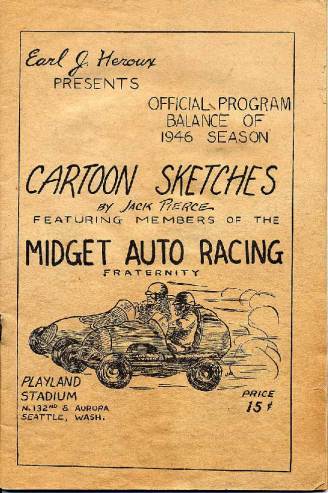
Paul, there are some remarkable additions to this week’s Now & Then. Ron Edge has sent us some chunky PDFs of materials he scanned from the early days of midget racing in the northwest. I’m posting only one of several items here today: The Midget Auto Racing Annual from 1946, the cover of which appears below.
More of Ron’s amazing scans to come, when I figure out how to override the 2 mb limit on our blog server.
The 2 meg limit has been cracked. Please see below for Ron’s classic PDFs of midget racing history. (Cautionary note: a couple are pretty large files, and may take time to download if you have a slow server.)


Anything to add, Paul?
Just a wee thing Jean – a now-&-then of a few years past. You may remember that the above story was begun with a mention of how the George Washington Bridge – AKA Aurora Bridge – opened up Aurora to its car and speed culture. Here follows the story from opening day, a picture of the same, and another photo of the bridge from its south end taken early in its life.
GEORGE WASHINGTON MEMORIAL BRIDGE 1932 DEDICATION

One of the great spectacles to have ever been staged here occurred on the six-lanes of the George Washington Memorial Bridge for its dedication on the sunlit winter afternoon of February 22, 1932. On that day, the 200 anniversary of the “father of the nation’s” birthday, no one called it the Aurora Bridge. The bridge dedication is still remembered by many locals (I’ve talked with at least five of them.) What is still vividly recalled is what shows here: a throng of 20,000 crowding the pavement of what one of the scheduled speakers described as “another link in the Pacific Coast Highway, the concrete chain between Canada and Mexico.”
A dedication program that included a few surprises preceded this ecstatic finale. There were, of course, appropriate times for when bands played, choruses sang, cannons boomed, speakers spoke, and as if on cue the crowd roared. That the day’s final speaker was the state’s Governor Roland H. Hartley was doubly ironic. First, Hartley had never been an advocate of the bridge and had once even described paved highways generally as “hard surfaced joy rides.”
The second Hartley irony played like retribution. The long-winded governor was interrupted mid-sentence by the President of the United State Herbert Hoover. Since Hartley was then heralding George Washington’s “avoidance of foreign entanglements” he was better interrupted considering that the new George Washington Memorial Bridge was designed in part to promote a better “entanglement” of Canada, Mexico and the U.S.A. It was, however, not any political nicety that motivated Hoover but rather strict observances of the ceremony schedule that had the president dedicating the bridge at 2:57 P.M. and it was exactly at 2: 57 that he pressed the golden telegraph key from his White House office.
Almost instantly the field artillery on Queen Anne Hill roared, a dozen trumpets blasted their fanfare, the fireboat Alki in the canal directly below the bridge shot water high into the arch made by the bridge, an oversized American flag, upper right, unfurled above the speaker’s platform at the south end of the bridge, and the state governor regrouped to shout into his microphone “The President has just pressed the key!”
What followed was the rush of thousands from both ends of the bridge to its center. The next day’s Seattle Times reported that “youngsters galloping ahead, were the first to meet across the great span, and a few minutes later the bridge was a black mass of citizens . . . The bridge was dedicated.”


At 3,612 feet Steptoe Butte is the unique observatory from which to delight in the real art of the Palouse: how prosperous farms mark its rolling hills. Cashup Davis was the Steptoe farmer-promoter most identified with the quartzite butte. Cashup always gave cash for the goods he needed to stock his popular stagecoach stop on the eastern slope of the butte. The English immigrant wed Mary Shoemaker of Columbus Ohio, and before they moved west in 1871 the couple raised eleven children in Wisconsin. Once settled into serving stagecoaches in the Palouse the family became known for its hospitality and the dance floor above the store. When the railroads arrived nearby in 1883 the stages stopped running and Cashup looked to Steptoe Butte to further his conviviality. After building a switchback road to the top he raised the two-story hotel shown here in 1888. The glass observatory on top held a powerful telescope that could look into four states.


As spectacular as it surely was, the hotel was also hard for man and beast to reach and its early popularity soon fell off. And the rolling Palouse was crowded with wheat not people. Mary Ann died in 1894 and, alone in his hotel, Cashup two years later. His instruction that he be buried in a hole he’d dug for himself beside the hotel was not followed. However, his internment in the Steptoe Cemetery was a grand affair and the procession following an ornate hearse brought south from Oaksdale was also impressive. Cashup’s hotel can be seen at the top although not so vividly as on the night of March 15, 1908, when it was destroyed by fire.


I used this contribution from the Muni Archive for a now-then feature in the Times back in 1998. (Well it would not be forward in 1998, I know, but the more needless words one uses the more time there is to think and even relax in between the meaningful ones.) The date is hand written below the clipping that follows. Remember please, don’t stop with one click, CLICK TWICE ENLARGE. This is in response to Ben Lukoff’s question about the possible existence of other Van de Kamp’s windmills. He also found one in the Roosevelt district and includes a link to it. It too no longer turns in the wind. I remember small Van de Camp’s sections in some supermarkets but no more big windmills when I arrived here in the mid-1960s. Read on for some description of what happened to this windmill near the north end of the University Bridge.

Horace Sykes’ slides include few urban scenes with the exception of celebrations like these of the Pendleton (Oregon) Roundup. The spectacle of horse logging (top) and bareback riding (bottom) are paraded here. I don’t know the year, although there is enough information here to easily determine it if we had ready access to the local library’s Pendleton Room. There’s an imperfect hint on the marquee of the Rivoli. Besides the local “Indian Vaudeville,” which would have been a stage presentation, the theater is showing the who-done-it mystery “Charlie Chan at Treasure Island” (in San Francisco.) The film was released in Sept. 1939. Although this year’s roundup (2010) is also held mid-September, I think it more likely that the Rivoli is showing the Chan film later than 1939. Chan films had legs.
(CLICK TO ENLARGE)
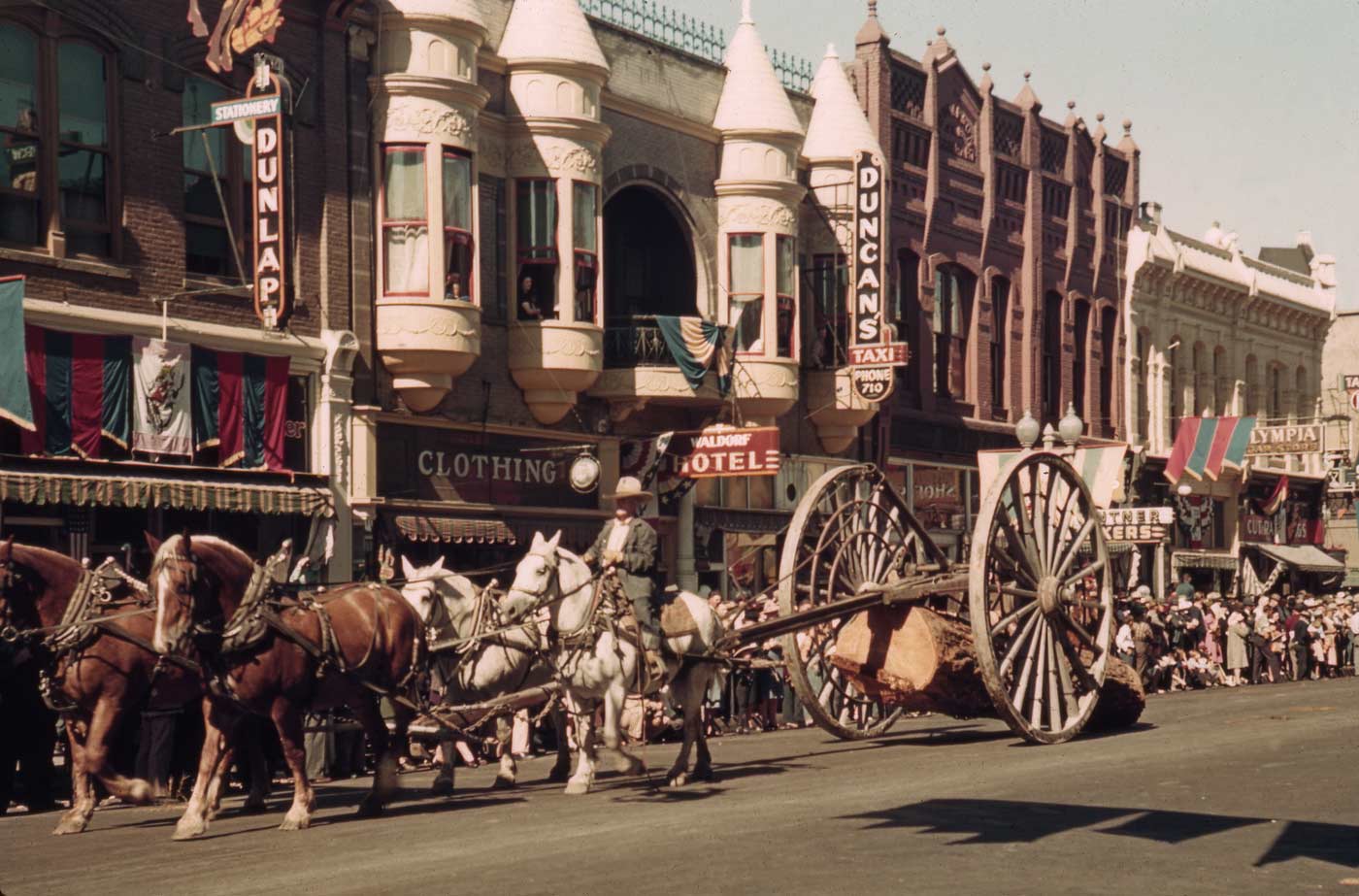

Sykes took these two Kodachromes from the same position on Main Street between Emigrant and Dorion Avenues. Unfortunately, the row of ornate Victorian structures showing in the top view has been lost with the exception of the two story white structure far right, the one with a sign reading, in part, Olympia.


A few weeks ago we featured the Green Lake Theater, photographed by Lennard LaVanway in 1947. Here is LaVanway’s Ridgemont Theater, and also from ’47.
I suspect that many readers will remember the Ridgemont as Seattle’s primary “art house” in the 1960s and ’70s. Jim Selvidge, the manager through most of those experimental years, “modestly” describes his theater “as the trigger that led to Seattle’s current reputation in Hollywood for the hippest audiences, the place to go if you want to test a film.”
Many of my best early film experiences in big, dark rooms were had from its seats or from Selvidge’s other repertoire venue, the Edgemont in Edmonds. I thank him. Since most of these were foreign films with subtitles, the Ridgemont was considered by some a “communist front” and the lights of its marquee were at risk — pelted often with rocks, eggs and even excrement.
Likely, though, the dangers were small when the Phinney Ridge theater was showing films like those showing here: “Easy to Wed,” a romantic comedy with Van Johnson, Esther Williams and Lucille Ball, and “Terror by Night,” a Sherlock Holmes thriller in which Basil Rathbone has to solve a Rhodesian diamond theft and find a murderer among the passengers of a train running from London to Edinburgh. Easy to do for Sherlock.
Rapping it now, thanks to local film historian David Jeffers for this tight summary of the Ridgemont’s long life. “It was a big-box neighborhood theater with 452 seats. Opened as Houghton’s 78th Theatre in 1919, Ridgemont in 1922, Bruen’s Ridgemont in 1928, remodeled twice, in 1938 and 1967.” After 70 often adventurous years, it closed in 1989.
Anything to add, Paul?
Yes and Welcome back from your European adventures, with your students from Hillside and then also with Berangere (of this blog). The Blog has missed you and your mastering. Now I’ll add a few more photographs, and with little comment.


Next up the block to 77th, the northeast corner with Greenwood Ave., and two more by LaVanway. It is a clapboard that has been now for many years familiar to us as the home of Moon Photo. (And yes they still do a color run for slide film.)


(CLICK to ENLARGE)
Both the flower and the frog have protection. Horace Sykes photographed flowers of all sorts, but he loved orchids and succulents. This, however, is the only frog portrait that I have found – so far – in the Sykes collection of 35mm Kodachrome slides recorded from the late 1930s into the early 1950s.


Please Click the Clip that Follows TWICE to REALLY ENLARGE it.

Click the above TWICE to Make is Much Larger!


I know nothing about the provenance of this photograph, except that it showed up on my front porch among a small bundle of negatives. Still with the help of a tax card, a few city directories, and a scattering of other sources we can make some notes.
With his or her back to Sacred Heart Catholic Church, an unknown photographer looked northeast through the intersection of Second Avenue North and Thomas Street. The Eaton Apartment House across the way was built in 1909 – in time perhaps for the city’s first world’s fair. (It is at least an irony that is was torn down for the second.) It held 19 of everything: tubs, sinks, basins, through its 52 plastered rooms. In the 1938 tax assessment it is described as in “fair condition” with a “future life” of about 13 years. In fact, it held the corner for a full half century until it and much else in the neighborhood was cleared for construction of Century 21.
The Eaton and its nearby neighbor, the Warren Avenue School, were two of the larger structures razed for Century 21. However, the neighborhood’s biggest – the Civic Auditorium, Ice Arena, and the 146th Field Artillery Armory – were given makeovers and saved for the fair. Built in 1939, the old Armory shows on the far right. (Another view of it is included below.) Although not so easy to find it is also in the “now” having served in its 71 years first as the Armory, then the ’62 fair’s Food Circus, and long since the Center House.
This is part of David and Louisa Denny’s pioneer land claim, which Salish history explains served for centuries as a favorite place to snag low-flying ducks and hold potlatches. The oldest user of the Eaton Apt. site was even more ancient. The Seattle Art Museum (SAM) brought King Tut, or at least parts of his tomb, to the Flag Pavilion in 1978. It was about then that Andy Warhol also showed up to party with SAM in the old pavilion, which in 2002 was replaced and greatly improved with the Fisher Pavilion.
Readers who have old photographs of this neighborhood from before the 1962 fair (they are rare) or of the fair itself might like to share them with historylink. That non-profit encyclopedia of regional history is preparing a book on the fair, one that will resemble, we expect, its impressive publication on the recent Alaska Yukon Pacific Centennial. As with the AYP book, the now hard-at-work authors are Paula Becker and Alan Stein. You can reach them by phone at 206-447-8140 or on line at Admin@historylink.org.


For Horace Sykes who consistently pursued the picturesque this scene may have seemed its parody. The sublime is slipping here towards the grotesque. The river looks nearly stagnant, the trees are hanging on. This canyon needs a drink, and the hill on the other side is having trouble with its rocky parts. It seems deflated: a rocky expression of depression. This canyon has colitis or maybe tortured bowel syndrome. It can be imagined groaning. There are none of Horace’s flowers in the foreground.

For this view Horace stopped above the last big curve in the serpentine Chelan River Canyon where it drops 500 feet from Lake Chelan to the Columbia River in about 4 miles. Horace took the old road on the south (or west) side of the river. A piece of the Columbia can be seen on the far right. The town of Chelan Falls is on the Columbia, and the town of Chelan (only) is on the lake. The trip between them is a rough climb – initiation – into the charmed land of Lake Chelan, all 50-plus miles of it.

The Sykes home in Magnolia was wonderfully set near the water end of Bertona Street off Perkins Lane. From there Horace Sykes took several slides of this gesturing cloud as it moved across Puget Sound at sunset. He looks to the southwest. At its far end the cloud turns or curls slightly to “point” towards the two young mountains named Ellinor and Washington by the federal surveyor George Davidson. They are about 40 miles from Horace. Ellinor was the name of the surveyor’s boss’ younger daughter and Constance – a grander peak north and west of Washington and not showing here – was an older daughter. The sisters had two Brothers who have also skipped out on this recording. If the weather is fair and warm and one is fit, then Ellinor is a mountain to climb without much danger of falling off it, although the route is steep and one may expect to be greeted near the top by mountain goats. There’s a path – of sorts. (Click to Enlarge)

John Sundsten’s log cabin on Hood Canal – near Alderbrook Resort – looks northwest to Ellinor and Washington, which are about 15 miles away. John shot the view below from his porch – or near it. Ellinor is on the left and Washington on the right. You have seen them many times – the last of the craggy peaks, at the southern end of the Olympic screen (or curtain) as seen from Seattle. The face of Ellinor seen here, the eastern side, is the route for reaching the top if it is clear of snow. John says this is from the winter of 2008.

In Sykes view are three nubs or hillocks to the left of Ellinor-Washington. They are much closer to Horace – about 15 miles. The one on the right is Green Mountain, and the one in the middle, Gold Mountain. Both have addresses in Bremerton. Gold is also home for two radio towers – KCPQ and KTMW – Fox and Trinity respectively – where free speech is being radiated and tested around the clock.


This addition to the most recent Seattle Now and Then is sent by frequent commentator and sometimes contributor, Matt Fleagle. Thanks Matt. Your sometimes shunning of optics during your walks of exploration is a kind of soft-focus Zen I think. Two points about your caption. I agree that your photograph does make an elegant composition, and the box cars – or flat cars with freight – carry it too. And the pigeons two. You mention the look down from the bluff at the building of Pier 66. I did a story on this maybe 20 years ago, and for the “now” I remember being a few yards north of the Lenora Street overpass and also turned a bit more to the west. They were preparing to tear down Pier 66 at the time. Perhaps it was more like 15 years ago, but I’m not looking it up for now. (left)
Here follows Matt’s snap and his explanation.

When the Rev. Theodore Erdman Dorpat (T.E.D.) approached Pasco from Spokane on his way to ministerial meetings in Portland he prepared to choose between driving his Plymouth (until a rocket-nosed Studebaker replaced it in 1951) to Portland through the Wallula Gap or take a short-cut – and he loved them – directly over the dwindling Horse Heaven hills south of Pasco. With his shortcut he – and sometimes we – would reach the Columbia River on the Washington side at Umatilla, and at the site of the McNary Dam. It was not much of a short cut. Only a few miles were “saved” by not following the Columbia River where it takes its big bend to the west. Dad left it up to the family, which way to go. We picked the Gap.
Here Horace Sykes has climbed about 100 feet above the highway to look southwest through the Wallula Gap. He chose his prospect in order to include the “Twin Sisters,” basalt pillars that stand side-by-side. There own slender day-lighted gap between them cannot be seen from Horace’s position nor in the “general delivery” of Google Earth. (While it is too slender for Google’s topo-computer, those “blue-dot” real photos contributed by many sensitive users show it several times. One of these dots is set on the Washington side of the Gap but it looks across the river to show the Twin Sisters in their unique position. You might wish to go looking for it and the rest of them.)
At least once the Dorpats stopped by the side of Highway 730 to study the Twins, although we thought of them then as captains: the Two Captains. The Lewis and Clark expedition camped about two miles downstream from these basalt pillars on Oct. 18, 1805. They camped on an island near Spring Gulch, and their island may well be the island showing in the river behind the intruding ground cover in Sykes’ Kodachrome. (Including a plant as a close-up in a landscape is very typical of Horace, and like most of his this composition is almost certainly “studied” from top-to-bottom and side-to-side.) Remember to CLICK TO ENLARGE.

Horace certainly recorded this look over the shoulders of the twins before McNary Dam was completed in 1953 when its big locks began lifting ships – mostly tugs pulling or pushing barges carrying wheat – 340 feet above tidewater into the 68 miles of slack water named Lake Wallula. Horace’s recording, then, shows the last of the unimpeded primeval river moving through a gap (between the Horse Heaven Hills and the Blue Mountains) begun millions of years earlier and then suddenly “improved” with the series of floods that followed the sudden release of sea-sized lakes – most of them in Montana – filled with the melting contributions of the most recent ice age.
By different accounts there were between 40 and 100 of these floods crashing through here with about thirty years between them, with the last one scouring the gap and the gorge beyond it a mere 13,000 years ago. (The top of the Twin Sisters is about 660 feet above sea level and so about 320 feet above Lake Wallula, which is an easy way of visualize how much of a drop it is from the maintained lake to the ocean. McNary Dam lifted the river about 90 feet above the Columbia’s old altitude at the dam site, which is about twenty miles down stream from Horace and the Twins.)
Horace’s, my, and perhaps your attraction to the sisters was anticipated by Coyote’s. Three sisters – not two – worked hard here at building a trap on the river for salmon, and at night the often too playful trickster did what he probably considered a prank or tease and destroyed their work. But when Coyote saw the sisters crying for want of food, he was touched and proposed to them that he would build a trap for them if they consented to marry him. They agreed and lived happily together for a very long time, but not forever. Eventually Coyote grew tired of his three wives. He then changed two of them into these pillars, and made a cave of the third wife on the opposite side of the river. From there he kept an eye on them all, until he too turned to stone.

Of all the trestles constructed to cross Alaskan Way the longest-lived is the overpass that reaches Colman Dock, the ferry terminal, on Marion Street. The second oldest is this one on Bell Street. The bridge on Marion was always only for pedestrians. The bridge on Bell was for many years used also by trucks, cars, and in the beginning wagons as well.
Actually, there have been many other overpasses on our waterfront. Those at King and Madison were both used for moving coal to ships. The trestle on Pike was used first for coal and later rebuilt for pedestrians. Bridges at Virginia, Clay and Lenora streets complete the list, but all these are now long gone.
The Bell Street overpass was completed in 1915 soon after the young Port of Seattle’s big Bell Street Terminal opened. The Port was proud of its grand new pier and the bridge helped to safely show it off. Here was an easy way for produce sellers to move between the Pike Place Market and the Port’s dock with the cold storage it offered. And the bridge – its sidewalk – encouraged families shopping nearby at the Pike market to also visit the recreation park the Port built on the roof of the Bell Street pier.
There is one concluding note to pull from the “top” of this subject: the Broadway – Empire Laundry. The name is signed large on the west façade of the four-story red brick power laundry at Bell and Western. It opened in 1914, a year before the Port got settled one block and one bridge away. As with other power laundries it was women who did most of the hard work and at measly wages. Consequently, the women in local laundries went on strike – first in 1917. Eighteen years later, the organized women of this laundry won the strike of 1935 and the union they formed was for two decades Seattle’s largest organized coalition of women workers. See www.66bellstreet.com for the full story.
[Please Remember to Click the images below to ENLARGE them.)


