
Our Daily Sykes #207 – Let Horace Be The First . . .


(click to enlarge photos)


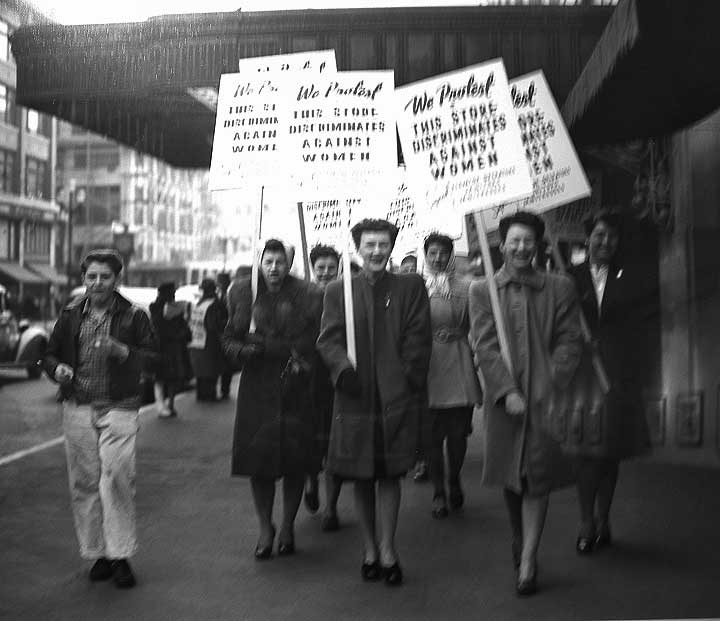
This past spring, Jean Sherrard and I attended the memorial service for Virginia Lee Slate Eals, mother of our friend, the writer Clay Eals. The oldest of three sons, Clay was the principal eulogist, and his memories of his mother were stirring.
The memorial was held at Park West Care Center, where Virginia spent the last six years of a buoyant life that began 87 years earlier, only seven West Seattle blocks away. The big room was filled with flowers, family, friends and photographs. The candid sidewalk snapshot shown here was among them.
From the 1930s into the 1950s, coming upon sidewalk photographers with the pitch of a candid portrait for a low price was commonplace. Virginia Slate had four of them in her album, all taken in her prime, before and during World War II. Clay explains, “She had many jobs downtown, and several of them were copy-girl type positions, delivering printed material from one place to another, so it’s no surprise that person-on-the-street photographers snapped her multiple times.”
With the then-popular Manning’s coffee house and the Colonial Theatre marquee behind her, both the place and time are easy to identify. The view looks north on the west side of Fourth Avenue between Pike and Pine streets in 1945, the year the films “Castle of Crime” and “Hotel Berlin,” on the marquees, upper-left, were making their American runs.
In 1970, Virginia went back to work, in part to help pay for her sons’ education. Clay notes that her job with the Bellevue Traffic Violations Bureau “was both tough and enlightening.” In a letter to Clay during her 18 years there, Virginia reflected, “It’s amazing how many people are repeaters on traffic violations. I’ve been cussed at and told off, which I was expecting, and also lied to. You can never tell by just looking at people what they are like. … I saw a part of life I’ve not been exposed to before, and it’s fascinating and depressing. It makes you appreciate good friends and family all the more.”
Hey Paul, this time round, I just know you’ve got a treasure trove to share with us – but let’s begin with Clay’s extraordinary and moving eulogy for his mom Virginia. What’s more, we’ve illustrated it with a sampler of family photographs supplied by Clay.

And now, on to your mini-survey of street photography now and then from around the planet. And of course I’ll prompt this outpouring with my usual query:
Anything to add, Paul?
YES Jean.
First something more about Clay Eals and 4th Avenue north of Pike. This part of 4th first – here in 1947 with the old Colonial.

On October 18, 2009 we put up on this blog a look at this from about the same year – about. It was – do you remember Jean? – a night shots with all the lovely neon aglow and you repeating it in the evening too. I came with you. That now-then also featured an excerpt from film reviewer Bill White’s work-in-progress, “Cinema Penitentiary.” If might be something to visit again for those who know how to use the search machinery. Ask to see anything with “Colonial.”
Next, Clay also figured in another 2009 insertion – the one for June 5th. This was an article putting the Portola Theatre in its proper place – a long move from West Seattle to Queen Anne Hill. Ask to see anything with “Portola” or ask for “Eals.” He comes up in some other stories although he is not identified. He hides more than lurks. You can also – you know Jean because you put him there – find him in the “now” repeat shot for this candid photo of his mother in this – and back to it – block.
Now as time allows (bedtime) I’ll lay in three stories that include street candor, followed by examples of another photographer’s (Victor Lydgman) candid shots on Pike Street (mostly) from the early 1960s, and a samples of my own Broadway Bus Stop project of 1976-77. (About this last I have an uncanny feeling that I showed a lot of these earlier on this blog but I could only find one, and so I will go ahead with it.) I might mix in some other grace notes if they make themselves heard before another nights “nightybears,” which you know is our mutual friend Bill Burden’s (of the button on our front page) customary salutation for metabolic closure, that is, which is his “good night.”
MILLER’S CANDOR


The Seattle News-Letter, a turn-of-the-century weekly, published candid photographs of locals on the city’s sidewalks to accompany a gossipy front-page column, “Stories of the Streets and of the Town.” The couple “posing” here was photographed for the series, although it seems that this shot never made it to print. Perhaps the photographer could not pry any stories from them.
The photographer was a young Walter P. Miller. Pieces of his estate, including these negatives for the tabloid – about 100 of them – survived in their original wraps. Roger Dudley Jr.s’ father worked for Walter Miller and in the mid-1930s bought out the business. The 3-inch-square flexible negatives were part of the deal. Roger Dudley Jr. took over his father’s studio 20 years later, and after a quarter-century more of commercial photography he retire and gave the negatives – these candid ones – to me. Miller lightly penciled the names of most of his subjects on his negative holders. This couple was one of the exceptions.
According to Lois Bark, costume curator for the Museum of History and Industry [in 1993 when this story first appeared in Pacific – on April 12] the woman is dressed conservatively but still modishly. Her hat, held in place with a long pin, is most likely straw-trimmed with tulle (a fine net) and artificial flowers. Her S-shaped figure is a creation of corsets, whale bones, petticoats, hip pads and hooks, and below all that maybe an S-shaped anatomy. Her two-piece walking dress was certainly black, the common dress color of the time, and most likely wool. It required help to get on and off and could not be cleaned, only brushed and spotted.
The man is distinguished by his gold chain. His double-vested waistline is another projection of his affluence or, at least, self-importance.
The couple stands on the southeast corner of First Ave. and Union Street. The pioneer Arthur and Mary Denny home is directly behind them and over their shoulders at the northeast corner is their son Orion Denny’s home. In 1852 he became the first boy born to white settlers in the village of Seattle. He died in 1916.
TWO MORE FROM MILLERS CANDID ONE HUNDRED
Walter Millers example of candid street photography are rare – for Seattle. Perhaps for anywhere, for the practice of “catching” subjects that were not confused by their own movement was dependent on still subjects and/or fast equipment.


MORE CANDOR ON FOURTH AVENUE NEAR (OR AT) PIKE STREET

Although the date for this Fourth and Pike scene is recorded on neither the original negative nor its protective envelop, uncovering it was not difficult. The newsstand at the center of this view includes copies of both The Seattle Times and the Seattle Post-Intelligencer. A 15-power magnifying glass reveals the date. It is Monday, July 25, 1938.
The Post-Intelligencer, just above the dealer’s head, announced “A New Forest Fire Rages at Sol Duc.” A week and a half of record heat had not only encouraged fires around Puget Sound, but also filled its beaches.
On this Monday, Seattle was even hotter with anticipation of a Tuesday-night fight. Jack Dempsey’s photograph is on the front page of the P-I. The “Mighty Manassa Mauler” was in town to referee what those who sport so consider one of the great sporting events in the city’s history: the Freddie Steele-Al Hostak fight for the middleweight title.
About 30 yours after this photograph was recorded, hometown-tough Hostak, in front of 35,000 sweating fans at Civic Field (now the Seattle Center Stadium) made quick work of the champion Steele. The P.I.’s purple-penned sports reporter, Royal Brougham, reported “Four times the twenty-two-year-old Seattle boy’s steel-tempered knuckles sent the champion reeling into the rosin.” Hostak brought the belt to Seattle by a knockout in the first minute of the first round.
The day’s fevered condition was also encouraged at the Colonial Theatre (a half-block up Fourth) where, the Time’s reported, “an eternal triangle in the heart of the African jungle brings added thrills in Tarzan’s Revenge.” The apeman’s affection for a young lady on safari with her father fires the resentment of her jealous fiancé. We will not reveal the ending of this hot affair, although by Wednesday the 27th, Seattle had cooled off.
[HERE we remind the reader that another visit to the Colonial was offered on this blog on Oct. 18, 2009 with an excerpt from film critic Bill White’s work-in-progress, “Cinema Penitentiary.” It is illustrated with a neon-lighted night view of Fourth from this corner in 1945. Search for “Colonial.”]
CANDOR (OR FEVERED PRODUCE EXHIBITION) AT THE PIKE PLACE MARKET ca. 1907


FARMERS AND FAMILIES
(This was first published in Pacific on August 6, 2006. The Pike Place Market and the city were preparing for the former’s100th Anniversary.)
A century ago Seattle, although barely over fifty, was already a metropolis with a population surging towards 200,000. Consequently, now our community’s centennials are multiplying. This view of boxes, sacks and rows of wagons and customers is offered as an early marker for the coming100th birthday of one of Seattle’s greatest institutions, the Pike Place Public Market.
Both the “then” and “now” look east from the inside angle of this L-shaped landmark. The contemporary view also looks over the rump of Rachel, (bottom-left) the Market’s famous brass piggy bank, which when empty is 200 pounds lighter than her namesake 750 pound Rachel, the 1985 winner of the Island County Fair. Since she was introduced to the Market in 1986 Rachel has contributed about $8,000 a year to its supporting Market Foundation. Most of this largess has been dropped through the slot in her back as small coins. It has amounted to heavy heaps of them.
Next year – the Centennial Year – the Market Foundation, and the Friends of the Market, and many other vital players in the closely-packed universe that is the Market will be helping and coaxing us to celebrate what local architect Fred Bassetti famously describe in the mid-1960s as “An honest place in a phony time.” And while it may be argued that the times have gotten even phonier the market has held onto much of its candor.
The historical view may well date from the Market’s first year, 1907. If not, then the postcard photographer Otto Frasch recorded it soon after. It is a scene revealing the original purpose of the Public Market: “farmers and families” meeting directly and with no “middleman” between them.
Then and Now Captions together: The Pike Place Market started out in the summer of 1907 as a city-supported place where farmers could sell their produce directly to homemakers. Since then the Market culture has developed many more attractions including crafts, performers, restaurants, and the human delights that are only delivered by milling and moving crowds.
BELOW THE PIG ON PIKE PLACE

ONE BLOCK SOUTH OF THE PIG THE FIREMAN AND THE YOUNG WOMAN SITS THE BED

FOUR FROM JEAN AND FOUR FROM BERANGERE
This morning I suggested to both our Jean and our Berangere that they apply some candor to this and they have with the following examples pulled from their profound larders or happy hordes or profound multitudes. Four for each – with Jean first.


FOUR FROM VICTOR LYDGMAN – CA. 1962
This quartet hangs around Pike Street too.


BROADWAY BUS STOP – 1976-77

For the two years I lived above Peter’s on Broadway in the grand-box apartment with two floors handed on from Cornish students and faculty to Cornish faculty and students through many years, I took the opportunity to photograph the bus stop across Broadway. It was laid beside the east facade of Marketime, a big place with food and sundries. The light was wonderfully mellow as it bounced off our side of Broadway in the afternoons. In the mornings it slanted from the south – left – directly into the architecture of the bus stop shed and those who were protected by it. I recorded a few thousand shots, both black and white and color. The Friends of Rag also put on a fashion show at the bus stop for the project. I asked many friends to sit for portraits with my zoom lens poking out below the open kitchen window on the second floor above the kindly Peter’s front door. Peter, I think, was the first gay clothier in Seattle, and he was also one of the first oulets for the Helix weekly in the late 60s. Here are a few examples taken from the thousands. A few of these – or others – were exhibited on city buses at the time. (Not all the buses.)


AT LAST MORE SIDEWALK CANDOR


TWO STREET SNAPS OF DELIA & LEWIS WHITTELSEY
Delia and Lewis, like may others, had a custom of doing much of their shopping downtown, and often the Pike Place Market was among their stops. As with Clay Eals’ mother Virginia this frequency meant that they had more than one chance to purchase a candid snapshot of them having their ways on a downtown street. Lewis Whittelsey “contribued” to his blog with his photography on another Sunday. You can search for him.


Located between the Luxembourg gardens, Saint-Germain-des-Pres neighborhood and Necker, Montparnasse is an area where Parisians have often come to party – even before the installation of the famous cemetery. Montparmasse was known for its famous cabarets since the seventeenth century when this neighborhood was then still Iocated in the outskirts of Paris.
Originally, Latin Quarter students were accustomed to recite poems on the Boulevard Edgar Quinet and rue du Montparnasse artificial hill, using poetic allusions to Mount Parnassus in central Greece, the wooded summit which inspired the muses.
For Parisians, the neighborhood evokes the presence of celebrated artists from the Universal Exhibition of 1889, artists such as Apollinaire, Gauguin, and Matisse, the famous “ Montparnos ”, which dates from the piquant years between the two world wars as Modigliani, Picasso , as well as other cinemas, theaters, and restaurants. Although now surrounded by Paris, Montparmasse keeps its mythical connection for links to western France. It is a crossroads. The neighborhood is also famous for the tower built there in 1972. It offers the best view of Paris – one that includes the Eiffel Tower but excludes itself.
Situé entre le jardin du Luxembourg, Saint-Germain-des-Prés et le quartier Necker, Montparnasse est un quartier où l’on est toujours venu faire la fête, et avant même l’installation du célèbre cimetière, il était connu pour ses célèbres cabarets installés en bordure de Paris depuis le XVII ème siècle .
A l’origine, les étudiants du Quartier latin avaient l’habitude de déclamer des poèmes sur la colline artificielle du boulevard Edgard Quinet et de l’actuelle rue du Montparnasse limitant Paris et l’avait surnommé ainsi en référence au Mont Parnasse au centre de la Grèce qui inspirait les muses.
Pour les Parisiens, ce quartier évoque le rendez-vous d’artistes bien connus depuis l’exposition universelle de 1889 tels Apollinaire, Gauguin, Matisse…et les célèbres Monparnos de l’entre-deux guerre, mais aussi des cinémas, de théâtres, de restaurants mythiques, le carrefour dû à la gare déservant tout l’Ouest de la France, et bien sûr la célèbre tour construite en 1972 célèbre pour offrir la meilleure de la vue de Paris , parce que n’étant pas dans la perspective…


I know neither the type of tree nor the place – white birch bordering a stream in the semi-arid west? Horace does not say. (Click to Enlarge)

(What follows is lifted from “Keep Clam” a work-in-progress on the life of Ivar and Ivar’s. This is part of the longer of two books, and will appear somewhat polished only on the net. The smaller book will be published between covers and available early in 2012. The longer book will begin to appear on its own webpage sometime early next year and “with many extreas” including recordings, video bits, and a reading of the serial installments by the author for those who like to be read to.)
MEETING TED ABRAMS & GUY WILLIAMS
In her revealing memoir “Wash Your Hearts with Laughter”, following her description of meeting Ivar at a Theosophy meeting, Maggie introduces Ted Abrams, the brilliant craftsman, cook, collector and raconteur. “We became friends with the most interesting man two young and green people could associate with.” Raised in a southern Jewish family, Abrams came to Seattle a short time before World War One. He escaped the war years living in Japan, working as a buyer for Seattle’s Frederick and Nelson Department store. Otherwise Ted Abrams lived in Seattle until his death in 1942. In a recorded conversation with Emmett Watson and Guy Williams, Ivar begins to describe Abrams, until Williams interrupts him. “Allow me to interpolate. Abrams! I’ll swear he knew everything.” Ivar continues, “He was a genius.” Guy Williams, Ivar’s college friend and sometimes his press agent as well, was encyclopedic on his own. As a young boy he was already an accomplished auto-dictate. Growing up in the gypo lumber camps that his dad managed, Williams read a multi-volume encyclopedia from A to Z and it would seem he remembered much of it.

Ivar and Maggie met Abrams at his Club Mauve on First Hill. Abrams was both the chef and the entertainer with a gift for rendering blues and gospel music he learned growing up in Savanna, Georgia. Maggie credits Abrams with inspiring Ivar to a more earnest life as a folklorist and songwriter. Club Mauve was designed around Abrams own collection of antiques and exotic art. The young couple was so taken with him that when Abram’s club fell victim of the wrecking ball they invited him to join them in West Seattle. After first distinguishing the old Haglund home on 59th Ave. SW with decorative brick work, Abrams built his own home from salvaged materials on a lot that Ivar donated across a Horton Street that was more an alleyway than a street. A visit to Abrams charmed construction became a kind of pilgrimage for members of Seattle’s Bohemian community in the 1930s. Artist William Cummings recalled the interior of Abrams home in his published, Sketchbook – A Memoir of the 30s of the Northwest School. “The house was crammed with paintings, drawings, sculpture, etchings and first-edition volumes signed by names famous and infamous. Ted managed to live just above the alleged level of poverty with an aristocratic grace that seldom showed the strained and stressed crevices of daily life.”


MEETING IVAR & THE BEES
Another visit to Ted Abrams home is recounted in Bill Cumming’s memoir. It is titled for our subject, “Ivar Haglund.” He might have titled it “Meeting Ivar Haglund” for nearly a half-century later he notes that their bumping “remains vivid” and a bit creepy.
On a spring Sunday afternoon Cumming accompanied Ken and Margaret Callahan aboard their Model A for a visit to Abrams little salvaged manse next door to Ivar’s and Maggie’s place. Abrams’ “tiny astonishingly fragile and graceful elderly nymph” of a sister had moved from Georgia to help take care of her fading brother, (Anguished, Cumming could not remember her name.) and the pair accompanied the Callahans for a visit to the nearby Alki Point. Cumming stayed behind, to explore Abrams’ library and watch his cat Mike “who dozed in a corner while I curled up in a big chair engrossed in a book.” The stage was set for meeting Ivar. Cumming continues.
“I was raised from the chair by a thunderous knocking on a fragile door, which threatened to collapse under the attack. Before I could open it, the door sprang open and on the threshold stood another short stocky figure in ample flesh, pale eyes set over drooping lower lids. At the moment the whole apparition gave off an air of general hysteria. ‘I’m sorry to bother you. My name’s Ivar Haglund and I live next door. I’m a friend of Ted’s and the Callahans’.” Cummings replied, “Yes. They speak of you a lot.” However, before he could complete his observation, Ivar “blurted out, ‘Listen! You wouldn’t know how to get rid of a room full of bees, would you? I mean an entire room full, my bedroom!’ . . . Driven by a Spartan sense of duty I walked back with him to his yard. Creeping through the long grass for all the world like marauding Indians in a B Western, we gained the relative safety of the wall of his house directly beneath the bedroom window, which gaped slightly open. From within floated the ominous hum of multitudinous wings, a hum of anger and threat. Rising up until our eyes just cleared the sill, we gazed into the room, then froze in terror and abject fear. The room was indeed filled with bees, flying, standing on edges and ledges, crawling over bed covers, crawling into and out an hollow containers, into lampshades, out of pillowcases . . . In front of our eyes, barely out of striking distance, the sill was three deep in black and yellow malcontents who glared balefully into our eyes, not yet collected enough to launch themselves across the scant inches between us. Hurriedly we ducked back down and retreated on all fours through the grass, praying that we would not be hit by a sudden raid from the rear.
“Regaining the safety of Ted’s porch, I slumped in a chair, while Ivar wandered off in search of someone who might be of practical help. My only suggestion was to burn the house down. I never met Ivar again. In fact, I never really found out if it actually was Ivar or not. If it’s of any significance to scholars, he wasn’t carrying a guitar.”
(The above was written – often copied – during a blizzard sent early from Canada this Monday evening, November 22, 2010. This morning the 93 year old Bill Cummings died, and the community lost thereby one of its great raconteurs. He had hosted his last painting class in his home a week earlier. Last Friday our mutual friend the pianist-producer Margaret Margason serenaded Bill. She brought with her to Bill’s home some romantic Robert Schumann and some Beatles, and he requested the latter, which she both played and sang. At the time he was reading again the Jeeves novels by the English humorist P. G. Wodehouse. About one month ago Bill celebrated his last birthday with the Margasons at their Wallingford home. A few days earlier I had found in a collection of negatives recorded by the artist Victor Lygdman a series of “artist at work” portraits of Bill that Victor took in the earlier 1960s. Six of these are included below.)


Bill Cumming, age 93, died this morning of congestive heart failure. He held his last painting class at his home last Monday. On Thursday his friend Margaret Margason serenaded Bill. She brought with her high romantic music for Soprano by Robert Schumann and a Beatles songbook. This time Bill chose the Beatles – for a sing-along. The six portraits of the artist “in process” were photographed in the mid-60s by Victor Lygdman, who died earlier this year of the relatively “mere” age of 83. Victor was born ten years after Bill.
(click photos to enlarge)


Soon after the Medical Dental Building at 509 Olive Way was completed in 1925 a photographer climbed to the roof of the Wilson Business College, one long block north at 5th and Virginia, and recorded this view looking back at the grand new health center’s soaring irregularities. The new skyscraper was a brilliant standout for the business district’s north end. Built on five-star Times Square corner of 5th, Olive, Stewart, and Westlake it gained the charms of asymmetry, a commitment that crowns the top with a small stepping tower.
That the Medical Dental Building it not easily mistaken for any other Seattle structure is because of its odd and soaring shape as much as for its gleaming tiles, which at the time were the preferred skin used in construction projects throughout the business district – if the tiles could be afforded. The new building continued the clean reflecting glow of the brilliant Frederick and Nelson Department Store (1918), seen here behind it at 5th and pine. It also complimented the brilliance of architects Bebb and Gould’s home for The Seattle Times. The Times Square Building is both cut like a piece of cake and decorated like one with a terra-cotta egg shell “frosting.”
Apart from these buoyant structures practically all else in this view is dark and made of wood and warm brick. For instance, the top three stories of the Times home, showing here on the right, rise above the dark Hotel Rainbow. Although here only in its “teens,” the big wooden box with small towers and simple bays was a Victorian hangover constructed soon after the Denny Regrade had completed lowering Denny Hill west of 5th Avenue to its present grades in 1910-11.
The Rainbow sat at the northwest corner of 5th and Stewart and survived into the 1930s when it was replaced with a small service station. That it is now a mere parking lot puzzles this writer about how such an important site can be so modestly employed.
We will conclude with a readers’ quiz followed by the answer. What two distinguished landmarks – not surviving in either our “then” or “now” – filled the block showing here on the left or east side of 5th Ave.? The answer: the Orpheum Theatre (1927-1967) and the Benjamin Franklin Hotel (1928-1967). Remember them?
Jean writes: I occasionally find myself wandering Seattle rooftops when searching for ‘Then’ footprints. Here are a few alternate views from the Griffin building:


Anything to add, Paul?
Yup Jean, and as time allows and seems prudent I’ll go looking for past features that hang around the neighborhood. Again, I am more likely to find the “then’s” than the “nows” for over nearly 25 pre-digital years I had a careless habit of not looking back at my own “now” negatives, and they are rather a jumble now, although they are safe in binders and with time they could all be put in order and dated. But not now. I will grab what we can before retiring. Tomorrow – Sunday – I’ll find some more. Meanwhile please forgive my typos and dyslexic flips. I’ll hope to discover and correct or flip them tomorrow. Now we will start with another story that is at the same intersection of 5th and Virginia although much earlier – ca. 1886. But you know this, because you took the “now” for it recently. We agree that these two views from Virginia south on 5th will be a pair to use in our show with Berangere at the Museum of History and Industry next April and thereafter for a few months.
THE WAGON ROAD TO QUEEN ANNE
In the mid-l880s there was no suburbia separating the city from the country. This week’s historical scene is evidence of that. It was photographed looking south across downtown Seattle’s northern border. The foreground is bucolic.

The view was photographed from the eastern slope of now-regraded Denny Hill. The evidence for this claim is the shaft of light that streaks across the scene’s foreground and bathes the fence posts in a late-afternoon glow. That beam cuts through the hill in line with Virginia Street, which was a valley between the two humps of Denny Hill.
After a little homework, I determined that the boxy white building just right of the scene’s center and above the break in the fence sits on the north side of Pike Street in the second lot west of Fifth Avenue. The clear break running diagonally between the buildings across the scene’s center is Fifth Avenue. The view shows Fifth ending at the Territorial University’s greenbelt.
The three principal landmarks – with towers – on the horizon left to right are Coppins Watertower at 9th and Columbia, Central School at 6th and Madison, and the Territorial University at 4th and Seneca. No structures survive from the old scene to the new. And Denny Hill and Denny Knoll have long since been graded away. In place of the wagon ruts are monorail struts. The level of the pre-regrade intersection is about 40 feet higher than Jean’s recent “now.” So the wagon road was in places close to the level of the monorail. Believe it or not.

FRANK SHAW – 2 TRANSPARENCIES LOOKING SO. on 5th TOWARD STEWART: 1962


TIMES SQUARE

The photograph above of Times Square includes three prominent Seattle fixtures. One is moving, one is long gone and the third survives. The survivor, of course, is the Times Square Building, home of The Seattle Times from 1916 to 1931 at the irregular intersection of Westlake and Fifth avenues with Olive and Stewart streets. The moving subject is Car 51, one of the six Niles cars that the Pacific Northwest Traction Co. bought from Niles, Ohio, for the Seattle-Everett Interurban. Car 51 continued to serve until the Interurban’s last day, Feb. 20,1939. The missing landmark is the noble little structure in the foreground, built in 1917 for a bus stop and underground rest rooms. It has been replaced by a simple bus shelter.

Times Square borrowed its name from New York City’s Times Square and, like its East Coast namesake, was highlighted by a newspaper. The building, embellished with granite and terra cotta, is perhaps the city’s best memorial to the art of Carl Gould, Seattle’s most celebrated turn-of-the-century architect. He designed it in a Beaux Arts style and this flatiron confection is still widely admired.


A LITTER OF TRIANGLES


HOMES FOR THE SEATTLE TIMES

In “RAISE HELL and Sell Newspapers,” Sharon Boswell and Lorraine McConagy’s 1996 history of Col. Alden J. Blethen marking the centennial of the founding of The Seattle Times, the 69-year-old editor-publisher is shown in shirtsleeves vigorously scooping the first shovel for the 1914 groundbreaking of his new Times Square plant. As the authors explain, this was a momentary vigor, for Blethen’s health was in steep decline. Actual construction was put off until after his death in July 1915, and resumed by his sons as a monument to their father’s uncommon life.

The building of Times Square began in September 1915 and proceeded with such speed that one year later, on Sept. 25, 1916, The Times could devote an entire edition to its move north from Second Avenue and Union Street to its new terra cotta-tile palace at Fifth and Olive.
The architects, Carl F. Gould and Charles Herbert Bebb, created a monument as much to Renaissance Revival style as to the Colonel. The new partners repeated the division of labor employed so effectively by Bebb’s former Chicago employers, the famous “prophet of modern architecture,” Louis Sullivan, and his partner, Dankmar Adler. Here the practical Bebb, like Adler in Chicago, handled the business and engineering while the Harvard-educated aesthete Gould, like Sullivan, created the designs. Gould took the Gothic plans Bebb had drawn earlier with another partner and transformed them into this gleaming Beaux Arts landmark.
The rare view (at the top of this feature) of the full northern facade was photographed before much of it was hidden between its neighbors. The flatiron block was Blethen’s direct and proud allusion to the similarly styled New York Times Building, which also faced a Times Square in Gotham.
The newspaper continued to publish here until 1930, when it moved north again, this time to its current offices on Fairview Avenue North.


THE WESTLAKE BEAT

I confess to having featured this intersection four times – that I remember – in the now 28-year life of this feature. Here’s the fifth (first put up five years ago), and I wondered then what took me so long. There are so many delightful photographs taken from this five-star corner looking north on Westlake from Fourth Avenue and Pike Street, and we have shown a few already on this blog acting like a webpage. But this scene with the officer probably counts as a “classic” because it has been published a number of times and has not grown tired.
It is only recently that I looked closely at the policeman, and I think I have figured out what he is doing. He is scratching his head. I suggest that the officer may be marveling at the great changes that had occurred in the three years before he was sent to help with traffic on the day this photo was taken. (I’m figuring that this is 1909 or near it.) Heading north for Fremont, trolley car No. 578 to the left of the officer, is only 2 years old, and so is the Hotel Plaza to the left of it. If the officer returns to this beat in a few years, he’ll probably know that there is a speakeasy running in the hotel basement.

Westlake Avenue was cut through the neighborhood in 1906 along what its planners described as “a low-lying valley, fairly level, with just enough pitch to give it satisfactory drainage.” The plan was to connect it with “a magnificent driveway around the lake. Readers may remember that there have been many magnificent plans for this part of Westlake. Beginning in 1960 with the opening of the Westlake Summer Mall, which quickly changed to Seafair Mall, the blocks between Pike and Stewart streets were dreamed over for a quarter century as the best available site for developing a civic center for a central business district that somehow wound up without one. One key to this dream was stopping the traffic on Pine Street between 4th and 5th Avenues, a dream accomplished but for only a while. The big retailers didn’t like it, thinking that any inhibition on the motorcar would make it harder for citizens to reach them.

Two colored postcards looking over the Westlake, 4th, Pine Street triangle follow. For may years grand lighted signs for railroads and coke were displayed at this odd corner. You are asked to date the cards. The last has got the name wrong. Times Square is down the ways at 5th, Stewart, Westlake & Olive.


WAR BOND DRIVE at FREDERICK & NELSON DEPT STORE


DURING WORLD WAR II, the local effort and ingenuity applied to the sale of war bonds reached the monumental when for the nation’s Sixth War Loan Drive the “two largest flags on the Pacific Coast” were draped across the Pine Street and Fifth Avenue facades of the Frederick & Nelson department store. In addition to rolling Red Cross bandages and selling bonds and stamps at the main-floor Victory Post, more than 90 percent of Frederick & Nelson’s employees invested at least 10 percent of their income in war bonds. During the Fifth War Loan Drive this was added to management’s investment, pushing Frederick & Nelson’s total purchases past $1.5 million, a prize-winning performance worthy of the Treasury Department’s T-flag award.

Billboard-size murals promoting bonds were commonplace outside and inside the store. Facing the bank of main-floor elevators, the names of former employees who were off to the war were displayed on a plaque that read, “Staff members who served you here . . . now serve our country.” To the sides were military uniforms draped on store mannequins.

Frederick & Nelson also opened a branch in a white cottage at Boeing Plant No.2, where civilian staples (toilet articles, bras, street suits, work clothing) were available. This convenience also was another way of saving the gas and rubber required to shop downtown. The war revived the flow of cash around Seattle, where nearly 50,000 people were employed making airplanes and twice that number making ships. But necessities were commonly rationed and luxuries postponed. War bonds, the nation’s price administrator explained, were a good way not only to aid the forces abroad but also to help ease inflation on the home front by taking extra cash out of circulation.


Horace Sykes had captioned this “A Promise of Spring.” We have signs too – optimistic ones for we prefer the warm mornings to the cold. Yesterday we – the Queen and I – saw a Robin hopping the limbs of the neighbor’s holly tree. We agreed that it was out of season, but there it was with red breast jumping about the red berries. Today I read of snow perhaps for Monday. And so following the omens of Sykes rare caption, we have it all – the “promise of spring” here in November. The Robin and the snow.

Fifteen years ago or so I was invited to give a lecture at a rod and gun club on Whidbey Island. Since I always liked to fish I was at least half in sympathy with the club’s program and so agreed to attend. It also helped that the manager was a relative.One of the islanders who attended the show was a retired real estate salesman who had worked most of his selling life in Seattle. He brought me the gift of this 1912 Baist Real Estate Map, and it was surely one of the finest gifts I have ever received and most useful too.
Although clearly used and sometimes improvised with penciled additions, the 1912 Baist is at this writing (in 2010) nearly a century old and still in good shape – except for the index. That was curled and creased and even torn in places – not that it matters much. The index is an overall map of the city on which 34 sections are given marked boundaries and numbered within. It is those 34 sections that are treated individually with their own maps. Those are still clear, and that is what matters.
All 34 plates are wonderfully hand-colored and detailed with information like additions that are distinguished by contrasting colors, numbered blocks and within those blocks numbered lots (and often that is all you need to get going with your research). The maps also show footprints of structures, color-coding for types of construction, lines for utilities, and more.
Many of us are simply in love with maps. For us the cheap thrills of hand-wrought cartography can keep us insensitive to the neighbor’s poodle barking at 3 A.M. Also with this gift of a Baist at your side it may no longer be necessary to drive to the library. Although that is not ordinarily an unpleasant journey it does take time. And parking “tokens” that fold or require signatures add up.
Ron Edge is in charge of this all. Ron is the techno-wit who took the big and heavy Baist map from my basement and made it the very readable resource you get here. Eventually and increasingly as time allows we will populate each map with symbols – contrasting dots or squares – that you can click for pop up illustrations of the places marked. (Somewhat like those blue squares on Google Earth, although, we hope, consistently accurate.)
And here we note and make a plea. If you should like to share a photo of your house or some other part of historical Seattle that can be included then send your scans to Ron at edge_clippings@comcast.net. With few exceptions he will use them on one of the 34 Baist plates – the proper one and in the proper place. So please be pointed about what plate and where on it. It is Ron who will also first field and interpret your recommendations and complaints.
How can one complain about a century old map? Turn or click to Plate #4. There from top to bottom – between Yesler Way and Union Street and about two blocks west of Broadway Ave. – the plate has been frayed or torn. But for all the blocks this mutilation touches only one of them ruinously. Block 61 of Terry’s 2nd Addition, between 7th and 8th Avenues and Spruce and Alder Streets, cannot be read. The information in the remaining torn blocks can generally be inferred. On two plates users have attempted to sketch in the curves of new city streets that were cut through the printed grid of those plates. One for E. Olive Way is on Plate 7, and the other, a real impressionistic whopper, is for the long and curving western end of West Seattle Bridge where it climbs the West Seattle ridge. You will find that scribble on Plate 28. All the rest of these 34 maps is left to search and enjoy – like the original serpentine course of the Duwamish River (plate 29), the tidelands of Interbay (plate 21), and the place of Foster Island before Union Bay, as part of Lake Washington, was lowered about nine feet for the ship canal in 1916, or four years after these plates were first published.
(Ron Edge is also responsible here for “Edge Clippings,” a blog feature created from historical clippings taken largely from periodicals he has collected.)
Next Ron explains – with illustrations – the “technical story” behind this Baist unfolding.
~~~~~~~~~~~~~~~~~~~~~~~~~~~~~~~~~~~~~~~~~~~~~~~~~~~~~~~~~~~~~~~~~~~~~
The first major decision in digitizing Paul’s 1912 Baist’s Real Estate Atlas was to remove all the 24” by 34” Plates from the bound hardcover book that held them. This allowed complete access to each of the maps.

After experimenting with camera settings, lighting and image overlap, I settled on taking 42 digital pictures of each map in sections 4.25″ by 5″. I built a target frame and laid out a grid so I could record 7 pictures across the length in 6 passes of each map. I used my Canon G10 camera controlled remotely from my computer.


In order to provide good detail and readability the size of the PDF files for each map are rather large and may require some time to open based on your cpmputer and internet access speed. Once opened these maps can be saved to your computer.
To get the latest Adobe Reader click link: http://get.adobe.com/reader/
As pictures and information are linked to each of the maps as Paul described above they will be updated on the web.


This street snapshot by Victor Lydgman (1927 to 2010) looks north on Second Avenue from its intersection with Pike Street, the southwest corner. Undated, the negative is yet part of a packet of consecutively numbered negatives, some of them dated 1962, the likely date for this too. The sun is to the northwest and so later in the afternoon and throwing long shadows. One of these shadows lends us “Unintended Effects #4” and waits on a reader to unravel its mysteries. The right leg (here on the left) of the tall and/or slender woman, left of center, seen here in profile, is planted on the pavement and throws an appropriate shadow to the east-southeast – like all other shadows at this time and in this place. The left leg is beginning its lifting motion that puts the toe – only – in touch with the sidewalk. It too castes a shadow – but an uncanny one. The shadow appears to originate to the left of the toe, and so on the sun’s side of the foot. Since this is not possible – that that part of the shadow be cast by the left leg or foot – what then is casting that shadow – or that part of it in front of the shoe? In all respects it looks like the darkness in front (to the left and west) of the shoe is continuous with the shadow behind the foot. There is also no blending of the shadows thrown by the left and right legs. Although they come close to touching or closing off the light between them, they do not. The darkness in front of the left foot does not look like a stain or something inserted into the pavement for, for instance, a utility. What and how is it? (Click to Enlarge)


ASSOCIATED POULTRY (Click Photos to Enlarge)
With its eccentric sawed-log shell, and the neon chicken perched on a big hanging sign that could be easily read by drivers coming in both directions on Victory Way, (AKA Bothell Way and Lake City Way), the Associated Poultry Company was an almost charming place to “buy direct,” as other sign boards declare, fryers and eggs cheap.
The eggs were gathered from the nesting boxes in the long log box to the rear and there the hens were also knifed, plucked, and trimmed before being brought out to the A-frame show room. There the fryers were hung above a sawdust floor from steel racks screwed to a knotty pine ceiling.
The Associated Poultry was constructed in 1930 primarily, as another sings reads, to “supply the Coon Chicken Inn,” a road house with live music, and chicken dinners served from its own semi-log quarters nearby on Lake City Way. It survived for twenty years on Associated Poultry’s fryers; a menu it claimed was homage to southern cooking. Older readers may remember the front door to this chicken dinner house. One entered through the open mouth of a black face. It was a grotesque but skilled caricature of a minstrel player more than a West African male.
The Inn closed in the 1949, when America’s “Jim Crow” years of post-civil war race relations were on the eve of being rolled over with civil rights. A G.I. Joe’s New Country Store moved into the building. Associated poultry was torn down earlier in 1950-51, and replaced ten years later with a Shell station.
Artifacts from the “Coon Chicken” culture on Bothell Way are exhibited and interpreted at the Jim Crow Museum of Racist Memorabilia on the campus of Michigan’s Ferris State University. The museum’s candid mission is “to promote racial tolerance by helping people understand the historical and contemporary expressions of intolerance.”
(click photos to enlarge)

As mentioned in the text of this weekends pull from Pacific Magazine, its subject, Associated Poultry, roosts on the shoulders of what for a number of years was a popular fried chicken house on Victory Highway, AKA Bothell Way, AKA Lake City Way. It’s name, Coon Chicken Inn, and its decor, or parts of it, were the products of a Jim Crow culture that started to break up only in the 1960s with the civil rights movement. As the “Epicurean’s Guile” map below shows, in the 1930s Bothell Way was strung with southern associations: Henry the Watermelon King, Lem’s Corner (at least I imagine Lem as a good ol’ boy), Dixie Inn and Mammy’s shack. Now it all seems a naive combination of silly and half-witted offensive. Below Ron Edge has curated illustrations and clippings from a Coon Chicken collection loaned to him for copying. Read and study. And now Ron explains.

In the 1930s chicken dinners were the main attraction and Bothell Way their stage. The star arrived in the summer of 1930 in the form of the Coon Chicken Inn, owned by M.L.Graham and located at 8500 Bothell Way. Mr. Graham relocated to Seattle in the late 20’s and opened the second link in his chain of “Nationally Famous Coast to Coast” restaurants. His first was opened in Salt Lake City in1924 and his third and last in Portland in 1931. He decided to expand his chain just as the Great Depression started and with his dedication to quality and his unique marketing skills he succeeded where many others failed.


I was fortunate enough to meet M.L. Graham’s grandson, Scott Farrar, in 1999 when researching the history of the CCI. Scott generously allowed me to photograph and scan his grandfather’s scrapbooks. Mr. Graham had pasted his life into these two large volumes in the form of ephemera and photos. Many of the pages contained things relating to the Coon Chicken Inn and its history. I think the story of the early Seattle CCI is best told from selected pages from a couple of the trade publications of the time. I have inserted several photos scanned from these scrapbooks to augment the articles.


In autumn, new restaurants open their doors. One of these, “Saturne,” located near the Bourse, represents “la nouvelle vague.” In a contemporary decor, Swen Chartier cooks with seasonal products from small farmers. His library of wines is filled with the most incredible names like “the sea to drink” or “wine of my one horse town Mount” (wine of my village ?).

A l’automne, les nouveaux restaurants ouvrent leur portes. L’un d’entre eux, « Saturne », situé à coté de la Bourse, représente la nouvelle vague. Dans un décor contemporain, Swen Chartier cuisine rigoureusement des produits de saison de petits producteurs, sa bibliothèque de vins contient les noms les plus improbables tels que : « la mer à boire » ou «Vin d’Montbled »

Horace Sykes is back from his five day vacation. We were also occupied with both Highway #2 and choosing which repeats to use or pursue for our upcoming show next April at the Museum of History and Industry here in Seattle. [Click to Enlarge]

(click to enlarge photos)
As Paul mentioned, I’ve been out shooting photos for our upcoming MOHAI exhibit opening in April 2010. Before we begin, allow me to proffer two delicious views of the interior of the King Street Station clock tower, where I reshot a panorama of the city (for that pan, you’ll have to wait for the exhibit!). My intrepid guide, pictured below, was Brian Henry.


And now on to our Startup addendum #2, which may be interrupted at any time if the weather gets nice today (Monday). In fact, let me hasten to add, between rainfalls, I’ll be updating this very post throughout the next couple of days between photo expeditions.
DISOBEDIENT INTERRUPT
We will insert now first a post-war postcard of Seattle’s “railroad center” when it still competed with the airlines. It includes a good look at both stations from the south, and the GN’s tower. Then – disobeying Jean’s reluctance to share the central business district pan of the city from the tower when it was new – we will post a detail of a pan from the tower – the part showing the south portal to the railway tunnel under the city and the intersection of Main Street with 4th Ave. S.


Also visit Startup Addendum #1 for more illustrations (84 more) of some of the sites along Highway 2 between Everett and Wenatchee.
The following photos and accompanying text are taken in large part from our book Washington Then and Now.
(PLEASE KEEP CLICKING TO ENLARGE. We take care to put up high resolution images but you have to click to see them so.)
Our journey along Highway 2 begins in Everett.
In celebration of his wedding and successful real estate speculations, Bethel Rucker built his namesake mansion in 1904 as a present for his bride.

He also hired Asahel Curtis to photograph a sweeping panorama of Everett harbor from the porch.


So Jean also used the deck of a neighbor to gain an unobstructed shot.

Another photographer, George W. Kirk, nicknamed Everett ‘The Pittsburgh of the West.’

Pittsburgh, indeed—except this town was built of lumber not steel.
Next up on our Highway 2 journey: Snohomish! Which photos will include the one shot taken from a helicopter in the book.


If the reader takes a moment to study the 1909 Snohomish River flood scene, she or he will find the Snohomish Condensery water tower from which the following panorama of Snohomish was recorder, perhaps the same year. Its dark rectangle is to the left of the tall silo burner near the center of the flood scene.


The condensery was built on the south side of the river in 1908 so an opportunistic photographer may have soon climbed its tower for this grand record of Emory Ferguson’s town a half century after the founder unloaded a portable cabin here from a steamer and set up a store in the path of the planned military road. This government thruway never amount to much more than a horse path but Ferguson held on and ultimately his riverside town prospered in service of lumber and agriculture. It was an opportunism typical of many communities in the forested and fertile valleys along the east side of Puget Sound. Advertised as “the longest swing bridge in the world” the bridge to Snohomish was nearly 20 years old when the panorama was recorded.
The flood photo was taken from the first bridge to Snhomish, the Seattle Lake Shore and Eastern’s 1888 timber trestle. Most likely the earlier river view printed above was also recorded from the railroad bridge that when it was completed put the town of Snohomish suddenly a mere two hours from Seattle. Jean’s repeat also looks down river from the Burlington Northern railroad trestle. While open to photographers with the will to walk it this steel replacement has long been closed to trains.
*****


SULTAN – The bridges of Sultan
This photograph from 1890 looking east across the Sultan River down Main Street was provided by archivist/ historian David Damkaer of the Sky Valley Historical Society. Where the swinging bridge once hung, busy Highway 2 hums and chatters with traffic headed towards Steven’s Pass and beyond. A 1920s photo (below) also looks east down Main Street from the old Wagon Bridge torn down in 1940. Fire frequently visited Sultan, leaving few wooden structures untouched for posterity. What does remain (though concealed in the “now” photo) is the dogleg Main Street takes at Third Street. In the 1890 shot, two barely visible sheds block the road. Damkaer imagines the recalcitrant owner of those sheds saying, “‘Go around or beside,’ which is why to this day, Main Street takes a turn there.”

*****


INDEX BIRDSEYE
In 1888, Persis and Amos Guy homesteaded here, opening a hotel and a tavern to serve miners, loggers, and railroad workers carving the Great Northern line through the Cascades. The town, platted in 1893, was named after nearby Mt. Index and, although dramatically ringed by mountains like an alpine village, is a mere 500 feet above sea level. Its distinctive granite was used in the capitol steps in Olympia. Notably, photographer Lee Pickett made his home here and for nearly forty years documented the life and work around him. His photograph of Index was taken from the bluff on which the old schoolhouse stood. Pat Sample, of Paradise Sound Recording, kindly allowed me on his roof to retake the shot.
*****


EAGLE FALLS
The above photo and its repeat demonstrate not the power of natural erosion, but the explosive charges placed by the Great Northern to smooth the bed of its railway, increasing Lee Pickett’s “easy jump” by several feet. Generations of young cliff jumpers have dived into the pool visible beyond the boulders. Two of them posed for the “now” photo. Al Faussett, a local lumberjack, took up a $1500 challenge from Fox Pictures in the spring of 1926 to go over nearby Sunset Falls in a canoe. Although Fox reneged on the deal, Faussett gave up logging and became a professional daredevil. On Labor Day, an enormous crowd gathered on the banks of the Skykomish to watch him shoot Eagle Falls. In a performance less impressive than his debut, Faussett’s canoe became wedged in a narrow channel halfway down until a friend pried it loose with a pike. Faussett went on to greater heights and broken bones, gaining renown as the Evel Knievel of his day. Pickett’s photo of the top of Eagle Falls (below) illustrates the dangers of the high water river earlier in the season. JS
* Primary waterfall photo, Courtesy U.W. Libraries, Special Collections. Photographer: Lee Pickett * Smaller photo of falls in flow, Courtesy Drew Miller


*****


SKYKOMISH HOTEL
The published photographs of this imposing roadhouse-hotel could paper its walls. Built in 1905 to accommodate the men working on the Great Northern Railroad, with the depot and roundhouse it helped make Skykomish a railroad center for over sixty years. While the population of more than 8000 in the 1920s has dropped now to under 300, the town is still well invested with landmarks, including the Skykomish hotel – some months open and some not. In 2005, the year the Jean photographed it, the big hotel celebrated its centennial in silence, and empty.
*****


STEVENS PASS
The highway over Stevens Pass opened officially on July 11, 1925. At an elevation of 4061 feet it was 1039 feet higher and ten years later than the Snoqualmie Pass highway. Index photographer Lee Pickett reveals how civilized the pass was in 1926 by posing Cowboy Mountain as backdrop for a gas station and a highway sign that reads “This is God’s Country. Don’t set it on fire and Make it Look Like Hell.”
Skiing at Stevens Pass began in earnest in the winter of 1937-38 with a rope tow powered by a Ford V-8 engine. Cowboy Mountain was first approached with a mile-long T-Bar lift in 1947. And in 1960 a chairlift nearly reached the Cowboy summit. It was impressively named Seventh Heaven. Stevens Pass Properties purchased the ski area in the mid 1970s and its additions include many new lodges, new lifts, lights for night skiing and a Ski School Center.
* Contemporary photo by Chet Marler
* Historical photo: Courtesy of U.W. Libraries, Special Collections, photo by Lee Pickett
*****


LEAVENWORTH
When local lumber mills closed in the mid-1960s, Leavenworth neared extinction. Four views, beginning in 1910, document the conversion from typical western town to alpine village. A controversial idea at first, more than a million tourists a year silenced the skeptics. The popular Christmas Lighting Ceremony draws crowds from across the state.
*****


WENATCHEE SADDLE from STEVENS SCHOOL
The Wenatchee Valley, providing nearly half the nation’s apple crop, sent its children to Wenatchee’s Stevens School. M.L. Oakes climbed atop the school roof for his 1909 photo of Saddle Rock. A few houses remain, but the John Gellatly mansion, converted into the first Deaconess Hospital in 1915, is long gone. A parking lot replaces the school, so I climbed onto the nearby Federal building for an approximate repeat.
* Credit Oakes Postcard to Wenatchee Valley Museum and Cultural Center, Wenatchee


WENATCHEE SPAN
W.T. Clark, more interested in piping irrigation water to East Wenatchee than in retiring the ferry, first spanned the “Mighty Columbia” at Wenatchee. When Clark’s water fees did not cover expenses and he proposed collecting tolls locals persuaded the state to buy Clark’s 1,060 ft. cantilever, in spite of what the state inspector described as its “ugliness.” When a second span was added upstream in 1950 this first one was given to pedestrians and water. To get his view of it Jean was required to moved considerably closer to the bridge.
*****


Next, on to SPOKANE as time allows and when asked to come.
Waking fresh from the long night of repeal for daylight savings 2010 Jean awakened to a sky with promise, and when it fulfilled he set out to take more repeats or “nows” for our upcoming show next spring at the Museum of History and Industry. He will return to put here our Highway #2 parts of Washington Then & Now later with Startup Addendum #2. Meanwhile I’ll search my collections for Stevens Pass (and routes) related illustrations, most of them what is called by their dealers and consumers, “Real Photo Postcards.” Depending upon how rare, some of these can be precious, indeed! My scans are mostly taken from loaned prints or from internegatives I have made from loaned prints. I learned early on to take nearly every precaution making my internegs – cleaned prints, polarized lights and lens, tech-pan high resolution 35mm black and white film. Consequently, what you see will be quite close to what I saw when I recorded or scanned the original. In some instances if the original was faded or cluttered with wear I have attempted to fix it with a little “photoshop polish.”
Showing now a slew of odd pictures identified by location, we will “startup” at Everett and stop at Wenatchee. Some of these will relate directly to what Jean will put up with the Startup Addendum #2. We will keep the captions short – mostly This is a sample only.


Marysville Old & New
Thanks to the popularity of “real photo postcards” we have faithful and often detailed historical views of most communities nation-wide. The first years of the 20th century was the time of greatest enthusiasm for this sharing and collecting and the date 1913 is postmarked on the rear of this record of the old Marysville business district on First Avenue looking west from State Street.
The three-story Marysville Hotel on the right is impressively fronted with an open veranda. If the three women standing at its second floor were not preoccupied for the moment with the unnamed “postcard artist” they might have looked a little ways south across First Avenue to the Marysville waterfront on Ebey Slough or two blocks west to the railroad tracks that first brought trains to town in 1889.
That was the old Marysville. Walt Taubeneck’s mother recalled for him how when the Pacific Highway first entered Marysville in the 1920s from the east on Third Avenue, “First Avenue wasn’t cutting it. It was built for boats and the railroads not automobiles. One by one the businesses moved north.”
Taubeneck, an expert on the history of Snohomish County logging, is one of the stalwarts of the Marysville Historical Society. His friend Arthur Duborko is another. In 1922 the Duborko family was living temporarily in the Marysville Hotel when it burned down. The seven-year-old Arthur was playing a quick game of marbles on the rug with a cousin before the two planned to take off for school. After someone started yelling “fire upstairs!” the boys dropped their marbles and started throwing furniture out the window. The quick thinking second grader went on to become Marysville’s mayor.
Marysville was founded in the 1870s as a trading post for the Tulalip Reservation. Now its citizens regularly shop at the Tulalip Mall. An alternative is the Marysville Mall, whose unadorned rear wall, seen here on the right of the “now” view, fronts First Avenue west of State Street. (The above first appeared in The Seattle Times Pacific Mag in late Sept. 2005.)


(click to enlarge photos)


Five years ago when Jean and I were gathering images for our book “Washington Then and Now,” he headed out on Highway 2 for Stevens Pass carrying a handful of historical views of towns – like Sultan, Startup, Gold Bar and Skykomish – along the way. He intended to repeat them for the book; this “now” of Startup is among them. We have been instructed by no less an authority than Snohomish County historian Louise Lindgren that “the blue paint on the steps to the century-old German Baptist church has faded but otherwise not much has changed since then.”
It was Louise who also introduced us to this fine Lee Pickett photo, most likely taken in 1911. It was Louise who help organized Pickett’s photographs and direct them into the University of Washington’s Northwest Collection, where many more examples of his Skykomish River valley work can be enjoyed on the library’s website.
In 1990 the Startup Baptists moved three miles down the highway to Sultan and sold their old sanctuary to arts and crafts professionals Toni Makinaw and Bill Schlicker, who then ran a gallery in the sanctuary while raising several children in the living quarters arranged in the rear. I was introduced to Toni through the regional historian and publisher, Buddie Williams. Williams has known the couple at least from the day they moved into the church twenty years past, and were then promptly sprayed with mace by a local sheriff who mistook them for invading foreigners, perhaps from Canada or Seattle.
Don Keck lives across 364th Ave. SE (on the left) from Toni and Bill. A long-time Baptist and church member, Keck tells us that this sanctuary was built in 1903-4, and typically it was church members who held the saws and hammers.
The climb to Stevens Pass can be said to start up at Startup, but it was not named so for that reason. Rather a local lumberman, George G. Startup, was given the honor. The town was first platted as Wallace in 1894 but the federal postal authorities soon nixed the name. Mail to Wallace, Idaho too often wound up in the valley of the Skykomish. It might have been renamed Sparling, for it was Francis Sparling who first settled here. The lonely bachelor soon got a wife. Ohioan Eva Helmic answered his advertisement in Heart and Hand Magazine with an energetic yes. My Startup advisor Buddie Williams says that Eva was escaping from a spouse intended for her by devout parents. Eva and Francis lived happily ever after.
Hey Paul, I’ve got a slew of Now and Then photos from Highway 2 starting in Everett and ending up in Wenatchee. Shall I post them?
Hey Jean, I’d say yes but it is a getting late and we both know what a week you have had. It is now a better time perhaps for you to retire knowing that another hour of rest will surely be given to you thru-the-night as we stop saving daylight. Tomorrow you will be refreshed and ready to return to or repeat your tour across Stevens Past and along Highway #2 five years past for our book “Washington Then and Now,” the “slew” you refer to.
Meanwhile I’ll look through my things and pull out a few more photos along the Stevens Pass way, most of them real photo postcards by the likes of Pickett and Ellis. I’ll be ready to interject them tomorrow following you like the truck with rock salt follows the plow. The reader, then, is asked to visit the site again Sunday evening before their own “nightybears” to see what we have come up with. And in preparation, I’ll now put up two photographs that prepare the way.
One is a state map from 1855 with markings that are sometimes accurate – taking into consideration the work of the earliest surveyors – and other times wildly off the mark. This I’ll follow with a photograph of a van outfitted to install highway signs. Putting up signs was then not so much the work of the state’s department of highways as of the Washington Chapter of the AAA or American Auto Association. This “signage photo” comes with a challenge to the readers. Where it is? There surely are plenty of clues: all those signs pointing to Snohomish County communities and the number of highway miles required to get to them.
(CLICK TO ENLARGE)

WIN A VALUABLE PRIZE!!!


Readers who read comments will find Arthur Allen’s hunch (resting on evidence) that the above photo was taken at Cavalero Corner. It is there that one can follow the sign both ways and get to Lake Stevens in about the same amount of time. (It is a big lake, but I’d suggest taking the way to the left if you want to get around it’s north end while on our way to the Stillaquamish River with innertubes – our frequent intentions years ago.) Below I have crudely merged three Google Earth street views to show – and Arthur will correct me if I am wrong – Cavalero Corner “today.” The last time I approached it at the east end of the roughly 2&1/2 miles trestle across the flood plain from Interstate-5 there were no flyovers like those you see in the pan. (Click to Enlarge the Pan Below.)

I had the mission to photograph the professions of Patrimoine for a book.
The best place to meet all these professions now is at the Opéra Garnier where a huge restoration has began on its lateral west façade.
At the eleventh floor of the scaffold, I discovered this sculptor modeling a new hand to this immense creature…
Un après-midi à l’Opéra
J’ai reçu la mission de photographier les métiers du Patrimoine pour un livre.
Le plus bel endroit où l’on peut rencontrer tous les métiers en ce moment est l’Opéra Garnier où une une gigantesque restauration a commencé sur sa façade latérale Ouest.
C’est alors que j’ai découvert au 11 éme étage de l’échaffaudage ce sculpteur modelant la main de cette immense créature…


Yes, Paul, I have something to add. It does not, I fear, provide proof for Horace Sykes’s photo being taken in the Yakima Canyon between E’burg and Selah. But it’s the closest rock/hill/river structure on “my” stretch of river.
This rock painting of Pacman graces a popular fishing/swimming spot several miles from the E’burg end of the canyon. The landscape is similar to Horace’s but I don’t think it’s the same.
Paul here: But a lovely coincidence made nearly uncanny with those obscuring trees.


And here’s a photo I found in searching my archives – taken when the sun was setting from a cliff overlooking the river about midway through the canyon. No connection to Sykes, but Paradis shot this paradise which we include in our book.


