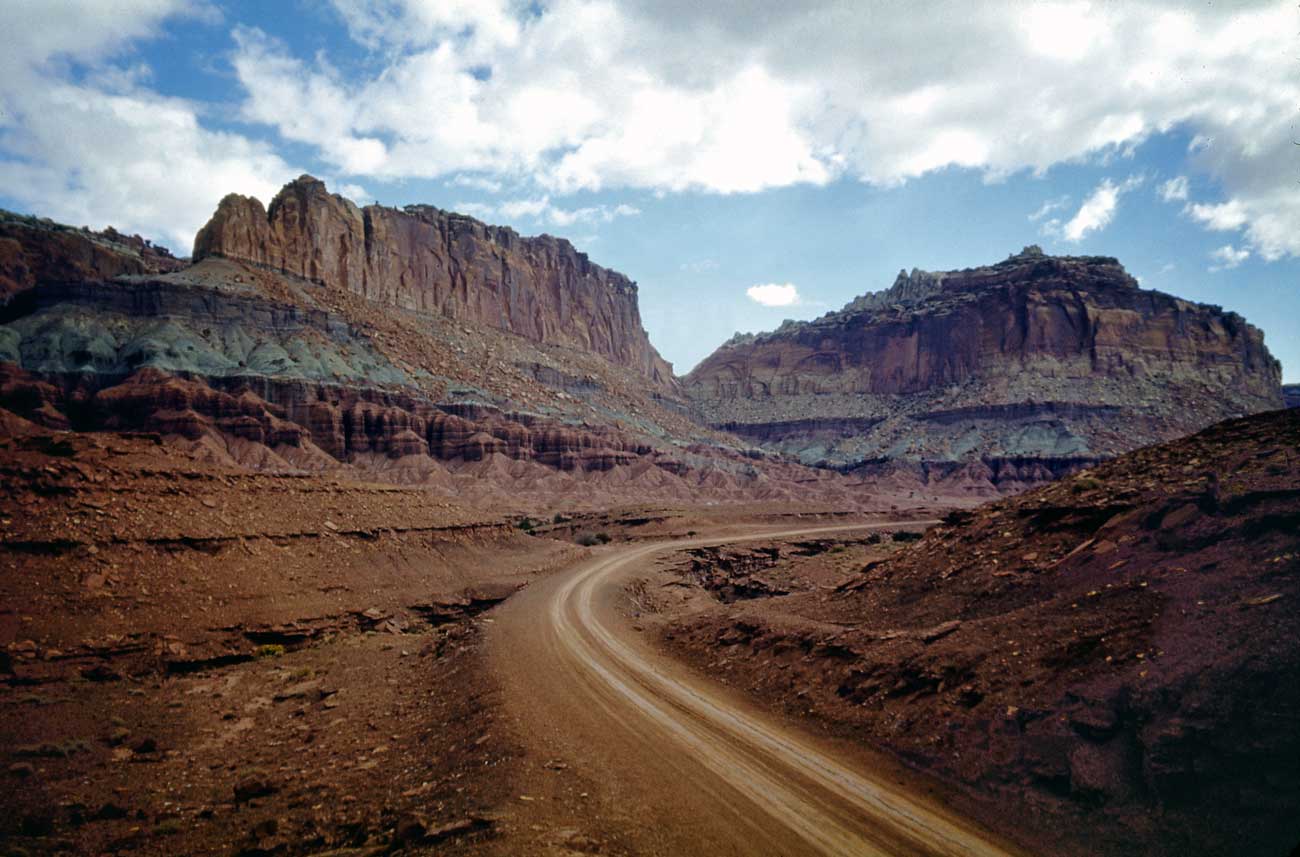
Our Daily Sykes #359 – In The NEIGHBORHOOD of CAPITOL REEF . . .


(click on photos to enlarge)


On a spring day in 1985 Raymond and Zia Hachiya purchased the “Brewer House.” It was named for the Walla Walla family that built it in 1890 as a Victorian show place for the 40 acres they platted in reasonable hope of making their fortune in the central district of what was then a roaring and generally lucky Seattle. They named their addition after Walla Walla. At the southeast corner of Columbia Street and 21st Avenue, their home was conveniently only five short blocks from street car service to Pioneer Square, or a mile and half walk to the same destination.

The Brewer House that the Hachiyas purchased in ’85 was a wreck, although a stately one. About four years empty, many of the windows were broken out, clapboards had been stripped from the sides and the interior lathe and plaster walls were so broken that photographs taken from one corner looked through the entire house to the farthest corner. On hearing a skulking crow complain from one of the barren cottonwoods on the lot, a relative visiting during the first winter described it as a “bad omen.” But as Zia explains “I had always wanted a Victorian.” And with Raymond’s help, judicious planning and perseverant searching for authentic materials they got one, both outside and in.

In 1892 or ‘93 Adora Bell and Louella Mae, two of the Brewer’s nine children, posed on the front porch for this recording of their nearly new Victorian. The timing is derived from the understanding that Louella, the smaller one, was born in the house. 1893 was also the year of the great economic panic, which was followed by a sustained depression. The Brewer’s central district dreams were not so enriching and after ten years they returned to the original Walla Walla.


Anything to add, Paul?
In the hours left for me before nighty bears* I’ll go fishing for homes – mostly – treated with other Pacific features in the past 29 years. There are a few less than 200, and the ones chosen – about 20 if there is time – will be the ones most readably found. It reminds me of fishing with my dad from a row boat in Lake Newman, a few miles east of Spokane, waiting in a bay for the fish to come to us. We arrived at the moment the state’s fisheries tanker started spouting trout – a restock – into the lake. Within an hour we had two buckets full. There was no limit, except to dad’s conscience. He said, “That’s enough.” We left for home. I was about ten. We shared the trout with neighbors.
* Bill Burden copyright meaning “going to bed.”
I confess that I will trust the text as found in the files – I will not change a thing. There will, of course, be plenty of time references that are now long past, but I wont change those either.

Sited on the “edge” of Phinney Ridge in upper Fremont the Fitch-Nutt House looks west over Ballard to the Olympics. A Works Progress Administration photographer recorded this view of it in 1937 as part of the WPA’s late 1930’s survey of every taxable structure in King County. (Courtesy, Washington State Archive, Bellevue Community College Branch)

THE FITCH-NUTT HOUSE
This landmark Fremont Neighborhood residence at the northwest corner of Phinney Avenue North and North 44th Street will have its fate decided soon. Should this rare “Vernacular Victorian” be rescued and restored as a local architectural treasure or should it be razed for more town houses?
Called the Fitch/Nutt House, it is named for its first two builders. The carpenter Jackson D. Fitch was first, building the less adorned western side of the house soon after he purchased the corner in 1899. In 1902 Thomas W. Nutt followed, adding the distinctive one-and-one-half story front section with its trinity of gables or dormers and decorative bargeboards. From its back looking west over Ballard and from its front watching the electric trolley’s that first rumbled by on Phinney Avenue in 1905, this working family home was ideally sited with sublime views of the Olympics and speedy connection to all parts of the then booming city.
Local historian Greg Lange in his search for homes in Seattle that were built in 1905 or earlier and still retain most of their original architectural integrity includes the Fitch-Nutt house in his “top 100” list. And now Paul Fellows and Carol Tobin, members of the Fremont Historical Society, have submitted this surviving feature of old Fremont to the Seattle Landmarks Preservation Board for protection. (I transgress my pledge above not to fuss with time corrections to note that this effort to preserve the Fitch/Nutt house was a success – at least at the start. The home was registered on the official landmarks list.)

The recently completed IDX Tower now covers the moving footprint of the Stacy Mansion that was first built on 3rd Avenue in 1885 and later moved 90 degrees to face Marion Street, where for 35 years it was the home of La Maison Blanc Restaurant. The Rathskellar bar was built below it at the sidewalk. The Rathskellar featured costumed Bohemian bar maids serving – during the Great Depression – 25 cent lunches. (Historical pix courtesy Seattle Public Library)

MAISON BLANC RESTAURANT
Real estate pioneer Martin Van Buren Stacy brought an inherited wealth to the cash poor west and bought Seattle land. He also built two mansion-sized homes. Here we see the first of these at 308 Marion Street in 1959 its last full year. Werner Lenggenhager, the photographer, was one of the more prolific of recorders of state landmarks. The year he took this photograph of the brilliantly white La Maison Blanc Restaurant Lenggenhager was awarded the Seattle Historical Society Certificate of Merit. With a few thousand more prints the original survives in the Seattle Public Library.
When Martin and Elizabeth Stacy built it in 1885 for a fortune as high as its ornate cupola — $50,000 — their French Third Empire styled mansion was one of Seattle’s three grandest homes. Henry and Sara Yesler and Jim and Agnes McNaught owned the others. The Yeslers and McNaughts generally got along. Martin and Elizabeth did not. In her 1944-45 weekly Times series on Seattle mansions, Margaret Pitcairn Strachan notes that “everyone admits she wore the pants of the family . . . He’d talk and joke and swear a lot – until she showed up. Then he’d never open his mouth.” This may explain why once finished their grand home stood empty until the couple moved in for only a little more than a moment before relocating to a second mansion on First Hill. Even then Martin was more likely to stay in a hotel or club than at their new home that later became the University Club which survives at the northeast corner of Madison Street and Boren Avenue.

For a brief period beginning in 1890 this Stacy home on Marion was quarters for the Seattle Chamber of Commerce. Next it was converted into what must have been the most sumptuous boarding house in town. But what followed the boarding is what is still remembered by many Pacific Northwest readers. In the mid-1920s Charles Joseph Ernest Blanc turned the mansion into what many considered to be Seattle’s best restaurant.
In her 1937 guide “Northwest Novelties” Elisabeth Webb Herrick writes “For the adventurous eater, the menu holds fatal lures. Green turtle steaks, reindeer meat, frogs’ legs, escargots, eels . . . Oh you can have a wonderful time here with a $5.00 bill. Just the two of you.” La Maison Blanc kept dishing out romance and French delicacies until the interior was scorched by fire on April 30, 1960. Within two months it was torn down.

This repeat looks north over W. 58th Street (once also known here as Ballard Place) to a mansion whose institutional uses are not obvious because the large rooftop neon sign for the Simpson Bible Institute is seen only on edge from this point of view. After the bible students moved on to Edmonds in 1977 the site was developed with townhouses.

SIMPSON BIBLE COLLEGE – aka PHINNEY RIDGE MISSIONARIES
If the King County Assessors form has it right then this oversized home at 101 W. 58th Street (three blocks west of Woodland Park) was built in 1911. Ten years later the then new Simpson Bible Institute purchased the mansion and its 3-acre lot and built a four story 63-room dormitory behind and below it on one of the steepest parts of Phinney Ridge. While the dormitory was Spartan in the extreme, the mansion with its large covered porch, graceful rooflines and diverse windows retained its external grace. That the inside was carved-up to conform to the needs of the bible college silenced any issue of saving the structure when the college moved out more than a half century later.
This is one of a few views of the mansion found in a photo album that dates from the late 1920s. One of the scenes shows what is probably the mostly coed student body posing with a slender dark-suit that may be the school’s president but is surely not Albert Benjamin Simpson for whom the school was named one year after his death. In 1887 Simpson founded the Christian and Missionary Alliance in Nyack, New York. He was a “born again” enthusiast for sending missionaries to foreign lands and students at the Simpson Institute would probably have considered that calling – excepting personal salvation – the greatest. The school’s 1938 catalogue notes Seattle’s strategic status as the “Gateway to the Orient.”
Judge by its daily schedule school routines were indeed soul searching. Students were awakened at 6:30 a.m. for half hour devotion. Chapel at 8:30, noonday missionary prayers from 11:30 to noon, after supper prayers in the dining room, and meditations from 10:00 to lights out a half hour later, completed an “extra-curricular” schedule that was semi-monastic.
The Simpson Institute closed in the mid 1950s but the campus was soon revived with the Puget Sound Bible College. After it too moved out for new quarters in Edmonds in 1977 this oversize triangular lot was converted into modern townhouses.

Friends of Admiralty Head Lighthouse, left-to-right, Doris Nothcutt, Linda Neinhuis and Tom Randall, repeat the 1871 poses of Lighthouse keeper Daniel Pearson and his wife and daughter. The Friends stand many feet lower than the pioneers for the Whidbey Island bluff here was scraped for the construction of the large “disappearing guns” of Fort Casey at the turn of the last century. The second lighthouse that replaced the first a century ago can be glimpsed in the distance just behind Randall. (Historical Photo courtesy of Friends of Admiralty Head Lighthouse. Contemporary Photo by Steve Kobylk.)

ADMIRALTY HEAD LIGHT
In the spring of 1871 one of the great innovators of pioneer photography traveled the West Coast between Puget Sound and San Diego photographing lighthouses for the U.S. Lighthouse Board at a fee of $20 a day. Born Edward Muggeridge at Kingston-on-Thames in England in 1830 he would become inventive with both his camera and name. By the time the 41 year old visited Whidbey Island and the first lighthouse at Admiralty Head Edward had changed his name to Eadweard Muybridge. Soon after he began his famous motion studies of horses (and much else) running and jumping, experiments paid for by Leland Stanford (of the University).
The trio posing for Muybridge is most likely Lighthouse keeper Daniel Pearson, his wife and his daughter Flora who was her father’s assistant. At the time Eadweard was either courting or married to (biographers are not certain which) a different Flora who was half his age and waiting back in San Francisco – sort of. In the fall of 1874 Muybridge shot and killed Flora’s lover, and a jury acquitted him. Flora Pearson loved better. After marrying a Whidbey Island pioneer, and taking a San Francisco honeymoon, she returned to her duties in 1876 – at $625 a year – of assisting her father for two years more until they both retired to a farm with their respective spouses.

Topped by its red lantern room the two-story frame Admiralty Head Lighthouse with tower first turned on its whale oil fed Fresnel lens on January 21, 1861. After passing the light at Dungeness Spit captains aimed their schooners at the fixed light on Whidbey Island in order to avoid the shallows off Point Hudson. This old light was moved for the construction of Fort Casey and then also replaced in 1903 with the elegantly stucco-covered brick lighthouse that later this month is celebrating its centennial. Designed by famed lighthouse architect Carl Leick the 1903 light is a magnet for lighthouse enthusiasts around the world and appears on a U.S. stamp as well. A great variety of public events are planned for the weekend of the 23rd and 24th – including performances by the Ballard Sedentary Sousa Band and the Straits of Juan De Fuca Barbershop Chorus.

The line of residents of the big brick home at the northeast corner of Boren Ave. and University Street saw how quickly changes came to First Hill. Built in 1904 for the Banker Manson Backus it became a boarding house during the Great Depression and was vacant when it was destroyed in 1956 to be ultimately replaced by the Panorama House.(Historical photo courtesy of Washington State Historical Society.)
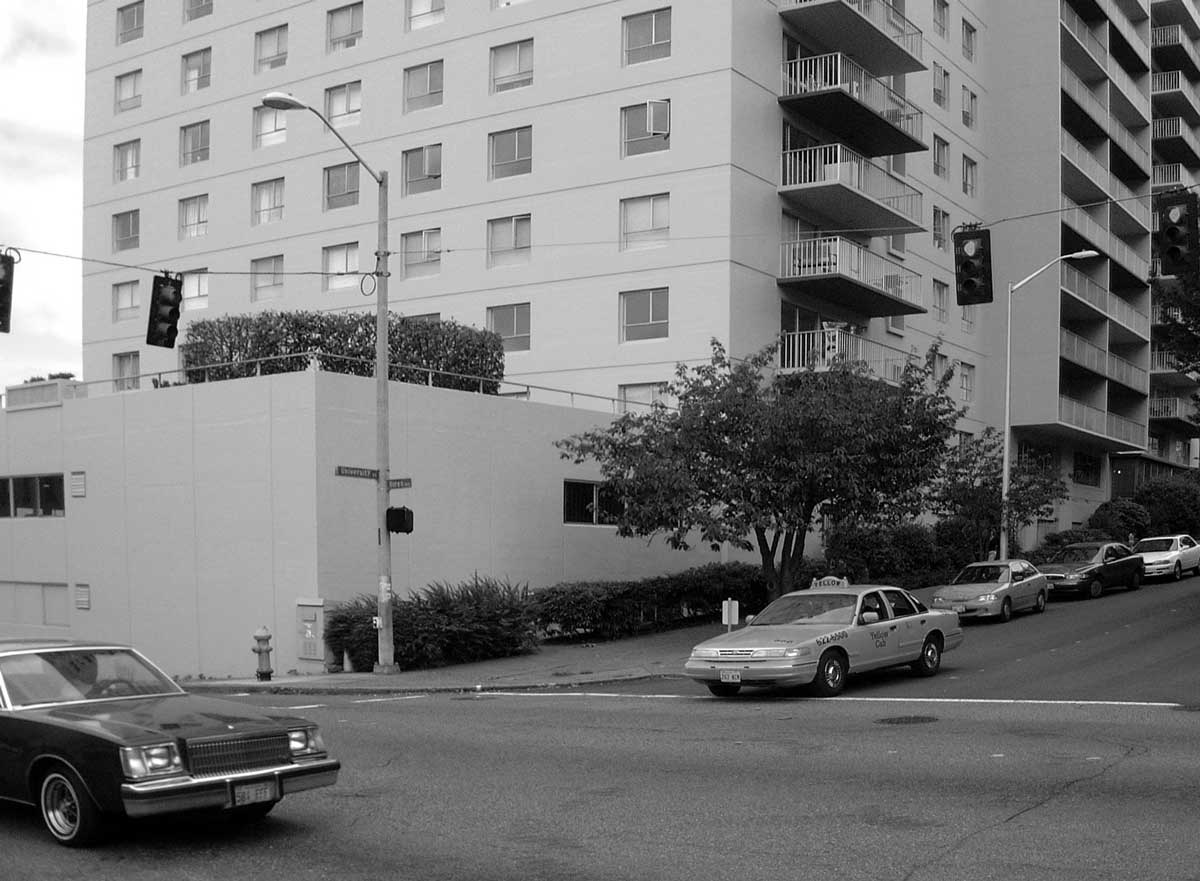
THE BIG BRICK HOME of BANKER MANSON BACKUS
Thanks to a 47 year old tip from Seattle Times writer Alice Staples that may well be Carl A. Peterson at the wheel of the motorcar posing at the northeast corner of University Way and Boren Avenue. Behind the driver and his riders is the brand new oversized home of the banker Manson Backus. Staples wrote a eulogy for the Backus home – and three others shown here – in the spring of 1956 when they were about to be torn down for a modern high rise. She interviewed Peterson.
For a half-century C.A.Peterson was a chauffeur of choice on First Hill. He drove for Backus and others and taught many of his employers to drive. He told Staples, “I watched them build this house in 1904.” Manson Backus the Second – the banker’s grandson — described for the reporter the red mahogany living room with a nearly 12 foot wide fireplace, the wide staircase that wound itself to the third floor, and his banker grandfather’s two electrically operated secret panels that he used as safety vaults.
The Mayflower descendent Backus came to Seattle from New York in 1889 with securities already in his pockets and started the (many times renamed) National Bank of Commerce. By the time the bank president moved into this big home he had lost two wives but had two children. His son LeRoy lived with his own family (including Manson the Second) next door on Boren, here to the left. As high-rise apartments first began to replace the mansions on First Hill many of its established families – Backus included – uprooted to the Highlands.

The present owners of 4221 Linden Avenue used the above WPA tax photo from 1937 as a guide for restoration. The restoration if below. (Courtesy Washington State Archive, Seattle Branch. Tel # (425) 564-3942.)

A RIGHTEOUS RESTORATION
The story of what its owner, Heather McAuliffe describes as a “worker bee home” in Fremont has concluded its first century with a restoration so conscientious that we are inclined to call it an “architectural redemption.”

When the first owner, a plasterer named Alfred Bartlett, moved into 4221 Linden Avenue in 1904 it was a modest clapboard distinguished by decorative gables with brackets, ornamental fish-scale shingles, old-growth porch columns, double-hung windows with crowns. When Heather and her husband Shawn purchased the home in 1998 it was sans everything – except the clapboards. For a half century they hid beneath clumsy rows of oversized cedar shakes. Most distressing, the original windows had been replaced by sliding aluminum ones. Even before they moved in Heather McAuliffe announced, “Those windows have to go or I’m not living here.” And now five years later gone they are, and the siding too.
Like many other King Country residents McAuliffe consulted a WPA tax photo of her home for a look at what had been destroyed or hidden since the late 1930s. She took the additional step of religiously restoring it.

The House Upside Down stood on the east side of the midway called the Pay Streak that was the carnival street for the 1909 Alaska Yukon Expo. Held on the U.W. Campus. It teetered about 700 feet north of Portage Bay on a South Campus site that is now part of the U.W.’s Magnuson Health Sciences Center. (Historical photo courtesy of Dan Kerlee.)

HOUSE UPSIDE DOWN
For this feature readers may wish to turn the magazine upside down for a conventional introduction to the eccentric subject of the House Upside Down. Next return Pacific to its proper posture and note the gigantic piano on the far right.
The Pianotorium and the House Upside Down (HUD) are two of the thirty odd amusements erected along The South Pay Streak of the Alaska Yukon and Pacific Exhibition (AYP) held on the University of Washington campus through the warmer months of 1909. These two architectural grotesqueries were propped midway between what is now the Burke Gilman trail and Portage Bay in line with Stevens Way – if it ran this way through the south campus, which is does not.
Conforming to AYP expectations, the House Upside Down also had a scientific apology. Henry Roltair, its manager, advertised HUD as featuring within it the “highest development of optical illusions and scientific information regarding optics.” Outside Roltair’s “barker and ballyhoo” pitchmen promised a more extreme science for those who handed across their dimes. Inside, they promised, were “labyrinthine circumvolutions of mazy wonders” and “mutliflexuous anfractuosities” that would “simply paralyze the imagination.”
This snapshot and these quotes all come from Dan Kerlee, the local AYP scholar-collector. Kerlee discovered that by the time Roltair came to Seattle he and his HUD were old fair attractions. In 1901 for the Pan American Expo at Buffalo, Roltair erected a HUD that aside from a few ornaments was the same as this one on the carnival midway of the AYP.

This Craftsman Bungalow on 62nd Ave. SW near Alki Point (was) one of the nine destinations included in the 10th Annual Homes With History Tour, produced by the Southwest Seattle Historical Society. (Historical photo courtesy Washington State Archives. Contemporary photo by Brooke Best.)

HOMES WITH HISTORY
Some readers may remember the once popular “progressive dinners” in which, say, the eager and eligible members of a church’s youth league would pile into cars and drive from host to host consuming a new course at each stop. This coming Saturday June the 5th from 10:00 am to 4:00 pm the Southwest Seattle Historical Society (SWSHS) will run its 10th annual Homes With History Tour. (This is dated by more than five years.) Here, of course, it is not potato soup or marshmallow Jell-O that is gobbled but heritage, architecture and something that the cliché “life style” seems to keep covering.
There are nine stops in the Saturday tour and since the Southwest Seattle is far flung you will want to drive. The historical society provides the list of sites, an open door to each and hosts that “interpret” the several landmarks and answer questions.
This Craftsman bungalow at 3253 62nd Ave. SW is one of the stops for the sufficient reasons that it is a fine example of one of the region’s most popular home styles and that the present owner is willing to share her delight in its typical and sturdy qualities. Built in 1907, this is an old bungalow. The historical photo dates from 1937 when catalogers were beginning to gather names for the 1938 Polk City Directory, which lists Fred and Esther Wheeler living here. Perhaps those are the Wheeler kids on the front steps. Fred worked as a laborer for the city’s department of engineering. Wages were low, living was often a pinch and the Wheelers were renters.
This year the tour stretches “domesticity” by including the Log House Museum, the newly renovated West Seattle Carnegie Library, the century old Homestead Restaurant (would that the home tour were also a progressive dinner!) and the Alki Point Light House. Since 9/11 this last has been harder to visit so here is your chance to visit the light that is about four years younger than the bungalow.
These annual tours are also fund-raisers for the Southwest Seattle Historical Society but the modest fee is well spent. Of course, you are encouraged to fill your car with family and/or friends that share your interest in community history and appreciate the open arms that will greet you at each place along the way. You may wish to call (206) 938-5293 for details or contact the society.

The Ranke home at the southeast corner of Terry Avenue and Madison Street was once one of the great mansions of First Hill. Built in 1890-91 it was razed in 1957 for an extension of the Columbus Hospital. Presently the home and hospital site are owned by the Cabrini Sisters and are being prepared by the Low Income Housing Institute in two stages for a mix-use development that will feature for the most part low income housing. This, of course, is by now a done good deed. (Historical view courtesy Lawton Gowey)

RANKE HOME
When new in 1891 Dora and Otto Ranke’s First Hill home was appropriately baronial for a family of six and one of the Seattle’s most prosperous pioneer contractors. The mansion was lavishly appointed with carved hardwoods, painted tiles, stained glass, and deep Persian rugs. On the first landing of the grand stairway was a conservatory of exotic plants including oversize palms that grew to envelope the place.
Also inside were the family’s famous traditions of performance and fun. The Rankes were married in Germany and immigrated together. Dora was a dancer and Otto a tenor. Together they supported and performed in the local productions of Gilbert and Sullivan’s comic operas. The couple also helped found the Seattle Juvenile Opera Company giving it rehearsal space in their home and instructions from an imported coach.

Perhaps the most surprising moment of Ranke family theatre was the informal one noted by Margaret Pitcairn Strachan in her 1944-45 Seattle Times series on Seattle Mansions. After Dora confounded Otto by declining to accompany him to a masquerade ball at Yesler’s Hall, she sneaked down in a baby costume with baby mask, and baby bottle. Dora danced with many men and sat on the laps of many more – including her husband’s although he did not know it was she – offering them a drink. Near the end of the evening with the judging of the costumes, Otto, who was one of the judges, “was chagrined to find he had awarded a prize to his wife.”

Most of the Ranke’s playful life was centered in their home at Fifth and Pike. Otto had little time to enjoy this their third Seattle home. He died in 1892. The family stayed on until1901 when the house was sold to Moritz Thomsen. The last occupants were student nurses training at Columbus Hospital that much earlier had been converted from what was originally the Perry Apartments, the large structure seen directly behind the Ranke Mansion.

Whatever its name or primacy the Alki cabin in this photograph was razed in the fall of 1892. The photograph is not dated. Its site may have been lost as well – temporarily. The contemporary photograph looks towards the corner of Alki Avenue and 63rd Avenue S.W., the original location of the Founder’s pylon that commemorates the builders of this log cabin. (The pylon has long since been moved across Alki Avenue.) Historical photo courtesy of Seattle Public Library.

LOW DOWN ON THE DENNY CABIN
Our punning headline plays with the uncertainty about this celebrated photograph. Is this the Denny Cabin or the Low Cabin? To add to the confusion, for reasons that still grieve John and Lydia Low’s descendants, the Low Cabin is most often called the Denny Cabin?
After scouting and then choosing Alki Point for a townsite John Low hired the teenager David Denny to build a cabin beside Alki beach while he returned to Portland to bring back his family and the rest of what later became known as “The Denny Party” and not the Low Party. The foundation was laid on Sept 28, 1851 and when the immigrants (22 of them) arrived on the schooner Exact on Nov. 13th the cabin still had no roof. Injured by his axe, a dismal David welcomed his older brother Arthur so, “I wish you hadn’t come.”

While building a second cabin – the Denny Cabin – the dampened settlers crammed into the Low Cabin. So the Low Cabin was first cabin, but in practically every printing of this photograph the structure is described, in some variation n, as “The Denny Cabin, the settler’s first home on Alki.” I think it is the Low Cabin. Greg Lange, of the Washington State Archive, thinks it is the Denny Cabin – or the second cabin.

Both Greg and I are members of the growing “CABIN COMMITTEE”—hitched to the Southwest Seattle Historical Society. (Since this is a committee without meetings you might like to join.) Members agree to two collective goals. The first is to investigate and share the early history of the Alki townsite and its architecture. The second is to identify where this cabin sat, and for this our standard is both liberal and circumspect. We want to locate it to within “the length of a medium sized horse, from nose to extended tail.” (The CABIN COMMITTEE failed to make its public report on Nov. 13, 2005, the centennial of the First Founders Day and the dedication of the Alki Beach landmark, the “Birthplace of Seattle” Pylon. It – we – need more time.)

From 1894 to their deaths in 1928 Henry and Kate Holmes raised their family in the ornate Victorian mansion seen here in part at the center of the historical scene. The residence in the foreground that survives in the “now” view was for many years the home of one of the Holmes daughters; Ruth Huntoon and her lawyer husband Richard. The historical photo is used courtesy of their grandson, also an attorney, Peter Buck.

THE HOLMES HOMES
In 1894 the retail-wholesale druggist Henry and his wife Kate Holmes followed the increasingly fashionable move to the ridge overlooking Lake Washington. Their grand home was three houses north of Jackson Street on 30th Avenue S and consequently conveniently close to the Yesler Way Cable Railway. When the Holmes moved in the Leschi neighborhood was already clear-cut and the view east unimpeded. Now the lofty greenbelt of Frink Park partially obscures it.
From whomever the couple bought the well detailed and mansion-sized Victorian – (the tower rises here at the center of the scene) they may have got it at a good price from an owner injured by the nation-wide financial crash of the year before. And the purchase may have also been speculative for it was expected by many of their neighbors that one day the ridge would be lined with hotels and apartments.
But the Holmes stayed put and raised a family of fours daughters and a son. As each grew to maturity they stayed on the block building homes beside their parents and creating thereby a kind of Holmes family compound. The larger modern bungalow in the foreground was built in 1910 (if you believe the tax records) for Ruth Holmes Huntoon and her lawyer husband Richard W. Huntoon, and they lived there for many decades. After the druggist and his wife both died in 1928 none of their children wanted to live in the ornate mansion of high ceilings and winter drafts. So it was razed in 1929.
A stand alone showing of the old Holmes home is featured on page 116 of “Leschi Snaps”, the third of Wade Vaughn’s books on the neighborhood. Of the three, this photo essay is the best evocation of Vaughn’s sensitive eye for his surrounds and like the first two it can only be purchased at the Leschi Food Mart. The proceeds all go to the Leschi Public Grade School Children’s Choir.

While the historical photograph is neither dated nor are it posers named, the home is identified as the last of the Bell residents in Belltown. A likely date is the mid-1880s. Like the Parking lot that replaced it, the Bell home faced First Avenue between Bell and Battery Streets and so in the heart of Belltown. Historical pix courtesy Museum of History and Industry.

BELLTOWN HOME
This is the last of the Bell family homes in Belltown. It faced First Avenue from its east side about mid-block between Bell and Battery Streets. Counting a temporary home near Pioneer Square this is the fourth Bell home. The family moved both around and away.
During the Indian war of 1855-56 the Bells sensibly fled their first finished home to Seattle for protection. That home overlooked Elliott Bay from the low bluff that was nearly two blocks west of this home on First. It was torched during the “Battle of Seattle’ and the fire could be seen from the navy gunboat Decatur that protected the village. After the battle the Bells left for California. Later William returned with his son and several daughters to develop their 320 acres into Belltown. His wife had died in California.
It seems that William Bell moved into this his last home in 1875 with his third wife Lucy, who was the sister of his first wife. William died in the fall of 1887 although he’d been an invalid for six years previous. So if those are Bells posing that is most likely William’s only son Austin posing with his wife Eva and three sisters.
Austin was gregarious, well liked and loved and to quote Edward Arlington Robinson’s famous poem, he was also “imperially slim . . .a gentleman from sole to crown . . . always human when he talked . . . he was rich . . .he was everything.” But also like Richard Cory he “put a bullet through his head.” The son thought he recognized his father’s dementia in himself and explained to his wife with a shaky note that life with such poor health was not worth living.
Austin shot himself in the right temple on April 24, 1889. The day before he was out with a nephew cheerfully describing the brick business block he was planning near the family home. The structure was built by his widow and named by her the Austin A. Bell building. The ornate front façade was landmarked and it survives facing First Avenue.

The Hainsworth home in West Seattle on 46th Avenue SW north of Massachusetts Street is certainly one of the oldest residents in Seattle. Although it has been added onto over the years the home is still distinguished and very fit. Richard and Holly Grambihler, the present owners, are pleased to point out how the strange variation in the number of panes in the two front second floor bedroom windows survives. On the left the pattern is four up and four wide. On the right it is four up and three wide. Such are the pleasures of preservation. Historical photo courtesy Southwest Seattle Historical Society and Log House Museum.

THE WEST SEATTLE PLATEAU
This week and next we’ll feature two William Hainsworth homes. Here is William Henry Hainsworth II Victorian mans on 46th Avenue Northwest overlooking Puget Sound and the Olympics. Next it will be “William the Third’s” home on S.W. Olga Street overlooking Elliott Bay and Seattle. Both distinguished residences survive up on the West Seattle plateau although their neighborhoods are separated by one of the most enchanted and yet hidden natural features of Seattle, the deep and long Fairmount Ravine.
William and Mary Hainsworth, their daughter Betsy and two sons Will III and John moved to the West Seattle plateau in 1889 when, according to the recollection of Will III’s brother in law Arthur Stretch, it was still “covered with second-growth timber and brush.” Both the Stretch and Hainsworth families lived on what the West Seattle Land and Improvement Company named Columbia Street — Arthur Stretch’s father Richard was the engineer who laid it out. The name was changed to 46th when West Seattle was annexed into Seattle in 1907. The fathers of both families – William II and Richard – were English immigrants and by Arthur’s accounting their’s were the first two families to settle there. They and their families were very close with Will III marrying Arthur’s sister Florence.
The 57-year-old Will II moved to West Seattle directly from Pittsburg where he had considerable success building a steel foundry when still in his late thirties. Family tradition, at least, has Andrew Carnegie advising him to stay in Pennsylvania but Hainsworth declined and opened a new foundry in Ballard. It might have taken a while then to get between Ballard and West Seattle but not forever. The San Francisco based developers that promoted the West Seattle plateau outfitted it with cable cars and an 8-minute ferry ride to Seattle.
This may not be the earliest photograph of the Hainsworth home. Another appears in Chapter Three of the West Side Story (page 28) where there is much more about the two families and the early years of life on the plateau.

Apparently when the Hainsworth home on Olga Street was built in 1907 the streets were still only lines on the plat map. The contemporary view looks southwest along 37th Avenue SW. It was taken a stones throw (to the rear) from the Belvedere Viewpoint on SW Admiral Way. Historical View Courtesy of West Seattle’s Log House Museum.

ENGLISH MANOR on OLGA
Last week we featured an early view of William Hainsworth Senior’s West Seattle home on 46th Avenue S.W. Built in 1889 it was one of the first two residences on the West Seattle plateau and it survives. True to our promise then here is the English Manor Manse of William Jr and Florence Hainsworth.
Florence’s maiden name was Stretch, and with the Hainsworths the Stretches was the other of the first two families. They also lived on 46th. When the couple’s grand home was built in 1907 at the southwest corner of SW Olga Street and 37th Ave. SW it was still a different neighborhood from that of the older homes on 46th overlooking Alki Beach. The new mansion was sited so that it could look directly over Elliott Bay to the Seattle waterfront.
In visiting the old homes from the new the couple could not at first easily follow the crow for although there were probably plenty of crows in the deep Fairmount Ravine there was no substantial bridge over it. The Hainsworths were leaders in getting the bridge built.
When Florence’s brother Arthur returned from the Yukon Gold Rush in 1899 he and his brother-in-law William Jr. opened the Coney Island Baths, one of the first on Alki Beach. While Arthur had been digging in Alaska William had been playing it careful with real estate in West Seattle and obviously doing very well at it.
Arthur recalls their pleasant times together in the Hainsworth mansion. “Will and my sister were great ones for entertaining and my wife and I spent many happy times with them. They would have community sings, dances and card parties and their tennis court and croquet field were popular. Every year they held a fourth of July celebration for the whole community with games, picnic supper, and fireworks in the evening … It seems to me that Will Hainsworth always was involved in some civic project for the improvement of the district and he assumed that I would work with him.”

Early members of the Seattle Historical Society pose on the front stairway to the Carkeek mansion at the southwest corner of Boren Avenue and Madison Street. The group portrait reminds us that it was once the practice for almost any group interested in culture – the arts, heritage, and philanthropy – to have been founded, attended, and run by women. Historical photo courtesy Lawton Gowey.

COSTUME PARTY
Except for one man – and can you find him? – none of the costumed members of the Seattle Historical Society posing here is wearing pants. (That little man in the upper-right corner seems to have snuck into the scene.) The front porch of the Emily and Morgan Carkeek First Hill home at Boren and Madison was used more than once for such a group portrait.
The Carkeeks where English immigrants and their children Guendolen and Vivian kept the family’s Anglo-Saxon flame lit. More than a student of the King Arthur legend, the lawyer Vivian Carkeek was a true believer and for years the national president of the Knights of the Round Table. The daughter Guendolen was packed off to England as a teenager for an English education, although she wound up living in Paris and marrying a Russian count. Later she returned to Seattle to help revive the historical society that her mother founded in 1911.
A few of these period costumes are very likely still part of the Society’s collection at the Museum of History and Industry. Although early, this is not the first costume party. That was held on Founders Day, Nov. 13, 1914 and there survives a different group portrait from that occasion. This is probably soon after.
But who are these early leaders in the celebration and study of local heritage? The only face familiar to me here (from other photographs) is that of Emily Carkeek herself. She looks straight into the camera at the center of the fourth row down from the top. Two rows behind her and also at the center, the woman with the large while plume in her hat resembles the artist Harriet Foster Beecher, but it is almost certainly not she.
On March 30, 1915, Harriet Beecher along with the historian-journalist Thomas W. Prosch, pioneer Margaret Lenora (Lenora Street) Denny and Virginia McCarver Prosch all drowned when the Carkeek’s Pierce-Arrow touring car crashed off the Riverton Bridge into the Duwamish River. Only the chauffeur and Emily Carkeek survived.
Both Virginia Prosch and Margaret Denny were involved either as officers or trustees of the historical society and neither of them appears in this cheerful group portrait.

The triplex at Spring and Boren is an example of the distinguished and yet affordable Victorian housing that was typical of Seattle during its boom decades between 1880 and 1910. Although both sturdy and stately many of these structures were short-lived, replaced with larger brick structures like the apartment house that took the place of 1017, 1019 and 1021 Spring Street. Historical photo courtesy of John E. Kelly III.

STAR-CROSSED ON SPRING STREET
Barely detectable, John E. Kelly Jr., the youngest of the then nine Kelly kids, here sits on the lowest of the steps that lead up to 1019 Spring Street, the center address for this triplex of Victorian row houses. It is a short row and compared to some it displays only a modest face of ornaments, latticework, shingle styles and recessed balconies. (However, it may have been quite colorful – a “painted lady.”)
Taking the Northern Pacific Route in only its tenth year as a transcontinental, the Kellys moved here from Waterford, New York in 1893 — just in time for the national depression of that year. Still the Kelly’s continued to prosper and multiply with John Senior opening a popular dry goods store downtown. And John Jr. soon rose from these steps on Spring Street to nurture a Seattle career as an architect.
Next the architect’s son John E. Kelly III continued the family’s talent for professional handiwork with a long career as a naval architect, and a valued activist for heritage with the Sea Scouts, the Puget Sound Maritime Historical Society, the Southwest Seattle Historical Society and, thankfully, Kelly-Gailey family history as well.
John “the third’s” mother Eileen, was the daughter of another First Hill household, the David and Elisabeth Gailey family. While Eileen was attending Broadway High School the Gailey’s bought a hotel, the Knickerbocker at 7th and Madison, and moved in. The maturing Eileen’s creative calendar included piano lessons with Nellie Cornish and courtship with John E. Kelly Jr. the lad on the steps.
It was during their dating that the couple shared a moment of unforseen amusement – a brush of domestic kismet — when they determined that four years after the Kelly family moved out of 1019 Spring Street in 1896 the Gaileys moved in and kept it for eleven years before they left to care for their big hotel.
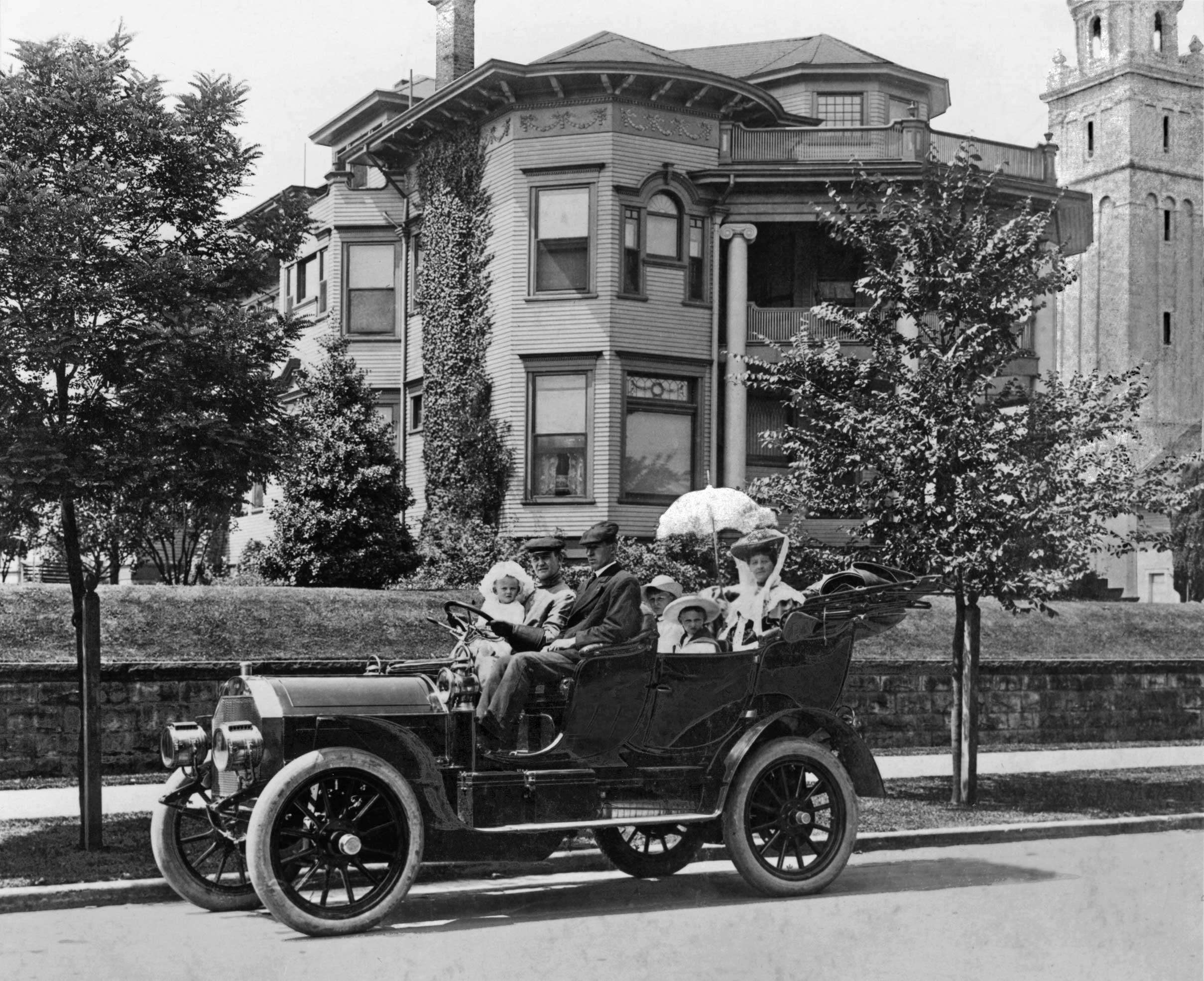
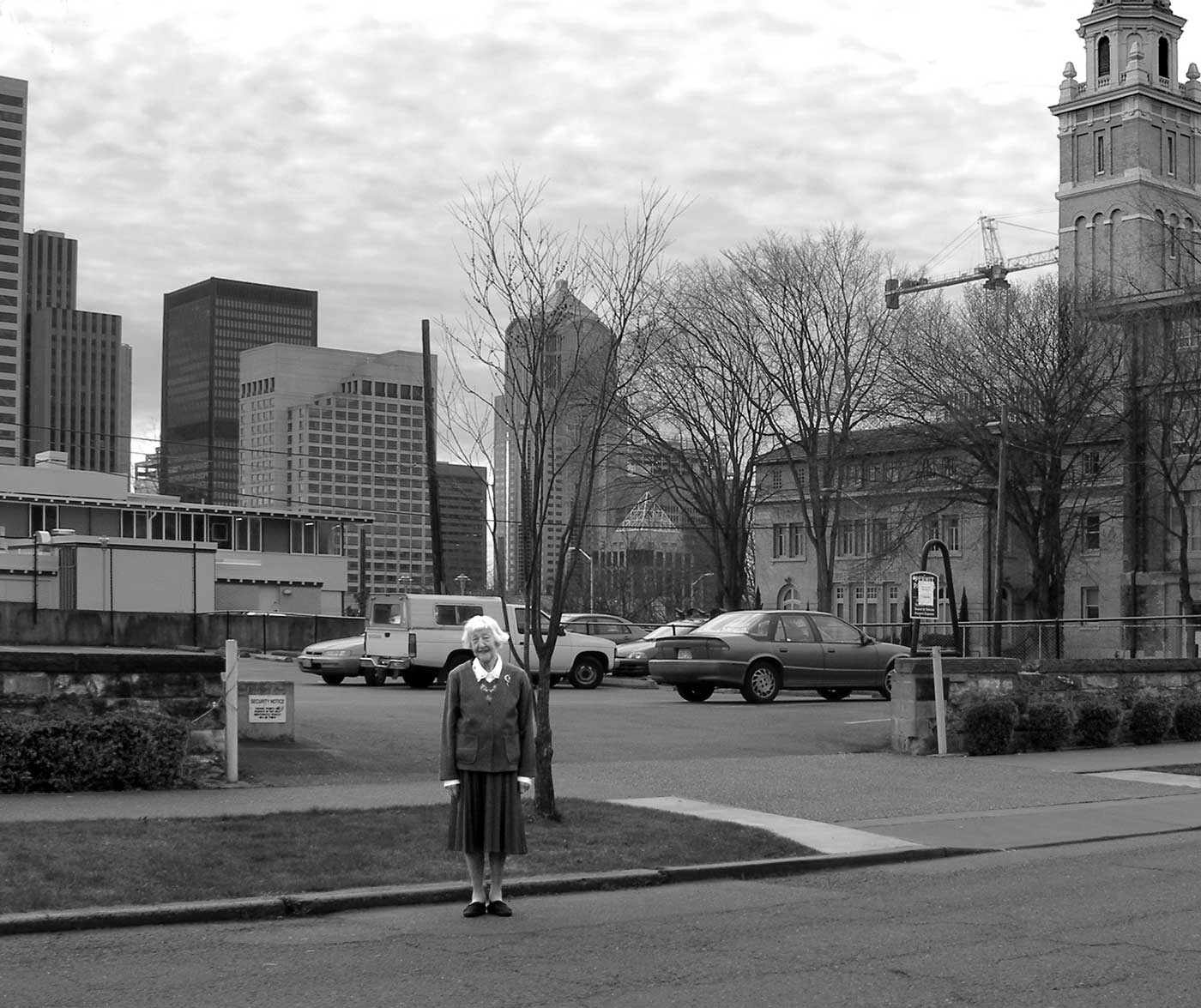
Then and Now Caption together. When Norval Latimer (in the front seat) married Margaret Moore (in the back seat) in 1890 he was the manager of the pioneer Dexter Horton bank. When they posed with three of their children for this 1907 view on Terry Street with the family home behind them, Norval was still managing the bank and would soon be made both president and director as well. Contemporary photo by Sue Champness. Historical photo courtesy of Jody Latimer Maurer.
The LATIMERS of FIRST HILL
There are certainly two artifacts that have survived the 99 years since the historical view was recorded of the Latimer family – or part of it – posing in the family car and in front of the family home on First Hill.
The scene was almost certainly recorded in 1907 because a slightly wider version of the same photograph shows construction scaffolding still attached to the north side of St. James Cathedral’s south tower, far right. The Cathedral is the most obvious survivor. By the time of the church’s dedication on Dec. 22, 1907 the scaffolding was removed. The second artifact is the stonewall that once restrained the Latimer lawn and now separates the Blood Bank parking lot from the sidewalks that meet at the southwest corner of Terry and Columbia.
In the “now” Margaret Latimer Callahan stands about two feet into Terry Street and near where her banker father Norval sits behind the wheel in the family Locomobile. Born on July 22, 1906, Margaret is the youngest of Norval and Margaret Latimer’s children.
For a while, Margaret, it was thought, might be a third visible link between the then and now — although certainly no artifact. The evidentiary question is this. Who is sitting on papa Norval’s lap? Is it his only daughter or his youngest son Vernon? After polling about – yes – 100 discerning friends and Latimer descendents the great consensus is that this is Vernon under the white bonnet. And Margaret agrees. “I was probably inside with a nurse while three of my brothers posed with my parents.”
Margaret also notes that her father is truly a poser behind the wheel, for he was never a driver. Sitting next to him is Gus the family’s chauffeur with whom he has traded seats for the moment.*
The clever reader has already concluded that Margaret Latimer Callahan will be celebrating her centennial in a few days. Happy 100th Margaret.
*The Locomobile used the English configuration for the driver’s position (to the right) until about 1912. Gus (I think his name was Gus.) the normal driver or (that French word) Chauffeur is closest to the camera. He is a big guy with either a lantern jaw or a weak jaw as I remember. On the other side of Gus is Norval. He is all suited up with gloves and riding gear and behind the wheel with his child on his lap. Yes this is Norval and so father is further from the camera than is the big-guy-gus-that-is-not-behind-the-wheel but would normally be because Norval was not a driver and he is only posing like one here.

The Furth family followed the procession of the Seattle’s movers and shakers to First Hill in the late 1880s and built this mansion at the northeast corner of 9th Avenue and Terrace Street. By the early 1900s they had move again, a few blocks to Summit Avenue, and for a few years thereafter their first mansion was home for the Seattle Boys Club. With the building of Harborview Hospital in 1930 Terrace at Ninth was vacated and bricked over as part of the hospital campus. Historical View courtesy Museum of History and Industry.

CITIZEN FURTH
When the Furths moved to Seattle in 1882 their new hometown was enjoying its first buoyant year as the largest community in Washington Territory. (It stepped ahead of Walla Walla in 1881.) In the next 30 years Seattle would roar, its population expanding from about five thousand to nearly 240 thousand, and much of this prosperous noise was Furth’s contribution, the ringing of his wealth and the rattle of his trolleys.
Born in Bohemia in 1840 – the eighth of twelve children – at the age of 16 Jacob immigrated to San Francisco, and managed during his quarter-century in California to express his turns as both a brilliant manager and caring citizen. In 1865 Jacob married Lucy Dunton, a Californian, and with her had three daughters. Once in Seattle with the help of San Francisco friends he founded the Puget Sound National Bank, and was in the beginning its only employee. After Furth built this substantial family home on First Hill he continued to list himself as the “cashier” for the bank. But he was effectively the bank’s president long before he was named such in 1893.
After the city’s “Great Fire” of 1889 Furth is quoted as cautioning his own board of directors to restrain their urge to take advantage of the ruined by calling in their loans. “Gentleman . . . what you propose may be good banking, but it is not human.”
When the 74-year-old capitalist died in 1914 he was probably Seattle’s most influential citizen, president of its big bank, its private power and streetcar company, a large iron works – fittingly named Vulcan – and much else. But it was his thoughtful kindnesses that were memorialized. His First Hill neighbor Thomas Burke noted how Jacob Furth’s “faculty for placing himself in another’s situation gave him insight . . . [and] he always found time to express understanding of and sympathy for the motives of even those who were against him.”

(Jacob Furth would have surely have had his life story told in detail had Seattle historian Bill Speidel managed to live a year to two more than his seventy-six. With his death in 1988 the creator of the Seattle Underground Tours was not able to complete the biography of Furth he was then preparing.)

Then photograph. Built in 1890 the above Victorian vestige on Eastlake Avenue survived until 1961. (Courtesy, Special Collections, University of Washington Libraries.) Completed in 2001 this home, below, to the Howard S. Wright Construction Co., the UW Physicians, and the Pro Sports Club is the third structure to hold the northwest corner of Eastlake Avenue and Republican Street.

VICTORIAN VESTIGE
When it was built in 1890 this steep-roofed Victorian was but one of the 2160 structures raised in Seattle during that first full boom year following the city’s “Great Fire” of 1889. Far to the north of the burned business district the Cascade Neighborhood home was “already somewhat retardataire for its time.” That description is from Dennis Andersen, one of Seattle’s more productive architectural historians.
Andersen first discovered this photograph in the 1970s when the then still young scholar took care of the University of Washington Library’s collections of historical photography and architectural ephemera. It is one of several photographs held there that were recorded (ca.1911) along Eastlake Avenue by James P. Lee — for many years the Seattle Department of Public Works photographer of choice.
The historian’s “retardataire” remark refers principally to the ornamental parts of the structure, it fanciful roof crest and the beautified bargeboards of its steep corner gable. (We know from a photograph taken of its rear façade as late as the 1950s that those wheels with spokes were attached there as well.)
Andersen both reflects and laments. “It looks like a pattern book house to me and really more at home in the 1870s or early 1880s. Also the protruding corner bay is an unusual feature that may have been added to enliven the design a bit. It’s a great photograph of a house that we are sorry to see is gone.”
At the northwest corner of Eastlake Ave. and Republican Street this delightful but mildly anachronistic residence survived until 1961 when big changes across Eastlake – the construction of the Seattle Freeway – razed it for a three story commercial structure that was for years home to the Fishing and Hunting News.
[ See BREWER HOUSE ADDENDUM for a rear view of this corner home dating from about 1950, in the latter-day years of it dilapidation.]

A half century ago – nearly – the Wallingford residence, above, at the southeast corner of 44th Street and Meridian Avenue was smothered in asbestos siding and shorn of much of its original charm. Since its imaginative restoration in the 1990s the home is a Wallingford Landmark. Historical photo courtesy Washington State Archives, Bellevue Community College branch.

A WALLINGFORD PLANATION
Chris and Mary Troth moved into their “classic Seattle box” at the southeast corner of 44th Street and Meridian Avenue (in Wallingford) as renters in 1993. In less than a year they persuaded their absentee landlord to sell it to them, and since the couple first met in architecture school at the University Oregon their new home was perhaps inevitably in store for more than a fixing-up.
The first sensitive “issue” was the concrete asbestos shingles that were sold sometime after WW2 to a former owner by some persuasive siding salesman. They appear in the 1957 tax photo printer here. An earlier tax photo from 1937 – not printed here – shows the home with its original clapboards. That depression era photo was a guide for the couple’s restoration, and like many homeowners the Troth’s found that most of that old wood siding that the ’37 photo showed was still intact when the asbestos was removed by masked men in white uniforms.
The “plantation effect” followed the couple’s decision to add a second open floor while restoring the original front porch. In 1917 when the 1908 residence was first converted into a multifamily dwelling, the steep and exposed stairway to the second floor, showing in the 1957 photograph but not the “now”, was attached to the building’s south façade. The landlord Troth’s desire to reach their second (and third) floor apartment out of the rain drew them into the labyrinthine variance process required to get permission to build their inspiring two story portico.
Fortunately for the couple and Wallingford they won, and to the perhaps uniform delight of their neighbors their corner home more than hints of New Orleans. Their box is now a Wallingford landmark – the neighborhood’s plantation. The colors are white, a golden-orange named “Jubilation” by its manufacturer, and a dark red, which Mary Troth explains acts like the home’s “eye-liner.”


Above: The two Seattle Gas tanks behind the Pioneer Denny home were constructed in 1907 when some of the Denny’s fruit trees were still producing. Built in 1871, the here, in 1911, abandoned and soon to be razed home faced Republican Street, on its north side between Dexter and Eighth Avenues. Courtesy, Lawton Gowey Below: Looking northeast across to a Republican Street between Dexter and 8th Avenues that was lowered considerably during the 1911 regrade.
[An attentive reader named Joshua has pointed out that one cannot ordinarily see the Space Needle when looking northeast across Republican between Dexter and 8th. I chose the wrong picture, and will next attach the correct subject below the wrong one for which you might like to find a proper home.]


A DRY REPUBLICAN HOME
I first stumbled upon the accompanying photograph of David and Louisa Denny’s home in a Seattle Times clipping dated Sept 7, 1911. The typical stack of headlines to the story is instructive but also melodramatic, and their bark is mildly silly. They read . . . “Pioneer Home Makes Way to Onward Rush of Busy Metropolis. Ruthless Steam Shovel Encroaches on Site of Old House Built by Late David T. Denny in 1871. Dwelling was pride of Little Village. Landmark, Which Falls Latest Victim to Progress, Was Scene of Many Social Gatherings in Days Long Past.”
Louise and David Denny’s home faced Republican Street at the north end of Denny Hill. The pioneer couple, of course, named it “Republican” for obvious reasons. Here the street is being lowered about twenty feet below its old grade. This was their first big home and with its extensive garden both were typically described as “overlooking Lake Union.” The front door, however, looks south in the direction of the city, although in 1871 it was still far from town and nearly surrounded by a forest that this original pioneer family continued to harvest for many years more. After 1882 the family could see the largest lumber mill in King County at the south end of Lake Union, and they owned it.
The Denny’s lived here until 1890 when they moved a few blocks west to an ornate pattern-book mansion at Mercer Street and Temperance Street, another Denny street name. The Republican Denny was also a tea-totaler and by the time of his death in 1903 his political preoccupations were better served, he explained, by the Prohibition Party. Certainly, the “many social gatherings” in all their homes – beginning with the log cabin near the waterfront foot of the Denny Way – were consistently dry.


I assume this is Crater Lake although while taking a Google trip around the rim I was unable to find a horizon like that small portion showing above. I did find examples of a rock guard that resembled – at least – the one Sykes chose to include here. His use of the rocks on the right is analogous to his attraction to trees and bushes that one sees so often in his landscapes standing nearby. Don’t they?
Every Saturday morning from 8 to 12:30 , in the town of Thiviers, capital of Foie-Gras in Périgord in the South West of France, there is a traditional market of producers, it is marvelous to buy food and also to meet friends and neighbors to tell them one’s last adventures since the previous Saturday…
Chaque samedi matin se tient le marché de Thiviers capitale du foie-gras en Périgord, c’est merveilleux d’y faire ses courses et aussi de rencontrer ses amis et voisins pour se raconter les dernières aventures depuis le samedi précédent ..


Like fingerprints, the little headlands are, or so it would for now only seem readily findable. I have piloted Google Earth ‘Copter north from the California Line along the coast and not found anything that resembles this landscape. Because it is the Oregonian Sykes I assumed – and still do – that this is most likely along that coast. The Washington coast has fewer places where a road follows the shore so closely and also wetter, or seems so, and so I think it most likely Oregon or possibly California, and surely not Utah.

(click to enlarge photos)


Motorman D.E. Stiles, Conductor P.J. Donnelly, and about 20 passengers were outbound on a Madison Street trolley on the Friday afternoon of Jan 9, 1920, when it jumped its slippery tracks while “dropping” about 40 feet through the steep block between 18th and 19th Avenues. Feeling the car leap forward, Stiles told the police that he applied the breaks but to no effect. Standing at the back platform conductor Donnelly would up with a sprained back. He speculated that he had been thrown against the metal railing there, but added that “I simply can’t remember anything about it.”
After the streetcar sailed across Madison it jumped the curb and smashed into the front door of Youngs Grocery at the street’s northeast corner with 19th Avenue. Residents of the several apartments above the grocery were described in the next day’s Seattle Times as “severely shaken by the impact.” (It is not a “reach” to imagine that some of them have here joined the small crowd in the street to inspect the damage.) As a precaution, passenger Minnie Aldrich, collapsed in shock from the excitement, was taken to the hospital but like Conductor Donnelly she was soon released and taken home, although not by trolley. After being counter-punched in a few places by Young’s Grocery, the abused streetcar was again put to its tracks and drove home to the car barn under its own power.
In spite of its potential for mayhem, the municipal trolley wreck of Jan. 9, 1920 was a mere incident, unlike the tragic derailment on the Green Lake line five days earlier when seventy passengers were injured and one killed. Naturally, the wreck on Madison was felt citywide as a foreboding aftershock to the Green Lake accident. It was also more evidence that the streetcar system that the city had recently purchased from its private builder at an imprudent price was even more dilapidated than thought.
Anything to add, Paul? Yeseree Jean. As you know the above subject came to us from the blog’s own Ron Edge. First we’ll put up some more photographs and related clippings that come from Ron and have to do with this incident on Madison Street and another that was considerably more tragic on the Green Lake Line. After that we will return to Madison Street and, for the most part, share more trolley related features from the past. A few will stray afield to other routes.


The Seattle Times report on the Madison Street crash. (Click to enlarge, for it is very readable.)

That day Webster and Stevens also covered – or illustrated – a reported safe busting, which like the trolley wreck appears in the afternoon paper.


DERAILED AT TWELFTH & MADISON, 1900
At 2:15 P.M., Sunday, May 13, 1900, a photographer named Franks photographed this derailed cable car on Madison Street at 12th Avenue. Sundays were the cable line’s busiest days, carrying working men and women and their families to Madison Park on weekend retreats. In midsummer cars would come along about every two minutes. The crowd here is a collection of stalled passengers and curious neighbors.
Given the number of westbound cable cars stacked up behind the derailment, it is likely that many other passengers got tired of waiting and decided to simply hoof it home. Since the trip to the end of the line at Elliott Bay was only a little over a mile, many of these passengers were almost home. Ww
The first cable car to run the nearly 20,000 feet between Elliott Bay and Lake Washington did it in December 1890. Two cables, like two arms, extended east and west from the powerhouse midway on the line at 22nd and Madison. To make the switch from cable to cable, the cars simply coasted the few feet between them. Their average speed was about 11 miles an hour, so the three-mile-plus trip from Elliott Bay to Lake Washington took less than 20 minutes. Given the pebbles, debris or, here the seasonal mud dirtying the rails, cars jumping their tracks were exceptions but not extraordinary.

THE POWERHOUSE
The competition for early transit franchises in Seattle was fought between two technologies: cable and electric. Although underground cables did not clutter the cityscape with overhead wires, the cables were harder to bend, so the best cable lines ran in a straight line or nearly so, like the Madison Street Cable Railway.
Nearly 40,000 feet of cable pulled the line’s stock 3&1/2 miles between its western roundtable on the waterfront and its eastern terminus at Madison Park. Aside from the 14-percent turn at the powerhouse this arrangement amounted to two straight and unconnected lines: the town section and the lake section. The former moved at 10 mph, while the latter went through the woods to Lake Washington at 12 mph. When a cable car reached the powerhouse at 22nd Avenue, the grip was released and the car coasted the few feet through the gap to the second line, where the gripman again took hold and the car jerked slightly forward.
The powerhouse was the cable company’s best chance for building a showpiece headquarters. Here Victorian ornaments are playfully ordered across a mounting false front. This symmetrical facade includes fan windows that admit some light onto the dominant artifice hidden within – the giant wheels that turned the cables under the strain of two 250-horsepower steam engines.
In 1911 a new powerhouse outfitted with electric motors was built one block west of Broadway. While the original powerhouse is long gone, the second survives, converted for the classrooms and studios of Seattle University’s Department of Art. The lake section of the line was eventually abandoned in favor of electricity. But both cable and electric railways were ultimately trampled together under rubber. In the spring of 1940 the cable below Madison Street quit pulling its cars up First Hill from the waterfront. Buses followed.

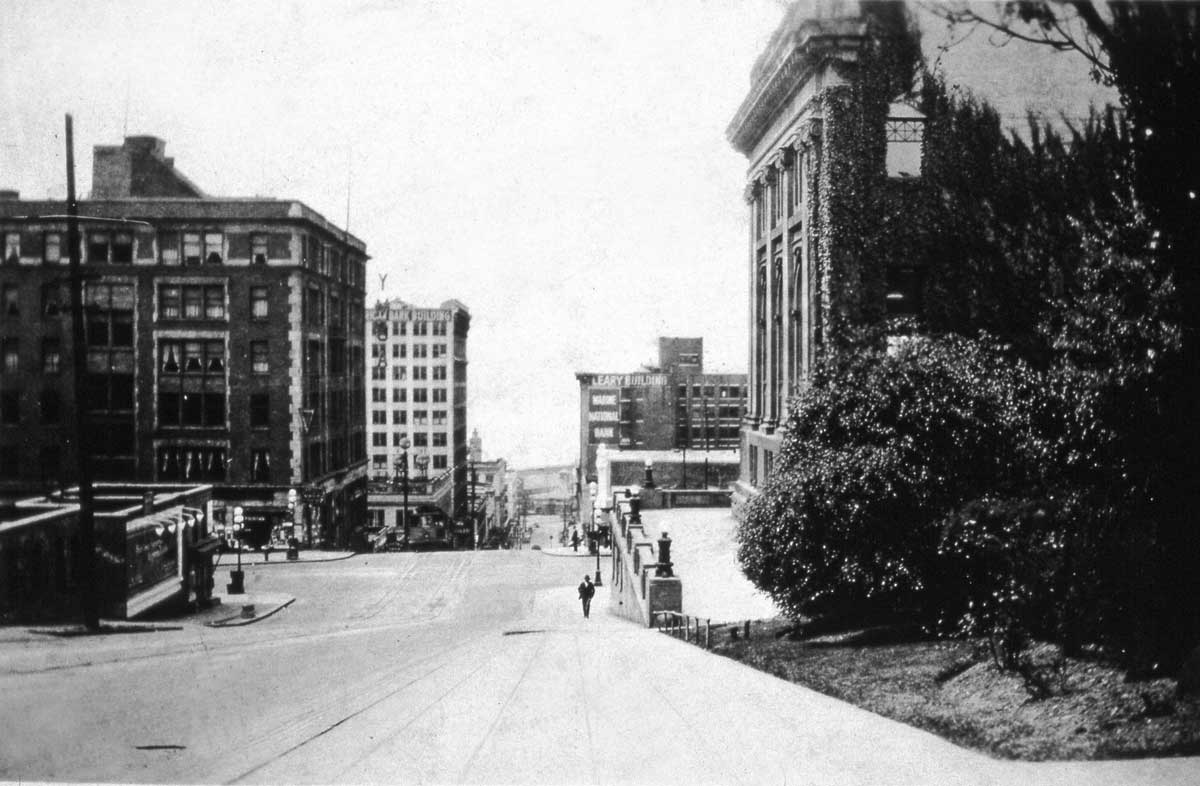
While revealing in its several parts this early 1890s look east up Madison Street from the trolley line’s terminal turntable is also a puzzle. A friend found this image in the Kingston Museum at Kingston on the Thames, England. It is attributed to Kingston’s most famous son, Eadweard Muybridge. The photographer-inventor returned to his hometown in 1895 after more than forty years of mostly taking photographs in the American West and performing some of the earliest experiments in motions pictures.
The puzzle is this. As far as I have been able to determine none of Muybridge’s biographers have ever put him in Seattle. The famous photographer was on Puget Sound in 1871 taking photographs for the U.S. Lighthouse service but that is at least 20 years before this lanternslide was recorded.
The best chance for having Muybridge here in time to take this photograph would be in the spring of 1893 when he left the West Coast for the last time. He was heading to Chicago to show his rudimentary “animal locomotion” pictures in his own “Zoopraxographical Hall” at the 1893 World Columbia Expedition in. But the Expo opened in May and this presents another problem for this scene includes a street broadside advertising an event for July 18. Perhaps the Englishman was late in getting to Chicago.
Another curiosity of this image is this; it is the only identified Seattle scene of any sort included with the Muybridge bequest of his life’s work to his hometown museum. The caption “Washington, Seattle, Madison Street Terraces” does have a Muybridge fit. San Francisco was the photographer’s west coast home base, so the Madison street cable line would have interested him, especially this part of it climbing to First Hill. Locals claimed that this was the second steepest incline in the trolley industry. Of course, the steepest trolley ride of all was in San Francisco.

The Madison Street Cable Railway began sending cars to Madison Park on the west shore of Lake Washington in 1890 from its turntable directly west of Western Avenue. Although the Madison railway was always a paying line it was closed down in 1940. Both views look east on Madison Street and across Western Avenue. (Muybridge photo courtesy Kingston Museum, Kingston on the Thames. The Haynes photo, directly below, courtesy of the Tacoma Public Library.)


The McGILVRA FIEFDOM
Judge John J. McGilvra, the pioneer who laid out the line of Madison Street, wanted to get to his homestead on Lake Washington the quickest way possible. So after climbing First Hill and crossing Broadway, Madison Street continues on its own way cutting through the city grid.
As it turned out, McGilvra’s short-cut also negotiated the city’s ups and downs in an oblique and easier manner. Beginning in 1890, these gradual grades helped considerably in the construction of a cable railway the entire length of Madison from salt water to fresh. In the early 1890s passengers enroute to the excitements of McGilvra’s many lakefront attractions, after first passing through still largely forested acres, dropped into the scene recorded here: grounds cleared for the playful enterprises of leisure.
The Madison Park Pavilion, left of center, and the ball park, far left, were the cable company’s two largest enclosed venues. But the beach itself was an equal attraction with floating bandstands and stages for musicals, farces and melodramas in which the villains might end up in the lake. McGilvra’s fiefdom – he would only lease lots, not sell them – and the railway’s end-of-the-line attractions also featured dance floors, bath houses, canoe rentals, restaurants, promenades, a greenhouse filled with exotic plants and a dock from which the “Mosquito Fleet” steamed to all habitable points on Lake Washington.


MADISON INCLINE
The city’s announcement in the summer of 1938 that Seattle’s three cable railways (on Yesler, James and Madison Streets) would be abandoned inspired considerable citizen resistance. Led by attorney Ben A. Maslan the protestors organized the Seattle Downtown Association. They managed, however, only to postpone the end. The city’s entire cable service was retired in 1940 and so was the fleet. After 51 years of clutching the cables beneath Madison Street car number 42 was scrapped.
The above view of the climbing cable car looks west on Madison from mid-block between 4th and 5th Avenues. The old Carnegie Library (1906-1957) is on the right. It seems a rail fan named Whinihan (the name is printed on the back of the original print) took the photograph as a tribute to the doomed cable car and line. The second historical view looks west from Fifth Ave. (Both come by way of Lawton Gowey.)
Arthur Denny, the city’s founder-surveyor, named Madison Street in 1853 for James Madison, but he did it for poetics (and fraternity) more than politics. In deciding to name his streets as a sequence of alliterative pairs (Jefferson & James, Cherry & Columbia and so on) Denny needed another M-moniker to partner with the street he named for his brother Marion. The fourth president was an obvious choice.
Lincoln-appointed federal attorney John McGilvra improved the three plus miles of Madison Street between the central waterfront and Lake Washington in order to reach his home beside the lake. Madison Street (more than Yesler) then became the principle first leg to the hinterlands both across the lake and to the northern destinations like Bothell and even Laurelhurst. The lake’s first steamers picked up and delivered their passengers at McGilvra’s dock.

Although faded the allure of Seattle’s old cable lines has not vanished and serious proposals to reintroduce them are periodically put forward. If the cable cars were to return to Madison they would serve a street in which nothing of the old street has survived west of Sixth Avenue since this they last ran there in 1940.

THE MYSTERIOUS MADISON STREET TRESTLE
Many years ago a friend of a friend asked if I had a photograph of the Madison Street trestle that once crossed the Madison valley roughly between Empire Way and the Lake Washington Blvd. I neither had the photo nor any inkling of the trestle. Silently – and foolishly – I concluded that his youthful memory of the big bridge was a childish exaggeration. Yet here it is, long and wide, and if we could walk into this scene and look over the railings (that ripple from settling) we would see that it was quite high as well.
The photograph is not dated. The Madison Park Apartments, on the right, were built in 1914, and this scene may have been recorded when they were nearly new. This is one of four photographs that trolley expert Lawton Gowey shared with me not long after I was asked about and mystified by the trestle. All four photos look east in line with the bridge and roughly from the same location, a few yards east of 29th Avenue. In one of the three not printed here the railing is gone, the power poles on the left no longer peek up from below but have been reset much higher in fresh fill along the north side of the bridge.
In his history of Washington Park, Don Sherwood, the now deceased Park Department historian, writes that in 1905 the trestle replaced the rough corduroy road that once crossed the valley and the stream that ran through it. Sherwood also estimated that the “the trestle was replaced with a fill about 1915.” The encyclopedic Ernie Dornfeld, Information Manager for the city, suggests a sensible alternative: the fill was a long project.
When driving on Madison east of 29th we are probably still crossing the trestle – or over most of it. Once the long effort of filling between and to the sides of the bridge timbers reached the roadway the deck could be removed and the fill packed and paved. Since the cable cars on Madison could not be stopped for long this final alteration – and it only – must have been done quickly.

The Madison Park Apartments on the right were built originally at the western end of the Madison Street trestle that crossed the Madison Valley east of 29th Avenue. (Historical photo courtesy of Lawton Gowey)

THE BRIDGE & The BRICKS
One of the helpful traits of many an official photograph is that it may, like this one, have a caption inscribed directly on the negative. Although not printed here, the description for this scene begins with its number, 394, and continues, “Brick Culls 30 Ave. (N. of Madison St.) 2-28-12.”
My first reading of this caption was immediately accompanied by one of those “eureka” experiences that are the liquor of research — I swooned. There on the horizon was my first unobstructed full sighting of the Madison Street trestle. It was built originally to take the cable car across Madison Valley and the stream that once meandered north through it to Union Bay. However, the ‘brick culls” in the scene (and in its caption) remained such a puzzle that I kept the picture back waiting for another revelation. Obviously, I have stopped waiting but these bricks remain a puzzle. I hope some reader will come forward with instructions – or even speculations.
One munificent source on Washington Park history is Don Sherwood. Don and my research paths often crossed decades ago when he was the Parks Department employee let loose to follow his bliss by preparing handwritten histories of every park in Seattle. Typed transcriptions of these histories (with facsimile reproductions of Sherwood’s accurately sketched maps) can now be visited on the net at www.cityofseattle.net/parks/history/sherwood.htm.
You are encouraged to visit the site and read Sherwood’s detailed history of Washington Park. You will learn about the filling and grading of the ravine to this side of Madison Street for the creation of the athletic field evident in the “now” photograph. You will also learn much else including the location of the 350,000 cobblestones taken from Madison Street and buried in the park. However, you will discover nothing about bricks.


MADISON PARK PAVILION
Like Leschi Park Madison Park was developed as an attraction at the end of a cable railway line. Both featured exotic landscapes, waterside promenades, gazebos, greenhouses, refreshment stands, garden-lined paths, bandstands, and boat rentals, even lodging. Leschi’s early novelty was its zoo. Madison Park’s was the baseball diamond. (The roof of the bleachers can be seen on the far left of the historical scene.)
Both parks featured monumental-sized pavilions with towers on top and great ballrooms within. The theatre-sized room in this landmark could also seat 1400 for melodramas, minstrel shows, musicals, farce, vaudeville and legitimate theatre. For many years members of the ever-dwindling mass of the Pioneer Association chose the Madison Park Pavilion for their annual meetings and posed for group portraits on the front steps.
Here the grand eastern face of the pavilion looks out at Lake Washington. The pleasurable variety of its lines with gables, towers, porticos and the symmetrically placed and exposed stairways to its high central tower surely got the attention of those approaching it from the Lake. (For many years beginning about 1880 Madison Park was the busiest port on Lake Washington.)
However, most visitors came from the city and the real crush was on the weekends for ballgames, dances, band concerts (most often with Dad Wagner’s Band), theatre, and moonlit serenading on the lake — ideally with a mandolin and receptive ingénue looking for pointers on how to navigate a rented canoe.
The Pavilion stood for a quarter century until destroyed by fire on March 25, 1914.


TWIN T-P’s 70th
[The feature that follows were first published in 2007 and made note then of its 70th birthday. We did not know then that it was also the last cake that this survivor would eat. While the story strays from the general subject of trolleys it does depend on transportation and like the Madison Park Pavilion, just above, has towers. But then the Twin T-P’s were nearly all towers – two of them. ]
In the spring of 1937 the shining steel towers of the Twin T-Ps were lifted above Aurora Avenue. They were strategically set across this speedway section of Highway 99 from the east shore of Green Lake. The Teepee, of course, is a form etched in the imagination of every American child and so this fanciful architectural corn (or maize) could be expected to lure a few matured kids called motorists off the highway.
Once inside the shiny example of Native American housing – the pointed and portable type used by the plains Indians – visitors were suddenly transported to the Northwest coast, for the decorations were done not on plains motifs but rather on designs like those we associate with totem poles, long houses, masks and spirit boxes.
Let’s imagine that almost everyone has eaten some of the regular American food at the T-Ps. I did once and ran into my old friends Walt Crowley and Marie McGaffrey who live nearby. If memory serves, they were enjoying prime rib. Walt would later write twice about the Twin T-P’s for historylink.org, the web site of state history he directs. The first essay (#2890) is a good summary of the exceptional story of this symmetrical piece of nutritious kitsch. Walt’s second essay (#3719) is a lament following the July 31, 2001 early morning bulldozing of the landmark. (So, if you use the computer do it now – please.)


ANOTHER ROADSIDE ATTRACTION
Across NW 54th Street from the long parking lot at Ballard’s Chittenden Locks sits one of Seattle’s roadside attractions, the Totem House. Built in 1939 to sell souvenirs the sturdy cedar structure was called by its owner-builders the Haida House Curio Shop. Like Ivar’s Salmon House thirty years later, although much smaller, its shape and parts – the vertical poles, planks, and artifacts – were arranged in admiring imitation of North Coast Indian architecture. Here the flap in the roof opening is up and open, a sensitive tribute to the aboriginal model. (Venting a central fire pit was necessary for a Haida longhouse, but probably not so for the Haida Curio Shop.)
The building permit for 3058 NW 54th Street reveals that the plans were submitted on March 31, 1939 and the final inspection followed only four months later, on the last day of July. This speedy construction allowed the owners to lure lock’s visitors still in the quick of the ’39 tourist season.
While the building permit describes the building’s owner James L. Houston as also its designer, the artist-entrepreneur’s children are quite certain that Houston’s father-in-law, the jeweler Del Thomas, was behind this enterprise. And it was also Thomas who took this photograph of the landmark shop soon after it was completed and before the necessary signs were added.
For its quick construction and the carving of its centerpiece, the totem pole at the front door, Huston family history for their curio shop has it that James Houston worked side-by-side with a native carver-builder named Jimmie John. An art student at both Cornish and the U of W, the blue-eyed Irishman Houston, born in 1908, was a talented watercolorist and jeweler who had a long life in the production of carvings done with the materials and refined styles of North Coast tribes.


THE LOST CREEK AND RAVINE
Most likely this photograph from the Asahel Curtis studio was recorded late in 1909. The number on the original negative falls near the end of the roughly 4556 studio numbers allotted that year. For Curtis it was a record year for picture taking, probably because the summer-long Alaska Yukon Pacific Exposition was held in 1909 on a picturesque University of Washington campus made photogenic for it.
Every part of the greater University District was retouched for AYP including Cowen Park although obviously the hard surface paving on University Way did not make it as far north as the entrance to the park here at Ravenna Boulevard. That Cowen Park was named for Charles Cowen, the wealthy English immigrant who gave it to the city in 1906, was part of the deal. Cowen also paid for both the rustic entrance shown here and when it wore out for the two stone columns and wing-wall seats that replaced it in the early 1920s.
The stone gate survives, and on it is written “Man Shall Not Live By Bread Alone.” Looking here beyond the woman standing with the child and through the original rustic gate it is clear that neither shall man leave the land alone. On the north side of the gate the park land drops away into a ravine. Since the early 1960s it has been a more-or-less level playfield made from one hundred thousand yards of “free fill” scooped away during the creation nearby of the 1-5 Freeway. At the time, to quote from Don Sherwood’s hand-written history of Seattle parks, “Many residents and the Mountaineers Club were appalled.”
In 1909 the creek from Green Lake still splashed down the enchanting canyon through Cowen and Ravenna parks. Had the Seattle Park Department followed the Olmsted Plan for Green Lake the creek would have been saved, for the lake would have been lowered only four feet. Instead it was dropped seven feet and the primary source of the creek was turned off. Green Lake Park’s gain was thereby Cowen and Ravenna Parks’ loss. Also taken from the community was a meandering Ravenna Boulevard for before reaching the ravine the primeval creek wandered through what is now the wide and straightened path of the boulevard.
Jumping forward to the freeway fill in 1971, that August the Second Annual Frisbee for Peace Intergalactic Memorial Thermogleep U.F.O. Frisbee Festival was held on the settled playfield. However, a proposal from the University District Center – the event sponsors — to make it an official Seafair event was rejected.


BUSES TO DIFFICULT DESTINATIONS
The official A.Curtis number (38871) for this image indicates that it was probably photographed late in 1919, or two years before Cornish moved from the Booth Building here at the southeast corner of Broadway Avenue and Pine Street north a few blocks on Capitol Hill to another Spanish-styled structure, the school’s then new home at Roy Street and Harvard Avenue.
When the city took public control of all the streetcars in the spring of 1919 they purchased a dangerously dilapidated system at a price so dear it precluded most improvements. The few exceptions included these buses that were purchased to reach parts of the city that the old private trolley system did not service. These buses are signed for Magnolia where most of the developing additions were not reached by the street railway line that ran only to the front gate of Fort Lawton.
Thomas White began making sewing machines in Massachusettes in 1859. He was still around in 1901 when his company made its first steam-powered automobile in Cleveland. Gas powered trucks were added in 1910; buses followed. Vancouver B.C. also purchased WMC buses to service the Grandview area to the east of that city. The best-known and longest-lived White buses were the red ones used for narrated tours at Glacier National Park. They were a park fixture (moving ones) until retired with “metal fatigue” in 1999 after 64 years of continuous service.


WAITING FOR THE INTERURBAN
This1923 tableau of municipal workers refurbishing a portion of the “grand union” of trolley tracks at 34th Street and Fremont Avenue allows us to reflect on the histories of both transportation and art in Fremont, the playful neighborhood that signs itself “The Center of the Universe.”
First the transportation. When a sawmill was built at the outflow of Lake Union in 1888 it was already possible to conveniently get to the new mill town from downtown Seattle aboard the Seattle Lake Shore and Eastern Railroad, which was laid along the north shore of the lake in 1887. After a trolley above a Westlake trestle was added in 1890 the bridge at Fremont increasingly became the way to get north to the suburbs and remained so until the Aurora Bridge was opened in 1932.
Next the art. According to Roger Wheeler, Fremont artist and historian, public art as a Fremont fixation began with the formation in the late 1970s of the Fremont Arts Council. Appropriately its first installation has a transportation theme with some built-in Fremont fun. The figures in sculptor Rich Beyer’s popular Waiting for the Interurban, will have to wait into eternity for they are pointed the wrong way – north. The interurban to Everett never turned east on 34th Street and so would have missed them.


The GRAND UNION
Barely hidden below the intersection of 34th St. and Fremont Avenue – at the north end of the Fremont Bridge – rests an iron cross of intersecting rails appropriately called the Grand Union. We see here the most western part of this steel matrix on June 29, 1923 at 6:30 in the morning. This is number ten in a series of thirty photographs that record the steps of replacing the plank paving framing the rails with bricks.
The artful work of laying the original Grand Union was guided by plans drawn in 1916 by Seattle Electric Company. It was timed of necessity with the building of Fremont’s bascule bridge that opened in 1917. Although this Fremont route was the major trolley feed to the north end the elaborate rail crossing at 34th would not have been needed except that it was also the way for trolleys to reach the Fremont Car Barn a few blocks west. (In 1905 when the barn was completed, 34th St. was still called Ewing Street.)
The last photograph – number thirty – of this repaving dates from the third of March the following year. Titled “Completed Layout” it looks west on 34th St. from the east side of the intersection and reveals a very spiffy Grand Union indeed. It was then as much a piece of public art as a public work. And as noted above this landmark survives below the veneer of blacktop that was first applied during the Second World War after locals complained about the slipper bricks on Fremont Avenue. One day, perhaps, the Grand Union will be revealed again, but beneath a transparent street surface – one that is not slippery – that we can now but imagine.


MADRONA HUB
This is the hub of the Madrona Neighborhood, the intersection of Division and Carroll looking south on Carroll — if I have counted the blocks correctly in the1893 street name index by my desk. If I have not bumbled then Division is now Union Street and Carroll is 34th Avenue. With city ordinances in 1895 and 1901 many of the historical street names were discarded for the efficiency of numbers and so also their benumbing. The name Carroll Street at least promises a good story. Thirty-fourth merely follows 33rd and comes before 35th. What can you do with that except find it?
The original names were probably given by George and Emma Randell who developed this Madrona Ridge in 1890 and built their home one block west at Drexel Avenue, or 35th now – I think. They did well, especially after the Union Trunk Line trolley to Madrona Park reached this intersection by 1893. The park first and then the neighborhood soon after got its name from the trees (arbutus) that were also residents. Thereon the Randall barn became Randall School and stayed so until 1904 when one of the typical frame box schools designed by school architect James Stephen opened at 33rd Avenue (AKA Alvan) and Union and was also named Madrona.
If the tax records can be believed the frame structure that survives on the right of both views was constructed in 1907 and so is about to fulfill its own century. The historical photo dates from ca. 1940 when the trolleys, like this car No. 376 on the No.11 Cherry Street Line, were traded for busses and, here also, trackless trolleys. The 1938 Polk Directory (also by my desk) lists the same businesses that show in the photograph – the pharmacy on the corner, followed by a barber, a shoe renewer, a luncheonette and a fish market – all of them named Madrona, except the café. Vernon and Anna Herrett who run the luncheonette, live upstairs, and Walter Cort, the cobbler, lives behind his store on 33rd..
Perhaps some reader will write and share the Carroll or Drexel or Alvan Stories. One likely storyteller would be Junius Rochester who wrote “The Last Electric Trolley,” in part a history of Madrona. But that lucky historian is often away conducting tours on Columbia River cruise ships and may not be reached.


SEEING SEATTLE
After the turn-of-the-century consolidation of Seattle’s previously diverse trolley lines the new and more efficient monopoly, the Seattle Electric Company, purchased four “special” cars from the John Stephenson Company of New Jersey. At 46-feet-long, bumper-to-bumper, they were then the biggest of Seattle’s electric cars, and the trolley company’s special plans for them were clearly signed on their sides. The four double-ender trolleys — numbered 362 to 365 — carried both visitors and locals on rail explorations of our then rapidly expanding metropolis.
Since motorcars were still a rarity in 1903, aside from walking, there were few ready ways to sample Seattle that were not by rail. From Pioneer Square the trolley lines reached to Lake Washington, Ballard, Green Lake, the University District, Rainier Valley, all destinations with attractions. So for the purchase of a single ticket a customer could explore almost every corner of the city, including, beginning in 1907, West Seattle. Since there was no competing cacophony of motorcars, to be heard by their passengers the conductor-tour-leaders had only to bark above the creaking of the long cars themselves as they rumbled along the rails.
By 1907 these “Special Seeing Seattle Cars” were not the only tour in town. There were then enough paved streets and even boulevards in Seattle to allow open busses to go anywhere hard tires and spring seats could comfortably carry their customers. These sightseers were also regularly photographed as a group and many among them would purchase a print of their adventure either for a memento or message. The group portraits were ordinarily printed on postcard stock and of the many sold some carry handwritten flip-side expressions of the joys of seeing Seattle.

The GREAT LATONA TRAIN WRECK
At 5pm on the Monday afternoon of Aug. 20, 1894 a west bound freight of the Seattle Lake Shore and Eastern entered the curve at Latona on the north shore of Lake Union. Engineer Osborn looked up and saw several cattle jousting near the track. In an instant a cow was gored and fell directly in front of the train lifting the engine off the track. Osborn cut the steam, threw the reverse lever and held on before he was thrown from the cab. (He survived the ejection well enough to frantically run to Fremont to stop the northbound passenger train.)
Within seconds of the derailment the ten cars filled with tons of coal, logs and shingles telescoped, propelling the coal tender beyond the engine. In the process it sheered the left side of the engine’s cab. When two shingle weavers from a nearby Latona mill first reached the wreck they saw through the still swirling steam and dust the horrific sight of brakeman Frank Parrot’s decapitated body propped against the boiler with his head lying between his legs. The mutilated fireman Thomas Black lay nearby. Black had been anxious to complete the trip and pick up his pay check, for his wife was waiting at home penniless and alone with their two children. She was also eight months pregnant.
To the side of the engine the shingle weavers laid the bodies of the two victims and covered them with green brush. Within an hour the coroner arrived aboard a special train that also carried railroad officials and a wrecking crew of 30 men.
The trail of grease left by the dragged cow was used later to determined the distance the engine bumped along the ties before it veered to the right and buried its nose in the small trees and bushes that lined the embankment. The Press-Times reported on Tuesday that the trail ran “about 200 feet.” The stack of the engine peeks above the upset boxcar, just left of center.
The assorted littered of shingles, coal, and railroad cars are scattered to the side of the Seattle Lake Shore and Eastern Right of way. The photo dates most likely from the day following the “Great Latona Train Wreck” of August 20, 1894. On the far left a crane has begun the clean up. Boys from the neighborhood sit on the roof of the tiled boxcar at the center. The house on the horizon survives at 3808 Eastern Avenue north. Built in 1890 it is easily one of the oldest north end homes. The railroad right-of-way also survives, sans tracks, as the Burke Gilman Recreation Trail. (Historical photo courtesy of Roy Nielsen)


CASEY JONES SPECIAL
Life – the leisure part of it – is a relatively simple affair for rail fans. Perhaps the one conflict that can add distress to this zest – and it cannot be avoided – is whether to be on a train or off it. On December 1, 1956 super rail fan Lawton Gowey was one of the nearly 1300 rail enthusiasts joyfully crammed into the 13 cars behind Northern Pacific steam engine no. 1372 for the first Casey Jones Special to Snoqualmie. The route followed the old Seattle Lake Shore and Eastern Railroad right-of-way.

Seven months later Gowey chose not to ride the train but chase it. Here on June 29, 1957 he has beat Northern Pacific Engine No.1372 to the north side of Lake Union. Perhaps steadying his camera in the open window of his car Gowey made a snopshot of the Special that with the smoke and steam escaping it we can almost hear. In a moment more he was stepping on his own throttle heading for the next photo opportunity to catch the train crossing the concrete trestle that still parallels N.E. Pacific Street about 100 yards east of the 15th Avenue N.E., the western border of the main U.W. campus. He made it in time.

For twelve years the regions rail fans were engaged with nearly 50 nostalgic rail excursions in every direction from Seattle that railroad’s lesser lines and spurs could carry them. The promoter was a pianist named Carol Cornish who was 71 when she started them. Actually, as her assistant Tom Baker notes in his Memories of the Casey Jones Excursions “She took the name of Carol Cornish as a stage name. Here actual name was Edna Baker.”

While no relation to Tom, Carol Cornish treated him as such. Titling him her “Train Host” she encouraged the friendly and handsome Baker to walk from car to car smoozing his good will and broad smile with the passengers. Baker and his kids also sold box lunches, and printed programs. When the two Bakers worried if their cars would fill up they could count on Seattle Times columnist Byron Fish to write a story about their next heroic efforts to – quoting By Fish here – “take one last steam trip before all the locomotives and their water towers are junked.”

More often than not they need more cars. As Tom Baker puts it, “Miss Cornish was a battler. Many a time ticket sales would run into the hundreds. The railroad would say that they did not have the cars. It always ended up with the railroad giving in and getting the cars needed, even if they had to borrow some from the Great Northern.” The last Casey Jones was to North Bend on June 9, 1968. It was also the day that Carol Cornish died.
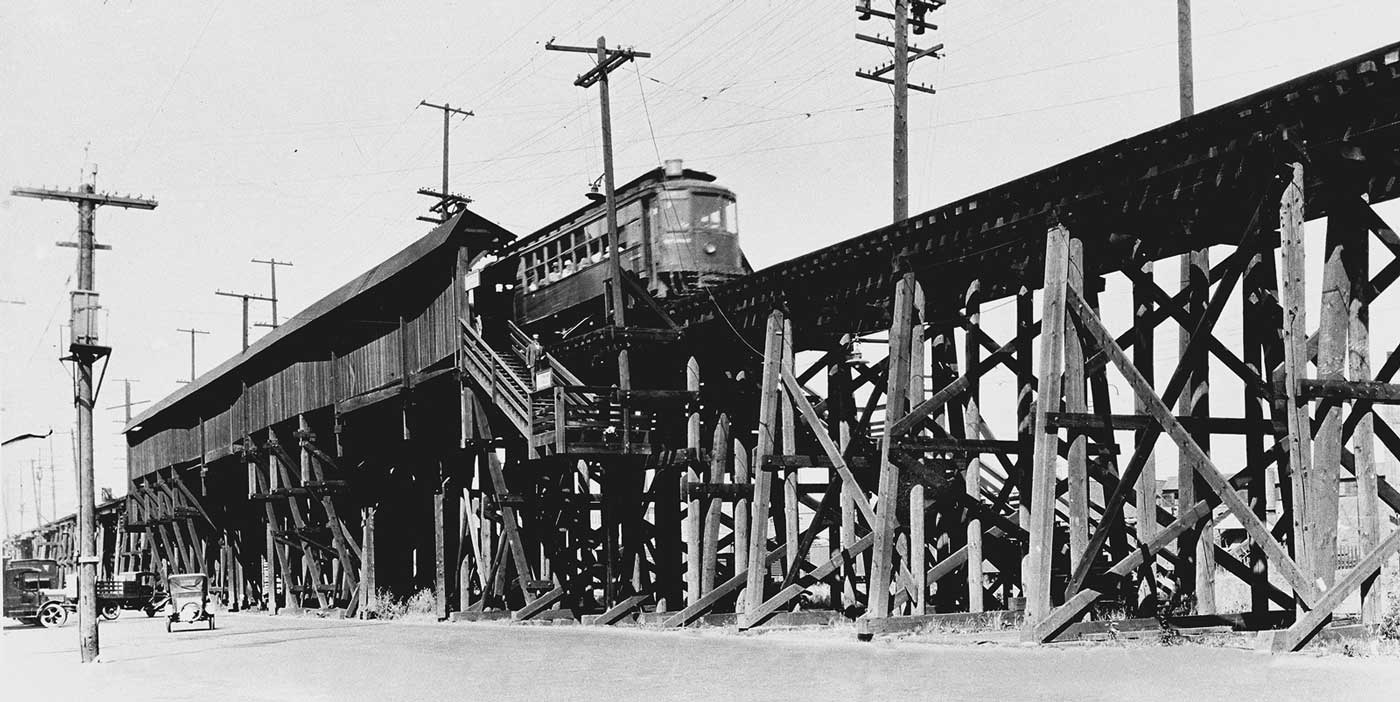

EAST MARGINAL WAY ELEVATED
The waterfront did get a belt railway of sorts in 1919 but one that was as poorly timed as the Seattle general strike. During the war, the workers were so hard to deliver to the shipyards that Mayor Hanson ordered an elevated railroad built to carry them south from Pioneer Square to Spokane Street and from there out to Harbor Island. It started street level at First South and Washington, and from there climbed the one block west to Railroad Avenue where it took a sharp curve south to be on its elevated way without impedance to another right turn on Spokane Street, this time west to Harbor Island and even West Seattle.
The elevated trolley was also Mayor Hanson’s political response to the almost universal criticism of the Seattle Electric Company’s trolley service. Hanson not only did the politic thing of ordering that the elevated be built, he also bought out the SEC, but at such an inflated price that in the 21 remaining years that trolleys were run on Seattle streets the debt could not be paid in full. While Hanson’s new municipal rail system was an albatross, his new elevated was a white elephant.
The Sunday Times of August 17 prepared the citizens to prepare themselves for a ride to Fauntleroy or Alki – there was of course no need to consider shipyards – that would be from five to ten minutes faster than the current service down First Avenue South because the railroad crossings in the industrial district would be avoided. Without fanfare, service started on the 4th of September, one week after the mayor resigned. Hanson claimed it was for reasons of health but more likely, as noted, he left to pursue his dreams of winning the Republican Party’s nomination for President. Certainly Hanson was also fleeing the growing complaints over the “deal” he’d made to purchase the worn out trolley system. Streetcars were regularly breaking down and sometimes – like the Mayor – running away.
Although brand new, the elevated railway to West Seattle had a ride that swayed like a roller coaster. It was scrapped in 1929 – in time for the Great Depression. They had only ten years to remember, but the survivors of the dwindling set of West Seattle old timers still describe it as a white-knuckle thrill. Two of the better-known members of this species – Emmett Watson and Ivar Haglund – now long gone remembered the ride well. Typically, as West Seattle adolescents both were fascinated with how to get to Seattle and equally thrilled by the trolley ride across the Duwamish waterway. In his book Digressions of a Native Son Watson recalls, “The way you got to First Ave. from West Seattle was by thumb or street car, those rattling old orange things. They clanked and swayed over an incredible old wooden trestle, high above Spokane Street, weaving and shaking until you had to close your eyes to keep from getting a headache.” Similarly Ivar recollects, “Some of my earliest memories are of taking the West Seattle ferry to Seattle, a ride that while thrilling was not so thrilling as that aboard the trolley. It was our rollercoaster. That thing would throw us from side to side as it stumbled along a trestle that was high, narrow and, most of the way, without guardrails. It seemed like there was nothing between you and the ground but the roofs of the buildings below you. It was marvelously scary.”


THE WRECK EPIDEMIC of 1919-1920.
After the private trolley system was made public in 1919 what Leslie Blanchard in his helpful history “The Street Railway Era in Seattle” calls a “wreck epidemic” followed. Blanchard described the crash of January 5, 1920 as its “climax . . . one of the most appalling accidents in the history of public transportation in Seattle.”
Heading downtown early in the morning with a full load of workers and shoppers car 721 jumped the track where Woodland Park Avenue still curves through its intersection with 39th Street. The speeding car fell from its tracks into a sturdy telephone pole (left of center) that opened the car roof like a can of cheap pop. Of the more than seventy passengers injured seven were seriously so and one of these died the following day.
The wreck was “appalling” because it was an accident made inevitable by the circumstances surrounding the sale of the system. The Seattle Electric Company sold the dilapidated line to a Seattle mayor, Ole Hanson, who purchased it at such an inflated price that no funds remained for repairs. At the time Mayor Hanson was more interested in whatever bold moves might make him an attractive candidate for the American presidency.


The Seattle Times’ same day front-page story on the wreck leads off with an ironic listing of conflicting voices. Councilman Oliver Erickson described the brakes and rails of the system as in “rotten condition.” Thomas Murphine, superintendent of public utilities, described them as “in perfect shape” but that the driver was “new and inexperienced.” For his part Motorman M.R. Fullerton claimed that the brakes would not work and that “I used everything I had to try to stop the car before reaching the curve.” Fortunately for Fullerton it was the bad brakes excuse that – unlike car 721 – ultimately held sway.


THE WORST
One of the most common recollections of Seattle’s “old timers” – those exploring Seattle already before the Second World War – is the elevated trolley ride along the Spokane Street viaduct and its old bascule bridges to West Seattle. That the experience of riding the rumbling and swaying electric cars along the exposed wooden trestle could be more than thrilling is evidences in this view of the worst streetcar wreck in Seattle history.
At about 7:30 on the Friday morning of Jan. 8, 1937, with its air-brakes frozen open, car 671 inbound on the Fauntleroy line lost control as it descended 30th Avenue Southwest and flipped to its side where the track curved sharply onto Spokane ‘Street. Derailments on this old system were not that uncommon and even flips not unprecedented. The upended car 671 did not skid to a grinding stop, however, but collided suddenly with a concrete pillar.
The afternoon Seattle Times listed the dead – Lee Bow, a 50-year-old city fireman, and William Court, a 39-year-old-mechanic – and the 60 West Seattle commuters who were injured with breaks, bruises and lacerations. Of these one died the next day. The derailment might have been even more deadly. The pillar that injured some might have saved others when it· prevented the car from falling to the railroad tracks below, at the lowest level of this three-tier grade separation at the western end of Spokane Street.
This catastrophe became an anxious symbol for the entire municipally owned trolley system that was in physical, fiscal and political tatters. The coincidence of this tragedy with the campaign to tear up city-wide the system’s rails aroused the -hysterical rumor that this wreck and others were planned by those who favored gas engines and rubber tires over electric motors and trolley tracks.

The concrete construction above replaced the wooden trestles below.


A slide without horizon is rare for Horace Sykes. Still the little corner – upper-left – of one is enjoyed. The red bush on the right is Horace’s primary subject, and he has carefully not put it directly in the center of the frame. This also a recording of what we have called the “Rocks of Theology” although they do not convert or inspire me. Painted in black letters with white borders are, left and right, two Christian prosaisms, “Christ Died for the Ungodly” and “To Heaven Or Hell Which.” Another less careful slogan appears top center although it is cut-off and all that I can make out is “sin.” And it surely is. [Click TWICE to Enlarge, for the sermons especially.]


[CLICK TWICE TO ENLARGE]
OVER THE EDGE EXTRAS:
“Labor, n. One of the processes whereby A acquires property for B.”
“Mythology, n. The body of a primitive people’s beliefs, concerning its origin, early history, heroes, deities and so forth, as distinguished from the true accounts which it invents later.”
Both excerpted from Ambrose Bierce, The Devil’s Dictionary, 1911
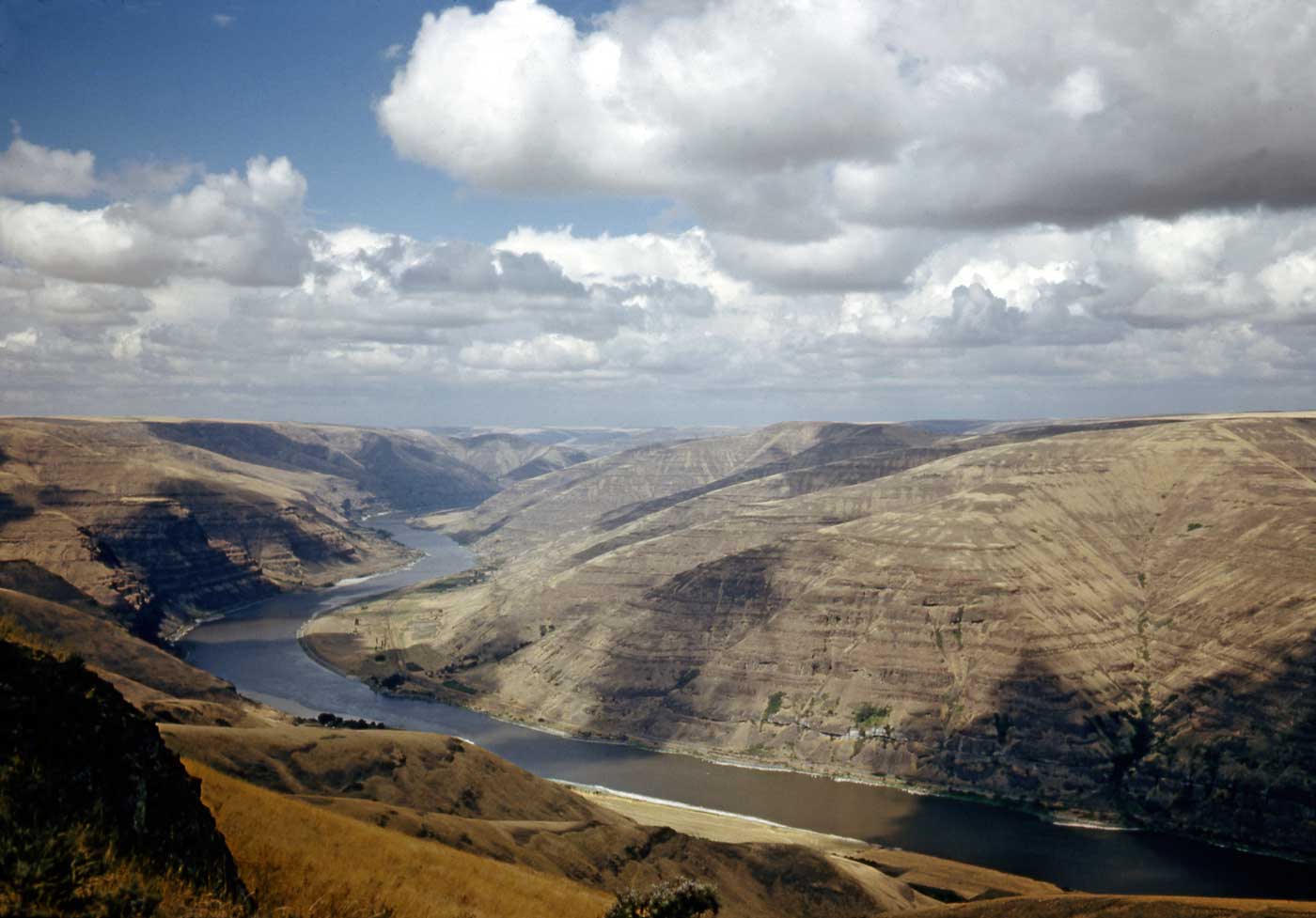
I imagine that this is the Snake River for I can not conjure any alternative, and yet with a Google Earth skimming of its winding way between Hell’s Canyon and the Columbia River I did not quickly find any part of that river that has these curves with a railroad track running beside the far shore. But then I only I only traveled from east to west assuming that the scene is exposed from a sun that is off to the left and so more likely in the west on an afternoon in the late 1940s, which is before any of the three dams were along the last part of the river. With time – tomorrow perhaps – I will return and try again heading then from the west. (Click TWICE to enlarge.)

Here are resting bovines
behaving predictably,
stock acting stock
in the shade
while around them
a field of blue flowers
acting like please forget-me-nots
cares little for so much sun
and yet cannot peaceably
join the cattle
in the pasture they share
beneath the covered
bumbershoot of a tree.

Here, just found, is another Sykes snap of the Whitman Monument (just west of Walla Walla) that shows, perhaps, his classical intentions. Here he has managed to almost juxtapose the needle on the moon with a care for symmetry.

Horace Sykes visited the memorial for Marcus and Narcissa Whitman and nine others about a century after the eleven were massacred by a band of Cayuse whom they had lived among or near since they first blazed the Oregon Trail in 1836. The massacre occurred in 1847 and so did the decimation of half of the Cayuse people in a measles epidemic for which the indigene believed the Whitman Mission was the source. Horace looks up at the “shaft on a hill” backlighted by the moon. Even in daylight it was difficult then to frame a 35mm camera for it did not allow the photographer to look through the lens but rather through optics set to the side of the lens. So we may ponder how he chose to imbricate the obelisk with the moon, but most likely the wag or wobble of chance was involved too. (Click to Enlarge)

While it looks familiar like many peaks in the Cascades and is surely near some passable bi-way for Horace and his Sykesmobile in the late 1940s and is now surely less than a day’s drive from the local Montaineer’s Bookstore, I cannot say where it is only where it is not. It is not in Utah. (Do Click to enlarge)

The name for this, Rural Electrification, is, of course, not Horace Sykes’ but our own. It may point to the barely detectable power or telephone line cutting across the center of this scene or to the stimulating effect the composition of this subject may switch on in you as it does in me. Here we have a “Sykes” road leading, this time, directly into the center of the arrangement. This is unusual for Sykes and his roads. And then we are given to all sides these wonderfully various masses and colors and our own purple mountains majesty on the horizon. [Please CLICK to enlarge]
(click to enlarge photos)


These two blocks on Front Street (First Avenue) between Columbia and Mill (Yesler Way) were Seattle’s first show-strip of distinguished structures. The view looks south on Front thru its intersection with Columbia. The subject was photographed sometime in 1887, perhaps only days before Toklas and Singerman, the city’s first department store, moved that year into its new home at the southwest corner, here right-of-center.
At the far end of this extended block, the tower of the Yesler-Leary Building (1883) tops what was known best then as Yesler’s Corner, after the pioneer who owned most of what we now call Pioneer Square. This classy strip faced east across Front to a pioneer string of plain false-front clapboards that contrasted with the brick, tile and cast iron ornaments of the buildings shown here.
After the city’s “Great Fire” ignited at Front and Madison in the mid-afternoon of June 6, 1889 it was hoped that should the fire eventually reach these formidable landmarks that they would not allow themselves to be consumed. The strip, however, proved almost as combustible as the wood firetraps on the east side of Front Street. These handsome facades did, however, make the best ruins.
In his Chronological History of Seattle, Thomas Wickham Prosch, explains this strip as another sign of Seattle’s robust prosperity then. He writes that the city’s boom began in 1886, and then “grew in volume and force in 1887, continued with unabated activity and vigor in 1888 . . . Every week at that time meant 150 more people in Seattle.” The reconstruction that followed the 1889 fire also swelled the immigration and spread the fire of ambition.
This time, Paul, Berangere has something to add. While she was visiting us for our MOHAI opening, she accompanied me downtown when I took the photo for this article. Here’s her shot of me and my ten foot pole:

Anything to add, Paul? What a splendid profile of you and your big ten foot pole Jean. Yes I have somethings to add, but again the question is how much may I load before I climb the padded stairs to nighty bears. Most of it relates to FRONT STREET, the subject above – some before and some after the 1889 fire. Again, there will be few “now” shots for I have never taken the time over the past nearly 30 years to properly file my own weekly negatives away. I know how to find the historical shots ordinarily because they are “classed” under different collections. Not so my own photographs of local “nows.” This was a bad habit of mine Jean and don’t you get into it! Some day I’ll organize it all – hopefully.
We will start with a hand-colored version of an 1888 4th of July parade on Front Street and followed it directly with a proper mono-toned version not of the same photograph but of the same parade – with some story.


JULY 4, 1888 ON FRONT STREET
Parades of many sorts were commonplace in the pioneer city. Streets were not so nervous, they were not overrun with motorcars. If you wish to celebrated you election to city council or appointment to animal control, if you knew a band that march and play for it you were ordinarily welcome to arrange a parade down “main street,” which for Seattle was First Avenue, or Front Street north of Yesler Way and Commercial Street south of it.
This grand parade with all the bunting and flags is surely an Independence Day celebration. Just to this side of the only open sidewalk awning is the Lace House, a woman’s apparel shop with fancy work that opened in February of 1888. So this can only be July 4, 1888, for in another eleven months and two days everything here was consumed by the “Great Fire” of June 6, 1889.
The photographer looks north from the southeast corner of Cherry Street and Front Street. Front was named for a setting that is now long lost. When platted in 1853, First Avenue (Front) was the most westerly of the avenues, and on a windy day at high tide a pedestrian on its west side might be splattered. Now the waterfront has moved far to the west.

The fancy structures on the left are part of Seattle’s two unbroken blocks of pioneer splendor between Yesler Way and Columbia Street, its touch of San Francisco elegance. The corner structure at Columbia Street; right of center, with the grandest decorations was the Toklas and Singerman Department Store, built in 1887. Some hoped that the Great Fire might be stopped by its sturdy brick façade, but the flames were barely stalled before they burst the windows, chewed the mortar and razed all but the sturdiest of walls south of it – like the bank facade on the far left, which was left standing although the building was gutted like all the others.

THE ELEPHANT STORE
In this 1878 view up Front Street (First Ave.) only the Elephant store on the right – where, presumably, both the bargains and the selection were over-sized – is obviously a retail house. The others look like homes, but the street’s residential character is slightly deceptive. One of those clapboards is a foundry; another, a cigar store; another, a drugstore; and the roof on the lower left-hand comer tops a brewery.
The Elephant Store is at Front’s southeast corner with Columbia, and two blocks north at Madison Street, Moses Maddock’s drugstore is the dominant white structure just left of the photo’s center. (The subject printed next was photographed from the balcony of the drugstore, and both it and this look in the opposite direction along Front Street were photographed by Peterson and Bros., which ran their commercial studio at the waterfront foot of Cherry Street.) Beyond Maddock’s drugstore at Madison Street, Front St. was sided for the most by homes. The gabled Amos Brown home at Spring St. rises above the drugstore and right of the tall fir. It and the Arthur & Mary Denny home at Union St., just left of the fir, were Seattle’s first grand homes. For the Dennys, city founders, it was their third residence when they moved there in 1865. Arthur lived in this fancy Victorian mansion with the jigsaw trim until 1899, the year of his death. By then the house was surrounded by tall hotels and department stores.
Beyond the Denny home Front St. jogs a little to the left and northwest beyond Pike St. Pike was the northern end of the street’s 1876 improvement. Before that regrading, there was a hump at Cherry St. (the site of the photographer’s studio and perch), another rise at Marion and a ravine at Seneca deep enough to require a bridge.
Finally this scene includes a subject on the horizon that is bigger than either the street or an elephant. It is Denny Hill. Here the top of it reaches about 100 ft. above the present elevation of Third Ave. between Stewart and Virginia streets. This is one of the few early recordings of Denny Hill that survives, while the hill itself, of course, does not.

FRONT STREET PROMENADE FOR THE PIPERS
The captioned subject of this Peterson brothers photograph is its vacant street. The studio has inscribed it “Front St. Seattle W. T. [Washington Territory]” along its dirty diagonal line. As the scene shows, the street’s name was appropriate. The Petersons took this shot in 1878 or 1879. Then, at high tide, Elliott Bay beat against the timber retaining wall that held Front St. high and dry above the waterfront. This is Seattle’s first major public works – the regrading of Front St. from a stump-strewn, ravine-ridden path to a filled-in, smoothed-out public work, with guardrail and a sidewalk promenade along the city’s front. The Petersons are showing it off.
The scene was shot from the balcony above Maddock’s drugstore at the N.E. corner of Front’s intersection with Madison St. The drugstore did not survive the Great Fire of 1889. I took the “now” shot from the second floor of a brick building which was raised there soon after the fire, and which, in 1986, was still after half-a-century the home of Warshall’s Sporting Goods. (For the moment I cannot find my “now” shot from the early 1980s. Typical. I did not also look to using it again while I was then preoccupied with looking back.)
The ’89 fire started across Front St. at its southwest corner with Madison in the Pontius Building. The corner of its balcony is on the older photo’s far right. It and the Woodward Grain House, the building that dominates the photo’s center, were both built on pilings. Between them is a glimpse of a section of Yesler’s wharf and mill.
The Woodward was the business home of Peter’s Furs, Cigars and Liquors. Peter was in the right line. The 1878 city directory claimed “five out of every six men in the territory use tobacco, and nine out of every ten men use intoxicating drinks.” However, another of the directory’s statistics suggests that these prevalent vices were still lonely ones, for “There are three bachelors to every bacheloress in the territory. ”
Posing in the photograph’s lower left-hand corner are A. W. Piper, his son Wallis, and their dog Jack. As the proprietor of the Puget Sound Candy Manufactory, Piper was very popular. The 1878 directory reviewed his confections as “warranted and strictly pure.” Both Piper’s confectionary and the Peterson’s studio were on Front St. near Cherry. They were, no doubt, friends.
For 30 years the Pipers lived in Seattle making candy and friends. When Piper died here in 1904, his Post Intelligencer obituary was an unusually good-natured one. The publisher-historian Thomas Prosch first of all remembered “Piper’s cream cakes. During the 1870s they were particularly noted. The people of those days to this time think nothing of the kind … has ever approached them in excellence.”
Piper was also an artist. Prosch recounted, “He could draw true to life, could mold in clay, cut stone . . . his Christmas display was noted for its originality, humor and beauty.”

In many ways the candy-maker was unconventional. A religious Unitarian, he was also a socialist member of the Seattle City council, and an unsuccessful Populist candidate for Mayor. He was, however, a successful practical joker. Once, at a public dance, he mimicked Henry Yesler so convincingly that the real Yesler ran home to construct a sign, which read “This is the only original Yesler.”
Thomas Prosch concluded, “Everybody regarded him as a friend.” A.W. Piper dies at the age of 76, survived by Mrs. Piper, their nine children and many friends.

[Somewhere within three feet of this desk is a black-white scan of this same Frye Opera House look into North Seattle and when found I’ll insert it here.]
NORTH SEATTLE
More than a few publishers and local historians have silently thanked Fred Dorsaz and/or Edward Schwerin for carrying their studio’s camera to the top floor of the nearly new Frye Opera House to record this local classic, a bird’s-eye into North Seattle. The scene looks over Madison Street, up Front Street (First Avenue), across the distant rooftops of Belltown and far beyond to the still hardly marked Magnolia Peninsula.
There was a touch of opportunism and pride in the partner’s climb and recording. The original photo card has “Souvenir Art Studio” printed across the bottom, and if you look hard, you can see their business name written again on the banner that stands out against the dark trees near the center of their photograph.
The Souvenir banner is strung over Front Street between the Pacific Drug Store building, bottom right, and the Kenyon Block, bottom left. The Souvenir Art Studio rented quarters in capitalist J. Gardner Kenyon’s” namesake commercial building. Taking clues from the few signs attached to its sides, so did the Globe Printing Co. (one of only four job printers listed in the 1885-’86 City Directory,) William P. Stanley’s books, stationary and wallpaper store, and Robert Abernethy’s “boots and shoes” store. Like its owner Kenyon, Abernethy, it seems, also conveniently lived in the Kenyon Block.
In his “King County History,” pioneer historian Clarence Bagley dates this view “about 1887.” Given the absence in this scene of important 1887 additions and the presence of structures not around in 1885, the likely date is 1886.

HUNTINGTON – & Others – EARLY RECORDS of FRONT STREET
The Huntington Bros. Studio of Olympia would not allow hometown bluster to get in the way of marketing and flattery. On the flip side of this view up Front Street (First Avenue) from Cherry Street, the Huntington promoter has written a rather long paragraph on Seattle’s virtues, noting: “Seattle is the leading town of Washington Territory … Its principal exports are agriculture produce, lumber and coal . . . It also exports much fish, furniture, doors and windows, flour, etc. The town is conveniently, beautifully and healthfully situated, and gives promise of becoming a place of considerable importance . . . Its own people are very proud of Seattle, and think it inside of 10 years destined to be second on the Pacific Slope to San Francisco only.”
The added claim that Seattle’s population “numbers 3,500” suggests that the Huntington caption was written in 1881, when Seattle first overcame Walla Walla to become the largest town in Washington Territory. The photograph, however, was most likely recorded before June 20, 1879. On that day, J. Willis Sayer notes in his book, “This City of Ours,” “the last forest tree on the central waterfront, standing just north of Pike
Street, was cut down.” That tree, I’m claiming, stands nearly alone on the horizon, left of center.
A few of the identifiable businesses here are F.W. Wald’s hardware store, far right, next door to Hendrick’s plumbing. Across the street in the shade of the sidewalk porch is the Fountain Beer Hall. To Huntington and his potential customers, the noteworthy quality of this street is not that it is vacant, but that it is smooth. In 1876 the bumps of Front Street north of Yesler Way were cut away to fill its valleys. This historical scene was copied from an original Huntington Stereo view. It may be compared to other studio’s recordings of Front Street also looking north through Cherry Street.


Looking south here through the same block only this time into Pioneer Square.


BOREN & BELL at SECOND & CHERRY
This pioneer snow is neither from Seattle’s still coldest winter of 1861-’62 nor from its still deepest snow, the “big snow” of 1880. The scene is too late for the former and too early for the latter. What is most curious about this look into what was then still Seattle’s first residential neighborhood is the scene’s “centerpiece,” the two-story box with four windows on its west facade. It sits at the northwest corner of Second Avenue and Cherry Street.
Judging from the remnants of the old forest on First Hill and from the other structures, most likely this view dates from the early to mid-1870s. Above the barn or large shed on the far left is the tower to Seattle’s first sanctuary, the so-called White Church at the southeast corner of Second and Columbia Street.
Significantly, the “centerpiece” box is a frame structure. Therefore it is not the log cabin that Carson Boren built at that corner in the spring of 1852. The local tradition that the Carson cabin was the first structure completed in Seattle is remembered with a plaque on the Hoge Building (that now fills the corner). However, according to Greg Lange, a historylink.org scholar of Seattle’s pioneer life, the Boren cabin was more likely the third house. It was completed after Doc Maynard’s home on First Avenue South and William Bell’s first home in Belltown.
Actually, Bell is also better associated with this box if not with its predecessor, the log cabin. In 1855 Boren sold the corner to him. Lange concedes that the frame building, seen here, may have been part of the deal. However, he thinks it more likely that Bell, not Boren, built it sometime after 1858. By the late 1870s the black box at Second and Cherry was replaced with a more distinguished residence.
As for the snow, we don’t know.


Another snowscape looking east on Cherry from Front (First). This one is also by Peterson & Bros and was recorded from the front door to their studio on the west side of Front. This 1880 is still the deepest in the city’s history. (See the Snow History buttoned on the front page if you like.) In 1880 Seattle was a few more than 3000 citizens, a few less than Walla Walla. Seattle would surpass Walla Walla in the next year and then become one of the country’s greatest examples of a boom town as it grew to roughly 40 thousand by 1890, more than 90s thousand by 1900, and to more than 200 thousand by 1910. The photographs directly below also look up Cherry from First and date approximately, in this order, from 1892, and two from around 1913. By then Cherry Street was one of the city’s examples of an “urban canyon” with steel-frame high-rises to many sides.


1884 SNOW ON COLUMBIA STREET
Although the snow of 1884 did not make it into our local freezer of big snows, it lent its own perishable delights. Through the first week of February, the winter of 1883-84 had been peculiarly dry and pleasantly warm. The local paper predicted more of the same. Then on the 8th two inches of snow dropped on Seattle, and the temperature dove, sticking below freezing.
Lake Union froze over and a procession of skaters trekked the length of the boardwalk that followed the bed of an abandoned coal railroad (near the line now of Westlake Avenue) to the south end of the lake. It was safe to skate until the 15th, when the thermometer first rose above freezing. With the skates, sleds were then also surrendered, but only temporarily. In three days more the sky opened and again dropped the fun stuff you see here -18 inches of it.
The photographer, Theodore E. Peiser, was nearly as fresh to Seattle as this snow. In 1884 the oversized gear and glass-plate routines of photography were both rare and elaborate enough to gain attention. Here, everyone seems to be posing for Peiser. The commercial photographer set his tripod at the waterfront foot of Columbia Street with his back to Elliott Bay.
Peiser recorded some of the best views of Seattle in the 1880s. There might have been many more, but his “Art Studio” on Second Avenue between Marion and Columbia Streets was destroyed along with his equipment and negatives in the city’s “Big Fire of 1889.” The loss is especially grievous given the claim Peiser made on the flip side of one of his surviving prints: “The largest and finest assortment of views of Seattle and Sound towns, logging camps, etc., for sale by the copy or in large quantities, at reasonable prices.”


MACKINTOSH’S SAFE DEPOSIT BUILDING
The Safe Deposit Building was one of the Victorian jewels strung along the west side of Front Street (First Avenue) between Pioneer Place (Square) and Columbia Street in the mid-1880s. Angus MacKintosh’s Merchants Bank operated at the sidewalk level, and in the basement was what the trim Scotsman from Ontario advertised as “the best safe-deposit vaults on the West Coast.” The bank was also distinguished by its biggest customer: the U.S. government.
Arriving in Seattle in 1870, the 31-year-old MacKintosh was among a second wave of pioneers who came too late to take claims but early enough to buy land cheap. He soon married Elizabeth Peeples, who had arrived in 1866 as one of the adventurous “Mercer Girls.” Both Elizabeth and Angus were talented accountants – she as the first woman to act as enrolling clerk for the House of Representatives in Olympia and he as specialist in preparing abstracts.

Soon after MacKintosh formed his bank, he built this building to house it. The date 1884 is set in relief at the crown of the building. Five years later the bank and more than 30 downtown blocks were destroyed by the Great Fire of June 6, 1889. The day after the fire, MacKintosh’s claims about the security of his basement vaults were given a grand affirmation when, to quote a contemporary, the Rev. H.K. Hines, “they became the storeroom for all the banks of the city until order was brought out of the existing chaos.” MacKintosh rebuilt his bank to seven stones above the same vaults. A nation-wide economic panic that began in 1893 brought down the Merchants National Bank four years later. MacKintosh, nearly 60, tried to recoup by joining the Yukon gold rush. When that failed he fell into depression and then poor health, dying in 1904. “Lizzie” lived another 22 years, which was time enough to see their son Kenneth become a Superior Court judge.


CLEMMER’S DREAM
On September 3, 1932 Seattle’s “pioneer showman” James Q. Clemmer rolled up the sleeves of his tuxedo and mounted a soapbox outside the Fifth Avenue Theater, which he managed. Above him stretched a bright red banner reading “Jim Clemmer’s Campaign Headquarters.”
In that depression and election year, radio charisma propelled Franklin Roosevelt’s promises of “a new deal for every American” far ahead of Herbert Hoover’s monotone assurances that “prosperity is just around the corner.” The showman Clemmer was running not for an office but in the Fox Theater’s coast-wide contest for the “most popular manager in the West.” Both FDR and JQC won. Jim Clemmer beat out 200 other west coast managers by hawking the most advance sale tickets to the Fifth Avenue’s coming show, Will Rogers’ new talkie, “Down to Earth.” Clemmer personally peddled these admissions to the multitude of happy customers he’d been entertaining, by then, through 24 years of pioneering film-playing in eight Seattle theaters.
The first of these was Clemmer’s Dream. In 1907 the 26-year-old newlywed brought his wife over from Spokane to live in and manage a recent family acquisition, the Kenneth Hotel. The Kenneth was one of the first and also most pleasingly ornate stone structures put up after the fire of 1889. Its very narrow but tall seven-story facade sat at the First Avenue foot of Cherry Street. Within a year Jim Clemmer converted an abandoned bank lobby on the hotel’s first floor into his Dream Theater. It was one of Seattle’s first photoplay houses and its “most spacious and best equipped.” In our historical photograph we see the Dream’s marquee in one of its several incarnations. Clemmer was constantly making improvements, both outside and in, and the best of these was the organ. The Dream’s Wurlitzer was said to be the first organ installed in any motion picture theater anywhere. And both the organ and Clemmer were fortunate to have “Ollie on the Wurlitzer” Wallace improvising his dramatic accompaniment to sentimental films like the “one advertised above the Dream’s entrance, “A Brother’s Devotion.” Oliver G. Wallace was one of those Seattle phenomena that after a hometown nurturing went on to great things elsewhere. With Wallace it was to Hollywood and a career of writing scores for many of Walt Disney’s films including “Dumbo” and “Peter Pan.”

Another of Clemmer’s Dream Theater innovations was probably the first “talking” motion picture. This it did literally. In 1910 Clemmer put actors behind the Dream’s screen to mouth aloud the screen actors’ mute lines. Predictably, after a week of this often too-comic dissonance, the noble experiment was shut up as an artistic howler.
The Dream Theater’s fare was actually a 50-50 mix of one-reelers and vaudeville. Much of the latter was on-stage singing acts. The movie shorts included Italian dramas, French comedies, pastoral forest stories, and from an American producer named Bison, the first of the cowboy pictures. Bison advertised that he still “employed men who have had actual experience in Indian fighting.”
In 1912 Jim Clemmer sold the Dream and built the 1,200-seat Clemmer, “the nation’s first grand theater devoted exclusively to photoplays.” In the next 20 years he also managed the Winter Garden, Music Box, Blue Mouse, Music Hall, Paramount, and the Orpheum. When Clemmer and Roosevelt won by landslides in 1932, Clemmer was in his second term as manager of the lavish Fifth Avenue Theater. When he died in 1942, he was remembered by John Hamrick, the Fifth Avenue’s owner, as “the best theater manager I ever knew.”


1884 BIRDSEYE of FRONT STREET from the OCCIDENTAL HOTEL
After searching some “ancient sources,” I think it likely that this look up Front Street (First Avenue) was photographed in the late summer or fall of 1884. The scene includes a number of well-leafed trees packed between buildings, so this is not in winter. But why 1884?
The unnamed photographer stood on the top floor of the nearly new Occidental Hotel, one of the then-prospering city’s showpieces, and looked north to another, the Frye Opera House at the northeast corner of Front and Marion. Here, the reader must concentrate. The mansard roof line of the opera house and its dominating tower, shaped like an inverted basket with the hazed mass of Denny Hill behind it, can be located above and to the right of the center of the photograph.
The Frye opened in early December 1884, although the structure was not completed until 1885. Here, the rear half of the “largest theatre north of San Francisco” -that part to the right showing the seven large, vacant windows through three floors –I s still far from complete. .
More evidence for 1884 appears with the construction scene on Front Street, left of center, for the ornate Safe Deposit Building at the foot of Cherry Street. In his 1901 “Chronological History of Seattle,” Thomas Prosch notes that the first pressed bricks used in Seattle (7,000 of them) were brought from San Francisco in May of 1884 and used for the Safe Deposit Building.
By 1888 that entire west side of Front Street between Columbia Street and Yesler Way was filled with ornate brick buildings. It was Seattle’s elegant show strip. All of them, and practically everything else in this panorama, including the opera house, was kindling for the city’s Great Fire of 1889. The pie-shaped Occidental Hotel – now the site of the “Sinking Ship Garage” facing Pioneer Square between James Street and Yesler Way – was also gutted.

YESLER-LEARY BUILDING
Completed in 1883, the Yesler-Leary Building was the proper symbol for its namesake owners, Henry Yesler and James Leary. Many of the 6,645 citizens counted in the Seattle census that year may have thought Yesler and Leary were, like their towering namesake landmark, made of bricks and cast iron. Yesler, the pioneer mill man, paid the most taxes, and Leary was described as “the president of everything.” The following year Leary would also be mayor of Seattle – the first to keep regular hours. Yesler had already been mayor and would be again in 1886.
William E. Boone, Seattle’s principal pre-1889 “Great Fire” architect, designed the Yesler-Leary Building. The cost of raising this Victorian ornament was, for the time, a whopping $100,000. This photograph was recorded sometime between late December 1883, when the planks evident on Mill Street (Yesler Way) were first laid, and September 1884, when the horse trolley first passed by on rails not yet part of this street scene.
The condition before planking is indicated in a Dec. 20, 1883, news story. “In attempting to cross Mill Street yesterday from the Post Office,” (the next structure on Mill Street to the left of the Yesler-Leary Building), “a woman came near drowning. She sank deeper than we care to describe, and only succeeded in saving herself, with dreadfully soiled skirts, after great difficulty.”
The utility poles seen here are nearly new. Telephone service began this year. Street numbering also began in 1883 possibly because 600 homes were added to Seattle. It was a booming year before it busted in the fall with another deep recession. The cosmopolitan tone of this growth is suggested by the appearance in ’83 of Die Puget Sound Post, the first locally published non-English newspaper.


“GREAT FIRE” OF JUNE 6, 1889
It takes a conspiring of coincidences to tum an ordinary fire into a great one. Mid-afternoon, June 6, 1889, Seattle was ready with a heat wave, a fanning wind from the north, its fire chief out of town, next to no water pressure, a clapboard business district, and an upset pot of boiling glue. By sunset Seattle had what has ever since been recalled as the Great Fire of 1889. Burning south through the night, it extinguished itself in the tideflats south of Pioneer Square – now the site of high salary sports. The next morning the exhausted citizens awoke to a smoldering landscape which, depending upon their disposition, inspired some to meditate on human folly and others to set up tents for business over warm ashes.
On the day of the fire most of the city’s photographers were too busy res?cuing their equipment from the flames to record them. So our photographic record of the Great Fire itself is not so great. But not so the ruins. On the morning of June 7, the photographers (those who still had cameras and film) got busy recording the conventional romance of ruins scattered through more than 30 picturesque if ruined city blocks.

(Note, above, the cleaned bricks at the southeast corner of Second Ave and Cherry, and above the bricks the still standing facade of the Merchant’s Bank, described above.)
Actually, there were not many distinguished ruins left in a firetrap business district made of wood. The best of the stood along the city’s incinerated “show-strip,” the buildings along the west side of Front Street (First Ave) between Yesler Way and Columbia Street, beginning with the Yesler-Leary building at Yesler Way. When it was built in 1883, it set the architectural example for masonry and decorative cast-iron that was soon after followed throughout the entire long block to Columbia Street. When the fire crossed Yesler Way around dinnertime it had left a gutted Seattle show block behind it but had not completely subdued it.
The photographers had to shoot quickly. The picturesque ruins were soon razed. Within the first year 150 brick buildings were started and some completed that year as well. The city celebrated the first anniversary of its very own Great Fire by serving strawberry shortcake to all those who had helped to first fight the fire and then feed and shelter those made destitute by it. The strawberry shortcake tradition is continued in Pioneer Square’s annual Fire Festival, which also features craft booths, live music, and displays of fire-fighting equipment.

(Under construction, bottom-right, is the frame for one of the many tents pitched for commerce following the fire. This one is set at the southwest corner of Second Ave. and Columbia Street.)

The 1889 Birdseye litho of Seattle was released weeks before many of its subjects were destroyed in the ’89 fire. Here someone had given a broad-stroked border to the incinerated blocks. Bottom left is a drawing of the extant Pioneer Building, which Henry Yesler was planning before the fire and then went on to build following it.)

FIRE STATION No. 1
The fancy brick façade of Seattle’s first dedicated engine house face Columbia Street from its south side mid-block between First and Second Avenues. It was built in 1883 to house the fire department’s Washington No. 1 – most likely the steam fire engine posed here with its crew and team.
Earlier, the department’s other engine, the smaller man-powered Washington No.2, was also housed here – in a bam. In the summer of 1882, when No.2 attempted to answer an alarm on the waterfront – sans horses – the weight of the rig dragged the men holding its pole down Columbia street and into the bay. Fortunately, both the firemen and the fire engine were pulled from the water with little injury.

By the time of the city’s “Great Fire” of 1889, the Seattle Fire Department had a half-dozen pieces of apparatus, but only one, No. 1 on Columbia Street, was horse-drawn. The ornate brick station that No. 1 left on the afternoon of June 6 to fight the Great Fire would not welcome it home. Of the 30-some city blocks destroyed that night, all those south of Spring Street and west of Second Avenue, were included.

“HIDEOUS REMAINS”
[What follows first appeared in Pacific on June 6, 2004.] Exactly 115 years ago this morning on June 6, 1889, Seattle awoke to these ruins and 30-plus blocks more. The Occidental Hotel’s three-story monoliths – perhaps the grandest wreckage – held above the still-smoking district like illustrations for the purple prose of that morning’s Seattle Daily Press.
“The forked tongues of a pierce pitiless holocaust have licked up with greedy rapacity the business portion of Seattle . . . It was a catastrophe sudden and terrific. Besides the smoking tomb-like ruins of a few standing walls . . . people are left living to endure with sheer despair . . . blackness, gloom, bereavement, suffering, poverty, the hideous remains of a feast of fire.”
Predictably, the city’s photographers were soon making sidewalk sales of scenes like this one. If the best of these ruins had been allowed to stand, it would have become both romantic and revered, but it was not. The Occidental’s “towers” were blown up on the evening of the 8th. Most likely it was either on the 7th or 8th that this record of their silhouette was captured, for the district was still generally hot and smoldering on the sixth.

The fire started about 2:30 in the afternoon of June 5 at the southwest corner of Front Street (First Avenue) and Madison. It took a little less than four hours to reach and jump James Street and ignite the north wall of the hotel. In another dozen minutes the fire passed through the distinguished landmark and jumped Yesler Way to spread through the firetrap frame structures between Yesler and the tideflats that were then still south of King Street.

GOLDEN RULE BAZAAR
One of Seattle’s first department stores, the Golden Rule Bazaar, was founded by a man who failed in the gold fields. Down and out in Comstock, Nev., Julius Bomstein chose Seattle over Portland and Walla Walla to begin again. He brought his family here in 1882, and within three years the Bomsteins had their own storefront on First Avenue, at Marion Street.
Eighty years later Julius and Louisa’s son, Sam, recited for Seattle Times writer Lucille McDonald some of the pioneer staples the Bomsteins sold here: “Lamp chimneys and wicks, dollar watches, chamber pots, spectacles, clothes hampers, market baskets, wooden potato smashers, .nutmeg grinders, luggage . . . telescopes and toys at Christmas.” Sam Bomstein recalled a brisk business in baskets that his father purchased from the natives in exchange for cooking utensils. Sam also claimed that the Golden Rule Bazaar was the first store on the Pacific Coast to have counters devoted exclusively to cut-rate items priced at a nickel, a dime, 15 cents and a quarter.

Seattle’s “Great Fire” of June 6, 1889 was made considerably less spectacular by the 12-year-old Sam. News of the fire reached his school soon after it started about one block north of the family business. Sam bolted, commandeered an idle wagon and two horses, and hauled away three truckloads of fireworks that his father had recently purchased for a Fourth of July promotion. The fireworks and a few blackened pieces of china were all the Bomsteins saved from the flames, which soon consumed nearly the entire business district. They did, however, hold their Independence Day sale from a tent.
The family’s business prospered again. During the gold rush Sam recalled that “the miners were nuts. They just took the stuff away from us. We didn’t have to do any selling.” By 1910 the firm of J. Bomstein and Sons was operating exclusively wholesale, a business that in 1927 was favorably sold to the Dohrman Hotel Supply Company.

THE GOTTSTEIN BLOCK
In the dawn of urban renewal, in the mid-1950s, the then-dilapidated Pioneer Square area of Seattle was envisioned as a parking lot for the central business district. A number of distinguished buildings were razed for the comfort of motorists before preservationists mobilized to save what remained of this historic district. The Gottstein Block at the southeast comer of First Avenue and Columbia Street was one of the losses.
Soon after the Great Fire of June 6, 1889 destroyed its predecessor, plans for this brick block were announced by the Gottsteins, local wholesalers of liquor and cigars. The Frisch Brothers jewelers were in the pre-fire building and returned to its ornate replacement. Their sign spans the building’s main entrance at 720 First Ave. The somewhat swift change in the character of First Avenue is repeated in the changing of the Gottsteins’ tenants. Eventually, the Brunswick Hotel upstairs became the Right Hotel, a semi-dive for mostly single men working the waterfront or moving Through it. The Frisch Brothers fled with their diamonds, and the Flag Pool Parlor moved in.

Beginning in 1930 until its sacrifice to parking, the Gottstein was home for the Seattle Seamen’s Mission. With a nautical decor featuring paintings of sailing ships, a reading-room window with stained-glass fish, and a blinking lighthouse at the mission’s entrance, the Norwegian Lutherans offered free meals and free or cheap bunks, found jobs, made loans, kept and forwarded mail, and preached the gospel in “a service to all seamen.” In the beginning most of the Mission’s users were Scandinavians and so often also Lutherans. When the center moved from First Avenue to Dexter Avenue in 1957 more were Buddhists and Shintoists.


FRONT STREET FROM PIONEER SQUARE, 1891
In 1891 any Seattle resident of three years residency looking over the shoulder of photographer Frank LaRoche would have understood the wonders of his subject. Everything here (above) is new, including the portion of Front Street (First Avenue) in the foreground.
The streetcar at the center of the scene is not an electric trolley but a cable car. When it began its service in March 1889, the Front Street Cable Railway ran between Yesler Way in Pioneer Square and the line’s powerhouse near Second Avenue and Denny. Three months later the tracks south of Seneca Street were destroyed in Seattle’s “Great Fire” of June 6, 1889.
The Front Street that rose from the ashes was made 18 feet wider and turned through its last block between Cherry Street and Yesler Way to connect with Commercial Street, now First Avenue South. Cutting this little stretch of street through Henry Yesler’s corner – the pre-fire home of the Yesler-Leary Building – cost the city $150,000, about half of its entire post-fire bill for street condemnations. Talk about pioneer clout.
The Starr-Boyd building on the far left was another of the (by one reckoning) 51 Seattle buildings architect Elmer Fisher designed in the first year after the fire. After an earthquake in 1949, the top three floors were dismantled as a precaution. Seven years later the surviving ground floor was razed for the parking lot still in use.


SHOW STRIP SEATTLE ca. 1887
This is the best face of the pre-fire Seattle – the west side of Front Street (now First Avenue) between Columbia Street and Mill Street (now Yesler Way). The fire, of course, was that “great” one of June 6, 1889, which reduced this and about 30 other blocks to a few brick ruins rising above the ashes. These are all substantial buildings, built with brick and ornate caste iron in a showy style that delighted in details – the architectural trimmings of a community self-conscious of its successes. And this pre-fire Seattle was booming with an average of 150 new residents arriving each week.
The photographer – probably David Judkins – took this view of the elegant side of city life at eight minutes to three o’clock on the afternoon of a gray day during the winter of 1887-88. The time is indicated on the clock to the left, and the date speculated from the signs on the right.
C. C. Calkins, of the banner-advertised real estate firm Calkins, Moore & Wood, came to town in 1887 with $300 dollars in his pocket, plenty of promotional savvy in his head and luck in his hands. After borrowing, buying, and selling, he was left holding, within the year, $170,000 worth of real estate. Below the Calkins banner, the sign in the window reads, in part, “The Lace House will open about February 10th.” We can conclude that this February was in 1888 from the little vanity biography of its proprietor, J. A. Baillargeon, included in the Reverend H. K. Hines 1893 Illustrated History of Washington State. Baillargeon ‘s window sign promotes the motto for his shop of “Fancy goods and materials of every description” as “reliable goods, lowest prices.” The historian-parson Hines explains his low prices fell from his policy of only selling on a cash basis and thus “proving the old adage that a nimble penny is better than a slow shilling.”
For all its distinction, this was a difficult two blocks to show off photographically – the pre-fire street was narrow and its east side was lined with non-photogenic frontier clapboards that were a confession of the boom town’s still somewhat pimitive soul. Here the photographer shoots from one of those false-fronts, misses them, but still manages to half-hide the block’s distant crowning touch – the tower atop the Yesler Leary Building, obscured behind the long pole on the left.
The reason for this apparent sloppiness is in the street itself. Front is being paved in a public work meant to cover the dirt with a little class of its own – planks. Here the eastern half of the street has been planked, and just to the right of the long pole that hides the tower we can see the line of men at work beginning the planking on the elegant west side of Front Street. The photographer cut off the tower because he was primarily interested in the street.

We might wonder what would have become of this long block had not the Great Fire of ’89 nipped it in its distinguished youth. These structures were solid and might have made it well into the 20th century – perhaps as far as the early twenties when a higher but still ornate strip of terra cotta tiled landmarks could have taken their place. Such a successor would have had a better chance of surviving today – in place of the more Spartan parking garage that now dominates the western side of First south of Columbia Street.


The post-fire impression for a new Toklas and Singerman.


A small clique of monoliths –
One, two, three and four –
Stand above the desert floor.
Bored, number four turns and sniffs
The forehead of number three.
Glum number two stands free while
Number one anxiously watches for the sheriff.

About ten miles north of Moab, Utah is a cluster of arches in the Arches National Park that when listed suggest what defines them – usually an analogous shape. Totems they are. For instance there is the Elephant Walk about two/tenths of a mile from the parking lot in the approaching paved highway that makes a loop along these arches like a lion circling an – elephant. The tops of these arches reach from about 150 to 300 feet above the paths that approach them from the parking lot. Other names include the Little Duck Arch (easy to see), the Ribbon Arch, Cove Arch, Seagull Arch (hard – for me – to see the bird), the Double Arch (very impressive in its cats cradle) and the Turret Arch, which is very close to the North and South Windows arches, and it is the North Window that is seen here posing like a Timbuktu Palace. What is also impressive about this group, which we have just sampled, is how they pose like sculpture that is intended to be seen in the round, and of course their aspects change considerably as you move among them. There are thousands of arches to all sides of Moab. Some south of the town – beside the Colorado River – are very big, like the Hall Arch. The Balcony Arch is near the Picture Frame Arch (quite rectangular it is too), the Penny Slot Arch (quite easy to see how it got the name) and Prostitute Butte for which the name is neither obvious nor explained. By then you are on your way, and only a little ways it is, to the seemingly out-of-place LaSal Mountains. Dark, somewhat forested and high enough (over 12,000 feet), it gets blanketed with snow for striking contrasts to the red rocks below the peaks of this small range, which is only about 30 miles long – if that. (Click TWICE to enlarge)

Aside from a few slides featuring his Magnolia home or a Coliseum flower show, I cannot think of any other Seattle subjects among the many hundreds of Sykes slides that have made their home for about thirty years on my shelves. Cityscapes are rare for him. The few rural or small town structures he has recorded are most often churches and schools. I think it more likely that this is the latter but I certainly do not know which. Again Sykes left no caption. Judging from the few motorcars and one pickup appearing in the street far right, this scene dates from the mid-1940s. In the more than half-century since this subject was recorded does its centerpiece survive? The place is not in good shape, circa 1947. The exterior plaster or stucco is blistering at the base and the rear chimney is broken. And yet Horace Sykes records it. Perhaps it is evidence less for his zest then for a small habit or sense of obligation to sometimes – perhaps for a remembered mentor or parent or teacher or priest – take a break from his recurring affection for picturesque landscapes. [Click Twice to Enlarge]

[Click TWICE to Enlarge.] This is Our Daily Sykes’ second visit to the Grand Canyon of the Yellowstone River in Yellowstone National Park. The first visit was our #34 from May 19 of last year, which confesses that we have not been what we claim: a daily Sykes. Indeed, we have missed most sundays while rushing to put up support or “extras” for whatever “now and then” appears on the weekend. Now reaching #342 we can see that we are likely to make it to 365 insertions even if the day we make it is not this feature’s first birthday. That would have been sometime in April. And should we continue on with more Sykes into another year or take on instead another photographer for a daily dose?
The differences between #34 and #342 are in the Sykes cosmology perhaps revealing. Number 34 was photographed a few feet to the left of #342, and it features none of the Sykes extras, like a second subject in the foreground, usually a tree or a rock. With #342 we get both, parts of a composition that is in rough thirds with the center third truly the center of attention. Was Horace then attracted to #342 to make a second subject of the canyon because #34 was too stark for him – too singular? The shadows may know. If we could find a difference between them it could tell us which was shot first and so give us some evidence into the motives of Horace the composer. But finding shadow forms in this farrago of jagged rocks even on this bright day with the soft lens that Horace used will be difficult. For myself, I’ll put it off until later.
When I was in Seattle, we talked a lot about French cheeses, of their character, of the fact they are made with raw milk, of their exceptional savour, because their taste changes with the time of fermentation. It is not only a difference in the way of production, but cultural, cheese like wine, made from agriculture, are elaborated in cellars, in tradition, savoir-faire and with the magic of fermentation. The best can be found at Place Maubert in the 5th arrondissement. Meeting with Mr Dubois.
Having been proclaimed « Meilleur ouvrier de France » since 2000, Laurent Dubois presents in his shop a great variety of cheeses he has chosen with great attention from small producers. He ages them in his own cellar. “The process ages a cheese until the exact moment of its peak of flavor.” To purchase cheese in his shop is very easy. But to shop there is also to discover the great tradition of cheesemaking, from the more traditional to the rarest cheeses, and specialities. The cheeses are presented as « œuvres d’art » with labels describing the name, the origin, and the fat content. We can admire the savoir-faire of the cuts, the different colors, the ripeness – in all, it is dazzling ! Laurent Dubois talks of his cheese with great knowledge and a sense of poetry: of the influence of seasons; of floral diversity influencing the subtle flavors of cheese from mountainous regions; of the concentrated flavor of aged cheeses; and of the shapes, textures and taste of chevre, of the land, and in our enchantment we would buy everything in the shop…
Lors de mon séjour à Seattle, nous avons beaucoup parlé des fromages français, de leur caractère, du fait qu’ils soient fabriqués avec du lait cru, et que leur goût évolue avec le temps de leur fermentation. Ce n’est peut-être pas seulement une différence de production , mais de culture, le fromage comme le vin, issus de l’agriculture, sont élaborés en cave dans la tradition, le savoir-faire et la magie de la fermentation. Ma meilleure adresse est Place Maubert dans le 5ème arrondissement. Rencontre avec Monsieur Dubois.
Meilleur ouvrier de France depuis 2000, Laurent Dubois propose dans sa fromagerie un éventail de fromages qu’il a choisis avec soin chez des petits producteurs, il les affine ensuite dans sa cave. « L’affinage consiste à amener le fromage au moment juste de l’excellence de son goût. » Acheter du fromage dans sa boutique est un geste simple. Mais il y a aussi toute une découverte du patrimoine fromager, des fromages les plus traditionnels aux très originaux ainsi que des associations les plus créatives. Les fromages sont présentés comme des œuvres d’art avec des étiquettes indiquant leur nom, leur provenance, et leur taux de matère grasse; on peut admirer le savoir faire de la coupe, les différentes couleurs, les maturités et c’est un tourbillon ! Laurent Dubois parle de ses fromages avec connaissance et poésie : de l’influence des saisons sur les fromages, de la diversité florale des paturages donnant toute la subtilité aux fromages de montagne, de la saveur concentrée des fromages de garde, des formes, des textures et du goût des chèvres, des terroirs, et dans l’enchantement on achèterait bien toute la boutique…

Laurent Dubois in his cellar holding a wheel of Comté
Laurent Dubois dans sa cave tenant une roue de Comté

 Choosing a reblochon
Le choix du reblochon


Three different Goat cheeses: Le Pouligny Saint Pierre, la Couronne lochoise, and la Galoche au thym
the Vine shoot goats
Les chèvres sarment

Laurent Dubois with several of his team
Une partie de la belle équipe avec Laurent Dubois

I believe that with some former early Daily Sykes I mentioned my father’s subscription to the glossy color-saturated monthly clay-paper periodical “Arizona Highways.” There might just as well be a “Utah Highways” but there is not. This subject is almost certainly recorded during an early Sykes visit to one or the other state. I describe it as “early” because of the car included a ways up the road. We have seen it before, and it is manufactured earlier than Sykes swept fender Chevy, which we see more often. Here Horace has had to walk back to repeat the composition he probably first noticed through his windshield. The curve in the road is important to the total effect – it repeats the curves in the sculpted rocks across the highway, rocks that are nearly as designed as the highway. [Click to Enlarge]

This old eastern approach to the Vantage Bridge was considerably more exposed. I remember the anticipation that started to build outside of Moses Lake as the Dorpat family from Spokane made its way to Seattle for one purpose or another. The bridge was built in 1927 – the seventh to cross the Columbia – with two cantilevers supported on caissons imbedded seventy feet under the river bed. It was dangerous work and even with a limit of two hours many workers got the bends badly. The raising of the river behind the Wanapum Dam required that the old bridge be replaced in 1962 with the one shown below with the red wind sock. I snapped that from the passenger’s seat of Bill Burden’s pick-up as we headed home after two weeks in Idaho. The old bridge was saved by a railroad siding down stream at Beverly and then assembled again in 1968 over the Snake River at Lions Gate. It took the place there of the oldest ferry on the river – running for 108 years. [Click to Enlarge]


(click to enlarge photos)


Signed at the lower left corner, “1225 W&S” is an early and low number for the Webster and Stevens Studio. Soon after they opened for business, Webster and Stevens became the primary editorial photographers for The Seattle Times when the newspaper was beginning to feature screened photographs rather than etchings on its pages.
Judging from the negative’s fledgling status and the structures showing we will give this subject a circa 1903 date. That’s the year that the Denny Hotel on top of Denny Hill opened in the spring for its first guest, President Theo Roosevelt. Here the hotel and the hill stand in the way of Third Avenue ten blocks and a few yards north of where the photographer stood in the middle of the avenue a few yards south of Cherry Street.
Right to left, the landmarks here include the St. Elmo Hotel, which opened in 1888 and so in time to host and care for those who fled and fought the city’s Great Fire of 1889. The Russell House, as it was then called, was one of the few hotels in Seattle to escape incineration. The proprietor, Sarah Russell, also the first music teacher at the U.W., fed the fire fighters and played the piano for them as well.
Across Cherry Street the Seattle Theatre (1892) was one of the city’s leading venues for variety, and later for programs that paired vaudeville with silent films. Across Third Avenue from the theatre is the brick Dexter Horton Building. It was constructed soon after the 1889 fire and in a rush. It took about three months from setting the foundation to welcoming its tenants. The venerable bookman Samuel Shorey kept his bookstore in the corner storefront until the building was razed in the early 1920s. You can see his books in the window facing Cherry Street.
The 1906-7 regrade of Third Avenue made deep cuts in Third Avenue north of Cherry Street, and brought with it the grades showing in Jean Sherrard’s “now.” The Denny Hotel’s last hurrah was a closing ball in May of 1906. The hotel was soon razed and then the hill too.
Anything to add, Paul?
Thank you Jean, and yes, although not as much as I’d like for those nighty bears are gently growling at the top of the stairs and I must soon join them. We’ll stay in the neighborhood with five features previously published as “now-and-then” features in Pacific Mag. of The Sunday Seattle Times. First – if we take the position the Webster and Stevens photographer used above to look north of Third and turn 90 degrees to the left (west) and go back a few years we might see Lyman and Nellie Wood on their front porch, as they are seen directly below. This first appears in Pacific sometime in 1988, and thanks to collector William Mix for sharing them now many years ago.

THE PEOPLE’S MAN
One won’t find Lyman Wood mentioned in any of Seattle’s earliest histories, although Wood once had a song written about him, which was sung with a brass band before 4,000 people in Pioneer Square. And in his time both Lyman and his wife Nellie were consistently popular with the people.
Not long after the Woods arrived in Seattle, Lyman went to work at the post office’s general delivery window, a job that eventually put him face to face with most of the town’s 5,000 residents. Within five years Lyman Wood was King County’s auditor, and this view of him framed by his front door with Nellie to his left was photographed in either 1888, his second and last year as auditor, or 1889. The 1889 city directory, compiled in 1888, lists the Woods’ residence on the west side of Third Avenue between James and Cherry streets. That this is that place is corroborated by the appearance in the photograph of the Yesler-Leary Building’s landmark tower on the scene’s far left between the ornate fence post and the tree. Then the most lavish structure in Seattle, it did not survive the city’s “Great Fire” of June 6, 1889.

Lyman Wood held a variety of government positions, some elected but most assigned: deputy assessor, clerk of Seattle School District Number One, bailiff in the federal court, deputy county treasurer. He was also exalted in the International Order of Odd Fellows, (I.O.O.F.), and his wife Nellie was a charter member of Rebekah Lodge, No. 6, and its chaplain for twenty years.
After 53 years of living with Lyman, Nellie Wood died suddenly on her eightieth birthday. In customary good humor, Lyman printed a memorial card featuring 16 portraits of his wife at different ages surrounding a portrait of himself. He captioned it, “Lyman Wood and his wives.” [This montage can be found published with the 45th chapter included in “Seattle Now and Then, Vol. 3,” which can be found as a PDF file through our book-button on the front page of this blog.] On the backside Wood printed a poem of his own which included the lines,
Stately, handsome Nell;
Your eyes are as clear as the eagle’s
They fling ’round me a magical spell
You sparkle, you radiate, you shine,
In all the walks of life
As friend, lover and wife.

Lyman died in 1924 at the age of 85, seven years after his “Beloved Nell.” Both of their funerals were officiated by a Rev. J.D.O. Powers, pastor of the People’s Church.
The Woods’ sentiments consistently ran with the people. Lyman Wood was the People’s Party (the Populists) nominee for secretary of state in 1892, and earlier that year he was their candidate for mayor of Seattle as well. It was during the mayoral campaign that Lyman was praised in a Pioneer Square rally with a song including these lines.
Ho , the People’s Party are in the race;
They’ll never fly the track;
For there’s our fore-horse Lyman,
Running neck and neck . . .
Three candidates are in the field,
Now . . .vote for an honest man
So vote for the People’s man.


FIRST METHODIST CHURCH, THIRD & MARION
The city’s oldest congregation has moved twice, but never far. Since 1908 First United Methodist Church has worshiped in the light of 16 windows that support its classical dome at Fifth Avenue and Marion Street. This low-rise Christian landmark is surrounded by skyscrapers in the heart of Seattle’s banking Babylon.
In 1855 the Methodists dedicated Seattle’s first church at Second Avenue and Columbia Street, or less than four blocks from its present location. This Spartan little clapboard was modest in every respect, including its color. It was called simply the “White Church.” As the size of its congregation grew so did the price of its promising commercial corner, which the church sold for $30,000 in 1887.
With those thousands the congregation skipped two blocks to Marion Street and Third Avenue and built the lavish Gothic pile we see above. Its first “white church” was moved too, by its new owners up to Third Avenue & Cherry Street. There, the First Methodist’s published history laments, “it fell into the hands of selfish men who used it for a saloon, gambling den, dance hall and other evil purposes.”

Both buildings survived the disastrous June 6, 1889 fire that swept through about three dozen city blocks, but destroyed only one building on Third Avenue north of Yesler Way, and that a church: Trinity Episcopal ‘s first sanctuary at Jefferson Street. But the Methodists at Marion Street did not survive the clean sweep of the 1906-7 Third Avenue regrade which put their front steps a few feet in the air.


As with their former property, the commercial value of this corner had also risen, this time considerably higher than the expensive, but not priceless, architectural detailing on their second home’s gothic spires. So the corner was sold, the landmark razed and the congregation moved, again only two blocks, up Marion Street to its present home. The first church survived three decades, the second but two, and the third still stands on a central city block the present value of which would have excited Nebuchadnezzar.
It also excites some of the mainstay members in the First Methodist congregation who would like to sell their landmark – for millions no doubt – and move Seattle’s first church onto a fourth corner. Although there were no landmark laws to save the Methodists’ first two historic sanctuaries, there are for the third. Preservationists both within and without the congregation like the distinguished old church where it is: a soulful center for a neighborhood of bankers and lawyers. Both sides have their lawyers. This old contest between the bottom-liners and the fine-liners is now (in 1988) in the courts, and will, no doubt, stay there for a long time. (This feature appeared first in Pacific long ago, and as we now know they have saved their third home and stayed put.)

SEATTLE THEATRE
Considering that the whole world is a spectacular stage which is electronically delivered 24 hours a day into our well-wired living rooms, we may be forgiven for not fathoming the excitement that once was part of leaving the house and stepping out to the theatre.
Seattle pioneer real estate nabob and theatre patron Henry Broderick remembered those early-century times as “an era when little pleasures were looked upon as treasures. Going to a theatre now is an incident in one’s life. Then, it was an event.”
And those events were decidedly democratic. You would almost certainly see a friend or acquaintance at the performance whether you were a “mechanic or a member of the 400.” You might well have dined out with friends before the show.
When the Seattle Theatre, at the northeast corner of Cherry and 3rd Avenue, was opened in 1892, it was the city’s premier showplace. J. Willis Sayer, who in his time was an early-century theatre critic for both the Times and the P-I, remembered it as “a beautiful modern structure that housed leading attractions for a dozen years and was used until 1915.” This view of it dates from about 1910, or a few years after its heyday. The billboard here reads, “Emma Bunting, In Excellent Company with Anita the Singing Girl.”
During the 1890s when the Seattle Theatre was the city’s leading stage for variety theatre, it billed national acts like Hopkin’s Trans-Oceanic Star Specialty Company for a three-day run in May of 1894; David Henderson’s American Extravaganza Co. in “Sinbad the Sailor” for two days in April, 1895; and Professor Bristol’s Educated Horses for a full week during the summer of 1896. Traveling minstrel shows like the Georgia Minstrels, Black Patti’s Troubadours, Dante the Magician, Rusco and Holland’s Operatic Minstrels, and Hi Henry’s Big City Minstrels were also popular acts that made it on the Seattle Theatre’s stage in the 1890s.
Even motion pictures in their early dim and jerky form made it into a darkened Seattle Theatre. In August,1897 a “Veriscope” exhibition of the Corbett-Fitzsimmons fight was projected there. Film, which didn’t get a voice of its own until the late 1920s, was throughout the early 1900s often run on the same program as vaudeville (the 20th century name for “Variety.”) As Eugene Elliott notes in his A History of Variety-Vaudeville in Seattle, it was “the motion picture that freed variety from the saloon. The darkened house made the sale of drinks during the show impractical . . . Now income depended solely upon admissions, a rapid turnover was necessary . . . Sometimes as many as 15 or 20 performances were given in a day. When the vaudeville part of the show was still the most important, motion pictures were used as ‘chasers’ to clear the house for the next performance.”

Of course, ultimately the movies eclipsed vaudeville. It was much easier to move a few reels around the country than a seven-act variety show with seven stars and supporting paraphernalia.
When John Cort, one of Seattle’s nationally known early century impresarios, opened his Grand Opera House in 1900, only one-half block down Cherry Street from the Seattle Theatre, the latter was superseded. For a while Cort also controlled the Seattle, introducing burlesque there after he captured the lease in 1905. But as Broderick recalled, this burlesque was of a “genteel character with only occasional lapses into the visceral vernacular.”
The Seattle Theatre’s run was, all in all, a rather long and successful one. It survived until the elegant terra cotta Arctic Club took its place. And more recently, beginning in the 1970s with a proliferation of many new companies, theatre in Seattle has once again become, for many residents, something more than a mere incident.


SHOREY’S BOOKSTORE
By all descriptions Samuel Shorey, an old bachelor in a skull cap, was a fussy eccentric, and he loved books. He and his partner Bradford Trask started out selling magazines and tobacco from a little storefront on Third Avenue near Yesler Way. In 1894 or ’95, they moved to 701 Third Ave., at its northwest comer with Cherry Street. The front window of Shorey’s Old Book Store reads “Old Books Bought and Exchanged.”
Shorey also was an essayist and aphorist with wide interests. This was a tradition continued into the 1970s with Shorey’s Publications, publishers of hundreds of out-of-print Northwest titles. Their limited first runs of inexpensive reprints could amount to as few as 25 books. (Many are now cherished by collectors.) Early century Shorey’s was a hangout for undergraduate intellectuals. The bookman was a kind of free tutor to university students in pursuit of scholarly leads and citations for school assignments.

In 1922, Shorey’s was forced to move one block north on Third Avenue when Seattle First National Bank razed this corner for the creation of the terra-cotta Dexter Horton Building. Sam and his brother William took 100,000 volumes with them to 815 Third Avenue, seen directly above. Millions of books and 53 years later the store moved to the northeast comer of First Avenue – then still “Flesh Avenue” – and Union Street.
Seattle’s largest used-book store celebrated its centennial in 1990. In 1991, displaced again, Shorey’s moved across First Avenue to the South Arcade Building of Pike Place Market. About ten years later it moved to its last location in “Freford” (aka Wallmont) the interstitial strip to both sides of Stone Way between the Fremont and Wallingford Avenues. There it lasted until – and this is from a very imperfect memory – about 2005, when Shorey’s became strictly an on-line book seller.

The FRYE HOTEL
When new in 1911 – and so a century ago – the Frye Hotel was described by consensus as simply the finest hotel in Seattle. It was also one of the tallest of the city’s new steel-frame skyscrapers. In the early photo, construction continues at the retail level facing the sidewalk on Yesler Way. Eleven stories up, the grandly ornamented cornice nearly overflows like a fountain at the cap of this elegant Italian Renaissance landmark.
The Frye Hotel was the last of Seattle pioneer George F. Frye’s many accomplishments. Arriving in Seattle in 1853, the 20-year-old German immigrant helped Henry Yesler assemble his steam sawmill and quickly became a favorite of Arthur and Mary Denny and, later, their daughter Louisa who was 17 when George married her in 1860. Together they had six children and many businesses, and Louisa was very much a partner in both. They ran the first meat market in Seattle, opened a bakery, raised the city’s first distinguished stage (the Frye Opera House), and built and managed at least three hotels.
Typically, the Fryes formed their own contracting company to build their grandest hotel. George, entering his late 70s, managed the construction. A little more than a year after the hotel’s grand opening in 1911, George Frye died. His widow continued to manage the Louisa C. Frye Hotel. George had named it for her.
The commercial heart of Seattle was already moving north from Pioneer Square when the Frye was opened. In the early 1970s, the hotel was converted into low-income apartments. Some brief time before this feature first appeared in Pacific on July 2, 2000, the Low Income Housing Institute purchased the hotel, restored the marble grandeur of its main floor, strengthened it against earthquakes and repainted and appointed its 234 units. Congratulations to the Frye on its centennial.

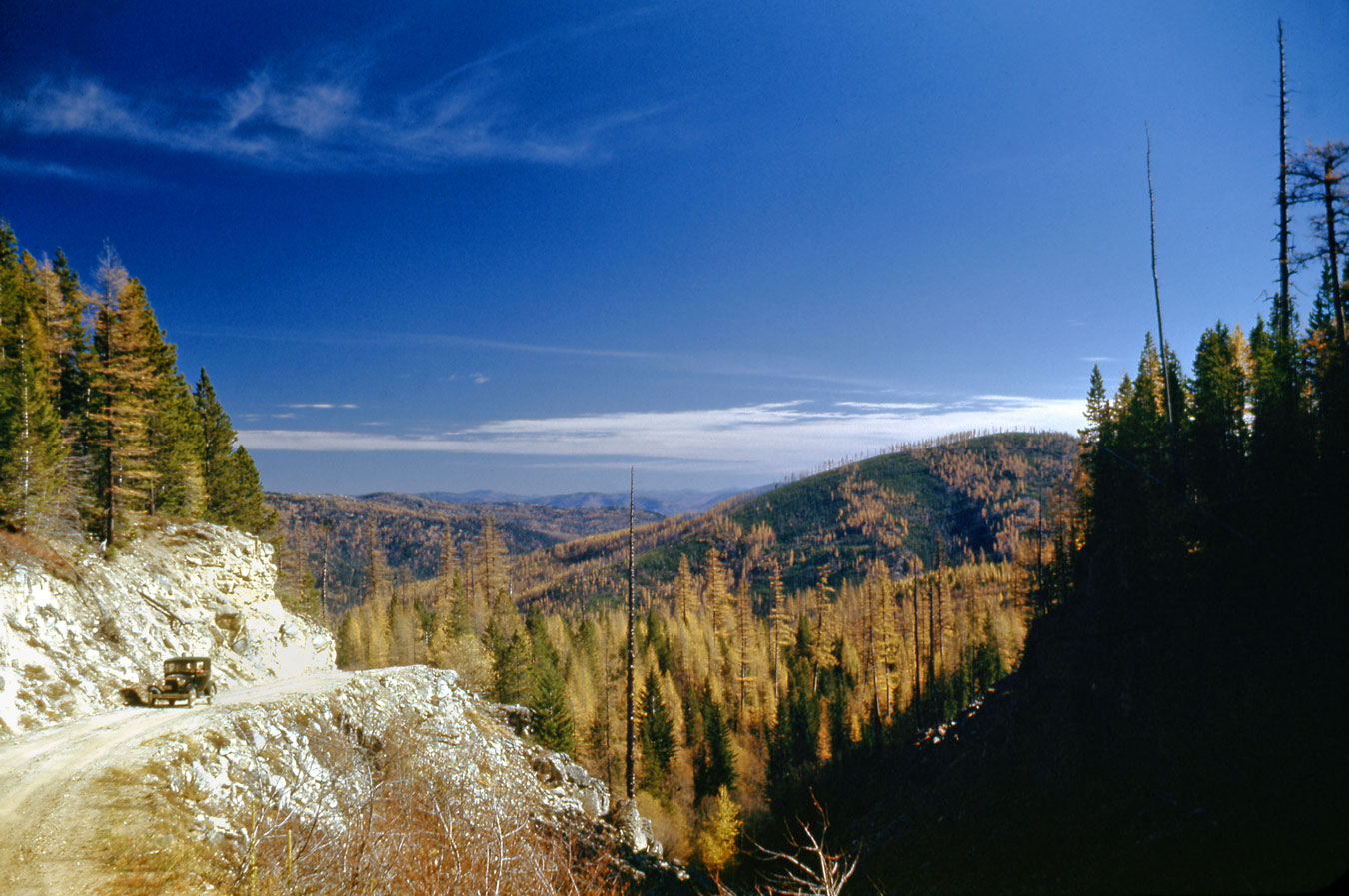
[Click TWICE to Enlarge] What model of motorcar is heading for Horace?

Where the shadow caste by the green and gold trees on the beach reaches its end a shepherd, perhaps, sits in the shade while a small distance to his left side a flock rests. Above the trees one sheep is drinking from the river for which Horace Sykes leaves no name. It is so rare for Sykes to include figures or their things in his landscapes that we may wonder how he felt here about this lonely man. [Click to Enlarge]

Here Horace is on top of Orcas Island’s Mt. Constitution and looking east over Rosario Strait to Bellingham Bay beyond the long interrupting strand of Lummi Island. When I first scanned this slide I imagined that it was somewhere in the Inside Passage between Vancouver Island and British Columbia. The revelation of what it is came with only a little reflection, for I spent four months looking back across these waters from the west shore of Lummi Island in the winter-spring of 1971. I rented a fishermen’s shack above the beach, far right, and from the window made several film time-lapses of the weather coming over Orcas Island towards me or rushing back and forth through Rosario Strait. The little islands nearer the east shore of Orcas do not look so small from Syke’s prospect. They are, first at the bottom, Barnes Island and above it Clarke Island. In the months that I lived on Lummi Island I worked on a film script with a working title Sky River Rock Fire. It is now, at last, the next “big project” I want to return to and hopefully complete – once I am finished with “Keep Clam,” the Ivar biography. Sky River, many will know, was the name we gave the first three-day outdoor festival produced and played in a natural setting and not a prepared venue. The first Sky River – in 1968 – was held on Betty Nelson’s Strawberry Farm near the town of Sultan, on Highway 2 to Stevens Pass. It will surely be a great recreation to return to the footage shot at that festival and several more and at last complete a film about it all. However, the film I took looking toward Orcas from my island home will not be useful. The laboratory had an accident with it and it came back to me very splotchy like seaweed seen through clouded water.

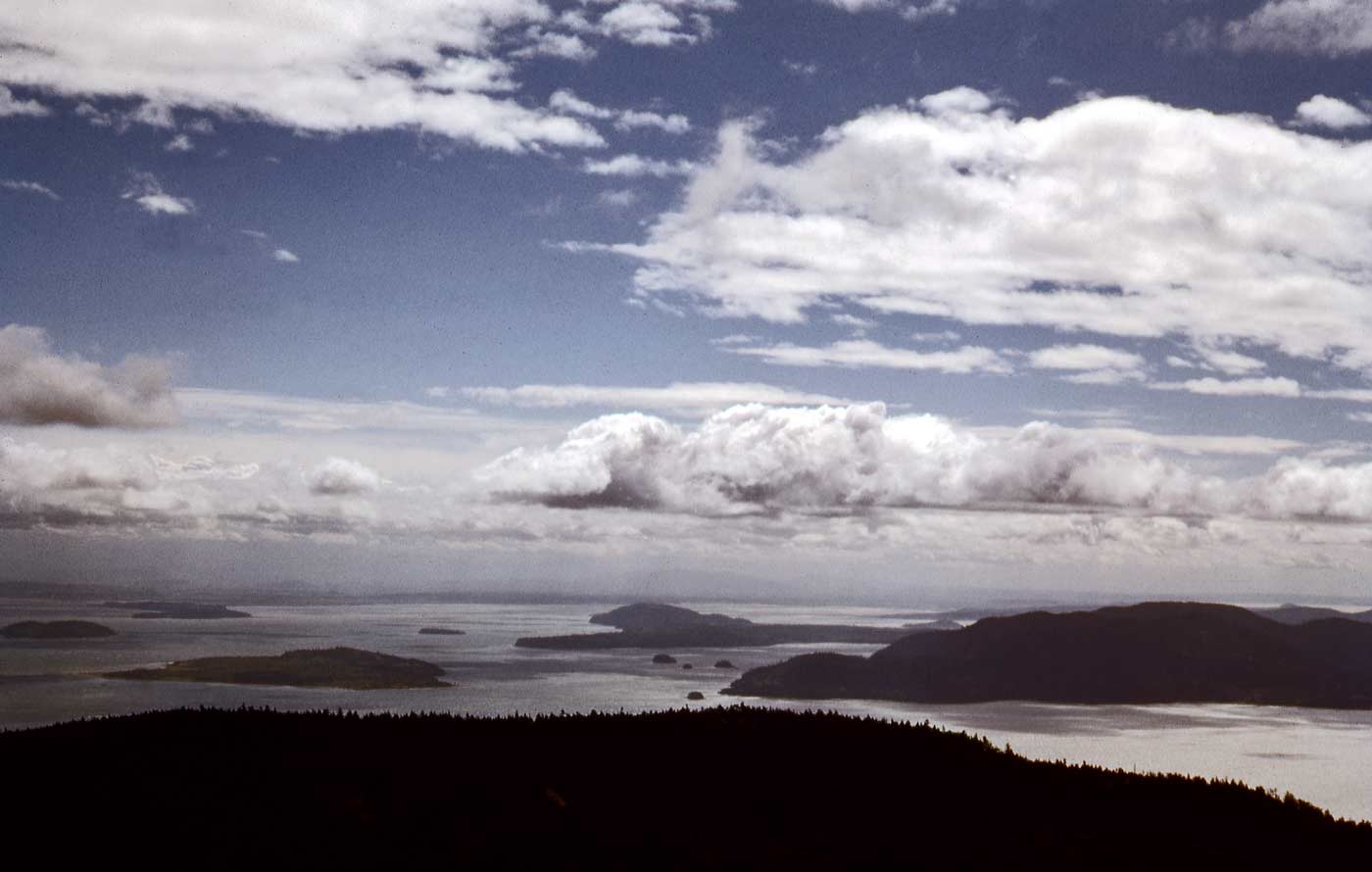
Here’s a familiar landscape in which the parts, the dark islands and roiling clouds, suggest a musical notation, a picturesque analogy for staffs of notes written across a page, with bass and treble clefs building a counterpoint of answering sounds like a Bruckner symphony – any of the eleven. Today I listened to all in order and continuous. So much hearing may also encourage seeing so. Look there, right of center, its the opening to the fourth and final movement, Bewegt, feurig, of Bruckner’s Symphony No. 1 in C minor, the 1877 Linz version, as played by the Bavarian Radio Symphony in concert, 1999, Lorin Maazel conducting.
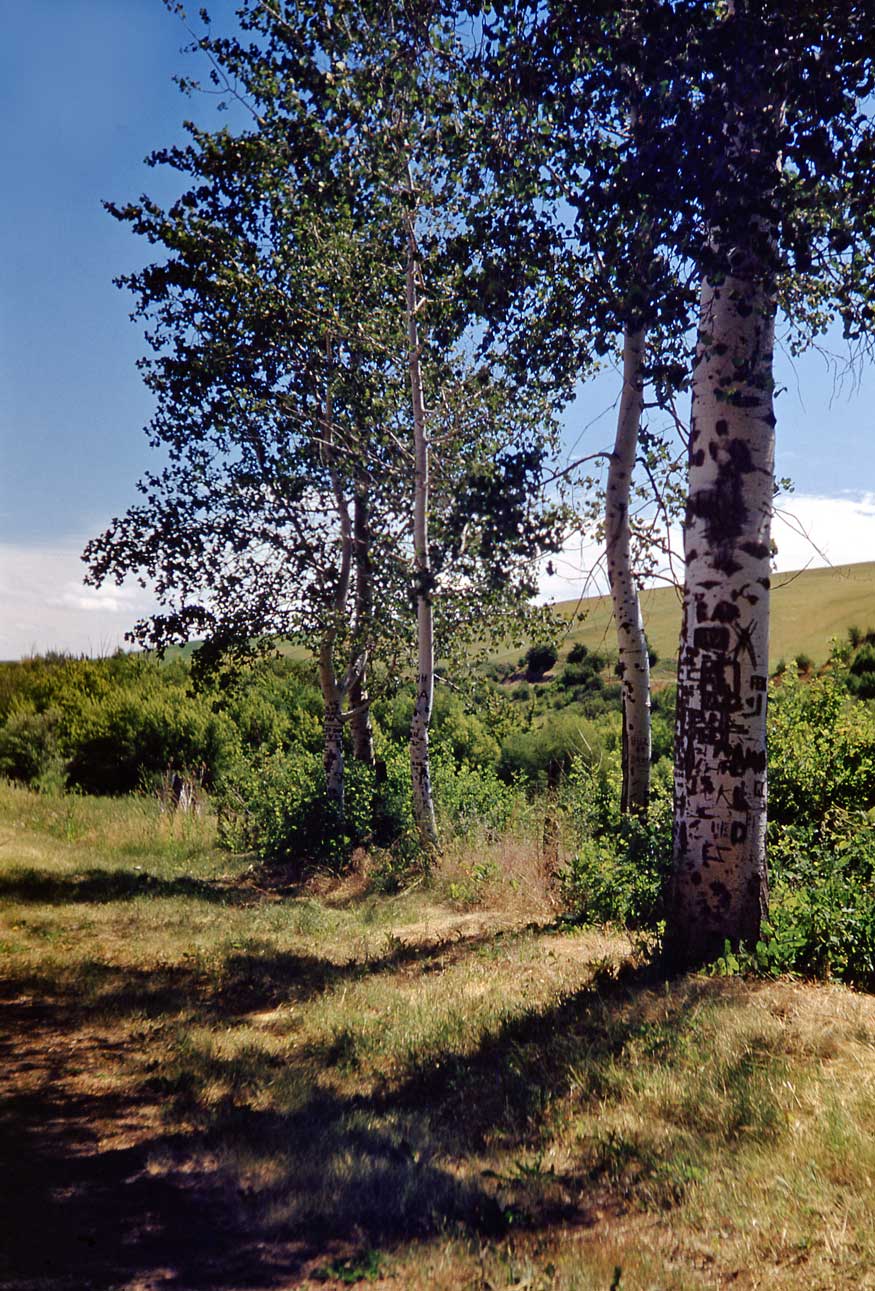
(click photos to enlarge)


In my oldest memory of this flat iron building the stone is a soiled black and the inside is stuffed with automobiles. As I remember it they seemed to have all been made in Detroit or near it. The pie-shaped place was well ventilated, for many of the windows were broken.
That was about fifty years ago, or roughly at its half-life. This our third City Hall was completed in 1909, and designed by local architect Clayton Wilson as a home not for the mayor or the council but rather for the local police, prisoners, courts, the city’s health and sanitation departments and emergency hospital.
When it opened in the spring of 1909 the Mayor and City Council moved in too, but temporarily. In 1916, they moved on and nearby to join King County offices in what was then called the City-County Building. Wilson’s trapezoidal creation between Yesler Way, Terrace Street and Fifth Avenue, was renamed the Public Safety Building.
Earlier, the primary addition to the building was a penthouse built not for the mayor but for housing the nurses. The hospital kept responding to emergencies until 1951 when the city abandoned the building, which sometime after got filled with those auto bodies, some of them also in distress. For those an auto repair shop was in residence.
Really the best source for Public Safety Building history is Dotty DeCoster’s illustrated – and still fresh – narrative on historylink.org. Published last year, it is that digital encyclopedia’s Essay 9336.
In 1977 a restored 400 Yesler Building, its new name, welcomed some municipal offices – including the Department of Community Development or DCD – back to its floors. I was by coincidence nearby when a visibly beaming Mayor Wes Ullman inspected it that year, his last in office.
Anything to add, Paul?
Yes Jean, a few relevant past features from the neighborhood. There are seven or eight more – although it is getting late. I’ll start with something on the first city hall.

CITY HALL, ca. 1886
This ca. 1886 portrait of a police line-up (of policemen not suspects) may be also the only surviving close-up of the Seattle city hall that was built on the east side of Third Avenue (Second Ave.) south of Mill Street (Yesler Way) in 1882. This first dedicated city hall is given a succinct description by pioneer journalist Thomas Prosch in the typewritten manuscript of his helpful chronological history of the city. “The house was a two-story brick of 40 by 60 feet, the first floor being used in the front for an engine room and in the rear for a jail, the upper floor being divided into a Council Chamber and rooms for the Clerk, Treasurer and Chief of Police.” The 1884 Sanborn fire insurance map notes that the rear windows were covered with iron bars and that this was the only brick building on the block – a material that nonetheless did not save it from destruction by the city’s Great Fire of 1889.
Chief, William Murphy posed on the far left. Murphy’s part in local history is in sum an unpleasant one. Instead of prohibiting the round up of Seattle’s Chinese from their homes on the Sunday morning of February 7, 1886, Murphy joined in. And since most his victims lived south of Yesler Way in quarters within a block or two of City Hall, the Chief was both near by and knew on what doors to pound. By the time the county sheriff, deputies and the volunteer home guards were alerted by the ringing of church bells, Murphy and his gang of sinophobes had pushed the resident Chinese and their belongings to the docks. Remarkably, for this sour performance Murphy was not fired. Instead he was outranked by a new office of inspector of police. The too-human truth is that Murphy’s racist behavior was widely popular and required time and a police force stocked with new officers loyal to the new inspector to check the habits of this chief and some of his force.

WILSE’S KATZENJAMMER CASTLE
In the long and comic history of Seattle’s search for a dignified city hall, the most bizarre years occurred when the city’s population exploded. Government offices for 40,000 Seattle citizens moved into the firetrap pictured in today’s historic scene just one year after the fire of 1889. It sat facing Third Avenue to the west between Jefferson Street and
Yesler Way and was saved from the fire by water buckets and wet blankets spread between the building’s roof and the shower of sparks that swept across Third.

The building was already eight years old in 1890 and had been the home of county government. When the county moved up to First Hill, the clapboard building was left to the city. Over the next 19 years, the city’s population quadrupled, and so did this city hall with an assortment of alterations and extensions that resembled the comic constructions in the then popular cartoon strip, the Katzenjammer Kids. In its last years, this city hall was popularly known as the Katzenjammer Castle.

Scores of photos exist showing the variety of permutations it took through its relatively short life. This view was recorded by Norwegian photographer Anders Wilse, who lived and worked in Seattle between 1897 and 1900. The first of these Katzenjammer scenes looks to the southwest, across the intersection of Third Avenue and Jefferson Street. By this time the city had added the extension to the clapboard muni-building visible on the right side along Third Avenue, the double stairway on the left along Jefferson, and had cut a sidewalk-level door into the odd-shaped space beneath its main entrance on Third. In the decade after Wilse shot this scene, the Katzenjammer Castle grew to at least three times its original size. However, the city outdistanced it and the castle was razed by 1909.

BLACK MARIA
[First published in Pacific on 9-30-1984.]
Seattle’s first horseless carriage came to town in 1900. Four years later, the city took an official count. For one day in December 1904, the Seattle Street Department counted and typed every vehicle that passed through the busy intersection of Second Avenue and Pike Street. The tally came to 3,959, but only 14 of them were automobiles. But by 1907 America and Seattle were automobile crazy. Every issue of the daily newspapers featured something about them. And although most American families could not afford to “get the motorcar habit,” there were, in Seattle at least, three chances to ride in one.
The favored choice was to take the Seeing Seattle tour bus. Or, for a little more trouble, an early Seattleite could get a ride in the Seattle Police Patrol’s brand new Black Maria. The last choice was a final option: a ride in Seattle’s first motorized hearse. But it was the city’s patrolling Black Maria that seemed to get the most attention.
In the accompanying historical photo, the new paddy wagon is being shown off in front of city hall and has no problem luring a crowd. On May 13, 1907 the Post-Intelligencer ran another photo of the police wagon with a caption that read: “The new automobile police patrol is ready to be formally delivered to the police department, provided it measures up . . . Chief Wappenstein and others made several trips in the wagon. On level streets, the machine moves along at the rate of 15 mph. It was built by the Knox Company of Springfield, Mass., and is for durability rather than speed.” And it did measure up.
The earliest record that contemporary police historian Capt. Mike Brasfield could find for the paddy wagon’s performance is from 1909. That year it made 7,637 calls, an average of almost 21 calls a day. But since it traveled an inner-city beat, its seemingly low 8,547 mile total included a lot of short trips to the jail.

Pictured in today’s contemporary photo is one of the department’s four modern vans. This one’s radio call name is David-Ten. It’s parked in the same spot as old Black Maria, but today the site of the old “Katzenjammer” City Hall is called City Hall Park.


SIDE BY SIDE
As far as I can recall, this is the only photograph that shows, side by side, two of the more significant structures in our pioneer history. On the left facing Third Avenue is the Yesler Mansion; on the right, Seattle City Hall. You cannot tell it here (although you directly above), but in its lifetime the latter grew into such a heterodox structure that it was popularly called “the Katzenjammer Castle.” The nickname was drawn from a comic strip featuring the two mischievous Katzenjammer Kids, whose adventures took place in a cityscape stuffed with clumsy structures resembling Rube Goldberg inventions.
In its own, ornate way, the 40-room Yesler Mansion was also clumsy. In “Shaping Seattle Architecture,” Jeffrey Karl Ochsner of the University of Washington Department of Architecture, notes its “highly agitated forms . . . irregular bays, picturesque profile and varied details . . . are typical of American High Victorian architecture.” I, for one, fall for this kind of clumsiness. When construction began on the mansion in 1883 in time for the depression or “Panic of 1883,” its municipal neighbor was already standing for two years as the King County Courthouse. When, in 1886, Henry and Sara Yesler moved two blocks from their home in Pioneer Place (Square) to their big home, it was barely furnished. After Sara died the following year, Henry and his nephew James Lowman went east to visit relatives and buy furniture. Henry died in late 1892. Seven years later, the Seattle Public Library moved in. The stay was short. On New Year’s Day 1901, fire destroyed the Yesler Mansion and 25,000 books. Twelve years earlier both buildings just escaped the city’s “Great Fire.” ~

UNREAD RUINS
In 1883 the city’s first industrialists, Henry and Sarah Yesler, rewarded themselves by building a 40-room mansion in their orchard facing Third Avenue between Jefferson and James Streets. The oversized home was not yet twenty when it burned down early in the morning of New Years Day, 1901. Actually, from this view of the ruins it is clear that while the big home was gutted by fire neither the corner tower (facing 3rd and Jefferson) nor the front porch – including the library sign over the front stairs – were more than blistered by it.
The Yesler landmark had a somewhat smoky history. Although completed in 1883 Sara and Henry did not move in, and instead continued to live in their little home facing Pioneer Place for three years more. When Sarah died in the late summer of 1887 it was in the mansion, which was then opened for the viewing of both Sarah – she was “resting” in its north parlor -and the big home too.
Soon after Sarah’s death Henry and James Lowman, Yesler’s younger nephew who was by then managing his affairs, took a long trip east to visit relatives, buy furnishings for the still largely empty mansion and, as it turned out, find a second wife for Henry. It was a local sensation when next the not-Iong-for-this-world octogenarian married in his 20-year-old (she may have been 19) cousin Minnie Gagler.
After Henry died in the master bedroom in 1892 no will could be found. While Minnie was suspected of having destroyed it this could not be proved. Consequently, the home was not — as Lowman and others expected — given to the city for use as a city hall. Instead Minnie stayed on secluded in it until 1899 when she moved out and the Seattle Public Library moved in.

Instead of partying on New Years Eve 1900 Librarian Charles Wesley Smith worked until midnight completing the annual inventory of books that only hours later would make an impressive fire. Except for the volumes that were checked out, the Seattle Public Library lost about 25 thousand volumes to the pyre. (The charge that Smith had started the fire was never proven.)

After its destruction the site was temporarily filled with the Coliseum Theatre (“The largest west of Chicago, seating 2600.”) until the first floors of the King County Courthouse – aka the City-County Building – replaced it in 1916 . . This comparison (the principal one) looks east across Third Avenue.


THE WAYSIDE MISSION
The Idaho was probably one of the last ships to be buried beneath Seattle’s waterfront. The irony of this sidewheeler’s last days was sensational enough to be popularly told and retold. As a 1903 article in the weekly Commonwealth put it, the Idaho’s career was “a happy instance of compensation” in which an “opium-smuggling ship became an ark of refuge for opium victims.”

Built to work on the Columbia River out of The Dalles, the Idaho was soon successfully taken over that river’s treacherous cascades and then, in 1882, was sent on to Puget Sound. Here its shadier labors included smuggling illegal aliens and opium. But in 1899 the ship was redeemed by a Spanish Jesuit turned surgeon.
Dr. Alexander de Soto bought the steamer with money made from practicing surgery on the well-to-do and converted it into a hospital for the down-and-out. With the ship set above high tide on pilings at the foot of Jackson Street, De Soto and his wards abandoned their first hospital, a borrowed bam where he not only cared for but also lived with his indigent patients. The good works of De Soto’s Wayside Mission were so in demand that his example eventually spurred the city itself to provide health care for the indigent. With the 1909 completion of the new Public Safety ·Building (now the 400 Yesler Building); Seattle opened its own clinic.

Two years earlier, in 1907, the Wayside Mission was forced from its land-bound sidewheeler and moved to a temporary site at Second and Republican, now the part of the Seattle Center taken by the Bagley Write Repertory Theatre. Soon after, the redeemed Idaho was laid to rest beneath fill near the foot of Jackson Street.
[ CLICK TWICE on the two Commonwealth pages that follow from May 23, 1903, and they will leap to a size for reading.]


FOURTH AVENUE UPHEAVAL
Under the headline “Many Evidences of Progress,” The Sunday Times of Nov. 22, 1908 reported that the completion of the Fourth Avenue regrade “comes doubtless something of a surprise to many who did not realized the progress that has been made.” Looking at the evidence of this photograph that looks north on Fourth from the Terrace Street overpass two days earlier we may also be surprised.
But we shouldn’t be. While the new street is not yet completed the lowering of it to a new grade has been. Within a year all of the structures — save for the middle one of five on the right — would be destroyed including the historic Turner Hall on the left. Built in 1886 it survived the city’s Great Fire of 1889 to be renamed the Seattle Opera House, although its standard faire was not Mozart or Verdi but minstrel shows. (Note: on the Friday night this photograph was shot Maud Powell, America’s greatest violinist of the time, played Ernst’s ‘Fantasia’ on airs from Verdi’s Othello to more than 1000 packed into the U.W.’s then new gymnasium.)

Also in the Sunday Times just noted, Henry Broderick, then the most quotable of local real estate agents, shared his philosophy of progress in this upheaval. “Someone has said that, in an American sense, a dead town is one in which the streets are not all torn up.” Broderick added this statistic, “It is interesting to know that at the moment there are not less than 15 lineal miles of Seattle streets in various processes of improvement.”

Finally, November 1908 was also a month for spiritual upheaval between two Presbyterian ministers: the Rev. C. H. Killen and the Rev. Mark Matthews. Speaking at Matthew’s invitation before the Ministerial Federation of Seattle, Killen warned his fellow preachers that if they did not reinstitute early Christian practices like “feet washing ceremonies, love feasts and holy kissing bees” that they with their flocks would “tumble head foremost into perdition.”
Embarrassed at having been “buncoed by a religious crank” Matthews soon put it strait on who is really going below. “There is no place where the ruin of young lives can be carried on so easily as in Seattle. The pernicious dance hall, the wine room and the quack doctor are inseparably involved in the steps of progress toward destruction. After that ring down the curtain, for the next act is in hell.”


YESLER CABLE’S LAST DAY
The above historical scene on Yesler Way was photographed on Friday afternoon August 9th, 1940. It was the last day of cable car service in Seattle, and on Saturday the Yesler line was turned over to gas busses.
Enough locals understood the significance of this Friday that the Municipal transit had to put two extra cars on the line. Before the last car was silenced at 2 a.m. Saturday morning the typical whirring and clanging noises of the cable line were counterpointed by the cheering and singing of the trolley fans that crowded onto the cars. The operators added to this noise by clanging the cable cars bells all along the line.

Earlier a spirit citizen attempt to save the cable lines only postponed their demise and first the James Street line, followed by the Madison cable and last the Yesler system were closed in 1940. Since its death at 52 there have been periodic calls for the system’s return and, no doubt, a rumbling and ringing cable line between Pioneer Square and Leschi Park would be a very popular “unrapid” transit for tourists and locals alike.
Car 22 was constructed in 1907 by the Seattle Electric Company at its Georgetown shops. It was part of the fleet sold with the city’s transit system to the city in 1919. Painted orange like the rest of the municipal fleet Car 22 was soon scraped.

In 1920 the Yesler Cable line’s western terminus was moved two blocks east from First Avenue to Prefontaine Place where here (in both photographs above) twenty years later Cable Car 22 takes on passengers for one of its last trips to Leschi Park on cable railway’s last day of operation in Seattle. More than half a century later both the Prefontaine Building, right, and the 400 Yesler Building, left, survive.


It has reached “nighty bears” time and so we will cut it off with a detail from the new City Hall, or Municipal Building – a moving piece of its sliding water. Tomorrow late morning we will look for two missing subjects and add them – if we find them.

