UPDATE: On Dec. 30, 2024, Stephen Sadis reports: “We are very excited about getting the cover story in Columbia Magazine’s winter issue. It focuses on the accomplishments of James J. Hill in the Northwest. Also, beginning in February, “The Empire Builder” documentary will be broadcast throughout the Northwest on Cascade PBS (details to come).”
To download a pdf of the cover story, click the cover above right!
=====
(Click and click again to enlarge photos)
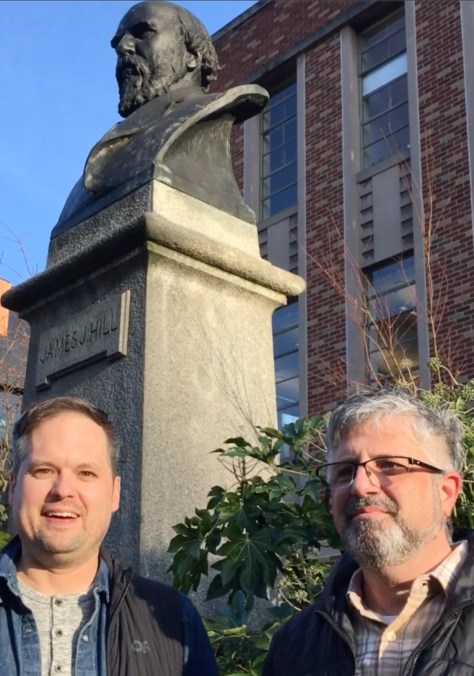
THEN1: In this west-facing image, James J. Hill (lower left, near flag) addresses 20,000 on June 1, 1909, the opening day of Seattle’s first world’s fair, the Alaska-Yukon-Pacific Exposition, in an amphitheater approximately where the Padelford Hall parking garage stands today at the University of Washington. (Romans Photo Co., courtesy Stephen Sadis)NOW: Stephen Sadis (right) and Kyle Kegley of Sadis Filmworks, sadisfilmworks.com, stand next to the James J. Hill bust and engraved railroad panel outside More Hall at the University of Washington. No plaque exists nearby to explain the stature of the Canadian-born, Minnesota-based Hill. The bust’s base originally was taller when it was unveiled Aug. 2, 1909, during the Alaska-Yukon-Pacific Exposition at a nearby site, west of today’s Drumheller Fountain on the UW campus. (Jean Sherrard)
Published in The Seattle Times online on Feb. 23, 2023
and in PacificNW Magazine of the printed Times on Feb. 26, 2023
Documentary launches up-Hill quest to honor the ‘Empire Builder’
By Clay Eals
THEN2: This northbound view on Fourth Avenue on Nov. 2, 1953, shows the Great Northern Railway sign, with its mountain goat and “EMPIRE BUILDER’ slogan, at the juncture of Olive Way and Stewart Street. In South Seattle, the former name of today’s Martin Luther King Jr. Way was Empire Way, in Hill’s honor. (Seattle Municipal Archives)
When I routinely rode with my dad to his downtown office in the late 1950s, he drove north along Fourth Avenue. Looming as we approached the nexus of Olive and Stewart, Seattle’s version of Times Square, was an enormous, elevated sign featuring a scaffolded Great Northern mountain goat atop a showy slogan: “EMPIRE BUILDER.” Through the windshield, I and countless others were absorbing a layered message.
“Empire Builder” referenced the passenger train from St. Paul that had crucially connected our city to the rest of the country in 1893, post-Great Fire. The catchphrase also echoed the sobriquet for the railway’s indefatigable founder, who helped turn Seattle into a metropolis — yet whose name is little seen or celebrated today.
Seasoned West Seattle documentarian Stephen Sadis seeks to change that, in a manner as audacious as his subject. His new “The Empire Builder: James J. Hill and the Great Northern Railway,” is a four-hour tour de force, the result of on-and-off research for 20-plus years, summoning 5,000-plus images, maps and film clips and dozens of interviews to tell its larger-than-life story.
Hill (1838-1916) was a town speculator, agriculturalist, shipping magnate, banker, collector, philanthropist, longtime husband and the father of 10, but his legacy rides with the “Iron Horse” and its inescapable impact, which inspired Sadis’ fascination.
“If I told you,” he says, “that tomorrow when you wake up you could travel from Seattle to New York in 10 minutes, that’s the kind of change that occurred in the mid-19th century, from a six-month wagon trek across the country to a four-day train ride. That transformation is the key.”
THEN3: A portrait of Hill from 1902. Quoted in the documentary, Hill says of the Great Northern line, “Most men who have really lived have had in some shape their great adventure. This railway is mine.” (Courtesy Stephen Sadis)
Through Hill’s saga, Sadis and producing partner Kyle Kegley weave the personal (Hill’s right-eye blindness from a bow-and-arrow accident as a child) with the enterprising (Hill’s insistence on fashioning efficient and enduring rail lines) while repeatedly giving voice to the trains’ displacement of Native Americans.
The tale hits a peak with Hill’s opening-day speech for the 1909 Alaska-Yukon-Pacific Exposition at the University of Washington. For an industrialist, the bent is surprising, as bold and prescient as its source — and certainly relevant today:
“Will you realize what this country will become when stripped of its forests — the washing away of the soil, the inevitable changes in climate when the forests have gone? …
“You have but to raise your eyes and be in the presence of some of the grandest works of God. Soil, climate, resources, all favor you. You will never again know isolation. The spaces once separating you from the rest of the country have been conquered. Remain as you have been, the architects of your own fortunes.”
WEB EXTRAS
Special thanks to Stephen Sadis and Kyle Kegley for their invaluable help with this installment!
To see Jean Sherrard‘s 360-degree video of the “Now” prospect and compare it with the “Then” photos, and to hear this column read aloud by Clay, check out our Seattle Now & Then 360 version of the column.
From roughly the same vantage as the “THEN2” image above is this color view of Fourth Avenue at dusk in the late 1960s, possibly from a postcard. The lighted Great Northern mountain goat (deep center) is backed by a red circle. Some letters are burned out in the “EMPIRE BUILDER” sign below.VIDEO (4:00): Click this image to view a 4-minute interview with Kyle Kegley (left) and Stephen Sadis about their new James J. Hill documentary. (Clay Eals)Oct. 5, 1896, Seattle Times, p5.June 1, 1909, Seattle Star, p1.June 2, 1909, Seattle Post-Intelligencer, p13, featuring the complete text of his speech on opening day of the Alaska-Yukon-Pacific Exposition at the University of Washington. The text continues and concludes in the next clip.June 2, 1909, Seattle Post-Intelligencer, p16.Aug. 1, 1909 Seattle Times, p3.May 14, 1916, Seattle Post-Intelligencer, p19.May 29, 1916, Seattle Times, p1.May 29, 1916, Seattle Times, p4.May 29, 1916, Seattle Times, p8.May 29, 1916, Seattle Times, p9.May 30, 1916, Seattle Times, p6.March 26, 2006, Seattle Times, p169, “Now & Then.”
THEN1: This elevated, hand-tinted image, circa 1924, overlooks the Jefferson streetcar barn and yard, opened between late 1909 and early 1910. Among the vehicles are smaller Birney-brand streetcars whose open backs were being enclosed by Seattle Municipal Railway. The twin towers of Immaculate Conception Catholic Church at 18th & Columbia, built in 1904, peek out hazily at upper right. (Courtesy Danny Eskenazi)NOW: To replicate the lofty “Then” vantage, streetcar historian Mike Bergman stands atop the four-floor Craft Apartments building at 1316 E. Jefferson St. In the background is Seattle University’s soccer stadium, Championship Field, site of the former Jefferson streetcar barn and yard, with the towers of Immaculate Conception Catholic Church at upper right. (Clay Eals)
Published in The Seattle Times online on Feb. 9, 2023
and in PacificNW Magazine of the printed Times on Feb. 12, 2023
The legacy of Seattle’s streetcar mindset isn’t black-and-white
By Clay Eals
Calvin & Hobbes, Sunday, Oct. 29, 1989.
In the beloved “Calvin & Hobbes” comic strip, Calvin asks his dad on Oct. 29, 1989, “How come old photographs are always black and white?” His dad’s classic response: “The world was black and white then.”
The jest underscores how hand-tinted images — like this week’s “Then” photo, circa 1924 — can let the color-habituated among us better envision city life a century ago.
Looking north and slightly east, we hover above East Jefferson Street in an impressive “bird’s eye view” of the Seattle Electric Company’s centrally located, all-wood streetcar barn and yard between 13th and 14th avenues on First Hill.
The Seattle Electrics baseball team, likely photogrphed at the Jefferson site. (David Eskenazi collection)
Erected on former pro-baseball grounds and replacing a barn at Sixth & Olive downtown, the storage and maintenance complex was to have been opened for the 1909 Alaska-Yukon-Pacific Exposition, but its launch came shortly afterward. At its north side, a tower stored water for potential fires while the city completed its fire-hydrant network.
THEN2: Twenty-nine streetcar staff pose on April 24, 1924, at the Jefferson Street barn and yard. For a time, the “trainmen” (motormen and conductors) mounted an amateur baseball team called the Jefferson Car Barn boys. At right is a 1923 or 1924 Ford Model T touring car. (Courtesy Danny Eskenazi)
With electrified streetcars continually rolling in and out, the unfenced facility became a busy community landmark, referenced for decades as a locator in classified ads for nearby apartment and room rentals and cafes. It hosted various meetings and even served as a draft-registration site in 1940.
The last Seattle streetcar ran in 1941, but the Jefferson hub operated for 44 years past the city’s rail-to-rubber conversion to trolley coaches. In 1984, the city sold the property to Seattle University, which 10 years later converted it to a soccer stadium, dubbed Championship Field in 1998.
Cover of “Seattle’s Streetcar Era.”
Despite today’s focus on light-rail expansion and getting people out of cars, Seattle’s matrix of now-vanished streetcars produced a higher per-capita use of public transit, notes Mike Bergman, retired Sound Transit and King County Metro planner and author of “Seattle’s Streetcar Era: An Illustrated History, 1884-1941.”
“I think there was more appreciation of the system then,” he says. “The highest levels of ridership occurred during the first and second World Wars, when population densities were far less. Part of it was lower car ownership. Fewer people could afford a car. Fewer still could afford two cars.”
Gradually and relentlessly, he says, automobile and petroleum interests converted the public mindset to individualized travel. “They certainly made it easy to fill up your tank, and it was really cheap,” he says. “It also became a status symbol.”
Bergman optimistically projects another mass-transit heyday, fueled by increased urbanization: “I just don’t think all of those people will be able to get around solely in cars.”
Here we can return to the comic Calvin. In the 1989 strip’s closing panel, he tells his tiger friend Hobbes, “The world is a complicated place.”
WEB EXTRAS
Special thanks to collector Danny Eskenazi , Zachary Tartabull of the Craft Apartments and historians Dave Eskenazi, Bob Carney and Mike Bergman for their invaluable help with this installment!
To see Jean Sherrard‘s 360-degree video of the “Now” prospect and compare it with the “Then” photos, and to hear this column read aloud by Clay, check out our Seattle Now & Then 360 version of the column.
THEN1: His buggy pulled by former racehorse Mabel Payne, Dr. Jacob Benshoof pauses in 1905 on hilly Madison Street at Fifth Avenue, backed by Providence Hospital, which operated there in various incarnations from 1877 to 1911. “There were few hospitals then,” Benshoof reflected circa 1976, “and it took forever to get to a real hospital such as Providence.” (Museum of History & Industry)NOW: At the former Providence Hospital site, a dozen relatives of Dr. Jacob Benshoof stand next to the 2004 downtown Seattle Public Library and before the 1940 William Kenzo Nakamura U.S. Courthouse for the Ninth Circuit U.S. Court of Appeals at the northwest corner of Fifth and Madison. They are (from left): Eric Sprunk, Blair Sprunk, Jill Ashley, Jeff Ashley, Joel Rosas, Blyth Claeys, Bill Benshoof, Dina Skeels, Dylan Skeels, Chris Foster, Bob Benshoof and Bob Foster. (Jean Sherrard)
Published in The Seattle Times online on Jan. 26, 2022
and in PacificNW Magazine of the printed Times on Jan. 29, 2023
Busy physician Jacob Benshoof relied on four-hoofed transit
By Clay Eals
Aug. 15, 1907, Seattle Times, p19.
Not yet 2 was tiny Rene Alarie. The evening of Aug. 13, 1907, she played in her South Park backyard as her mother focused on her 4-month-old sister. The tot opened a gate and toddled into the road, where returning to Seattle was a Route 5 streetcar.
The conductor and motorman, not yet aboard, ran to catch the car, but its fender knocked Rene down, and she was seriously injured. Fortunately, she regained consciousness while resting at a neighbor’s home, where she recognized her mom.
“Dr. J.A. Benshoof, the attending physician, believes she has a good chance to recover,” reported The Seattle Times.
Seattle Public Library circa 1910s, just west of Providence Hospital. This incarnation of the library stood between 1906 and 1956. (Seattle Vintage)
With automobiles a blossoming curiosity, the phrase “attending physician” painted a rustic picture 115 years ago. The doctor, Jacob Andrew Benshoof (1882-1979), who began work in South Park two years earlier, reached a wide swath of patients — including uphill in forested White Center, where he was the district’s first doctor — via horse.
“I would start out for some cabin in the woods in the morning, and by the time I got there a neighbor might have sent for me to come on another two or three miles farther to their home,” Benshoof told The Times in 1955 on his 50th anniversary of practice. “I’d go out to some tent or cabin in the timber to care for a woman in childbirth or a man who had been hit by a timber or caught in a saw or shot. Things happened in the timber country in those days.”
THEN3: Dr. Jacob Benshoof is shown circa 1915 with family: (from left) son Allen, daughters Helen and Thelma, wife Neoma and daughters Geraldine and Genevieve. (Courtesy Dina Skeels)
Born and raised in Iowa and trained in St. Louis, the busy Benshoof served as surgeon for the long-gone Meadows Race Track south of Georgetown and as Seattle medical examiner. He also joined the early staff of Providence Hospital and established offices downtown.
And he acquired a car. (He placed a 1910 Times ad to sell his “buggy horse and saddle, sound and gentle; new buggy and harness.”) But while building a family and becoming known as a prolific deliverer of babies, he never lost his early reputation for four-hoofed service, carrying a medical kit and rifle while riding or driving an ex-racehorse named Mabel Payne.
Aug. 16, 1907, Seattle Times, p3.
Two days after Rene Alarie’s streetcar accident, the Times reported that another South Park girl, Helen Taylor, 7, visited a neighbor’s home to get milk.
The neighbor’s chained bulldog startled the girl and bit her as she fell into a hole. A key part of the report:
“Dr. J.A. Benshoof dressed the wounds, and the little girl was removed to her home, where she is now resting easily.”
WEB EXTRAS
Special thanks to Dina Skeels of the Benshoof family and to Wendy Malloy of the Museum of History & Industry and streetcar historian Mike Bergman for their invaluable help with this installment!
To see Jean Sherrard‘s 360-degree video of the “Now” prospect and compare it with the “Then” photos, and to hear this column read aloud by Clay, check out our Seattle Now & Then 360 version of the column.
THEN1: Observing the recently rebuilt Tacoma Narrows Bridge in 1951 are Burien’s William Fogelstedt and his three daughters (from left), Julia, Helen and Gail. (Marjorie Fogelstedt, courtesy Lauren Koslowsky Bakken)NOW1: With its fraternal-twin span (opened in 2007) to the south (left), family members match the 1951 Narrows Bridge pose from state Department of Transportation property: (from right) Gail Fogelstedt Koslowsky and husband Marq Koslowsky of Spokane; Helen Fogelstedt Hackett of Bothell; and Lauren Koslowsky Bakken of Shoreline, daughter of Gail and Marq. (Clay Eals)
Published in The Seattle Times online on Jan. 12, 2022
and in PacificNW Magazine of the printed Times on Jan. 15, 2023
For his family, a Burien father reveals ‘Sturdy Gertie’
and ‘how big the world is’
By Clay Eals
In this tranquil tableau that his wife captured with a camera, a father and the couple’s daughters gaze upon the newly completed Tacoma Narrows Bridge in 1951.
For the girls, it was a surprise visit, like others their dad initiated on Sundays. However, little could they comprehend the notorious catastrophe that had unfolded there before any of them was born.
Relative newcomers accustomed to today’s pair of Narrows bridges may be forgiven for not knowing the riveting context of the solitary span that opened there on Oct. 14, 1950. It replaced a narrower Narrows Bridge that had opened on July 1, 1940, but had met a calamitous fate.
Nov. 7, 1940, Seattle Times, page 1.
After four months and 265,000 car crossings, the earlier bridge twisted for two hours (like a ribbon, corkscrew or hammock, onlookers said) in 42-mph winds, broke apart and plunged 190 feet into Puget Sound just before noon on Nov. 7, 1940. The only lost life was that of a dog mistakenly abandoned in a sedan mid-span.
The bridge’s failure pulled out the rhetorical stops. A reporter later termed it “the Pearl Harbor of American civil engineering,” but its enduring and endearing epithet was “Galloping Gertie.”
Newspapers, accordingly, termed the stronger, wider Narrows Bridge “Sturdy Gertie,” and it has stood for 72-plus years. (To accommodate more traffic, a fraternal twin to the south opened July 15, 2007.)
Eye-popping film of Gertie’s 1940 undulation and collapse became familiar to those in the 1950s who watched its repeated airings on the weekly ABC-TV series “You Asked for It.”
VIDEO (2:12) Click the image to see a clip from the movie serial “Atom Man vs. Superman,” in which the Man of Steel stabilizes the undulating Narrows Bridge to save a woman in danger on the span.
The electrifying footage also figured in an episode of the movie serial “Atom Man vs. Superman,” in which evil Lex Luthor destroys the bridge as a warning signal to Metropolis but not before the Man of Steel briefly grasps and stabilizes the span so that a woman on it can be rescued.
In 1951, the real-life girls in our “Then” photo possessed their own Sunday-drive context, imparted by their dad, railroad dispatcher William Fogelstedt of Burien.
“He would choose places that we had never seen before,” says daughter Helen Hackett of Bothell, who has no memory of the Narrows trip beyond its photos. “He would keep it a secret until we got there. It was always a buildup: ‘Now, just a few more miles down the road, and we’ll be there.’
“He would show us all the wonders of the world here in Washington. It always was followed up by an ice-cream cone on the way home. It was his way of expressing life and how big the world is.”
A simple snapshot. A lesson for a lifetime.
THEN2: Facing the camera are the Fogelstedt daughters (from left) Helen, Julia and Gail. (Marjorie Fogelstedt, courtesy Lauren Koslowsky Bakken)NOW2: Facing the camera are Fogelstedt daughters Helen Hackett (left) and Gail Koslowsky, who hold a framed photo of their late sister, Julia Hick. (Clay Eals)
WEB EXTRAS
Special thanks to Washington Department of Transportation staffers Robert Webster, Stan Zal, April Leigh and Stefanie Randolph, as well as Lauren Koslowsky Bakken, for their help with this installment!
To see Jean Sherrard‘s 360-degree video of the “Now” prospect and compare it with the “Then” photos, and to hear this column read aloud by Clay, check out our Seattle Now & Then 360 version of the column.
Below are (1) links to a contemporary video interview, a Feliks Banel story (with vintage audio) and three historical accounts of the 1940 bridge collapse, (2) an additional photo, (3) a 1994 Paul Dorpat “Now & Then” column on Tacoma’s “other bridge,” (4) a link to a 2007 Seattle Times article by Mike Lindblom on 1950 Narrows Bridge steelworker Earl White, plus, (5) in chronological order, 22 historical clips from The Seattle Times and Seattle Post-Intelligencer online archive (available via Seattle Public Library) and Washington Digital Newspapers, that were helpful in the preparation of this column.
Also, new film footage from a more distant site has been found of the 1940 bridge collapse. That fascinating story, and the footage, can be found here.
VIDEO (3:07) Click this image to see Gail and Helen Fogelstadt recall their father’s Sunday driving trips during which he would surprise them by visiting “all the wonders of the world here in Washington,” including Tacoma’s newly rebuilt Narrows Bridge in 1951. (Clay Eals)
Seen looking northwest from state Department of Transportation property, the twin Narrows Bridges gleam in the morning sun, Dec. 7, 2022. (Clay Eals)Leta Caldwell stands at roughly the same position as our “Then” and “Now” prospects in 1962. (Francis E. Caldwell, courtesy Bob Caldwell)Dec. 25, 1994, Seattle Times, “Now & Then” column by Paul Dorpat.Click this 1950 image to see a 2007 Seattle Times story by Mike Lindblom about steelworker Earl White, who helped built the “Sturdy Gertie” span. (Washington Department of Transportation)
THEN: The P-I globe glows in late 1948 at the southwest corner of Sixth & Wall downtown. When the paper moved to 101 Elliott Ave. W. in January 1986, the globe moved with it and remains today. The P-I ceased publication there in 2009 and operates online only. (Lawton Gowey / Paul Dorpat collection)NOW2: Today, sans neon globe, the full-block building built by the P-I in 1947-1948 at Sixth & Wall and left behind in 1986 houses City University. (Jean Sherrard)NOW3: In this north-facing view, Matt Hucke, author of the just-released “Seattle Neon,” stands before the immobile and deteriorating P-I globe on the roof of 101 Elliott Ave. W. Hucke will speak at the Southwest Seattle Historical Society’s free online series “Words, Writers & Southwest Seattle” on Jan. 12. More info: SeattleNeonBook.com and LogHouseMuseum.org. (Jean Sherrard)
Published in The Seattle Times online on Dec. 29, 2022
and in PacificNW Magazine of the printed Times on Jan. 1, 2023
In light of history, Seattle’s neon signs scream, ‘Hey, look at me!’
By Clay Eals
For more than 13,500 nights, from November 1948 to January 1986 atop a building at Sixth & Wall, it glowed in hues of red, blue, green and yellow — a beacon of hope for journalism and the city itself. Once dubbed “the earth and eagle,” it was known more simply and affectionately as the P-I globe.
Latecomers may find the hyphenated letters unfamiliar. But for 128 years, from the 1881 merger of the Seattle Post and Daily Intelligencer until the newspaper’s final press run on March 17, 2009, the Seattle Post-Intelligencer competed for citywide attention. Reinforcing this was the glimmering globe’s rotating slogan, profound in its brevity: “It’s in the P-I.”
NOW3: In repose today at the Museum of History & Industry warehouse in Georgetown, the P-I’s earlier neon sign, the city’s first, shone from the paper’s Sixth & Pine location from June 1927 through late 1948, when the P-I opened its new building (with neon globe) at Sixth & Wall. (Feliks Banel)
Allowing the 48-foot-tall worldly ornament to burn brightly was the 1898 British discovery of neon. The treated gas also had fueled Seattle’s first-ever neon sign, also for the P-I, which shone at its earlier site at Sixth & Pine from June 1927 through late 1948.
Today, neon is ubiquitous, as documented in a new, wildly colorful book, “Seattle Neon.” For three years, author/photographer Matt Hucke, a Chicagoan who arrived in the Queen Anne district in 2015, explored all corners of the city. The result: a 174-page volume with 460 annotated images, arranged by neighborhood and depicting the most noteworthy examples of the elemental art.
It’s also a snapshot of a fluid commercial landscape. “In an age where everything is being torn down and built again in a few years,” Hucke says, “it gives you a sense of place.” And illuminated neon, he says, can yield expressive insight. “It’s about screaming for attention in the middle of the night. It’s ‘Hey, look at me!’ ”
His array includes such icons as the chef and flapping fish of the now-closed Dahlia Lounge downtown and “everyone’s favorite,” the giant rotating sign at Denny & Battery for Elephant Super Car Wash. Hucke captured the pink pachyderm and its smaller, stationary sibling before closure of the business prompted the signs’ dismantling for preservation and restoration.
Unfortunately, his cover shot of the smaller elephant shows the scripted “Super” tubing burned out. Hucke finds that symbolic: “Not everything is perfect here.”
In 1986, the P-I globe is dismantled at Sixth and Wall before its move to Western Avenue. (Clifford Petty, courtesy Ron Petty)
A similar fate is slowly befalling the P-I globe. Seattle landmarked it in 2012, and it still overlooks the waterfront from a five-floor office building at 101 Elliott Ave. W., where the paper moved in 1986 and operated until its 2009 print shutdown. But the battered sphere is largely unlit, and its slogan no longer rotates. A fix-up would be expensive.
In our New Year, where shines the beacon’s hope?
WEB EXTRAS
Special thanks to Mari Rabung and Barbara Dorhofer of 101 Elliott Ave. W., staff of Mindful Therapy, Jeff Pattison of NW Work Lofts, Matt Hucke, Dora-Faye Hendricks, Casey McNerthney, Heather & Erik Pihl and especially Feliks Banel for their help with this installment!
To see Jean Sherrard‘s 360-degree video of the “Now” prospect and compare it with the “Then” photos, and to hear this column read aloud by Clay, check out our Seattle Now & Then 360 version of the column.
The back and front cover of “Seattle Neon.” (Everything Goes Media)The P-I globe, seen from the corner of Elliott Avenue West and Denny Way. (Clay Eals)A present-day close-up view of the P-I globe. (Jean Sherrard)An alternate present-day view of the P-I globe. (Jean Sherrard)Backed by Queen Anne Hill, an alternate present-day view of the P-I globe. (Jean Sherrard)Looking north from atop the former P-I building, 101 Elliott Ave. W. (Jean Sherrard)Looking south from atop the former P-I building, 101 Elliott Ave. W. (Jean Sherrard)Two eagles perch atop the “earth and eagle” globe of the Seattle Post-Intelligencer in January 2022. (Heather Pihl)Two eagles perch atop the “earth and eagle” globe of the Seattle Post-Intelligencer in January 2022. (Heather Pihl)Two eagles perch atop the “earth and eagle” globe of the Seattle Post-Intelligencer in January 2022. (Erik Pihl)Click the page above to read a pdf of the 2012 Seattle landmark designation for the P-I globe.June 18, 1927, Seattle Post-Intelligencer, p15.June 9, 1928, Seattle Post-Intelligencer, p17.June 9, 1928, Seattle Post-Intelligencer, p18.Nov. 13, 1947, Seattle Post-Intelligencer, p21.Nov. 10, 1948, Seattle Post-Intelligencer, p21.Nov. 11, 1948, Seattle Post-Intelligencer, p15.Dec. 7, 1948, Seattle Post-Intelligencer, p3.Jan. 2, 1949, Seattle Post-Intelligencer, p1Jan. 2, 1949, Seattle Post-Intelligencer, p4.Jan. 2, 1949, Seattle Post-Intelligencer, p11.Jan. 2, 1949, Seattle Post-Intelligencer, p13.Jan. 2, 1949, Seattle Post-Intelligencer, p34.Jan. 2, 1949, Seattle Post-Intelligencer, p36.Jan. 2, 1949, Seattle Post-Intelligencer, p44.Jan. 2, 1949, Seattle Post-Intelligencer, p46.Jan. 2, 1949, Seattle Post-Intelligencer, p70.Jan. 2, 1949, Seattle Post-Intelligencer, p76.Jan. 2, 1949, Seattle Post-Intelligencer, p108.Jan. 2, 1949, Seattle Post-Intelligencer, p109.Jan. 2, 1949, Seattle Post-Intelligencer, p110.Jan. 2, 1949, Seattle Post-Intelligencer, p113.Sept. 27, 1955, Seattle Post-Intelligencer, p17.April 7, 1963, Seattle Post-Intelligencer, p158.Jan. 24, 1986, Seattle Post-Intelligencer, p3.Jan. 27, 1986, Seattle Post-Intelligencer, p32.April 11, 1986, Seattle Post-Intelligencer, p15.March 17, 2009, Seattle Post-Intelligencer, the final printed front page.The front of a vintage Seattle Post-Intelligencer carrier coin.The rear of a vintage Seattle Post-Intelligencer carrier coin.
The David Miller-designed “Now & Then” column, May 1, 2022.The David Miller-designed “Now & Then” column, Oct. 17, 2021.The David Miller-designed “Now & Then” column, Aug. 28, 2022.
Published in The Seattle Times online on Dec. 15, 2022
and in PacificNW Magazine of the printed Times on Dec. 20, 2022
Like a visit from Father Christmas every Tuesday night
“Beauty is truth, truth beauty. That is all ye know on earth, and all ye need to know.” — John Keats
By Clay Eals and Jean Sherrard
To write a column with accompanying photos is one thing. To see all the elements juxtaposed for print is quite another.
For us, receiving David Miller’s proofs for our forthcoming “Now & Then” columns in The Seattle Times was like receiving a cherished Christmas gift every week of the year.
Each Tuesday, a proof arrived as early as 8 p.m., but more typically after midnight. His creations were so expertly crafted that both of us often stayed up to view the magic as soon as possible.
Our responses usually centered on fine-tuning text or captions, but we also sought to salute the visual splendor David had wrought. His work so consistently and effectively showcased our work that we embraced a delicious challenge: finding new phrases with which to thank him. A sampling:
Jean: “Remember that feeling you’d get cracking open the Sunday paper and digging out the funny papers? … I’ve pretty much lost that sense of wonder and anticipation, except when I receive an original David Miller!” (For a column on the downtown waterfront.)
Clay: “With apologies to John Lennon, ‘All You Need is David.’ You did an unbelievably perfect job with this layout. … From Me to You, I Feel Fine.” (For a column on the Beatles in Seattle.)
Jean: “Dagnabbit, David! Now you’ve done it. I’m going to have to teach this morning without socks, because you’ve knocked them right off!” (For a column on Eagle Falls.)
Clay: “This looks beautiful, especially given your vertical emphasis. It’s as if the spread were a retaining wall for the magazine itself.” (For a column on Queen Anne’s Wilcox Walls.)
From his end, David communicated with warmth, cleverness and humility. Samples:
“I love this one. We’ll make the horizontals work. No trubble at all. … When La Push comes to La Shove, your [photos] are still way better than mine.” (For Jean’s Olympic Peninsula columns.)
“As a Kansas native, I appreciated the ruby slippers.” (For a “no place like home” column on Clay’s grandparents’ former house.)
“You’re probably giving me too much credit for creativity and subtlety. … It could be that I was subliminally directed by the shape and didn’t even know it!” (For a Virginia V column for which David initially had fashioned a V-shaped headline.)
Finally, “Thanks for all the nice compliments. I’m not sure I deserve ANY of them,” and, “Some days, I go whole minutes between screwups.”
We also are grateful that David voted with his feet on our behalf, choosing to break bread with a jolly group at Ivar’s Salmon House to celebrate column founder Paul Dorpat’s 81st birthday in 2019.
Suffice to say, we will continue to honor — and miss — David Miller more than just “now and then.”
THEN1: The three-masted USS Constitution (far center) sails in Elliott Bay in mid-1933 as part of a three-year tour of 76 ports. This west-facing view looks down Yesler Way from the Smith Tower. Skylights are visible on the Pioneer Building, as is (bottom center) the “Seattle” top of the sign for the old Seattle Hotel, site of today’s sinking-ship parking garage. Flaws at right could indicate the photo was taken inside a window. (University of Washington Special Collections)NOW1: This view, from midway up the Smith Tower, matches the vantage of the 1933 photo. (Jean Sherrard)
Published in The Seattle Times online on Dec. 1, 2022
and in PacificNW Magazine of the printed Times on Dec. 4, 2022
Treasure and mystery set sail in yard-sale images from 1933
By Clay Eals
When unexpected photographic treasures arise, sometimes they bear more than a modicum of mystery.
John Gerhard, a retired Boeing intellectual-property manager who lives in West Seattle, went on one of his usual prowls last summer, combing yard sales for finds. On a table at a house bordering Admiral Way, spilling out of an envelope was a set of 12 thin items, tiny and shiny.
They were medium-format photo negatives from long ago. Squinting while holding each one skyward, he discovered a negative with an airborne perspective of downtown and boat-packed Elliott Bay, backed by the West Seattle peninsula.
Gerhard grinned.
The seller, Caty Burt, had purchased the negs at a Georgetown sale years earlier but knew nothing about them. Gerhard asked her if he could donate them to University of Washington Special Collections, where he has volunteered for six years and which has a ships collection. Sure, she said.
The images centered on the 1797 warship USS Constitution, better known as Old Ironsides because, while it sank a British vessel during the War of 1812, its thick, oak hull survived a barrage of cannonballs. Restored, it toured 76 ports for three years starting in 1931. Its Seattle visit from May 31 to June 14, 1933, drew an astounding 201,422 visitors. Today, it’s on permanent exhibition at the Boston Naval Shipyard.
Of the 12 negatives, only one had the helicopter view, having been taken from the West Coast’s then-tallest building, the Smith Tower. Seen looking east down Yesler Way, the 2,200-ton, 175-foot, three-masted USS Constitution stands out among fishing boats, tugs, small craft and even a ferry.
THEN2: This image of the stern was John Gerhard’s first clue that the 12 negatives he acquired at a yard sale depicted the U.S. Constitution, aka Old Ironsides, while in Seattle in 1933. (University of Washington Special Collections)
Gerhard had no prior knowledge of the famous frigate. But he got up to speed after spotting, in another of the negatives, the ship’s name on its stern.
NOW2: With an archivist’s white gloves, John Gerhard examines one of the 12 negatives he acquired last summer at a West Seattle yard sale. This one shows the stern of the USS Constitution, which bears its name. (Clay Eals)
Six of the images depict Old Ironsides hosting tours while anchored at Pier 41 (now 91) at Magnolia’s Smith Cove, where cruise ships dock today.
One even reveals, in the distance, the remains of West Seattle’s Luna Park Natatorium, destroyed by fire in 1931.
THEN3: Docked at Pier 41 (now 91) at Magnolia’s Smith Cove, the USS Constitution takes on a lineup of visitors. A total of 201,422 toured the frigate during its two-week stay in Seattle. (University of Washington Special Collections)
But riddles remain: Who took the photos?
The negatives are unmarked. They include four images of a model sailboat. One of them shows a man examining a camera, seemingly about to photograph the model. Did he take the other 11 photos? He’s standing in front of a Spanish-style, stucco home near a bluff. Where was this house?
THEN4: Who is this man, shown with a medium-format camera, possibly about to photograph a model sailboat, and where are the house and front lawn where he is standing? The set of 12 negatives is unlabeled. (University of Washington Special Collections)
Gerhard speculates the guy was an engineer, interested in the mechanics of vessels. Perhaps, like Gerhard, he worked at Boeing?
“There’s a story here,” says Gerhard, a determined sleuth.
Can any of you come aboard with more details?
WEB EXTRAS
Special thanks to Lisa Oberg and John Gerhard for their help with this installment!
With an archivist’s white gloves, John Gerhard examines one of the 12 negatives he acquired last summer at a West Seattle yard sale. This one (see THEN3 above) shows the USS Constitution docked at Smith Cove while visitors queue to climb aboard. (Clay Eals)Another view of the mysterious model sailboat, with a peek at further clues to the neighborhood. (University of Washington Special Collections)Another view of visitors lined up to board the USS Constitution at Pier 91 at Magnolia’s Smith Cove in June 1933. In the background can be seen the remains of the Luna Park Natatorium, destroyed by fire in 1931. (University of Washington Special Collections)Another image from one of the 12 negatives, this one a total mystery. Where was it taken, by whom and of what relevance is it to the others? (University of Washington Special Collections)The USS Constitution in Elliott Bay, 1933. (Lynn Couch of Olympia)Collector’s cover from Anacortes. (Universal Ship Cancel Society)Collector’s cover from Bellingham. (Universal Ship Cancel Society)Collector’s cover from Everett. (Universal Ship Cancel Society)Collector’s cover from Grays Harbor. (Universal Ship Cancel Society)Collector’s cover from Longview. (Universal Ship Cancel Society)Collector’s cover from Olympia. (Universal Ship Cancel Society)Collector’s cover from Seattle. (Universal Ship Cancel Society)Collector’s cover from Seattle. (Universal Ship Cancel Society)Collector’s cover from Tacoma. (Universal Ship Cancel Society)The cover of a USS Constitution scrapbook. Click it to see the full 126-page pdf, available from the USS Constitution Museum website.
Here are links to other websites relating to the USS Constitution:
THEN1: Looking southeast, this 1958 view of 2939 Madison St. shows Clifton’s Nursery and Garden Store. State records indicate that no building stood here before that year, but two mid-1970 newspaper articles reported that owner Hubert Clifton had operated his business there since 1951. (Puget Sound Branch, Washington State Archives)NOW1: (From right) owner Alison Greene, former owner Steve Magley and Save Madison Valley board member Tony Hacker join longtime staff and supporters of City People’s Garden Store re-create the 1958 view of this nursery site. The rest of those pictured (from right): Kate Allen, Rolland Hiebert, Vivian Ares, Ann Wyman, Anne Janisse, Beth Farrow, Jeff Hedgepeth, Sarah Trethewey, Maija Zageris, Heather Cullen Knapp, Kyra Butzel, Susan Denning, Rose Palmer Miess, Mairead Galloway, Bob Horan, Doug McDonnal, Tristen Sallande, Elizabeth Donahue, Jodi Jaecks, John Victor, Lisa Crabtree, Kathleen Glasman, Deb Woodland, Jordan Colvard, Dee Wyman, Virginia Wyman and Eva Jensen. (Jean Sherrard)
Published in The Seattle Times online on Nov. 17, 2022
and in PacificNW Magazine of the printed Times on Nov. 20, 2022
Longtime ‘sanctuary’ nursery to be uprooted by six-floor complex
By Clay Eals
On Thanksgiving, many of us will gather with family and friends to share a cornucopia of cuisine, including garden greens and other symbols of nature’s bounty.
Now instead of the food, envision a mammoth building dropped onto the table. With this unwieldy centerpiece, you couldn’t see or talk with many of your fellow guests. You might even be shocked enough to wonder why you pulled up a chair in the first place.
That’s how some locals feel about a retail-residential project slated at 2939 E. Madison St. in the Madison Valley. The new structure — six floors, 87 market-rate apartments and 140 parking stalls with a ground-level supermarket — would end the site’s seven-decade run as a single-floor hub that plant fans deem an oasis crucial to Seattle’s psyche.
THEN2: This snapshot captures the 1988 transition between Lynn’s Garden Center and City People’s Garden Store. (Courtesy City People’s Garden Store)
The lowland setting is near Washington Park Arboretum and Broadmoor Golf Club and its gated community. Clifton’s Nursery and Garden Store (owner Hubert Clifton) operated at the site starting in 1951, succeeded by Lynn’s Garden Center (owner Lynn Meyer) in 1981. City People’s Garden Center took over in 1988.
Alison Greene, City People’s owner, says garden lovers converge there from all over Seattle and out of town. “It’s like a park, it’s filled with beauty, and it’s inspiring,” she says. “One customer told me, ‘This is my church, my safe place.’ In this crazy world we live in, it’s a sanctuary.”
NOW2: Jodi Jaecks peruses the City People’s Garden Store nursery. (Jean Sherrard)
“Gardening brings people a lot of joy. It’s not like buying a washing machine,” adds Steve Magley, City People’s owner from 1990 to 2016. “Plants bring people satisfaction on a different level.”
Velmeir Companies, the developer, hasn’t responded to requests for comment on the project. But directly across the busy arterial, City People’s already faces the four-floor Madison Lofts, built in 2008, which only furthers fears of a concrete canyon.
NOW3: Through the entry of the City People’s nursery and across Madison Street stands four-floor Madison Lofts, built in 2008. (Jean Sherrard)
The symbolism of losing a growing, nurturing, life-giving enterprise is not lost on Save Madison Valley, a nonprofit that opposed the project for years and is dismayed that Seattle approved a master-use permit for it in June. Tony Hacker, on the group’s board, laments the pending demise of a neighborhood cornerstone.
Greene has searched in vain for a new site within the city. She anticipates having to shut down at year’s end, with her annual Christmas-tree sale a bittersweet finale, but she hopes for an extension.
“Where is the soul of Seattle going?” she asks. “Current zoning doesn’t take into account a business like ours that creates community, and we seem to be forgotten in the name of maximizing profit. It would be really tragic if this had to close forever.”
WEB EXTRAS
Special thanks to Alison Greene for her help with this installment!
To see Jean Sherrard‘s 360-degree video of the “Now” prospect and compare it with the “Then” photos, and to hear this column read aloud by Clay, check out our Seattle Now & Then 360 version of the column.
THEN1: This north-facing view from 1969 by Paul Gillingham, today a retired trial lawyer and Ravenna resident, shows Sam’s Red Robin Tavern at 3272 Fuhrman Ave. E. near the south end of University Bridge. Heidelberg and Budweiser boxes and a beer keg lie next to a now-rare telephone booth. Seattle Times restaurant columnist John Hinterberger cracked, “In the old Robin, if they’d passed a pool cue around, someone would have smoked it.” (Paul Gillingham, courtesy Ron Edge)THEN2: In a 1937 view looking northeast, the building that became the Red Robin Tavern five years later operates as all-night Bee’s Corner Cafe, advertising Pabst Blue Ribbon and (painted out) Heidelberg beer. (Puget Sound Branch, Washington State Archives)THEN3: In this northeast-facing view, the Red Robin Tavern stands in April 1970 after Gerry Kingen purchased and expanded it, posting a cartoon logo near the door. Kingen converted it to what he termed an “emporium” for dozens of hamburger styles. “I basically created a grownup’s McDonalds,” he recalled in a 2010 Seattle Times interview. (Puget Sound Branch, Washington State Archives)NOW: Two men carry away a food order from the three-floor Robin’s Nest retail-residential complex on the initial Red Robin site, in a wider north-facing view that takes in part of the mid-1960s Interstate 5 Ship Canal Bridge to the west (left). The building houses 61 apartments and a ground-floor pizzeria. A protruding, decorative bird signals the site’s history. (Clay Eals)
Published in The Seattle Times online on Nov. 10, 2022
and in PacificNW Magazine of the printed Times on Nov. 13, 2022
Legendary Red Robin chain arose from a tiny site near a bridge
By Clay Eals
It’s a behemoth restaurant chain with 546 outlets in 44 states and British Columbia, known for lighthearted TV commercials that end with a resonant voiceover chorus of “Yummm!”
However, the enterprise reportedly took root in 1916 as a tiny grocery perched above Portage Bay just a stone’s toss from the south end of University Bridge. By 1926, it was an eatery. Seattle Times classified ads reflect a tenuous tenure:
July 1, 1926: “HAMBURGER, waffles: busy corner; rent $30.”
March 31, 1929: “FOR SALE — Cheap, lunchroom; rent $30 per month. Owner leaving town. Come to see it Monday if you want a bargain.”
Jan. 7, 1930: “PARTNER — Established café; small investment; new taxi stand; must stay open nights. Too long hours for one.”
Ads and Polk directory listings reference a succession of 12 proprietors and a bevy of business names for the property at 3272 Furhman Ave. E. It was the Zimmerman Cafe, the Bridge Cafe, Bee’s Corner Cafe, Ann’s Corner Cafe and, starting in 1942, the Red Robin Tavern. That name stuck.
Legend has it that in the 1940s the watering hole’s avian appellation originated from tavern-keeper Samuel Caston, whose barbershop quartet warbled the 1926 hit “When the Red, Red Robin (Comes Bob, Bob, Bobbin’ Along)” and who added “Sam’s” to the name for good measure. But Polk listings indicate that Caston assumed ownership later, in 1953. No matter. Legends can befit a storied sudshouse.
Seattle Freeway postcard, mid-1960s, with Red Robin indicated by red circle.
By the late 1960s, the Robin, as it was known, was a Bohemian hangout, says Paul Gillingham, then a University of Washington philosophy and history student, folksinger and motorcyclist. “Strictly a tavern,” offering popcorn and “horrible” Polish sausages as the only food, the 1,500-square-foot pub bulged with students, Gillingham says. Some “would take bets on who would jump off the bridge.”
One morning in 1969, Gillingham vroomed by and photographed the dilapidated saloon, its awning ragged and sagging. That year, Caston sold the Robin to fledgling Seattle restaurateur Gerry Kingen, triggering a final-night, legendarily rowdy free-for-all.
Kingen expanded the Robin, adding a huge deck, and dropped “Sam’s” from its name. Later, he transformed it into a hamburger “emporium” and opened namesakes citywide. Starting in 1985, the chain went to outside interests that eventually grew Red Robin into a national presence. The initial eatery closed in 2010 and was razed in 2014, yielding to a three-floor retail-residential complex dubbed the Robin’s Nest.
Today you can find a Red Robin in 31 Washington cities. Perhaps fittingly, if sadly, only one remains in Seattle, at Northgate, five miles from the original site.
WEB EXTRAS
Special thanks to Ron Edge and Joe Bopp for their help with this installment!
To see Jean Sherrard‘s 360-degree video of the “Now” prospect and compare it with the “Then” photos, and to hear this column read aloud by Clay, check out our Seattle Now & Then 360 version of the column.
THEN1: A taxi and likely its driver dominate this depiction of the northeast corner of Ravenna Avenue Northeast and Northeast 65th Street, likely in 1921. The four-cylinder touring car is a 1917 Studebaker Series 18 Model SF. The building behind it has, since 1920, housed a pharmacy, a cleaners, cooperatives and the King County branch of the National Organization for Women (NOW). (Courtesy Peter Blecha)NOW: Positioned in front of McCarthy & Schiering Wine Merchants are (left) Jay Schiering, former co-owner, and Gene Yeldon, current managing central partner. Historian Peter Blecha, former employee of the wine shop, is behind his 2013 Honda Fit, which stands in for the 1917 Studebaker. (Jean Sherrard)
Published in The Seattle Times online on Nov. 3, 2022
and in PacificNW Magazine of the printed Times on Nov. 6, 2022
Like fine wine, this Ravenna Avenue anchor has aged well
By Clay Eals
Do you yearn to travel in time — say, to a century ago? For the trip, you might hail this jaunty, four-cylinder touring car, a 1917 Studebaker Series 18 Model SF.
The gent standing by is likely the taxi’s driver. His territory, indicated on the windshield, was Cowen Park, west of Ravenna Ravine in northeast Seattle. If we assume the city license (left of the driver’s right shoulder) is current, you likely would be stepping into the year 1921.
We look almost due east across Ravenna Avenue at its intersection with 65th Street, just out of frame at right, which was Seattle’s northern boundary at this crossroads until the mid-1940s.
Beyond the taxi stands a charming, two-floor brick façade built in 1920. Topped by an apartment, its street-level retail space over the years supplied a range of what broadly could be called apothecary assistance, medicinal and non-.
In its earliest days, the building housed Ravenna Pharmacy, assuredly a center for prescriptions, but also general-store dalliances such as locally made Stokes Ice Cream (“supremely good”) and wind-driven whirligigs, both promoted in the front window.
THEN2: A June 2, 1927, ad in the Seattle Times promotes Calport wine grape tonic. Ravenna Pharmacy was one of more than 200 businesses named below the ad as carrying the product. (Seattle Times online archive)
The pharmacy signed on to newspaper ads offering free enticements, from Kotex sanitary pads (“each sample wrapped in plain paper”) to Gillette safety razors (“complete with blade”). Shoppers also could find Sunset dye (“58 fashionable shades, 22 standard colors”), Ayer’s Cherry Pectoral (a fix for coughs or colds “in a day or so” or money back) and Calport wine grape tonic (“brings to a tired world tingling, vibrant force”).
It also served as a polling place for elections, a meeting site for the Masonic-based Social Club of the Seattle Court (Order of Amaranth) and a hub for free tickets to see Independence Day fireworks at nearby University of Washington Stadium.
In 1937, the pharmacy became Monsen Cleaners and Self Service Laundry, which in the early 1960s gave way to Car-Tel TV Radio (featuring the Philco Cool Chassis TV “with 82-channel VHR-UHF tuning”), then Monsen’s Ivory Jade Collectors.
In the mid-1970s, Puget Mercantile, an adjunct of today’s PCC Community Markets, moved in. Also hosting speakers and gatherings there were King County NOW (National Organization for Women, promoting the Equal Rights Amendment, still unratified today) and the North End Housing Cooperative.
The edifice assumed its most enduring identity in 1980, as an award-winning wine shop that adopted the name of owners McCarthy & Schiering and continues today under new owners who kept the appellation.
In a city bursting with redeveloped business corners, such a mainstay anchor earns esteem. You might say it’s part of the cure for what ails you.
SIDE NOTE
Did any of you wonder about the little vehicle at the left side of our main “Then” photo? Reader Bob Bernstein did. And we have an answer from our automotive expert, Bob Carney:
Detail from the left side of our main “Then” photo.
“It’s probably a home-built version of a ‘speedster,’ which was an early version of a hot rod in the 1910s and 1920s. You remove the body and fenders and add a big gas tank and bucket seats, and you then have your personal version of a Mercer Raceabout or Stutz Bearcat at a fraction of the cost. Most were based on the Ford Model T, but any car could be the basis for a speedster. The one in the photo looks too big to be a Ford, and also has right-hand steering, which the Model T did not have. I think the wheels shown toward the front of the little car are not part of it, but rather leaning against it. Not sure why.”
Thanks, Bob (both of you)!
WEB EXTRAS
Special thanks to Peter Blecha for his help with this installment!
To see Jean Sherrard‘s 360-degree video of the “Now” prospect and compare it with the “Then” photos, and to hear this column read aloud by Clay, check out our Seattle Now & Then 360 version of the column.
UPDATE: The Seattle Landmarks Preservation Board voted to nominate the Cettolin house for landmark status on March 1, 2023, and voted to designate it a landmark on April 19, 2023. It awaits Seattle City Council approval once “controls and incentives” are negotiated.
(Click and click again to enlarge photos)
THEN1: In 1952, then-17-year-old Virginia Cettolin perches in what she and her five siblings called the “wonder tree” (a Magnolia) in front of her childhood home at 4022 32nd Ave. S.W. that took her father 13 years to finish, starting in 1926. “How many hours we spent in our wonderful tree,” Virginia says. “It was an airplane, a stagecoach. Even the dog went up in the tree.” (Courtesy Virginia Cettolin)NOW1: Virginia Cettolin, visiting from her present home in Blaine, stands before the same tree today. Her mom and dad lived in the house until their deaths in 1966 and 1969, respectively. (Clay Eals)
Published in The Seattle Times online on Oct.20, 2022
and in PacificNW Magazine of the printed Times on Oct. 23, 2022
‘A dream to do good’ inspired steelworker to build Italian villa
By Clay Eals
The phrase “hidden in plain sight” could have originated with the Cettolin house in West Seattle.
Nestled along the unpretentious, extended block of 32nd Avenue between the Fauntleroy Expressway (opened in 1965) and Nucor Steel (opened in 1905 as Seattle Steel), the dwelling, upon further examination, looks to be a villa straight from Italy.
Which was the intention. It was created by Fausto Urbano Cettolin (sett-oh-LEEN), who came to the United States in 1913 from the northern Italian town of Pianzano. In 1921, he married Erma Dina Monti, also a 1913 newcomer, arriving from Italy’s coastal city of Livorno.
THEN2: The Cettolin house in progress, without a finished front porch, in a battered late 1930s print. (Puget Sound Brnach, Washington State Archives, courtesy Marilyn Kennell)
In 1926, the industrious Fausto, who worked in the steel mill’s open hearth, began giving shape to a vision. “My father had a great love for my mother. That’s why he built the house,” says Virginia Cettolin, youngest of their six children. (Her sister Emma Dina Wislocker is the only other living sibling.) The project took 13 years.
THEN3: Fausto Cettolin works on his house’s brick foundation, a project that began in 1926. (Courtesy Virginia Cettolin)
“It was all in his head. He never had a plan as far as we knew,” says Virginia, an 87-year-old retired teacher and Dominican nun, visiting the three-story house from the Washington border town of Blaine. “I think it was just in him to create a family memory.”
Fausto’s pride materialized in the house’s slender stature, terrazzo floors, leaded windows and the arches and columns of its front porch, which also bears a colorful, if weathered, inlay circled by the words “Cettolin Autore” (Italian for “author”).
NOW2: Backed by the porch of her childhood home, Virginia Cettolin is flanked by owners Alan McMurray and Marilyn Kennell. (Clay Eals)
Stewarding the house are Marilyn Kennell, a former yoga teacher, and Alan McMurray, a cabinetry engineer, owners since 2014. The charm of the light-filled home brings tears to Kennell’s eyes: “It’s got such a good feeling to it.” Adds McMurray, “There’s nothing like it around.”
Welcoming Virginia Cettolin to their home is part of the couple’s dogged effort to gather data to support a Seattle landmark nomination they have commissioned.
NOW3: The Cettolin house (shaded, far right) stands on 32nd Avenue Southwest, possibly due for demolition in Sound Transit’s plan for the West Seattle light-rail extension. (Clay Eals)
While they would vouch for preserving the home in any event, the two hope landmark status would help persuade Sound Transit not to threaten their neighborhood by constructing its West Seattle light-rail extension through their street. The light-rail decision could come in 2023.
THEN4: The Cettolin house, 1944. (Puget Sound Branch, Washington State Archives, courtesy Marilyn Kennell)
In early years, the Cettolin house stood alone on three lots, with the Pigeon Point bluff, south Seattle and downtown as a stunning backdrop. Today, with subdivisions by later owners, the home is hemmed in, and the growth of greenery makes it nearly hidden and easy to miss.
NOW4: In this east-facing view, the Cettolin house stands at far right, with West Seattle’s Pigeon Point in the distance. (Clay Eals)
But not for Virginia Cettolin: “It’s the fulfillment of an immigrant, and to me, that’s why it’s very important. It truly shows from nothing to something in America. You come with a dream to do good in America.”
WEB EXTRAS
Special thanks to Deb Barker and especially Virginia Cettolin, Marilyn Kennell and Alan McMurray for their help with this installment!
To see Jean Sherrard‘s 360-degree video of the “Now” prospect and compare it with the “Then” photos, and to hear this column read aloud by Clay, check out our Seattle Now & Then 360 version of the column.
Fausto and Erma Cettolin. (Courtesy Virginia Cettolin)Erma and Fausto Cettolin in younger years. (Courtesy Virginia Cettolin)Erma and Fausto Cettolin. (Courtesy Virginia Cettolin)Fausto Cettolin. (Courtesy Virginia Cettolin)Erma Cettolin in back garden, 1950. (Courtesy Virginia Cettolin)Erma Cettolin in garden, 1950. (Courtesy Virginia Cettolin)June 5, 1953, Erma Cettolin in garden. (Courtesy Virginia Cettolin)Virginia (Sister Cabrini) between parents Erma and Fausto Cettolin with nun, August 1960.Monkey tree in Cettolin yard. (Courtesy Virginia Cettolin)August 1961 (from left): Marian (Fausto Jr.’s ex-wife), Erma and Sister Olive. (Courtesy Virginia Cettolin)Steps at side of Cettolin house. (Courtesy Virginia Cettolin)(From left) Erma Cettolin with dog Blackie and friends Eugene and Kathy Gallanetti. (Courtesy Virginia Cettolin)Cettolin children on front porch (clockwise from top left) Fausto Jr., Gloria, Norma and Ricardo. (Courtesy Virginia Cettolin)Erma Cettolin. (Courtesy Virginia Cettolin)Norma Cettolin next to the family home. (Courtesy Virginia Cettolin)Fausto Cettolin at work. (Courtesy Virginia Cettolin)Fausto Cettolin with daughters Norma (left) and Gloria. (Courtesy Virginia Cettolin)(From left) Gloria, Norma and Ricardo Cettolin and their house. (Courtesy Virginia Cettolin)The rear of the house under construction. (Courtesy Virginia Cettolin)Erma and Fausto Cettolin. (Courtesy Virginia Cettolin)Cettolin children (from left): Gloria, Fausto Jr., Norma and Ricardo. (Courtesy Virginia Cettolin)Cettolin children (from left): Ricardo, Gloria and Norma.. (Courtesy Virginia Cettolin)Erma Cettolin (third from left) and six children (from left): Norma, Erma, Virginia, Gloria, Ricardo (with violin) and Fausto Jr. (Courtesy Virginia Cettolin)The Cettolin lily garden. (Courtesy Virginia Cettolin)The rear of the Cettolin house. (Courtesy Virginia Cettolin)Virginia Cettolin in the garden. (Courtesy Virginia Cettolin)The Cettolin garden. (Courtesy Virginia Cettolin)Two girls hide in the garden at the side of the Cettolin house. (Courtesy Virginia Cettolin)Side of Cettolin house. (Courtesy Virginia Cettolin)(From left) Erma and Virginia Cettolin sit in a carved shrub next to the family house. (Courtesy Virginia Cettolin)Erma Cettolin in the back of the family home. (Courtesy Virginia Cettolin)Cettolin lily garden. (Courtesy Virginia Cettolin)Erma and Fausto Cettolin with nun, August 1960.In later years, a gathering of the Cettolin siblings (from left): Erma, Norma, Gloria, Ricardo, Virgini and Fausto Jr. (Courtesy Virginia Cettolin)A map of the Cettolin house and property. (Virginia Cettolin)The wooden form Fausto Cettolin used to create the house’s columns. (Courtesy Marilyn Kennell)Fausto Cettolin’s name, with “Autore” (author) embedded in the porch. (Clay Eals)Dec. 2, 1926, Seattle Times, p24.Aug. 17, 1929, Seattle Times, p13.Jan. 13, 1935, Seattle Times, p34.Nov. 30, 1933, Seattle Times, p25.Sept. 27, 1935, Seattle Post-Intelligencer, p3.Sept. 27, 1935, Seattle Times, p3.July 11, 1949, Seattle Times, p13.Feb. 1, 1951, Seattle Times, p23.Dec. 5, 1950, Seattle Times, p6.Oct. 29, 1951, Seattle Times, p29.Feb. 2, 1952, Seattle Times, p32.Sept. 11, 1952, Seattle Times, p22.July 3, 1954, Seattle Times, p4.March 29, 1959, Seattle Times, p47.March 9, 1961, Seattle Post-Intelligencer, p27.April 5, 1963, Seattle Post-Intelligencer, p29.April 4, 1963, Seattle Post-Intelligencer, p36.July 12, 1966, Seattle Times, p8.Aug. 1, 1966, Seattle Times, p26.Aug. 1, 1966, Seattle Times, p26.Aug. 2, 1966, Seattle Post-Intelligencer, p11.April 1, 1969, Seattle Times, p32.April 20, 1969, Seattle Post-Intelligencer, p68.April 17, 1991, Seattle Post-Intelligencer, p45.March 29, 1992, Seattle Post-Intelligencer, p87.May 1, 1994, Seattle Post-Intelligencer, p70.
THEN1: Edo Vanni, former Seattle Rainiers outfielder and, in 1966, general manager of the Pacific Coast League-topping Seattle Angels, stands on the ledge of the team’s sky-high promotional sign at Sicks’ Stadium along Rainier Avenue South north of South McClellan Street. (David Eskenazi Collection)NOW: Former 1966 SeAngels batboy George Bianchi (left) and part-time catcher John Olerud (with wife Lynda) mimic Edo Vanni’s “Then” pose next to a weathered sign at Rainier and McClellan that memorializes Sick’s Stadium (later Sicks’ Stadium). The SeAngels caps and jerseys they are wearing were provided by Seattle baseball historian extraordinaire David Eskenazi. (Jean Sherrard)
Published in The Seattle Times online on Oct. 6, 2022
and in PacificNW Magazine of the printed Times on Oct. 9, 2022
Aided by a Rodriguez, baseball flag last flew over Seattle in 1966
By Clay Eals
Once upon a time, a Seattle baseball team thrived on playoff hope. News stories brimmed with “pennant,” “flag” and “magic numbers” to success.
Sound familiar? Except we’re not talking about the 2022 Mariners. Instead, we salute the last Seattle pro-baseball team to win a championship — the Seattle Angels, who, one step below the majors, topped the Pacific Coast League in 1966.
Based at venerated Sicks’ Stadium (razed in 1979, now the site of a Lowe’s home-improvement store ) and managed by former pitching stalwart Bob Lemon (Hall of Fame, 1976), the team was dubbed the SeAngels by sportswriters to distinguish it from its Los Angeles-based parent club.
THEN3: The 1966 Seattle Angels team photo. Aurelio Rodriguez joined the team later. (David Eskenazi Collection)
Dotting the roster were former and future big-leaguers, including pitchers Jim McGlothlin, Roger Craig and Andy Messersmith and outfielders Jay Johnstone, Al Spangler and Bubba Morton. Veteran third-baseman Felix Torres led the team with 20 home runs and 90 runs batted in. Young first-baseman Charlie Vinson hit 19 homers, with 84 RBI.
THEN2: Official Seattle Angels portrait of Aurelio Rodriguez, who was acquired from the Mexican League in August 1966 and helped spark the Halos to the Pacific Coast League pennant. Note the “Leo” first name. (David Eskenazi Collection)
But firing up the SeAngels in their final weeks was a sensation from the Mexican League, an 18-year-old infielder whose last name matched that of Julio, today’s megawatt M’s star — Aurelio Rodriguez.
In his first game Aug. 18, the 5-foot-10, 170-pound shortstop went three-for-four. The Seattle Times’ headline: “SeAngels Pick Up Three Hits at Airport.” The future longtime major-leaguer played 17 games down the stretch for the ’66 SeAngels, hitting 254 and adding vim to the lineup. He made his first appearance in the majors the next year.
Unlike latter-day M’s luminary Alex Rodriguez, he was not nicknamed A-Rod. In fact, his first name often was shortened to Leo. He didn’t speak English, writers said, so he used sign language and was assisted in conversations by roomie Hector Torres, an infielder. After the SeAngels’ Western Division clincher, the Times’ Gil Lyons noted Rodriguez’ “ear-splitting smile.”
Rodriguez played 17 seasons for seven big-league teams, most notably the Detroit Tigers from 1971 to 1979. He was a strong-armed third-baseman in the majors, winning a Gold Glove in 1976. Rodriguez appeared in 2,017 major-league games and hit 124 homers. Tragically, he died in 2000 at age 52 while walking in Detroit when a car jumped a sidewalk and ran over him.
The 1966 season became a jolly run for a team that synonym-seeking journalists called the Halos, Cherubs and Seraphs. The nailbiter playoff victory against Tulsa (head-scratchingly far from the Pacific Coast) stretched to all seven games. The SeAngels won the final contest 3-1.
Masterminding 44 player transactions that year was SeAngels general manager Edo Vanni, no stranger to pennants, having starred for the PCL-leading Seattle Rainiers in 1939-1941. “It’s a thrill, I’ll tell you,” Vanni said as the Halos entered their playoff. “If that’s what it takes to get major-league ball here, Seattle is in.”
His words were prescient. The Pilots arrived at Sicks’ for their solitary year in 1969, and one year after the old Kingdome opened in 1976, the M’s sailed into Seattle for good.
The rest is history — to be made.
THEN4: A 1966 Seattle Angels scorebook, which showcases Sicks’ Stadium beneath the superimposed SeAngels’ cartoon mascot Homer. (David Eskenazi Collection)
WEB EXTRAS
Special thanks to the incomparable Dave Eskenazi for his help with this installment!
To see Jean Sherrard‘s 360-degree video of the “Now” prospect and compare it with the “Then” photos, and to hear this column read aloud by Clay, check out our Seattle Now & Then 360 version of the column.
For a comprehensive look at the SeAngels’ 1966 season, click here.
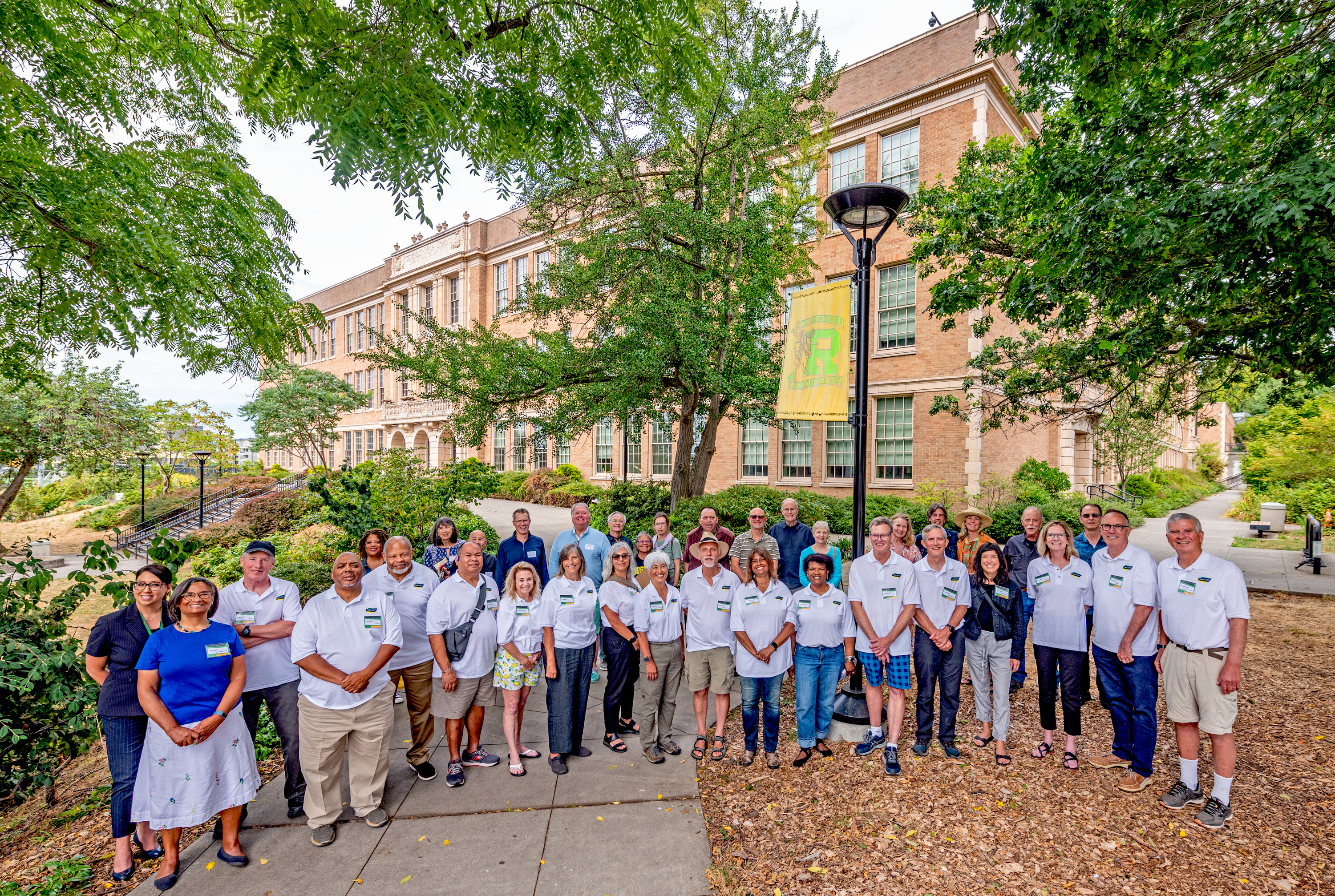
THEN1: Positive and reversed negative images from the title page of the 1969 Roosevelt High School yearbook show students on the school’s front walkways. (Courtesy Lea Vaughn)NOW: In white logo T-shirts, Roosevelt Alumni for Racial Equity (RARE) leaders, along with other alums and supporters, gather Aug. 20 during the school’s centennial celebration. They are (front row, from left): Tami Brewer, new principal; Lea Vaughn, video lead, RARE co-chairs Tony Allison and Joe Hunter, Les Young, Allan Bergano, Robin Balee Ogburn, Kristi Blake, Leyla Salmassi, Robin Lange, Bruce Johnson, Jane Harris Nellams, Michelle Osborne, Gregg Blodgett, Tim Hennings, Hillary Moore, Jude Fisher, Steve Fisher and Bruce Williams; (back row, from left) Nejaa Brown, Catherine Bailey, Doug Seto, David Kersten, Duane Covey, John Richards, Cynthia Mejia-Giudici, Carol Haffar, John Vallot, Brooks Kolb, Doug Whalley, Janet Sage Whalley, Leslie Fikso Newell, Delos Ransom, Kris Day, Michael Bogan and Kim Peterson. RARE is open to Roosevelt alumni, students and supporters. For more info and to see the documentary film, visit RHS4RacialEquity.org. (Jean Sherrard)
Published in The Seattle Times online on Sept. 22, 2022
and in PacificNW Magazine of the printed Times on Sept. 25, 2022
Roosevelt alums create film to prompt ‘difficult’ talks about race
By Clay Eals
It probably was intended purely as creative expression, but today it holds potent symbolism.
When Roosevelt High School students designed their 1968-69 yearbook, on the title page and on each of six section-introduction layouts they paired two versions of a large photo — the first appearing conventionally and the second in a reversed, negative format, as in this week’s “Then.”
Thus, in the first version, the faces of students at the largely white north-end school appeared as just that, largely white. In the reversed version, the faces became dark.
It was the first year in which Seattle Public Schools implemented its Voluntary Racial Transfer Program, an effort to avoid litigation over a perceived failure to integrate schools as mandated by the famous 1954 Supreme Court decision that struck down “separate but equal” education.
As shown in Roosevelt’s 1969 yearbook, the program had a relatively small but visible impact there. Of 1,865 students, about 75 (or 4%) were people of color, many bused from southern neighborhoods. One of those was Lea Vaughn, a biracial sophomore whose parents (father Black, mother white) chose for her to bus from the Central District, near Washington Park, to highly regarded Roosevelt and back.
Vaughn, a retired attorney and emerita University of Washington law professor, is at the core of a grassroots nonprofit, Roosevelt Alumni for Racial Equity (RARE), formed via Zoom during the national upheaval over the 2020 murder of George Floyd.
With a 21-member multi-ethnic board, RARE provides scholarships for students of color and has produced an engaging half-hour documentary, “Roosevelt High School: Beyond Black & White,” which aired twice this year on KCTS-TV and is available online.
With historical data and footage, along with provocative observations from 20 alums, educators and present-day students, the film seeks to “stimulate difficult discussions about race and education.” Interviewees conclude that despite Seattle’s efforts at voluntary, then mandatory busing, racial equity in city schools remains elusive.
THEN2: This is a portion of a 1936 Kroll map that color-coded areas of Seattle as green (“best”), blue (“still desirable”), yellow (“definitely declining”) and pink (“hazardous”). (Roosevelt Alumni for Racial Equity video)
They also characterize a perceived “Seattle nice” as “performative, not reformative” and address the “baked-in” effects of racist covenants and redlining in real-estate sales and rentals that the city finally upended in 1968. Startling is a 1936 Kroll map that codes areas of Seattle as green (“best”), blue (“still desirable”), yellow (“definitely declining”) and pink (“hazardous”).
Today, Vaughn lives in a Ballard neighborhood that her family would have been disallowed to inhabit when she was young. But she asserts, “I think because we used busing as the Band-Aid to not face redlining, we never really dealt with it.”
Clearly, the complexities of race bolster the longtime name of Roosevelt’s yearbook: “Strenuous Life.”
WEB EXTRAS
Thanks to Lea Vaughn, Peggy Sturdivant and the members of RARE for their help with this installment!
To see Jean Sherrard‘s 360-degree video of the “Now” prospect and compare it with the “Then” photos, and to hear this column read aloud by Clay, check out our Seattle Now & Then 360 version of the column.
Below are two PowerPoint presentations prepared for RARE by Vaughn and a list of discussion questions from the RARE video.
Click the image above to see a PowerPoint prepared for RARE by Lea Vaughn, “Schools, Property, Wealth and Inequality.”Click the image above to see a PowerPoint prepared for RARE by Lea Vaughn, “What ARE You?”Click the image above to read the pdf of discussion questions prepared by RARE.
The Coliseum has been sold. For more information, visit this link. from July 9, 2024.
Historian and neon-restorer Mike Shaughnessy of West Seattle displays letters from the late-1950s Coliseum marquee on June 24, 2023. (photo by Todd Hewitt, owner of Big Top Curiosity Shop and a fabrication-restoration specialist)
Letters from the late-1950s Coliseum marquee (see background below) soon may see the light of day, thanks in part to historian and neon-restorer Mike Shaughnessy of West Seattle. The former theater, which in 2023 is serving as a rotating art space, houses the letters and may make one or more sets available for an exhibit of old Seattle artifacts. The photo above represents the first time in more than 30 years that Coliseum marquee letters have been arranged to spell the theater’s name. Stay tuned for details!
=====
THEN1: Designed exclusively as a movie house, the Coliseum at 500 Pike St. in August 1925 promotes actress Colleen Moore in the silent film “The Desert Flower.” For more Coliseum details and many more photos from the 1920s, visit PaulDorpat.com. (Frank Jacobs, courtesy Historic Seattle)THEN2: In June 1950, the Coliseum’s altered half-dome marquee advertises “Kill the Umpire,” a baseball comedy with Seattle diamond clown Bill Schuster in a bit part as a shortstop. (David Eskenazi collection)THEN3: In May 1987, nearly three years before the Coliseum closed, its rotating circular marquee with neon pillar, sans Oscar statue, advertises “Evil Dead II.” (Courtesy Colin Campbell Design)NOW: Boarded up and backed by the 520 Pike Building, the 1916 terra-cotta Coliseum Theatre (until 2020 a Banana Republic store) shines in the late July sun. (Clay Eals)
Published in The Seattle Times online on Sept. 11, 2022
and in PacificNW Magazine of the printed Times on Sept. 8, 2022
Priteca’s captivating Coliseum still shines brightly downtown
By Clay Eals
Back in 1989 when I was helping to save West Seattle’s Admiral Theatre, word came out that downtown’s Coliseum Theatre, which opened in 1916, also was endangered. So I did what came naturally — went there to see a film. In it, Morgan Freeman portrayed the notoriously tough New Jersey high-school principal Joe Clark. Based on a song, its title was “Lean on Me.”
To appreciate the grandeur of what was considered the nation’s first movie palace, I climbed to the top of its balcony. The view was startling. I sat mere feet from the Italian Renaissance-style ceiling beams. The rake was so steep that only by splaying my knees could I glimpse the screen far below.
“Tremors,” March 11, 1990.
Today, as a theater, the Coliseum is largely a memory, its closing night coming 32 years ago, on March 11, 1990, with the sci-fi thriller “Tremors.”
When a plan emerged in 1992 to restore and convert the Coliseum to a Banana Republic outlet, then-Seattle Mayor Norm Rice declared, “There won’t be a more stunning building this side of the Taj Mahal” in India. The clothier operated inside the city-landmarked structure from 1994 until the pandemic sank the store in 2020.
THEN4: In 1916, young architect “Benny” Priteca works inside the Coliseum building he designed. (Museum of History & Industry 2011.49.29)
The trendsetting, terra-cotta Coliseum was one of 60 major West Coast theaters (including the Pantages chain and, yes, the still-operating Admiral) designed by architect Bernard “Benny” Marcus Priteca (1886-1971). With 2,400 seats and hailed by the Seattle Post-Intelligencer as “the last word in picture playhouse construction,” the Coliseum opened when Priteca was just 26.
Scotland-born into an eastern European Jewish family, Priteca had been lured to Seattle by the city’s first world’s fair, the 1909 Alaska-Yukon-Pacific Exposition. His affection blossomed. As he told The Seattle Times’ Don Duncan while puffing on a cigar eight months before his death, “Washington and Oregon are the world!”
His designs — the lifelong bachelor never retired — extended to Seattle’s Bikur Cholim synagogue (now Langston Hughes Performing Arts Institute), Renton’s now-gone Longacres racetrack and even a Paige auto grille and windshield. But the stage was his steadfast siren.
Arguably his most captivating creation was the Coliseum, whose showcase signage changed with the times. Notably, its concave corner half-dome, topped by a massive glass cupola, gave way in late 1950 to a rotating circular marquee and neon pillar featuring filmdom’s golden Oscar. The weather-damaged statue was removed in 1966.
Priteca told Duncan he wished that “Seattle would just stop growing, period.” Perhaps he also would have liked his Coliseum to screen movies forever. It still shines at Fifth & Pike. As the “Lean on Me” lyrics proclaim, “… there’s always tomorrow.”
WEB EXTRAS
Thanks to Lawrence Kreisman , Wendy Malloy, Dave Eskenazi, Colin Campbell and Gavin MacDougall for their help with this installment!
To see Jean Sherrard‘s 360-degree video of the “Now” prospect and compare it with the “Then” photos, and to hear this column read aloud by Clay, check out our Seattle Now & Then 360 version of the column.
Below are an additional video, 28 additional photos (including a gallery of 22 early 1920s Coliseum images from Historic Seattle) and 50 historical clips from The Seattle Times and Seattle Post-Intelligencer online archive (available via Seattle Public Library) and Washington Digital Newspapers, that were helpful in the preparation of this column. These include five previous “Now & Then” columns related to Priteca and the Coliseum by column founder Paul Dorpat!
(VIDEO: 6:51) Click the image above to see video of Seattle theater historian Lawrence Kreisman discussing archiect B. Marcus Priteca and the Coliseum Theatre. (Clay Eals)An alternate view of the magnificent exterior of the Coliseum. (Clay Eals)An alternate view of the magnificent exterior of the Coliseum. (Clay Eals)An alternate view of the magnificent exterior of the Coliseum. (Clay Eals)An alternate view of the magnificent exterior of the Coliseum. (Clay Eals)An alternate view of the magnificent exterior of the Coliseum. (Clay Eals)1923 Coliseum, “The Fighting Blade.” (Frank Jacobs, courtesy Historic Seattle)1924 Coliseum, “A Self-Made Failure.” (Frank Jacobs, courtesy Historic Seattle)1924 Coliseum, “A Son of the Sahara.” (Frank Jacobs, courtesy Historic Seattle)1924 Coliseum, “Cytherea.” (Frank Jacobs, courtesy Historic Seattle)1924 Coliseum, “Her Night of Romance.” (Frank Jacobs, courtesy Historic Seattle)1924 Coliseum, “Inex from Hollywood.” (Frank Jacobs, courtesy Historic Seattle)1924 Coliseum, “Sandra.” (Frank Jacobs, courtesy Historic Seattle)1924 Coliseum, “Sundown.” (Frank Jacobs, courtesy Historic Seattle)1924 Coliseum, “Those Who Dance.” (Frank Jacobs, courtesy Historic Seattle)1925 Coliseum, “Graustark.” (Frank Jacobs, courtesy Historic Seattle)1925 Coliseum, “Her Sister from Paris.” (Frank Jacobs, courtesy Historic Seattle)1925 Coliseum, “If I Marry Again.” (Courtesy Historic Seattle)1925 Coliseum, “Infatuation.” (Frank Jacobs, courtesy Historic Seattle)1925 Coliseum, “New Toys.” (Frank Jacobs, courtesy Historic Seattle)1925 Coliseum, “Shore Leave.” (Frank Jacobs, courtesy Historic Seattle)1925 Coliseum, “The Half Way Girl.” (Frank Jacobs, courtesy Historic Seattle)1925 Coliseum, “The Marriage Whirl.” (Frank Jacobs, courtesy Historic Seattle)1925 Coliseum, “The New Commandment.” (Frank Jacobs, courtesy Historic Seattle)1925 Coliseum, “The Talker.” (Frank Jacobs, courtesy Historic Seattle)1925 Coliseum, “Why Women Love.” (Frank Jacobs, courtesy Historic Seattle)1926 Coliseum, “Mlle. Modiste.” (Frank Jacobs, courtesy Historic Seattle)
THEN1: Backed by a working Seattle waterfront, the Virginia V takes its first voyage on June 11, 1922. (Puget Sound Maritime Historical Society, Williamson Collection)NOW1: Flanked by sailboats while gliding west from Lake Union, the Virginia V cruises toward the Ballard Locks and Shilshole Bay on July 9, prior to a Bainbridge Island Historical Museum cruise the following day. For info on chartering, tours, field trips, events (such as in Olympia Sept. 3-4) and volunteer opportunities, visit VirginiaV.org. (Jean Sherrard)THEN2: As shown in the June 20, 1922, Seattle Times, Seattle Camp Fire Girls and counselors board the Virginia V at the downtown waterfront for a two-week stint at Camp Sealth at the southwest corner of Vashon Island. The name Lisabeula, on the life ring, represented a community north of the camp, reportedly named for two women who operated its tiny post office. (Seattle Times)NOW2: At the Historic Ships Wharf at Lake Union Park near the Museum of History & Industry. replicating the 1922 photo are (from left) John McClintock, crew member; Sara Intriligator, passenger; Debra Alderman, foundation executive director; Rebecca Laszlo, passenger; Ed Brown, senior docent; John Arnesen, passenger; Will Wagner and Steven Walsh, crew members; Tad Bixby, passenger; and Mark Miller, finance manager and crew member. Above are (from left) Alison Greene, passenger; and Megan Kolenski and Le Qi Huang, crew interns. (Jean Sherrard)
Published in The Seattle Times online on Aug. 25, 2022
and in PacificNW Magazine of the printed Times on Aug. 28, 2022
The magical Virginia V: a century of weaving maritime memories
By Clay Eals
THEN3: Dressed somewhat like 100 years earlier, Brad Chrisman (left) and Clay Eals of the Southwest Seattle Historical Society strike a pose serious enough for 1888 while standing at the bow of the Virginia V during a Dec. 10, 1988, cruise to celebrate the centennial of the first ferry on Puget Sound. (Brad Chrisman collection)
We all seek to create indelible memories. One of mine came in 1988 when I helped lead a Southwest Seattle Historical Society cruise to celebrate the first voyage of the City of Seattle, the first ferryboat on Puget Sound. Sadly, the original craft had ventured south to become a houseboat in Sausalito. So, standing — or, shall I say, floating — in was another vintage vessel, Seattle’s legendary passenger carrier, the Virginia V.
What a glorious two-hour trip we had. Though 200 were aboard, the steamer felt like a comfy cottage, a buoyant sanctuary. Our vice-president, Neal Lockett, joked that everyone must have had a good time because no one left early. But the sentiment transcended jest. We’d been soothed equally by tradition and tranquility.
For 100 years, the Virginia V has woven such maritime magic. It is the last of five “Virginia” ships, the first incarnation named for Virginia Merrill, whose later marriage resulted in a vast Bainbridge Island garden known today as Bloedel Reserve.
The 120-foot-long Virginia V originally was operated by West Pass Transportation Company, an indication of its headquarters and midway stop in regular runs between Tacoma and Seattle along the west side of rural Vashon Island. On the National Register of Historic Places since 1973, the Virginia V remains the sole surviving Mosquito Fleet steamship among hundreds of private craft that once plied Puget Sound like a swarm of busy bugs.
THEN5: The Virginia V’s first regular sailing schedule, from the June 23, 1922, Vashon Island News-Record. (Washington Digital Newspapers)
Before transporting farmers, freight, excursionists and even World War II soldiers, the Virginia V forged its earliest identity as the summertime vehicle for hundreds of Seattle Camp Fire Girls to reach the recently purchased Camp Sealth on Vashon’s southwest shore. Before being towed to Seattle for installation of its boilers and engines, the Virginia V was christened March 2, 1922, by Camp Fire secretary Ellen Bringloe.
“If sea traditions are to be trusted,” the Seattle Times reported, “Dame Fortune smiled favorably upon the Virginia V, for with one blow Miss Bringloe shattered the bottle of grape juice over the keel, and as if cheered by this good luck, the boat glided smoothly down the ways, splashed gently into the Sound and floated proudly off.”
THEN4: Shown in the Oct. 22, 1934, Seattle Times is the severely damaged Virginia V during a storm near tiny Olalla. The wreck imperiled 25-30 passengers. A few were injured, and many lost luggage, but amazingly, the vessel’s power plant and hull were unharmed. Six weeks and $11,000 worth of repairs later, the boat went back into service. (Seattle Times, courtesy Virginia V Foundation)
After a century of service — including a 1934 wreck during a storm near the Kitsap County hamlet of Olalla and a brief 1942 Portland-Astoria run on the Columbia River, along with expensive latter-day restorations mounted by a dedicated foundation — the Virginia V still invites passengers to tour Puget Sound.
Seemingly unscathed by modern modes of transit, it continues to make memories for us all. Did I mention its exhilarating steam whistle?
WEB EXTRAS
Thanks to Debra Alderman, Alicia Barnes, Wendy Malloy and the crew of the Virginia V for their help with this installment!
To see Jean Sherrard‘s 360-degree video of the “Now” prospect and compare it with the “Then” photos, and to hear this column read aloud by Clay, check out our Seattle Now & Then 360 version of the column.
(VIDEO: 11:49) Click the image above to see video impressions of a July 9, 2022, cruise on the Virginia V. Be sure to listen for the steam whistle! (Clay Eals)(VIDEO: 22:30) Click image above to see video of the Southwest Seattle Historical Society cruise aboard the Virginia V on Dec. 10, 1988, to commemorate the centennial of the first ferry on Puget Sound, the City of Seattle, which ran between downtown and West Seattle starting Dec. 24, 1888, through 1913. This video consists of audio of the onboard program, supplemented with stills, song lyrics and other annotation. (Clay Eals)The Virginia V passes beneath the Aurora Bridge. (Jean Sherrard)The Virginia V passes beneath the opened Fremont Bridge. (Jean Sherrard)The Virginia V passes beneath the Ballard Bridge. (Jean Sherrard)The Virginia V arrives at the Ballard Locks. (Jean Sherrard)Virginia V plaques. (Clay Eals)Virginia V deck, in Lake Washington Ship Canal. (Clay Eals)Virginia V heading west toward the Ballard Locks. (Clay Eals)The Virginia V plies the Lake Washington Ship Canal. (Tad Bixby)In a 360-degree view, Tad Bixby enjoys the Virginia V cruise. (Tad Bixby)
You can find additional Virginia V photos by Tad Bixby here.
UPDATE: a KING5-TV tribute to John Spaccarotelli on April 4, 2024.
UPDATE: The Seattle Times on John Spaccarotelli, ballplayer, July 15, 2024.
=====
(Click and click again to enlarge photos)
THEN1: Mack’s Shanty Tavern, late 1940s, along Bothell Way, now Lake City Way. The cars include, starting second from left, a 1946/47 Pontiac Streamliner, 1939 Chevrolet Coupe and 1939 Chevrolet. (Courtesy the Shanty Tavern)NOW1: Authors (from left) Peter Blecha and Brad Holden join Dayna Spaccarotelli and her father John Spaccarotelli of the Shanty Tavern in front of the shack-themed sign. (Jean Sherrard)
Published in The Seattle Times online on Aug. 18, 2022
and in PacificNW Magazine of the printed Times on Aug. 21, 2022
Scandals and soul fueled ‘Lost Roadhouses’ at Seattle’s outskirts
By Clay Eals
NOW2: The cover of “Lost Roadhouses” by Peter Blecha and Brad Holden, who will host their book launch from 2 to 5 p.m. Aug. 27 at the Shanty Tavern, 9002 Lake City Way N.E. Bottoms up!
A new book by historians Peter Blecha and Brad Holden, “Lost Roadhouses of Seattle,” showcases more than 60 dance halls and speakeasies on the city’s outskirts whose heyday foamed in the Prohibition and repeal days of the 1930s and 1940s.
“It’s a nod to Seattle’s naughty past,” Holden says.
Blecha adds, “It’s almost like a lost civilization.”
So it brings a smile that the book also profiles something easily found — the last roadhouse still operating on a local highway, the Shanty Tavern at 90th and Lake City Way. On Fridays from 4:30 p.m. to 2 a.m., the Shanty rocks with live music and conversational buzz, moderated by 91-year-old John Spaccarotelli and his daughter Dayna.
Dayna and John Spaccarotelli. (Jean Sherrard)
“I like the music, I like the people. I like to talk with people especially,” says the elder owner, who leased the place 61 years ago and bought it two years later. “It’s just a fantastic thing to have a business and not only love it but live it.”
Built by Doris McLeod in 1932 on 22nd Avenue Northeast, the Shanty building moved twice before settling at its current site in 1948. The “Mack” nickname of Doris’ son Bill adorned the nightspot until Spaccarotelli took its reins in 1961.
The Shanty Tavern sign.
Over the years, it’s drawn celebrities from actor David Arquette to hydroplane racer Chip Hanauer, who have mixed with neighbors and motorists spotting the tavern’s unpretentious sign in the shape of a shack, complete with off-kilter stovepipe.
The sign is an uncanny cue to the devil-may-care spirit of the book’s neon-lit dine-and-dance establishments, where chicken dinners and musical spectacle consorted with headline-grabbing liquor and gambling scandals. All of this was fueled by car culture and a desire to flee the city limits via Highway 99 and the Bothell Highway to find, as the book asserts, “the sordid underbelly of Seattle’s peripheral nightlife.”
Impresario John H. “Doc” Hamilton. (Courtesy Peter Blecha and Brad Holden)
With Arcadia as their publisher, the authors sprinkle the book with 93 photos, ads and news clippings, but its text also covers a broad swath, from the countless musicians who played the roadside “joints” to cleanup efforts by Snohomish County prosecutor (and later U.S. senator) Henry “Scoop” Jackson. Showing up throughout are the detailed legal travails of infamous impresario John H. “Doc” Hamilton.
Page by page, from the north-end Duffy’s Roadhouse to the south-end Spanish Castle, it’s like the old Lay’s potato-chip commercial: You can’t read about just one. And the vignettes reveal that behind the roadhouses’ notoriety lay a lot of soul.
Dayna Spaccarotelli would agree. The Shanty means “everything” to her. “This is my life,” she says. “It’s like a second home.”
THEN2: Sunset Bottling Co. delivers beer to Mack’s Shanty Tavern in 1941. Note the truck’s cable-operated turn-signal arm. (Puget Sound Regional Branch, Washington State Archives)
WEB EXTRAS
Thanks to Bob Carney for his help with this installment!
To see Jean Sherrard‘s 360-degree video of the “Now” prospect and compare it with the “Then” photos, and to hear this column read aloud by Clay, check out our Seattle Now & Then 360 version of the column.
THEN1: This 1932 image, made into a postcard, looks north and slightly west, showing the private Mukilteo ferry dock, fronted by a baseball field. The state’s new Mukilteo Ferry Terminal, opened in December 2020, stands one-third mile to the east of the old landing. (J.A. Juleen, Northwest History Room, Everett Public Library)THEN2: A close-in view, likely taken the same day, of the Mukilteo ferry. Vehicles are (left) a 1930-31 International and a 1929-30 Chevrolet. (J.A. Juleen, Northwest History Room, Everett Public Library)NOW1: The state ferry Suquamish cruises northwest toward Clinton as it passes the old Mukilteo dock, now a street end next to Ivar’s. To reach the new terminal, cars must turn one-third mile east. (Colleen Chartier)NOW2: With a Native longhouse design and fronted by interpretive signs and benches, the new Mukilteo terminal awaits vehicles boarding the Suquamish ferry. (Colleen Chartier)
Published in The Seattle Times online on Aug. 11, 2022
and in PacificNW Magazine of the printed Times on Aug. 14, 2022
Century of Mukilteo ferrying leads to new Native-themed terminal
By Clay Eals
Sooner or later, for functionality or fun, most of us living in Puget Sound get out on the water. So let’s time-travel to the era when motor vehicles first came into vogue.
You’re a saltwater town at the foot of a hill, near the mushrooming metropolis of Seattle, and also just four miles across the brine from a beckoning island paradise. What do you do? Launch a ferry.
THEN3: Shown in 1921, the privately operated Mukilteo ferry opened in 1916. Aboard is a 1917-1920 touring car. (Courtesy Mukilteo Historical Society)
Mukilteo did so in 1916, connecting with equally tiny Clinton on the southern tip of Whidby (no “e” at the time) Island. The ferry ran two times daily, twice that on weekends. The fare was $1 for car and driver, a quarter per additional passenger.
The Mukilteo-Clinton ferry cinched a scenic loop that had been fostered three years earlier with establishment of a north-island ferry at Deception Pass, whose classic bridge wouldn’t be built until 1934.
The outcome: a trip of “much beauty,” wrote Douglas Shelor, automotive editor, in the Sept. 20, 1916, Seattle Post-Intelligencer, “a diversion that every motorist looking for something a little different from the general run of two-day trips should not fail to take.”
THEN4: Circa 1918, cars line up for the Mukilteo ferry facing west along Front Street. The background smokestack was part of Crown Lumber, which closed in 1930. It could produce 200,000 board feet of lumber per day. The Crown site was used for ammunition transfer during World War II and as a “tank farm” (aviation fuel depot) during the Korean War. It now is home to the new Mukilteo ferry terminal. Cars shown are (from left) possibly a 1914 Cadillac, a 1916-17 Studebaker, a 1917-18 Ford Model T, unidentified, a 1917-18 Ford Model T and others. (Courtesy Mukilteo Historical Society)
Vessels were small, holding only a few vehicles at a time, but the P-I assured that “those who may feel timid in driving their machines on the ferry under [their] own power may roll the car on in perfect safety.”
Fast-forward through a century of growth: Puget Sound’s cluster of competitive ferry operations morphed into the Black Ball Line, which the state bought in 1951. Mukilteo’s dock was reconstructed in 1952 and modernized in 1980.
But usage also ballooned. During 2019, the most recent pre-COVID year, the 20-minute crossing carried 2,276,967 vehicles, the highest number of any route in the state system. To say Mukilteo suffered traffic tie-ups would be like saying Elvis sold a few records. Standstills became the norm.
NOW3: Beneath circular Native art at the new terminal, two men hustle up a stairway to board the Suquamish ferry at Mukilteo. (Colleen Chartier)
In response, the state built a much larger, seismically safe terminal one-third mile east. Partly in recognition of Mukilteo as the site of the landmark 1855 Point Elliott Treaty signing, the state fashioned the $187 million terminal as a Native American art-filled longhouse summoning the rich heritage of the Coast Salish People, specifically the Tulalip tribes. Since the terminal opened in December 2020, it has netted more than 25 awards.
The terminal’s designer, Seattle-based LMN Architects, will be showcased Aug. 20-26 at the Seattle Design Festival, SeaDesignFest.org. Given the terminal’s ties to the past, improved transit links, sustainable elements and the potent symbolism of travel, the festival’s 2022 theme of “Connection” is apt.
Just like our relationship with the water itself.
The Mukilteo lighthouse, west of the old ferry terminal, in 1932. At far right is a 1924-26 Chevrolet, and the car with a trailer is a 1928-29 Ford Model A. (J.A. Juleen, Northwest History Room, Everett Public Library)NOW4: The new terminal showcases Native-themed artwork. (Colleen Chartier)NOW5: One-third-mile east of the old Mukilteo dock, solar panels top the Native longhouse design of the new terminal. (Colleen Chartier)
And in lieu of a 360 video, we top off this installment with a gallery of 43 additional present-day photos of the Mukilteo terminal by Colleen Chartier!
THEN: Twenty-two members of the Bothell post of the Woman’s Relief Corps (and two men) sit and stand outside the 1893 William Hannan home in Bothell in 1908. Standing, from left: Josephine Bothell Burns, Della Bothell Young, Etta Adams, Isabelle Woody, Kitty Burgess, Ida Anderson, May Bothell Platner, Alta Elliott Violet Hanschel, Mrs. (first name unavailable) Ellis, Neal Bothell Baley, Jemima “Mima” Hannan (wife of William) and Rachel Keener. Seated on chairs, from left: Amy Campbell, Maggie Dutton, Aunt Bessy (last name unavailable), Mrs. S.F. Woody Sr. and Grandma Annis (full name unavailable). Seated in front, from left: unknown, Marie Campbell, Bertha Dutton Ross and Hannah Staples. At rear left are homeowner William Hannan and, to his right, son Almon Hannan. (Courtesy Bothell Historical Museum)NOW: Repeating the pose at the William Hannan home, now situated at Bothell Landing and housing the Bothell Historical Museum (BothellHistoricalMuseum.org), are 18 women, four girls and a man, including several descendants of historical city figures. Complete identifications follow. Standing, back left: Bill Carlyon, great-grandson of Bothell pioneers William and Jemima Hannon and grandson of Gladys Hannan Worley, their daughter, who was born and married in the parlor. Standing, from left: Pat Pierce, Jill Keeney, Jeanette Backstrom, Sue Kienast, Melanie Carlyon McCracken (daughter of Bill and Emmy Carlyon and great, great granddaughter of the Hannans), Pippin Sardo, Emmy Carlyon (wife of Bill Carlyon), Margaret Turcott, JoAnne Hunt, Linda Avery, Margaret Carroll, Mary Evans and Pamela McCrae. Seated, from left: Terry Roth, Iva Metz, Carol King, Nancy Velando and Mary Anne Gibbons. Children in front, from left: Wendy Stow (Linda Avery’s granddaughter) and Camille, Evelyn and Mira McCracken (great, great, great granddaughters of the Hannans). Camille and Evelyn flank a life-size doll. (Jean Sherrard)
Published in The Seattle Times online on July 28, 2022
and in PacificNW Magazine of the printed Times on July 31, 2022
Born of war, Woman’s Relief Corps fed nation’s ‘higher sphere’
By Clay Eals
One of my mentors — the late Elliott Couden, an open-housing advocate in the 1960s who 20 years later founded the Southwest Seattle Historical Society — once lamented that as a boy, he had to learn history by memorizing timelines keyed mostly to wars. “We didn’t get very much into what relation we as individuals have to this society,” he said.
NOW: Historian Richard Heisler at Bothell Pioneer Cemetery. For info on his Aug. 3 talk, click here. (Clay Eals)
He could have been reading the mind, and heart, of Richard Heisler. During the pandemic, the energetic equestrian artist and historian, 49, focused his research on the estimated 3,500 Civil War veterans and their families who migrated to King County near the turn of the 20th century. Heisler, of Bothell, has unearthed direct links between these vets and the rise of the town east of Lake Washington’s northern tip.
Nationally, starting in 1866, many of the war’s surviving Union soldiers formed the Grand Army of the Republic (GAR) fraternal organization. In 1883, their wives, along with daughters and other descendants and supporters, began gathering in posts of an auxiliary, the Woman’s Relief Corps (WRC).
THEN: An alternate view of the Woman’s Relief Corps gathering at the William Hannan house in 1908. (Courtesy Bothell Historical Museum)
The Bothell WRC post began in 1902, and 22 of its members (plus two discreetly positioned men) populate our “Then” photo from 1908. They pose outside the city’s 1893 William Hannan home, which stands today at Bothell Landing along the Sammamish River, a half-mile west of its original site. Pristinely restored, it houses the Bothell Historical Museum.
NOW: At Bothell Pioneer Cemetery, the two-sided monument for David and Mary Ann Bothell includes a Grand Army of the Republic (GAR) insignia for David and a Woman’s Relief Corps (WRC) insignia for Mary Ann. The FCL acronym on Mary Ann’s side indicates the GAR and WLC slogan: “Fraternity. Charity. Loyalty.” (Clay Eals)
Bothell, the city, derives from a family by the same name. Heisler pointedly notes that the only graphic symbols on a Bothell Pioneer Cemetery monument for founder David Bothell (1820-1905) and his wife Mary Ann (1823-1907), parents of George, the city’s first mayor, are of the GAR for David and WRC for Mary Ann.
Other local luminaries had ties to the war’s Union forces and their abolitionist, Lincoln Republican ways of thinking, Heisler says. “We think it was all so distant,” he says, “but many veterans and their families came west and walked the streets all over this county.”
WRC posts produced patriotic Memorial Day observances, installed flags and monuments and even supported women’s suffrage. At an 1885 Seattle gathering, the GAR’s J.C. Haines saluted their role: “We welcome you because you have demonstrated that woman has a higher sphere than any that man can ever lay claim to — a sphere as broad as human sorrow, as lasting as humanity itself.”
Today, the WRC has receded locally, but it lives on in Heisler’s talks, including one set for 6 p.m. Aug. 3, at the Bothell Library, for the Bothell museum. “This is not an abstract thing,” he says. “These are people.”
WEB EXTRAS
Thanks to Bill Woodward, Pat Pierce, Jill Keeney and especially Richard Heisler for their help with this installment!
To see Jean Sherrard‘s 360-degree video of the “Now” prospect and compare it with the “Then” photos, and to hear this column read aloud by Clay, check out our Seattle Now & Then 360 version of the column.
THEN: Complete with a live Statue of Liberty, a 1908 Bothell Independence Day float salutes the Grand Army of the Republic (GAR). The FCL flag stands for: “Fraternity. Charity. Loyalty.” (Courtesy Bothell Historical Museum)NOW: In this alternate view, posing before the William Hannan home (now headquarters of the Bothell Historical Museum) are, standing from left, Pamela McCrae, Jill Keeney, JoAnne Hunt, Margaret Carroll, Emmy Carlyon, Terry Roth, Margaret Turcott, Pat Pierce, Mary Evans and Bill Carlyon and, seated from left, Nancy Velando, Mary Anne Gibbons, Carol King, Camille McCracken, Melanie Carlyon McCracken, Mira McCracken, Iva Metz, Pippin Sardo and Evelyn McCracken. Historian Richard Heisler peeks over umbrella at left. (Jean Sherrard)VIDEO (14:00): Click the image above to see historian Richard Heisler describe the Civil War connections to early leaders of Bothell, Washington, at Bothell Pioneer Cemetery. (Clay Eals)VIDEO (2:12): Click the title card above to see three Bothell residents talk about the importance of their ties to the past. (Clay Eals)March 27, 1884, Seattle Post-Intelligencer.April 16, 1885, National Tribune, weekly for Civil War veterans and families.Oct. 2, 1887, Seattle Star.Sept. 18, 1888, Seattle Post-Intelligencer.Aug. 27, 1896, Seattle Times, page 8.July 27, 1898, Seattle Times, page 8.Feb. 26, 1899, Seattle Times, page 6.Feb. 28, 1899, Seattle Times, page 1.May 30, 1899, Seattle Times, page 2.June 24, 1899, Seattle Times, page 14.March 10, 1900, Seattle Times, page 17.Nov. 1, 1899, Seattle Times, page 4.June 25, 1901, Seattle Post-Intelligencer, p12.March 1, 1902, Seattle Star.May 31, 1902, Seattle Post-Intelligencer, p10.March 2, 1902, Seattle Times, page 39.July 14, 1963, Seattle Post-Intelligencer, p13.July 14, 1963, Seattle Post-Intelligencer, p10B.Oct. 24, 1966, Seattle Post-Intelligencer, p19.June 4, 1975, Seattle Times, page 35.April 15, 1973, Seattle Times, page 101.March 19, 1976, Seattle Post-Intelligencer, p41.May 28, 1978, Seattle Times, page 14.
NOW: As shown two blocks north of Lenora Street from today’s Bell Street overpass, the Eight Arcs — the Seattle Great Wheel, Lumen Field, T-Mobile Park and Mount Rainier — shine in the crisp magic light of a late afternoon in early January 2022. (Jean Sherrard)THEN1: Taken from a Lenora Street overpass that was removed in 1983, this view looks south along the timber trestle of then-Railroad Avenue on June 22, 1934. The Smith Tower presides at distant center. (Seattle Municipal Archives)
Published in The Seattle Times online on July 21, 2022
and in PacificNW Magazine of the printed Times on July 24, 2022
‘Eight Arcs’ tableau signifies transformation on Alaskan Way
By Clay Eals
You can see it looking south along Alaskan Way, but only for a block and a half at street level starting at Pier 66 or atop the Bell Street overpass, and only on clear days. To me, it symbolizes a century of transformation for Seattle’s shore. It’s a tableau that I call the Eight Arcs.
In our “Now” photo, front to back, count ’em:
The Seattle Great Wheel (2012).
The twin roof ridges of Lumen Field (2002, originally Seahawks Stadium then Qwest Field).
The four roof ridges of T-Mobile Park (1999, originally Safeco Field).
The curved countenance of Mount Rainier (1 to 2 million years ago, originally Tahoma).
This pleasing juxtaposition serves both today’s saltwater tourists and the roadway’s recently arrived condominium dwellers. For them, it’s a place of play.
But little — besides the pointed Smith Tower (1914) in the distance — is the same when you zip back nearly 90 years to our “Then” scene, along what had long been named Railroad Avenue.
Taken on an overcast Friday, June 22, 1934, from the Lenora Street overpass (1930-1983), the photo reveals what we characterize as a working waterfront, with side-by-side wharves, rail tracks and a divided, wooden boulevard beneath which washed the tides of Elliott Bay.
With much of its former train traffic undergrounded in a nearby tunnel, and as cars used the timber trestle to bypass the upland business district, this byway spelled sporadic trouble. To wit, on Nov. 24, 1934, a car skidded on tracks near Lenora, plunged 15 feet through the center split and landed upside down in 3 feet of water. The stunned driver was unhurt.
Thankfully, progress on the route already was afoot. In this Depression decade, work had begun to pave the thoroughfare and close its gap, remove its above-ground electrical wiring and poles and, most important, construct a protective western seawall, finished in 1936.
Such enterprise inspired the city to give the water-hugging street a more relevant, elegant name. More than 9,000 ideas poured in, many invoking the expansive sobriquet of “Way.”
THEN2: Robert H. Harlin, who had served as Seattle mayor in 1931-32, inserted the “n” in Alaskan Way as the new name for Railroad Avenue while serving on the city council in July 1936. (W.H. Dahl, Seattle Municipal Archives)
With a decision nigh on July 6, 1936, the leading contender was Pacific Way. However, in a nod to the role Seattle’s waterfront played in the late-1890s Klondike Gold Rush, as well as to the 1909 Alaska-Yukon-Pacific Exposition (the city’s first world’s fair), Alaska Way slipped in as the finish-line favorite.
To honor “the men and women who pioneered the territory,” councilman and former mayor Robert Harlin appended the letter “n.”
The result, Alaskan Way, still provides a touch of humanity along the road to today’s Eight Arcs.
WEB EXTRAS
Thanks to Ron Edge, Bob Carney , Gavin MacDougall and Mike Bergman for their help with this installment!
Below are two additional alternate images from our NOW view and 41 clips from The Seattle Times and Seattle Post-Intelligencer online archive (available via Seattle Public Library) that were helpful in the preparation of this column. Among the clips are 20 exploring the fascinating process of renaming Railroad Avenue, plus 8 historical pieces by our column founder, Paul Dorpat!
THEN1: The horse-drawn Fall City Women’s Bowling League cart rolls past the Fall City Hotel and Café during the town’s 1954 Strawberry Festival parade. (Courtesy Fall City Historical Society)THEN2: A procession of seven soap-box derby cars is towed on the same route in the 1956 parade. The Fall City Hotel and Café’s neon sign glows, with the initial letter in the bottom word alternating to drive home the message “GOOD” and “FOOD.” (Larry Divers, courtesy Fall City Historical Society)NOW: In front of the same building, now the El Caporal Family Mexican Restaurant, the Mount Si High School Wildcats Dance Team entertains during this year’s Fall City Day parade on June 11. (Jean Sherrard)
Published in The Seattle Times online on July 14, 2022
and in PacificNW Magazine of the printed Times on July 17, 2022
A parade of community continuity thrives in tiny Fall City
By Clay Eals
Is anything so timeless and appealing as a parade? From musical to commercial, from patriotic to protesting (which in turn is patriotic), a parade engages countless participants and onlookers, encompassing every age, setting, group and cause. All you need is two feet — or wheels — and the willingness to move.
Parades happen so often that movie characters on the run momentarily evade capture by joining one. In 1984, I saw a local political candidate become so entranced by a parade’s effect that after one cruise along the route he circled back to the end of the line and motored through again.
There’s just something innate that draws us together in person, what I’ve learned to label the Original Social Media: Face to Face. Especially in a neighborhood or small town, a parade embodies this, weaving a powerful spell. Seemingly everyone sees everyone, breathes the same air and exchanges smiles and waves.
And this summer, after a two-year pandemic hiatus, parades are back all over the county. One of the earliest took place June 11 in Fall City, the unincorporated burg 25 miles east of Seattle. The route, on Redmond-Fall City Road paralleling the Snoqualmie River, has served the tiny town’s annual processions since the post-World War II early 1950s.
Greater gatherings surrounded the parades, of course. Initially, the event was called the Strawberry Festival before morphing into Fall City Derby Day, saluting a Cub Scouts soap-box race and showcasing Derby Darlings atop a float. (One year, in 1968, the parade gave way to a River Drift, in which a 35-gallon metal barrel was dropped into the Snoqualmie, and citizens guessed how long it would take for the barrel to float 3.2 miles to a finish line.)
NOW: Commemorative button given away at this year’s Fall City Day by the Fall City Historical Society. (Clay Eals)
A new name emerged in 1971: Fall City Days and Logging Show. This year’s post-virus rebound was simply Fall City Day, celebrating 150 years since establishment of the hamlet’s first post office. Accoutrements included the traditional dunk tank and watermelon-eating contest.
One sign of community continuity along the parade route is a building at 337th Place Southeast whose legacy stretches to the late 1880s, when it began life as a hotel and restaurant. Over the decades, its name, functions and roofline have changed, but it has stood as a parade touchpoint, next to the reviewing stand.
NOW: Ruth Pickering, Fall City Historical Society director, beams after serving as grand marshal of this year’s parade. (Clay Eals)
The Fall City Historical Society’s history books have tracked those incarnations faithfully, thanks in no small part to the group’s longtime director, the vigilant Ruth Pickering, this year’s parade grand marshal. “Rural towns are an important thing,” she maintains. “They’re kind of an endangered species.”
Unlike, thank goodness, their parades!
WEB EXTRAS
Thanks to Bob Carney, Emily and Bruce Howard and Ruth Pickering for their help with this installment!
To see Clay Eals‘ 360-degree video of the “Now” prospect and compare it with the “Then” photos, and to hear this column read aloud by Clay, check out our Seattle Now & Then 360 version of the column.
Click the image above to read a report on the hotel/cafe corner depicted in our “Then” and “Now” photos. (Fall City Historical Society)Click the image above to read a report on Fall City’s annual celebrations. (Fall City Historical Society)Click the image above to read a 2007 report on Ruth Pickering. (Fall City Historical Society)Click the image above to see the welcome brochure of the Fall City Historical Society. (Fall City Historical Society)Need evidence of the staying power of parades? Read this oddball item from the June 15, 1882, Seattle Post-Intelligencer.
Parades R us!
In three groups, here are 93 additional photos (click twice on each one to enlarge it):
15 photos from the Memorial Stadium endpoint of the 1965 Seafair Torchlight Parade, by Katherine Drazic, courtesy of Teresa Anderson.
30 photos from the June 11, 2022, Fall City parade by Jean Sherrard. Click twice on each photo to enlarge it.
THEN: The Grand Lodge of Washington & Alaska visits the Masonic Home in Zenith on June 17, 1928, one year after the home opened as a retirement center for Freemasons and their wives. (Courtesy Des Moines Historical Society)NOW: More than 100 people support the Washington Trust for Historic Preservation (PreserveWA.org) in front of the fenced-off Masonic Home, including ex-Des Moines mayor Richard Kennedy (mid-left, with accordion) and 8 elected officials: Des Moines City Council member JC Harris (right of Kennedy, red hat), King County Executive Dow Constantine (left, black jacket), King County Council member Joe McDermott (behind Constantine, left), state Rep. Tina Orwall (D-33rd, behind Constantine, right), state Sen. Karen Keiser (D-33rd, standing center, blond hair, print shirt), Normandy Park Mayor Sue-Ann Hohimer (right of Orwall), Normandy Park City Council member Earnest Thompson (right of Harris), Highline School Board member Azeb Hagos (front, standing, second from left, print shirt) and SeaTac City Council member Peter Kwon (back row, left center, dark glasses). (Clay Eals)
Published in The Seattle Times online on June 30, 2022
and in PacificNW Magazine of the printed Times on July 3, 2022
Will Des Moines’ majestic Masonic Home be demolished?
By Clay Eals
Near the south King County waterfront suburb of Des Moines, 10-year-old Richard Kennedy tickled his accordion keys to perform the “Lone Ranger” TV theme (the “William Tell Overture” finale) in a 1964 recital on the stage of the Masonic Home of Washington.
He had no idea he would grow up to be mayor of Des Moines and later lead the Des Moines Historical Society’s effort to save the same structure inside which he’d played the clarion call.
NOW: Richard Kennedy, Des Moines Historical Society director, local history-book author and former mayor, points to the Masonic Home in its context of downtown Des Moines (left) and Puget Sound in an enlarged aerial photo of the city circa 1987. (Clay Eals)
What would Kennedy’s hometown be without the majestic, 95-year-old edifice, sparkling from its hillside for all to see from land and Puget Sound?
“Des Moines would slowly become just another place without anything to denote it from the next town,” he says. “We’ve lost so much. The history is gone, there’s very little left. The Masonic Home is the most outstanding building in the city.”
Technically, the Masonic Home — built in 1925-27 by the European-rooted Freemasons fraternal assembly as a statewide residence for elderly members and wives “who have ceased to bear the heat and burdens of the day” — was erected not in Des Moines but one mile south in the community of Zenith.
But in 1982, Des Moines annexed Zenith, and in a town known for massive retirement complexes, the Chateauesque, five-floor Masonic Home stands preeminent. As city-council member JC Harris told the Waterland Blog earlier this year, “The Masonic Home is Des Moines. We all just live here.”
Closed as a retirement center in the mid-2000s, it hosted events for several years. The Masons studied its conversion to assisted living, a tourist casino or communal workspaces but determined that rehabilitation, costing $40 million, would not pencil out. In 2019, they sought a city demolition permit and sold the home. The current owner is Sumner-based Zenith Properties, which has filed its own wrecking-ball permit request.
In response, Des Moines began an environmental review, inviting citizen comments this spring and triggering an advocacy alert by the Washington Trust for Historic Preservation. But the city, says Bonnie Wilkins, city clerk, has advised its council members to stay mum to achieve an appearance of fairness during the extended study because council comments could prompt a developer lawsuit. “It’s pretty serious stuff,” she says.
That doesn’t deter the passionate JC Harris, who promotes the Masonic Home’s preservation, envisioning it as a park, city hall and/or community center, complete with coffee or wine bar: “It’s one of the most beautiful things in all of Puget Sound, which makes it one of the most beautiful things on the planet Earth.”
Thanks to Mike Shaughnessy, Richard Kennedy, Kevin Hall, Chris Moore and Huy Phan for their help with this installment. Additional kudos go to the more than 100 people who turned out in the hot sun of May 22 to pose in our “Now” photo.
To see Clay Eals‘ 360-degree video of the “Now” prospect and compare it with the “Then” photos, and to hear this column read aloud by Clay, check out our Seattle Now & Then 360 version of the column.
Below are a video of Des Moines City Council member JC Harris, six additional photos, a 1938 booklet, four reports and documents, six web links and two historical articles from The Seattle Times and Seattle Post-Intelligencer online archive (available via Seattle Public Library) that were helpful in the preparation of this column.
VIDEO (8:51): Click the image above to see and hear JC Harris, Des Moines City Council member, speak about why the Masonic Home of Washington should be preserved. (Clay Eals)Groundbreaking ceremony for the Masonic Home of Washington, Aug. 8, 1925. (Courtesy Des Moines Historical Society)Cornerstone ceremony, Masonic Home of Washington, May 1, 1926. (Courtesy Des Moines Historical Society)Entrance to the Masonic Home of Washington, May 17, 2022. (Clay Eals)Masonic Home of Washington from the air, May 26, 1996. (Courtesy Des Moines Historical Society)Undated view of Masonic Home of Washington. (Courtesy Des Moines Historical Society)Undated view of Masonic Home of Washington. (Courtesy Des Moines Historical Society)Click the image above to download a pdf of a 24-page booklet from 1938 on the Masonic Home of Washington. (Courtesy Des Moines Historical Society)Click image above to download a pdf of “The Three Masonic Homes of Washington State,” April 6, 2020, by architect Adam Alsobrook. (Washington Trust for Historic Preservation)Click on image above to download a pdf of the Historic Resource Report, May 27, 2020, by David Peterson, historic resource consultant. (Washington Trust for Historic Preservation)Click the image above to download a pdf of the city of Des Moines’ determination of significance for the Masonic Home of Washington, May 3, 2022. (City of Des Moines)Click the image above to download a pdf of a letter of support for the demolition permit application by the grand master of the Grand Lodge, Free and Accepted Masons of Washington, Univeristy Place, May 16, 2022. (Zenith Properties)PowerPoint slide from city of Des Moines online hearing, May 17, 2022.PowerPoint slide from city of Des Moines online hearing, May 17, 2022.PowerPoint slide from city of Des Moines online hearing, May 17, 2022.PowerPoint slide from city of Des Moines online hearing, May 17, 2022.PowerPoint slide from city of Des Moines online hearing, May 17, 2022.PowerPoint slide from city of Des Moines online hearing, May 17, 2022.
THEN: Framed by three cars, including a 1927 Pierce-Arrow (center) and 1927 Cadillac (right), Bleitz Funeral Home presides next to the Fremont Bridge and along the Lake Washington Ship Canal circa 1930. The building’s architect and builder are unknown. (Pierson Photo Co., Emmick Family Collection )NOW: In this wider view of the landmarked Bleitz building are (from left) Michael, Desirée and Craig Emmick, their firm’s 1972 Cadillac Miller Meteor hearse; Georgi Phelps of building owner Pastakia & Associates; Craig Smith of general contractor Foushée; and Leanne Olson, Maureen Elenga and Michael Herschensohn of the Queen Anne Historical Society. Demolition of a non-landmarked 1988 addition made possible the new, four-story office building at left. More info: the Bleitz page on Facebook and the Queen Anne Historical Society. (Clay Eals)
Published in The Seattle Times online on June 16, 2022
and in PacificNW Magazine of the printed Times on June19, 2022
Bleitz’s consumer-first legacy enlivens 101-year-old funeral home
By Clay Eals
From death can spring life. Case in point: the feisty, long-lasting Bleitz Funeral Home.
The 101-year-old edifice represents a customer-focused tradition at a prominent corner, hovering over the Lake Washington Ship Canal at the south end of the Fremont Bridge.
Serving bereaved families until 2017, the same year it was designated a Seattle landmark, it has entered a new phase as a fully leased office building, anchored by The North Face apparel firm. The pandemic-era preservation triumph was stewarded by its current owner, Pastakia & Associates of Seattle, and general contractor, Bellevue-based Foushée.
THEN: Jacob Bleitz (left) confers with his son, James, who followed in his father’s funeral-director footsteps. The chair in which James is sitting is still in use at Emmick Family Funeral Services in West Seattle. (Pierson Photo Co., Emmick Family Collection)
The stately, 2-1/2-floor concrete structure arose just four years after the ship canal and bridge were completed. Illinois-born Jacob Bleitz (pronounced “Blites”) had worked as an undertaker in Wichita before establishing a funeral business in 1904 in Seattle’s Green Lake neighborhood. After short partnerships in Fremont with morticians Edgar Ray Butterworth and John Rafferty, he crossed the bridge and settled his sole-owner mortuary in 1921 along Queen Anne’s industrial northern edge.
THEN: A full-page ad for Bleitz-Rafferty Co. in the Feb. 18, 1915, Seattle Star newspaper blasts overcharging for funeral services. Kilbourne Street is now North 36th Street in Fremont. (Washington Digital Newspapers)
From the start, dealing with death transcended mere business for Bleitz. He promoted affordability and excoriated undertakers he called predatory. “The People of Seattle Have Been Outrageously Overcharged for Funerals and Materials,” roared a full-page notice in the Feb. 18, 1915, Seattle Star. His ads promised the “lowest” prices. One even warned of “graft” by competitors whom Bleitz said gave away hundreds of Christmas turkeys to induce referrals.
April 19, 1938, Seattle Post-Intelligencer, p18.
Long before it became popular, Bleitz also encouraged a cheaper alternative: cremation. In the late 1930s, he went further, patenting and using an ultra-hot-flame technique leaving no remains, called evaporation: “The New And Better Way … COSTS NO MORE … Gives a comfort never before known.” It didn’t catch on.
In the year Bleitz died, 1939, the family firm partnered with the new People’s Memorial Benefit Association, a cooperative that emphasized spiritual rather than material aspects of attending to the bereaved. Later, the Bleitz company became known in funeral circles for serving AIDS victims and the LGBTQ+ community when other mortuaries rejected them.
THEN3: Lawrence Bleitz (left), younger son of Jacob Bleitz, stands at the KJR radio microphone while an unknown organist performs at Bleitz Funeral Home circa 1930. The pipe organ was removed and donated in 2005 to Blessed Seelos Catholic Church in New Orleans as part of Hurricane Katrina recovery. (Pierson Photo Co., Emmick Family Collection)
Over the years, Bleitz Funeral Home handled more than 180,000 deaths, including the cremations of famed grunge rockers Andrew Wood in 1990 and Kurt Cobain in 1994. Today the building showcases “adaptive reuse,” meriting an award in May from the Queen Anne Historical Society.
Historian Michael Emmick embodies the Bleitz legacy via family connections. Working stints at Bleitz were Michael’s great-grandfather, Sam Frederiksen (1970s-80s); father, Craig Emmick (1975-2004); and wife, Desirée Emmick, (2015-17). Since 2014, the Emmicks have operated their own West Seattle funeral business, guided by the Bleitz approach — as Michael says, “not selling people something they don’t need.”
WEB EXTRAS
Thanks to Eric Jones, Tejal Pastakia, Bob Carney and the Emmicks — Craig, Desirée and especially Michael — for their help with this installment.
To see Clay Eals‘ 360-degree video of the “Now” prospect and compare it with the “Then” photos, and to hear this column read aloud by Clay, check out our Seattle Now & Then 360 version of the column.
VIDEO (8:00): Click the image to see video interviews about Bleitz Funeral Home with Michael, Craig and Desiree Emmick of Emmick Family Funeral Services of West Seattle. (Clay Eals)Click image above to download the Seattle Landmarks Preservation Board minutes from April 19, 2017, regarding Bleitz Funeral Home.Click image above to download the Seattle Landmarks Preservation Board designation report for Bleitz Funeral Home, April 24, 2017.Drawing of Bleitz Funeral Home, 1921. (Emmick Family Collection)Cars outside Bleitz Funeral Home. (Emmick Family Collection)Casket letter, 1929. (Emmick Family Collection)(From left) Jeanne, Lawrence and James Bleitz, children of Jacob Bleitz. (Emmick Family Collection)Bleitz Funeral Home, 1937. (Puget Sound Regional Branch, Washington State Archives, Emmick Family Collection)Bleitz Funeral Home, 1937. (Puget Sound Regional Branch, Washington State Archives, Emmick Family Collection)1958 Cadillac and Chrysler outside Bleitz Funeral Home. (Emmick Family Collection)Bleitz Funeral Home, Sept. 20, 1960. (Puget Sound Regional Branch, Washington State Archives, Emmick Family Collection)Irene Clay Bleitz, Jacob Bleitz’s wife, outside Bleitz Funeral Home, 1944. (Emmick Family Collection)Bleitz Funeral Home, 1981. (Emmick Family Collection)Bleitz Funeral Home, 1981. (Emmick Family Collection)Bleitz Funeral Home, 1981. (Emmick Family Collection)Casket room, Bleitz Funeral Home, 1981. (Emmick Family Collection)Staff atop entrance, Bleitz Funeral Home, 1981. (Emmick Family Collection)Jacob Bleitz’s embalming certificate, June 1900. (Emmick Family Collection)Jacob Bleitz’s cremation furnace patent, 1932. (Emmick Family Collection)Jacob Bleitz and daughter-in-law Ebba Bleitz, August 1937. (Emmick Family Collection)Larry Bleitz, son of Jacob, and Irene Bleitz, wife of Jacob, 1944. (Emmick Family Collection)Möller organ, Bleitz Funeral Home, 1930s. (Emmick Family Collection)Looking northwest: Bleitz Funeral Home at far left, Nickerson Street and Fremont Bridge. (Seattle Municipal Archives, Emmick Family Collection)Bleitz home, 1900 Magnolia Blvd. W. (Emmick Family Collection)Bleitz home, 1900 Magnolia Blvd W. (Emmick Family Collection)Thank-you letter, April 8, 1927. (Emmick Family Collection)1928 Reader’s Digest article, “Profiteering on Grief.” (Emmick Family Collection)Mortuary Management article on showroom recommendations, February 1930. (Emmick Family Collection)Financial accounting for Malan, 1936. (Emmick Family Collection)Financial accounting for Nebenfuhr, 1936. (Emmick Family Collection)Financial accounting for Repco, 1936. (Emmick Family Collection)Bleitz blueprint. (Emmick Family Collection)Bleitz blueprint. (Emmick Family Collection)Bleitz blueprint. (Emmick Family Collection)Bleitz Funeral Home casket and flowers. (Emmick Family Collection)Bleitz Funeral Home contract. (Emmick Family Collection)Bleitz Funeral Home staff, 1981, including Craig Emmick, wearing sunglasses, center. (Emmick Family Collection)Bleitz Funeral Home crying room. (Emmick Family Collection)Bleitz Funeral Home drawing. (Emmick Family Collection)Bleitz Funeral Home meeting room. (Emmick Family Collection)Bleitz Funeral Home podium and piano. (Emmick Family Collection)Bleitz Funeral Home reception room. (Emmick Family Collection)Bleitz Funeral Home chapel. (Emmick Family Collection)Bleitz Funeral Home waiting room. (Emmick Family Collection)Feb. 6, 1905, Seattle Times, p2.Jan. 5, 1906, Seattle Times, p4.Feb. 5, 1906, Seattle Times, p4.April 28, 1907, Seattle Post-Intelligencer, p57.Oct. 16, 1908, Catholic Progress, p5.Feb. 9, 1915, Seattle Star, p9.May 27, 1915, Seattle Star, p5.June 3, 1915, Seattle Star, p5.June 10, 1915, Seattle Star, p3.Sept. 30, 1915, Seattle Star, p4.Nov. 14, 1916, Seattle Star, p4.Nov. 30, 1916, Seattle Star, p4.Dec. 21, 1916, Seattle Star, p4.June 21, 1917, Seattle Star, p4.Nov. 1, 1917, Seattle Star, p8.Sept. 12, 1919, Seattle Star, p25.May 21, 1920, Seattle Star, p11.May 18, 1922, Seattle Times, p27.March 27, 1923, Seattle Star.April 30, 1923, Seattle Star.May 20, 1923, Seattle Post-Intelligencer, p84.Nov. 5, 1924, Seattle Star.Feb. 24, 1934, Seattle Times, p19.Feb. 26, 1938, Seattle Post-Intelligencer, p20.April 24, 1938, Seattle Post-Intelligencer, p55.May 31, 1938, Seattle Post-Intelligencer, p8.May 14, 1938, Seattle Post-Intelligencer, p14.July 11, 1938, Seattle Post-Intelligencer, p15.Aug. 4, 1938, Seattle Times, p25.December 1939, Jacob Bleitz funeral notice. (Emmick Family Collection)Dec. 12, 1947, Catholic Progress.1964, Seattle Times. (Emmick Family Collection)May 25, 1968, Lawrence Bleitz obituary. (Emmick Family Collection)November 1983, Jim Bleitz obituary. (Emmick Family Collection)
THEN: Shown at the turn of the 20th century, the Bush House in recently logged Index fed and housed local miners and workers who built the Great Northern Railway. The inn was constructed by Clarence W. Bush. (Courtesy Museum of History & Industry)NOW: Owners of the Bush House Inn — Blair and Kathy Corson (back, third and fourth from left) and (next to them) Dan Kerlee (green shirt) and wife Carol Wollenberg (pink sweater) — join Index volunteers and the visiting Millers of West Seattle’s Husky Deli in late April in front of the hotel. Third from right in the front row, matriarch Marie Miller was celebrating her 93rd birthday. For IDs of most everyone in this photo and similar ones, see key below. (Clay Eals)
Published in The Seattle Times online on June 2, 2022
and in PacificNW Magazine of the printed Times on June 5, 2022
Index’s only inn perseveres amid historic charm and challenge
By Clay Eals
For more than 100 years, as a gravel road or streamlined pavement, the Stevens Pass Highway has beckoned as a cross-Cascades catalyst to intimate scenic bliss.
As we motor through a succession of tiny towns on the west side of the mountains, a rich palette of trees, bridges and railroad tracks along the Skykomish River feels so fresh, green and close, it’s as if we can reach out and touch the wide, deep swaths of crisp, wooded splendor.
The former timber and mining burg of Index, roughly 60 miles northeast of Seattle, once welcomed such pass-through traffic along its few unpretentious blocks via a 10-mile winding road from Gold Bar.
But the early 1930s brought modernization. The state constructed a shorter stretch of the highway that bypassed Index, leaving the hamlet one mile northeast of the new artery. It was, The Seattle Times stated on Sept. 13, 1931, part of “the steady movement to minimize the blockade of the Cascade range against the vast hinterland that feeds Seattle and Tacoma with produce for export and manufacturing.”
School buses head east on the Stevens Pass Highway, next to a sign previewing the turn-off to Index and the Bush House Inn. (Clay Eals)
Accessible via a turn-off road and ringed by four “Washington Alps” from to 5,464 to 6,244 feet in height, Index has persevered through the decades as a mini-paradise. Remoteness has both bolstered the town’s charm and embodied its challenge.
Enter the Bush House Inn. Built in 1898 (some say earlier), the three-floor structure competed with four other hotels for hungry lodgers when the Index population topped 500. Now it’s the only hotel in the riverside town of 150.
It presides on Index Avenue, nestled against a sheer, 1,270-foot climbing wall and a stone’s throw from Great Northern rail tracks whose freight trains and Amtrak cars regularly roll through town.
The inn suffered from disrepair and closure early this century. But after a decade of energy and financing marshaled by a pair of couples — Blair and Kathy Corson, proprietors of an Index recreational firm, and Dan Kerlee and Carol Wollenberg of Seattle’s Magnolia neighborhood — the extensively restored and remodeled 10-room hotel reopened last fall.
This effort merited a salute at last month’s gala of the Washington Trust for Historic Preservation, which in 2009 placed the inn on its list of Most Endangered Places.
The building holds promise as not only a travelers’ getaway but also a center for weddings, events and, with a new, expansive stage, concerts and dramatic productions. To echo its original incarnation, the owners are even searching for an on-site restaurateur.
Invisible from the highway, however, the Bush House Inn begs a “Field of Dreams”-like riddle: If you rebuild it, will they come?
To see Clay Eals‘ 360-degree video of the “Now” prospect and compare it with the “Then” photos, and to hear this column read aloud by Clay, check out our Seattle Now & Then 360 version of the column.
THEN: Framed by a pair of 1923-25 Ford Model Ts, the expanded Bush House stands in 1925 along a dirt road that is today’s Index Avenue. The town got its name because a nearby peak resembled an index finger. (Courtesy Runyon Collection, Index Museum)NOW: Owners of the Bush House Inn — Blair and Kathy Corson (back, second and third from left) and (next to them) Dan Kerlee (green shirt) and wife Carol Wollenberg (pink sweater) — join Index volunteers and the visiting Millers of West Seattle’s Husky Deli in late April in front of the hotel. Third from right in the front row, matriarch Marie Miller was celebrating her 93rd birthday. For IDs of most everyone in this photo and similar ones, see key below. (Clay Eals)Above is a key to the names of most everyone in the group photo above. Use this key to identify people in the other similar NOW photos. (Clay Eals)THEN: Elevated for repairs, the Bush House appears to be shored up by Index volunteers in 2012. (Kathy and Blair Corson)NOW: Owners of the Bush House Inn — Blair and Kathy Corson (fourth and sixth from left) and (next to them) Carol Wollenberg (pink sweater) and husband Dan Kerlee (green shirt) — join Index volunteers and the visiting Millers of West Seattle’s Husky Deli in late April in front of the hotel. Tenth from right in the front row, matriarch Marie Miller was celebrating her 93rd birthday. For IDs of most everyone in this photo and similar ones, see key above. (Clay Eals)THEN: A Great Northern train passes by the Bush House in its early days. (Courtesy Dan Kerlee)NOW: A similar view of the Great Northern train passing by today. (Clay Eals)
VIDEO (3:08): Click the image to hear Blair and Kathy Corson, co-owners with Dan Kerlee and Carol Wollenberg of the Bush House Inn, describe their involvement in the hotel and its town of Index, Washington. (Clay Eals)VIDEO (3:51): Click the image to see Carol Wollenberg & Dan Kerlee, co-owners with Blair & Kathy Corson of the Bush House Inn, describe their involvement in the hotel and its town of Index, Washington. (Clay Eals)July 2, 1902, Seattle Times, p8.Feb. 2, 1913, Seattle Post-Intelligencer, p56.May 7, 1916, Seattle Post-Intelligencer, p65.Aug. 9, 1919, Seattle Times, p15.May 27, 1920, Seattle Times, p12.April 23, 1927, Seattle Post-Intelligencer, p10.May 14, 1927, Seattle Post-Intelligencer, p9.May 12, 1928, Seattle Post-Intelligencer, p11.Sept. 4, 1931, Seattle Times, p13.Sept. 11, 1931, Seattle Times, p15.Oct. 22, 1931, Seattle Times, p9.Sept. 13, 1931, Seattle Times, p47.Feb. 27, 1932, Seattle Times, p3.Feb. 28, 1932, Seattle Times, p13.March 20, 1932, Seattle Times, p44.May 20, 1933, Seattle Times, p1.Sept. 27, 1978, Seattle Times, p83.Aug. 26, 1978, Seattle Times, p11.March 18, 1979, Seattle Post-Intelligencer, p29.March 18, 1979, Seattle Post-Intelligencer, p35.May 25, 1979, Seattle Times, p60.July 9, 1979, Seattle Post-Intelligencer, p3.July 5, 1980, Seattle Post-Intelligencer, p12.July 9, 1980, Seattle Times, p37.Aug. 23, 1980, Seattle Post-Intelligencer, p1.Aug. 23, 1980, Seattle Post-Intelligencer, p10.May 23, 1982, Seattle Times, p290.Oct. 6, 1984, Seattle Times, p29.June 16, 1985, Seattle Times, p118.June 16, 1985, Seattle Times, p119.Feb. 16, 1986, Seattle Post-Intelligencer, p93.May 17, 1987, Seattle Times, p146.May 17, 1987, Seattle Times, p147.June 14, 1987, Seattle Post-Intelligencer, p121.Sept. 25, 1988, Seattle Times, p182.Sept. 25, 1988, Seattle Times, p183.Sept. 25, 1988, Seattle Times, p184.Oct. 1, 1989, Seattle Post-Intelligencer, p148.Oct. 27, 1991, Seattle Post-Intelligencer, p131.Jan. 12, 1992, Seattle Times, p140.Jan. 12, 1992, Seattle Times, p141.Feb. 10, 1993, Seattle Post-Intelligencer, p11.Sept. 6, 1997, Seattle Post-Intelligencer, p21.Sept. 6, 1997, Seattle Post-Intelligencer, p22.Sept. 6, 1997, Seattle Post-Intelligencer, p23.Sept. 6, 1997, Seattle Post-Intelligencer, p24.Sept. 6, 1997, Seattle Post-Intelligencer, p25.Sept. 6, 1997, Seattle Post-Intelligencer, p27.
THEN: The Walnut Avenue house stands in 1942. Built in 1925, it was the Slate home until 1956, the Rounds home until 1985 and the Bigelow home until this spring. Clay Eals’ grandfather, Joseph Slate, maintained a vegetable garden in the grassy area at left, across Lander Street from Hiawatha Park. In 1966, the plot was split off, and a smaller house arose there the following year. (Eals family collection)NOW: Bill and Deb Bigelow stand before the Walnut house they owned from 1985 through this spring. Retired, they are moving south to Portland to live closer to their son and daughter-in-law. (Clay Eals)
Published in The Seattle Times online on May 19, 2022
and in PacificNW Magazine of the printed Times on May 22, 2022
A lovingly preserved house can help us find our way home
By Clay Eals
Can we go back home again? An oft-quoted aphorism says we can’t. But we all yearn to click our figurative ruby slippers.
THEN: Joseph and Florence Slate, first owners of the Walnut house, stand on its snowy back steps in January 1943. They sold the house in 1956 for $15,750 to Robert and Lois Rounds, who sold it in 1985 for $110,000 to Bill and Deb Bigelow. Its assessed value in 1938 was just $1,500. (Eals family collection)
In March, I learned that the home my grandparents had built 97 years ago on Walnut Avenue in West Seattle was up for sale. At its open house, I languished for two hours.
I imagined my young mom and her three older sisters running up and down its stairs and singing by an upright Ludwig piano in the first-floor sunroom. I pictured their pranks, one mischievously flushing a toilet while another talked with a boy on the nearby phone. I envisioned my parents’ wedding in front of the golden-brown tiled living-room fireplace, where in 2000 I posed them for a matching “Now” photo on their 50th anniversary.
Preschool-age recollections also surfaced as I sat on front-porch benches that opened into ostensibly secret storage pods. And I lingered in the remodeled kitchen where, in its former breakfast nook, I learned to sip from a straw.
In one sense, this house isn’t distinctive. Just a two-story, four-bedroom prairie Craftsman.
Yet its context, a stone’s throw from Seattle’s first indoor-outdoor community center at Hiawatha Park, has, for nearly a century, conveyed unspoiled neighborhood warmth. Seemingly everything one could want — schools, stores, even a library, ravine, wading pool and movie theater — was mere steps away.
Mainly, however, I marvel at a dwelling that has been owned by only three families, each one stewarding it with loving care.
Alisa and Brandon Allgood. (Courtesy Alisa and Brandon Allgood)
The soon-to-be fourth family, Brandon and Alisa Allgood, hail from California’s Silicon Valley. Brandon, 47, is an artificial-intelligence executive, and his wife, Alisa, 53, is an architectural and interior designer.
Because Brandon grew up in Marysville and on Capitol Hill and has family near Arlington and Darrington, the two have long eyed a move to Seattle. They got serious in February, gravitating to the Walnut house because of its streetside stature, open floor plan, plentiful light, proximity to Alki Beach and what today is called walkability. “We didn’t want run of the mill,” Brandon says. “We like aesthetics and uniqueness.”
The pair anticipates electrical and plumbing upgrades but will retain the house’s integrity. “We realize,” Alisa says, “we have a responsibility to keep it up.”
In Seattle’s dizzying real-estate spiral, preservation comes with a price — in this case, a purchase in excess of $1.4 million. As the cliché goes, for many the so-called American Dream remains just that: a dream.
But I also know that my early time at the Walnut house eventually led me to claim West Seattle as my own Emerald City base. May similar homes survive everywhere to inspire us all.
THEN: In 1929, Clay Eals’ mother, Virginia Slate (left), and her sister, Betty, stand in back of the Walnut house, dressed as a “man and woman act” that performed “the cakewalk” four blocks away at the Portola Theatre, which in 1942 was enlarged to become today’s Admiral Theatre. (Eals family collection)THEN: Joseph and Florence Slate, first owners, stand in back of the Walnut house in the mid-1940s. (Eals family collection)
WEB EXTRAS
Special thanks to Bill Reid, Whitney Mason, Midori Okazaki, Ann Ferguson, Mahina Oshie, Joe Bopp and especially Deb & Bill Bigelow for their help with this installment.
To see Clay Eals‘ 360-degree video of the “Now” prospect and compare it with the “Then” photos, and to hear this column read aloud by Clay, check out our Seattle Now & Then 360 version of the column.
Below are a video interview of Deb Bigelow, 7 additional photos, a property record card from the Puget Sound Regional Branch of Washington State Archives and 12 historical clippings from The Seattle Times and Seattle Post-Intelligencer online archive (available via Seattle Public Library) that were helpful in the preparation of this column.
VIDEO (12:17): Click this image to see an interview with Deb Bigelow, who with her husband Bill owned the Walnut Avenue home from 1985 through spring 2022. (Clay Eals)The Walnut Avenue house on April 12, 1926, shortly after the Slate family moved in. The oblong angles result from correcting the photo’s horizon line. (Eals family collection)A rear view of the Walnut Avenue house on April 12, 1926, shortly after the Slate family moved in. The oblong angles result from correcting the photo’s horizon line. (Eals family collection)The Walnut house today, near the corner of Walnut Avenue Southwest and Southwest Lander Street. (Clay Eals)The Walnut house, built in 1925, with a newer home (left) built in 1967 on the former Slate vegetable garden. (Clay Eals)Mountain detail of the golden-brown tiled living-room fireplace of the Walnut house. (Clay Eals)Mountain detail of the golden-brown tiled living-room fireplace of the Walnut house. (Clay Eals)A two-page spread in the April 2022 edition of Old House Journal, featuring the remodeled kitchen of the Walnut house. (Clay Eals)Click the image to download a pdf of the late-1930s Property Record Card for the Walnut house. (Puget Sound Regional Branch, Washington State Archives)Nov. 18, 1926, West Seattle Herald indicates Walnut house as meeting site.March 11, 1934, Seattle Times, p11, indicates Walnut house as polling place.March 13, 1934, Seattle Times, p2, indicates Walnut house as site of polling place.Dec. 6, 1936, Seattle Post-Intelligencer, p44, indicates Walnut house as luncheon site.June 23, 1937, Seattle Times, p39, indicates lot north of Walnut house for sale.Jan. 21, 1939, Seattle Times, p13, indicates Walnut house as site of talk.April 7, 1939, West Seattle Herald indicates Walnut house as club meeting site.May 25, 1939, West Seattle Herald indicates Walnut house as club meeting site.August 1956 ad in West Seattle Herald indicates Walnut house for sale.Aug. 15, 1956, Seattle Times, p52, indicates Walnut house for sale.Oct. 30, 1983, Seattle Post-Intelligencer, p74, indicates Walnut house for sale.July 22, 1984, Seattle Times, p72, indicates Walnut house for sale.
THEN1: With cherry blossoms abloom and the Seward Park torii to the north behind him, Don Taniguchi, 7 or 8 years old, stands near the park’s entry in 1953 or 1954. The torii was moved to this site in 1935. (Courtesy Taniguchi family)NOW1: Before the April 2 ceremony to dedicate the new torii behind him, Don Taniguchi stands about 20 feet north of his childhood pose and holds a portrait of his late sister Diane, who raised funds for the project. Flanking him are the concrete foundations of the original span. The event was organized by Friends of Seward Park, Seattle Parks Foundation and Seattle Parks and Recreation. (Jean Sherrard)
Published in The Seattle Times online on May 5, 2022
and in PacificNW Magazine of the printed Times on May 8, 2022
Seward Park’s torii was a welcome gateway, especially for a child
By Clay Eals
Unaware of her parents’ painful memories of World War II incarceration at Camp Tule Lake in northern California, preschooler Diane Taniguchi found that weekends in the early 1950s promised a family frolic.
“We used to take joy rides on Sunday afternoon after church,” Diane said in a 2015 video, citing drives from their home in the Publix Hotel in what is now called the Chinatown-International District to a South Seattle peninsular paradise — Seward Park.
“Dad called it ‘Suwado Pock’ because he couldn’t say r’s, and his pronunciation was still very Japanese right after the war. But those were great times. It was carefree. I was 4 or 5 years old. Not a worry in the world.”
Welcoming the Taniguchis and myriad other park visitors was a cultural symbol that Diane “really loved” — an imposing, reddish span modeled on entrance structures at Shinto shrines in Japan, called a torii. Pronounced “torr-ee,” the word means “bird perch,” but such structures have become known more broadly as gateways to extraordinary spaces.
THEN3: In a still image taken from family home-movie footage, the torii stands in its original spot, on University Street between Fourth and Fifth avenues, for the 1934 International Golden Potlatch. The sign at top reads: “Seattle — America’s Gateway to the Orient.” Sponsored by the Seattle Japanese Chamber of Commerce, the torii’s total cost was just $172. (Kushi Collection, University of Washington Special Collections)
The wooden Seward Park torii had a 50-year life, starting on University Street downtown at the 1934 International Potlatch and bearing a pro-trade sign: “Seattle — America’s Gateway to the Orient.”
The following spring, the torii (sans sign) found a verdant site at Seward Park’s entry isthmus, joining other Japanese elements, including cherry trees and an 8-ton stone lantern. It oversaw festivals and countless informal meadow gatherings through mid-1984, when Seattle Parks removed it due to decades of decay.
In 2011, the park’s centennial organizers vowed to build a new version. Fueled by $360,000 in grants and donations, a 20-foot-tall basalt-and-cedar replacement stands today in a plaza 20 feet north of the original’s tree-confined concrete foundations. At an April 2 ceremony, a crowd of 200 enjoyed musicians, dancers and speakers exulting beneath the edifice.
Officiants included Don Taniguchi, 76, honoring his younger sister, Diane, a preservationist who helped raise money for the new torii but died of cancer in 2016. Don’s thoughts also drifted to their dad, originally from Hawaii, and mom, of Tacoma, who both stayed silent about their camp challenges and the complexity of their new life while working “all the time” managing the Publix.
“They didn’t talk about the hardships,” Don says. “I guess it hurt them too much.”
From youthful eyes, he says, Seward Park and its torii bespoke “family time,” a cheerful refuge. “You felt a little prejudice, like somebody getting in line ahead of you, but you didn’t really understand why,” he says. “You didn’t think about those things. You just played. … You cherish those days now.”
NOW2: Drummers from the School of Taiko kick off the April 2 ceremony. (Jean Sherrard)NOW3: Mayor Bruce Harrell speaks at the April 2 ceremony: “Being of biracial background [Japanese American and Black], I try to find out what’s common in cultures,” he said. “That’s what this [torii] represents: oneness. … This is Seattle at its best.” (Jean Sherrard)
WEB EXTRAS
Special thanks to Paul Talbert of Friends of Seward Park and Karen O’Brien of the Rainier Valley Historical Society, as well as automotive expert Bob Carney and former Seattle Parks staffer Bob Baines for their help with this installment. For more info, visit their Seward Park torii page.
To see Jean Sherrard‘s 360-degree video of the “Now” prospect and compare it with the “Then” photos, and to hear this column read aloud by Clay Eals, check out our Seattle Now & Then 360 version of the column.
VIDEO (23:12): Click the image to view the Friends of Seward Park documentary on the campaign to re-create the Seward Park torii. An interview of Diane Taniguchi can be seen at time code 17:31. (Friends of Seward Park)VIDEO (1:59): Click the image to see Don Taniguchi interviewed about his sister and childhood days at Seward Park. (Clay Eals)VIDEO (1:54): Click image to see state Rep. Sharon Tomoko Santos speak at Seward Park torii dedication ceremony. (Clay Eals)VIDEO (7:16): Click the image to see Seattle Mayor Bruce Harrell speak at the Seward Park torii dedication ceremony. (Clay Eals)VIDEO (2:48): Click the image to see excerpts of performances at the Seward Park dedication ceremony. (Clay Eals)Diane and Don Taniguchi in about 1953. (Courtesy Taniguchi family)The Taniguchi family, with young siblings Don and Diane in front, stands before the old Seward Park torii in the early 1950s. (Courtesy Taniguchi family)Girls participate in a running race in the meadow near the old Seward Park torii during the annual Rainier District Pow-Wow on July 31, 1950. (Courtesy Rainier Valley Historical Society)Officials preside at a 50th anniversary ceremony for the old Seward Park torii in July 1983, including (from right) state Rep. John O’Brien, Seattle Mayor Charles Royer, real-estatte agent John Merrill, Seafair pageant queen and princesses. (Courtesy O’Brien family)Three days before the April 2, 2022, ceremony to dedicate the new Seward Park torii, Paul Talbert of Friends of Seward Park displays a section of the old torii on its western concrete base. (Clay Eals)The same section of the old torii on display at Seward Park. (Clay Eals)Sides of a marker credit donors to the new Seward Park torii project. (Clay Eals)A marker credits donors to the new Seward Park torii project. (Clay Eals)Story marker for the new Seward Park torii. (Clay Eals)Aug. 26, 1934, Seattle Times, p9.Aug. 21, 1938, Seattle Times, p72.April 15, 1945, Seattle Times, p31.April 2, 1962, Seattle Times, p44.
Longtime Seattle historian Paul Dorpat, founder of the “Now & Then” column that appears Sundays in The Seattle Times (and with “web extras” on this blog), will receive the 2022 Board Legacy Award of the Association of King County Historical Organizations (AKCHO).
The honor will be presented during AKCHO’s annual awards event, online, from 5:30 to 7:15 p.m. Tuesday, May 24, 2022. To view the event, visit this link. Paul’s award is being saved for the end!
The award to Paul is triggered by his recent donation of a vast collection of historical photos, videos and printed materials to the Seattle Public Library so that they eventually can be accessed by anyone free of charge.
The donation reflects “your legendary loyalty to identifying and celebrating Seattle history,” says Pat Filer, award chair.
Paul, the author of many local history books, originated “Now & Then” in the Sunday magazine of The Seattle Times in January 1982. He prepared more than 1,800 columns over 37 years before retiring in 2019.
VIDEO (3:21): Click this image to see Paul’s award acceptance speech. (Clay Eals)
THEN: The Beatles — (clockwise from top) Paul McCartney, John Lennon, Ringo Starr and George Harrison — cast for fish in Elliott Bay from a window in room 272 of Seattle’s Edgewater Inn on the afternoon of Aug. 21, 1964, before delivering a 30-minute show that night at the Coliseum. (Clay Eals collection, possibly by Curt Gunther — see below)NOW: Gleefully replicating the Beatles’ 1964 pose in a narrower window opening in the Beatles Suite of The Edgewater Hotel (no longer Inn) are four Seattle-area women who attended the 1964 show: (from top) Joey Richesson, Garnis Armbruster Adkins, Teresa Anderson and Carol Griff Reynolds. Peeking out behind them are Pier 69, redeveloped in the early 1980s, as well as Magnolia bluff, Bainbridge Island and the Olympics. (Jean Sherrard)
Published in The Seattle Times online on April 28, 2022
(visit that link for many extra photos!)
and in PacificNW Magazine of the printed Times on May 1, 2022
The Beatles found good fishing for young fans in 1964 Seattle
By Clay Eals
A long-ago best friend sometimes offered a question at social gatherings as an icebreaker: “What was your first concert?” One by one, all would mention fond memories of musicians and venues. Taking the final turn, my friend would stun everyone with three words:
“Beatles, 1964, Coliseum.”
The show was an instant Seattle legend. The third in 23 cities of the Beatles’ first North American tour, the Aug. 21 stop at what today is called Climate Pledge Arena drew a sellout throng of 14,045. Mostly young teens, reportedly “20 to 1” girls to boys, each paid just $3, $4 or $5 to contribute and/or endure waves of nearly continuous ear-splitting screams that all but drowned out the foursome’s half-hour, 12-song set.
This “Beatlemania” and attendant controversies typified the entire tour, reporters summoning the swoons historically incited by the likes of Elvis Presley, Frank Sinatra and even silent-film’s Rudolph Valentino.
Sept. 2, 1962, Seattle Post-Intelligencer, p9.
What gave the Beatles’ visit a distinctly Seattle touch was their overnight at the waterfront Edgewater Inn, then 2 years old. From room 272, the “moptops” leaned out a window and famously posed with fishing poles over Elliott Bay.
Did they catch anything? No, they agreed at a press conference. Drummer Ringo Starr deadpanned, “Someone on the other side of the bay kept shouting, ‘There’s no fishing here.’ ”
Sandy Fliesbach, 11, holds Beatles autographs she secured by “fishing” out her window. See full story in news clips below. (Stuart B. Hertz, Seattle Post-Intelliegencer)
Endearingly, one floor above them, 11-year-old Sandy Fliesbach, attending a wedding at the Edgewater, cast her own line. On hotel stationery she wrote a note seeking the Fab Four’s autographs, lowering it out her window with ribbon from opened gifts. She whistled, and someone below pulled in the note. A minute later, it came back out the window, and Sandy reeled it in. All four had signed it. Hundreds of girls chanting outside the inn’s temporary plywood and barbed-wire barricade were not so fortunate.
Two years later, the Beatles returned for two shows at the Coliseum. After the group’s 1970 break-up, John Lennon never had another Seattle gig (he was shot and killed in 1980). George Harrison played the Coliseum in 1974 (he died in 2001). Starr and Paul McCartney have performed here in several separate incarnations, the latter’s Wings group notching the first concert at the old Kingdome in 1976.
Paul McCartney 2022 tour logo.
Astoundingly, the still-boyish McCartney, just six weeks shy of age 80, will play Climate Pledge on May 2-3. Perhaps he would twist and shout over a 58-year-old crack by parodist Allan Sherman (“Hello Muddah, Hello Faddah”), who played the Opera House and bunked at the Edgewater during the Beatles’ 1964 Seattle stay:
“The Beatles are really quite unpopular, but nobody knows it yet.”
Beatles, 1964, Coliseum — just the facts
Set list: “Twist and Shout,” “You Can’t Do That,” “All My Lovin’,” “She Loves You,” “Things We Said Today,” “Roll Over Beethoven,” “Can’t Buy Me Love,” “If I Fell,” “I Want to Hold Your Hand,” “Boys,” “A Hard Day’s Night,” “Long Tall Sally.” To hear audio of their show, click here.
The Beatles play their Aug. 21, 1964, show at the Coliseum. John Lennon (left) and Ringo Starr on drums are recognizable. Note the extra drum set for opening acts, plus Navy volunteers in the foreground. Also in the foreground, with blonde hair, facing left and in a white sleeveless dress, is Colleen Convis Holmes, sister of the photographer, Christi Convis Perrault. Edward Holmes, husband of Colleen, recalls: “Both she (Colleen) and I were driven (separately) to the concert by our older sisters, who had just gotten their driver’s licenses. I was 13 and was forced to go because my parents didn’t want my sister to drive alone to Seattle. I could hear only the first few notes of every song before the teenage-girl screaming drowned the boys out. I was a very long way from the stage. I had zero interest in the Beatles, but I’m now glad I went. I met my wife 9 years later at the University of Washington.” (Christi Convis Perrault, courtesy Edward Holmes)
Sound: The Beatles’ set, measured by acoustic expert Robin Towne, was 95+ decibels for 60% of the show and 100+ decibels for 30%. (Maximum exposure without earplugs, such as an industrial plant, was recommended as 85 decibels.)
Bucks: The show grossed $64,000. The Beatles were to earn $25,000 or 60% of the gross, whichever was greater, so after $7,000 in taxes, they were paid $34,200. Minus fees for warm-up acts, their take-home was $32,000 ($278,000 today).
Warm-up acts: the Bill Black Combo, the Exciters, the Righteous Brothers and Jackie DeShannon. (Smash hits for the latter two came later.)
Security: At the Coliseum were 50 Seattle police, 4 King County deputies, 14 firefighters, 6 Armed Forces police and 100 Navy volunteers from Pier 91.
Health: Hospitalized were 2 teens; 35 others received first aid. On hand were 5 ambulances, one of which carried the Beatles back to the Edgewater.
Souvenirs: After the Beatles left Seattle, their room 272 rug at the Edgewater was cut into 2-inch squares that sold for $1 apiece at MacDougall’s department store, to benefit Children’s Orthopedic Hospital.
Airwaves: The Beatles had five songs on KJR-AM’s Fabulous 50 the week of their Seattle show.
Silver screen: Playing the Paramount Theatre during the show was the Beatles’ first film, “A Hard Day’s Night.”
Special thanks to Kelsey Beniasch and Claudia Lew of Wagstaff Marketing, to staff of The Edgewater Hotel, to Joe Wren and Gavin MacDougall and especially to Teresa Anderson, Garnis Armbruster Adkins, Carol Griff Reynolds, Joey Richesson and Kate “Bobbey” Blessing, for their help with this installment.
Click here to see a previous “Now & Then” column on the Edgewater.
We offer no 360-degree video for this installment, but instead we feature a video with interviews of all the participants in our “Now” photo (plus a backup), in which they reflect on the Beatles’ 1964 show at the Coliseum. To see it, click here or on the image below.
VIDEO (6:20): Click image to see video interviews of our “Now” photo participants about their experiences at the Beatles’ 1964 show at the Coliseum in Seattle. (Clay Eals)
To start off the extras, we have an essay by Clay examining the orientation of our “Then” photo:
Hocus-focus: Here is our THEN photo, flopped in both directions, the Beatles facing right and facing left. Both versions can be found on the internet. (Clay Eals collection)
‘All I’ve got is a photograph ‘ : Flipping over the Beatles
By Clay Eals
The topic du jour is the orientation of our color “Then” photo, the well-known image of the Beatles fishing out the window of their room 272 suite at the Edgewater Inn on the afternoon of their evening show Aug. 21, 1964, at the Coliseum.
On the internet, it’s easy to find our “Then” in two versions, one in which the Beatles face right, and one in which the Beatles face left. But which version is correct? I was determined to solve the puzzle prior to our “Now” shoot.
Details of the Beatles’ hair parts and shirt collars in the photo, compared to the same details in several other photos from Getty Images of the Beatles inside their Edgewater suite, seemed to indicate that that the facing-right version was correct. I also was skeptical of a facing-left orientation because the low-level, indistinct masses in the background appeared to me to likely depict Harbor Island and its ships and shipyards. However, the Edgewater’s website, as well as a blown-up display inside room 272 and a framed photo in the hotel lobby all use the facing-left version.
With these conflicting notions in mind, before our “Now” shoot I made a separate trip to the Beatles Suite (still room 272) of The Edgewater Hotel (formerly Inn) in the hope of figuring out the correct orientation. The Edgewater staff asserted that room 272 is in the same west/southwest-facing corner spot today as it was in 1964. When I examined the room’s windows and leaned out them, taking sample photos, it seemed clear to me that the facing-left version had to be correct.
I had two reasons for this conclusion: (1) The positioning of the fishing window immediately adjacent to the building’s corner in the facing-left version is consistent with the present-day position of a similar window along present-day room 272’s exterior wall that runs northwest/southeast. (2) Given this, if the facing-right version were correct, from the window of today’s room 272 the photographer would have looked southeast and captured in the distance the Smith Tower and the rest of Seattle’s 1964 waterfront and downtown scene, but instead we see the low-level, indistinct mass. This argued for the photographer shooting in a northwestern direction — the direction shown in the version with the Beatles facing left.
As I looked northwest from outside the room 272 window, I noted that the end of Pier 69 that jutted out in the background was not present in the 1964 “Then.” But this could be explained by separate newspaper research indicating that Pier 69 had been redeveloped in the early 1980s.
Thus, the facing-left orientation seemed the better bet when Jean Sherrard and I shot our “Now” photo on March 24, 2022. Jean looked northwest, and our four “Now” posers matched the Beatles, facing left. That’s how they appear in this post and in the Seattle Times online and in print.
But on April 29, 2022, after this column had been posted for a day, the plot thickened. New evidence and insight emerged from one of our column’s stalwart volunteers, Gavin MacDougall.
Though I had searched Google Images and Getty Images for relevant Beatles fishing photos, Gavin’s own search turned up two Getty black-and-white versions of out-the-window Beatles fishing photos that I hadn’t seen — and that obviously were taken slightly before or after our “Then.” These photos, which you can see at this link, and at this link, provide definitive evidence that the correct orientation of the photo has the Beatles facing right, not left.
Here’s why: The background of these black-and-white photos is much more distinct than in the color photo of the same situation. Clearly in the background are not only Harbor Island and silhouetted ships in for repair but also a ribbon of white further in the distance reflecting construction underway on the Fauntleroy Expressway snaking diagonally up the east bluff of West Seattle.
But how could this be, if this view is not possible from the windows of present-day room 272? The answer, as the Edgewater had told me, is that in 1964 when the Beatles stayed in room 272, the room was larger and/or likely connected to adjacent rooms, whereas today’s room 272, marketed as the Beatles Suite, is smaller and designed for a couple, not a Fab Foursome. So in 1964, the larger version of room 272 had to extend around the corner along part of the adjacent exterior wall that ran due north and south and included windows that faced due west. Thus, when the Beatles fished out the southernmost window along that wall, the photographer leaning out the window to its north would have been facing due south and would have shown Harbor Island and West Seattle in the background of the resulting photos.
That room 272 was larger and provided windows straddling the Edgewater’s west/southwest facing corner is apparent from the Getty photo at this link. There, the fishing window is shown at right, and drapes cover another window at left on a wall that is at an irregular angle to the fishing-window wall, indicating the corner.
Bottom line: Though I tried hard to suss out this question before the “Now” shoot, I should have been able to dig up the Getty Images that served as the “smoking gun.” Had I done so, we would have flopped our 1964 “Then” photo so that the Beatles were facing right. We also would have sought access from the Edgewater to the room next door to — and around the irregular corner of — today’s Beatles Suite in room 272 to shoot our “Now.”
Why take pains to explain this how this error occurred? A whimsical answer may lie in the chorus of a 1973 Ringo Starr song, “Photograph”:
“All I’ve got is a photograph And I realize you’re not coming back anymore …”
Incidentally, while versions of the out-the-window fishing photo have been widely circulated in both orientations, its photographer is rarely mentioned. KOMO-TV archivist Joe Wren notes that in a 1995 interview that Beatles companion and confidant Derek Taylor did with the station, the photographer for the exterior fishing shot was identified as the Beatles’ official photographer, the late Curt Gunther. But such attribution is made difficult by the assertion on the Getty Images website that several photos of the Beatles inside their Edgewater suite were taken by a William Lovelace. The mystery continues, but here’s the KOMO-TV story, aired April 28, 2022:
VIDEO (3:34): Click the image to see a KOMO-TV story from April 28, 2022, in which Derek Taylor identifies Curt Gunther as the photographer for the fishing photo. (Joe Wren)
=====
More photos, a ticket stub, a letter, another video, an essay,
an array of news clippings and the Beatles’ 1964 tour booklet
Here are additional photos taken March 24, 2022, the day of our “Now” shoot, of the Edgewater’s Beatles Suite and of our “Now” posers therein. At the end of this gallery you will find a brief video of our posers standing before a Fab Four portrait in the suite’s bathroom gamely making their way through a minute or so of one of the songs the Beatles sang at their 1964 show: “I Want to Hold Your Hand.”
ALTERNATE NOW: Replicating the Beatles’ serious facial expressions in their 1964 fishing pose in a narrower window opening in the Beatles Suite at The Edgewater Hotel (no longer Inn) are four Seattle-area women who attended the 1964 show: (from top) Joey Richesson, Garnis Armbruster Adkins, Teresa Anderson and Carol Griff Reynolds. (Jean Sherrard)Our Beatles “Now” posers — (from left) Carol Griff Reynolds, Garnis Armbruster Adkins, Joey Richesson and Teresa Anderson — stand in The Edgewater Hotel lobby before the 1964 photo they replicated. (Jean Sherrard)Our Beatles “Now” posers — (from left) Carol Griff Reynolds, Garnis Armbruster Adkins, Joey Richesson and Teresa Anderson — stand in The Edgewater Hotel lobby, saluting the 1964 photo they replicated. (Jean Sherrard)The bedstead in the Beatles Suite of The Edgewater Hotel. A one-night stay in the suite goes for $700 today. (Jean Sherrard)The bathtub in the Beatles Suite of The Edgewater Hotel. A one-night stay in the suite goes for $700 today. (Jean Sherrard)VIDEO (1:14): On March 22, 2022, five women who attended the Beatles’ 1964 show at the Coliseum in Seattle — Joey Richesson, Kate “Bobbey” Blessing, Teresa Anderson, Carol Griff Reynolds and Garnis Armbruster Adkins, good sports all — stand in the bathroom of the Beatles Suite of The Edgewater Hotel and make their way through a portion of a song the Beatles sang that night 58 years ago, “I Want to Hold Your Hand.” (Clay Eals)
=====
This is Teresa Anderson’s ticket stub from the Beatles’ Aug. 21, 1964, show at the Coliseum. (Teresa Anderson collection)A plaintive 1964 letter to Seattle Mayor Dorm Braman from a young Lu Ellen Peterson. (Seattle Municipal Archives)Click this image to download a pdf of a detailed article from summer 1996 Columbia magazine on the Beatles’ 1964 show at the Coliseum.
=====
These 57 newspaper clippings document the Beatles’ 1964 show in Seattle:
These photos depict the Beatles’ 1964 tour booklet “Beatles (U.S.A.) Ltd.,” available for purchase at their shows. The images are courtesy of Teresa Anderson. Click once or twice on each one to enlarge it. At the very bottom is the cover for the Beatles’ 1966 tour booklet, contributed by Deb Bigelow.
Cover of 1966 Beatles program. (Courtesy Deb Bigelow)
THEN: In the cover image of a new book, “Preserving Ballard,” three young women straddle a railroad track along Ballard’s west flank in the late 1910s or early 1920s. Two are Swedish sisters from the Peterson family: Rhoda, left, and Ethel, center. The third is believed to have been their friend. A younger sibling, Ted Peterson, became a state senator and during his retirement led a successful campaign to restore the Ballard Bell to its original position on Ballard Avenue. (Peterson Collection, Ballard Historical Society)NOW: Ballard Historical Society leaders replicate the pose near the old Ballard train depot on 37th Place Northwest: (from left) Cass O’Callaghan, treasurer; Laura K. Cooper, trustee and “Preserving Ballard” producer; and Mary Shile, president. The book will launch at 5 p.m. April 19 at Secret Garden Books, 2214 N.W. Market St.; 7 p.m. April 22 at Sunset Hill Community Association, 3003 N.W. 66th St.; and at 4 p.m. April 24 at the National Nordic Museum, 2655 N.W. Market St. More info: ballardhistory.org. (Jean Sherrard)
Published in the Seattle Times online on April 14, 2022
and in PacificNW Magazine of the printed Times on April 17, 2022
A trio from a century ago bids a
warm welcome to ‘Preserving Ballard’
By Clay Eals
From about 100 years ago, three young women cheerfully invite us into Seattle’s northwesterly neighborhood of Ballard.
Their sanguine salutation seems germane, given the area’s geographic separation; the formidable length of its namesake 1917 bridge; and its storied, early concentration of work-seeking northern European immigrants who arrived by train.
As the late longtime Ballard resident Maxine Shallow Tuck genially noted in an oral-history interview, “Bus drivers used to say, ‘You got your passports ready? We’re going into Ballard.’ … Because it was a foreign country. It was Scandinavian.”
In fact, when the Ballard News-Tribune produced a 304-page, large-format history book in 1988, the title reinforced that theme: “Passport to Ballard.”
The latest “passport” will be published this month by the all-volunteer Ballard Historical Society. “Preserving Ballard” is trimmer and slimmer at 128 pages, and, as an Arcadia book, it favors visuals over text.
But its narrative and nearly 200 images cover a wide swath, including the life of the Shilshole branch of the Duwamish people and Ballard’s 27-year stretch as an incorporated city before its 1907 annexation to Seattle, along with ample views of industries, businesses, residences and churches.
The book’s cover features our “Then” photo. Clad in bloomers (less restrictive than heavy dresses and promoted by women’s rights activists), the jolly trio looks south while cavorting on Ballard’s west-flank railroad tracks, symbolizing the area’s rapid initial growth.
“For non-Native settlers, this part of the world was about resource extraction from the get-go,” says Laura K. Cooper, who led production of the book. “This was a great place for timber. That’s what really built Ballard, and the fishing industry came along after that. So from the beginning there was the need to move things around.”
The rail line, opening in 1891 and featuring a Ballard depot from 1914 to 1948, runs roughly perpendicular to the Ship Canal locks, built from 1912 to 1917, and borders the bridge-hugging Fisherman’s Terminal, established in 1914. This formative infrastructure helps define Ballard to this day.
The book complements an online innovation of the historical society, funded by 4Culture, that lets visitors click a map to see photos and data linked to 60 Ballard residences and listen to complete, decades-old audio interviews of those who lived therein, some from Polish and other underrepresented nationalities. This parallels another project that tracked more than 2,200 Ballard buildings over 100 years old as of 2016.
The overall aim, Cooper says, is as straightforward as a welcoming wave: “There are a lot of cool things that have happened here over time, and we want people to know about them.”
WEB EXTRAS
Special thanks to Laura Cooper, Peggy Sturdivant and Mike Bergman for their help with this installment.
To see Jean Sherrard‘s 360-degree video of the “Now” prospect and compare it with the “Then” photos, and to hear this column read aloud by Clay Eals, check out our Seattle Now & Then 360 version of the column.
VIDEO: Click this photo to see a 3-minute video of Laura Cooper talking about the Ballard railroad and the new book, “Preserving Ballard”! (Clay Eals)Oct. 7, 1905, Seattle Post-Intelligencer, page 5.
THEN1: In the late 1970s, a Western Airlines jet flies over Sunset Junior High School, from which the Puget Sound branch of the state archives operated from 1979 to 1998. Formerly open space, the site hosted the school from 1957 to 1975, when it closed due to protests over jet noise. (King County Archives)
THEN2: In one of more than 750,000 prints from the archives’ Property Record Card collection, featuring distinctive white lettering hand-scratched into the negative, the former Sunset Junior High School stands in 1958 at 1809 S. 140th St. Scans of such photos throughout King County — part of the lifeblood of this column— are available for a nominal fee. (Puget Sound Regional Branch, Washington State Archives)NOW1: Eleven longtime Puget Sound regional archives staff and other veteran agency leaders, anchored at left by retiring regional archivist Michael Saunders (1980-85/1989-2022), stand at the former Sunset Junior High School site while a Spirit Airlines jet at upper right flies south to land at Sea-Tac Airport. Those besides Saunders, from left, are David Owens (deputy state archivist 1970s-2000), Scott Cline (Seattle city archivist 1985-2016), Charles Payton (former longtime King County museum adviser), David Kennedy (collections inventory and transport in 1998 from the Sunset to Bellevue College facilities), Deborah Kennedy (assistant regional archivist 1997-2000/King County archivist 2000-2011/King County archives, records management and mail services manager 2011-20), Greg Lange (research assistant 1997-2011/King County archivist 2012-present), Philippa Stairs (research assistant 1989-2019), Elizabeth Stead (research assistant 1986-89), Candace Lein-Hayes (regional archivist 1985-88/National Archives regional administrator 1988-2016) and Chuck Cary (regional archivist 1988-89). (Jean Sherrard)NOW2: Gathered below the 1997 sculpture “A Collection” by Harold Balazx at the entrance to the Bellevue College-based Puget Sound branch of the state archives are 18 longtime regional archives staff and other veteran agency leaders and supporters, from left, retiring regional archivist Michael Saunders, new branch manager Emily Dominick, Greg Lange (research assistant 1997-2011/King County archivist 2012-preent), Philippa Stairs (research assistant 1989-2019), T.A. Perry (Bellevue College instructor and volunteer), Janette Gomes (assistant regional archivist 2002-2007/current Northwest branch manager), Jessica Jones (research archivist 2021-present), Emily Venemon (branch records management consultant 2019-present), Graham Haslam (Bellevue College instructor and volunteer), Midori Okazaki (lead branch archivist 2005-present), Chuck Cary (regional archivist 1988-89), David Owens (deputy state archivist 1970s-2000), Tsang Partnership Design Team members Randall Robbins (project manager), Scott Shaw (project architect), Kelly Shaw (interior designer), David Kennedy (collections inventory and transport in 1998 from the Sunset to Bellevue College facilities), Deborah Kennedy (assistant regional archivist 1997-2000/King County archivist 2000-2011/King County archives, records management and mail services manager 2011-20), Charles Payton (former longtime King County museum adviser). (Jean Sherrard)
Published in the Seattle Times online on March 31, 2022
and in PacificNW Magazine of the printed Times on April 3, 2022
Smile! Here’s where you can find a DNA test for your home
By Clay Eals
Whether we’ve been here 40 years or 40 days, we all yearn to embrace the place we call home. One way to do so is to see what came before.
The Puget Sound Regional Branch of Washington State Archives — a godsend to some, unknown to others — provides just such a peek, drawing 5,000 research requests annually. Among its wide-ranging governmental records is a showcase collection that can touch nearly every King County resident.
The collection, starting in the late 1930s, assembled a Property Record Card for each of 146,000 buildings, revealing year of construction, structural materials and myriad other specifics, often with crisp black-and-white photos of same.
Taken with large-format view cameras, the photos bear dates and addresses hand-scratched into their negatives, appearing in white in corresponding prints. Today they might be called a DNA test for your home. But that wasn’t their original purpose.
In 1935, King County Assessor Roy Misener sought to jettison poor data and subjective appraisals that had produced incomplete property-tax valuations. With federal Works Progress Administration dollars, over five years he hired 700 workers to create maps, interview residents and create photos to equalize assessments.
After initial work ended in 1940, if a building was upgraded, staff updated its data and took a new photo. In 1972, high-grade imaging ended. Seven years later, the collection transferred to the state archives. Ever since, copies and reprints (digital scans today) have been available to the public for nominal fees. The reasons for such requests range from nostalgic to legal.
Photos for a few sites, such as areas beneath Interstate 5, are missing. But the collection, which often provides a historic building’s only visual evidence of existence, has remained largely intact— from 1979 to 1998 inside the jet-noisy former Sunset Junior High in the north clear zone of Sea-Tac Airport and since 1998 at a facility built for the archives at Bellevue College.
T-shirt design based on the late 1970s photo. Michael Saunders gifted these T-shirts to his staff and others upon his retirement. The T-shirts were created by destination-goods.com. (Michael Saunders)
That the collection survives and thrives owes to a tenacious staff led by a regional archivist who retired in March after 46 years, Michael Saunders. He is quick to credit the “innate stubbornness” of his team and support from the Secretary of State’s office, partner agencies and scores of volunteers.
Of course, digitizing, gatekeeping and otherwise managing the records is an endless task fit for the mythical Sisyphus. It requires, Saunders says, “the ability to see how a bunch of mundane and even sometimes tedious work gets you to a better outcome.” Which is, he says, to serve “a legacy of societal memory.”
In other words, for our collective psyche, there’s no place like home.
WEB EXTRAS
Special thanks to Michael Saunders for his invaluable help with this installment.
Below are 2 additional photos, 4 pages of a 20th anniversary program, a newsletter page and 24 historical clippings from The Seattle Times and Seattle Post-Intelligencer online archive (available via Seattle Public Library) that were helpful in the preparation of this column.
Also helpful was a HistoryLink essay on the King County Land Use Survey.
Regional Archives System graphic. (Puget Sound Branch, Washington State Archives)Dedication plaque for the entry sculpture “A Collection.” (Clay Eals)First page of a program marking the 20th anniversary of the archives branch Bellevue College location. (Michael Saunders)Second page of a program marking the 20th anniversary of the archives branch Bellevue College location. (Michael Saunders)Third page of a program marking the 20th anniversary of the archives branch Bellevue College location. (Michael Saunders)Fourth page of a program marking the 20th anniversary of the archives branch Bellevue College location. (Michael Saunders)March 2010 page from Fall City Historical Society newsletter saluting the archives. (Ruth Pickering)Jan. 15, 1936, Seattle Post-Intelligencer, p10.March 15, 1938, Seattle Times, p5.May 19, 1940, Seattle Times, p3.Sept. 3, 1940, Seattle Times, p5.Sept. 5, 1940, Seattle Post-Intelligencer, p8.June 16, 1956, Seattle Times, p5.Oct. 28, 1956, Seattle Times, p133.May 12, 1957, Seattle Post-Intelligencer, p36.Sept. 15, 1957, Seattle Times, p37.March 23, 1958, Seattle Times p38.Feb. 1, 1973, Seattle Post-Intelligencer, p4.Feb. 18, 1973, Seattle Times, p37.May 17, 1973, Seattle Times, p8.May 22, 1973, Seattle Times, p3.May 22, 1973, Seattle Times, p15.Dec. 2, 1977, Seattle Post-Intelligencer, p3.Dec. 2, 1979, Seattle Times, p166.March 23, 1980, Seattle Post-Intelligencer, p43.March 23, 1980, Seattle Post-Intelligencer, p45.June 18, 1980, Seattle Times, p101.March 25, 1981, Seattle Post-Intelligencer, p25.Feb. 24, 1982, Seattle Times, p87.July 6, 1983, Seattle Times, p81.March 23, 1994, Seattle Post-Intelligencer, p22.March 31, 2007, Seattle Post-Intelligencer, p88.
THEN: As seen from room 502 of the nearly 2-year-old Olympic Hotel, a Sept. 24, 1926, crowd rivaling Seattle’s Armistice Day outpouring in 1918 greets the opening of the Fifth Avenue Theatre. (Webster & Stevens, Museum of History & Industry)NOW: Framed by the 1977 Rainier Tower pedestal and seen from the same guest room of the now-named Fairmont Olympic Hotel, a crowd circles the block to enter the Fifth Avenue Theatre on Feb. 15 for the opening of “Jersey Boys.” The “5th” atop the marque rotates during shows. (Jean Sherrard)
Published in the Seattle Times online on March 17, 2022
and in PacificNW Magazine of the printed Times on March 20, 2022
Fifth Avenue Theatre endures as the pride of downtown Seattle
By Clay Eals
Pearls of promotion can bear timeless truths, as in this pair of catch-phrases 95-1/2 years apart:
“The Magic Sign of a Wonderful Time.”
“Joy is essential. Laughter is essential. Escape is essential. Inspiration is essential.”
Sept. 13, 1926, Seattle Times, p8.
The former graced ads for the Sept. 24, 1926, grand opening of downtown Seattle’s Fifth Avenue Theatre. The latter exhorts from today’s marquee. Either can apply to each era.
Beneath the hype is a bedrock message: An alluring array of entertainment venues can bolster a downtown’s durability and buoy the soul of an entire city.
No doubt the Fifth’s first-night throng — its girth likened to the spontaneous celebration that broke out at the end of World War I eight years prior — heartily agreed.
“More humanity to the square inch than was ever crowded into a similar space in this northwest corner of these United States packed the streets of seven city blocks radiating from the Fifth Avenue Theatre last night,” exulted the next-day Seattle Post-Intelligencer.
The turnout, spurred by an outdoor carnival and free streetcar service, equaled “the populace of Ballard and Georgetown, Ravenna, Alki and the whole Rainier Valley.” It was “the closest approach to a human sardine can that Seattle has seen since Armistice Day.”
Inside the 2,400-seat, elaborately Chinese-themed palace, those with tickets enjoyed three stage shows, each climaxed by Cecil B. De Mille’s silent cinematic drama “Young April.”
Emblematic of a raft of vintage downtown theaters, the Fifth has stood tall through the years, supported crucially by a massive 1978-80 renovation. Sadly, many Seattle showplaces (notably the Orpheum, Music Box and Blue Mouse) have fallen, while one was preserved for a different use (the Coliseum, as the now-closed Banana Republic clothier) and two others (the Moore and Paramount) survived largely intact.
After a two-year pandemic-induced closure, the Fifth reopened in January, providing hope for all who see such institutions as instrumental to the physical and mental health of Seattle’s core.
Architectural historian Lawrence Kreisman is the former longtime program director for Historic Seattle. For info on his online theater-history talk set for March 31, visit PreserveWa.org. (Historic Seattle)
Surveying more than a century of context and detail about the rich history of downtown theaters, longtime Seattle architectural historian Lawrence Kreisman has assembled a lavishly illustrated online talk, “Another Opening, Another Show,” which he will present at 5 p.m. March 31, for the Washington Trust for Historic Preservation.
The sponsor couldn’t be more apt, as the Trust, with the state Department of Archaeology and Historic Preservation, launched in 2020 a grant program to bolster the viability of 80 eligible historic theaters statewide.
That aim catches the 1926 sentiment of the P-I, which proclaimed the Fifth “a large asset to this city” that “far excels the ordinary.”
To see Jean Sherrard‘s 360-degree video of the “Now” prospect and compare it with the “Then” photos, and to hear this column read aloud by Clay Eals, check out our Seattle Now & Then 360 version of the column.
A wider view of our NOW perspective. (Jean Sherrard)A ground-level view of the opening-night scene on Feb. 15, showing the “essential” litany on the Fifth’s south-side marquee. (Jean Sherrard)The cover of the opening-night program for the 5th Avenue Theatre, Sept. 24, 1926. (Courtesy Lawrence Kreisman)Inside pages of the opening-night program for the Fifth Avenue Theatre, Sept. 24, 1926. (Courtesy Lawrence Kreisman)The vestibule of the Fifth Avenue Theatre, Sept. 24, 1926. (Courtesy Lawrence Kreisman)Panoramic view of present-day vestibule. (Clay Eals)Entry plaque recognizing contributors to 1978-80 restoration. (Clay Eals)Daytime view of marquee, looking south. (Clay Eals)Daytime view of marquee, looking north. (Clay Eals)The old Coliseum Theatre, northeast corner of Fifth and Pike (now the closed Banana Republic clothier), promotes the silent film “Sweet Daddies” in 1926. (Historic Seattle, courtesy Lawrence Kreisman)A faux hatbox promotes the Coliseum Theatre showing of the silent film “Her Sister from Paris” in 1925. (Historic Seattle, courtesy Lawrence Kreisman)A miniature locomotive promotes the showing of John Ford’s silent film “The Iron Horse” in 1924 at the old Liberty Theatre, First and Pike. (Historic Seattle, courtesy Lawrence Kreisman)A horse-drawn wagon and a young bicyclist promote the showing of the sound film “The Whole Town’s Talking,” starring Edward G. Robinson, at the Liberty Theatre in 1935. (Historic Seattle, courtesy Lawrence Kreisman)A faux tank promotes the showing of the World War I-based silent film “Behind the Front” at the Liberty Theatre in 1926. (Historic Seattle, courtesy Lawrence Kreisman)Ten costumed ushers promote the Douglas Fairbanks silent film “Robin Hood” at the Liberty Theatre in 1922. (Historic Seattle, courtesy Lawrence Kreisman)July 24, 1926, Seattle Post-Intelligencer, p2.July 25, 1926, Seattle Post-Intelligencer, p44.July 25, 1926, Seattle Times, p85.Aug. 1, 1926, Seattle Times, p19.Aug. 4, 1926, Seattle Post-Intelligencer, p5.Aug. 22, 1926, Seattle Post-Intelligencer, p47.Sept. 2, 1926, Seattle Post-Intelligencer, p23.Sept. 3, 1926, Seattle Times, p28.Sept. 7, 1926, Seattle Times, p23.Sept. 13, 1926, Seattle Times, p8.Sept. 16, 1926, Seattle Post-Intelligencer, p13.Sept. 19, 1926, Seattle Times, p26.Sept. 21, 1926, Seattle Times, p13.Sept. 21, 1926, Seattle Times, p13.Sept. 23, 1926, Seattle Post-Intelligencer, p28.Sept. 23, 1926, Seattle Times, p16.Sept. 23, 1926, Seattle Times, p17.Sept. 24, 1926, Seattle Times, p1.Sept. 24, 1926, Seattle Times, p15.Sept. 24, 1926, Seattle Times, p15.Sept. 24, 1926, Seattle Times, p24.Sept. 25, 1926, Seattle Post-Intelligencer, p1.Sept. 25, 1926, Seattle Post-Intelligencer, p2.Sept. 25, 1926, Seattle Times, p1.Sept. 25, 1926, Seattle Times, p3.Sept. 25, 1926, Seattle Times, p3.July 12, 1936, Seattle Times. (Courtesy Bob Carney)
THEN 1: A 1906 home with a furniture store on its first floor presides along Northeast 45th Street at 11th Avenue circa 1937-38. The corner address of 4345 11th Ave. N.E. was later changed to 1013 N.E. 45th St. (Puget Sound Regional Branch, Washington State Archives)THEN 2: In the same spot in April 1958 is a Shell service station that was built in 1950. (Puget Sound Regional Branch, Washington State Archives)NOW: The Shell station stands today but soon is to be replaced by a 27-floor apartment tower called OneU. For details, visit here and search 3037792-LU. (Jean Sherrard)
Published in the Seattle Times online on March 3, 2022
and in PacificNW Magazine of the printed Times on March 6, 2022
The inexorable trend on many Seattle street corners: small to big
By Clay Eals
We at “Now & Then” usually focus on places we find distinctive. Meanwhile, on our city’s everyday corners, change is churning. So inured are we that our reaction is often a wan shrug.
Which brings us to this week’s “Then” photo, looking southwest across busy Northeast 45th Street at 11th Avenue in the University District.
Relatively few are old enough to recall this unpretentious 1906 home, with charming third-floor gables and a second-floor bay window. In this late-1930s view, the first-floor store sold furniture. In 1914, the retail space was touted in The Seattle Times as a “dandy little grocery.”
To its west, a General Motors billboard presages the property’s coming incarnation. In October 1949, the building was razed. In its place in 1950 arose a Shell service station, which, remodeled, survives today. But not for long.
A careful peek at our “Now” photo reveals a vandalized Seattle land-use sign. Beneath the graffiti, it discloses the planned construction of a 27-story edifice with 366 apartments and 52 parking spots, plus room for street-level stores and offices.
The working name of the high-rise, developed by global Onelin Capital Corporation, reflects the firm and the neighborhood: OneU. It’s one of several tall towers in the works between the University of Washington and Interstate 5, triggered by a 2017 upzone that allows construction up to 320 feet.
Julia Nagele, principal of Hewitt Seattle, which designed OneU, pinpoints the boom’s catalyst — last October’s opening of a new light-rail U District Station. “Because of light rail,” she says, “a person easily could work downtown while living near a very cool university.”
To her, the project’s symbolism is both stark and apt. “We are converting the site from auto-centric and not environmentally friendly to more than 300 places for people to live,” she says. “It’s going full-stop in a 180-degree direction, which is a good thing.”
An eye-opening feature is that into the face of floors 7-9 and 16-18 are to be carved “social greenways.” Drawings depict them as huge, open stairways to encourage residential mixing.
Symbolism and innovations aside, OneU is destined to become yet another big box in a metro area of so many new ones. Unsurprisingly, demolition permit applications have soared citywide: 609 in 2019, 676 in 2020 and 739 in 2021. Small to big is the inexorable trend.
So we are well beyond Joni Mitchell’s 1970 “Big Yellow Taxi” punchline: “They paved paradise, put up a parking lot.” But the lyric’s lead-in line still stings: “Don’t it always seem to go that you don’t know what you’ve got till it’s gone?”
WEB EXTRAS
Special thanks to Larry Kreisman, Joe Bopp, Wendy Shark, Sean Ludviksen, Julia Nagele and Midori Okazaki as well as to Kurt Armbruster (who brought this corner’s pending development to our attention and is featured in this week’s 360-degree video) for their invaluable help on this installment.
To see Jean Sherrard‘s 360-degree video of the “Now” prospect and compare it with the “Then” photos, and to hear this column read aloud by Clay Eals, check out our Seattle Now & Then 360 version of the column.
Here is a March 31, 1950, view of the newly built Shell service station at 1013 NE 45th St. (Puget Sound Regional Branch, Washington State Archives)Here, looking southeast, is the snowy site on Dec. 28, 2021, with the Seattle land-use sign in the foreground. (Kurt Armbruster)Seattle historian Kurt Armbruster stands at the Shell site on Jan. 29, 2022. Kurt says of the pending development, “Yep, we’re gettin’ canyonized right along, but as a longtime U District denizen, I find a lot of the new buildings exciting, especially if they make possible more affordable housing and amenities that contribute to urban living.” (Jean Sherrard)Click the image above to download a pdf of Seattle Public Library researcher Joe Bopp’s accounting of the site’s early 20th-century residents.The front of the Seattle Side Sewer card for the site. (Joe Bopp)The back of the Seattle Side Sewer card for the site. (Joe Bopp)March 25, 1914, Seattle Times, p21.April 5, 1914, Seattle Times, p19.June 6, 1925, Seattle Times, p13.Feb. 24, 1935, Seattle Times, p27.July 19, 1952, Seattle Times, p15.Jan. 4, 1955, Seattle Post-Intelligencer, p25.Jan. 4, 1955, Seattle Times, p11.March 30, 1955, Seattle Times, p24.May 27, 1955, Seattle Post-Intelligencer, p25.
THEN1: In this composite of three snapshots from Feb. 23, 1952, a reported crowd of 2,000 Sea Scouts and Boy Scouts, bearing 68 flags, joins others in dedicating the Alki Statue of Liberty replica just before its shroud was lifted next to the Alki Bathhouse (right rear). The Sea Scouts’ 44-foot wooden ketch, the S.S.S. Yankee Clipper, anchors offshore. (Courtesy Steve Grassia, Sea Scouts, Chief Seattle Council)NOW1: Representing those at the 1952 ceremony, teenage Sea Scouts (a branch of the Boy Scouts) and their leaders salute the 2007 Alki Statue of Liberty replica while their 65-foot, steel-hulled Army t-boat, the S.S.S. Propeller, skippered by Al Bruce, anchors offshore. They are (from left) leaders Robyn Kolke, Jeremy Makin and Daniel McMinn; and scouts Daniel Kolke, Liam Rolstad, Ryan Covey, Finley Russell, Arnav Venna, Sam Vick, Vaughn Russell and Sylvia Adams, all of the Propeller, and Gavin Walker of sister ship Yankee Clipper. The uniform of Walker, holding the U.S. flag, bears a 1952 design. (Jean Sherrard)
Published in the Seattle Times online on Feb. 17, 2022
and in PacificNW Magazine of the printed Times on Feb. 20, 2022
What can we learn about liberty from a replica at Alki?
By Clay Eals
When I led a tour for a mother and her 3-year-old daughter along Alki Beach a few years back, we stopped at the Statue of Liberty replica. I asked the girl to look up and tell me what she thought the statue was raising aloft in her right hand. Her innocent, timeless response:
“An ice-cream cone!”
The next question was tougher. What was the statue cradling in her left arm?
“A phone?”
Of course, the correct answers are a flaming torch and a tablet, the latter inscribed with the Declaration of Independence date of July 4, 1776.
The replica, in two renditions over the years, has prompted countless moments, teachable and otherwise, ever since 200 of the 8-1/2-foot-tall miniatures — modeled on the 151-foot, 1886 original in New York harbor — were erected across the country by the Boy Scouts of America following World War II. The patriotic campaign was dubbed “Strengthening the Arm of Liberty.”
THEN2: John Kelly is interviewed on April 3, 2017, by Circa TV before the Alki Statue of Liberty replica. He joined the Sea Scouts as a West Seattle High School junior in 1938. For the 1952 dedication, he was a Yankee Clipper mate and later its longtime skipper. He died a year ago at age 99. (Clay Eals)
At Alki, after filling a 15-block-long parade, 2,000 scouts dedicated a water-facing replica along the park’s promenade on Feb. 23, 1952. This Wednesday marks its 70th anniversary.
Weather and dispiriting crime took a toll. By climbing her ridged foundation, vandals repeatedly yanked off Lady Liberty’s right arm, flame and seven-point crown. In 1975, she even was knocked off her base.
Further heartache surfaced in 2000 when, as scheduled, a 1952 time capsule of thousands of scout names and other ephemera in the base was opened, but water had destroyed much of its contents.
The replica assumed new poignancy after the 9/11 attacks in 2001. For days, locals congregated at its base, inscribing 1,000 paper bags that held tea-light candles and lined the Alki promenade as luminarias.
Messages ranged from anger (“You can hide, you cowards, but we will find you”) to hope (“We have really only one thing in common: freedom to believe what we want, in peace”). The Southwest Seattle Historical Society preserved and later displayed the bags annually.
NOW2: Best friends and Alki Elementary School fourth-graders Esme Jones (left), 9, and Eliza Cooper, 10, stand with the original 1952 Alki Statue of Liberty replica, on display at the Log House Museum of the Southwest Seattle Historical Society, 3003 61st Ave. S.W. (Clay Eals)
A new replica arose on the old base in 2007 and, thanks to a campaign funded by inscribed bricks, was rededicated in 2008 on a sheer, lighthouse-themed base in a redesigned plaza. The battered earlier version was moved to the historical society’s nearby Log House Museum.
In 2009, fueled partly by children’s items, the historical society and Alki Community Council buried near the new replica’s base a better-protected time capsule, to be opened in 2059.
Only 100 of the replicas still stand nationwide. With liberty’s hard truths and stern ideals buffeted by today’s tyrannical forces, those visiting the Alki statue just might rediscover a measure of honest inspiration.
WEB EXTRAS
Special thanks to Sea Scouts skippers Steve Grassia,Al Bruce and Robin Kolke for their invaluable help on this installment. Also thanks to Mary Kay Walsh, who loaned the U.S. flag!
The pre-Valentine’s Day cover of the Feb. 13, 2022, PacificNW magazine of the Seattle Times. (Design by David Miller)
Building love over time
Our “Now & Then” column often focuses on the built environment, but in anticipation of Valentine’s Day, we turn our cameras (and hearts) to the architecture of romance.
We are delighted that PacificNW magazine of The Seattle Times granted Jean and Clay the opportunity to prepare this “Now & Then Special” cover story on four longtime couples for the print edition of the magazine’s pre-Valentine’s Day edition of Feb. 13, 2022.
Below are links to:
The personal backstory
The stories of the four couples, with “web extras”
You also can visit the Seattle Times website for the four couples in our cover story plus the backstory. Enjoy!
THEN 1: The Willcox Walls under construction April 17, 1914, below Eighth Place and Eighth Street West. (Seattle Municipal Archives)NOW: Standing on the stairs and boulevard sidewalk of the Willcox Walls are Queen Anne Historical Society members (from bottom to top of “S” shape): Dan Kerlee, Nicole Demers Changelo, Maureen Elenga (president), Cindy Hughes, Jan Hadley, Marga Rose Hancock, Julia Herschensohn, Leanne Olson, Michael Herschensohn, Kathleen Conner, Mary Chapman Cole and Richard Cole. For more on Willcox walls, visit QAhistory.org. (Jean Sherrard)
Published in the Seattle Times online on Feb. 6, 2022
and in PacificNW Magazine of the printed Times on Feb. 6, 2022
A walk can reveal the wonder of Willcox’ walls — and words
By Clay Eals
The key to outdoor living may be short and sweet. No big plan. No long trips to the hinterlands. No special equipment. Just get up on our feet and walk.
And one of the joys of life in geographically and topographically diverse Seattle is that so many enjoyable strolls and vistas beckon outside our doors, a short bus ride or drive away.
Among the most cheerful is a 4.74-mile boulevard encircling the crown of Queen Anne Hill. Technically, the scenic route’s southwest curve is a continuum of West Highland Drive and Eighth Place and Eighth Avenue West, but most people probably think of it as the stately street just west of popular Kerry Park.
One might say the promenade is Queen Anne’s version of Alki Beach. Or, Queen Anne might say, vice versa.
What makes this corner’s panorama possible is what’s beneath it: a retaining wall featuring criss-crossing steps and horseshoe arches, highlighted by decorative herringbone brick and 60-plus sphere-topped green light standards, a bold infrastructure known by locals as the Willcox Walls.
THEN 2: Walter Ross Baumes Willcox, 1913. (Pacific Coast Architecture Database)
The name is that of architect and educator Walter Ross Baumes Willcox, who from 1907 to 1922 guided some 60 projects in the Seattle area, mostly residential but a few more publicly focused, including this massive west Queen Anne hillside undertaking whose construction began in 1913 and finished in 1916.
So unusual and simultaneously artistic and functional were the walls that they — and the entire boulevard — became one of Seattle’s first official landmarks in 1976. Thirteen years later, after residents complained of the walls’ deterioration, a voter-approved levy funded their restoration.
The walls reflected the activist philosophy of Willcox himself. Acquainted with and influenced by famed architects Louis Sullivan and Frank Lloyd Wright, he advocated for consulting engineer Virgil Bogue’s visionary 1911 Seattle comprehensive plan, which fell to voter defeat in 1912.
A selection of Willcox’ words, taken from the Feb. 16, 1910, Seattle Post-Intelligencer, bespeaks an articulate approach, both utilitarian and grand:
“Open air spaces in the heart of a city, as convenient to those who must dwell therein as are the parks and boulevards to the more fortunate, make for peace, happiness and good manners, which are conserving forces in the community. …
“A haphazard, piecemeal growth of a city defeats economy, efficiency and uniform contentment, while a systematic ensemble, encompassing the convenience, comfort and pleasure of its citizens, makes for all these things and results in a city from which those who have prospered largely do not hasten, nor those less fortunate long to depart.”
It’s as if Willcox were out on a Queen Anne constitutional, talking about today.
WEB EXTRAS
Special thanks to longtime historian and former president of the Queen Anne Historical SocietyMichael Herschensohn for invaluable help on this installment.
To see Jean Sherrard‘s 360-degree video of the “Now” prospect and compare it with the “Then” photos, and to hear this column read aloud by Clay Eals, check out our Seattle Now & Then 360 version of the column as soon as it’s posted mid-day.
Below are (1) four added photos, (2) a video interview, (3) a map of Queen Anne Boulevard, (4) a Dec. 13, 1974, Seattle Landmarks Preservation Board nomination for Willcox Walls, (5) a Willcox chapter from an architectural history book, and (6) four historical clippings from The Seattle Times and Seattle Post-Intelligencer online archive (available via Seattle Public Library) that were helpful in the preparation of this column.
The south-facing view from the street above Willcox Walls, captured Jan. 3, 2022. (Jean Sherrard)Here is a more precise “Now” replication of the 1914 “Then” of Willcox Walls, taken May 7, 2020. For our column “Now,” we opted for a wider view to also reveal the adjacent promenade. (Michael Herschensohn)This snowy view of Willcox Walls was taken Jan. 1, 2022. (Clay Eals)This snowy view of Willcox Walls was taken Jan. 1, 2022. (Clay Eals)This snowy view of Willcox Walls was taken Jan. 1, 2022. (Clay Eals)VIDEO: 3:28. Click on the image to see and hear Maureen Elenga, president of the Queen Anne Historical Society, talk about the significance of Willcox Walls. (Clay Eals)This map shows the landmarked boulevard that circles the crown of Queen Anne Hill. (Maureen Elenga)Click this image to download the Dec. 13, 1974, Seattle Landmarks Preservation Board nomination for Willcox Walls and Queen Anne Boulevard.Click this image to download a pdf of the Willcox chapter of “Shaping Seattle Architecture” by Jeffrey Karl Ochsner.Feb. 16, 1910, Seattle Post-Intelligencer, p5.April 3, 1975, Seattle Post-Intelligencer, p8.April 3, 1975, Seattle Times, p20.Nov. 23, 2006, Seattle Post-Intelligencer, p91.Nov. 23, 2006, Seattle Post-Intelligencer, p92.Nov. 23, 2006, Seattle Post-Intelligencer, p93.
THEN1: Two 1933 film titles — the Barbara Stanwyck World War I melodrama “Ever in My Heart” and the disaster film “Deluge” — glow from the neon marquee of H.W. Bruen’s 45th Street Theatre during an evening in 1934. (Museum of History & Industry, Pemco Webster & Stevens Collection)NOW1: Carol Cruz and her two girls walk beneath the “Scarfface” marquee of the closed, 100-year-old Guild 45th Theatre in April 2021. The other side (not visible here) summoned another pertinent film title, “Mask,” and the flat marquee for the adjacent auditorium briefly read “Citizen Pain.” The prow marquee and sign were removed early this month. (Clay Eals)NOW2: Pedestrians walk past the marquee, reading “Vax to the Future,” in December 2021. The marquee messages were the creation of Seattle architect and guerrilla artist Todd Lawson, who calls them “good, clean fun.” (Clay Eals)
Published in the Seattle Times online on Jan. 20, 2022
and in PacificNW Magazine of the printed Times on Jan. 23, 2022
Wallingford’s main-street movie theater is ‘ever in our hearts’
By Clay Eals
Along Wallingford’s main street has stood a theater known since 1957 as the Guild 45th. It’s been shuttered since 2017. Early this month, its sign and prow marquee, deemed a safety hazard after a delivery truck hit them, were torn down.
The marquee recently had injected pandemic-era whimsy and inspiration. Starting Dec. 18, 2020, its east face displayed just one word: “Scarfface.” It switched last July 18 to another movie pun: “Vax to the Future.”
The pointed humor masked a dour trend. Virus-related restrictions have sent revenue plummeting at movie theaters nationwide. Insiders note that some demographic groups (such as older women) have stopped going to movies altogether, which in turn affects the types of films in production.
’Twas not always thus. Before video rentals, DVDs and the internet, not to mention TV, neighborhood movie theaters were ubiquitous magnets. For Wallingford, the love affair started a century ago.
What became the Guild 45th at 2115 N. 45th St. was opened in 1921 by W.C. Code as the Paramount Theatre. The 40-by-90-foot building seated 475 and hosted movies and live productions, with occasional political or business gatherings.
It was rechristened the 45th Street Theatre on Sept. 1, 1933, by its new owner, theater veteran H.W. Bruen. With a neon marquee, the art-deco mini-palace became what The Seattle Times called “symbolic in architecture and design of the Century of Progress.”
Two-plus decades later, in December 1956, the fledgling, non-mainstream Seattle Cinema Guild began bookings of classic U.S. and foreign films at the 45th.
THEN2: The French sexploitation film “Companions of the Night,” the initial offering at the newly named Guild 45th Theatre, is advertised in the Oct. 14, 1957, Seattle Post-Intelligencer. (Seattle Post-Intelligencer online archive)
The next year, the remodeled theater acquired its present name and became a so-called art house, screening “the world’s greatest” foreign films, banning anyone under 18 and supplying free coffee and cigarettes between shows. The first offering was a French sexploitation flick, “Companions of the Night.”
The fare had broadened considerably by February 1983 when, four years after joining the Seven Gables chain, the Guild 45th appended an auditorium with 200 steeply raked seats two storefronts to its west. In 1989, it became part of Landmark Theatres.
Citing too many alterations, the city landmarks board voted 6-2 in May 2016 not to protect the Guild 45th, and it closed abruptly 13 months later. Early in 2021, its deteriorating structures, including an ex-restaurant between them, were painted with a colorful mural by Urban ArtWorks to deter random graffiti.
NOW3: The Guild 45th site as it looked the morning of Jan. 5, 2022, after the eastern (left) building’s prow marquee had been removed. (Jean Sherrard)
What will become of the Guild 45th site? One clue is that last November, LA-based owner 2929 Entertainment applied for a demolition permit.
The 1933 films on the marquee in our “Then” photo provide us with additional insight: While the theater certainly is “Ever in My Heart,” no one would be surprised if it were to give way to yet another faceless, modern monolith — like the disaster befalling the characters in “Deluge.”
WEB EXTRAS
Special thanks to Feliks Banel for his help on this installment.
To see Jean Sherrard‘s 360-degree video of the “Now” prospect and compare it with the “Then” photos, and to hear this column read aloud by Clay Eals, check out our Seattle Now & Then 360 version of the column as soon as it’s posted mid-day.
Below are two added photos taken Dec. 18, 2020, by Seattle architect and guerrilla artist Todd Lawson of his clever and uncannily realistic marquee posts, 6 additional current photos by Jean Sherrard of the bedraggled Guild 45th (4 from Jan. 5 and 2 from Jan. 20), a late 1937 photo from the Puget Sound Regional Archives, 2 sets of Seattle Landmarks Preservation Board minutes, and 22 historical clippings from The Seattle Times and Seattle Post-Intelligencer online archive (available via Seattle Public Library) that were helpful in the preparation of this column.
Click the above image to see a 77-second montage of the varied 2008 billings displayed on the prow marquee of the Guild 45th Theatre. This time-lapse depiction was created by our column founder Paul Dorpat as part of his “Wallingford Walks” series. (Ron Edge)The Guild 45th prow marquee on Dec. 18, 2020, the night Seattle guerrilla artist Todd Lawson posted his punny titles “Scarfface” and “Mask.” (Todd Lawson)The Guild 45th’s next-door flat marquee on Dec. 18, 2020, the night Seattle guerrilla artist Todd Lawson posted his punny title “Citizen Pain” atop graffiti. (Todd Lawson)The scene outside the Guild 45th on Jan. 5, 2022, after a crew ripped down the theater’s prow marquee the night before. (Jean Sherrard)The scene outside the Guild 45th on Jan. 5, 2022, after a crew ripped down the theater’s prow marquee the night before. (Jean Sherrard)The scene outside the Guild 45th on Jan. 5, 2022, after a crew ripped down the theater’s prow marquee the night before. (Jean Sherrard)The scene outside the Guild 45th on Jan. 5, 2022, after a crew ripped down the theater’s prow marquee the night before. (Jean Sherrard)The Guild 45th scene on Jan. 20, with a new touch-up by Urban Artworks. (Jean Sherrard)The easterly (left) end of the Guild 45th property on Jan. 20, with a new touch-up by Urban Artworks. (Jean Sherrard)The 45th Street Theatre in late 1937, showing “The Frame-Up” and “Parnell,” the latter starring Clark Gable and Myrna Loy. (Puget Sound Regional Archives)Click above image to see pdf of minutes of the April 6, 2016, meeting of the Seattle Landmarks Preservation Board, at which the Guild 45th was nominated for landmark designation.Click above image to see pdf of minutes of the May 18, 2016, meeting of the Seattle Landmarks Preservation Board, at which the Guild 45th was turned down for landmark designation by a vote of 6-2.March 3, 1921, Seattle Times, p19.Feb. 4, 1929, Seattle Times, p7.March 25, 1929, Seattle Times, p14.March 3, 1932, Seattle Times, p2.July 19, 1933, Seattle Times, p21.Aug. 31, 1933, Seattle Times, p11.Oct. 24, 1933, Seattle Post-Intelligencer, p3.Oct. 26, 1933, Seattle Times, p10.Oct. 27, 1933, Seattle Post-Intelligencer, p14.Oct. 29, 1933, Seattle Post-Intelligencer, p68.Dec. 29, 1933, Seattle Times, p11.Nov. 1, 1934, Seattle Times, p18.April 27, 1934, Seattle Times, p18.April 26, 1936, Seattle Times, p33.Nov. 19, 1939, Seattle Times, p15.Feb. 28, 1943, Seattle Times, p28.March 3, 1954, Seattle Times, p14.Dec. 13, 1956, Seattle Times, p48.Oct. 8, 1957, Seattle Times, p28.Oct. 9, 1957, Seattle Post-Intelligencer, p14.Oct. 9, 1957, Seattle Times, p47.Feb. 16, 1983, Seattle Times, p34.
The cover of the Jan. 9, 2022, PacificNW magazine of The Seattle Times (Photo courtesy Debra Prins, design by David Miller)
We are delighted that PacificNW magazine of The Seattle Times granted Clay the opportunity to prepare a cover story on Ruth Prins for the print edition of Jan. 9, 2022.
Below are links to:
The cover story
The personal backstory
A wide array of “web extras.”
These items include kinescopes of “Wunda Wunda” shows unseen since they first aired in the 1950s and 1960s, along with photos, children’s drawings, fan letters, news clippings, songs, promotional items and original writings by Ruth Prins — all of which document the saga of the local TV pioneer who many of us as youngsters learned from and knew fondly as Wunda Wunda.
Ruth Prins as “The Story Lady” regales grade-schoolers with the 1960 book “The Trouble with Jenny’s Ear” by Oliver Butterworth on “Telaventure Tales,” which ran 16 years on KING-TV. (University of Washington Libraries Special Collections UW41317)
Paul Hansen — the son of Edward Hansen, who served as Music Man for the “Wunda Wunda” children’s show on KING-TV from 1964 to 1972 — speaks Dec. 5, 2021, about being on the show’s set as a youngster and about his appreciation for Ruth Prins, who played the title character. (Clay Eals)
Dressed as Wunda Wunda and backed by a display of mailed-in children’s drawings, Ruth greets young fans June 5, 1954, at the grand opening of The Toy Shop at Seventh and Pike. (Forde Photographers, courtesy Debra Prins)
Ruth Prins’ World War II memoir: “Over Here! Over Here! Sketchbook of an Army Wife (1942-1945).” Click on image to see the entire 51-page pdf. (Courtesy Debra Prins)
An alternate cover image: A 1960s promotional photo of Ruth Prins as “Wunda Wunda” rests atop the corresponding original costume and hat, loaned by Prins’ daughter Debra. Though her attire was quite colorful, many of those who viewed her on TV when they were children remember her only in black-and-white. (Clay Eals, with design assistance from Leslie Howells. Photo and costume components courtesy Debra Prins)
THEN 1: Helen Sing’s father, James Sui Sing, stands eighth from the left in this November 1931 photo of 44 employees inside the Frye meat-packing plant at 2305 Airport Way South. A portion of the art collection of plant owner Charles Frye and wife Emma lines the walls at right. Charles Frye stands second from the left. (Courtesy James Sing family)THEN 2: The Frye & Company meat-packing plant stands in the late 1930s along Airport Way, some six years before its destruction mid-World War II from a deadly Boeing bomber crash. (Puget Sound Regional Branch, Washington State Archives)NOW: Helen Sing, a retired pharmaceutical medical-science liaison, displays a portfolio on her father, James Sui Sing, at the Sodo site of the former Frye plant, where he worked from 1930 to 1935. Those assisting Helen’s research include, from left, Kayla Trail, collections and exhibition assistant, and Cory Gooch, chief registrar, both of Frye Art Museum; Nicole Sing and spouse Vanessa Sing, Helen’s niece; Allen and Phil Sing, Helen’s brothers; and Louisa Sing, Allen’s wife. (Jean Sherrard)
Published in the Seattle Times online on Dec. 30, 2021
and in PacificNW Magazine of the printed Times on Jan. 2, 2022
Daughter’s ‘superpower’ uncovers father’s early Seattle story
By Clay Eals
Helen Sing thinks her father is the story, but I think it’s Helen.
Last May, her brother Allen opened a box in his garage and discovered a photo of 44 Frye meat-packing workers in what today we call Sodo. Therein, Helen’s father, James Sui Sing, stands eighth from the left.
THEN3: A few minutes out on its first test a still secret and as yet unnamed XB-29 turned back for Boeing Field and did not make it. The view looks southwest from Walker Street to the severed north wall of the Frye meat-packing plant at 2305 Airport Way S. (Museum of History & Industry, Seattle Post-Intelligencer collection)
The Frye plant was destroyed by the shocking Feb. 18, 1943, test-flight crash of a top-secret Boeing XB-29 bomber that killed at least 32 people. Helen knew her father was not among the deceased, but his early life remained largely a mystery that she longed to solve.
A DNA test had helped her locate hundreds of cross-country relatives and a flurry of photos and documents. Also, Helen had retained, after her dad’s 1985 death, 50 letters she had rescued from the garbage, written in Chinese from relatives in China.
The pandemic further unleashed the Rainier Beach resident’s inner bloodhound. Dating the Frye photo was key.
Charles Frye in Hawaii, Feb. 7, 1940. (Frye Art Museum)
She consulted Seattle Public Library, Wing Luke Museum and Frye Art Museum (it holds the surviving art collection of plant owner Charles Frye and wife Emma). She studied everything from U.S. Census records to period fashion and hairstyles.
Her chief corroboration was a wall calendar in the photo itself (on post at far left). A high-res scan revealed its month: November 1931.
Along the way, Helen unearthed myriad other details, such as her dad’s true birthdate, Feb. 29, 1904, his tenure as a Frye printer (1930-1935) and later as a restaurateur, plus the surprise that he served, likely in the late 1940s, as Seattle chair of the Chinese Nationalist Party.
Her resulting dossier is an enduring family portrait and gift that reflects skill and tenacity. “I know a little bit about a lot,” Helen says, “but I like to think that my ‘superpower’ is that I know who to ask and where to search for information.”
She also feels “the guiding hand of my father, gently pushing me toward clues and answers and people to help me.” It’s “the stone that ripples through the water.”
Her lesson nestles snugly in this time of New Year’s resolutions:
“If you can understand the circumstances of your relatives’ lives and the choices required of them, the struggles they endured but kept hidden from their children, then you might arrive at a point of respect and gratitude for the sacrifices they made to raise their families to the best of their abilities.
“I regret not knowing my dad’s history until well after he passed away. I encourage everyone to start collecting memories from their elder relatives and document as much as you can.
“Now.”
WEB EXTRAS
To see Jean Sherrard‘s 360-degree video of the “Now” prospect and compare it with the “Then” photos, and to hear this column read aloud by Clay Eals, check out our Seattle Now & Then 360 version of the column!
Also, we include (1) a video interview of Helen Sing, (2) an illustrated essay by Helen, “The Stone That Ripples Through the Water: A Journey Through Time,” and (3) a portfolio of photos of a current exhibition kindly provided by the Frye Art Museum.
And at the very bottom, courtesy of stalwart archivist Gavin MacDougall, we add a link to Paul Dorpat‘s original 2013 “Now & Then” on the Frye plant, plus a related column from 1996.
VIDEO: 5:07. Click on the photo above to see Helen Sing discuss her family research and why others should do the same. (Clay Eals)
= = = = =
The Stone That Ripples
Through the Water:
A Journey Through Time
Notes for My Family by Helen C. Sing
(Click and click again to enlarge photos)
Standing at the water’s edge, as you pick up a stone and drop it into the water, ripples extend out in concentric circles. The stone creates waves that grow wider from its point of entry.
This is a story of how with one dropped stone into the water, I found myself unexpectedly unwrapping family mysteries, each revealing more discoveries about my dad, James S. Sing, as he established his life in Seattle after his 1928 arrival.
My four brothers and I knew about our dad’s life after he married our mom in February 1946. From that point, our lives were documented with black-and-white photos of a growing family, typical of many Americans.
James S. Sing (Slide courtesy Helen Sing)
We knew very little about our dad’s life, “pre-mom.” As kids growing up in the late 1940s and 1950s, we exhibited an extreme lack of curiosity about our parents’ histories.
After collecting family narratives from our mom’s Canadian Chow branch for a 2006 family reunion in Vancouver, B.C., and updating the 190-plus family narratives in 2020, our paternal Sing side weighed in at a paltry 15 members at the time. In January 2019, we knew only that our dad had an older brother who lived in Portland, Oregon, by the name of Frank, whom we met, perhaps once or twice.
Dad James passed away in January 1985, and mom Nellie in March 2016. In our combined family trees, the Chow branches facing the West grew in leaps and bounds compared to the Sing branch, sadly lopsided. We knew next to nothing about our dad.
STONE #1
In November 2018, I bought a “23andMe” DNA test kit at a Black Friday sale because it was half-price. Why not?
By January 2019, the initial results had started populating my emails. By the beginning of 2020, I received three “2nd cousin” hits from New York and one from Boston. A 2nd cousin match has a greater-than-99% likelihood of being detected.
On February 15, 2020, just as the coronavirus became big local news, with Seattle as the initial ground zero, I started communicating with these cousins. None of the them knew each other. I asked the three New York cousins if they would be willing to move from “23andMe” messaging to a group email to share information and photos.
On February 25, 2020, we started sharing information, trying to figure out if they were related on my maternal or paternal side. On March 4, I visited mom Nellie’s grave on the fourth anniversary of her passing, took a photo of my parents’ headstone and sent it to our group chat.
By March 5, a translation of dad’s headstone showed that James was from the same village and had the same family name as the great-grandfather of Bet and Jeff. Nearly five hours later that day, cousin Kat emailed a 1979 photo to me showing her grandparents, father and uncle immigrating to the United States, stopping in Seattle on their way to New York City.
In the middle of the photo, taken at Sea-Tac Airport, was my dad, James, sitting in a wheelchair! It was eventually confirmed that James was Kat’s great-grandmother’s big brother. I had an Aunt Chun! I was able to send a photo of my grandmother “DONG Shee” to these cousins. She would be these younger cousins’ great-great grandmother.
1979 photo connecting Chun Ai LI to James Sing. (Slide courtesy Helen Sing)
From February 25 to March 5, in a matter of 10 days after sharing photos and information by group email, we determined that Bet and Jeff’s great grandfather Frank was James’ older brother and that Kat’s great grandmother Chun was James’ younger sister.
I knew that a young James had traveled to the United States in 1917 with his father CHOO Chung Hock and his uncle. At some point, James’s father told him to return to China, as his mother was ill. Older brother Frank (b. 1896) was married with two daughters and had remained behind in Guangdong Toishan, China.
James married wife #1, who later miscarried twins. When James and Frank left for America, Frank left behind his wife and two daughters, ages 4 and 2. Based on these ages, we determined that they left China in 1925.
In May 2021, Kat and I determined that the 2nd cousin from Boston (Henry) was descended from their great-grandmother Chun’s branch. Kat’s grandfather and Henry’s grandmother were siblings. We believe that between all branches, including those of James, Frank, Chun and their uncle, whose family also settled in the northeastern United States, along with the family of their younger brother, Siu Wai, there are likely more than 100 living relatives!
The East side of my family tree started sprouting sturdy branches. What are the odds that five cousins, strangers to each other, living in different parts of the country (Seattle, New York city, Brooklyn, Rochester and Boston) would take the same consumer DNA test around the same time? These younger cousins are my first cousins, twice removed, due to our age and generational differences.
STONE #2
In spring 1985, in one of my visits to mom Nellie after Dad James passed away in 1985, I saw that Mom had thrown away a stack of blue aerogram letters addressed to Dad. Mom explained that they were of no value to us because we could not read Chinese and we didn’t know the people in the letters.
Instinctively, I grabbed the whole stack of correspondence from the recycle bin, stuffed the pile into a garbage bag and placed it in the back of my closet.
1950s to 1970s: saved letters to James Sing from China. (Slide courtesy Helen Sing)
Fast forward to June 2020: After Frank left for America with James in 1925, his wife adopted a son. KS was born in 1929. Frank’s two daughters eventually married Americans and immigrated to New York. KS remained behind in Hong Kong, married and had two sons, all eventually immigrating to the U.S.
After locating the two sons (my nephews CT and TM), I pulled out that garbage bag full of letters left untouched for 35 years in my closet. Of the 50 letters, 15 were from KS to his Uncle James in Seattle. After scanning the letters, TM provided general translations for the letters from James’s mother, younger brother, wife #1, daughter-in-law and granddaughter as well as correspondence from his father to his Uncle James.
After I had James’ headstone translated, I noticed that his 1904 birth year did not match “1903,” his listed year of birth on his legal documents. James wrote his headstone inscription and provided it to the monument company before his passing.
Translated, it says that he was “born in the 29th year of Guangxu.” Emperor Guangxu lived from 1871 to 1908. I found an article online on how to read a Chinese tombstone. It stated that you add the number of years to the start of the emperor’s reign.
In Guangxu’s case, he was a 4-year-old child emperor beginning in 1875. So, 29 + 1875 = 1904.
Eventually searching through the lunar calendars for 1903 and 1904, along with a clue from one of the 1970 letters from wife #1, in which she stated that she celebrated his (Western) birthday in April that year, I determined that dad’s lunar birthday of Jan. 14 (1st lunar month, 14th day) converted to a Gregorian/Western birthday of Feb. 29, 1904, a leap year.
Because 1970 was not a leap year, wife #1 mistakenly took his Gregorian birthday (Feb. 29) as his lunar birthday (second lunar month, 29th day) and converted it to a Gregorian date of April 5, 1970.
I don’t know why he recorded 1903 as his birth year unless he needed to be older, or perhaps because 1903 was a leap year in the lunar calendar, or he was confused with the Gregorian calendar.
1903 Gregorian Lunar Calendar conversion table. (Slide courtesy Helen Sing)1904 Gregorian Lunar Calendar conversion table. (Slide courtesy Helen Sing)1970 Gregorian Lunar Calendar conversion table. (Slide courtesy Helen Sing)1983 James Sing’s 79th birthday. (Slide courtesy Helen Sing)
STONE #3
In May 2021, brother Allen scanned and sent a photo he found in a box in his garage of Dad James standing among 44 employees while working as a printer at Frye & Co., a meat-packing plant in Sodo on Airport Way S. I wanted to date the photo to determine when dad worked at the plant.
Nieces Vanessa and Nicole scanned the photo at high resolution and noticed a wall calendar that seemed to indicate 30 days in a month starting on a Sunday, with the name of the month appearing to indicate a longer month such as September or November.
November 1931: Frye Packing Co., James Sing (eighth from left) printer, 1930 to 1935. (Slide courtesy Helen Sing)1930s Frye and Co. office building. (Slide courtesy Helen Sing)
After finding articles about the Feb. 18, 1943, crash of the Boeing XB-29 bomber from nearby Boeing Field into the Frye plant, I wondered if James was still working at the plant in 1943.
Feb. 18, 1943, Boeing XB-29 bomber crash into Frye & Co. building. (Slide courtesy Helen Sing)
In my research, I read that plant owner Charles Frye and wife Emma had an extensive collection of paintings, many of which were hung at the plant when they ran out of space at their First Hill mansion. Noticing that many large paintings could be seen on the plant wall in the Frye photo, I contacted Cory Gooch, chief registrar at the Frye Museum.
One of the men in the photo looked like the owner, Charles Frye. She confirmed that it was he. Charles Frye passed away on May 1, 1940. This left the calendar options of November 1931, September 1935 or November 1936.
Another man in the photo, wearing a heavy overcoat over his suit, seemed to indicate November rather than a balmier Seattle September. A search of women’s fashion and hairstyles suggested an early 1930’s date. An ad showing women’s fashion had a dress and hairstyle very similar to the one worn by the young woman standing in front of the counter (center) in the Frye photo. The ad line says, in part, “Only 1932 conditions make these low prices possible.”
Ad with 1932 women’s fashions. (Slide courtesy Helen Sing)
Cory and Kayla Trail, collections & exhibitions assistant at the Frye, found a 1931 plant survey that seemed to indicate that due to the location of the Frye office, the fire would have been survivable. Frye property records from the Puget Sound Regional Branch of Washington State Archives sent from a friend showed that the office building constructed in 1927 contained a full basement.
Both my brother Phil and I remember seeing a second photo of James and another Chinese employee standing at their print-shop workstation seemingly in a basement along with other employees at their workstations. The photographer may have stood on a stairway or floor above the workstations. In the first Frye photo, another Chinese man stands 12th from the left.]
1931 Frye plant survey. (Slide courtesy Helen Sing)
In June 2021, while searching the Seattle Public Library website, I found the 1940 U.S. Census and located “James S. Sing.” James’s entry stated he was living at 719 ½ King St., Seattle. James filed his “paper son” documents (see footnote below) on Jan. 19, 1928 in San Francisco. By December 1928, James was already in Seattle.
1940 US Census for James S. Sing. (Slide courtesy Helen Sing)Freeman Hotel, 719-1/2 King St., Seattle. (Slide courtesy Helen Sing)
In July 2021, I went to Chinatown to try to locate where dad lived in 1940 and at least from 1935 on, based on the census. I found that the current location of the Wing Luke Museum is at 719 King St. and that the Freeman Hotel was located in the upper two floors of the museum.
In August 2021, I emailed Special Collections at Seattle Public Library trying to determine when James worked at the Frye plant and when he worked as a printer at the print shop in Chinatown. Our family knew he had also been a printer in a Chinatown print shop.
A wonderful librarian replied that James Sing worked at Frye & Co as a printer from 1930 to 1935, based on the R.L. Polk city directories.
From 1937 to 1946, he worked as a printer/manager at the Chinese Star Printing Co., at 711 King St. We had not known the name of the print shop in Chinatown.
The mention of “star” jogged a memory, and I looked in Dad’s stack of correspondence and found a receipt/invoice pad with the name “Chinese Star Printing Co.” with a photo of a military man on the cover. Further research revealed that the star emblem was the official symbol on the flag of the Republic of China (1928-1949; Taiwan). The military man was a young Chiang Kai-shek, the military leader of the Republic of China.
Chinese Star Printing Co., 1937 to 1946, Seattle. (Slide courtesy Helen Sing)1950 Sanborn Street Map of Chinatown, Seattle. (Slide courtesy Helen Sing)
The information on dad working at Frye & Co. (1930-1935) along with the fashion ad, would confirm that the Frye employee photo was taken in November 1931.
STONE #4
In September 2021, brother Allen found two more photos of Dad James in group photos of the Kuomintang (KMT), a political party of the Chinese Nationalist Party (anti-Communist).
One photo was definitely dated “December 9, 1928” and was the first meeting (grand meeting) of the NW branch of the KMT with nearly 70 people in the photo, taken in South Canton Alley, Seattle Chinatown.
Dec. 9, 1928: Kuomintang First Northwest meeting, Canton Alley. (Slide courtesy Helen Sing)1942 World War II draft registration card for James Sing/. (Slide courtesy Helen Sing)Oct. 24, 1948: Meeting of the Kuomintang in front of KMT, 711 King St., Seattle. (Slide courtesy Helen Sing)
On the back of the 1928 photo was a note “13 Goon Dip” and “9 James Sing” identifying the photo location of Dad James and businessman Goon Dip, who owned the Milwaukee Hotel. Revered by the community, Goon Dip was appointed honorary consul of China during the 1909 Alaska-Yukon-Pacific Exposition and, later, permanent consul until his death in 1933.
I contacted the Wing collections manager, and after showing him the second photo, taken on Oct. 24, 1948 (likely for the 20th anniversary of the original 1928 grand meeting), the manager indicated that it was taken downstairs on King Street in front of the KMT office, which also housed the Chinese Star Printing Co. I now knew where Dad James worked on his second job in Seattle.
With the knowledge that the print shop and the KMT office shared the same address, our family realized that our dad was more involved with the KMT than we had known. As a child, I remember Mom mentioning the “Kuomintang,” but I did not know what it was. According to the Seattle Public Library librarian, the Chinese Star Printing Co. was no longer listed as a business in the Seattle Street Address directory in 1947.
2021: Former location of Chinese Star Printing Co. and Kuomintang offices, 711 King St. Seattle, and site of 1948 KMT photo. (Slide courtesy Helen Sing)
In February 1946, James married Nellie, and by October 1946, twin sons were born, with another son born in August 1947. It would seem that James, with a growing family, needed to earn more income.
By 1948, “Jim Sing” was listed in the Polk directory as working at Louie’s Chinese Garden. No Polk directory was produced in 1947, so James could have been working at Chinese Garden in 1947.
The Wing sent a copy of an April 10, 1951, Seattle Post-Intelligencer article, “Chinatown Detests Communism Evil,” with a photo of James Sing in front of the “Kuo Min Tang” office at 711 King St. It quotes James and identifies him as “past Chairman of the Seattle branch.”
James was probably the chairman of the KMT in the late 1940s when that 1948 photo was taken. He is standing in the back of the photo, against the KMT building, under the “K” on the window.
1951: James Sing past chairman, KMT. (Seattle Post-Intelligencer, Slide courtesy Helen Sing)1931-1960: Kuo Min Tang at 711 King St., Seattle. (Slide courtesy Helen Sing)2021: Wing Luke Museum, Canton Alley, Chinese Star Printing, KMT. (Slide courtesy Helen Sing)
One of the translated aerograms (year unknown), which was a letter from a “nephew” from Taiwan, was addressed to James c/o Chinese Garden. James worked at Chinese Garden from 1948 to 1958.
The letter mentions that this “nephew” could make his way to the United States to carry on or share James’ duties so he could take a break due to his old age. He would need a job when he arrived.
In 1949, James moved his now family of six to a home on Beacon Hill. By 1951, James was the past chairman of the local KMT branch.
1930s to 1958: Louie’s Chinese Garden Restaurant. (Slide courtesy Helen Sing)1950 New Year’s Eve, Korean War]era soldiers with James’ sons at Chinese Garden, Seattle. (Slide courtesy Helen Sing)1950s: Miss Chinatown. (Slide courtesy Helen Sing)
We knew that dad served as an informal banker, since Chinese families found it difficult to obtain loans from the local Seattle banks. Families paid a monthly fee, which James collected and recorded. When a loan was needed, he provided the funds and the recipient would repay the loan with interest.
While James worked at the Chinese Garden and Gim Ling restaurants, there was a safe that securely held the deposits. Several years ago, the father of one of my close friends recounted this arrangement. Shirley remembers sitting in her father’s car when he would stop by our house to drop off the money from his family. Dad was respected and trusted in the community.
1959: Gim Ling Restaurant postcards. (Slide courtesy Helen Sing)1960 Seattle Times ad and menu, Gim Ling Restaurant. (Slide courtesy Helen Sing)
From 1962 to 1972, Dad and a cousin co-owned the Sea Dragon Restaurant in Puyallup after finding Chinatown Seattle overcrowded with Chinese restaurants and hoping to take advantage of the untapped Chinese food scene about 30 miles south of Seattle.
Unfortunately, Dad retired, and the Sea Dragon was sold at the time of President Richard Nixon’s historic visit to China in February 1972, enhancing the popularity of Chinese cuisine in America. Charlie’s Restaurant & Lounge took over the space in 1972 and still stands today.
1972: Last Sea Dragon Restaurant menu, first two pages, Puyallup. (Slide courtesy Helen Sing)1972: Last Sea Dragon Restaurant menu, second two pages, Puyallup. (Slide courtesy Helen Sing)
Dad constantly practiced his calligraphy even during his rest breaks at the restaurant and after he retired in 1972. Businessmen would have him draw Chinese characters for their business signs atop their stores or restaurants.
He once showed me a calligraphy project in which he compiled and demonstrated 10 styles of calligraphy. Dad even convinced a visiting Chinese master erhu musician to come to our house to show him how to play the erhu after he retired. I came home one day to find a University of Washington Chinese art professor showing him water color techniques!
1978 to 1984: James Sing in retirement, practicing calligraphy skills. (Slide courtesy Helen Sing)1979: James Sing in retirement, practicing painting. (Slide courtesy Helen Sing)
Among one of the retrieved letters, I found one from January 1973 written by a San Francisco friend of Dad. Loosely translated, it said:
“Christmas greetings! I learned that you have retired and closed the restaurant. Good for you to enjoy your old age and have a good family. Your achievements were due to your talents and your abilities to adapt. If other people were in the same boat as yours, they might not have the same achievements.”
In today’s vernacular, Dad was able to “pivot” from immigrant to political party member to chairman, from printer to restaurant manager, owner and community banker. Add calligrapher, amateur painter and musician in retirement. Most important, he was Dad in our family of seven. Here is an overall timeline:
1917 arrived in the United States with his father and uncle.
1925 arrived in the United States for the second time with older brother.
1928 Jan. 19 filed his paper son documents in San Francisco.
1928 Dec. 9 in Seattle as part of the first meeting of the Northwest KMT branch.
1930-1935, printer at Frye & Co., meat-packing plant, 2305 Airport Way S.
1937-1946, printer and manager at Chinese Star Printing Co., 711 King St.
1948 Oct. 24, 20th Anniversary of the Northwest Kuomintang branch.
Late 1940s-1950, chairman of the Seattle Kuomintang branch.
1947-1959, manager, Louie’s Chinese Garden, 516 7th Ave S.
1959-1962, manager & co-owner of the Gim Ling Restaurant, 516 7th Ave S.
1962-1972, manager and co-owner of the Sea Dragon Restaurant, 113 E. Main St., Puyallup.
1972-1985, retired at his Beacon Hill home.
In the last three years, with one stone after another, and with the help of family members and the discovery of many more, this journey has filled in so many gaps in my dad’s early life in Seattle. It also has given his children a fuller picture of his struggles and sacrifices to make a life for his family.
I have so much respect and gratitude for both my parents in their respective journeys from China to the United States, twice for my dad, and from Canada to China to Canada and finally, to the United States for my mom.
We will never know their full stories, wasting too many years, left only with faint memories of a childhood full of mysterious clues, waiting to be pieced together to reveal the truth — their truth.
I would encourage you to speak with your parents and grandparents while they are alive, to follow and preserve their “footprints in the sand” before the incoming tide of time washes away their memory, leaving us with regret for time lost.
– – – – –
Helen’s footnote regarding the term “paper son”
A “paper son” is explained here. As an early teenager, my dad illegally immigrated to the United States in 1917 and again in 1925 through Mexicali on the southern California border. He jumped ship at some point before docking in southern California and traveled up through California.
By his second entry in 1925, the Immigration Act of 1924, according to Wikipedia, “introduced quotas for immigration based on national origin, creating a quota of zero for Asian countries, as well as forming the United States Border Patrol.” This required that Dad had to provide documentation. There have been many documentaries done on this “paper son” phenomenon.
In part, due to my dad’s immigration status, my parents were always careful not to tell us everything, although I knew that he came through Mexicali. That is why the translation on his headstone was important in telling the truth of when and where he was born. He literally took the truth to his grave.
That is why I believe he was actually born in 1904, based on his traditional Chinese listing of his date of birth. He would have had no reason to lie in Chinese on his headstone, written in a way that immigration officials would not understand. How many kids grew up knowing the name of prominent Seattle immigration attorney Dan Danilov? He was always concerned with the earlier version of Immigration and Customs Enforcement officials.
Chinese were allowed to remain in the United States if they could document that they were sons or daughters (mostly sons) of legal citizens (Chinese parents). They had to file affidavits declaring that they were the son or daughter of an American citizen (Chinese).
I have my dad’s “paper son” documents. This was common in the early 1900s, and many Bay Area Chinese would testify that their “government” documents were destroyed in the 1906 San Francisco earthquake. The affidavit was signed by a known citizen who would testify that he “knew” this affiant was born in “such and such” city to “such and such” American parents.
When I started researching my dad’s early history, I knew that the typical Ancestry.com documents would not be helpful, because it was never going to be a matter of finding a straight-line progression of his footprints through government documents. Only when Dad filed his 1940 US Census, married my mom in 1946, applied for Social Security (enacted in 1935) and paid taxes would his U.S. government documents start to appear.
This is why I have such respect and gratitude for my dad in what he was able to achieve in his lifetime. He spent two years of high school (1940 Census), which was two years of night school at the old Broadway High School, learning English after he arrived in Seattle in 1928. Many immigrants did the same. Then in 1930, according to the Polk Directory, he was working at the Frye plant as a clerk and printer — hired by an American company!
= = = = =
‘Human Nature, Animal Culture:
Selections from the
Frye Art Museum Collection’
The exhibit opened June 12, 2021, and runs through Aug. 21, 2022. It looks at Charles and Emma Frye’s art collection through the lens of their businesses and includes archival materials and photos.
The images below are courtesy of the Frye Art Museum.
To see full descriptions for the entire exhibit, click here.
(Click and click again to enlarge photos)
Heinrich von Zügel. Three Young Cows with their Drover in the High Meadow Grass, Worth, 1912. Oil on canvas. 21 x 31 3/4 in. Founding Collection, Gift of Charles and Emma Frye, 1952.206. Photo: Jueqian FangHeinrich von Zügel. Old Man Asleep with Sheep, ca.1870-1880. Oil on canvas. 21 1/2 x 28 1/4 in. Founding Collection, Gift of Charles and Emma Frye, 1952.209. Photo: Jueqian FangPercival Rosseau. Two Gordon Setters in a Field, 1904. Oil on canvas. 23 3/4 x 32 1/4 in. Founding Collection, Gift of Charles and Emma Frye, 1952.146. Photo: Jueqian FangAnton Braith. Shepherd with Goats, 1895. Oil on canvas. 19 13/16 x 31 in. Founding Collection, Gift of Charles and Emma Frye, 1952.015. Photo: Jueqian FangAlexander Max Koester. Ducks in Green Water, ca. 1910–13. Oil on canvas. 25 x 38 in. Founding Collection, Gift of Charles and Emma Frye, 1952.088. Photo: Jueqian FangGabriel von Max. Botaniker (The Botanists), after 1900. Oil on canvas. 25 x 31 3/4 in. Founding Collection, Gift of Charles and Emma Frye, 1952.117. Photo: Eduardo CalderonEustace Paul Ziegler. Packhorses at Mt. Rainier, n.d. Oil on canvas. 26 x 34 in. Frye Art Museum, Bequest of Hugh S. Ferguson, 2011.006.02. Photo: Spike MaffordLéon Barillot. Three Cows and a Calf, ca. 1890. Oil on linen. 52 x 64 1/4 in. Founding Collection, Gift of Charles and Emma Frye, 1952.005. Photo: Jueqian FangAdolphe Charles Marais. Peasant Girl with Cattle, 1890. Oil on canvas. 41 3/4 x 53 1/4 in. Founding Collection, Gift of Charles and Emma Frye, 1952.110. Photo: Jueqian FangMeatpacking operations, Frye & Company, ca. 1945. Frye Art Museum ArchivesFrye-Bruhn market, Seward, Alaska, late 1880s–1920s. Frye Art Museum ArchivesFrye postcard advertisement, 1910–1950. Frye Art Museum ArchivesFrye & Company products, Seattle, ca.1911–1920. Photo: Curtis & Miller. Frye Art Museum ArchivesInstallation view of Human Nature, Animal Culture, Frye Art Museum, Seattle, June 12, 2021–August 21, 2022. Photo: Jueqian FangInstallation view of Human Nature, Animal Culture, Frye Art Museum, Seattle, June 12, 2021–August 21, 2022. Photo: Jueqian FangInstallation view of Human Nature, Animal Culture, Frye Art Museum, Seattle, June 12, 2021–August 21, 2022. Photo: Jueqian FangInstallation view of Human Nature, Animal Culture, Frye Art Museum, Seattle, June 12, 2021–August 21, 2022. Photo: Jueqian FangInstallation view of Human Nature, Animal Culture, Frye Art Museum, Seattle, June 12, 2021–August 21, 2022. Photo: Jueqian FangInstallation view of Human Nature, Animal Culture, Frye Art Museum, Seattle, June 12, 2021–August 21, 2022. Photo: Jueqian Fang
= = = = =
Related ‘Now & Then’ columns
To see Paul Dorpat’s Feb. 9 2013, column on the another crash near Airport Way, click here. And to see his column about the fire station that responded to the 1943 bomber crash into the Frye plant, see below.
From his abode at Providence Heritage House at the Market, “Now & Then” column founder Paul Dorpat, decked in his father’s Santa garb, extends us greetings of the season. (Video by Jean Sherrard)
———
Our collection of cheer continues below. It includes an assortment of Christmas-related images from the collection of Paul and Jean, past and present, as well as a reprise of Clay’s 1985 newspaper profile of a Black Santa. Enjoy!
———
‘The Goblins Who Stole a Sexton’
Our next feature, however, is a delightful video excerpt from Jean Sherrard‘s “Short Stories Live: Rogue’s Christmas,” presented Dec. 12, 2021, at Town Hall. It’s a reading of Charles Dickens’ “The Goblins Who Stole a Sexton” by Marianne Owen.
(VIDEO: 25:59) Marianne Owen reads Charles Dickens’ “The Goblins Who Stole a Sexton” during the Dec. 12, 2021, “Rogue’s Christmas” at Town Hall. (Photo: Clay Eals)
———
Images of the season, from now and then
(Click to enlarge photos)
Nov. 30, 1907, reception of Garvey Buchanon Co.’s Santa Claus and live reindeer Dancer and Prances at Pioneer Square totem pole. (Paul Dorpat collection)Dec. 12, 1935, Seattle Christmas Trolley. (Paul Dorpat collection)Santa Claus promotion at the Bon Marche, downtown Seattle. (Paul Dorpat collection)Baby seal Patsy heads to the Aquarium, led, of course, by Ivar Haglund. (Paul Dorpat collection)October 2003: Paul Dorpat in his father’s Santa garb poses with friends at Paulk’s 65th birthday party. (Paul Dorpat collection)A peppered wreath: Christmas at Pike Place Market, 2019. (Jean Sherrard)Santa at Pike Place Market, 2019. (Jean Sherrard)Santa at Pike Place Market, 2019. (Jean Sherrard)Santa at Pike Place Market, 2019. (Jean Sherrard)Pork deer at Pike Place Market, 2019. (Jean Sherrard)Gum wall at Pike Place Market, 2019.(Jean Sherrard)
———
Black Santa, 1985
By Clay Eals
PacificNW magazine of The Seattle Times is not running “Now & Then” in the Sunday print edition of Dec. 26, 2021. So I offer this “Black Santa” story that appeared Christmas Day 1985 on the front page of the West Seattle Herald, for which I served as editor. The fine photos were by Herald photographer Brad Garrison. This is posted with the permission of Robinson Newspapers.
In 2020, thinking this story and photos might make the basis for a “Now & Then” column, I tried searching online for Tracy Bennett, the subject of this story, who would be 58 today. Alas, I turned up nothing.
Still, in our COVID era, this 36-year-old story about Tracy and his view on the Santa milieu remains timely and inspiring — at least that’s my hope.
At the time I wrote it, the story resonated personally, From 1985 to 1993, I volunteered more than 100 times to play Santa for children and adults at parties and in schools, community halls and private homes throughout Puget Sound as part of the American Heart Association’s “Santa with a Heart” fundraising program. As any Santa will tell you, it was a uniquely heartwarming and unforgettable experience. (See clippings at bottom.)
Please click any of the images once or twice to enlarge them for easy reading. And if you want to read the transcribed Black Santa text instead of reading directly from the images, scroll down.
Merry merry, and ho, ho, ho!
Dec. 25, 1985, West Seattle Herald, page one. (Posted with permission of Robinson Newspapers.)Dec. 25, 1985, West Seattle Herald, page two. (Posted with permission of Robinson Newspapers.)
West Seattle Herald, Dec. 25, 1985
‘Just for you’
Black Santa relishes children’s happiness
Santa Claus, known as Tracy Bennett in the “off”-season, walks into a class of busy fifth- and sixth-graders at Hughes Elementary School in West Seattle.
“Hi, boys and girls,” says Santa.
“Oh, hi Santa Claus!” the students respond, almost in unison.
“Howya doin’?”
“Fine.”
“That’s good. I thought I’d drop in and visit you for a minute.”
“Yeah,” say a couple of students. “You changed colors.”
“Yeah,” answers Santa, “I sure did, didn’t I?”
By CLAY EALS
When most of those who are opening packages under the Christmas tree this morning think about “the man with all the toys,” their vision probably doesn’t look like Tracy Bennett.
That’s because Bennett is Black, while nearly all of the Santas in the world — at least in the United States — seem to be as white as the North Pole’s year-round snow.
Bennett isn’t bothered, however. He keeps an upbeat, optimistic attitude about the seasonal craft he’s practiced for the past 12 years. He says he’s encountered subtle prejudice from adults and skepticism from kids, but he boasts of being able to win over most of the doubters.
Exposure is what Bennett says he needs most. And so do the other Black Santas in America, he says.
Bennett got some of the exposure he desired last week when he walked the halls of both Hughes and Van Asselt elementary schools, the latter of which is attended by some students who live in southern West Seattle and the city side of White Center.
He roamed the halls at Hughes and, with the assistance of teacher Willa Williams, peeked into classrooms and dropped off sacks of candy canes, occasionally stopping for a few minutes to talk to kids on his lap. Bearing a staccato, smile-inducing “ho, ho, ho,” he almost resembled a politician, repeatedly extending his hand for a shake and greeting children with a steady stream of “Howyadoin’? … Howyadoin’, guy? … Hiya guys. Workin’ hard?”
The racially mixed classes responded in a generally positive way. Although one sixth-grader was heard to say, “I thought Santa Claus was white, because I saw a white Santa Claus at The Bon,” for the most part any negative comments centered on whether he was “real,” not on his skin color.
“He’s nice, but his hair’s made out of cotton. Weird,” said fourth-grader Jessica Canfield. “And he has clothes under his other clothes.”
“He’s fine, and I like him,” said fellow fourth-grader Johnny Cassanova. “He said that he would visit me, and he would try to get everything that I want for Christmas and to get good grades.”
Was he the “real” Santa? “Yeah,” said Johnny, “to me he is.”
“It went real good,” Bennett said afterward. “They were very polite. They weren’t skeptical. Mostly loving, you can tell.”
Bennett, who at 22 is unemployed and intends to go to school so that he can get a job either as a police officer or working with handicapped kids, began his Santa “career” at the young age of 10. “I started as a little dwarf and moved my way up,” the Rainier Valley resident said with a laugh.
Over the years, Bennett said, he’s been Santa at private gatherings and community centers in Seattle’s south end, and he’s pieced together a costume he thinks is unimposing. The key part, he said, is his beard, which is a rather flat affair.
“The big Santa Claus beards and hairs are so flocky, so thick, that it scares some children,” Bennett said. “His color of his suit and his beard is so bright already, along with the brightness of his face.
“A Black Santa Claus with a white beard seems to bring out an older look, and the color of my skin makes it look like a normal Black man wearing a suit.”
Consequently, he said, kids warm up to him rather quickly. “Apparently I work out pretty good,” he said.
Children, both white and minority, raise the racial question fairly often, Bennett said. They usually just say, “Santa Claus is white,” expecting a response, he said.
“But I really don’t say nothing. I just look at ’em and smile, or I say ‘Ho, ho, ho,’ and they usually don’t ask anymore,” he said. “I’m used to it, so it’s no problem.”
Bennett does look forward to a day when more Black Santas are around to break the racial ice at Christmastime.
“I’m not the only one, but I never see ’em in stores,” he said. If just one major downtown store would feature a Black Santa, “that would mean the 12 years that I’ve been working on it has started to come through,” he said. “It would be a breakthrough. I want it to happen.”
He also would like to see children exposed to Santas of a variety of races. “If we bring the children Black Santa Clauses, Korean Santa Clauses, Japanese Santa Clauses, the kids will like it after a while,” he said.
For that to happen, however, some prejudices will have to be broken down gradually. “You can feel it’s there,” he said. “You try to believe it’s not there, but you can see it in people’s eyes.”
Like any Santa Claus, Bennett finds it a “thrill” to portray Saint Nick to children. “When kids are happy, I’m happy. When they’re sad, I feel for ’em. I’d like to give ’em more than I can.”
He insists, however, that it’s important not to insist that he’s the “real” Santa when kids challenge him. He tells children, “You don’t have to believe in me. But I’m doing this just for you.”
“Why ruin a kid’s mind and say, ‘I’m real, believe me’?” he said. “He (Santa) is a beautiful man, OK? No one can take that away from him. But we have to tell what’s real from not. We have to tell our kids we play Santa Claus because we love children.”
Bennett also said it’s important not to push the religious aspects of Christmas as Santa. “When we talk about religion, we have to let kids do what they want, do not force them.”
Williams, the teacher, took the same approach in deciding to invite Bennett, a friend of hers, to visit Hughes. While Christmas “is a fun time and should be a time for joy,” she said she’s well aware of the Seattle School District’s policy that’s intended to separate religion from school activity.
Bringing Santa to the classroom — and a Black Santa at that — was an attempt to get students to “understand each other’s differences,” she said.
“When I told them Santa Claus might visit, one student told me, ‘I don’t believe in Santa Claus.’ Another said, ‘Santa Claus is my mom and dad,’ and another said, ‘Santa Claus is Jesus’,” Williams said. “It was just the idea of general thought and letting them express themselves and learning to accept each and every person and their differences as long as there isn’t any harm.”
For Bennett, the delight of being Santa is that “the guy is just a giving person, you know?
“He gives away things to make people happy. If a child’s sick in bed, he sees Santa Claus, he’s going to try to smile as much as he can because he’s happy. When they say, ‘Santa Claus, you didn’t give me so-and-so,’ I say, ‘Well, maybe next year, OK?’
“I don’t tell them I’m going to get this (particular item) for them and get their hopes up. I tell them that maybe somebody will get it for them very soon.
“One guy said he wanted to go to college, and I said, ‘Maybe next Christmas or a few Christmases from now, you’ll be going to college and be saying you got your wish.’ ”
Bennett clearly is hooked on his annual role: “As long as I live and as long as I stay healthy, I’ll always be Santa Claus.”
———
P.S. Clay as Santa
As promised above, here are tidbits from my eight-year volunteer Santa Claus “career” for the American Heart Association: two clippings in which I demonstrate for other Santas the best way to don the uniform, plus a sketch I created to provide step-by-step guidance. Click once or twice on the images to enlarge them. —Clay
Nov. 11, 1992, North Central Outlook.Dec. 16, 1992, West Seattle Herald.Clay’s sketched guide to the most efficient order for donning elements of a Santa Claus suit.
———
A bonus:
Just for fun and to keep with the theme, I also dug up and am including a Santa article I wrote that appeared on Christmas Eve 1980 in the Oregonian near the end of my eight-year stint as a reporter and photographer for that newspaper. Again, click once or twice on the image to enlarge it for easy readability. —Clay
Here are two of what The Seattle Times calls “postscripts” — items that follow up stories (including “Now & Then” columns) printed in in its PacificNW magazine.
———
(Click and click again to enlarge photos)
THEN: Wyatt recalls using a Nikkormat SLR with a 50mm lens and Tri-X black-and-white film. “I was just figuring out how to use it,” he says. “Looking over the negatives, I had a long way to go.” Upon further reflection, he adds, “It was grungy… in 1970. The quintessential Seattle concert.” (Scott Wyatt)NOW: At the Kurt Cobain Memorial Bench in Seattle’s Viretta Park, Wyatt holds a sheaf of the photos he took of Jimi Hendrix at Sicks Stadium. Tragically and coincidentally, both rockers died at 27. (Jean Sherrard)
(Published in the Seattle Times online on Dec. 19, 2021
and in the PacificNW Magazine print edition on Dec. 19, 2021)
The bigger picture: More rare photos of
Jimi Hendrix’s last Seattle concert emerge
By Jean Sherrard
Last summer, I naively thought it would be easy to visually verify Jimi Hendrix’s final appearance in Seattle and in the continental United States.
After all, the date was only a half-century ago, July 26, 1970, just a few weeks before the legendary guitarist died. The venue was the city’s prominent but fading baseball cathedral, Sicks Stadium. And thousands besides my early teenage self were there. Surely many were clicking away.
How wrong I was.
All the usual sources came up goose eggs. To my relief, however, Dave DePartee’s name popped up on a rock ’n’ roll fan site. DePartee, just 16, had used a point-and-shoot camera to snap two color pictures, one of which we showcased in our July 25 “Now & Then.” Grainy and distant, DePartee’s were seemingly the only stills of a major event in music history.
Wrong again!
After the column was published, an email from Scott Wyatt landed in my inbox. He had stood next to the stage on that soggy Sunday, wielding his Nikkormat camera. Proof was attached: a stunning, close-in black-and-white of Hendrix.
“I was just getting into photography,” Wyatt says, “but Hendrix’s was the only concert I ever shot. And it was like no other I’d ever attended.”
While studying architecture in New York, Wyatt held a summer job at a Longview sawmill. He and friends often trekked to Seattle for weekend shows. The Sicks gig was “uniquely intimate,” he recalls. “To me, Hendrix was a god, and I was right up front kissing his feet.”
In the early 1970s, Wyatt and his wife joined the Peace Corps and traveled to Iran, where his camera granted him special access in a country on the verge of revolution.
Back stateside, he worked as an architect, rising to become CEO of NBBJ, a Seattle-based global architectural firm. Retired after 30 years, he now attends Gage Academy, engaging a new passion: oil painting.
WEB EXTRAS
Here is the original “Now & Then” column on Hendrix at Sicks, published July 25, 2021 — click it to see the column and its own “web extras”:
July 25, 2021, “Now & Then” column on Hendrix at Sicks.
Here are additional “Then” photos of Hendrix from Scott Wyatt:
THEN 2: A cop prowls the Sicks bleachers, on the lookout for gatecrashers. Denizens of Cheapskate Hill watch the concert for free. (Scott Wyatt)THEN 3: Another shot from the front of the stage. Paul Dorpat, a backstage guest at the concert, believes that his forehead appears just below the tuning pegs of Hendrix’s guitar. (Scott Wyatt)
For a photo essay by Scott Wyatt about his Peace Corps stint in Iran and Afghanistan, click here.
A street photographer in Teheran, one of Scott Wyatt’s many portraits of daily life in Iran
———
(click and click again to enlarge photos)
THEN1: An undated mid-20th-century view of the west-entry face of East Seattle School, built in 1914. (Mercer Island Historical Society)THEN2: A total of 109 East Seattle School alumni assemble before the west entry face of East Seattle School on June 8, 2019, to support preservation of the edifice. (Jean Sherrard)NOW: With the East Seattle School demolition site behind them on Nov. 7, 2021, are (from left) Kit Malmfeldt, who organized a 2019 gathering of alums for a group photo that she is holding, along with Mercer Island Historical Society board members Susan Blake, Einer Handeland, Judy Ginn, co-presidents Terry Moreman and Jane Meyer Brahm, and, displaying a throw depicting the school, Nancy Gould Hilliard. They surround a replica of the school’s entry archway that Malmfeldt built as a Little Free Library near her home in Everett. (Clay Eals)
(Published in the Seattle Times online on Dec. 19, 2021
and in the PacificNW Magazine print edition on Dec. 19, 2021)
Good and grief, Charlie Brown: The razing of Mercer Island’s
former East Seattle School signifies a mixed preservation year
By Clay Eals
Undergirding this Postscript is one of the more charming homilies in comic-strip history.
Sept. 17, 1973, Peanuts cartoon
“Life is rarely all one way,” says Linus in a Peanuts installment from Sept. 17, 1973. “You win a few, and you lose a few!” Charlie Brown replies, “Really? Gee, that’d be neat!!”
Two “Now & Then”-related preservation wins emerged in 2021:
The La Quinta Apartments on Capitol Hill became a city landmark March 22, and its new owner signed a controls agreement Sept. 27. Tenants and Historic Seattle, whose quest to save the U-shaped structure we explored last Jan. 31, breathed a collective sigh of relief.
The stunning, south-facing view of tiny Ursula Judkins Park in Magnolia was protected by a city hearing examiner’s ruling Oct. 19 that blocked proposed mega-mansions on the steep slope nearby. We featured a downtown skyline view from the park on Jan. 5, 2020.
But we were not spared the loss of the former East Seattle School on Mercer Island, near Interstate 90, at the turn of the New Year.
As we noted in “Now & Then” on July 28, 2019, the 1914 building had anchored the island’s first community hub, operating as a public school until 1982 and as a Boys & Girls Club until 2008.
Filling the 2.9-acre parcel will be 14 single-family homes. But the Mercer Island Historical Society is somewhat cheered that the city will require inclusion of a physical reminder of what came before.
Jane Meyer Brahm
“We have identified 200 square feet by the northeast corner of the property,” says Jane Meyer Brahm, co-president of the historical society. “We’ve talked about a paved area with an interpretive sign and hopefully a miniature representation of the archway that faced west, with information not just about the school but the entire East Seattle neighborhood.”
The extrapolated lesson becomes a Charlie Brown corollary: In preservation, often something irreplaceable has to fall for us to make sure that others remain standing.
WEB EXTRAS
Here are the original “Now & Then” columns on La Quinta Apartments from Jan. 31, 2021, and the view from Ursula Judkins Park from Jan. 5, 2020, along with the July 28, 2019, column on East Seattle School. Click on each to see each column and its own “web extras”:
Jan. 31, 2021, “Now & Then” column on La Quinta Apartments.Jan. 5, 2020, “Now & Then” column on the skyline view from Ursula Judkins ParkJuly 28, 2019, “Now & Then” column on East Seattle School.
Here are an additional photo and a video on East Seattle School:
On Nov. 7, 2021, Mercer Island Historical Society members and Kit Malmfeldt (center) examine a Roanoke Inn throw that includes a depiction of East Seattle School. (Clay Eals)Video, 1:20. Click on the photo of Jane Meyer Brahm above to hear her speak of the historical interpretation anticipated for the East Seattle School site. (Clay Eals)
Calling all “Wunda Wunda” fans! Come honor her by taking part in a group photo with this “Wunda Wunda” standee at noon this Sunday, Dec. 5, 2021.
Ruth Prins, who played “Wunda Wunda” on KING-TV from 1953 to 1972, died Nov. 6 at age 101. Jean Sherrard and I are staging the group photo so that it can appear in an upcoming tribute to Ruth in PacificNW magazine of the Seattle Times.
The photo will be taken in Ruth’s longtime neighborhood, at Magnolia Boulevard Viewpoint, between Howe Street and Montavista Place. (See map below.)
The viewpoint has a large parking lot, and if it fills up, there is plenty of nearby parking space along the scenic boulevard.
We are grateful that no rain is forecast, but it’ll be a chilly 41 degrees, so bundle up. The backdrop will be the Space Needle, part of downtown and, if it’s visible, Mount Rainier. We will aim to take the photo shortly after noon, and we should be done by 12:30 p.m.
If you have any questions, please call or email me. Hope you can come!
THEN1: The Van Asselt flambeau was built in 1940. In this undated early photo, nearby foliage is scant. (Courtesy Seattle Municipal Archives)NOW: On a rainy Sunday, Karen Spiel crouches beneath the Van Asselt flambeau with her Kirkland-based granddaughter Clara, 6, the same age as Spiel was when she cavorted around and pondered the monument. (Jean Sherrard)
Published in the Seattle Times online on Dec. 2, 2021
and in PacificNW Magazine of the printed Times on Dec. 5, 2021
Questions light up a childlike look at the Van Asselt flambeau
By Clay Eals
Today we return to you, dear readers, for help with one of our periodic puzzles. This one invokes the delights of childhood.
We speak of a 20-foot brick-and-metal monument that looks to be an elevated gyroscope, standing sentinel at the east end of Van Asselt Playground next to the mixed-income Seattle Housing Authority neighborhood of NewHolly (formerly Holly Park) in South Seattle.
In summer 2020, George Scarola, a friend and NewHolly resident, asked what I knew about this unmarked pillar. Off and on, through sporadic digging, I’ve learned some but not nearly enough.
THEN2: An excerpt from the Don Sherwood files describes the Van Asselt flambeau. (Seattle Parks)
From the invaluable, handwritten Don Sherwood research files at Seattle Parks comes its name — the French term “flambeau,” which Sherwood describes as “a flaming torch sundial that was common in the South: a gaslit smudge in the orchards and by whose light the children played.”
As verified only by a 1964 Seattle Times photo caption, it was sponsored by local garden clubs and built by the federal Works Progress Administration in 1940. Sherwood adds that it bore a lighted wick, and a paved area and fireplaces were part of its “pageantry.”
Which garden clubs? Who designed it? What did it cost? Why was it erected in Holly Park? Did it salute flight and next-door Boeing? Was it ever lit? And why does no plaque interpret it?
Larry Webb, a retired auto-service manager and pro-racecar driver from Covington, grew up in Holly Park starting as a first-grader in 1943. He and friends played hide-and-seek in nearby brush but never saw the flambeau lit. Once, he recalls, vandals wrested an adjacent softball backstop and hung it from the tower’s speared, rounded top.
Karen Spiel, a West Seattleite who retired this fall after 33-plus years at Seattle Public Library, grew up “a few skips away” from the monument in the 1960s.
“We used to call that thing the sundial,” she says. “We couldn’t figure out how it worked, but we had lots of weird kid games where the sundial was home base. Sometimes we would walk around and peer up at it, trying to figure out how it worked. We were sure that it could tell you the time, if we just knew how.
“When it got dark, we wanted to stay out as long as we could. We pretended that we couldn’t hear our moms calling us, but when Vern’s mom, whose house was closest, started calling Vern, we knew it was time to head home.”
Her youthful wonderment is persistent, even today: “What a charming and mysterious thing it is!”
Indeed.
Readers, can you clear up any more of its mystery?
WEB EXTRAS
To see Jean Sherrard‘s 360-degree video of the “Now” prospect and compare it with the “Then” photo, and to hear this column read aloud by Clay Eals, check out our Seattle Now & Then 360 version of the column later this week!
In addition, we report that a reader named D. Carver of Marysville posted this comment on the Seattle Times website today:
“My 1973 book about sundials says that this is an armillary sphere. The slanted spear, i.e. the gnomon, casts a shadow on the lower half of the ring, or band, where the hour marks are.”
Dec. 27, 1964, Seattle Times, page 27, part of photo essay on local sundials.Dec. 30, 1939, Seattle Post-Intelligencer, page 4.Sept. 5, 1940, Seattle Times, page 10.March 2, 1941, Seattle Post-Intelligencer, page 15.July 31, 1941, Seattle Times, page 7.Jan. 1, 1968, Seattle Times, page 32. What’s a five-letter word for “flambeau”?
THEN 1: Performing Nov. 13, 2000, at the opening of “The Spirit Returns” exhibit at the Alki-based Log House Museum of the Southwest Seattle Historical Society is the Suquamish Traditional Dance Group. In the mid-19th century, the Duwamish and Suquamish tribes were led by Chief Seattle, for whom our city was named. (Deborah Mendenhall)NOW: At the Duwamish Longhouse on West Marginal Way are (from left) Heidi Bohan, curator for the Duwamish portion of “The Spirit Returns 2.0”; Jolene Haas, executive director of Duwamish Tribal Services and daughter of Cecile Hansen, tribal chair; and, from the Southwest Seattle Historical Society, Kathy Blackwell, board president; Maggie Kase. curator of the historical-society portion of “The Spirit Returns 2.0”; and Michael King, executive director. Haas holds a cedar-bark hat worn by Chief Seattle that is part of the Duwamish display. The dual exhibit opened Oct. 9. Info: LogHouseMuseum.org and DuwamishTribe.org. (Jean Sjerrard)
Published in the Seattle Times online on Nov. 18, 2021
and in PacificNW Magazine of the printed Times on Nov. 21, 2021
‘The Spirit Returns 2.0’ unveils a dual look at landing anniversary
By Clay Eals
Time was, a round-numbered anniversary was a straightforward occasion to celebrate. No longer, in the case of our city’s birth. Today we can witness a more complex — and richer — commemoration.
THEN 2: Rolland Denny, a babe in arms when he was part of the Alki Landing Party on Nov. 13, 1851, inspects the “Birthplace of Seattle” obelisk in 1938. The 1905 monument, moved across Alki Avenue in 1926 and augmented by plaques unveiled by the Southwest Seattle Historical Society on Nov. 13, 2001, still stands today along the beach. ( Museum of History & Industry)
This month’s round number is 170, the number of years from Nov. 13, 1851, the cold and rainy day when the so-called Denny Party famously landed at Alki Beach after traveling west from Illinois and sailing north from Portland to establish a new home.
It’s the date carved into the “Birthplace of Seattle” obelisk that has stood at Alki since 1905.
Of course, complications arise from long-repeated references to that simplified tale:
The 22 who landed on Nov. 13 were not the first Euro-American settlers who arrived in what became known as Seattle.
Besides Dennys, other families were in the Nov. 13 group, with the familiar names of Boren, Bell, Terry and Low, calling into question the “Denny Party” designation. (All except the Lows later were rewarded with Seattle street names.)
The obelisk identified the married women in the group merely as “and wife.”
The 1851 landing does not denote Seattle’s official birth. The city was incorporated in 1865 and, after its charter was voided, was re-incorporated in 1869.
The most egregious error, however, lies in the story’s neglect for the presence of Native Americans for thousands of years prior to the landing. The obelisk’s “birthplace” reference thus reflected solely the perception of immigrants, many who forcefully dismissed (and later eradicated) the lives and culture that existed before their arrival.
On Nov. 13, 2000, the Southwest Seattle Historical Society began correcting the course, launching “The Spirit Returns,” an exhibit telling the Duwamish and settler stories at the organization’s Log House Museum at Alki.
One year later, it unveiled new plaques on the beach monument. The markers recast the settlers as the Alki Landing Party, added the wives’ names and honored the generosity of city namesake Chief Seattle and his Duwamish and Suquamish tribes.
This fall, the historical society and the Duwamish Tribe have teamed to go further, mounting a thorough follow-up: “The Spirit Returns 2.0: A Duwamish and Settler Story.” This venture is hosted at two West Seattle sites: the historical society’s 1904-vintage museum and the Duwamish Longhouse, which opened in 2009 on West Marginal Way.
In conversations that shaped their displays, the organizations decided to focus on differing aspects but also to weave a common thread — the early acts of friendship between the natives and settlers. The quest, as the historical society says, is to “uncover a new way to think about Seattle history.”
WEB EXTRAS
To see Jean Sherrard‘s 360-degree video of the “Now” prospect and compare it with the “Then” photo, and to hear this column read aloud by Clay Eals, check out our Seattle Now & Then 360 version of the column!
Below also are (1) a photo of the exhibit poster, (2) an “epilogue” by Alki historian Phil Hoffman, (3) nine more photos from the 2000 opening of “The Spirit Returns” and (4) a photo and Seattle Times coverage of the Nov. 13, 1951, centennial of the settler landing.
Special thanks to West Seattle’s Deborah Mendenhall for preserving and sharing her 2000 slides of “The Spirit Returns” opening ceremony, and to Bruce and Emily Howard for their expert slide-scanning skills in helping make these images available to the public for the first time in color!
Poster for “The Spirit Returns 2.0” at the Duwamish Longhouse. (Clay Eals)Click the image above to read a pdf of an “epilogue” by Alki historian Phil Hoffman.The Suquamish Traditional Dance Group performs Nov. 13, 2000, at the opening of “The Spirit Returns” exhibit at the Log House Museum. This is an alternate version of our “Then” photo. (Deborah Mendenhall)The Suquamish Traditional Dance Group performs Nov. 13, 2000, at the opening of “The Spirit Returns” exhibit at the Log House Museum. This is an alternate version of our “Then” photo. (Deborah Mendenhall)Visitors watch the Nov. 13, 2000, opening ceremony of “The Spirit Returns” at the Log House Museum. (Deborah Mendenhall)Cecile Hansen, chair of the Duwamish Tribe, speaks during the Nov. 13, 2000, opening ceremony of “The Spirit Returns” at the Log House Museum. (Deborah Mendenhall)Lorelle Sian-Chin (left) visits with Cecile Hansen, chair of the Duwamish Tribe, at the Nov. 13, 2000, opening ceremony of “The Spirit Returns” at the Log House Museum. (Deborah Mendenhall)Visitors peruse “The Spirit Returns” at its opening day Nov. 13, 2000, at the Log House Museum. (Deborah Mendenhall)Visitors peruse “The Spirit Returns” at its opening day Nov. 13, 2000, at the Log House Museum. Artifacts included a cedar-bark hat worn by Chief Seattle, at back center. (Deborah Mendenhall)Visitors peruse “The Spirit Returns” at its opening day Nov. 13, 2000, at the Log House Museum. Pat Filer, then-museum manager, stands at left, while present-day “Now & Then” columnist Clay Eals (red shirt) stands at right. (Deborah Mendenhall)A TV news cameraman records “The Spirit Returns” at its opening day Nov. 13, 2000, at the Log House Museum. Artifacts included a cedar-bark hat worn by Chief Seattle at back center, and a model of the Schooner Exact, right. (Deborah Mendenhall)A Seattle Times photographer captures the centennial re-enactment of the settler landing on Alki on Nov. 13, 1951. (Ron Edge collection)Nov. 13, 1951, Seattle Times, p1.Nov. 13, 1951, Seattle Times, p10, including the photo posted above.
VIDEO (23:29): Click the photo to see the significant moments of the celebration of Paul Dorpat’s 83rd birthday, which took place Friday afternoon, Oct. 29, 2021, in the entry courtyard of Paul’s home, Providence Heritage House at the Market on Western Avenue. The celebration was held one day after his actual 83rd to avoid a monsoon.
Paul Dorpat greets friends at his 83rd birthday celebration
By Clay Eals
Because the Seattle Times has postponed the “Now & Then” column this weekend and next, for this week’s post we present an audiovisual account of the 83rd birthday celebration of column founder, legendary historian and avuncular contrarian Paul Dorpat!
The party, publicized on Paul’s Facebook page, was held Friday afternoon, Oct. 29, 2021, in the entry courtyard of Paul’s home, Providence Heritage House at the Market on Western Avenue downtown. The two-hour outdoor event took place one day after Paul’s actual birthday to avoid heavy rains.
The celebration included champagne (including the popping of a cork), cake, a round of “Happy Birthday” and a reading of Facebook comments from those who were not able to attend.
The 23-1/2-minute birthday video (above) encompasses the significant moments of the celebration. More than 15 people attended, including (in alphabetical order) Kurt Armbruster, Joe Breskin, Rose Bushnell (who lived in the same apartment building as Paul in the 1970s), Clay Eals, Ron Edge, Buddy Foley, Patrick Ford, Marga Rose Hancock, Rena Ilumin, Howard Lev, Scott Rohrer, Jean Sherrard and Philip (Flip) Wells.
Apologies in advance for our dereliction in not knowing the names of a couple other friends who attended. If any of you dear blog readers can fill us in by sending us a comment, we would greatly appreciate it, and we will promptly add missing names.
Below, we add several still photos from Jean’s able lens. Thanks to everyone who came. We wish Paul another happy year in the city whose history he has chronicled vividly, with humor and verve!
The group (from left): Clay Eals, XX, Joe Breskin, Rose Bushnell, Ron Edge, Kurt Armbruster, Paul Dorpat, Marga Rose Hancock, XX, Rena Ilumin, Scott Rohrer, Patrick Ford, Buddy Foley, XX.Philip (Flip) WellsMarga Rose Hancock(From left): Rose Bushnell, Paul Dorpat, Rena Ilumin.Ron EdgeKurt ArmbrusterScott Rohrer (left) and Joe Breskin(From left) Philip (Flip) Breskin, Ron Edge, Patrick Ford.(From left): Buddy Foley, Marga Rose Hancock, Paul Dorpat.Buddy FoleyRose Bushnell and Paul Dorpat.
THEN1: Taken in 1940 as the city’s street railway network neared its collapse, this north-facing view illustrates the intertwining of Seattle streetcars and cable cars. The Route 11/East Cherry streetcar (left) heads north on Broadway at James Street, while cable-car #11 lays over in front of its car barn and powerhouse, built in 1891. Transferring from the former to the latter let riders reach downtown’s south end. (Courtesy Pacific Northwest Railroad Archive, WWASMR-11-005)NOW: Author Mike Bergman stands at the same vantage while a golden City of Seattle streetcar heads north along its First Hill route. The Wallingford resident’s new book, “Seattle’s Streetcar Era: An Illustrated History 1884-1941,” will be available after Dec. 1, 2021. The book’s launch event will take place 2-4 p.m. Saturday, Dec. 4, 2021, at Highline Heritage Museum, 819 SW 152nd St., Burien. Proof of vaccination and masks are required. For more info, visit WSUPress.WSU.edu. (Jean Sherrard)
Published in the Seattle Times online on Oct. 21, 2021
and in PacificNW Magazine of the printed Times on Oct. 24, 2021
From Blanchard to Bergman, Seattle’s transit saga keeps moving
By Clay Eals
While leading historical tours in West Seattle’s shopping hub, which in 1907 was named The Junction for its streetcar intersection, I often assert that transportation fuels our very existence. It guides where we reside, work and play. To live, we’ve gotta move.
This, of course, applied at the turn of the 20th century, when autos were new and owned by only a few. So to quickly cross town, Seattleites frequently rode the rails of a cable car or electric streetcar. Originally charted by 13 companies, the routes evolved into a grid that gave shape to downtown and outlying neighborhoods (dubbed “streetcar suburbs”).
THEN2: Streetcar historian Leslie Blanchard, about 39 years old, as shown in a Seattle Times story on Aug. 10, 1969. He died in November 2011. (Seattle Times online archive)
To document this, historian Leslie Blanchard, a longtime city engineer, assembled a landmark book, “The Street Railway Era in Seattle: A Chronicle of Six Decades,” published in 1968.
Enter Mike Bergman.
Growing up atop Queen Anne Hill, Bergman pestered trolley-bus drivers about how their vehicles worked. Clerking at the downtown library in 1968 while a senior at the old Queen Anne High School, he repeatedly observed Blanchard examining documents and even introduced himself to the researcher. The seeds of Bergman’s future were growing.
Fifty-three years later, he is a retired planner, with 16 years at Sound Transit and 20 years at King County Metro. Emulating Blanchard with countless study hours at the Pacific Northwest Railroad Archive in Burien, Bergman has produced his own large-format book, “Seattle’s Streetcar Era: An Illustrated History 1884-1941,” to be published by WSU Press.
The book’s launch event will take place 2-4 p.m. Saturday, Dec. 4, 2021, at Highline Heritage Museum, 819 SW 152nd St., Burien. Proof of vaccination and masks are required.
Blanchard’s 1968 primer is long out of print. Surviving copies go for hundreds of dollars online. But Bergman’s book, with 130 crisply reproduced historical photos and 13 new maps, offers a fresh chance to, as he writes, “give the reader more of a feeling of being there.”
That feeling — in today’s city of 737,000 people, clogged with 461,000 cars — might be elusive. But Bergman’s book evokes the social and political trends of a time when citizens surmounted Seattle’s legendary hills aboard railcars, akin to San Francisco’s famed fleet but enclosed because of our chillier clime.
Highlights include the saga of the Queen Anne counterbalance, the ingenious, gravity-powered underground rig that propelled cars up and down the district’s 18%-grade hill. Its can-do ethic reflected the era.
Bergman also charts the city’s bumpy takeover of the streetcar network in 1919, when yearly trips peaked at 133 million, as well as the system’s demise and conversion to rubber-tired buses by World War II.
Then, as now, civic debate over public transportation was rife. But as Bergman notes, today’s multi-jurisdictional light-rail web is steadily expanding while shaping a Seattle that just keeps moving.
WEB EXTRAS
To see Jean Sherrard‘s 360-degree video of the “Now” prospect and compare it with the “Then” photo, and to hear this column read aloud by Clay Eals, check out our Seattle Now & Then 360 version of the column!
Below also are (1) a video interview of Mike Bergman, (2) a photo of his book cover and Leslie Blanchard‘s, (3) a 1925 Seattle streetcar map courtesy of Ron Edge , (4) video of a 2017 Bergman presentation and (5), in chronological order, 15 historical clippings from The Seattle Times and Seattle Post-Intelligencer online archive (available via Seattle Public Library) and other online newspaper sources that document Leslie Blanchard’s pace-setting streetcar research. Of these clippings, six are earlier “Now & Then” columns by Paul Dorpat, our column’s founder.
VIDEO (12:48): Click this photo to see a video interview of author Mike Bergman. (Clay Eals)The covers of streetcar books by Leslie Blanchard (lrft) and Mike Bergman.1925 map of the Seattle Municipal Street Railway. (Courtesy Ron Edge)VIDEO (56:30): Click photo to see Mike Bergman present, for the Southwest Seattle Historical Society on May 21, 2017, “Streetcar Suburbs: History of the Highland Park & Lake Burien Railway.” (Klem Daniels)Sept. 5, 1965, Seattle Times, page 95.June 22, 1969, Seattle Times, page 166.Aug. 10, 1969, Seattle Times, page 34.Sept. 17, 1972, Seattle Times, page 17.Dec. 31, 1972, Seattle Times, page 18.April 21, 1974, Seattle Times, page 130.Feb. 1, 1987, Seattle Times, page 23.Aug. 2, 1987, Seattle Times, page 124.Aug. 12, 1990, Seattle Times, page 182.Oct. 13, 1997, Seattle Post-Intelligencer, page 14.Aug. 1, 1999, Seattle Times, page 199.Dec. 20, 2000, Seattle Times, page 208.Sept. 28, 2003, Seattle Times, page 211.Oct. 31, 2004, Seattle Times, page 212.Dec. 12, 2007, Seattle Post-Intelligencers, page 12.
The cover of the Oct. 10, 2021, PacificNW magazine of The Seattle Times (“Then” photo courtesy Marti Dell, “Now” photo by Perry Barber)
We are delighted that the editors of PacificNW magazine of The Seattle Times asked us to prepare a cover-story package for the magazine’s print edition of Sunday, Oct. 10, 2021, on the topic of vicarious vacations. Call it an epic “Now & Then.”
Here’s the introduction:
The places we visited when we were young stand stubbornly, often joyously, in our minds and hearts.
In this collection, we delve into these memories as illuminated by long-ago travel photos — many of them submitted by readers of our “Now & Then” column.
We also return to these sites, in images kindly contributed by professional and amateur photographers in places that we collectively cannot or choose not to revisit at present because of the coronavirus.
It’s a way of taking vacations without leaving home. Enjoy the trip!
And below are links to 12 fully illustrated vignettes, including video interviews, preceded by the Backstory. Special thanks to the friends and others we called upon to snap “Now” photos out of the goodness of their hearts. We hope you enjoy it all.
THEN: A half-dozen Woman’s Century Club members stand in 1925 on the steps of the club’s newly erected headquarters. Women-centric institutions with roots in the neighborhood include Nellie Cornish College of the Arts and the Rainier Chapter of the National Society Daughters of the American Revolution, all part of the Belmont-Harvard Historical District. (Pemco Webster & Stevens Collection, Museum of History & Industry)NOW (with names): Club members (from left) Cindy Hughes, Cheri Sayer, Debra Alderman, Diana James, Michele Genthon, Sara Patton, Jackie Williams, Denise Frisino, Carla Rickerson, Janet Wainwright, Michael McCullough, Saundra Magnussen-Martin, Twila Meeks and Patty Whisler stand before the Woman’s Century Club building, now the Mexican Consulate, while protesters gather at right, seeking safety for displaced families. The club’s annual fall reception will take place at noon Friday, Oct. 22, either in person or online. For more info, visit WomansCenturyClub.org. (Jean Sherrard)
Published in the Seattle Times online on Sept. 30, 2021
and in PacificNW Magazine of the printed Times on Oct. 3, 2021
‘Important conversations’ fuel 130-year Woman’s Century Club
By Clay Eals
For whom is the 19th century known?
Answers abound, but a half-dozen progressive women from Seattle claimed it as their own during the century’s final decade.
Because of educational, occupational, social and political strides, especially the right to vote, this local group adopted the phrase “the Woman’s Century,” forming a club with that name in 1891. The designation also took off nationally throughout the 1890s.
Late 1899 or early 1900 Singer ad, McClure’s Magazine. (Courtesy Debra Alderman)
To no surprise, the appellation was appropriated commercially. The Singer Manufacturing Co. placed full-page ads headed “The Woman’s Century” in turn-of-the-century editions of McClure’s Magazine. The ads touted Singer sewing machines and typewriters for providing “increased time and opportunity for women’s rest and recreation or for other occupations from which they had been debarred.”
In Seattle, club founders were more high-minded. An early organizational history states that amid “the sordid atmosphere of a rapidly developing western city,” they felt the need to gather “for intellectual culture, original research and the solution of the altruistic problems of the day.”
Such sturdy stock flourished in the club’s early decades. In 1926, members helped elect the first female Seattle mayor, Bertha Landes, a former club president. In 1933, they hosted a reception for famed aviator Amelia Earhart.
The club’s talks and teas held an additional purpose, to raise money for a permanent headquarters and theater on Capitol Hill. A three-story brick edifice, with “Woman’s Century Club” etched above its entrance, took shape in 1925 at the southeast corner of Harvard and East Roy.
Club events took place there for 40-plus years, but thinning membership prompted its sale in 1968 and conversion to what became the charming Harvard Exit Theatre, with movie auditoriums on two floors. The club still met in its parlor, but screens went dark when the building was resold in 2014 and renovated by Eagle Rock Ventures. The main tenant today is the Mexican Consulate.
Debra Alderman, club vice-president. (Clay Eals)
Now based at Dearborn House on First Hill, the club sponsors provocative presentations and funds an annual scholarship for a young woman “with promise.”
Members appreciate the club’s focus on history and the arts. They also revere its trailblazing legacy. In its 130th year, Debra Alderman, vice-president, says, “We need to continue to have important conversations.”
We are a little more than one-fifth of the way through the 21st century. For whom will it be named?
WEB EXTRAS
To see Jean Sherrard‘s 360-degree video of the “Now” prospect and compare it with the “Then” photo, and to hear this column read aloud by Clay Eals, check out our Seattle Now & Then 360 version of the column!
Here are video interviews of three Woman’s Century Club leaders: (1) Cheri Sayer, treasurer and past president, (2) Debra Alderman, vice-president, and (3) Twila Meeks, scholarship chair.
VIDEO: Click on photo to see Cheri Sayer, treasurer and past president, reflect July 19, 2021, on Woman’s Century Club, 2:27. (Clay Eals)VIDEO: Click on photo to see Debra Alderman, vice-president, reflect July 19, 2021, on Woman’s Century Club, 4:07. (Clay Eals)VIDEO: Click on photo to see Twila Meeks, scholarship chair, reflect July 19, 2021, on Woman’s Century Club, 2:29. (Clay Eals — apologies for poor framing in spots)
And here, in chronological order, are 21 historical clippings from The Seattle Times and Seattle Post-Intelligencer online archive (available via Seattle Public Library) and other online newspaper sources that were helpful in the preparation of this column.
THEN1: On a visit to Seattle on Aug. 28, 1965, three years after the Seattle World’s Fair, and posing in front of the mural created for the fair by his great uncle, is a grinning 3-year-old Brian Horiuchi, second from left, with family members (from left) Brian’s mother, Maynard Cooke Horiuchi; aunt, Gloria Lewis Horiuchi; cousin, Mark Shigetoshi Horiuchi; grandmother, Takeko Horiuchi; and uncle, Arthur Horiuchi. (Courtesy Brian Horiuchi)NOW1: Cosima Horiuchi, 5, twirls as 15 other Horiuchi descendants join her on July 13 in front of the Paul Horiuchi mural at Seattle Center. Cosima’s dad, Brian Horiuchi, fourth from right, beams as he stands not far from his great uncle’s corner signature. Here is the full lineup (from left): Cosima Horiuchi, Trish Howard, Karen Ooka Hofman, Grant Wataru Horiuchi, Halli Hisako Horiuchi, Hiro Hayden Horiuchi, Hannah Amaya Horiuchi, Ottilie Horiuchi (purple hair), Cheryl Ooka (obscured), Naomi Ooka Bang, Greg Bang, Lucius Horiuchi (boy), Brian Horiuchi, Rowan Manesse, Mark Shigetoshi Horiuchi and Kassie Maneri. (Jean Sherrard)
Published in the Seattle Times online on Sept. 23, 2021
and in PacificNW Magazine of the printed Times on Sept. 26, 2021
In celebration out of darkness, Horiuchi mural inspires reunion
By Clay Eals
Memorable moments abound naturally at Seattle Center, our collective keepsake from the 1962 World’s Fair. And for me, its touchstone is the amphitheater west of the Space Needle, anchored by the rich hues and galvanizing composition of its 60-by-17-foot mosaic mural by Paul Horiuchi.
Both arresting and unifying, the juxtaposed Needle, green grass and mural bear a timeless appeal, enveloping us like a hug. Where else, over the past six decades, could we rather have passed time alone in urban contemplation or enjoyed an outdoor experience with a festive crowd?
I’ve long presumed that the mural’s warmth and complexity derived from the art itself, but thanks to a recent reunion of Horiuchis at the mural, I know it also springs from a stinging saga.
THEN2: Paul Horiuchi relaxes Oct. 6, 1978, while visiting Kobe, Japan. (Courtesy Brian Horiuchi)
Born in 1906 in Japan, Horiuchi first delved into ink-wash painting as a boy. He came to the United States in 1920, becoming a railroad worker in Wyoming until World War II, when he was fired for being Japanese and lived largely in hiding with his young family in a truck while laboring as a janitor and gardener.
Postwar, after a move to Seattle, Horiuchi’s artistic career took off. Fifteen years later, the Century 21 Exposition commissioned what became the soft-spoken collagist’s best-known and most beloved piece. His melding of odd-shaped and multi-colored chunks of glass from Venice, Italy, was touted in 1962 as the largest single work of art in the Northwest.
Brian Horiuchi, a descendant and L.A. screenwriter-director who organized the reunion, sees accessibility and emotional truth in his great uncle’s creation.
NOW2: Paul Horiuchi’s 1962 mural signature. (Clay Eals)
“Though it’s abstract, it doesn’t strike me as intellectualized or at all forced,” he says. A family gathering at the amphitheater, he says, becomes a pilgrimage to a tangled but triumphant legacy: “I think there’s celebration with the darkness, for sure.”
His 5-year-old daughter, Cosima, a budding artist, catches the symbolism while twirling before the parabolic mural: “It’s about feelings.”
NOW3: Horiuchi mural plaque, 1962. (Clay Eals)
My own feelings about the mural hover to amphitheater events such as Pete Seeger inspiring a 1997 Northwest Folklife audience to sing along to “Amen/Freedom/Union” with the new Seattle Labor Chorus, as well as, more recently, the perennially mesmerizing performances of Eduardo Mendonça and Show Brazil.
The long ribbon of such occasions bespeaks permanence — and survival amid sporadic talk of redesigning Seattle Center, especially a scuttled late-1980s Disney scheme.
The mural’s endurance also breeds comfort that its maker expressed in a handwritten message, shared at his 1999 memorial service:
“I have always wanted to create something serene, the peace and serenity, the quality needed to balance the sensationalism in our surroundings today.”
NOW4: This view matches and expands the straight-on vantage of our THEN. Those posing are (from left) Grant Wataru Horiuchi, Halli Hisako Horiuchi, Hiro Hayden Horiuchi, Hannah Amaya Horiuchi, Lucius Horiuchi held by Rowan Manesse, Ottilie Horiuchi (purple hair), Cosima Horiuchi, Brian Horiuchi, Mark Shigetoshi Horiuchi, Kassie Maneri, Karen Ooka Hofman, Trish Howard, Cheryl Ooka, Naomi Ooka Bang and Greg Bang.
WEB EXTRAS
To see Jean Sherrard‘s 360-degree video of the “Now” prospect and compare it with the “Then” photo, and to hear this column read aloud by Clay Eals, check out our Seattle Now & Then 360 version of the column!
Also please click here to see a Queen Anne Historical Society story on the mural’s 2011 restoration.
We present an array of additional extras related to this column’s topic.
Here are video interviews of four Paul Horiuchi descendants attending the July 13, 2021, family reunion at the Seattle Center Mural Amphitheater: (1) Brian Horiuchi, (2) Mark Horiuchi, (3) Grant Horiuchi and (4) Trish Howard.
VIDEO: Click photo to see an interview with Brian Horiuchi, 7:07. (Clay Eals)VIDEO: Click photo to see an interview with Mark Horiuchi, 14:47. (Clay Eals)VIDEO: Click photo to see an interview with Grant Horiuchi, 8:27. (Clay Eals)VIDEO: Click photo to see an interview with Trish Howard, 3:06. (Clay Eals)
We also present two other videos from the Seattle Center’s Mural Amphitheater: (1) a May 25, 1997, Pete Seeger performance of “Amen/Freedom/Union” at Northwest Folklife Festival and (2) a May 28, 2018, performance, also from Folklife.
VIDEO: Click photo to see folk legend Pete Seeger lead the newly formed Seattle Labor Chorus in “Amen/Freedom/Union” on May 25, 1997, at the Mural Amphitheater, 6:44. (Clay Eals)VIDEO: Click photo to see a short glimpse from May 28, 2018, of another Mural Amphitheater performance, 0:15. (Clay Eals)
Below we present three examples of other Paul Horiuchi artworks from the private collection of Brian Horiuchi and Rowan Maness.
This 1944 Paul Horiuchi painting depicts Brian Horiuchi’s father, Lucius Horiuchi, and aunt, Marie Horiuchi, walking by the guard tower of the Minidoka relocation camp in Hunt, Idaho. (Courtesy Brian Horiuchi and Rowan Maness)This July 21, 1976, Paul Horiuchi collage is done with paper strips. On its reverse side, the piece is titled “Reflections” and is dedicated to Brian Horiuchi’s mother and father, Maynard and Lucius, on Lucius’ 48th birthday, from Paul and his wife Bernadette Horiuchi. (Courtesy Brian Horiuchi and Rowan Maness)This Paul Horiuchi watercolor was painted in 1952. On its reverse is this note: “This watercolor was done after WWII by Paul Chikamasa Horiuchi (represents an area of Alkai (sic), outside Seattle). Paul gave this to Lucius in either 1957 or 1959 in Seattle. (Lucius was visiting Paul’s shop; and Paul was grateful for little favors Lucius extended to Paul’s mother who lived in Oishi, Yamanashi-ken, Japan.)” (Courtesy Brian Horiuchi and Rowan Maness)
Here, in chronological order, are 22 historical clippings from The Seattle Times and Seattle Post-Intelligencer online archive (available via Seattle Public Library) and other online newspaper sources that were helpful in the preparation of this column.
THEN: In this Tacoma Historical Society lobby card for the 1927 silent film “Eyes of the Totem,” filmed in Tacoma, actress Wanda Hawley, playing a homeless single mother, wears sunglasses while sitting at the base of the Tacoma totem pole, searching for the killer of her husband. This view is at 10th and A streets looking east to the Municipal Dock and tideflats, including Tacoma Lumber Co. (The pole was moved one block north in 1954.) The historical society has just released a digital version of “Eyes” for rental or purchase. (Courtesy Tacoma Historical Society)NOW: A Tacoma Power worker uses a chainsaw to slice a midsection from the 118-year-old Tacoma totem pole. (Jean Sherrard) See below for many more NOW photos.
Published in the Seattle Times online on Sept. 2, 2021
and in PacificNW Magazine of the printed Times on Sept. 5, 2021
Tacoma’s totem-pole takedown aims to ease tribal trauma
By Clay Eals
All the arguing over tearing down what some consider to be inappropriate public monuments becomes palpable once you hear the revving-up of chainsaws.
The roar came to Tacoma’s Fireman’s Park, the South A Street vista overlooking the port’s industrial tideflats, at 7 a.m. Tuesday, Aug. 3. That’s when Tacoma Power workers hoisted cherry-picker buckets and began slicing into pieces a 118-year city landmark — the Tacoma totem pole.
Capped by an eagle, it was erected just before then-President Teddy Roosevelt’s May 22, 1903, visit to Tacoma as a lasting way to promote the City of Destiny in favorable comparison to northern neighbor Seattle. Described as 75 to 105 feet long, with some 15 feet underground, the pole bore a plaque calling it “the largest totem pole in the world,” a status touted for decades but eclipsed elsewhere.
First it stood at 10th Street next to the old Tacoma Hotel, then was moved one block north in 1954. It came down in 1974-76 for extensive restoration and was steadied in 2014 by a tall metal brace.
Its most prominent national role came in the 1927 silent film “Eyes of the Totem” (working title “The Totem Pole Beggar”), helmed by famed director W.S. Van Dyke and restored and re-premiered in 2015 by the Tacoma Historical Society. As shown in our “Then” photo, the pole figured strikingly in the melodrama.
NOW: The carved eagle atop the 118-year-old Tacoma totem pole is held by a strap around its neck as a Tacoma Power worker below uses a chainsaw to cut the uppermost slice off the pole. (Jean Sherrard)
Trouble is, the pole, long said to have been carved by Alaskan Natives hired by Tacoma businessmen, recently has been deemed both inauthentic in origin and purpose and unrepresentative of the indigenous Puyallup Tribe, which sought its exile. “There has been a lot of trauma,” tribal council chair Annette Bryan has said, “and we have to tell the true story to be able to heal.”
Tacoma officials agreed. They plan to commission new Coast Salish art for the park while storing the pole’s pieces and working with the historical society to display them with appropriate interpretation.
Debate rages on, however. Doug Granum of Southworth, who led the pole’s mid-1970s restoration, calls its amputation tragic. “Destroying history,” he says, “is right out of the Communist playbook.”
The feelings of Don Lacky, former member of the Tacoma Arts Commission who fervently pursued the pole’s preservation, are more mixed. “I can understand why the Puyallup nation finds it offensive,” he says. “It would be like Russia putting up a monument here in the United States.”
Meanwhile, 46-year Tacoma resident Verna Stewart, one of a few non-city staff or media witnessing the two-hour chainsaw takedown, was grateful to see removal of what she calls “another American history lie.”
WEB EXTRAS
To see Jean Sherrard‘s 360-degree video of the “Now” prospect and compare it with the “Then” photo, and to hear this column read aloud by Clay Eals, check out our Seattle Now & Then 360 version of the column!
We present a huge collection of extras related to this column’s topic.
Below are 14 additional NOW photos, four other photos, one postcard and, in chronological order, 119 historical clippings from the Tacoma News Tribune and other online newspaper sources (including two period movie reviews!) that were helpful in the preparation of this column.
We also present four videos: (1) comments from Amy McBride, Tacoma’s arts administrator, (2) comments from Don Lacky, former Tacoma arts commissioner, (3) comments from Verna Stewart, 46-year resident of Tacoma, and (4) a start-to-finish, 43-minute account of the totem pole’s takedown.
In addition, we present a provocative essay by Southworth artist Doug Granum, who led the restoration of the totem pole in 1976 and strongly opposed its takedown. Below the essay are photos of the pole taken by Granum prior to its 1976 restoration.
We also present (1) an Aug. 5, 2021, press release from the Tacoma Historical Society announcing the ability to see online its restoration of the 1927 silent film “Eyes of the Totem” and (2) extensive packets from three recent meetings of Tacoma’s arts and landmarks preservation commissions. The packets include letters from citizens, staff assessments and historical photos and graphics.
In addition, here are two “Eyes of the Totem” video links:
NOW: In this southeast-facing view in the post-sunrise haze of Tuesday, Aug. 3, the 118-year-old Tacoma totem pole stands in the city’s Fireman’s Park one half-hour before its takedown by a Tacoma Power crew. (Jean Sherrard)NOW: Prior to the cutting, the 118-year-old base of the pole proudly proclaims “Largest Totem Pole in the World.” (Jean Sherrard)NOW: In this south-facing view early Tuesday morning, Aug. 3, the 118-year-old Tacoma totem pole is framed by artist Lance Kagey’s new Port of Tacoma sculpture called SWELL, which was installed last December in the city’s Fireman’s Park. (Jean Sherrard)NOW: A Tacoma Power crew lifts a cherry-picker bucket to the top of the Tacoma totem pole in preparation for slicing it in pieces on Tuesday morning, Aug. 3. (Jean Sherrard)NOW: A Tacoma Power worker steadies the top (eagle) section of the pole after it was sliced off, while a second bucketed worker looks on. (Jean Sherrard)NOW: The top (eagle) portion of the pole is eased downward to a waiting truck. (Jean Sherrard)NOW: The top (eagle) portion of the pole is eased downward to a waiting truck. (Jean Sherrard)NOW: A Tacoma Power worker eyes a mid-section where it is attached to its metal brace. (Jean Sherrard)NOW: Tacoma Power workers tie off a midsection of the pole before slicing it with a chainsaw. (Jean Sherrard)NOW: The carved eagle that made up the top portion of the 118-year-old Tacoma totem pole rests with other pieces on a Tacoma Power truck, ready to be stored by the city for possible later display by the Tacoma Historical Society. (Jean Sherrard)NOW: A Tacoma Power worker wields a chainsaw to slice another midsection off the 118-year-old totem pole. (Jean Sherrard)NOW: Pieces of the 118-year-old Tacoma totem pole rest in a city truck next to the pole’s stump. (Jean Sherrard)NOW: A Tacoma Power worker uses a chainsaw to slice off the pole’s stump. (Jean Sherrard)NOW: The moon rises on the evening of Aug. 15, 2021, near the top of the metal brace for the Tacoma pole in Fireman’s Park. The brace was installed in 2014 and was not removed on Aug. 3 because city officials say it may be used later in conjunction with Coast Salish art. (Clay Eals)VIDEO: Click above to see Amy McBride, arts administrator for the City of Tacoma, explain the city’s perspective on Aug. 3, 2021, the morning of the city’s removal of the Tacoma totem pole from Fireman’s Park downtown. Video length: 1:56. (Clay Eals)VIDEO: Click above to see Don Lacky, a former arts commissioner for the City of Tacoma, explain his perspective on Aug. 3, 2021, the morning of the city’s removal of the Tacoma totem pole from Fireman’s Park downtown. Video length: 5:29. (Clay Eals)VIDEO: Click above to see Verna Stewart, a 46-year resident of Tacoma, explain her perspective on Aug. 3, 2021, the morning of the city’s removal of the Tacoma totem pole from Fireman’s Park downtown. Video length: 1:24. (Clay Eals)VIDEO: Click above to see the entire takedown of the Tacoma totem pole on Tuesday morning, Aug. 3, 2021. Video length: 43:01. (Clay Eals)TWO-PAGE ESSAY: Click above to download and read a pdf of the case made by Southworth artist Douglas Granum, who led restoration of the Tacoma totem pole in 1976, for why it should not have been removed.THEN: This is a composite photo of the Tacoma totem pole as it lay in Doug Granum’s care for restoration in 1976. Double-click it to see the full detail. (Doug Granum)THEN: The deteriorated top (eagle) portion of the Tacoma totem pole lies in Doug Granum’s care for restoration in 1976. (Doug Granum)THEN: The deteriorated top (eagle) portion of the Tacoma totem pole lies in Doug Granum’s care for restoration in 1976. (Doug Granum)NOW: The four lobby cards for the restored 1927 silent film “Eyes of the Totem” are sold by the Tacoma Historical Society. (Tacoma Historical Society)1906 boosterish postcard depicting the Tacoma totem pole alongside the peak with the indigenous name of Tahoma that carries the official moniker of Mount Rainier, designated by explorer George Vancouver in 1792. Some Tacoma-area interests have striven for a “Mount Tacoma” name, as printed on the postcard, for more than a century. (Image courtesy Dan Kerlee)Click above to download and read the Aug. 5, 2021, press release from the Tacoma Historical Society for details about the online opportunity to see the organization’s restored version of the 1927 silent film “Eyes of the Totem.” (Tacoma Historical Society)Click above to download the extensive packet from the June 4, 2013, meeting of the Tacoma Arts Commission in which the Tacoma totem pole was a prominent topic.Click above to download the extensive packet from the May 12, 2021, meeting of the Tacoma Landmarks Preservation Commission in which the Tacoma totem pole was a prominent topic.Click above to download the extensive packet from the May 26, 2021, meeting of the Tacoma Landmarks Preservation Commission in which the Tacoma totem pole was a prominent topic.May 25, 1903, Seattle Post-Intelligencer, page 7.April 25, 1923, Tacoma News Tribune, page 17.April 2, 1925, Tacoma News Tribune, page 8.April 4, 1925, Tacoma News Tribune, page 4May 23, 1925, Tacoma News Tribune, page 7.Dec. 23, 1925, Tacoma News Tribune, page 1.Jan. 11, 1926, Tacoma News Tribune, page 8.Jan. 22, 1926, Tacoma News Tribune, page 12.Jan. 29, 1926, Tacoma News Tribune, page 8.Feb. 11, 1926, Tacoma News Tribune, page 14.Feb. 18, 1926, Tacoma News Tribune, page 8.Feb. 20, 1926, Tacoma News Tribune, page 16.Feb. 23, 1926, Tacoma News Tribune, page 8.March 6, 1926, Tacoma News Tribune, page 1.March 6, 1926, Tacoma News Tribune, page 2.March 13, 1926, Tacoma News Tribune, page 8.March 29, 1926, Tacoma News Tribune, page 23.April 9, 1926, Tacoma News Tribune, page 12.May 13, 1927, Motion Picture Daily review.May 15, 1927, Film Daily review.June 11, 1927, Tacoma News Tribune, page 4.Sept. 5, 1929, Tacoma News Tribune, page 1.Dec. 16, 1938, Tacoma News Tribune, page 17.July 24, 1940, Tacoma News Tribune, page 3.July 25, 1943, Tacoma News Tribune, page 1.July 25, 1943, Tacoma News Tribune, page 11.Jan. 31, 1945, Tacoma News Tribune, page 1.June 2, 1945, Tacoma News Tribune, page 4.May 13, 1949, Tacoma News Tribune, page 1.Nov. 1, 1950, Tacoma News Tribune, page 7.March 16, 1952, Tacoma News Tribune, page 67.Aug. 19, 1952, Tacoma News Tribune, page 1.Sept. 24, 1953, Tacoma News Tribune, page 14.Oct. 3, `953, Tacoma News Tribune, page 16.Oct. 9, 1953, Tacoma News Tribune, page 20.Oct. 23, 1953, Tacoma News Tribune, page 46.Oct. 28, 1953, Tacoma News Tribune, page 7.Nov. 1, 1953, Tacoma News Tribune, page 23.Nov. 4, 1953, Tacoma News Tribune, page 2.Nov. 19, 1953, Tacoma News Tribune, page 1.Nov. 30, 1953, Tacoma News Tribune, page 4.Dec. 3, 1953, Tacoma News Tribune, page 1.Dec. 3, 1953, Tacoma News Tribune, page 3.Dec. 6, 1953, Tacoma News Tribune, page 6.Dec. 16, 1953, Tacoma News Tribune, page 1.July 13, 1954, Tacoma News Tribune, page 14.July 28, 1954, Tacoma News Tribune, page 15.Nov. 21, 1954, Tacoma News Tribune, page 33.Nov. 25, 1954, Tacoma News Tribune, page 1.May 8, 1955, Tacoma News Tribune, page 28.May 24, 1959, Tacoma News Tribune, page 22.July 7, 1959, Tacoma News Tribune, page 9.July 12, 1959, Tacoma News Tribune, page 64.July 29, 1959, Tacoma News Tribune, page 18.Aug. 2, 1959, Tacoma News Tribune, page 1.Aug. 16, 1959, Tacoma News Tribune, page 1.Aug. 16, 1959, Tacoma News Tribune, page 10.Aug. 17, 1959, Tacoma News Tribune, page 1.Aug. 23, 1959, Tacoma News Tribune, page 77.Aug. 23, 1959, Tacoma News Tribune, page 78.Sept. 1, 1959, Tacoma News Tribune, page 10.Aug. 2, 1959, Tacoma News Tribune, page 2.Sept. 2, 1959, Tacoma News Tribune, page 41.Sept. 6, 1959, Tacoma News Tribune, page 9.Sept. 10, 1959, Tacoma News Tribune, page 12.Sept. 12, 1959, Tacoma News Tribune, page 6.Sept. 17, 1959, Tacoma News Tribune, page 44.Oct. 25, 1959, Tacoma News Tribune, page 60.April 10, 1960, Tacoma News Tribune, page 72.June 19, 1960, Tacoma News Tribune, page 65.June 19, 1960, Tacoma News Tribune, page 66.Dec. 11, 1960, Tacoma News Tribune, page 33.June 24, 1962, Tacoma News Tribune, page 69.July 3, 1966, Tacoma News Tribune, page 12.March 19, 1969, Tacoma News Tribune, page 54.March 23, 1969, Tacoma News Tribune, page 20.April 26, 1969, Tacoma News Tribune, page 2.June 10, 1969, Tacoma News Tribune, page 4.June 27, 1969, Tacoma News Tribune, page 95.June 29, 1969, Tacoma News Tribune, page 37.Feb. 1, 1970, Tacoma News Tribune, page 32.Jan 4, 1973, Tacoma News Tribune, page 25.Aug. 17, 1974, Tacoma News Tribune, page 1.Oct. 27, 1974, Tacoma News Tribune, page 5.Nov. 1, 1974, Tacoma News Tribune, page 2.March 12, 1975, Tacoma News Tribune, page 3.March 22, 1975, Tacoma News Tribune, page 3.April 15, 1975, Tacoma News Tribune, page 13.July 17, 1975, Tacoma News Tribune, page 4.Dec. 11, 1975, Tacoma News Tribune, page 55.March 17, 1976, Tacoma News Tribune, page 3.July 10, 1976, Tacoma News Tribune, page 3.Sept. 12, 1976, Tacoma News Tribune, page 7.March 20, 1977, Tacoma News Tribune, page 13.May 19, 1978, Tacoma News Tribune, page 23.Nov. 1, 1981, Tacoma News Tribune, page 116.Nov. 1, 1981, Tacoma News Tribune, page 117.Click to download pdf of article from June 7, 1996, Tacoma News Tribune, page 8.Click to download pdf of article from May 2, 2013, Tacoma News Tribune, page 1.Click to download pdf of article from May 17, 2013, Tacoma News Tribune, page 1.Click to download pdf of article from May 19, 2013, Tacoma News Tribune, page 1.Click to download pdf of article from May 23, 2013, Tacoma News Tribune, page 3.Click to download pdf of article from June 2, 2013, Tacoma News Tribune, page 1.Click to download pdf of article from June 5, 2013, Tacoma News Tribune, page 1.Click to download pdf of article from June 5, 2013, Tacoma News Tribune.Click to download pdf of article from June 13, 2013, Tacoma News Tribune.Click to download pdf of article from Sept. 26, 2013, Tacoma News Tribune, page 1.Click to download pdf of article from Sept. 29, 2013, Tacoma News Tribune, page 1.Click to download pdf of article from May 9, 2014, Tacoma News Tribune, page 3.Click to download pdf of article from May 24, 2015, Tacoma News Tribune, page 1.Click to download pdf of article from Sept. 18, 2015, Tacoma News Tribune, page 20.December 2017 article in Grit City online.Click to download pdf of article from March 17, 2021, Tacoma News Tribune.March 21, 2021, Tacoma News Tribune, page 4.Click to download pdf of article from June 30, 2021, Tacoma News Tribune.July 1, 2021, Tacoma News Tribune, page 2.July 7, 2021, Tacoma News Tribune, page 7.July 11, 2021, Tacoma News Tribune, page 8.
THEN 1: Bob Hale creates a weather cartoon in 1956 at the KING-TV studio at 320 Aurora Ave. N. (Courtesy Peter Blecha)NOW: As engineering tech Bob Konis trains a camera on them, KING-TV meteorologists Rich Marriott and Rebecca Stevenson (holding her own weather cartoon) watch as Peter Blecha stands in for Bob Hale, displaying an original 1962 KING weather cartoon by Hale outside the KING studio in SoDo. Blecha has aggregated more than 200 Hale artifacts. He showcases Hale’s art on Facebook and penned a recently posted Hale essay at HistoryLink.org. (Jean Sherrard)
Published in the Seattle Times online on Aug. 26, 2021
and in PacificNW Magazine of the printed Times on Aug. 29, 2021
Old Sol came alive in Bob Hale’s wild art on early Seattle TV
By Clay Eals
Many of us ride a media treadmill, ingesting recorded events that we re-run at our command. But the most astonishing stuff of life often is ephemeral, solely in the moment. In other words, “You have to be there.”
Like the weather itself, Bob Hale, Seattle’s original cartooning TV weatherman, once wove such momentary magic. Maple Leaf-based historian Peter Blecha, though just a tyke at the time, was “there” to revel in it. He methodically collects all things Hale to keep his hero’s legacy alive.
Early TV weather reporting, Blecha says, was retrospective, documenting yesterday’s rain with only a touch of Farmer’s Almanac-like prediction. Hale helped change that. A commercial artist who left Bellingham for Seattle in 1938, Hale began doing illustrated forecasts for KING-TV’s fledgling news shows in 1955.
THEN 2: One of Peter Blecha’s many Bob Hale finds is this cover for a 1962 cartoon booklet, “Web Feet and Fir Trees.” It incorporates a trademark Hale self-portrait. During the World’s Fair year, he did many of his comic weather segments from the Coliseum (today’s Climate Pledge Arena under renovation), depicted here along with other fair symbols: the Space Needle, Pacific Science Center and the Monorail. (Courtesy Peter Blecha)
Hale’s magic derived from delivering jokey meteorological details while drawing wildly comic cartoons with personified characters such as Sammy Seagull. It was all live, in real time. Adults and kids alike couldn’t take their eyes off him.
His personal appearances, ad work and zany products (cans of “Pure Puget Sound Air”) ballooned. Clients ranged from Sunny Jim peanut butter to Seattle Rainiers baseball. His fame matched that of local TV’s other stars, from child-focused Wunda Wunda to sportscaster Rod Belcher.
A warm smile gave Hale a genial persona, while his eyeglasses and balding dome conveyed authority. But his calling card was a sharp visual style.
“He loved drawing people and critters in motion, Old Sol grimacing, shaking its fists, clouds angry with menacing eyes,” Blecha says. “It wasn’t just cutie-pie, easygoing fun. He was purposely adding drama to what otherwise could be a dry situation. He also was possibly projecting tensions from his own life.”
The tensions, Blecha says, included being a closeted gay man who battled alcohol addiction. His KING reign ended in 1963, the station eventually replacing him with cartoonist Bob Cram. Short stints followed in California TV and, in 1968-69, back in Seattle at KIRO-TV. Alcoholism recovery became a late-life cause. In 1983 at age 64, he died in obscurity.
Hale’s broadcast tapes do not survive, and he typically gave thousands of his KING drawings to kids. Undeterred, Blecha is preparing a cartoon-heavy Hale biography. It will reflect the quaint, in-the-moment sentiment of E.R. Babcock of Vashon Island, who, in a 1969 Seattle Times letter, lamented KIRO’s dismissal of Hale:
“In a world and area where protests, taxes, wars, politicians and you-name-it hog the news programs, it was a real pleasure to have a little humor on something, thank God, we mortals have no control of yet — and that is the weather.”
WEB EXTRAS
To see Jean Sherrard‘s 360-degree video of the “Now” prospect and compare it with the “Then” photo, and to hear this column read aloud by Clay Eals, check out our Seattle Now & Then 360 version of the column!
Special thanks to Denise Frisino, Harry Faust, Barbara Manning, Libby Sundgren and Peter Blecha for their invaluable help with this installment.
Below are three additional photos and, in chronological order, 64 historical clippings from The Seattle Times and Seattle Post-Intelligencer online archive (available via Seattle Public Library) and other online newspaper sources that were helpful in the preparation of this column.
We also present three videos: (1) a 360-degree Bob Hale residential room mural from 1946 previously unseen until now, (2) a story by KING 5 meterologist Rich Marriott about Hale in 1973, and (3) an assemblage of images and footage of Bob Cram that was shared at Cram’s 2017 memorial service.
VIDEO: Harry Faust of north Seattle describes the room of his house that is decorated with a 360-degree mural of skiing images drawn by Bob Hale in 1946. (Clay Eals)This panorama shows the 360-degree mural of skiing images drawn in 1946 by Bob Hale on the bedroom walls of Harry Faust’s north Seattle home. (Clay Eals)VIDEO: 1:31: KING 5 meteorologist Rich Marriott tells a childhood story about Bob Hale from 1973. (Clay Eals)VIDEO: This collection of video and images of Bob Cram was distributed at Cram’s memorial service in 2017. (Courtesy daughter Robin Hall)Frames from 1959 TV commercial for a weight-loss product. (Courtesy Peter Blecha)Frames from 1959 TV commercial for Tirend, a caffeine product. (Courtesy Peter Blecha)May 9, 1951, Seattle Times, page 6.April 11, 1954, Seattle Times, page 60.April 29, 1956, Seattle Post-Intelligencer, page 94.Dec. 2, 1956, Seattle Post-Intelligencer, page 63.Jan. 9, 1957, Seattle Times, page 7.July 3, 1957, Seattle Times, page 30.Sept. 13, 1957, Seattle Times, page 22.Jan. 27, 1958, Seattle Times, page 10.Aug. 8, 1958, Seattle Times, page 36.Sept. 17, 1958, Seattle Times, page 14.April 22, 1959, Seattle Times, page 33.July 30, 1959, Seattle Post-Intelligencer, page 23.March 19, 1960, Seattle Post-Intelligencer, page 10.July 15, 1962,Seattle Post-Intelligencer, page 54.Aug. 1, 1962,Seattle Post-Intelligencer, page 17, Emmett Watson column.Aug. 29, 1962,Seattle Post-Intelligencer, page 17, Emmett Watson column.Sept. 9, 1962,Seattle Post-Intelligencer, page 119.Oct. 14, 1962, Seattle Times, page 87.Nov. 25, 1962,Seattle Post-Intelligencer, page 28.Nov. 25, 1962,Seattle Post-Intelligencer, page 34.Nov. 25, 1962,Seattle Post-Intelligencer, page 30.Dec. 4, 1962,Seattle Post-Intelligencer, page 10.Dec. 30, 1962,Seattle Post-Intelligencer, page 34.March 24, 1963,Seattle Post-Intelligencer, page 71.March 24, 1963, Seattle Times, page 61.Aug. 27, 1963,Seattle Post-Intelligencer, page 15, Emmett Watson column.Sept. 2, 1963, Seattle Times, page 30.Sept. 3, 1963,Seattle Post-Intelligencer, page 19, Emmett Watson column.Sept. 10, 1963, Seattle Times, page 16.Sept. 29, 1963, Seattle Times, page 27.Feb. 12, 1964,Seattle Post-Intelligencer, page 6, Mike Mailway column.Feb. 23, 1964, Tacoma News Tribune, page 8.June 26, 1964, Seattle Times, page 43.Sept. 30, 1965,Seattle Post-Intelligencer, page 8, Emmett Watson column.Jan. 30, 1966, Seattle Times, page 97.Feb. 6, 1966, Seattle Times, page 100.April 24, 1966,Seattle Post-Intelligencer, page 134.May 9, 1966, Seattle Times, page 28.July 14, 1966, Seattle Times, page 28.Nov. 23, 1966,Seattle Post-Intelligencer, page 2, Emmett Watson column.Sept. 1, 1967, Seattle Times, page 20.March 13, 1968, Seattle Times, page 57.March 14, 1968,Seattle Post-Intelligencer, page 5, Emmett Watson column.March 29, 1968, Seattle Times, page 29.April 30, 1969, Seattle Times, page 38.May 1, 1969,Seattle Post-Intelligencer, page 50.May 4, 1969,Seattle Post-Intelligencer, page 63.May 9, 1969,Seattle Post-Intelligencer, page 4, Emmett Watson column.May 18, 1969, Seattle Times, page 146.June 1, 1969,Seattle Post-Intelligencer, page 131.June 5, 1969,Seattle Post-Intelligencer, page 64.July 21, 1969,Seattle Post-Intelligencer, page 6, Emmett Watson column.Nov. 27, 1970,Seattle Post-Intelligencer, page 65, Emmett Watson column.Dec. 17, 1970, Seattle Times, page 20.July 2, 1972, Seattle Times, page 61.Jan. 17, 1973, Tacoma News Tribune, page 34.Feb. 1, 1973,Seattle Post-Intelligencer, page 11, Emmett Watson column.Aug. 18, 1974, Oregonian, page 167.April 20, 1975,Seattle Post-Intelligencer, page 2.July 17, 1975,Seattle Post-Intelligencer, page 11, Emmett Watson column.Sept. 7, 1975,Seattle Post-Intelligencer, page 29.May 27, 1979, Seattle Times, page 168.Dec. 6, 1981, Seattle Times, page 44.June 13, 1982, Seattle Times, page 274.
THEN: This 1918 view looks south and slightly east along 59th Avenue Southwest through the Schmitz Park arch, which stood from 1913 to 1953. Alki Elementary School, which was built in 1912 and stands in upgraded form today, is faintly visible behind the 1917 Paige auto, whose slogan was “the most beautiful car in America.” (Debbie Lezon collection)NOW1: At the same vantage, the northwest corner of today’s Alki Playfield, present-day family matriarch Vicki Schmitz (left) provides a human welcome while leaning on the hood of a gleaming 1940 Mercury convertible coupe owned by Lee Forte (second from right). In the driver’s seat is his son, Omri, and behind Lee is their neighbor and this column’s automotive consultant, Bob Carney. They are West Seattleites all. (Jean Sherrard)
Published in the Seattle Times online on Aug. 12, 2021
and in PacificNW Magazine of the printed Times on Aug. 15, 2021
Backed by a bustling beach, old-growth endures at Schmitz Park
By Clay Eals
Next time you pull out your phone and aim it to snap a picture, consider the scene playing out in exactly the opposite direction. Sometimes what’s behind the camera is as important as what’s in front. Context can be everything.
Our 1918 “Then” photo illustrates the point. We are in West Seattle, looking south and slightly east to a unique, old-growth preserve, Schmitz Park. Yet over our shoulder lies our city’s sandy, saltwater showcase, Alki Beach.
Beneath a stone-pillared arch leading to the park, three gents in hats, suits and ties, with an equally fashionable woman in the driver’s seat, are eyeing the camera — and the beach. These unknown adventurers have pulled a 1917 Paige touring car to the side of 59th Avenue near its intersection with Lander Street, beyond which the park’s sturdy trees are visible in the distance.
The philanthropic Schmitz family donated the hillside property to the city in portions from 1908 to 1912, with the proviso that it be maintained largely in its natural state. The arch, erected in 1913, served as a grand entry through which motorists could parade their vehicles and pedestrians could stroll to the sanctuary.
NOW2: The reverse view today, with Alki Beach one-half block away. (Clay Eals)
But how did visitors get here? Likely via the beach directly in back of the photographer, one-half block away.
Of course, Alki was the site of the city’s first non-Native settlement in 1851, thus its vaunted “birthplace.” When this photo was taken, 11 years after West Seattle’s annexation to Seattle, Alki had become a crowd-pleasing daytime destination and summertime retreat. Easing access was a just-opened wooden swing bridge across the Duwamish River mudflats, augmenting a streetcar that had served the coastline since 1908.
Alki Beach Park had opened formally in 1911, its bathing pavilion drawing 73,000 visitors in 1913 alone. A mile northeast, on piers above lapping waves stood the private Luna Park amusement center, all of which but a natatorium (saltwater pool) closed in 1913 after a raucous, seven-year run.
Given the pressures of Seattle’s gargantuan growth, it’s astonishing that bastions of beauty survive intact near this photographic site. Creek-centered and trail-lined, 53-acre Schmitz Park remains a sensory refuge from urban life.
Likewise, Alki Beach Park encircles the peninsula’s northern tip on the water side of Alki and Harbor avenues, still providing a panorama nonpareil. One shudders to envision the vanished vistas had the city not acquired and protected these precious parcels.
So as we navigate and reinvigorate our society post-virus, we might do well to express gratitude for the context of our lives, before and behind us, a century ago and now.
WEB EXTRAS
To see Jean Sherrard‘s 360-degree video of the “Now” prospect and compare it with the “Then” photo, and to hear this column read aloud by Clay Eals, check out our Seattle Now & Then 360 version of the column!
Below are several interpretive signs from Schmitz Park plus, as provided and annotated by our ace automotive informant Bob Carney, a complement of vintage photos of cars on Alki Beach. Thanks, Bob!
Entry pillar to Schmitz Park. (Clay Eals)Schmitz Park trail sign. (Clay Eals)Schmitz Park restoration sign. (Clay Eals)A history sign at Schmitz Park. (Clay Eals)Cars line Alki Beach in 1912. Cars represented include Model T Ford, Packard, Hudson, Buick and Olsmobile. “Latham” on building at right could stand for C.W. Latham, West Seattle real-estate agent. (Bob Carney collection)Above the women lounging on Alki Beach are several cars (from left): unidentified, 1925-26 Chrysler, 1920s Model T Ford, 1925-26 Chevrolet and three more 1920s Model T Fords. (Bob Carney collection)Circa 1945, this view of Spud Fish & Chips on Alki Beach features these cars (from left): unknown, 1940 Oldsmobile, 1938-39 Ford, 1940s Oldsmobile and 1937 Chevrolet. At left are signs for the Alki Beach Cafe and a souvenir and gift shop. (Bob Carney collection)A woman displays a new-looking 1950 Studebaker Land Cruiser across from the “Birthplace of Seattle” monument on Alki Beach. In the background are (left) a 1942 Chevrolet and a 1946-48 Ford. (Bob Carney collection)
UPDATE: You may recall our “Now & Then” column on the La Quinta Apartments from Jan. 28, 2021. The La Quinta tenants are attempting to buy the building, and today they announced that the sale of La Quinta to a developer has been successfully delayed to allow the tenants to prepare their offer. For more info, visit this link.
=====
UPDATE: The Seattle Landmarks Preservation Board voted unanimously on March 17, 2021, to designate the La Quinta apartment building an official city landmark. Congratulations!
=====
Here is our “Now & Then” column from Jan. 28, 2021.
(click and click again to enlarge photos)
THEN: Two years after the complex opened, this photo of the La Quinta Apartments from a 1929 Anhalt Company brochure exemplifies the pitch therein: “ ’Every Man’s Home Is His Castle’ is an Ideal realized to an unusual extent for tenants of Anhalt Apartment-Homes.” (Courtesy Larry Kreisman)NOW: Socially distanced and momentarily unmasked, two dozen current and past tenants of La Quinta Apartments (some leaning from windows) are joined by historian Larry Kreisman (left) and Historic Seattle’s director of preservation services, Eugenia Woo (fourth from left), in displaying support for landmarking the Spanish Eclectic-style complex. For more info on the campaign, visit vivalaquinta.com. Following are the names of everyone. On the parking strip (from left): Larry Kreisman, Jacob Nelson, Brandon Simmons, Eugenia Woo, Alex Baker, Lawrence Norman, Tom Heuser (Capitol Hill Historical Society president), Juliana Roble, Eliza Warwick, Rebecca Herzfeld, Gordon Crawford, Samantha Siciliano, Ryan Batie, Michael Strangeways, Chelsea Bolan, Jerry Jancarik, Sean Campos, Clea Hixon, Jenifer Curtin, Marta Sivertsen, Aaron Miller, Finn (dog) and Mariana Gutheim. In the windows (from left): Zach Moblo (above), Ryan Moblo (below), Carlos Chávez (waving flag), María Jesús Silva (above) and Begonia Irigoyen (below). (Jean Sherrard)
(Published in the Seattle Times online on Jan. 28, 2021
and in PacificNW Magazine of the print Times on Jan. 31, 2021)
U-shaped edifice courts its tenants in 1927 and today
By Clay Eals
How can a house feel more like a home if the home isn’t a house? That’s no trick question. It was a real concern for prolific Seattle developer Frederick Anhalt during the Roaring ’20s nearly a century ago.
Of note among some 45 buildings Anhalt constructed were 19 apartment complexes on Capitol Hill and in Queen Anne. Each exuded unique charm that eludes the modern tendency toward mega-unit boxes.
The first example of Anhalt’s approach and execution presides in our “Then” photo. Built in 1927, the La Quinta Apartments at 1710 East Denny Way in south-central Capitol Hill clearly reflect Spanish influences, with red-clay roof tiles and stucco embedded with colored stones and panels artfully arranged in arches.
Even more significant, however, is the early use of a U-shaped footprint surrounding an ample courtyard filled with foliage and places to sit. It’s long been a welcoming centerpiece for residents of the dozen apartments (two floors each), including units in the pair of turrets at the inner corners. This element creates the notion of “home” even today, when social gatherings are discouraged but an uplifting vision can provide at least the sense of belonging.
Frederick Anhalt, circa 1929. The self-taught builder, who lived to age 101, died in 1996. (Courtesy Larry Kreisman)
“I thought that people should have a nice view to look out to and the feeling that they were living in a house of their own, different from their neighbor’s,” the developer reflected in the 1982 book “Built by Anhalt” by Steve Lambert. “It didn’t seem to make sense … to spend a lot of extra money on a building site just because it had a pretty view in one direction. Somebody else could always put another building between you and your view.”
Small wonder that a for-rent ad in the Nov. 6, 1927, Seattle Times labeled La Quinta “the prettiest and best-arranged individual apartment building in Seattle.”
Today, tenants echo the sentiment. “I know all my neighbors, I talk to them all, I trust them,” says Chelsea Bolan, a resident since 2003. “You interact, you share, you see each other all the time.”
“There just aren’t places like this anymore,” says Lawrence Norman, who grew up there when his dad owned it in 1964-74. “It brings community together. That’s a special thing, and I think that should be preserved.”
Historic Seattle agrees and is nominating it for city landmark status. The first hearing is Feb. 3.
Heartily endorsing the effort is longtime architectural historian Larry Kreisman, who wrote the 1978 book “Apartments by Anhalt” and salutes the developer’s boomtime vision: “For an expanding middle class, Anhalt made dense city-living palatable.”
WEB EXTRAS
To see Jean Sherrard‘s 360-degree video of the “Now” prospect and compare it with the “Then” photo, and to hear this column read aloud by Clay Eals, check out our Seattle Now & Then 360 version of the column!
Below are five additional photos, a brochure, a landmark nomination, a support letter and, in chronological order, 10 historical clippings from The Seattle Times and Seattle Post-Intelligencer online archive (available via Seattle Public Library) and other online newspaper sources that were helpful in the preparation of this column.
Special thanks to Eugenia Woo, Larry Kreisman and the residents of La Quinta for their assistance with this column!
The 1937 King County assessor’s tax photo for La Quinta. (Puget Sound Regional Archives)Panorama of the La Quinta apartments taken Dec. 28, 2020. (Clay Eals)Detail of La Quinta exterior art, Dec. 28, 2020. (Clay Eals)La Quinta entry gate, Dec. 28, 2020. (Clay Eals)La Quinta entry sign promoting landmark campaign, Dec. 28, 2020. (Clay Eals)1929 Anhalt brochure cover. Click it to see full 16-page brochure. (Courtesy Larry Kreisman)La Quinta landmark nomination cover, December 2020. Click it to see the full nomination.Click to see pdf of two-page landmark support letter by Larry Kreisman.Nov. 6, 1927, Seattle Times, page 54.Oct. 31, 1931, Seattle Times, page 9.April 17, 1932, Seattle Times, page 36.April 24, 1932, Seattle Times, page 34.Aug. 28, 1932, Seattle Times, page 15.July 16, 1933, Seattle Post-Intelligencer, page 45.July 30, 1933, Seattle Post-Intelligencer, page 41.Nov. 18, 1939, Seattle Post-Intelligencer, page 1.Nov. 8, 1976, Seattle Times, page 7.
THEN1: On Sept. 21, 1941, in this view looking northwest, a crowd estimated at 4,000 watches as drivers of so-called “midget” race cars are escorted around Playland Stadium at approximately North 132nd Street and Aurora Avenue North, before a 100-lap Northwest championship contest. The pace car is a 1940 or 1941 Graham Hollywood, a rarity as only 1,597 were built in those two model years, says vehicle historian Mike Bergman, who also notes that the Hollywood used the body tooling of the 1936-1937 Cord 812. The track was bought in 1957 and converted to commercial buildings. (Paul Dorpat collection)NOW: The only auto racing today on the former Playland oval is done by drivers who maneuver through the parking lot of this former strip-mall, recently anchored by a Gov-Mart store. (Clay Eals)
Published in the Seattle Times online on July 29, 2021
and in PacificNW Magazine of the printed Times on Aug. 1, 2021
Half-size race cars sported big appeal, but not everyone applauded
By Clay Eals
Sports bear an ongoing tension with safety, as violence often shadows physicality. Since childhood, I have alleged this about football, and don’t get me started on boxing or our city’s beloved hydroplanes.
So what are we to think of auto racing? Within Seattle, it’s gone, unless you count a recent trend of midnight hooligans commandeering residential streets to screech tires. Still ringing in many ears, however, are the 1960s radio ads for dragsters and “funny cars” on “Sunday! Sunday! Sunday!” at Seattle International Raceway (now Pacific Raceways) near Kent.
Nationally, amid the Depression, a popular competitive subset emerged, employing a since-disparaged label: “midget” auto racing. The adjective addressed the cars.
THEN2: This detail from an Oct. 2, 1938, full-page Camel cigarette endorsement ad depicts “midget” race cars. (Seattle Post-Intelligencer online archive)
Also known as doodlebugs and “bucking bronchos on wheels” according to a 1938 full-page Camel cigarette ad in the Seattle Post-Intelligencer, the vehicles were half the length and height of a typical sedan but capable of speeds to embody “the World’s Fastest Sport.” The pastime even merited a glorifying 1939 Hollywood film, “Burn ’Em Up O’Connor.”
Several regional venues hosted these races, including one, shown in our “Then” photo, at Playland, the long-cherished amusement park that operated from 1930 to 1961 in unincorporated Broadview, between Aurora Avenue North and Bitter Lake. Playland Stadium, which presented greyhound racing in 1933 until the state shuttered it for betting, opened its track for undersized-car contests in mid-1941.
There each week, up to 6,000 adults (60 cents to $1 admission) and children (30 to 50 cents) witnessed up to three-dozen helmeted drivers seeking fame by propelling tiny racers in hundreds of laps around the quarter-mile dirt oval.
From the start, however, the noise, dust and traffic stirred neighbors’ ire (and lawsuits). Moreover, drivers’ rivalries often crossed the line to serious injury. Twice, in 1941 and 1946, Playland crashes produced fatalities.
Royal Brougham, P-I sports editor, cast an acerbic eye. The enterprise, he wrote, was rigged vaudeville “in which the drivers pull their punches with one eye on the gate receipts.” But he also soberly observed that a driver’s death was a “heavy cost to pay for a two-hour thrill.”
World War II, with rubber and gas rationing, forced a three-year hiatus in the races. In 1954, reflecting post-war growth, Seattle annexed Broadview, and in 1957 a real-estate firm bought the Playland track, converting it to commercial buildings.
Racing under the “midget” name surfaced into the 1980s within Seattle, inside the old Coliseum and Kingdome. Today it endures worldwide, sometimes with a newer descriptor: “open wheel.”
While closing this fossil-fueled saga, dare I note that climate change ensures us all a different kind of race to a safe finish?
WEB EXTRAS
To see Jean Sherrard‘s 360-degree video of the “Now” prospect and compare it with the “Then” photo, and to hear this column read aloud by Clay Eals, check out our Seattle Now & Then 360 version of the column!
Below are a full racing annual and, in chronological order, 96 historical clippings from The Seattle Times and Seattle Post-Intelligencer online archives (available via Seattle Public Library) and other online newspaper sources that were helpful in the preparation of this column.
Plus, we have a song! Click on the record label below:
THEN: This photo looks north along Second Street (now Avenue) north of Spring Street in July 1889, just weeks after the Great Seattle Fire of June 6, 1889. Though a 1912 notation appears with the name McManus on the photo, that credit amounts to an appropriation of the work of prolific post-fire photographer John P. Soule. A cropped postcard of this image originally came to “Now & Then” from Woodinville Heritage Society. (John P. Soule, courtesy Ron Edge)NOW: Today, 132 years after the Great Seattle Fire, this tree-lined section of Second Avenue from the same vantage has become largely a high-rise canyon. (Jean Sherrard)
Published in the Seattle Times online on July 15, 2021
and in PacificNW Magazine of the print Times on July 18, 2021
Downtown broke out in tents after Seattle’s most disastrous fire
By Clay Eals
These days of human-made climate change, we steel ourselves for summertime forest fires that bring vile smoke to our air and lungs.
All the more reason to renew our awareness of Seattle’s most devastating fire, not from the wild but from an overturned glue pot in the heart of downtown.
The toughest aspect of that storied June 6, 1889, blaze may not have been its widespread destruction, but rather the arduous restoration of the city’s core. Our “Then” photo reflects the immediate emergence of a “multitude of tents,” many quite substantial, as headlined in the July 24, 1889, Seattle Post Intelligencer, which dispatched a reporter to count all 454 of them.
Detail from our “Then” showing “TENTS SIGNS” and in smaller print “PAINTED ANYWHERE.”
We look north to then-Denny Hill (pre-regrade) along Second Avenue (then Street) north of Spring Street, a section that escaped the more southern flames. A rippled banner at far left hints that the need for tents and signs “painted anywhere” was in itself urgent.
Among 11 make-do structures on this block is one on the west side sheltering Doheny & Marum Dry Goods, purveyor of women’s wear, drapery and linens. “Forty Cases New Goods Opened Yesterday,” the firm bellowed in the July 17, 1889, P-I. “Every department in our canvass establishment is now fully complete.”
Arthur Letts, 1886. (Tye Publishing)
Across the street, English émigré Arthur Letts hawked menswear from a lean-to. Seven years later, he moved to Los Angeles, reviving one famed department store, the Broadway, and creating another, Bullock’s.
A posthumous assist in researching these businesses came from citizen historian W. Burton Eidsmoe, a Seattle-area accountant who spent several years before his 1996 death at 81 typing up listings from the 1889 Polk directory and elsewhere. This resulted in his massive, 730-page report, “They Watched Seattle Burn,” available online via Seattle Public Library.
“He could get focused and single-minded,” says Eidsmoe’s son, Craig, of Mountlake Terrace. “He was a cross between (Sinclair Lewis’ fictional) Babbitt and H.L. Mencken, that American spirit of doing it on your own.”
Much, apparently, like the intrepid merchants who took to tents to lift downtown back onto its feet.
For contemporary resonance, here’s a coda: Of the 454 tents, 100 were small sleepers on a hillside block southeast of downtown, sent across the Cascades by the U.S. Army’s Fort Spokane.
“They are yet occupied for the distressed, under direction of the general relief committee,” the P-I reported. “These tents are all occupied nightly by men lately in want, who now get daily employment and will soon be out of need. No families are there. It is expected that this camp will be broken ere long and the tents turned over to the government.”
WEB EXTRAS
To see Jean Sherrard‘s 360-degree video of the “Now” prospect and compare it with the “Then” photo, and to hear this column read aloud by Clay Eals, check out our Seattle Now & Then 360 version of the column!
Special thanks to Phyllis Keller of Woodinville Heritage Society, who first brought the “Then” postcard to our attention!
Below are W. Burton Eidsmoe’s massive report, five additional photos and, in chronological order, three historical clippings from The Seattle Times and Seattle Post-Intelligencer online archives (available via Seattle Public Library) and other online newspaper sources that were helpful in the preparation of this column.
Cover of “They Watched Seattle Burn,” a 1996 compilation by W. Burton Eidsmoe. Click image to see pdf of this 730-page report.The original “Then” postcard, cropped from the photo provided by Ron Edge, as forwarded to this column by Phyllis Keller of Woodinville Heritage Society.Second Avenue further north, post-fire, July 1889. (John P. Soule, courtesy Ron Edge)Tents post-fire, July 1889. (John P. Soule, courtesy Ron Edge)Tents post-fire, looking west, July 1889. (John P. Soule, courtesy Ron Edge)Tents post-fire, looking west, July 1889. (D.T. Smith, courtesy Ron Edge)July 21, 1889, Doheny & Marum ad, Seattle Post-Intelligencer. (Courtesy Ron Edge)July 24, 1889, Seattle Post-Intelligencer, page 3. (Courtesy Ron Edge)Dec. 3, 1996, Seattle Post-Intelligencer, page 13.
UPDATE: Remember the “Now & Then” column on puppeteer Aurora Valentinetti from two years ago? This Wednesday, July 14, 2021, in Wenatchee, she celebrates her 100th birthday! Here’s a photo with her “100” crown. And read the Aug. 14, 2019, column and “web extras” (below) to learn more about her incredible life!
Aurora Valentinetti wears a “100” crown in honor of her 100th birthday on July 14, 2021. (Joanne Bratton)
(click and click again to enlarge photos)
THEN: Much as Aurora Valentinetti asked children to do in her puppet shows, transport yourself to a different realm – in this case the drama department in the basement of Denny Hall at the University of Washington where, in this view from the late 1940s/early 1950s, the new professor coaxes the personality of her handmade Pip marionette for a production of “The Shoemaker and the Elves.” (James O. Sneddon, Aurora Valentinetti collection)NOW: In a vestibule of Meany Hall, Valentinetti poses with the same seat prop and Pip marionette prior to her June 13, 2019, receipt of the University of Washington Distinguished Teaching Legacy Award. To see more of her and her students’ original creations and puppets of all kinds, from tiny to life-size, visit the Valentinetti Puppet Museum in downtown Bremerton. (Clay Eals)
(Published in Seattle Times online on Aug. 1, 2019,
and in print on Aug. 4, 2019)
A distinguished lifetime of bringing puppets to moppets
By Clay Eals
It all might seem rather simple, maybe childlike. But concocting, constructing and bringing to life an inanimate object to stir emotions and imagination is complex, profound business.
Just ask Aurora Valentinetti, winner of the University of Washington’s 2019 Distinguished Teaching Legacy Award, who as this column appears has reached her 98th birthday.
Propelling a walker as she strode across the Meany Hall stage June 13 to receive the award medal, the pint-sized honoree drew a roaring ovation while mirroring the fortitude that she carried from her West Seattle upbringing to the UW in the fall of 1939 and that helped her forge a lifetime persona – that of puppeteer.
From the early 1940s to her retirement in 1992 and beyond, this puppetry professor and promoter took her hand, rod and string creations seemingly everywhere – from the Showboat Theatre to the Metropolitan Theatre (both long gone), from St. Mark’s Cathedral to First African Episcopal Church, from Bainbridge to Bumbershoot, from Fremont to Federal Way, from statewide tours to national festivals, from the beloved Christmas windows of the old Frederick & Nelson department store downtown to her own “Puppet Playhouse” show on KCTS-TV, Channel 9.
Though her productions sometimes targeted adults by exploring themes from operatic to existentialist, Valentinetti’s deepest impact – and love – lay in her shows for children, tapping into worldwide cultures and using puppets that each took 200 hours to build.
She wasn’t a recognizable kids’ TV icon like Wunda Wunda or Brakeman Bill because her work, by definition, was behind the scenes. “You have to become the soul of that figure, and you don’t count,” she says.
Nonetheless, she mesmerized moppets, no doubt because most of the time, their eyes wide open, mouths agape and minds “still in touch with fantasy and magic,” they were reacting to the escapades of her puppets in person and in real time.
Such engagement, she says, validates a universal, desperate need for artistic endeavor.
“Without the arts, we are going to be robots or back to the level of animals,” she says. “Real learning happens through all of the arts, particularly for young children. That’s where they grow and expand. That also is where children can be individuals.”
Since college days, she lived in Wallingford to be close to her classes. She never married or drove a car, instead bidding rides from students. “They knew that if they drove me home, I’d feed them.”
To live closer to a niece, Joanne Bratton, she moved in 2016 to Wenatchee. There, she keeps several of her puppets close by. “They have a power all their own,” she says. “I just treat them like human beings.”
Perhaps she’s imparting a deeper lesson to us all.
WEB EXTRAS
This week, instead of a 360-degree video, we are providing links to several video interviews of Aurora Valentinetti from which quotes were drawn for this column.
Aurora Valentinetti, one month shy of 98, receives the University of Washington Distinguished Teaching Legacy Award June 13, 2019, at Meany Hall. This award presentation is at the end of this video, preceded by a “now” photo shoot for the Seattle Times “Now & Then” column and an interview of Aurora by Clay Eals.Aurora Valentinetti,, 97, the legendary puppetry professor at the University of Washington for 50 years, received the Distinguished Teaching Legacy Award from the University of Washington Alumni Association on April 12, 2019, in a ceremony at her home in Wenatchee, Washington. This video depicts the ceremony only. It was emceed by Grant Kollett, UW assistant vice president for alumni and stakeholder engagement. Speakers were nieces Katy Larson and Joanne Bratton.This is the same video as above but includes an interview at the end, starting at 37:10. Aurora Valentinetti,, 97, the legendary puppetry professor at the University of Washington for 50 years, received the Distinguished Teaching Legacy Award from the University of Washington Alumni Association on April 12, 2019, in a ceremony at her home in Wenatchee, Washington. This video depicts the ceremony, as well as displays and greetings beforehand from well-wishers and Aurora describing some of her favorite puppets afterward. The ceremony was emceed by Grant Kollett, UW assistant vice president for alumni and stakeholder engagement. Speakers were nieces Katy Larson and Joanne Bratton.In this 1992 interview, “Upon Reflection” host Marcia Alvar speaks with Aurora “The Puppet Lady” Valentinetti, puppeteer and professor emeritus at the University of Washington School of Drama. Valentinetti examines the history of puppetry around the world. While Americans have regarded puppets as little more than a childish amusement, she highlights the importance of puppets in other cultures and recognizes the efforts of Jim Henson in gaining a wider acceptance for puppets as a viable form of theater.
Also, below are two additional photos, plus, in chronological order, several clippings from The Seattle Times online archive (available via Seattle Public Library) and one from the Mercer Island Reporter that were helpful in the preparation of this column.
In the early 1950s, Aurora Valentinetti displays seven of her marionettes at the University of Washington. (Aurora Valentinetti collection)Aurora Valentinetti displays her University of Washington Distinguished Teaching Legacy Award medal minutes after she received it on June 13, 2019. (Clay Eals)Oct. 19, 1947, Seattle Times, page 63July 20, 1948, Seattle Times, page 9Dec. 18, 1950, Seattle Times, page 21Dec. 31, 1950, Seattle Times, page 54Dec. 13, 1951, Seattle Times, page 62Dec. 17, 1951, Seattle Times, page 27June 20, 1952, Seattle Times, page 20Jan. 25, 1959, Seattle Times, page 69March 29, 1959, Seattle Times, page 109April 14, 1959, Seattle Times, page 39Feb. 4, 1962, Seattle Times, page 144June 24, 1962, Seattle Times, page 62Jan. 24, 1963, Mercer Island ReporterApril 3, 1963, Seattle Times, page 21April 7, 1963, Seattle Times, page 16Nov. 10, 1963, Seattle Times, page 16March 16, 1964, Seattle Times, page 141March 29, 1964, Seattle Times, page 130July 5, 1964, Seattle Times, page 41Aug. 18, 1965, Seattle Times, page 21Oct. 27, 1968, Seattle Times, page 206Oct. 27, 1968, Seattle Times, page 211Dec. 8, 1968, Seattle Times, page 53
THEN1: Shining lower left in this 1907-1913 postcard is Luna Park. With more than two-dozen amusement rides and other “attractions,” as well as concerts and a natatorium (saltwater pool), it advertised itself in 1908 as “the Nation’s Greatest Playground on the Pacific Coast.” The park was outlined in Westinghouse “A” lamps, deemed the top bulbs of the day. “Brilliant Electrical Displays Every Evening,” ads promised. (Courtesy Aaron J. Naff, “Seattle’s Luna Park.“)NOW: Perched above Hamilton Viewpoint Park at a similar prospect to the vintage postcard are Kerry Korsgaard, holding a framed version of the poem she requested, and typewriter poet Sean Petrie, with his “Listen to the Trees” book and his 1928 Remington Portable No. 2. A state ferry stands in for the postcard’s steamer Kennedy. Petrie returns from Texas to create poetry in West Seattle this weekend, including for the Junction Sidewalk Sale. For details, visit SeanPetrie.com. (Clay Eals)
(Published in the Seattle Times online on July 8, 2021
and in PacificNW Magazine of the print Times on July 11, 2021)
Illustrated, impromptu poetry is just this author’s type
By Clay Eals
If I were Sean Petrie, I might be able to write this column in two minutes.
Petrie, 50, is a thaumaturge with a typewriter. And no, he won’t send you to the dictionary like I just did. He specializes in down-to-earth poetry, clacked out impromptu on his manual 1928 Remington Portable No. 2.
In West Seattle, home away from home for the University of Texas law lecturer, several times a year you’ll find him escaping legalities at a festival, on a street corner, basically anywhere people are walking by. His sign, “Free Poems: Any Topic,” lures them in. After a brief chat and a few moments of focused rat-a-tat-tat, they leave with a piece of personalized verbal art.
THEN2: Sean Petrie’s poem, “Nightowls,” created in 2018. Kerry Korsgaard, requester of the poem, is a longtime board member of the Southwest Seattle Historical Society. Because of images and assistance lent him in the publishing process, Petrie credited the historical society as co-author of his book. (Sean Petrie)
Which brings us to our “Then” photo, used in the book to augment a poem he wrote for West Seattleite Kerry Korsgaard about her favorite local creatures, the nightowls. For her theme, he conjured a 15-line tribute in the voice of the critters “Who shine / When that sun dips down” in the “shimmering / Soft darkness.”
The illustrative image is a roughly 110-year-old, hand-colored postcard of “Seattle at Night, from West Seattle.” The peaceful scene is illuminated by the lights of twin-mounded Queen Anne Hill and the moon, shimmering indeed over dark Elliott Bay while the Mosquito Fleet steamer Kennedy slices the reflection.
In the West Seattle foreground are the lamps of a small yacht and the famed Luna Park, which operated at Duwamish Head from 1907 to 1913. In our repeat, taken at a slightly higher point, atop the Sunset Avenue stairclimb above Hamilton Viewpoint Park, trees obscure today’s teeming Harbor Avenue waterfront, including bike paths, Don Armeni Boat Ramp and (out of frame) the King County Water Taxi.
The poems and photos in “Listen to the Trees” encompass neighborhoods, businesses, parks and people peninsula-wide — an expansive result from a deceptively spare form.
For eight years, Petrie and others in a national writers group called Typewriter Rodeo have nurtured this approach, earning raves from the likes of cinematic thaumaturge Tom Hanks, a typewriter aficionado. “You QWERTY Cowboys,” Hanks wrote (typed). “Thank you … for keeping the sound and fury of typewriting available to all.”
In case you didn’t look it up, thaumaturge is defined as “a worker of wonders and performer of miracles; a magician.”
Almost a poem in itself.
WEB EXTRAS
To see Jean Sherrard‘s 360-degree video of the “Now” prospect and compare it with the “Then” photo, and to hear this column read aloud by Clay Eals, check out our Seattle Now & Then 360 version of the column!
Below are three additional photos, a video link and, in chronological order, 15 historical clippings from The Seattle Times and Seattle Post-Intelligencer online archives (available via Seattle Public Library) and other online newspaper sources that were helpful in the preparation of this column.
Cover for “Listen to the Trees: A Poetic Snapshot of West Seattle, Then & Now” (Documentary Media, 2020). Sticker indicates the book won a silver medal from the Independent Publishers Association. (Courtesy Sean Petrie)VIDEO: Click the image above to see a one-hour presentation on Luna Park by documentary filmmaker Paul Moyes, including a screening of his “Location, Layout and Attractions of Seattle’s Lost Luna Park.” The presentation took place June 30, 2021, and was sponsored by the Southwest Seattle Historical Society.The downtown skyline and the moon over Elliott Bay on March 28, 2021. (Clay Eals)Endorsement letter from actor Tom Hanks, May 2, 2018. (Sean Petrie)May 9, 1908, Seattle Times, page 5.Jan. 31, 1911, Seattle Post-Intelligencer, page 5.Oct. 29, 1911, Seattle Times, page 50.April 29, 1912, Seattle Post-Intelligencer, page 8.April 30, 1912, Seattle Times, page 19.Feb. 27, 1913, Seattle Post-Intelligencer, page 20.March 15, 1913, Seattle Times, page 2.April 20, 1913, Seattle Post-Intelligencer, page 77.June 4, 1913, Seattle Times, page 3.June 8, 1913, Seattle Times, page 15.June 18, 1913, Seattle Times, page 9.June 23, 1913, Seattle Times, page 8.June 27, 1913, Seattle Post-Intelligencer, page 19.Aug. 9, 1913, Seattle Post-Intelligencer, page 18.Aug. 12, 1913, Seattle Times, page 11.
Readers, in tune with the theme of this week’s column, we encourage you to submit your own photos of early-day, treasured vacation moments. We’ll feature them on this blog and select several to appear in this column at summer’s end. Email them to VicariousVacationPix@gmail.com. As with our own vacation snaps, we’ll track down photographers from around the world to reshoot “Nows” of your “Then” vacations!
= = = = =
(Click and click again to enlarge photos)
THEN (Clay): Flanked by his parents Virginia and Henry, 2-1/2-year-old Clay Eals straddles a tourist “zonkey” circa Christmas 1953 and New Year’s Day 1954, likely on Avenida Revolución in Tijuana, Mexico. (Clay Eals collection)NOW (Clay): Scott Koenig, a San Diego food blogger, graphic designer and marketing specialist who conducts “taco tours” in northern Mexico, poses with a “zonkey” in 2014 on Tijuana’s tourist boulevard, Avenida Revolución. Painting donkeys for tourist photos has declined due to animal-rights concerns. Koenig has been told they are out only on weekends, partly because of a COVID-induced drop in tourists. (Courtesy Scott Koenig)THEN (Jean): Posing on the banks of Venice’s Grand Canal in 1962 are (from left) 5-year-old Jean Sherrard, his grandmother Dorothy Randal, brother Kael and mother Edith. In the distance is the Ponte degli Scalzi, one of only four bridges crossing the Grand Canal. The stone arch footbridge was completed in 1934. (Jean Sherrard collection)NOW (Jean): Several staff members of the three-star Hotel Antiche Figure pose at the identical location on the Grand Canal. From left, Ecaterina Madan, Hana Bohusevich, Ivano Tagliapietra, Francesca Zambotto, and Majid Kokalay. Hotel Manager Alessandro Fornasier graciously offered to retake our “Now” photo, in which little seems to have changed. (Alessandro Fornasier)
Published in the Seattle Times online on July 1, 2021
and in PacificNW Magazine of the print Times on July 4, 2021
Oh, the places we won’t go — but photos can take us there
By Jean Sherrard and Clay Eals
JEAN: This Fourth of July, we at “Now & Then” mark the occasion with a declaration of interdependence. In a time riven with political and viral strife, we call upon you, dear readers, to unite with us in recalling and celebrating past joys and anticipating future pleasures.
CLAY: We all have places we’d like to go, but the complications and risks have been formidable. It’s only natural for our thoughts to drift to places we’ve visited and would like to experience again.
JEAN: Sometimes the places we long to revisit exist only in the pages of old photo albums when our memories were unformed. You’ve got one of those.
CLAY: I’ve long pondered a photo of my parents and me in Tijuana near the end of 1953 when I was 2-1/2. I’m astride a donkey, painted to look like a zebra for visibility, called a “zonkey.” Background signs tell more of the story.
JEAN: Talk about a photo and caption all in one!
CLAY: I never asked my parents about it while they were alive. It might have been taken when we visited my dad’s sister in Los Angeles. It’d be fun to try to find the spot again, but I’ve not been to Mexico since. (Playing Herb Alpert records doesn’t count.) What example comes to your mind?
JEAN: First, a bit of backstory. The U.S. Army drafted my dad in 1960, right out of the University of Washington Medical School. His young family ended up in a little town just outside Stuttgart, Germany, where we lived for the next three years. Every summer, we tooled around Europe in a VW van, from Greece to Norway, once with my grandparents in tow. And dad took thousands of color photos, including this one in Venice, with his trusty Zeiss-Ikon.
CLAY: Hmm, you’re making me think of Paul Simon.
JEAN: Right on: “Kodachrome”!
CLAY and JEAN (singing together): “Give us those nice bright colors / Give us the greens of summer / Makes you think all the world’s a sunny day.”
JEAN: It’s been a gas enlisting photographers to shoot “Now” photos in roughly the same spots. In-person visits may not be possible in coming months, but these repeat images fire the imagination and anticipate our return to “normal.”
Readers, we encourage you to submit your own photos of early-day, treasured vacation moments. We’ll feature them on this blog and select several to appear in this column at summer’s end. Email them to VicariousVacationPix@gmail.com. As with our own vacation snaps, we’ll track down photographers from around the world to reshoot “Nows” of your “Then” vacations!
WEB EXTRAS
No 360-degree video for this installment, for obvious reasons. But we do have another vicarious-vacations photo pair from Jean:
THEN2 (Jean): Striking a pose in front of Notre-Dame de Paris in September 1963 are Jean Sherrard’s paternal grandmother Marion and parents Don and Edith. Like most medieval cathedrals, Notre-Dame was a labor of spiritual love built over centuries, begun in 1163 and largely completed in 1345. (Jean Sherrard collection)NOW2 (Jean): On April 15, 2019, Notre-Dame Cathedral caught fire, narrowly averting complete destruction. The enormous job of reconstruction likely will conclude before the 2024 Summer Olympics to be held in Paris. Two masked Parisians certainly hope for a return to normal. (Berangere Lomont)
We also present a couple of additional Tijuana-based photos contributed by Scott Koenig, shown above posing with a “zonkey.”
Signage in 2018 at Food Garden Plaza Rio, Tijuana, reflects that the city has evolved to become a world-class dining destination. (Scott Koenig)Tijuana’s iconic arch as viewed from Plaza Santa Cecilia. (Scott Koenig)
THEN1: Visual chicanery to match verbal puffery for “The Wayfarer” came in the lavish program sold at the 1921 shows. Across its center spread sprawled this east-facing photo depicting the stage surrounded by a jam-packed crowd at University of Washington (now Husky) Stadium. Trouble is, the crowd in the doctored photo is the one that attended the stadium’s inaugural football game the previous Nov. 27, when the UW fell 28-7 to Dartmouth. (Pierson & Co. courtesy Dan Kerlee)THEN2: This is one of the few findable photos accurately placing the massive “Wayfarer” stage in its venue in 1921. It likely depicts a daytime rehearsal for the Christian passion play, touted as Seattle’s answer to a similar show in Oberammergau, Germany, that has been performed about every 10 years starting in 1634. (Cowan photo, Museum of History & Industry, 1980.7005.5)THEN3: Also from the 1921 “Wayfarer” program is this depiction of the grand finale, in which all bow to Christ. (Pierson & Co., courtesy Dan Kerlee)THEN4: This southeast view shows the Wayfarer stage under construction at University of Washington Stadium. (Courtesy Dan Kerlee)NOW: From the same vantage at Husky Stadium, this Nov. 18, 2017, image shows a hefty football audience watching the Washington Huskies defeat the University of Utah Utes, 33-30. Originally, unlimited by a stage, the stadium held 30,000. Today, with a 1936 addition and new grandstands in 1950 and 1987, the capacity is 70,083. (Jean Sherrard)
(Published in the Seattle Times online on June 24, 2021
and in PacificNW Magazine of the print Times on June 27, 2021)
In 1921, a passion play of ‘reverential grandeur’
shone brightly, if bitterly, at UW
By Clay Eals
Believe it or not, Seattle once possessed “the largest stage in the world” for an event “second to nothing that the world has ever seen.”
From promoters and newspapers, such superlatives flowed to biblical proportions for “The Wayfarer,” a Christian passion play whose Seattle centennial is next month.
The production rented eight-month-old University of Washington (Husky) Stadium and erected a stage covering its east end, with a massive 100-by-75-foot proscenium. The six-night show ran at 8 p.m. July 23 and July 25-30, 1921, drawing a total of 88,285 who bought $1.10-$3.30 tickets ($16-$49 today, with inflation) to see 100 paid performers and 5,000 local volunteers present a three-hour musical tribute to Christ, culminating in his allegorical, global coronation.
“Never, perhaps, in the 1,921 years since was born the Babe ‘that in a manger lay’ has humanity witnessed such a spectacle of reverential grandeur,” stated one ad.
THEN5: From a 2016 doctoral dissertation on Northwest pageantry for the University of California at Riverside by Chelsea Kristen Vaughn, curator of the Clatsop County Historical Society in Astoria, is this portrait of the Rev. James Crowther, originally of Seattle’s First United Methodist Church and author of “The Wayfarer.”
To counter the “horrible nightmare” of the just-completed Great War (World War I), “The Wayfarer” had inspired awe since its 23-show debut in 1919 in Columbus, Ohio, and five-week run in 1919-1920 at New York’s Madison Square Garden. The fanfare intensified when its author, the Rev. James Crowther, formerly of Seattle’s First United Methodist Church, pressed a button in Philadelphia to electrically launch Seattle’s opening performance.
On its front page, the Seattle Post-Intelligencer predicted “The Wayfarer” would become “the most important civic enterprise ever undertaken here.” Five nights in, the show legitimized the tall talk when attendance hit the event’s 24,000 capacity and 3,000-plus were turned away. “Stadium Too Small!” trumpeted a front-page Seattle Times headline.
Crowther had projected, and many locals had assumed, that “The Wayfarer” would become an annual affair here. Civic leader C.T. Conover vowed it would “make Seattle a Mecca for spiritual uplift and regeneration.” But cracks quickly shattered the sheen.
After closing night, the troupe’s manager, Edgar Webster, clumsily declared the pageant “strictly a business proposition” that would use half its $125,000 Seattle proceeds to — as implied by its foot-traveling name — stage it wherever it wished.
“COMMERCIALISM!” cried a Times editorial, accusing Webster of breaching public trust. “Bitterly disappointed,” the paper said it “resents this playing upon the normal religious feeling of the tens of thousands who … went away confident that Seattle would become the home of the greatest spectacle of its kind in the world.”
Immediately, Webster’s board walked back his affront. “The Wayfarer” returned to the stadium, but just twice, in 1922 and 1925. Of course, the generations to come supplied us further evidence that transcendent visions often fail to sustain the heights of their hype.
WEB EXTRAS
To see Jean Sherrard‘s 360-degree video of the “Now” prospect and compare it with the “Then” photo, and to hear this column read aloud by Clay Eals, check out our Seattle Now & Then 360 version of the column!
Special thanks to Magnolia historian Dan Kerlee as well as Chelsea Kristen Vaughn for her informative doctoral dissertation (see below). Both provided invaluable assistance with this installment.
Below is an additional photo, a doctoral dissertation and, in chronological order, 56 historical clippings from The Seattle Times and Seattle Post-Intelligencer online archives (available via Seattle Public Library) and other online newspaper sources that were helpful in the preparation of this column.
THEN: In Edward Curtis’s hand-tinted lantern slide, twenty-one would-be government rescuers line the rails of the Lucile at Schwabacher’s Wharf in 1898, ready to bring food and supplies to starving miners in the frozen north. Reports of privation did not deter an estimated 100,000 Argonauts (70,000 of whom passed through Seattle) from heading to the Klondike by 1900. Of those, only 300 struck it rich. (Courtesy Scott Rohrer and Museum of History & Industry)NOW: Framed by the Seattle Wheel and the Aquarium, a 70-foot yacht owned by Sailing Seattle and called the Obsession, returns from an evening journey past the former Schwabacher’s Wharf. The dock, which survived the Great Seattle Fire of 1889, was renamed Pier 58 after World War II. Removed in the 1960s, it was replaced by Waterfront Park until its collapse and demolition in 2020. (Jean Sherrard)
(Published in the Seattle Times online on June 17, 2021
and in PacificNW Magazine of the print Times on June 20, 2021)
In 1898, all that glittered wasn’t gold — or a rescue expedition
By Jean Sherrard
It’s said that success has a hundred fathers. Failure, on the other hand, is an orphan best ignored and forgotten.
On July 17, 1897, seven months before our “Then” photo was taken, the Seattle Post-Intelligencer trumpeted: “Gold! Gold! Gold! Gold! Sixty-Eight Rich Men on the steamer Portland. Stacks of Yellow Metal!”
On that misty Saturday morning, thousands at Schwabacher’s Wharf on the downtown waterfront cheered the haggard returnees who lined the steamer’s decks bearing at least a ton of “golden fruit.”
The Seattle Times listed the 10 wealthiest miners, starting with Seattle bookseller William Stanley, worth a reported $112,000. “Now is the time,” The Times allowed, “to go to the rich Klondike country, where … gold is as plentiful as sawdust.” The P-I predicted: “There will no doubt be a great rush for the new discoveries, and the majority will outfit in and leave from Seattle.”
Such news of a bonanza was most welcome amid Seattle’s economic depression. It sparked a stampede known as the Gold Rush.
Lured were the jobless and gainfully employed, from bums to bankers, con men to carpenters. Heeding the siren song was Seattle Mayor W.D. Wood, who immediately resigned, along with a dozen Seattle cops. Within 10 days of the Portland’s arrival, more than 1,500 latter-day Argonauts headed north.
Of course, the smart money played it safe and stayed home. Downtown merchants and shipping firms ramped up services while Chamber of Commerce boosters insisted that only Seattle could serve as a jumping-off point and fanned the rallying cry: “Klondike or bust!”
Contrarians — from returning miners to newspapers — immediately sounded notes of caution. “Winter has set in at the frozen north,” the Tacoma Daily News reported Sept. 10, 1897. “Those who have been seeking gold must now seek for food or starve.”
News of impending famine in the Yukon soon reached the halls of government. In December, an alarmed U.S. Congress funded a “relief expedition.” Accordingly, the sailing ship Lucile (subject of our “Then” photo) docked in Seattle, fully loaded with 1,200 tons of supplies, 110 mules, and 22 government packers, all commanded by two Army lieutenants.
On Feb. 15, 1898, the morning the expedition departed, “an immense crowd” lined docks to cheer the would-be rescuers. Photographer Edward S. Curtis, whose brother Asahel already was mining the Yukon for gold and photos, captured the Lucile and its crew on what should have been an auspicious day.
Mysteriously, however, the three-masted schooner never completed its mission. Sparse and cryptic accounts indicate only that after weeks of delay, it was towed into Skagway. Its efforts never bore fruit — or delivered it.
WEB EXTRAS
To see Jean Sherrard‘s 360-degree video of the “Now” prospect and compare it with the “Then” photo, and to hear this column read aloud by Jean, check out our Seattle Now & Then 360 version of the column!
THEN: Members gather Aug. 6, 1921, at the grand opening of the Inglewood Golf Club clubhouse, two years after the club formally organized itself. To learn more, consult “Inglewood Golf Club Centennial,” a 200-page coffee-table history book by veteran newsman Dan Raley, great nephew of the course’s midcentury owner, aided by longtime club historian Kent Ahlf. The book is available at the club. (Courtesy Ron Edge)NOW: Twenty-eight leaders and members of Inglewood Golf Club pause in front of its clubhouse, which replaced the 1921 original in 1925. The club plans a members-only event on Friday, Aug. 6, to salute the grand opening from 100 years ago. More info: InglewoodGolfClub.com. Those pictured are (standing, from left) Kenny Miller; Don Lo; Roxanne Koch; Keith Bosley, building engineer; Rank Baty; Marshall Moon; Marilyn Ward; Alexia Roberts, human-resources manager; Dottie Perkins (in hat); Mike Lally; Steve Camp; Leo Moen, communications; Steve Byrne; Lou Novak; Sue Ann Riendeau; Larry Christensen; Mike Gove, director of golf; Chuck Lockhart; Kerry Koch; Dave Riendeau, centennial chair; Don Olson, controller; and (kneeling, from left) Doug Collins; Craig McCrone, general manager; Michael Colagrossi; Bob Reeves; David Arista; Benny Im; and David Harrison. (Jean Sherrard)
(Published in the Seattle Times online on June 10, 2021
and in PacificNW Magazine of the print Times on June 13, 2021)
Conversations are par for Inglewood clubhouse at its centennial
By Clay Eals
The word “golf” originates with a Dutch word for “club.” But if it were an acronym, it might stand for “good old longtime friends.”
That’s what you might hear from leaders of century-old Inglewood Golf Club, where the Sammamish River empties into northeastern Lake Washington. While acknowledging that golf feeds a universal desire to compete, they also assert that the sport — especially at their well-aged course — fosters vital interaction.
“Look at all the people who are out here,” says Dave Riendeau, centennial chair, gesturing to players deep in conversation while teeing up at the driving range. “Most of them know each other.” With a course swathed in hilly holes that require 14,000 footsteps to cover a full round, the club aims to be as much about talk as walk.
This emerges in our “Then” photo, taken at the Aug. 6, 1921, opening of Inglewood’s original clubhouse, attended by 350 enthusiasts, 225 of whom played the course. “The lawn,” reported The Seattle Times, “was an animated scene.”
Detail from our “THEN” photo, showing the golf bags. (Ron Edge)
The setting is so filled with chatty coteries that it’s hard to spot clues, other than a dozen dark bags leaned in a row against a distant wall at right, that the gathering had anything to do with golf.
It took determined collaboration for the club to survive and thrive over the decades. Challenges began four years after the it opened, when faulty wiring triggered an Oct. 23, 1925, blaze that leveled its $25,000 building. Within two days, members had erected large tents to serve as a temporary hub. Just 10 months later, a stately, 50,000 square-foot replacement had risen in its place. Renovated and expanded, it stands today.
While the secluded Inglewood was designed to be a prestige course second to none, through the years it faced bankruptcies and teetered on collapse, during the Depression and again when the Coast Guard leased it as a receiving station during World War II. But members repeatedly rescued it with funds and commitment.
The Arnold Palmer stone at Inglewood Golf Club. (Clay Eals)
The hosting of top tournaments and big names didn’t hurt. Inglewood has drawn celebrities from Bob Hope to Jack Lemmon, sports heroes from Michael Jordan to Roger Clemens and an endless array of golf stars from Chi Chi Rodriguez and Ruth “Jitterbug” Jessen to Jack Nicklaus and Arnold Palmer, who famously shot his age there on Sept. 10, 1995, his 66th birthday.
Membership at Inglewood is capped at 403, and the privilege isn’t cheap. The initiation fee alone is $39,500. But the real riches derive from historical connections. “We have a unique old course,” says Paul Haack, former Inglewood president. “It’s like stepping back in time.”
WEB EXTRAS
To see Jean Sherrard‘s 360-degree video of the “Now” prospect and compare it with the “Then” photo, and to hear this column read aloud by Clay Eals, check out our Seattle Now & Then 360 version of the column!
Special thanks to Dave Riendeau, Kent Ahlf and Craig McCrone of Inglewood Golf Club for their assistance with this installment. Also, a tip of the hat to aces journalist and author Dan Raley for his comprehensive book on the club!
THEN1: This east-facing view shows the ornate lobby of the Olympic Hotel upon its opening in 1924. To learn more, seek out the book “The Olympic: The Story of Seattle’s Landmark Hotel” (2005/2014, HistoryLink). (Photo: Paul Dorpat Collection)NOW: Sunny Joseph (left), general manager, and Victoria Dyson, sales and marketing director, stand on the new marble floor of the Olympic Hotel’s newly restored and transformed lobby on April 30, the day it reopened to the public. To see time-lapse videos of the lobby work, visit the Fairmount Olympic Hotel channel on YouTube. (Jean Sherrard)
(Published in the Seattle Times online on June 3, 2021
and in PacificNW Magazine of the print Times on June 6, 2021)
‘Where the magic begins’: Olympic Hotel restores its 1924 lobby
By Clay Eals
On Sunday morning, Dec. 7, 1924, boomtown Seattle awakened to an appetizing analogy in an editorial cartoon atop The Seattle Times front page.
THEN2: An editorial cartoon by Thomas Thurlby from the Dec. 7, 1924, front page of The Seattle Times lauds civic enterprise and the grand unveiling of the landmark Olympic Hotel. (The Seattle Times online archive)
A flapper, symbol of freewheeling youth, sat at a sumptuous table, applauding an older, tuxedoed steward who opened a cloche platter revealing a miniature, 12-floor Italian Renaissance edifice.
As inscribed in her hair feather, the flapper embodied “Seattle.” As drawn on his lapel ribbon, the steward personified “Civic Enterprise.” The edifice, named on the platter’s bell-shaped cover, was the Olympic Hotel.
Dec. 7, 1924, Seattle Times, front page of 32-page rotogravure section on the Olympic Hotel. (The Seattle Times online archive)
On five news pages, and in a whopping 32-page rotogravure section, stories and photos celebrated the previous night’s dedication of the $4.6 million luxury hostelry, which had arisen on the downtown block between Fourth and Fifth avenues and University and Seneca streets, original site of the University of Washington.
More than 4,500 citizen bond-buyers had helped finance the Olympic, so it was fitting that the inaugural dinner and dance events drew 2,100 revelers. The Times proclaimed the hotel “second to none in America.”
Through the years, amid astounding citywide growth and change, the Olympic (now managed by Fairmont Hotels & Resorts) hosted presidential visits, business travelers and lavish weddings, losing none of its preeminence. That is due in part to a building-wide renovation in 1981-82, followed 40 years later by a new $25 million project to restore and transform its elongated lobby and public spaces.
“The lobby is the heart and soul, where the magic begins,” says Sunny Joseph, the India-born general manager whose disposition matches his given first name. “It’s where our guests get the feel of turning moments into their memories.”
Uncovered, after decades under carpets, are original terrazzo and marble floors. Two 300-pound chandeliers have been moved and rehung. Original woodwork has been refurbished. A “history walk” of vintage ephemera adorns the mezzanine. Subdued lighting throughout aims at warmth and intimacy.
A striking addition is an enormous, largely wooden kinetic sculpture, with 400 parts, including seven wheels, emulating the nautical theme of the hotel’s original sailing-ship logo. Hanging above a central bar, the sculpture has no name but doubtless will acquire an informal one.
Of course, today’s milieu differs from the Twenties that roared. An entire printed newspaper often falls short of 32 pages now. Downtown and tourism face a slow rebound from COVID-19, not to mention nearly ubiquitous tent encampments.
But the appeal of the Olympic Hotel endures. Much like its namesake mountain range, this grand inn perpetually brings awe to the psyche of locals, whether or not they have the privilege to step inside. As Joseph says, “It’s about happiness, joy, happenings.”
WEB EXTRAS
To see Jean Sherrard‘s 360-degree video of the “Now” prospect and compare it with the “Then” photo, and to hear this column read aloud by Clay Eals, check out our Seattle Now & Then 360 version of the column!
Special thanks to Kristy Mendes of the Fairmont Olympic Hotel for her assistance with this installment. To see fascinating, time-lapse video of the renovation, visit the YouTube channel of the Fairmont Olympic.
Below are five additional photos and four press releases. Also, we present, in chronological order, 24 historical clippings from The Seattle Times and Seattle Post-Intelligencer online archives (available via Seattle Public Library) and other online newspaper sources that were helpful in the preparation of this column.
The text above references a 32-page rotogravure section in the Dec. 7, 1924, edition of the Seattle Times. The section is accessible via the Times online archive. Below, for variety, we present the similarly extensive post-opening coverage in the Seattle Post-Intelligencer from the same day.
Olympic Hotel employees cut a red ribbon on May 1, 2021, to formally open the renovated lobby. Manager Sunny Joseph applauds at front right. (Jean Sherrard)The new bar in the renovated Olympic Hotel lobby is topped by a kinetic sculpture that expresses a seafaring theme. (Jean Sherrard)A piano and a moved chandelier grace the foyer outside the Spanish Ballroom off the renovated lobby. (Jean Sherrard)This 1960s view of the Olympic lobby shows an interior skyway that has been removed. (Courtesy Alan Stein)Cover of “The Olympic: The Story of Seattle’s Landmark Hotel.”Olympic press release on installation of the kinetic sculpture. Click to read entire pdf.Olympic press release on lobby unveiling. Click to read entire pdf.Olympic press release on lobby and bar. Click to read entire pdf.Olympic press release on historic elements of renovated lobby. Click to read entire pdf.June 13, 1924, Seattle Post-Intelligencer, page 14.Oct. 23, 1924, Seattle Post-Intelligencer, page 15.Oct. 23, 1924, Seattle Post-Intelligencer, page 15.Dec. 5, 1924, Seattle Post-Intelligencer, page 1.Dec. 7, 1924, Seattle Post-Intelligencer, page 32.Dec. 7, 1924, Seattle Post-Intelligencer, page 33.Dec. 7, 1924, Seattle Post-Intelligencer, page 45.Dec. 7, 1924, Seattle Post-Intelligencer, page 46.Dec. 7, 1924, Seattle Post-Intelligencer, page 47.Dec. 7, 1924, Seattle Post-Intelligencer, page 49.Dec. 7, 1924, Seattle Post-Intelligencer, page 50.Dec. 7, 1924, Seattle Post-Intelligencer, page 51.Dec. 7, 1924, Seattle Post-Intelligencer, page 52.Dec. 7, 1924, Seattle Post-Intelligencer, page 53.Dec. 7, 1924, Seattle Post-Intelligencer, page 54.Dec. 7, 1924, Seattle Post-Intelligencer, page 55.Dec. 7, 1924, Seattle Post-Intelligencer, page 56.Dec. 7, 1924, Seattle Post-Intelligencer, page 57.Dec. 7, 1924, Seattle Post-Intelligencer, page 58.Dec. 7, 1924, Seattle Post-Intelligencer, page 59.Dec. 7, 1924, Seattle Post-Intelligencer, page 60.Dec. 7, 1924, Seattle Times, page 1.Dec. 7, 1924, Seattle Times editorial, page 6.Dec. 7, 1924, Seattle Times, page 34.
THEN: Alaska-Yukon-Pacific Exposition visitors stroll past the Chehalis County Building in 1909 on the University of Washington campus. At left is a portion of the Spokane County Building. The 112th anniversary of the fair’s opening will be June 1. Find many more A-Y-P photos at Dan Kerlee’s website, AYPE.com. (University of Washington Libraries, Special Collections, AYP448)NOW: Near what had been the entrance to the Chehalis County Building, University of Washington students Rachel Kulp (left) of Washington, D.C., and Kaya Dunn, of Vancouver, Wash., walk along the backside of present-day Miller Hall, home of the UW College of Education. Kulp majors in environmental studies and history, while Dunn majors in political science. (Jean Sherrard)
(Published in the Seattle Times online on May 20, 2021
and in PacificNW Magazine of the print Times on May 23, 2021)
In today’s online world, will you ever again ‘Meet me at the fair’?
By Clay Eals
Betcha can’t name the last world’s fair held in North America. Thirty-five years ago, it was Expo ’86 in Vancouver, B.C.
Today, as technology brings nearly every aspect of the planet to our fingertips, eyeballs and eardrums, the appeal of another in-person, all-in-one extravaganza on this continent seems elusive.
Even so, we in Seattle revere our pair of world’s fairs past. They assembled multitudes in real time and concrete space and left enduring legacies and ambience.
The six-month 1962 fair drew nearly 10 million and gave us the well-used Seattle Center. Touchstones included the Space Needle, International Fountain, Pacific Science Center and now-named Climate Pledge Arena (I’ll always call it the Coliseum).
Less known today was the direct predecessor, the Alaska-Yukon-Pacific Exposition in 1909. It yielded the spectacular University of Washington promenade known as Rainier Vista while fostering a steadfast locus of learning. In four-and-a-half months, 3.7 million AYPE visitors encountered an endless array of cultural and commercial offerings, both high and low of brow.
Dan Kerlee (Clay Eals)
This and other fairs constituted “the internet of the early 20th century,” contends Magnolia’s Dan Kerlee, a leading AYPE researcher. “You could come to the A-Y-P and ‘click on’ most anything you wanted.”
Among myriad examples is the dominant hall in our “Then” photo. Promoting “the greatest timber belt in the world,” the Chehalis County Building faced southeast near the UW’s northeast corner.
Above the columns of this temporary structure, a 3D frieze of a log trailer, locomotive, mill and other figures depicted what the Seattle Post-Intelligencer called the “pretty legend of travels of the tree from the forest to the building,” along with the pursuits of livestock, dairy and farming.
This building would give the county (six years later renamed for Grays Harbor) worldwide recognition “in capital letters with indelible ink,” predicted its executive, H.D. Chapman. He signaled hopes for a harbor-based “metropolis” to export timber that he labeled “the finest on God’s footstool.”
Cover of “Boosting a New West” by John C. Putman (Washington State University Press, 2020)
Such AYPE zeal also pervaded three other expositions of the era: in Portland in 1905 and in San Francisco and San Diego in 1915. The book “Boosting a New West” (Washington State University Press, 2020) says the coastal fairs sought to outstrip the backwoods imagery of dime novels and “Wild West” shows to lure new settlers and investments.
Will we ever again see such a one-off, global smorgasbord?
An AYPE ad from the book whets my yearning for common physical ground:
You ought to see Seattle, And the Fair she plans on giving; ’Twill put new notions in your head, And make life worth the living.
WEB EXTRAS
To see Jean Sherrard‘s 360-degree video of the “Now” prospect and compare it with the “Then” photo, and to hear this column read aloud by Clay Eals, check out our Seattle Now & Then 360 version of the column!
Special thanks to Dan Kerlee, as well as Caryn Lawton of Washington State University Press, for their assistance with this installment.
Below are a second “Now & Then” comparison, a map and five additional photos. Also, we present, in chronological order, 14 historical clippings from The Seattle Times and Seattle Post-Intelligencer online archives (available via Seattle Public Library) and other online newspaper sources that were helpful in the preparation of this column.
THEN2: An unnamed visitor to the Alaska-Yukon-Pacific Exposition prepares to take a photo just southeast of the University of Washington’s Frosh Pond. (Courtesy Dan Kerlee)NOW2: A view from the same prospect southeast of Frosh Pond, renamed in 1961 as Drumheller Fountain to honor regent/philanthropist Joseph Drumheller. (Clay Eals)A red arrow shows the location of the Chehalis County Building on the grounds of the Alaska-Yukon-Pacific Exposition in 1909. (Courtesy Dan Kerlee)Detail of the frieze atop the Chehalis County Building at the Alaska-Yukon-Pacific Exposition. (Courtesy Dan Kerlee)A period postcard depicting the same elements of the frieze. (Courtesy Dan Kerlee)Another image promoting the industries of Chehalis County during the Alaska-Yukon-Pacific Exposition. (Courtesy Dan Kerlee)An ad for the Alaska-Yukon-Pacific Exposition in 1909. (from “Boosting a New West,” credited to University of Washington Libraries, Special Collections)Postcard for the Alaska-Yukon-Pacific Exposition. (from “Boosting a New West”)Oct. 23, 1907, Seattle Post-Intelligencer, page 11.June 25, 1908, Tacoma Daily News, page 10.Aug. 2, 1908, Seattle Times, page 26.Jan. 26, 1909, Seattle Times, page 3.Feb. 17, 1909, Seattle Times, page 9.Feb. 18, 1909, Seattle Times, page 16.Feb. 21, 1909, Seattle Times, page 28.March 19, 1909, Seattle Post-Intelligencer, page 4.May 4, 1909, Seattle Times, page 15.Aug. 7, 1909, Seattle Post-Intelligencer, page 13.Aug. 24, 1909, Seattle Times, page 10.Sept. 15, 1909, Seattle Times, page 4.Sept. 16, 1909, Seattle Times, page 7.Sept. 17, 1909, Seattle Post-Intelligencer, page 16.
THEN: With the Duwamish Waterway in the foreground, this 1920 photo shows, in superimposed green lines, the route of the West Duwamish Greenbelt Trail. It is among 44 hikes in the expanded “Hiking Washington’s History” by Judy Bentley and Craig Romano (University of Washington Press). For book events, visit JudyBentley.com and CraigRomano.com. (The Boeing Company)NOW1: A century later, the First Avenue South Bridge and a filled-in oxbow dominate the industrial foreground while green lines trace today’s West Duwamish Greenbelt Trail above. For videos and closer aerials of the trail, visit PaulDorpat.com. For trail maps and more info, including plans for a new Ridge to River Trail emanating from the Duwamish Longhouse on West Marginal Way, visit WDGTrails.com. (Jean Sherrard, via Helicopters Northwest)NOW2: Four former and current staff of nearby South Seattle College walk the West Duwamish Greenbelt Trail: (from left) guidebook co-author Judy Bentley, Randy Nelson, Monica Lundberg and Colby Keene. (West Duwamish Greenbelt Trails)
(Published in the Seattle Times online on May 6, 2021
and in PacificNW Magazine of the print Times on May 9, 2021)
From up in the air, we get down to the Duwamish earth
By Clay Eals
It’s fitting, perhaps spiritual, that our first use of aerial photography for “Now & Then” showcases the wooded walkways above our city’s only river — a waterway named for the Native American tribe whose early chief is our city’s namesake.
An established public trail lets us walk this hillside and imagine the homeland of the Duwamish people, whose name means “the way in” and who once numbered 4,000 along the river and its tributaries. This, of course, was before Euro-American immigrants brought dominance and disease that decimated the tribe, even burning some members out of their shoreline dwellings.
You can find this path, called the West Duwamish Greenbelt Trail, along superimposed green lines in our “Then” and “Now” photos.
The older view, from 1920, provides a stunning glimpse of the eastern ridge of West Seattle, fronted by the Duwamish Waterway and precursors of West Marginal Way and the First Avenue South Bridge. At right swirls a U-shaped oxbow created by the river’s recent widening, deepening and straightening. Standing at center is Plant 1 of the fledgling Boeing Airplane Co. (sign on roof). Intruding at far right is the wing of an early biplane, from which the photo was taken rather courageously.
Book cover for the enlarged second edition of “Hiking Washington’s History.” (University of Washington Press)
But our focus is on the trail, a new one in the expanded, soon-to-be-published second edition of “Hiking Washington’s History,” a color guidebook detailing 44 hikes statewide, with 12 added treks.
The route, accessed by two trail heads, snakes along a steep slope, which by 1920 had been logged for profit as well as operation of a streetcar line (faintly visible in our “Then” photo) that from 1912 to 1931 crossed the expanse, connecting bridges at Spokane Street to White Center and Burien.
Today, the trail traverses a 500-acre forest buffering two intensive forms of 20th-century development — housing above and industrial glut below. Over time, Seattle Parks acquired most of the greenbelt parcels. West Duwamish Greenbelt Trails volunteers and others regularly replant the land and maintain its path.
To create a matching “Now” image, Jean Sherrard and I literally got a helicopter view in late February, he making stills and I shooting video. Aloft, we quickly appreciated a 1970s city report that called the hillside a potential “gift of peace and quiet in our busy, noisy, polluted city.”
Also ringing true was the insight of guidebook co-author Judy Bentley:
“We hike historic trails for resonance: for connection to the people on the land before us and to a landscape relatively constant across centuries. We also hike out of curiosity: Who went this way before? Where were they going? Who made this trail and why?”
WEB EXTRAS
Because we were airborne, there is no 360 video for this week’s installment. But you can see Clay Eals‘ video of the “Now” prospect and above the trail, taken from the helicopter view, and hear him read the column aloud by visiting this video link:
VIDEO: Aerial view of West Duwamish Greenbelt Trail, Feb. 27, 2021, (Clay Eals)
Look below for 21 additional aerial photos by Jean Sherrard that showcase the West Duwamish Greenbelt Trail. In each one, can you spot the temporarily placed white bags that mark the trail route? You may have to click on each photo twice.
Also, look below for video by Matthew Clark of the helicopter from the ground, along with photos and maps provided by the West Duwamish Greenbelt Trails volunteers. We start off with a bonus photo from the same vantage, circa 1966-1967, courtesy of West Seattle’s Bob Carney.
In addition, we salute the volunteers present on the trail during the Feb. 27, 2021, aerial photo shoot, some of whom laid white plastic bags on the trail to make the route visible from the air. They were Judy Bentley, Asa Clark, Christine Clark, Matthew Clark, Mackenzie Dolstad, Alec Duncan, Susan Elderkin, Shannon Harris, Trissa Hodapp, Angela Johnson, Billy Markham, Karen Nelson, Randy Nelson, Antoinette Palmer, Craig Rankin, Hagen Rankin, Leela Rankin, Hans Rikhof, Holly Rikhof, Sarah Ritums, Shawnti Rockwell, Ruth Anne Wallace, Tom Wallace, Paul West and Barbara Williams.
From a similar aerial vantage as our THEN and NOW images, this photo, circa 1966-1967, shows the West Duwamish Greenbelt fronted by the Duwamish River, Boeing Plan 1 and the First Avenue South Bridge, which was built in 1956. (Bob Carney collection)Map of the West Duwamish Greenbelt Trail.Map of the West Duwamish Greenbelt Trail. The red line indicates the route of the Highland Park & Lake Burien Railway, which operated from 1912 to 1931.West Duwamish Greenbelt Trail head at the foot of Highland Park Way Southwest, known locally as Boeing Hill. (Clay Eals)Hikers on the West Duwamish Greenbelt Trail.Ken Workman (right), fourth-generation great-grandson of Chief Seattle, leads a group before walking the West Duwamish Greenbelt Trail. (Judy Bentley)The Highland Park & Lake Burien Railway, looking northeast. The streetcar line ran from 1912 to 1931. (West Duwamish Greenbelt Trails.)Hikers with temporarily placed white bags, to make the trail visible from the air for the Feb. 27, 2021, photo shoot. (Matthew Clark)Hikers with temporarily placed white bags, to make the trail visible from the air for the Feb. 27, 2021, photo shoot. (Matthew Clark)Hikers with temporarily placed white bags, to make the trail visible from the air for the Feb. 27, 2021, photo shoot. (Matthew Clark)Hikers with temporarily placed white bags, to make the trail visible from the air for the Feb. 27, 2021, photo shoot. (Matthew Clark)Hikers with temporarily placed white bags, to make the trail visible from the air for the Feb. 27, 2021, photo shoot. (Christine Clark)Hiker Leela Rankin with temporarily placed white bags, to make the trail visible from the air for the Feb. 27, 2021, photo shoot. (Christine Clark)Hikers with temporarily placed white bags, to make the trail visible from the air for the Feb. 27, 2021, photo shoot. (Christine Clark)Hikers with temporarily placed white bags, to make the trail visible from the air for the Feb. 27, 2021, photo shoot. (Christine Clark)Hikers with temporarily placed white bags, to make the trail visible from the air for the Feb. 27, 2021, photo shoot. (Christine Clark)Hikers with temporarily placed white bags, to make the trail visible from the air for the Feb. 27, 2021, photo shoot. (Christine Clark)Hikers with temporarily placed white bags, to make the trail visible from the air for the Feb. 27, 2021, photo shoot. (Christine Clark)Aerial view of the West Duwamish Greenbelt Trail. (Jean Sherrard)Aerial view of the West Duwamish Greenbelt Trail. (Jean Sherrard)Aerial view of the West Duwamish Greenbelt Trail. (Jean Sherrard)Aerial view of the West Duwamish Greenbelt Trail. (Jean Sherrard)Aerial view of the West Duwamish Greenbelt Trail. (Jean Sherrard)Aerial view of the West Duwamish Greenbelt Trail. (Jean Sherrard)Aerial view of the West Duwamish Greenbelt Trail. (Jean Sherrard)Aerial view of the West Duwamish Greenbelt Trail. (Jean Sherrard)Aerial view of the West Duwamish Greenbelt Trail. (Jean Sherrard)Aerial view of the West Duwamish Greenbelt Trail. (Jean Sherrard)Aerial view of the West Duwamish Greenbelt Trail. (Jean Sherrard)Aerial view of the West Duwamish Greenbelt Trail. (Jean Sherrard)Aerial view of the West Duwamish Greenbelt Trail. (Jean Sherrard)Aerial view of the West Duwamish Greenbelt Trail. (Jean Sherrard)Aerial view of the West Duwamish Greenbelt Trail. (Jean Sherrard)Aerial view of the West Duwamish Greenbelt Trail. (Jean Sherrard)Aerial view of the West Duwamish Greenbelt Trail. (Jean Sherrard)Aerial view of the West Duwamish Greenbelt Trail. (Jean Sherrard)Aerial view of the West Duwamish Greenbelt Trail. (Jean Sherrard)Aerial view of the West Duwamish Greenbelt Trail. (Jean Sherrard)Aerial view of the West Duwamish Greenbelt Trail. (Jean Sherrard)VIDEO: This 30-second clip shows the helicopter from the trail below. (Matthew Clark)
THEN: These two images of the Space Needle under construction may look other-worldly today, but they were just part of the blink-and-you’ll-miss-it scene in summer 1961 as organizers and construction workers hustled to prepare for the April 21, 1962, opening of the Seattle World’s Fair. (Fora Meredith, courtesy Denise & Brad Chrisman)ALMOST NOW: Gary Curtis (top right), one of the Needle’s Pasadena-based engineers, poses with his son and daughter-in-law, Gart and Deb Curtis, and grandchildren, Margo and Leland, at the Needle’s base in 2015. Curtis says when he was drafting Needle drawings, Gart was “in diapers.” (Courtesy Gary Curtis)NOW: The Space Needle rises behind Alexander Liberman’s bright-red 1984 Olympic Iliad sculpture at Seattle Center. For an in-depth account of the Needle’s history, dig into Knute Berger’s colorful book “Space Needle: The Spirit of Seattle,” Documentary Media, 2012. (Jean Sherrard)
(Published in the Seattle Times online on April 15, 2021
and in PacificNW Magazine of the print Times on April 18, 2021)
One Space Needle, coming right up! A 60th anniversary tale
By Clay Eals
It was an era of courageous quests: Nationally, landing on the moon within the decade. Locally, building a bold, enduring beacon.
Sixty years ago, ground was broken for our city’s 605-foot Space Needle — on April 17, 1961, to be exact. A year later, on April 21, 1962, the Seattle World’s Fair opened, and so did the Needle.
Today’s warp-speed endeavors have little on this one. It’s hard to fathom how fast the fair’s signature symbol went up, but Gary Curtis has a grasp.
The 24-year-old was two years out of Walla Walla University’s engineering program in March 1961 while working in the five-person Pasadena office of structural engineer John Minasian, an expert in the wind and seismic loads of towers. There, Curtis began pumping out detailed drawings that guided the Needle’s assembly.
From the get-go, adrenaline fueled the overtime pace. “Thirteen months later, the structure’s going to be done,” Curtis says. “They hadn’t even rolled the steel yet in Chicago.”
Daily, Curtis and others produced and overnighted tubes of oversized documents to Seattle at 11 p.m. for use by 8 a.m. “We would look at where they were, the actual construction, the guys putting steel together, and we’d be detailing stuff 150 feet above where they were working,” he says. “You didn’t mess around.”
Instead of cutting corners, however, the engineers strengthened them.
“We just threw the steel at it,” he says. “What we did was brutal. It was a beautiful design, but we didn’t have time to do a refined analysis. If you found out that a quarter-inch plate was going to probably be about right, use three-eighths, use five-sixteenths. You didn’t skimp on anything. If 50 bolts made a connection, 75 went in. There was no time to try to figure out how to save money. Saving money wasn’t the point. Getting it done on time was the point.”
Through the Needle’s decades of wear and renovation, the work has held up — and so has Curtis. Now 84 and living 80 miles and a ferry ride north of Seattle, Curtis lovingly preserves copies of his drawings and the tools he used to create them: a slide rule, triangle, drafting pencils, a pencil sharpener, erasers and an erasing shield. Eyeing his 1961 lettering and “GNC” initials on the plans, he breaks into a grin.
“It was really exciting,” he says. “You’re 24? Come on! Good grief, that’s just what you do.”
Though he’s worked on high bridges and geodesic domes and consulted at the South Pole, for him the Needle stands supreme: “It’s the most dramatic project that people know most about.”
WEB EXTRAS
To see Jean Sherrard‘s 360-degree video of the “Now” prospect and compare it with the “Then” photo, and to hear this column read aloud by Clay Eals, check out our Seattle Now & Then 360 version of the column!
Special thanks to Gary Curtis, Denise and Brad Chrisman and Bruce and Emily Howard for their assistance with this installment.
Below are a link to an in-depth video interview of Gary, two additional “Now” photos by Jean, five additional photos by Gary, two additional photos by Fora Meredith and a book cover.
Also, to vividly illustrate the intense interest and excitement over the speedy construction of the Space Needle, we present, in chronological order, 102 historical photo clippings from The Seattle Times and Seattle Post-Intelligencer online archives (available via Seattle Public Library) and other online newspaper sources that were helpful in the preparation of this column.
VIDEO: Gary Curtis is interviewed by Clay Eals on Feb. 20, 2020, at his Guemes Island home about his engineering work on the Space Needle. Click image to view the 58-minute video!The Space Needle under construction in September 1961. (Gary Curtis)The Space Needle under construction in September 1961. (Gary Curtis)The Space Needle under construction in September 1961. (Gary Curtis)A worker is transported to a lofty spot while the Space Needle is under construction in September 1961. (Gary Curtis)Curved steel beams await placement while the Space Needle is under construction in September 1961. (Gary Curtis)The Space Needle under construction in late summer 1961. (Fora Meredith, courtesy Denise & Brad Chrisman)The Coliseum under construction in late summer 1961. (Fora Meredith, courtesy Denise & Brad Chrisman)
THEN: Signs saying “Telephone Office” and, in faded letters, “Fall City Telephone,” along with the old Bell system logo, adorn this 1904 home along the Snoqualmie River in unincorporated Fall City. The photo, taken May 9, 1940, is hand-labeled “Falls City,” in popular use at the time. (Puget Sound Regional Branch, Washington State Archives)NOW: With smartphones to their ears, celebrating Prescott-Harshman House’s receipt of the John Spellman historic-preservation award for adaptive reuse (named for the late King County executive) are (from left) Aroma Coffee Co. proprietors Kelsey Wilson, Sara Cox and Emily Ridout and Fall City Historical Society members Cindy Parks, Donna Driver-Kummen and Paula Spence, along with Sarah Steen, King County landmarks coordinator, and her niece, Ellie Steen. In the background at right is Fall City Library. (Clay Eals)
(Published in the Seattle Times online on April 8, 2021
and in PacificNW Magazine of the print Times on April 11, 2021)
Can we talk? Fall City celebrates communication in any form
By Clay Eals
Because of its expense and spam, I’m ready to shed our household’s telephone landline. “It’s about time — LOL,” my nephew Chris chides me. He’s probably right, but as a history writer, maybe I get some leeway.
No question: Landlines were once a big deal. More than a century before so-called smartphones and other technology, and in an era of telegraphs and handwritten letters, a telephone tethered to other phones through switchboards in country homes and wires strung along roadways from pole to pole was … well, revolutionary. People hearing real voices in real time over really long distances? Imagine that.
Our “Then” photo hints at how vital this was for tiny towns like Fall City, 25 miles and two lakes east of Seattle. With laundry rippling on a backyard clothesline and a manual lawnmower leaning against the side porch, this lived-in home also displayed three signs (can you spot them?) that it was communications central.
Fledgling telephones in Fall City date to 1900. By 1905, residents banded together, with $300 from lawyer-lumberman Newton Harshman and wife Julia, to connect phone lines from their stores to the local Northern Pacific Depot. In 1912, the Harshmans moved the switchboard to the 1904 home in our “Then” photo, first occupied by Martin and Parthena Prescott, at River and Mill streets along the Snoqualmie River.
Newton died in 1929, and Julia in 1933, when her Fall City Telephone Company sported 250 customers. Keeping the business afloat were their daughter, Gertrude Harshman, and her husband, George Satterlee, until 1947 when a new dial system soon would eliminate the need for a switchboard and operators.
The house was restored as office space, became a county landmark in 1984 and later hosted a Montessori school. Last fall, after 13 years of planning and hands-on fix-up, the building (known as Prescott-Harshman House and owned by Judy and Emily Nelson of nearby Preston) took on a retail persona that hearkens to its chatty roots.
Run by three local women, Aroma Coffee Co. aims to build connections — even with takeout only during the pandemic — at the busy intersection, now 335th Place Southeast and Redmond-Fall City Road (state Highway 202).
Like the rest of us, Aroma yearns for a post-virus day when friends and neighbors can gather in homey quarters for eye-to-eye conversation over a hot drink. Now that’ll be revolutionary.
WEB EXTRAS
To see Jean Sherrard‘s 360-degree video of the “Now” prospect and compare it with the “Then” photo, and to hear this column read aloud by Clay Eals, check out our Seattle Now & Then 360 version of the column!
Below are two video links, nine photos, five documents and seven historical clippings from The Seattle Times and Seattle Post-Intelligencer online archives (available via Seattle Public Library) and other online newspaper sources that were helpful in the preparation of this column.
VIDEO: Click the image to see the full 24-minute video on the 2020 John Spellman King County Preservation Awards. The segment on Prescott-Harshman House is at time code 6:55-11:50.VIDEO: Aroma Coffee Co. proprietors (from left) Kelsey Wilson, Sara Cox and Emily Ridout explain how and why they opened a coffeehouse inside the renovated Prescott-Harshman House in Fall City. Click the image to see the two-and-a-half-minute video.1878 Seattle Post-Intelligencer, squib on “the telephone.” (Courtesy of Ron Edge)Sept. 15, 1921, Seattle Times, page 15.Aug. 24, 1929, Seattle Post-Intelligencer, page 14.July 23, 1950, Seattle Times, page 78.The porch of the Prescott-Harshman House. (Fall City Historical Society)An early view of the Prescott-Harshman House. (Courtesy Fall City Historical Society)This is the state Historic Property Inventory Form for Prescott-Harshman House. Click the image to see the full pdf file. (King County Historic Preservation)History of telephones in Fall City. Click the image to see the full pdf. (Fall City Historical Society)Excerpt from Jack Kelley’s history of Fall City. Click the image to see the full pdf. (Fall City Historical Society)The telephone chapter of the Fall City oral-history memory book. Click the image to see the full pdf. (Fall City Historical Society)Obituary of Gertrude Harshman. Click the image to read the full pdf. (Fall City Historical Society)An early view of Prescott-Harshman House. (Snoqualmie Valley Record collection, Fall City Historical Society)Newton Roswell Harshman and Julia Gertrune Camp at Prescott-Harshman House, Nov. 17, 1915. (Fall City Historical Society)Satterlee wedding party, 1919. (Fall City Historical Society)Undated newspaper ad for Fall City telephone exchange. (Fall City Historical Society)George Satterlee and Gertrude Harshman wedding article, 1919. (Snoqualmie Valley Museum)Gertrude Harshman Satterlee with her children outside Fall City Church. (Snoqualmie Valley Museum)Gertrude Harshman, 1917. (Snoqualmie Valley Museum)Newton Rosewell Harshman. (Snoqualmie Valley Museum)Newton Harshman. (Snoqualmie Valley Museum)Obituary for Gertrude Harshman Satterlee. (Snoqualmie Valley Museum)
NOTE: To see a July 28, 2021, story in the Mukilteo Beacon updating the saga of the missing plaque, click here.
= = = = =
(Click and click again to enlarge photos)
THEN1: The May 2, 1931, ceremony to dedicate a monument to the consequential Point Elliott Treaty on hillside Mukilteo included Gov. Roland Hartley, left in suit, and University of Washington historian Edmond S. Meany, right of the monument, who wrote the plaque text and who is largely hidden by Native American headdress. (Mukilteo Historical Society)THEN2: The event, organized by the Everett-based Marcus Whitman chapter of the Daughters of the American Revolution, drew more than 3,000 people, including 300 Native Americans. The chapter relinquished custody of the monument to the city of Mukilteo in 1977. (Mukilteo Historical Society)THEN3: Attendees filled much of the block at 304 Lincoln Ave., then the site of Rosehill High School, now a city park and home of Rosehill Community Center. (Mukilteo Historical Society)NOW: “What happened to the plaque?” asks Ralph Wittmeyer of south Everett, who stopped recently at the monument while in town to get a haircut. Down the hill at left is the Mukilteo Lighthouse. To the right, out of frame, stands the new Mukilteo state ferry terminal, designed like a Coast Salish longhouse, with interpretive signage about the Point Elliott Treaty. (Clay Eals)
(Published in the Seattle Times online on April 1, 2021
and in PacificNW Magazine of the print Times on April 4, 2021)
Treaty monument in Mukilteo is plaqueless — perhaps forever?
By Clay Eals
Sometimes history isn’t where you think you’ll find it.
Case in point: the Jan. 22, 1855, accord known as the Point Elliott Treaty, signed with an “X” by Chief Seattle and 81 other Puget Sound tribal leaders.
While it conferred tribal sovereignty and later was judicially interpreted to protect tribal fishing rights, it also ceded countless acres of land to European newcomers and has long been considered a lordly license for settler supremacy.
Nearly 90 years ago, a ceremony commemorated the treaty with a granite monument. The marker was installed at Third and Lincoln in downtown Mukilteo, a site thought to be near the place the treaty was signed. A Daughters of the American Revolution event on May 2, 1931, drew more than 3,000 people, including 300 Native Americans, some who were descendants of the treaty signers.
THEN4: The treaty plaque, before it vanished last October. The monument was listed on the National Register of Historic Places in 2004. (Andrew Ruppenstein, (Historical Marker Database)
To absorb the dedication’s hillside milieu, I recently drove north to see the marker at its Mukilteo city block. Imagine my surprise when I reached the stone and found its plaque missing. All that remained in its rectangular frame were three screw holes and a washered pin.
The plaque has been gone since October, when the city discovered its absence, along with graffiti that covered the monument. The scrawls included an anarchist symbol, an expletive and the phrase “BROKEN TREATIES.” Staff scrubbed off the defacement but have puzzled over the plaque’s whereabouts.
Jennifer Gregerson, two-term mayor of Mukilteo, issued a statement hinting that the plaque would not be replaced: “The signing location itself has an important significance in our shared history with the Northwest tribes. I believe this act of vandalism can provide an opportunity to spur our community forward into a new conversation. I hope that we can find a different way to explain and acknowledge that history at this site in Mukilteo.”
The Mukilteo Historical Society doesn’t plan to weigh in on the monument’s future, but Joanne Mulloy, president, is curious about what, if anything, the city will do.
Leaving the marker plaqueless appeals to Ken Workman, fourth-generation great grandson of Chief Seattle, whose Duwamish Tribe still lacks federal recognition. Lyrically, Workman notes that granite and computer memory chips both contain silicon.
“Granite holds the memories of people,” he says. “It’s a symbolic link to the genetic pain of 170 years.”
WEB EXTRAS
To see Jean Sherrard‘s 360-degree video of the “Now” prospect and compare it with the “Then” photo, and to hear this column read aloud by Clay Eals, check out our Seattle Now & Then 360 version of the column!
Below are a photo, brochure, a HistoryLink backgrounder, a map, a DAR timeline and, in chronological order, four historical clippings from The Seattle Times and Seattle Post-Intelligencer online archives (available via Seattle Public Library) and other online newspaper sources that were helpful in the preparation of this column.
Special thanks to local historian Phil Hoffman and his Alki History Project for the initial idea for this installment and for invaluable assistance. He reminds us that the formal name of the Point Elliott Treaty is “Treaty between the United States and the Duwamish, Suquamish, and other allied and subordinate tribes of Indians in Washington Territory.” Hoffman adds, “I am operating on the premise that what we call things reveals what we really think and our biases.”
Joanne Mulloy, president of the Mukilteo Historical Society, offers this additional information and insight: “John Collier, our past president, wrote a quote that I quite like: ‘The Point Elliott Treaty remains a significant historical event for both the Tulalip people and the City of Mukilteo. As such, it should be remembered and, more important, continue to be studied as a means of strengthening cooperation and progress today.’ There are several plaques down at Lighthouse Park still. One was leftover from a bench that was on the beach in the 1950s, but the bench washed out in the Sound.”
Mukilteo monument, March 15, 2010. (Andrew Czernek)Point Elliott Treaty brochure. Click image to see full pdf. (Courtesy Mukilteo Historical Society)Signatures of territorial Gov. Isaac Stevens and Chief Seattle (“X”) on 1855 Point Elliott Treaty. (The Indigenous Digital Archive)HistoryLink article on Point Elliott Treaty monument in Mukilteo. Click image to see full article.Map showing boundaries of land ceded by Native American tribes in the 1855 Point Elliott Treaty. (Courtesy Phil Hoffman)Timeline of the connection between the Marcus Whitman chapter of the Daughters of the American Revolution and the Point Elliott Treaty monument in Mukilteo. Click image to see full document. (Courtesy Teri Lynn Scott)Jan. 25, 1925, Seattle Times, page 24.April 20, 1931, Seattle Post-Intelligencer, page 4.May 1, 1931, Seattle Times, page 13.Nov. 11, 2020, Mukilteo Beacon. The expletive in the graffiti has been digitally obscured. Click image for full story.
(Click and click again to enlarge photos — and these severely horizontal gems fairly demand to be enlarged!)
THEN1: When the Seattle Post-Intelligencer printed a closer image from this March 28, 1925, photo shoot for Vean Gregg Service Station at 2006 Rainier Ave., the headline read “3 Gallons and You’re Out.” However, Vean is not in the picture. The station bore the Gregg name through 1927. (David Eskenazi collection) Here, thanks to automotive informant Bob Carney, are the years and makes of the cars (from left): 1920-21 Dodge touring car, 1922-24 Studebaker roadster (behind front row), 1923-24 Oldsmobile coupe, 1922 Chandler two-door sedan, unidentified, 1925 Nash two-door sedan, 1920s Model T Ford with cargo box (behind front row), 1925 Willys-Knight touring car, 1922-1925 REO Speedwagon truck, 1920s Model T Ford.NOW: On the same triangular lot, celebrating the Vean Gregg Service Station site 96 years later are (from left) baseball historians David Eskenazi and Eric Sallee, the owners of eight vintage cars from the Evergreen As and Gallopin’ Gertie Model A clubs and Daniel Tessema and Mesh Tadesse of today’s YET Oil and Brake Services. Here are the names of the car owners and their cars (from left): Win & Cathy Brown, 1931 Tudor Delux; Christy & Robert McLaughlin, 1931 Blindback Sedan; Rich Nestler, 1930 Coupe; Steve Francois, 1931 Delux Roadster; Ahna Holder & Tammy Nyhus, 1931 Roadster; Don Werlech, 1931 Coupe; Dale Erickson, 1931 Coupe; and John Hash, 1931 Victoria.
(Published in the Seattle Times online on March 18, 2021
and in PacificNW Magazine of the print Times on March 21, 2021)
Baseball’s ‘Western Wonder’ knew how to fuel a negotiation
By Clay Eals
On a late-1950s Saturday morning when I was a tyke, my Kentucky-born dad beckoned me to the living room and pointed at the CBS Game of the Week on TV. “Take a look: The pitcher’s a southpaw.” I peered at the screen and blurted out, “He’s left-handed, too!”
This lefty appreciated the impromptu vocabulary lesson. And trust me, in this righty world, lefties give each other a certain recognition and respect. Of course, that extends to Vean Gregg.
What, you haven’t heard of Gregg? Obscurity can’t dim the fact that among early big-league pitchers, the Chehalis native, raised mostly in the Eastern Washington border town of Clarkston, was a phenom.
THEN2: Vean Gregg, the lanky, 6-foot-2, 180-pound “Western Wonder,” shown at age 37 in 1922, winds up for the Seattle Indians. Newspaper crop marks are intact in this scrapbook photo. (David Eskenazi collection)
Nicknamed the “Western Wonder,” Sylveanus Augustus Gregg dazzled in 1911 as a Cleveland Naps rookie. The 26-year-old won 23 games and topped the American League with a 1.80 earned-run average. The fierce Ty Cobb called him the toughest lefty he ever faced. Gregg became the only 20th century hurler to win at least 20 games in his first three years in the majors.
Then came severe, mysterious arm pain and so-so seasons. A plasterer by trade, he even abandoned the pro game for three years. But he built a delightfully local comeback.
For the Seattle Indians based at Dugdale Park (future site of the storied Sicks’ Seattle Stadium and today’s Lowe’s Home Improvement on Rainier Avenue), he won 19 games in 1922, led the Pacific Coast League in earned-run average in 1923 and, with 25 wins, spurred the team to its first PCL pennant in 1924.
Gregg could taste a big-league rebound. In February 1925, with the Washington Senators calling, his brother, Dave, a journeyman righty who ended up pitching just one inning in the majors, opened a service station one-half mile north of Dugdale on Rainier Avenue. In this owner-dominated era, the siblings hatched a plan.
The trick was to name the station for Vean. “The idea,” says Eric Sallee, who with fellow Seattle diamond historian David Eskenazi has written extensively about Gregg, “was to prove to the Seattle and Washington team owners that he had another way to earn a living besides baseball.”
The ploy worked. The Senators snagged him for $10,000 and three players. But arm pain and humdrum performances soon resurfaced. He split that season with Washington (his last stint in the majors) and a Class A minor-league team. Other than one-third of an inning with Class AA Sacramento in 1927, his professional career was over. After pitching for semi-pro teams, he retired in 1931. For 37 years, he ran a Hoquiam sporting-goods store and cafe called The Home Plate. He died in 1964.
The triangular lot on Rainier still hosts a service station. It all reminds me of my usual advice to my daughter: Life is negotiable. And lefties get frequent practice.
WEB EXTRAS
To see Jean Sherrard‘s 360-degree video of the “Now” prospect and compare it with the “Then” photo, and to hear this column read aloud by Clay Eals, check out our Seattle Now & Then 360 version of the column!
Below are 25 additional photos, two book chapters and, in chronological order, 31 historical clippings from The Seattle Times and Seattle Post-Intelligencer online archives (available via Seattle Public Library) and other online newspaper sources that were helpful in the preparation of this column.
Special thanks to local baseball historians Dave Eskenazi and Eric Sallee , Rich Nestler of the Evergreen A’s Model A Club and automotive informant Bob Carney, as well as Joseph Bopp, Albert Balch curator and Special Collections librarian at Seattle Public Library, for their assistance with this column!
With vintage clothing and equipment, Eric Sallee (left) and Dave Eskenazi have a catch on the day of the “Now” shoot, Feb. 20, 2021. (Jean Sherrard)Win & Cathy Brown and their 1931 Tudor Delux on the day of the “Now” shoot, Feb. 20, 2021. (Jean Sherrard)Christy & Robert McLaughlin and their 1931 Blindback Sedan on the day of the “Now” shoot, Feb. 20, 2021. (Jean Sherrard)Rich Nestler and his 1930 Coupe on the day of the “Now” shoot, Feb. 20, 2021. (Jean Sherrard)Steve Francois and his 1931 Delux Roadster on the day of the “Now” shoot, Feb. 20, 2021. (Jean Sherrard)Ahna Holder and her 1931 Roadster on the day of the “Now” shoot, Feb. 20, 2021. (Jean Sherrard)Don Werlech and his 1931 Coupe on the day of the “Now” shoot, Feb. 20, 2021. (Jean Sherrard)Dale Erickson and his 1931 Coupe on the day of the “Now” shoot, Feb. 20, 2021. (Jean Sherrard)John Hash and his 1931 Victoria on the day of the “Now” shoot, Feb. 20, 2021. (Jean Sherrard)Three Greggs (from left) Vean, circa 1924; Vean, 1910 with Portland Beavers; and Dave, circa 1912, Vaughan Street ballpark. (David Eskenazi collection)Cy Young (left) and Vean Gregg, 1911. (David Eskenazi collection)Plows Candy card of Vean Gregg, 1912. (David Eskenazi collection)Vean Gregg in The Sporting News supplement, Nov. 2, 1911. (David Eskenazi collection)Vean Gregg with Portland Beavers on Obak cigarette baseball card, 1910. (David Eskenazi collection)Vean Gregg on Portland Beavers, postcard, 1910. (David Eskenazi collection)Vean Gregg (left) with Boston Red Sox rightfielder and pitcher Smoky Joe Wood, 1914-1915. (David Eskenazi collection)Vean Gregg Service Station, 2006 Rainier Ave., March 28, 1925. (David Eskenazi collection)Vean Gregg Service Station, 2006 Rainier Ave., March 28, 1925. (David Eskenazi collection)Vean Gregg Service Station, 2006 Rainier Ave., March 28, 1925. (David Eskenazi collection)Vean Gregg Service Station, 2006 Rainier Ave., March 28, 1925. (David Eskenazi collection)Vean Gregg Service Station, 2006 Rainier Ave., 1925-1926. (David Eskenazi collection)Vean Gregg autograph. (David Eskenazi collection)Matchbook cover from Vean Gregg’s The Home Plate, Hoquiam. (David Eskenazi collection)Matchbook cover from Vean Gregg’s The Home Plate, Hoquiam. (David Eskenazi collection)Token from Vean Gregg’s The Home Plate, Hoquiam. (David Eskenazi collection)Vean Gregg portrait from the collection of Sam Thompson, who writes, “He was a friend of my dad’s many, many years ago. They owned service stations on Rainier Avenue at the same time. I remember going to see him in Hoquiam, probably around 1960, and being lifted into his arms. Haven’t thought about him in years until reading your article. Thanks for bringing back fond memories!” (Courtesy Sam Thompson)April 21, 1910, Oregonian, page 8.April 24, 1910, Oregonian, page 3.Jan. 14, 1912, Billy Evans article. (Eric Sallee collection)December 1912 Baseball Magazine article on Vean Gregg. Click the page to open the pdf. (Eric Sallee collection)June 21, 1913, Cleveland Press. (Eric Sallee collection)Jan. 12, 1922, Seattle Times, page 15.Feb. 20, 1922, Seattle Times, page 10.March 19, 1922, Seattle Times, page 19.April 23, 1922, Seattle Times, page 34.June 7, 1922, Seattle Times, page 14.Jan. 14, 1923, Seattle Post-Intelligencer, page 37.July 13, 1924, from a Seattle newspaper. (Eric Sallee collection)July 7, 1924, Seattle Times, page 17.July 13, 1924, Seattle Post-Intelligencer, page 54. (It turns out that the P-I was one year early with its 40th birthday celebration.)Jan. 7, 1925, Washington Post. (Eric Sallee collection)Feb. 17, 1925, Seattle Times, page 17.Feb. 18, 1925, from a Seattle newspaper. (Eric Sallee collection)Feb. 18, 1925, Seattle Post-Intelligencer, page 7.March 29, 1925, Seattle Post-Intelligencer, page 34.March 29, 1925, Seattle Times, page 22.April 21, 1925, Seattle Times, page 28.April 25, 1925, Seattle Post-Intelligencer, page 4.May 8, 1925, Washington Post. (Eric Sallee collection)June 8, 1925, Seattle Post-Intelligencer, page 9.July 19, 1925, Seattle Post-Intelligencer, page 8.June 27, 1925, Seattle Post-Intelligencer, page 7.June 31, 1925, Seattle Post-Intelligencer, page 5.Dec. 28, 1925, Seattle Times, page 17.Feb. 19, 1926, Seattle Times, page 29.June 5, 1931, Tacoma News-Tribune, page 21.Aug. 31, 1933, Seattle Post-Intelligencer, page 4.July 5, 1949, Oregonian, L.H. Gregory column, page 23.Vean Gregg chapter of “They Tasted Glory” book. Click image to read pdf. (Eric Sallee collection)
THEN: Mount Rainier and its foothills falsely rise above the north end of downtown Yakima’s Second Street in this early 1930s exaggeration postcard. The 11-floor Larson Building at left entered the National Register of Historic Places in 1984. Got an old exaggeration postcard? Scan and send it to ceals@comcast.net so that we can share it here. (Courtesy Dan Kerlee)NOW: The Art Deco walls of the Larson Building still reign over downtown Yakima. Since 2016, its Second Street façade has been illuminated with multiple colors at night under downtown’s Larson Light project. (John Baule)
(Published in the Seattle Times online on March 4, 2021
and in PacificNW Magazine of the print Times on March 7, 2021)
With exaggeration postcards, we’re not in Kansas anymore
By Clay Eals
As springtime wanderlust beckons, so does a road trip. Just fill the tank and drive someplace civilized but close to nature. If the town seems nice enough, consider moving there.
That’s the underlying message of our 1930s “Then” postcard. It positions the Eastern Washington burg of Yakima as a gateway to recreation on the most topographically prominent peak in the then-48 states.
Oh, but what was a newcomer or out-of-stater to think? On the card, Rainier looks as close to downtown as the fictional Emerald City appeared to Dorothy and her cinematic compatriots.
Reality was quite different. This view of Second Street, anchored by the majestic Larson Building at left, looks north, while the mountain, as locals know, rises to the west. Even if someone standing at this vantage swiveled to gaze left, Rainier would be much more distant and invisible.
This is what collectors term an exaggeration postcard. Call it early-day Photoshop. Such mass-produced novelties often superimposed outrageously enormous vegetables or fake animals (“jackalopes,” anyone?) to promote fertile farming or abundant hunting. The intent was to bring a vacation laugh to folks back home.
The whimsical cards also fed tourism, as business districts everywhere strove to survive during the Great Depression. Yakima — at 27,000 population, part of a “trading territory” of 100,000 residents, according to a 1929 chamber of commerce brochure — was no exception. (Included were 3,000 Yakama tribal members on a 30,000-acre reservation.)
Adelbert E. Larson in the early 1930s. He died in 1934 at age 71. (Courtesy Yakima Valley Museum)
If any downtown feature was a flashy draw for visitors, it was the Larson Building, constructed in 1931 by entrepreneur and civic leader Adelbert E. Larson, who devoted himself to the city he adopted in 1884 when he arrived as a 22-year-old, legendarily carrying all his belongings in a pack.
Though the financial crash had begun when Larson broke ground on the area’s first skyscraper, he “persevered because he wanted people to continue to believe in the future of Yakima,” says John Baule, archivist and longtime former director of the Yakima Valley Museum.
The resulting edifice rose to 11 stories. The Society of Architectural Historians says the detail and prestige of this John Maloney-designed structure is rivaled statewide only by Seattle’s 1929 Northern Life Tower. Inside and out, it stands as an Art Deco masterpiece.
Just north, the white Yakima Trust Building is the other remaining structure from the postcard. The massive Donnelly Hotel and other storefronts on the east side of Second Street fell victim to urban renewal in the 1970s and 1980s. A planned plaza was never built.
The result was street-level parking — the likes of which would never be seen in Oz.
WEB EXTRAS
John Baule (Washington Trust for Historic Preservation)
Below are a two-part Yakima Chamber of Commerce brochure, an additional photo, a National Register nomination and, in chronological order, 14 historical clippings from The Seattle Times and Seattle Post-Intelligencer online archives (available via Seattle Public Library) and other online newspaper sources that were helpful in the preparation of this column.
Special thanks to John Baule, archivist for and, from 1992 to 2016, the director of Yakima Valley Museum, for his assistance with this column!
1929 Yakima Chamber of Commerce brochure, part one. (Courtesy Yakima Valley Museum)1929 Yakima Chamber of Commerce brochure, part two. (Courtesy Yakima Valley Museum)A Boyd Ellis postcard of downtown Yakima’s Second Street from the same vantage as our “Then” postcard, circa 1937.The 1984 nomination of the A.E. Larson Building to the National Register of Historic Places. Click to see full pdf file.Aug. 12, 1930, Oregonian, page 9.Oct. 6, 1930, Seattle Times, page 33.Dec. 21, 1930, Seattle Times, page 19.Feb. 1, 1931, Seattle Times, page 12.April 17, 1931, Seattle Post-Intelligencer, page 11.May 13, 1931, Seattle Post-Intelligencer, page 11.Oct. 18, 1931, Seattle Times, page 4.Oct. 18, 1931, Seattle Times, page 38.Nov. 22, 1931, Seattle Times, page 30.July 8, 1932, Seattle Post-Intelligencer, page 14. The Larson Building is at bottom left.Feb. 18, 1934, Seattle Post-Intelligencer, page 36.June 8, 1934, Seattle Times, page 34.June 9, 1934, Seattle Post-Intelligencer, page 8.Feb. 23, 1936, Seattle Post-Intelligencer, page 96. She was an active socialite in Yakima.
THEN: This Feb. 14, 1934, view looks northwest at 19 workers paving the entrance to Firland Sanatorium. The image is from an album of 93 New Deal-era prints of local sites purchased decades ago at a thrift store and recently loaned to this column for scanning — itself a gift of love for our region. (Courtesy Marvin Holappa family)NOW: Standing before CRISTA’s Mike Martin Administration Building beside sanitation workers are (from left) Aaron Bard, great-grandnephew of author and former Firland Sanatorium patient Betty MacDonald; Paula Becker, author of an acclaimed 2016 MacDonald biography; Vicki Stiles, executive director of Shoreline Historical Museum, home of a Firland exhibit in 2007; Jan Screen, receptionist affiliated with CRISTA since 1957; and Kyle Roquet, facilities VP. (Jean Sherrard)
(Published in the Seattle Times online on Feb. 18, 2021
and in PacificNW Magazine of the print Times on Feb. 21, 2021)
Inside and out, a stately, cross-topped edifice nurtures acts of love
By Clay Eals
We at “Now & Then” heartily proclaim that Valentine’s Day is worth not just 24 hours’ attention but rather a season — nay, a full year. So while the holiday fell last Sunday, we still can celebrate that our “Then” photo, taken 87 years ago on Feb. 14, represents the largess of love.
Most obvious is its esteem for jobless Americans during the Great Depression. Nineteen men are shown paving the road to the City of Seattle’s 44-acre Firland Sanatorium, west of Highway 99 in today’s Shoreline. The labor was funded by the federal Emergency Relief Administration (ERA), a New Deal relief program.
Also potent is the devotion inherent in the sanatorium, whose stately 1913 Administration Building was topped by the two-barred Cross of Lorraine, longtime logo for the National Association for the Study and Prevention of Tuberculosis, later the American Lung Association.
In our coronavirus era, the word “sanatorium” seems obscure, but before the mid-20th-century discovery and distribution of antibiotics to combat TB, it denoted an institution for isolated treatment of the notoriously contagious and deadly lung infection.
In Firland’s heyday, those admitted for one of its 250 openings endured 24-hour bed rest, nonstop fresh air and other strict regimens and surgeries for months or years. Patients who beat the disease emerged deeply grateful for a new chapter of life.
“The Plague and I” book cover, 1948.
Its most famous survivor, author of the multi-million-selling farm chronicle “The Egg and I” and four Mrs. Piggle-Wiggle children’s books, was Seattle’s beloved Betty MacDonald. In 1938-39, amid her own New Deal administrative employment, she spent nine months at Firland. A decade later, she wrote a second memoir echoing the title of her first: “The Plague and I.”
While etching droll portraits of fellow patients and staff, the thankful MacDonald also rendered the darkness of her experience. Life there, she wrote irreverently, would “make dying seem like a lot of fun.” A paean to public health, “Plague” became her favorite of four books she penned for adults. Ovarian cancer claimed her in 1958 at age 50.
Today, the Administration Building bears a single-barred cross under the private auspices of CRISTA (first called King’s Garden), which since 1949 has housed and cared for seniors and served students among its ministries based at the now-56-acre campus. Of its own volition, CRISTA has preserved the edifice lovingly.
At its door in early days, a prescient plaque placed a heart on the building’s figurative sleeve: “Generosity and a liberal spirit make men to be humane and genial, open-hearted, frank and sincere, earnest to do good, easy and contented and well-wishers of mankind.”
WEB EXTRAS
To see Jean Sherrard‘s 360-degree video of the “Now” prospect and compare it with the “Then” photo, and to hear this column read aloud by Clay Eals, check out our Seattle Now & Then 360 version of the column!
Below are three more book covers, a movie poster, five additional photos and, in chronological order, 14 historical clippings from The Seattle Times and Seattle Post-Intelligencer online archives (available via Seattle Public Library) and other online newspaper sources that were helpful in the preparation of this column.
Special thanks to Rex Holappa, Paula Becker and Vicki Stiles for their assistance with this column!
“The Egg and I” book cover, 1945.“Mrs. Piggle-Wiggle” book cover, 1947.“Looking for Betty MacDonald” book cover, 2016.“The Egg and I” movie poster, 1947.Plaque depicted in 1937 Firland book assembled by patients. (Courtesy Paula Becker)Firland Sanatorium founder Horace Henry, depicted in woodcut from 1937 Firland book assembled by patients. (Courtesy Paula Becker)Aerial sketch of Firland Sanatorium depicted in 1937 Firland book assembled by patients. (Courtesy Paula Becker)The path from Seattle to Firland, depicted in front-endpaper woodcut from 1937 Firland book assembled by patients. (Courtesy Paula Becker)The path from Firland back to Seattle, depicted in back-endpaper woodcut from 1937 Firland book assembled by patients. (Courtesy Paula Becker)Aug. 13, 1913, Seattle Times, page 4.March 13, 1915, Seattle Times, page 3.Dec. 27, 1925, Seattle Times, page 12.Sept. 19, 1926, Seattle Times, page 9.April 9, 1927, Seattle Times, page 5.Feb. 2, 1931, Seattle Times, page 1.Feb. 14, 1931, Seattle Times, page 6.Nov. 14, 1937, Seattle Times, page 39.Oct. 4, 1939, Seattle Times, page 26.May 18, 1943, Seattle Post-Intelligencer, page 11.May 22, 1945, Seattle Post-Intelligencer, page 18.March 1, 1947, Seattle Post-Intelligencer, page 10.June 14, 1953, Seattle Times, page 72.April 21, 1979, Seattle Post-Intelligencer, page 8.
THEN: In 1969, the two-floor brick building on the southwest corner of Sixth & Pike sparkled with colorful marquees, anchored the wraparound neon of Burt’s Credit Jewelers. The decorative black-and-white squares above gave the modest edifice an inexpensive focal point to draw eyes upward. (Frank Shaw / Paul Dorpat collection)NOW: With a welcoming gesture at the southwest corner of Sixth & Pike, which had been dominated by his grandfather Max Bender’s store, Burt’s Credit Jewelers, stands Scott Bender, who carries on the family business tradition with his jewelry in Bellevue. (Jean Sherrard)
(Published in the Seattle Times online on Jan. 28, 2021
and in PacificNW Magazine of the print Times on Jan. 31, 2021)
Confident commerce of a colorful corner beckons from 1969
By Clay Eals
As we envision a post-virus time when the heart of the city can feel colorful again, this red-bricked beauty with its kaleidoscopic signage serves as a talisman.
The scene, the southwest corner of Sixth & Pike, is specific to the day — Sept. 21, 1969, an overcast Sunday afternoon with no one on the streets. But the stillness masks a season that was anything but quiet.
Richard Nixon was president, Woodstock had drawn 350,000 rock fans, Sen. Edward Kennedy had driven off the Chappaquiddick bridge, Neil Armstrong had walked on the moon, and the anti-war “Chicago Eight” trial was nigh. Locally, the first Boeing 747 had taken flight, the Seafirst Tower (peeking at top left) had opened, and the Seattle Pilots were finishing their lone baseball season.
Anchoring this modest corner with sparkling neon and a perpetually opening and closing ring box was Burt’s Credit Jewelers, “the Northwest’s only diamond cutters.” Latvian immigrant Max Bender started the store in 1926, operating it until its closure in 1975 after the family launched a Ballard outpost.
Next to Burt’s was the equally enduring Home of the Green Apple Pie. Opening on Union Street across from the post office in 1918 and arriving at Sixth & Pike in 1932, this restaurant and bar, founded by Myrtle and Floyd Smith, swelled with cheeky hype. For example, a Nov. 4, 1960, Seattle Post-Intelligencer ad claimed “15 Million Persons (They Could Swing This Election) Have Eaten the Pies Baked on the Premises.” In 1971, the eatery bragged of having served up (urp!) more than 4 million pies. By decade’s end, it had closed.
On the second floor percolated an early outlet for Recreational Equipment Inc. (REI), before the outdoors giant expanded to Capitol Hill and later to its flagship along Interstate 5.
Minnesotan Dick Swenson recalls carrying a folding camp tool he had just invented, called the Sven-Saw, as he bounded up the long flight of stairs to REI while visiting the World’s Fair in 1962. Greeting him was REI’s first full-time employee, Jim Whittaker, one year from becoming the first American to scale Mount Everest. Whittaker eyed the saw and said, “Why don’t you send me six?” When Swenson got home, Whittaker had ordered another six. REI remains Sven-Saw’s best retailer.
No surprise, the building eventually gave way to a high-rise, half-block business complex, City Centre. From 1995 to 2004, the corner’s newly rounded façade housed a flashy branch of FAO Schwarz toys, accented by a 15-foot-tall waving bronzed teddy bear outside.
With its legacy of commercial ingenuity, this charmed corner stands ready for post-virus life.
WEB EXTRAS
To see Jean Sherrard‘s 360-degree video of the “Now” prospect and compare it with the “Then” photo, and to hear this column read aloud by Clay Eals, check out our Seattle Now & Then 360 version of the column!
Below are two additional photos and, in chronological order, 39 historical clippings from The Seattle Times and Seattle Post-Intelligencer online archives (available via Seattle Public Library) and other online newspaper sources that were helpful in the preparation of this column.
Special thanks to Linnea Swenson Tellekson for her assistance with this column!
THEN: The President Hotel rises on Olive Way in 1937-38, in this assessor’s photo rescued among thousands of others by now-retired county employee Stan Unger, of Magnolia. Below right, a New Richmond Laundry truck services the President, trumpeting Zoric fluid, “the most revolutionary dry cleaning process of all time.” The motherly laundry’s longtime slogan: “Sox, we darn ’em.” (Courtesy Stan Unger)NOW: With Interstate 5 to their backs, descendants of Matthew Zindorf stand socially distanced at the former President Hotel site: (from left) Audrey and Adrian Tarr, Christine Brauner and Christine and Gus Marshall, all of South Seattle. (Jean Sherrard)
(Published in the Seattle Times online on Jan. 14, 2021
and in PacificNW Magazine of the print Times on Jan. 17, 2021)
Builder Matthew Zindorf once installed a prudent President
By Clay Eals
On the cusp of Wednesday’s inauguration in Washington, D.C., we at “Now & Then” unequivocally commit ourselves to a peaceful transition — to a pertinent Seattle subject.
We reference, faithful readers might have guessed, the President Apartment Hotel. This seven-story brick building served a 34-year term from 1927 to 1961 while perched northeast of downtown on Olive Way atop what today is Interstate 5.
Though an elegant edifice, this was no overnight abode for the likes of Hoover, Roosevelt, Truman, Eisenhower or Kennedy, as its name could imply. With 36 single rooms and 58 two-room suites, each with pull-down wall beds, the President hosted longer stays starting at $30 a month.
Upon its opening, newspapers rallied public support. They touted electric refrigeration, radio outlets and hardwood floors and lauded “automatic elevator service to all floors,” including a basement garage, “doing away with the sometimes unpleasant necessity of going out of the building to reach the car.”
Matthew P. Zindorf as a young adult. (J.H. Blome Studio, courtesy Leon Blauner)
Headstrong entrepreneur Matthew P. Zindorf both designed and owned the President. Known as an engineer who constructed Seattle’s first reinforced concrete structure (the 1910 Zindorf Apartments, still standing at 714 Seventh Ave.), he had developed major projects here and in Canada since 1890.
He also dabbled in public policy. In three 1934 letters to The Seattle Times, he proposed how to cast off the Depression: “I would keep every honest, willing worker at work. No children nor women would be needed. I would begin to reduce the hours of the employed to give work to the unemployed. I would keep them employed all the time.”
Politics on the home front earned him tabloid-style coverage in 1929. “Wealthy Realtor Sued for Divorce On Cruelty Charge,” bellowed The Seattle Times, as Zindorf conceded custody of a daughter, a house and alimony. A Seattle Post-Intelligencer subhead said his wife, Daisy, complained that “She Did Own Housework To Save Money.” Daisy reportedly testified that Zindorf had canceled her charge accounts, limiting her to spending $80 a month to run their household with no help. Zindorf’s side went unreported.
Zindorf died in 1952 at age 93, stepping down from work just three years earlier. While residing at the Elks Club, he often walked downtown with grandson Leon Brauner, now of Ocean Shores, who recalls, “Every time we passed a particular Fourth Avenue bank, he whacked his cane against the plate-glass window.” His granddad’s rationale is a fuzzy memory, but surely “it was his way of making a point.”
Power-cranes clawed away the President’s walls in March 1961, declaring another victory in the inevitable campaign to build I-5. Pardon the expression: All in favor?
WEB EXTRAS
To see Jean Sherrard‘s 360-degree video of the “Now” prospect and compare it with the “Then” photo, and to hear this column read aloud by Clay Eals, check out our Seattle Now & Then 360 version of the column!
Our automotive informant Bob Carney discloses that our “Then” photo depicts (from right) a 1928-29 Ford Model A panel truck, a 1929-30 Chevrolet coupe and a 1935 Ford Tudor. The car at far left is unidentifiable.
Below are an additional photo, a map and, in chronological order, 38 historical clippings from The Seattle Times online archive (available via Seattle Public Library) and other online newspaper sources that were helpful in the preparation of this column.
As a bonus, at the bottom, we include 27 additional clippings that convey the creativity of the anonymous advertising copy writer for New Richmond Laundry, who certainly wasn’t depressed during the Great Depression!
Special thanks to Leon Brauner and Diana James for their assistance with this column!
Matthew P. Zindorf as a young adult. (J.H. Blome Studio, courtesy Leon Blauner)A section of the 1912 Baist map shows the future location of the President Hotel, indicated by red arrow. (Ron Edge)July 24, 1905, Seattle Times, page 10. This ad indicates a five-room cottage stood on the site where the President Hotel was later built.Sept. 3, 1911, Seattle Post-Intelligencer letter to the editor, page 7.March 24, 1913, Seattle Times, page 19.May 2, 1926, Seattle Times, page 80.July 18, 1926, Seattle Post-Intelligencer, page 35.Sept. 18, 1926, Hotel News of the West. (Diana James)Feb. 20, 1927, Seattle Times, page 14.Feb. 1, 1928, Seattle Times, page 2.Feb. 15, 1928, Seattle Times. (Diana James)Dec. 3, 1928, Seattle Times, page 28.June 20, 1929, Seattle Times, page 7.June 29, 1929, Seattle Times, page 2.Oct. 11, 1929, Seattle Post-Intelligencer, page 19.Feb. 15, 1931, Seattle Times, page 3.May 11, 1933, Seattle Times, page 24.Aug. 7, 1934, Seattle Times letter to the editor, page 6.Sept. 1, 1934, Seattle Times letter to the editor, page 6.Sept. 17, 1934, Seattle Times, page 6.May 8, 1936, Seattle Post-Intelligencer, page 10.Feb. 27, 1945, Seattle Post-Intelligencer, page 15.May 18, 1945, Seattle Post-Intelligencer, page 19.June 22, 1945, Seattle Times, page 19.Oct. 14, 1945, Seattle Post-Intelligencer, page 33.March 1, 1946, Seattle Post-Intelligencer, page 21.Feb. 16, 1952, Seattle Times, page 12.April 13, 1952, Seattle Times, page 30.July 5, 1953, Seattle Times, page 25.Dec. 30, 1955, Seattle Post-Intelligencer, page 26.Sept. 21, 1959, Seattle Post-Intelligencer, page 1.Oct. 31, 1959, Seattle Post-Intelligencer, page 16.Jan. 2, 1960, Seattle Times, page 17.March 15, 1960, Seattle Times, page 25.Oct. 28, 1960, Seattle Times, page 21.Oct. 29, 1960, Seattle Post-Intelligencer, page 5.Oct. 30, 1960, Seattle Times, page 52.Nov. 5, 1960, Seattle Times, page 18.Dec. 3, 1960, Seattle Times, page 21.March 9, 1961, Seattle Post-Intelligencer, page 5.
New Richmond Laundry ads
Here is a selection of 27 creative classified ads for New Richmond Laundry, whose truck appears at bottom right in our “Then” photo. At the very bottom are an article and ad for Zoric, the fluid touted by New Richmond Laundry.
THEN: In an image featured in a journal article by historian Dale Soden, 1,500 open-housing advocates gather March 7, 1964, at the old Westlake Mall after a march from Mount Zion Baptist Church. An open-housing ordinance on the city ballot three days later lost by a more than two-to-one margin. Visible beyond the Monorail tracks are the old Orpheum Theatre and, more distant, the Trailways bus depot. (Harvey Davis, Seattle Post-Intelligencer / Museum of History & Industry)NOW: Dale Soden chooses a Black Lives Matter sign to stand near the same spot as the 1964 rally. Behind him is today’s Westlake Center, a 4-story shopping center and 25-floor office tower that replaced the old mall in the mid-1980s while the Monorail was slightly truncated and a new Westlake Park stretched to the south. On the old Orpheum site rose today’s Westin Hotel. (Jean Sherrard)
(Published in the Seattle Times online on Dec. 31, 2021
and in PacificNW Magazine of the print Times on Jan. 3, 2021)
Tracking the role of spiritual leadership in the public square
By Clay Eals
Here’s a New Year’s reflection as newly elected public servants take office this month:
While the First Amendment commands social distancing between government and religion, there’s never been a year they haven’t mixed it up. Indeed, spiritual leaders have long challenged citizens to use free speech and the ballot box for what they see as the public good.
This week’s “Then” photo, looking north at Seattle’s old Westlake Mall, is an apt demonstration. Led by Catholic, Jewish and Protestant clerics, some 1,500 opponents of racist real-estate covenants hoisted a sea of signs on March 7, 1964, to urge voter passage of a city open-housing ordinance.
“Voting against basic rights of men is against the will of God,” the Rev. James Lynch of St. James Cathedral told the crowd beneath the beams of the Monorail, which opened for the World’s Fair two years prior, and in front of the elegant 1927 Orpheum Theatre three years away from its razing.
With opponents stoking fears of “forced” housing, the 1964 measure failed, 115,627 to 54,448. But as vowed at the rally by the Rev. Dr. John Adams, chair of the Central Area Committee for Civil Rights, “We will not be deterred until we have the respect, dignity and freedom we deserve.”
The political tide turned in 1968 when the city council passed an open-housing ordinance whose ban on racial discrimination expanded in 1975 to gender, marital status, sexual orientation and political ideology; in 1979 to age and parental status; in 1986 to creed and disability; and in 1999 to gender identity.
Such issues captivate Dale Soden, a 35-year history professor at Spokane’s Whitworth University. He’s written two books and many articles documenting how religious activism — for good and ill — has shaped Northwest politics. His life’s work earned him the 2019-2020 Robert Gray Medal, the Washington State Historical Society’s highest honor, bestowed last September.
Soden, a white Lutheran, grew up in Bellevue, then nearly all-white. The earliest of his many career influences was his Black sixth-grade teacher at Robinswood Elementary School, the booming-voiced Don Phelps, a later KOMO-TV analyst and community-college chancellor in Seattle and Los Angeles.
Civil rights and Vietnam War protests fueled Soden’s adult direction: “I was always trying to figure out whether Christianity made any difference in how you looked at the world or lived your life.”
Clearly, he believes it has — and should. Though the Northwest is acknowledged as the least-churched region of the country, and while its religious leaders may seem less prominent in the public square than in 1964, Soden says their function “is still potent.”
WEB EXTRAS
To see Jean Sherrard‘s 360-degree video of the “Now” prospect and compare it with the “Then” photo, and to hear this column read aloud by Clay Eals, check out our Seattle Now & Then 360 version of the column!
Below are an additional photo, a PowerPoint presentation from the Washington State Historical Society, a video interview of Dale Soden and a historical clipping from the Seattle Post-Intelligencer, all of which were helpful in the preparation of this column.
Special thanks to Dale Soden for traveling to Seattle from Spokane to pose for our “Now” photo!
The covers of Dale Soden’s books.A brief PowerPoint presentation on Dale Soden by the Washington State Historical Society.Click this photo to see a 12-minute video interview of Dale Soden (Clay Eals)March 8, 1964, Seattle Post-Intelligencer, page 77.
PacificNW magazine of The Seattle Times is not running “Now & Then” in the Sunday print editions of Dec. 20 and Dec. 27, 2020.
So as one way to fill the gap for you, our faithful blog subscribers, I offer this “Black Santa” story of mine that appeared Christmas Day 1985 on the front page of the West Seattle Herald, for which I served as editor. The fine photos were by Herald photographer Brad Garrison. This is posted with the permission of Robinson Newspapers.
A couple months ago, thinking this story and photos might make the basis for a “Now & Then” column this month, I tried searching online for Tracy Bennett, the subject of this story, who would be 57 today. Alas, I turned up nothing.
Still, in our coronaviral time of health crisis and social, economic and political upheaval, this 35-year-old story about Tracy and his view on the Santa milieu remains timely, powerful and inspiring — at least that’s my hope.
At the time I wrote it, the story resonated quite personally, From 1985 to 1993, I volunteered more than 100 times to play Santa for children and adults at parties and in schools, community halls and private homes throughout Puget Sound as part of the American Heart Association’s “Santa with a Heart” fundraising program. As any Santa will tell you, it was a uniquely heartwarming and unforgettable experience. (See clippings at bottom.)
Please click any of the images once or twice to enlarge them for easy reading. And if you want to read the transcribed Black Santa text instead of reading directly from the images, scroll down.
Merry merry, and ho, ho, ho!
Dec. 25, 1985, West Seattle Herald, page one. (Posted with permission of Robinson Newspapers.)Dec. 25, 1985, West Seattle Herald, page two. (Posted with permission of Robinson Newspapers.)
West Seattle Herald, Dec. 25, 1985
‘Just for you’
Black Santa relishes children’s happiness
Santa Claus, known as Tracy Bennett in the “off”-season, walks into a class of busy fifth- and sixth-graders at Hughes Elementary School in West Seattle.
“Hi, boys and girls,” says Santa.
“Oh, hi Santa Claus!” the students respond, almost in unison.
“Howya doin’?”
“Fine.”
“That’s good. I thought I’d drop in and visit you for a minute.”
“Yeah,” say a couple of students. “You changed colors.”
“Yeah,” answers Santa, “I sure did, didn’t I?”
By CLAY EALS
When most of those who are opening packages under the Christmas tree this morning think about “the man with all the toys,” their vision probably doesn’t look like Tracy Bennett.
That’s because Bennett is Black, while nearly all of the Santas in the world — at least in the United States — seem to be as white as the North Pole’s year-round snow.
Bennett isn’t bothered, however. He keeps an upbeat, optimistic attitude about the seasonal craft he’s practiced for the past 12 years. He says he’s encountered subtle prejudice from adults and skepticism from kids, but he boasts of being able to win over most of the doubters.
Exposure is what Bennett says he needs most. And so do the other Black Santas in America, he says.
Bennett got some of the exposure he desired last week when he walked the halls of both Hughes and Van Asselt elementary schools, the latter of which is attended by some students who live in southern West Seattle and the city side of White Center.
He roamed the halls at Hughes and, with the assistance of teacher Willa Williams, peeked into classrooms and dropped off sacks of candy canes, occasionally stopping for a few minutes to talk to kids on his lap. Bearing a staccato, smile-inducing “ho, ho, ho,” he almost resembled a politician, repeatedly extending his hand for a shake and greeting children with a steady stream of “Howyadoin’? … Howyadoin’, guy? … Hiya guys. Workin’ hard?”
The racially mixed classes responded in a generally positive way. Although one sixth-grader was heard to say, “I thought Santa Claus was white, because I saw a white Santa Claus at The Bon,” for the most part any negative comments centered on whether he was “real,” not on his skin color.
“He’s nice, but his hair’s made out of cotton. Weird,” said fourth-grader Jessica Canfield. “And he has clothes under his other clothes.”
“He’s fine, and I like him,” said fellow fourth-grader Johnny Cassanova. “He said that he would visit me, and he would try to get everything that I want for Christmas and to get good grades.”
Was he the “real” Santa? “Yeah,” said Johnny, “to me he is.”
“It went real good,” Bennett said afterward. “They were very polite. They weren’t skeptical. Mostly loving, you can tell.”
Bennett, who at 22 is unemployed and intends to go to school so that he can get a job either as a police officer or working with handicapped kids, began his Santa “career” at the young age of 10. “I started as a little dwarf and moved my way up,” the Rainier Valley resident said with a laugh.
Over the years, Bennett said, he’s been Santa at private gatherings and community centers in Seattle’s south end, and he’s pieced together a costume he thinks is unimposing. The key part, he said, is his beard, which is a rather flat affair.
“The big Santa Claus beards and hairs are so flocky, so thick, that it scares some children,” Bennett said. “His color of his suit and his beard is so bright already, along with the brightness of his face.
“A Black Santa Claus with a white beard seems to bring out an older look, and the color of my skin makes it look like a normal Black man wearing a suit.”
Consequently, he said, kids warm up to him rather quickly. “Apparently I work out pretty good,” he said.
Children, both white and minority, raise the racial question fairly often, Bennett said. They usually just say, “Santa Claus is white,” expecting a response, he said.
“But I really don’t say nothing. I just look at ’em and smile, or I say ‘Ho, ho, ho,’ and they usually don’t ask anymore,” he said. “I’m used to it, so it’s no problem.”
Bennett does look forward to a day when more Black Santas are around to break the racial ice at Christmastime.
“I’m not the only one, but I never see ’em in stores,” he said. If just one major downtown store would feature a Black Santa, “that would mean the 12 years that I’ve been working on it has started to come through,” he said. “It would be a breakthrough. I want it to happen.”
He also would like to see children exposed to Santas of a variety of races. “If we bring the children Black Santa Clauses, Korean Santa Clauses, Japanese Santa Clauses, the kids will like it after a while,” he said.
For that to happen, however, some prejudices will have to be broken down gradually. “You can feel it’s there,” he said. “You try to believe it’s not there, but you can see it in people’s eyes.”
Like any Santa Claus, Bennett finds it a “thrill” to portray Saint Nick to children. “When kids are happy, I’m happy. When they’re sad, I feel for ’em. I’d like to give ’em more than I can.”
He insists, however, that it’s important not to insist that he’s the “real” Santa when kids challenge him. He tells children, “You don’t have to believe in me. But I’m doing this just for you.”
“Why ruin a kid’s mind and say, ‘I’m real, believe me’?” he said. “He (Santa) is a beautiful man, OK? No one can take that away from him. But we have to tell what’s real from not. We have to tell our kids we play Santa Claus because we love children.”
Bennett also said it’s important not to push the religious aspects of Christmas as Santa. “When we talk about religion, we have to let kids do what they want, do not force them.”
Williams, the teacher, took the same approach in deciding to invite Bennett, a friend of hers, to visit Hughes. While Christmas “is a fun time and should be a time for joy,” she said she’s well aware of the Seattle School District’s policy that’s intended to separate religion from school activity.
Bringing Santa to the classroom — and a Black Santa at that — was an attempt to get students to “understand each other’s differences,” she said.
“When I told them Santa Claus might visit, one student told me, ‘I don’t believe in Santa Claus.’ Another said, ‘Santa Claus is my mom and dad,’ and another said, ‘Santa Claus is Jesus’,” Williams said. “It was just the idea of general thought and letting them express themselves and learning to accept each and every person and their differences as long as there isn’t any harm.”
For Bennett, the delight of being Santa is that “guy is just a giving person, you know?
“He gives away things to make people happy. If a child’s sick in bed, he sees Santa Claus, he’s going to try to smile as much as he can because he’s happy. When they say, ‘Santa Claus, you didn’t give me so-and-so,’ I say, ‘Well, maybe next year, OK?’
“I don’t tell them I’m going to get this (particular item) for them and get their hopes up. I tell them that maybe somebody will get it for them very soon.
“One guy said he wanted to go to college, and I said, ‘Maybe next Christmas or a few Christmases from now, you’ll be going to college and be saying you got your wish.’ ”
Bennett clearly is hooked on his annual role: “As long as I live and as long as I stay healthy, I’ll always be Santa Claus.”
P.S. Clay as Santa
As promised at the top, here are tidbits from my eight-year volunteer Santa Claus “career” for the American Heart Association: two clippings in which I demonstrate for other Santas the best way to don the uniform, plus a sketch I created to provide step-by-step guidance. Click once or twice on the images to enlarge them. —Clay
Nov. 11, 1992, North Central Outlook.Dec. 16, 1992, West Seattle Herald.Clay’s sketched guide to the most efficient order for donning elements of a Santa Claus suit.
A bonus:
Just for fun and to keep with the theme, I also dug up and am including a Santa article I wrote that appeared on Christmas Eve 1980 in the Oregonian near the end of my eight-year stint as a reporter and photographer for that newspaper. Again, click once or twice on the image to enlarge it for easy readability. Enjoy! —Clay
THEN: Posing on the Westin Hotel skybridge in 1984 are the Emerald Street Boys, formed in 1981: (from left) Eddie “Sugar Bear” Wells, James “Captain Crunch” Croone and Robert “Sweet J” Jamerson. The span was built in 1982 at second-floor level above Virginia Street between Fifth and Sixth avenues to connect the circular 1969 hotel with its new parking garage. (Kristine Larsen, courtesy Daudi Abe)NOW: With masks briefly removed, standing in for the late Eddie Wells at left is Daudi Abe, author of “Emerald Street: A History of Hip Hop in Seattle” (University of Washington Press), while the two surviving Emerald Street Boys, James Croone (center) and Rcurtis Jamerson, re-create their 1984 poses on the Westin skybridge. For a video interview of the three, see below. (Jean Sherrard)
(Published in the Seattle Times online on Dec. 3, 2020
and in PacificNW Magazine of the print Times on Dec. 6, 2020)
Seattle helped hip hop cross into the cultural mainstream
By Clay Eals
Create a futuristic space in this Space Needle city, and you might launch more movement than you imagined.
Proof is the 1982 Westin Hotel skybridge, whose rounded roof ribbing seems to pull pedestrians into the world of tomorrow. So how fitting that Seattle’s celebrated early rap group, the aptly named Emerald Street Boys, chose the elevated walkway as the site for an early promo photo.
No one recalls why the shot was staged on the 66-foot, steel-beam span, but the image anchored the trio’s local roots and symbolized the professional beginnings of Seattle hip hop.
With voluminous detail in 262 pages, including a 40-page timeline and 21 pages of footnotes, Abe chronicles the previously undocumented rise of Seattle hip hop, from its national titans Sir Mix-A-Lot (from whom Abe secured a foreword) and Macklemore to less-known practitioners and trends. With a journalist’s eye, he weaves the growth of Seattle hip hop with broader events and tracks its evolution toward diversity.
Author Daudi Abe, in t-shirt with our “Then” image of the Emerald Street Boys from 1984.
“It could be argued,” he writes, “that Seattle is one of the more inclusive environments in all of hip hop, as over time African Americans, Africans, Asian/Pacific Islanders, Native Americans, whites, Latinos, women, the disabled, homeless and others have all been represented. … There is no question that misogynistic attitudes and inappropriate behavior — a characteristic of hip hop and society in general — were also present in Seattle.”
Though Abe says Seattle hip hop originally was seen as a fleeting fad, like disco, he affirms its enduring stature amid other forms of expression. His book supplies myriad examples, from a landmark Seattle Symphony show to an annual mayor’s award.
Of this progression, Abe stands in awe: “I’ve been teaching the history of hip hop for 20 years, and sometimes I find it difficult to get across how exciting it was. Nobody knew what was going to happen. There was no formula, no road map. Everything was so new. … Now it’s so natural. It’s so part of the mainstream.”
The Garfield High School graduate says that in his pre-teens, hip hop emerged as a “weapon against social and political oppression” that taught him about earning respect. With an unintentional nod to the Westin setting, he adds, “It also helps bridge our cultural gaps.”
WEB EXTRAS
To see Jean Sherrard‘s 360-degree video of the “Now” prospect and compare it with the “Then” photo, and to hear this column read aloud by Clay Eals, check out our Seattle Now & Then 360 version of the column!
Below are an additional photo and, in chronological order, 19 historical clippings from The Seattle Times online archive (available via Seattle Public Library) and other online newspaper sources that were helpful in the preparation of this column.
Also, here is a link to the Facebook page of “That Guy” Rcurtis Jamerson, singer /songwriter / music producer / lyricist / drummer / host / vocal coach / trainer / booking agent / actor / emcee.
As a bonus, here is the link to a 9-1/2-minute video interview of Daudi Abe, James Croone and Rcurtis Jamerson. If you click the photo below, you will open a pdf with a partial transcript of the interview. Enjoy!
Click on the photo to see a partial transcript of the video interview of author Daudi Abe and the two surviving members of the Emerald Street Boys, Rcurtis Jamerson and James Croone.Here is an alternate NOW: With masks briefly removed, standing in for the late Eddie Wells at left is author Daudi Abe, while the two surviving Emerald Street Boys, James Croone (center) and Rcurtis Jamerson, re-create their 1984 poses on the Westin skybridge. For a video interview of the three, see above. (Jean Sherrard)April 27, 1981, Seattle Times, page 53, Westin Hotel skybridgeJune 28, 1981, Seattle Times, page 130, Westin Hotel skybridge.April 9, 1982, Seattle Times, page 71.April 9, 1982 Seattle Times, page 61.April 23, 1982, Seattle Times, page 66.Nov. 2, 1982, Seattle Times, page 33.June 27, 1982, Seattle Times, page 51, Westin Hotel skybridge.Nov. 3, 1982, Seattle Times, page 27.Nov. 12, 1982, Seattle Post-Intelligencer, page 49.Feb. 18, 1983, Seattle Times, page 54.April 29, 1983, Seattle Post-Intelligencer, page 53.April 29, 1983, Seattle Times, page 70.May 27, 1983, Seattle Post-Intelligencer, page 24.June 27, 1983, Seattle Times, page 70.June 3, 1983, Seattle Times, page 65.June 6, 1983, Seattle Times, page 43.Sept. 25, 1983, Seattle Times, page 143.Feb. 19, 1984, Seattle Times, page 114.Feb. 19, 1984, Seattle Times, page 115.April 29, 2010, Seattle Times.
THEN: Facing west in front of the wooden predecessor of Pioneer Hall on June 21, 1904, are 39 members (top) and 60 members (bottom) of the Pioneer Association of the State of Washington. Twelve years hence, the level of Lake Washington, behind the hall, dropped by 9 feet with the opening of the Lake Washington Ship Canal. (University of Washington Special Collections)NOW: Posing before Washington Pioneer Hall are 15 leaders and members of the Pioneer Association of the State of Washington: (from left) Randy Sleight, Junius Rochester, Gary Zimmerman, David Brazier, Sally Irving, Roy Pettus, Nancy Hewitt Spaeth, Alan Murray, Betsy Terry Losh, Liz Blaszczak, Lea Stimson, Steve Ellersick, Saundra Selle, Caroline Kiser and Regina Cornish. An online toast and talk will take place at 1 p.m. Saturday, Dec. 5, to celebrate the 125th anniversary of the organization’s incorporation. More info: wapioneers.com. (Jean Sherrard)
(Published in the Seattle Times online on Nov. 19, 2020
and in PacificNW Magazine of the print Times on Nov. 22, 2020)
In their 125th year, these pioneer ancestors
are a study of history in repose
By Clay Eals
When I first saw this juxtaposition of “Then” images, I had to smile. It’s tough enough to get a large group to pose pleasantly for just one photo. But this is a pair, taken before and after a 1904 reunion. Why two? Doubtless some turned up later and wanted to be represented, and someone wisely reckoned that pasting together both shots would please everyone concerned.
These days, with renewed urgency over ensuring equal standing and justice for all, it’s difficult for any pursuit — particularly an exclusive club — to achieve universal harmony.
That date points to a 125th anniversary, which the members plan to celebrate with an online talk and toast at 1 p.m. Saturday, Dec. 5, 2020, with a focus on their artifact-filled Washington Pioneer Hall, built from brick in 1910 on the site of an earlier wooden hall, in Madison Park along the western shore of Lake Washington.
The word “pioneer,” common in historical conversation, statuary and sites (Pioneer Square, anyone?), denotes someone who discovers a new place or founds something. For some, the synonyms “explorer” and “trailblazer” conjure inspiration and heroism.
One person’s pioneer, of course, can be another’s oppressor — which, as everyone knows, was exactly the case in the settling of our state in the 19th century.
The association focuses its three-story hall on families whom its voting members can trace to ancestors living in Washington or Oregon territories prior to Washington statehood on Nov. 11, 1889. Those lacking such roots can join as nonvoters.
Chief Seattle portrait and chair. (For more info, see brochure below.)
Inside the hall is a forest of exhibits, early furniture, framed photos and an extensive genealogical library. Prominent in the entry, a portrait of Chief Seattle hangs near a replica of a wooden chair that the city namesake used in later years on his Suquamish porch.
Over time, a few voting members with Native American ties have joined. Teresa Summers, with 9% lineage to the Yakama Nation, has edited the association newsletter. Her membership “means I can help honor all my ancestors,” she says. The late Norman Perkins, association president in the mid-1980s, traced his roots to Chief Seattle.
Pioneer Hall, says Junius Rochester, past president, “acts as a kind of viewpoint from today backwards, and I think students — adults, too — should be reminded that our roots are important.”
That’s an inclusive “our,” even when some turn up later.
WEB EXTRAS
To see Jean Sherrard‘s 360-degree video of the “Now” prospect and compare it with the “Then” photo, and to hear this column read aloud by Clay Eals, check out our Seattle Now & Then 360 version of the column!
Below are a video, a brochure, 5 supplemental photos and, in chronological order, 12 historical clippings from The Seattle Times online archive (available via Seattle Public Library) and other online newspaper sources that were helpful in the preparation of this column.
VIDEO (1:37): Junius Rochester, historian and past president, addresses why Washington Pioneer Hall is important. Click the photo to see the video. (Clay Eals)This is the six-panel brochure of the Pioneer Association of the State of Washington.ALTERNATE NOW: Posing with masks before Washington Pioneer Hall are 15 leaders and members of the Pioneer Association are (from left) Randy Sleight, Junius Rochester, Gary Zimmerman, David Brazier, Sally Irving, Roy Pettus, Nancy Hewitt Spaeth, Alan Murray, Betsy Terry Losh, Liz Blaszczak, Lea Stimson, Steve Ellersick, Saundra Selle, Caroline Kiser and Regina Cornish. The group will hold an online toast and talk at 1 p.m. Saturday, Dec. 5, to celebrate the 125th anniversary of the organization’s incorporation. (Jean Sherrard)From the association’s December 2018 newsletter, here is a brief history of its headquarters before the brick hall was built in 1910. (Pioneer Association of the State of Washington)Interior entryway sign. (Clay Eals)Interior entryway sign. (Clay Eals)Early photo of 1910 brick Washington Pioneer Hall. (Pioneer Association of the State of Washington)May 18, 1905, Tacoma News-Tribune, page 4.May 18, 1914, Seattle Times, page 11.June 8, 1932, Seattle Times, page 3.June 19, 1932, Seattle Times, page 44.June 7, 1933, Seattle Post-Intelligencer, page 11.June 5, 1949, Seattle Times, page 5.June 8, 1952, Seattle Times, page 19.March 30, 1958, Seattle Times Charmed Land magazine, cover.March 30, 1958, Seattle Times Charmed Land magazine, page 2.June 10, 1962, Seattle Post-Intelligencer, page 3.June 11, 1967, Seattle Times, page 3.Sept. 13, 1970, Seattle Post-Intelligencer, page 65.Sept. 13, 1970, Seattle Post-Intelligencer, page 66.June 13, 1971, Seattle Times, page 19.
For details on “Be Water My Friend: The Teachings of Bruce Lee,” the new exhibit at the Wink Luke Museum of the Asian Pacific American Experience, visit here.
= = = = =
(click and click again to enlarge photos)
THEN1: In late 1963 or early 1964, close to his 23rd birthday, Bruce Lee stands with gung-fu student and future wife Linda Emery as they look north outside Lee’s studio at 4750 University Way N.E. The storefront later housed a ballet studio, a metaphysics school and a plasma center. Today, it’s an art boutique. (Courtesy Bruce Lee Foundation)NOW1: Doug Palmer and his wife, Noriko Goto Palmer, long active in the local Japanese and Japanese American communities, replicate the pose of Bruce Lee and Linda Emery in the same spot. Note the Bruce Lee posters in the windows. Doug will speak about his memoir, “Bruce Lee: Sifu, Friend and Big Brother” (2020, Chinn Music Press), at an online event at 2 p.m. Dec. 5, sponsored by the Wing Luke Museum of the Asian Pacific American Experience. (Jean Sherrard)THEN2: The apartment building at 4750 University Way N.E., completed in June 1958, is shown Jan. 9, 1959. (Puget Sound Regional Archives, courtesy Barbara Manning)NOW2: The apartment building at 4750 University Way N.E. today. (Jean Sherrard)
(Published in the Seattle Times online on Nov. 12, 2020
and in PacificNW Magazine of the print Times on Nov. 15, 2020)
The Seattle roots of Bruce Lee flow on his 80th anniversary
By Clay Eals
He was a global martial-arts hero, showcasing strength for Asian males while living in Seattle. And undergoing a 2020 revival is the late Bruce Lee.
Nationally, he’s the focus of a book by daughter Shannon and a documentary film, the titles of each invoking Lee’s fluid metaphor for mortality: “Be Water.” In Seattle, where Lee lived from 1959 to 1964 (he is buried at Lake View Cemetery), a Lee exhibit continues at Wing Luke Museum, and a local former student of Lee just released a memoir of their friendship. All of this precedes the 80th anniversary of the superstar’s Nov. 27 birth.
Doug Palmer’s new memoir on Bruce Lee. (Chinn Music Press)
The memoirist, retired Mount Baker attorney Doug Palmer, was a Garfield High School senior when he began to bond with Lee. Four years older, Lee was building a local reputation with gung-fu shows in person and on public-TV’s KCTS Channel 9.
Lee’s time in Seattle, Palmer says, was pivotal. While working at and living in a walk-in closet above Ruby Chow’s restaurant at Broadway and Jefferson, Lee atypically welcomed students of all races to his gung-fu classes in the eatery’s basement, area parks and a garage.
In October 1963, as a University of Washington drama/philosophy student, Lee expanded to a live-in studio for 10 months on the ground floor of the three-story University Way Apartments at 4750 University Way N.E.
In our “Then” photo, Lee stands at 4750 with gung-fu student Linda Emery, whom he married in August 1964 in Seattle. Two years later, he played Kato in the “Batman” and “Green Hornet” TV series, soon cascading to Hollywood fame, followed by an untimely, mysterious death in 1973 at age 32.
Palmer’s memoir brims with anecdotes about Lee, who was born in San Francisco and raised in Hong Kong. Lee’s father was Chinese and his mother Eurasian. Palmer says Lee proudly identified as Chinese, while his parents urged him to embrace diversity.
This helped him in December 1963, when Lee was dating Emery, who is white. Palmer, who is white, was dating a Chinese woman at the same time. Both women’s parents objected to interracial dating, so Lee and Palmer picked up each other’s dates at the parents’ homes, then switched partners.
Lee, Palmer writes, could be a challenge: “He liked the limelight and had a tendency to suck all the oxygen out of the room.” This, he says, was “a small price to pay” to experience Lee’s magnetism and a cross-cultural vision. As Palmer notes, “We’ve come a long way, but we still have a long way to go.”
WEB EXTRAS
To see Jean Sherrard‘s 360-degree video of the “Now” prospect and compare it with the “Then” photo, and to hear this column read aloud by Clay Eals, check out our Seattle Now & Then 360 version of the column!
Big thanks to Barbara Manning, househistories@icloud.com, for suggesting this column topic, for compiling an impressive dossier on the 4750 University Way N.E. site and for her stellar research skills, curiosity and generosity. Check out her 38-page report:
This is the cover of a thorough report on the history of 4750 University Way N.E. by Seattle house-history researcher Barbara Manning, househistories@icloud.com. Click the cover to access the 38-page report. (Courtesy Barbara Manning)
Below are 7 supplemental photos and, in chronological order, 11 historical clippings from The Seattle Times online archive (available via Seattle Public Library) and other online newspaper sources that were helpful in the preparation of this column.
Fall 1963, Bruce Lee (center right) leads class in studio at 4750 University Way N.E. Doug Palmer is third from left. (Courtesy Doug Palmer)Fall 1963, Bruce Lee (back to camera, right) leads class in studio at 4750 University Way N.E. Doug Palmer is at far left. (David Tadman, courtesy Doug Palmer)Fall 1963, Doug Palmer (front right) takes part in Bruce Lee class in studio at 4750 University Way N.E. (David Tadman, courtesy Doug Palmer)Fall 1963, class under way at Bruce Lee studio at 4750 University Way N.E. Doug Palmer is at far right. (David Tadman, courtesy Doug Palmer)Membership card for Bruce Lee’s Jun Fan Gung Fu Institute in Seattle. (Courtesy Jeff Chinn)1937-1938, predecessor home at 4750 University Way N.E. (Puget Sound Regional Archives, courtesy Barbara Manning)2020, Bruce Lee portrait by Desmond Hansen, aka Graves Hansen, on city signal box at northwest corner of 35th Avenue Southwest and Southwest Morgan Street in West Seattle. (Clay Eals)May 28, 1961 Seattle Post-Intelligencer, page 42.May 29, 1961, Seattle Times, page 8.May 29, 1961, Seattle Post-Intelligencer, page 8.March 4, 1962, Seattle Post-Intelligencer, page 55.May 18, 1962, Seattle Post-Intelligencer, page 29.March 6, 1963, Seattle Times, page 18.March 15, 1964, Seattle Times, page 135.July 20, 1966, Seattle Times, page 14.Dec. 29, 1966, Seattle Times, page 58.Dec. 31, 1966, Seattle Post-Intelligencer, page 10.July 3, 1967, Seattle Times, page 11.
THEN1: Dating between 1938 and the mid-1940s, this postcard is a pre-Photoshop consolidation of two photos of Mack’s Totem Curio Shop, elevated above street level at 71 Marion Street Viaduct. In its first few years, Mack’s was a few doors west at 63-1/2. Be sure to click this photo twice to see the mismatch at bottom center. (Courtesy Dan Kerlee)THEN2: Albert Angus “Mack” McKillop stands at the entry to his shop, which bears a slightly different name, likely at 63-1/2 Marion Street Viaduct in the mid-1930s. (Courtesy Victoria McKillop)NOW: Wearing an ivory pendant made by her grandfather, Victoria McKillop of Ballard stands on the Marion Street Viaduct where her grandfather operated Mack’s Totem Curio Shop from 1933 to 1971. The viaduct was truncated during the 2019 demolition of the Alaskan Way Viaduct. Pedestrians now walk between First Avenue and Colman Dock along a new elevated walkway that doglegs via Columbia Street. (Clay Eals)
(Published in the Seattle Times online on Oct. 29, 2020
and in PacificNW Magazine of the print Times on Nov. 1, 2020)
Totem-shop postcard turns the corner on a curious puzzle
By Clay Eals
With this week’s “Then” photo, we present a visual puzzle whose clue is quite difficult to detect.
The subject is Mack’s Totem Curio Shop. Most Seattleites today associate the word “curio” with Ye Olde Curiosity Shop, for 121 years a tourist fixture with ghoulish attractions at several spots near or along the downtown waterfront, now at Pier 54.
But not much farther than a mummy’s throw away, Albert Angus “Mack” McKillop competed with Ye Olde for 38 years, from his store’s inception in 1933 to his death in 1971. His wares ranged from Native American carvings and Belfast cord (used in macramé) to fossils and walrus ivory (whose sale came under federal regulation in 1972).
Mack’s operated from the Marion Street Viaduct, a second-story bridge guiding countless pedestrians from First Avenue across Alaskan Way to the Colman Dock ferries and vice versa. Talk about storefront visibility.
That’s where the puzzle comes in. With carved panels, totem poles and bauble-filled windows, the shop stood near the middle of the elevated block. So why does this postcard depict Mack’s on a corner?
A detail of the mismatch in our “Then.” (Courtesy Ron Edge)
Our sleuths strained for clues by studying old maps, aerial photos and window reflections. Finally, Ron Edge enlarged the card to reveal that the lower bricks of the depicted corner do not exactly line up. Thus, discounting potentially poor masonry, we assume the card is a mash-up of two images, one facing east and the other facing south, to create a faux angle.
The postcard is among artifacts preserved by the family. Did McKillop create and sell the fabricated portrayal for his shop to be perceived as more conspicuous and prosperous? Did he assume newcomers, conned by the card, would forgive the deception upon their arrival? The answers remain … a curiosity.
Born in Manitoba in 1896, McKillop spent early adult years as a schooner seaman near Point Barrow, Alaska, before heading south at age 37 to start his Seattle business. His carved ivory gavels, earrings and belt buckles became a specialty.
His most celebrated showpiece, glaring from high on an interior wall, was a walrus head with four tusks. In 1956, McKillop told The Seattle Times he had found the rare remnant in a local tavern. His research indicated the animal was shot in 1915 in Siberia, and he claimed it was the world’s only known four-tusker.
McKillop was both craftsman and salesman. So one can wonder at the monogram — a mix of his A and M initials — visible at the base of the totem poles appearing at each end of the postcard. Did Mack commission or acquire the poles or carve them himself? Another unsolved puzzle!
WEB EXTRAS
To see Jean Sherrard‘s 360-degree video of the “Now” prospect and compare it with the “Then” photo, and to hear this column read aloud by Clay Eals, check out our Seattle Now & Then 360 version of the column!
Big thanks to Dan Kerlee, Ron Edge, Barbara Manning and especially Victoria McKillop for their invaluable help in assembling the elements and thrust of this column!
Below are 55 supplemental photos, a map, an email message, four certificates and, in chronological order, 43 historical clippings from The Seattle Times online archive (available via Seattle Public Library) and other online newspaper sources that relate to Mack’s Totem Curio Shop, A.A. McKillop and the Marion Street Viaduct and that were helpful in the preparation of this column.
A detail of the mismatch in our “Then.” (Courtesy Ron Edge)1905, site of future Marion Street Viaduct, looking west on Marion Street. (Courtesy Ron Edge)Pre-1930s Marion Street Viaduct, looking west. (Courtesy Ron Edge)Nov. 29, 1951, Mack’s Totem Curio Shop along the Marion Street Viaduct, looking west. (Seattle Municipal Archives)1950 Sanborn map address numbers for Marion Street Viaduct (north is up). (Courtesy Ron Edge)A.A. McKillop and son John (Courtesy Victoria McKillop)April 1, 1931, A.A. McKillop seaman’s application. (Courtesy Barbara Manning)Undated A.A. McKillop registration. (Courtesy Victoria McKillop)April 2, 1931, A.A. McKillop seaman’s protection certificate. (Courtesy Victoria McKillop)July 27, 1939, A.A. McKillop marriage registration, Victoria, B.C. (Courtesy Barbara Manning)1934 McKillop listing in city directory. (Courtesy Barbara Manning, Ron Edge)Undated, Albert Angus McKillop at his counter. (Courtesy Victoria McKillop)Undated, Albert Angus McKillop at desk with ivory. (Courtesy Victoria McKillop)Undated, Albert Angus McKillop outside shop with bird totem. (Courtesy Victoria McKillop)Undated, A.A. McKillop at shop entry. (Courtesy Victoria McKillop)1954 Mack’s Totem Curio Shop looking east. (Courtesy Seattle Public Library)Undated, Mack’s Totem Curio Shop looking east. (Courtesy Victoria McKillop)Undated, Mack’s Totem Curio Shop looking east. (Courtesy Victoria McKillop)Undated, Mack’s Totem Curio Shop looking east. (Courtesy Victoria McKillop)Undated, Mack’s Totem Curio Shop looking east. (Courtesy Victoria McKillop)Undated, Mack’s Totem Curio Shop looking south. (Courtesy Victoria McKillop)Undated, Mack’s Totem Curio Shop looking south. (Courtesy Victoria McKillop)Undated, Mack’s Totem Curio Shop looking south. (Courtesy Victoria McKillop)Undated, seven masks at Mack’s exterior. (Courtesy Victoria McKillop)Undated, totem outside Mack’s. (Courtesy Victoria McKillop)Undated, totem outside Mack’s. (Courtesy Victoria McKillop)Undated, totem outside Mack’s. (Courtesy Victoria McKillop)Undated, totem outside Mack’s. (Courtesy Victoria McKillop)Undated, totem outside Mack’s. (Courtesy Victoria McKillop)Undated, totem outside Mack’s. (Courtesy Victoria McKillop)Undated, totem outside Mack’s. (Courtesy Victoria McKillop)Undated, totem outside Mack’s. (Courtesy Victoria McKillop)Undated, totem outside Mack’s. (Courtesy Victoria McKillop)Undated, totem outside Mack’s. (Courtesy Victoria McKillop)Undated, totem outside Mack’s. (Courtesy Victoria McKillop)Undated, totem outside Mack’s. (Courtesy Victoria McKillop)Undated, totem outside Mack’s. (Courtesy Victoria McKillop)Undated, totem outside Mack’s. (Courtesy Victoria McKillop)Undated, masks outside Mack’s. (Courtesy Victoria McKillop)Undated, inside Mack’s. (Courtesy Victoria McKillop)Undated, inside Mack’s. (Courtesy Victoria McKillop)Undated, inside Mack’s. (Courtesy Victoria McKillop)Undated, four-tusk walrus inside Mack’s. (Courtesy Victoria McKillop)Undated, four-tusk walrus postcard. (Courtesy Victoria McKillop)Undated, Mack’s panel detail. (Clay Eals)Undated, Mack’s panel detail. (Clay Eals)Undated, Mack’s panel detail. (Clay Eals)Undated, Mack’s panel detail. (Clay Eals)Undated, Victoria McKillop with Mack’s panel. (Clay Eals)Undated, Mack’s panel. (Clay Eals)Undated, Mack’s panel detail. (Clay Eals)Undated, Mack’s panel detail. (Clay Eals)Undated, Mack’s panel detail. (Clay Eals)Undated, Mack’s panel. (Clay Eals)Undated, Mack’s panel. (Clay Eals)Undated, Mack’s panel. (Clay Eals)Mack’s two-tusk walrus head. (Clay Eals)Andrew Angus “Mack” McKillop signature on letter to wife. (Courtesy Victoria McKillop)Email message, Nov. 9, 2020, by Selene Higgins, niece of A.A. “Mack” McKillop.“Mack” McKillop’s wife Carmen as a child. (Courtesy Selene Higgins)The McKillop house on Bainbridge Island. (Courtesy Selene Higgins)March 10, 1909, Seattle Post-Intelligencer, page 13.March 11, 1909, Seattle Post-Intelligencer, page 6.July 3, 1909, Seattle Post-Intelligencer, page 12.Oct. 17, 1909, Seattle Post-Intelligencer, page 25.Dec. 18, 1910, Seattle Post-Intelligencer, page 22.Oct. 27, 1910, Seattle Times, page 76.Oct. 18, 1911, Seattle Post-Intelligencer, page 7.April 10, 1914, Seattle Post-Intelligencer, page 14.Nov. 17, 1914, Seattle Times, page 17.July 20, 1916, Seattle Post-Intelligencer, page 2.Oct. 7, 1916, Seattle Post-Intelligencer, page 4.March 4, 1917, Seattle Post-Intelligencer, page 10.Sept. 30, 1917, Seattle Post-Intelligencer, page 30.Oct. 6, 1918, Seattle Post-Intelligencer, page 9.Nov. 3, 1918, Seattle Post-Intelligencer, page 30.Dec. 8, 1918, Seattle Post-Intelligencer, page 39.Jan. 1, 1920, Seattle Post-Intelligencer, page 17.April 24, 1920, Seattle Post-Intelligencer, page 22.June 9, 1921, Seattle Times, page 20.Dec. 5, 1923, Seattle Post-Intelligencer, page 5.Sept. 10, 1939, Seattle Times, page 25.Aug. 7, 1940, Seattle Post-Intelligencer, page 19.June 7, 1942, Seattle Times, page 24.Sept. 6, 1943, Seattle Times, page 17.Nov. 24, 1947, Seattle Post-Intelligencer, page 16.Oct. 30, 1949, Seattle Times, page 23.June 22, 1955, Seattle Times, page 31.Dec. 30, 1955, Seattle Post-Intelligencer, page 23.March 6, 1956, Seattle Times, page 26.May 6, 1956, Seattle Times, page 115.Oct. 20, 1959, Seattle Times, page 23.
THEN: This property-value assessor’s photo, looking west and slightly north from the intersection of Seventh Avenue and Lenora Street north of downtown, was taken Dec. 18, 1957. Car details from our automotive informant Bob Carney: (from left) on street 1953 Chevrolet, 1956 Buick Special and 1953 Chevrolet 210 sedan. To left of Lee Moran building: 1953 Chevrolet. To right of building: 1955 Mercury. The lineup of used cars facing the street: 1956 Lincoln, 1956 Mercury, 1954 Mercury, 1956 Mercury, 1955 Oldsmobile 88, 1955 Studebaker coupe, 1950 Buick (can barely see the portholes) and, at far right, 1957 Ford. (Puget Sound Regional Branch, Washington State Archives)NOW: Opened Jan. 30, 2018, the Amazon Spheres complex serves as the signature structure for the internet-based colossus. Standing three to four stories tall, the spheres mix 40,000 plants with meeting spaces and stores, but the orbs are closed during the coronavirus pandemic. (Jean Sherrard)
(Published in the Seattle Times online on Oct. 15, 2020
and in PacificNW Magazine of the print Times on Oct. 18, 2020)
Who could have predicted what these car lots would become?
By Clay Eals
Will Ferrell is mortally worried. Using the phrase “little did he know,” a stranger’s voice in his head is foretelling his death. He consults a literature professor, Dustin Hoffman, who warms to the puzzle by saying that he “once gave an entire seminar on ‘little did he know’ .”
Dustin Hoffman (left) and Will Ferrell in the 2006 film “Stranger Than Fiction.”
We jump from that scene in the 2006 film “Stranger than Fiction” (left) to our “Then” photo from Dec. 18, 1957. It captures a gent in a fedora driving a 1956 Buick Special and in momentary contemplation while stopped on Seventh Avenue at Lenora Street. Little did he know — or could anyone conceive — of the transformation 60 years later of this down-to-earth commercial tableau.
A stone’s throw from post-World War II downtown, this block is a typical 1950s tribute to the internal combustion engine, featuring the Lee Moran, W.R. Smith and ABC Fair-Way businesses and their symphony of signs: from “Cash for Cars” and “Cars under Cover” to “Highest Price for Used Cars” and “All Makes All Prices.” Car dealers had covered the block since the early 1940s, preceded by rental housing back to the century’s turn.
On the day this photo was taken (for use by the county to aid in assessing property tax), the weather forecast was familiar: “mostly cloudy with a few showers, occasional sun,” with a high of 45 to 50 degrees.
Gov. Albert Rosellini was inviting Seattle and King County to lead construction of a controversial second bridge across Lake Washington. Nationally, the first Atlas intercontinental missile was launched at Cape Canaveral, Alabama voters allowed the state to abolish a county in which Blacks outnumbered whites by more than 7 to 1, and actress Elizabeth Taylor underwent an appendectomy. Internationally, NATO delegates pushed Russia to resume disarmament talks.
Dec. 18, 1957, Frederick & Nelson ad, Seattle Post-Intelligencer, page 16. (Illustration by Bob Cram.) The “ultra-chrome dome home” resembles, among other things, the legendary Kalakala ferry.
Among newspaper ads this day was one for the classy Frederick & Nelson department store (right). The pitched product was women’s stockings, but the accompanying Bob Cram illustration was a huge, pre-Jetsons cartoon featuring a “man of tomorrow” having landed in a space vehicle and his wife dashing to greet him — in “Round-the-Clock superb sheers” — at the front door of their “ultra-chrome dome home.”
One might say that the many round-topped sedans in our “Then” photo serve as figurative domes, each one a sphere to represent the life of a driver or family.
Today we find the block dominated by the triple-orb greenhouse of Seattle-based Amazon. The online giant is doing everything it can — including, most recently, dabbling in drone delivery — to encompass all of us in its shopping sphere.
Where will that lead? Little do we know.
WEB EXTRAS
To see Jean Sherrard‘s 360-degree video of the “Now” prospect and compare it with the “Then” photo, and to hear this column read aloud by Clay Eals, check out our Seattle Now & Then 360 version of the column!
Below are three supplemental photos and, in chronological order, 21 historical clippings from The Seattle Times online archive (available via Seattle Public Library) and other online newspaper sources that were helpful in the preparation of this column.
Sept. 29, 1943, tax assessor’s photo of the same site as our “then” but taken from Sixth Avenue at the address 2016 Sixth Ave. Car details from our automotive informant Bob Carney: (from left) 1934 Studebaker, 1940 Plymouth, 1939 Ford Standard, and 1930 Studebaker Dictator. (Puget Sound Regional Branch, Washington State Archives)Dec. 18, 1957, tax assessor’s photo of the same site as our “then” but taken from Sixth Avenue at the address 2016 Sixth Ave. Car details from our automotive informant Bob Carney: (from left) 1956 Ford Fairlane, 1954 Chevrolet 210 station wagon, 1951 Nash and 1956 Chevrolet Bel Air. (Puget Sound Regional Branch, Washington State Archives)Sept. 8, 2020, Amazon Spheres, facing east from Sixth Avenue. (Jean Sherrard)May 31, 1903, Seattle Times, page 26.June 12, 1904, Seattle Times, page 13.June 3, 1910, Seattle Times, page 23.April 30, 1911, Seattle Times, page 39.July 9, 1911, Seattle Times, page 22.Oct. 5, 1913, Seattle Times, page 43.Dec. 14, 1913, Seattle Times, page 38.March 1, 1914, Seattle Times, page 43.Sept. 2, 1926, Seattle Times, page 27.Sept. 3, 1926, Seattle Times, page 29.Feb. 1, 1944, Seattle Times, page 19.Sept. 3, 1948, Seattle Times, page 35.May 19, 1954, Seattle Times, page 48.Feb. 25, 1955, Seattle Times, page 39.May 19, 1957, Seattle Times, page 56.Dec. 17, 1957, Seattle Post-Intelligencer, page 28.Dec. 18, 1957, Seattle Post-Intelligencer, page 11.Dec. 18, 1957, Frederick & Nelson ad, Seattle Post-Intelligencer, page 16. (Illustration by Bob Cram.)Dec. 18, 1957, Seattle Post-Intelligencer, page 17. (Illustration by Bob Cram.)Dec. 18, 1957, Seattle Post-Intelligencer, page 27.Dec. 19, 1957, Seattle Post-Intelligencer, page 40.
THEN: This nighttime view of the eastbound Mount Baker tunnel shows that the original twin tubes had two lanes apiece. The photo was taken at least a few weeks after the tunnel’s July 2, 1940, opening because the 3-foot wide interior sidewalks, with high curbs and pipe guardrail, were not installed until later that month. (University of Washington Libraries, Special Collections, TRA1001)NOW: Repeating the original path of our “Then,” this daytime view shows only two of the Mount Baker tunnel’s four present-day eastbound lanes for auto traffic. The other two, not pictured, emerge from the formerly westbound tunnel immediately to the north. (Jean Sherrard)
(Published in the Seattle Times online on Oct. 1, 2020
and in PacificNW Magazine of the print Times on Oct. 4, 2020)
In 1940, tunnel vision created a connection to the Eastside
By Clay Eals
As spooky as it is ethereal, our “Then” photo suggests Seattle barreling through a spacey cylinder to meet the future. The scene typifies our city’s bent for transforming its topography to satisfy urban dreams.
Eighty years ago, on July 2, 1940, an audacious dream — twin tunnels drilled through Mount Baker Ridge to connect Seattle to Mercer Island and the greater Eastside via an innovative bridge with floating concrete pontoons that crossed Lake Washington — became a reality that countless motorists take for granted today.
From the outset, the inextricably linked tunnels and bridge personified popularity, drawing 11,611 vehicles in the first 10-1/2 hours alone. To sustain this full-to-bursting stretch of what became an interstate artery, a companion tunnel and span were added a half-century later while, astonishingly, the original bridge sank and was quickly rebuilt.
Time was, Seattleites traveled east only by ferrying across or circumnavigating the elongated next-door lake. Some, including James Wood, Seattle Times associate editor, wanted to keep it that way.
“Just about the wildest dream ever to afflict an engineering mind is the proposed 8,000-foot concrete fence,” he wrote on Aug. 13, 1937. He called the tunnel-bridge project “a gross and wholly unnecessary obstruction.”
Prevailing, however, were campaigners for commerce. “The future prosperity of Seattle depends upon removing the barrier of the lake in order to gain easier access to the hinterland,” wrote Medina mogul Miller Freeman in the Jan. 9, 1938, Times. “It will providentially afford Seattle room for expansion in the only direction it can grow successfully.”
Thus the bridge and tunnels joined Seattle’s indelible identity. We of a certain age recall holding our breath through all 1,465 feet when parents drove us through one of the tunnels. Sometimes our elders humored us, generating a riotous echo by honking the car horn. But all was not childish fun.
As the neon indicates in our “Then,” when crossing the bridge to Mercer Island, drivers faced a variable toll of 25 to 45 cents, which ended in 1949. The curved arrow pointed to an abrupt “Lake Shore” entrance/exit opportunity tucked between the tunnels and bridge both east- and westbound at 35th Avenue South. A treacherous invitation to high-speed fender-benders and worse, it was curtailed in 1989.
Other tunnel-bridge idiosyncrasies, inconceivable today, triggered repeated fatalities. An awkward mid-bridge bulge to allow boat crossings was mercifully removed in 1981. Unprotected reversible lanes, instituted in 1960 to ease commuting, finally were eliminated in 1984.
Momentarily inattentive to the latter, as a fledgling 16-year-old driver in 1967 I barely avoided a head-on crash one afternoon.
The prospect still spooks me.
WEB EXTRAS
To see Jean Sherrard‘s 360-degree video of the “Now” prospect and compare it with the “Then” photo, and to hear this column read aloud by Clay Eals, check out our Seattle Now & Then 360 version of the column!
Below are seven present-day photos and, in chronological order, 62 historical clippings from The Seattle Times online archive (available via Seattle Public Library) and other online newspaper sources that were helpful in the preparation of this column. As a bonus, we’ve added a full-color cartoon map from 1940.
Traffic heads eastbound out of the two original Mount Baker tunnels on Aug. 28, 2020. Westbound traffic uses newer tunnels out of view at far right. (Clay Eals)A car emerges from the southernmost original Mount Baker tunnel, Aug. 28, 2020. The original “Portal of the North Pacific” concrete artwork is barely discernible at upper middle. (Clay Eals)Traffic crosses the Mercer Island Floating Bridge in this eastbound view from atop the Mount Baker tunnels, Aug. 28, 2020. (Clay Eals)Now a mere side street, 35th Avenue South dead-ends on the south side of the original Mount Baker tunnels, on Aug. 28, 2020. Here is where, for decades, eastbound drivers could enter the highway bridge or exit immediately after driving through the tunnel. Such access to the tunnel and bridge today is blocked and restricted to emergency vehicles. (Clay Eals)A plaque dedicating the bridge to designer Homer Hadley, Aug. 28, 2020. (Clay Eals)A plaque designating the bridge and tunnel a National Historic Civil Engineering Landmark, Aug. 28, 2020. (Clay Eals)With bridge traffic roaring in the distance, this plaque dedicates the bridge to state highway director Lacey V. Murrow, Aug. 28, 2020. (Clay Eals)Aug. 13, 1937, Seattle Times, page 6.Jan. 9, 1938, Seattle Times, page 8.May 15, 1938, Seattle Times, page 1.May 15, 1938, Seattle Times, page 4.June 26, 1938, Seattle Times, page 11.April 1, 1939, Seattle Times, page 27.Aug. 13, 1939, Seattle Times, page 42.Sept. 3, 1939, Seattle Times, page 35.Oct. 13, 1939, Seattle Times, page 16.Oct. 21, 1939, Seattle Times, page 1.Oct. 21, 1939, Seattle Times, page 2.Jan. 26, 1940, Seattle Post-Intelligencer, page 17.Feb. 5, 1940, Seattle Post-Intelligencer, page 11.Feb. 26, 1940, Seattle Post-Intelligencer, page 9.April 12, 1940, Seattle Post-Intelligencer, page 6.April 13, 1940, Seattle Post-Intelligencer, page 3.April 13, 1940, Seattle Post-Intelligencer, pages 1 and 3.May 19, 1940, Seattle Post-Intelligencer, page 27.May 31, 1940, Seattle Post-Intelligencer, page 17.June 8, 1940, Seattle Post-Intelligencer, page 9.June 14, 1940, Seattle Post-Intelligencer, page 1.June 14, 1940, Seattle Post-Intelligencer, page 3.June 14, 1940, Seattle Post-Intelligencer, page 5.June 30, 1940, Seattle Post-Intelligencer, page 1.June 30, 1940, Seattle Post-Intelligencer, page 16.June 30, 1940, Seattle Times, page 17.June 30, 1940, Seattle Times, page 19.July 3, 1940, Seattle Post-Intelligencer, page 1.July 3, 1940, Seattle Post-Intelligencer, page 6.July 3, 1940, Seattle Post-Intelligencer, page 6.July 3, 1940, Seattle Post-Intelligencer, page 7.July 4, 1940, Seattle Post-Intelligencer, page 6.July 10, 1940, Seattle Post-Intelligencer, page 10.July 21, 1940, Seattle Post-Intelligencer, page 66.Sept. 2, 1940, Seattle Post-Intelligencer, page 3.Sept. 19, 1940, Seattle Post-Intelligencer, page 9.Oct. 11, 1940, Seattle Post-Intelligencer, page 31.Cartoon map of the new floating bridge, 1940. (Randi Gustavson, Seattle Vintage)Oct. 13, 1940, Seattle Post-Intelligencer, page 58.Dec. 17, 1947, Seattle Post-Intelligencer, page 28.July 19, 1949, Southeast Missourian.Aug. 24, 1954, Seattle Times, page 4.Jan. 7, 1955, Seattle Times, page 8.May 31, 1955, Seattle Times, page 8.Feb. 3, 1957, Seattle Times, page 2.May 31, 1957, Seattle Times, page 21.Dec. 30, 1959, Seattle Times, page 17.March 16, 1960, Seattle Times, page 13.Feb. 22, 1961, Mercer Island Reporter.March 25, 1963, Seattle Times, page 5.Dec. 17, 1963, Seattle Times, page 10.Dec. 25, 1963, Seattle Times, page 67.Dec. 26, 1963, Seattle Times, page 10.Jan. 3, 1964, Seattle Times, page 10.Sept. 23, 1970, Seattle Post-Intelligencer, page 3.Jan. 17, 1974, Seattle Times, page 4.May 20, 1974, Seattle Times, page 11.Feb. 27, 1979, Seattle Times, page 12.Jan. 30, 1980, Seattle Times, page 10.Sept. 4, 1981, Seattle Times, page 98.Sept. 7, 1981, Seattle Times, page 1.April 13, 1984, Seattle Times, page 10.Aug. 16, 1984, Seattle Times, page 56.
THEN: This May 2, 1955, view, looking west from 21st Avenue East along the East John/Thomas street arterial, shows clearing to the right (north) for the expansion of Miller Playfield. A 1949 Buick anchors the left foreground. In the distance at center are the Coryell Court Apartments, featured in the 1992 film “Singles.” (Courtesy Seattle Municipal Archives)NOW: Andrew Taylor, the informal Mayor of Miller Park for two decades, stands at the same intersection. (jean Sherrard)
(Published in the Seattle Times online on Sept. 17, 2020
and in PacificNW Magazine of the print Times on Sept. 20, 2020)
For an ever-changing neighborhood, we ‘single’ out Miller Park
By Clay Eals
These coronaviral days, when distant travel is discouraged, the elements defining our neighborhoods assume extra meaning. We more deeply value our collective, super-local identity even as it undergoes constant, if incremental change.
No exception is Miller Park.
The name may be unfamiliar to some. On the eastern side of Capitol Hill, the neighborhood embodies a trapezoid, bounded north-to-south by East Aloha and Madison streets and west-to-east by 19th and 23rd avenues. Its outskirts include business strips and high-profile hubs of health care (Kaiser Permanente, formerly Group Health), religion and education (St. Joseph Catholic Church and School, Holy Names Academy).
In the glen at its core lies a playground, the initial acreage for which came to the city in 1906 from namesake Mary M. Miller (see clarification below), whose descendants became major local landowners and conservation philanthropists. Next door is Edmund Meany Middle School, named for the University of Washington historian.
In our “Then,” taken May 2, 1955, looking west to the Capitol Hill crest, at right we see land recently cleared to augment the park prior to construction of a nearby community center. Sparse trees punctuate clusters of homes. In the distant center, the John/Thomas street arterial rises to pass a two-story brick building on 19th Avenue that nearly four decades later gained national fame.
Fronted by a communal courtyard, the Coryell Court Apartments, built in 1928, hosted Matt Dillon, Bridget Fonda and other actors playing 20-something love-seekers in Cameron Crowe’s 1992 film “Singles.” While the film widened Seattle’s reputation for grunge music, it also is known for a breathtaking visual finale. Shot from a helicopter, it starts tight on the Coryell building and pulls up to reveal the neighborhood and city.
Nearly 30 years hence, encased by the heavy foliage of mature trees, Miller Park is a mix of single- and multi-family housing. Its residents have reckoned with drug dealing, broadcast towers, affordable housing and today’s influx of transient tents in the park.
Such topics drew Andrew Taylor into the role of nerve center. The now-retired Fred Hutch scientist has lived in the house at the left edge of our “Then” since 1983. Known as the neighborhood’s informal mayor, he launched its newsletter (later a blog) in 1990.
For family reasons, he will move five miles north this fall, but despite the challenges of his “eclectic” soon-to-be former neighborhood, he cheerfully salutes it.
“It’s a quiet, modest oasis,” he says. “It’s ethnically and economically diverse, close to everything, with much activity but still peaceful enough for quiet contemplation.”
In other words, an apt model for our time.
WEB EXTRAS
To see Jean Sherrard‘s 360-degree video of the “Now” prospect and compare it with the “Then” photo, and to hear this column read aloud by Clay Eals, check out our Seattle Now & Then 360 version of the column!
Clarification: Jim Rupp of Seattle points out that while Mary Miller donated the initial land for Miller Playfield, the donation was made the family in the name of her son, Pendleton.
Below are two photos, a video link and a Seattle Parks historical illustration, as well as a clipping from The Seattle Times online archive (available via Seattle Public Library) or other online newspaper sources that were helpful in the preparation of this column.
For those interested in more details about Miller Park, the neighborhood association has a current website and a former website.
Here is an uncropped version of our “Then.” (Courtesy Seattle Municipal Archives)Here is a reverse angle of our “Then” photo, looking east along the John/Thomas arterial. (Courtesy Seattle Municipal Archives)CLICK PHOTO FOR VIDEO: Andrew Taylor, the informal mayor of Seattle’s Miller Park neighborhood, talks about its characteristics and issues. (14:50, Clay Eals)The Miller Park page of Seattle Parks’ Don Sherwood illustrated historical files. (Seattle Municipal Archives)Dec. 9, 1967, Seattle Post-Intelligencer, page 2.
THEN1: Pictured just north of today’s Broad Street on the Seattle waterfront by Norwegian photographer Anders Wilse in the late 1890s, Native Americans prepare dugout canoes for their waterborne trek to hop fields in the White and Puyallup river valleys. Queen Anne Hill peeks out at upper left. (Courtesy Museum of History & Industry)THEN2: One of five George Benson Waterfront Streetcars leaves the Broad Street Station in 2005, just prior to the line’s demise. The 1962 Space Needle anchors the scene at top. (Eric Bell)NOW: Straddling the two “Then” vantages, our contemporary view shows West Seattle bicyclist and photographer Eric Bell on Pier 70, before the seawall that fronts Seattle Art Museum’s Olympic Sculpture Park. To the right of the outsized human head of “Echo” by Jaume Plensa and below the vertical Pier 70 banner is the site of the former Broad Street station of the Benson streetcars. (Jean Sherrard)
(Published in the Seattle Times online on Sept. 3, 2020
and in PacificNW Magazine of the print Times on Sept. 6, 2020)
Waves of waterfront change: canoes to streetcars to sculpture
By Clay Eals
It’s natural to mourn the loss of things from younger days – old homes, favored stores – as if they had “always” been there. Self-centered sentiment can steal our sense that something else existed before we entered the arena.
Case in point: today’s pair of “Thens.”
If you lived here from 15 to 38 years ago, you may gravitate to the “Then” depicting the green-and-yellow glow of a George Benson Waterfront Streetcar leaving its Broad Street station and motoring south (right) to Pioneer Square and the Chinatown-International District.
The rickety streetcars – five total – were themselves nostalgia pieces, built in 1925-1930 in Australia and first operated there. Here, tourists loved them, and locals were proud, none more so than Benson, the pharmacist-turned-city councilman for whom they were named and who championed their transition to Seattle as an attraction for the masses. They were a direct nod to our city’s own streetcar heritage, which screeched to a halt by 1941, eventually overrun by petroleum-powered transit.
But what preceded the Benson streetcars? One answer lies in our earlier “Then,” from the late 1890s, angled more directly north and revealing a temporary Native American camp north of Broad (then Lake) Street, long before the city built a seawall there in the mid-1930s.
Pioneer journalist-historian Thomas Prosch labeled this a “common scene.” Via dugout canoes, Prosch said, Native Americans headed from Canada to the White and Puyallup river valleys, where up to 1,000 received low wages to pick hops, fueling a booming industry.
One century later, this waterfront stretch had evolved into pier-based offices and eateries and a breathtaking park named in 1976 for Myrtle Edwards, another city council member, fronting the northern terminus for the Benson streetcars and their maintenance barn when they commenced in 1982.
Having died in 2004, Benson didn’t witness the 2005 demise of his streetcars, whose barn was razed when Seattle Art Museum built its Olympic Sculpture Park, shown in our “Now.”
Some have strategized to revive the streetcars. But trackage and stations fell victim to the 2019 teardown of the nearby Alaskan Way Viaduct for its replacement by a tunnel. Today, a modern, light-rail connector to parallel the waterfront along First Avenue – which some would like to include two retrofitted Benson cars – is stalled by money woes.
Just as those who remembered the Native American canoes are gone, those of us who recall the Benson streetcars will vanish, and the collective memory of the area will default to Olympic Sculpture Park. For the attractive and lucrative waterfront, however, we surely can forecast relentless waves of change.
WEB EXTRAS
To see Jean Sherrard‘s 360-degree video of the “Now” prospect and compare it with the “Then” photo, and to hear this column read aloud by Clay Eals, check out our Seattle Now & Then 360 version of the column!
Below are eight clippings from The Seattle Times online archive (available via Seattle Public Library) and other online newspaper sources that were helpful in the preparation of this column.
Also, check out 18 additional photos, including 13 by West Seattle’s Eric Bell, that were helpful in the preparation of this column. Bell, who worked on the waterfront in 2005, says the failure to retain and incorporate the Benson streetcars was a huge missed opportunity for the city.
May 18, 1980, Seattle Times, page 124.July 18, 1980, Seattle Times, page 16.March 13, 1981, Seattle Post-Intelligencer, page 56.April 4, 1981, The Oregonian, page 1.June 16, 1981, Seattle Post-Intelligencer, page 1.May 18, 1982, Seattle Times, page 67.May 30, 1982, Seattle Post-Intelligencer, page 3.June 24, 1982, Seattle Times, page 72.Sanborn plate #62 from 1893, showing the location of our first “Then.” (Courtesy Ron Edge)A 1935 aerial view of the waterfront from Laidlaw and the Museum of History & Industry. (Courtesy Ron Edge)A 1935 view of the waterfront seawall under construction. (Courtesy Ron Edge)Elliott Couden (left), further real-estate agent and civil-rights and heritage activist, stands in 1939 with George Benson, future Seattle City Council member, in front of their rooming house in the Green Lake neighborhood. (Elliott Couden collection)An anachronistic George Benson Waterfront Streetcar crossing sign remains today along Alaskan Way. (Clay Eals)A 2005 view of a northbound George Benson Waterfront Streetcar, W2-class car 512 leaving Vine Street. (Eric Bell)A 2005 view of a southbound George Benson Waterfront Streetcar. “The writing is on the wall,” says Eric Bell. “The background beckons the end of the line for the streetcars.” (Eric Bell)A 2005 view of a southbound George Benson Waterfront Streetcar and the maintenance barn. Seattle Art Museum’s Olympic Sculpture Park now sits on this site. (Eric Bell)A 2005 view of a northbound George Benson Waterfront Streetcar. Eric Bell says, “The timber and windows of car 482 complement the glazing of the former Seattle Trade Center.” (Eric Bell)A 2005 view of the interior of a George Benson Waterfront Streetcar. “It’s a non-seasonal day,” says Eric Bell. “Gone are the lunch crowd and tourists.” (Eric Bell)A 2005 view of a southbound George Benson Waterfront Streetcar, W2-class car 512 in Pioneer Square, with the Alaskan Way Viaduct in the background. “To this day,” says Eric Bell, “I can still feel the car rumble by me.” (Eric Bell)A 2005 view of a George Benson Waterfront Streetcar at Jackson Street, the southern terminus in the Chinatown-International District. (Eric Bell)A November 2005 view of two disengaged George Benson Waterfront Streetcars ready for transport. “The advertising,” says Eric Bell, “mocks instead of entices.” (Eric Bell)A 2005 view of a George Benson Waterfront Streetcar, W2-class car 605, zooming along at 25 mph along the waterfront. (Eric Bell)A 2005 view inside a George Benson Waterfront Streetcar, indicating that the W2-class cars, produced in 1927 in Australia, largely retained their decor until service ended. (Eric Bell)A 2005 view of the car number of a George Benson Waterfront Streetcar. The cars retained their original numbers and 1920s headlight design. (Eric Bell)A 2005 view of a George Benson Waterfront Streetcar logo, originally from the Melbourne and Metropolitan Tramways Board. (Eric Bell)
On April 28, 2021, the Association of King County Historical Organizations ( AKCHO) announced its selection of Magnolia: Midcentury Memories as winner of the group’s annual Long-Term Project award. The award ceremony, to be held via Zoom, is scheduled for 5:30 p.m. Tuesday, May 25, 2021. Congratulations to Monica Wooton and all others associated with this project!
=====
(click and click again to enlarge photos)
THEN: A house sits mid-move on 34th Avenue West just north of the Magnolia Theatre between June 11 and June 17, 1963, when “It Happened at the World’s Fair” and the Connie Francis vehicle “Follow the Boys” played the second-run house. The theater hit a peak in 1969 as the only place in Seattle to see “Oliver!” in first run, but it closed in 1974 and was razed in 1977. (Ken Baxter / Courtesy Magnolia Historical Society)NOW: Socially distanced and most with masks down, (from left) Jeff Graham, Tab Melton, Brian Hogan, Gene Willard, Dan Kerlee, Kathy Cunningham, Sherrie Quinton, Mike Musslewhite and editor Monica Wooton from the nearly 70-member team that produced “Magnolia: Midcentury Memories” look southwest in front of Chase Bank, whose previous incarnation, Washington Mutual Savings Bank, opened a branch on the Magnolia Theatre site in 1978. For info on the book’s launch, visit magnoliahistoricalsociety.org. (Jean Sherrard)
(Published in the Seattle Times online on Aug. 20, 2020
and in PacificNW Magazine of the print Times on Aug. 23, 2020)
For Magnolia baby boomers, it happened at the midcentury
By Clay Eals
Grab a giant popcorn. This week’s “Then” premieres a triple feature.
The photo comes from a project that enlisted 60 writers to document baby boomers’ youthful years in the Magnolia neighborhood. Just-released Magnolia: Midcentury Memories is the third coffee-table book assembled this century by volunteers and represented by the Magnolia Historical Society.
With 448 pages and 450-plus photos, the volume dives into everything from military family life at Fort Lawton (now Discovery Park) to peninsula-wide immigrant roots and racist redlining, from mudslides along the Perkins Lane cliffs to the demise of the Interbay garbage dump.
In our “Then,” the marquee points to the photo’s date (mid-June 1963) and our first feature, the Seattle World’s Fair. The book notes that Fort Lawton was considered for the 1962 exposition site and that from the Magnolia Bridge locals could see the eventual fairgrounds take shape.
Among memories of the fair from then-upper-grade students – most who attended Queen Anne High School, which peered over what is now Seattle Center – is that of Cheryl Peterson Bower. In the book, she tells of securing two autographs, for her and her sister, from Elvis Presley, who was at the fair to star in the marquee movie. But the crooner “signed both sides of the paper dead in the middle, making it impossible to share.”
Parked near the marquee is our second feature, a midcentury house mid-move. This symbolizes a time 14 years prior when Magnolians vigorously debated whether 20 homes to the north should be condemned to make way for a combined junior high school and fieldhouse. What The Seattle Times labeled “Seattle’s most explosive community controversy in many years” ended with a go-ahead. Some houses made dramatic treks in 1950-1951 to vacant lots nearby.
“It was quite a sight for a 5-year-old to see her house being driven down the street,” Karin Barter Fielding says in the book. “It was such a big event for the family. I still talk about it.”
Our third feature is the Magnolia Theatre itself. Opening Nov. 25, 1948, with Cary Grant in “Mr. Blandings Builds His Dream House,” it was the largest commercial building in the shopping district, dubbed “the Village.” Seating 985 people, it became a true community center.
Michael Musselwhite, who worked there 1959-1963 as a teen, writes that a tavern was barred from buying on-screen advertising “because children were usually in attendance” and that changing the marquee each Monday evening took two students, a tall ladder and 2-1/2 hours.
A Magnolia blockbuster, the book uses only the right half of our “Then.” So consider this photo the widescreen version!
WEB EXTRAS
To see Jean Sherrard‘s 360-degree video of the “Now” prospect and compare it with the “Then” photo, and to hear this column read aloud by Clay Eals, check out our Seattle Now & Then 360 version of the column!
Below are three additional photos, as well as nine clippings from The Seattle Times online archive (available via Seattle Public Library) that were helpful in the preparation of this column. As a bonus, right at the top you will find a nearly five-minute video featuring Monica Wooton, editor of “Magnolia: Midcentury Memories.” Enjoy!
VIDEO: Click photo to see video of Monica Wooton, editor of “Magnolia: Midcentury Memories,” describing the book’s process and product. (Clay Eals)Cover of “Magnolia: Midcentury Memories”The Magnolia Theatre marquee shines in 1949. (Courtesy Magnolia Historical Society)June 11, 1963, Seattle Times, page 17, listing for movies on the marquee in our “Then.”June 11-17, 1963, an alternate to our “Then” photo, showing the same house being moved. (Courtesy Magnolia Historical Society)Jan. 12, 1969, Seattle Times, locator graphic from Magnolia Theatre ad.Jan. 28, 1969, Seattle Times, page 10, ad for exclusive Seattle engagement of “Oliver!”Jan. 30, 1969, Seattle Times, page 10.July 20, 1969, Seattle Times, Magnolia Theatre ad after “Oliver!” had won Best Picture at the Oscars.Nov. 7, 1974, Seattle Times, page 545, announcement of closure.Dec. 3, 1974, Seattle Times, page 38, closing night for the Magnolia.July 17, 1977, Seattle Times, page 51, building demolition.Sept. 8, 1979, Seattle Times, page 17.
THEN: “Doc” Maynard’s home at 3045 64th Ave. S.W., the oldest structure still standing in Seattle, replaced an earlier Maynard farmhouse that burned in February 1858. This photo, taken after 1905, when the home was moved a block south from Alki Beach, shows later owners, the Hanson and Olson families, ancestors of the late restaurateur Ivar Haglund, who gave the print to this column’s originator, Paul Dorpat. (Paul Dorpat Collection)NOW: Ken Workman (left), board member and great-great-great-great grandson of Chief Seattle, and other representatives of the Southwest Seattle Historical Society (left) join Maynard descendants (right), including Chris Braaten (second from right), last February in front of the Maynard home, renovated in 2019 by owner Mardy Toepke (center, light shirt). The home will be the focus Aug. 15 of the historical society’s “If These Walls Could Talk” tour, online because of the coronavirus. For details, visit loghousemuseum.org. Here are all the IDs: (from left) from the Southwest Seattle Historical Society: Ken Workman, board member and great-great-great-great grandson of Chief Seattle; Phil Hoffman, Alki researcher; Nancy Sorensen, board member; Patty Ahonen, wife of Phil; Judy Bentley, Advisory Council; Rachel Regelein, collection manager and registrar; Marcy Johnsen, Advisory Council; Tasia Williams, curator; Dora-Faye Hendricks, board member; Michael King, executive director; Jen Shaughnessy, Gala Committee; Kerry Korsgaard, board member; Mike Shaughnessy, board member; Kathy Blackwell, board president; (center) Mardy Toepke, building owner and B&B proprietor; Justin O’Dell, Toepke’s friend and Berkshire Hathaway Real Estate agent; (right) Maynard descendants Mike Watson, Karen Watson, Erik Bjodstrup, Victoria Bjodstrup, Brian Bjodstrup, Ann Stenzel, Adam Bjodstrup, John Bjodstrup, Joanne Beyer, David Frost, Mary Braaten, Kai Braaten, Chris Braaten and Jana Hindman. (Jean Sherrard)
(Published in the Seattle Times online on Aug. 6, 2020
and in PacificNW Magazine of the print Times on Aug. 9, 2020)
The unseen letters of ‘Doc’ Maynard reveal poignancy and pride
By Clay Eals
Talk about destiny.
Chris Braaten entered this world Aug. 14, 1950, inside Maynard Hospital, a long-gone First Hill facility named for Chris’ great-great-great grandfather – the storied Seattle physician and promoter David “Doc” Maynard, who befriended and named our city for Seattle, the Duwamish and Suquamish chief.
The birth merited a Seattle Times blurb quoting Chris’ mother, Margret. “We have a lot of Dr. Maynard’s letters and papers at home,” she said. “I think Chris will get a thrill out of looking them over a few years from now.”
(April 29, 1945, Seattle Times)
Today, Chris has delivered on his mom’s hunch, donating to the Southwest Seattle Historical Society 35 handwritten letters unseen by the public, including 25 by Maynard from 1850 to 1873, the year he died at age 64, and five by his second wife, Catherine.
It’s a priceless, scholarly gift to a fitting repository. The historical society’s Log House Museum stands just east of Maynard’s late-1850s farmsite near Alki Beach.
The letters total 112 pages that once had been slipped between magazine pages in a damp family shed at Seola Beach at the south end of West Seattle.
Chris, of Tucson, began to “look them over” 30 years ago. With a typewriter, he transcribed the earliest 17 of the faint missives. (A niece later transcribed two others. A brother-in-law digitized them all.)
Maynard’s letters addressed his grown children, Henry and Frances, whom he had left and failed to lure to Seattle from the Midwest. In 53 transcribed pages, the gregarious tippler whom “Skid Road” author Murray Morgan said “preached the gospel of Seattle’s certain greatness” waxes at length, with misspellings, about everything from coal mines to Catherine’s motherly instinct.
Throughout are poignant fatherly yearnings. “In you two,” he writes Feb. 26, 1854, “are wraped (sic) my troubles and anxieties & my bitter in these my latter days.”
Maynard also touts his territorial appointment as “agent” for local Native Americans, for whom he sought inter-tribal peace during their wars with settlers on Puget Sound.
There can be no avoiding his privileged promotion of white settlers at Native Americans’ expense. “They will fight,” he writes on Nov. 4, 1855. “There is no reason why they (sho)uld not, but we must conquer them.”
Still, on March 30, 1856, based on business and medical transactions with them, Maynard takes pride in building a “friendly feeling.” On Nov. 28, 1858, he says he must close because “the old Indian chief after whom I named the town of Seattle is here to talk with me.”
The museum will preserve and finish transcribing these unique letters and use them in exhibits and a possible book. As Chris’ mom foretold in 1950, this prospect will give students of Seattle “a thrill.”
WEB EXTRAS
To see Jean Sherrard‘s 360-degree video of the “Now” prospect and compare it with the “Then” photo, and to hear this column read aloud by Clay Eals, check out our Seattle Now & Then 360 version of the column!
A follow-up Zoom session on the Maynard house, featuring Phil Hoffman, historian, and Mardy Topeke, owner of the house, is set for 7 p.m. Thursday, Nov. 12, 2020, sponsored by the Mukilteo Historical Society.
The Southwest Seattle Historical Society panel was composed of three experts (see the next three photos):
Ken Workman, great-great-great-great grandson of Chief Seattle and member of the Southwest Seattle Historical Society board. (Clay Eals)Phil Hoffman, Alki historian and Southwest Seattle Historical Society volunteer, https://alkihistoryproject.com/. (Clay Eals)King County archivist and Alki historian Greg Lange. (Clay Eals)
Below are seven additional photos, as well as six clippings from The Seattle Times online archive (available via Seattle Public Library) and other online newspaper sources that were helpful in the preparation of this column. As a bonus, you will find a 40-minute video of the Maynard letter-donation ceremony. Enjoy!
Aug. 17, 1950, Seattle Times, page 23.Chris and wife Pamela Braaten in front of the Maynard house, Dec. 13, 2019 (Clay Eals)The Maynard descendants (back, from left) Adam Bjodstrup, Chris Braaten, Kai Braaten, Erik Bjodstrup, Brian Bjodstrup, (the rest, from left) Victoria Bjodstrup, Mary Braaten, Ann Stenzel, John Bjodstrup, Joanne Beyer, Karen Watson and Mike Watson on the porch of the Maynard home, Feb. 8, 2020. (Jean Sherrard)The Maynard descendants (from left) Chris Braaten, Mary Braaten, David Frost, Kai Braaten, Erik Bjodstrup, Mike Watson, Karen Watson, John Bjodstrup and Joanne Beyer on front steps of the Log House Museum of the Southwest Seattle Historical Society, Feb. 8, 2020. (Clay Eals)Chris Braaten (left), great-great-great grandson of “Doc” Maynard, speaks at the Feb. 8, 2020, ceremony about his donation of original, handwritten letters by “Doc” and his second wife, Catherine. The ceremony was held at the Log House Museum of the Southwest Seattle Historical Society. (Clay Eals)VIDEO: Click above to see video of the complete ceremony on Feb. 8, 2020, regarding the donation to the Southwest Seattle Historical Society of handwritten letters by “Doc” Maynard and his second wife, Catherine. Run time: 40:55. (Clay Eals)A “Doc” Maynard family tree assembled by the Maynard descendants. Click twice to enlarge.A plaque embedded in the sidewalk at 64th Avenue Southwest and Alki Avenue Southwest denoting the Maynard house, the oldest structure still standing in Seattle.The Maynard house before it was moved one block south in 1905. (Caption by Phil Hoffman)Nov. 4, 1908, Seattle Post-Intelligencer, page 67.Dec. 5, 1908, Seattle Post-Intelligencer, page 11.April 27, 1937, Seattle Post-Intelligencer, page 13.The Maynard house as it stood in April 1945. (Seattle Times, courtesy of Bob Carney)April 29, 1945, Seattle Times, page 32.
THEN: Joe DiMaggio stands along the first-base line in a Fort Lawton uniform in late May 1944, at what is believed to be the original baseball field at the south end of the fort’s Parade Grounds. The photo was first published in The Seattle Times Dec. 13, 1951, after DiMaggio announced his major-league retirement. (Seattle Times, courtesy Mike Bandli)NOW: Fort Lawton researcher and Magnolia resident Mike Bandli chokes up on a DiMaggio bat (loaned by Dave Eskenazi) while donning a Yankees cap. A meteorite hunter and dealer, Bandli pinpointed what he feels certain is the precise repeat location based on shadows, topography, GPS and a 3D laser (LIDAR) image of the park grounds. In back, Mark Lucas and daughter Stella play kickball. (Jean Sherrard)
(Published in the Seattle Times online on July 23, 2020
and in PacificNW Magazine of the print Times on July 26, 2020)
Joltin’ G.I. Joe DiMiaggio was once on Fort Lawton’s side
By Clay Eals
Where have you gone, big-league baseball stars? Our nation turns pandemic eyes to you. Woo-woo-woo.
This lyric update of Paul Simon’s “Mrs. Robinson” may capture the mood of diamond fans who, because of a season stalled by the coronavirus, have been left with visions of the past.
One such apparition is Joe DiMaggio. Some call him baseball’s best. He also could be the most fabled, not just because Simon enshrined him in song. Joe’s troubled marriage and poignant devotion to second wife Marilyn Monroe, post-divorce, is the stuff of legend.
DiMaggio’s 13-year big-league career – topped by a 56-game hitting streak in 1941, never equaled in the majors – came in New York Yankees pinstripes, after three stellar seasons with the Pacific Coast League San Francisco Seals.
So why, in our “Then,” is Joe in uniform for Fort Lawton, the longtime Army post on Magnolia Bluff that Seattle transformed in 1973 into Discovery Park?
The answer lies in World War II patriotism. Like other stars facing a new draft, DiMaggio enlisted instead. He played in Army Air Forces exhibition games in 1943-1945 to entertain troops in California, Hawaii and New Jersey.
En route to Honolulu in early June 1944, the elegant outfielder played at least two games at Fort Lawton. He arrived May 16, four days after finalization of a divorce from his first wife, movie actress Dorothy Arnold, and soon suited up for the fort.
Coverage of his Seattle stint was cryptic. “A team of soldiers which could probably win the World Series played a baseball game here yesterday, civilians barred,” stated a May 25 blurb by Royal Brougham, Seattle Post-Intelligencer sports editor. “Price of admission to the diamond performance by Joe DiMaggio, … etc., was an Army or Navy uniform. There are times when being a G.I. isn’t so bad.”
The wartime games were not Joe’s sole Seattle stops.
For the PCL Seals in 1933-1935, says historian Dave Eskenazi, he hit .411 (30 for 73) against the Seattle Indians at grassless Civic Field, site of today’s Seattle Center. In 1933, at just 18, he played there in eight games while compiling a 61-game hitting streak, still the second longest such feat in pro baseball history. (The longest: 69 games by Joe Wilhoit of the Western League’s Wichita Jobbers in 1919.)
In retirement, the Yankee Clipper often revisited our city. He lunched with Seattle baseball legend Fred Hutchinson in 1959, coached for the Oakland A’s against the Seattle Pilots in 1969, dedicated the “Hutch” cancer center in 1975, golfed in a 1980 tourney and tossed out first pitches for the Seattle Mariners at the Kingdome in 1978 and 1985.
What’s that you say, local baseball fans? Joltin’ Joe was never far away. Hey-hey-hey.
WEB EXTRAS
To see Jean Sherrard‘s 360-degree video of the “Now” prospect and compare it with the “Then” photo, and to hear this column read aloud by Clay Eals, check out our Seattle Now & Then 360 version of the column!
Below are five additional photos, as well as 35 clippings from The Seattle Times online archive (available via Seattle Public Library) and other online newspaper sources that were helpful in the preparation of this column. Also, as a bonus, see the four images at bottom of a signed Fort Lawton ball from 1943-1944!
LIDAR (Light Detection and Ranging) image of Fort Lawton shows the location of the baseball field in the fort’s south parade grounds. (Courtesy Mike Bandli)A 1936 aerial photo of Fort Lawton shows the location of the baseball field in the fort’s south parade grounds. (Courtesy Mike Bandli)A 1946 aerial of the Magnolia peninsula, including the ballfield. (Courtesy Ron Edge)May 5, 1959, Joe DiMaggio has lunch in Seattle with local baseball legend Fred Hutchinson. (George Carkonen, courtesy Dave Eskenazi)April 1969, prior to an Oakland A’s/Seattle Pilots game at Sicks’ Seattle Stadium are (from left) A’s hitting coach Joe DiMaggio, former Cleveland Indians slugger Jeff Heath, Hall-of-Famer Earl Averill Sr. and Pilots coach and former New York Yankees legend Frank Crosetti. (Dr. Bill Hutchinson, courtesy Dave Eskenazi)These games took place at Sicks’ Stadium between the Oakland A’s and the Seattle Pilots in 1969, when Joe DiMaggio served as the A’s hitting coach. (BaseballReference.com)April 26, 1969: Joe DiMaggio receives the Fred Hutchinson Major League Award at Sicks’ Stadium from Seattle restaurateur Bill Gasperetti. See stories below. (Courtesy Dave Eskenazi)May 13, 1944, Seattle Times, page 12.May 17, 1944, Seattle Times, page 16.May 20, 1944, Seattle Times, page 8.May 21, 1944, Seattle Times, page 24.May 23, 1944, Seattle Post-Intelligencer, Royal Brougham column.June 8, 1944, Seattle Times, page 11.June 10, 1944, Wilmington Morning Star.July 16, 1944, Seattle Times, page 14.July 24, 1944, Seattle Post-Intelligencer, Royal Brougham column.Sept. 9, 1944, Jackson Advocate.Nov. 12, 1944, Evening Star, Bob Hope column.Nov. 30, 1944, Seattle Post-Intelligencer, page 16.Dec. 6, 1944, Seattle Post-Intelligencer, page 167.Dec. 23, 1944, Wilmington Morning Star.Dec. 29, 1944, Wilmington Morning Star.Dec. 31, 1944, Wilmington Morning Star.Dec. 13, 1951, Seattle Times, page 35.May 5, 1959, Seattle Times, page 26.May 8, 1959, Seattle Post-Intelligencer, page 2.April 23, 1969, Seattle Times, page 72.April 27, 1969, Seattle Post-Intelligencer, page 24.April 27, 1969, Seattle Post-Intelligencer, page 25.April 27, 1969, Seattle Post-Intelligencer, page 28.April 27, Seattle Times, page 37.April 28, 1969, Seattle Post-Intelligencer, page 42.July 10, 1969, Seattle Post-Intelligencer, page 51.March 5, 1970, Seattle Post-Intelligencer, page 54.Sept. 6, 1975, Seattle Post-Intelligencer, page 1.Sept. 6, 1975, Seattle Post-Intelligencer, page 3.March 30, 1978, Seattle Post-Intelligencer, page 28.April 5, 1978, Seattle Post-Intelligencer, page 47.April 6, 1978, Seattle Post-Intelligencer, page 49.April 6, 1978, Seattle Times, page 18.July 1, 1980, Seattle Times, page 14, Walter Evans column.May 11, 1985, Seattle Times, page 17.May 22, 1985, Seattle Post-Intelligencer, page 50.Signed baseball used in 1943 or 1944 at Fort Lawton. See red lettering in middle. (Courtesy Dave Eskenazi)Signed baseball used in 1943 or 1944 at Fort Lawton. (Courtesy Dave Eskenazi)Signed baseball used in 1943 or 1944 at Fort Lawton. Note signature of local favorite Earl Torgeson. (Courtesy Dave Eskenazi)Signed baseball used in 1943 or 1944 at Fort Lawton. (Courtesy Dave Eskenazi)
THEN: A masked newsboy looks west outside the closed Pantages Theatre box office during the influenza pandemic of nearly 102 years ago. Likely, the photo was taken between Oct. 5 and Nov. 11, 1918. Seattle theater historians helped us identify the Pantages by matching the marble pattern in its box-office base with that in a later photo. (Courtesy Museum of History & Industry)NOW: A masked Raquel “Rocky” Harmon-Sellers of Seattle holds a sign for a different cause at the site of the Pantages, built in 1915 at the former home of Plymouth Congregational Church. The theater was renamed the Palomar in 1936, razed in 1965 and replaced in 1966 by the parking garage behind Harmon-Sellers. (Jean Sherrard)
(Published in the Seattle Times online on July 9, 2020
and in PacificNW Magazine of the print Times on July 12, 2020)
There’s no covering up the message of this masked boy
By Clay Eals
When we weigh how to respond to big issues, we often ponder the effect on children, who represent the future. That’s what makes this week’s “Then” so potent.
Standing alone, staring at the camera (and seemingly at us) is a nameless preteen, labeled only as a newsboy. Behind him is the box office of the vaudevillian Pantages Theatre, on the east side of Third Avenue near University Street. The stark sign reflects an order on Saturday, Oct. 5, 1918, by Seattle Mayor Ole Hanson to close theaters, churches and schools and cancel public gatherings to slow the flu pandemic.
We don’t know who posed the masked boy or why, and we can’t find evidence that a Seattle newspaper published the photo. But the boy’s example bears a plea: What will we do today for the sake of tomorrow?
Curiously, public policy on masks that autumn was halting. Masks were absent from initially publicized anti-flu tips, which included using handkerchiefs for sneezes and avoiding crowds. Kissing, too, was disfavored. With a straight face, The Seattle Times reported, “This practice should be stopped except in cases where it is absolutely indispensable to happiness.”
But momentum was building for masks. Their first mention in The Times (other than gas masks for overseas combat) came Oct. 10, when the Red Cross was said to be making them by the thousands. An “urgent appeal” bid women to assist in their manufacture. On the lighter side, a fashion article Oct. 18 proclaimed flu masks, especially chiffon veils, “a necessity in milady’s wardrobe.”
Finally came official action. On Oct. 24, the city ordered barbers to mask up. By Oct. 26, the order covered restaurant workers and counter clerks and, by Oct. 27, messengers, bank tellers and elevator operators. On Oct. 28, masks became mandatory on streetcars.
Noncompliance arrests began Oct. 29 (punishment: $5 bail). Stores capitalized on the cause. The Criterion millinery at Second and Seneca advertised, “You are as safe in this store as you are on the street.”
Some officials grumbled. Thomas Murphine, utility superintendent: “I know now how a mule feels when its head is shoved into a nosebag.”
Newspapers beseeched cooperation. “It is easy to be cynical and skeptical,” the Seattle Star said in a front-page banner on Oct. 30, “but knocking and scoffing aren’t going to keep down the toll of deaths.”
One day after the Nov. 11 armistice, in tune with jubilation over the Great War’s end, Seattle’s mask orders and theater closures were rescinded.
In today’s pandemic, who knows when or why masking will cease, but the century-old plea remains: What will we do for the sake of tomorrow?
WEB EXTRAS
To see Jean Sherrard‘s 360-degree video of the “Now” prospect and compare it with the “Then” photo, and to hear this column read aloud by Clay Eals, check out our Seattle Now & Then 360 version of the column!
We extend special thanks to Tom Blackwell, Ron Edge, Ann Ferguson, Eric Flom, David Jeffers, Lisa Oberg, Karen Spiel and Marian Thrasher as well as Jenn of Seattle Area Archivists and Joe at Seattle Public Library Quick Info for their invaluable help in digging up info to pin down the location of our “Then” photo.
Below are three additional photos along with 90 clippings from The Seattle Times online archive (available via Seattle Public Library) and other online newspaper sources that were helpful in the preparation of this column. As a bonus, at the very bottom is a 2007 “Now & Then” column on masks by Paul Dorpat!
This photo of the Palomar (formerly Pantages) Theatre at Third and University, contributed by Tom Blackwell of the Puget Sound Theatre Organ Society, and taken Oct. 3-9, 1949, provided the key clue allowing identification of the theater in our “Then.” The clue lay in the marble pattern at the base of the box office. (Courtesy Tom Blackwell)Oct. 3, 1949, Seattle Times, page 27.Here is another photo that verifies the location of our “Then.” From a distance, it shows the street-level Pantages Theatre at the middle of the frame in 1921. Also see next photo. (Courtesy Ron Edge)Here is a detail of the preceding photo, clearly indicating the sidewalk decoration and box-office pattern that match both elements of our “Then.” (Courtesy Ron Edge)
THEN: Eight men, women and children, perhaps on a family outing, gather in 1891 at Cassell’s Point along the not-yet-industrial west bank of the Duwamish River. Beyond the group, to the southeast, is the Eighth Avenue bridge, which, starting in January 1892, carried a Grant Street Electric Railway streetcar connecting unincorporated South Park and Georgetown a half mile north of today’s South Park Bridge. (University of Washington Special Collections, LaRoche 159)NOW: On the future site of a Seattle Public Utilities flood-reduction pump station and public open space along Riverside Drive in South Park, barges and docks cramp the view of the Duwamish. Socially distanced are (from left) author BJ Cummings; Paulina López, executive director of the Duwamish River Cleanup Coalition; and James Rasmussen, Duwamish tribal leader. Cummings’ book, “The River That Made Seattle” (University of Washington Press) will be launched online July 11 from the Duwamish Longhouse. (Jean Sherrard)
(Published in the Seattle Times online on July 2, 2020
and in the PacificNW Magazine print edition on July 5, 2020)
Seattle arose from a tortuously transformed Duwamish River
By Clay Eals
When we think of waters that define Seattle, which ones come to mind? Puget Sound and Elliott Bay, with Lake Washington and Lake Union close behind. Perhaps Green Lake. Don’t forget the Lake Washington Ship Canal.
But what about the seemingly invisible Duwamish River, harnessed (some say ravaged) beyond original recognition and poisoned beyond palatability? Shouldn’t it rise to the top?
That’s the question behind a new social and environmental history book with a provocative title: “The River That Made Seattle.” Is it really true that the Duwamish “made” our city?
Author BJ Cummings – serving for 25 years in leading roles for Puget Soundkeeper, the Duwamish River Cleanup Coalition, Sustainable Seattle and the University of Washington Department of Environmental and Occupational Health Sciences’ Superfund Research Program – “makes” a potent case.
For starters, she says, most of the waterways that surrounded and fed Seattle once drained through the Duwamish. Also, and not incidentally, the river is named for the tribe whose chief’s bowdlerized name became that of the city.
Cummings further points out that, contrary to commonly told history, the city’s first white settlers (she calls them “immigrants”) were not those who alighted Nov. 13, 1851, at Alki Beach but rather those bearing the names of Maple, van Asselt and Collins, who roosted two months earlier along the Duwamish.
In time, city-builders’ projects diverted or dried up feeder rivers so that by 1920, a watershed of more than 2,000 square miles had shrunk to fewer than 500. The spaghetti-like course of the Duwamish itself also had been straightened and the channel widened and deepened to make way for enormous ships and an industrial identity that nearly erased a tribal homeland.
Even so, portions of the original riverbed survive – some barely. One is shown in our “Then,” taken in 1891 from a bend in the Duwamish west bank (present-day South Park) called Cassell’s Point, named for longtime Seattle railroad engineer John Cassell, who may be the gent pointing the umbrella. This spot also lies across from where Chief Seattle paid his final visit to the river.
Though we strain today to imagine the river before unwieldy industry and its persistent pollutants transformed it, Cummings bears a bottomless affinity for its past via her long ties to the tribe and others who care about the Duwamish.
“This trashed river made its way into my heart,” she says. “There have been seven generations of immigrant history and 10,000 years of native history here. The city was built on the back of the river. The river gave the city the riches and the infrastructure it needed to grow, and it’s time for us to give back a little of that love.”
WEB EXTRAS
To see Jean Sherrard‘s 360-degree video of the “Now” prospect and compare it with the “Then” photo, and to hear this column read aloud by Clay Eals, check out our Seattle Now & Then 360 version of the column!
Below are two additional photos, a video link and a clipping from The Seattle Times online archive (available via Seattle Public Library) that were helpful in the preparation of this column.
Also, scroll to the bottom to see a 1945 report on sources of pollution on the Duwamish River.
The cover of BJ Cummings’ new book, “The River That Made Seattle.” (Courtesy BJ Cummings)On May 13, 2020, Jean Sherrard (far right) shoots the 360-degree video for this column. Socially distanced are (from left) author BJ Cummings; Paulina López, executive director of the Duwamish River Cleanup Coalition; and James Rasmussen, Duwamish tribal leader. (Clay Eals)VIDEO: Click this photo to view a four-minute video of BJ Cummings talking about her new book. (Clay Eals)Dec. 19, 1924, Seattle Times obituary for railroad engineer John Cassell.This 34-page report on sources of pollution in the Duwamish-Green River drainage area was published Dec. 6, 1945. Click on the front page to read the full pdf. (courtesy Judy Bentley)
THEN1: Facing southwest, Otto A. Kuehnoel poses in 1936 with five female staff in front of his Triple XXX Drive-In Lunch Station at 2822 Rainier Ave. S. Two years later, Sick’s Stadium opened behind the eatery. Parked at right, says automotive informant Bob Carney, is a 1930 or 1931 Ford Model A roadster. (Courtesy Bob Kuehnoel)NOW: Standing at the Kuehnoel’s site, now the Mount Baker Transit Center for King County Metro, are (left) Bainbridge Island’s Chuck Flood, author of “Lost Restaurants of Seattle,” pnwhighwayhistory.com, and North Bend’s Greg Kuehnoel, grandson of Otto Kuehnoel. Greg holds a colorized 1940 photo of another Triple XXX stand on Fourth Avenue South, in which his grandpa was partnered. (Jean Sherrard)
(Published in the Seattle Times online on June 18, 2020
and in the PacificNW Magazine print edition on June 21, 2020)
Five-cent Triple XXX took root here as a popular 1930s brew
By Clay Eals
Before Google, there was “Brewer’s Dictionary of Phrase and Fable.” My aunt Dorothy Johnson, sensing my pending writing career, presented 17-year-old me with the red-covered, 970-page reference treasury for Christmas in 1969.
Today I reach for Brewer’s to seek the origin of the term “XXX.” The sober tome has a coherent answer:
“X on beer casks formerly indicated beer which had paid the old 10s (shilling) duty, and hence it came to mean beer of a given quality. Two or three crosses are mere trademarks intended to convey the impression that the beer so marked was twice or thrice as strong as that which paid this duty.”
Thus, in 1920, when Prohibition took effect nationally, a Texas firm took note, appropriating the term by marketing a new, non-alcoholic beverage by the name of Triple XXX root beer. Soon, capitalizing on the automotive craze, the soft drink spread throughout the South via sales at barrel-shaped drive-ins.
The brand expanded west in the late 1920s, and the first of more than a dozen stands in our state took root along busy arterials. A Seattle Times ad called such franchises “a gold mine.”
The Triple XXX in our “Then” image opened in 1931. Owner Otto A. Kuehnoel (pronounced “KEE-no,” with a silent “L”) claimed a fortuitous site across McClellan Street from the Seattle Indians’ Dugdale Park and two blocks northwest of stately Franklin High School. The double-barreled drive-in drew droves of minor-league baseball fans and local teens to quaff 5-cent mugs of innocent brew.
Bob Kuehnoel in his late 50s in the early 1980s. (Courtesy Greg Kuehnoel)
Dugdale burned in 1932, but from its ashes Sick’s Stadium (later renamed Sicks’ Stadium) and the Seattle Rainiers arose in 1938, when Franklin phenom and future major-leaguer Fred Hutchinson became a draw. The late Bob Kuehnoel (Otto’s son) told me in a 2000 interview that “Hutch” and other players were mainstays at Triple XXX.
“That’s where all the action was,” said Kuehnoel, who washed dishes and swept the parking lot after school. “So many of these ballplayers practically adopted my mom and dad. It was like home to them.”
Intriguingly, the twin barrels were not a mere advertising shell. “One barrel was my parents’ bedroom, the other was mine, and my brother slept in the middle,” Bob said. “My bedroom was right over the pinball machines and the jukebox, so I learned at an early age to sleep through anything.”
Triple XXX barrels faded from the local scene by the 1960s. (A former barrel still operates as a Chinese restaurant on Lake City Way, and a Triple XXX thrives in Issaquah, though its barrel is flat, not three-dimensional.)
In these coronavirus days, all manner of take-out – and root beer – endure, and a fun mystery remains. Why the redundancy in “Triple XXX”? Not even the aptly named Brewer’s can say.
WEB EXTRAS
To see Jean Sherrard‘s 360-degree video of the “Now” prospect and compare it with the “Then” photo, and to hear this column read aloud by Clay Eals, check out our Seattle Now & Then 360 version of the column!
Below are three additional photos, four vintage Triple XXX menus (including two from Kuehnoel’s Triple XXX) and one Kuehnoel’s Triple XXX calendar, as well as 14 clippings from The Seattle Times online archive (available via Seattle Public Library) that were helpful in the preparation of this column.
The 1969 edition of “Brewer’s Dictionary of Phrase and Fable” given to Clay Eals by his aunt, Dorothy Johnson, in 1969. (Clay Eals)The cover of Chuck Flood’s book “Lost Restaurants of Seattle,” available at pnwhighwayhistory.com. Five pages of the book are devoted to local Triple XXX Barrels.AUDIO INTERVIEW: Click the photo to hear Clay Eals’ interview of Bob Kuehnoel on Sept. 30, 2000, at his Bainbridge Island home. The early part of the 54-minute interview covers the Triple XXX restaurant, and the rest focuses on Fred Hutchinson. (Photo courtesy Greg Kuehnoel)1941 Kuehnoel’s Triple XXX menu, outside, orange. (Courtesy Charles Kapner)1941 Kuehnoel’s Triple XXX menu, inside, orange. (Courtesy Charles Kapner)1941 Kuehnoel’s Triple XXX menu, back, orange. (Courtesy Charles Kapner)1953 Kuehnoel’s Triple XXX calendar, outside. (Courtesy Charles Kapner)1953 Kuehnoel’s Triple XXX calendar, inside, with Seattle Rainiers schedule. (Courtesy Charles Kapner)Undated Kuehnoel’s Triple XXX menu, outside, tan. (Courtesy Charles Kapner)Undated Kuehnoel’s Triple XXX menu, inside, tan. (Courtesy Charles Kapner)One side of a 1941 menu from the Triple XXX Barrel in Ballard. (Courtesy Ron Edge)The other side of a 1941 menu from the Triple XXX Barrel in Ballard. (Courtesy Ron Edge)One side of the 1951 menu of the Triple XXX Barrel on Fourth Avenue South. (Ron Edge)The other side of the 1951 menu from the Triple XXX Barrel on Fourth Avenue South. (Courtesy Ron Edge)An insert of specials from the 1951 menu of the Triple XXX Barrell on Fourth Avenue South. (Courtesy Ron Edge)July 21, 1955, Kuehnoel’s Triple XXX. (Puget Sound Regional Archives, courtesy Rainier Valley Historical Society)Feb. 14, 1958, Kuehnoel’s Triple XXX. (Puget Sound Regional Archives, courtesy Rainier Valley Historical Society)The Triple XXX Barrell at Fourth Avenue South. (Courtesy Chuck Flood and Ron Edge)June 20, 1930, Seattle Times, page 39.July 13, 1934, Seattle Times, page 26.April 17, 1940, Seattle Times, page 19.May 1, 1940, Seattle Times, page 11.May 1, 1940, Seattle Times, page 30.Aug. 21, 1940, Seattle Times, page 15.Sept. 29, 1940, Seattle Times, page 32.Oct. 15, 1940, Seattle Times, page 12.Sept. 27, 1942, Seattle Times, page 25.June 18, 1945, Seattle Times, page 11.Sept. 14, 1949, Seattle Times, page 27.Feb. 13, 1955, Seattle Times, page 24.April 28, 1955, Seattle Times, page 19.Feb. 5, 1958, Seattle Times, page 14.
THEN1: “Armed” with a cap gun, Jerry Calnan, 5, guards a depleted pile of castoff metal near his Beacon Hill home for a regional, wartime scrap-metal drive in October 1942. (Seattle Times, courtesy Bob Carney)THEN2: A billboard for the October 1942 scrap drive anchors an empty parcel that served as a drop-off site for metal between Denny Way and Broad Street between Second and Third avenues. Historian Bob Carney, who scooped up our “Then” photos, says the campaign reflected a time “when everyone pulled together for a common purpose.” (Courtesy Bob Carney)NOW: Looking east at the billboard site is Dave Swaintek of nearby JDog Junk Removal and Hauling. (Jean Sherrard)
(Published in the Seattle Times online on June 11, 2020
and in the PacificNW Magazine print edition on June 14, 2020)
Keen-eyed kid embodies Seattle’s zeal for 1942 scrap drive
By Clay Eals
You might call Jerry Calnan a scrappy little sheriff.
The 5-year-old leveled an intense glare when photographed in October 1942 sitting on an old water heater and guarding other castoff metal near his Beacon Hill home in South Seattle.
With zeal similar to today’s quest to slow the coronavirus, Jerry spent two days protecting items amassed by his neighborhood for a massive regional scrap-metal drive to support the U.S. military during World War II. Overnight, however, before Army vehicles could arrive to pick up the load, metal rustlers made off with nearly half the heap.
“He had placed several of his toys – old automobiles and trucks – in the pile,” reported The Seattle Times on Oct. 15. “A neighbor boy took some of them, and Jerry, with his sister, Mary Ellen, marched right down and put them back.” A photo caption added, “That was when Jerry decided to buckle on his toy pistol and holster.”
Theft was a challenge addressed by the Oct. 4-18 volunteer drive, which matched efforts nationwide. Ads in Seattle’s three sponsoring dailies – Times, Post-Intelligencer and Star – urged “every boy and girl” to “appoint yourselves guardians of the scrap metal piles in your block.”
Stories, editorials, photos and cartoons displayed boundless fervor. Full-page ads cited scores of items to contribute toward recycling and military-equipment building, from vacuum cleaners and garden tools to golf clubs and washing machines. Visiting First Lady Eleanor Roosevelt even cited the Seattle campaign in her national “My Day” column.
The word “scrap” blanketed headlines, sometimes rhyming with the racist pejorative for the war’s overseas enemy. Others declared: “If you want to keep these fighters ‘in the scrap,’ then you must get busy and ‘get out the scrap.’ ”
Humor also held sway. Sports columnist Sandy McDonald wrote, “One unhappy baseball fan telephones to point out that in his opinion there is a lot of old junk on the Rainiers squad that well might be scrapped.”
Oct. 25, 1942, Seattle Times
The total haul, divvied among West Seattle’s Bethlehem Steel, Ballard’s Northwest Steel Rolling Mills and other processors, was enormous: 67.4 million pounds, “or about 133 pounds for every person in King County,” said Leo Weisfield, salvage chair for the Civilian War Commission.
“Beyond any question, this unselfish, patriotic effort was the greatest promotion or drive ever held in Seattle,” he claimed. “The campaign not only made highly significant contributions to the nation’s war effort, but it developed a unified spirit among our citizens.”
Surely the success pleased young Jerry Calnan. He died far too soon, of cancer at age 17 in 1954, but today relatives recall an intelligent, adventurous, inventive lad with dark eyes and eyebrows – and that glare.
WEB EXTRAS
To see Jean Sherrard‘s 360-degree video of the “Now” prospect and compare it with the “Then” photo, and to hear this column read aloud by Clay Eals, check out our Seattle Now & Then 360 version of the column!
We extend special thanks to Bob Carney and Michelle Weinhardt (niece of the late Jerry Calnan) for their assistance in the preparation of this column.
Below are 16 additional photos as well as 64 clippings from The Seattle Times online archive (available via Seattle Public Library) that were helpful in the preparation of this column. The initial extras relate to Jerry Calnan, and the rest address the scrap drive.
THEN: With inscrutable countenances typical in photos from the era, 15 men look southeast along Front Street (now First Avenue) while surrounding the #6 grip car and #2 trailer car of the Front Street Cable Railway in June 1889 following the Great Seattle Fire. Framing them is the gloomy façade of Merchants National Bank. (Courtesy Dan Kerlee and Orv Mallott)NOW: In place of the 1889 cable-car posers and on the cusp of the 131st anniversary of the Great Seattle Fire, historical photo-collecting friends Dan Kerlee (left) of Magnolia and Orv Mallott of Federal Way stand at First and Cherry. The 10-story parking garage behind them was built in 1968. (Jean Sherrard)
(Published in the Seattle Times online on May 28, 2020
and in the PacificNW Magazine print edition on May 31, 2020)
Cable-car bells signaled ‘back to normal’ after Great Seattle Fire
By Clay Eals
Have you ever unearthed an old family photo you’ve never seen before? Instantly, it’s a treasure.
Seattle has its own family album, with familiar images of legendary events. To the many photos depicting the aftermath of the devastating June 6, 1889, Great Seattle Fire, this week we add a rare stunner.
Its focus is crisp, its vertical orientation unusual and its composition arresting. The torn corner even contributes charm. Best of all, in spotlighting the fledgling Front Street Cable Railway, it symbolizes the Seattle’s resilience and determination to rebuild after the fire destroyed the city’s 30-block core.
Backed by the peaked façade of burned-out Merchants National Bank, this view looks northwest along Front Street (today’s First Avenue) just north of its intersection with Cherry Street, along what had been Seattle’s showpiece commercial strip. Behind the photographer was what would become the resurrected Pioneer Square.
Contrary to a handwritten caption that denotes the fire date, the photo likely was taken days afterward, perhaps on Tuesday, June 18. That’s when the Seattle Post-Intelligencer reported that the private cable line, which had opened three months prior to the fire, was resuming service after repairing its heat-warped underground guide-irons.
Jacob Furth, president, Front Street Cable Railway (Seattle Times)
The firm’s nattily dressed executives seem to have been among the posers, including what appears to be Jacob Furth, president, the only bareheaded gent.
Echoing our present-day desires during coronaviral times, local street-rail historian Mike Bergman says the photo’s message is clear: “Hey, folks, things are getting back to normal.”
More efficient electric streetcars were to prevail in the coming century, but in 1889 cable cars were the height of urban transit. Rides cost 5 cents, and cars traveled up to 10 mph. This line ran to and from the terminus depicted here, north along Front Street, jogging to Second Street (now avenue) and over then-Denny Hill (now the regraded Belltown) to a car barn at Depot Street (Denny Way).
For this line, cars traveled in pairs. An open “grip car” generated movement when a gripman pulled a handle to grasp a moving underground cable, while an unpowered, closed trailer car tagged along. Shown here are #6 of the firm’s six grip cars and #2 of its six trailers. The gripman stands, center, in dark uniform. Above his right arm is a cord he would pull to ring a bell alerting the conductor, in striped hat, and pedestrians of a change in speed.
Today, the only such manually operated cable railway in the world is, of course, in San Francisco, where 27 single cars propel no trailers. In times when we’re not social distancing, it is the only way to come close to experiencing the cable-car page of Seattle’s family album.
WEB EXTRAS
To see Jean Sherrard‘s 360-degree video of the “Now” prospect and compare it with the “Then” photo, and to hear this column read aloud by Clay Eals, check out our Seattle Now & Then 360 version of the column!
We extend special thanks to Mike Bergman and Ron Edge for their assistance in the preparation of this column.
THEN: Rerouted westbound traffic clogs the 1930 West Seattle drawbridge during the afternoon rush hour of Monday, June 12, 1978, some 36 hours after the freighter Antonio Chavez rammed its companion 1924 span (right) and stuck it upward and beyond repair. (Greg Carter, West Seattle Herald, courtesy Robinson Newspapers)NOW: The West Seattle Bridge dwarfs the approach (right) to the low-level West Seattle swing bridge, which opened in 1991, replacing the 1930 drawbridge that had remained after the ramming of its companion. When closing the high bridge, the city reserved the low bridge for transit, freight, bicycles and emergency vehicles. The electronic sign on the bus reads, “Essential trips only.” (Jean Sherrard)
(Published in the Seattle Times online on May 21, 2020
and in the PacificNW Magazine print edition on May 24, 2020)
For West Seattle’s bridge, if at first you don’t succeed, secede!
By Clay Eals
Sounds screwy, but having reported on it when it was built, I still call it the new bridge:
The busy West Seattle Bridge, until recently second in city traffic only to Interstate 5.
The span swooping 157 feet over the Duwamish Waterway that linked a massive peninsula with the rest of Seattle.
The arch that elevated West Seattle to hipness from relative obscurity, ensnaring the district in a citywide development boom.
The towering roadway that opened not that long ago – can it really be 36 years?
And now, to protect the public, it’s been closed since March 23 for incalculable, indeterminate repairs. Not to reopen until 2022, if at all.
Coping with the coronavirus and now possessing only a circuitous way out, West Seattle could be said to be on double lockdown. It’s a fine time to reflect on a dramatic juncture from 1978 that makes today’s bridge turmoil seem like Yogi Berra’s “déjà vu all over again.”
After years of scandals and broken city promises to build a high bridge to replace two run-down but frequently opening, traffic-clogging drawbridges built in 1924 and 1930, the peninsula’s civic leaders were fed up. On March 29, 1978, a who’s who of West Seattle launched a campaign to secede from Seattle.
Though some thought it a joke, it had a straight-faced rationale: A separate West Seattle would become the state’s fourth largest city, with stronger status to secure money for a high bridge to connect with top dog Seattle. Secession required citywide balloting, including by those outside of West Seattle not anxious to shed a hefty tax base. But the secession campaign, said chair Dick Kennedy, was “deadly serious.”
Quickly, petitions filled with signatures approaching half the number to force a secession vote, when at 2:58 a.m. Sunday, June 11, an enormous freighter rammed the east end of the opened 1924 drawbridge, freezing it upward and beyond repair. The culprit was the now-legendary three-minute “lack of concentration” of 80-year-old pilot Rolf Neslund, who, bizarrely, later was murdered by his wife.
The ramming produced the best pun in West Seattle history: “the night the ship hit the span.” The immediate result – eight lanes of traffic squashed into four on the remaining, functioning 1930 low bridge – is depicted in our “Then” photo.
Officials leapt into action. Warren Magnuson, our longtime U.S. senator, secured $110 million for a freeway-like high bridge. Other jurisdictions chipped in lesser amounts. Secession fizzled. Construction began in November 1980. Eastbound lanes opened in November 1983, westbound lanes in July 1984.
Fast living, however, takes a toll. The high span was to last 75 years but hasn’t made it halfway. How long before the city builds another new bridge?
WEB EXTRAS
To see Jean Sherrard‘s 360-degree video of the “Now” prospect and compare it with the “Then” photo, and to hear this column read aloud by Clay Eals, check out our Seattle Now & Then 360 version of the column!
Below are two video links and four additional photos as well as 14 clippings, mostly from The Seattle Times online archive (available via Seattle Public Library) that were helpful in the preparation of this column.
VIDEO: West Seattle Bridge history, 15:19. (Seattle Municipal Archives)VIDEO: “Bridging the Gap” panel discussion featuring former Mayor Charles Royer, Seattle City Council member Tom Rasmussen and others, July 14, 2014, celebrating the 30th anniversary of the opening of the high-level West Seattle Bridge, moderated by Clay Eals, 1:41:18. (Southwest Seattle Historical Society)The first pour on footings for the new, high-level West Seattle Bridge, early 1980s. (Greg Carter, West Seattle Herald)An ironworker climbs a pier of the high-level West Seattle Bridge under construction in the early 1980s. (Greg Carter, West Seattle Herald)A fisheye view of removal of the the rammed, stuck-open 1924 span of the low-level Spokane Street Bridge, early 1980s. (Greg Carter, West Seattle Herald)The 1924 span of the Spokane Street Bridge soon after the June 11, 1978, ramming stuck it open. The recently opened Kingdome is seen in the background. (Greg Carter, West Seattle Herald)July 11, 1936, Seattle Times, page 21March 29, 1978, Seattle Times, page 1April 5, 1978, Seattle Times, page 14April 16, 1978, Seattle Times, page 27April 18, 1978, Seattle Times, page 18April 19, 1978, Seattle Times, page 51April 22, 1978, Seattle Times, page 1April 27, 1978, Seattle Times, page 14June 12, 1978, Seattle Times, page 1June 12, 1978, Seattle Times, page 3June 24, 1978, Seattle Times, page 13July 6, 1978, Seattle Times, page 14Sept. 4, 1978, Seattle Times, page 15Dec. 17, 1978, Seattle Times, page 14April 20, 1983, West Seattle Herald/White Center News, photos by Peggy Peattie, story by Clay Eals, page 3Clay Eals (left), reporting for West Seattle Herald and White Center News, and Bob Rudman, U.S. Army Corps of Engineers resident engineer, stand inside the east end of the under-construction, high-level West Seattle Bridge on April 7, 1983. The gap shown in the photo is 65 feet. It was joined on July 13, 1983. (Peggy Peattie, West Seattle Herald)With reporting clipboard stuffed in his jacket, Clay Eals (right), then editor of the West Seattle Herald and White Center News, looks south with his dad, Henry Eals, in the gusty winds atop the high-level West Seattle Bridge on Nov. 10, 1983, the day its eastbound lanes opened. (Peggy Peattie, West Seattle Herald/White Center News)
The cover of the May 17, 2020, PacificNW magazine of The Seattle Times
We are fortunate that the editors of PacificNW magazine of The Seattle Times asked us to prepare a cover-story package for the magazine’s print edition scheduled for Sunday, May 17, 2020, one day prior to the 40th anniversary of the mountain’s May 18, 1980, eruption.
Below are links to what we came up with. We hope you enjoy it all.
We also invite you to use the comment section to send us your own St. Helens stories and photos!
Most of these stories originated via the Mount St. Helens Visitor Center, thanks to interpretive specialist Alysa Adams. They are edited by us and are presented in alphabetical order.
THEN1: Smith descendant Curt Green photographed this immense Suess & Smith three-panel window in about 1980 when it hung at the Frye Hotel. Its whereabouts are elusive. When was it made? Does it depict a real-life scene? If you have clues, please enter them below! (Curt Green)THEN2: Workers at Suess & Smith look eastward outside their storefront at 2421 Western Ave. in about 1906. The firm’s move to Virginia Street near Westlake Avenue in 1909 came none too soon, as an eight-block fire on June 10, 1910, destroyed this building, including next-door Wall Street House, causing a total of $500,000 in damage. No one died. (Courtesy Curt Green)NOW: Grouped across Western Avenue from the Belltown Apartments, where Suess & Smith Co. once stood, are (from left) Suess descendants Gloria Elda Suess Abbenhouse, Martin Suess Abbenhouse, Susan Marks and Keetje Abbenhuis, and Smith descendants Sebastian Schaad, Barbara Schaad-Lamphere, Theo Schaad, Deborah Riedesel, Paula Green, Curt Green, Jessica Murphy and David Green. (Jean Sherrard)
(Published in the Seattle Times online on May 7, 2020
and in the PacificNW Magazine print edition on May 10, 2020)
Help us solve the mystery of this Suess & Smith masterwork
By Clay Eals
This week, we present a puzzle. It centers on a national innovator in aesthetic glass that brightened downtown Seattle more than a century ago.
The glitter of the Gold Rush lured members of two German families, named Suess and Smith, to Seattle from Chicago in the late 1890s. But physical gold was not their destiny. Their Klondike expedition produced meager earnings, so in boomtown Seattle they marched to a different shimmer.
During the height of the international Art Nouveau movement, Suess & Smith Co. opened in 1901 on Western Avenue near Wall Street (in today’s Belltown), specializing in leaded, cut and stained glass. Soon it branched into plate and window glass for major buildings as well as memorial windows, lampshades, mirrors and “glass of all descriptions.” The business morphed in October 1906 to Suess Art Glass Co. and moved to Virginia Street near Westlake Avenue in fall 1909.
The firm’s display at that year’s Alaska-Yukon-Pacific Exposition on the University of Washington campus drew acclaim from The Coast magazine as “one of the most attractive and interesting art exhibits upon the grounds, appealing to the truly artistic and demonstrating the high grade and excellence of the home product of a Seattle industry.”
Three years later, for the city’s second Golden Potlatch industrial parade, the company mounted an all-glass, award-winning float with an impact “never before seen in this country,” reported The Seattle Times. “Had the sun been shining as brilliantly as it did a few days before, it would have been almost impossible for anyone standing in the direct rays to withstand the brilliancy of the different prismatic effects from the reflection of lights on this float.”
Inspirational commissions abounded, from a triple window depicting recently slain President William McKinley for a Bremerton church in 1902 to the gleaming cupola for The Coliseum theater (today’s Banana Republic store) in 1916. The enterprise continued until at least 1951.
Cover of “Suess Ornamental Glass” by Deborah Suess Weaver, 2019.
Today, descendants have dug into the genealogical and commercial history of both families. This work produced a book, “Suess Ornamental Glass: Chicago~Seattle,” by Deborah Suess Weaver of Tonasket. On the Smith side, Theo Schaad of West Seattle also has written a lengthy narrative.
Here’s the puzzle: The families seek details about a Suess & Smith stained-glass masterwork they feel deserves public display. It’s a gold-hued, 7-by-10-foot, three-panel piece (see top of page) depicting a couple in what might be a Bavarian courtyard. It once hung at the Frye Hotel at Second and Yesler. Clues to its whereabouts lead to Skagway, Alaska, “Gateway to the Klondike,” but the coronavirus might limit access there for now.
Might you, kind readers, have information or insight to keep this inquiry aglow?
WEB EXTRAS
To see Jean Sherrard‘s 360-degree video of the “Now” prospect and compare it with the “Then” photo, and to hear this column read aloud by Clay Eals, check out our Seattle Now & Then 360 version of the column, when it is posted Thursday afternoon!
As a special treat courtesy of the Fall City Historical Society, we present a complete scan, in three parts, of the 80-page sales book “Ornamental Glass: Suess Ornamental Glass Company, Chicago, Illinois” (1904). You can access the three parts here:
Also, see this link to a Fall City Historical Society brief on that town’s Neighbor-Bennett House, which features Suess glasswork.
Below are 10 additional photos as well as 31 clippings, mostly from The Seattle Times online archive (available via Seattle Public Library) that were helpful in the preparation of this column.
To read more about Suess & Smith, click here. And to order Deborah Weaver’s, “Suess Ornamental Glass: Chicago~Seattle,” click here.
Jan. 18, 1911, Seattle Times, page 19Aug. 2, 1911, Seattle Times, page 9July 1, 1912, Seattle Times, page 11July 21, 1912, Seattle Times, page 20Sept. 19, 1915, Seattle Times, page 11Sept. 26, 1915, Seattle Times, page 9Jan. 2, 1916, Seattle Times, page 23May 6, 1917, Seattle Times, page 11July 1, 1917, Seattle Times, page 10Dec. 9, 1917, Seattle Times, page 59Dec. 16, 1917, Seattle Times, page 63October 1909, The Coast magazine, describing Suess & Smith exhibit at Alaska-Yukon-Pacific Exposition. (Courtesy Deborah Suess Weaver)From 1910 onward, Suess Art Glass (Courtesy Deborah Suess Weaver and Ron Edge)1915, Suess Art Glass (Seattle Municipal Archives, courtesy Deborah Suess Weaver)November 2015, Fall City Historical Society newsletter (Courtesy Fall City Historical Society, Deborah Suess Weaver)Suess Art Glass (Courtesy Deborah Suess Weaver)Suess Art Glass (Courtesy Deborah Suess Weaver)Suess Art Glass (Courtesy Deborah Suess Weaver)This etched glass pane by Max Suess was purchased in mid-2022 for $10 at a Goodwill store in Norman, Oklahoma. It appears to match item 757 in the Art Sand Blast section of part 1 of the 1916 catalog whose links appear above. The pane is 19 inches square. Anyone with more information about it can email Laney Laws or call 405-615-0393. (Laney Laws)
THEN: The pre-demolition photo event on June 1, 1985, at Jefferson Elementary School drew 175 students, three teachers and a secretary. After separate photos were taken for each decade of the school’s 1911-1979 existence, 130 former Jeffersonians – including Lisa McCandless Bernardez, Karen Arthur White and Myra Bowen Skubitz – stayed to assemble for this final image. (Brad Garrison, West Seattle Herald / Courtesy Robinson Newspapers)NOW: Vehicles and shoppers clog the entry parking lot for Jefferson Square, opened in August 1987 on the former school site. Retail anchors are Safeway (right) and Bartell Drug. From Seattle Public Schools, the complex holds a 99-year lease that began in December 1982. (Clay Eals)
(Published in the Seattle Times online on April 30, 2020
and in the PacificNW Magazine print edition on May 3, 2020)
Jefferson school days echo in the May memories of its students
By Clay Eals
In our coronaviral days of school closures and social distancing and with May Day here, this week’s “Then” image might be poignant. It depicts 130 people posing for a group photo at West Seattle’s Jefferson Elementary School on Saturday, June 1, 1985, just 17 days before it fell victim to the wrecking ball.
As editor of the West Seattle Herald, I organized the gathering to document the passing of a building in which thousands of students spent formative years, from its opening in 1911 until 1979, when plummeting enrollment and soaring renovation costs sealed its fate.
The former Jefferson students and staff who turned out faced 42nd Avenue while our fearless photographer, Brad Garrison, perched atop an 8-foot wooden stepladder to capture the scene. The print’s upper edge is irregular because, for effect, the photo ran large on the front page, extending up into the newspaper’s nameplate.
The school, named for our third president, designed by Edgar Blair and built one block east of West Seattle’s Junction business district, had an enduring effect of its own – on its students.
“We bleed Jefferson,” says Lisa McCandless Bernardez, who attended in the mid-1970s. Every five years since, she has reunited with her best friend, Jefferson classmate Sue Haynie Craig, at the salad bar inside the Safeway anchoring the full-block complex that replaced the school and opened in August 1987.
“It was a great, mysterious, humongous school,” Bernardez says. “When they tore it down, it broke our hearts.”
Some recall the edifice’s crowded baby-boom classrooms (nearly 1,000 students in 1953-1954), wooden desks and worn stairs, along with the “old smell you never forget.” Others cite civil defense (atomic bomb) drills and sneaking into the basement to discover long-abandoned rations and body tags.
Students also exploited the neighborhood’s business milieu to create meandering walking routes. Wayne Hagler, who attended in the late 1960s, says, “We’d go through the showroom of Gene Fiedler Chevrolet, then Lucky’s grocery, then the auto-parts store to get STP stickers, so a 20-minute walk home took 45 minutes.”
Most wish Jefferson could have been preserved and repurposed as were schools in Queen Anne, Wallingford and elsewhere. But the latter-day impact of its 33-year-old substitute, Jefferson Square, is undeniable. The five-level structure serves thousands of customers, workers and residents via retail storefronts (80,000 square feet), offices (67,000 square feet) and residential space (78 apartments).
Nevertheless, lingering today in the memories of Myra Bowen Skubitz, who attended in the mid-1940s, and Karen Arthur White who attended 10 years later, is Jefferson’s annual spring jamboree. It brought every student in the school to its enormous asphalt playground for dancing with streamers around a maypole and other fun. One can still imagine.
WEB EXTRAS
Below are two more memories of former Jefferson Elementary School students, 11 Jefferson-related photos and 16 clippings from The Seattle Times online archive (available via Seattle Public Library) that, among others, were helpful in the preparation of this column.
Robert Terrana. uncle of Lisa McCandless Bernardez who attended in the 1940s during World War II, recalls air-raid drills. ” We had to go down to the basement floor under the first floor. We had to stay there until they rang the bells when it was safe to go upstairs.” He also recalls the “nice, big, wide playground.” He recalls walking to school in the snow. “We had some big snowstorms, more than we have now. Winter used to be winter.” A lifelong West Seattleite, he will be 85 in August. “I used to be in some of the little skits they used to put on for the children in the auditorium. … When they had the March of Dimes campaign in January, they had those tables at California Avenue and Alaska, and I used to volunteer with that, helping with the announcing: ‘Give to March of Dimes. Put your dimes on the table.’ That was probably in sixth grade.”
John Carlson, longtime talk-show host for KVI, attended kindergarten and first grade in the 1960s. “I brought my copy of the album ‘A Hard Day’s Night’ to Show and Tell, but (kindergarten teacher) Mrs. Price said it was inappropriate. The following week I brought my collection of troll-sized Beatles dolls, pointing out that they were dolls, not Beatles toys. Mrs. Price was not impressed with my logic and said that if I brought any more Beatles memorabilia to class, it would be confiscated. Loved those days.”
April 24, 1949, Seattle Times, page 94During the 1951-1952 school year, Jefferson students gather, looking south, with Gene Fiedler Chevrolet in the background. (Courtesy Les Bretthauer)May 18, 1955, Seattle Times, page 36An aerial photo from 1957 showing Jefferson Elementary School in the foreground. (Seattle Municipal Archives)Feb. 22, 1961, Seattle Times, page 2, John J. Reddin columnOct. 23, 1964, Seattle Times, page 14June 11, 1969, Seattle Times, page 79, ad for Lucky’s across from Jefferson Elementary SchoolDec. 31, 1969, Seattle Times, page 28, ad for Gene Fiedler Chevrolet across from Jefferson Elementary School1971-1972 Jefferson Elementary School yearbook, page 1 (Courtesy Wayne Hagler)1971-1972 Jefferson Elementary School yearbook, page 2 (Courtesy Wayne Hagler)1971-1972 Jefferson Elementary School yearbook, page 3 (Courtesy Wayne Hagler)1971-1972 Jefferson Elementary School yearbook, page 4 (Courtesy Wayne Hagler)June 6, 1972, Jefferson Elementary School audio-visual certificate for Wayne Hagler (Courtesy Wayne Hagler)June 12, 1972, Jefferson Elementary School crossing-guard certificate for Wayne Hagler (Courtesy Wayne Hagler)Aug. 10, 1972, Seattle Times, page 28Oct. 1, 1972, Seattle Times, page 4Feb. 15, 1973, Seattle Times, page 59march 10, 1973, Seattle Times, page 5March 22, 1973, Seattle Times, page 52Sept. 6, 1978, Seattle Times, page 3March 9, 1979, Seattle Times, page 9March 22, 1979, Seattle Times, page 14Aug. 14, 1979, Seattle Times, page 13June 6, 1985, West Seattle Herald, listing of participants in final group photos (Photos by Brad Garrison)In June 1985, when demolition of Jefferson Elementary School began. (Grace Fredeen)From 1974-1975, the Jefferson School third-grade class of Mrs. Everson. Pigtailed Sue Haymie Craig is back row, fifth from left. Similarly pigtailed Lisa McCandless Bernardez is front row, far right. (Courtesy Lisa McCandless Bernardez)In 1985, Lisa McCandless (left) and Sue Haynie stand in front of Jefferson School’s front doors before it was demolished. (Courtesy Lisa McCandless Bernardez)In 1985, Lisa McCandless (left) and Sue Haynie stand in front of partially demolished Jefferson Elementary School. (Courtesy Lisa McCandless Bernardez)In 1990, Lisa McCandless (left) and Sue Haynie reunite at Safeway on the site of former Jefferson Elementary School. (Courtesy Lisa McCandless Bernardez)On May 2, 2020, former Jefferson students Lisa McCandless Bernardez(left) and Sue Haynie Craig display artifacts from Jefferson school while visiting Jefferson Square. (Courtesy Lisa McCandless Bernardez)On June 27, 2020, former Jefferson students Lisa McCandless Bernardez (left) and Sue Haynie Craig, socially distanced, once again display their artifacts from Jefferson school while visiting Jefferson Square. (Courtesy Lisa McCandless Bernardez)On June 30, 2025, former Jefferson students Lisa McCandless Bernardez (left) and Sue Haynie Craig once again display their artifacts from Jefferson School while visiting Jefferson Square. The two have a tradition of meeting at the school every five years. Bernardez lives in Fort Mohave, Arizona, and Craig lives in Sumter, Oregon. (Courtesy Lisa McCandless Bernardez)On June 30, 2025, former Jefferson students Lisa McCandless Bernardez (left) and Sue Haynie Craig once again display their artifacts from Jefferson School while visiting Jefferson Square. The two have a tradition of meeting at the school every five years. Bernardez lives in Fort Mohave, Arizona, and Craig lives in Sumter, Oregon. (Courtesy Lisa McCandless Bernardez)Jefferson Elementary School chapter of “Building for Learning / Seattle Public School Histories, 1862-2000, page 1 (Courtesy Seattle Public Schools Archives)Jefferson Elementary School chapter of “Building for Learning / Seattle Public School Histories, 1862-2000, page 2 (Courtesy Seattle Public Schools Archives)Jefferson Elementary School chapter of “Building for Learning / Seattle Public School Histories, 1862-2000, page 3 (Courtesy Seattle Public Schools Archives)
THEN: Sixty women and three children, dressed in finery to greet Queen Marie of Romania, pose Nov. 4, 1926, along the west side of the then-six-year-old clubhouse of the Seattle Yacht Club. The hunch of our auto informant, Bob Carney, is that at left, the touring car in front is a 1924 or 1925 Cadillac, and the car behind it is a 1925 or 1926 Lincoln. For more info on the clubhouse and its centennial, visit the website of Seattle Yacht Club. (Museum of History & Industry, courtesy Seattle Yacht Club)NOW: The Seattle Yacht Club high-school sailing team, representing the club of the future (and backed by staff who keep the club humming), approximate the pose of their 1926 predecessors. Major changes since 1920 to the clubhouse and grounds, officially landmarked by the city in 2006, include enlarged windows (1946) and an expanded dining room (1967) at right. The photo looks more directly east than the “Then” image because the tree at left would obscure a more accurate repeat. Here’s who is in the photo: The high-school sailing team (front, from left): Matteo Horvat, Alex Shemwell, Ryan Milne, Anna Lindberg, Blake Weld, Taylor Burck, Aurora Kreyche, Isabel Souza, Caroline Schmale, Andy Roedel, Filippa Cable, Alvaro De Lucas and Alden Arnold. Staff (back, from left): Jose Cadena, Devon Cannon, sailing coach Cameron Hoard, Lynn Lawrence, Jorge Vallejo, Annee King, Carlos Sagastume, Jody Tapsak, Chef Alex Garcia, Mason Pollock, Natalia Ruiz-Jiminez, Kevin Martinez-Jara, Coner Hannum, Jenne Lawrence, Alicia Kern, Geoffrey Moore, Quang-Ngoc Tran, Shyheem Mitchell, Ellen Beardsley, Anthony Navarro, Juan Abrego-Hernandez, D’Andre Miller, Tiffiney Jones, Benjamin St. Clair, Jade Lennstrom, Jeremy Witham, general manager Amy Shaftel, Josie Weiss, Mike Young and Penny Slade.
(Published in the Seattle Times online on April 23, 2020
and in the PacificNW Magazine print edition on April 26, 2020)
Yacht club’s 1926 Montlake reception had a crowning touch
By Clay Eals
Royalty fueled the roar of the 1920s in Seattle on Nov. 4, 1926. That day, the city welcomed a woman whom The Seattle Times called the “most beautiful and gracious of all Europe’s feminine monarchs,” Queen Marie.
For the 51-year-old regal representative of Romania (then spelled Rumania), Seattle was but one destination on a cross-country tour. Accompanied in an open touring car by our first female mayor, Bertha Landes, the queen zipped through an afternoon of stops initially intended for a full day.
Queen Marie in 1926. (British Pathe)
She drew record crowds, and the city delighted her: “In all the towns I have visited, I have found none so beautiful as your Seattle. In each corner today, I have found a place where I should like to live.”
The fitting finale was the home of the Seattle Yacht Club. Its clubhouse, perched on Portage Bay, south of the University of Washington and north of today’s Highway 520, had opened six years earlier, on May 1, 1920. For a reception put on by “club women of the city” to honor the queen, the building burst with autumn blooms, its veranda rails draped in dahlias.
Only 200 of the 1,500 assembled women could greet Marie, however, because what was to be a one-hour stay lasted “scarcely more than 15 minutes.” This did not prevent 60 women – bonneted, like the queen – from posing outside with three youngsters, as our “Then” photo shows.
It’s no accident that a lighthouse-shaped cupola topped the clubhouse, which The Times called “the finest on the Coast and one of the finest in the United States.” Famed architect John Graham, Sr., certainly intended for the Colonial Revival/Shingle Style structure to complement the recently opened Lake Washington Ship Canal, including nearby Montlake Cut, which connected Portage Bay to the lake.
The parcel, formerly marshland and a landfill for the 1909 Alaska-Yukon-Pacific Exposition at the UW campus, became available for the club’s purchase after a casino proposed for the site fizzled. The club deemed the calm, freshwater setting a buoyant change from the rough weather, railroad noise, oil dumping and swells of passing steamboats that its boaters and craft had endured at saltwater bases on Elliott Bay and along the West Seattle shore since its founding in 1892.
Today, with 2,800 member families and myriad programs for all ages, Seattle Yacht Club is the oldest and largest such local organization.
The coronavirus scuttled its traditionally sponsored early-May merriment for Opening Day, but the club optimistically has rescheduled an elaborate celebration of its clubhouse centennial for Sept. 26. Sailing and motor vessels from the 1920s are to be on display, including one that participated on Opening Day in 1920.
One might envision the pending party as fit for a queen.
WEB EXTRAS
To see Jean Sherrard‘s 360-degree video of the “Now” prospect and compare it with the “Then” photo, and to hear this column read aloud by Clay Eals, check out our Seattle Now & Then 360 version of the column, when it is posted!
Below are a “Now” identifier photo and two other photos as well as 11 clippings from The Seattle Times online archive (available via Seattle Public Library) that, among others, were helpful in the preparation of this column.
And at the bottom, see a book excerpt relating to Queen Marie’s visit to the Seattle Yacht Club clubhouse on Nov. 4, 1926, plus a 1954 club menu!
Here is an identifier photo for the “Now” photo above.Early clubhouse of Seattle Yacht Club at Duwamish Head in West Seattle, built in 1892. (Courtesy Seattle Yacht Club)Early clubhouse of Seattle Yacht Club and Elliott Bay Yacht Club in West Seattle, 1909. (Courtesy Seattle Yacht Club)April 25, 1920, Seattle Times, page 62May 3, 1920, Seattle Times, page 13Oct. 12, 1926, Seattle Times, page 13Nov. 2, 1926, Seattle Times, page 1Nov. 2, 1926, Seattle Times, page 7Nov. 4, 1926, Seattle Times, page 1Nov. 5, 1926, Seattle Times, page 11Nov. 5, 1926, Seattle Times, page 12, mainbar excerptNov. 5, 1926, Seattle Times, page 12, sidebarNov. 5, 1926, Seattle Times, page 12Nov. 5, 1926, Seattle Times, page 13Nov. 6, 1926, Seattle Times, page 5Excerpt from “On Tour with Queen Marie” (Robert M. McBride & Co, New York, March 1927), by Constance Lily Rothschild Morris, who accompanied Queen Marie on her tour of the United States and Canada in 1926. It is not known if the tree referenced here is the tree shown at left in our “Now” photo above. (Courtesy Mike Young)1954 Seattle Yacht Club menu
THEN: In this view looking northwest in Fujitaro Kubota’s garden in the 1930s, Kubota stands at far left as four visitors are reflected in a pond while posing at the Heart Bridge. This is one of 175 vintage and contemporary images in the new book “Spirited Stone,” sponsored by the Kubota Garden Foundation. (Courtesy Kubota Garden Foundation)NOW: Assembling on the Heart Bridge of Kubota Garden, for 33 years a city park, are (from left) Aubrey Unemori, book publisher Bruce Rutledge, Anna Carragee, Marjorie Lamarre and Jason Wirth, all representing the Kubota Garden Foundation, along with Renton’s Michelle Risinger and children Mari, Rylan and Charleston. To stay current on book and film events, visit the website of the Kubota Garden Foundation. (Jean Sherrard)
Discovering a healing heart for nature at Kubota Garden
By Clay Eals
With Earth Day now seemingly every day, symbolism abounds in Kubota Garden. This 20-acre park near Seattle’s southern city limits showcases a calming mix of greenery, stone and water, all buoyed by an early enhancement, the Heart Bridge. And in this uncertain era, more than ever we need heart.
Soon after officials invoked social distancing to slow the coronavirus, I wandered the garden’s vast and meandering paths. Beckoning with bright red railings was the diminutive bridge.
The garden’s founder, Fujitaro Kubota (1880-1973), who left Japan for America in 1907, installed the span a few years after acquiring the tract’s first five acres in 1927. It bolsters the entire park’s role as a refuge for contemplation, healing and renewal.
Its range of trees, pools and meadows is complemented by a bronze entry gate, ornamental wall, hanging bell, stone lantern and interlaced waterfalls, blending Japanese and American styles of landscaping. One can instantly internalize the careful combination of art and nature.
The peace it engenders was no effortless ethos to create, given that Kubota, with thousands of other stateside Japanese during World War II, was shunted into three years of incarceration at Minidoka, Idaho. There, the headstrong horticulturalist coped by leading the camp’s beautification. Post-war, he wept for hours when encountering his overgrown Seattle garden and struggled with back taxes, but he pushed on.
Naturalized in 1955, Kubota shaped public spaces of the Rainier Club, Seattle University and Bainbridge Island’s Bloedel Preserve as well as the grounds of countless residences.
The garden in South Seattle, however, was Kubota’s magnum opus. He didn’t live to see its splendor triumph over a 480-unit condo development scheme to become an official city landmark (1980) and city park (1987). But he maintained vision and a desire to share.
“Every rock and every key plant have a meaning,” he told The Seattle Times in imperfect English at age 82 in 1962. “I wish to leave in this ‘beautiful’ and ‘artistic.’ ”
That’s evident in a new, 230-page coffee-table book, “Spirited Stone: Lessons from Kubota’s Garden,” with evocative essays and photos from 20 contributors. Infused with earthly humanity, the book is a stirring backgrounder for experienced visitors. For the uninitiated, it’s a lavish entree to Kubota’s story.
As expressed by Linda Kubota Byrd in a companion documentary, her grandfather embodied “an overarching spirit and a testament to the power of holding an intention.” In the same film, Bellevue landscape architect Don Shimono says Kubota devoted himself to working with nature, not against it.
“It seems like this whole planet is man trying to conquer nature,” Shimono adds, “and there’s no way nature is going to be conquered. Nature is going to have the last word.”
WEB EXTRAS
Seattle’s Jim Rupp, of the Pacific Northwest Historians Guild, observes that in our “Then” photo, “The fellow standing next to the seated woman (presumably his wife) is Dr. Henry Gowen, longtime UW professor for whom Gowen Hall is named.” That this is Gowen is bolstered by a photo of Gowen from the Museum of History and Industry, Rupp says.
To see Jean Sherrard‘s 360-degree video of the “Now” prospect and compare it with the “Then” photo, and to hear this column read aloud by Clay Eals, check out our Seattle Now & Then 360 version of the column!
Below are the cover of “Spirited Stone,” a map of Kubota Garden and 18 clippings from The Seattle Times online archive (available via Seattle Public Library) that, among others, were helpful in the preparation of this column.
THEN: With the northern end of West Seattle and just a hint of downtown as a backdrop on a cloudy day, workers busily construct the High Point Defense Housing Project in March 1942. Visible at upper left are the Holy Rosary Church bell tower and Charlestown Street water tank. Be sure to double-click this photo to reveal a constellation of details. And see below for the makes and years of 15 vehicles depicted. (Museum of History and Industry)NOW: From a vantage about a block north of our “Then” photo, the downtown skyline shines as the colorful dwellings of redeveloped High Point anchor this panorama. The fine details of both images can be best appreciated when enlarged (click and click again). For info on Tom Phillips’ book, click here. (Jean Sherrard)
Published in the Seattle Times online on April 9, 2020
and in the PacificNW Magazine print edition on April 12, 2020
Creating a new neighborhood with an old name: High Point
By Clay Eals
Seattle’s most elevated vista is not well-known Queen Anne, Magnolia or Capitol Hill. At 512 feet, it’s West Seattle’s High Point. The name bespeaks lofty aspirations.
It surfaced in the April 11, 1926, Seattle Times: “High Point, so named because of the commanding position it occupies, will be the next fine residence addition to go on the market here … and will be one of the most sightly subdivisions in that part of West Seattle.”
Indeed, the potential was high for the mid-peninsula plats just north of the “summit.” But ravages of the Great Depression soon intervened.
Prompted by late-1930s New Deal money, the state created the Seattle Housing Authority, which snapped up big parcels, including High Point, to aid the downtrodden. It wasn’t easy, as the agency’s charge drew flak from those viewing public housing and integration as “socialism.”
With war looming, however, the feds redirected funds to bolster defense, so the barracks-style housing built in 1942 at High Point became home to a surge of Boeing and shipyard workers.
High Point reverted to the original mission in 1953 and for the next 50 years served 15,000 racially diverse low-income families.
By the 1990s, wracked by civic inattention and growing crime, the deteriorated units merited federal help aimed at “severely distressed” areas, and in 2004 razing began on the High Point of old.
Rising in its place over the last 15 years has been a novel neighborhood. Its kaleidoscope of green features includes an unusual park, a bee garden and a large pond to go with a new library branch, health clinic, senior complex and community center. Moreover, the project intersperses 854 market-rate dwellings with 675 low-income rentals.
Tom Phillips, author of “High Point: The Inside Story of Seattle’s First Green Mixed-Income Neighborhood” To reach Tom, you can email him at tomjphillips@msn.com. (Clay Eals)
The transformation was so profound that Tom Phillips wrote a book. Phillips, who spent his childhood in Mount Baker, shepherded the redevelopment for the housing authority – a “dream job” after Peace Corps and VISTA stints and work in urban planning and community organizing,
“I was given 120 acres – to plan it and build it,” he says. “It’s a lifetime opportunity that nobody ever gets, and it’s not out in the suburbs. It’s in the city I grew up in.”
His book, “High Point: The Inside Story of Seattle’s First Green, Mixed-Income Neighborhood,” reveals the project’s sometimes bumpy ride to fruition, including missteps that cost the “food desert” of nearby 35th Avenue a supermarket. But it also celebrates renewed life and an invigorated reputation for a district whose name has proclaimed optimism for the past century.
WEB EXTRAS
Our automotive informant Bob Carney identifies 15 of the 21 vehicles in our “Then” photo: (from left) 1940 GMC panel truck, 1933-34 Plymouth, 1930-31 Ford Model A, 1937 Ford sedan, unknown, 1939 Chevrolet; in cluster of five: in back on right 1928-29 Ford Model A, in foreground 1941 Dodge sedan, the other three unknown; 1938-39 Ford pickup, 1936 Hudson, 1941 light-colored Ford coupe, 1928 Chevrolet, 1939 light-colored Plymouth sedan, the next three unknown, in foreground 1936-37 Hudson sedan.
Below are a book cover, an additional photo and two vintage maps, all relating to this week’s column.
Also, you will find 18 clippings from The Seattle Times online archive (available via Seattle Public Library) that, among others, were helpful in the preparation of this column.
The cover of Tom Phillips’ new book. Click here for more info.Another view of High Point shortly after 1942. (Courtesy Tom Phillips)A plat of the High Point housing development on Feb. 29, 1928, before it became a federally funded housing project. (Courtesy Ron Edge)A fire-alarm plan for the High Point project from June 28, 1944. (Courtesy Ron Edge)April 11, 1926, Seattle Times, page 77Oct. 16, 1941, Seattle Times, page 37Dec. 23, 1941, Seattle Times, page 16Jan. 18, 1942, Seattle Times, page 9Jan. 18, 1942, Seattle Times, page 20March 20, 1942, Seattle Times, page 32April 9, 1942, Seattle Times, page 2May 28, 1942, Seattle Times, page 8July 19, 1942, Seattle Times, page 10Nov. 24, 1942, Seattle Times, page 4May 11, 1943, Seattle Times, page 9May 11, 1943, Seattle Times, page 16Aug. 17, 1943, Seattle Times, page 4Nov. 24, 1943, Seattle Times, page 7Jan. 2, 1944, Seattle Times, page 9Jan. 2, 1944, Seattle Times, page 10June 14, 1944, Seattle Times, page 13May 11, 1950, Seattle Times, page 15March 25, 1979, Seattle Times, page 155May 4, 1982, Seattle Times, page 56
THEN: Seattle bon vivant and amateur photographer Max Loudon took this photo featuring his beloved Indian Motorcycle during the 1918 pandemic. His sister Grace Loudon McAdams, second from the right, perches side saddle amidst masked friends on a Third Avenue sidewalk half a block south of Washington Street. (Paul Dorpat collection)NOW: A lone Seattleite walks her dog along a nearly-deserted Third Avenue. (Jean Sherrard)
(Published in the Seattle Times online on April 2, 2020
and in the PacificNW Magazine print edition on April 5, 2020)
A deadly flu kept Seattle indoors and in masks in 1918
By Jean Sherrard
“I had a little bird and its name was Enza.
I opened the window and in-flew-Enza.”
In the fall of 1918, this was not just a nursery rhyme. The worldwide influenza pandemic was quite real – and lethal.
It blew into Washington state on a perfect storm. Percolating in the wet, filthy trenches of World War 1, this mutated H1N1 strain infected weary soldiers, and in the war’s waning months, it circled the globe. At U.S. military bases, deaths from pneumonia multiplied, alarmingly within days, even hours, of the onset of symptoms. Unlike past flus, the most vulnerable were young and healthy.
In mid-September, Camp (now Fort) Lewis and Bremerton’s naval facilities reported their first cases of flu. So on Oct. 5, Seattle’s mayor, Ole Hanson, and commissioner of health, Dr. J. S. McBride, ordered the immediate closure of schools, churches, theaters, dance halls and “every place of indoor public assemblage … to check the spread of disease.”
Frank Cooper, school superintendent, pronounced the closures “hysterical” and “senseless,” while children applauded the unexpected vacation. Outside City Hall, a young boy demanded of Hanson, “Are you the guy that closed the schools?” Hanson admitted that he was. “Well,” said the lad, “I’m for you!”
To many, the closures seemed draconian. Deprived of entertainment, recreation and indoor religion (although St. James Cathedral and First Presbyterian Church held open-air services throughout rainy October), Seattleites derided the closures. “An awful day for husbands and wives,” the Post-Intelligencer huffed. “Both had to either remain at home or walk the streets.”
Druggists peddled a plethora of snake-oil cures, from Coronoleum and Septol Spray to Bark-la’s Gargle and Gude’s Pepto-Mangan (“the Red Blood Builder”).
The Red Cross distributed 250,000 six-ply linen masks, and public transit became off-limits to the open-faced. (“Wear the mask or walk,” proclaimed Hanson.) Taking advantage of the anonymity, a few masked crooks staged stickups and burglaries.
As contagion swelled, public complaints evaporated as newspapers listed sobering daily death tolls of men and women in their 20s, 30s and 40s.
On Nov. 11, Armistice Day, “perfectly sunny weather” was forecast. After five weeks of gloom and isolation, Seattle was primed for a celebration. “In [an] ecstasy of joy at ending the world’s worst war,” reported The Seattle Times, “it grew from nothing into cheering thousands.” Masks were shucked and “instead of handkerchiefs … waved from windows and doorways by cheering spectators.”
The next day, the closures were revoked. “All places of public assembly” reopened, though masks were still de rigueur.
Before the virus ran its course in 1919, a third of the world’s population had been infected, resulting in 50-100 million deaths, including nearly 5,000 Washingtonians.
By springtime, it could be said, out flew Enza.
WEB EXTRAS
To see Jean Sherrard‘s 360-degree video of the “Now” prospect and compare it with the “Then” photo, and to hear this column read aloud by Jean, check out our Seattle Now & Then 360 version of the column!
And there’s more!
THEN: Max Loudon’s 2nd photo of his motorcycle posers unmasked!
Also below is an alternate “Now & Then” photo pair on the same topic. Enjoy!
THEN: On Oct 29, 1918, the noon shift of Police Chief J.F. Warren’s “Influenza Squad” emerges from police headquarters in the Public Safety Building (now the Yesler Building), in this easterly view up Terrace Street. The force was charged with cracking down on public spitting (a $5 fine), enforcing the wearing of masks and dispersing crowds. Warren himself was infected early on but recovered. (Paul Dorpat collection)NOW: Two mask-free Seattleites bravely cross the intersection of Terrace Street and Yesler Way. (Jean Sherrard)
March 25, 2007, Seattle Times, Paul Dorpat’s “Now & Then” column about the 1918 flu.
UPDATE: Click here or on the screen grab above to see a 25-minute live interview of “The Boys in the Boat” author Daniel James Brown, along with Nicole Klein, ASUW Shell House capital campaign manager, on Jan. 29, 2021, as part of the all-online 2021 Seattle Boat Show. Start with time code 1:21:40. It ends at 1:47:00.
= = = = = = = = = =
(click and click again to enlarge photos)
THEN: Posing in front of the Shell House doors are “The Boys in the Boat” (from left): Don Hume, Joe Rantz, George “Shorty” Hunt, Jim “Stub” McMillin, John White, Gordy Adam, Chuck Day and Roger Morris, with (front) coxswain Bobby Moch. This image may become more iconic if, as forecast by MGM, a Hollywood film directed by George Clooney commemorates the “Boys” story. (University of Washington Libraries Special Collections, UW2234)NOW: (Also see identifier photo below.) Family of “The Boys in the Boat” and of famed shell-maker George Pocock and coach Al Ulbrickson pose Feb. 25, 2020, outside the ASUW Shell House. The ramp from the Shell House to Lake Washington extends only a handful of yards, so with the hardiness of an oarsman, Jean Sherrard shed his socks and shoes, rolled his pants to his knees and waded into near-freezing water to secure this wide shot depicting the full girth of the building. Descendants posing between the oars, approximating the positions of their ancestors in the “Then” photo, are (from left) Jennifer Huffman, Judy Willman and Fred Rantz, granddaughter, daughter and son, respectively, of rower Joe Rantz; Nicci Burrell, granddaughter of rower George Hunt; Colby White, John White, Loren White and Colby White Jr., son, great-grandson, great-grandson and grandson, respectively, of rower John White; Jeff Day, Kris Day, John Day, children of rower Chuck Day; Joseph and Susan Hanshaw, son-in-law and daughter of rower Roger Morris; (front, from left) Marilynn Moch, Maya Sackett and BJ Cummings, daughter, great-grandchild and granddaughter, respectively, of coxswain Bobby Moch. Other descendants are (far left) Lindsay and A.K. Ulbrickson, great-grandchildren of coach Al Ulbrickson; (right rear, from left) Alvin Ulbrickson III and Rinda Ulbrickson, grandchildren of coach Al Ulbrickson; Ray Willman, son-in-law of rower Joe Rantz; (right front, from left) Nathan Pocock, Jim and Beth Pocock, Sue Pocock-Saul, Dave and Katie Kusske, great-grand nephew, grand nephew and grand niece-in-law, granddaughter, grandson-in-law and granddaughter, respectively, of famed shell-builder George Pocock; and Chris Eckmann, grandson of athletic director Ray Eckmann. (Jean Sherrard)
(Published in the Seattle Times online on March 26, 2020
and in the PacificNW Magazine print edition on March 29, 2020)
The rowing ‘home’ that launched a repudiation of pre-war Hitler
By Clay Eals
Imposing outside, cavernous inside, yet somehow out of sight – that’s the ASUW Shell House.
Tucked behind tall trees near Husky Stadium at the end of a secluded hairpin lane, it anchors a bucolic scene that faces Lake Washington’s shore. Bordering State Route 520, pell-mell traffic and frequent construction near the intersection of Montlake and Pacific, the Shell House is mainly hidden. The most likely way to notice it has been from the water.
That’s changing, given the publishing phenomenon of “The Boys in the Boat.” Since Daniel James Brown’s bestselling book burst on the national scene in 2013, the now-102-year-old barn-shaped structure, named for the University of Washington student government, has garnered acclaim for having launched a breathtakingly implausible feat.
From this ex-World War I naval seaplane hangar, an unassuming nine-member UW men’s crew from then-backwoods Seattle trained in 1936 on Montlake Cut, won a berth in the Summer Olympics in Berlin, overcame illness and intimidation and snared a gold medal, embarrassing an overconfident Adolf Hitler and uplifting a Depression-saddled, pre-war America.
In an era when speedy, synchronized rowers roused wide fascination, this true-life David and Goliath story became a race against the concept of a master race, providing potent symbolism for the ages.
Today, the Shell House is redolent with a legacy as intense as the swelter of its famous “Boys.” They’re all gone, but the senses of their descendants swell as they enter this local and national landmark.
Jeff Day, son of oarsman Chuck Day (in position #2 on the 1936 team), gets wide-eyed as he surveys the rafters: “I imagine these guys yelling and shouting and carrying the boats out with all the energy that they had. This building was hearing all of that energy. This is the building.”
Likewise, the Shell House makes the hair on Judy Willman’s neck stand on end. For her father, Joe Rantz (#7 in 1936), “this was a home, a place to come to, a place he could be, a place to be safe and a place where he could trust again.” Abandoned as a child in Sequim, her father found crew at the UW “and got the trust back.”
UW rowers now toil from newer headquarters to the north, so the Shell House is largely empty. But the university, represented by buoyant Nicole Klein, is mounting a drive to preserve and restore it as an inspiring waterfront venue to last, as the slogan goes, “the next 100 years.” The campaign is $2 million toward its $13 million goal.
Because of the descendants’ passion, not to mention Seattle’s affection for all things connected to the water, the Shell House soon may, so to speak, come out of its shell.
WEB EXTRAS
To see Jean Sherrard‘s 360-degree video of the “Now” prospect and compare it with the “Then” photo, and to hear this column read aloud by Clay Eals, check out our Seattle Now & Then 360 version of the column!
Below are several clippings from The Seattle Times online archive (available via Seattle Public Library) that, among others, were helpful in the preparation of this column.
Also below is an identifier photo for our “Now” image plus other “Then” images, some with “Now” counterparts. There also is a trio of bonuses at the bottom — a photo of barefoot Jean Sherrard taking the “Now” photo, a 2002 Paul Dorpat column featuring the Shell House, and a link to a recent story indicating that George Clooney will direct a film version of “The Boys in the Boat” for MGM.
(10:30 p.m. Thursday, March 26, 2020: I’ve added one more “extra,” a photo collage courtesy of a good friend from my Mercer Island High School class of 1969, Bob Ewing, plus a related clipping mentioning Bob’s dad’s name. They’re at the very bottom. Enjoy! –Clay)
April 5, 1936, Seattle Times, page 20July 26, 1936, Seattle Times, page 12Aug. 13, 1936, Seattle Times, page 8Aug. 14, 1936, Seattle Times, page 1Aug. 14, 1936, Seattle Times, page 14Identifier photo for the “Now” image at the top of the column. (Jean Sherrard)Early planes are parked in late 1918 or early 1919 in the Shell House during the short time it served as a hangar. (Courtesy University of Washington)Female rowers at the University of Washington pose with oars in the 1920s. (Courtesy of University of Washington)Legendary shell maker George Pocock works in 1922 or 1923 in his upstairs shop in the Shell House. (Courtesy of University of Washington)An unfinished shell rests in upstairs shop at the Shell House in 1924. (Courtesy University of Washington)Shell maker George Pocock works on May 15, 1938, in his upstairs shop at the Shell House. (Seattle Times archives, courtesy of University of Washington)Family of George Pocock pose Feb. 25, 2020, inside the Shell House (from left): Katie Kusske, grandaughter; Dave Kusske, grandson-in-law; Sue Pocock-Saul, granddaughter; Nathan Pocock, great-grandnephew; Beth Pocock, grandniece-in-law; and Jim Pocock, grandnephew. (Jean Sherrard)Family of George Pocock pose Feb. 25, 2020, in Pocock’s upstairs shop at the Shell House (from left): Dave Kusske, grandson-in-law; Katie Kusske, grandaughter; Nathan Pocock, great-grandnephew; Beth Pocock, grandniece-in-law; and Jim Pocock, grandnephew. (Jean Sherrard)Children of rower Chuck Day — (from left) Jeff Day, Kris Day and John Day — pose before a standee that shows 1936 rowers Chuck Day (left) and Roger Morris. (Jean Sherrard)Sportswriter George Varnell walks the ribbed apron of the Shell House in the 1920s. (Courtesy University of Washington)Katherine Varnell Dunn, great-granddaughter of George Varnell, approximates the pose and position of her sportswriter ancestor. (Jean Sherrard)Aug. 20, 1936, Seattle Times, page 22The Montlake Cut in 1936, the year the University of Washington crew won a gold medal at the Summer Olympic Games. (Seattle Municipal Archives, courtesy University of Washington)Future coach Al Ulbrickson as a University of Washington student rower, 1924. Notice his name, “Al,” on the oar handle.(Courtesy University of Washington)A.K. Ulbrickson, great-grandson of coach Al Ulbrickson, repeats his ancestor’s pose on Feb. 25, 2020. (Jean Sherrard)A.K. Ulbrickson adds a smile to his pose. (Jean Sherrard)Coach Al Ulbrickson on Feb. 19, 1941. (Courtesy University of Washington)Lindsay Ulbrickson, great-granddaughter of coach Al Ulbrickson approximates the pose of her ancestor outside the Shell House on Montlake Cut on Feb. 25, 2020. (Jean Sherrard)Lindsay Ulbrickson speaks into the megaphone toward Montlake Cut on Feb. 25, 2020. (Jean Sherrard)Card commemorating the football career of Ray Eckmann, later University of Washington athletic director. (Courtesy University of Washington)Plaque at ASUW Shell House (Clay Eals)Shell House campaign poster. For more info, contact Nicole Klein. (Courtesy University of Washington)Aug. 15, 1971, Seattle Times, when the Shell House was endangered.Standing in near-freezing water on the ramp of the Shell House, barefoot Jean Sherrard photographs family of rowers and associates on Feb. 25, 2020. (Clay Eals)July 7, 2002, “Now & Then” column by Paul Dorpat features the Shell House.Click the photo of George Clooney to read about his plan to direct a film version of “The Boys in the Boat” for MGM.
GREAT news update, April 8, 2021, the “happy coda” that Peter Jackson hoped for below: The federal government has decided not to sell the NARA building after all. For more, from Feliks Banel, the man who broke the story in early 2020, visit here.
= = = = =
(click and click again to enlarge photos)
THEN: Behind chain-link fence and west of Sand Point Way from an undeveloped bluff at Northeast 61st Street stands the National Archives and Records Administration (NARA) building circa 1960, three years before its dedication. It was built in 1946 as an airplane-parts hangar for nearby Sand Point Naval Air Station. Rising above the structure is the Hawthorne Hills neighborhood. (Courtesy National Archives and Records Administration)NOW: Standing on a deck across Sand Point Way from NARA Seattle are Peter Jackson (left), son of the late U.S. Sen. Henry Jackson, and KIRO Radio journalist and Columbia magazine editor Feliks Banel, who broke the news about the proposed property sale on Jan. 15. Jackson says, “Let’s hope there’s a happy coda to this story.” (Jean Sherrard)
(Published in the Seattle Times online on March 12, 2020
and in the PacificNW Magazine print edition on March 15, 2020)
If our historical records aren’t here anymore, do they still exist?
“Public access to government records strengthens democracy by allowing Americans to claim their rights of citizenship, hold their government accountable and understand their history.” – from the mission statement of the National Archives and Records Administration (NARA)
By Clay Eals
If we can’t readily put our hands on something, does it have a purpose?
The question fits the proposed demise of the 1946 federal warehouse that for 57 years has had a sole and distinguished use, as the NARA repository for the Northwest states of Washington, Oregon, Idaho, Hawaii and (starting in 2014) Alaska. Our revered former U.S. senators, Warren “Maggie” Magnuson and Henry “Scoop” Jackson, helped dedicate it in 1963.
With a rectangular footprint on 10 acres, the former airplane-parts hangar stands on the farmland of Japanese who were relocated and incarcerated during World War II. It’s tucked along abandoned rail track, now Burke-Gilman Trail, west of Sand Point Way, north of Children’s Hospital and south of the ex-naval air station that is Magnuson Park.
Executing a 2016 law enabling speedy land disposal, the Public Buildings Reform Board last fall targeted the Seattle archive (which is operated by the National Archives and Records Administration) and 11 other sites nationwide to sell off. Why? The parcels are high-value and “underutilized.” Nearly 1,000 people visited NARA Seattle to dig up info last year, which might belie such jargon.
The building is hardly charming, and its deferred maintenance is estimated in the millions of dollars.
What counts is inside – some 800,000 cubic feet of boxed records, 17% of which are permanent and stored in secured, climate-controlled chambers. More significant is what public and agency access to the records would look like if, as proposed, these boxes are shipped at no small expense to federal records centers in Kansas City or Riverside, California (near Los Angeles).
No wonder many historians, news outlets, genealogists, plus eight U.S. senators from four Northwest states, eight of our state’s House members and our state’s attorney general are aghast. Particularly egregious would be the effect on 272 native tribes as well as other non-white groups whose stories are captured in Bureau of Indian Affairs documents and immigration interrogation and photo files.
Notice of the plan was scant at best. It came to light nine days before a supposedly final decision on Jan. 24, but opposition is intensifying. Tellingly, none of the other 11 targeted sale sites is a NARA archive, and none, says Adam Bodner of the Public Buildings Reform Board, is generating dissent.
The situation triggers questions both practical and rhetorical: How many could travel 1,200 or 1,900 miles from Seattle to research their past? Would the NARA sale have gained traction in the days of Scoop and Maggie? Will protests alter the outcome? Is there a question that history cannot answer?
WEB EXTRAS
To see Jean Sherrard‘s 360-degree video of the “Now” prospect and compare it with the “Then” photo, and to hear this column read aloud by Clay Eals, check out our Seattle Now & Then 360 version of the column!
Our automotive informant Bob Carney provides us with the years and makes of the cars in our “Then” photo: In the foreground is a 1956 Ford Fairlane. In the background are (from left) a 1956 Chevrolet, a 1949-1952 Chevrolet sedan delivery, a 1959 Ford station wagon and a 1948-1953 Chevrolet pickup.
Below are 10 links to related articles, an additional photo plus seven clippings from The Seattle Times online archive (available via Seattle Public Library) that, among others, were helpful in the preparation of this column. There’s also a bonus as the bottom. Enjoy!
Here’s an alternate “Now”: Peter Jackson (left), son of the late U.S. Sen. Henry Jackson, and KIRO Radio journalist and Columbia magazine editor Feliks Banel, stand at the entrance to NARA Seattle. (Jean Sherrard)Protesters at a Feb. 11, 2020, demonstration at NARA Seattle sought retention of Native American records at the Sand Point facility. (Jean Sherrard)Protesters at a Feb. 11, 2020, demonstration at NARA Seattle sought retention of Native American records at the Sand Point facility. (Jean Sherrard)Covering the Feb. 11, 2020, demonstration at NARA Seattle was Feliks Banel (extending microphone) of KIRO Radio, who broke the story about the proposed sale of the facility. (Jean Sherrard)Also covering the Feb. 11, 2020, demonstration at NARA Seattle was (right) historian Knute Berger of Crosscut. (Jean Sherrard)Aug. 26, 1945, Seattle Times, page 8May 25, 1958, Seattle Times, page 137Aug. 24, 1958, Seattle Times, page 78Sept. 1, 1963, Seattle Times, page 72Nov. 17, 1963, Seattle Times, page 17Aug. 31, 1969, Seattle Times, page 89Aug. 31, 1969, Seattle Times, page 90Feb. 26, 1980, Seattle Times, page 1A quote from former President Thomas Jefferson that hangs inside NARA Seattle. (Clay Eals)
THEN: With Bailey Peninsula (later Seward Park) behind them, a trio looks west from the dock of the summer cottage of Tekla Nelson, widow of Nels Nelson (co-founder of downtown’s Frederick & Nelson department store, now Nordstrom), circa 1903, some 13 years before the water level dropped nine feet with the opening of the Lake Washington Ship Canal. On the far side of the dock and house, the water sometimes rose high enough to make the peninsula an island. (Courtesy Marilyn DeWitte and Rainier Valley Historical Society)NOW: A cyclist skirts two leaders of the Wild Isle in the City project, author-researcher Paul Talbert (book in hand), president of Friends of Seward Park; and photographer-archivist Karen O’Brien (with dog, Buddy, hidden), president of the Rainier Valley Historical Society, as they pose on South Orcas Street near the park entrance. They will present an illustrated talk at 7 p.m. March 10 at Third Place Books, 5041 Wilson Ave. S. (Jean Sherrard)
(Published in the Seattle Times online on Feb. 27, 2020
and in the PacificNW Magazine print edition on March 1, 2020)
The future of a pristine peninsula through the eyes of the city
By Clay Eals
Playing outlaw Butch Cassidy in 1969, Paul Newman nonchalantly expressed one of my favorite movie maxims: “Boy, I got vision, and the rest of the world wears bifocals.”
Of course, vision pertains as we struggle with today’s urban development maelstrom. But go back more than a century to when much of Seattle’s destiny was uncertain. Take South Seattle’s Bailey Peninsula, not yet known as city-owned Seward Park.
Many, indeed, wanted to take it – city government picturing it as a park in 1892, as did the famed Olmsted Brothers landscape consultants a decade later. Other interests touted it as a golf course, a stockade and a scout camp. It even was pronounced by a nearby land agent to be the “logical” site for our first world’s fair, the 1909 Alaska-Yukon-Pacific Exposition. “The majority of the people of Seattle would like this location,” Columbia Realty claimed June 17, 1906, in an ad in The Seattle Times.
The fledgling fair quickly opted for the University of Washington, rejecting “beautiful” Bailey Peninsula as “badly isolated, and there is no positive assurance that the grounds can be had from the private owners.” The Pennsylvania-based Bailey family and owners of other smaller portions of the peninsula held out for a high price, and in 1911, four years after the land was annexed to Seattle, the city stuck to its vision. Leveraging condemnation and court proceedings, the city bought the parcel for a whopping $322,000.
Crucial to the pristine peninsula’s appeal was its size, nearly 200 acres. Instantly it became the city’s largest park. Boosters called it “a wonder of the West.” No surprise, then, that the city named it for statesman William H. Seward.
In 1867, as President Andrew Johnson’s secretary of state, Seward had purchased for the United States (from Russia) the enormous Alaska territory. A white expansionist, Seward drew native criticism near Ketchikan, but his endearment to Seattle grew after the late 1890s when the city exploded as the jumping-off point for the Gold Rush, which lured 100,000 prospectors through Alaskan ports.
Like a thumb penetrating Lake Washington, Seward Park always has embodied unusual geography. In early days during spring runoff, water covered its isthmus, and the peninsula became an island. But when the new Lake Washington Ship Canal dropped the lake level by nine feet in 1916, any future island status evaporated.
From planning to politics, from geology to greenery, emphasizing the beloved park’s diversity of uses and users, its story is told precisely and pictorially in the 336-page coffee-table book Wild Isle in the City: Tales from Seward Park’s First 100 Years, published last fall by Friends of Seward Park. Even read with bifocals, it’s clearly a validation of vision.
WEB EXTRAS
To see Jean Sherrard‘s 360-degree video of the “Now” prospect and compare it with the “Then” photo, and to hear this column read aloud by Clay Eals, check out our Seattle Now & Then 360 version of the column.
Below are three additional photos plus 27 clippings from The Seattle Times online archive (available via Seattle Public Library) that, among others, were helpful in the preparation of this column. There’s also a bonus at the end. Enjoy!
The cover of Wild Isle in the City, which will be the subject of an illustrated talk at 7 p.m. Tuesday, March 10, at Third Place Books Seward Park, 5041 Wilson Ave. S.A 1913 south-facing view of the Nelson cottage, far in the distance. (Seattle Municipal Archives)A portion of the 1908 Baist Map of Seattle showing then-privately owned Bailey Peninsula. (Courtesy Karen O’Brien)Sept. 24, 1905, Seattle Times, page 20May 27, 1906, Seattle Times, page 28June 5, 1906, Seattle Times, page 4June 17, 1906, Seattle Times, page 29June 23, 1906, Seattle Times, page 2Sept. 28, 1906, Seattle Times, page 10Feb. 10, 1907, Seattle Times, page 8April 8, 1909, Seattle Times, page 8May 2, 1909, Seattle Times, page 14May 15, 1910, Seattle Times, page 28June 3, 1911, Seattle Times, page 16June 4, 1911, Seattle Times, page 6June 11, 1911, Seattle Times, page 6Feb. 10, 1912, Seattle Times, page 5March 3, 1912, Seattle Times, page 72April 6, 1912, Seattle Times, page 3Nov. 5, 1912, Seattle Times, page 7July 13, 1913, Seattle Times, page 11Aug. 12, 1913, Seattle Times, page 6Aug. 15, 1915, Seattle Times, page 4Aug. 22, 1915, Seattle Times, page 4Sept. 23, 1915, Seattle Times, page 5Jan. 14, 1917, Seattle Times, page 30Jan. 28, 1917, Seattle Times, page 32Oct. 27, 1917, Seattle Times, page 2Jan. 5, 1919, Seattle Times, page 16Jan. 5, 1919, Seattle Times, page 21
=====
Nels and Tekla Nelson’s residence was in the Capitol Hill neighborhood best known by its “granite pile,” Broadway High School, seen here behind and to the right of the Nelson home. Most of the residences in this part of Capitol Hill have been replaced by apartments, and Broadway High (most of it) was razed for Seattle Community College.
(This column first appeared in Pacific magazine
of The Seattle Times on March 15, 1992.)
Nelson home on Boylston
By Paul Dorpat
Standing on his front lawn, Charles Whittelsey aimed his camera across Boylston Avenue toward Nels and Tekla Nelson’s home at the northeast comer of Olive and Boylston. The Nelsons’ was the most lavish residence on the block. Nels was C.D. Frederick’s partner in what was one of the Northwest’s largest mercantile establishments: Frederick and Nelson. Whittelsey, an accountant for the city’s water department, photographed this view in 1906.
The city directory lists the Nelsons at their new home at 1704 Boylston in 1901, the year construction began on Seattle High School (Broadway High). Whittelsey’s snapshot includes, behind and right of the Nelson home, a good glimpse of Broadway High’s western stone facade.
Born in Sweden in 1856, Nels Nelson crossed the Atlantic as a teenager. In the years before his arrival in Seattle, he farmed in Illinois, mined for gold and raised livestock in Colorado, and there met C.D. Frederick. In 1891 Nelson visited Frederick in Seattle and stayed as his partner. The following year Nelson helped found the local Swedish Club and in 1895 he married Tekla, another Swedish immigrant.
Nelson was C.D. Frederick’s second partner. J.G. Mecham, his first, left their then still-mostly-used-furniture store soon after Nelson arrived with his $5,000 raised in Colorado on cattle. The three, however, remained friends. After Nelson died in 1907 on the Atlantic while returning from an unsuccessful attempt to renew his health at a Bavarian spa, Mecham remembered him as “truly one of God’s noblemen. With his passing I lost a valued friend.”
The Nelsons had three sons, but no grandchildren by them. In 1913 Tekla married Daniel Johanson, another Swedish immigrant, a mining engineer, fish wholesaler and ship builder. They lived in the Boylston home until Daniel died in 1919. Daniel and Tekla had two children of their own, Sylvia and Tekla Linnea, and ultimately one grandchild, Marilyn DeWitte, a Kirkland resident.
THEN1: About to cross the Snoqualmie River and cruising northbound on U.S. Highway 10 past the Riverside Tavern is a 1934 Ford Model 40 Deluxe Tudor Sedan, according to our auto informant, Bob Carney. An eye-catching corner sign advertises Alpine Ice Cream, produced by Alpine Dairy, formerly Northwestern Milk Condensing Co. and Issaquah Creamery and later part of the Darigold Cooperative. (Fall City Historical Society)THEN2: A multi-pointed sign depicts mileage to various locales from Fall City, adjacent to the two-floor Riverside Inn, in this photo published July 23, 1950, in The Seattle Times. Room prices at the Riverside started at $1.25, and meals at 50 cents.NOW: Braving the snowy chill of mid-January are (from left) Donna Driver-Kummen and Sheryl Gibler of the Fall City Historical Society, with Cynthia Heyamoto and John Manning, owners of The Roadhouse Restaurant and Inn. The two worked there a half-dozen years before partnering to buy the business. Says John: “We’re passionate about food, we’re people persons, it’s a historic building, and out here you’re really not that far from anything. It was a no-brainer.” (Clay Eals)
(Published in the Seattle Times online on Feb. 13, 2020
and in the PacificNW Magazine print edition on Feb. 16, 2020)
In riverside Fall City, all roads lead to The Roadhouse
By Clay Eals
What comes to mind with the word “roadhouse”? For me, the answer is cinematic – the scenes of Madonna and others in the 1992 film “A League of Their Own” dancing raucously to a big band in a World War II-era saloon called the Suds Bucket. For others, the term may summon the 1990-1991 and 2017 episodes of TV’s mystery/horror series “Twin Peaks,” set partly at a seedy rural outpost known as The Roadhouse.
In either incarnation, a roadhouse bore a smear of the unsavory, given that an isolated establishment along a country highway could produce experiences as fleeting as the travelers it served.
Such may have been true at times for the business depicted in our 1930s “Then,” the Riverside Tavern, built between 1916 and 1920 (accounts vary). It perched in Fall City along the Snoqualmie River and U.S. Highway 10, better known as the cross-state Sunset Highway in the decades before Interstate 90 bypassed the burg 2 miles south.
But as ownerships changed and the Riverside gained a second floor (mid-1930s), morphed to the Colonial Inn (1966) and evolved with an extensive renovation (2008) to the name it bears today, The Roadhouse Restaurant and Inn, it became a community hub. Known for fine food and likeable lodging, it primarily serves locals and the surrounding, increasingly suburban cities fueled by our region’s tech boom. (It doesn’t hurt that the “Twin Peaks” producers filmed exteriors at this very spot.)
It stands near a unique crossroads, what might be called a double-Y intersection that straddles the river and leads motorists to nearby Preston, Redmond, Carnation and Snoqualmie. A 1950 Seattle Times photo depicts a multi-pointed sign outside the building denoting mileage to those Eastside destinations as well as to Seattle (25), Ellensburg (87) and Spokane (270).
Fall City itself possesses a curious nomenclature. The hamlet of 2,000 never formally incorporated, and while it sits less than 3 miles downstream from Snoqualmie Falls, its name may have nothing to do with that spectacular cascade. Robert Hitchman, writing for the Washington State Historical Society in 1985, asserts that the name derived from a fellow named Fall who started a ferry nearby in the 1870s.
Ruth Pickering
The 14-year-old Fall City Historical Society, led by the indefatigable Ruth Pickering, keeps track of this ambiguity while shepherding a searchable online collection and producing a stuffed slate of events and projects, including 520-page and 350-page history books and an annual calendar.
Though the historical society operates from the second floor of Fall City United Methodist Church, fittingly its most prominent display of photos and artifacts can be found inside – you guessed it – The Roadhouse.
WEB EXTRAS
To see Jean Sherrard‘s 360-degree video of the “Now” prospect and compare it with the “Then” photo, and to hear this column read aloud by Clay Eals, check out our Seattle Now & Then 360 version of the column.
VIDEO: John Manning and (briefly) Cynthia Heyamoto, co-owners of The Roadhouse Restaurant and Inn in Fall City, tell the story of their business. (8:32)
Below are two additional photos plus two clippings from The Seattle Times online archive (available via Seattle Public Library) that, among others, were helpful in the preparation of this column. Enjoy!
Riverside Tavern, circa 1930. (Fall City Historical Society)Colonial Inn, post-1966. (Fall City Historical Society)Feb. 11, 1950, Seattle Times, page 2July 23, 1950, Seattle Times, page 77

 UPDATE: On Dec. 30, 2024, Stephen Sadis reports: “We are very excited about getting the cover story in Columbia Magazine’s winter issue. It focuses on the accomplishments of James J. Hill in the Northwest. Also, beginning in February, “The Empire Builder” documentary will be broadcast throughout the Northwest on Cascade PBS (details to come).”